
STOCK VALUATION CHAPTER 8 Copyright © 2023
YM
Published · 36 slides · 0 views
1 / 1









Description
STOCK VALUATION CHAPTER 8 Copyright 2023 McGraw-Hill Education. All rights reserved. No reproduction or distribution without the prior written consent of McGraw-Hill Education. Explain how stock prices depend on future dividends and
Related Topics
Share
Embed code
Download this presentation From Below
"STOCK VALUATION CHAPTER 8 Copyright © 2023" is the property of its rightful owner. Permission is granted to download and print the materials on this website for personal, non-commercial use only, and to display it on your personal computer provided you do not modify the materials and that you retain all copyright notices contained in the materials. By downloading content from our website, you accept the terms of this agreement.
Presentation Transcript
01
STOCK VALUATION CHAPTER 8 Copyright © 2023 McGraw-Hill Education. All rights reserved. No reproduction or distribution without the prior written consent of McGraw-Hill Education.<br>
02
Explain how stock prices depend on future dividends and dividend growth
Show how to value stocks using multiples
Lay out the different ways corporate directors are elected to office
Define how the stock markets work Copyright © 2023 McGraw-Hill Education. All rights reserved. No reproduction or distribution without the prior written consent of McGraw-Hill Education. Learning objectives<br>
Show how to value stocks using multiples
Lay out the different ways corporate directors are elected to office
Define how the stock markets work Copyright © 2023 McGraw-Hill Education. All rights reserved. No reproduction or distribution without the prior written consent of McGraw-Hill Education. Learning objectives<br>
03
Common Stock Valuation
Some Features of Common and Preferred Stocks
The Stock Markets Copyright © 2023 McGraw-Hill Education. All rights reserved. No reproduction or distribution without the prior written consent of McGraw-Hill Education. Chapter Outline<br>
Some Features of Common and Preferred Stocks
The Stock Markets Copyright © 2023 McGraw-Hill Education. All rights reserved. No reproduction or distribution without the prior written consent of McGraw-Hill Education. Chapter Outline<br>
04
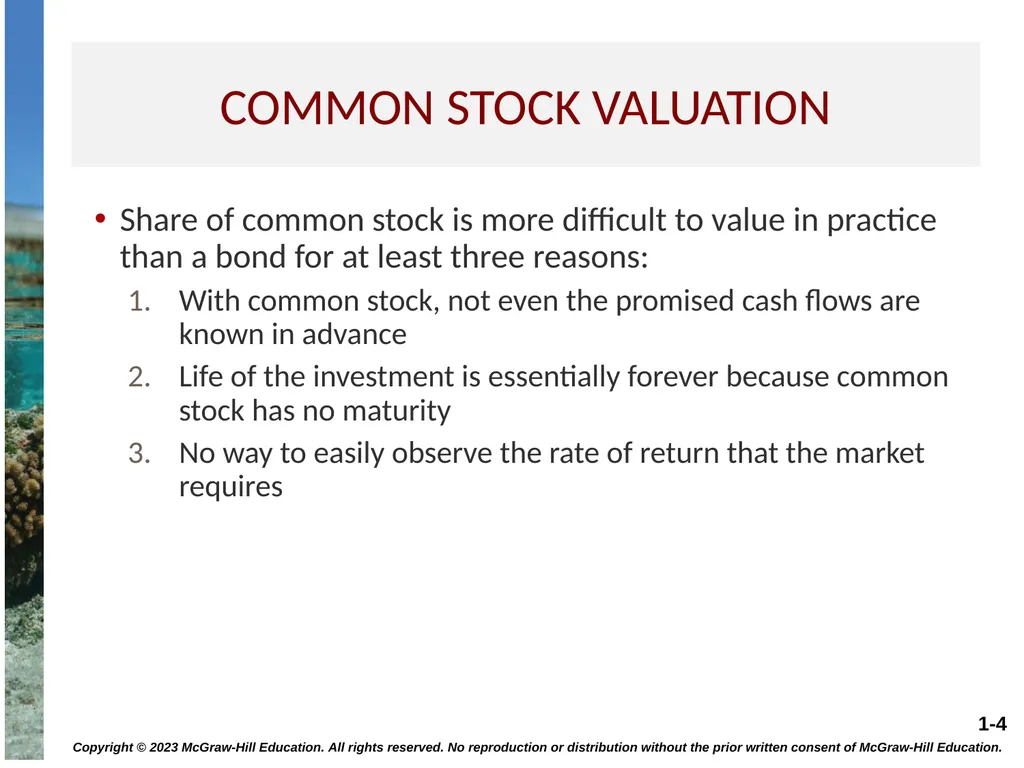
Share of common stock is more difficult to value in practice than a bond for at least three reasons:
With common stock, not even the promised cash flows are known in advance
Life of the investment is essentially forever because common stock has no maturity
No way to easily observe the rate of return that the market requires Copyright © 2023 McGraw-Hill Education. All rights reserved. No reproduction or distribution without the prior written consent of McGraw-Hill Education. Common stock valuation<br>
With common stock, not even the promised cash flows are known in advance
Life of the investment is essentially forever because common stock has no maturity
No way to easily observe the rate of return that the market requires Copyright © 2023 McGraw-Hill Education. All rights reserved. No reproduction or distribution without the prior written consent of McGraw-Hill Education. Common stock valuation<br>
05
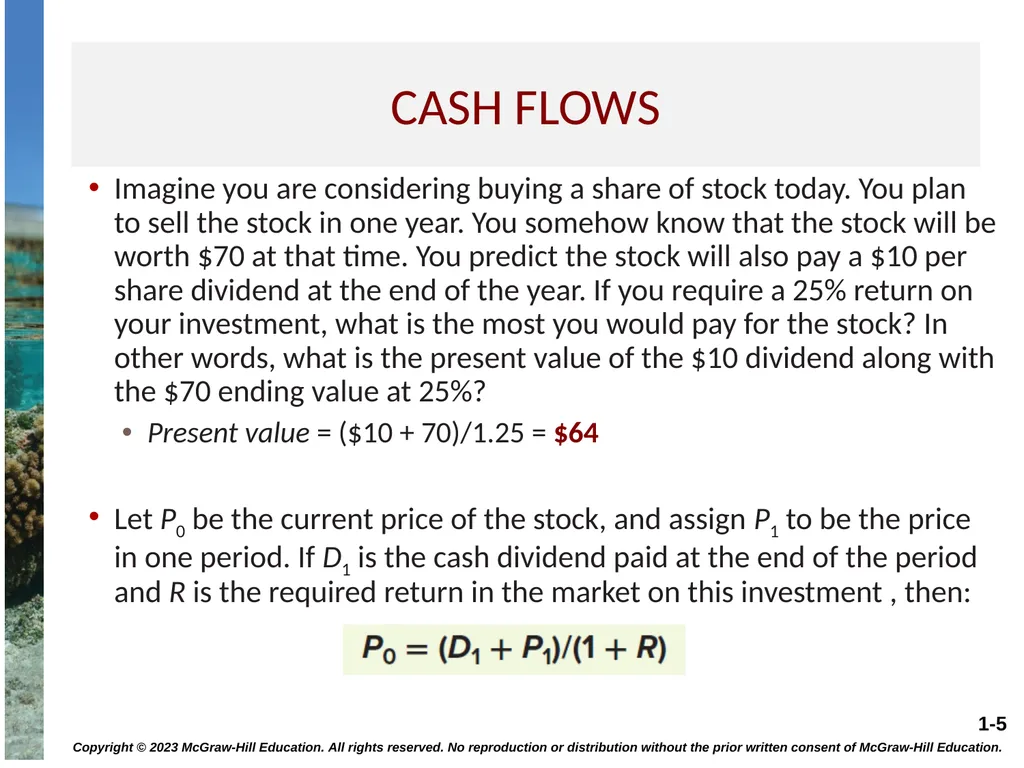
Imagine you are considering buying a share of stock today. You plan to sell the stock in one year. You somehow know that the stock will be worth $70 at that time. You predict the stock will also pay a $10 per share dividend at the end of the year. If you require a 25% return on your investment, what is the most you would pay for the stock? In other words, what is the present value of the $10 dividend along with the $70 ending value at 25%?
Present value = ($10 + 70)/1.25 = $64
Let P0 be the current price of the stock, and assign P1 to be the price in one period. If D1 is the cash dividend paid at the end of the period and R is the required return in the market on this investment , then: Copyright © 2023 McGraw-Hill Education. All rights reserved. No reproduction or distribution without the prior written consent of McGraw-Hill Education. Cash flows<br>
Present value = ($10 + 70)/1.25 = $64
Let P0 be the current price of the stock, and assign P1 to be the price in one period. If D1 is the cash dividend paid at the end of the period and R is the required return in the market on this investment , then: Copyright © 2023 McGraw-Hill Education. All rights reserved. No reproduction or distribution without the prior written consent of McGraw-Hill Education. Cash flows<br>
06
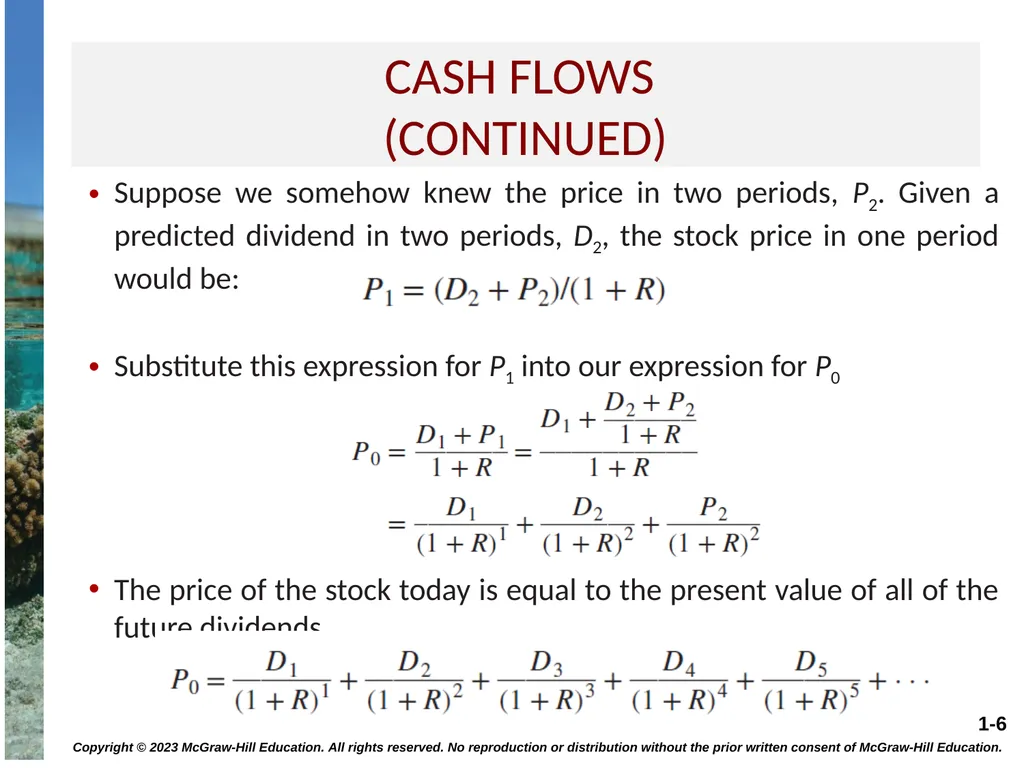
Suppose we somehow knew the price in two periods, P2. Given a predicted dividend in two periods, D2, the stock price in one period would be:
Substitute this expression for P1 into our expression for P0
The price of the stock today is equal to the present value of all of the future dividends Copyright © 2023 McGraw-Hill Education. All rights reserved. No reproduction or distribution without the prior written consent of McGraw-Hill Education. Cash flows (continued)<br>
Substitute this expression for P1 into our expression for P0
The price of the stock today is equal to the present value of all of the future dividends Copyright © 2023 McGraw-Hill Education. All rights reserved. No reproduction or distribution without the prior written consent of McGraw-Hill Education. Cash flows (continued)<br>
07
Copyright © 2023 McGraw-Hill Education. All rights reserved. No reproduction or distribution without the prior written consent of McGraw-Hill Education. Growth stocks<br>
08
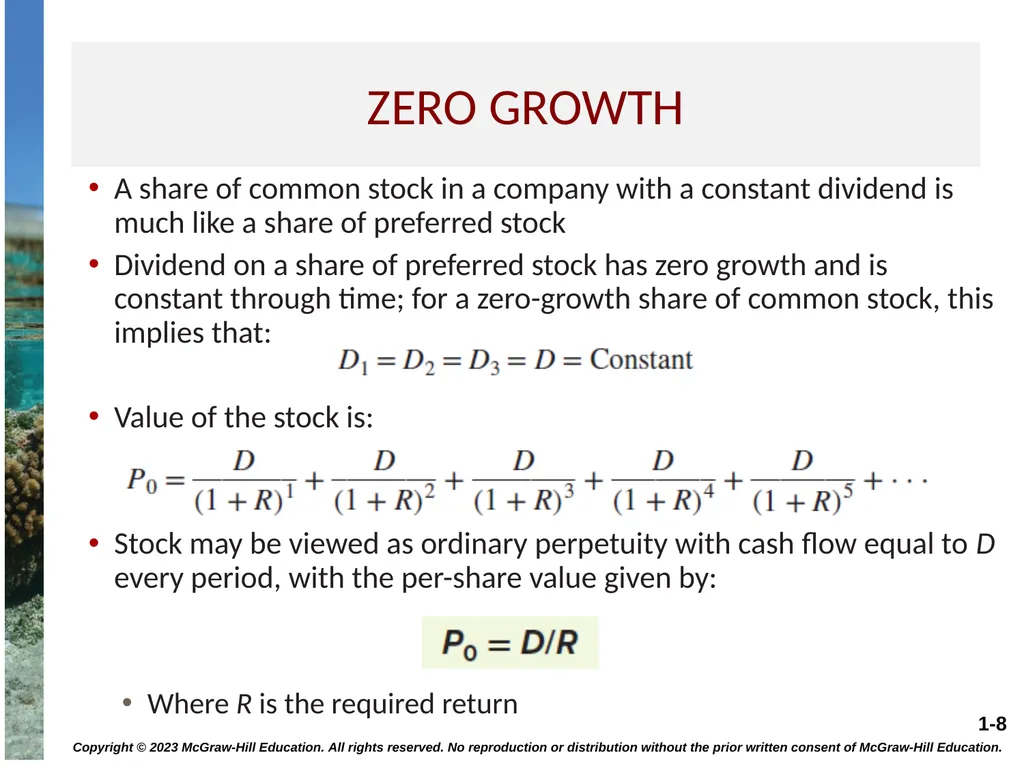
A share of common stock in a company with a constant dividend is much like a share of preferred stock
Dividend on a share of preferred stock has zero growth and is constant through time; for a zero-growth share of common stock, this implies that:
Value of the stock is:
Stock may be viewed as ordinary perpetuity with cash flow equal to D every period, with the per-share value given by:
Where R is the required return Copyright © 2023 McGraw-Hill Education. All rights reserved. No reproduction or distribution without the prior written consent of McGraw-Hill Education. Zero growth<br>
Dividend on a share of preferred stock has zero growth and is constant through time; for a zero-growth share of common stock, this implies that:
Value of the stock is:
Stock may be viewed as ordinary perpetuity with cash flow equal to D every period, with the per-share value given by:
Where R is the required return Copyright © 2023 McGraw-Hill Education. All rights reserved. No reproduction or distribution without the prior written consent of McGraw-Hill Education. Zero growth<br>
09
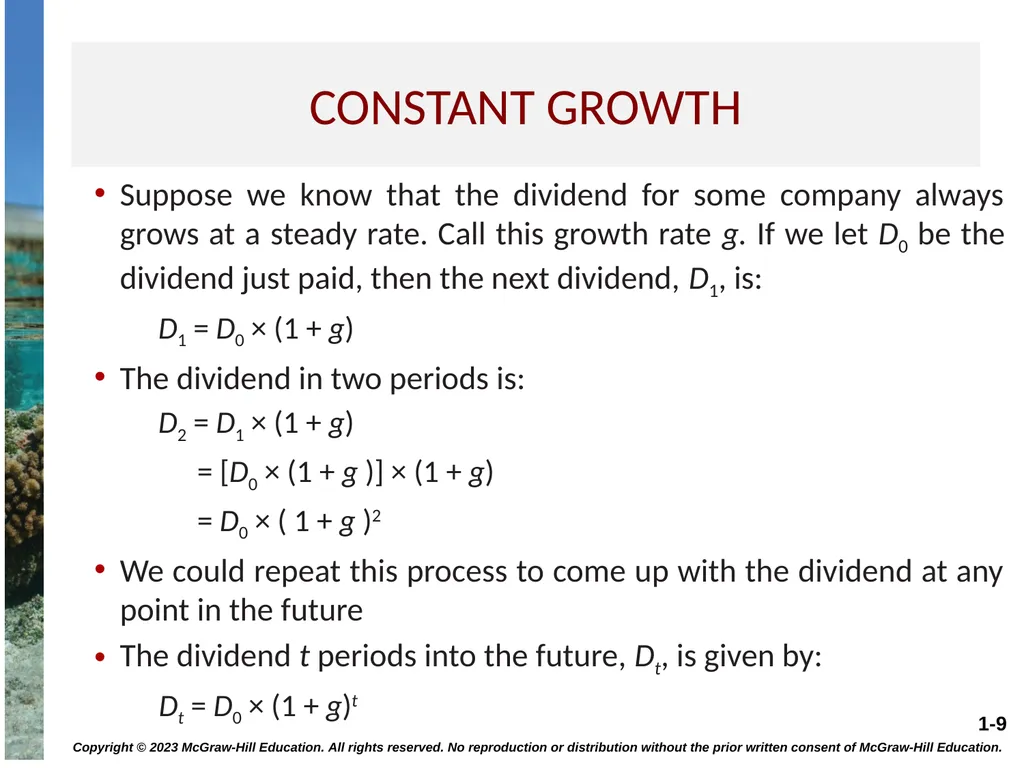
Suppose we know that the dividend for some company always grows at a steady rate. Call this growth rate g. If we let D0 be the dividend just paid, then the next dividend, D1, is:
D1 = D0 × (1 + g)
The dividend in two periods is:
D2 = D1 × (1 + g)
= [D0 × (1 + g )] × (1 + g)
= D0 × ( 1 + g )2
We could repeat this process to come up with the dividend at any point in the future
The dividend t periods into the future, Dt, is given by:
Dt = D0 × (1 + g)t Copyright © 2023 McGraw-Hill Education. All rights reserved. No reproduction or distribution without the prior written consent of McGraw-Hill Education. Constant growth<br>
D1 = D0 × (1 + g)
The dividend in two periods is:
D2 = D1 × (1 + g)
= [D0 × (1 + g )] × (1 + g)
= D0 × ( 1 + g )2
We could repeat this process to come up with the dividend at any point in the future
The dividend t periods into the future, Dt, is given by:
Dt = D0 × (1 + g)t Copyright © 2023 McGraw-Hill Education. All rights reserved. No reproduction or distribution without the prior written consent of McGraw-Hill Education. Constant growth<br>
10
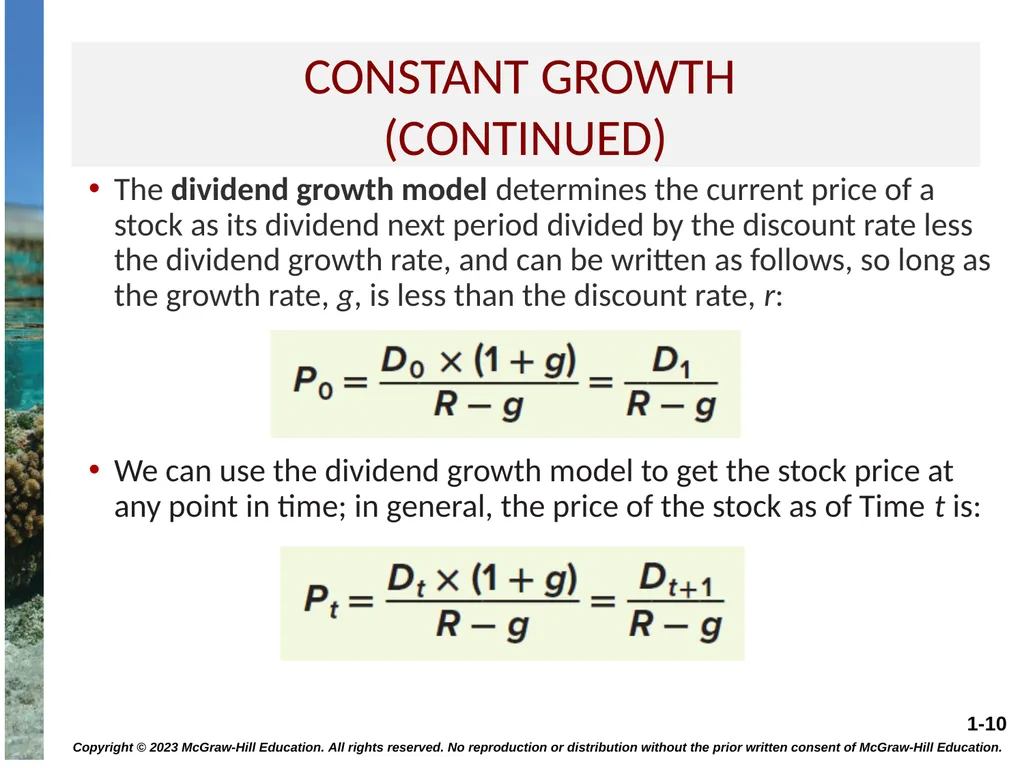
The dividend growth model determines the current price of a stock as its dividend next period divided by the discount rate less the dividend growth rate, and can be written as follows, so long as the growth rate, g, is less than the discount rate, r:
We can use the dividend growth model to get the stock price at any point in time; in general, the price of the stock as of Time t is: Copyright © 2023 McGraw-Hill Education. All rights reserved. No reproduction or distribution without the prior written consent of McGraw-Hill Education. Constant growth (continued)<br>
We can use the dividend growth model to get the stock price at any point in time; in general, the price of the stock as of Time t is: Copyright © 2023 McGraw-Hill Education. All rights reserved. No reproduction or distribution without the prior written consent of McGraw-Hill Education. Constant growth (continued)<br>
11
Suppose D0 is $2.30, R is 13%, and g is 5%. The price per share in this case is:
P0 = D0 × (1 + g)/(R − g)
= $2.30 × 1.05/(. 13 − . 05 )
= $2.415 / .08
= $30.19
Suppose we are interested in the price of the stock in five years, P5. We first need the dividend at Time 5, D5. Because the dividend just paid is $2.30 and the growth rate is 5% per year, D5 is:
D5 = $2.30 × 1.055 = $2.30 × 1.2763 = $2.935
The price of the stock in five years is: Copyright © 2023 McGraw-Hill Education. All rights reserved. No reproduction or distribution without the prior written consent of McGraw-Hill Education. Constant growth (concluded)<br>
P0 = D0 × (1 + g)/(R − g)
= $2.30 × 1.05/(. 13 − . 05 )
= $2.415 / .08
= $30.19
Suppose we are interested in the price of the stock in five years, P5. We first need the dividend at Time 5, D5. Because the dividend just paid is $2.30 and the growth rate is 5% per year, D5 is:
D5 = $2.30 × 1.055 = $2.30 × 1.2763 = $2.935
The price of the stock in five years is: Copyright © 2023 McGraw-Hill Education. All rights reserved. No reproduction or distribution without the prior written consent of McGraw-Hill Education. Constant growth (concluded)<br>
12
Main reason to consider this case is to allow for “supernormal” growth rates over some finite length of time
Require dividends start growing at a constant rate sometime in future
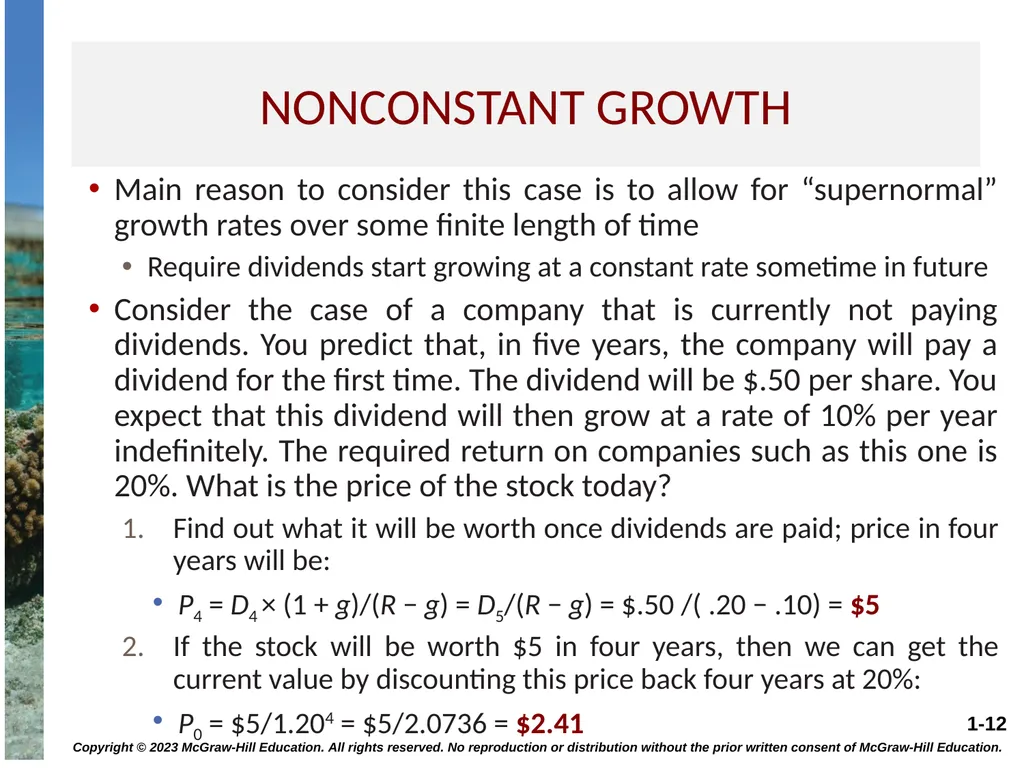
Consider the case of a company that is currently not paying dividends. You predict that, in five years, the company will pay a dividend for the first time. The dividend will be $.50 per share. You expect that this dividend will then grow at a rate of 10% per year indefinitely. The required return on companies such as this one is 20%. What is the price of the stock today?
Find out what it will be worth once dividends are paid; price in four years will be:
P4 = D4 × (1 + g)/(R − g) = D5/(R − g) = $.50 /( .20 − .10) = $5
If the stock will be worth $5 in four years, then we can get the current value by discounting this price back four years at 20%:
P0 = $5/1.204 = $5/2.0736 = $2.41 Copyright © 2023 McGraw-Hill Education. All rights reserved. No reproduction or distribution without the prior written consent of McGraw-Hill Education. Nonconstant GROWTH<br>
Require dividends start growing at a constant rate sometime in future
Consider the case of a company that is currently not paying dividends. You predict that, in five years, the company will pay a dividend for the first time. The dividend will be $.50 per share. You expect that this dividend will then grow at a rate of 10% per year indefinitely. The required return on companies such as this one is 20%. What is the price of the stock today?
Find out what it will be worth once dividends are paid; price in four years will be:
P4 = D4 × (1 + g)/(R − g) = D5/(R − g) = $.50 /( .20 − .10) = $5
If the stock will be worth $5 in four years, then we can get the current value by discounting this price back four years at 20%:
P0 = $5/1.204 = $5/2.0736 = $2.41 Copyright © 2023 McGraw-Hill Education. All rights reserved. No reproduction or distribution without the prior written consent of McGraw-Hill Education. Nonconstant GROWTH<br>
13
Suppose you have come up with the following dividend forecasts for the next three years. After the third year, the dividend will grow at a constant rate of 5% per year. The required return is 10%. What is the value of the stock today?
In dealing with nonconstant growth, a time line can be helpful Copyright © 2023 McGraw-Hill Education. All rights reserved. No reproduction or distribution without the prior written consent of McGraw-Hill Education. Nonconstant GROWTH (continued)<br>
In dealing with nonconstant growth, a time line can be helpful Copyright © 2023 McGraw-Hill Education. All rights reserved. No reproduction or distribution without the prior written consent of McGraw-Hill Education. Nonconstant GROWTH (continued)<br>
14
Value of the stock is the present value of all the future dividends:
Compute the PV of the stock price three years down the road
Add in the PV of dividends that will be paid between now and then Copyright © 2023 McGraw-Hill Education. All rights reserved. No reproduction or distribution without the prior written consent of McGraw-Hill Education. Nonconstant GROWTH (Concluded)<br>
Compute the PV of the stock price three years down the road
Add in the PV of dividends that will be paid between now and then Copyright © 2023 McGraw-Hill Education. All rights reserved. No reproduction or distribution without the prior written consent of McGraw-Hill Education. Nonconstant GROWTH (Concluded)<br>
15
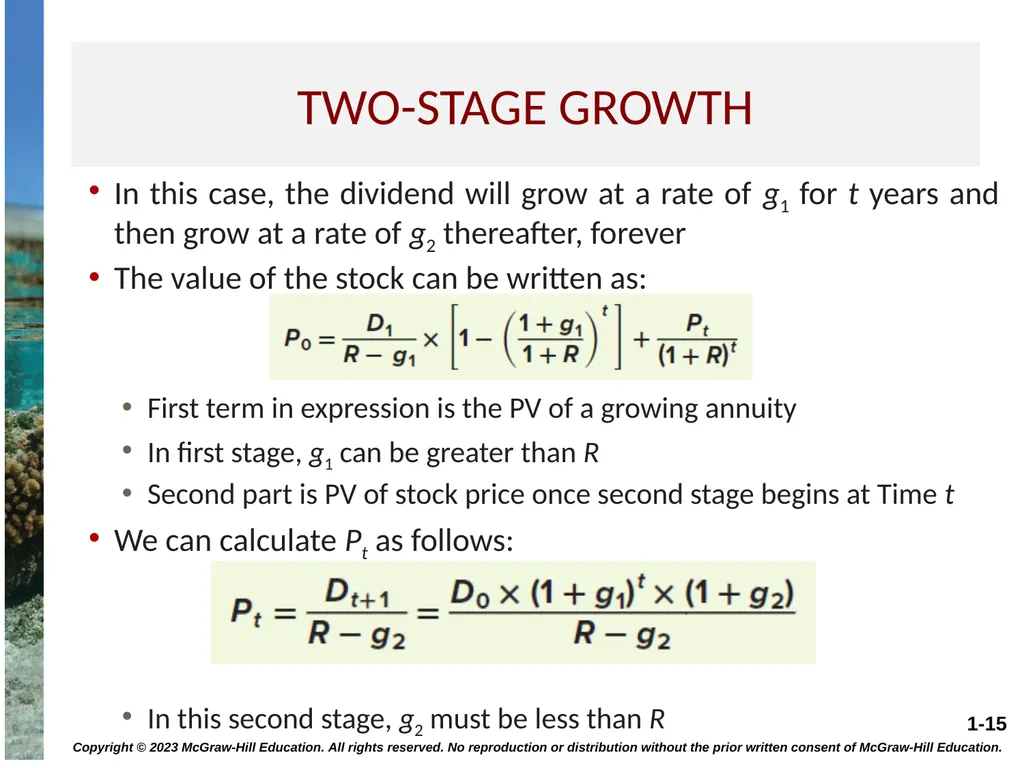
In this case, the dividend will grow at a rate of g1 for t years and then grow at a rate of g2 thereafter, forever
The value of the stock can be written as:
First term in expression is the PV of a growing annuity
In first stage, g1 can be greater than R
Second part is PV of stock price once second stage begins at Time t
We can calculate Pt as follows:
In this second stage, g2 must be less than R Copyright © 2023 McGraw-Hill Education. All rights reserved. No reproduction or distribution without the prior written consent of McGraw-Hill Education. Two-stage growth<br>
The value of the stock can be written as:
First term in expression is the PV of a growing annuity
In first stage, g1 can be greater than R
Second part is PV of stock price once second stage begins at Time t
We can calculate Pt as follows:
In this second stage, g2 must be less than R Copyright © 2023 McGraw-Hill Education. All rights reserved. No reproduction or distribution without the prior written consent of McGraw-Hill Education. Two-stage growth<br>
16
Copyright © 2023 McGraw-Hill Education. All rights reserved. No reproduction or distribution without the prior written consent of McGraw-Hill Education. Two-stage growth: an example<br>
17
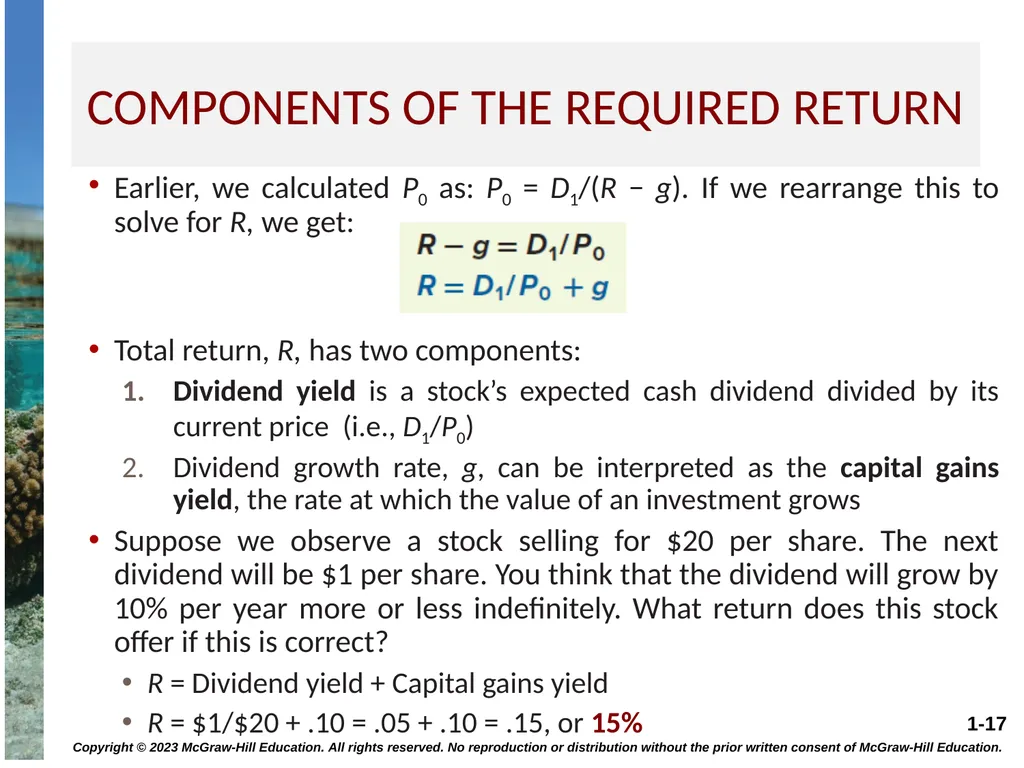
Earlier, we calculated P0 as: P0 = D1/(R − g). If we rearrange this to solve for R, we get:
Total return, R, has two components:
Dividend yield is a stock’s expected cash dividend divided by its current price (i.e., D1/P0)
Dividend growth rate, g, can be interpreted as the capital gains yield, the rate at which the value of an investment grows
Suppose we observe a stock selling for $20 per share. The next dividend will be $1 per share. You think that the dividend will grow by 10% per year more or less indefinitely. What return does this stock offer if this is correct?
R = Dividend yield + Capital gains yield
R = $1/$20 + .10 = .05 + .10 = .15, or 15% Copyright © 2023 McGraw-Hill Education. All rights reserved. No reproduction or distribution without the prior written consent of McGraw-Hill Education. Components of the required return<br>
Total return, R, has two components:
Dividend yield is a stock’s expected cash dividend divided by its current price (i.e., D1/P0)
Dividend growth rate, g, can be interpreted as the capital gains yield, the rate at which the value of an investment grows
Suppose we observe a stock selling for $20 per share. The next dividend will be $1 per share. You think that the dividend will grow by 10% per year more or less indefinitely. What return does this stock offer if this is correct?
R = Dividend yield + Capital gains yield
R = $1/$20 + .10 = .05 + .10 = .15, or 15% Copyright © 2023 McGraw-Hill Education. All rights reserved. No reproduction or distribution without the prior written consent of McGraw-Hill Education. Components of the required return<br>
18
Obvious problem with dividend-based approach to stock valuation is that many companies don’t pay dividends
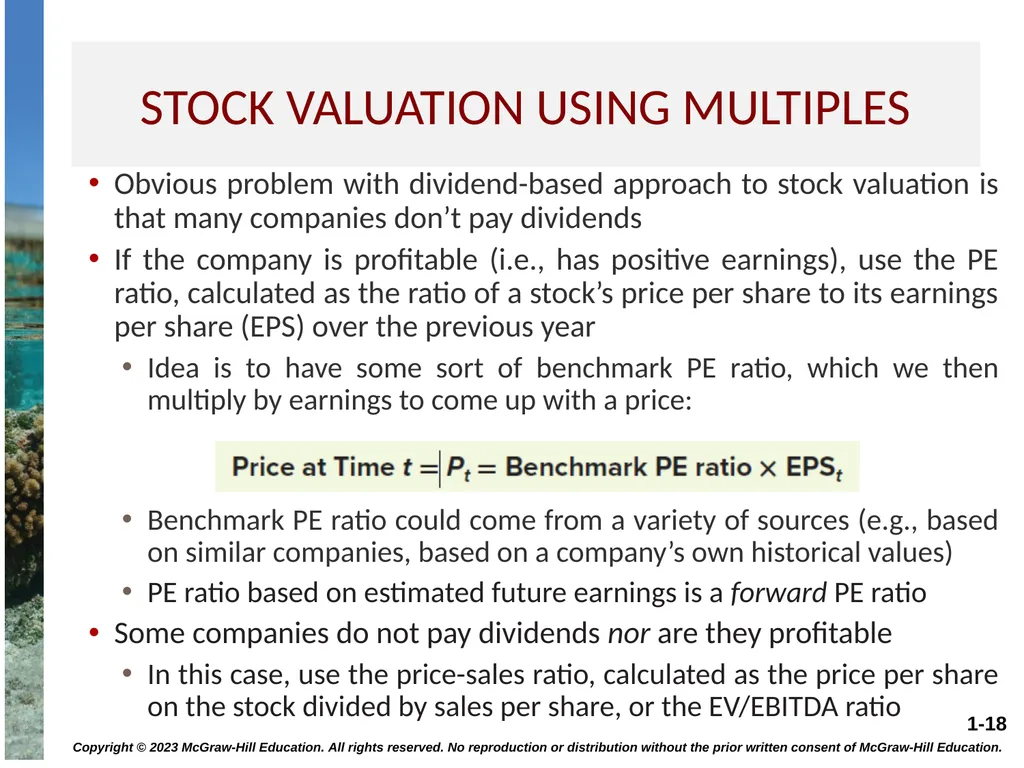
If the company is profitable (i.e., has positive earnings), use the PE ratio, calculated as the ratio of a stock’s price per share to its earnings per share (EPS) over the previous year
Idea is to have some sort of benchmark PE ratio, which we then multiply by earnings to come up with a price:
Benchmark PE ratio could come from a variety of sources (e.g., based on similar companies, based on a company’s own historical values)
PE ratio based on estimated future earnings is a forward PE ratio
Some companies do not pay dividends nor are they profitable
In this case, use the price-sales ratio, calculated as the price per share on the stock divided by sales per share, or the EV/EBITDA ratio Copyright © 2023 McGraw-Hill Education. All rights reserved. No reproduction or distribution without the prior written consent of McGraw-Hill Education. Stock valuation using multiples<br>
If the company is profitable (i.e., has positive earnings), use the PE ratio, calculated as the ratio of a stock’s price per share to its earnings per share (EPS) over the previous year
Idea is to have some sort of benchmark PE ratio, which we then multiply by earnings to come up with a price:
Benchmark PE ratio could come from a variety of sources (e.g., based on similar companies, based on a company’s own historical values)
PE ratio based on estimated future earnings is a forward PE ratio
Some companies do not pay dividends nor are they profitable
In this case, use the price-sales ratio, calculated as the price per share on the stock divided by sales per share, or the EV/EBITDA ratio Copyright © 2023 McGraw-Hill Education. All rights reserved. No reproduction or distribution without the prior written consent of McGraw-Hill Education. Stock valuation using multiples<br>
19
Copyright © 2023 McGraw-Hill Education. All rights reserved. No reproduction or distribution without the prior written consent of McGraw-Hill Education. PE, PS, AND EV/EBITDA RATIOS FOR VARIOUS INDUSTRIES<br>
20
Copyright © 2023 McGraw-Hill Education. All rights reserved. No reproduction or distribution without the prior written consent of McGraw-Hill Education. SUMMARY OF STOCK VALUATION<br>
21
Common stock is equity without priority for dividends or in bankruptcy
Shareholders elect directors who, in turn, hire managers to carry out their directives
Directors are elected each year at an annual meeting by a vote of the holders of a majority of shares who are present and entitled to vote
In cumulative voting, a shareholder may cast all votes for one member of the board of directors; all directors are elected at once
In straight voting, a shareholder may cast all votes for each member of the board of directors; directors are elected one at a time
Many companies have staggered elections for directors (i.e., classified boards), but several have been pressured to declassify
Staggering has two basic effects:
Makes it more difficult for a minority to elect a director
Makes takeover attempts less likely to be successful Copyright © 2023 McGraw-Hill Education. All rights reserved. No reproduction or distribution without the prior written consent of McGraw-Hill Education. Common stock features: shareholder rights<br>
Shareholders elect directors who, in turn, hire managers to carry out their directives
Directors are elected each year at an annual meeting by a vote of the holders of a majority of shares who are present and entitled to vote
In cumulative voting, a shareholder may cast all votes for one member of the board of directors; all directors are elected at once
In straight voting, a shareholder may cast all votes for each member of the board of directors; directors are elected one at a time
Many companies have staggered elections for directors (i.e., classified boards), but several have been pressured to declassify
Staggering has two basic effects:
Makes it more difficult for a minority to elect a director
Makes takeover attempts less likely to be successful Copyright © 2023 McGraw-Hill Education. All rights reserved. No reproduction or distribution without the prior written consent of McGraw-Hill Education. Common stock features: shareholder rights<br>
22
A proxy is a grant of authority by a shareholder allowing another individual to vote his or her shares
Shareholders can come to the annual meeting and vote in person, or they can transfer their right to vote to another party
Most voting in large public corporations is done by proxy
If shareholders are not satisfied with management, an “outside” group of shareholders can try to obtain votes via proxy, with the resulting battle called a proxy fight
Some firms have more than one class of common stock
E.g., Ford Motor Company has Class B common stock, which is not publicly traded
Primary reason for creating dual or multiple classes of stock has to do with control of the firm
If multiple classes exist, management can raise equity capital by issuing nonvoting or limited-voting stock while maintaining control Copyright © 2023 McGraw-Hill Education. All rights reserved. No reproduction or distribution without the prior written consent of McGraw-Hill Education. Common stock features: proxy voting and stock classes<br>
Shareholders can come to the annual meeting and vote in person, or they can transfer their right to vote to another party
Most voting in large public corporations is done by proxy
If shareholders are not satisfied with management, an “outside” group of shareholders can try to obtain votes via proxy, with the resulting battle called a proxy fight
Some firms have more than one class of common stock
E.g., Ford Motor Company has Class B common stock, which is not publicly traded
Primary reason for creating dual or multiple classes of stock has to do with control of the firm
If multiple classes exist, management can raise equity capital by issuing nonvoting or limited-voting stock while maintaining control Copyright © 2023 McGraw-Hill Education. All rights reserved. No reproduction or distribution without the prior written consent of McGraw-Hill Education. Common stock features: proxy voting and stock classes<br>
23
In addition to the right to vote for directors, shareholders usually have the following rights:
Right to share proportionally in dividends paid
Right to share proportionally in assets remaining after liabilities have been paid in a liquidation
Right to vote on stockholder matters of great importance (e.g., a merger), with voting usually done at the annual meeting or a special meeting
Stockholders sometimes have a preemptive right, the right to share proportionally in any new stock sold
Purpose is to give stockholders the opportunity to protect their proportionate ownership in the corporation
Company that wishes to sell stock must first offer it to the existing stockholders before offering it to the general public Copyright © 2023 McGraw-Hill Education. All rights reserved. No reproduction or distribution without the prior written consent of McGraw-Hill Education. Common stock features: other rights<br>
Right to share proportionally in dividends paid
Right to share proportionally in assets remaining after liabilities have been paid in a liquidation
Right to vote on stockholder matters of great importance (e.g., a merger), with voting usually done at the annual meeting or a special meeting
Stockholders sometimes have a preemptive right, the right to share proportionally in any new stock sold
Purpose is to give stockholders the opportunity to protect their proportionate ownership in the corporation
Company that wishes to sell stock must first offer it to the existing stockholders before offering it to the general public Copyright © 2023 McGraw-Hill Education. All rights reserved. No reproduction or distribution without the prior written consent of McGraw-Hill Education. Common stock features: other rights<br>
24
Distinctive feature of corporations is that they have shares of stock on which they are authorized by law to pay dividends to their shareholders
Dividends are payments by a corporation to shareholders, made in either cash or stock
Payment of dividends is at discretion of the board of directors
Important characteristics of dividends include the following:
Unless a dividend is declared by the board of directors of a corporation, it is not a liability of the corporation. A corporation cannot default on an undeclared dividend. Therefore, corporations cannot become bankrupt because of nonpayment of dividends.
Payment of dividends by the corporation is not a business expense. Dividends are not deductible for corporate tax purposes.
Dividends received by individual shareholders are taxable. In 2020, the tax rate was 15 to 20 percent. Copyright © 2023 McGraw-Hill Education. All rights reserved. No reproduction or distribution without the prior written consent of McGraw-Hill Education. Common stock features: dividends<br>
Dividends are payments by a corporation to shareholders, made in either cash or stock
Payment of dividends is at discretion of the board of directors
Important characteristics of dividends include the following:
Unless a dividend is declared by the board of directors of a corporation, it is not a liability of the corporation. A corporation cannot default on an undeclared dividend. Therefore, corporations cannot become bankrupt because of nonpayment of dividends.
Payment of dividends by the corporation is not a business expense. Dividends are not deductible for corporate tax purposes.
Dividends received by individual shareholders are taxable. In 2020, the tax rate was 15 to 20 percent. Copyright © 2023 McGraw-Hill Education. All rights reserved. No reproduction or distribution without the prior written consent of McGraw-Hill Education. Common stock features: dividends<br>
25
Preferred stock has dividend priority over common stock, normally with a fixed dividend rate, sometimes without voting rights
Preferred shares have a stated liquidating value, usually $100 per share, with the cash dividend described in terms of dollars per share
“$5 preferred” translates into a dividend yield of 5% of stated value
Preferred dividend is not like interest on a bond
Board of directors may decide not to pay dividends on preferred share, (which may have nothing to do with the current net income of the corporation), in which case:
Common shareholders must also forgo dividends
Holders of preferred shares are often granted voting and other rights if preferred dividends have not been paid for some time
Dividends payable on preferred stock are either cumulative or noncumulative, though most are cumulative
Unpaid preferred dividends are not debts of the firm Copyright © 2023 McGraw-Hill Education. All rights reserved. No reproduction or distribution without the prior written consent of McGraw-Hill Education. preferred stock features: stated value and dividends<br>
Preferred shares have a stated liquidating value, usually $100 per share, with the cash dividend described in terms of dollars per share
“$5 preferred” translates into a dividend yield of 5% of stated value
Preferred dividend is not like interest on a bond
Board of directors may decide not to pay dividends on preferred share, (which may have nothing to do with the current net income of the corporation), in which case:
Common shareholders must also forgo dividends
Holders of preferred shares are often granted voting and other rights if preferred dividends have not been paid for some time
Dividends payable on preferred stock are either cumulative or noncumulative, though most are cumulative
Unpaid preferred dividends are not debts of the firm Copyright © 2023 McGraw-Hill Education. All rights reserved. No reproduction or distribution without the prior written consent of McGraw-Hill Education. preferred stock features: stated value and dividends<br>
26
Good case can be made that preferred stock is really debt in disguise, a kind of equity bond, for the following reasons:
Preferred shareholders receive a stated dividend only
If corporation is liquidated, preferred shareholders get a stated value
Preferred stocks often carry credit ratings much like those of bonds
Preferred stock is sometimes convertible into common stock
Preferred stocks are often callable
Many issues of preferred stock have obligatory sinking funds, effectively creating a final maturity
In the 1990s, firms began to sell securities that looked a lot like preferred stocks but were treated as debt for tax purposes, making the interest payments tax deductible
Until 2003, interest payments and dividends were taxed at the same marginal tax rate; when the tax rate on dividend payments was reduced, these instruments were not included Copyright © 2023 McGraw-Hill Education. All rights reserved. No reproduction or distribution without the prior written consent of McGraw-Hill Education. preferred stock features: is preferred stock really debt?<br>
Preferred shareholders receive a stated dividend only
If corporation is liquidated, preferred shareholders get a stated value
Preferred stocks often carry credit ratings much like those of bonds
Preferred stock is sometimes convertible into common stock
Preferred stocks are often callable
Many issues of preferred stock have obligatory sinking funds, effectively creating a final maturity
In the 1990s, firms began to sell securities that looked a lot like preferred stocks but were treated as debt for tax purposes, making the interest payments tax deductible
Until 2003, interest payments and dividends were taxed at the same marginal tax rate; when the tax rate on dividend payments was reduced, these instruments were not included Copyright © 2023 McGraw-Hill Education. All rights reserved. No reproduction or distribution without the prior written consent of McGraw-Hill Education. preferred stock features: is preferred stock really debt?<br>
27
Recall the stock market consists of a primary and secondary market
Most securities transactions involve dealers and brokers
Dealer is an agent who buys and sells securities from inventory
Stands ready to buy securities from investors wishing to sell them and sell securities to investors wishing to buy them
The price the dealer is willing to pay is called the bid price
The price at which the dealer will sell is called the ask price (i.e., asked, offered, or offering price)
Difference between the bid and ask prices is the spread, the basic source of dealer profits
Broker is an agent who arranges security transactions among investors
Does not buy or sell securities for their own accounts, but rather facilitates trades by others Copyright © 2023 McGraw-Hill Education. All rights reserved. No reproduction or distribution without the prior written consent of McGraw-Hill Education. The stock markets: dealers and brokers<br>
Most securities transactions involve dealers and brokers
Dealer is an agent who buys and sells securities from inventory
Stands ready to buy securities from investors wishing to sell them and sell securities to investors wishing to buy them
The price the dealer is willing to pay is called the bid price
The price at which the dealer will sell is called the ask price (i.e., asked, offered, or offering price)
Difference between the bid and ask prices is the spread, the basic source of dealer profits
Broker is an agent who arranges security transactions among investors
Does not buy or sell securities for their own accounts, but rather facilitates trades by others Copyright © 2023 McGraw-Hill Education. All rights reserved. No reproduction or distribution without the prior written consent of McGraw-Hill Education. The stock markets: dealers and brokers<br>
28
As of 2006, a member is the owner of a trading license on the NYSE
NYSE has 1,366 exchange members
Prior to 2006, exchange members owned “seats” on the exchange, and collectively the members were also the owners
Seat prices reached a record $4 million in 2005
NYSE became a publicly owned corporation in 2006
Instead of purchasing seats, exchange members were required to purchase trading licenses, which entitle you to buy and sell securities on the floor of the exchange
In 2007, NYSE merged with Euronext to form NYSE Euronext, becoming the world’s “first global exchange”
In 2008, NYSE Euronext merged with the American Stock Exchange
In 2013, Intercontinental Exchange (ICE) acquired the NYSE
NYSE is a hybrid market, with trading taking place both electronically and face-to-face Copyright © 2023 McGraw-Hill Education. All rights reserved. No reproduction or distribution without the prior written consent of McGraw-Hill Education. Organization of the nyse: members<br>
NYSE has 1,366 exchange members
Prior to 2006, exchange members owned “seats” on the exchange, and collectively the members were also the owners
Seat prices reached a record $4 million in 2005
NYSE became a publicly owned corporation in 2006
Instead of purchasing seats, exchange members were required to purchase trading licenses, which entitle you to buy and sell securities on the floor of the exchange
In 2007, NYSE merged with Euronext to form NYSE Euronext, becoming the world’s “first global exchange”
In 2008, NYSE Euronext merged with the American Stock Exchange
In 2013, Intercontinental Exchange (ICE) acquired the NYSE
NYSE is a hybrid market, with trading taking place both electronically and face-to-face Copyright © 2023 McGraw-Hill Education. All rights reserved. No reproduction or distribution without the prior written consent of McGraw-Hill Education. Organization of the nyse: members<br>
29
With electronic trading, orders to buy and orders to sell are submitted to the exchange
Orders are compared by a computer and whenever there is a match, the orders are executed with no human intervention
Most trades on the NYSE occur this way
For orders that are not handled electronically, the NYSE relies on its three types of license holders:
Designated market makers (DMMs) are NYSE members who act as dealers in particular stocks; formerly known as “specialists”
Floor brokers are NYSE members who execute customer buy and sell orders
Supplemental liquidity providers (SLPs) are investment firms that are active participants in stocks assigned to them
Their job is to make a one-sided market (i.e., offering to either buy or sell), and they trade purely for their own accounts Copyright © 2023 McGraw-Hill Education. All rights reserved. No reproduction or distribution without the prior written consent of McGraw-Hill Education. Organization of the nyse: members (continued)<br>
Orders are compared by a computer and whenever there is a match, the orders are executed with no human intervention
Most trades on the NYSE occur this way
For orders that are not handled electronically, the NYSE relies on its three types of license holders:
Designated market makers (DMMs) are NYSE members who act as dealers in particular stocks; formerly known as “specialists”
Floor brokers are NYSE members who execute customer buy and sell orders
Supplemental liquidity providers (SLPs) are investment firms that are active participants in stocks assigned to them
Their job is to make a one-sided market (i.e., offering to either buy or sell), and they trade purely for their own accounts Copyright © 2023 McGraw-Hill Education. All rights reserved. No reproduction or distribution without the prior written consent of McGraw-Hill Education. Organization of the nyse: members (continued)<br>
30
How does trading take place?
DDM’s post is a fixed place on the exchange floor where the DMM operates
DMMs normally operate in front of their posts to monitor and manage trading in the stocks assigned to them
Floor brokers move between the many workstations lining the walls of the exchange and the exchange floor
They are receiving customer orders, walking to DMMs’ posts where the orders can be executed, and returning to confirm order executions and receive new customer orders
For a very actively traded stock, there may be many buyers and sellers around the DMM’s post, and most of the trading will be done directly between brokers (i.e., trading in the “crowd”)
DMM’s responsibility is to maintain order and to make sure that all buyers and sellers receive a fair price Copyright © 2023 McGraw-Hill Education. All rights reserved. No reproduction or distribution without the prior written consent of McGraw-Hill Education. Organization of the nyse: floor activity<br>
DDM’s post is a fixed place on the exchange floor where the DMM operates
DMMs normally operate in front of their posts to monitor and manage trading in the stocks assigned to them
Floor brokers move between the many workstations lining the walls of the exchange and the exchange floor
They are receiving customer orders, walking to DMMs’ posts where the orders can be executed, and returning to confirm order executions and receive new customer orders
For a very actively traded stock, there may be many buyers and sellers around the DMM’s post, and most of the trading will be done directly between brokers (i.e., trading in the “crowd”)
DMM’s responsibility is to maintain order and to make sure that all buyers and sellers receive a fair price Copyright © 2023 McGraw-Hill Education. All rights reserved. No reproduction or distribution without the prior written consent of McGraw-Hill Education. Organization of the nyse: floor activity<br>
31
Introduced in 1971, the Nasdaq market is a computer network of securities dealers and others that disseminates timely security price quotes to computer screens worldwide
Second largest stock market in the U.S.
Nasdaq dealers act as market makers for securities listed on Nasdaq, posting bid and ask prices at which they accept sell and buy orders
Nasdaq market makers trade on an inventory basis, using their inventory as a buffer to absorb buy and sell order imbalances
Nasdaq features multiple market makers for actively traded stocks
Two key differences between the NYSE and Nasdaq:
Nasdaq is a computer network and has no physical location where trading takes place
Nasdaq has a multiple market maker system rather than a DMM system Copyright © 2023 McGraw-Hill Education. All rights reserved. No reproduction or distribution without the prior written consent of McGraw-Hill Education. Nasdaq operations<br>
Second largest stock market in the U.S.
Nasdaq dealers act as market makers for securities listed on Nasdaq, posting bid and ask prices at which they accept sell and buy orders
Nasdaq market makers trade on an inventory basis, using their inventory as a buffer to absorb buy and sell order imbalances
Nasdaq features multiple market makers for actively traded stocks
Two key differences between the NYSE and Nasdaq:
Nasdaq is a computer network and has no physical location where trading takes place
Nasdaq has a multiple market maker system rather than a DMM system Copyright © 2023 McGraw-Hill Education. All rights reserved. No reproduction or distribution without the prior written consent of McGraw-Hill Education. Nasdaq operations<br>
32
Nasdaq is often referred to as an OTC market, but Nasdaq officials prefer the term OTC not be used when referring to Nasdaq market
Over-the-counter (OTC) market is a securities market in which trading is almost exclusively done through dealers who buy and sell for their own inventories
Nasdaq network operates with three levels of information access:
Level 1 is designed to provide a timely, accurate source of price quotations, with prices freely available over the internet
Level 2 allows users to view price quotes from all Nasdaq market makers, and is not available on the web (sometimes for a small fee)
Allows access to inside quotes, the highest bid quotes and the lowest ask quotes for a security
Level 3 is for the use of market makers only, as it allows Nasdaq dealers to enter or change their price quote information Copyright © 2023 McGraw-Hill Education. All rights reserved. No reproduction or distribution without the prior written consent of McGraw-Hill Education. Nasdaq operations (continued)<br>
Over-the-counter (OTC) market is a securities market in which trading is almost exclusively done through dealers who buy and sell for their own inventories
Nasdaq network operates with three levels of information access:
Level 1 is designed to provide a timely, accurate source of price quotations, with prices freely available over the internet
Level 2 allows users to view price quotes from all Nasdaq market makers, and is not available on the web (sometimes for a small fee)
Allows access to inside quotes, the highest bid quotes and the lowest ask quotes for a security
Level 3 is for the use of market makers only, as it allows Nasdaq dealers to enter or change their price quote information Copyright © 2023 McGraw-Hill Education. All rights reserved. No reproduction or distribution without the prior written consent of McGraw-Hill Education. Nasdaq operations (continued)<br>
33
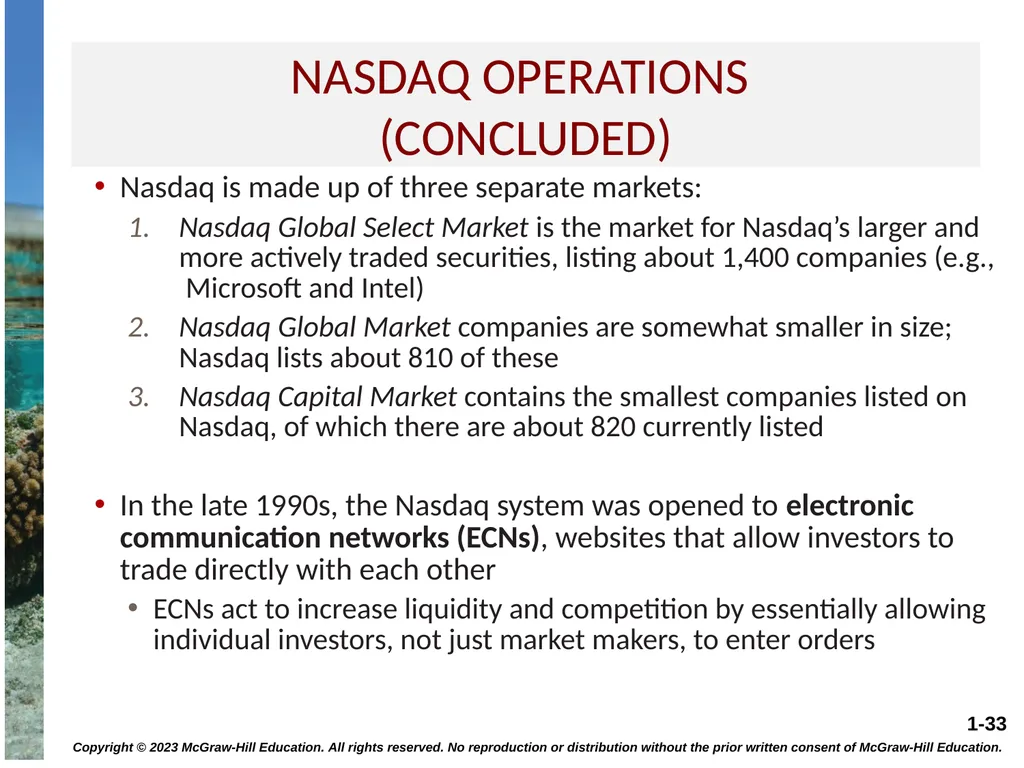
Nasdaq is made up of three separate markets:
Nasdaq Global Select Market is the market for Nasdaq’s larger and more actively traded securities, listing about 1,400 companies (e.g., Microsoft and Intel)
Nasdaq Global Market companies are somewhat smaller in size; Nasdaq lists about 810 of these
Nasdaq Capital Market contains the smallest companies listed on Nasdaq, of which there are about 820 currently listed
In the late 1990s, the Nasdaq system was opened to electronic communication networks (ECNs), websites that allow investors to trade directly with each other
ECNs act to increase liquidity and competition by essentially allowing individual investors, not just market makers, to enter orders Copyright © 2023 McGraw-Hill Education. All rights reserved. No reproduction or distribution without the prior written consent of McGraw-Hill Education. Nasdaq operations (concluded)<br>
Nasdaq Global Select Market is the market for Nasdaq’s larger and more actively traded securities, listing about 1,400 companies (e.g., Microsoft and Intel)
Nasdaq Global Market companies are somewhat smaller in size; Nasdaq lists about 810 of these
Nasdaq Capital Market contains the smallest companies listed on Nasdaq, of which there are about 820 currently listed
In the late 1990s, the Nasdaq system was opened to electronic communication networks (ECNs), websites that allow investors to trade directly with each other
ECNs act to increase liquidity and competition by essentially allowing individual investors, not just market makers, to enter orders Copyright © 2023 McGraw-Hill Education. All rights reserved. No reproduction or distribution without the prior written consent of McGraw-Hill Education. Nasdaq operations (concluded)<br>
34
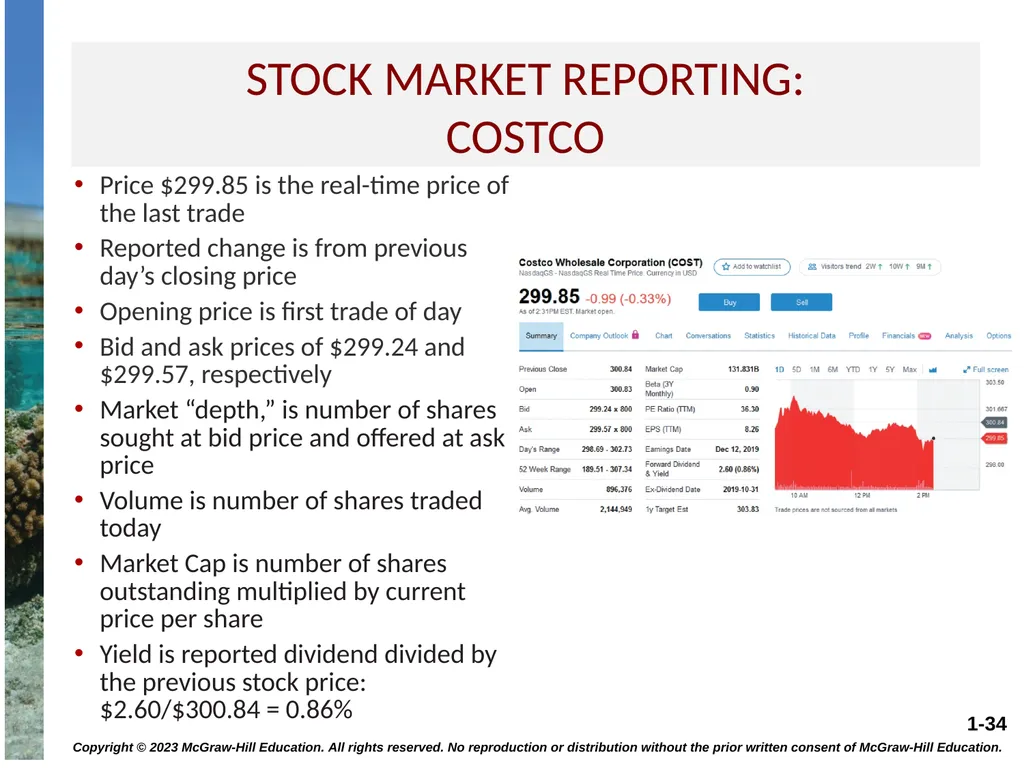
Price $299.85 is the real-time price of the last trade
Reported change is from previous day’s closing price
Opening price is first trade of day
Bid and ask prices of $299.24 and $299.57, respectively
Market “depth,” is number of shares sought at bid price and offered at ask price
Volume is number of shares traded today
Market Cap is number of shares outstanding multiplied by current price per share
Yield is reported dividend divided by the previous stock price: $2.60/$300.84 = 0.86% Copyright © 2023 McGraw-Hill Education. All rights reserved. No reproduction or distribution without the prior written consent of McGraw-Hill Education. Stock market reporting: costco<br>
Reported change is from previous day’s closing price
Opening price is first trade of day
Bid and ask prices of $299.24 and $299.57, respectively
Market “depth,” is number of shares sought at bid price and offered at ask price
Volume is number of shares traded today
Market Cap is number of shares outstanding multiplied by current price per share
Yield is reported dividend divided by the previous stock price: $2.60/$300.84 = 0.86% Copyright © 2023 McGraw-Hill Education. All rights reserved. No reproduction or distribution without the prior written consent of McGraw-Hill Education. Stock market reporting: costco<br>
35
Does the value of a share of stock depend on how long you expect to keep it?
What is the value of a share of stock when the dividend grows at a constant rate?
What is a proxy?
What rights to stockholders have?
What is the difference between a securities broker and a securities dealer?
How does Nasdaq differ from the NSYE? Copyright © 2023 McGraw-Hill Education. All rights reserved. No reproduction or distribution without the prior written consent of McGraw-Hill Education. Selected concept questions<br>
What is the value of a share of stock when the dividend grows at a constant rate?
What is a proxy?
What rights to stockholders have?
What is the difference between a securities broker and a securities dealer?
How does Nasdaq differ from the NSYE? Copyright © 2023 McGraw-Hill Education. All rights reserved. No reproduction or distribution without the prior written consent of McGraw-Hill Education. Selected concept questions<br>
36
End of Chapter Chapter 8 Copyright © 2023 McGraw-Hill Education. All rights reserved. No reproduction or distribution without the prior written consent of McGraw-Hill Education.<br>