04
Academic Background PhD in Psychology (2005)
NRSA-funded post-doctoral fellow (2005-2008)
Assistant Professor (2008-2014)
Fundamental Interest: Understanding neural and computational mechanisms underlying higher cognition<br>
05
Transitions… Personally, I was not good at setting boundaries
When I was doing work, I was worried about being a good father and husband
When I was at home, I was worried about supporting students and helping colleagues Question: Would I be happy performing the role of a faculty member for the next 15 years? Answer: I no longer knew. The answer was no longer a definitive yes.<br>
06
Decisions Very long time between “I don’t know” and even the first step of casually looking at opportunities
I eventually found something that fit my skill set and interests<br>
07
Revolution Analytics Made “R” enterprise-ready by adding scalable learning algorithms and libraries that provide portability and reproducibility.
Professional Services: Consultant / Trainer role – I would go to various clients and deliver training (i.e. teach) and help them solve research problems (i.e. research).<br>
08
Microsoft Microsoft acquired Revolution Analytics in Spring of 2015, and I’ve worked for MS since
Senior Data Scientist Lead
Basically just means I’m a technical manager who works with other data scientists<br>
09
Why does my industry experience matter? I’ve seen the skills necessary to succeed at both the level of an individual contributor and as a manager, and I know, first hand, what kinds of growing pains there are.
Lessons are purely anecdotal, but they are consistent with other anecdotes that you can find online Survey Results on Academia and Industry<br>
10
Being an Individual Contributor<br>
11
How do you get hired in industry?
Depends somewhat on the position, but I’ll focus on the analyst / data scientist role First step: Get Hired Step 1: Don’t sell yourself short! Apply for things that sound interesting to you or that you think you would be good at, even if you don’t have all of the skills that are listed. You have a wealth of expertise and experience that companies find valuable.<br>
12
Your competition: Computer Science (as an isolated discipline), Physics, Statistics, and a few other science domains.
What generally differentiates you from these individuals? Differentiators<br>
13
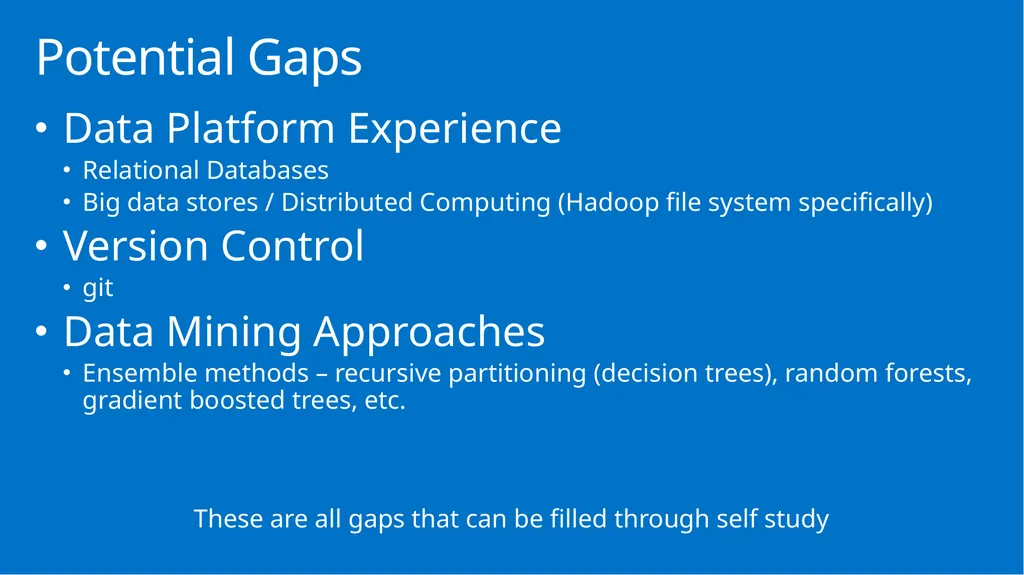
Data Platform Experience
Relational Databases
Big data stores / Distributed Computing (Hadoop file system specifically)
Version Control
git
Data Mining Approaches
Ensemble methods – recursive partitioning (decision trees), random forests, gradient boosted trees, etc. Potential Gaps These are all gaps that can be filled through self study<br>
14
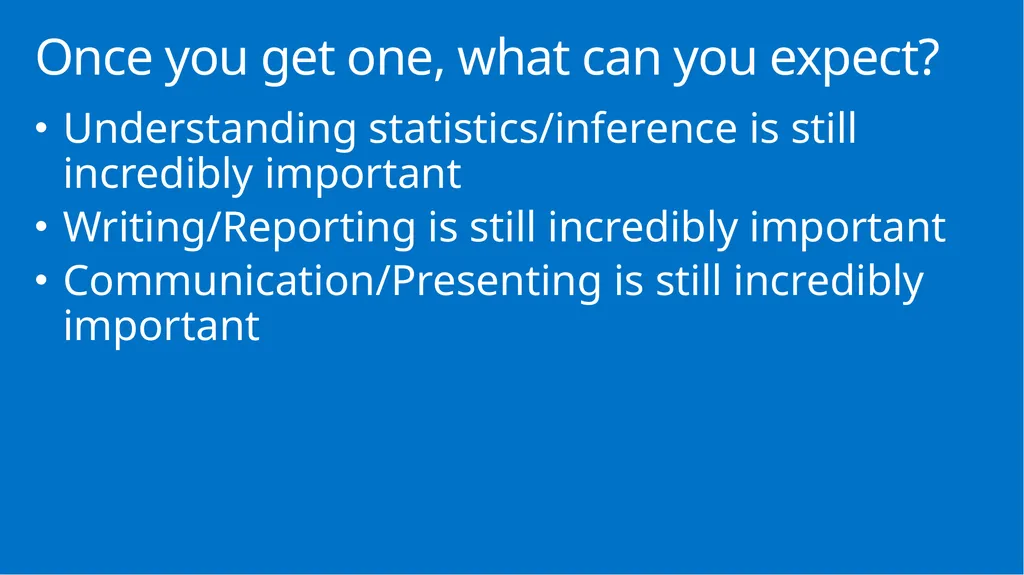
Understanding statistics/inference is still incredibly important
Writing/Reporting is still incredibly important
Communication/Presenting is still incredibly important Once you get one, what can you expect?<br>
15
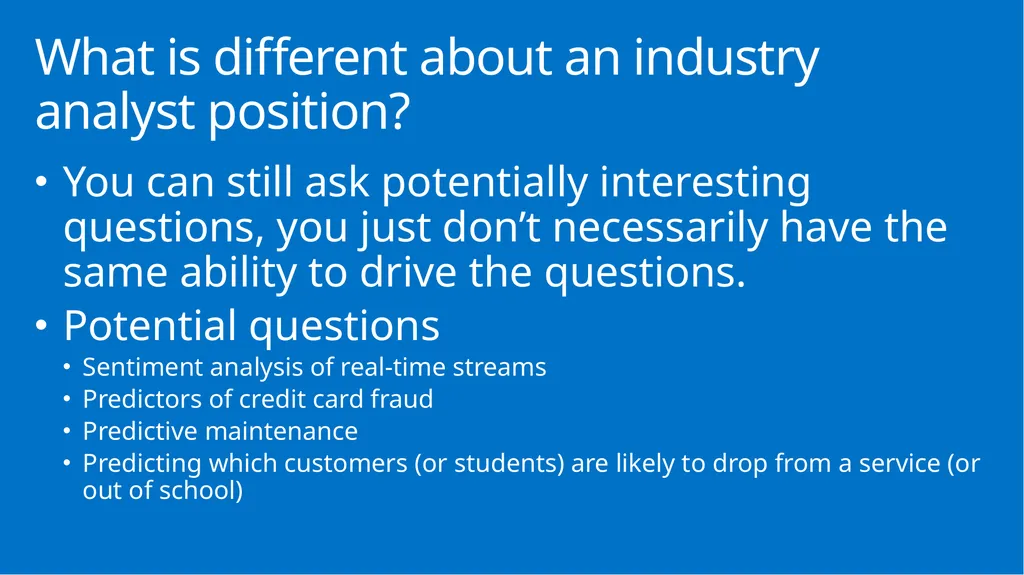
You can still ask potentially interesting questions, you just don’t necessarily have the same ability to drive the questions.
Potential questions
Sentiment analysis of real-time streams
Predictors of credit card fraud
Predictive maintenance
Predicting which customers (or students) are likely to drop from a service (or out of school) What is different about an industry analyst position?<br>
16
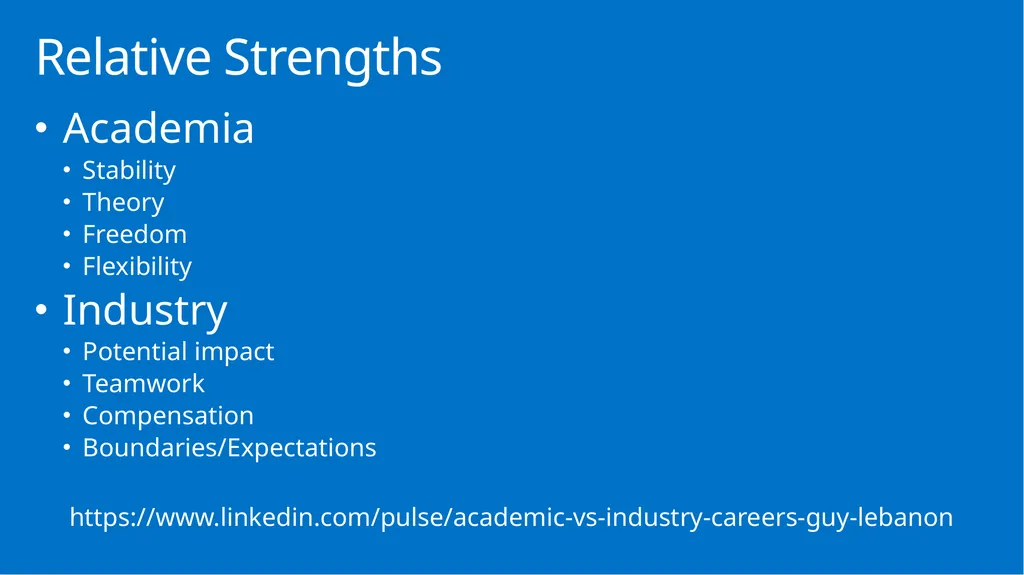
Academia
Stability
Theory
Freedom
Flexibility
Industry
Potential impact
Teamwork
Compensation
Boundaries/Expectations Relative Strengths https://www.linkedin.com/pulse/academic-vs-industry-careers-guy-lebanon<br>
17
Questions about being an Individual Contributor<br>
19
Is at a University (as a faculty member) and at Microsoft.
Experience is confounded, so keep that in mind
University
Just assumed that we had the knowledge and experience
Even if we did, or do, it’s completely anecdotal, and not clear that our identified solutions were remotely close to optimal
Microsoft
Large internal management training program, trouble is finding time to take them
A HUGE existing organization, so there are many processes in place My manager experience<br>
20
Parallels across Academia and Industry Career development within academia is largely a shift in roles from an individual contributor to a manager.
Program / Project management – getting tasks done in a timely fashion
Person management (students, post-docs, RAs) Regardless of career path – skills in these areas are gaps across virtually all areas of academia. Students and grad students just do not get much formal training in these, unless they’re explicitly pursuing business-oriented degrees in parallel<br>
21
Tools / Software
Numerous tools, but the most common is just Excel (or Google Sheets)
Approaches
Organizational responsibilities and accountabilities
Monitoring Status, Agile, etc.
Research
http://www.pmi.org/Learning/academic-research/ongoing-research.aspx
Data-driven field of research around best practices and effectiveness
It’s not just setting appropriate goals, especially when you have are relying on a team. Project Management<br>
22
Reporting and “Visibility”
Academia: Progress reports (departmental, funding, etc)
Industry: Live dashboards, weekly reports about activities Differences in Managing across Domains<br>
23
Leading a team to accomplish goals
Any amount of formal training would be hugely beneficial
Monthly brown-bags
Courses in business school
There is quite a bit of research on this as well… Person Management Library search of personnel management<br>
24
Questions about Management differences?<br>
25
Future Steps and�Conclusions<br>
26
General Preparation
Irrespective of career path, any type of formal training in management would be exceedingly valuable to trainees (e.g. excellent candidate for NRSA development / course plan).
They almost certainly will encounter these scenarios
Encourage trainees to ask “meta” questions.
Not just about research track and projects – it is also about understanding what uncertainty means and what the relevant trade-offs are across different career paths
Understand Valuable skills and Gaps
Differentiators in the industry marketplace
Gaps Provide Support<br>
27
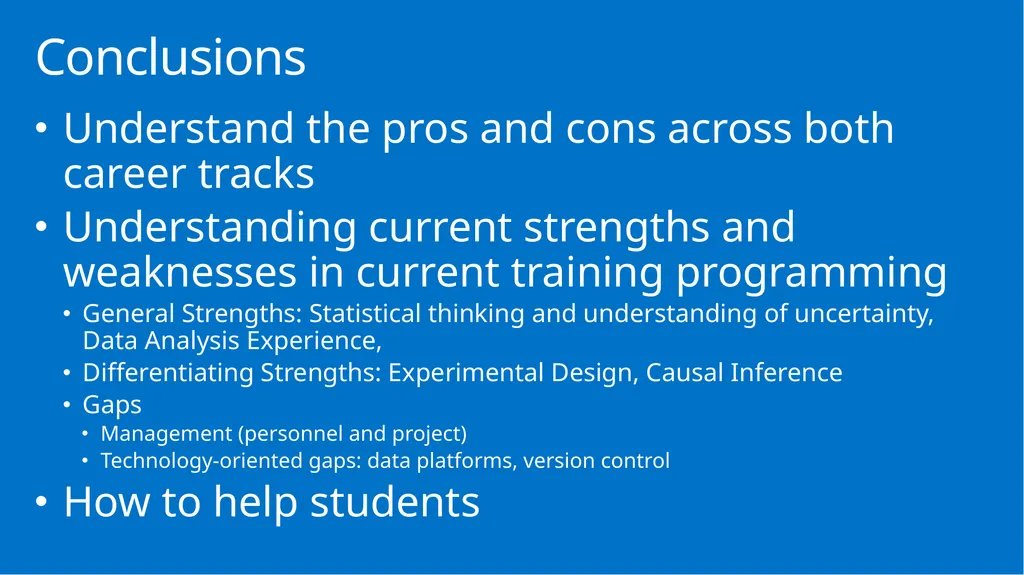
Understand the pros and cons across both career tracks
Understanding current strengths and weaknesses in current training programming
General Strengths: Statistical thinking and understanding of uncertainty, Data Analysis Experience,
Differentiating Strengths: Experimental Design, Causal Inference
Gaps
Management (personnel and project)
Technology-oriented gaps: data platforms, version control
How to help students Conclusions<br>