
Storytelling with Data 4.1 The importance of
DJ
Published · 29 slides · 0 views

1 / 1







Description
Storytelling with Data 4.1 The importance of context โดย สรนทรทพ ศกดภวดล Why is story telling important???? There is a story in your data. But your tools dont know what that story is. Thats where it takes youthe analyst or
Related Topics
Share
Embed code
Download this presentation From Below
"Storytelling with Data 4.1 The importance of" is the property of its rightful owner. Permission is granted to download and print the materials on this website for personal, non-commercial use only, and to display it on your personal computer provided you do not modify the materials and that you retain all copyright notices contained in the materials. By downloading content from our website, you accept the terms of this agreement.
Presentation Transcript
01
Storytelling with Data 4.1 The importance of context โดย สุรินทร์ทิพ ศักดิ์ภูวดล<br>
02
Why is story telling important???? There is a story in your data. But your tools don’t know what that story is. That’s where it takes you—the analyst or communicator of the information—to bring that story visually and contextually to life.<br>
03
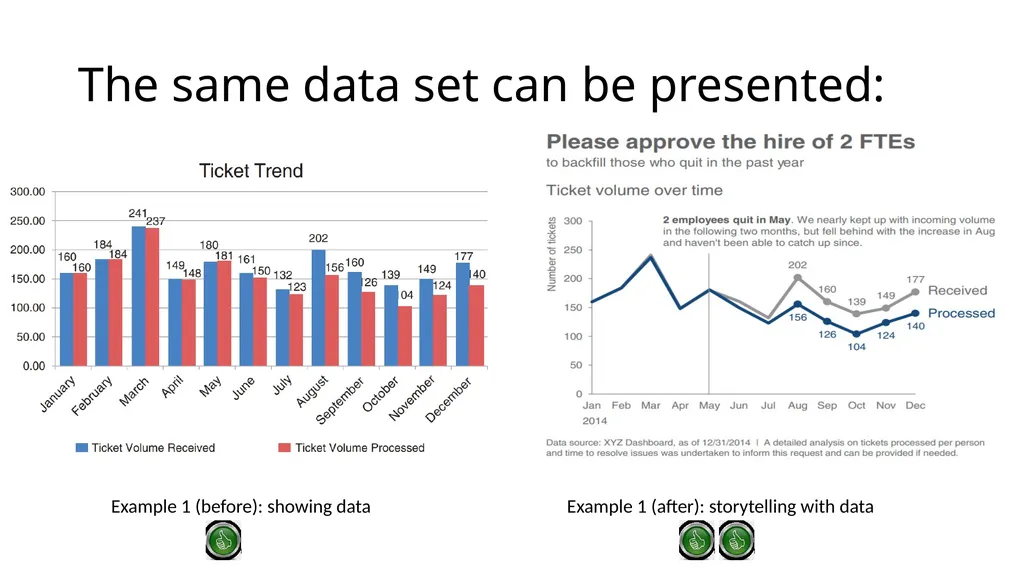
The same data set can be presented: Example 1 (before): showing data Example 1 (after): storytelling with data<br>
04
เปรียบเทียบการนำเสนอ 2 แบบ ก่อนและหลังการแสดงโดยคำนึงถึง data storytelling Example 2 (before): showing data Example 2 (after): storytelling with data<br>
05
The importance of context (ความสำคัญของบริบท) Success in data visualization does not start with data visualization. Rather, before you begin down the path of creating a data visualization or communication, attention and time should be paid to understanding the context for the need to communicate. In this chapter, we will focus on understanding the important components of context and discuss some strategies to help set you up for success when it comes to communicating visually with data.<br>
06
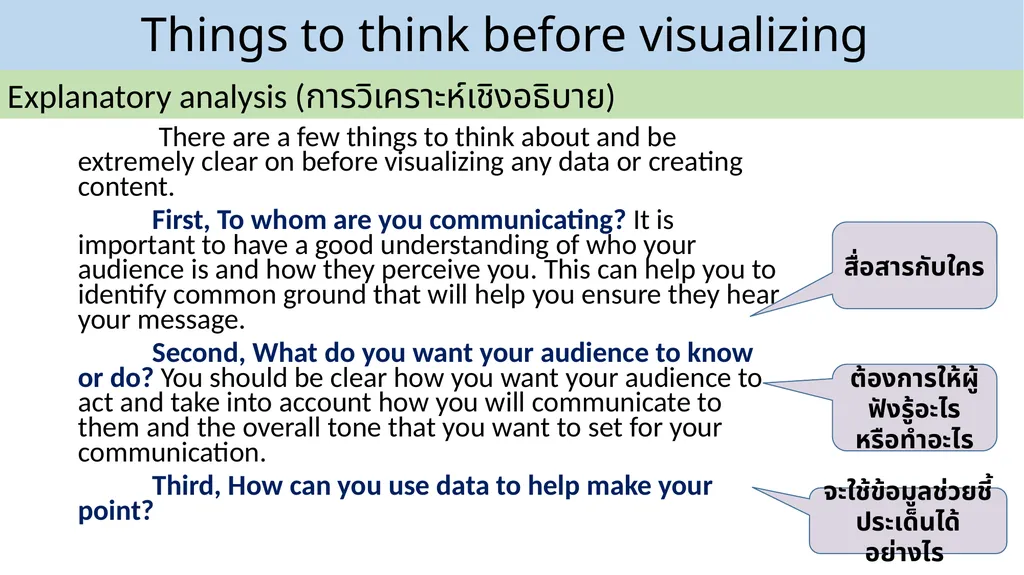
Things to think before visualizing There are a few things to think about and be extremely clear on before visualizing any data or creating content.
First, To whom are you communicating? It is important to have a good understanding of who your audience is and how they perceive you. This can help you to identify common ground that will help you ensure they hear your message.
Second, What do you want your audience to know or do? You should be clear how you want your audience to act and take into account how you will communicate to them and the overall tone that you want to set for your communication.
Third, How can you use data to help make your point? สื่อสารกับใคร ต้องการให้ผู้ฟังรู้อะไร หรือทำอะไร จะใช้ข้อมูลช่วยชี้ประเด็นได้อย่างไร Explanatory analysis (การวิเคราะห์เชิงอธิบาย)<br>
First, To whom are you communicating? It is important to have a good understanding of who your audience is and how they perceive you. This can help you to identify common ground that will help you ensure they hear your message.
Second, What do you want your audience to know or do? You should be clear how you want your audience to act and take into account how you will communicate to them and the overall tone that you want to set for your communication.
Third, How can you use data to help make your point? สื่อสารกับใคร ต้องการให้ผู้ฟังรู้อะไร หรือทำอะไร จะใช้ข้อมูลช่วยชี้ประเด็นได้อย่างไร Explanatory analysis (การวิเคราะห์เชิงอธิบาย)<br>
07
Explanatory analysis (การวิเคราะห์เชิงอธิบาย)
Who
What
How Things to think before visualizing<br>
Who
What
How Things to think before visualizing<br>
08
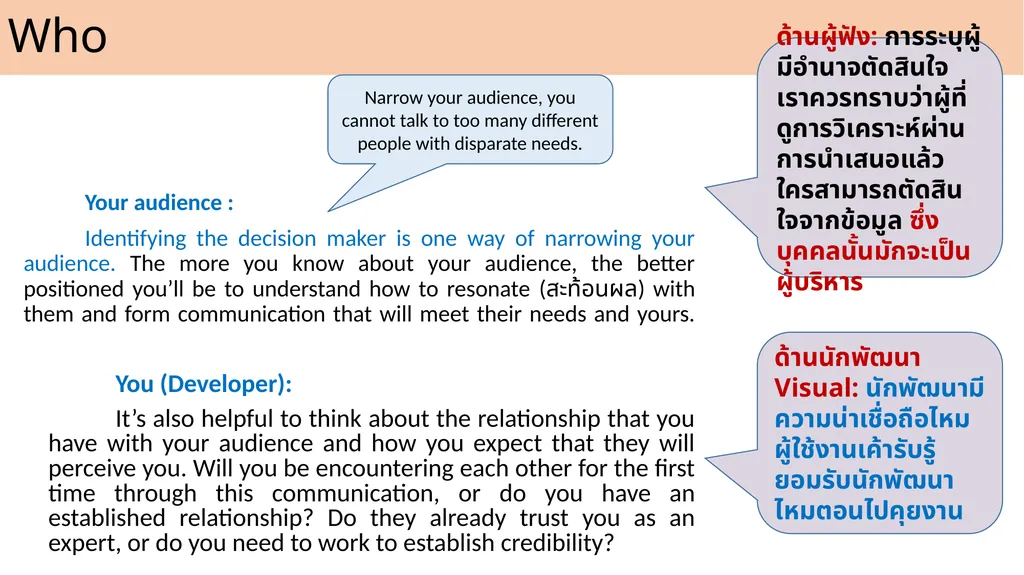
Who Your audience :
Identifying the decision maker is one way of narrowing your audience. The more you know about your audience, the better positioned you’ll be to understand how to resonate (สะท้อนผล) with them and form communication that will meet their needs and yours. ด้านผู้ฟัง: การระบุผู้มีอำนาจตัดสินใจ เราควรทราบว่าผู้ที่ดูการวิเคราะห์ผ่านการนำเสนอแล้ว ใครสามารถตัดสินใจจากข้อมูล ซึ่งบุคคลนั้นมักจะเป็นผู้บริหาร You (Developer):
It’s also helpful to think about the relationship that you have with your audience and how you expect that they will perceive you. Will you be encountering each other for the first time through this communication, or do you have an established relationship? Do they already trust you as an expert, or do you need to work to establish credibility? ด้านนักพัฒนา Visual: นักพัฒนามีความน่าเชื่อถือไหม ผู้ใช้งานเค้ารับรู้ ยอมรับนักพัฒนาไหมตอนไปคุยงาน Narrow your audience, you cannot talk to too many different people with disparate needs.<br>
Identifying the decision maker is one way of narrowing your audience. The more you know about your audience, the better positioned you’ll be to understand how to resonate (สะท้อนผล) with them and form communication that will meet their needs and yours. ด้านผู้ฟัง: การระบุผู้มีอำนาจตัดสินใจ เราควรทราบว่าผู้ที่ดูการวิเคราะห์ผ่านการนำเสนอแล้ว ใครสามารถตัดสินใจจากข้อมูล ซึ่งบุคคลนั้นมักจะเป็นผู้บริหาร You (Developer):
It’s also helpful to think about the relationship that you have with your audience and how you expect that they will perceive you. Will you be encountering each other for the first time through this communication, or do you have an established relationship? Do they already trust you as an expert, or do you need to work to establish credibility? ด้านนักพัฒนา Visual: นักพัฒนามีความน่าเชื่อถือไหม ผู้ใช้งานเค้ารับรู้ ยอมรับนักพัฒนาไหมตอนไปคุยงาน Narrow your audience, you cannot talk to too many different people with disparate needs.<br>
09
What 1. Action
2. Mechanism
3. Tone<br>
2. Mechanism
3. Tone<br>
10
1. Action
What do you need your audience to know or do? This is the point where you think through how to make what you communicate relevant for your audience and form a clear understanding of why they should care about what you say. You should always want your audience to know or do something. What<br>
What do you need your audience to know or do? This is the point where you think through how to make what you communicate relevant for your audience and form a clear understanding of why they should care about what you say. You should always want your audience to know or do something. What<br>
11
Prompting action: คำที่ช่วยกระตุ้น หรือช่วยให้เริ่มคิด ในการสนทนา Here are some action words to help act as thought starters as you determine what you are asking of your audience: accept | agree | begin | believe | change | collaborate | commence | create | defend | desire | differentiate | do | empathize | empower | encourage | engage | establish | examine | facilitate | familiarize | form | implement | include | influence | invest | invigorate | know | learn | like | persuade | plan | promote | pursue | recommend | receive | remember | report | respond | secure | support | simplify | start | try | understand | validate ยอมรับ | เห็นด้วย | เริ่ม | เชื่อ | เปลี่ยน | ร่วมมือ | เริ่ม | สร้าง | ปกป้อง | ความปรารถนา | แตกต่าง | ทำ | เห็นอกเห็นใจ | อำนาจ | ให้กำลังใจ | มีส่วนร่วม | ก่อตั้ง | ตรวจสอบ | อำนวยความสะดวก | ทำความคุ้นเคย | แบบฟอร์ม | ดำเนินการ | รวม | อิทธิพล | ลงทุน | เติมพลัง | รู้ | เรียนรู้ | ชอบ | ชักชวน | แผน | โปรโมท | ไล่ตาม | แนะนำ | รับ | จำไว้ | รายงาน | ตอบกลับ | ปลอดภัย | สนับสนุน | ลดความซับซ้อน | เริ่ม | ลอง | เข้าใจ | ตรวจสอบความถูกต้อง What<br>
12
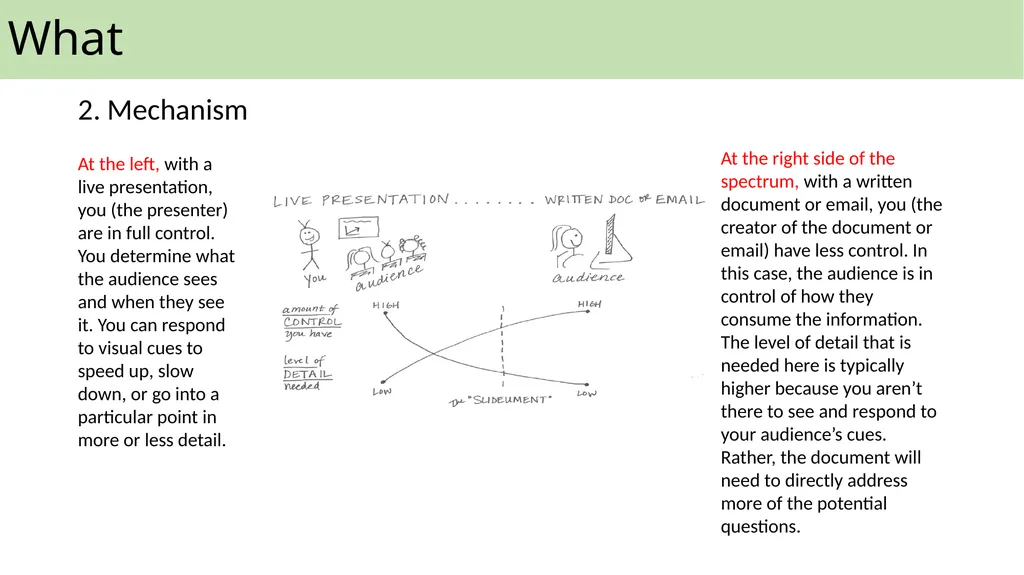
2. Mechanism At the left, with a live presentation, you (the presenter) are in full control. You determine what the audience sees and when they see it. You can respond to visual cues to speed up, slow down, or go into a particular point in more or less detail. At the right side of the spectrum, with a written document or email, you (the creator of the document or email) have less control. In this case, the audience is in control of how they consume the information. The level of detail that is needed here is typically higher because you aren’t there to see and respond to your audience’s cues. Rather, the document will need to directly address more of the potential questions. What<br>
13
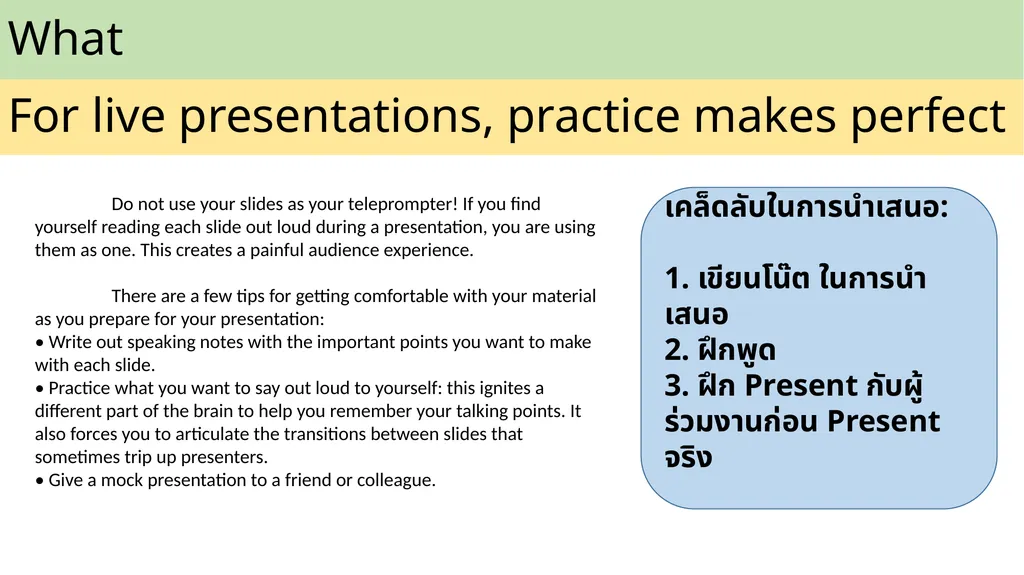
For live presentations, practice makes perfect Do not use your slides as your teleprompter! If you find yourself reading each slide out loud during a presentation, you are using them as one. This creates a painful audience experience.
There are a few tips for getting comfortable with your material as you prepare for your presentation:
• Write out speaking notes with the important points you want to make with each slide.
• Practice what you want to say out loud to yourself: this ignites a different part of the brain to help you remember your talking points. It also forces you to articulate the transitions between slides that sometimes trip up presenters.
• Give a mock presentation to a friend or colleague. เคล็ดลับในการนำเสนอ:
1. เขียนโน๊ต ในการนำเสนอ
2. ฝึกพูด
3. ฝึก Present กับผู้ร่วมงานก่อน Present จริง What<br>
There are a few tips for getting comfortable with your material as you prepare for your presentation:
• Write out speaking notes with the important points you want to make with each slide.
• Practice what you want to say out loud to yourself: this ignites a different part of the brain to help you remember your talking points. It also forces you to articulate the transitions between slides that sometimes trip up presenters.
• Give a mock presentation to a friend or colleague. เคล็ดลับในการนำเสนอ:
1. เขียนโน๊ต ในการนำเสนอ
2. ฝึกพูด
3. ฝึก Present กับผู้ร่วมงานก่อน Present จริง What<br>
14
Live presentation (นำเสนอต่อหน้าผู้ฟัง)
ข้อดี : เราสามารถโต้ตอบ, ตอบคำถามผู้ฟังที่อยู่ในห้องประชุมได้หมด
แต่ : ถ้า presentation ไม่มีรายละเอียดมาก ผู้ใช้งานที่มาติดตามอ่านทีหลังไม่สามารถทราบข้อมูลที่ละเอียดได้
ดังนั้น : อาจต้องทำเอกสารประกอบการนำเสนอ
ดังนั้นสรุป
ในการนำเสนอ Project ควรจะมีทั้ง Slide Presentation และเอกสารประกอบการนำเสนอ What<br>
ข้อดี : เราสามารถโต้ตอบ, ตอบคำถามผู้ฟังที่อยู่ในห้องประชุมได้หมด
แต่ : ถ้า presentation ไม่มีรายละเอียดมาก ผู้ใช้งานที่มาติดตามอ่านทีหลังไม่สามารถทราบข้อมูลที่ละเอียดได้
ดังนั้น : อาจต้องทำเอกสารประกอบการนำเสนอ
ดังนั้นสรุป
ในการนำเสนอ Project ควรจะมีทั้ง Slide Presentation และเอกสารประกอบการนำเสนอ What<br>
15
3. Tone
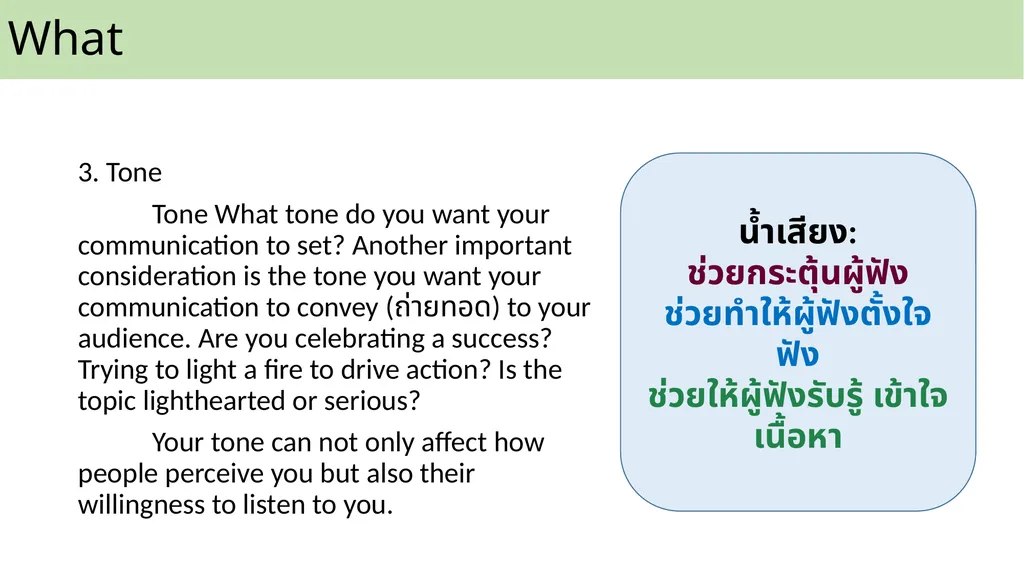
Tone What tone do you want your communication to set? Another important consideration is the tone you want your communication to convey (ถ่ายทอด) to your audience. Are you celebrating a success? Trying to light a fire to drive action? Is the topic lighthearted or serious?
Your tone can not only affect how people perceive you but also their willingness to listen to you. น้ำเสียง:
ช่วยกระตุ้นผู้ฟัง
ช่วยทำให้ผู้ฟังตั้งใจฟัง
ช่วยให้ผู้ฟังรับรู้ เข้าใจเนื้อหา What<br>
Tone What tone do you want your communication to set? Another important consideration is the tone you want your communication to convey (ถ่ายทอด) to your audience. Are you celebrating a success? Trying to light a fire to drive action? Is the topic lighthearted or serious?
Your tone can not only affect how people perceive you but also their willingness to listen to you. น้ำเสียง:
ช่วยกระตุ้นผู้ฟัง
ช่วยทำให้ผู้ฟังตั้งใจฟัง
ช่วยให้ผู้ฟังรับรู้ เข้าใจเนื้อหา What<br>
16
How After we can clearly articulate who our audience is and what we need them to know or do—we can turn to the data and ask the question:
What data is available that will help make my point? Data becomes supporting evidence of the story you will build and tell.<br>
What data is available that will help make my point? Data becomes supporting evidence of the story you will build and tell.<br>
17
Explanatory analysis
ตัวอย่างการใช้แนวคิด Who, What, and How กุหลาบเป็นครูสอนวิทยาศาสตร์ชั้นประถมศึกษาปีที่สี่ กุหลาบเพิ่งเสร็จสิ้นโครงการทดลองนำร่องภาคฤดูร้อนเกี่ยวกับวิทยาศาสตร์ที่มีจุดประสงค์ ให้เด็กได้สัมผัสกับเรื่องที่ไม่เป็นที่นิยม กุหลาบได้ทำการสำรวจความคิด เด็กนักเรียนก่อนและหลังของโปรแกรม ในด้านการรับรู้ของเด็ก ต่อวิทยาศาสตร์ที่ได้ถูกเปลี่ยนแปลงไป กุหลาบมีเชื่อมั่นในข้อมูลว่าสามารถแสดงให้เห็นถึงเรื่องราวความสำเร็จได้ หากกุหลาบต้องการที่จะนำเสนอ โครงการเรียนวิทยาศาสตร์ภาคฤดูร้อนในอนาคตต่อไป กุหลาบจะต้องนำเสนอ ข้อมูลครั้งต่อไป
โจทย์ : ให้นิสิตวิเคราะห์เชิงอธิบาย (Explanatory analysis) โดยใช้ แนวคิด Who, What, and How<br>
โจทย์ : ให้นิสิตวิเคราะห์เชิงอธิบาย (Explanatory analysis) โดยใช้ แนวคิด Who, What, and How<br>
18
Who :
ในตอนแรกที่เราคิดไว้อาจจะมีหลายคน : นักเรียน ผู้ปกครอง ครูท่านอื่น หรือ คณะกรรมการงบประมาณ
สมมุติว่า ผู้ฟัง (audience) คือ คณะกรรมการงบประมาณ ซึ่งเป็นกลุ่มบุคคลที่บริหารจัดการงบประมาณ
What we need from them : สิ่งที่เราต้องการคือ เงินทุน หรืองบประมาณก้อนใหม่ ดังนั้นเราต้องทำ Visualization เพื่อของบสนับสนุนโครงการ สิ่งที่สำคัญในการนำเสนอคือแสดงให้เห็นถึงความสำเร็จของโปรแกรมที่ผ่านมา
Data to present and convince audience : ในการนำเสนอนั้นสิ่งที่เราจะใช้ประโยชน์ในการนำเสนอคือ ผลสำรวจ เด็กนักเรียนก่อนและหลังของโปรแกรม Explanatory analysis ตัวอย่างการใช้แนวคิด Who, What, and How<br>
ในตอนแรกที่เราคิดไว้อาจจะมีหลายคน : นักเรียน ผู้ปกครอง ครูท่านอื่น หรือ คณะกรรมการงบประมาณ
สมมุติว่า ผู้ฟัง (audience) คือ คณะกรรมการงบประมาณ ซึ่งเป็นกลุ่มบุคคลที่บริหารจัดการงบประมาณ
What we need from them : สิ่งที่เราต้องการคือ เงินทุน หรืองบประมาณก้อนใหม่ ดังนั้นเราต้องทำ Visualization เพื่อของบสนับสนุนโครงการ สิ่งที่สำคัญในการนำเสนอคือแสดงให้เห็นถึงความสำเร็จของโปรแกรมที่ผ่านมา
Data to present and convince audience : ในการนำเสนอนั้นสิ่งที่เราจะใช้ประโยชน์ในการนำเสนอคือ ผลสำรวจ เด็กนักเรียนก่อนและหลังของโปรแกรม Explanatory analysis ตัวอย่างการใช้แนวคิด Who, What, and How<br>
19
Who: The budget committee that can approve funding for continuation of the summer learning program.
What: The summer learning program on science was a success; please approve budget of $X to continue.
How: Illustrate success with data collected through the survey conducted before and after the pilot program Explanatory analysis ตัวอย่างการใช้แนวคิด Who, What, and How<br>
What: The summer learning program on science was a success; please approve budget of $X to continue.
How: Illustrate success with data collected through the survey conducted before and after the pilot program Explanatory analysis ตัวอย่างการใช้แนวคิด Who, What, and How<br>
20
ในการศึกษาบริบทของงาน (Context) นั้นเราสามารถเก็บรวบรวมข้อมูลของบริบท และทำความเข้าใจบริบทของงานได้จากผู้เกี่ยวข้อง โดยเราสามารถขอรับคำปรึกษาหรือสอบถามข้อมูลเพิ่มเติมจากจากผู้เกี่ยวข้อง เพื่อให้เราเข้าใจบริบทของงานได้ชัดเจน และตรงตามความต้องการ
ผู้เกี่ยวข้องในการให้ข้อมูลดังกล่าว ประกอบด้วย
1. Client: ลูกค้า
2. Stakeholder: ผู้มีส่วนได้ส่วนเสีย คือผู้ที่อยู่ในโครงการ หรือคนที่ได้รับผลกระทบจาก
โครงการ
3. Your boss: อาจเป็นหัวหน้าทีมงานสร้าง Data Visualization Consulting for context: questions to ask (การให้คำปรึกษาสำหรับบริบท: คำถามที่จะถาม)<br>
21
ตัวอย่างคำถาม ที่เราต้องพิจารณาในการทำงานที่ช่วยในการรวบรวมข้อมูลเพื่อเข้าใจบริบท (Context) ของงาน What background information is relevant or essential?
• Who is the audience or decision maker?
What do we know about them?
• What biases does our audience have that might make them supportive of or resistant to our message?
• What data is available that would strengthen our case? Is our audience familiar with this data, or is it new?
• Where are the risks: what factors could weaken our case and do we need to proactively address them?
• What would a successful outcome look like?
• If you only had a limited amount of time or a single sentence to tell your audience what they need to know, what would you say can lead to insightful conversation Consulting for context: questions to ask (การให้คำปรึกษาสำหรับบริบท: คำถามที่จะถาม)<br>
• Who is the audience or decision maker?
What do we know about them?
• What biases does our audience have that might make them supportive of or resistant to our message?
• What data is available that would strengthen our case? Is our audience familiar with this data, or is it new?
• Where are the risks: what factors could weaken our case and do we need to proactively address them?
• What would a successful outcome look like?
• If you only had a limited amount of time or a single sentence to tell your audience what they need to know, what would you say can lead to insightful conversation Consulting for context: questions to ask (การให้คำปรึกษาสำหรับบริบท: คำถามที่จะถาม)<br>
22
The 3-minute story and the Big Idea Putting a significant constraint on the message (a short amount of time or a single sentence) can help you to boil the overall communication down (ลด) to the single, most important message. To that end, there are a couple of concepts that need to know and employ: the 3-minute story and the Big Idea<br>
23
3‐minute story The 3‐minute story is exactly that: if you had only three minutes to tell your audience what they need to know, what would you say? This is a great way to ensure you are clear on and can articulate the story you want to tell. Being able to do this removes you from dependence on your slides or visuals for a presentation.<br>
24
Big Idea The Big Idea boils the so‐what down even further: to a single sentence. This is a concept that Nancy Duarte discusses in her book, Resonate (2010). She says the Big Idea has three components:
1. It must articulate your unique point of view;
2. It must convey what’s at stake;
and 3. It must be a complete sentence.
Remark : boils down = ลด 1. ต้องแสดงมุมมองเฉพาะของคุณ
2. ต้องถ่ายทอดสิ่งที่เป็นประโยชน์ แสดงส่วนได้ส่วนเสีย
3. ต้องเป็นประโยคที่สมบูรณ์.
(ประธาน+กริยา)<br>
1. It must articulate your unique point of view;
2. It must convey what’s at stake;
and 3. It must be a complete sentence.
Remark : boils down = ลด 1. ต้องแสดงมุมมองเฉพาะของคุณ
2. ต้องถ่ายทอดสิ่งที่เป็นประโยชน์ แสดงส่วนได้ส่วนเสีย
3. ต้องเป็นประโยคที่สมบูรณ์.
(ประธาน+กริยา)<br>
25
3‐minute story: A group of us in the science department were brainstorming about how to resolve an ongoing issue we have with incoming fourth‐graders. It seems that when kids get to their first science class, they come in with this attitude that it’s going to be difficult and they aren’t going to like it. It takes a good amount of time at the beginning of the school year to get beyond that. So we thought, what if we try to give kids exposure to science sooner? Can we influence their perception? We piloted a learning program last summer aimed at doing just that. We invited elementary school students and ended up with a large group of second‐ and third‐graders. Our goal was to give them earlier exposure to science in hopes of forming positive perception. To test whether we were successful, we surveyed the students before and after the program. We found that, going into the program, the biggest segment of students, 40%, felt just “OK” about science, whereas after the program, most of these shifted into positive perceptions, with nearly 70% of total students expressing some level of interest toward science. We feel that this demonstrates the success of the program and that we should not only continue to offer it, but also to expand our reach with it going forward.<br>
26
Big Idea: The pilot summer learning program was successful at improving students’ perceptions of science and, because of this success, we recommend continuing to offer it going forward; please approve our budget for this program.<br>
27
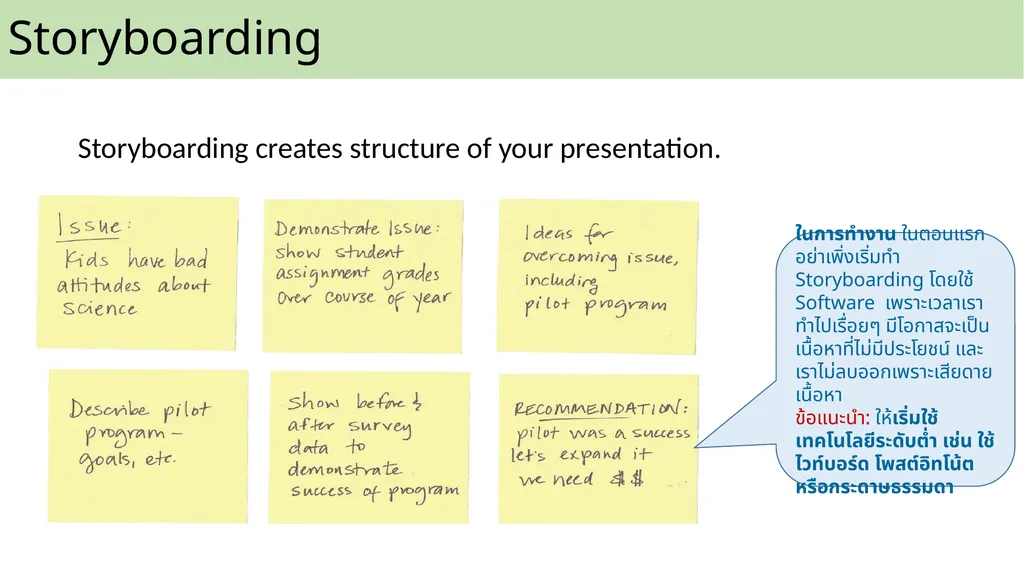
Storyboarding Storyboarding creates structure of your presentation. ในการทำงาน ในตอนแรกอย่าเพิ่งเริ่มทำ Storyboarding โดยใช้ Software เพราะเวลาเราทำไปเรื่อยๆ มีโอกาสจะเป็นเนื้อหาที่ไม่มีประโยชน์ และเราไม่ลบออกเพราะเสียดายเนื้อหา
ข้อแนะนำ: ให้เริ่มใช้เทคโนโลยีระดับต่ำ เช่น ใช้ไวท์บอร์ด โพสต์อิทโน้ต หรือกระดาษธรรมดา<br>
ข้อแนะนำ: ให้เริ่มใช้เทคโนโลยีระดับต่ำ เช่น ใช้ไวท์บอร์ด โพสต์อิทโน้ต หรือกระดาษธรรมดา<br>
28
บทสรุป ในการวิเคราะห์เชิงอธิบาย ต้องระบุให้ชัดว่าว่าเราต้องการสื่อสารกับใครและต้องการอะไร
ทำความเข้าใจและใช้แนวคิดเช่น 3‐minute story, Big Idea และ
Storyboarding จะช่วยให้เราเข้าใจและ บอกเล่าเรื่องราวของคุณอย่างกระชับและระบุสิ่งที่ต้องการได้<br>
ทำความเข้าใจและใช้แนวคิดเช่น 3‐minute story, Big Idea และ
Storyboarding จะช่วยให้เราเข้าใจและ บอกเล่าเรื่องราวของคุณอย่างกระชับและระบุสิ่งที่ต้องการได้<br>
29
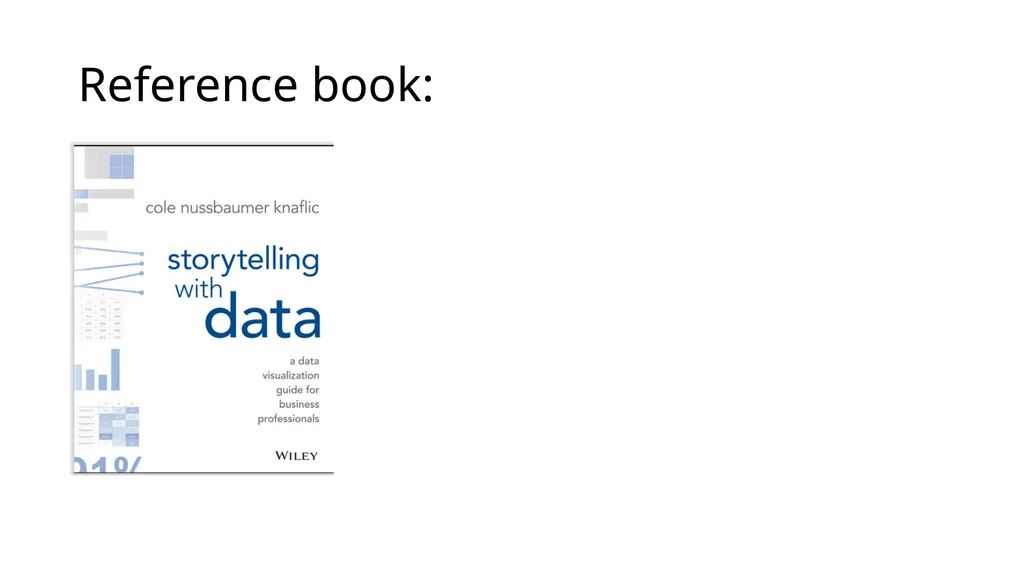
Reference book:<br>