
Streamlining Integrated Infrastructure
Description: Streamlining Integrated Infrastructure Implementation: Workshop Report Report Prepared by Alliance for the Chesapeake Bay Hirschman Water Environment, LLC Planning Teams Observations: Capital projects rarely address (or even consider
Related Topics
Download Presentation
"Streamlining Integrated Infrastructure" is the property of its rightful owner. Permission is granted to download and print the materials on this website for personal, non-commercial use only, and to display it on your personal computer provided you do not modify the materials and that you retain all copyright notices contained in the materials. By downloading content from our website, you accept the terms of this agreement.
Presentation Transcript
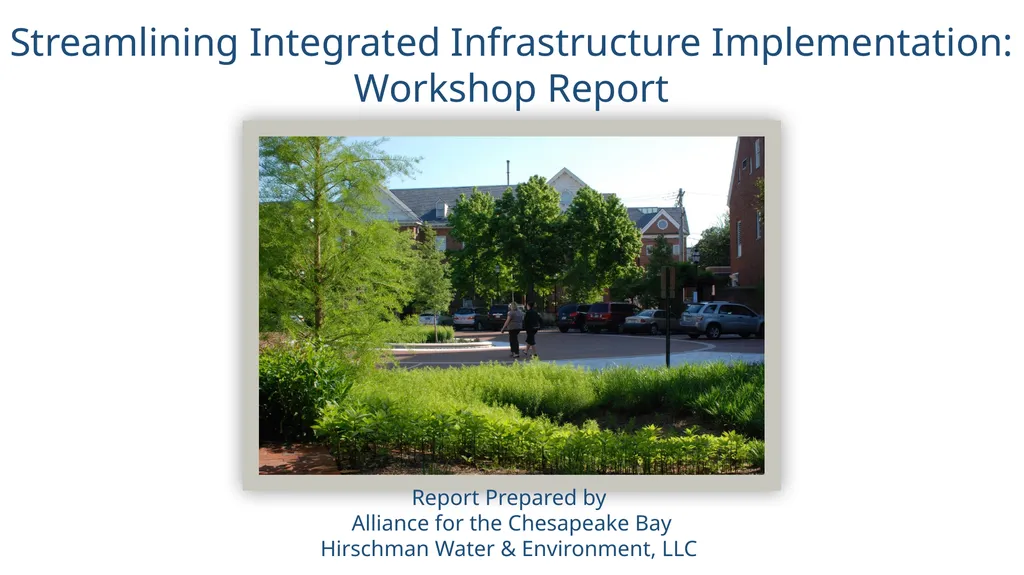
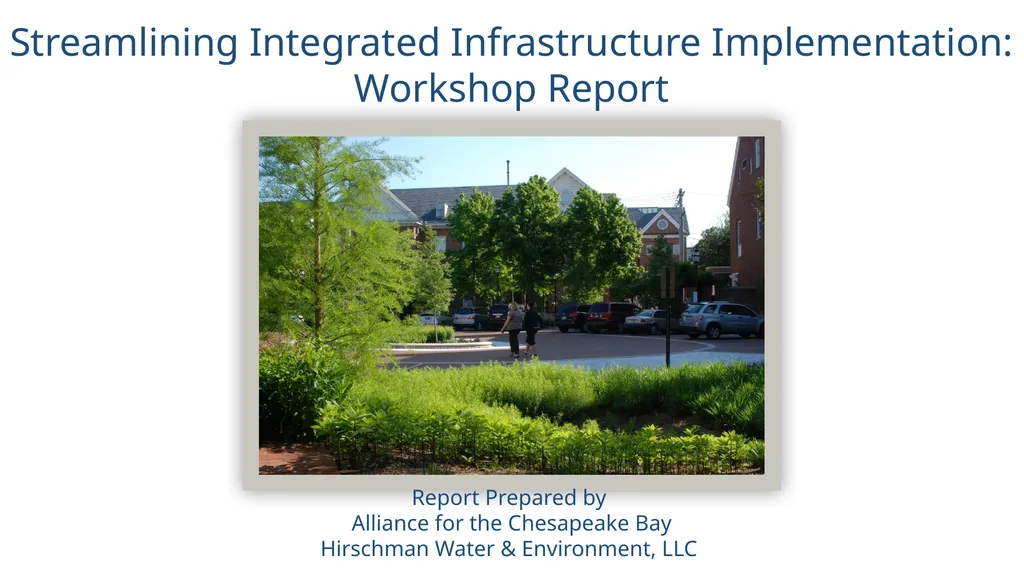
slide1. Streamlining Integrated Infrastructure Implementation: Workshop Report Report Prepared by
Alliance for the Chesapeake Bay
Hirschman Water & Environment, LLC<br>
slide2. Planning Team’s Observations: Capital projects rarely address (or even consider opportunities to address) water quality goals.
The stars need to align for administration, procurement, funding, plan review, permitting, staffing, and schedules – even for a single project – and we need to implement many of them!
Capital project and stormwater staffs (often in different departments) need to seek mutual opportunities, with guidance from the elected officials.
Additional observations …<br>
slide3. Defining the Issues Local Administration and Management Processes aren’t aligned in a way that facilitates efficient implementation of capital and maintenance projects that incorporate green stormwater infrastructure, e.g. streetscape enhancements.
Funding for capital or maintenance projects that incorporate green infrastructure generally comes from multiple sources, driving up administrative costs and resulting in scheduling conflicts that can jeopardize project implementation.
Additional issues …<br>
slide4. Preliminary Recommendation Example Issue: Administrative/management processes aren’t aligned
Recommendation – Local goals and policies can be set by elected officials to promote alignment and streamlining. Tools to help local governments align processes would be helpful, including examples from other communities, checklists, etc.
Recommendation – Opportunities for achieving pollutant reduction should be considered at the front end when developing capital project plans (as an automatic step). Systems to prioritize the best projects can be developed. Provide training on capital improvement planning.<br>
slide5. Preliminary Recommendation Example Issue: Inability to secure funding for green infrastructure results in elimination of GI from capital project.
Recommendation – Secure dedicated funding to cover cost of GI in capital projects. Additional discussion is needed to determine if change is feasible. Options for securing dedicated funding include: 1) Work with funders to develop preferential funding criteria; 2) establish stormwater fees that could be dedicated to implementing the highest priority GI projects.<br>
slide6. Final Recommendation Example Issue: Administrative/management processes aren’t aligned
Recommendation – Opportunities for achieving pollutant reduction should be considered when developing capital project plans. Revised as follows: Capital Improvement Plans should be used to maximize benefits achieved from allocation of resources. Capital project planning guidance and tools should include an evaluation of opportunities for achieving pollutant reduction. Change is possible at the local government and state level. Training on Capital Improvement Planning should be provided to local governments. Goal is to increase the number of communities that develop and adopt CIPs that include an evaluation of opportunities to incorporate green infrastructure.
The American Planning Association is best suited to carry out this recommendation. Other potential partners include the Government Finance Officers Association.
Next steps: Contact American Planning Association to explore current CIP Training Materials and Programs.<br>
slide7. Issues That Apply to the Entire Stormwater Universe Maintenance
Standards for Design, Plants, etc.
Technical expertise in design, construction, maintenance
Politics, resources at larger scales
Regulatory Drivers, BMP crediting, TMDL
OUR ASSUMPTION OF THE STARTING POINTFOR THE AFTERNOON:
Want GI (whatever it is); want better integration/streamlining
Looking for specific process and integration solutions<br>
slide8. Sheridan Room – Lots of Burning Issues Dig Once, Dig Again & Again, OR Don’t Dig at All, DIG?: Integration = more partners & processes = complexity, uncertain timelines; WHAT’S THE SWEET SPOT?
Leveraging Multiple Financing/Funding Strategies: What is proper role for grants & loans, bonds, financing, etc.: timing, pay for feasibility? NOT ongoing maintenance, wean localities off of grants to loans & other sources
Overcoming Obstacles With GI; Is There A Better Way to Make Best Use of Funds?: Planning & prioritization, co-benefits; what are good tools (GIS, policies, checklists, etc.) and is there good access to the tools, breaking down silos; strive for BEST USE OF FUNDS
Commitment: Institutionalizing COMMITMENT: state down to local
Critical Mass: Beyond Town-By-Town approach, regional programs, peer-to-peer learning, dealing with turnover to staff & elected officials<br>
slide9. Preliminary Recommendations What Needs to be Changed?
Is Change Feasible?
What is Needed to Facilitate Change?<br>
slide10. Preliminary Recommendations: Critical Mass Collaboration among localities:
Authority to collaborate from state; cooperative purchasing; allow economies of scale. Partners: CB Commission, WASHCOG, U.S. Communities (cooperative purchasing), Chesapeake Legal Alliance
Existing success stories; developing models; what was spark behind collaboration. Partners: Upper Susquehanna Coalition, IMLA (model codes), NARC
Resources for cost/benefit analysis (acting alone vs. collaborative). Partners: Inspector General’s Office (VA), EFC, Assoc of PDCs (VA)
Coordinator as single point of contact within region; regional capital improvement planning. GFOA, APA
Political momentum
Political expectations, similar to flooding, water supply (need to do regionally)
Educating constituents; taxpayer/ratepayer buy-in<br>
slide11. Preliminary Recommendations: Obstacles Pilot on public property, share experiences & case studies (including problems/failures) through checklist – program to pilot a program. Then scale up. Chesapeake Water Environment Assoc., APWA state chapters,
Standardize data (GIS and other) & make accessible. ESRI, DC open data platform<br>
slide12. Preliminary Recommendations: Commitment What needs to change: Buy in at state, federal, local levels & partnership vs. top-down mandate
Facilitating change:
Messaging from states to localities that explain benefits: health, daily lives, jobs – buy-in & relevance (engage health community). Bay Program, CBFN, Bay Commission
Providing training from state to locals & educating state staff about how to interact with locals. Municipal associations, state chapters, MPOs, training modules for locals, certified public manager programs
States leading by example: tours, etc.
Guidance on codifying changes to strengthen GI
Adding GI to locality infrastructure maps
Ongoing training: GI, stormwater – deal with turnover of staff, elected officials. KEY PEOPLE: City manager, PW Director (get to ICMA, APWA, etc.)<br>
slide13. Preliminary Recommendations: Dig What needs to change: Integrate proper GI practices into every organization concept planning (programmatic) so GI becomes new standard. Not mandate GI with EVERY project, but make sure program allows consideration of GI. Lump with other group on CIP planning
Facilitating change:
Improved communications EARLY in process to integrate stormwater piece, e.g., roadway, new library, etc. Engage public utility commissions. Need to have someone advocating for this (champion).
Where, what, when, why,
Clearinghouse of projects, deadline for getting projects into hopper<br>
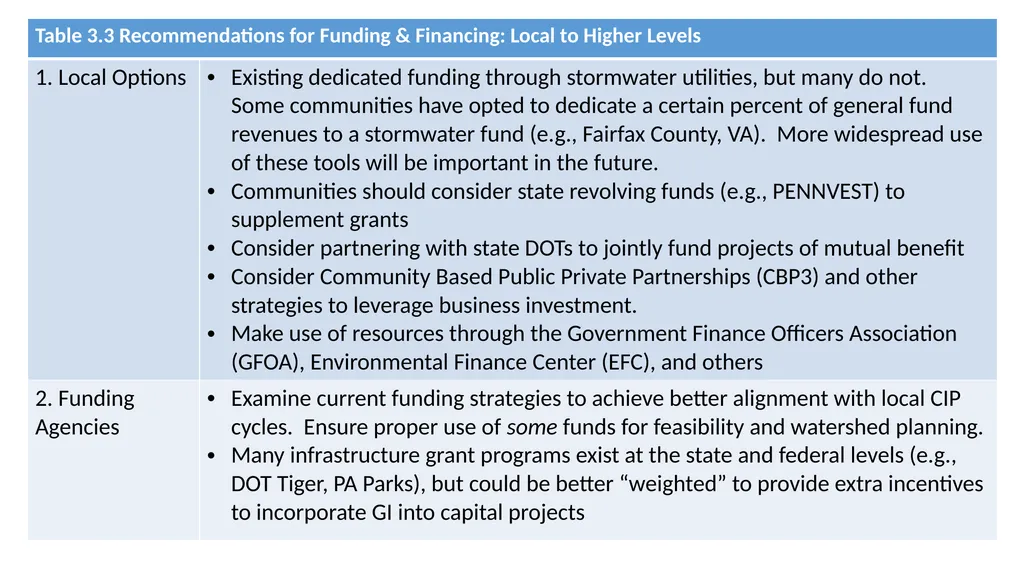
slide14. Preliminary Recommendations: Funding Incentivize integrated CIPs that include GI (pre-requisite for funding, or ID funding sources to do the planning). This is intended to address the issues with timing of grants and other issues that are due to lack of long-term planning.
ID funding strategy for implementation – DOT, revolving loans, local utility fees. Can’t rely on grants alone
Toolkits, case studies of financing (already out there)
Coordination between funding agencies (Bay Funders Network)
Business investment open door to federal $, such as HUD
www.gfoa.org ; they also provide some technical assistance
Weight grants to award higher points for projects that have GI (DOT Tiger, PA Parks)
Award or recognition for communities that have taken risk of integrating GI, maybe taken loan<br>
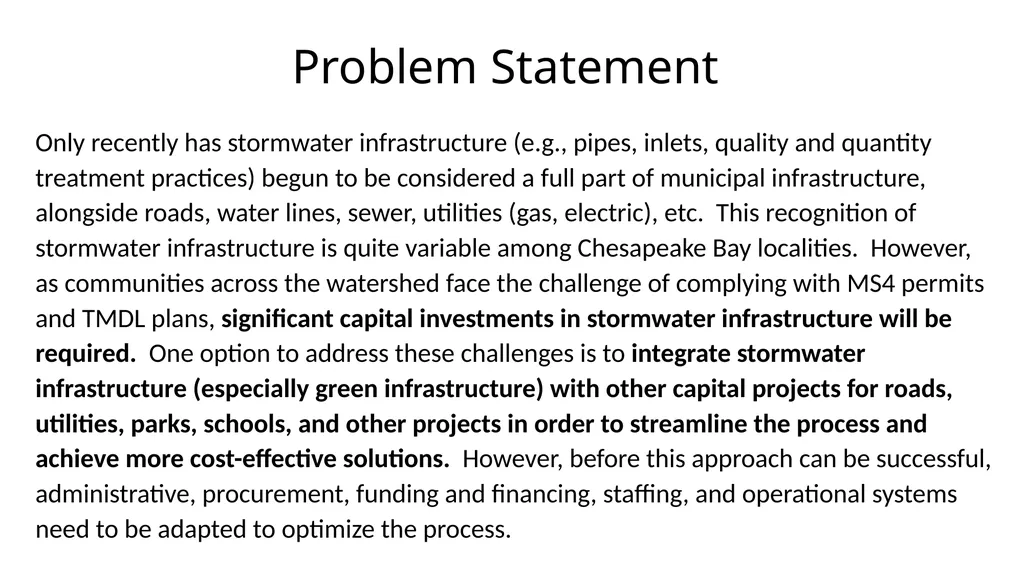
slide15. Problem Statement Only recently has stormwater infrastructure (e.g., pipes, inlets, quality and quantity treatment practices) begun to be considered a full part of municipal infrastructure, alongside roads, water lines, sewer, utilities (gas, electric), etc. This recognition of stormwater infrastructure is quite variable among Chesapeake Bay localities. However, as communities across the watershed face the challenge of complying with MS4 permits and TMDL plans, significant capital investments in stormwater infrastructure will be required. One option to address these challenges is to integrate stormwater infrastructure (especially green infrastructure) with other capital projects for roads, utilities, parks, schools, and other projects in order to streamline the process and achieve more cost-effective solutions. However, before this approach can be successful, administrative, procurement, funding and financing, staffing, and operational systems need to be adapted to optimize the process.<br>
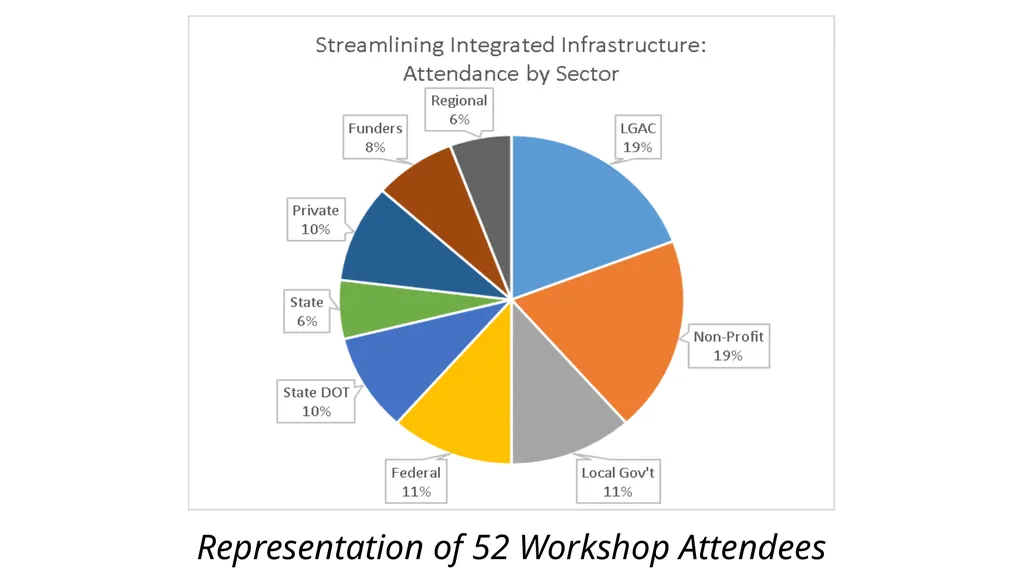
slide16. Representation of 52 Workshop Attendees<br>
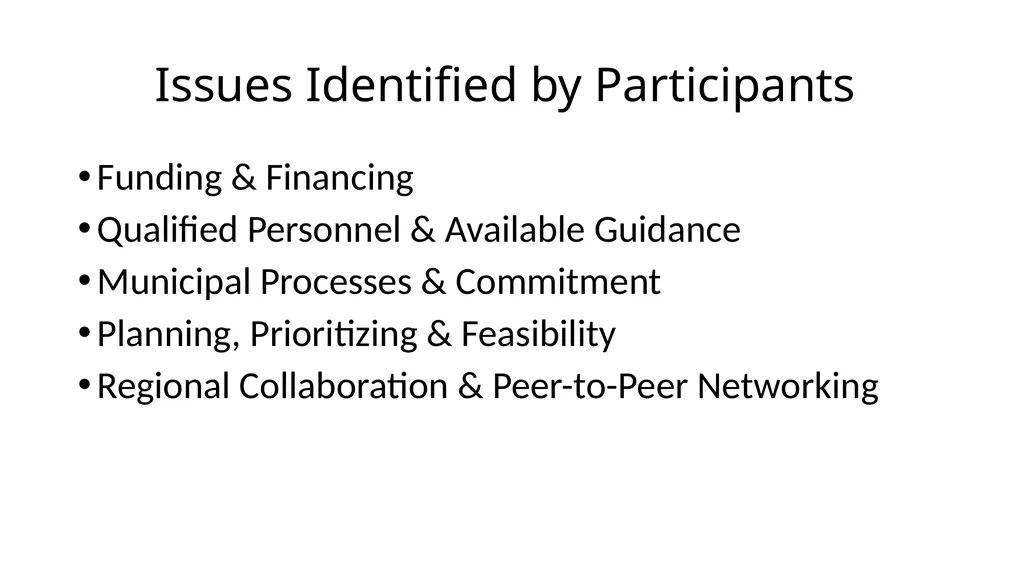
slide17. Issues Identified by Participants Funding & Financing
Qualified Personnel & Available Guidance
Municipal Processes & Commitment
Planning, Prioritizing & Feasibility
Regional Collaboration & Peer-to-Peer Networking<br>
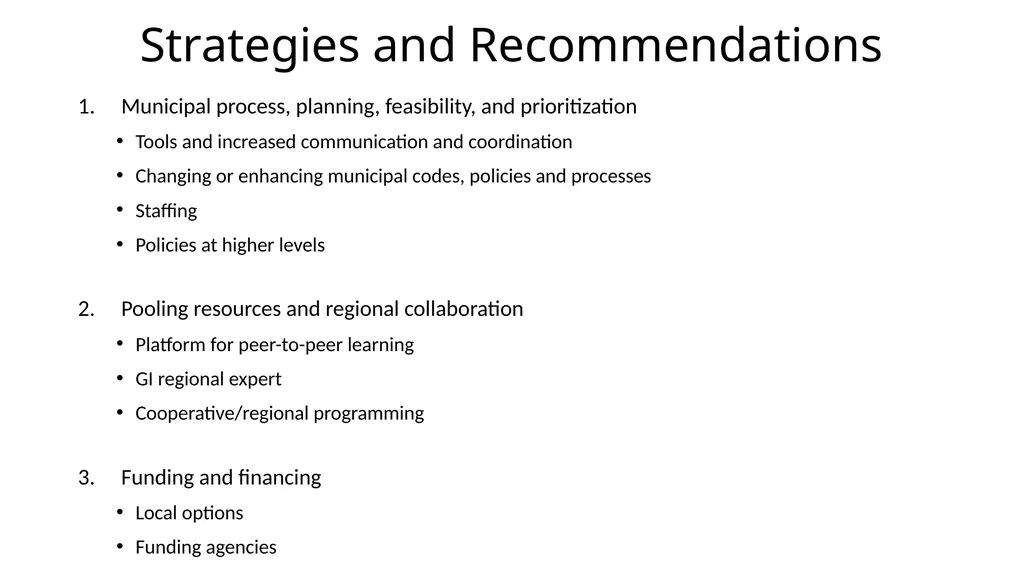
slide18. Strategies and Recommendations Municipal process, planning, feasibility, and prioritization
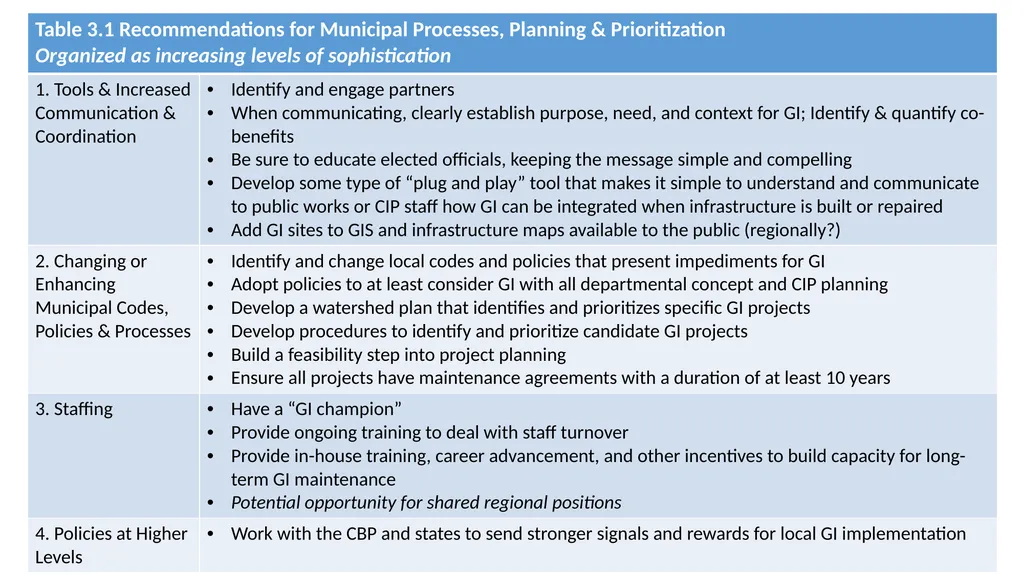
Tools and increased communication and coordination
Changing or enhancing municipal codes, policies and processes
Staffing
Policies at higher levels
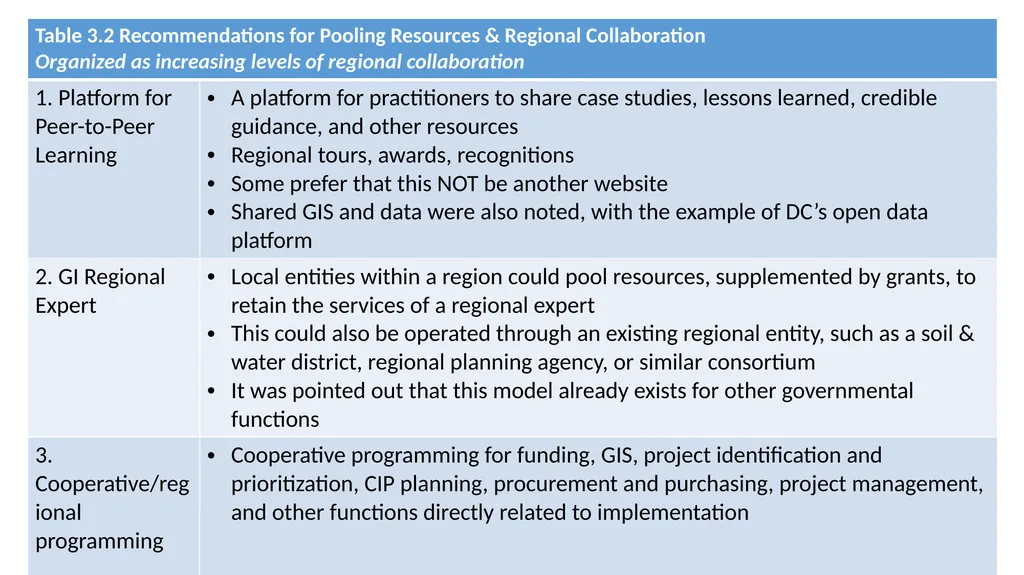
Pooling resources and regional collaboration
Platform for peer-to-peer learning
GI regional expert
Cooperative/regional programming
Funding and financing
Local options
Funding agencies<br>
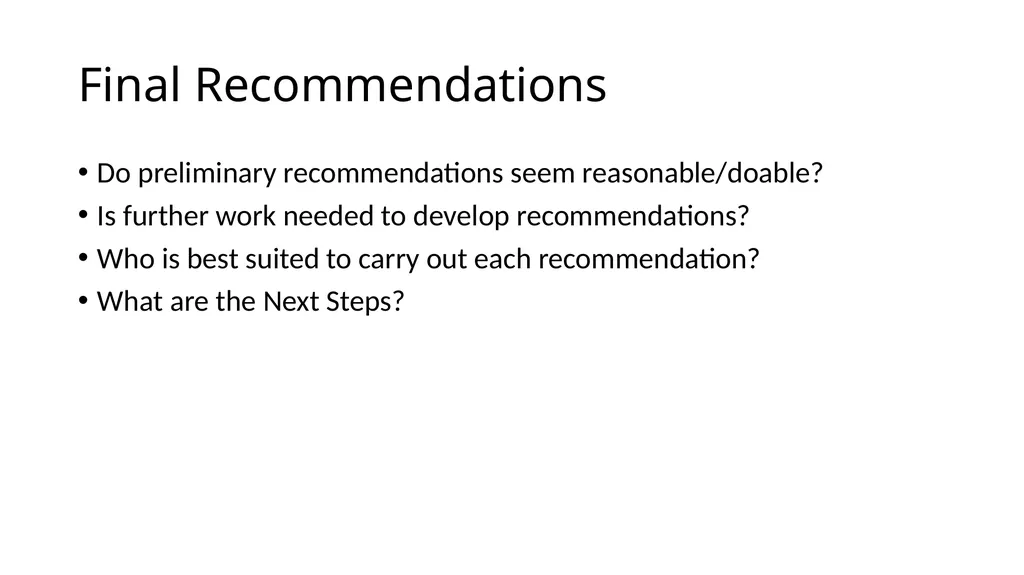
slide22. Final Recommendations Do preliminary recommendations seem reasonable/doable?
Is further work needed to develop recommendations?
Who is best suited to carry out each recommendation?
What are the Next Steps?<br>
Alliance for the Chesapeake Bay
Hirschman Water & Environment, LLC<br>
slide2. Planning Team’s Observations: Capital projects rarely address (or even consider opportunities to address) water quality goals.
The stars need to align for administration, procurement, funding, plan review, permitting, staffing, and schedules – even for a single project – and we need to implement many of them!
Capital project and stormwater staffs (often in different departments) need to seek mutual opportunities, with guidance from the elected officials.
Additional observations …<br>
slide3. Defining the Issues Local Administration and Management Processes aren’t aligned in a way that facilitates efficient implementation of capital and maintenance projects that incorporate green stormwater infrastructure, e.g. streetscape enhancements.
Funding for capital or maintenance projects that incorporate green infrastructure generally comes from multiple sources, driving up administrative costs and resulting in scheduling conflicts that can jeopardize project implementation.
Additional issues …<br>
slide4. Preliminary Recommendation Example Issue: Administrative/management processes aren’t aligned
Recommendation – Local goals and policies can be set by elected officials to promote alignment and streamlining. Tools to help local governments align processes would be helpful, including examples from other communities, checklists, etc.
Recommendation – Opportunities for achieving pollutant reduction should be considered at the front end when developing capital project plans (as an automatic step). Systems to prioritize the best projects can be developed. Provide training on capital improvement planning.<br>
slide5. Preliminary Recommendation Example Issue: Inability to secure funding for green infrastructure results in elimination of GI from capital project.
Recommendation – Secure dedicated funding to cover cost of GI in capital projects. Additional discussion is needed to determine if change is feasible. Options for securing dedicated funding include: 1) Work with funders to develop preferential funding criteria; 2) establish stormwater fees that could be dedicated to implementing the highest priority GI projects.<br>
slide6. Final Recommendation Example Issue: Administrative/management processes aren’t aligned
Recommendation – Opportunities for achieving pollutant reduction should be considered when developing capital project plans. Revised as follows: Capital Improvement Plans should be used to maximize benefits achieved from allocation of resources. Capital project planning guidance and tools should include an evaluation of opportunities for achieving pollutant reduction. Change is possible at the local government and state level. Training on Capital Improvement Planning should be provided to local governments. Goal is to increase the number of communities that develop and adopt CIPs that include an evaluation of opportunities to incorporate green infrastructure.
The American Planning Association is best suited to carry out this recommendation. Other potential partners include the Government Finance Officers Association.
Next steps: Contact American Planning Association to explore current CIP Training Materials and Programs.<br>
slide7. Issues That Apply to the Entire Stormwater Universe Maintenance
Standards for Design, Plants, etc.
Technical expertise in design, construction, maintenance
Politics, resources at larger scales
Regulatory Drivers, BMP crediting, TMDL
OUR ASSUMPTION OF THE STARTING POINTFOR THE AFTERNOON:
Want GI (whatever it is); want better integration/streamlining
Looking for specific process and integration solutions<br>
slide8. Sheridan Room – Lots of Burning Issues Dig Once, Dig Again & Again, OR Don’t Dig at All, DIG?: Integration = more partners & processes = complexity, uncertain timelines; WHAT’S THE SWEET SPOT?
Leveraging Multiple Financing/Funding Strategies: What is proper role for grants & loans, bonds, financing, etc.: timing, pay for feasibility? NOT ongoing maintenance, wean localities off of grants to loans & other sources
Overcoming Obstacles With GI; Is There A Better Way to Make Best Use of Funds?: Planning & prioritization, co-benefits; what are good tools (GIS, policies, checklists, etc.) and is there good access to the tools, breaking down silos; strive for BEST USE OF FUNDS
Commitment: Institutionalizing COMMITMENT: state down to local
Critical Mass: Beyond Town-By-Town approach, regional programs, peer-to-peer learning, dealing with turnover to staff & elected officials<br>
slide9. Preliminary Recommendations What Needs to be Changed?
Is Change Feasible?
What is Needed to Facilitate Change?<br>
slide10. Preliminary Recommendations: Critical Mass Collaboration among localities:
Authority to collaborate from state; cooperative purchasing; allow economies of scale. Partners: CB Commission, WASHCOG, U.S. Communities (cooperative purchasing), Chesapeake Legal Alliance
Existing success stories; developing models; what was spark behind collaboration. Partners: Upper Susquehanna Coalition, IMLA (model codes), NARC
Resources for cost/benefit analysis (acting alone vs. collaborative). Partners: Inspector General’s Office (VA), EFC, Assoc of PDCs (VA)
Coordinator as single point of contact within region; regional capital improvement planning. GFOA, APA
Political momentum
Political expectations, similar to flooding, water supply (need to do regionally)
Educating constituents; taxpayer/ratepayer buy-in<br>
slide11. Preliminary Recommendations: Obstacles Pilot on public property, share experiences & case studies (including problems/failures) through checklist – program to pilot a program. Then scale up. Chesapeake Water Environment Assoc., APWA state chapters,
Standardize data (GIS and other) & make accessible. ESRI, DC open data platform<br>
slide12. Preliminary Recommendations: Commitment What needs to change: Buy in at state, federal, local levels & partnership vs. top-down mandate
Facilitating change:
Messaging from states to localities that explain benefits: health, daily lives, jobs – buy-in & relevance (engage health community). Bay Program, CBFN, Bay Commission
Providing training from state to locals & educating state staff about how to interact with locals. Municipal associations, state chapters, MPOs, training modules for locals, certified public manager programs
States leading by example: tours, etc.
Guidance on codifying changes to strengthen GI
Adding GI to locality infrastructure maps
Ongoing training: GI, stormwater – deal with turnover of staff, elected officials. KEY PEOPLE: City manager, PW Director (get to ICMA, APWA, etc.)<br>
slide13. Preliminary Recommendations: Dig What needs to change: Integrate proper GI practices into every organization concept planning (programmatic) so GI becomes new standard. Not mandate GI with EVERY project, but make sure program allows consideration of GI. Lump with other group on CIP planning
Facilitating change:
Improved communications EARLY in process to integrate stormwater piece, e.g., roadway, new library, etc. Engage public utility commissions. Need to have someone advocating for this (champion).
Where, what, when, why,
Clearinghouse of projects, deadline for getting projects into hopper<br>
slide14. Preliminary Recommendations: Funding Incentivize integrated CIPs that include GI (pre-requisite for funding, or ID funding sources to do the planning). This is intended to address the issues with timing of grants and other issues that are due to lack of long-term planning.
ID funding strategy for implementation – DOT, revolving loans, local utility fees. Can’t rely on grants alone
Toolkits, case studies of financing (already out there)
Coordination between funding agencies (Bay Funders Network)
Business investment open door to federal $, such as HUD
www.gfoa.org ; they also provide some technical assistance
Weight grants to award higher points for projects that have GI (DOT Tiger, PA Parks)
Award or recognition for communities that have taken risk of integrating GI, maybe taken loan<br>
slide15. Problem Statement Only recently has stormwater infrastructure (e.g., pipes, inlets, quality and quantity treatment practices) begun to be considered a full part of municipal infrastructure, alongside roads, water lines, sewer, utilities (gas, electric), etc. This recognition of stormwater infrastructure is quite variable among Chesapeake Bay localities. However, as communities across the watershed face the challenge of complying with MS4 permits and TMDL plans, significant capital investments in stormwater infrastructure will be required. One option to address these challenges is to integrate stormwater infrastructure (especially green infrastructure) with other capital projects for roads, utilities, parks, schools, and other projects in order to streamline the process and achieve more cost-effective solutions. However, before this approach can be successful, administrative, procurement, funding and financing, staffing, and operational systems need to be adapted to optimize the process.<br>
slide16. Representation of 52 Workshop Attendees<br>
slide17. Issues Identified by Participants Funding & Financing
Qualified Personnel & Available Guidance
Municipal Processes & Commitment
Planning, Prioritizing & Feasibility
Regional Collaboration & Peer-to-Peer Networking<br>
slide18. Strategies and Recommendations Municipal process, planning, feasibility, and prioritization
Tools and increased communication and coordination
Changing or enhancing municipal codes, policies and processes
Staffing
Policies at higher levels
Pooling resources and regional collaboration
Platform for peer-to-peer learning
GI regional expert
Cooperative/regional programming
Funding and financing
Local options
Funding agencies<br>
slide22. Final Recommendations Do preliminary recommendations seem reasonable/doable?
Is further work needed to develop recommendations?
Who is best suited to carry out each recommendation?
What are the Next Steps?<br>