
STRUCTURALISM AS A METHOD OF LITERARY CRITICISM.
DP
Published · 23 slides · 0 views

1 / 1






Description
STRUCTURALISM AS A METHOD OF LITERARY CRITICISM. BY- ISIAHA SMITHSON What is Structuralism? One of the most influential intellectual movements in the twentieth century which embraces a wide variety of intellectual
Related Topics
Share
Embed code
Download this presentation From Below
"STRUCTURALISM AS A METHOD OF LITERARY CRITICISM." is the property of its rightful owner. Permission is granted to download and print the materials on this website for personal, non-commercial use only, and to display it on your personal computer provided you do not modify the materials and that you retain all copyright notices contained in the materials. By downloading content from our website, you accept the terms of this agreement.
Presentation Transcript
01
STRUCTURALISM AS A METHOD OF LITERARY CRITICISM. BY- ISIAHA SMITHSON<br>
02
What is Structuralism? One of the most influential intellectual movements in the twentieth century which embraces a wide variety of intellectual disciplines.”Linguistics”,”Aesthetics”,”Anthropology”,”Sociology”,”Psychoanalysis”.
Aims to analyse isolated events or meanings in terms of their underlying structural laws.
Looks for the deep and other hidden structures beneath the surface manifestations of meaning<br>
Aims to analyse isolated events or meanings in terms of their underlying structural laws.
Looks for the deep and other hidden structures beneath the surface manifestations of meaning<br>
03
Introduction Structuralism is a current of knowledge in which everything human beings say ,do ,think ,or feel is due to a structure of underlying common rules.
Several approaches strive to understand the rules that govern human thought and action. Structualism is one of the most significant ones.<br>
Several approaches strive to understand the rules that govern human thought and action. Structualism is one of the most significant ones.<br>
04
The Definition of Structuralism Structuralism ,is a way of perceiving the world in terms of structures.
First seen in the works of the anthropologist Claude Levi Strauss and the literary critic Roland Barthes ,the essence of Structuralism is the belief that “things cannot be understood in isolation, they have to be seen in the context of larger structures they are part of”<br>
First seen in the works of the anthropologist Claude Levi Strauss and the literary critic Roland Barthes ,the essence of Structuralism is the belief that “things cannot be understood in isolation, they have to be seen in the context of larger structures they are part of”<br>
05
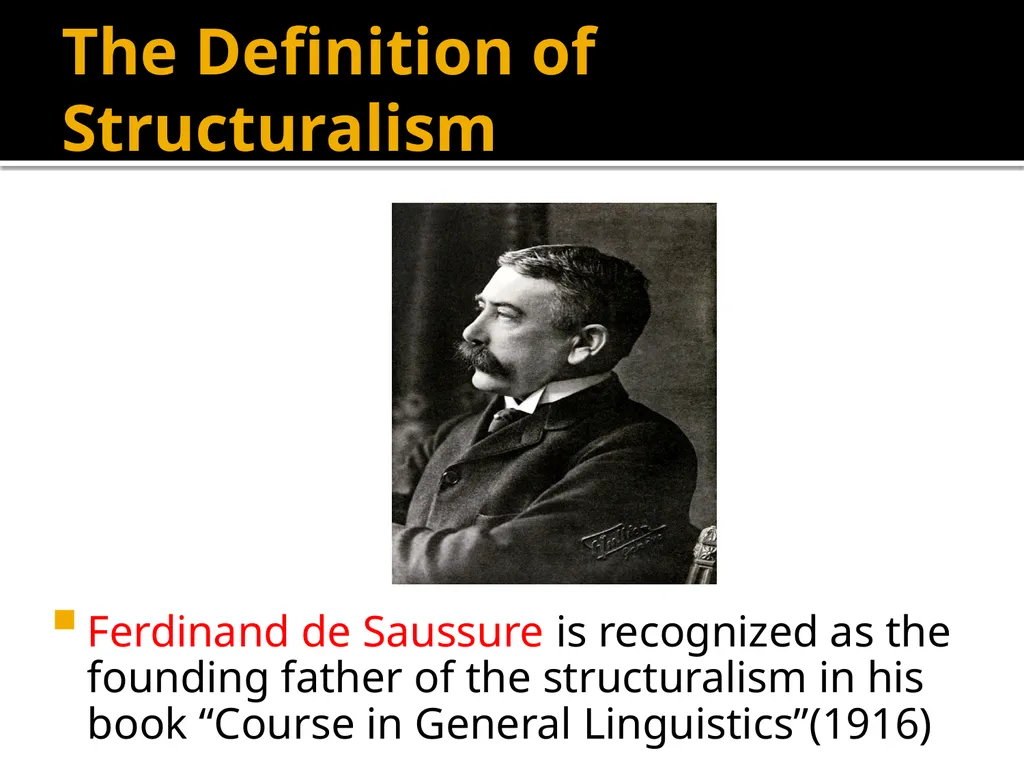
The Definition of Structuralism Ferdinand de Saussure is recognized as the founding father of the structuralism in his book “Course in General Linguistics”(1916)<br>
06
The full significance of any entity cannot be perceived unless it is integrated into the structure of which it forms a part .
STRUCTURALISM as a mode of literary criticism consistently encounter two problems.
The diversity of approaches actually included under this term is immense. Because of this, it is difficult to discern the basic assumptions that underlie and define the structuralist approach.<br>
STRUCTURALISM as a mode of literary criticism consistently encounter two problems.
The diversity of approaches actually included under this term is immense. Because of this, it is difficult to discern the basic assumptions that underlie and define the structuralist approach.<br>
07
Second, since structuralism has its origins primarily in the physical and social sciences, it is necessarily the case that, even if its essential principles can be deduced, they will be expressed in a terminology and context that makes their applicability to literary criticism obscure and even doubtful.<br>
08
it is possible to determine a few fundamental assumptions that are shared by almost all varieties of structuralism, and to illustrate, or at least suggest, their relevance to literary criticism. Accordingly, using the theories of Jean Piaget, Claude L6vi-Strauss, Michael Lane, and Roland Barthes,
a discussion of what appear to be four defining principles of structuralism, then briefly consider a few supposed and real disadvantages of the method as a means of literary criticism, and conclude with an actual structuralist analysis that illustrates the concepts involved in, and the advantages of, the approach. P<br>
a discussion of what appear to be four defining principles of structuralism, then briefly consider a few supposed and real disadvantages of the method as a means of literary criticism, and conclude with an actual structuralist analysis that illustrates the concepts involved in, and the advantages of, the approach. P<br>
09
Women In Love (1920) is a novel by D.H Lawrence
Ursula and Gudrun Brangwen are sisters living in The Midlands in England in the 1910s. Ursula is a schoolteacher, Gudrun a painter. They meet two men who live nearby, school inspector Rupert Birkin and Gerald Crich, heir to a coal mine, and the four become friends. Romantic relationships quickly develop as the novel progresses.<br>
Ursula and Gudrun Brangwen are sisters living in The Midlands in England in the 1910s. Ursula is a schoolteacher, Gudrun a painter. They meet two men who live nearby, school inspector Rupert Birkin and Gerald Crich, heir to a coal mine, and the four become friends. Romantic relationships quickly develop as the novel progresses.<br>
10
All four are deeply concerned with questions of society, politics, and the relationship between men and women. At a party at Shortlands, the Birkin's country manor home, Gerald's sister Diana drowns. Gudrun becomes the teacher and mentor of Gerald's youngest sister. Soon, Gerald's coal-mine-owning father dies as well, after a long illness. After the funeral, Gerald goes to Gudrun's house and spends the night with her while her parents sleep in another room.
Birkin asks Ursula to marry him, and she agrees. Gerald and Gudrun's relationship, however, becomes stormy.<br>
Birkin asks Ursula to marry him, and she agrees. Gerald and Gudrun's relationship, however, becomes stormy.<br>
11
The two couples take a holiday together in the Austrian Alps. Gudrun begins an intense friendship with Loerke.
Gerald, enraged by Loerke and most of all by Gudrun's verbal abuse and rejection of his manhood, and driven by his own internal violence, tries to strangle Gudrun. He suddenly becomes disgusted with his actions and lets her go, and he leaves Gudrun and Loerke to climb the mountain eventually slipping into a snowy valley where he falls asleep and freezes to death.<br>
Gerald, enraged by Loerke and most of all by Gudrun's verbal abuse and rejection of his manhood, and driven by his own internal violence, tries to strangle Gudrun. He suddenly becomes disgusted with his actions and lets her go, and he leaves Gudrun and Loerke to climb the mountain eventually slipping into a snowy valley where he falls asleep and freezes to death.<br>
12
One can see, for example, that a whole novel or poem would be a system in the sense defined above. One can also see that smaller units within the total work would also qualify as systems:
the various male/female relationships in Lawrence's Women in Love (Birkin and Ursula, Birkin and Hermione, Gerald and Gudrun, and Gudrun and Loerke) are obvious examples of separate variations of one recognizable structure. the various male/female relationships in Lawrence's Women in Love (Birkin and Ursula, Birkin and Hermione, Gerald and Gudrun, and Gudrun and Loerke) are obvious examples of separate variations of one recognizable structure<br>
the various male/female relationships in Lawrence's Women in Love (Birkin and Ursula, Birkin and Hermione, Gerald and Gudrun, and Gudrun and Loerke) are obvious examples of separate variations of one recognizable structure. the various male/female relationships in Lawrence's Women in Love (Birkin and Ursula, Birkin and Hermione, Gerald and Gudrun, and Gudrun and Loerke) are obvious examples of separate variations of one recognizable structure<br>
13
Iris Murdoch’s novel A Severed Head (1961) is an example of convoluted relationships that may appear hilarious upon superficial analysis
The most mysterious female protagonist, the sexually ambivalent Honor Klein, deploys a wide range of possible interpretations. Honor’s powerful figure is like an axis around which the rest of the characters rotate and without whom the plot would fall apart.<br>
The most mysterious female protagonist, the sexually ambivalent Honor Klein, deploys a wide range of possible interpretations. Honor’s powerful figure is like an axis around which the rest of the characters rotate and without whom the plot would fall apart.<br>
14
Honor Klein is a force, is suspicion, and fear, and seems to be an external projection of Martin’s subconscious imaginary fears and trauma. She has a similar narrative function as Shakespeare‘s ghosts in, e.g., Macbeth , Hamlet and Julius Caesar .
One could, for example, identify Honor Klein of Iris Murdoch's A Severed Head as being of the structure of the Terrible Mother. One could then analyze the transformed elements that emerge as one compares the appearance of the Terrible Mother in myth with that of Honor Klein in the novel.<br>
One could, for example, identify Honor Klein of Iris Murdoch's A Severed Head as being of the structure of the Terrible Mother. One could then analyze the transformed elements that emerge as one compares the appearance of the Terrible Mother in myth with that of Honor Klein in the novel.<br>
15
lane says, "Probably the most distinctive feature of the structuralist method is the emphasis it gives to wholes, to totalities. . . . a new importance has been given to the logical priority of the whole over its parts.
"it is neither the elements nor a whole . . . , but the relations among elements that count. In other words, the logical procedures or natural processes by which the whole is formed are primary, not the whole . .. or the elements" (Piaget, pp. 8-9
If one can, for example, grasp the set of relations that holds among several novels of a particular type (categories such as "Bildungsroman," first person narrative, and Naturalistic), if one can see the relations that obtain among the several elements of a single novel, or if one can define the relations existing between a mythic and a novelistic expression of the same structure, or existing among the elements of that structure as it appears in the novel alone, one will, sometimes simply by a process of comparative morphology, perceive things imperceptible without the structuralist method<br>
"it is neither the elements nor a whole . . . , but the relations among elements that count. In other words, the logical procedures or natural processes by which the whole is formed are primary, not the whole . .. or the elements" (Piaget, pp. 8-9
If one can, for example, grasp the set of relations that holds among several novels of a particular type (categories such as "Bildungsroman," first person narrative, and Naturalistic), if one can see the relations that obtain among the several elements of a single novel, or if one can define the relations existing between a mythic and a novelistic expression of the same structure, or existing among the elements of that structure as it appears in the novel alone, one will, sometimes simply by a process of comparative morphology, perceive things imperceptible without the structuralist method<br>
16
Synchronic and Diachronic Distinction The relevance of the synchronic/diachronic distinction to literary criticism is easy to illustrate; the appropriateness of the so-called laws of transformation is not.
To view Women in Love as the presentation of Birkin's spiritual development through time, the specific phases in his development and their causes being considered essential, is to see the novel diachronically.<br>
To view Women in Love as the presentation of Birkin's spiritual development through time, the specific phases in his development and their causes being considered essential, is to see the novel diachronically.<br>
17
But to isolate the four main couples as the structural principle of the novel is to view the work synchronously
clearly, one's understanding of this novel, or of any work, will differ greatly according to whether one approaches it diachronically or synchronously.<br>
clearly, one's understanding of this novel, or of any work, will differ greatly according to whether one approaches it diachronically or synchronously.<br>
18
Structures exist below the Surface. This description of structuralism in terms of dissection and articulation is helpfully suggestive. To dissect a work of art in order to determine its structures is to delve "below the surface" of the work.
The "simulacrum" that is the result of the structural analysis will be a description of structures that exists only at a great"depth," and which cannot be uncovered without the application of the structuralist method.<br>
The "simulacrum" that is the result of the structural analysis will be a description of structures that exists only at a great"depth," and which cannot be uncovered without the application of the structuralist method.<br>
19
As for the fourth condition, that the systems are "built by the mind on the level of unconscious thought," it would seem that this must hold simply because the third condition does.
Thus, what" is being said about this fourth defining principle is perhaps closer to "wish" than fact. But it is worth exploring.
structuralism seeks not only to elucidate the work itself and the structural parallels among various literary works, but also to relate the literary structures to structures existing in the nonliterary realm, and to elucidate those related structures in terms of the literary structures<br>
Thus, what" is being said about this fourth defining principle is perhaps closer to "wish" than fact. But it is worth exploring.
structuralism seeks not only to elucidate the work itself and the structural parallels among various literary works, but also to relate the literary structures to structures existing in the nonliterary realm, and to elucidate those related structures in terms of the literary structures<br>
20
Inadequacies Levi-Strauss's supposition that there is a given relationship among all types of structures determined by the structuring capacity of the mind itself, that can never be proven or disprove.
different structuralists find different structures in the same work.
Structuralsim, in so far as it is a method of literary criticism, is not and never will be a science.<br>
different structuralists find different structures in the same work.
Structuralsim, in so far as it is a method of literary criticism, is not and never will be a science.<br>
21
L6vi-Strauss, in an interview, expresses the problem: "Instead of searching methodically for the real meaning behind consciously elaborated metaphors, people believed they could use it [structuralism] as a pretext for indefinitely substituting one set of metaphors for another. That gave birth to what I would call a 'structuralism-fiction.
Structuralsim, in so far as it is a method of literary criticism, is not and never will be a science. Literature for obvious reasons, will not yield to a scientific approach.<br>
Structuralsim, in so far as it is a method of literary criticism, is not and never will be a science. Literature for obvious reasons, will not yield to a scientific approach.<br>
22
The Rainbow tells the story of three generations of the Brangwen family, a dynasty of farmers and craftsmen who live in the east Midlands of England, on the borders of Nottinghamshire and Derbyshire. The book spans a period of roughly 65 years from the 1840s to 1905, and shows how the love relationships of the Brangwens change against the backdrop of the increasing industrialisation of Britain. The first central character, Tom Brangwen, is a farmer whose experience of the world does not stretch beyond these two counties; while the last, Ursula, his granddaughter, studies at university and becomes a teacher in the progressively urbanised, capitalist and industrial world.<br>
23
e book starts with a description of the Brangwen dynasty, then deals with how Tom Brangwen, one of several brothers, fell in love with a Polish refugee and widow, Lydia. The next part of the book deals with Lydia's daughter by her first husband, Anna, and her destructive, battle-riven relationship with her husband, Will, the son of one of Tom's brothers. The last and most extended part of the book, and also probably the most famous, then deals with Will and Anna's daughter, Ursula, and her struggle to find fulfilment for her passionate, spiritual and sensual nature against the confines of the increasingly materialist and conformist society around her. She experiences a same-sex relationship with a teacher, and a passionate but ultimately doomed love affair with Anton Skrebensky, a British soldier of Polish ancestry. At the end of the book, having failed to find her fulfilment in Skrebensky, she has a vision of a rainbow towering over the Earth, promising a new dawn for humanity:<br>
24
In Lawrence's The Rainbow, the principal structure that underlies the novel is that of the various male/female conflicts
In Lawrence's The Rainbow, the principal structure that underlies the novel is that of the various male/female conflicts<br>
In Lawrence's The Rainbow, the principal structure that underlies the novel is that of the various male/female conflicts<br>