Structure and function of Ecosystem An Ecosystem was defined by A.G Tansley in 1935 as a unit of interaction between the living and non-living components of the environment. It is the structural and functional unit of ecology. Structure
"Structure and function of Ecosystem An Ecosystem" is the property of its rightful owner. Permission is granted to
download and print the materials on this website for personal, non-commercial use only, and to display it
on your personal computer provided you do not modify the materials and that you retain all copyright
notices contained in the materials. By downloading content from our website, you accept the terms of this
agreement.
Presentation Transcript
01
Structure and function of Ecosystem<br>
02
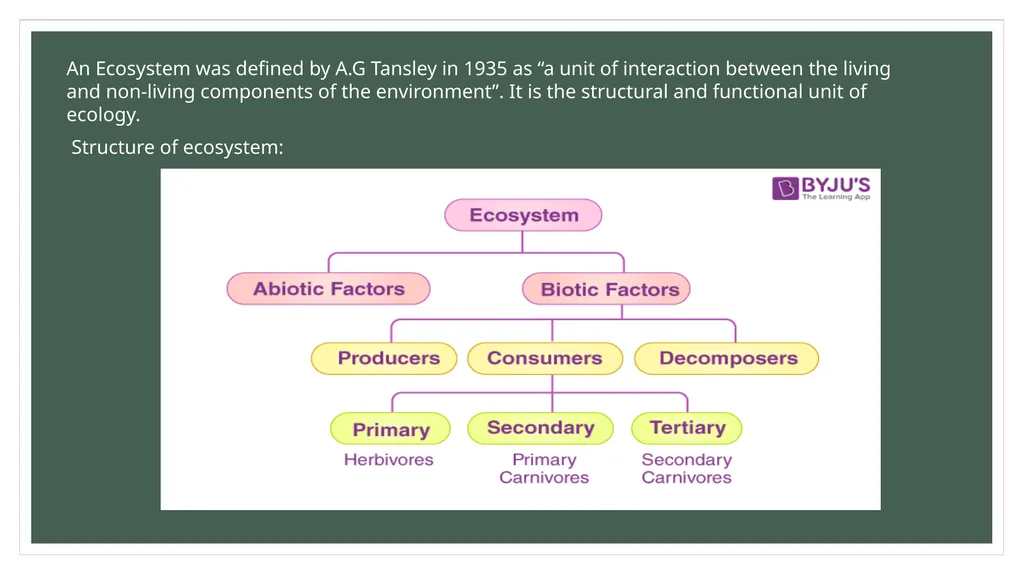
An Ecosystem was defined by A.G Tansley in 1935 as “a unit of interaction between the living and non-living components of the environment”. It is the structural and functional unit of ecology.
Structure of ecosystem:<br>
03
1. Abiotic component of ecosystem:
It consists of non living substances and factors.
A large number of minerals which are required by the organisms for their proper growth eg, calcium, sodium, potassium, nitrogen, etc. the deficiency of any one of these minerals results in abnormal growth and may lead to even death.
climatic factors like rain water, carbon dioxide, temperature, light, wind, humidity, etc.<br>
04
2. Biotic components.:
The living organism like plants, animals and micro organisms present in the ecosystem are called biotic component. They are classified into 3 main groups:
Producer (autotrophs): they are photosynthetic plants, bacteria and algae. They convert solar energy into chemical energy by the chlorophyll present in them. As the green plants manufacture their own food they are known as autotrophs.<br>
05
(b) Consumers (heterotrophs): they are animals which cannot manufacture their own food. They obtain their food from plants or other animals for their survival. Consumers are of 4 types:
primary consumers (herbivore): the animals which obtain their food from green plants. Eg: deer, cow, rabbit etc.
Secondary consumer (primary carnivore): the animals which live on the flesh of the primary consumers .Eg: birds, fox, frogs ,etc
Tertiary consumers (secondary carnivore): these are the large carnivores which eat the flesh of secondary consumers. Eg: wolves, peacock, fishes, etc.
(iv) Top carnivore: these are the largest carnivores, which eats the flesh of the tertiary consumers and cant be eaten up by any other animals. Eg: lion , tiger, vulture.<br>
06
c) Decomposers (reducers): small animals like bacteria, fungi, insects and worms act as decomposers. They breakdown the dead organic materials of producers and consumers into simpler and smaller particles and release the simple substances as by-products that are used by plants as nutrition. They are called reducers because they are also able to degrade or remove the dead bodies of organisms.<br>
07
Functions of ecosystem:
The functions of the ecosystem are as follows:
It regulates the essential ecological processes, supports life systems and renders stability.
It is also responsible for the cycling of nutrients between biotic and abiotic components.
It maintains a balance among the various trophic levels in the ecosystem.
It cycles the minerals through the biosphere.
The abiotic components help in the synthesis of organic components that involve the exchange of energy.<br>