
Student Residency Classification Overview and
JO
Published · 43 slides · 0 views
1 / 1




Description
Student Residency Classification Overview and Current Updates Natalie Wagner, CCC Chancellors Office Rafael Artiga Meza, CCC Chancellors Office CACCRAO Annual Conference Monday, March 30, 2026 1 Agenda Update on Student Residency
Related Topics
Share
Embed code
Download this presentation From Below
"Student Residency Classification Overview and" is the property of its rightful owner. Permission is granted to download and print the materials on this website for personal, non-commercial use only, and to display it on your personal computer provided you do not modify the materials and that you retain all copyright notices contained in the materials. By downloading content from our website, you accept the terms of this agreement.
Presentation Transcript
01
Student Residency Classification
Overview and Current Updates
Natalie Wagner, CCC Chancellor’s Office
Rafael Artiga Meza, CCC Chancellor’s Office CACCRAO Annual Conference – Monday, March 30, 2026 1<br>
02
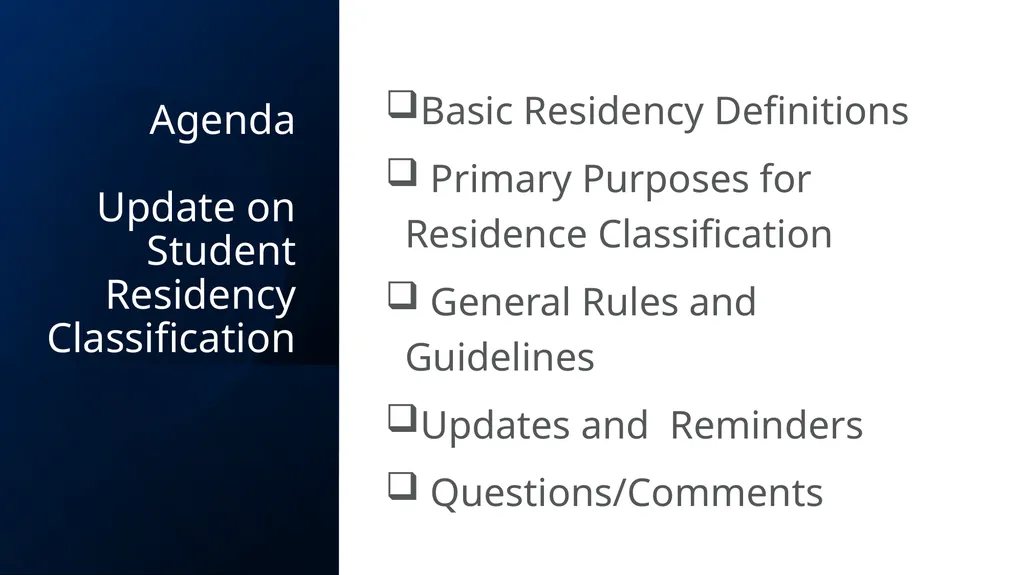
Agenda
Update on Student Residency Classification Basic Residency Definitions
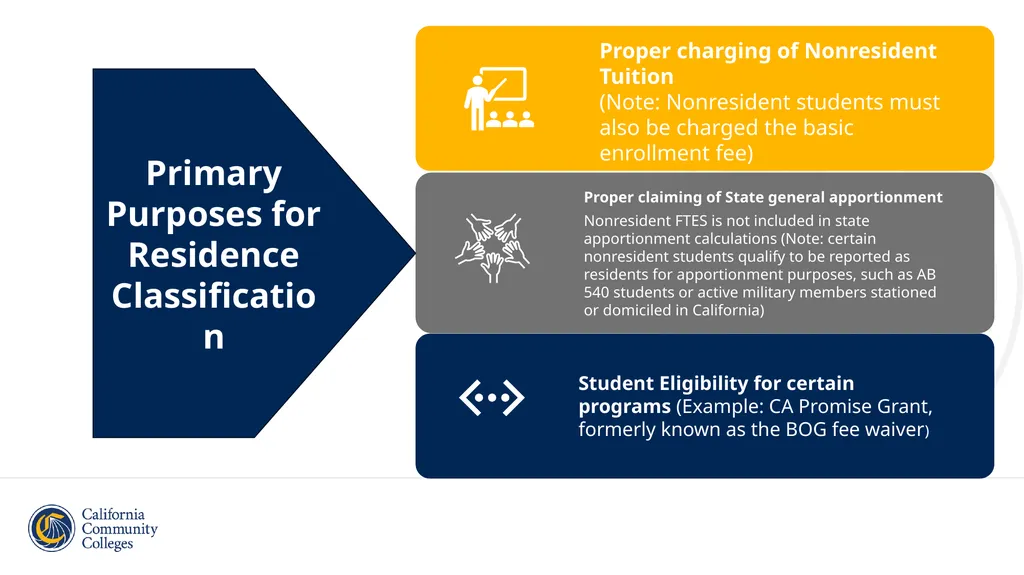
Primary Purposes for Residence Classification
General Rules and Guidelines
Updates and Reminders
Questions/Comments<br>
Primary Purposes for Residence Classification
General Rules and Guidelines
Updates and Reminders
Questions/Comments<br>
03
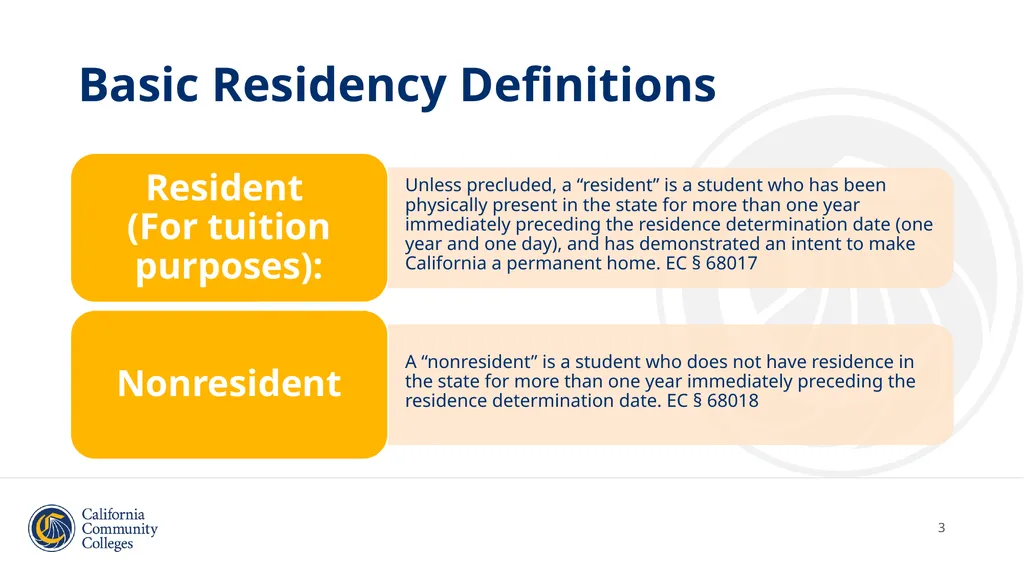
Basic Residency Definitions 3<br>
04
Basic Residency Definitions Residence:
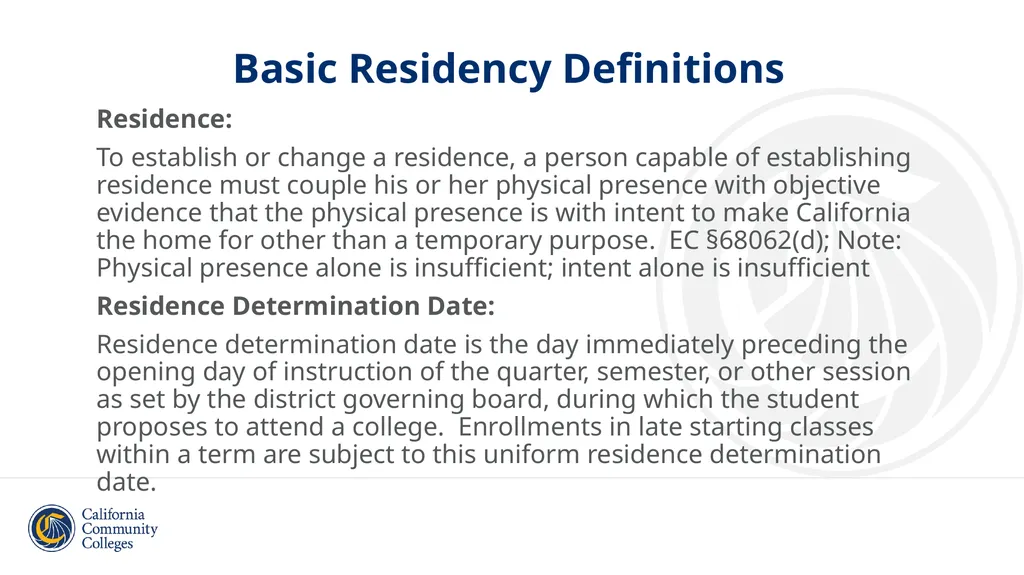
To establish or change a residence, a person capable of establishing residence must couple his or her physical presence with objective evidence that the physical presence is with intent to make California the home for other than a temporary purpose. EC §68062(d); Note: Physical presence alone is insufficient; intent alone is insufficient
Residence Determination Date:
Residence determination date is the day immediately preceding the opening day of instruction of the quarter, semester, or other session as set by the district governing board, during which the student proposes to attend a college. Enrollments in late starting classes within a term are subject to this uniform residence determination date.<br>
To establish or change a residence, a person capable of establishing residence must couple his or her physical presence with objective evidence that the physical presence is with intent to make California the home for other than a temporary purpose. EC §68062(d); Note: Physical presence alone is insufficient; intent alone is insufficient
Residence Determination Date:
Residence determination date is the day immediately preceding the opening day of instruction of the quarter, semester, or other session as set by the district governing board, during which the student proposes to attend a college. Enrollments in late starting classes within a term are subject to this uniform residence determination date.<br>
05
Basic Residency Definitions Exceptions to Residence Determination:
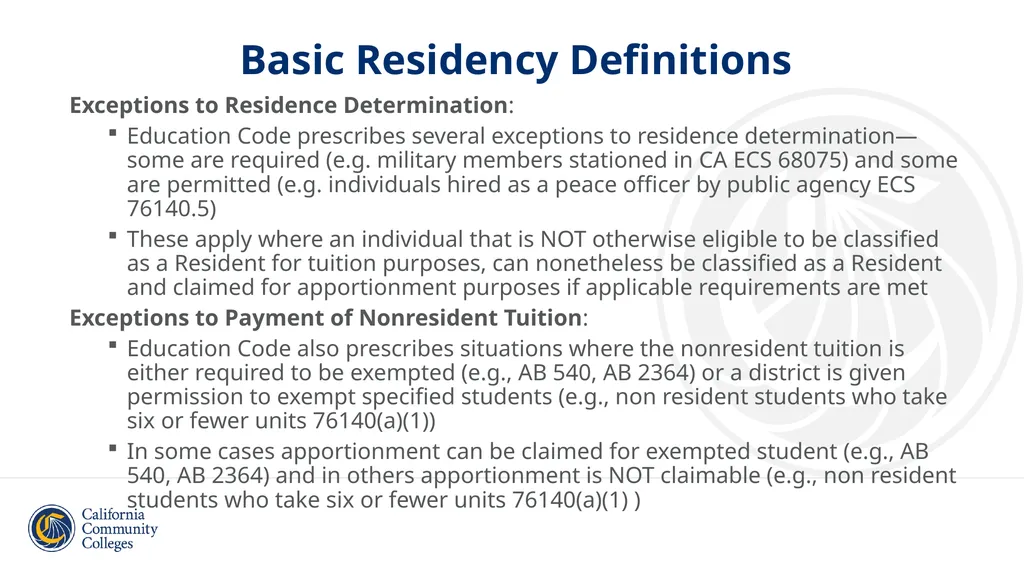
Education Code prescribes several exceptions to residence determination—some are required (e.g. military members stationed in CA ECS 68075) and some are permitted (e.g. individuals hired as a peace officer by public agency ECS 76140.5)
These apply where an individual that is NOT otherwise eligible to be classified as a Resident for tuition purposes, can nonetheless be classified as a Resident and claimed for apportionment purposes if applicable requirements are met
Exceptions to Payment of Nonresident Tuition:
Education Code also prescribes situations where the nonresident tuition is either required to be exempted (e.g., AB 540, AB 2364) or a district is given permission to exempt specified students (e.g., non resident students who take six or fewer units 76140(a)(1))
In some cases apportionment can be claimed for exempted student (e.g., AB 540, AB 2364) and in others apportionment is NOT claimable (e.g., non resident students who take six or fewer units 76140(a)(1) )<br>
Education Code prescribes several exceptions to residence determination—some are required (e.g. military members stationed in CA ECS 68075) and some are permitted (e.g. individuals hired as a peace officer by public agency ECS 76140.5)
These apply where an individual that is NOT otherwise eligible to be classified as a Resident for tuition purposes, can nonetheless be classified as a Resident and claimed for apportionment purposes if applicable requirements are met
Exceptions to Payment of Nonresident Tuition:
Education Code also prescribes situations where the nonresident tuition is either required to be exempted (e.g., AB 540, AB 2364) or a district is given permission to exempt specified students (e.g., non resident students who take six or fewer units 76140(a)(1))
In some cases apportionment can be claimed for exempted student (e.g., AB 540, AB 2364) and in others apportionment is NOT claimable (e.g., non resident students who take six or fewer units 76140(a)(1) )<br>
06
Next Steps for Implementation Primary Purposes for Residence Classification<br>
07
General Rules and Guidelines Residence Classification:
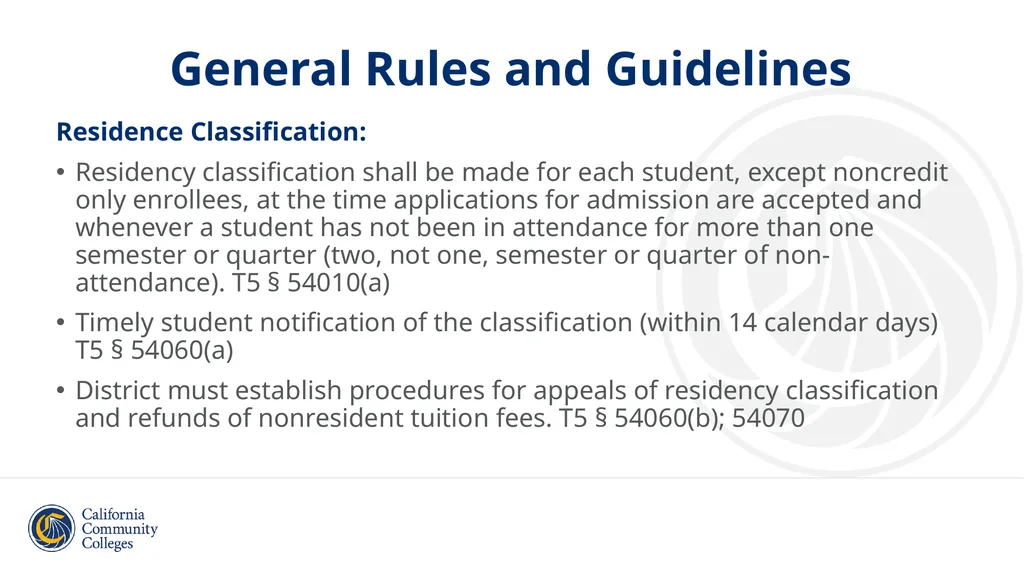
Residency classification shall be made for each student, except noncredit only enrollees, at the time applications for admission are accepted and whenever a student has not been in attendance for more than one semester or quarter (two, not one, semester or quarter of non-attendance). T5 § 54010(a)
Timely student notification of the classification (within 14 calendar days) T5 § 54060(a)
District must establish procedures for appeals of residency classification and refunds of nonresident tuition fees. T5 § 54060(b); 54070<br>
Residency classification shall be made for each student, except noncredit only enrollees, at the time applications for admission are accepted and whenever a student has not been in attendance for more than one semester or quarter (two, not one, semester or quarter of non-attendance). T5 § 54010(a)
Timely student notification of the classification (within 14 calendar days) T5 § 54060(a)
District must establish procedures for appeals of residency classification and refunds of nonresident tuition fees. T5 § 54060(b); 54070<br>
08
General Rules and Guidelines Rules For Determining Residence
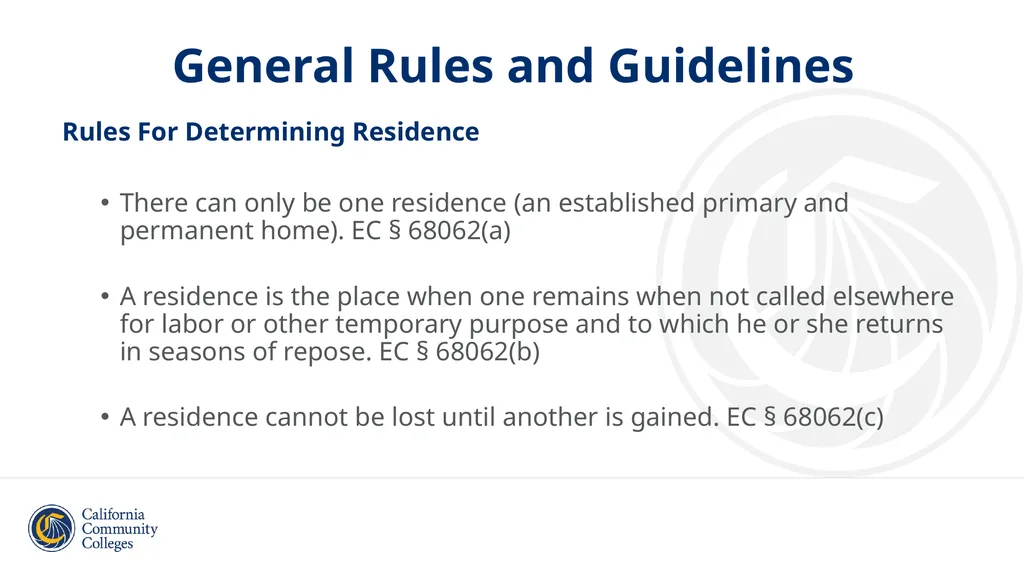
There can only be one residence (an established primary and permanent home). EC § 68062(a)
A residence is the place when one remains when not called elsewhere for labor or other temporary purpose and to which he or she returns in seasons of repose. EC § 68062(b)
A residence cannot be lost until another is gained. EC § 68062(c)<br>
There can only be one residence (an established primary and permanent home). EC § 68062(a)
A residence is the place when one remains when not called elsewhere for labor or other temporary purpose and to which he or she returns in seasons of repose. EC § 68062(b)
A residence cannot be lost until another is gained. EC § 68062(c)<br>
09
General Rules and Guidelines Rules For Determining Residence (Cont.)
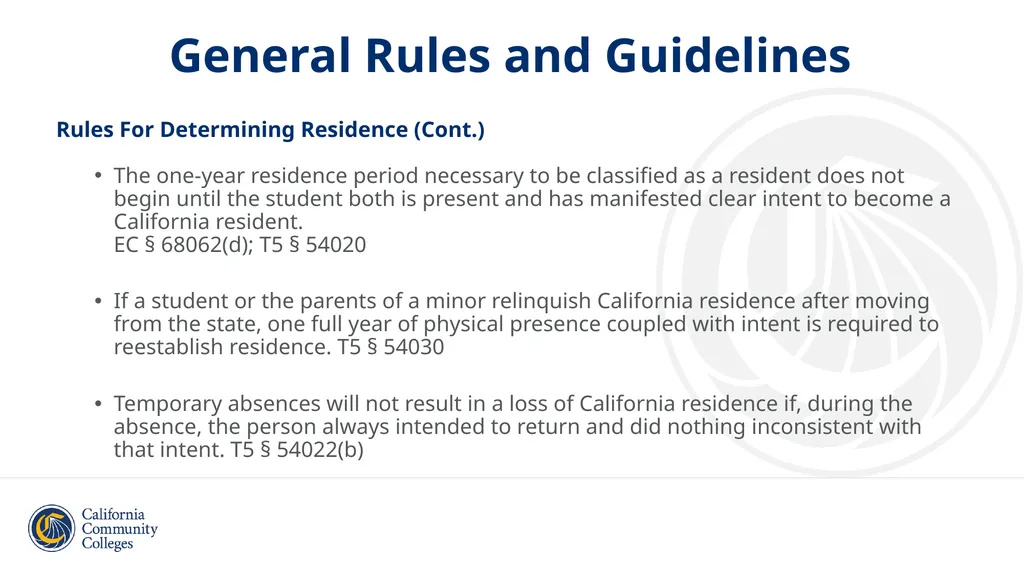
The one-year residence period necessary to be classified as a resident does not begin until the student both is present and has manifested clear intent to become a California resident. EC § 68062(d); T5 § 54020
If a student or the parents of a minor relinquish California residence after moving from the state, one full year of physical presence coupled with intent is required to reestablish residence. T5 § 54030
Temporary absences will not result in a loss of California residence if, during the absence, the person always intended to return and did nothing inconsistent with that intent. T5 § 54022(b)<br>
The one-year residence period necessary to be classified as a resident does not begin until the student both is present and has manifested clear intent to become a California resident. EC § 68062(d); T5 § 54020
If a student or the parents of a minor relinquish California residence after moving from the state, one full year of physical presence coupled with intent is required to reestablish residence. T5 § 54030
Temporary absences will not result in a loss of California residence if, during the absence, the person always intended to return and did nothing inconsistent with that intent. T5 § 54022(b)<br>
10
General Rules and Guidelines Rules For Determining Residence (Cont.)
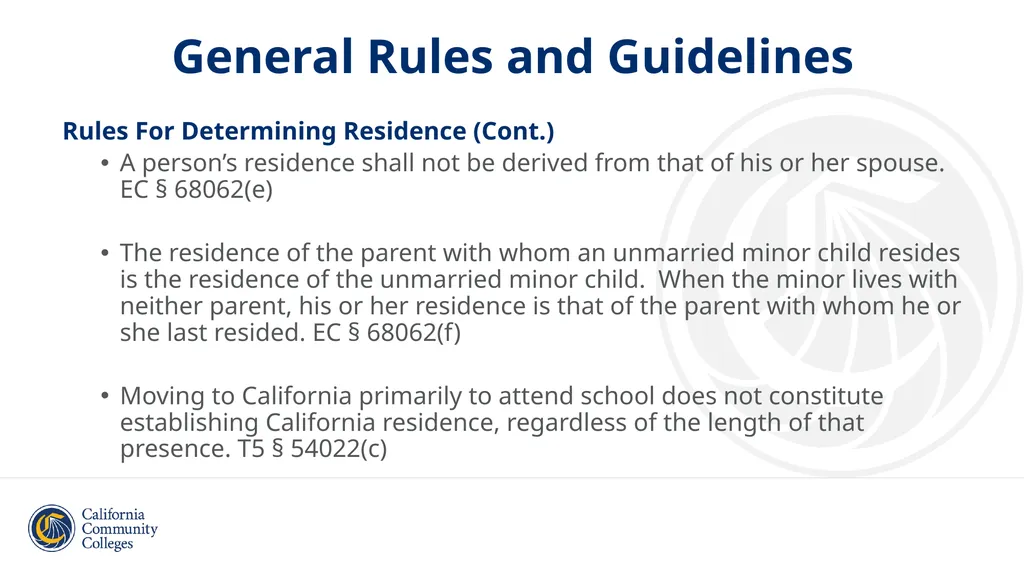
A person’s residence shall not be derived from that of his or her spouse. EC § 68062(e)
The residence of the parent with whom an unmarried minor child resides is the residence of the unmarried minor child. When the minor lives with neither parent, his or her residence is that of the parent with whom he or she last resided. EC § 68062(f)
Moving to California primarily to attend school does not constitute establishing California residence, regardless of the length of that presence. T5 § 54022(c)<br>
A person’s residence shall not be derived from that of his or her spouse. EC § 68062(e)
The residence of the parent with whom an unmarried minor child resides is the residence of the unmarried minor child. When the minor lives with neither parent, his or her residence is that of the parent with whom he or she last resided. EC § 68062(f)
Moving to California primarily to attend school does not constitute establishing California residence, regardless of the length of that presence. T5 § 54022(c)<br>
11
General Rules and Guidelines Residency Reclassification and Financial Independence:
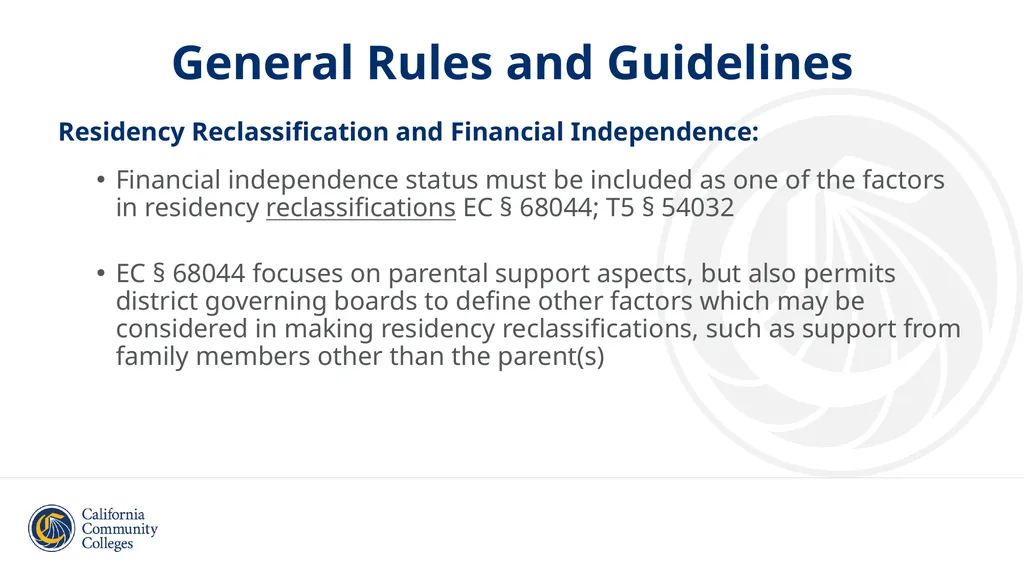
Financial independence status must be included as one of the factors in residency reclassifications EC § 68044; T5 § 54032
EC § 68044 focuses on parental support aspects, but also permits district governing boards to define other factors which may be considered in making residency reclassifications, such as support from family members other than the parent(s)<br>
Financial independence status must be included as one of the factors in residency reclassifications EC § 68044; T5 § 54032
EC § 68044 focuses on parental support aspects, but also permits district governing boards to define other factors which may be considered in making residency reclassifications, such as support from family members other than the parent(s)<br>
12
General Rules and Guidelines Residency Reclassification and Financial Independence (cont.):
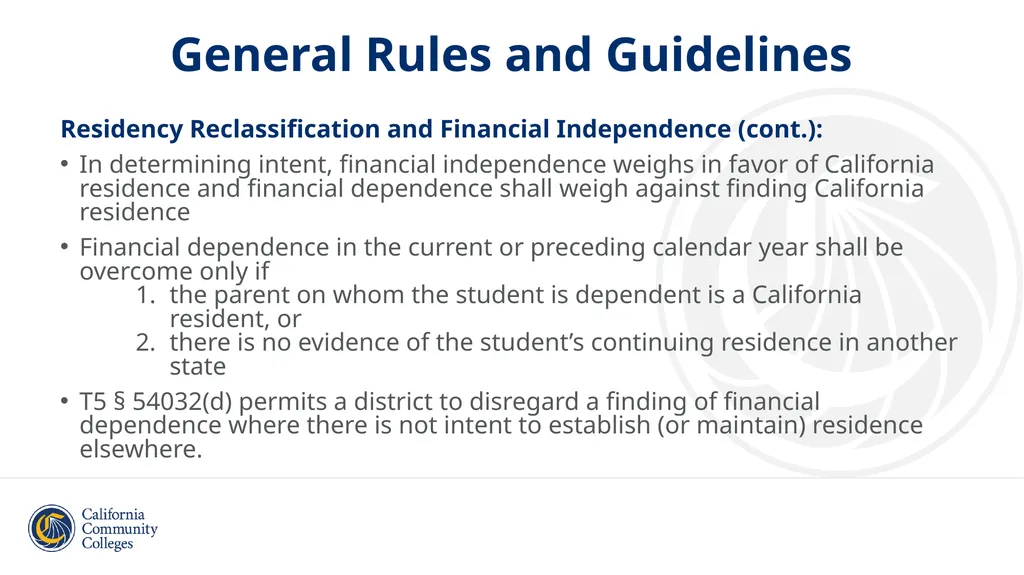
In determining intent, financial independence weighs in favor of California residence and financial dependence shall weigh against finding California residence
Financial dependence in the current or preceding calendar year shall be overcome only if
the parent on whom the student is dependent is a California resident, or
there is no evidence of the student’s continuing residence in another state
T5 § 54032(d) permits a district to disregard a finding of financial dependence where there is not intent to establish (or maintain) residence elsewhere.<br>
In determining intent, financial independence weighs in favor of California residence and financial dependence shall weigh against finding California residence
Financial dependence in the current or preceding calendar year shall be overcome only if
the parent on whom the student is dependent is a California resident, or
there is no evidence of the student’s continuing residence in another state
T5 § 54032(d) permits a district to disregard a finding of financial dependence where there is not intent to establish (or maintain) residence elsewhere.<br>
13
Updates and Reminders<br>
14
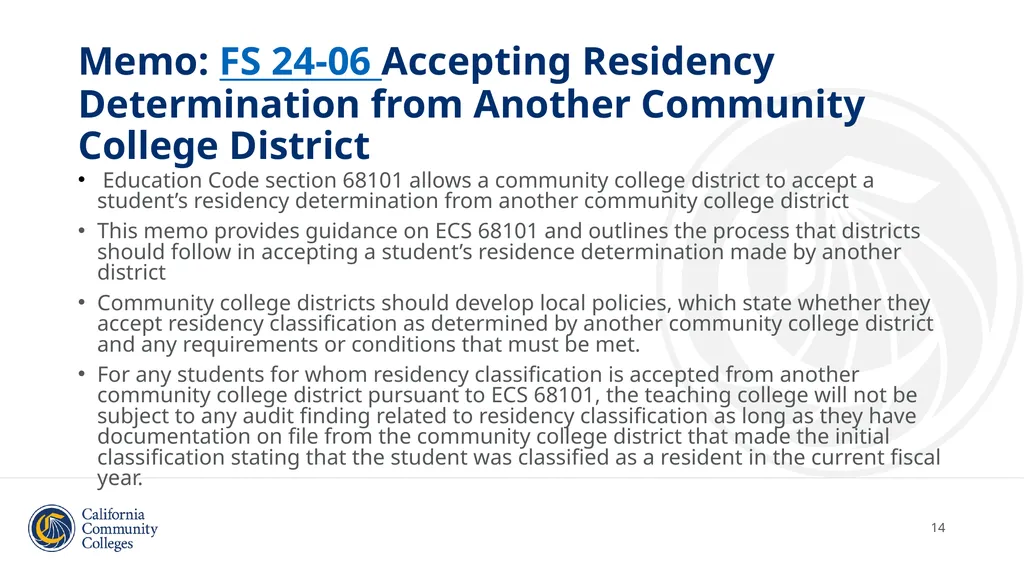
Memo: FS 24-06 Accepting Residency Determination from Another Community College District Education Code section 68101 allows a community college district to accept a student’s residency determination from another community college district
This memo provides guidance on ECS 68101 and outlines the process that districts should follow in accepting a student’s residence determination made by another district
Community college districts should develop local policies, which state whether they accept residency classification as determined by another community college district and any requirements or conditions that must be met.
For any students for whom residency classification is accepted from another community college district pursuant to ECS 68101, the teaching college will not be subject to any audit finding related to residency classification as long as they have documentation on file from the community college district that made the initial classification stating that the student was classified as a resident in the current fiscal year. 14<br>
This memo provides guidance on ECS 68101 and outlines the process that districts should follow in accepting a student’s residence determination made by another district
Community college districts should develop local policies, which state whether they accept residency classification as determined by another community college district and any requirements or conditions that must be met.
For any students for whom residency classification is accepted from another community college district pursuant to ECS 68101, the teaching college will not be subject to any audit finding related to residency classification as long as they have documentation on file from the community college district that made the initial classification stating that the student was classified as a resident in the current fiscal year. 14<br>
15
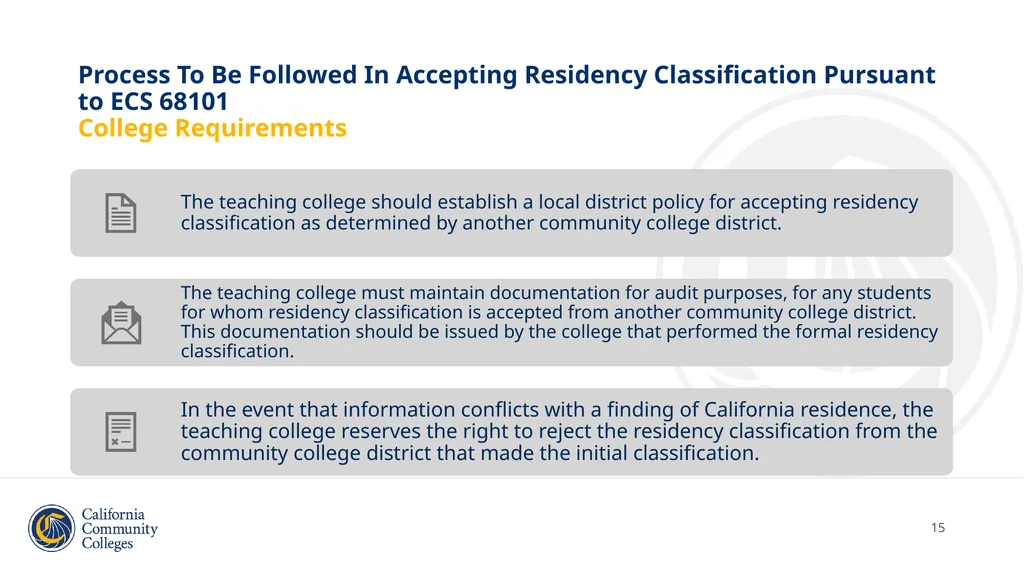
Process To Be Followed In Accepting Residency Classification Pursuant to ECS 68101
College Requirements 15<br>
16
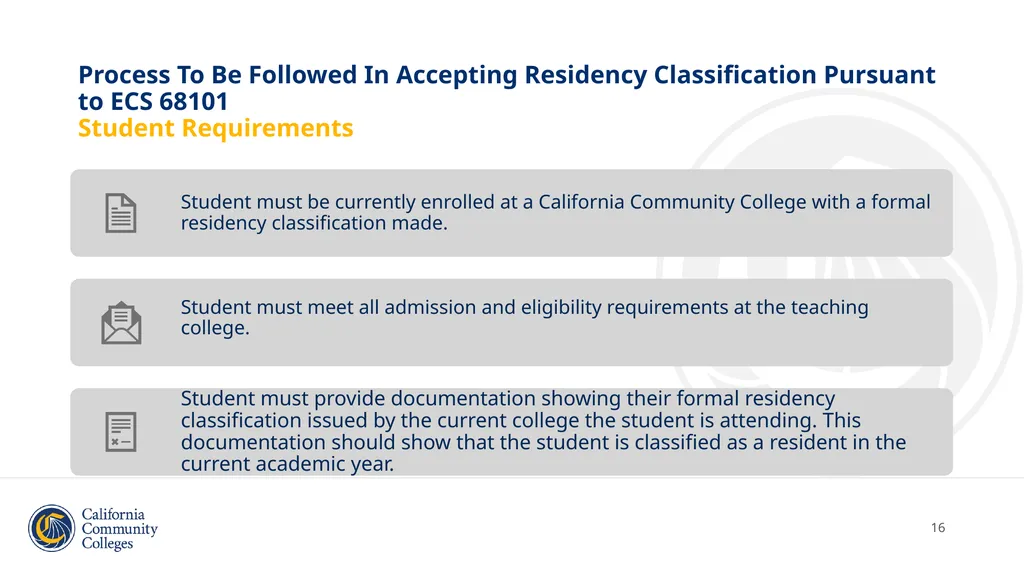
Process To Be Followed In Accepting Residency Classification Pursuant to ECS 68101
Student Requirements 16<br>
17
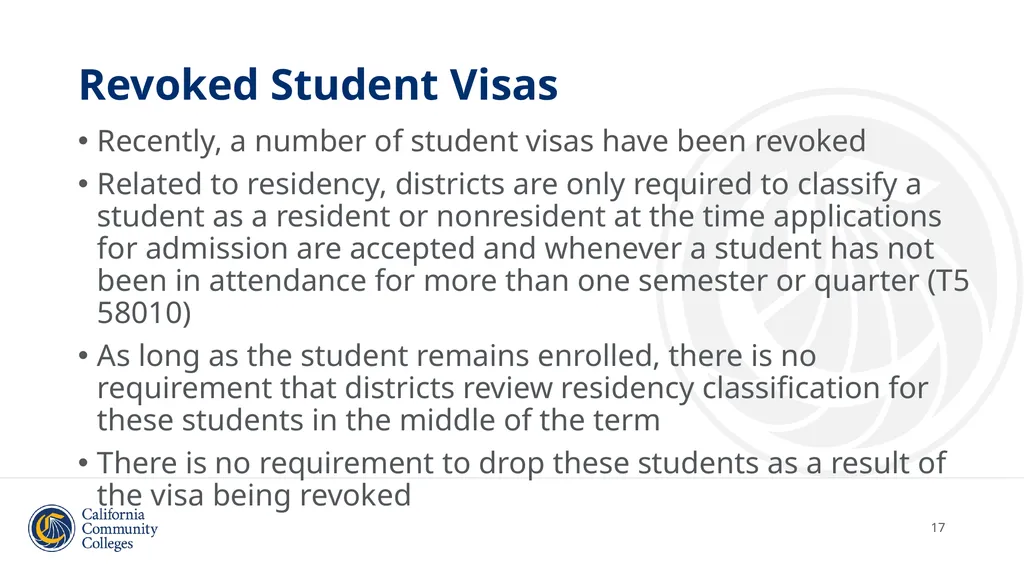
Revoked Student Visas Recently, a number of student visas have been revoked
Related to residency, districts are only required to classify a student as a resident or nonresident at the time applications for admission are accepted and whenever a student has not been in attendance for more than one semester or quarter (T5 58010)
As long as the student remains enrolled, there is no requirement that districts review residency classification for these students in the middle of the term
There is no requirement to drop these students as a result of the visa being revoked 17<br>
Related to residency, districts are only required to classify a student as a resident or nonresident at the time applications for admission are accepted and whenever a student has not been in attendance for more than one semester or quarter (T5 58010)
As long as the student remains enrolled, there is no requirement that districts review residency classification for these students in the middle of the term
There is no requirement to drop these students as a result of the visa being revoked 17<br>
18
Special Immigrant Juveniles (SIJ) 18 Students with approved SIJ status (Form I-360) may establish California residency for tuition purposes if they meet the requirements for physical presence and intent.
SIJ status is a special immigrant classification, not a nonimmigrant visa, and does not require maintaining a foreign residence or otherwise prevent establishing domicile in the U.S.
Under Education Code §68062 and Title 5 §54045, students may establish residency unless their immigration status precludes establishing domicile in the United States.
This treatment is consistent with other humanitarian statuses recognized in SAAM (e.g., asylum applicants, VAWA self-petitioners, T and U visa holders, Special Immigrant Visa holders).
Consistent with UC and CSU treatment of these individuals.<br>
SIJ status is a special immigrant classification, not a nonimmigrant visa, and does not require maintaining a foreign residence or otherwise prevent establishing domicile in the U.S.
Under Education Code §68062 and Title 5 §54045, students may establish residency unless their immigration status precludes establishing domicile in the United States.
This treatment is consistent with other humanitarian statuses recognized in SAAM (e.g., asylum applicants, VAWA self-petitioners, T and U visa holders, Special Immigrant Visa holders).
Consistent with UC and CSU treatment of these individuals.<br>
19
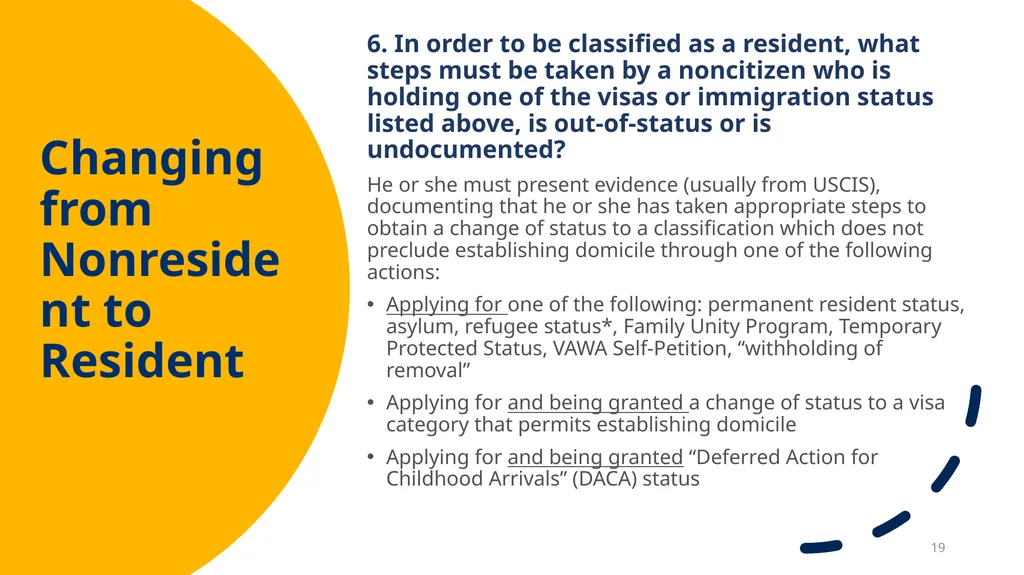
Changing from Nonresident to Resident 6. In order to be classified as a resident, what steps must be taken by a noncitizen who is holding one of the visas or immigration status listed above, is out-of-status or is undocumented?
He or she must present evidence (usually from USCIS), documenting that he or she has taken appropriate steps to obtain a change of status to a classification which does not preclude establishing domicile through one of the following actions:
Applying for one of the following: permanent resident status, asylum, refugee status*, Family Unity Program, Temporary Protected Status, VAWA Self-Petition, “withholding of removal”
Applying for and being granted a change of status to a visa category that permits establishing domicile
Applying for and being granted “Deferred Action for Childhood Arrivals” (DACA) status 19<br>
He or she must present evidence (usually from USCIS), documenting that he or she has taken appropriate steps to obtain a change of status to a classification which does not preclude establishing domicile through one of the following actions:
Applying for one of the following: permanent resident status, asylum, refugee status*, Family Unity Program, Temporary Protected Status, VAWA Self-Petition, “withholding of removal”
Applying for and being granted a change of status to a visa category that permits establishing domicile
Applying for and being granted “Deferred Action for Childhood Arrivals” (DACA) status 19<br>
20
Retroactive AB 540 or Resident Classification AB 540
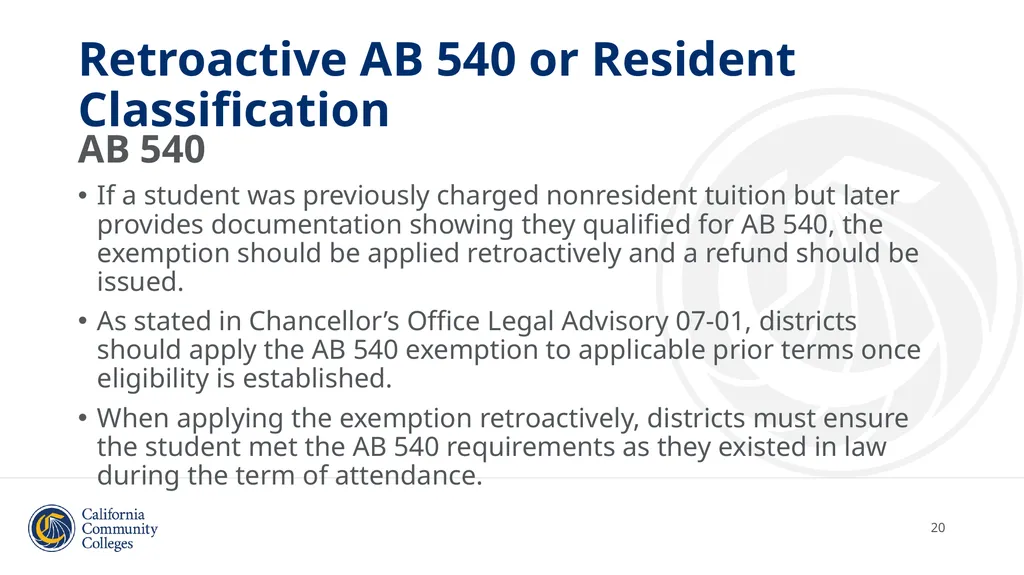
If a student was previously charged nonresident tuition but later provides documentation showing they qualified for AB 540, the exemption should be applied retroactively and a refund should be issued.
As stated in Chancellor’s Office Legal Advisory 07-01, districts should apply the AB 540 exemption to applicable prior terms once eligibility is established.
When applying the exemption retroactively, districts must ensure the student met the AB 540 requirements as they existed in law during the term of attendance. 20<br>
If a student was previously charged nonresident tuition but later provides documentation showing they qualified for AB 540, the exemption should be applied retroactively and a refund should be issued.
As stated in Chancellor’s Office Legal Advisory 07-01, districts should apply the AB 540 exemption to applicable prior terms once eligibility is established.
When applying the exemption retroactively, districts must ensure the student met the AB 540 requirements as they existed in law during the term of attendance. 20<br>
21
Retroactive AB 540 or Resident Classification Resident Classification
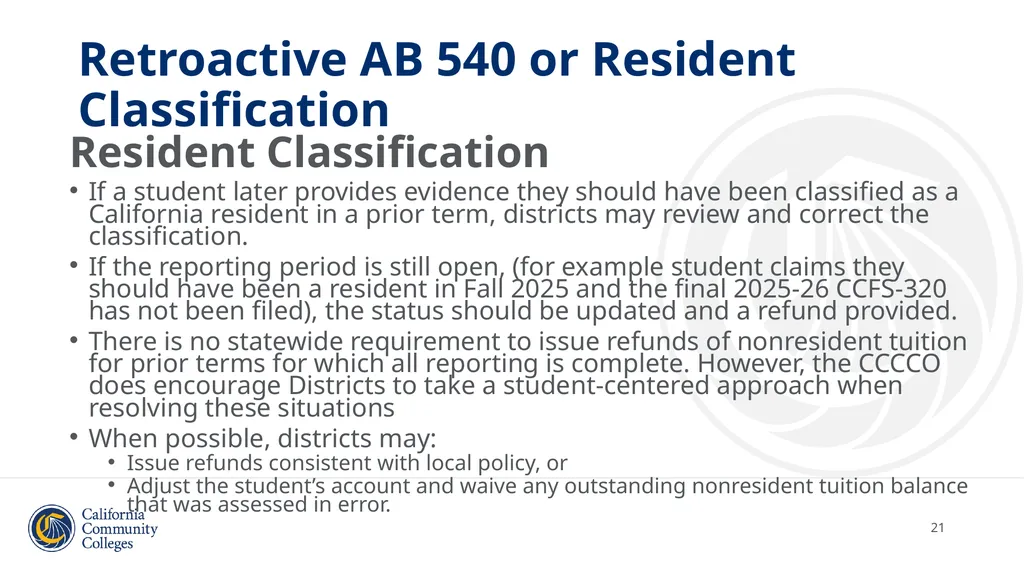
If a student later provides evidence they should have been classified as a California resident in a prior term, districts may review and correct the classification.
If the reporting period is still open, (for example student claims they should have been a resident in Fall 2025 and the final 2025-26 CCFS-320 has not been filed), the status should be updated and a refund provided.
There is no statewide requirement to issue refunds of nonresident tuition for prior terms for which all reporting is complete. However, the CCCCO does encourage Districts to take a student-centered approach when resolving these situations
When possible, districts may:
Issue refunds consistent with local policy, or
Adjust the student’s account and waive any outstanding nonresident tuition balance that was assessed in error. 21<br>
If a student later provides evidence they should have been classified as a California resident in a prior term, districts may review and correct the classification.
If the reporting period is still open, (for example student claims they should have been a resident in Fall 2025 and the final 2025-26 CCFS-320 has not been filed), the status should be updated and a refund provided.
There is no statewide requirement to issue refunds of nonresident tuition for prior terms for which all reporting is complete. However, the CCCCO does encourage Districts to take a student-centered approach when resolving these situations
When possible, districts may:
Issue refunds consistent with local policy, or
Adjust the student’s account and waive any outstanding nonresident tuition balance that was assessed in error. 21<br>
22
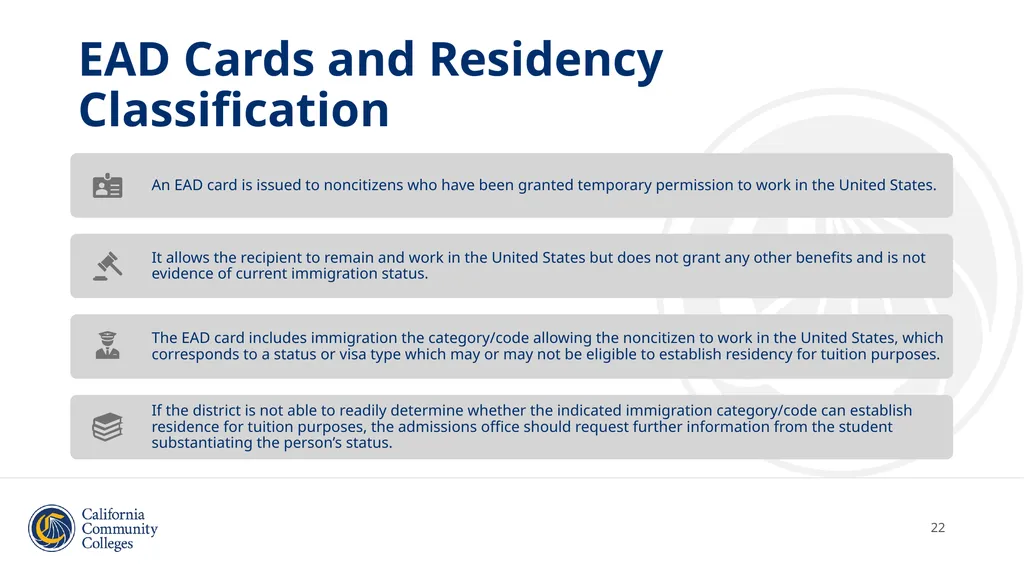
EAD Cards and Residency Classification 22<br>
23
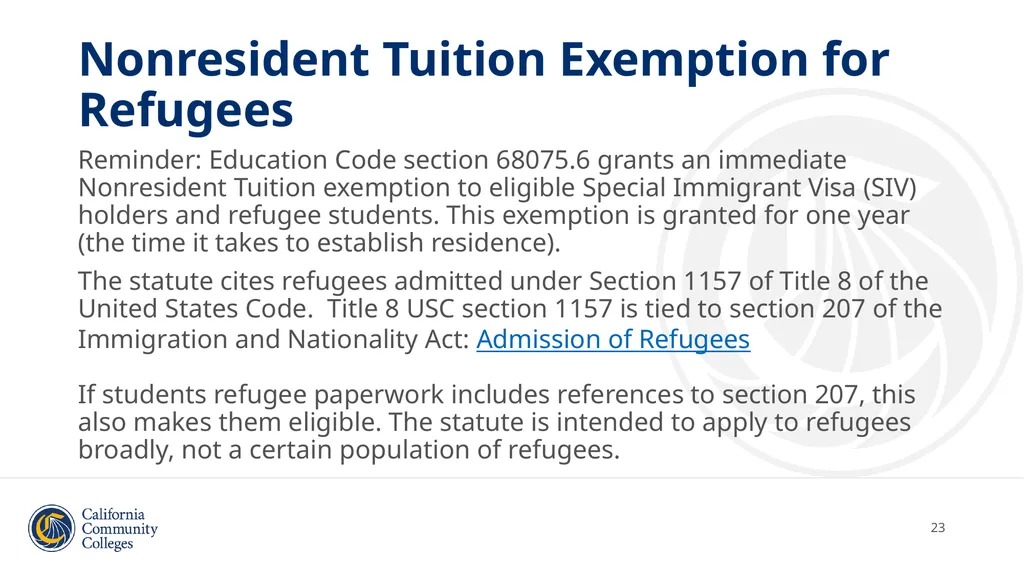
Nonresident Tuition Exemption for Refugees Reminder: Education Code section 68075.6 grants an immediate Nonresident Tuition exemption to eligible Special Immigrant Visa (SIV) holders and refugee students. This exemption is granted for one year (the time it takes to establish residence).
The statute cites refugees admitted under Section 1157 of Title 8 of the United States Code. Title 8 USC section 1157 is tied to section 207 of the Immigration and Nationality Act: Admission of Refugees
If students refugee paperwork includes references to section 207, this also makes them eligible. The statute is intended to apply to refugees broadly, not a certain population of refugees. 23<br>
The statute cites refugees admitted under Section 1157 of Title 8 of the United States Code. Title 8 USC section 1157 is tied to section 207 of the Immigration and Nationality Act: Admission of Refugees
If students refugee paperwork includes references to section 207, this also makes them eligible. The statute is intended to apply to refugees broadly, not a certain population of refugees. 23<br>
24
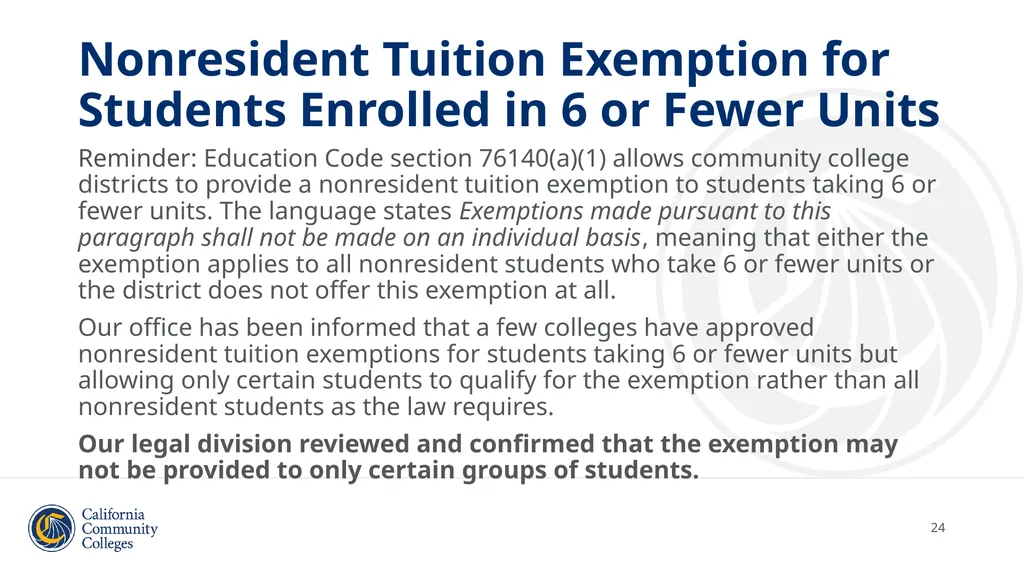
Nonresident Tuition Exemption for Students Enrolled in 6 or Fewer Units Reminder: Education Code section 76140(a)(1) allows community college districts to provide a nonresident tuition exemption to students taking 6 or fewer units. The language states Exemptions made pursuant to this paragraph shall not be made on an individual basis, meaning that either the exemption applies to all nonresident students who take 6 or fewer units or the district does not offer this exemption at all.
Our office has been informed that a few colleges have approved nonresident tuition exemptions for students taking 6 or fewer units but allowing only certain students to qualify for the exemption rather than all nonresident students as the law requires.
Our legal division reviewed and confirmed that the exemption may not be provided to only certain groups of students. 24<br>
Our office has been informed that a few colleges have approved nonresident tuition exemptions for students taking 6 or fewer units but allowing only certain students to qualify for the exemption rather than all nonresident students as the law requires.
Our legal division reviewed and confirmed that the exemption may not be provided to only certain groups of students. 24<br>
25
Conditions for Claiming Apportionment<br>
26
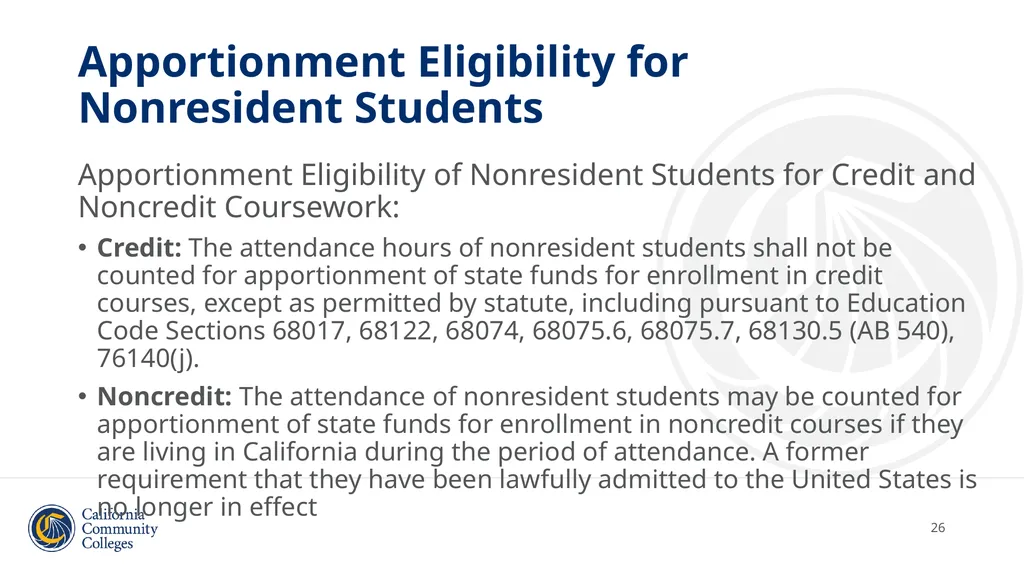
Apportionment Eligibility for Nonresident Students Apportionment Eligibility of Nonresident Students for Credit and Noncredit Coursework:
Credit: The attendance hours of nonresident students shall not be counted for apportionment of state funds for enrollment in credit courses, except as permitted by statute, including pursuant to Education Code Sections 68017, 68122, 68074, 68075.6, 68075.7, 68130.5 (AB 540), 76140(j).
Noncredit: The attendance of nonresident students may be counted for apportionment of state funds for enrollment in noncredit courses if they are living in California during the period of attendance. A former requirement that they have been lawfully admitted to the United States is no longer in effect 26<br>
Credit: The attendance hours of nonresident students shall not be counted for apportionment of state funds for enrollment in credit courses, except as permitted by statute, including pursuant to Education Code Sections 68017, 68122, 68074, 68075.6, 68075.7, 68130.5 (AB 540), 76140(j).
Noncredit: The attendance of nonresident students may be counted for apportionment of state funds for enrollment in noncredit courses if they are living in California during the period of attendance. A former requirement that they have been lawfully admitted to the United States is no longer in effect 26<br>
27
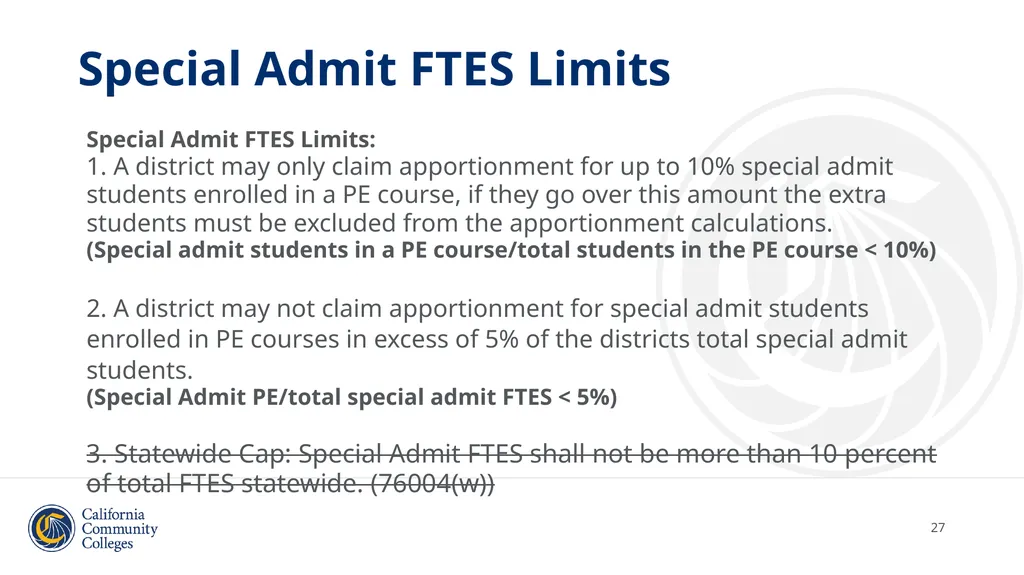
Special Admit FTES Limits Special Admit FTES Limits:
1. A district may only claim apportionment for up to 10% special admit students enrolled in a PE course, if they go over this amount the extra students must be excluded from the apportionment calculations.
(Special admit students in a PE course/total students in the PE course < 10%)
2. A district may not claim apportionment for special admit students enrolled in PE courses in excess of 5% of the districts total special admit students.
(Special Admit PE/total special admit FTES < 5%)
3. Statewide Cap: Special Admit FTES shall not be more than 10 percent of total FTES statewide. (76004(w)) 27<br>
1. A district may only claim apportionment for up to 10% special admit students enrolled in a PE course, if they go over this amount the extra students must be excluded from the apportionment calculations.
(Special admit students in a PE course/total students in the PE course < 10%)
2. A district may not claim apportionment for special admit students enrolled in PE courses in excess of 5% of the districts total special admit students.
(Special Admit PE/total special admit FTES < 5%)
3. Statewide Cap: Special Admit FTES shall not be more than 10 percent of total FTES statewide. (76004(w)) 27<br>
28
AB 540 Updates, Reminders and Commonly Asked Questions<br>
29
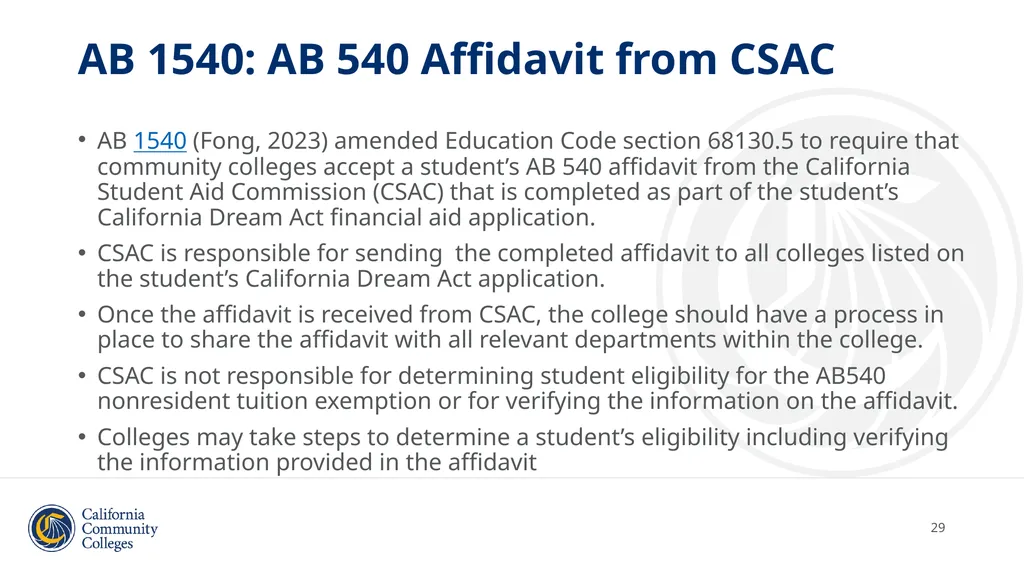
AB 1540: AB 540 Affidavit from CSAC AB 1540 (Fong, 2023) amended Education Code section 68130.5 to require that community colleges accept a student’s AB 540 affidavit from the California Student Aid Commission (CSAC) that is completed as part of the student’s California Dream Act financial aid application.
CSAC is responsible for sending the completed affidavit to all colleges listed on the student’s California Dream Act application.
Once the affidavit is received from CSAC, the college should have a process in place to share the affidavit with all relevant departments within the college.
CSAC is not responsible for determining student eligibility for the AB540 nonresident tuition exemption or for verifying the information on the affidavit.
Colleges may take steps to determine a student’s eligibility including verifying the information provided in the affidavit 29<br>
CSAC is responsible for sending the completed affidavit to all colleges listed on the student’s California Dream Act application.
Once the affidavit is received from CSAC, the college should have a process in place to share the affidavit with all relevant departments within the college.
CSAC is not responsible for determining student eligibility for the AB540 nonresident tuition exemption or for verifying the information on the affidavit.
Colleges may take steps to determine a student’s eligibility including verifying the information provided in the affidavit 29<br>
30
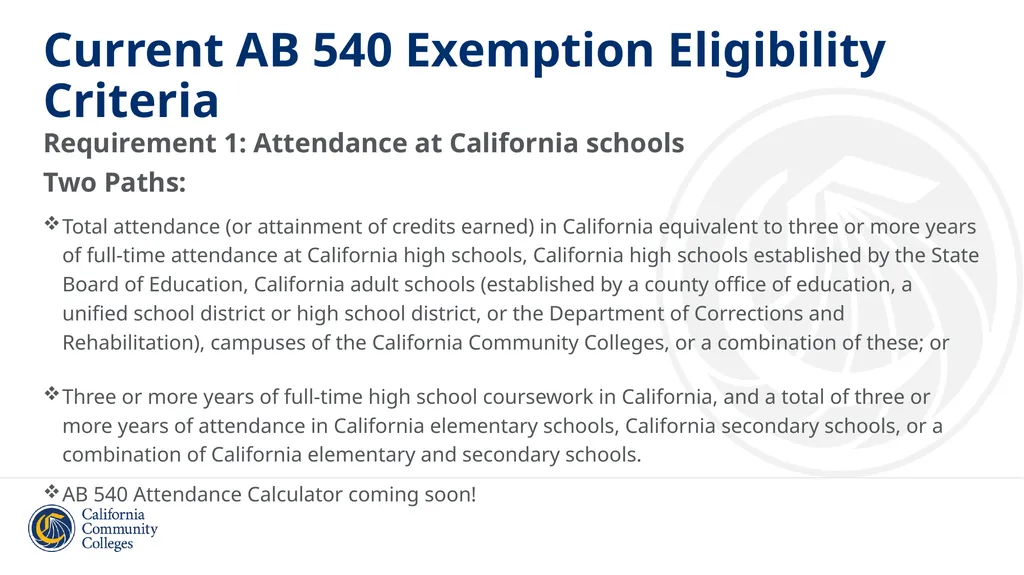
Current AB 540 Exemption Eligibility Criteria Requirement 1: Attendance at California schools
Two Paths:
Total attendance (or attainment of credits earned) in California equivalent to three or more years of full-time attendance at California high schools, California high schools established by the State Board of Education, California adult schools (established by a county office of education, a unified school district or high school district, or the Department of Corrections and Rehabilitation), campuses of the California Community Colleges, or a combination of these; or
Three or more years of full-time high school coursework in California, and a total of three or more years of attendance in California elementary schools, California secondary schools, or a combination of California elementary and secondary schools.
AB 540 Attendance Calculator coming soon!<br>
Two Paths:
Total attendance (or attainment of credits earned) in California equivalent to three or more years of full-time attendance at California high schools, California high schools established by the State Board of Education, California adult schools (established by a county office of education, a unified school district or high school district, or the Department of Corrections and Rehabilitation), campuses of the California Community Colleges, or a combination of these; or
Three or more years of full-time high school coursework in California, and a total of three or more years of attendance in California elementary schools, California secondary schools, or a combination of California elementary and secondary schools.
AB 540 Attendance Calculator coming soon!<br>
31
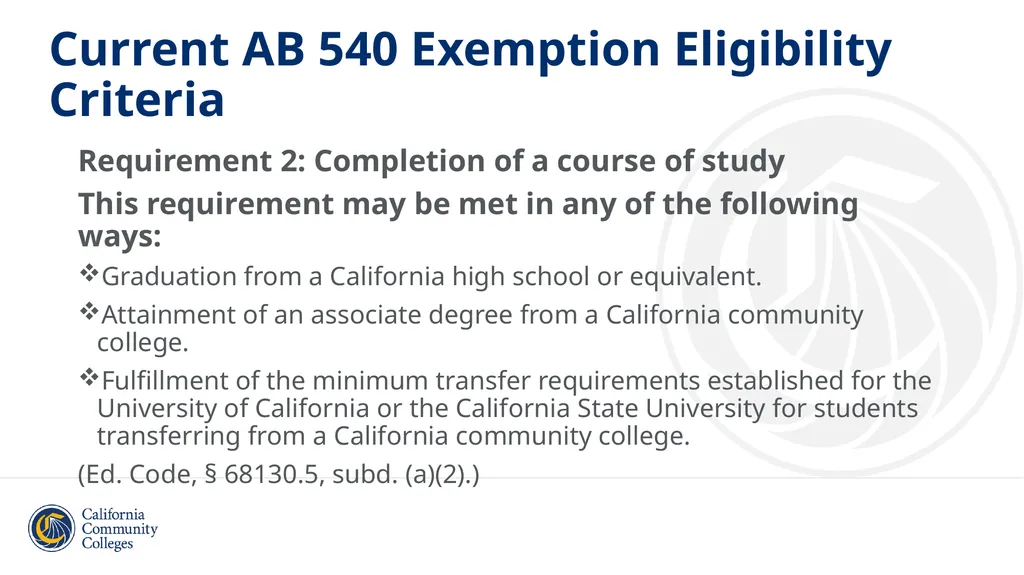
Current AB 540 Exemption Eligibility Criteria Requirement 2: Completion of a course of study
This requirement may be met in any of the following ways:
Graduation from a California high school or equivalent.
Attainment of an associate degree from a California community college.
Fulfillment of the minimum transfer requirements established for the University of California or the California State University for students transferring from a California community college.
(Ed. Code, § 68130.5, subd. (a)(2).)<br>
This requirement may be met in any of the following ways:
Graduation from a California high school or equivalent.
Attainment of an associate degree from a California community college.
Fulfillment of the minimum transfer requirements established for the University of California or the California State University for students transferring from a California community college.
(Ed. Code, § 68130.5, subd. (a)(2).)<br>
32
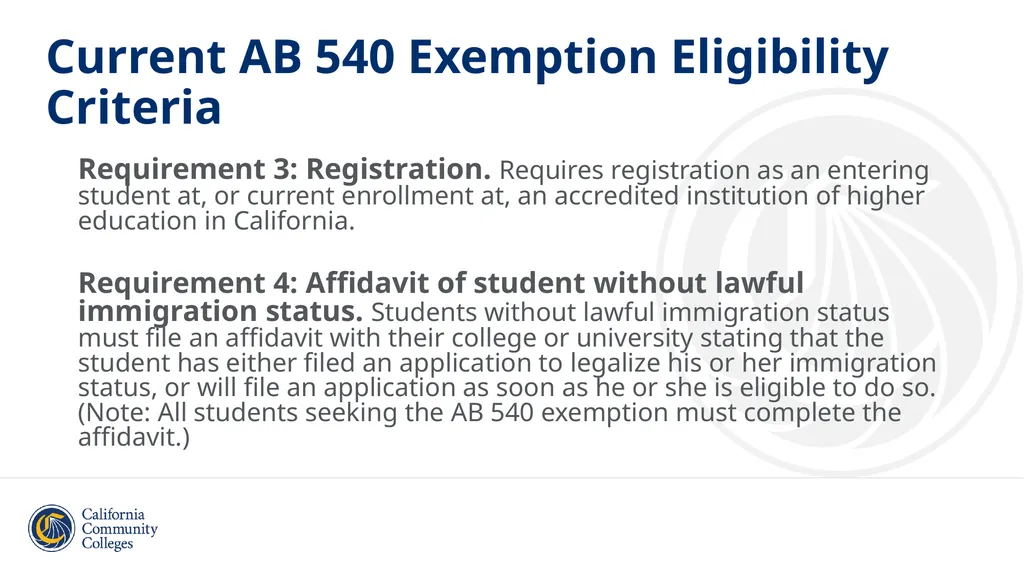
Current AB 540 Exemption Eligibility Criteria Requirement 3: Registration. Requires registration as an entering student at, or current enrollment at, an accredited institution of higher education in California.
Requirement 4: Affidavit of student without lawful immigration status. Students without lawful immigration status must file an affidavit with their college or university stating that the student has either filed an application to legalize his or her immigration status, or will file an application as soon as he or she is eligible to do so. (Note: All students seeking the AB 540 exemption must complete the affidavit.)<br>
Requirement 4: Affidavit of student without lawful immigration status. Students without lawful immigration status must file an affidavit with their college or university stating that the student has either filed an application to legalize his or her immigration status, or will file an application as soon as he or she is eligible to do so. (Note: All students seeking the AB 540 exemption must complete the affidavit.)<br>
33
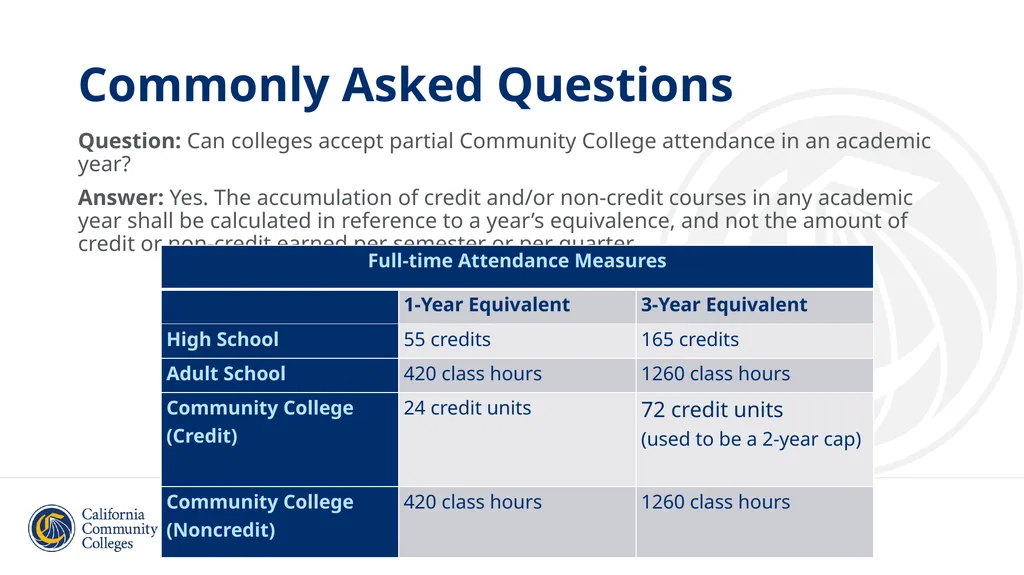
Commonly Asked Questions Question: Can colleges accept partial Community College attendance in an academic year?
Answer: Yes. The accumulation of credit and/or non-credit courses in any academic year shall be calculated in reference to a year’s equivalence, and not the amount of credit or non-credit earned per semester or per quarter.<br>
Answer: Yes. The accumulation of credit and/or non-credit courses in any academic year shall be calculated in reference to a year’s equivalence, and not the amount of credit or non-credit earned per semester or per quarter.<br>
34
Commonly Asked Questions Question: Does the attendance requirement have to be completed before the completion of a course of study requirement?
Example: Student who has 2 years at a California high school and graduated with a high school diploma. After graduating, she attended noncredit community college classes and completed 450 class hours.
Answer: No. There is no specific sequence outlined in the statute, as long as the student meets all applicable requirements, they would be eligible for the exemption.<br>
Example: Student who has 2 years at a California high school and graduated with a high school diploma. After graduating, she attended noncredit community college classes and completed 450 class hours.
Answer: No. There is no specific sequence outlined in the statute, as long as the student meets all applicable requirements, they would be eligible for the exemption.<br>
35
Commonly Asked Questions Question: Are students who are “out of status” or undocumented eligible for this exemption?
Answer: Yes. Students who previously held valid nonimmigrant visas but who are out-of-status, or those who are undocumented at the time of execution of the affidavit are eligible for the AB 540 exemption.<br>
Answer: Yes. Students who previously held valid nonimmigrant visas but who are out-of-status, or those who are undocumented at the time of execution of the affidavit are eligible for the AB 540 exemption.<br>
36
Commonly Asked Questions Question: Does a student’s visa have to be expired for the student to be considered “out of status”?
Answer: Not necessarily, if a student overstays his/her I-94 authorization date, the student is in violation of the terms of that visa and would be considered to be “out of status” even if the visa is not expired.<br>
Answer: Not necessarily, if a student overstays his/her I-94 authorization date, the student is in violation of the terms of that visa and would be considered to be “out of status” even if the visa is not expired.<br>
37
Commonly Asked Questions Question: What if a student does not know how many credit hours from elementary, middle, and high school they completed?
Answer: In this case, the best approach would be to rely upon periods of attendance. For community college purposes, self-certification of attendance is sufficient. UC or CSU may require more.<br>
Answer: In this case, the best approach would be to rely upon periods of attendance. For community college purposes, self-certification of attendance is sufficient. UC or CSU may require more.<br>
38
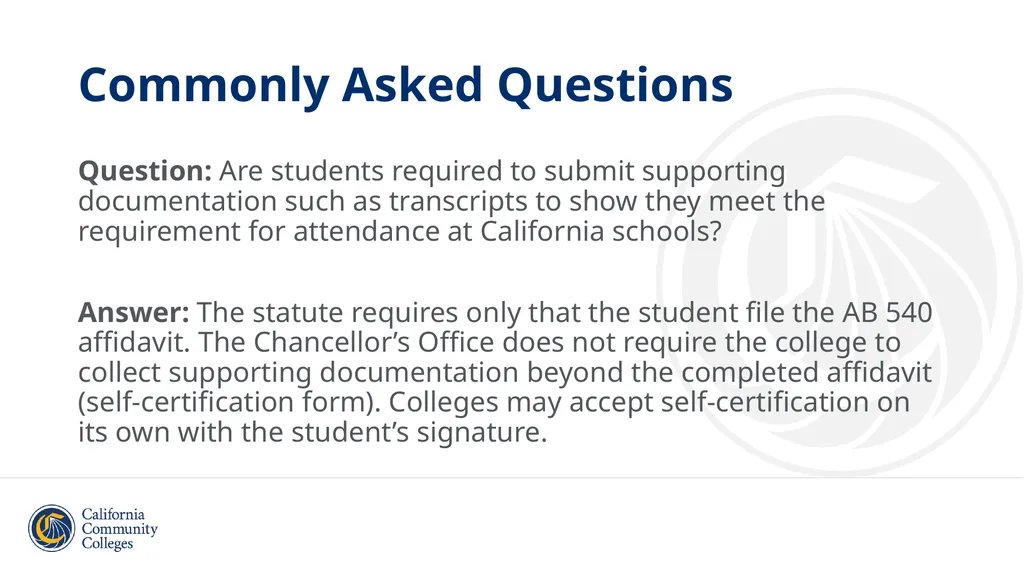
Commonly Asked Questions Question: Are students required to submit supporting documentation such as transcripts to show they meet the requirement for attendance at California schools?
Answer: The statute requires only that the student file the AB 540 affidavit. The Chancellor’s Office does not require the college to collect supporting documentation beyond the completed affidavit (self-certification form). Colleges may accept self-certification on its own with the student’s signature.<br>
Answer: The statute requires only that the student file the AB 540 affidavit. The Chancellor’s Office does not require the college to collect supporting documentation beyond the completed affidavit (self-certification form). Colleges may accept self-certification on its own with the student’s signature.<br>
39
B-visas and AB 540 Eligibility Question: Is an out-of-status B-visa student eligible for AB 540?
Answer: Yes. Legal Advisory 18-02, page 8 states: Students who previously held valid nonimmigrant visas but who are out-of-status at the time of execution of the affidavit are eligible for the exemption.
Question: When do they become eligible?
Answer: The CCCCO Legal Division has always taken the position that if the student overstays his/her I-94 authorization date, the student is in violation of the terms of that visa and would be considered to be “out of status” even if the passport is not expired.<br>
Answer: Yes. Legal Advisory 18-02, page 8 states: Students who previously held valid nonimmigrant visas but who are out-of-status at the time of execution of the affidavit are eligible for the exemption.
Question: When do they become eligible?
Answer: The CCCCO Legal Division has always taken the position that if the student overstays his/her I-94 authorization date, the student is in violation of the terms of that visa and would be considered to be “out of status” even if the passport is not expired.<br>
40
B-visas and AB 540 Eligibility Question: Are community colleges allowed to admit students holding a B-visa?
Answer: Individuals with a B-1 or B-2 visa are prohibited from enrolling in a course of study. However, the prohibition is on the visa holder, not the college (there is nothing in the law that says colleges may not enroll B-visa holders). The CCCCO Legal Division has not issued an opinion on this matter, instead, they defer to college’s legal counsel to set a policy of enrolling or not enrolling B-visa holders.<br>
Answer: Individuals with a B-1 or B-2 visa are prohibited from enrolling in a course of study. However, the prohibition is on the visa holder, not the college (there is nothing in the law that says colleges may not enroll B-visa holders). The CCCCO Legal Division has not issued an opinion on this matter, instead, they defer to college’s legal counsel to set a policy of enrolling or not enrolling B-visa holders.<br>
41
Resources and Ways to Stay Informed Residency Overview Document
Student Attendance Accounting Manual
Chancellor’s Office Monthly Fiscal & Policy Webinars 41<br>
Student Attendance Accounting Manual
Chancellor’s Office Monthly Fiscal & Policy Webinars 41<br>
42
Questions/Comments<br>
43
Contact Information Natalie Wagner
nwagner@cccco.edu
Rafael Artiga Meza (CCFS-320)
rartiga@cccco.edu
Lorena Romero (Director, Fiscal Standards and Accountability)
lromero@cccco.edu<br>
nwagner@cccco.edu
Rafael Artiga Meza (CCFS-320)
rartiga@cccco.edu
Lorena Romero (Director, Fiscal Standards and Accountability)
lromero@cccco.edu<br>