Student : Sura Jarjees course tutor Prof . Ahmed Q. Abed, Ph.D Semantic functional linguistics INTRODUCTION Halliday states that language is the study of how people exchange meanings through the use of language. Systemic Functional theory
"Student : Sura Jarjees course tutor Prof . Ahmed" is the property of its rightful owner. Permission is granted to
download and print the materials on this website for personal, non-commercial use only, and to display it
on your personal computer provided you do not modify the materials and that you retain all copyright
notices contained in the materials. By downloading content from our website, you accept the terms of this
agreement.
Presentation Transcript
01
Student : Sura Jarjees course tutor Prof . Ahmed Q. Abed, Ph.D Semantic functional linguistics<br>
02
INTRODUCTION Halliday states that language is the study of how people exchange meanings through the use of language. Systemic Functional theory views language as a social semiotic a resource of people use to accomplish their purposes by expressing meanings in context. Halliday wrote, “the value of theory” lies in the use that can be made of it, and He has always considered a theory of language to be essentially consumer oriented”. (1985a, p. 7). SFL is an approach to linguistics that considers language as a social semiotic system.<br>
03
Definition SFL : is the study of the relationship between language and its functions in social settings. SFL treats grammar as a meaning-making resource and insists on the interrelation of form and meaning.<br>
04
Function and structure In SFL, language is considered primarily functional. The structure or form of language is important only to serve the function. Without function, structure would be completely pointless. In most cases, function matters more than structure. However, one needs to understand how language is structured in order to effectively produce and analyze its function. In this sense, both are like two sides of the same coin. Halliday (in Fontaine, 2013) posits that “a theory of linguistics must incorporate the functions of language in use.” Unlike the traditionalists who tend to see grammar as an entity separate from meaning and context of use, the systemic functionalists perceive language as a social semiotic system–that is to say, a system in which its meaning and form are always driven by its context and speaker’s communicative goals.<br>
05
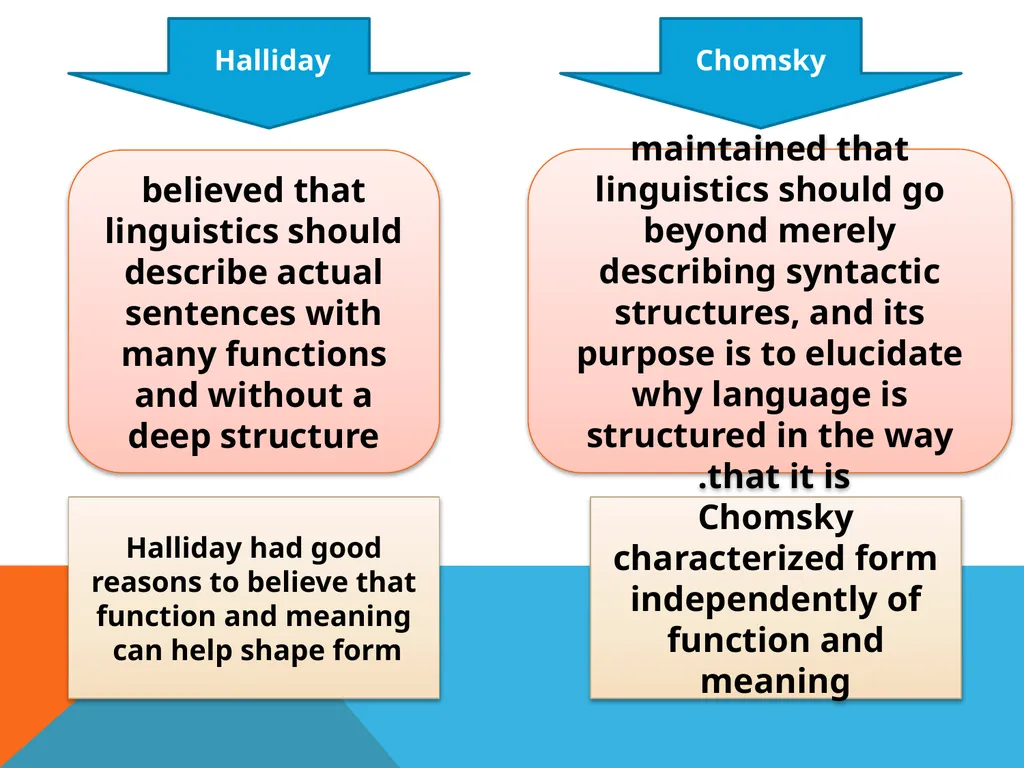
believed that linguistics should describe actual sentences with many functions and without a deep structure Halliday Chomsky maintained that linguistics should go beyond merely describing syntactic structures, and its purpose is to elucidate why language is structured in the way that it is. Halliday had good reasons to believe that function and meaning can help shape form Chomsky characterized form independently of function and meaning<br>
06
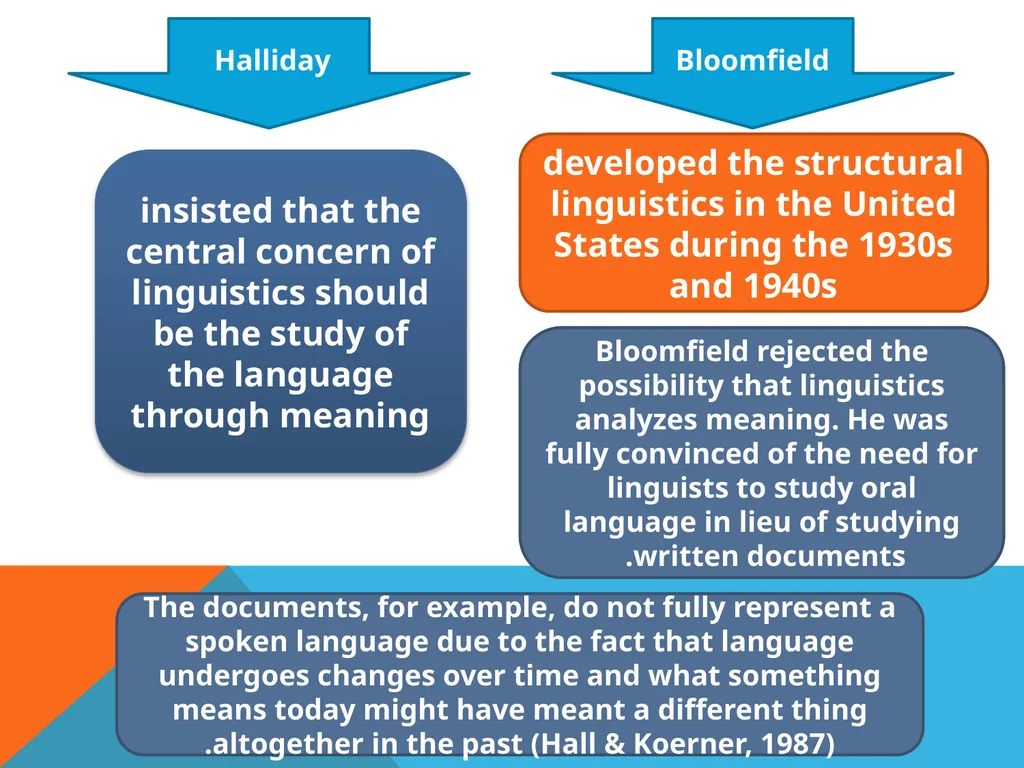
Halliday Bloomfield insisted that the central concern of linguistics should be the study of the language through meaning developed the structural linguistics in the United States during the 1930s and 1940s Bloomfield rejected the possibility that linguistics analyzes meaning. He was fully convinced of the need for linguists to study oral language in lieu of studying written documents. The documents, for example, do not fully represent a spoken language due to the fact that language undergoes changes over time and what something means today might have meant a different thing altogether in the past (Hall & Koerner, 1987).<br>
07
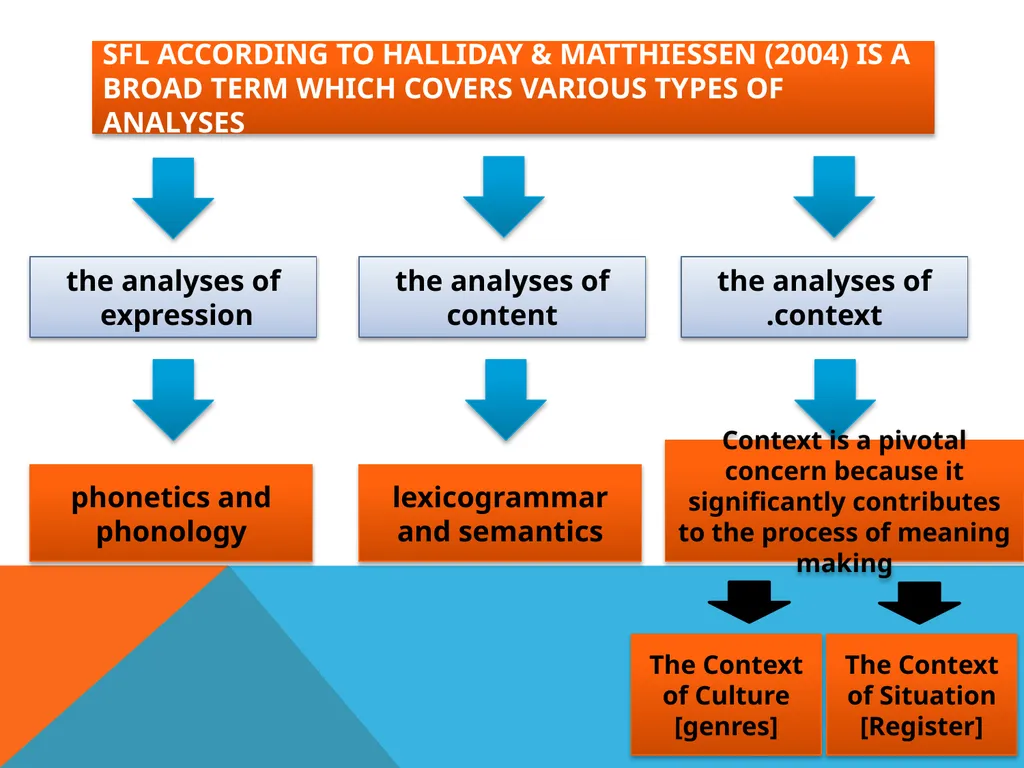
SFL according to Halliday & Matthiessen (2004) is a broad term which covers various types of analyses the analyses of expression the analyses of context. the analyses of content phonetics and phonology Context is a pivotal concern because it significantly contributes to the process of meaning making lexicogrammar and semantics The Context of Situation [Register] The Context of Culture [genres]<br>
08
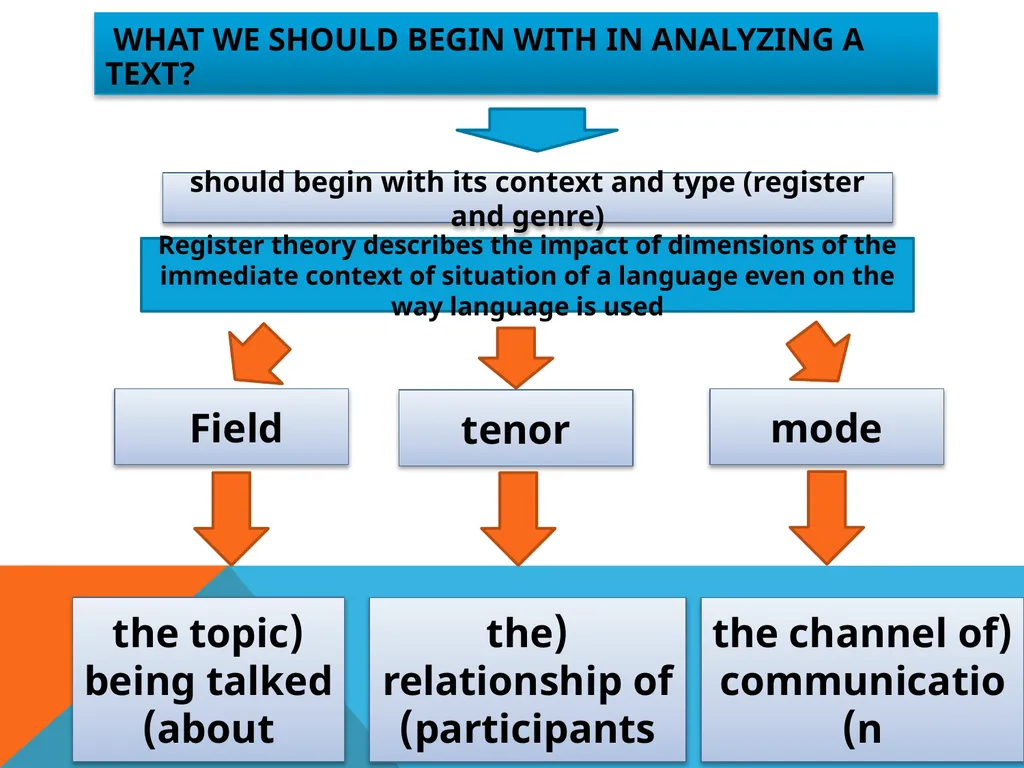
What we should begin with in analyzing a text? should begin with its context and type (register and genre) Field tenor mode (the topic being talked about) (the relationship of participants) (the channel of communication) Register theory describes the impact of dimensions of the immediate context of situation of a language even on the way language is used<br>
09
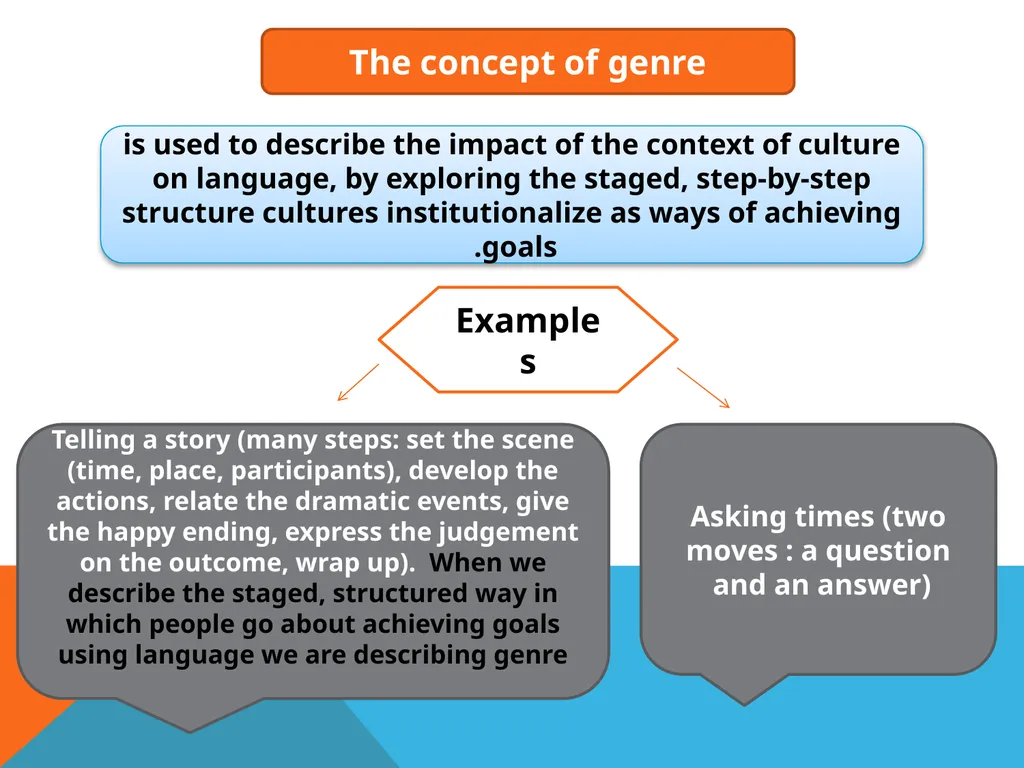
The concept of genre is used to describe the impact of the context of culture on language, by exploring the staged, step-by-step structure cultures institutionalize as ways of achieving goals. Asking times (two moves : a question and an answer) Telling a story (many steps: set the scene (time, place, participants), develop the actions, relate the dramatic events, give the happy ending, express the judgement on the outcome, wrap up). When we describe the staged, structured way in which people go about achieving goals using language we are describing genre Examples<br>
10
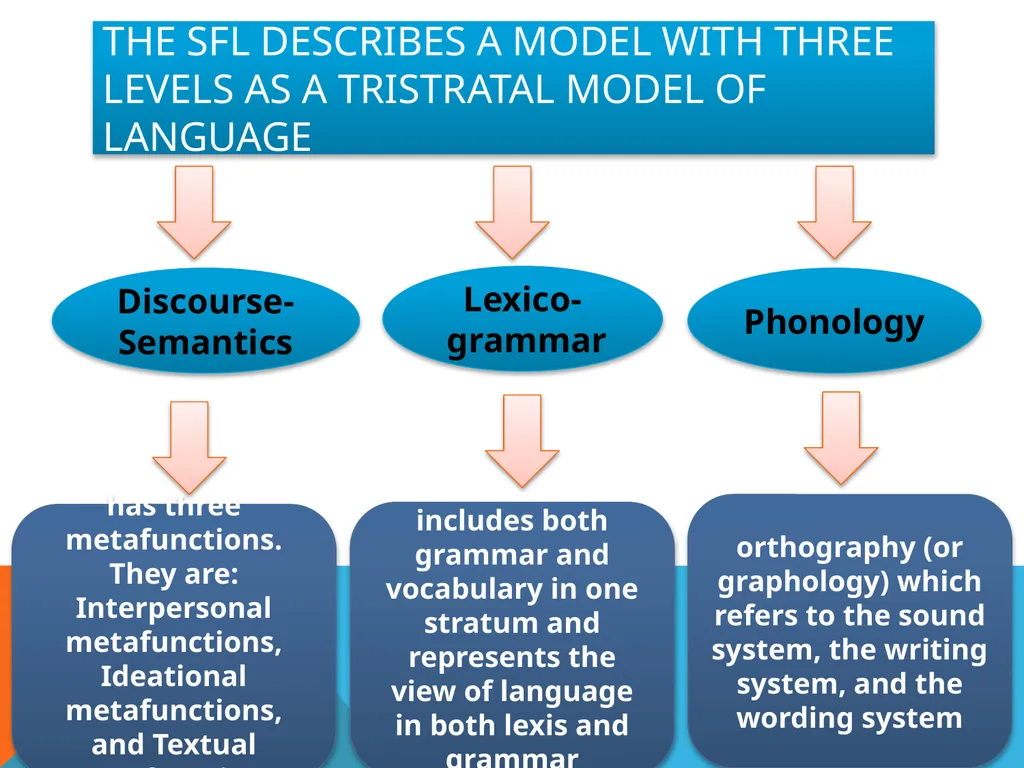
the SFL describes a model with three levels as a tristratal model of language Discourse-Semantics Lexico-grammar Phonology orthography (or graphology) which refers to the sound system, the writing system, and the wording system includes both grammar and vocabulary in one stratum and represents the view of language in both lexis and grammar has three metafunctions. They are: Interpersonal metafunctions, Ideational metafunctions, and Textual metafunctions<br>
11
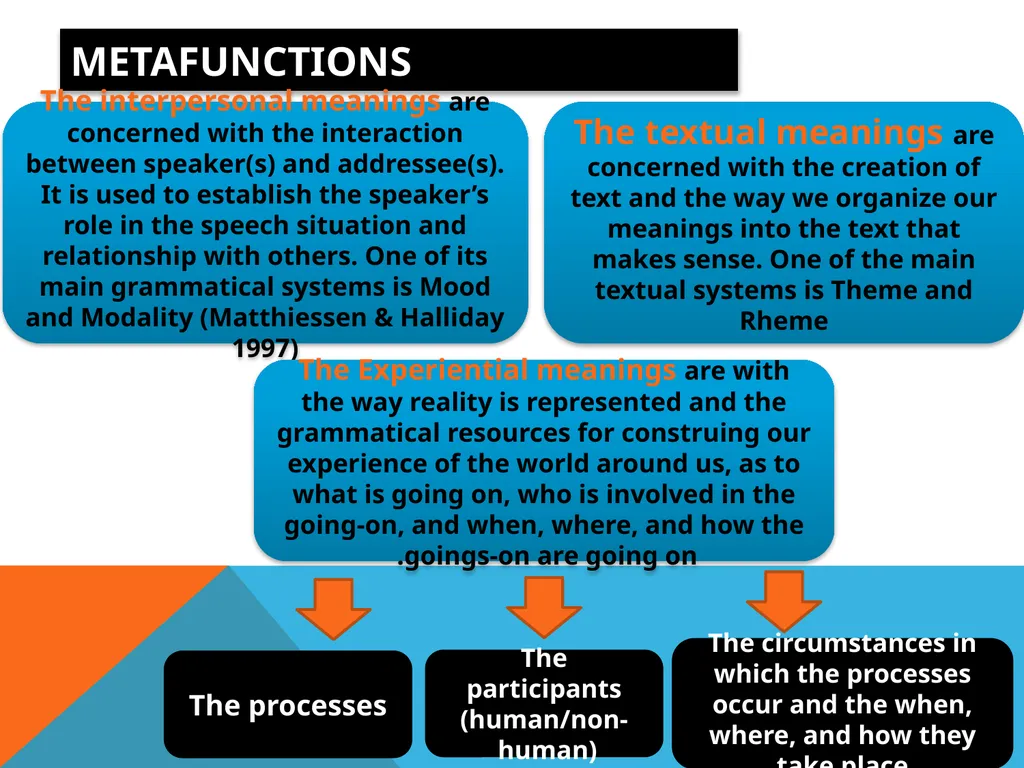
metafunctions The interpersonal meanings are concerned with the interaction between speaker(s) and addressee(s). It is used to establish the speaker’s role in the speech situation and relationship with others. One of its main grammatical systems is Mood and Modality (Matthiessen & Halliday 1997) The Experiential meanings are with the way reality is represented and the grammatical resources for construing our experience of the world around us, as to what is going on, who is involved in the going-on, and when, where, and how the goings-on are going on. The textual meanings are concerned with the creation of text and the way we organize our meanings into the text that makes sense. One of the main textual systems is Theme and Rheme The processes The participants (human/non-human) The circumstances in which the processes occur and the when, where, and how they take place<br>
12
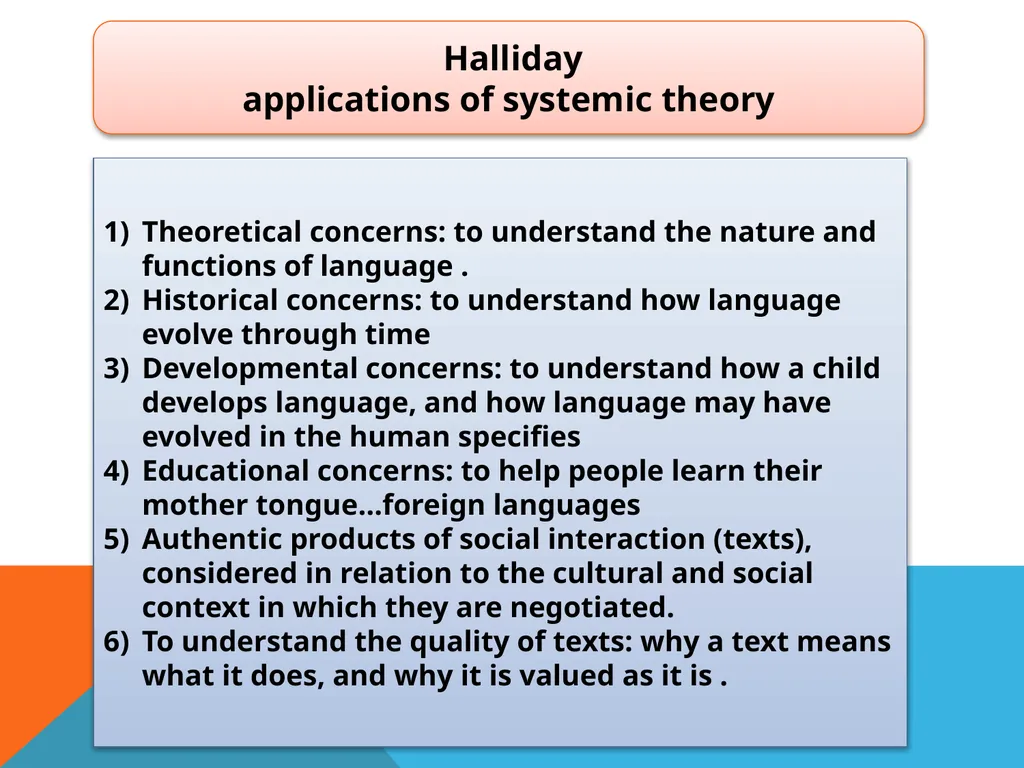
Halliday
applications of systemic theory Theoretical concerns: to understand the nature and functions of language .
Historical concerns: to understand how language evolve through time
Developmental concerns: to understand how a child develops language, and how language may have evolved in the human specifies
Educational concerns: to help people learn their mother tongue…foreign languages
Authentic products of social interaction (texts), considered in relation to the cultural and social context in which they are negotiated.
To understand the quality of texts: why a text means what it does, and why it is valued as it is .<br>
13
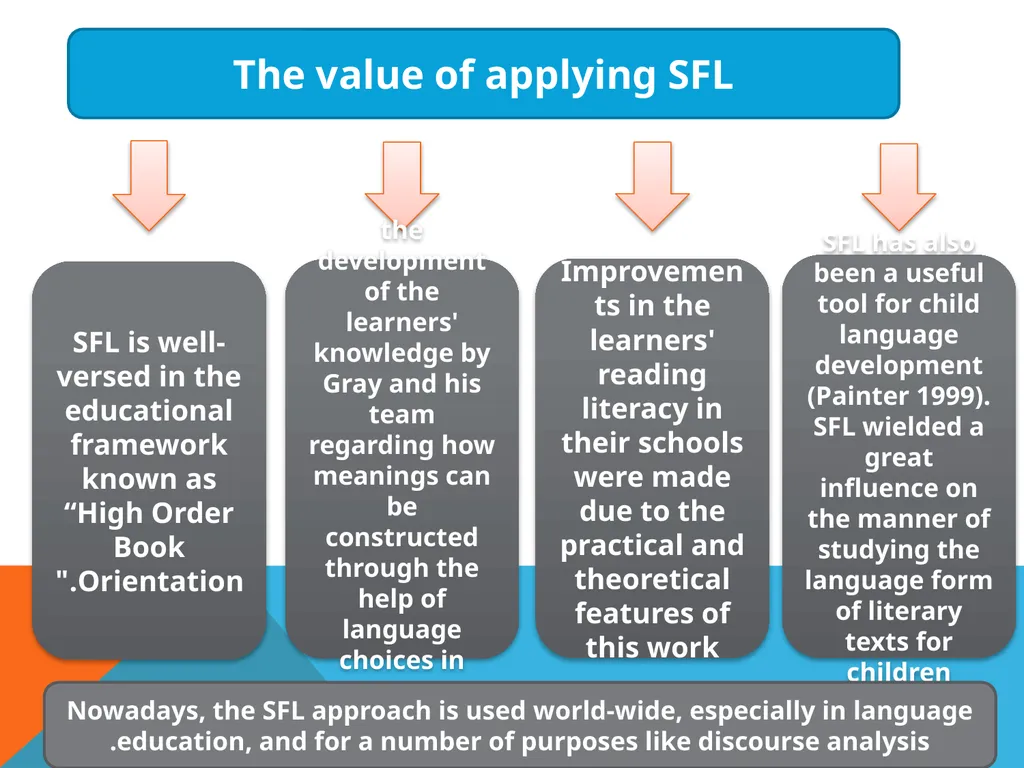
The value of applying SFL SFL is well-versed in the educational framework known as “High Order Book Orientation." the development of the learners' knowledge by Gray and his team regarding how meanings can be constructed through the help of language choices in texts Improvements in the learners' reading literacy in their schools were made due to the practical and theoretical features of this work SFL has also been a useful tool for child language development (Painter 1999). SFL wielded a great influence on the manner of studying the language form of literary texts for children Nowadays, the SFL approach is used world-wide, especially in language education, and for a number of purposes like discourse analysis.<br>