Studying Life Sciences at the University of
Description: Studying Life Sciences at the University of Glasgow Dr Chris Finlay: Level 1 Biology Coordinator Senior Advisor of Studies Chris.Finlayglasgow.ac.uk Life Sciences degrees BSc (three years) BSc Honours (four years) Most Common MSci
Related Topics
Download Presentation
"Studying Life Sciences at the University of" is the property of its rightful owner. Permission is granted to download and print the materials on this website for personal, non-commercial use only, and to display it on your personal computer provided you do not modify the materials and that you retain all copyright notices contained in the materials. By downloading content from our website, you accept the terms of this agreement.
Presentation Transcript
slide1. Studying Life Sciences at the University of Glasgow
Dr Chris Finlay: Level 1 Biology Coordinator & Senior Advisor of Studies
Chris.Finlay@glasgow.ac.uk<br>
slide2. Life Sciences degrees BSc (three years)
BSc Honours (four years) – Most Common
MSci Honours (five years)
Integrated Masters degree – an advanced undergraduate degree which includes a one year research-based work placement, taken in Year 4 of the 5-year structure<br>
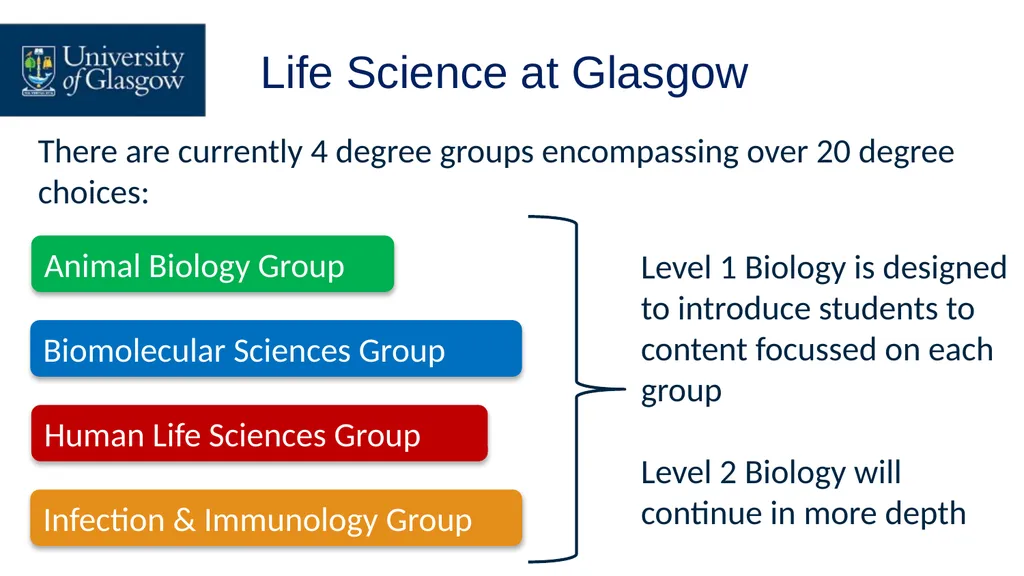
slide3. Life Science at Glasgow There are currently 4 degree groups encompassing over 20 degree choices: Animal Biology Group Biomolecular Sciences Group Human Life Sciences Group Infection & Immunology Group Level 1 Biology is designed to introduce students to content focussed on each group
Level 2 Biology will continue in more depth<br>
slide4. Animal Biology:
Marine & Freshwater Biology
Zoology Life Science at Glasgow Biomolecular Sciences:
Biochemistry
Genetics
Molecular & Cellular Biology (with Biotech or Plant Scence)<br>
slide5. Life Science at Glasgow Infection & Immunology:
Immunology
Microbiology Human Life Sciences:
Anatomy
Human Biology / Human Biology & Nutrition
Neuroscience
Pharmacology
Physiology
Physiology & Sports Science / Physiology, Sports Science & Nutrition<br>
slide6. Flexibility of choice When entering the School of Life Sciences – all degrees are available to you.
Your degree subject is not fixed until your third year 6 Flexibility of Choice Animal Biology Group Biomolecular Sciences Group Human Life Sciences & Sports Science Group Infection & Immunology Group<br>
slide7. A typical First Year Curriculum:
Semester one:
Biology 1A
Chemistry 1 OR Science Fundamentals 1X
Optional Course
Semester two:
Biology 1B (semester two)
Chemistry 1 OR Science Fundamentals 1Y
Optional Course 7 Level 1 Biology 1st Year / Level 1 Biology Common optional courses:
Psychology
Environmental Biology
Current Directions in Life Sci
Geography / Earth Sci
Maths / Statistics
Physics
Languages
Computing Science
Exploring the Cosmos<br>
slide8. 1st Semester:
introduces students to cellular systems, both at the unicellular and multicellular level. 8 Level 1 Biology – Biology 1A Biology 1A<br>
slide9. There is a weekly lab and lecture series, building week on week:
Unicellular 9 Lectures:
Cells & Model Systems, Parasitology,
The Immunological Armoury,
Microbiology, Virology, Prokaryotic Life Labs:
Microscopy, Cell Motility, Diagnosis of Infectious Disease Level 1 Biology – Biology 1A Biology 1A<br>
slide10. There is a weekly lab and lecture series, building week on week:
Multicellular 10 Lectures:
Nutrition & Digestion, Circulatory System, Kidney Function, Nervous System, Ecosystems, Immunology & Infections Labs:
Microscopy, Histology, Dissections (rat & Heart dissection), Skulls, Infectious Disease Level 1 Biology – Biology 1A Biology 1A<br>
slide11. 11 Level 1 Biology – Biology 1A Biology 1A<br>
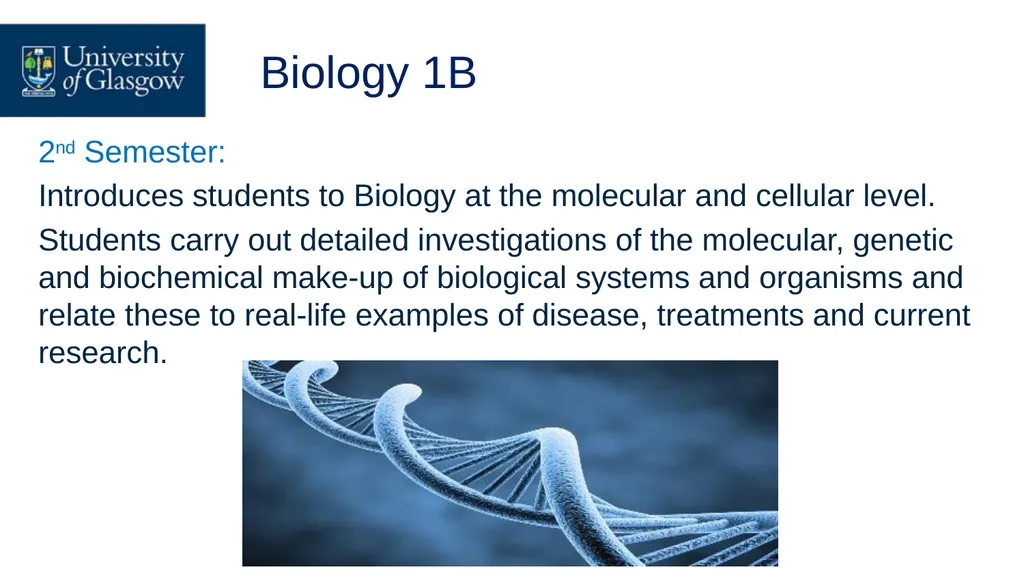
slide12. 2nd Semester:
Introduces students to Biology at the molecular and cellular level.
Students carry out detailed investigations of the molecular, genetic and biochemical make-up of biological systems and organisms and relate these to real-life examples of disease, treatments and current research. 12 Level 1 Biology – Biology 1B Biology 1B<br>
slide13. There is a weekly lab and lecture series, building week on week: 13 Lectures:
Bioenergetics & Respiration, Photosynthesis, DNA, RNA & Protein Synthesis, Evolution, Genetic Development and Disease, Mammalian Reproduction, Genes & Gene Expression, Plant models, Bioengineering, Food production Level 1 Biology – Biology 1B Biology 1B<br>
slide14. There is a weekly lab and lecture series, building week on week: 14 Labs:
Photosynthesis, Protein Structure & Function, Bioinformatics, Genetic Crosses, Mutant models (Arabidopsis), Genetic Disease & Profiling, Stem Cells & Reproductive Ethics Level 1 Biology – Biology 1B Biology 1B<br>
slide15. 15 Level 1 Biology – Biology 1B Biology 1B<br>
slide16. 16 Transition/ Direct Entry Curriculum Matching Content differences:
Genetic disease, diagnosis, treatment
Comparative physiology investigations
Stem Cells / CRISPR / Bioengineering
When to use model systems
Skills:
Microscopy – calibration and measurement / scale bars
Pipetting – consistency and accuracy
Tissue handling / dissection<br>
slide17. 17 Transition/ Direct Entry Transitioning to HE Some consistent experiences:
One student in a large class (~650-750 students)
‘Scared’ of maths, stats, data analysis
New assessment requirements (and new assessment scale)
Expected to pick up the new system and processes quickly
Unsure what their chosen degree actually involves
Peer assessment and peer scoring
A lot of students expect that any extra school support that they had will automatically roll over and be in place at the start of their undergraduate studies. It can be put in place but it is not automatic and the student has to trigger the discussion.<br>
slide18. 18 Transition/ Direct Entry Transitioning to HE Two things that deserve their own slide:
Unsure what specific word we look for in assessments (we don’t look for specific words – this really unsettles a lot of students)
Data analysis – especially when there are multiple, valid ways to interpret the same data<br>
slide19. 19 Transition/ Direct Entry Transitioning to HE Support:
Skills labs and lectures, e.g. scientific writing, exam preparation etc.
Group work and presentations
On-line quizzes (both for revision and for coursework)
Peer support activities
Biology Teaching Centre
Effective Learning Service
Adviser of Studies
All designed to prepare students for Level 2.<br>
slide20. Erasmus - Europe
13 universities in 9 European countries to choose from
3 -10 month programmes
Erasmus grant / language tuition available
International opportunities include:
Australia, Canada, Hong Kong, Japan, Korea, New Zealand, Singapore, USA, Central & South America. 20 Study Abroad Study Abroad – 2nd year preferably<br>

Dr Chris Finlay: Level 1 Biology Coordinator & Senior Advisor of Studies
Chris.Finlay@glasgow.ac.uk<br>
slide2. Life Sciences degrees BSc (three years)
BSc Honours (four years) – Most Common
MSci Honours (five years)
Integrated Masters degree – an advanced undergraduate degree which includes a one year research-based work placement, taken in Year 4 of the 5-year structure<br>
slide3. Life Science at Glasgow There are currently 4 degree groups encompassing over 20 degree choices: Animal Biology Group Biomolecular Sciences Group Human Life Sciences Group Infection & Immunology Group Level 1 Biology is designed to introduce students to content focussed on each group
Level 2 Biology will continue in more depth<br>
slide4. Animal Biology:
Marine & Freshwater Biology
Zoology Life Science at Glasgow Biomolecular Sciences:
Biochemistry
Genetics
Molecular & Cellular Biology (with Biotech or Plant Scence)<br>
slide5. Life Science at Glasgow Infection & Immunology:
Immunology
Microbiology Human Life Sciences:
Anatomy
Human Biology / Human Biology & Nutrition
Neuroscience
Pharmacology
Physiology
Physiology & Sports Science / Physiology, Sports Science & Nutrition<br>
slide6. Flexibility of choice When entering the School of Life Sciences – all degrees are available to you.
Your degree subject is not fixed until your third year 6 Flexibility of Choice Animal Biology Group Biomolecular Sciences Group Human Life Sciences & Sports Science Group Infection & Immunology Group<br>
slide7. A typical First Year Curriculum:
Semester one:
Biology 1A
Chemistry 1 OR Science Fundamentals 1X
Optional Course
Semester two:
Biology 1B (semester two)
Chemistry 1 OR Science Fundamentals 1Y
Optional Course 7 Level 1 Biology 1st Year / Level 1 Biology Common optional courses:
Psychology
Environmental Biology
Current Directions in Life Sci
Geography / Earth Sci
Maths / Statistics
Physics
Languages
Computing Science
Exploring the Cosmos<br>
slide8. 1st Semester:
introduces students to cellular systems, both at the unicellular and multicellular level. 8 Level 1 Biology – Biology 1A Biology 1A<br>
slide9. There is a weekly lab and lecture series, building week on week:
Unicellular 9 Lectures:
Cells & Model Systems, Parasitology,
The Immunological Armoury,
Microbiology, Virology, Prokaryotic Life Labs:
Microscopy, Cell Motility, Diagnosis of Infectious Disease Level 1 Biology – Biology 1A Biology 1A<br>
slide10. There is a weekly lab and lecture series, building week on week:
Multicellular 10 Lectures:
Nutrition & Digestion, Circulatory System, Kidney Function, Nervous System, Ecosystems, Immunology & Infections Labs:
Microscopy, Histology, Dissections (rat & Heart dissection), Skulls, Infectious Disease Level 1 Biology – Biology 1A Biology 1A<br>
slide11. 11 Level 1 Biology – Biology 1A Biology 1A<br>
slide12. 2nd Semester:
Introduces students to Biology at the molecular and cellular level.
Students carry out detailed investigations of the molecular, genetic and biochemical make-up of biological systems and organisms and relate these to real-life examples of disease, treatments and current research. 12 Level 1 Biology – Biology 1B Biology 1B<br>
slide13. There is a weekly lab and lecture series, building week on week: 13 Lectures:
Bioenergetics & Respiration, Photosynthesis, DNA, RNA & Protein Synthesis, Evolution, Genetic Development and Disease, Mammalian Reproduction, Genes & Gene Expression, Plant models, Bioengineering, Food production Level 1 Biology – Biology 1B Biology 1B<br>
slide14. There is a weekly lab and lecture series, building week on week: 14 Labs:
Photosynthesis, Protein Structure & Function, Bioinformatics, Genetic Crosses, Mutant models (Arabidopsis), Genetic Disease & Profiling, Stem Cells & Reproductive Ethics Level 1 Biology – Biology 1B Biology 1B<br>
slide15. 15 Level 1 Biology – Biology 1B Biology 1B<br>
slide16. 16 Transition/ Direct Entry Curriculum Matching Content differences:
Genetic disease, diagnosis, treatment
Comparative physiology investigations
Stem Cells / CRISPR / Bioengineering
When to use model systems
Skills:
Microscopy – calibration and measurement / scale bars
Pipetting – consistency and accuracy
Tissue handling / dissection<br>
slide17. 17 Transition/ Direct Entry Transitioning to HE Some consistent experiences:
One student in a large class (~650-750 students)
‘Scared’ of maths, stats, data analysis
New assessment requirements (and new assessment scale)
Expected to pick up the new system and processes quickly
Unsure what their chosen degree actually involves
Peer assessment and peer scoring
A lot of students expect that any extra school support that they had will automatically roll over and be in place at the start of their undergraduate studies. It can be put in place but it is not automatic and the student has to trigger the discussion.<br>
slide18. 18 Transition/ Direct Entry Transitioning to HE Two things that deserve their own slide:
Unsure what specific word we look for in assessments (we don’t look for specific words – this really unsettles a lot of students)
Data analysis – especially when there are multiple, valid ways to interpret the same data<br>
slide19. 19 Transition/ Direct Entry Transitioning to HE Support:
Skills labs and lectures, e.g. scientific writing, exam preparation etc.
Group work and presentations
On-line quizzes (both for revision and for coursework)
Peer support activities
Biology Teaching Centre
Effective Learning Service
Adviser of Studies
All designed to prepare students for Level 2.<br>
slide20. Erasmus - Europe
13 universities in 9 European countries to choose from
3 -10 month programmes
Erasmus grant / language tuition available
International opportunities include:
Australia, Canada, Hong Kong, Japan, Korea, New Zealand, Singapore, USA, Central & South America. 20 Study Abroad Study Abroad – 2nd year preferably<br>