StudyMafia.Org Submitted To: Submitted By: Studymafia.org Studymafia.org Normal Flora of Human Table Contents Definition Introduction Microflora of Skin Microflora of Upper Respiratory Tract and Buccal Cavity Microflora of Intestine
"StudyMafia.Org Submitted To: Submitted By:" is the property of its rightful owner. Permission is granted to
download and print the materials on this website for personal, non-commercial use only, and to display it
on your personal computer provided you do not modify the materials and that you retain all copyright
notices contained in the materials. By downloading content from our website, you accept the terms of this
agreement.
Presentation Transcript
01
StudyMafia.Org Submitted To: Submitted By:
Studymafia.org Studymafia.org Normal Flora of Human<br>
02
Table Contents Definition
Introduction
Microflora of Skin
Microflora of Upper Respiratory Tract and Buccal Cavity
Microflora of Intestine
Microflora of Vagina
Other Human Microflora
Conclusion 2<br>
03
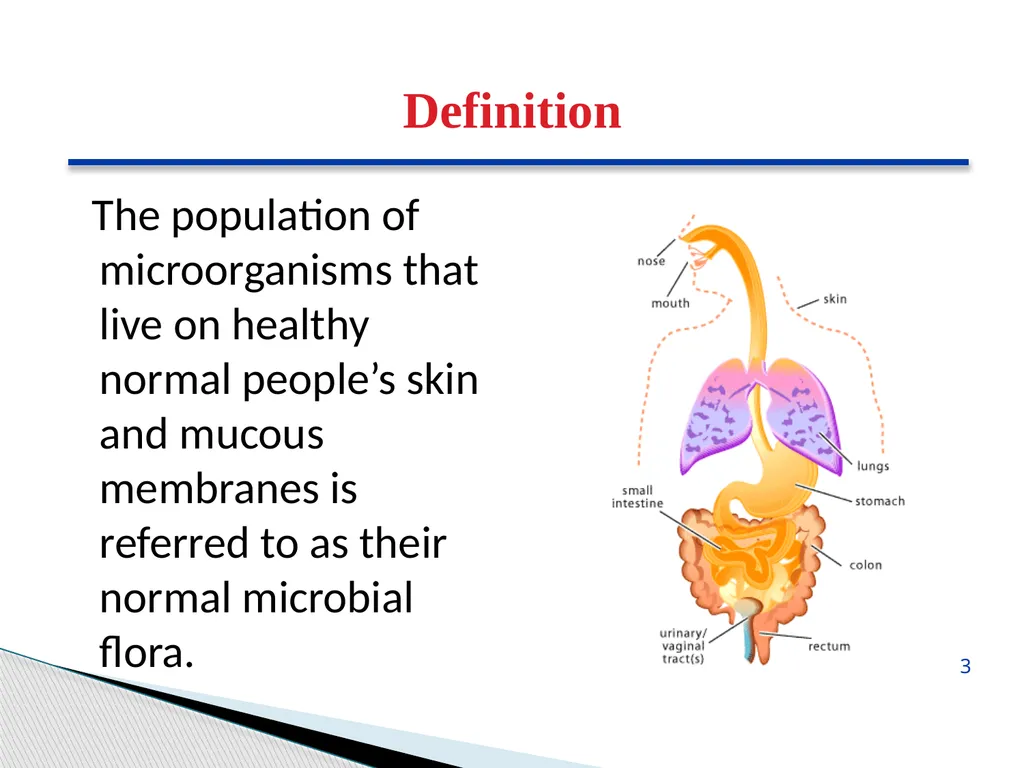
Definition The population of microorganisms that live on healthy normal people’s skin and mucous membranes is referred to as their normal microbial flora. 3<br>
04
Introduction Normal flora is found in all areas of the human body exposed to the environment (one exception is the lungs), but internal organs and body fluids are considered sterile in a healthy individual.
Members of the normal flora form part of the host and include: saprophytes, commensals, facultative pathogens and true pathogens. Skin is constantly exposed to and is in contact with the environment, the skin is particularly apt to contain transient microorganisms. 4<br>
05
5<br>
06
Microflora of Skin The skin is home to a wide variety of microorganisms, most of which are benign or even helpful to the host. It is most likely to carry transitory flora due to its frequent exposure to the environment.
However, there is a consistent and distinct resident flora that is altered in various anatomical regions by secretions or exposure to mucosal membranes. ●●●
6<br>
07
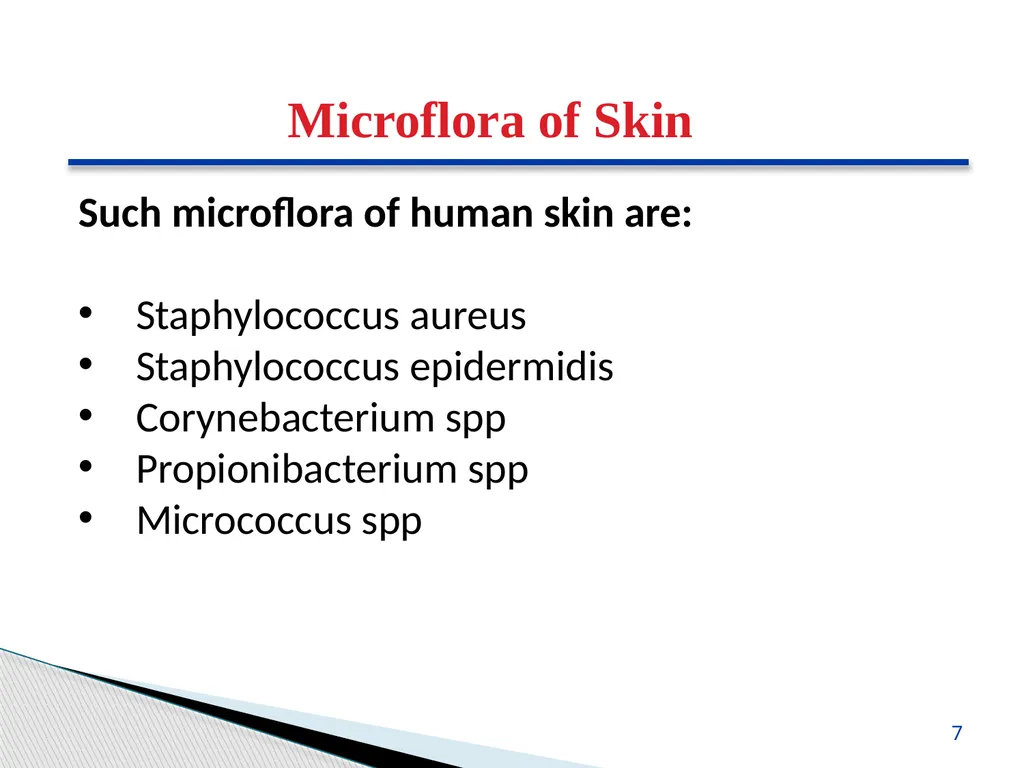
Microflora of Skin Such microflora of human skin are:
Microflora of Upper Respiratory
Tract and Buccal Cavity In the mouth, yeast (Candida species) is present. Even in teeth, several anaerobes such as Provotella spp, Fusobacterium spp, Lactobacilli and several anaerobic vibrios are seen.
Significant Staphylococci such as S.epidermidis and S.aureus, Corynebacteria and Streptococci make up the nose’s flora. Likewise, an adult human’s tonsillar tissue and gingivae typically contain Actinomyces species and other protozoa. ●●●
8<br>
09
Microflora of Upper Respiratory
Tract and Buccal Cavity Other predominant microbes in the upper respiratory tract are Neisseriae, mycoplasmas, pneumococci and diphtheroids.
The ciliated epithelium that lines the lower respiratory tract, which includes the bronchi, trachea and pulmonary tissues, performs an effective cleansing function that keeps the area almost free of microbes. 9<br>
10
Microflora of Intestine The relative makeup of the intestinal and faecal flora is significantly influenced by diet.
For instance, it has been demonstrated that those who consume an animal-based diet have higher concentrations of bile-tolerant microbes such as Bilophilia and Bacteroides and lower concentrations of Firmicutes which break down dietary plant polysaccharides. ●●●
10<br>
11
Microflora of Intestine Only Helicobacter pylori survive in the acidic environment of the human stomach out of the hundreds of phylotypes found there.
The phylum Bacteroidetes and members of the order Clostridiales are among the bacteria found in the upper intestine’s mucosa, whereas Enterococci and Enterobacteriales can be found in the lumen. 11<br>
12
Microflora of Vagina Aerobic lactobacilli enter the vagina shortly after birth and survive as long as the pH is acidic.
A mixed flora of cocci and bacilli is present when the pH reaches neutral and it stays that way until adolescence. Then there is an increase in anaerobic and aerobic lactobacilli during puberty. 12<br>
13
Other Human Microflora Diphtheroids, S.epidermidis and Enterococcus are regularly detected in the human anterior urethra. Likewise, E. coli, Proteus and Neisseria are also infrequently discovered there.
Diphtheroids and S.epidermidis are also predominant in the conjunctiva. ●●●
13<br>
14
Other Human Microflora Conjunctival pathogens that do cause infection include Chlamydia trachomatis and Neisseria gonorrhoeae. Usually, the regular tear flow, which contains the antimicrobial lysozyme keeps the conjunctival flora under control.
The flora in the colon (large intestine) is qualitatively comparable to that in faeces. 14<br>
15
Conclusion The functions of the normal flora include digestion of substrates, production of vitamins, stimulation of cell maturation, stimulation of the immune system, aid in intestinal transit and colonization resistance. 15<br>