
Subcontractor Electrical Safety Management (SESM)



Description: Subcontractor Electrical Safety Management (SESM) Working Group Electrical Contact Release Training WSHES-16-06 Preparing for work with electrical hazards Review work-site specific hazards, identify de-energization points, and discuss
Related Topics
Download Presentation
"Subcontractor Electrical Safety Management (SESM)" is the property of its rightful owner. Permission is granted to download and print the materials on this website for personal, non-commercial use only, and to display it on your personal computer provided you do not modify the materials and that you retain all copyright notices contained in the materials. By downloading content from our website, you accept the terms of this agreement.
Presentation Transcript
slide1. Subcontractor Electrical Safety Management (SESM) Working Group Electrical Contact Release Training
WSH/ES-16-06<br>
slide2. Preparing for work with electrical hazards
Review work-site specific hazards, identify de-energization points, and discuss potential rescue scenarios and techniques. Ensure work crew size and training is adequate to respond to emergent conditions.
Use correct shock and arc flash PPE. Use non-conductive ladders, platforms, and barriers, insulated tools, and insulating mats and blankets.
Designate the person who will direct rescue efforts
Provide at the worksite, or identify at a location nearby:
Means for contacting First Responders:
Landline or cellular telephones (verify reliable reception)
Continuously monitored jobsite two-way radios
Fire alarm manual pull stations
Automated Electric Defibrillator (AED)
Adequately rated and inspected rescue hooks, if appropriate Contact Release Training<br>
slide3. Response Actions
Notify First Responders first – get more help on the way
No matter what else happens, the victim will need prompt medical attention
Other work team members or even a passerby can do this
Remember: the safest method of contact release is to turn off the power
If there’s an obvious and safe way to turn off the source, DO IT!
Do not consider other contact release methods until options to quickly isolate the source have been exhausted Contact Release Training<br>
slide4. Release the Victim
Contact Release is a high-risk activity – for the rescuer!
Many well-intentioned rescuers have become an additional casualty instead
Perform a real-time risk assessment
Assume the victim is still energized when assessing the incident
Do not assume the hazards you expected are the only ones present
Assess the situation
Identify energized components which the victim could be contacting, or that the rescuer could contact
Observe the victim for signs they are still receiving a shock Contact Release Training<br>
slide5. If unable to isolate the power, determine if other contact release methods are advisable
Time is critical for the victim
Chances for survival decrease every minute a person is in ventricular fibrillation or respiratory paralysis.
National average for EMS response is over 15 minutes
Prompt rescue is vital for survival and minimizing brain injury Contact Release Training<br>
slide6. Some Accepted Rescue Techniques when isolating the power is not an option
The rescuer cannot forget that they are about to contact a potentially energized victim and must protect themselves.
Designated rescuers should don PPE appropriate for the hazard – preferably before the hazardous work starts
Rescuers must maintain a firm and stable posture
Use a rescue hook to remove the worker from the source
Push or pry the worker away with a DRY board or wooden broom handle.
Note: New lumber delivered to a construction site is wet and is not safe for rescue Contact Release Training<br>
slide7. Higher Risk Rescue Techniques
Use voltage-rated gloves to grab or push the victim free
Use a dry belt or rope to grab or pull the victim from the source
Using insulated tools or gloves, pull the victim off a ladder or platform
If there is sufficient space, as a last resort a flying football tackle can be used to propel the victim and rescuer away from the source Contact Release Training<br>
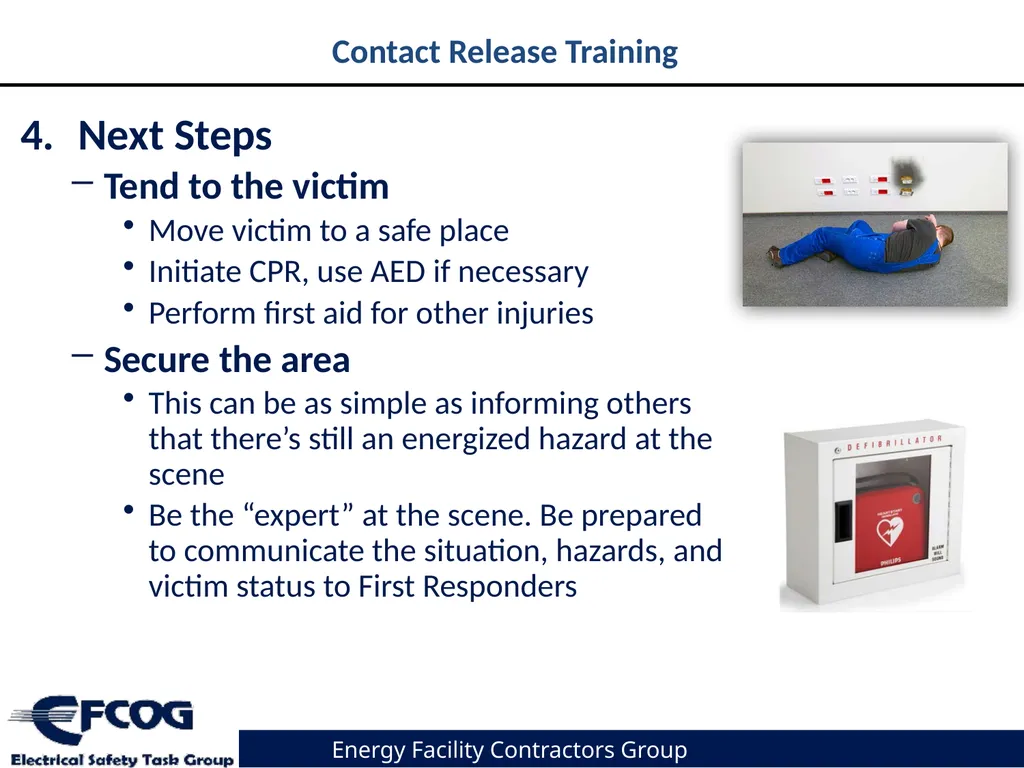
slide8. Next Steps
Tend to the victim
Move victim to a safe place
Initiate CPR, use AED if necessary
Perform first aid for other injuries
Secure the area
This can be as simple as informing others that there’s still an energized hazard at the scene
Be the “expert” at the scene. Be prepared to communicate the situation, hazards, and victim status to First Responders Contact Release Training<br>
WSH/ES-16-06<br>
slide2. Preparing for work with electrical hazards
Review work-site specific hazards, identify de-energization points, and discuss potential rescue scenarios and techniques. Ensure work crew size and training is adequate to respond to emergent conditions.
Use correct shock and arc flash PPE. Use non-conductive ladders, platforms, and barriers, insulated tools, and insulating mats and blankets.
Designate the person who will direct rescue efforts
Provide at the worksite, or identify at a location nearby:
Means for contacting First Responders:
Landline or cellular telephones (verify reliable reception)
Continuously monitored jobsite two-way radios
Fire alarm manual pull stations
Automated Electric Defibrillator (AED)
Adequately rated and inspected rescue hooks, if appropriate Contact Release Training<br>
slide3. Response Actions
Notify First Responders first – get more help on the way
No matter what else happens, the victim will need prompt medical attention
Other work team members or even a passerby can do this
Remember: the safest method of contact release is to turn off the power
If there’s an obvious and safe way to turn off the source, DO IT!
Do not consider other contact release methods until options to quickly isolate the source have been exhausted Contact Release Training<br>
slide4. Release the Victim
Contact Release is a high-risk activity – for the rescuer!
Many well-intentioned rescuers have become an additional casualty instead
Perform a real-time risk assessment
Assume the victim is still energized when assessing the incident
Do not assume the hazards you expected are the only ones present
Assess the situation
Identify energized components which the victim could be contacting, or that the rescuer could contact
Observe the victim for signs they are still receiving a shock Contact Release Training<br>
slide5. If unable to isolate the power, determine if other contact release methods are advisable
Time is critical for the victim
Chances for survival decrease every minute a person is in ventricular fibrillation or respiratory paralysis.
National average for EMS response is over 15 minutes
Prompt rescue is vital for survival and minimizing brain injury Contact Release Training<br>
slide6. Some Accepted Rescue Techniques when isolating the power is not an option
The rescuer cannot forget that they are about to contact a potentially energized victim and must protect themselves.
Designated rescuers should don PPE appropriate for the hazard – preferably before the hazardous work starts
Rescuers must maintain a firm and stable posture
Use a rescue hook to remove the worker from the source
Push or pry the worker away with a DRY board or wooden broom handle.
Note: New lumber delivered to a construction site is wet and is not safe for rescue Contact Release Training<br>
slide7. Higher Risk Rescue Techniques
Use voltage-rated gloves to grab or push the victim free
Use a dry belt or rope to grab or pull the victim from the source
Using insulated tools or gloves, pull the victim off a ladder or platform
If there is sufficient space, as a last resort a flying football tackle can be used to propel the victim and rescuer away from the source Contact Release Training<br>
slide8. Next Steps
Tend to the victim
Move victim to a safe place
Initiate CPR, use AED if necessary
Perform first aid for other injuries
Secure the area
This can be as simple as informing others that there’s still an energized hazard at the scene
Be the “expert” at the scene. Be prepared to communicate the situation, hazards, and victim status to First Responders Contact Release Training<br>