01
Subject: Performing Arts: Drama
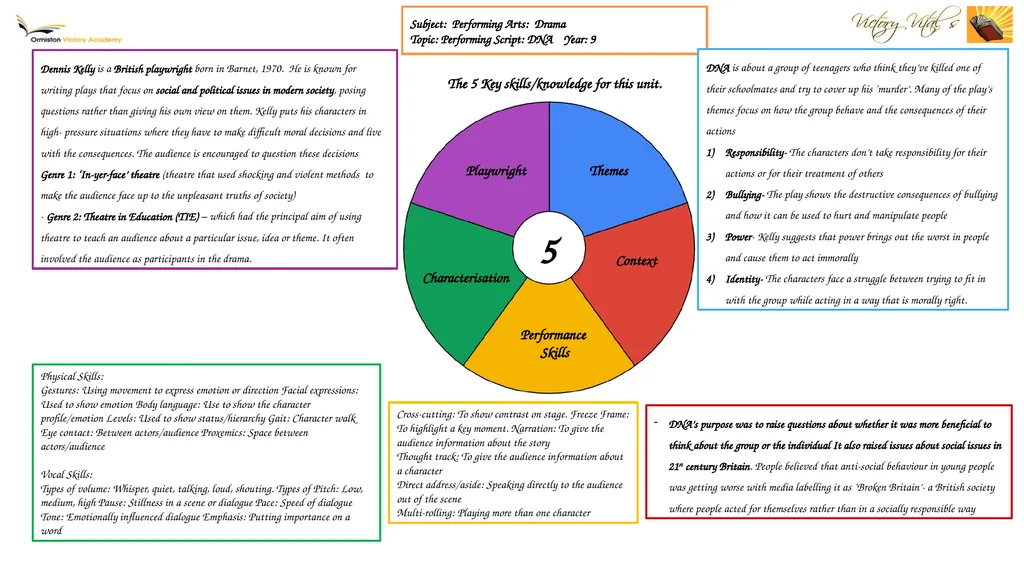
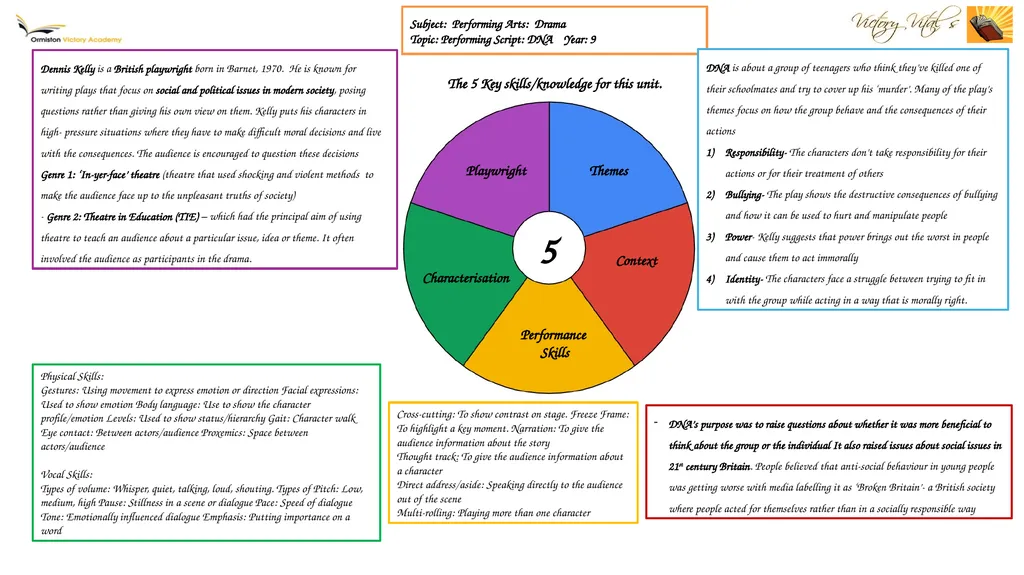
Topic: Performing Script: DNA Year: 9 Dennis Kelly is a British playwright born in Barnet, 1970. He is known for writing plays that focus on social and political issues in modern society, posing questions rather than giving his own view on them. Kelly puts his characters in high- pressure situations where they have to make difficult moral decisions and live with the consequences. The audience is encouraged to question these decisions
Genre 1: ‘In-yer-face’ theatre (theatre that used shocking and violent methods to make the audience face up to the unpleasant truths of society)
- Genre 2: Theatre in Education (TIE) – which had the principal aim of using theatre to teach an audience about a particular issue, idea or theme. It often involved the audience as participants in the drama. DNA is about a group of teenagers who think they’ve killed one of their schoolmates and try to cover up his ‘murder’. Many of the play’s themes focus on how the group behave and the consequences of their actions
Responsibility- The characters don’t take responsibility for their actions or for their treatment of others
Bullying- The play shows the destructive consequences of bullying and how it can be used to hurt and manipulate people
Power- Kelly suggests that power brings out the worst in people and cause them to act immorally
Identity- The characters face a struggle between trying to fit in with the group while acting in a way that is morally right. DNA’s purpose was to raise questions about whether it was more beneficial to think about the group or the individual It also raised issues about social issues in 21st century Britain. People believed that anti-social behaviour in young people was getting worse with media labelling it as ‘Broken Britain’- a British society where people acted for themselves rather than in a socially responsible way Cross-cutting: To show contrast on stage. Freeze Frame: To highlight a key moment. Narration: To give the audience information about the story
Thought track: To give the audience information about a character
Direct address/aside: Speaking directly to the audience out of the scene
Multi-rolling: Playing more than one character The 5 Key skills/knowledge for this unit. Physical Skills:
Gestures: Using movement to express emotion or direction Facial expressions: Used to show emotion Body language: Use to show the character profile/emotion Levels: Used to show status/hierarchy Gait: Character walk Eye contact: Between actors/audience Proxemics: Space between actors/audience
Vocal Skills:
Types of volume: Whisper, quiet, talking, loud, shouting. Types of Pitch: Low, medium, high Pause: Stillness in a scene or dialogue Pace: Speed of dialogue Tone: Emotionally influenced dialogue Emphasis: Putting importance on a word<br>
02
Stage Types Plot Summary:
DNA is about a group of teenagers, who could be described as a 'gang', who have accidentally killed one of their classmates. When they realise the terrible mistake they have made, they try to cover up this crime, but inadvertently implicate an innocent man in the process. Definition and purpose: How important or how high someone’s social position is compared to someone else to emphasise social differences between characters
Height and Width: Tall and wide= superior; small and thin= inferior
Proxemics (distance): Close= trying to intimidate; far away= showing fear
Movement and still: Moving=nervousness; Still= control or moving= dangerous and in control; still= paralysed with fear
Eye contact: Strong eye contact= intimidation; weak eye contact= nervous/low confidence or Strong eye contact= trying to seek approval; weak eye contact= believe you are superior than the other person
Time: Take your time= superior; Do things quickly= Nervous or trying to get out of the public eye as quickly as possible
Space: Take up a lot of space= superior; take up as little as possible=inferior<br>