
Substance Misuse Module Diagnosis & Treatment of
MS
Published · 87 slides · 0 views

1 / 1





Description
Substance Misuse Module Diagnosis Treatment of People with Alcohol Problems Insert name of the LEP Aims and Objectives (from handbook) Assessment, diagnosis and treatment of people with alcohol problems To develop awareness of
Related Topics
Share
Embed code
Download this presentation From Below
"Substance Misuse Module Diagnosis & Treatment of" is the property of its rightful owner. Permission is granted to download and print the materials on this website for personal, non-commercial use only, and to display it on your personal computer provided you do not modify the materials and that you retain all copyright notices contained in the materials. By downloading content from our website, you accept the terms of this agreement.
Presentation Transcript
01
Substance Misuse Module Diagnosis & Treatment of People with Alcohol Problems<br>
02
Insert name of the LEP Aims and Objectives (from handbook) Assessment, diagnosis and treatment of people with alcohol problems
To develop awareness of complications associated with alcohol use
To understand some of the practical aspects of managing people with alcohol problems
To gain awareness of local provisions and guidelines<br>
To develop awareness of complications associated with alcohol use
To understand some of the practical aspects of managing people with alcohol problems
To gain awareness of local provisions and guidelines<br>
03
Insert name of the LEP To achieve this Case Presentation
Journal Club
555 Presentation
Expert-Led Session
MCQs
Please sign the register and complete the feedback<br>
Journal Club
555 Presentation
Expert-Led Session
MCQs
Please sign the register and complete the feedback<br>
04
Insert name of the LEP Expert Led Session Alcohol Dependence
P Horgan
Consultant in Substance Misuse, Cumbria<br>
P Horgan
Consultant in Substance Misuse, Cumbria<br>
05
Overview Pharmacology / Neuropharmacology
Classification
Assessment
Epidemiology
Health Consequences
Treatment issues<br>
Classification
Assessment
Epidemiology
Health Consequences
Treatment issues<br>
06
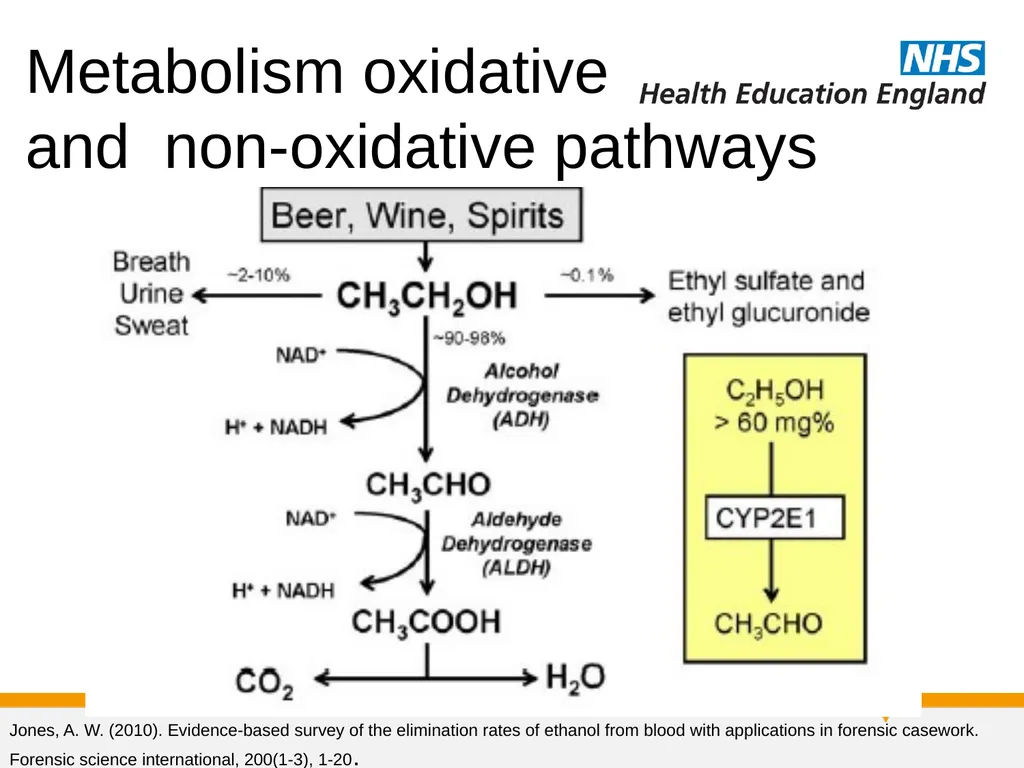
Metabolism oxidative
and non-oxidative pathways 6 Jones, A. W. (2010). Evidence-based survey of the elimination rates of ethanol from blood with applications in forensic casework. Forensic science international, 200(1-3), 1-20.<br>
07
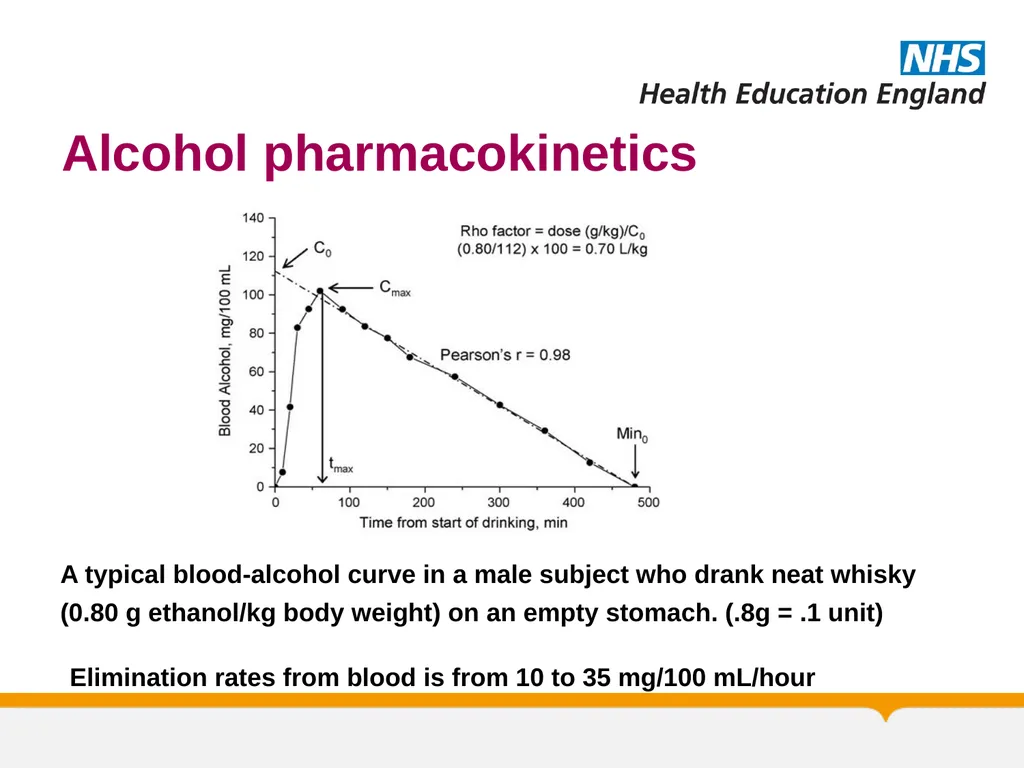
Alcohol pharmacokinetics A typical blood-alcohol curve in a male subject who drank neat whisky (0.80 g ethanol/kg body weight) on an empty stomach. (.8g = .1 unit) Elimination rates from blood is from 10 to 35 mg/100 mL/hour<br>
08
Blood alcohol and breath alcohol Limit drink driving England
80 milligrams per 100 millilitres of blood (Scotland is 50)
On some breath alcometer machines
This will shown as 0.35 mg/L
On other alcometer machines
This will be shown as 80%
These systems are set to sample deep-lung air; this reflects the blood alcohol concentration 8<br>
80 milligrams per 100 millilitres of blood (Scotland is 50)
On some breath alcometer machines
This will shown as 0.35 mg/L
On other alcometer machines
This will be shown as 80%
These systems are set to sample deep-lung air; this reflects the blood alcohol concentration 8<br>
09
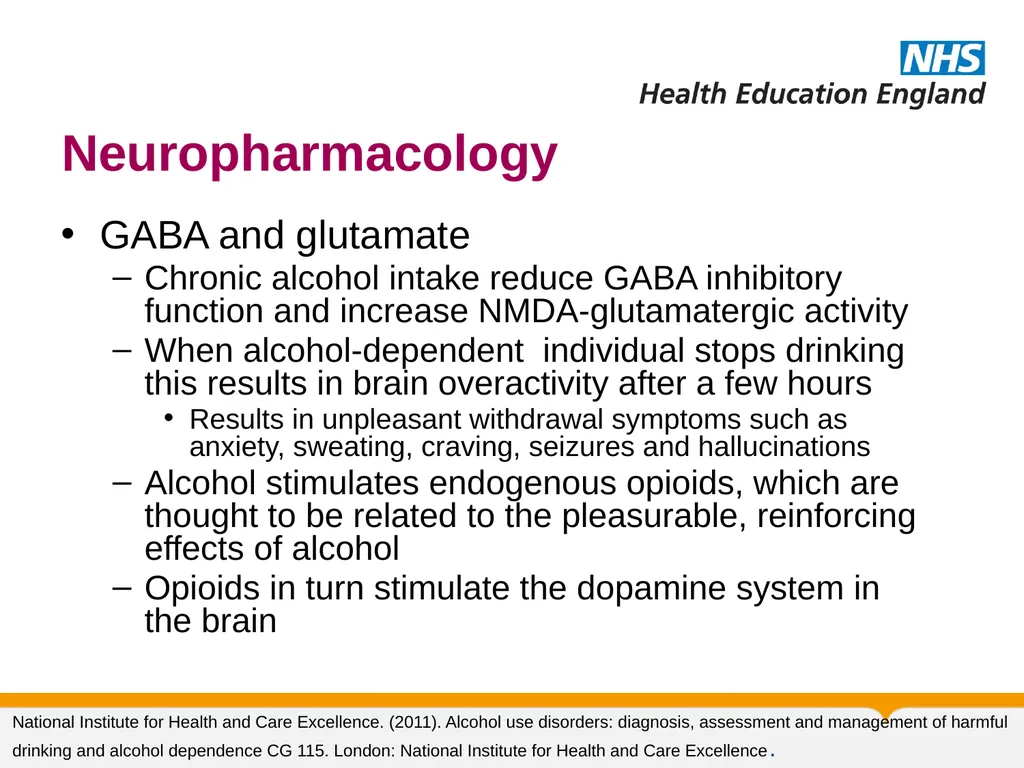
Neuropharmacology GABA and glutamate
Chronic alcohol intake reduce GABA inhibitory function and increase NMDA-glutamatergic activity
When alcohol-dependent individual stops drinking this results in brain overactivity after a few hours
Results in unpleasant withdrawal symptoms such as anxiety, sweating, craving, seizures and hallucinations
Alcohol stimulates endogenous opioids, which are thought to be related to the pleasurable, reinforcing effects of alcohol
Opioids in turn stimulate the dopamine system in the brain National Institute for Health and Care Excellence. (2011). Alcohol use disorders: diagnosis, assessment and management of harmful drinking and alcohol dependence CG 115. London: National Institute for Health and Care Excellence.<br>
Chronic alcohol intake reduce GABA inhibitory function and increase NMDA-glutamatergic activity
When alcohol-dependent individual stops drinking this results in brain overactivity after a few hours
Results in unpleasant withdrawal symptoms such as anxiety, sweating, craving, seizures and hallucinations
Alcohol stimulates endogenous opioids, which are thought to be related to the pleasurable, reinforcing effects of alcohol
Opioids in turn stimulate the dopamine system in the brain National Institute for Health and Care Excellence. (2011). Alcohol use disorders: diagnosis, assessment and management of harmful drinking and alcohol dependence CG 115. London: National Institute for Health and Care Excellence.<br>
10
Brain imaging studies A range of a neuropsychological deficits identified
E.g., working memory and executive function )
Abnormalities using brain structural and functional techniques
Frontal lobe regions
Magnetic resonance imaging studies have shown differences between people with AUD ( alcohol use disorder) relative to controls such as volume deficits low rates of glucose metabolism and task related depressed BOLD responses
Frontocerebellar circuits
Structural MRI has shown smaller volumes of the pons, thalamus, cerebellar hemispheres, and cerebellar vermis
Frontolimbic circuits
For social drinkers, acute alcohol reduces the response to fearful stimuli in limbic regions
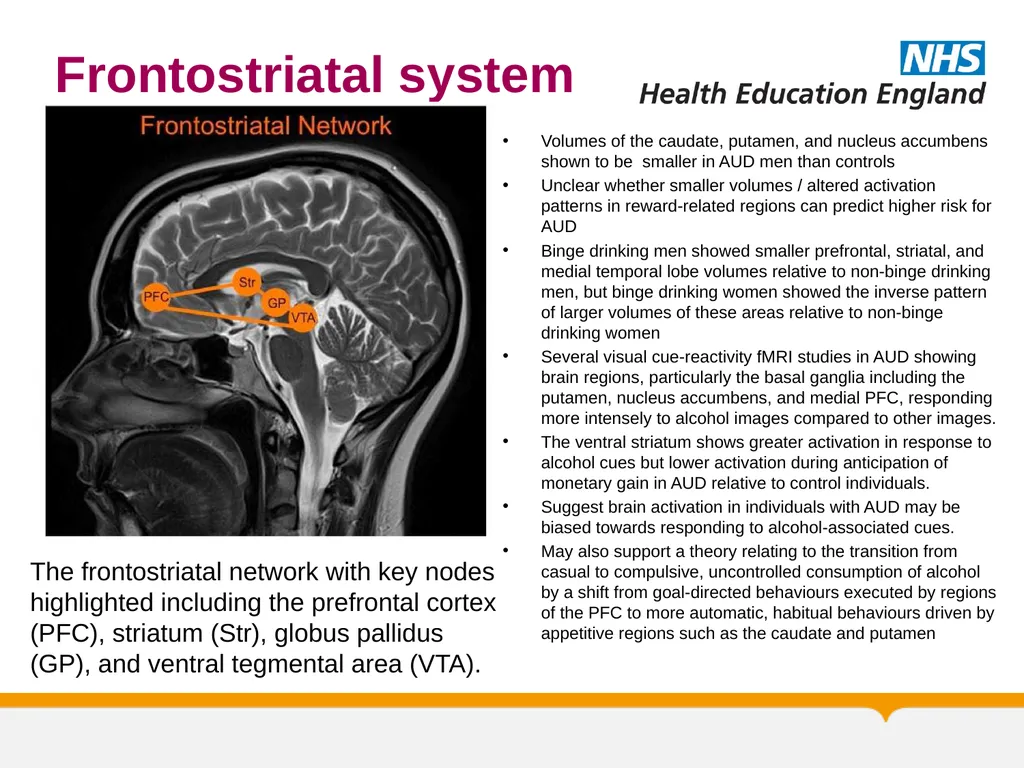
Frontostriatal system
Several fMRI studies in AUD have shown the basal ganglia including the putamen, nucleus accumbens, and medial PFC, responding more intensely to alcohol images compared to other images Zahr, N. M., Pfefferbaum, A., & Sullivan, E. V. (2017). Perspectives on fronto-fugal circuitry from human imaging of alcohol use disorders. Neuropharmacology, 122, 189-200.<br>
E.g., working memory and executive function )
Abnormalities using brain structural and functional techniques
Frontal lobe regions
Magnetic resonance imaging studies have shown differences between people with AUD ( alcohol use disorder) relative to controls such as volume deficits low rates of glucose metabolism and task related depressed BOLD responses
Frontocerebellar circuits
Structural MRI has shown smaller volumes of the pons, thalamus, cerebellar hemispheres, and cerebellar vermis
Frontolimbic circuits
For social drinkers, acute alcohol reduces the response to fearful stimuli in limbic regions
Frontostriatal system
Several fMRI studies in AUD have shown the basal ganglia including the putamen, nucleus accumbens, and medial PFC, responding more intensely to alcohol images compared to other images Zahr, N. M., Pfefferbaum, A., & Sullivan, E. V. (2017). Perspectives on fronto-fugal circuitry from human imaging of alcohol use disorders. Neuropharmacology, 122, 189-200.<br>
11
ICD 10 Dependence A definite diagnosis of dependence should usually be made only if three or more of the following have been present together at some time during the previous year:
A strong desire or sense of compulsion to take the substance
Difficulties in controlling substance-taking behaviour in terms of its onset, termination, or levels of use
A physiological withdrawal state when substance use has ceased or have been reduced, as evidenced by: the characteristic withdrawal syndrome for the substance; or use of the same (or closely related) substance with the intention of relieving or avoiding withdrawal symptoms<br>
A strong desire or sense of compulsion to take the substance
Difficulties in controlling substance-taking behaviour in terms of its onset, termination, or levels of use
A physiological withdrawal state when substance use has ceased or have been reduced, as evidenced by: the characteristic withdrawal syndrome for the substance; or use of the same (or closely related) substance with the intention of relieving or avoiding withdrawal symptoms<br>
12
ICD 10 Dependence Evidence of tolerance, such that increased doses of the psychoactive substance are required in order to achieve effects originally produced by lower doses (clear examples of this are found in alcohol- and opiate-dependent individuals who may take daily doses sufficient to incapacitate or kill non tolerant users)
Progressive neglect of alternative pleasures or interests because of psychoactive substance use, increased amount of time necessary to obtain or take the substance or to recover from its effects
Persisting with substance use despite clear evidence of overtly harmful consequences, such as harm to the liver through excessive drinking, depressive mood states consequent to periods of heavy substance use, or drug-related impairment of cognitive functioning; efforts should be made to determine that the user was actually, or could be expected to be, aware of the nature and extent of the harm<br>
Progressive neglect of alternative pleasures or interests because of psychoactive substance use, increased amount of time necessary to obtain or take the substance or to recover from its effects
Persisting with substance use despite clear evidence of overtly harmful consequences, such as harm to the liver through excessive drinking, depressive mood states consequent to periods of heavy substance use, or drug-related impairment of cognitive functioning; efforts should be made to determine that the user was actually, or could be expected to be, aware of the nature and extent of the harm<br>
13
ICD 10 Harmful use The diagnosis requires that actual damage should have been caused to the mental or physical health of the user
Harmful patterns of use are often criticized by others and frequently associated with adverse social consequences of various kinds. The fact that a pattern of use or a particular substance is disapproved of by another person or by the culture, or may have led to socially negative consequences such as arrest or marital arguments is not in itself evidence of harmful use
Acute intoxication, or “hangover” is not in itself sufficient evidence of the damage to health required for coding harmful use
Harmful use should not be diagnosed if dependence syndrome, a psychotic disorder, or another specific form of drug- or alcohol-related disorder is present<br>
Harmful patterns of use are often criticized by others and frequently associated with adverse social consequences of various kinds. The fact that a pattern of use or a particular substance is disapproved of by another person or by the culture, or may have led to socially negative consequences such as arrest or marital arguments is not in itself evidence of harmful use
Acute intoxication, or “hangover” is not in itself sufficient evidence of the damage to health required for coding harmful use
Harmful use should not be diagnosed if dependence syndrome, a psychotic disorder, or another specific form of drug- or alcohol-related disorder is present<br>
14
ICD 10 Hazardous use A pattern of substance use that increases the risk of harmful consequences for the user
In contrast to harmful use, hazardous use refers to patterns of use that are of public health significance despite the absence of any current disorder in the individual user
The term is used currently by WHO but is not a diagnostic term in ICD-10<br>
In contrast to harmful use, hazardous use refers to patterns of use that are of public health significance despite the absence of any current disorder in the individual user
The term is used currently by WHO but is not a diagnostic term in ICD-10<br>
15
Other relevant
ICD 10 codes F10.4 Withdrawal state with delirium
Alcohol induced delirium tremens
F10.5 Psychotic disorder
Psychotic disorder usually within 48 hours
Onset needs to be within 2 weeks of substance use
Includes alcoholic hallucinosis
F10.6 Amnesic syndrome
Includes Korsakoff’s syndrome
F10.7 Residual and late onset psychotic disorder
ICD -11 new codes
E.g. Alcohol-induced mood disorder
Amnestic disorder due to use of alcohol ( excludes Korsakoff Syndrome – listed separately)<br>
Alcohol induced delirium tremens
F10.5 Psychotic disorder
Psychotic disorder usually within 48 hours
Onset needs to be within 2 weeks of substance use
Includes alcoholic hallucinosis
F10.6 Amnesic syndrome
Includes Korsakoff’s syndrome
F10.7 Residual and late onset psychotic disorder
ICD -11 new codes
E.g. Alcohol-induced mood disorder
Amnestic disorder due to use of alcohol ( excludes Korsakoff Syndrome – listed separately)<br>
16
Assessment Current Alcohol Use
Assess length of time using alcohol; type of alcohol; frequency; any breaks; timeline for starting and increase to current levels; binges along with usual alcohol use; stabilising / destabilising factors
Calculate total daily units of alcohol used (1 unit of alcohol = 10 ml = 8 g)
Formula is ( alcohol by volume x volume in ml) /1000
Rule of thumb - 1 litre of cider (6% alcohol by volume) is 6 Units
Check for features of dependence / harmful use
Check previous treatment – Self reduction/outpatient assisted withdrawals/ inpatient assisted withdrawals/ emergency admissions (physical or mental health complications)/ periods in Rehabilitation ( community or residential)/Use of AA/SMART/local services
How long was previous abstinence / what were factors for relapse?
Withdrawals
Current or previous – sweating/ agitation/ seizures/hallucinations/ liver failure
Other drug use
Any other previous or current drug use
Sedating drugs - cannabis/benzodiazepines /opioids/pregabalin/ketamine GBH
Stimulants – cocaine / amphetamine/ highly concentrated caffeine drinks<br>
Assess length of time using alcohol; type of alcohol; frequency; any breaks; timeline for starting and increase to current levels; binges along with usual alcohol use; stabilising / destabilising factors
Calculate total daily units of alcohol used (1 unit of alcohol = 10 ml = 8 g)
Formula is ( alcohol by volume x volume in ml) /1000
Rule of thumb - 1 litre of cider (6% alcohol by volume) is 6 Units
Check for features of dependence / harmful use
Check previous treatment – Self reduction/outpatient assisted withdrawals/ inpatient assisted withdrawals/ emergency admissions (physical or mental health complications)/ periods in Rehabilitation ( community or residential)/Use of AA/SMART/local services
How long was previous abstinence / what were factors for relapse?
Withdrawals
Current or previous – sweating/ agitation/ seizures/hallucinations/ liver failure
Other drug use
Any other previous or current drug use
Sedating drugs - cannabis/benzodiazepines /opioids/pregabalin/ketamine GBH
Stimulants – cocaine / amphetamine/ highly concentrated caffeine drinks<br>
17
Assessment Medication
Prescribed by drug or alcohol services or GP
Thiamine /acamprosate/ disulfiram/ naltrexone/ nalmefene currently or previously
Proton pump inhibitor/ diuretics
Sedating medication /benzodiazepines/opioids
Physical health
Liver disease / Hepatitis C
CNS - Epilepsy/Seizures/Confusion/ Myopathy/ Neuropathy/ Space Occupying Lesions
Cancer screen – GI/ Breast cancer
Endocrine – Diabetes
Mental Health
Depression/Anxiety/Psychosis/Bipolar Affective disorder/ Personality disorder/DSH/Suicide
Dementia screen
Social Issues
Homelessness/ Living Alone/Family Spport
Risks / Forensic
Driving/Children/Safe Storage/Criminal Justice system/Violence<br>
Prescribed by drug or alcohol services or GP
Thiamine /acamprosate/ disulfiram/ naltrexone/ nalmefene currently or previously
Proton pump inhibitor/ diuretics
Sedating medication /benzodiazepines/opioids
Physical health
Liver disease / Hepatitis C
CNS - Epilepsy/Seizures/Confusion/ Myopathy/ Neuropathy/ Space Occupying Lesions
Cancer screen – GI/ Breast cancer
Endocrine – Diabetes
Mental Health
Depression/Anxiety/Psychosis/Bipolar Affective disorder/ Personality disorder/DSH/Suicide
Dementia screen
Social Issues
Homelessness/ Living Alone/Family Spport
Risks / Forensic
Driving/Children/Safe Storage/Criminal Justice system/Violence<br>
18
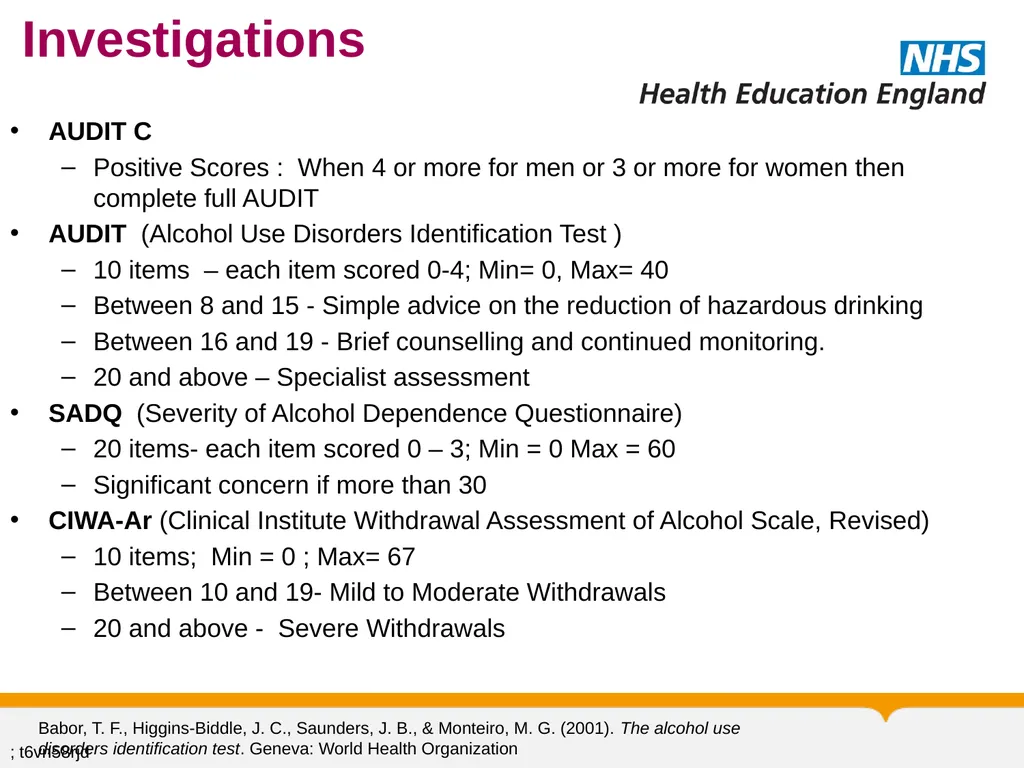
Investigations AUDIT C
Positive Scores : When 4 or more for men or 3 or more for women then complete full AUDIT
AUDIT (Alcohol Use Disorders Identification Test )
10 items – each item scored 0-4; Min= 0, Max= 40
Between 8 and 15 - Simple advice on the reduction of hazardous drinking
Between 16 and 19 - Brief counselling and continued monitoring.
20 and above – Specialist assessment
SADQ (Severity of Alcohol Dependence Questionnaire)
20 items- each item scored 0 – 3; Min = 0 Max = 60
Significant concern if more than 30
CIWA-Ar (Clinical Institute Withdrawal Assessment of Alcohol Scale, Revised)
10 items; Min = 0 ; Max= 67
Between 10 and 19- Mild to Moderate Withdrawals
20 and above - Severe Withdrawals
; t6vn58rjd Babor, T. F., Higgins-Biddle, J. C., Saunders, J. B., & Monteiro, M. G. (2001). The alcohol use disorders identification test. Geneva: World Health Organization<br>
Positive Scores : When 4 or more for men or 3 or more for women then complete full AUDIT
AUDIT (Alcohol Use Disorders Identification Test )
10 items – each item scored 0-4; Min= 0, Max= 40
Between 8 and 15 - Simple advice on the reduction of hazardous drinking
Between 16 and 19 - Brief counselling and continued monitoring.
20 and above – Specialist assessment
SADQ (Severity of Alcohol Dependence Questionnaire)
20 items- each item scored 0 – 3; Min = 0 Max = 60
Significant concern if more than 30
CIWA-Ar (Clinical Institute Withdrawal Assessment of Alcohol Scale, Revised)
10 items; Min = 0 ; Max= 67
Between 10 and 19- Mild to Moderate Withdrawals
20 and above - Severe Withdrawals
; t6vn58rjd Babor, T. F., Higgins-Biddle, J. C., Saunders, J. B., & Monteiro, M. G. (2001). The alcohol use disorders identification test. Geneva: World Health Organization<br>
19
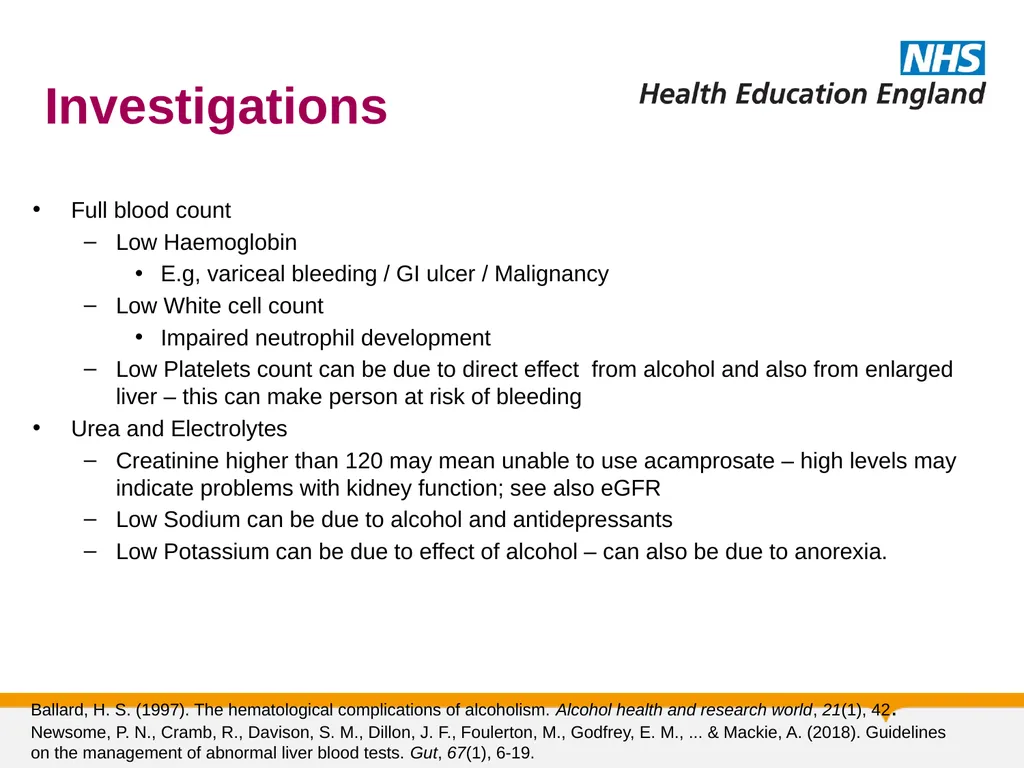
Investigations Full blood count
Low Haemoglobin
E.g, variceal bleeding / GI ulcer / Malignancy
Low White cell count
Impaired neutrophil development
Low Platelets count can be due to direct effect from alcohol and also from enlarged liver – this can make person at risk of bleeding
Urea and Electrolytes
Creatinine higher than 120 may mean unable to use acamprosate – high levels may indicate problems with kidney function; see also eGFR
Low Sodium can be due to alcohol and antidepressants
Low Potassium can be due to effect of alcohol – can also be due to anorexia. Ballard, H. S. (1997). The hematological complications of alcoholism. Alcohol health and research world, 21(1), 42.
Newsome, P. N., Cramb, R., Davison, S. M., Dillon, J. F., Foulerton, M., Godfrey, E. M., ... & Mackie, A. (2018). Guidelines on the management of abnormal liver blood tests. Gut, 67(1), 6-19.<br>
Low Haemoglobin
E.g, variceal bleeding / GI ulcer / Malignancy
Low White cell count
Impaired neutrophil development
Low Platelets count can be due to direct effect from alcohol and also from enlarged liver – this can make person at risk of bleeding
Urea and Electrolytes
Creatinine higher than 120 may mean unable to use acamprosate – high levels may indicate problems with kidney function; see also eGFR
Low Sodium can be due to alcohol and antidepressants
Low Potassium can be due to effect of alcohol – can also be due to anorexia. Ballard, H. S. (1997). The hematological complications of alcoholism. Alcohol health and research world, 21(1), 42.
Newsome, P. N., Cramb, R., Davison, S. M., Dillon, J. F., Foulerton, M., Godfrey, E. M., ... & Mackie, A. (2018). Guidelines on the management of abnormal liver blood tests. Gut, 67(1), 6-19.<br>
20
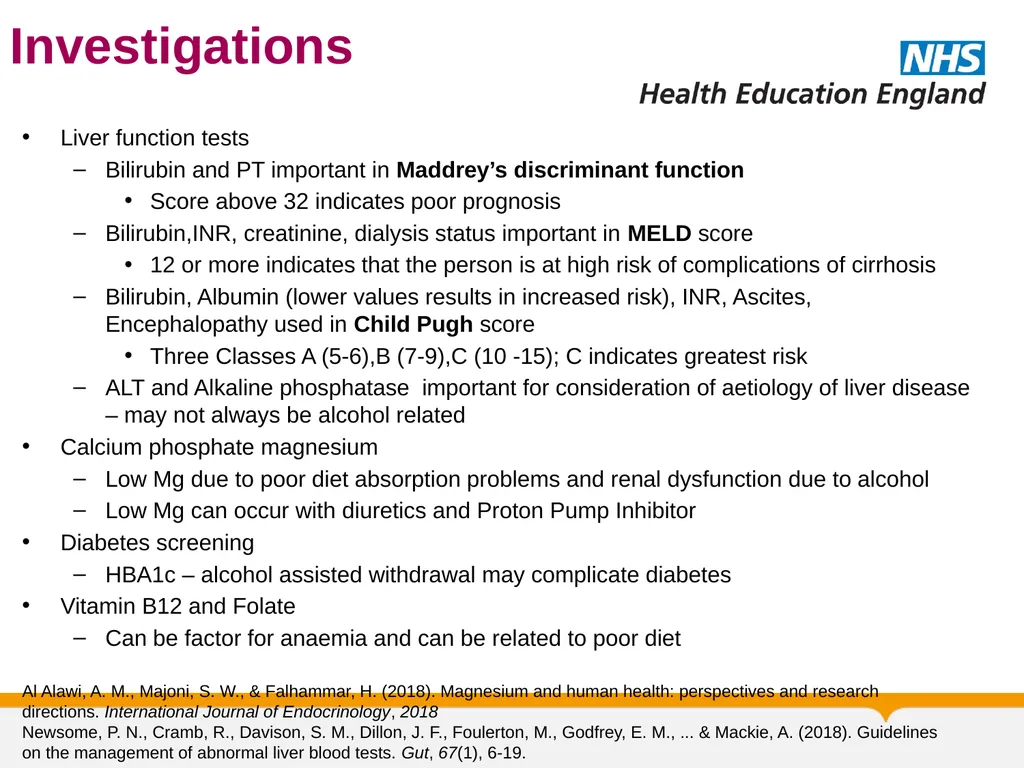
Investigations Liver function tests
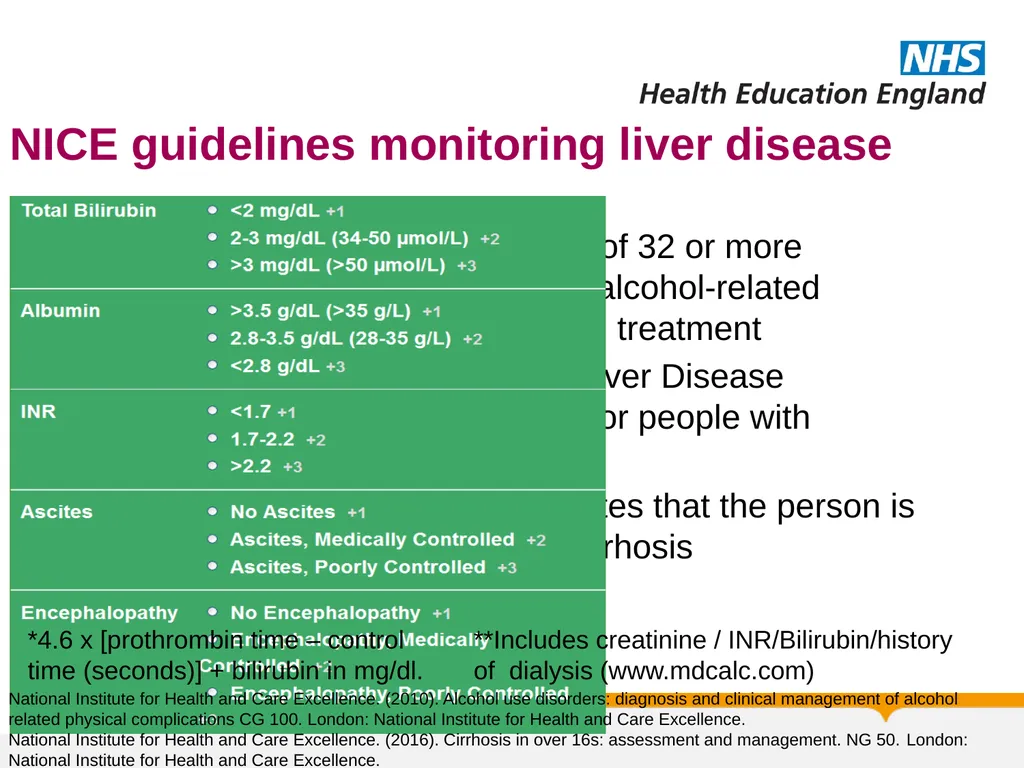
Bilirubin and PT important in Maddrey’s discriminant function
Score above 32 indicates poor prognosis
Bilirubin,INR, creatinine, dialysis status important in MELD score
12 or more indicates that the person is at high risk of complications of cirrhosis
Bilirubin, Albumin (lower values results in increased risk), INR, Ascites, Encephalopathy used in Child Pugh score
Three Classes A (5-6),B (7-9),C (10 -15); C indicates greatest risk
ALT and Alkaline phosphatase important for consideration of aetiology of liver disease – may not always be alcohol related
Calcium phosphate magnesium
Low Mg due to poor diet absorption problems and renal dysfunction due to alcohol
Low Mg can occur with diuretics and Proton Pump Inhibitor
Diabetes screening
HBA1c – alcohol assisted withdrawal may complicate diabetes
Vitamin B12 and Folate
Can be factor for anaemia and can be related to poor diet Al Alawi, A. M., Majoni, S. W., & Falhammar, H. (2018). Magnesium and human health: perspectives and research directions. International Journal of Endocrinology, 2018
Newsome, P. N., Cramb, R., Davison, S. M., Dillon, J. F., Foulerton, M., Godfrey, E. M., ... & Mackie, A. (2018). Guidelines on the management of abnormal liver blood tests. Gut, 67(1), 6-19.<br>
Bilirubin and PT important in Maddrey’s discriminant function
Score above 32 indicates poor prognosis
Bilirubin,INR, creatinine, dialysis status important in MELD score
12 or more indicates that the person is at high risk of complications of cirrhosis
Bilirubin, Albumin (lower values results in increased risk), INR, Ascites, Encephalopathy used in Child Pugh score
Three Classes A (5-6),B (7-9),C (10 -15); C indicates greatest risk
ALT and Alkaline phosphatase important for consideration of aetiology of liver disease – may not always be alcohol related
Calcium phosphate magnesium
Low Mg due to poor diet absorption problems and renal dysfunction due to alcohol
Low Mg can occur with diuretics and Proton Pump Inhibitor
Diabetes screening
HBA1c – alcohol assisted withdrawal may complicate diabetes
Vitamin B12 and Folate
Can be factor for anaemia and can be related to poor diet Al Alawi, A. M., Majoni, S. W., & Falhammar, H. (2018). Magnesium and human health: perspectives and research directions. International Journal of Endocrinology, 2018
Newsome, P. N., Cramb, R., Davison, S. M., Dillon, J. F., Foulerton, M., Godfrey, E. M., ... & Mackie, A. (2018). Guidelines on the management of abnormal liver blood tests. Gut, 67(1), 6-19.<br>
21
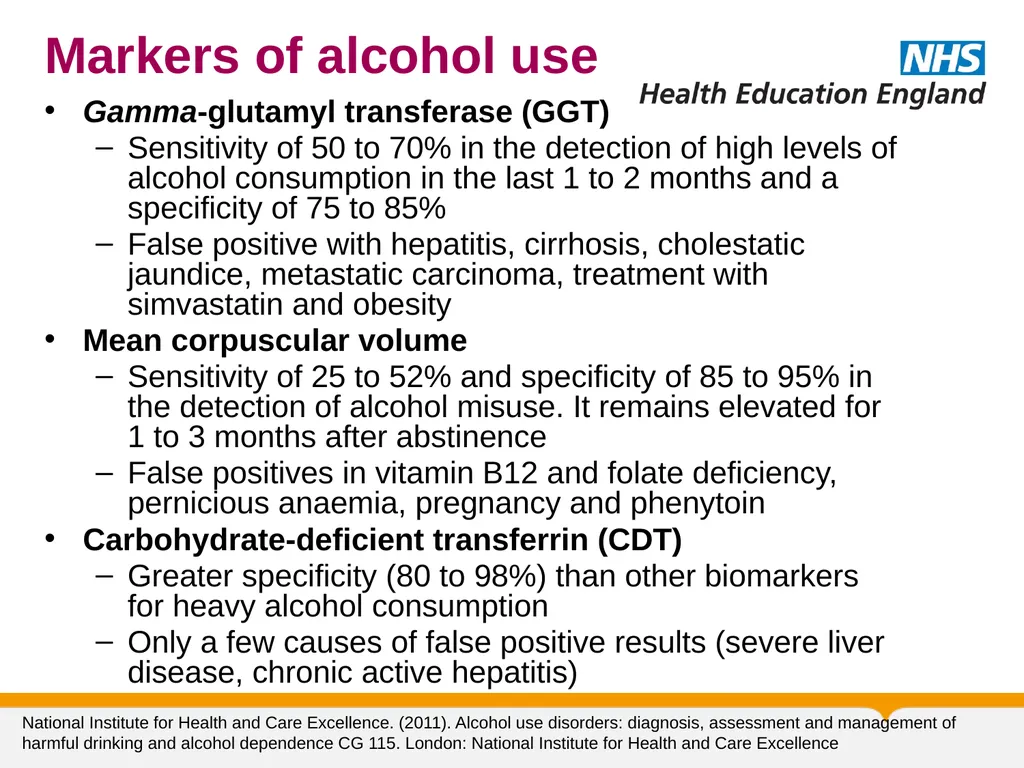
Markers of alcohol use Gamma-glutamyl transferase (GGT)
Sensitivity of 50 to 70% in the detection of high levels of alcohol consumption in the last 1 to 2 months and a specificity of 75 to 85%
False positive with hepatitis, cirrhosis, cholestatic jaundice, metastatic carcinoma, treatment with simvastatin and obesity
Mean corpuscular volume
Sensitivity of 25 to 52% and specificity of 85 to 95% in the detection of alcohol misuse. It remains elevated for 1 to 3 months after abstinence
False positives in vitamin B12 and folate deficiency, pernicious anaemia, pregnancy and phenytoin
Carbohydrate-deficient transferrin (CDT)
Greater specificity (80 to 98%) than other biomarkers for heavy alcohol consumption
Only a few causes of false positive results (severe liver disease, chronic active hepatitis) 21 National Institute for Health and Care Excellence. (2011). Alcohol use disorders: diagnosis, assessment and management of harmful drinking and alcohol dependence CG 115. London: National Institute for Health and Care Excellence<br>
Sensitivity of 50 to 70% in the detection of high levels of alcohol consumption in the last 1 to 2 months and a specificity of 75 to 85%
False positive with hepatitis, cirrhosis, cholestatic jaundice, metastatic carcinoma, treatment with simvastatin and obesity
Mean corpuscular volume
Sensitivity of 25 to 52% and specificity of 85 to 95% in the detection of alcohol misuse. It remains elevated for 1 to 3 months after abstinence
False positives in vitamin B12 and folate deficiency, pernicious anaemia, pregnancy and phenytoin
Carbohydrate-deficient transferrin (CDT)
Greater specificity (80 to 98%) than other biomarkers for heavy alcohol consumption
Only a few causes of false positive results (severe liver disease, chronic active hepatitis) 21 National Institute for Health and Care Excellence. (2011). Alcohol use disorders: diagnosis, assessment and management of harmful drinking and alcohol dependence CG 115. London: National Institute for Health and Care Excellence<br>
22
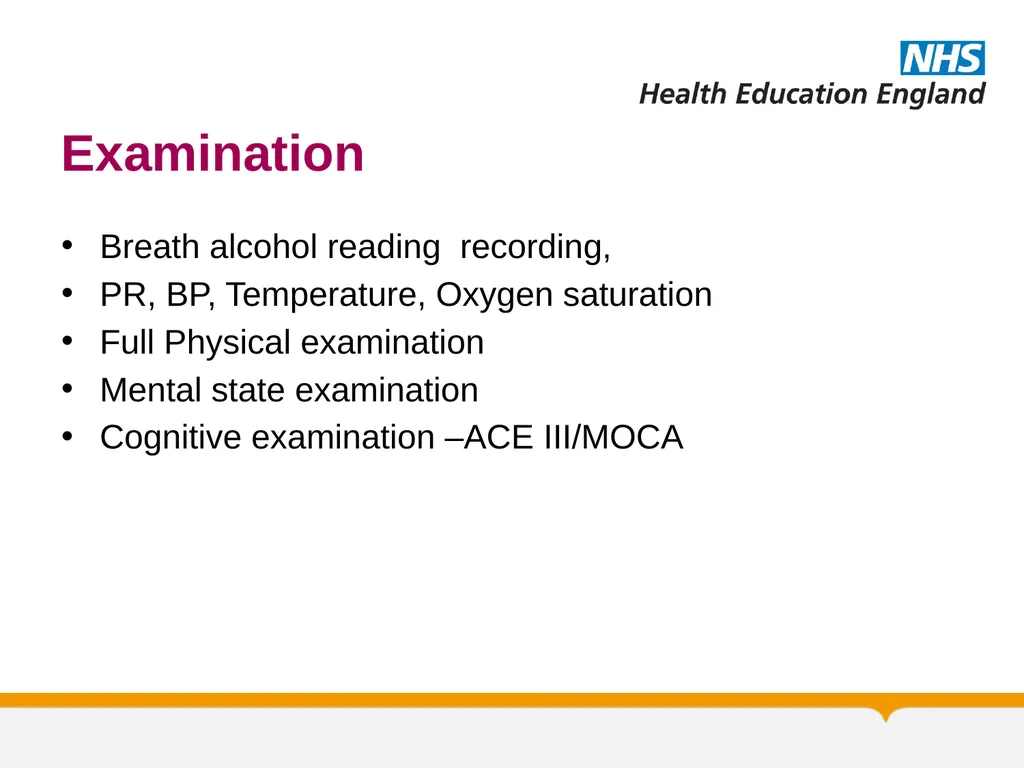
Examination Breath alcohol reading recording,
PR, BP, Temperature, Oxygen saturation
Full Physical examination
Mental state examination
Cognitive examination –ACE III/MOCA<br>
PR, BP, Temperature, Oxygen saturation
Full Physical examination
Mental state examination
Cognitive examination –ACE III/MOCA<br>
23
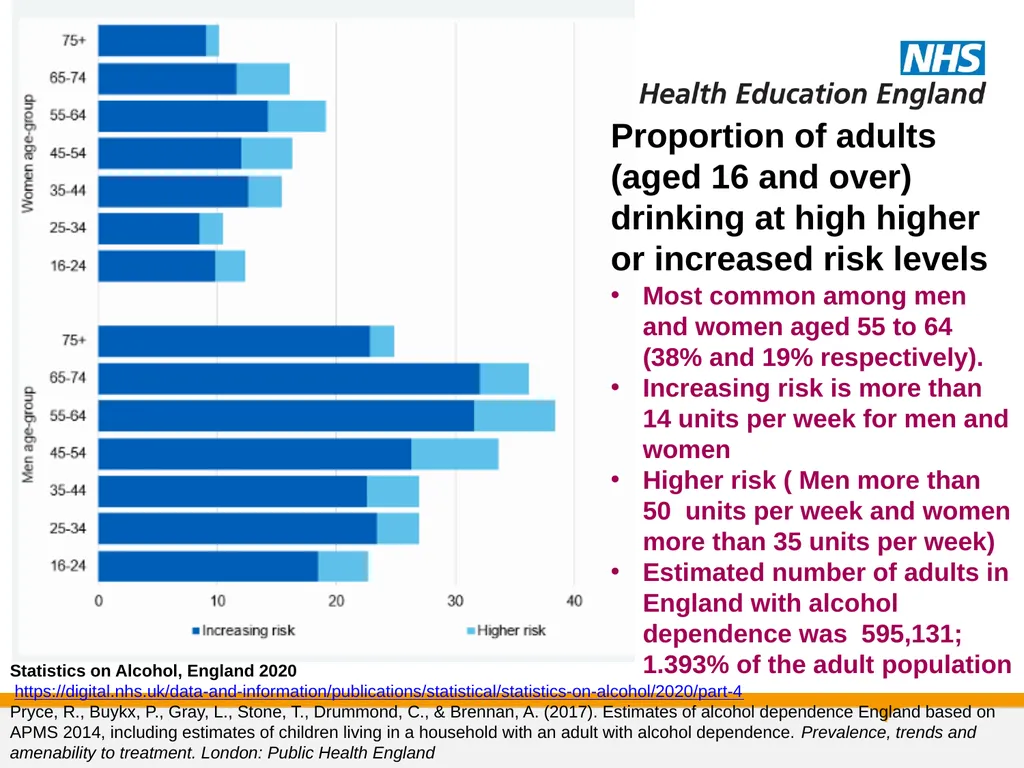
Most common among men and women aged 55 to 64 (38% and 19% respectively).
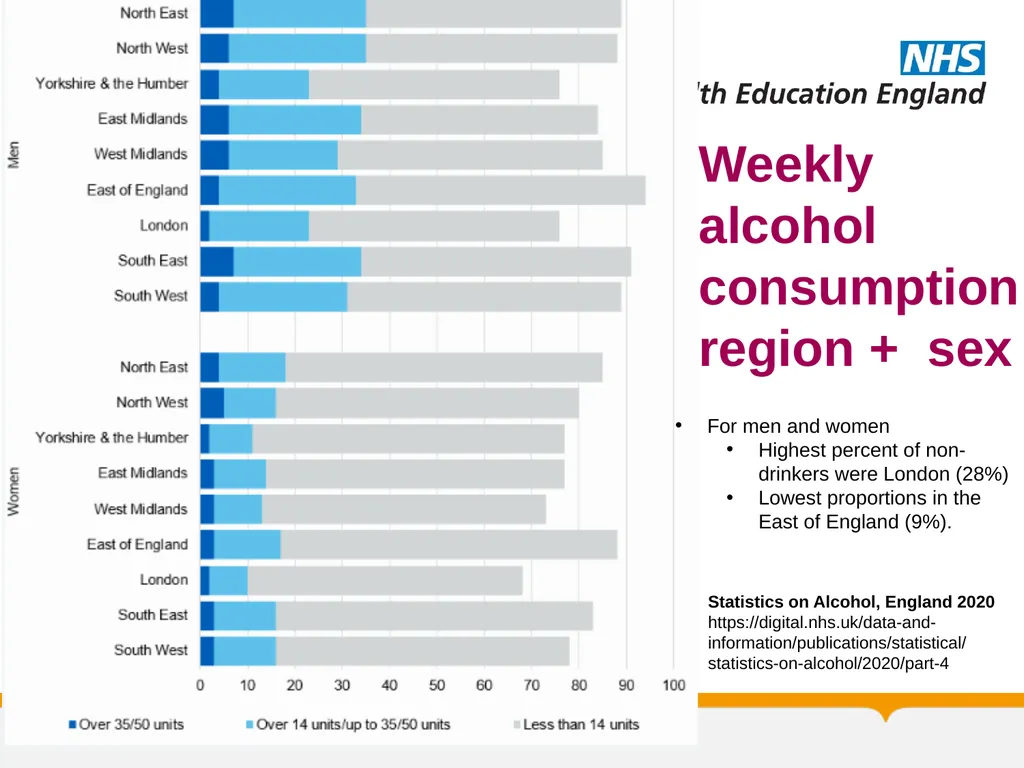
Increasing risk is more than 14 units per week for men and women
Higher risk ( Men more than 50 units per week and women more than 35 units per week)
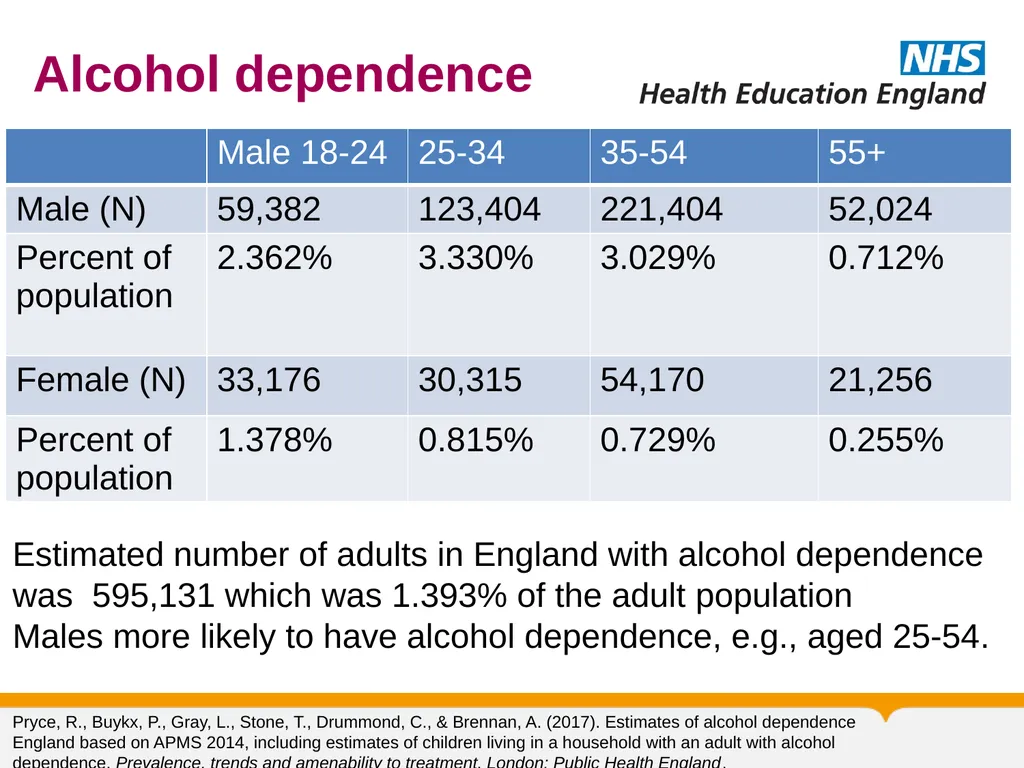
Estimated number of adults in England with alcohol dependence was 595,131; 1.393% of the adult population Statistics on Alcohol, England 2020
https://digital.nhs.uk/data-and-information/publications/statistical/statistics-on-alcohol/2020/part-4
Pryce, R., Buykx, P., Gray, L., Stone, T., Drummond, C., & Brennan, A. (2017). Estimates of alcohol dependence England based on APMS 2014, including estimates of children living in a household with an adult with alcohol dependence. Prevalence, trends and amenability to treatment. London: Public Health England Proportion of adults (aged 16 and over) drinking at high higher or increased risk levels<br>
Increasing risk is more than 14 units per week for men and women
Higher risk ( Men more than 50 units per week and women more than 35 units per week)
Estimated number of adults in England with alcohol dependence was 595,131; 1.393% of the adult population Statistics on Alcohol, England 2020
https://digital.nhs.uk/data-and-information/publications/statistical/statistics-on-alcohol/2020/part-4
Pryce, R., Buykx, P., Gray, L., Stone, T., Drummond, C., & Brennan, A. (2017). Estimates of alcohol dependence England based on APMS 2014, including estimates of children living in a household with an adult with alcohol dependence. Prevalence, trends and amenability to treatment. London: Public Health England Proportion of adults (aged 16 and over) drinking at high higher or increased risk levels<br>
24
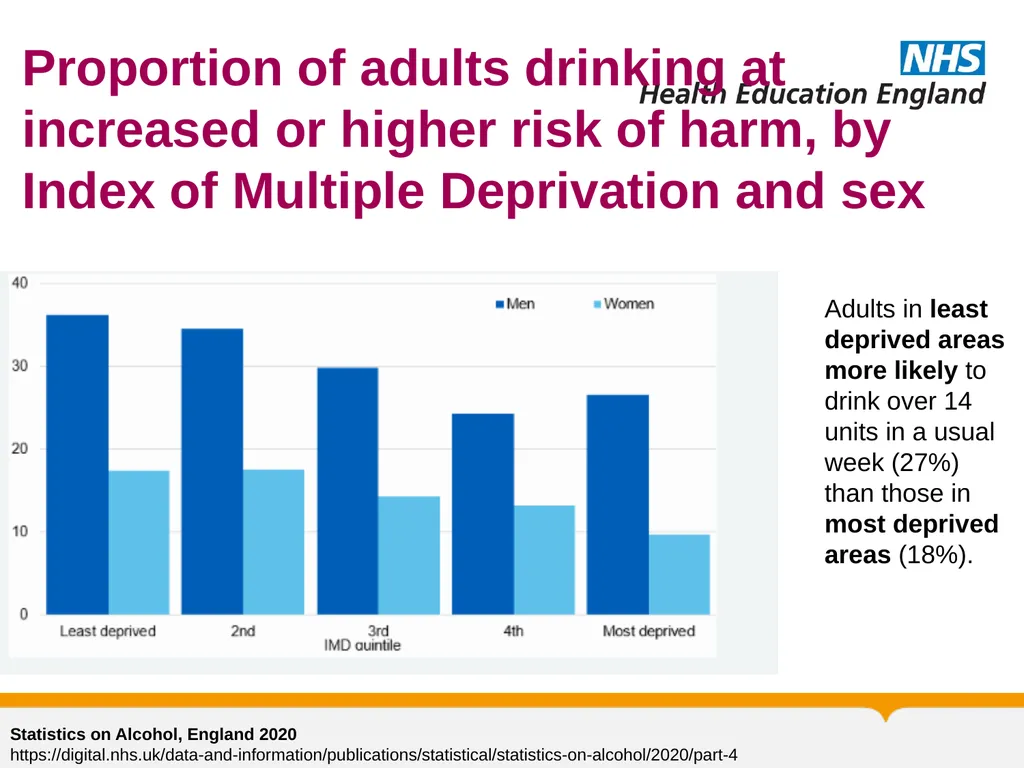
Proportion of adults drinking at increased or higher risk of harm, by Index of Multiple Deprivation and sex Adults in least deprived areas more likely to drink over 14 units in a usual week (27%) than those in most deprived areas (18%). Statistics on Alcohol, England 2020
https://digital.nhs.uk/data-and-information/publications/statistical/statistics-on-alcohol/2020/part-4<br>
https://digital.nhs.uk/data-and-information/publications/statistical/statistics-on-alcohol/2020/part-4<br>
25
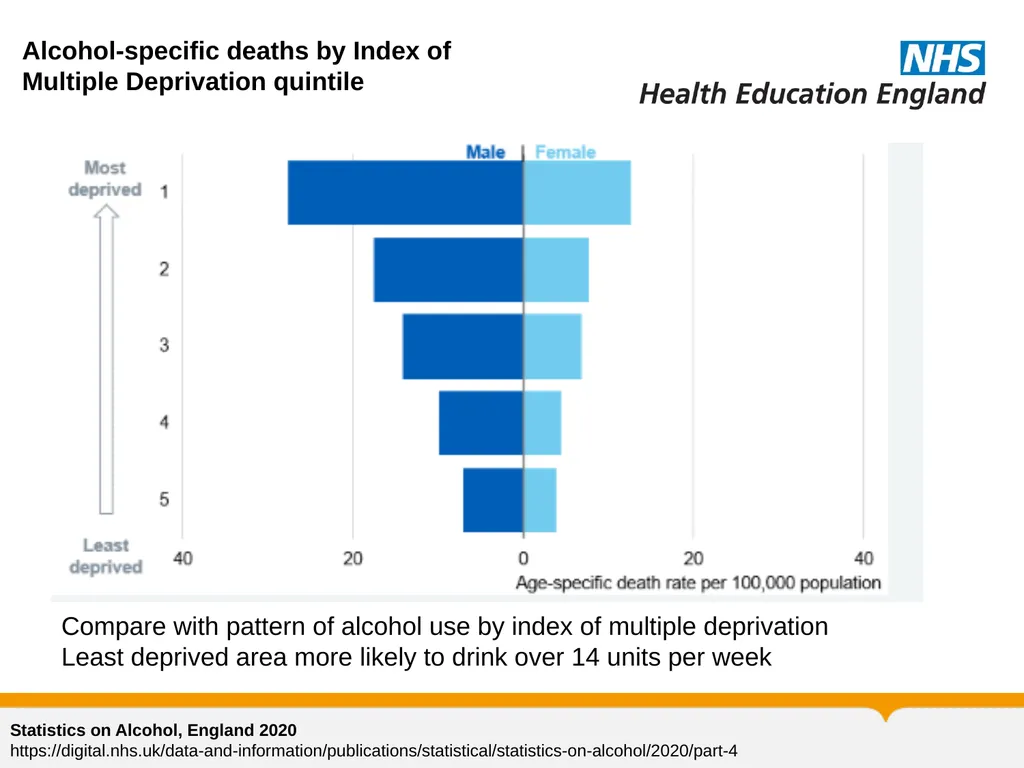
Alcohol-specific deaths by Index of Multiple Deprivation quintile Statistics on Alcohol, England 2020
https://digital.nhs.uk/data-and-information/publications/statistical/statistics-on-alcohol/2020/part-4 Compare with pattern of alcohol use by index of multiple deprivation
Least deprived area more likely to drink over 14 units per week<br>
https://digital.nhs.uk/data-and-information/publications/statistical/statistics-on-alcohol/2020/part-4 Compare with pattern of alcohol use by index of multiple deprivation
Least deprived area more likely to drink over 14 units per week<br>
26
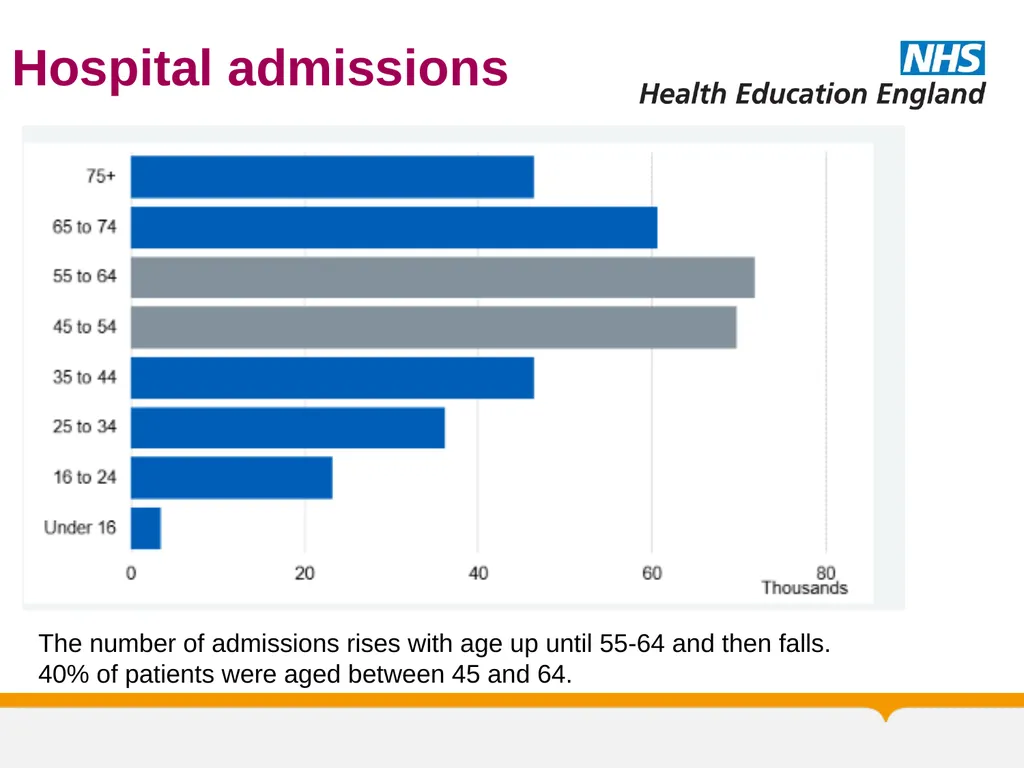
Estimated alcohol-related hospital admissions – narrow measure In 2018/19 there were 358 thousand estimated admissions where the main reason
for admission to hospital was attributable to alcohol (narrow measure).
This is 6% higher than 2017/18 and 19% higher than 2008/09
This represents 2.1% of all hospital admissions<br>
for admission to hospital was attributable to alcohol (narrow measure).
This is 6% higher than 2017/18 and 19% higher than 2008/09
This represents 2.1% of all hospital admissions<br>
27
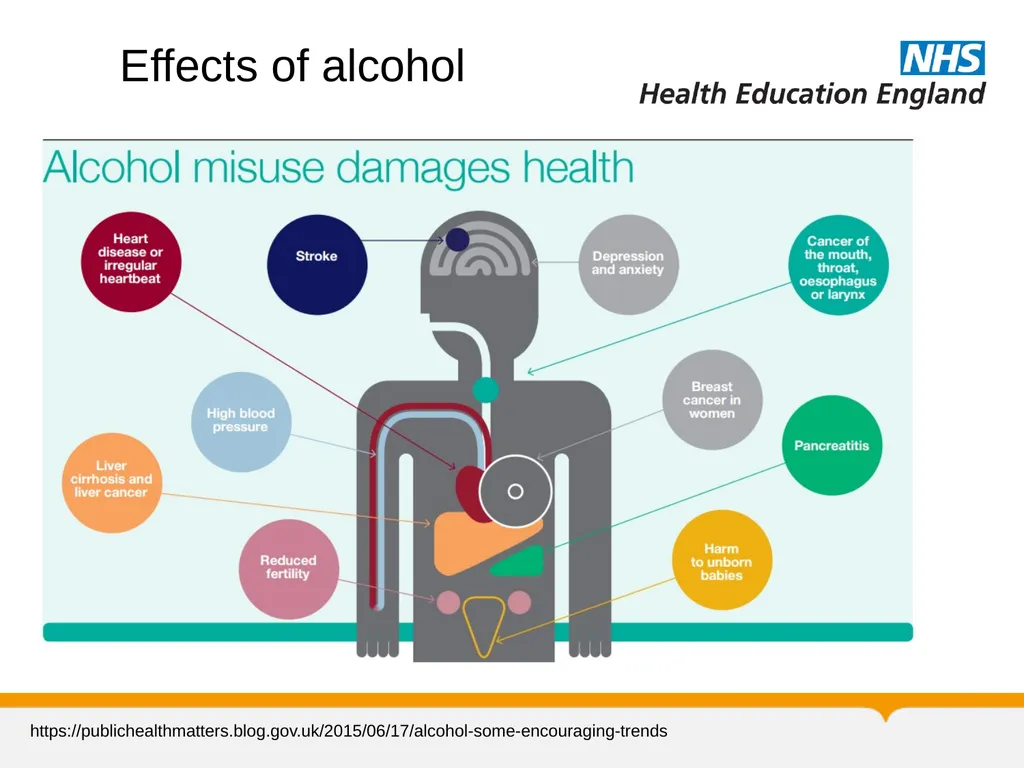
/ Effects of alcohol https://publichealthmatters.blog.gov.uk/2015/06/17/alcohol-some-encouraging-trends<br>
28
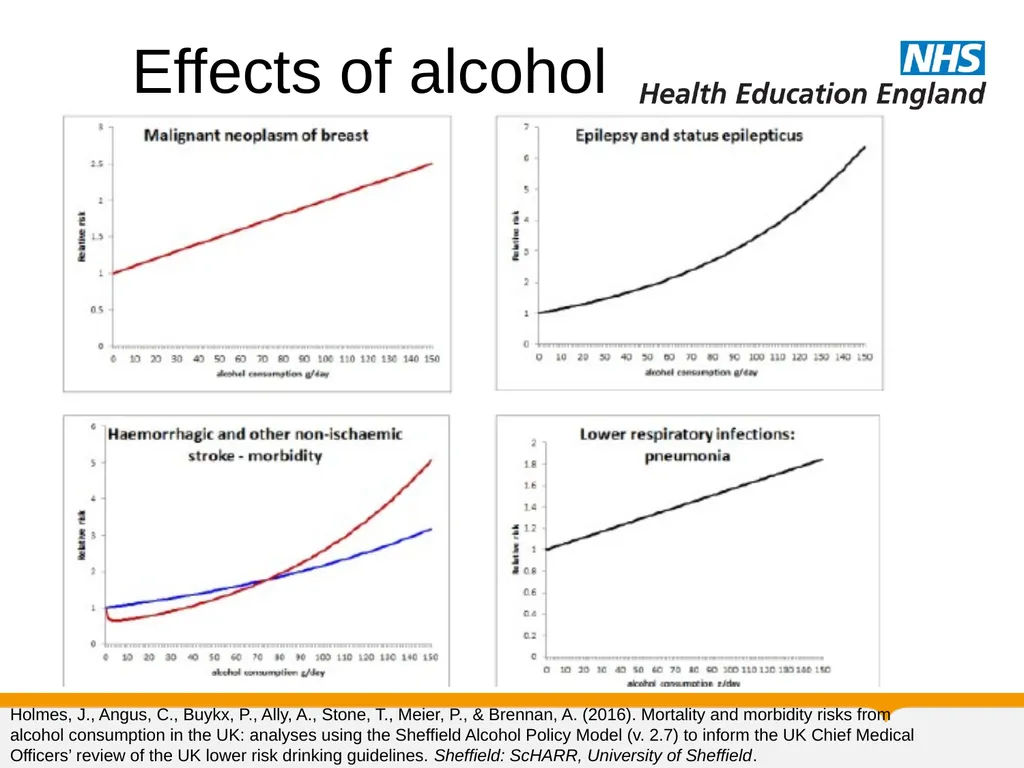
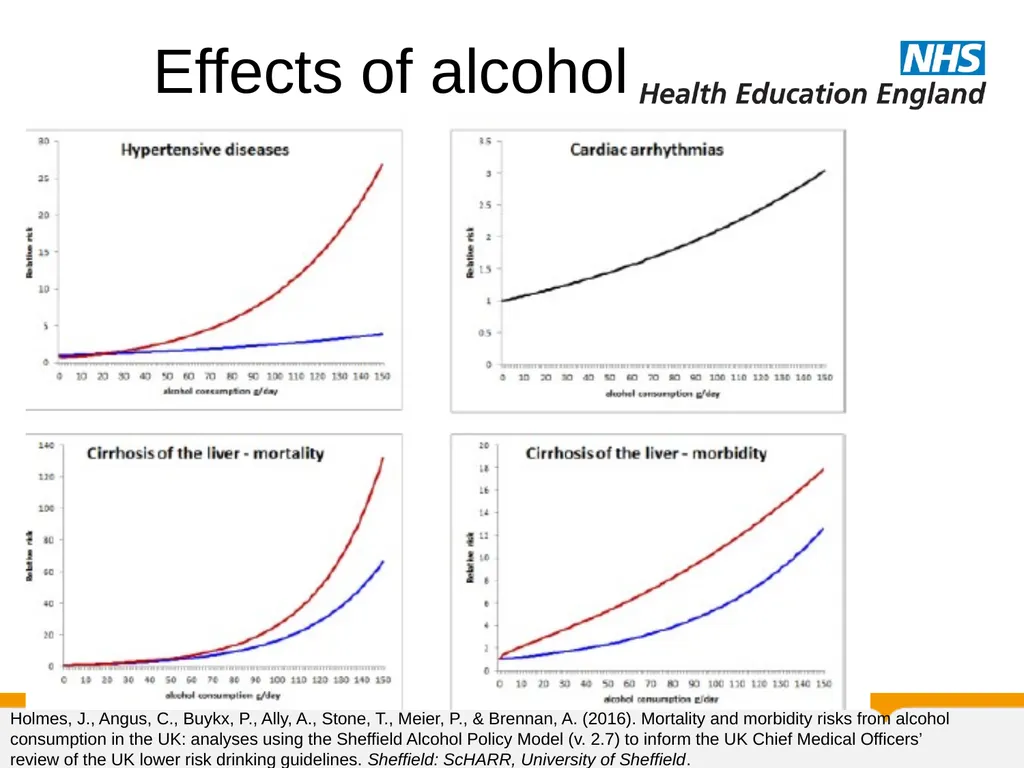
Effects of alcohol Holmes, J., Angus, C., Buykx, P., Ally, A., Stone, T., Meier, P., & Brennan, A. (2016). Mortality and morbidity risks from alcohol consumption in the UK: analyses using the Sheffield Alcohol Policy Model (v. 2.7) to inform the UK Chief Medical Officers’ review of the UK lower risk drinking guidelines. Sheffield: ScHARR, University of Sheffield.<br>
29
Interventions for harmful drinking and mild alcohol dependence For harmful drinkers and people with mild alcohol dependence, offer a psychological intervention (such as cognitive behavioural therapies, behavioural therapies or social network and environment-based therapies) focused specifically on alcohol-related cognitions, behaviour, problems and social networks 29 National Institute for Health and Care Excellence. (2011). Alcohol use disorders: diagnosis, assessment and management of harmful drinking and alcohol dependence CG 115. London: National Institute for Health and Care Excellence<br>
30
Assessment for assisted alcohol withdrawal For service users who typically drink over 15 units of alcohol per day, and/or who score 20 or more on the AUDIT, consider offering:
An assessment for and delivery of a community-based assisted withdrawal
Assessment and management in specialist alcohol services if there are safety concerns about a community-based assisted withdrawal 30 National Institute for Health and Care Excellence. (2011). Alcohol use disorders: diagnosis, assessment and management of harmful drinking and alcohol dependence CG 115. London: National Institute for Health and Care Excellence<br>
An assessment for and delivery of a community-based assisted withdrawal
Assessment and management in specialist alcohol services if there are safety concerns about a community-based assisted withdrawal 30 National Institute for Health and Care Excellence. (2011). Alcohol use disorders: diagnosis, assessment and management of harmful drinking and alcohol dependence CG 115. London: National Institute for Health and Care Excellence<br>
31
Consider inpatient
if one or more of following present Drink over 30 units of alcohol per day
Have a score of more than 30 on the SADQ
Have a history of epilepsy, or experience of withdrawal-related seizures or delirium tremens during previous assisted withdrawal programmes
Need concurrent withdrawal from alcohol and benzodiazepines
Drink between 15 and 30 units of alcohol per day and have:
A significant learning disability or cognitive impairment
Significant psychiatric or physical comorbidities (for example, chronic severe depression, psychosis, malnutrition, congestive cardiac failure, unstable angina, chronic liver disease)
Consider a lower threshold for inpatient or residential assisted withdrawal in vulnerable groups, for example, homeless and older people 31 SADQ = Severity of Alcohol Dependence Questionnaire National Institute for Health and Care Excellence. (2010). Alcohol use disorders: diagnosis and clinical management of alcohol related physical complications CG 100. London: National Institute for Health and Care Excellence.<br>
Have a score of more than 30 on the SADQ
Have a history of epilepsy, or experience of withdrawal-related seizures or delirium tremens during previous assisted withdrawal programmes
Need concurrent withdrawal from alcohol and benzodiazepines
Drink between 15 and 30 units of alcohol per day and have:
A significant learning disability or cognitive impairment
Significant psychiatric or physical comorbidities (for example, chronic severe depression, psychosis, malnutrition, congestive cardiac failure, unstable angina, chronic liver disease)
Consider a lower threshold for inpatient or residential assisted withdrawal in vulnerable groups, for example, homeless and older people 31 SADQ = Severity of Alcohol Dependence Questionnaire National Institute for Health and Care Excellence. (2010). Alcohol use disorders: diagnosis and clinical management of alcohol related physical complications CG 100. London: National Institute for Health and Care Excellence.<br>
32
Regimes to use Fixed-dose or symptom-triggered medication regimens can be used in assisted withdrawal programmes in inpatient or residential settings
If a symptom-triggered regimen is used, all staff should be competent in monitoring symptoms effectively and the unit should have sufficient resources to allow them to do so frequently and safely
Prescribe and administer medication for assisted withdrawal within a standard clinical protocol. The preferred medication for assisted withdrawal is a benzodiazepine (chlordiazepoxide or diazepam)
Local guidelines will vary in treatments used 32 National Institute for Health and Care Excellence. (2010). Alcohol use disorders: diagnosis and clinical management of alcohol related physical complications CG 100. London: National Institute for Health and Care Excellence.<br>
If a symptom-triggered regimen is used, all staff should be competent in monitoring symptoms effectively and the unit should have sufficient resources to allow them to do so frequently and safely
Prescribe and administer medication for assisted withdrawal within a standard clinical protocol. The preferred medication for assisted withdrawal is a benzodiazepine (chlordiazepoxide or diazepam)
Local guidelines will vary in treatments used 32 National Institute for Health and Care Excellence. (2010). Alcohol use disorders: diagnosis and clinical management of alcohol related physical complications CG 100. London: National Institute for Health and Care Excellence.<br>
33
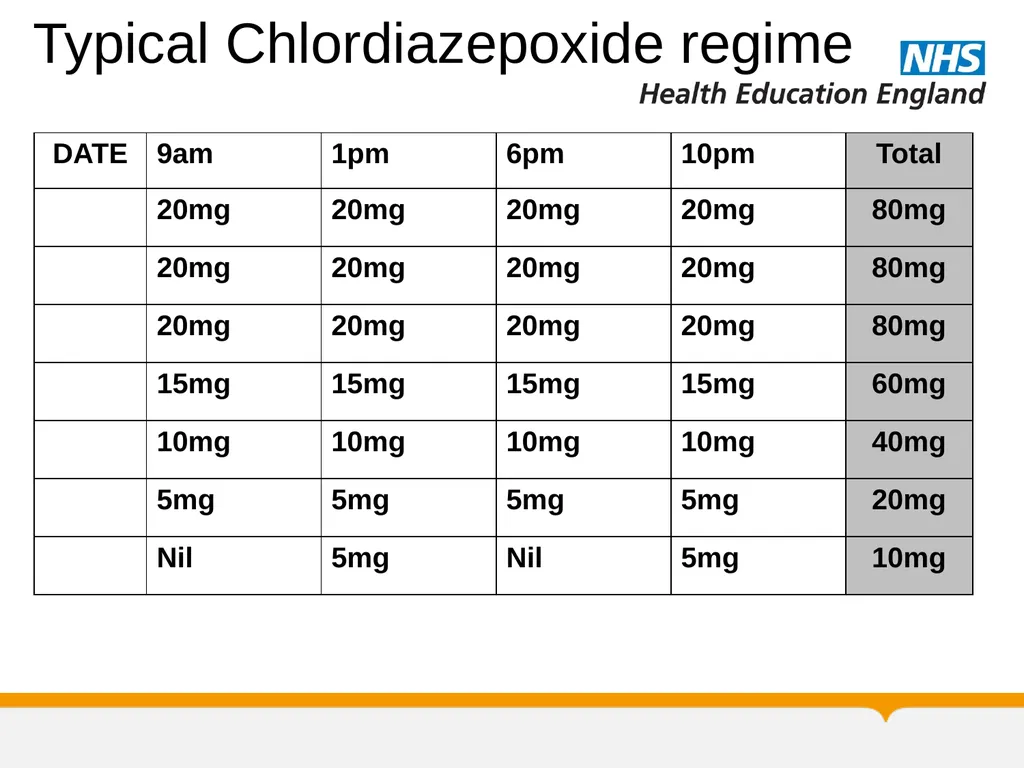
Typical Chlordiazepoxide regime 33<br>
34
Other medications Ensure that Chlordiazepoxide 10-20mg PRN max QDS is available
Seizures – Diazepam per rectum 10–20 mg, repeated once after 10–15 minutes if required /Buccal Midazolam (10 mg, repeated once after 10 minutes if necessary)
Consider Zopiclone 7.5mg nocte PRN for insomnia. This should be for a maximum of 4 days to avoid risk of misuse or dependence
Medication to treat nausea and vomiting (e.g. Prochlorperazine (see BNF), diarrhoea (Loperamide 2-4mg, max 16mg daily) or skin itching (Loratadine 10mg od) may be required 34<br>
Seizures – Diazepam per rectum 10–20 mg, repeated once after 10–15 minutes if required /Buccal Midazolam (10 mg, repeated once after 10 minutes if necessary)
Consider Zopiclone 7.5mg nocte PRN for insomnia. This should be for a maximum of 4 days to avoid risk of misuse or dependence
Medication to treat nausea and vomiting (e.g. Prochlorperazine (see BNF), diarrhoea (Loperamide 2-4mg, max 16mg daily) or skin itching (Loratadine 10mg od) may be required 34<br>
35
Some potential complications during alcohol detoxification Seizures
Delirium Tremens
Wernicke encephalopathy- Korsakoff syndrome
Hepatic encephalopathy
Liver disease /Cirrhosis complications (see supplementary slides) 35<br>
Delirium Tremens
Wernicke encephalopathy- Korsakoff syndrome
Hepatic encephalopathy
Liver disease /Cirrhosis complications (see supplementary slides) 35<br>
36
Seizures Highest risk in first 72 hours after stopping drinking
Prevention is better than cure so ensure adequate dosing with Chlordiazepoxide and regular monitoring
Administer appropriate first aid and undertake necessary actions to maintain client’s airway and general safety in the event of a seizure
If the seizure continues for longer than 5 minutes can use Diazepam per rectum 10–20 mg, repeated once after 10–15 minutes if required /Buccal Midazolam (10 mg, repeated once after 10 minutes if necessary)
If the seizure continues for longer than a further 5 minutes, or there are other concerns call the crash team / ambulance.
To prevent further seizures review and increase if necessary the dose of Chlordiazepoxide 36<br>
Prevention is better than cure so ensure adequate dosing with Chlordiazepoxide and regular monitoring
Administer appropriate first aid and undertake necessary actions to maintain client’s airway and general safety in the event of a seizure
If the seizure continues for longer than 5 minutes can use Diazepam per rectum 10–20 mg, repeated once after 10–15 minutes if required /Buccal Midazolam (10 mg, repeated once after 10 minutes if necessary)
If the seizure continues for longer than a further 5 minutes, or there are other concerns call the crash team / ambulance.
To prevent further seizures review and increase if necessary the dose of Chlordiazepoxide 36<br>
37
Delirium Tremens Highest risk around 72 hours after stopping drinking
An acute confusional state and medical emergency therefore refer urgently to medical colleagues for medical admission
Offer oral Lorazepam in the first instance. If symptoms persist or medication is refused consider parenteral Lorazepam, Haloperidol or Olanzapine (NICE recommended but unlicensed indications for these medications)
Ensure Pabrinex is given to treat any underlying Wernicke’s encephalopathy 37<br>
An acute confusional state and medical emergency therefore refer urgently to medical colleagues for medical admission
Offer oral Lorazepam in the first instance. If symptoms persist or medication is refused consider parenteral Lorazepam, Haloperidol or Olanzapine (NICE recommended but unlicensed indications for these medications)
Ensure Pabrinex is given to treat any underlying Wernicke’s encephalopathy 37<br>
38
Wernicke encephalopathy and Korsakoff syndrome Wernicke encephalopathy is an acute, potentially reversible neurological disorder
Deficiency/depletion of thiamine
Incidence rates in Western countries—up to 12.5% in patients with alcohol problems
When untreated about 80% of patients with this condition develop Korsakoff syndrome
Korsakoff syndrome characterised by global amnesia.
Patients have severe deficits in memory for new material (despite sparing of general intelligence) and in gait and balance, short-term memory and visuoperceptual implicit learning
May also have prefrontal dysfunction – difficulties with problem solving, working memory, cognitive flexibility, perseverative responding, and self-regulation 38 Zahr, N. M., Kaufman, K. L., & Harper, C. G. (2011). Clinical and pathological features of alcohol-related brain damage. Nature Reviews Neurology, 7(5), 284.<br>
Deficiency/depletion of thiamine
Incidence rates in Western countries—up to 12.5% in patients with alcohol problems
When untreated about 80% of patients with this condition develop Korsakoff syndrome
Korsakoff syndrome characterised by global amnesia.
Patients have severe deficits in memory for new material (despite sparing of general intelligence) and in gait and balance, short-term memory and visuoperceptual implicit learning
May also have prefrontal dysfunction – difficulties with problem solving, working memory, cognitive flexibility, perseverative responding, and self-regulation 38 Zahr, N. M., Kaufman, K. L., & Harper, C. G. (2011). Clinical and pathological features of alcohol-related brain damage. Nature Reviews Neurology, 7(5), 284.<br>
39
Symptoms of Wernicke Encephalopathy Classic triad is ocular motor abnormalities, cerebellar dysfunction, and altered mental state
Only 20% of patients present with the full triad
30% of those only presented with altered mental state
Altered mental state occurs in 80%
mental sluggishness, apathy, impaired awareness of an immediate situation, an inability to concentrate, confusion or agitation, hallucinations, behavioral disturbances mimicking an acute psychotic disorder, or coma
Ocular motor abnormalities occur in 30%
nystagmus or ophthalmoplegia
Cerebellar dysfunction occur in 25% of patients
loss of equilibrium, incoordination of gait, trunk ataxia, dysdiadochokinesia and, occasionally, limb ataxia or dysarthria 39 Zahr, N. M., Kaufman, K. L., & Harper, C. G. (2011). Clinical and pathological features of alcohol-related brain damage. Nature Reviews Neurology, 7(5), 284.<br>
Only 20% of patients present with the full triad
30% of those only presented with altered mental state
Altered mental state occurs in 80%
mental sluggishness, apathy, impaired awareness of an immediate situation, an inability to concentrate, confusion or agitation, hallucinations, behavioral disturbances mimicking an acute psychotic disorder, or coma
Ocular motor abnormalities occur in 30%
nystagmus or ophthalmoplegia
Cerebellar dysfunction occur in 25% of patients
loss of equilibrium, incoordination of gait, trunk ataxia, dysdiadochokinesia and, occasionally, limb ataxia or dysarthria 39 Zahr, N. M., Kaufman, K. L., & Harper, C. G. (2011). Clinical and pathological features of alcohol-related brain damage. Nature Reviews Neurology, 7(5), 284.<br>
40
Use of thiamine Offer prophylactic oral thiamine to harmful or dependent drinkers:
if they are malnourished or at risk of malnourishment or
if they have decompensated liver disease or
if they are in acute withdrawal or
before and during a planned medically assisted alcohol withdrawal.
Offer prophylactic parenteral thiamine followed by oral thiamine to harmful or dependent drinkers:
if they are malnourished or at risk of malnourishment or
if they have decompensated liver disease
and in addition
attend an emergency department or are admitted to hospital acutely
Offer parenteral thiamine to people with suspected Wernicke’s encephalopathy
Parenteral thiamine should be given for a minimum of 5 days, unless Wernicke’s encephalopathy is excluded. Oral thiamine should follow parenteral therapy 40 National Institute for Health and Care Excellence. (2010). Alcohol use disorders: diagnosis and clinical management of alcohol related physical complications CG 100. London: National Institute for Health and Care Excellence.<br>
if they are malnourished or at risk of malnourishment or
if they have decompensated liver disease or
if they are in acute withdrawal or
before and during a planned medically assisted alcohol withdrawal.
Offer prophylactic parenteral thiamine followed by oral thiamine to harmful or dependent drinkers:
if they are malnourished or at risk of malnourishment or
if they have decompensated liver disease
and in addition
attend an emergency department or are admitted to hospital acutely
Offer parenteral thiamine to people with suspected Wernicke’s encephalopathy
Parenteral thiamine should be given for a minimum of 5 days, unless Wernicke’s encephalopathy is excluded. Oral thiamine should follow parenteral therapy 40 National Institute for Health and Care Excellence. (2010). Alcohol use disorders: diagnosis and clinical management of alcohol related physical complications CG 100. London: National Institute for Health and Care Excellence.<br>
41
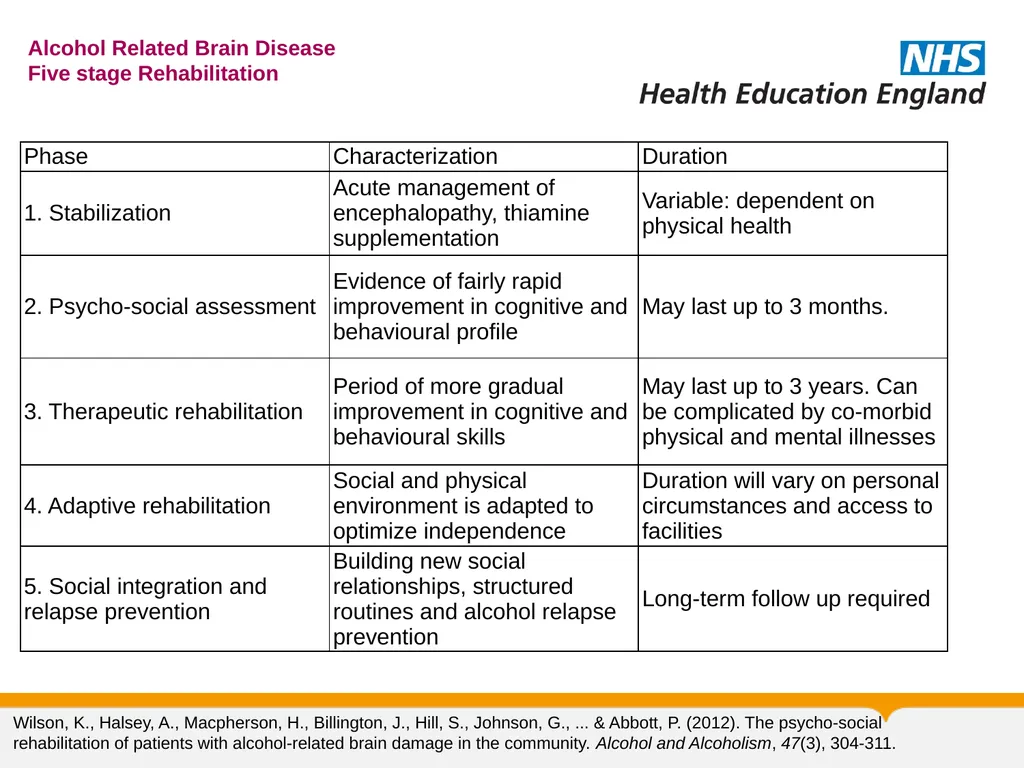
Alcohol Related Brain Disease
Five stage Rehabilitation 41 Wilson, K., Halsey, A., Macpherson, H., Billington, J., Hill, S., Johnson, G., ... & Abbott, P. (2012). The psycho-social rehabilitation of patients with alcohol-related brain damage in the community. Alcohol and Alcoholism, 47(3), 304-311.<br>
42
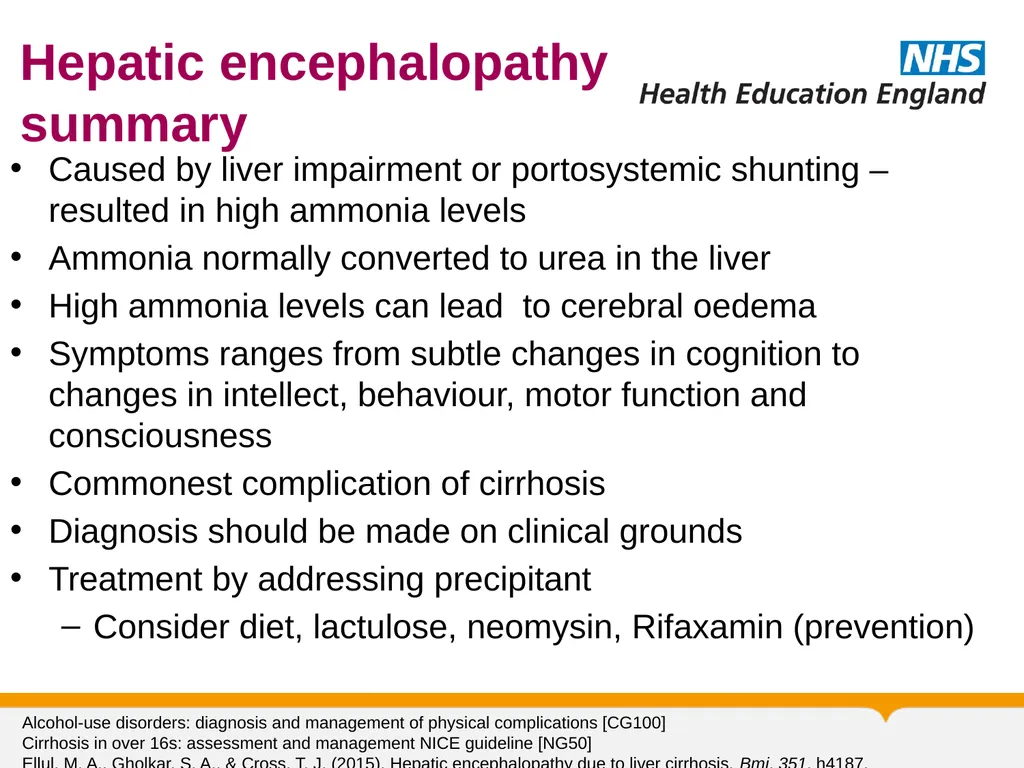
Hepatic encephalopathy
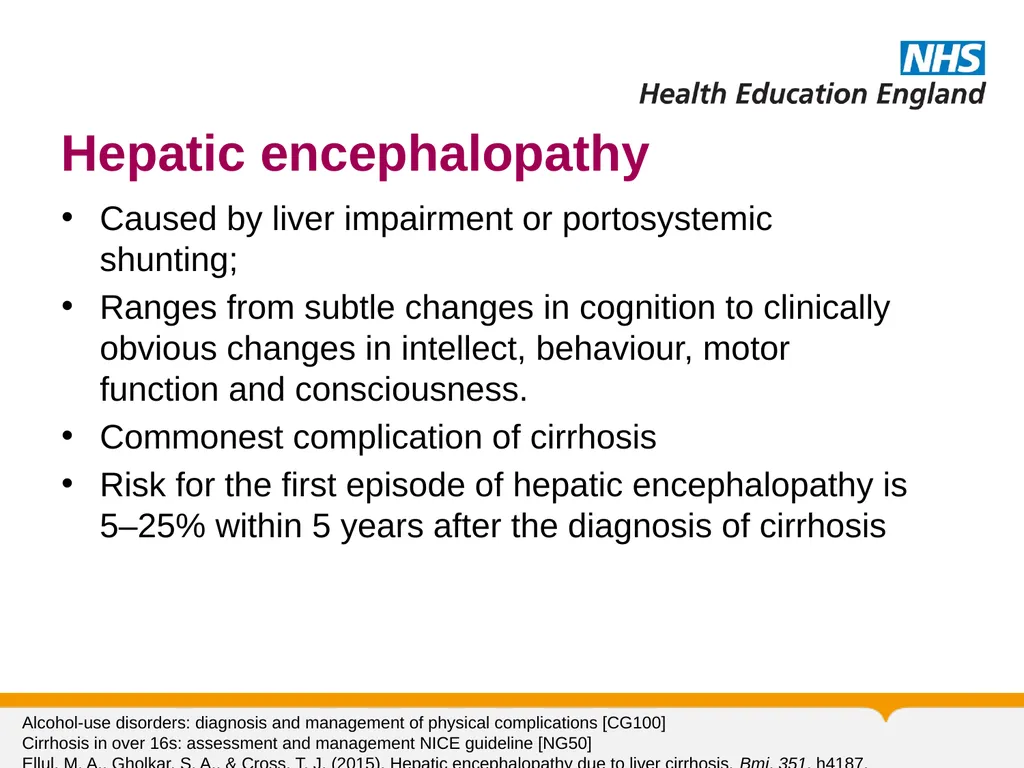
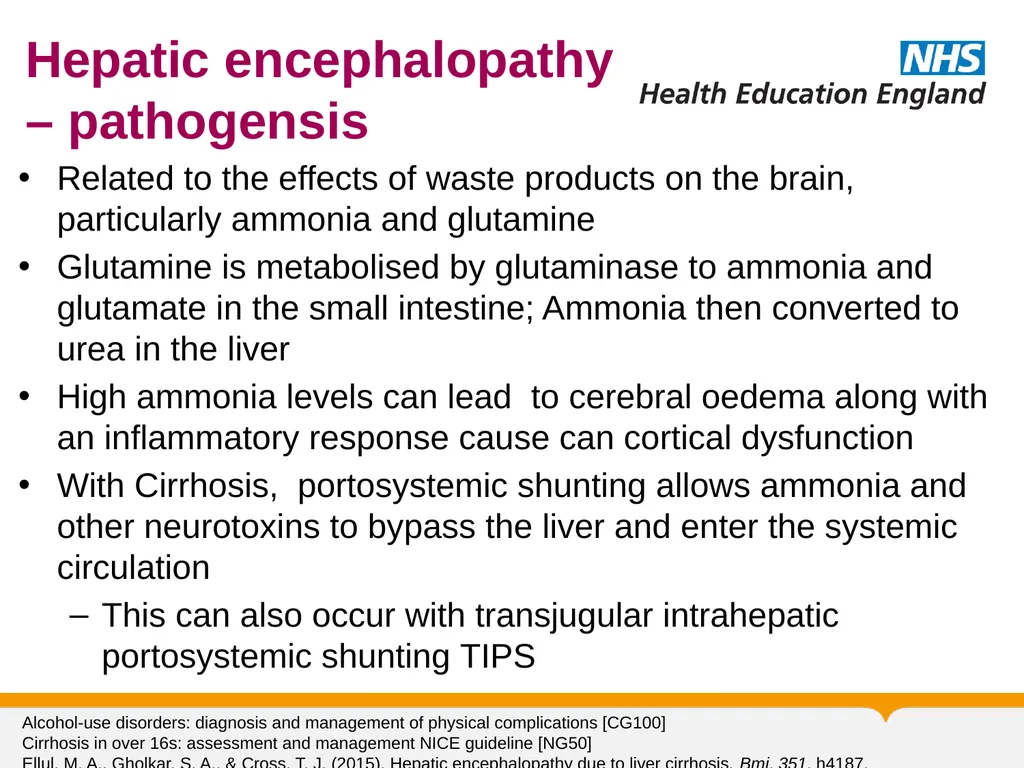
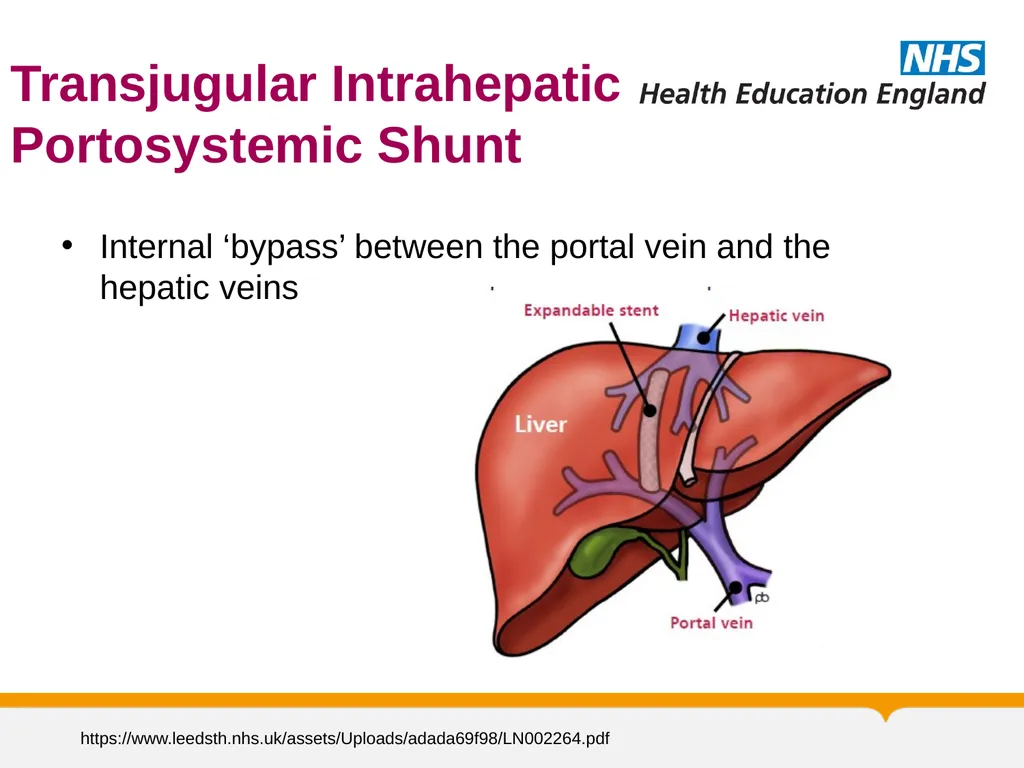
summary Caused by liver impairment or portosystemic shunting – resulted in high ammonia levels
Ammonia normally converted to urea in the liver
High ammonia levels can lead to cerebral oedema
Symptoms ranges from subtle changes in cognition to changes in intellect, behaviour, motor function and consciousness
Commonest complication of cirrhosis
Diagnosis should be made on clinical grounds
Treatment by addressing precipitant
Consider diet, lactulose, neomysin, Rifaxamin (prevention) Alcohol-use disorders: diagnosis and management of physical complications [CG100]
Cirrhosis in over 16s: assessment and management NICE guideline [NG50]
Ellul, M. A., Gholkar, S. A., & Cross, T. J. (2015). Hepatic encephalopathy due to liver cirrhosis. Bmj, 351, h4187.<br>
Ammonia normally converted to urea in the liver
High ammonia levels can lead to cerebral oedema
Symptoms ranges from subtle changes in cognition to changes in intellect, behaviour, motor function and consciousness
Commonest complication of cirrhosis
Diagnosis should be made on clinical grounds
Treatment by addressing precipitant
Consider diet, lactulose, neomysin, Rifaxamin (prevention) Alcohol-use disorders: diagnosis and management of physical complications [CG100]
Cirrhosis in over 16s: assessment and management NICE guideline [NG50]
Ellul, M. A., Gholkar, S. A., & Cross, T. J. (2015). Hepatic encephalopathy due to liver cirrhosis. Bmj, 351, h4187.<br>
43
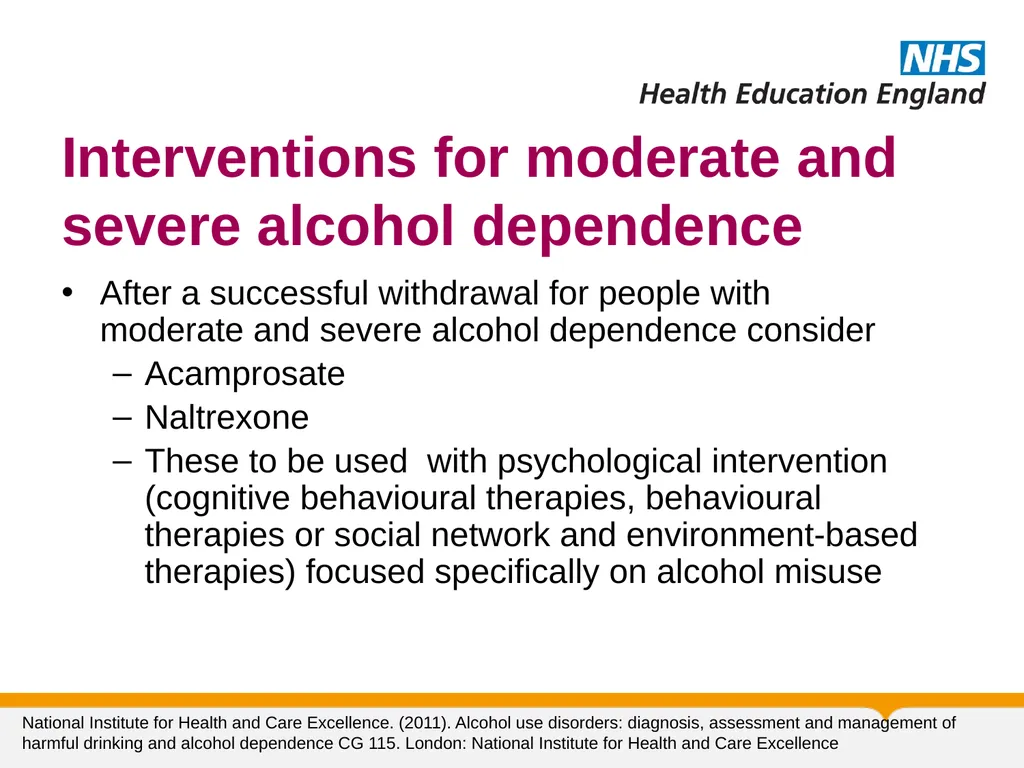
Interventions for moderate and severe alcohol dependence After a successful withdrawal for people with moderate and severe alcohol dependence consider
Acamprosate
Naltrexone
These to be used with psychological intervention (cognitive behavioural therapies, behavioural therapies or social network and environment-based therapies) focused specifically on alcohol misuse 43 National Institute for Health and Care Excellence. (2011). Alcohol use disorders: diagnosis, assessment and management of harmful drinking and alcohol dependence CG 115. London: National Institute for Health and Care Excellence<br>
Acamprosate
Naltrexone
These to be used with psychological intervention (cognitive behavioural therapies, behavioural therapies or social network and environment-based therapies) focused specifically on alcohol misuse 43 National Institute for Health and Care Excellence. (2011). Alcohol use disorders: diagnosis, assessment and management of harmful drinking and alcohol dependence CG 115. London: National Institute for Health and Care Excellence<br>
44
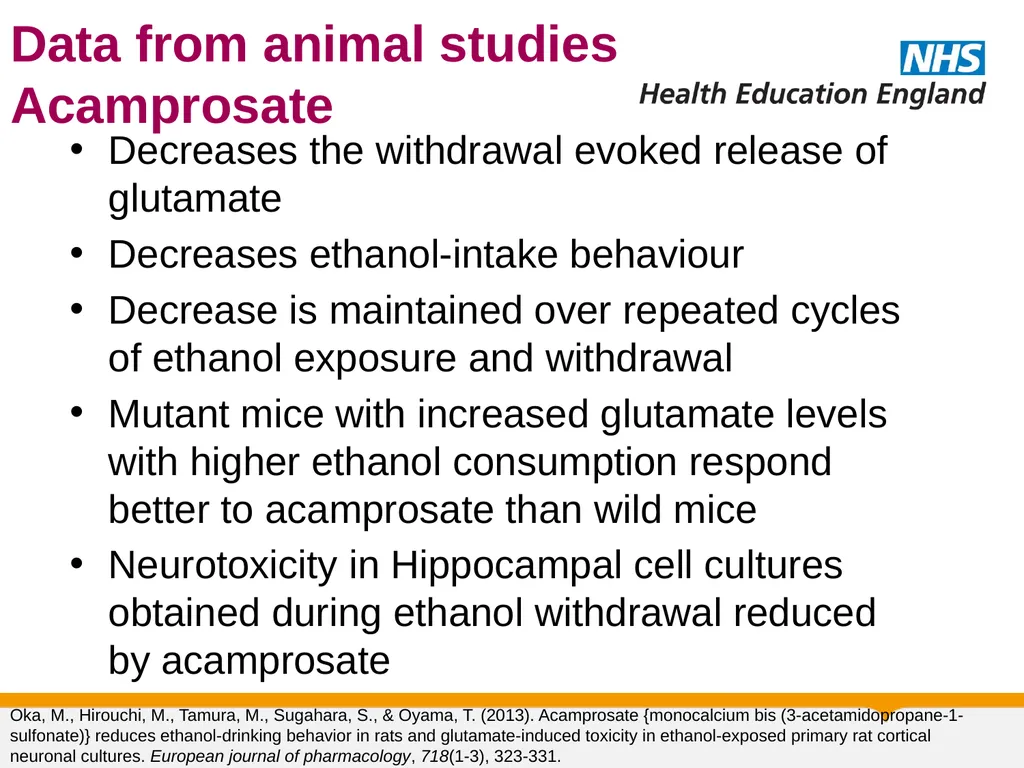
Data from animal studies Acamprosate Decreases the withdrawal evoked release of glutamate
Decreases ethanol-intake behaviour
Decrease is maintained over repeated cycles of ethanol exposure and withdrawal
Mutant mice with increased glutamate levels with higher ethanol consumption respond better to acamprosate than wild mice
Neurotoxicity in Hippocampal cell cultures obtained during ethanol withdrawal reduced by acamprosate 44 Oka, M., Hirouchi, M., Tamura, M., Sugahara, S., & Oyama, T. (2013). Acamprosate {monocalcium bis (3-acetamidopropane-1-sulfonate)} reduces ethanol-drinking behavior in rats and glutamate-induced toxicity in ethanol-exposed primary rat cortical neuronal cultures. European journal of pharmacology, 718(1-3), 323-331.<br>
Decreases ethanol-intake behaviour
Decrease is maintained over repeated cycles of ethanol exposure and withdrawal
Mutant mice with increased glutamate levels with higher ethanol consumption respond better to acamprosate than wild mice
Neurotoxicity in Hippocampal cell cultures obtained during ethanol withdrawal reduced by acamprosate 44 Oka, M., Hirouchi, M., Tamura, M., Sugahara, S., & Oyama, T. (2013). Acamprosate {monocalcium bis (3-acetamidopropane-1-sulfonate)} reduces ethanol-drinking behavior in rats and glutamate-induced toxicity in ethanol-exposed primary rat cortical neuronal cultures. European journal of pharmacology, 718(1-3), 323-331.<br>
45
Use of disulfiram After a successful withdrawal for people with moderate and severe alcohol dependence, consider offering disulfiram in combination with a psychological intervention to service users who:
have a goal of abstinence but for whom acamprosate and oral naltrexone are not suitable, or
prefer disulfiram and understand the relative risks of taking the drug 45 National Institute for Health and Care Excellence. (2011). Alcohol use disorders: diagnosis, assessment and management of harmful drinking and alcohol dependence CG 115. London: National Institute for Health and Care Excellence<br>
have a goal of abstinence but for whom acamprosate and oral naltrexone are not suitable, or
prefer disulfiram and understand the relative risks of taking the drug 45 National Institute for Health and Care Excellence. (2011). Alcohol use disorders: diagnosis, assessment and management of harmful drinking and alcohol dependence CG 115. London: National Institute for Health and Care Excellence<br>
46
Disulfiram Irreversible inactivation of liver ALDH and hence the intracellular acetaldehyde concentration rises
High levels of acetaldehyde account for the symptoms of disulfiram-alcohol reaction
Disulfiram inhibits the conversion of dopamine to noradrenaline
Depletion of noradrenaline in the heart and blood vessels facilitates action of acetaldehyde (flushing tachycardia and hypotension) 46 https://www.medicines.org.uk/emc/product/11168/smpc<br>
High levels of acetaldehyde account for the symptoms of disulfiram-alcohol reaction
Disulfiram inhibits the conversion of dopamine to noradrenaline
Depletion of noradrenaline in the heart and blood vessels facilitates action of acetaldehyde (flushing tachycardia and hypotension) 46 https://www.medicines.org.uk/emc/product/11168/smpc<br>
47
Naltrexone Long acting specific opioid antagonist.
Competitively binds to receptors in CNS and PNS hence blocking effects of (endogenous and exogenous) opioids.
Assumption is that alcohol leads to stimulation of the endogenous opioid system and naltrexone affects this process
Nalmefene similar but also partial agonist activity at the κ receptor 47 https://www.medicines.org.uk/emc/product/6073/smpc<br>
Competitively binds to receptors in CNS and PNS hence blocking effects of (endogenous and exogenous) opioids.
Assumption is that alcohol leads to stimulation of the endogenous opioid system and naltrexone affects this process
Nalmefene similar but also partial agonist activity at the κ receptor 47 https://www.medicines.org.uk/emc/product/6073/smpc<br>
48
Pharmacological treatments alcohol
dependence summary 48 No clear advantage of combination of Acamprosate and Naltrexone over either drug alone National Institute for Health and Care Excellence. (2011). Alcohol use disorders: diagnosis, assessment and management of harmful drinking and alcohol dependence CG 115. London: National Institute for Health and Care Excellence<br>
49
Review Pharmacology / Neuropharmacology
Classification
Assessment
Epidemiology
Health Consequences
Treatment issues<br>
Classification
Assessment
Epidemiology
Health Consequences
Treatment issues<br>
50
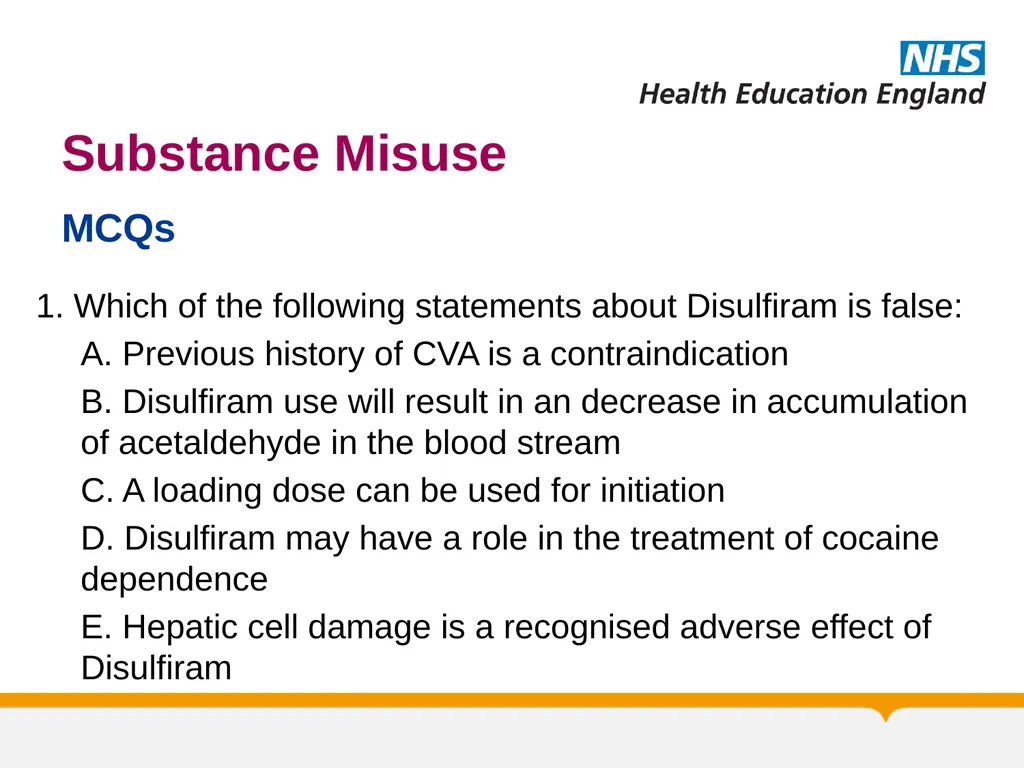
Substance Misuse MCQs 1. Which of the following statements about Disulfiram is false:
A. Previous history of CVA is a contraindication
B. Disulfiram use will result in an decrease in accumulation of acetaldehyde in the blood stream
C. A loading dose can be used for initiation
D. Disulfiram may have a role in the treatment of cocaine dependence
E. Hepatic cell damage is a recognised adverse effect of Disulfiram<br>
A. Previous history of CVA is a contraindication
B. Disulfiram use will result in an decrease in accumulation of acetaldehyde in the blood stream
C. A loading dose can be used for initiation
D. Disulfiram may have a role in the treatment of cocaine dependence
E. Hepatic cell damage is a recognised adverse effect of Disulfiram<br>
51
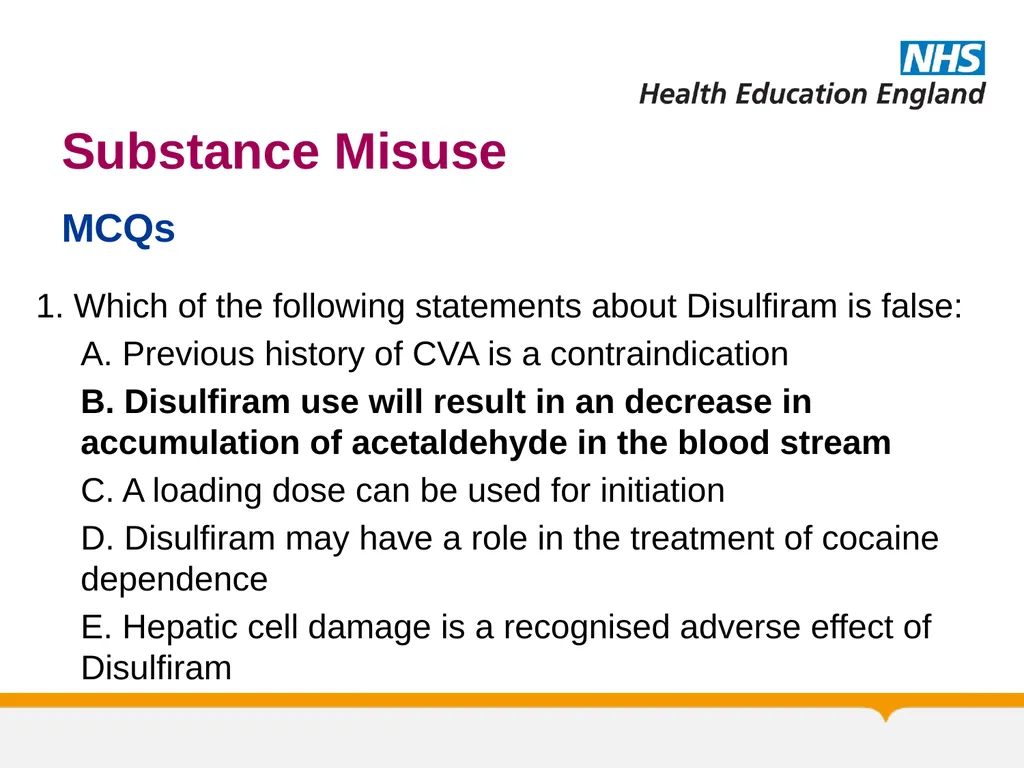
Substance Misuse MCQs 1. Which of the following statements about Disulfiram is false:
A. Previous history of CVA is a contraindication
B. Disulfiram use will result in an decrease in accumulation of acetaldehyde in the blood stream
C. A loading dose can be used for initiation
D. Disulfiram may have a role in the treatment of cocaine dependence
E. Hepatic cell damage is a recognised adverse effect of Disulfiram<br>
A. Previous history of CVA is a contraindication
B. Disulfiram use will result in an decrease in accumulation of acetaldehyde in the blood stream
C. A loading dose can be used for initiation
D. Disulfiram may have a role in the treatment of cocaine dependence
E. Hepatic cell damage is a recognised adverse effect of Disulfiram<br>
52
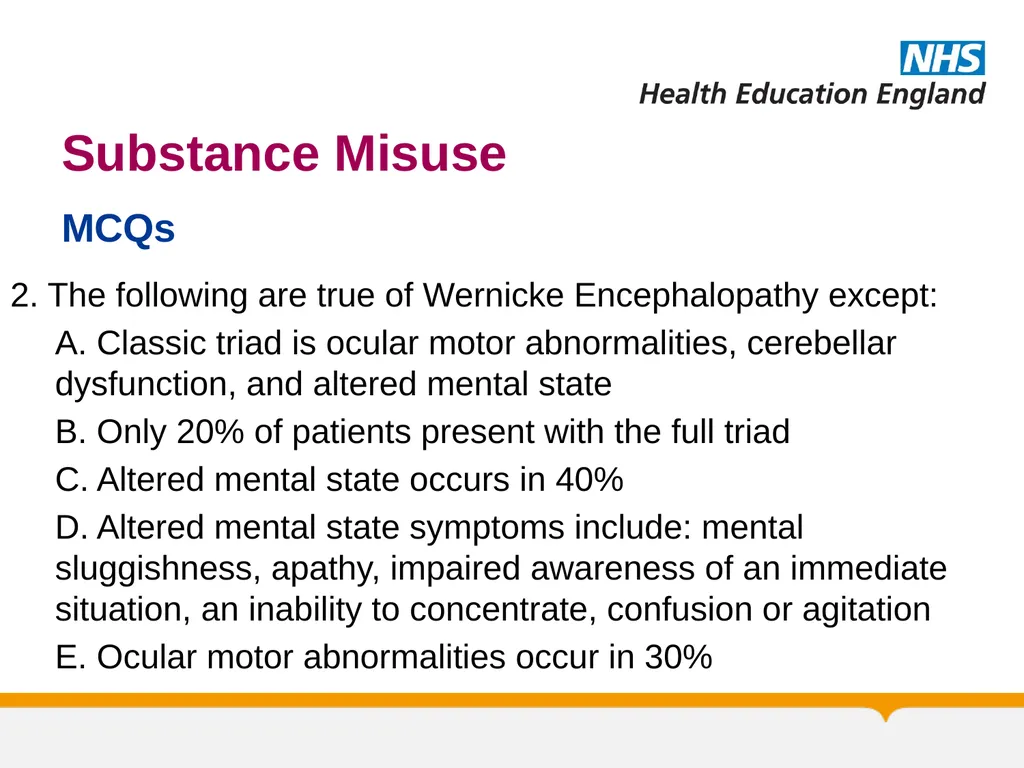
Substance Misuse MCQs 2. The following are true of Wernicke Encephalopathy except:
A. Classic triad is ocular motor abnormalities, cerebellar dysfunction, and altered mental state
B. Only 20% of patients present with the full triad
C. Altered mental state occurs in 40%
D. Altered mental state symptoms include: mental sluggishness, apathy, impaired awareness of an immediate situation, an inability to concentrate, confusion or agitation
E. Ocular motor abnormalities occur in 30%<br>
A. Classic triad is ocular motor abnormalities, cerebellar dysfunction, and altered mental state
B. Only 20% of patients present with the full triad
C. Altered mental state occurs in 40%
D. Altered mental state symptoms include: mental sluggishness, apathy, impaired awareness of an immediate situation, an inability to concentrate, confusion or agitation
E. Ocular motor abnormalities occur in 30%<br>
53
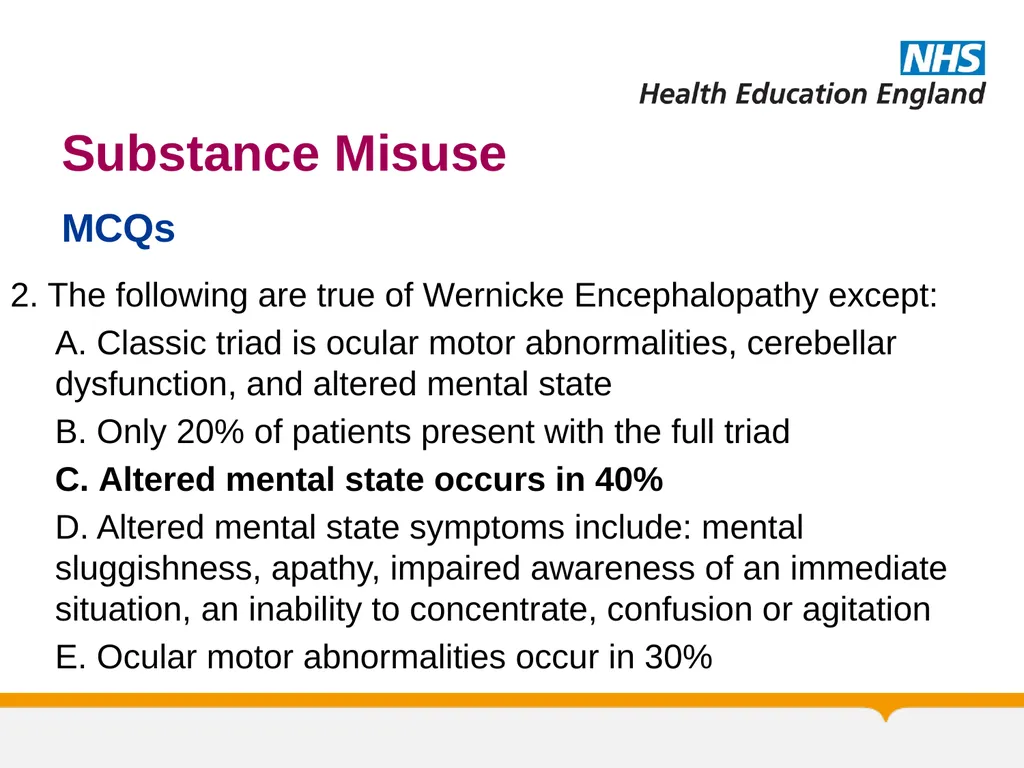
Substance Misuse MCQs 2. The following are true of Wernicke Encephalopathy except:
A. Classic triad is ocular motor abnormalities, cerebellar dysfunction, and altered mental state
B. Only 20% of patients present with the full triad
C. Altered mental state occurs in 40%
D. Altered mental state symptoms include: mental sluggishness, apathy, impaired awareness of an immediate situation, an inability to concentrate, confusion or agitation
E. Ocular motor abnormalities occur in 30%<br>
A. Classic triad is ocular motor abnormalities, cerebellar dysfunction, and altered mental state
B. Only 20% of patients present with the full triad
C. Altered mental state occurs in 40%
D. Altered mental state symptoms include: mental sluggishness, apathy, impaired awareness of an immediate situation, an inability to concentrate, confusion or agitation
E. Ocular motor abnormalities occur in 30%<br>
54
Substance Misuse MCQs 3. Which of the following is not based on Nice Guidelines about the need to consider inpatient setting for alcohol detoxification:
A. Drink over 50 units of alcohol per day
B. Have a score of more than 30 on the Severity of Alcohol Dependence Questionnaire
C. Have a history of epilepsy, or experience of withdrawal-related seizures or delirium tremens during previous assisted withdrawal programmes
D. Need concurrent withdrawal from alcohol and benzodiazepines
E. Consider a lower threshold for inpatient or residential assisted withdrawal in vulnerable groups, for example, homeless and older people<br>
A. Drink over 50 units of alcohol per day
B. Have a score of more than 30 on the Severity of Alcohol Dependence Questionnaire
C. Have a history of epilepsy, or experience of withdrawal-related seizures or delirium tremens during previous assisted withdrawal programmes
D. Need concurrent withdrawal from alcohol and benzodiazepines
E. Consider a lower threshold for inpatient or residential assisted withdrawal in vulnerable groups, for example, homeless and older people<br>
55
Substance Misuse MCQs 3. Which of the following is not based on Nice Guidelines about the need to consider inpatient setting for alcohol detoxification:
A. Drink over 50 units of alcohol per day
B. Have a score of more than 30 on the Severity of Alcohol Dependence Questionnaire
C. Have a history of epilepsy, or experience of withdrawal-related seizures or delirium tremens during previous assisted withdrawal programmes
D. Need concurrent withdrawal from alcohol and benzodiazepines
E. Consider a lower threshold for inpatient or residential assisted withdrawal in vulnerable groups, for example, homeless and older people<br>
A. Drink over 50 units of alcohol per day
B. Have a score of more than 30 on the Severity of Alcohol Dependence Questionnaire
C. Have a history of epilepsy, or experience of withdrawal-related seizures or delirium tremens during previous assisted withdrawal programmes
D. Need concurrent withdrawal from alcohol and benzodiazepines
E. Consider a lower threshold for inpatient or residential assisted withdrawal in vulnerable groups, for example, homeless and older people<br>
56
Substance Misuse MCQs 4. Features required for a diagnosis of dependence within ICD 10 include the following except:
A. A strong desire or sense of compulsion to take the substance;
B. Difficulties in controlling substance-taking behaviour in terms of its onset, termination, or levels of use;
C. A physiological withdrawal state when substance use has ceased or have been reduced, as evidenced by: the characteristic withdrawal syndrome for the substance; or use of the same (or closely related) substance with the intention of relieving or avoiding withdrawal symptoms;
D. Evidence of tolerance, such that increased doses of the psychoactive substance are required in order to achieve effects originally produced by lower doses
E. Returning to substance use after a period of abstinence leads to more rapid reappearance of features of dependence than with non-dependent individuals<br>
A. A strong desire or sense of compulsion to take the substance;
B. Difficulties in controlling substance-taking behaviour in terms of its onset, termination, or levels of use;
C. A physiological withdrawal state when substance use has ceased or have been reduced, as evidenced by: the characteristic withdrawal syndrome for the substance; or use of the same (or closely related) substance with the intention of relieving or avoiding withdrawal symptoms;
D. Evidence of tolerance, such that increased doses of the psychoactive substance are required in order to achieve effects originally produced by lower doses
E. Returning to substance use after a period of abstinence leads to more rapid reappearance of features of dependence than with non-dependent individuals<br>
57
Substance Misuse MCQs 4. Features required for a diagnosis of dependence within ICD 10 include the following except:
A. A strong desire or sense of compulsion to take the substance;
B. Difficulties in controlling substance-taking behaviour in terms of its onset, termination, or levels of use;
C. A physiological withdrawal state when substance use has ceased or have been reduced, as evidenced by: the characteristic withdrawal syndrome for the substance; or use of the same (or closely related) substance with the intention of relieving or avoiding withdrawal symptoms;
D. Evidence of tolerance, such that increased doses of the psychoactive substance are required in order to achieve effects originally produced by lower doses
E. Returning to substance use after a period of abstinence leads to more rapid reappearance of features of dependence than with non-dependent individuals<br>
A. A strong desire or sense of compulsion to take the substance;
B. Difficulties in controlling substance-taking behaviour in terms of its onset, termination, or levels of use;
C. A physiological withdrawal state when substance use has ceased or have been reduced, as evidenced by: the characteristic withdrawal syndrome for the substance; or use of the same (or closely related) substance with the intention of relieving or avoiding withdrawal symptoms;
D. Evidence of tolerance, such that increased doses of the psychoactive substance are required in order to achieve effects originally produced by lower doses
E. Returning to substance use after a period of abstinence leads to more rapid reappearance of features of dependence than with non-dependent individuals<br>
58
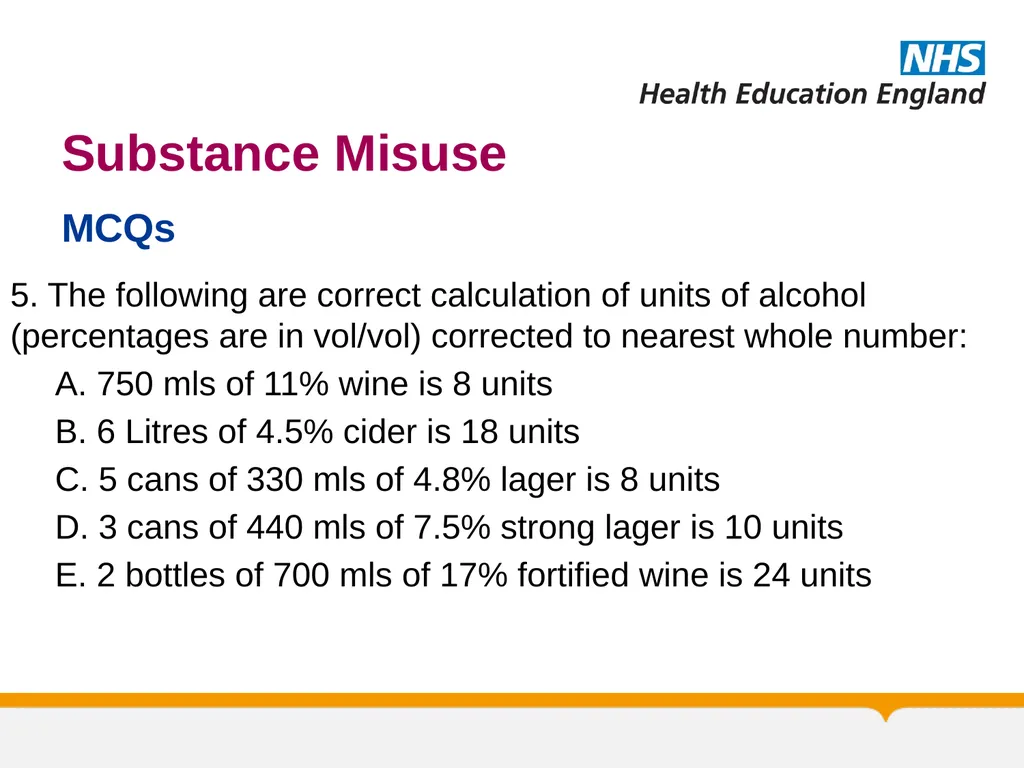
Substance Misuse MCQs 5. The following are correct calculation of units of alcohol (percentages are in vol/vol) corrected to nearest whole number:
A. 750 mls of 11% wine is 8 units
B. 6 Litres of 4.5% cider is 18 units
C. 5 cans of 330 mls of 4.8% lager is 8 units
D. 3 cans of 440 mls of 7.5% strong lager is 10 units
E. 2 bottles of 700 mls of 17% fortified wine is 24 units<br>
A. 750 mls of 11% wine is 8 units
B. 6 Litres of 4.5% cider is 18 units
C. 5 cans of 330 mls of 4.8% lager is 8 units
D. 3 cans of 440 mls of 7.5% strong lager is 10 units
E. 2 bottles of 700 mls of 17% fortified wine is 24 units<br>
59
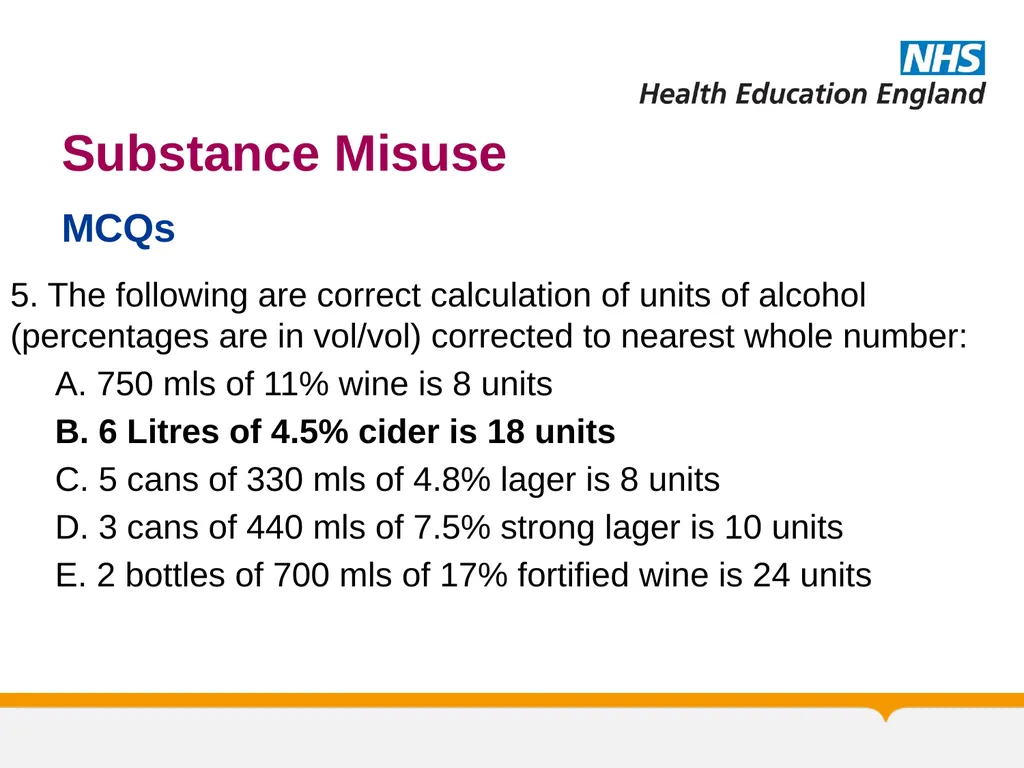
Substance Misuse MCQs 5. The following are correct calculation of units of alcohol (percentages are in vol/vol) corrected to nearest whole number:
A. 750 mls of 11% wine is 8 units
B. 6 Litres of 4.5% cider is 18 units
C. 5 cans of 330 mls of 4.8% lager is 8 units
D. 3 cans of 440 mls of 7.5% strong lager is 10 units
E. 2 bottles of 700 mls of 17% fortified wine is 24 units<br>
A. 750 mls of 11% wine is 8 units
B. 6 Litres of 4.5% cider is 18 units
C. 5 cans of 330 mls of 4.8% lager is 8 units
D. 3 cans of 440 mls of 7.5% strong lager is 10 units
E. 2 bottles of 700 mls of 17% fortified wine is 24 units<br>
60
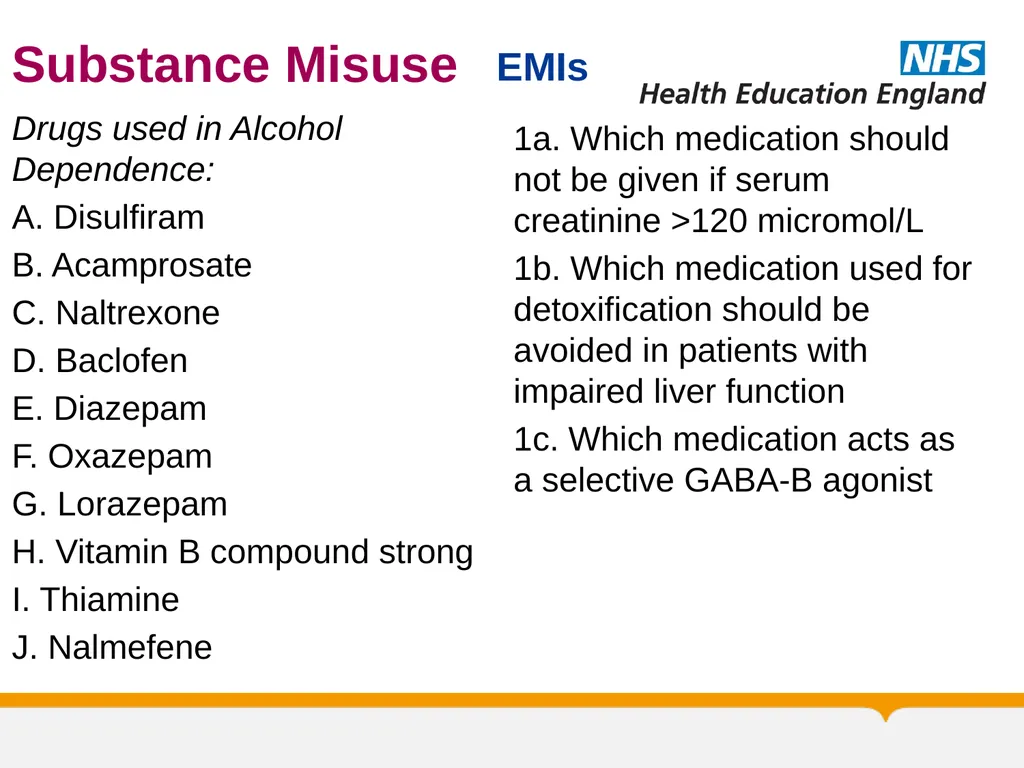
Substance Misuse EMIs Drugs used in Alcohol Dependence:
A. Disulfiram
B. Acamprosate
C. Naltrexone
D. Baclofen
E. Diazepam
F. Oxazepam
G. Lorazepam
H. Vitamin B compound strong
I. Thiamine
J. Nalmefene 1a. Which medication should not be given if serum creatinine >120 micromol/L
1b. Which medication used for detoxification should be avoided in patients with impaired liver function
1c. Which medication acts as a selective GABA-B agonist<br>
A. Disulfiram
B. Acamprosate
C. Naltrexone
D. Baclofen
E. Diazepam
F. Oxazepam
G. Lorazepam
H. Vitamin B compound strong
I. Thiamine
J. Nalmefene 1a. Which medication should not be given if serum creatinine >120 micromol/L
1b. Which medication used for detoxification should be avoided in patients with impaired liver function
1c. Which medication acts as a selective GABA-B agonist<br>
61
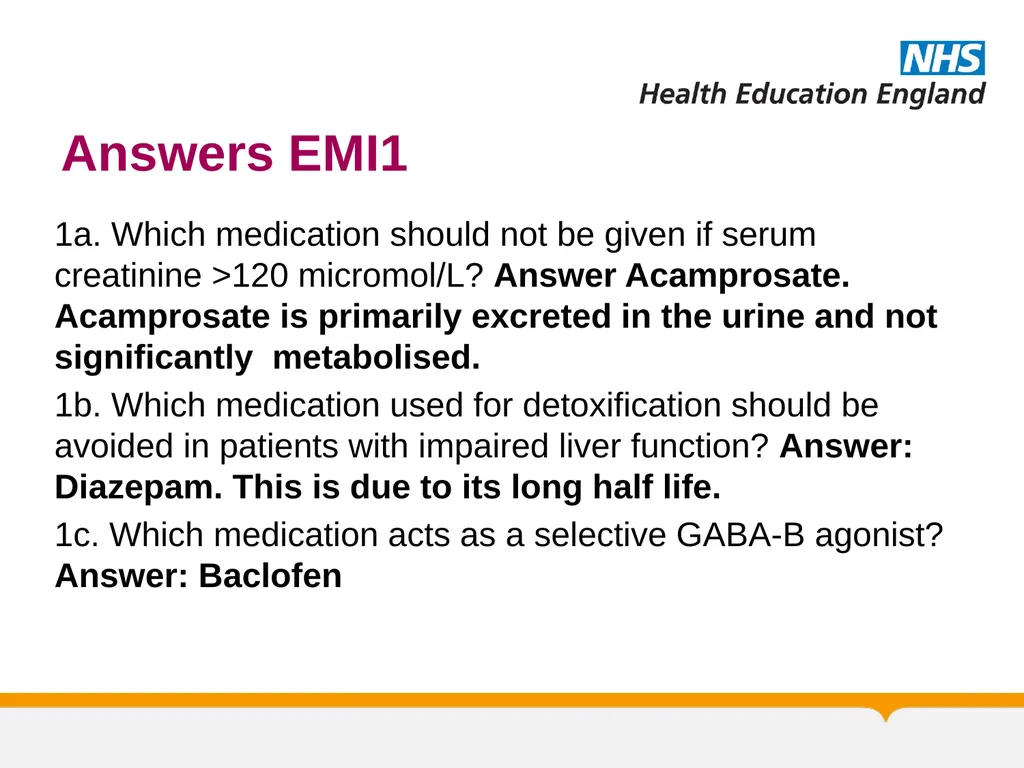
Answers EMI1 1a. Which medication should not be given if serum creatinine >120 micromol/L? Answer Acamprosate. Acamprosate is primarily excreted in the urine and not significantly metabolised.
1b. Which medication used for detoxification should be avoided in patients with impaired liver function? Answer: Diazepam. This is due to its long half life.
1c. Which medication acts as a selective GABA-B agonist? Answer: Baclofen<br>
1b. Which medication used for detoxification should be avoided in patients with impaired liver function? Answer: Diazepam. This is due to its long half life.
1c. Which medication acts as a selective GABA-B agonist? Answer: Baclofen<br>
62
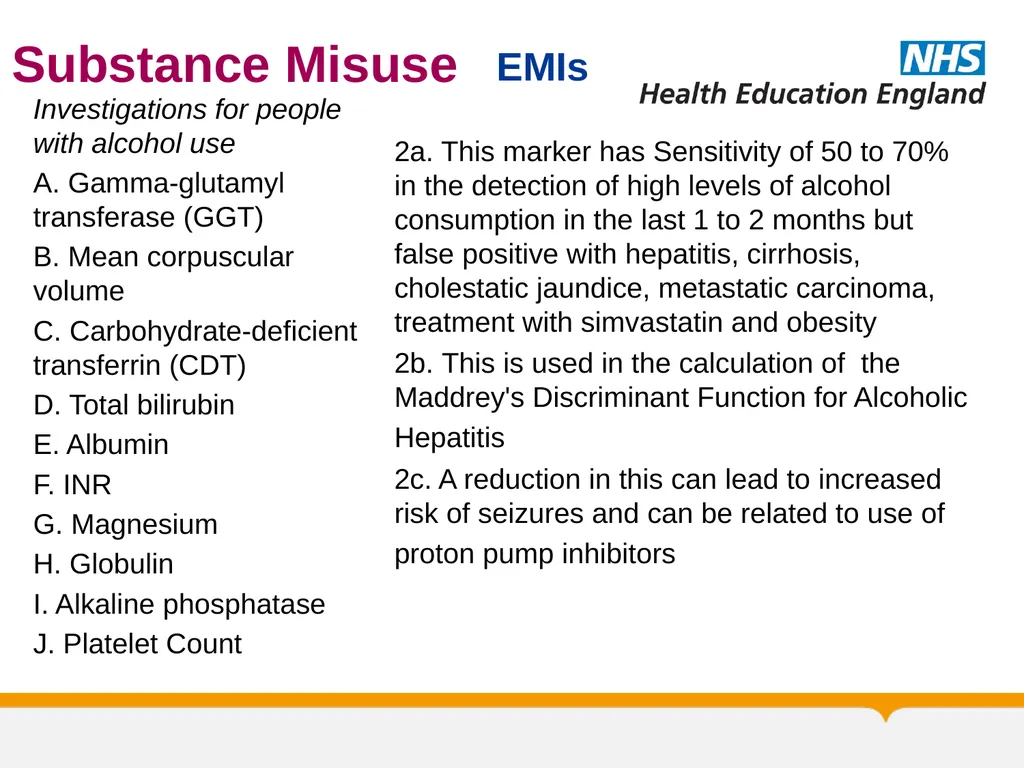
Substance Misuse EMIs 2a. This marker has Sensitivity of 50 to 70% in the detection of high levels of alcohol consumption in the last 1 to 2 months but false positive with hepatitis, cirrhosis, cholestatic jaundice, metastatic carcinoma, treatment with simvastatin and obesity
2b. This is used in the calculation of the Maddrey's Discriminant Function for Alcoholic Hepatitis
2c. A reduction in this can lead to increased risk of seizures and can be related to use of proton pump inhibitors Investigations for people with alcohol use
A. Gamma-glutamyl transferase (GGT)
B. Mean corpuscular volume
C. Carbohydrate-deficient transferrin (CDT)
D. Total bilirubin
E. Albumin
F. INR
G. Magnesium
H. Globulin
I. Alkaline phosphatase
J. Platelet Count<br>
2b. This is used in the calculation of the Maddrey's Discriminant Function for Alcoholic Hepatitis
2c. A reduction in this can lead to increased risk of seizures and can be related to use of proton pump inhibitors Investigations for people with alcohol use
A. Gamma-glutamyl transferase (GGT)
B. Mean corpuscular volume
C. Carbohydrate-deficient transferrin (CDT)
D. Total bilirubin
E. Albumin
F. INR
G. Magnesium
H. Globulin
I. Alkaline phosphatase
J. Platelet Count<br>
63
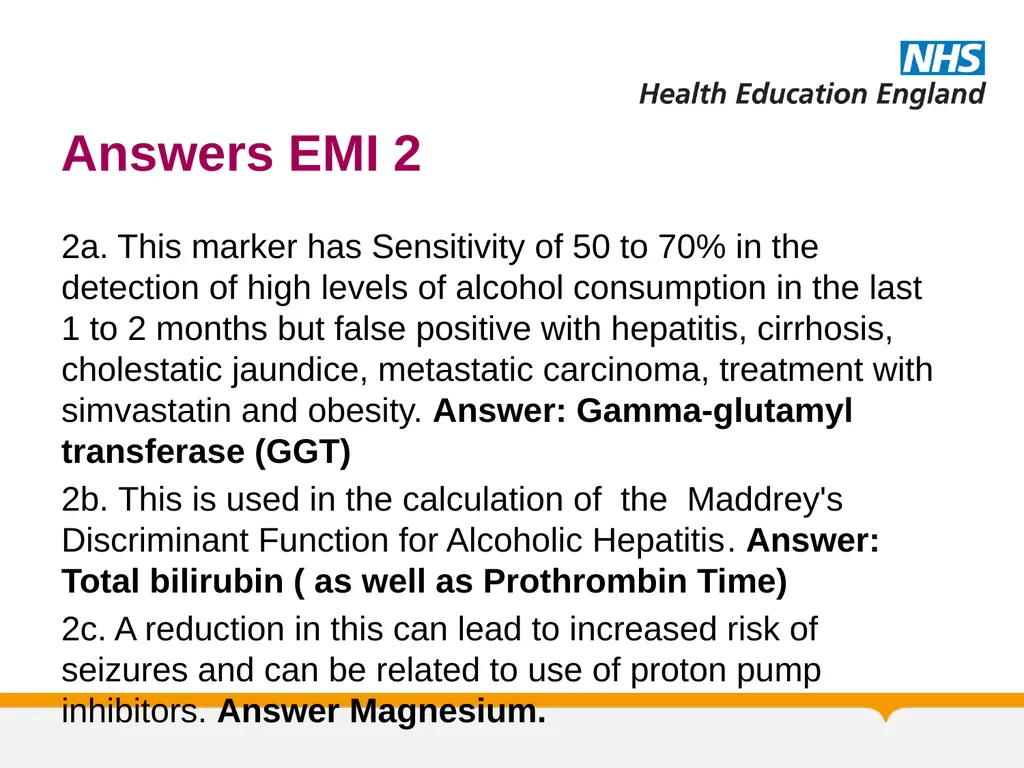
Answers EMI 2 2a. This marker has Sensitivity of 50 to 70% in the detection of high levels of alcohol consumption in the last 1 to 2 months but false positive with hepatitis, cirrhosis, cholestatic jaundice, metastatic carcinoma, treatment with simvastatin and obesity. Answer: Gamma-glutamyl transferase (GGT)
2b. This is used in the calculation of the Maddrey's Discriminant Function for Alcoholic Hepatitis . Answer: Total bilirubin ( as well as Prothrombin Time)
2c. A reduction in this can lead to increased risk of seizures and can be related to use of proton pump inhibitors. Answer Magnesium.<br>
2b. This is used in the calculation of the Maddrey's Discriminant Function for Alcoholic Hepatitis . Answer: Total bilirubin ( as well as Prothrombin Time)
2c. A reduction in this can lead to increased risk of seizures and can be related to use of proton pump inhibitors. Answer Magnesium.<br>
64
Substance misuse module Any Questions?
Thank you.<br>
Thank you.<br>
65
Supplementary slides Diagnosis using ICD 11 and DSM V
Neuroimaging findings
Epidemiology
Hepatic encephalopathy
Deaths in alcohol related admissions<br>
Neuroimaging findings
Epidemiology
Hepatic encephalopathy
Deaths in alcohol related admissions<br>
66
ICD 11 – similar to ICD-10
Time frames more specific Harmful pattern of use
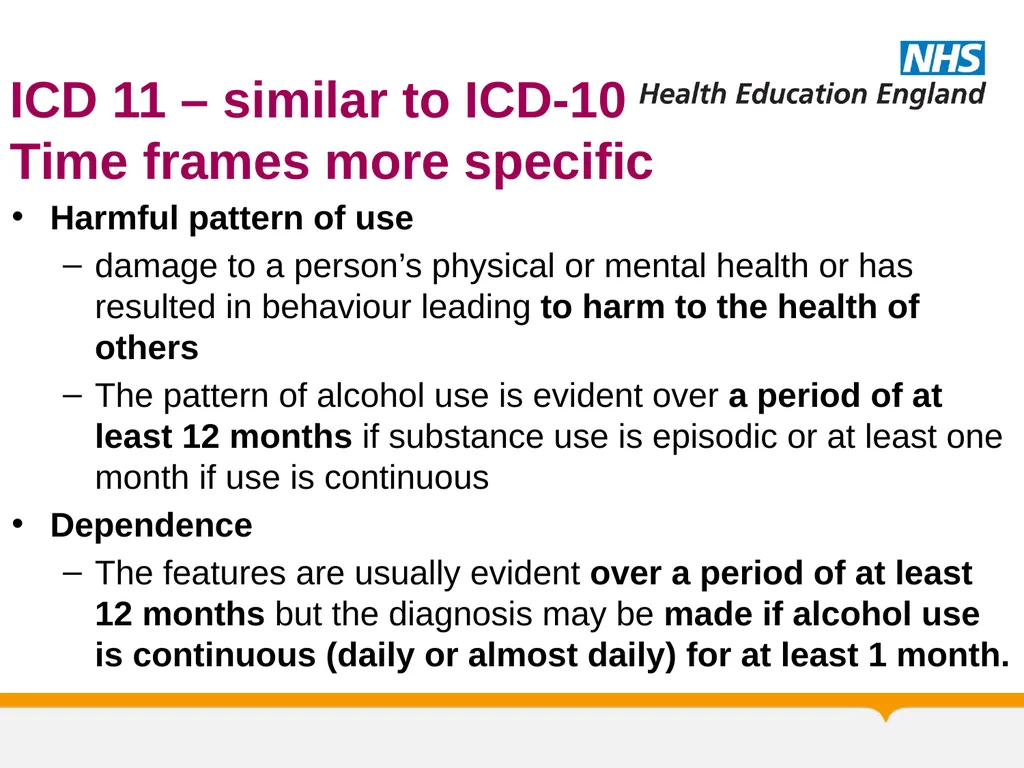
damage to a person’s physical or mental health or has resulted in behaviour leading to harm to the health of others
The pattern of alcohol use is evident over a period of at least 12 months if substance use is episodic or at least one month if use is continuous
Dependence
The features are usually evident over a period of at least 12 months but the diagnosis may be made if alcohol use is continuous (daily or almost daily) for at least 1 month.<br>
damage to a person’s physical or mental health or has resulted in behaviour leading to harm to the health of others
The pattern of alcohol use is evident over a period of at least 12 months if substance use is episodic or at least one month if use is continuous
Dependence
The features are usually evident over a period of at least 12 months but the diagnosis may be made if alcohol use is continuous (daily or almost daily) for at least 1 month.<br>
67
DSM V -Substance use disorder
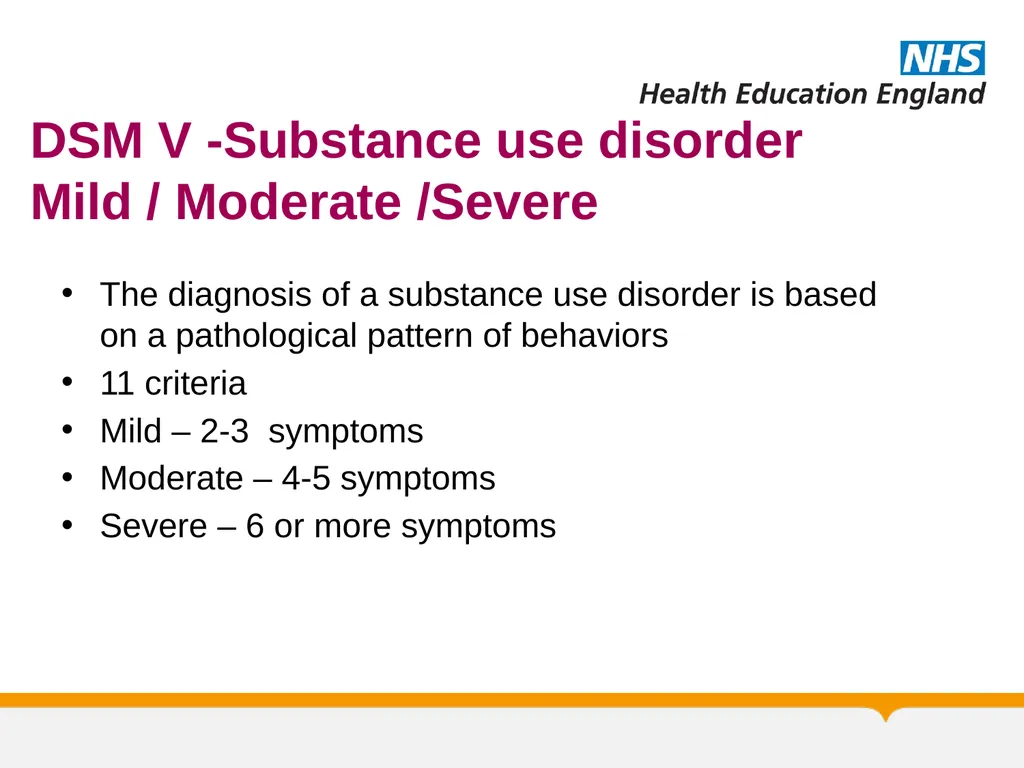
Mild / Moderate /Severe The diagnosis of a substance use disorder is based on a pathological pattern of behaviors
11 criteria
Mild – 2-3 symptoms
Moderate – 4-5 symptoms
Severe – 6 or more symptoms<br>
11 criteria
Mild – 2-3 symptoms
Moderate – 4-5 symptoms
Severe – 6 or more symptoms<br>
68
DSM V
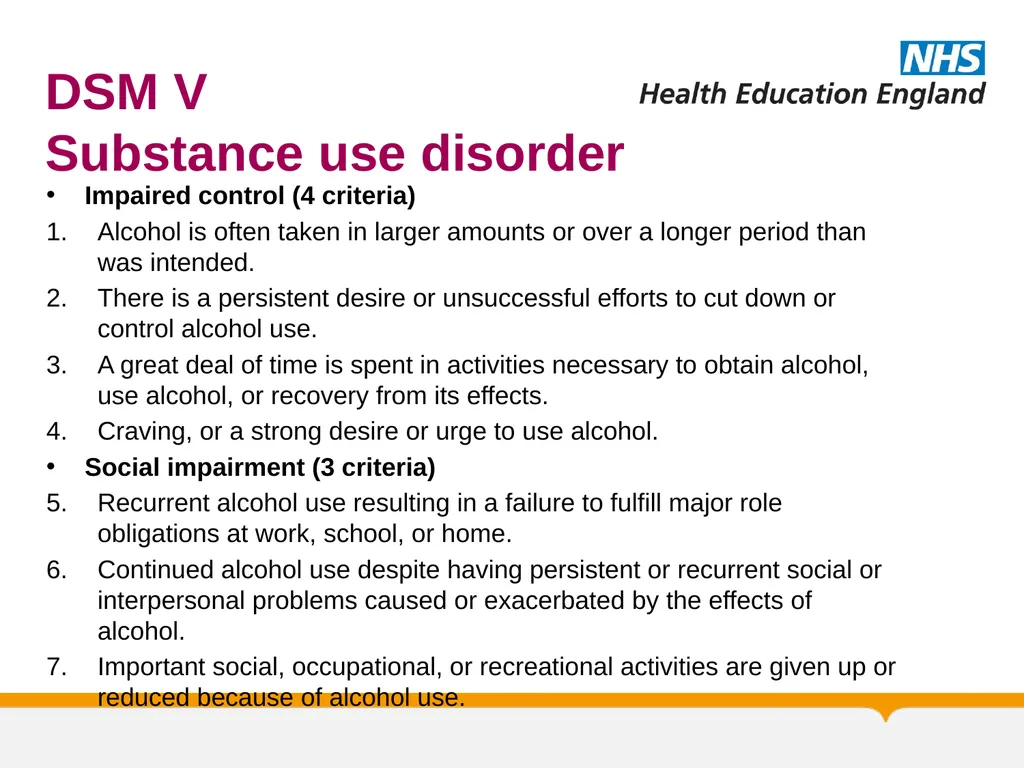
Substance use disorder Impaired control (4 criteria)
Alcohol is often taken in larger amounts or over a longer period than was intended.
There is a persistent desire or unsuccessful efforts to cut down or control alcohol use.
A great deal of time is spent in activities necessary to obtain alcohol, use alcohol, or recovery from its effects.
Craving, or a strong desire or urge to use alcohol.
Social impairment (3 criteria)
Recurrent alcohol use resulting in a failure to fulfill major role obligations at work, school, or home.
Continued alcohol use despite having persistent or recurrent social or interpersonal problems caused or exacerbated by the effects of alcohol.
Important social, occupational, or recreational activities are given up or reduced because of alcohol use.<br>
Alcohol is often taken in larger amounts or over a longer period than was intended.
There is a persistent desire or unsuccessful efforts to cut down or control alcohol use.
A great deal of time is spent in activities necessary to obtain alcohol, use alcohol, or recovery from its effects.
Craving, or a strong desire or urge to use alcohol.
Social impairment (3 criteria)
Recurrent alcohol use resulting in a failure to fulfill major role obligations at work, school, or home.
Continued alcohol use despite having persistent or recurrent social or interpersonal problems caused or exacerbated by the effects of alcohol.
Important social, occupational, or recreational activities are given up or reduced because of alcohol use.<br>
69
DSM V
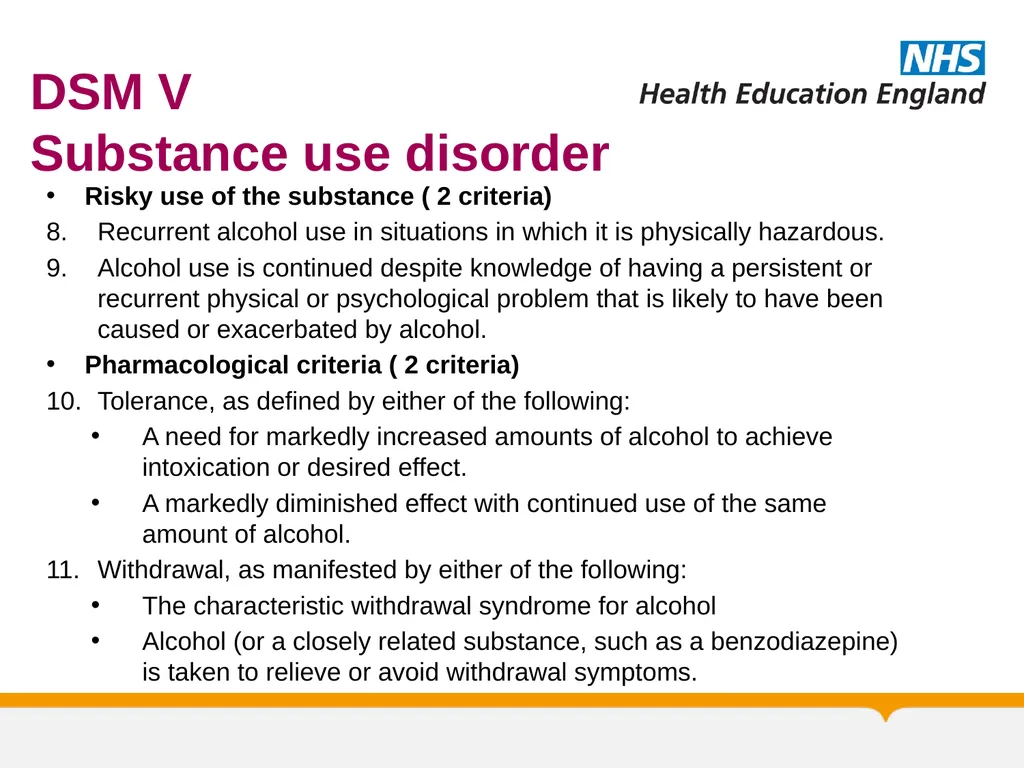
Substance use disorder Risky use of the substance ( 2 criteria)
Recurrent alcohol use in situations in which it is physically hazardous.
Alcohol use is continued despite knowledge of having a persistent or recurrent physical or psychological problem that is likely to have been caused or exacerbated by alcohol.
Pharmacological criteria ( 2 criteria)
Tolerance, as defined by either of the following:
A need for markedly increased amounts of alcohol to achieve intoxication or desired effect.
A markedly diminished effect with continued use of the same amount of alcohol.
Withdrawal, as manifested by either of the following:
The characteristic withdrawal syndrome for alcohol
Alcohol (or a closely related substance, such as a benzodiazepine) is taken to relieve or avoid withdrawal symptoms.<br>
Recurrent alcohol use in situations in which it is physically hazardous.
Alcohol use is continued despite knowledge of having a persistent or recurrent physical or psychological problem that is likely to have been caused or exacerbated by alcohol.
Pharmacological criteria ( 2 criteria)
Tolerance, as defined by either of the following:
A need for markedly increased amounts of alcohol to achieve intoxication or desired effect.
A markedly diminished effect with continued use of the same amount of alcohol.
Withdrawal, as manifested by either of the following:
The characteristic withdrawal syndrome for alcohol
Alcohol (or a closely related substance, such as a benzodiazepine) is taken to relieve or avoid withdrawal symptoms.<br>
70
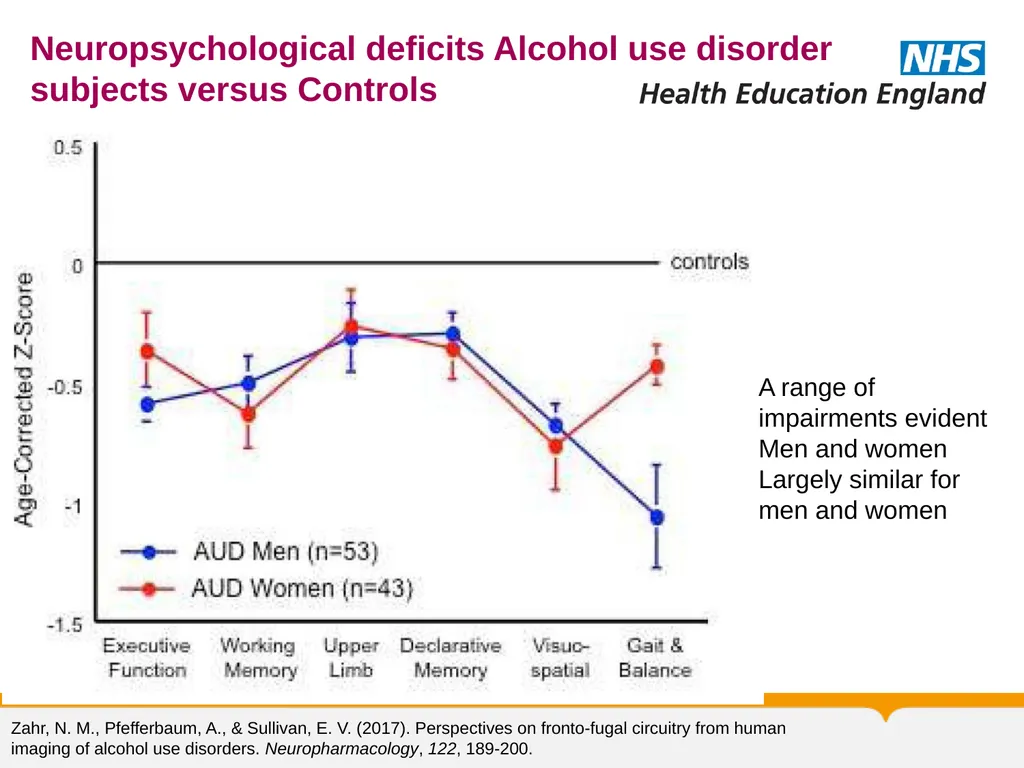
Neuropsychological deficits Alcohol use disorder subjects versus Controls A range of impairments evident
Men and women Largely similar for men and women Zahr, N. M., Pfefferbaum, A., & Sullivan, E. V. (2017). Perspectives on fronto-fugal circuitry from human imaging of alcohol use disorders. Neuropharmacology, 122, 189-200.<br>
Men and women Largely similar for men and women Zahr, N. M., Pfefferbaum, A., & Sullivan, E. V. (2017). Perspectives on fronto-fugal circuitry from human imaging of alcohol use disorders. Neuropharmacology, 122, 189-200.<br>
71
Frontal lobe deficits
in Alcohol use disorder (AUD) Older individuals with AUD have greater volume deficits in frontal gray and white matter relative to their younger controls independent of age of AUD onset
Postmortem studies of AUD brains have shown biochemical disturbances in frontal regions including effects on gene, protein, and receptor expression
Suggestive of how cognitive deficits may persist even with abstinence.
Magnetic resonance imaging studies have shown differences between AUD relative to healthy control individuals in frontal regions such as volume deficits low rates of glucose metabolism and depressed BOLD responses (e.g., during inhibition tasks),
MR spectroscopy studies in frontal regions have shown lower levels of the brain metabolite, N-acetylaspartate (NAA) in recently sober AUD subjects relative to healthy controls
Correlations between volumes of frontal lobes and neuropsychological tests are not clear-cut<br>
Postmortem studies of AUD brains have shown biochemical disturbances in frontal regions including effects on gene, protein, and receptor expression
Suggestive of how cognitive deficits may persist even with abstinence.
Magnetic resonance imaging studies have shown differences between AUD relative to healthy control individuals in frontal regions such as volume deficits low rates of glucose metabolism and depressed BOLD responses (e.g., during inhibition tasks),
MR spectroscopy studies in frontal regions have shown lower levels of the brain metabolite, N-acetylaspartate (NAA) in recently sober AUD subjects relative to healthy controls
Correlations between volumes of frontal lobes and neuropsychological tests are not clear-cut<br>
72
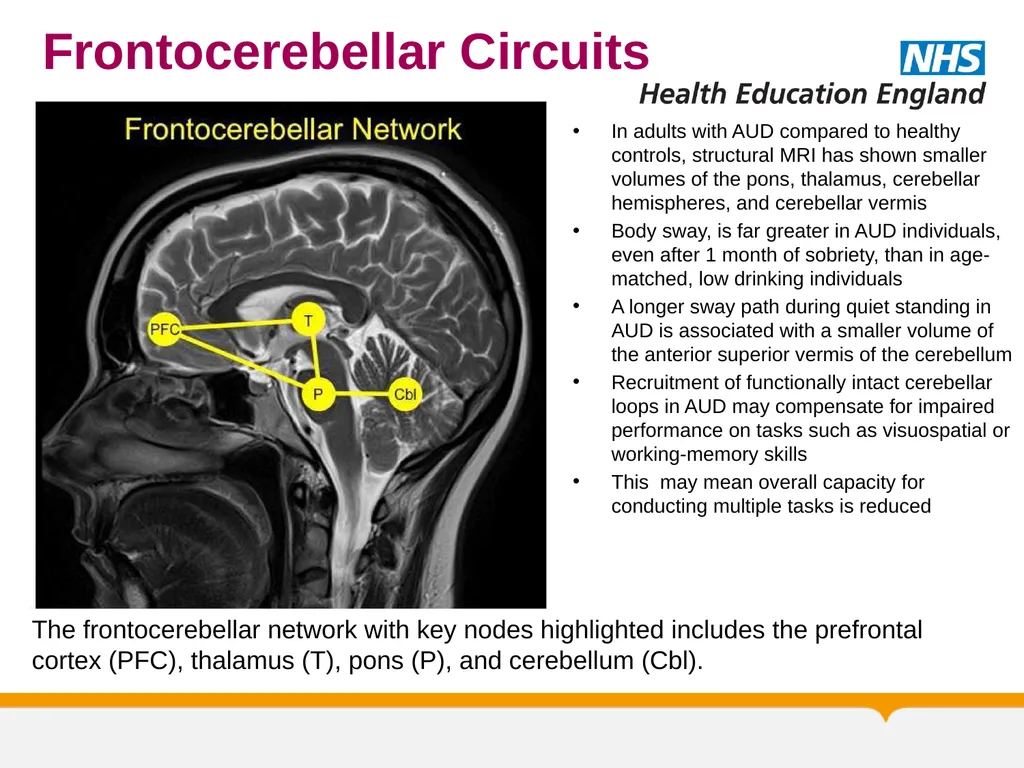
Frontocerebellar Circuits In adults with AUD compared to healthy controls, structural MRI has shown smaller volumes of the pons, thalamus, cerebellar hemispheres, and cerebellar vermis
Body sway, is far greater in AUD individuals, even after 1 month of sobriety, than in age-matched, low drinking individuals
A longer sway path during quiet standing in AUD is associated with a smaller volume of the anterior superior vermis of the cerebellum
Recruitment of functionally intact cerebellar loops in AUD may compensate for impaired performance on tasks such as visuospatial or working-memory skills
This may mean overall capacity for conducting multiple tasks is reduced The frontocerebellar network with key nodes highlighted includes the prefrontal cortex (PFC), thalamus (T), pons (P), and cerebellum (Cbl).<br>
Body sway, is far greater in AUD individuals, even after 1 month of sobriety, than in age-matched, low drinking individuals
A longer sway path during quiet standing in AUD is associated with a smaller volume of the anterior superior vermis of the cerebellum
Recruitment of functionally intact cerebellar loops in AUD may compensate for impaired performance on tasks such as visuospatial or working-memory skills
This may mean overall capacity for conducting multiple tasks is reduced The frontocerebellar network with key nodes highlighted includes the prefrontal cortex (PFC), thalamus (T), pons (P), and cerebellum (Cbl).<br>
73
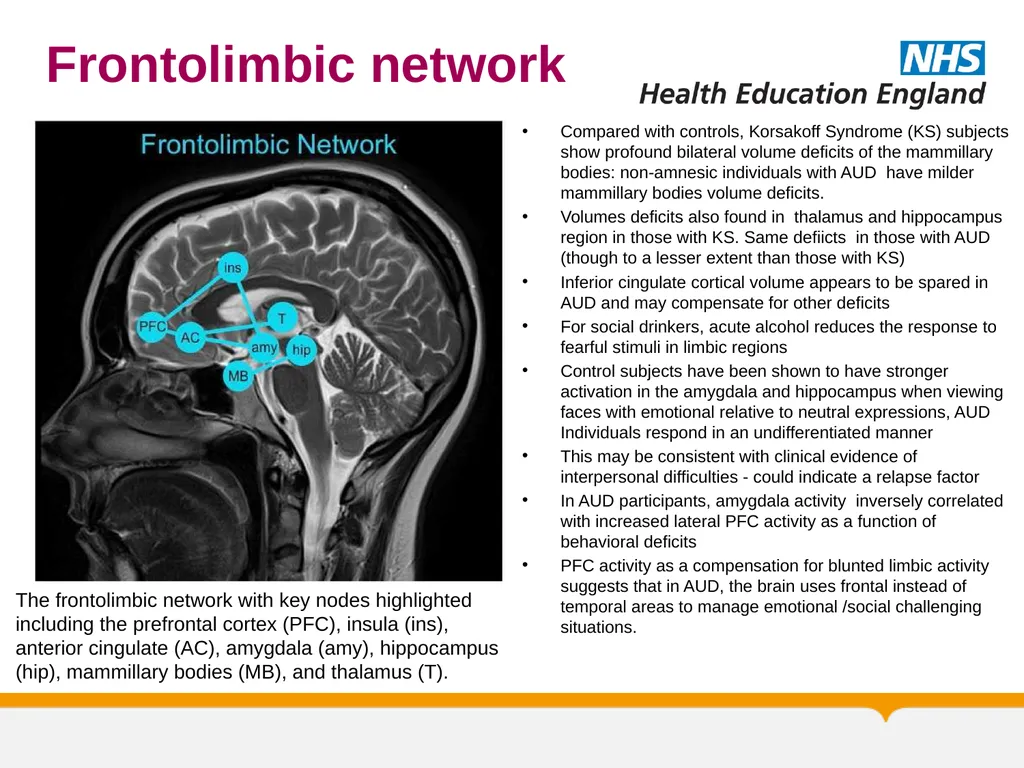
Frontolimbic network Compared with controls, Korsakoff Syndrome (KS) subjects show profound bilateral volume deficits of the mammillary bodies: non-amnesic individuals with AUD have milder mammillary bodies volume deficits.
Volumes deficits also found in thalamus and hippocampus region in those with KS. Same defiicts in those with AUD (though to a lesser extent than those with KS)
Inferior cingulate cortical volume appears to be spared in AUD and may compensate for other deficits
For social drinkers, acute alcohol reduces the response to fearful stimuli in limbic regions
Control subjects have been shown to have stronger activation in the amygdala and hippocampus when viewing faces with emotional relative to neutral expressions, AUD Individuals respond in an undifferentiated manner
This may be consistent with clinical evidence of interpersonal difficulties - could indicate a relapse factor
In AUD participants, amygdala activity inversely correlated with increased lateral PFC activity as a function of behavioral deficits
PFC activity as a compensation for blunted limbic activity suggests that in AUD, the brain uses frontal instead of temporal areas to manage emotional /social challenging situations. The frontolimbic network with key nodes highlighted including the prefrontal cortex (PFC), insula (ins), anterior cingulate (AC), amygdala (amy), hippocampus (hip), mammillary bodies (MB), and thalamus (T).<br>
Volumes deficits also found in thalamus and hippocampus region in those with KS. Same defiicts in those with AUD (though to a lesser extent than those with KS)
Inferior cingulate cortical volume appears to be spared in AUD and may compensate for other deficits
For social drinkers, acute alcohol reduces the response to fearful stimuli in limbic regions
Control subjects have been shown to have stronger activation in the amygdala and hippocampus when viewing faces with emotional relative to neutral expressions, AUD Individuals respond in an undifferentiated manner
This may be consistent with clinical evidence of interpersonal difficulties - could indicate a relapse factor
In AUD participants, amygdala activity inversely correlated with increased lateral PFC activity as a function of behavioral deficits
PFC activity as a compensation for blunted limbic activity suggests that in AUD, the brain uses frontal instead of temporal areas to manage emotional /social challenging situations. The frontolimbic network with key nodes highlighted including the prefrontal cortex (PFC), insula (ins), anterior cingulate (AC), amygdala (amy), hippocampus (hip), mammillary bodies (MB), and thalamus (T).<br>
74
Frontostriatal system Volumes of the caudate, putamen, and nucleus accumbens shown to be smaller in AUD men than controls
Unclear whether smaller volumes / altered activation patterns in reward-related regions can predict higher risk for AUD
Binge drinking men showed smaller prefrontal, striatal, and medial temporal lobe volumes relative to non-binge drinking men, but binge drinking women showed the inverse pattern of larger volumes of these areas relative to non-binge drinking women
Several visual cue-reactivity fMRI studies in AUD showing brain regions, particularly the basal ganglia including the putamen, nucleus accumbens, and medial PFC, responding more intensely to alcohol images compared to other images.
The ventral striatum shows greater activation in response to alcohol cues but lower activation during anticipation of monetary gain in AUD relative to control individuals.
Suggest brain activation in individuals with AUD may be biased towards responding to alcohol-associated cues.
May also support a theory relating to the transition from casual to compulsive, uncontrolled consumption of alcohol by a shift from goal-directed behaviours executed by regions of the PFC to more automatic, habitual behaviours driven by appetitive regions such as the caudate and putamen The frontostriatal network with key nodes highlighted including the prefrontal cortex (PFC), striatum (Str), globus pallidus (GP), and ventral tegmental area (VTA).<br>
Unclear whether smaller volumes / altered activation patterns in reward-related regions can predict higher risk for AUD
Binge drinking men showed smaller prefrontal, striatal, and medial temporal lobe volumes relative to non-binge drinking men, but binge drinking women showed the inverse pattern of larger volumes of these areas relative to non-binge drinking women
Several visual cue-reactivity fMRI studies in AUD showing brain regions, particularly the basal ganglia including the putamen, nucleus accumbens, and medial PFC, responding more intensely to alcohol images compared to other images.
The ventral striatum shows greater activation in response to alcohol cues but lower activation during anticipation of monetary gain in AUD relative to control individuals.
Suggest brain activation in individuals with AUD may be biased towards responding to alcohol-associated cues.
May also support a theory relating to the transition from casual to compulsive, uncontrolled consumption of alcohol by a shift from goal-directed behaviours executed by regions of the PFC to more automatic, habitual behaviours driven by appetitive regions such as the caudate and putamen The frontostriatal network with key nodes highlighted including the prefrontal cortex (PFC), striatum (Str), globus pallidus (GP), and ventral tegmental area (VTA).<br>
75
Alcohol dependence Estimated number of adults in England with alcohol dependence was 595,131 which was 1.393% of the adult population
Males more likely to have alcohol dependence, e.g., aged 25-54. Pryce, R., Buykx, P., Gray, L., Stone, T., Drummond, C., & Brennan, A. (2017). Estimates of alcohol dependence England based on APMS 2014, including estimates of children living in a household with an adult with alcohol dependence. Prevalence, trends and amenability to treatment. London: Public Health England.<br>
Males more likely to have alcohol dependence, e.g., aged 25-54. Pryce, R., Buykx, P., Gray, L., Stone, T., Drummond, C., & Brennan, A. (2017). Estimates of alcohol dependence England based on APMS 2014, including estimates of children living in a household with an adult with alcohol dependence. Prevalence, trends and amenability to treatment. London: Public Health England.<br>
76
Weekly alcohol consumption region + sex Statistics on Alcohol, England 2020
https://digital.nhs.uk/data-and-information/publications/statistical/statistics-on-alcohol/2020/part-4 For men and women
Highest percent of non-drinkers were London (28%)
Lowest proportions in the East of England (9%).<br>
https://digital.nhs.uk/data-and-information/publications/statistical/statistics-on-alcohol/2020/part-4 For men and women
Highest percent of non-drinkers were London (28%)
Lowest proportions in the East of England (9%).<br>
77
Hospital admissions The number of admissions rises with age up until 55-64 and then falls.
40% of patients were aged between 45 and 64.<br>
40% of patients were aged between 45 and 64.<br>
78
Effects of alcohol Holmes, J., Angus, C., Buykx, P., Ally, A., Stone, T., Meier, P., & Brennan, A. (2016). Mortality and morbidity risks from alcohol consumption in the UK: analyses using the Sheffield Alcohol Policy Model (v. 2.7) to inform the UK Chief Medical Officers’ review of the UK lower risk drinking guidelines. Sheffield: ScHARR, University of Sheffield.<br>
79
NICE guidelines monitoring liver disease Maddrey’s discriminant function* of 32 or more indicate that people with severe alcohol-related hepatitis may need corticosteroid treatment
Complete Model for End‑Stage Liver Disease (MELD**) score every 6 months for people with compensated cirrhosis.
MELD score of 12 or more indicates that the person is at high risk of complications of cirrhosis 79 *4.6 x [prothrombin time – control time (seconds)] + bilirubin in mg/dl. National Institute for Health and Care Excellence. (2010). Alcohol use disorders: diagnosis and clinical management of alcohol related physical complications CG 100. London: National Institute for Health and Care Excellence.
National Institute for Health and Care Excellence. (2016). Cirrhosis in over 16s: assessment and management. NG 50. London: National Institute for Health and Care Excellence. **Includes creatinine / INR/Bilirubin/history of dialysis (www.mdcalc.com)<br>
Complete Model for End‑Stage Liver Disease (MELD**) score every 6 months for people with compensated cirrhosis.
MELD score of 12 or more indicates that the person is at high risk of complications of cirrhosis 79 *4.6 x [prothrombin time – control time (seconds)] + bilirubin in mg/dl. National Institute for Health and Care Excellence. (2010). Alcohol use disorders: diagnosis and clinical management of alcohol related physical complications CG 100. London: National Institute for Health and Care Excellence.
National Institute for Health and Care Excellence. (2016). Cirrhosis in over 16s: assessment and management. NG 50. London: National Institute for Health and Care Excellence. **Includes creatinine / INR/Bilirubin/history of dialysis (www.mdcalc.com)<br>
80
Hepatic encephalopathy Caused by liver impairment or portosystemic shunting;
Ranges from subtle changes in cognition to clinically obvious changes in intellect, behaviour, motor function and consciousness.
Commonest complication of cirrhosis
Risk for the first episode of hepatic encephalopathy is 5–25% within 5 years after the diagnosis of cirrhosis Alcohol-use disorders: diagnosis and management of physical complications [CG100]
Cirrhosis in over 16s: assessment and management NICE guideline [NG50]
Ellul, M. A., Gholkar, S. A., & Cross, T. J. (2015). Hepatic encephalopathy due to liver cirrhosis. Bmj, 351, h4187.<br>
Ranges from subtle changes in cognition to clinically obvious changes in intellect, behaviour, motor function and consciousness.
Commonest complication of cirrhosis
Risk for the first episode of hepatic encephalopathy is 5–25% within 5 years after the diagnosis of cirrhosis Alcohol-use disorders: diagnosis and management of physical complications [CG100]
Cirrhosis in over 16s: assessment and management NICE guideline [NG50]
Ellul, M. A., Gholkar, S. A., & Cross, T. J. (2015). Hepatic encephalopathy due to liver cirrhosis. Bmj, 351, h4187.<br>
81
Hepatic encephalopathy
– pathogensis Related to the effects of waste products on the brain, particularly ammonia and glutamine
Glutamine is metabolised by glutaminase to ammonia and glutamate in the small intestine; Ammonia then converted to urea in the liver
High ammonia levels can lead to cerebral oedema along with an inflammatory response cause can cortical dysfunction
With Cirrhosis, portosystemic shunting allows ammonia and other neurotoxins to bypass the liver and enter the systemic circulation
This can also occur with transjugular intrahepatic portosystemic shunting TIPS Alcohol-use disorders: diagnosis and management of physical complications [CG100]
Cirrhosis in over 16s: assessment and management NICE guideline [NG50]
Ellul, M. A., Gholkar, S. A., & Cross, T. J. (2015). Hepatic encephalopathy due to liver cirrhosis. Bmj, 351, h4187.<br>
Glutamine is metabolised by glutaminase to ammonia and glutamate in the small intestine; Ammonia then converted to urea in the liver
High ammonia levels can lead to cerebral oedema along with an inflammatory response cause can cortical dysfunction
With Cirrhosis, portosystemic shunting allows ammonia and other neurotoxins to bypass the liver and enter the systemic circulation
This can also occur with transjugular intrahepatic portosystemic shunting TIPS Alcohol-use disorders: diagnosis and management of physical complications [CG100]
Cirrhosis in over 16s: assessment and management NICE guideline [NG50]
Ellul, M. A., Gholkar, S. A., & Cross, T. J. (2015). Hepatic encephalopathy due to liver cirrhosis. Bmj, 351, h4187.<br>
82
Transjugular Intrahepatic Portosystemic Shunt Internal ‘bypass’ between the portal vein and the hepatic veins https://www.leedsth.nhs.uk/assets/Uploads/adada69f98/LN002264.pdf<br>
83
Hepatic encephalopathy
– diagnosis No specific test for hepatic encephalopathy,
The diagnosis should be made on clinical grounds
Arterial or venous ammonia levels correlate poorly with the grade of hepatic encephalopathy
Electroencephalography may show characteristic triphasic waves
Neuropsychological assessments can also be used to help with diagnosis Alcohol-use disorders: diagnosis and management of physical complications [CG100]
Cirrhosis in over 16s: assessment and management NICE guideline [NG50]
Ellul, M. A., Gholkar, S. A., & Cross, T. J. (2015). Hepatic encephalopathy due to liver cirrhosis. Bmj, 351, h4187.<br>
The diagnosis should be made on clinical grounds
Arterial or venous ammonia levels correlate poorly with the grade of hepatic encephalopathy
Electroencephalography may show characteristic triphasic waves
Neuropsychological assessments can also be used to help with diagnosis Alcohol-use disorders: diagnosis and management of physical complications [CG100]
Cirrhosis in over 16s: assessment and management NICE guideline [NG50]
Ellul, M. A., Gholkar, S. A., & Cross, T. J. (2015). Hepatic encephalopathy due to liver cirrhosis. Bmj, 351, h4187.<br>
84
Hepatic encephalopathy
– Treatment Treat precipitant such as gastrointestinal bleeding, infection, diuretic overdose
Diet - care with protein diet – e.g., use small amounts throughout the day
Lactulose
a non-absorbable disaccharide
metabolised to lactic and acetic acid in the colon
reducing the pH and promoting the excretion of ammonia
Neomycin reaches high concentrations in the gut and acts as a glutaminase inhibitor
Rifaximin is a semisynthetic antibiotic derived from rifamycin. can be use for the prevention of episodes of overt hepatic encephalopathy
may inhibit the division of urea-deaminating bacteria, thereby reducing the production of ammonia Alcohol-use disorders: diagnosis and management of physical complications [CG100]
Cirrhosis in over 16s: assessment and management NICE guideline [NG50]
Ellul, M. A., Gholkar, S. A., & Cross, T. J. (2015). Hepatic encephalopathy due to liver cirrhosis. Bmj, 351, h4187.<br>
Diet - care with protein diet – e.g., use small amounts throughout the day
Lactulose
a non-absorbable disaccharide
metabolised to lactic and acetic acid in the colon
reducing the pH and promoting the excretion of ammonia
Neomycin reaches high concentrations in the gut and acts as a glutaminase inhibitor
Rifaximin is a semisynthetic antibiotic derived from rifamycin. can be use for the prevention of episodes of overt hepatic encephalopathy
may inhibit the division of urea-deaminating bacteria, thereby reducing the production of ammonia Alcohol-use disorders: diagnosis and management of physical complications [CG100]
Cirrhosis in over 16s: assessment and management NICE guideline [NG50]
Ellul, M. A., Gholkar, S. A., & Cross, T. J. (2015). Hepatic encephalopathy due to liver cirrhosis. Bmj, 351, h4187.<br>
85
Cirrhosis Risk factors for Cirrhosis
misuse alcohol
have hepatitis B/ hepatitis C virus infection
are obese (BMI of 30 kg/m2 or higher)or have type 2 diabetes
Offer transient elastography to diagnose cirrhosis for:
people with hepatitis C virus infection
men who consumed over 50 units of alcohol per week and women who drink over 35 units of alcohol per week for several months
people diagnosed with alcohol-related liver disease
Do not use routine laboratory liver blood tests to rule out cirrhosis.
Refer people diagnosed with cirrhosis to a specialist in hepatology
Calculate the Model for End-Stage Liver Disease (MELD) score every 6 months for people with compensated cirrhosis.
a MELD score of 12 or more suggests a person is at high risk of complications of cirrhosis. Cirrhosis in over 16s: assessment and management NICE guideline [NG50]<br>
misuse alcohol
have hepatitis B/ hepatitis C virus infection
are obese (BMI of 30 kg/m2 or higher)or have type 2 diabetes
Offer transient elastography to diagnose cirrhosis for:
people with hepatitis C virus infection
men who consumed over 50 units of alcohol per week and women who drink over 35 units of alcohol per week for several months
people diagnosed with alcohol-related liver disease
Do not use routine laboratory liver blood tests to rule out cirrhosis.
Refer people diagnosed with cirrhosis to a specialist in hepatology
Calculate the Model for End-Stage Liver Disease (MELD) score every 6 months for people with compensated cirrhosis.
a MELD score of 12 or more suggests a person is at high risk of complications of cirrhosis. Cirrhosis in over 16s: assessment and management NICE guideline [NG50]<br>
86
Review of patients who died in hospital with a diagnosis of alcohol-related liver disease (ARLD) 2454 patients identified as dying of a diagnosis of ARLD
Mean age for men was 56.1 for women 58.0
62% had an admission in the two years for prior to final admission
In sub-sample analyses
24% were shown to have had no previous admission to the hospital in which they finally died in the five years preceding their final admission
Ascites, Jaundice, Chronic liver disease most common presentation
Sepsis in 34% and Acute Alcohol hepatitis in 29%
53% had alternate cause of liver disease excluded Juniper, M., Smith, N., Kelly, K., & Mason, M. (2013). Measuring the units–a review of patients who died with alcohol-related liver disease. London: National Confidential Enquiry into Patient Outcome and Death.<br>
Mean age for men was 56.1 for women 58.0
62% had an admission in the two years for prior to final admission
In sub-sample analyses
24% were shown to have had no previous admission to the hospital in which they finally died in the five years preceding their final admission
Ascites, Jaundice, Chronic liver disease most common presentation
Sepsis in 34% and Acute Alcohol hepatitis in 29%
53% had alternate cause of liver disease excluded Juniper, M., Smith, N., Kelly, K., & Mason, M. (2013). Measuring the units–a review of patients who died with alcohol-related liver disease. London: National Confidential Enquiry into Patient Outcome and Death.<br>
87
Review of patients who died in hospital with a diagnosis of alcohol-related liver disease (ARLD) Concerns about initial management related to fluid management ; renal dysfunction and sepsis
25% were not currently using alcohol
One in four patients (25%; 117/467) were never seen by a gastroenterologist or hepatologist.
Only 15% (56/373) of patients were reviewed by a specialist nurse.
Thiamine was omitted in more than one in ten cases (39/343; 11%). Juniper, M., Smith, N., Kelly, K., & Mason, M. (2013). Measuring the units–a review of patients who died with alcohol-related liver disease. London: National Confidential Enquiry into Patient Outcome and Death.<br>
25% were not currently using alcohol
One in four patients (25%; 117/467) were never seen by a gastroenterologist or hepatologist.
Only 15% (56/373) of patients were reviewed by a specialist nurse.
Thiamine was omitted in more than one in ten cases (39/343; 11%). Juniper, M., Smith, N., Kelly, K., & Mason, M. (2013). Measuring the units–a review of patients who died with alcohol-related liver disease. London: National Confidential Enquiry into Patient Outcome and Death.<br>