
SUBSTANCE USE DISORDERS: Overview and applications
LO
Published · 48 slides · 0 views
1 / 1




Description
SUBSTANCE USE DISORDERS: Overview and applications to safer prescribing Ted Parran MD FACP Isabel and Carter Wang Professor and Chair in Medical Education CWRU School of Medicine tvpcase.edu Disclosure and Learning Objectives Disclosures:
Related Topics
Share
Embed code
Download this presentation From Below
"SUBSTANCE USE DISORDERS: Overview and applications" is the property of its rightful owner. Permission is granted to download and print the materials on this website for personal, non-commercial use only, and to display it on your personal computer provided you do not modify the materials and that you retain all copyright notices contained in the materials. By downloading content from our website, you accept the terms of this agreement.
Presentation Transcript
01
SUBSTANCE USE DISORDERS:
Overview and applications to safer prescribing Ted Parran MD FACP
Isabel and Carter Wang Professor and Chair in Medical Education
CWRU School of Medicine
tvp@case.edu<br>
Isabel and Carter Wang Professor and Chair in Medical Education
CWRU School of Medicine
tvp@case.edu<br>
02
Disclosure and Learning Objectives Disclosures: none
Learning Objectives: following this presentation participants will:
Describe the lifetime prevalence and incidence of SUD Moderate-Severe
List the domains of life involved in the natural history of SUD-MS
Practice screening and brief intervention strategies that are applicable to all types of patient care environments<br>
Learning Objectives: following this presentation participants will:
Describe the lifetime prevalence and incidence of SUD Moderate-Severe
List the domains of life involved in the natural history of SUD-MS
Practice screening and brief intervention strategies that are applicable to all types of patient care environments<br>
03
Euphoria Producing (EPD) or Brain Reward Drugs EPD’s include: opioids, stimulants, sedative-hypnotics, cannabinoids, and psychedelics – Licit & Illicit
Very different substances
Totally different primary brain effects
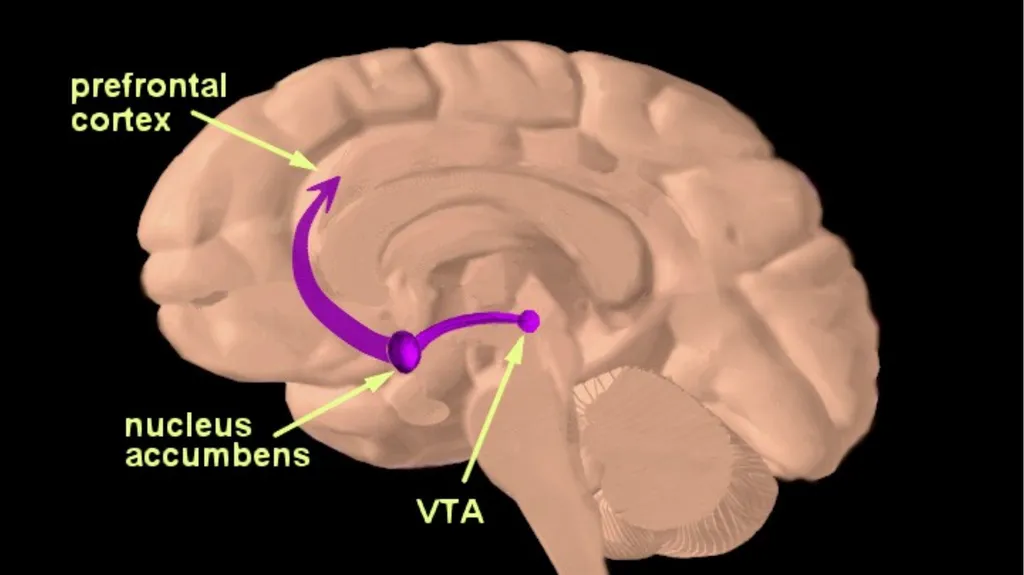
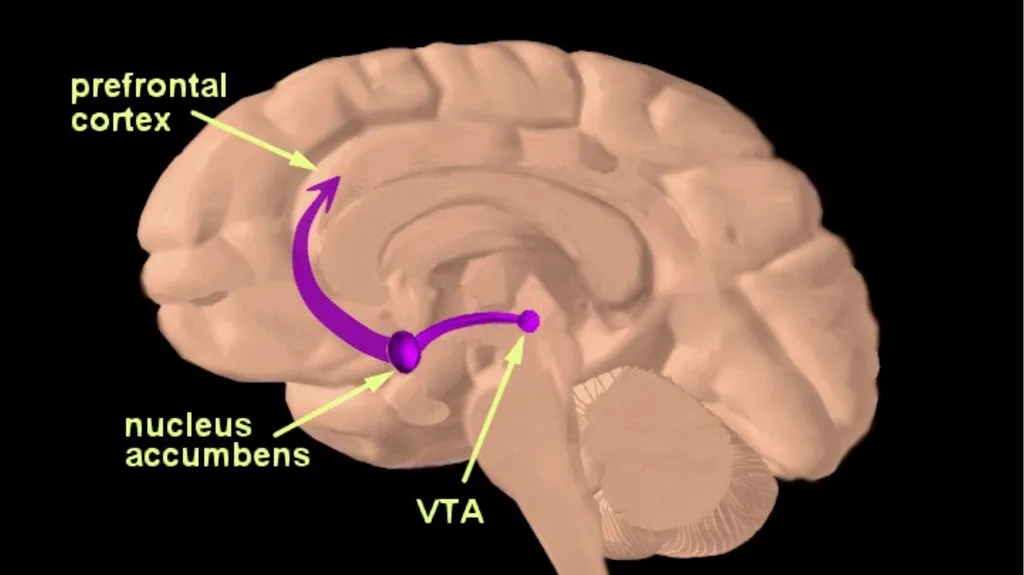
ALL produce an acute surge of dopamine from the mid brain to the fore-brain
Dopamine surges mediate addictive disease<br>
Very different substances
Totally different primary brain effects
ALL produce an acute surge of dopamine from the mid brain to the fore-brain
Dopamine surges mediate addictive disease<br>
04
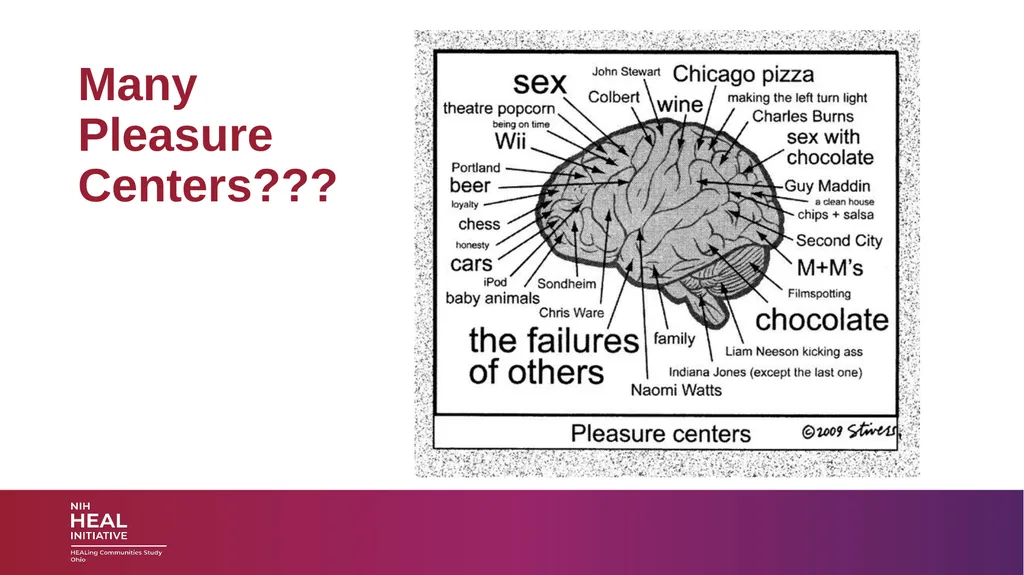
Many Pleasure Centers???<br>
05
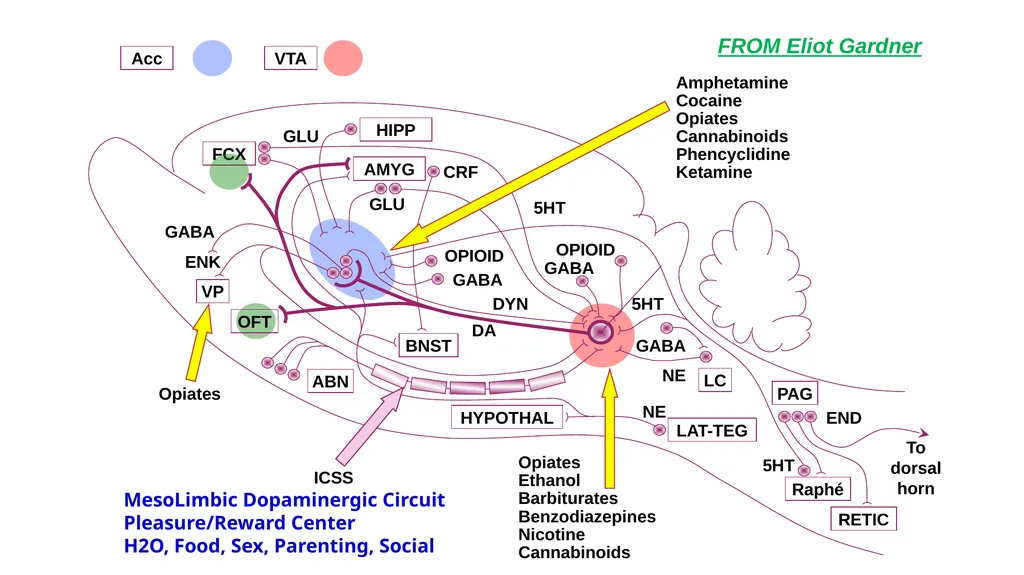
FCX AMYG VP ABN Raphé LC GLU GABA ENK OPIOID GABA GABA GABA DYN 5HT 5HT 5HT NE HIPP PAG RETIC To dorsal horn END DA GLU Opiates ICSS OPIOID HYPOTHAL LAT-TEG BNST NE CRF OFT MesoLimbic Dopaminergic Circuit Pleasure/Reward Center
H2O, Food, Sex, Parenting, Social FROM Eliot Gardner<br>
H2O, Food, Sex, Parenting, Social FROM Eliot Gardner<br>
06
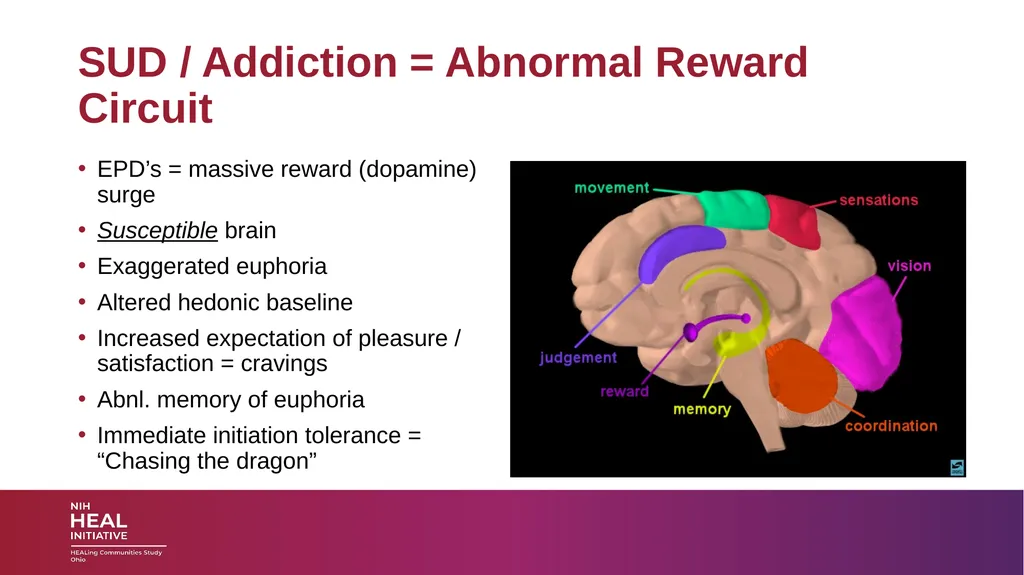
SUD / Addiction = Abnormal Reward Circuit EPD’s = massive reward (dopamine) surge
Susceptible brain
Exaggerated euphoria
Altered hedonic baseline
Increased expectation of pleasure / satisfaction = cravings
Abnl. memory of euphoria
Immediate initiation tolerance = “Chasing the dragon”<br>
Susceptible brain
Exaggerated euphoria
Altered hedonic baseline
Increased expectation of pleasure / satisfaction = cravings
Abnl. memory of euphoria
Immediate initiation tolerance = “Chasing the dragon”<br>
07
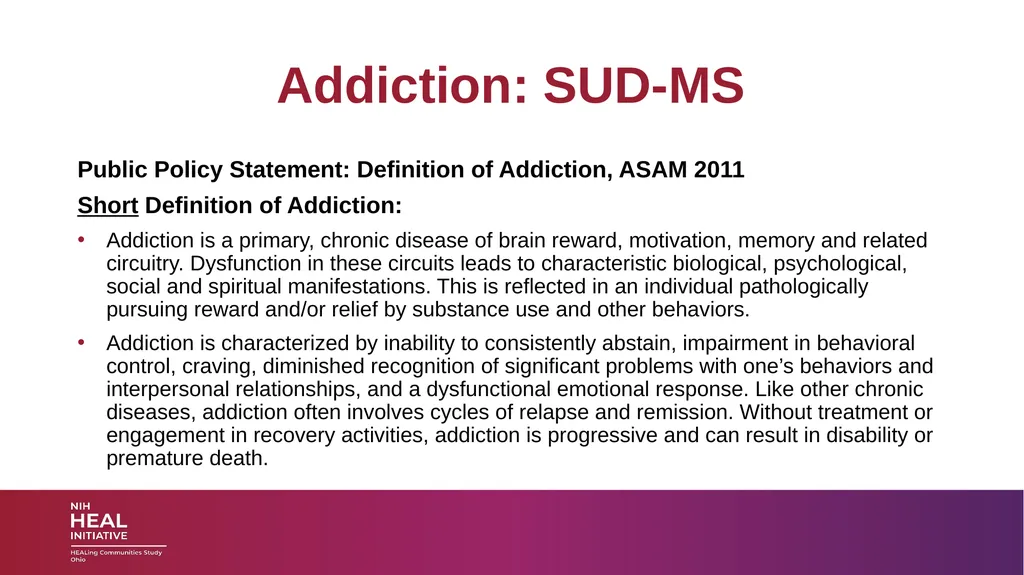
Addiction: SUD-MS Public Policy Statement: Definition of Addiction, ASAM 2011
Short Definition of Addiction:
Addiction is a primary, chronic disease of brain reward, motivation, memory and related circuitry. Dysfunction in these circuits leads to characteristic biological, psychological, social and spiritual manifestations. This is reflected in an individual pathologically pursuing reward and/or relief by substance use and other behaviors.
Addiction is characterized by inability to consistently abstain, impairment in behavioral control, craving, diminished recognition of significant problems with one’s behaviors and interpersonal relationships, and a dysfunctional emotional response. Like other chronic diseases, addiction often involves cycles of relapse and remission. Without treatment or engagement in recovery activities, addiction is progressive and can result in disability or premature death.<br>
Short Definition of Addiction:
Addiction is a primary, chronic disease of brain reward, motivation, memory and related circuitry. Dysfunction in these circuits leads to characteristic biological, psychological, social and spiritual manifestations. This is reflected in an individual pathologically pursuing reward and/or relief by substance use and other behaviors.
Addiction is characterized by inability to consistently abstain, impairment in behavioral control, craving, diminished recognition of significant problems with one’s behaviors and interpersonal relationships, and a dysfunctional emotional response. Like other chronic diseases, addiction often involves cycles of relapse and remission. Without treatment or engagement in recovery activities, addiction is progressive and can result in disability or premature death.<br>
08
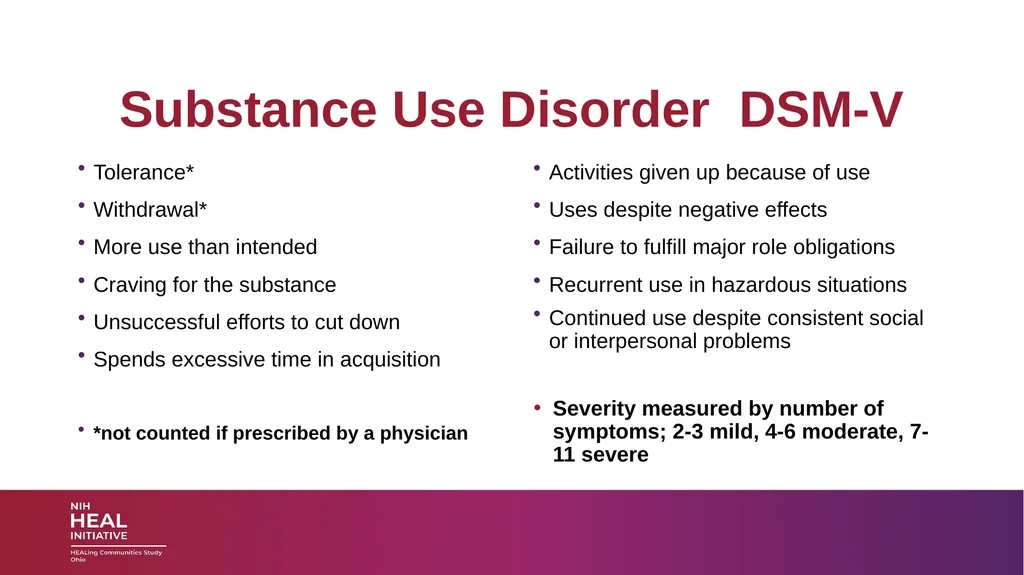
Substance Use Disorder DSM-V Tolerance*
Withdrawal*
More use than intended
Craving for the substance
Unsuccessful efforts to cut down
Spends excessive time in acquisition
*not counted if prescribed by a physician Activities given up because of use
Uses despite negative effects
Failure to fulfill major role obligations
Recurrent use in hazardous situations
Continued use despite consistent social or interpersonal problems
Severity measured by number of symptoms; 2-3 mild, 4-6 moderate, 7-11 severe<br>
Withdrawal*
More use than intended
Craving for the substance
Unsuccessful efforts to cut down
Spends excessive time in acquisition
*not counted if prescribed by a physician Activities given up because of use
Uses despite negative effects
Failure to fulfill major role obligations
Recurrent use in hazardous situations
Continued use despite consistent social or interpersonal problems
Severity measured by number of symptoms; 2-3 mild, 4-6 moderate, 7-11 severe<br>
09
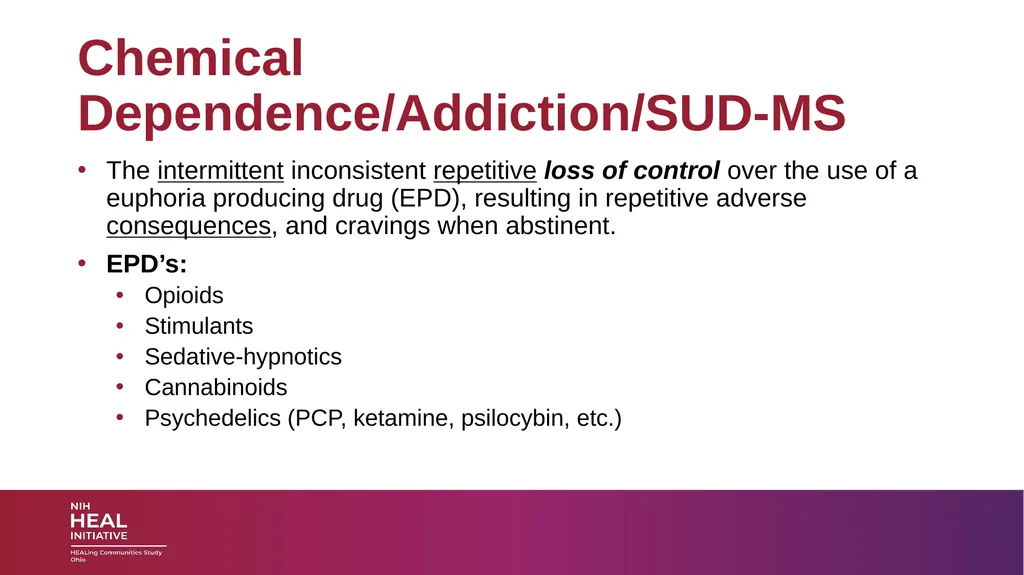
Chemical Dependence/Addiction/SUD-MS The intermittent inconsistent repetitive loss of control over the use of a euphoria producing drug (EPD), resulting in repetitive adverse consequences, and cravings when abstinent.
EPD’s:
Opioids
Stimulants
Sedative-hypnotics
Cannabinoids
Psychedelics (PCP, ketamine, psilocybin, etc.)<br>
EPD’s:
Opioids
Stimulants
Sedative-hypnotics
Cannabinoids
Psychedelics (PCP, ketamine, psilocybin, etc.)<br>
10
What Makes a “Susceptible Brain? Aristotle- “drunken women bring forth children like themselves” (stigma since before 400 BC)
Plutarch- “one drunk begets another”
Every study since the late 1800’s shows higher rates of addiction in relatives of alcoholics.
3 to 4 times higher rate in first degree relatives.
Familial or genetic … or both?
GENETICS & ENVIRONMENT! (BOTH)<br>
Plutarch- “one drunk begets another”
Every study since the late 1800’s shows higher rates of addiction in relatives of alcoholics.
3 to 4 times higher rate in first degree relatives.
Familial or genetic … or both?
GENETICS & ENVIRONMENT! (BOTH)<br>
11
From Familial to Genetic
“genes V. environment” What is the relative importance of genetic influences compared to environmental / familial influences?
Adoption studies
Twin studies
50-60% Genetic
25-30% Environment
10-20% “Other”<br>
Adoption studies
Twin studies
50-60% Genetic
25-30% Environment
10-20% “Other”<br>
12
What Do We Really Know About Addiction?
It is a Chronic Brain Disease A bio-psycho-social-spiritual chronic disease
High prevalence rate
Identified risk factors
Hints about etiology
Predictable natural history – behavior control centers
Morbidity and mortality – behavior control centers
Good treatment efficacy<br>
High prevalence rate
Identified risk factors
Hints about etiology
Predictable natural history – behavior control centers
Morbidity and mortality – behavior control centers
Good treatment efficacy<br>
13
What Do We Really Know About Addiction?
Emerging Pathophysiology Dopamine surge related substances
High risk brains and low risk brains
Loss of control / cravings / isolation
Changes in brain chemistry – a “radical make-over”
Months to re-regulate: 80% of relapses in 1st 6 months
Stages of recovery: 6, 12 and 24 months
Kindling phenomena in relapse
Some “known best practices” are not used in TX<br>
High risk brains and low risk brains
Loss of control / cravings / isolation
Changes in brain chemistry – a “radical make-over”
Months to re-regulate: 80% of relapses in 1st 6 months
Stages of recovery: 6, 12 and 24 months
Kindling phenomena in relapse
Some “known best practices” are not used in TX<br>
14
What Do We NOT Know About Addiction? Specific genes / combinations
HOW / WHY dopamine surges are experienced differently in “high risk brains”
Biologic markers / measurable predictors of risk
Link between dopamine and behavioral control
Lots and lots and lots
With everything that is learned … we realize that there is more we do not know – or even imagined!<br>
HOW / WHY dopamine surges are experienced differently in “high risk brains”
Biologic markers / measurable predictors of risk
Link between dopamine and behavioral control
Lots and lots and lots
With everything that is learned … we realize that there is more we do not know – or even imagined!<br>
15
The Clinical Conundrum:
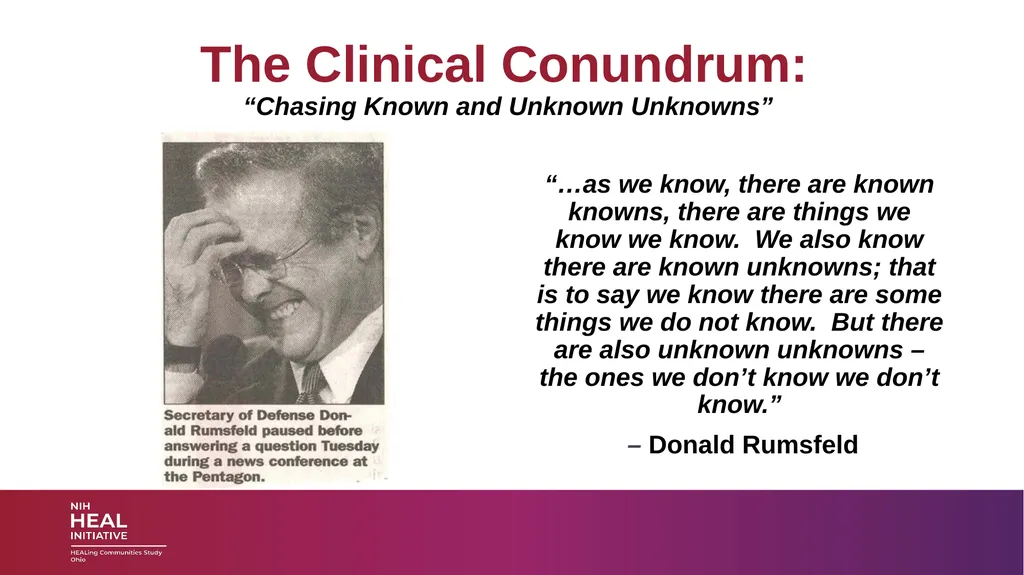
“Chasing Known and Unknown Unknowns” “…as we know, there are known knowns, there are things we know we know. We also know there are known unknowns; that is to say we know there are some things we do not know. But there are also unknown unknowns – the ones we don’t know we don’t know.”
– Donald Rumsfeld<br>
– Donald Rumsfeld<br>
16
Neurobiology of Addiction / SUD-MS: CLINICAL IMPLICATIONS<br>
17
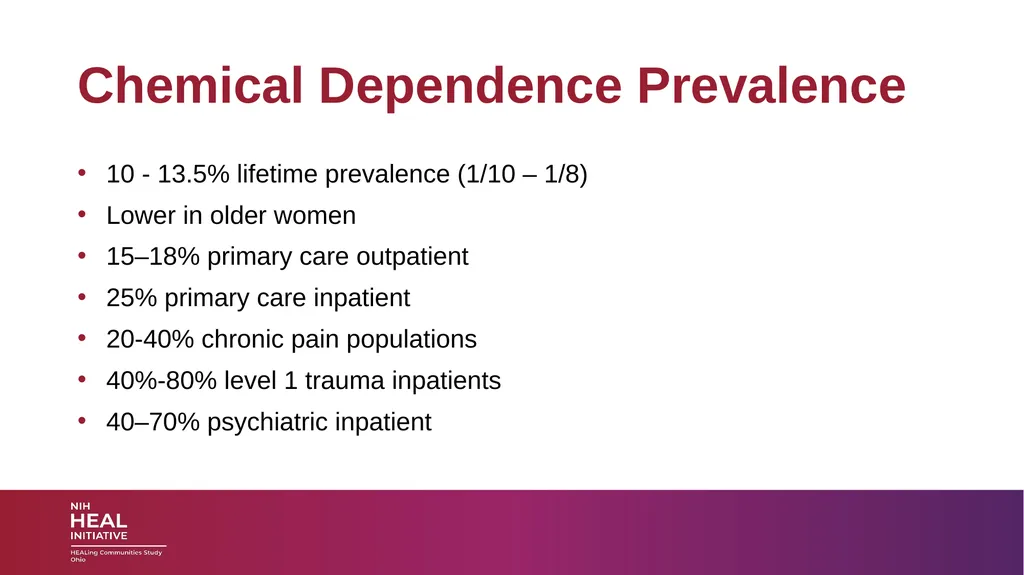
Chemical Dependence Prevalence 10 - 13.5% lifetime prevalence (1/10 – 1/8)
Lower in older women
15–18% primary care outpatient
25% primary care inpatient
20-40% chronic pain populations
40%-80% level 1 trauma inpatients
40–70% psychiatric inpatient<br>
Lower in older women
15–18% primary care outpatient
25% primary care inpatient
20-40% chronic pain populations
40%-80% level 1 trauma inpatients
40–70% psychiatric inpatient<br>
18
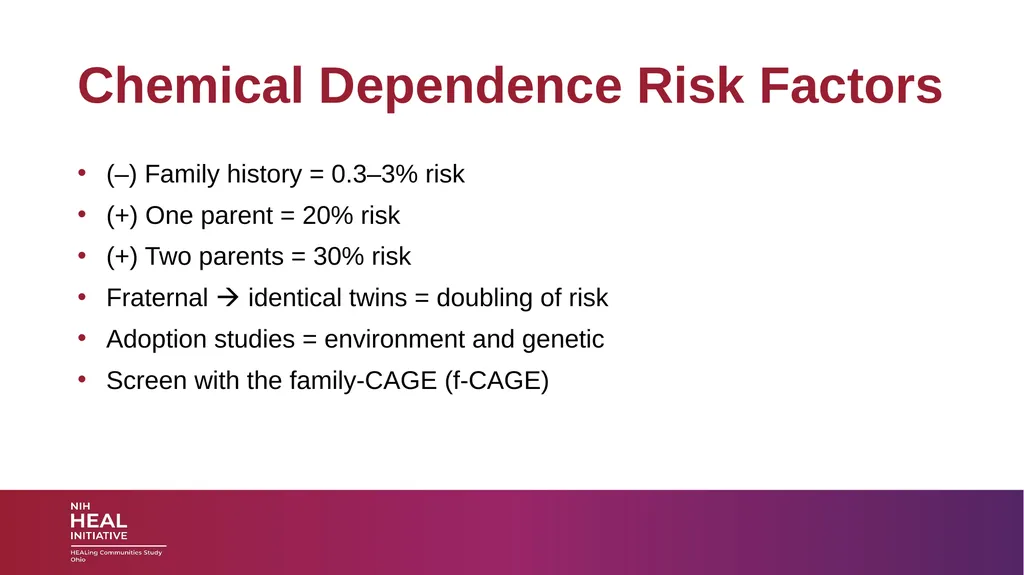
Chemical Dependence Risk Factors (–) Family history = 0.3–3% risk
(+) One parent = 20% risk
(+) Two parents = 30% risk
Fraternal identical twins = doubling of risk
Adoption studies = environment and genetic
Screen with the family-CAGE (f-CAGE)<br>
(+) One parent = 20% risk
(+) Two parents = 30% risk
Fraternal identical twins = doubling of risk
Adoption studies = environment and genetic
Screen with the family-CAGE (f-CAGE)<br>
19
Chemical Dependence: Etiology
A Brain Disease!!! Brain functions:
Movement
Intelligence
Behavior
Diseases of the brain in each area:
Parkinson’s, M.S., Seizures
Mental retardation, Dementia
Addiction, Schizophrenia, Bipolar<br>
Movement
Intelligence
Behavior
Diseases of the brain in each area:
Parkinson’s, M.S., Seizures
Mental retardation, Dementia
Addiction, Schizophrenia, Bipolar<br>
20
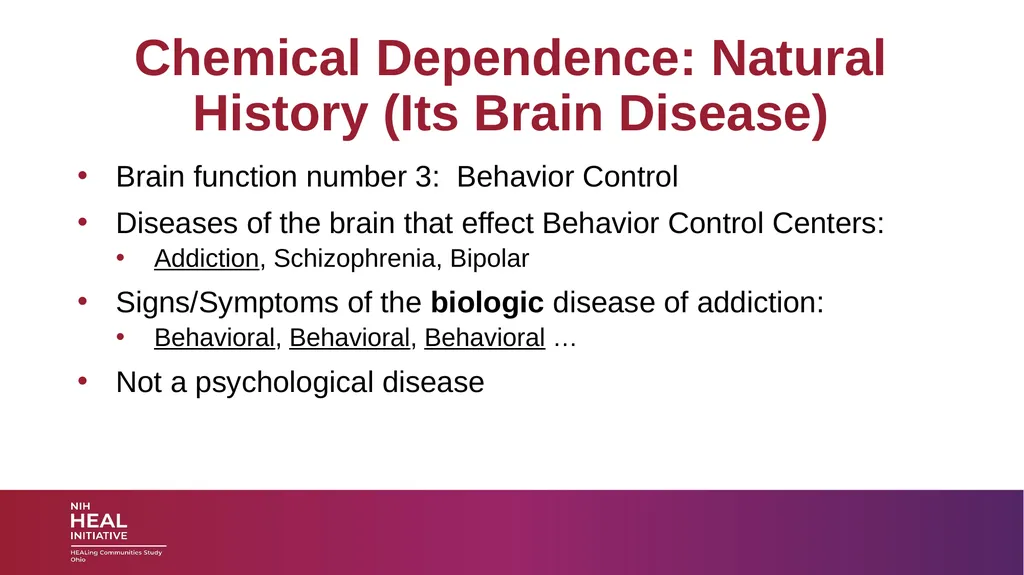
Chemical Dependence: Natural History (Its Brain Disease) Brain function number 3: Behavior Control
Diseases of the brain that effect Behavior Control Centers:
Addiction, Schizophrenia, Bipolar
Signs/Symptoms of the biologic disease of addiction:
Behavioral, Behavioral, Behavioral …
Not a psychological disease<br>
Diseases of the brain that effect Behavior Control Centers:
Addiction, Schizophrenia, Bipolar
Signs/Symptoms of the biologic disease of addiction:
Behavioral, Behavioral, Behavioral …
Not a psychological disease<br>
21
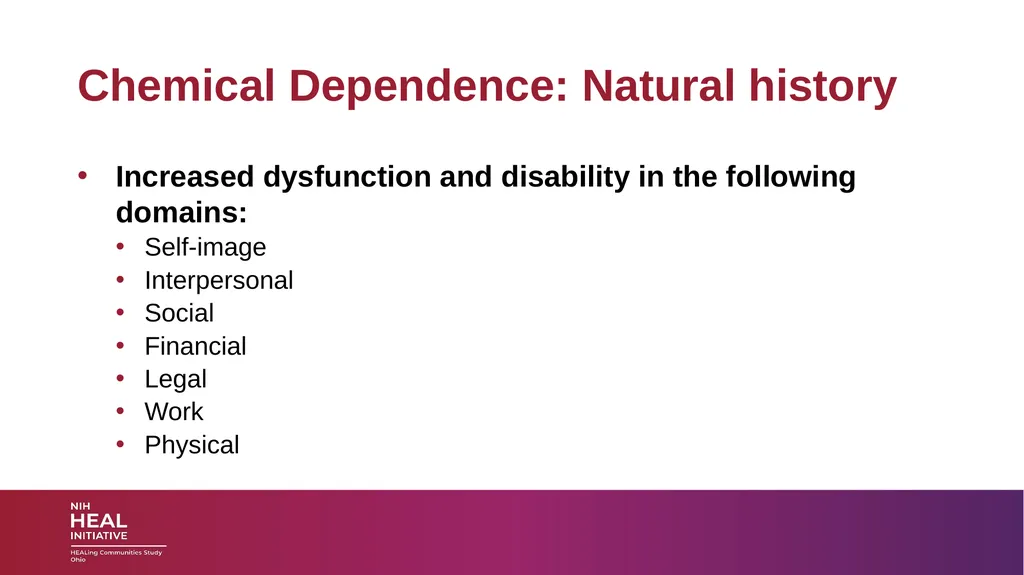
Chemical Dependence: Natural history Increased dysfunction and disability in the following domains:
Self-image
Interpersonal
Social
Financial
Legal
Work
Physical<br>
Self-image
Interpersonal
Social
Financial
Legal
Work
Physical<br>
22
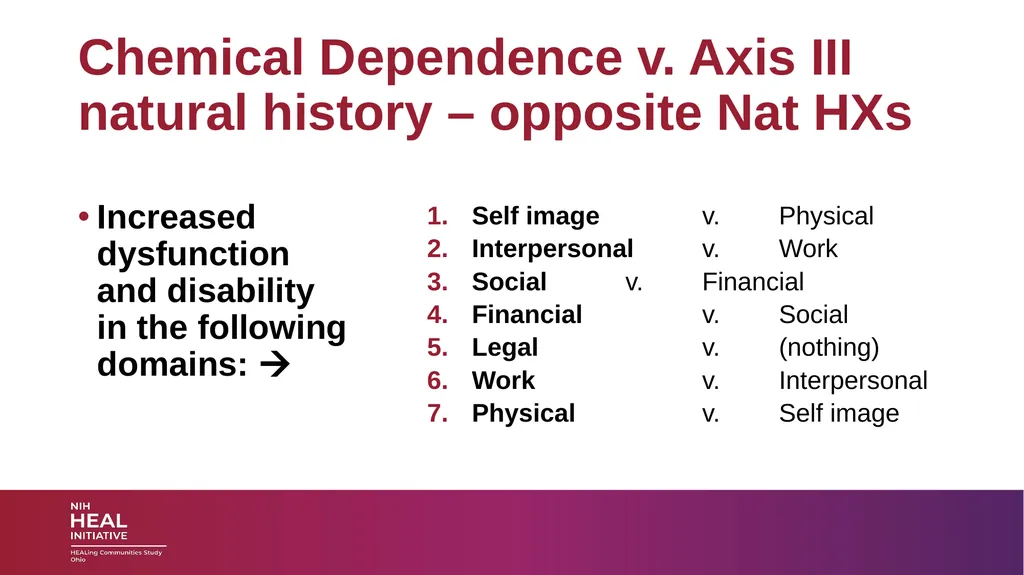
Chemical Dependence v. Axis III
natural history – opposite Nat HXs Self image v. Physical
Interpersonal v. Work
Social v. Financial
Financial v. Social
Legal v. (nothing)
Work v. Interpersonal
Physical v. Self image Increased dysfunction and disability in the following domains: <br>
Interpersonal v. Work
Social v. Financial
Financial v. Social
Legal v. (nothing)
Work v. Interpersonal
Physical v. Self image Increased dysfunction and disability in the following domains: <br>
23
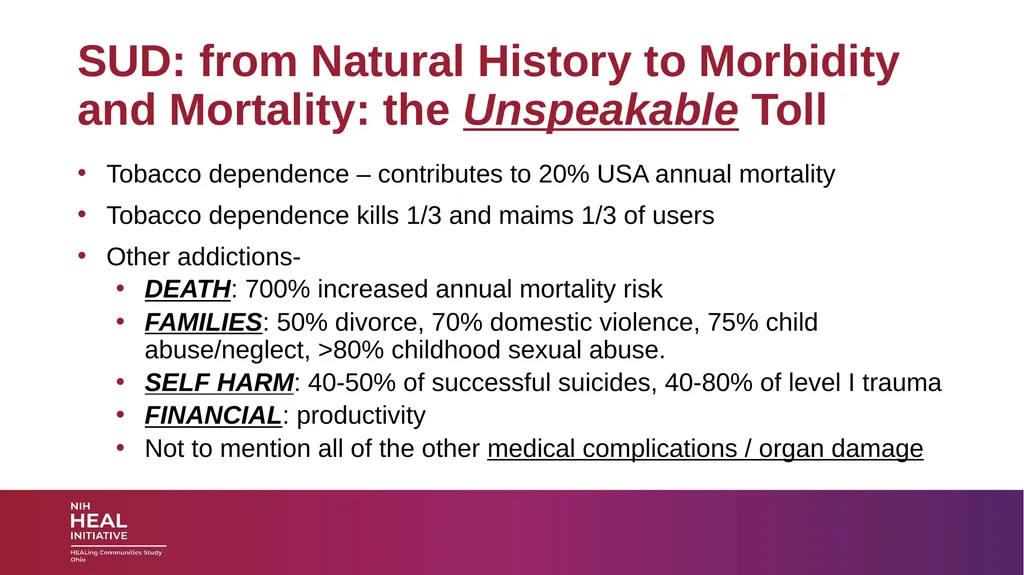
SUD: from Natural History to Morbidity and Mortality: the Unspeakable Toll Tobacco dependence – contributes to 20% USA annual mortality
Tobacco dependence kills 1/3 and maims 1/3 of users
Other addictions-
DEATH: 700% increased annual mortality risk
FAMILIES: 50% divorce, 70% domestic violence, 75% child abuse/neglect, >80% childhood sexual abuse.
SELF HARM: 40-50% of successful suicides, 40-80% of level I trauma
FINANCIAL: productivity
Not to mention all of the other medical complications / organ damage<br>
Tobacco dependence kills 1/3 and maims 1/3 of users
Other addictions-
DEATH: 700% increased annual mortality risk
FAMILIES: 50% divorce, 70% domestic violence, 75% child abuse/neglect, >80% childhood sexual abuse.
SELF HARM: 40-50% of successful suicides, 40-80% of level I trauma
FINANCIAL: productivity
Not to mention all of the other medical complications / organ damage<br>
24
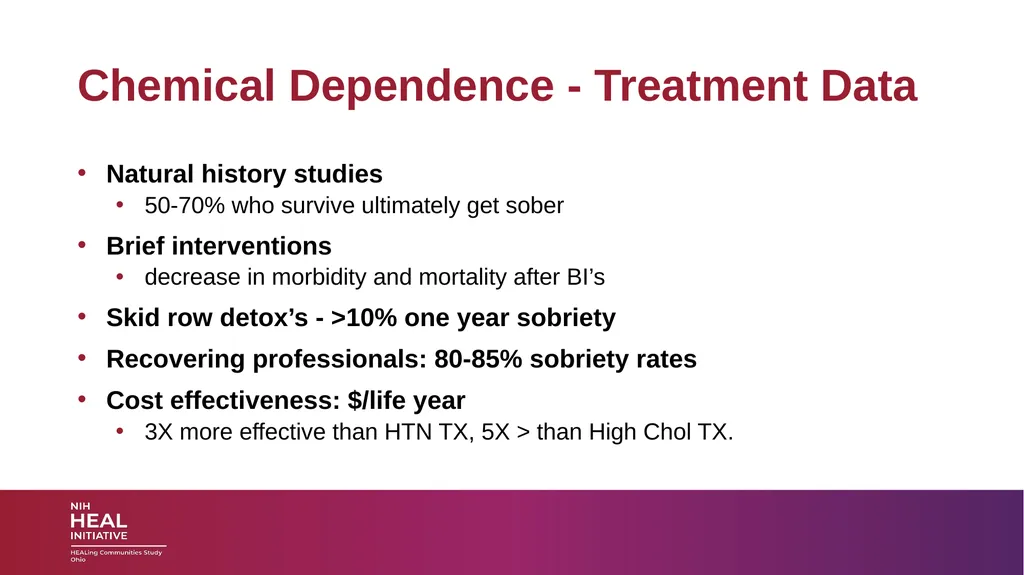
Chemical Dependence - Treatment Data Natural history studies
50-70% who survive ultimately get sober
Brief interventions
decrease in morbidity and mortality after BI’s
Skid row detox’s - >10% one year sobriety
Recovering professionals: 80-85% sobriety rates
Cost effectiveness: $/life year
3X more effective than HTN TX, 5X > than High Chol TX.<br>
50-70% who survive ultimately get sober
Brief interventions
decrease in morbidity and mortality after BI’s
Skid row detox’s - >10% one year sobriety
Recovering professionals: 80-85% sobriety rates
Cost effectiveness: $/life year
3X more effective than HTN TX, 5X > than High Chol TX.<br>
25
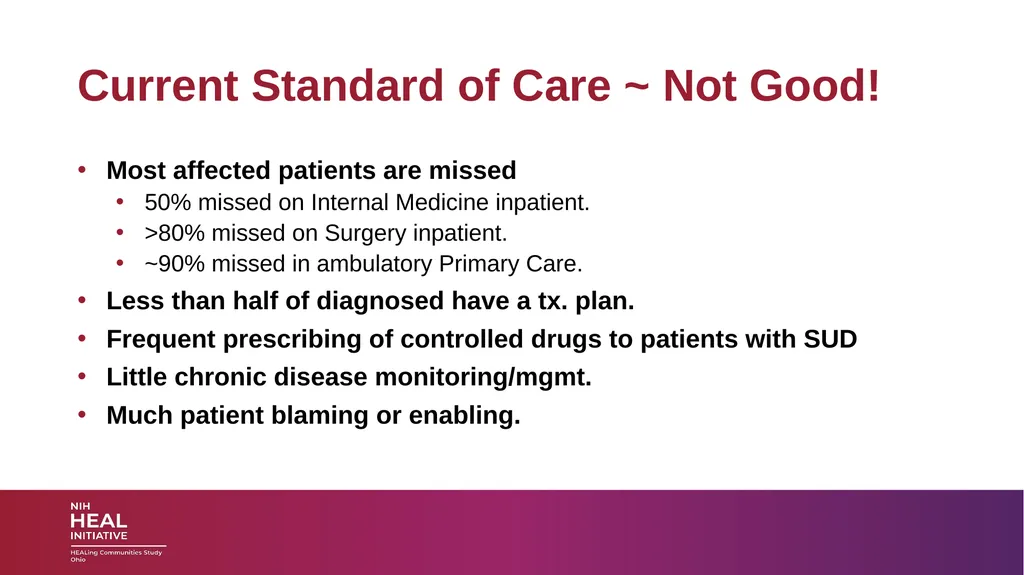
Current Standard of Care ~ Not Good! Most affected patients are missed
50% missed on Internal Medicine inpatient.
>80% missed on Surgery inpatient.
~90% missed in ambulatory Primary Care.
Less than half of diagnosed have a tx. plan.
Frequent prescribing of controlled drugs to patients with SUD
Little chronic disease monitoring/mgmt.
Much patient blaming or enabling.<br>
50% missed on Internal Medicine inpatient.
>80% missed on Surgery inpatient.
~90% missed in ambulatory Primary Care.
Less than half of diagnosed have a tx. plan.
Frequent prescribing of controlled drugs to patients with SUD
Little chronic disease monitoring/mgmt.
Much patient blaming or enabling.<br>
26
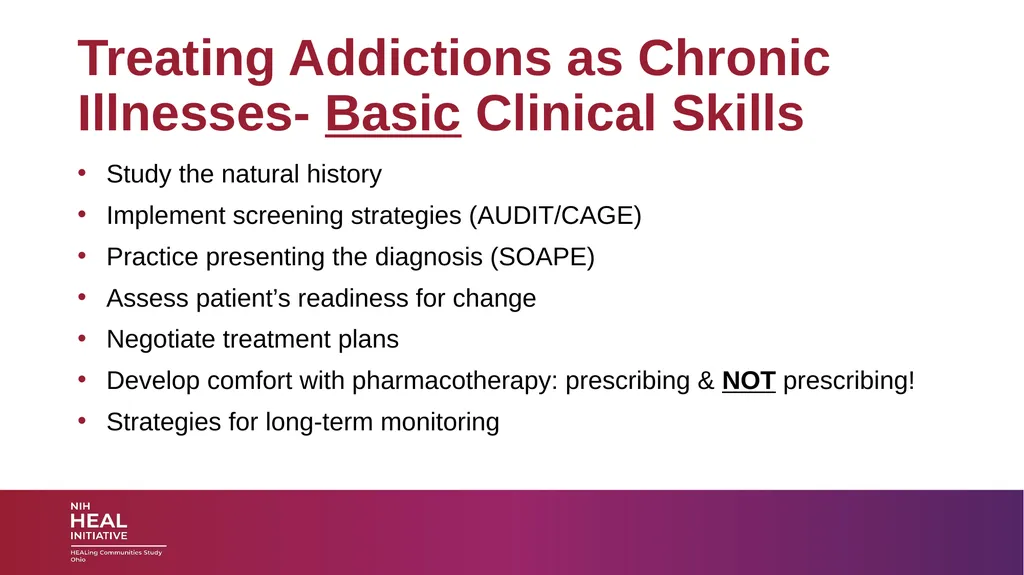
Treating Addictions as Chronic Illnesses- Basic Clinical Skills Study the natural history
Implement screening strategies (AUDIT/CAGE)
Practice presenting the diagnosis (SOAPE)
Assess patient’s readiness for change
Negotiate treatment plans
Develop comfort with pharmacotherapy: prescribing & NOT prescribing!
Strategies for long-term monitoring<br>
Implement screening strategies (AUDIT/CAGE)
Practice presenting the diagnosis (SOAPE)
Assess patient’s readiness for change
Negotiate treatment plans
Develop comfort with pharmacotherapy: prescribing & NOT prescribing!
Strategies for long-term monitoring<br>
27
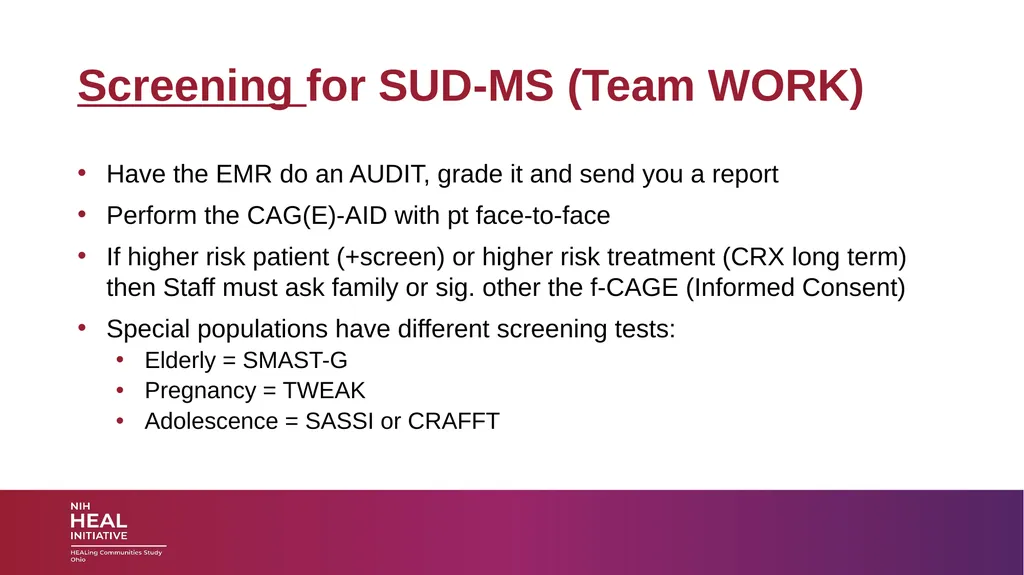
Screening for SUD-MS (Team WORK) Have the EMR do an AUDIT, grade it and send you a report
Perform the CAG(E)-AID with pt face-to-face
If higher risk patient (+screen) or higher risk treatment (CRX long term) then Staff must ask family or sig. other the f-CAGE (Informed Consent)
Special populations have different screening tests:
Elderly = SMAST-G
Pregnancy = TWEAK
Adolescence = SASSI or CRAFFT<br>
Perform the CAG(E)-AID with pt face-to-face
If higher risk patient (+screen) or higher risk treatment (CRX long term) then Staff must ask family or sig. other the f-CAGE (Informed Consent)
Special populations have different screening tests:
Elderly = SMAST-G
Pregnancy = TWEAK
Adolescence = SASSI or CRAFFT<br>
28
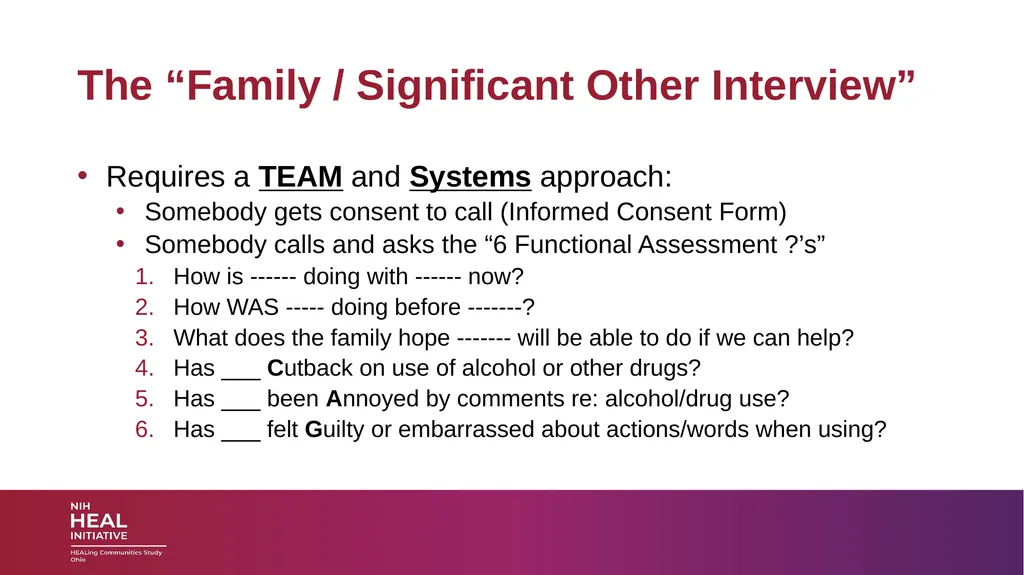
The “Family / Significant Other Interview” Requires a TEAM and Systems approach:
Somebody gets consent to call (Informed Consent Form)
Somebody calls and asks the “6 Functional Assessment ?’s”
How is ------ doing with ------ now?
How WAS ----- doing before -------?
What does the family hope ------- will be able to do if we can help?
Has ___ Cutback on use of alcohol or other drugs?
Has ___ been Annoyed by comments re: alcohol/drug use?
Has ___ felt Guilty or embarrassed about actions/words when using?<br>
Somebody gets consent to call (Informed Consent Form)
Somebody calls and asks the “6 Functional Assessment ?’s”
How is ------ doing with ------ now?
How WAS ----- doing before -------?
What does the family hope ------- will be able to do if we can help?
Has ___ Cutback on use of alcohol or other drugs?
Has ___ been Annoyed by comments re: alcohol/drug use?
Has ___ felt Guilty or embarrassed about actions/words when using?<br>
29
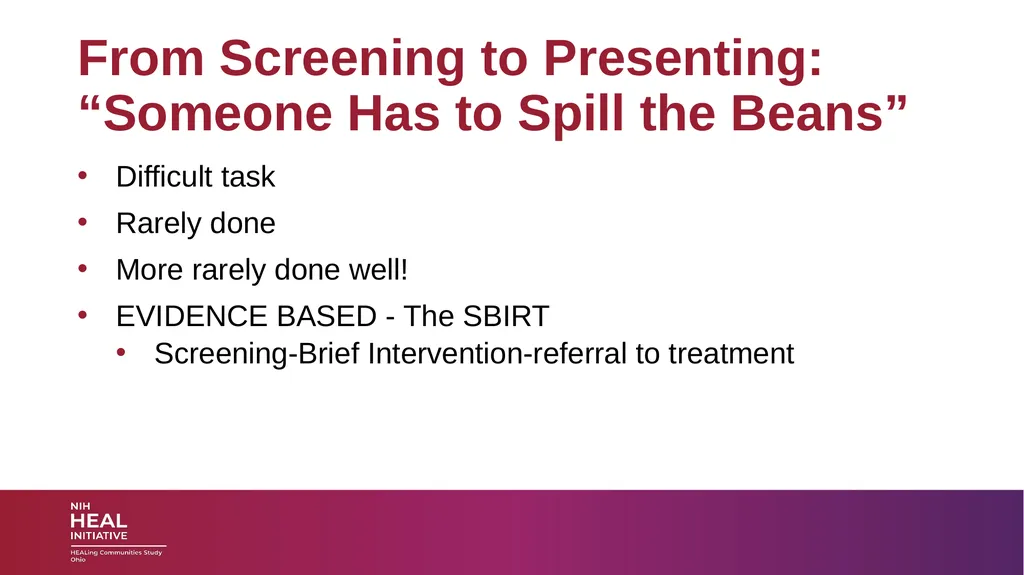
From Screening to Presenting:
“Someone Has to Spill the Beans” Difficult task
Rarely done
More rarely done well!
EVIDENCE BASED - The SBIRT
Screening-Brief Intervention-referral to treatment<br>
Rarely done
More rarely done well!
EVIDENCE BASED - The SBIRT
Screening-Brief Intervention-referral to treatment<br>
30
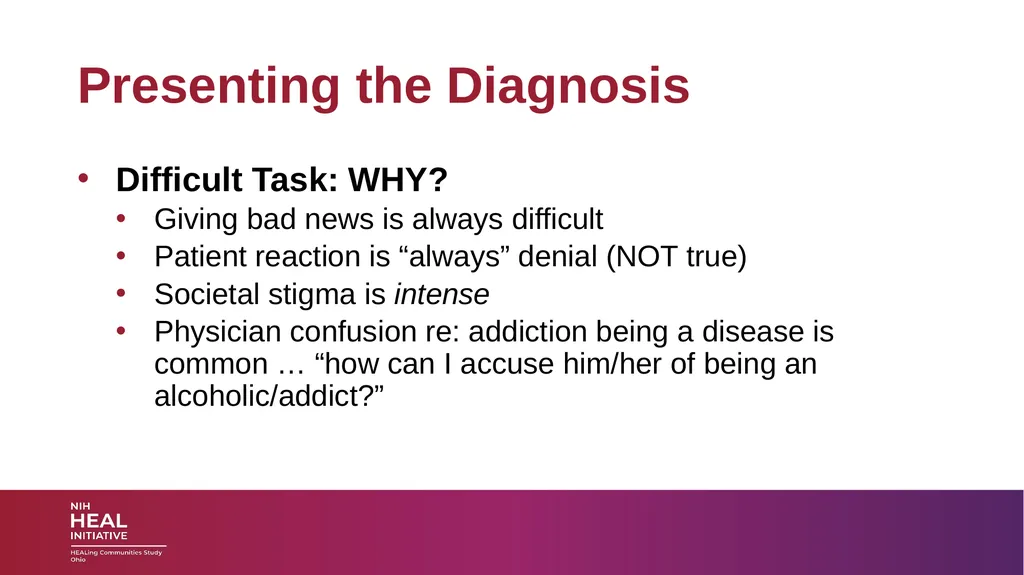
Presenting the Diagnosis Difficult Task: WHY?
Giving bad news is always difficult
Patient reaction is “always” denial (NOT true)
Societal stigma is intense
Physician confusion re: addiction being a disease is common … “how can I accuse him/her of being an alcoholic/addict?”<br>
Giving bad news is always difficult
Patient reaction is “always” denial (NOT true)
Societal stigma is intense
Physician confusion re: addiction being a disease is common … “how can I accuse him/her of being an alcoholic/addict?”<br>
31
Presenting the Diagnosis and Treatment Planning Rarely done with respect to addictive disorders:
“less than 50% of charts containing a diagnosis of alcoholism had documentation of any sort of treatment plan”
Moore RD, JAMA 1989;261:403-407<br>
“less than 50% of charts containing a diagnosis of alcoholism had documentation of any sort of treatment plan”
Moore RD, JAMA 1989;261:403-407<br>
32
Presenting the Diagnosis and Treatment Planning Rarely done well!
Typical clinical skills are often not used
Common approaches are:
“Don’t waste your breath”
“If you don’t quit you will die”
“How could you do this to yourself?”
“Have you no shame…what will it take?”<br>
Typical clinical skills are often not used
Common approaches are:
“Don’t waste your breath”
“If you don’t quit you will die”
“How could you do this to yourself?”
“Have you no shame…what will it take?”<br>
33
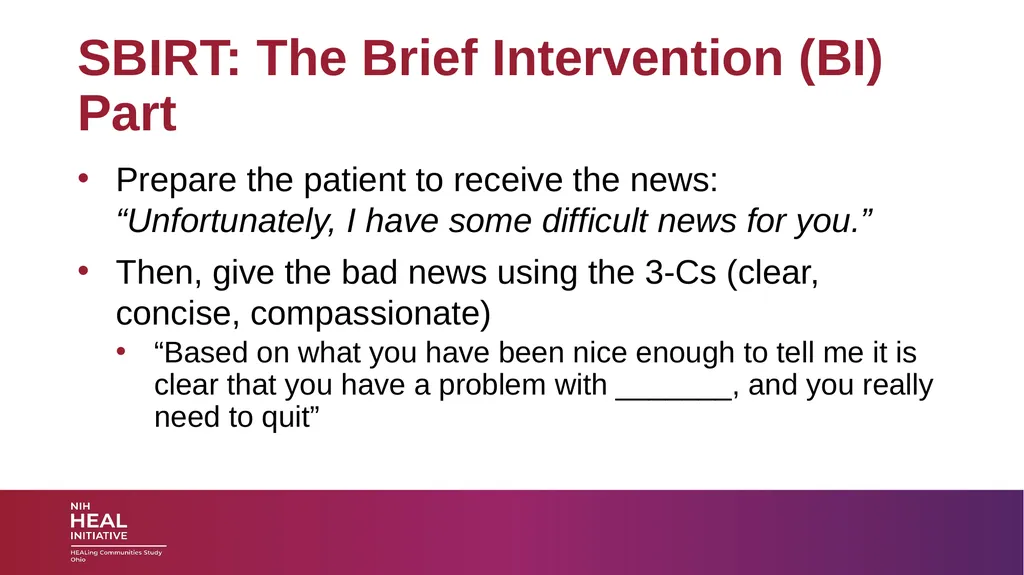
SBIRT: The Brief Intervention (BI) Part Prepare the patient to receive the news: “Unfortunately, I have some difficult news for you.”
Then, give the bad news using the 3-Cs (clear, concise, compassionate)
“Based on what you have been nice enough to tell me it is clear that you have a problem with _______, and you really need to quit”<br>
Then, give the bad news using the 3-Cs (clear, concise, compassionate)
“Based on what you have been nice enough to tell me it is clear that you have a problem with _______, and you really need to quit”<br>
34
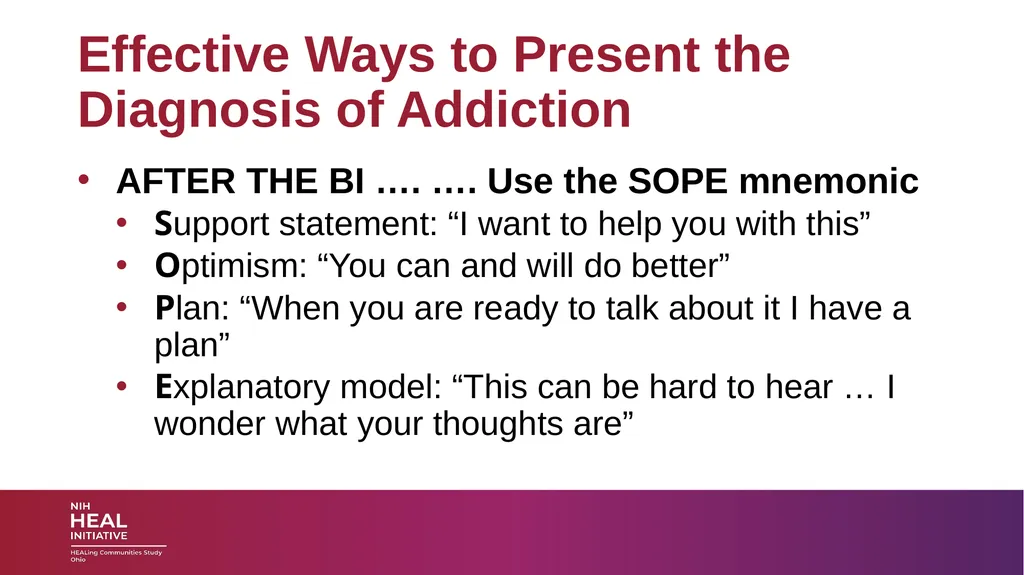
Effective Ways to Present the Diagnosis of Addiction AFTER THE BI …. …. Use the SOPE mnemonic
Support statement: “I want to help you with this”
Optimism: “You can and will do better”
Plan: “When you are ready to talk about it I have a plan”
Explanatory model: “This can be hard to hear … I wonder what your thoughts are”<br>
Support statement: “I want to help you with this”
Optimism: “You can and will do better”
Plan: “When you are ready to talk about it I have a plan”
Explanatory model: “This can be hard to hear … I wonder what your thoughts are”<br>
35
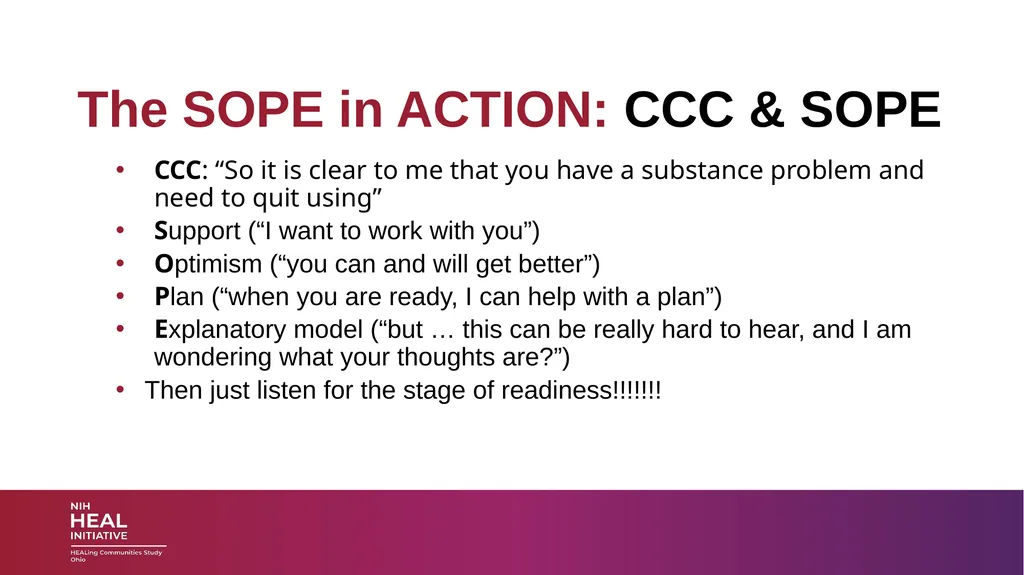
The SOPE in ACTION: CCC & SOPE CCC: “So it is clear to me that you have a substance problem and need to quit using”
Support (“I want to work with you”)
Optimism (“you can and will get better”)
Plan (“when you are ready, I can help with a plan”)
Explanatory model (“but … this can be really hard to hear, and I am wondering what your thoughts are?”)
Then just listen for the stage of readiness!!!!!!!<br>
Support (“I want to work with you”)
Optimism (“you can and will get better”)
Plan (“when you are ready, I can help with a plan”)
Explanatory model (“but … this can be really hard to hear, and I am wondering what your thoughts are?”)
Then just listen for the stage of readiness!!!!!!!<br>
36
Presenting the Diagnosis “Pitfalls to Avoid” the DEATH mnemonic
Details: don’t get bogged down in the details of the DX
Etiology: “Why do I have it” is not very important
Arguments: arguing is a waste of time, just agree to disagree
Threats and Tranquilizers: “If you don’t quit you will be dead …”
Hedging: be Clear / Concise / Compassionate and do not beat around the bush!<br>
Details: don’t get bogged down in the details of the DX
Etiology: “Why do I have it” is not very important
Arguments: arguing is a waste of time, just agree to disagree
Threats and Tranquilizers: “If you don’t quit you will be dead …”
Hedging: be Clear / Concise / Compassionate and do not beat around the bush!<br>
37
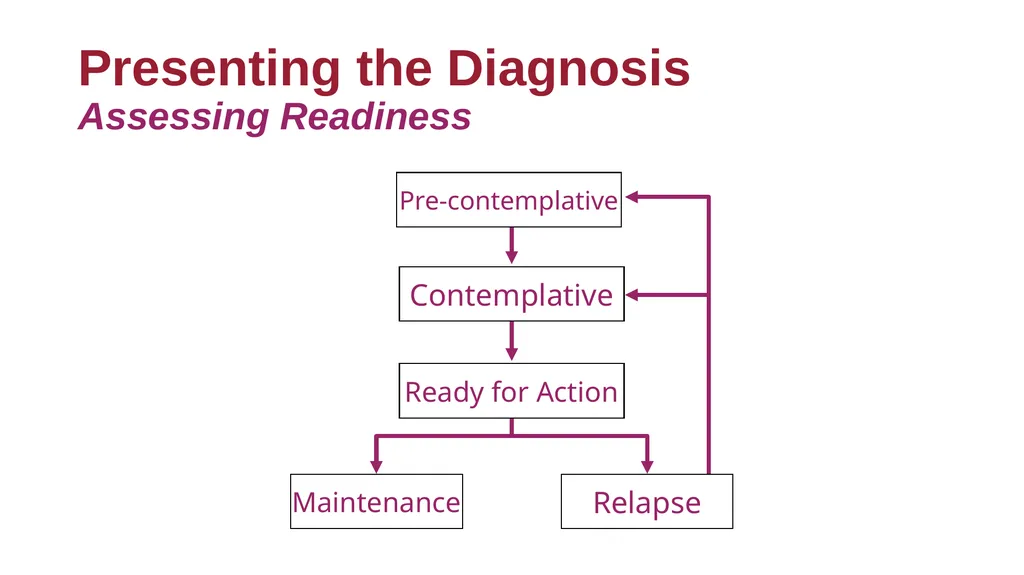
Presenting the Diagnosis
Assessing Readiness Relapse Maintenance Contemplative Ready for Action Pre-contemplative<br>
38
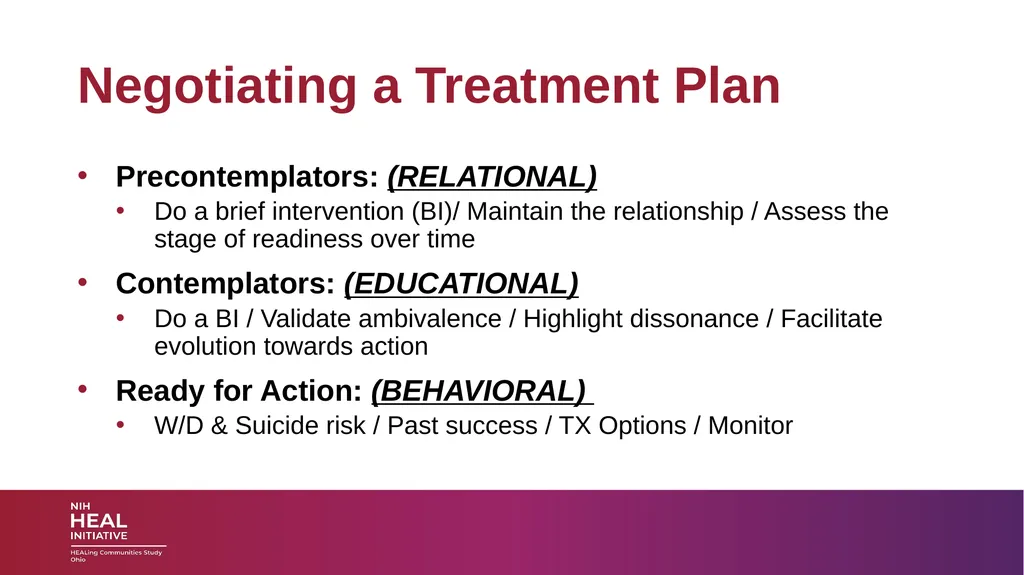
Negotiating a Treatment Plan Precontemplators: (RELATIONAL)
Do a brief intervention (BI)/ Maintain the relationship / Assess the stage of readiness over time
Contemplators: (EDUCATIONAL)
Do a BI / Validate ambivalence / Highlight dissonance / Facilitate evolution towards action
Ready for Action: (BEHAVIORAL)
W/D & Suicide risk / Past success / TX Options / Monitor<br>
Do a brief intervention (BI)/ Maintain the relationship / Assess the stage of readiness over time
Contemplators: (EDUCATIONAL)
Do a BI / Validate ambivalence / Highlight dissonance / Facilitate evolution towards action
Ready for Action: (BEHAVIORAL)
W/D & Suicide risk / Past success / TX Options / Monitor<br>
39
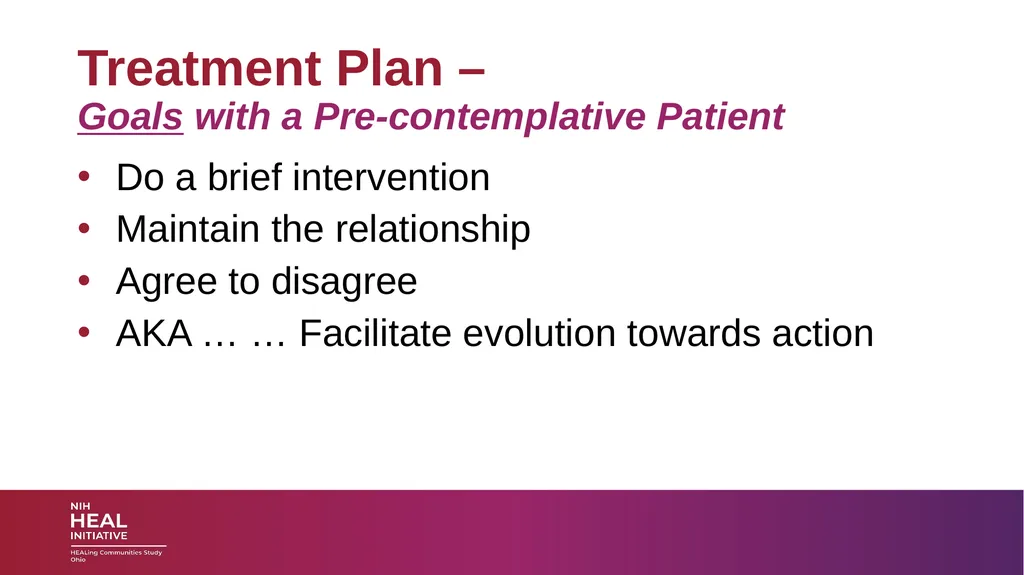
Treatment Plan –
Goals with a Pre-contemplative Patient Do a brief intervention
Maintain the relationship
Agree to disagree
AKA … … Facilitate evolution towards action<br>
Maintain the relationship
Agree to disagree
AKA … … Facilitate evolution towards action<br>
40
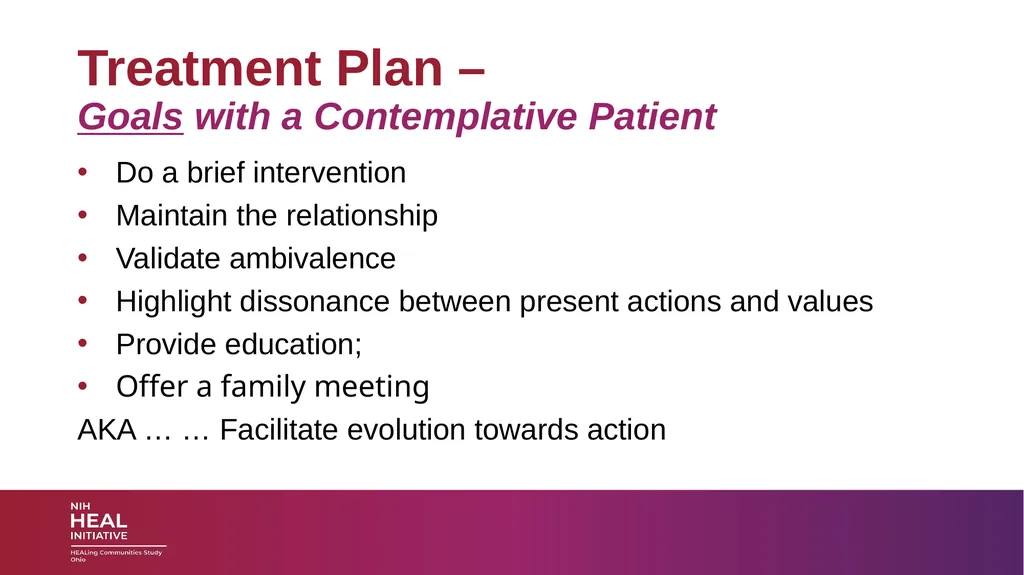
Treatment Plan –
Goals with a Contemplative Patient Do a brief intervention
Maintain the relationship
Validate ambivalence
Highlight dissonance between present actions and values
Provide education;
Offer a family meeting
AKA … … Facilitate evolution towards action<br>
Maintain the relationship
Validate ambivalence
Highlight dissonance between present actions and values
Provide education;
Offer a family meeting
AKA … … Facilitate evolution towards action<br>
41
Negotiating a Treatment Plan
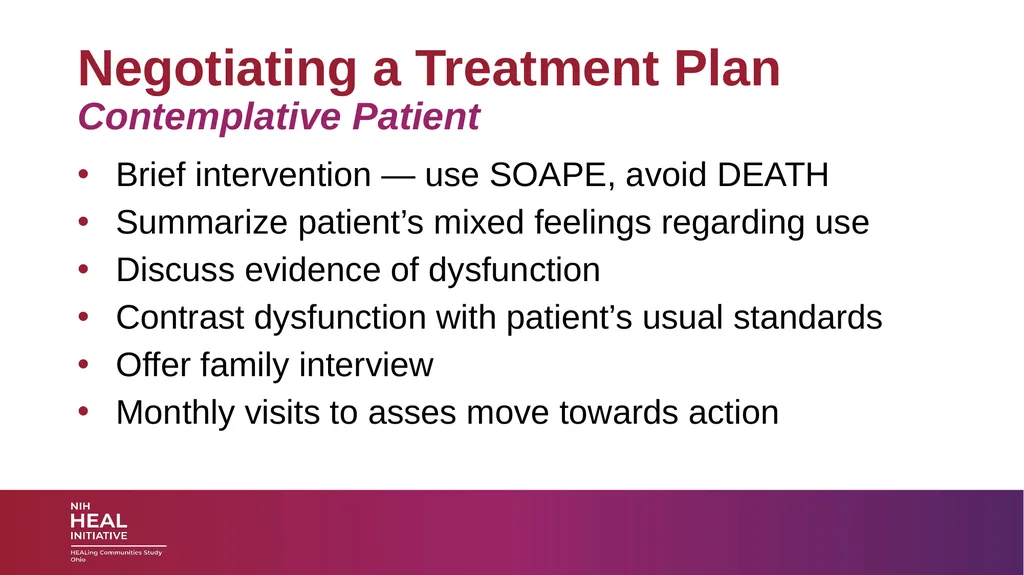
Contemplative Patient Brief intervention — use SOAPE, avoid DEATH
Summarize patient’s mixed feelings regarding use
Discuss evidence of dysfunction
Contrast dysfunction with patient’s usual standards
Offer family interview
Monthly visits to asses move towards action<br>
Summarize patient’s mixed feelings regarding use
Discuss evidence of dysfunction
Contrast dysfunction with patient’s usual standards
Offer family interview
Monthly visits to asses move towards action<br>
42
Treatment Plan –
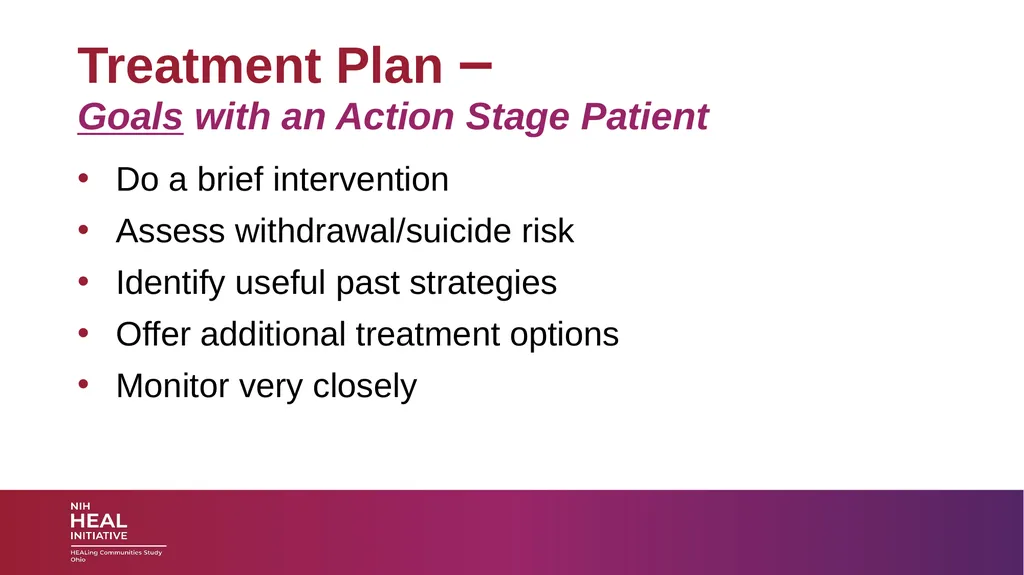
Goals with an Action Stage Patient Do a brief intervention
Assess withdrawal/suicide risk
Identify useful past strategies
Offer additional treatment options
Monitor very closely<br>
Assess withdrawal/suicide risk
Identify useful past strategies
Offer additional treatment options
Monitor very closely<br>
43
Negotiating a Treatment Plan
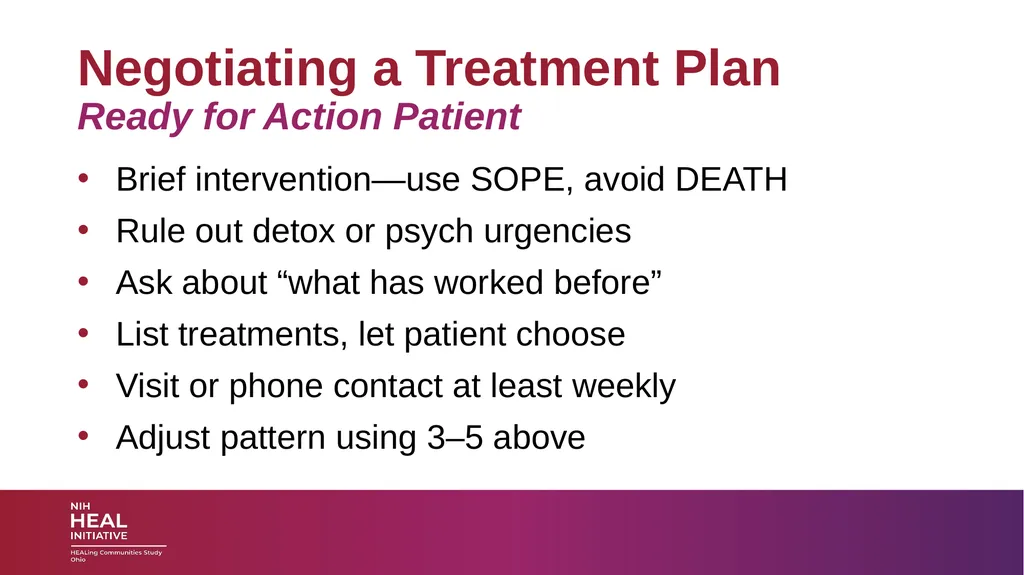
Ready for Action Patient Brief intervention—use SOPE, avoid DEATH
Rule out detox or psych urgencies
Ask about “what has worked before”
List treatments, let patient choose
Visit or phone contact at least weekly
Adjust pattern using 3–5 above<br>
Rule out detox or psych urgencies
Ask about “what has worked before”
List treatments, let patient choose
Visit or phone contact at least weekly
Adjust pattern using 3–5 above<br>
44
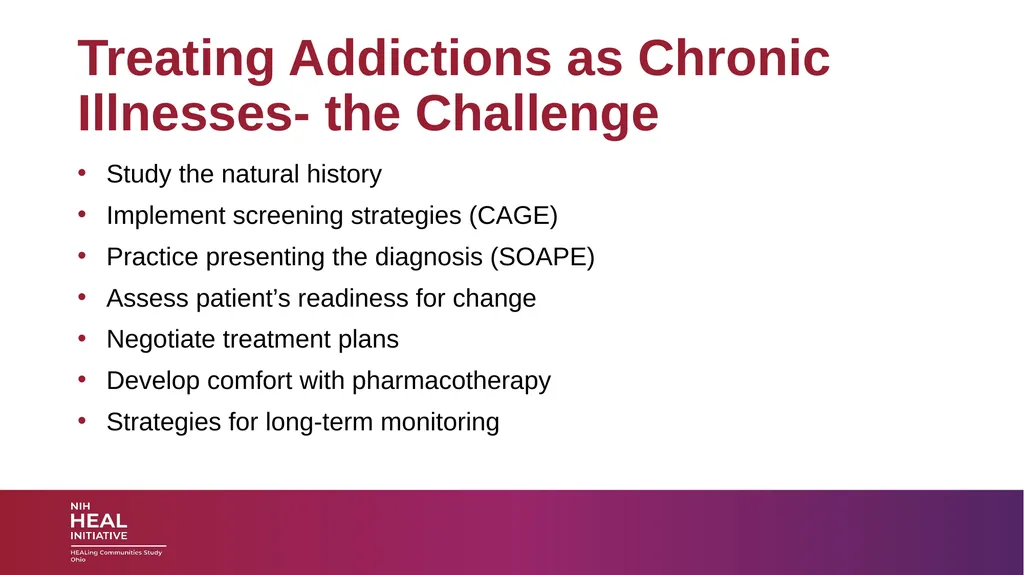
Treating Addictions as Chronic Illnesses- the Challenge Study the natural history
Implement screening strategies (CAGE)
Practice presenting the diagnosis (SOAPE)
Assess patient’s readiness for change
Negotiate treatment plans
Develop comfort with pharmacotherapy
Strategies for long-term monitoring<br>
Implement screening strategies (CAGE)
Practice presenting the diagnosis (SOAPE)
Assess patient’s readiness for change
Negotiate treatment plans
Develop comfort with pharmacotherapy
Strategies for long-term monitoring<br>
45
Questions, comments, cases?<br>