
Suicide by Self-Inflicted Burns – A Persistent
CB
Published · 1 slides · 0 views
1 / 1
Description
Suicide by Self-Inflicted Burns A Persistent Psychiatric Problem School of Medicine, University of California, Davis Department of Public Health Sciences, School of Medicine, University of California, Davis Department of Surgery,
Related Topics
Share
Embed code
Download this presentation From Below
"Suicide by Self-Inflicted Burns – A Persistent" is the property of its rightful owner. Permission is granted to download and print the materials on this website for personal, non-commercial use only, and to display it on your personal computer provided you do not modify the materials and that you retain all copyright notices contained in the materials. By downloading content from our website, you accept the terms of this agreement.
Presentation Transcript
01
Suicide by Self-Inflicted Burns – A Persistent Psychiatric Problem
School of Medicine, University of California, Davis
Department of Public Health Sciences, School of Medicine, University of California, Davis
Department of Surgery, University of California, Davis and Shriners Hospitals for Children Jordan M. Smith, BS, Jeffrey R. Fine, MPH, Katherine S. Romanowski, MD, FACS, Soman Sen, MD, FACS, Tina L. Palmieri, MD, FACS, FCCM, David G. Greenhalgh, MD, FACS Introduction Self-inflicted burns are a relatively uncommon but profound attempt at suicide. In 2019, suicide was the 10th leading cause of death in the United States with suicide by burns accounting for less than 1.0% of suicide attempts. Incidence of suicide by burning and self-inflicted burns have been estimated at between 0.67%-9.0% of total burn admissions in developed countries.
20 years ago, we first reviewed our experience with self-inflicted burns. This study evaluated for any change in the incidence or outcomes of self-inflicted burns.
Due to the rarity of occurrence, there is limited literature available evaluating the psychosocial contributors and outcomes of suicide by burning and self-inflicted burns.
Prior studies have described characteristics of patients with self-inflicted burns as predominantly male and Caucasian and with a history of psychiatric illness and substance use
A nationwide Japanese study with data from over 200 major tertiary care centers compared outcomes amongst 1094 patients with burns, 222 with self-inflicted burns. They concluded that self-inflicted burns are associated with increased in-hospital mortality.
Other studies have found such an association does not exist after comparing for injury characteristics and patient demographics. Self-inflicted burns are not associated with increased mortality during hospital admission compared to other burn injuries after controlling for confounding factors.
Characteristics of patients with self-inflicted burns include male predominance, history of substance use, and prior psychiatric illness. Retrospective chart review of all patients admitted to Burn Surgery, Shriners Hospitals for Children, Northern California and the Department of Surgery, University of California at Davis, Sacramento, California between January 1, 2012 and December 31, 2021.
The primary outcome was patient mortality. Secondary outcomes included length of stay in the hospital, days in the ICU, and days on a ventilator.
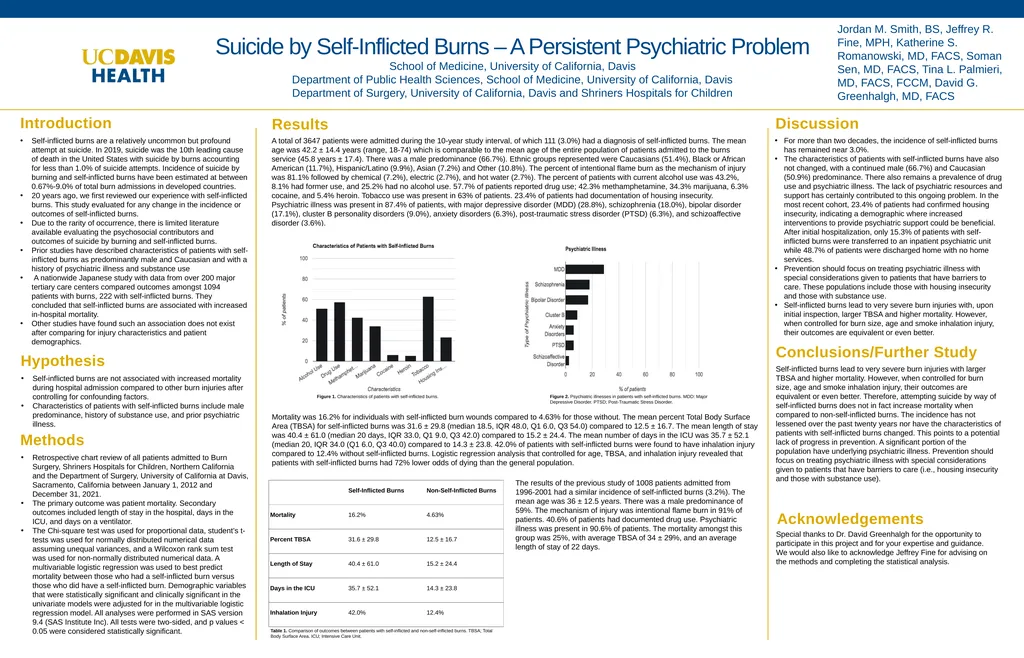
The Chi-square test was used for proportional data, student’s t-tests was used for normally distributed numerical data assuming unequal variances, and a Wilcoxon rank sum test was used for non-normally distributed numerical data. A multivariable logistic regression was used to best predict mortality between those who had a self-inflicted burn versus those who did have a self-inflicted burn. Demographic variables that were statistically significant and clinically significant in the univariate models were adjusted for in the multivariable logistic regression model. All analyses were performed in SAS version 9.4 (SAS Institute Inc). All tests were two-sided, and p values < 0.05 were considered statistically significant. Hypothesis Methods Results A total of 3647 patients were admitted during the 10-year study interval, of which 111 (3.0%) had a diagnosis of self-inflicted burns. The mean age was 42.2 ± 14.4 years (range, 18-74) which is comparable to the mean age of the entire population of patients admitted to the burns service (45.8 years ± 17.4). There was a male predominance (66.7%). Ethnic groups represented were Caucasians (51.4%), Black or African American (11.7%), Hispanic/Latino (9.9%), Asian (7.2%) and Other (10.8%). The percent of intentional flame burn as the mechanism of injury was 81.1% followed by chemical (7.2%), electric (2.7%), and hot water (2.7%). The percent of patients with current alcohol use was 43.2%, 8.1% had former use, and 25.2% had no alcohol use. 57.7% of patients reported drug use; 42.3% methamphetamine, 34.3% marijuana, 6.3% cocaine, and 5.4% heroin. Tobacco use was present in 63% of patients. 23.4% of patients had documentation of housing insecurity. Psychiatric illness was present in 87.4% of patients, with major depressive disorder (MDD) (28.8%), schizophrenia (18.0%), bipolar disorder (17.1%), cluster B personality disorders (9.0%), anxiety disorders (6.3%), post-traumatic stress disorder (PTSD) (6.3%), and schizoaffective disorder (3.6%). Discussion For more than two decades, the incidence of self-inflicted burns has remained near 3.0%.
The characteristics of patients with self-inflicted burns have also not changed, with a continued male (66.7%) and Caucasian (50.9%) predominance. There also remains a prevalence of drug use and psychiatric illness. The lack of psychiatric resources and support has certainly contributed to this ongoing problem. In the most recent cohort, 23.4% of patients had confirmed housing insecurity, indicating a demographic where increased interventions to provide psychiatric support could be beneficial. After initial hospitalization, only 15.3% of patients with self-inflicted burns were transferred to an inpatient psychiatric unit while 48.7% of patients were discharged home with no home services.
Prevention should focus on treating psychiatric illness with special considerations given to patients that have barriers to care. These populations include those with housing insecurity and those with substance use.
Self-inflicted burns lead to very severe burn injuries with, upon initial inspection, larger TBSA and higher mortality. However, when controlled for burn size, age and smoke inhalation injury, their outcomes are equivalent or even better. Self-inflicted burns lead to very severe burn injuries with larger TBSA and higher mortality. However, when controlled for burn size, age and smoke inhalation injury, their outcomes are equivalent or even better. Therefore, attempting suicide by way of self-inflicted burns does not in fact increase mortality when compared to non-self-inflicted burns. The incidence has not lessened over the past twenty years nor have the characteristics of patients with self-inflicted burns changed. This points to a potential lack of progress in prevention. A significant portion of the population have underlying psychiatric illness. Prevention should focus on treating psychiatric illness with special considerations given to patients that have barriers to care (i.e., housing insecurity and those with substance use). Conclusions/Further Study Special thanks to Dr. David Greenhalgh for the opportunity to participate in this project and for your expertise and guidance. We would also like to acknowledge Jeffrey Fine for advising on the methods and completing the statistical analysis. Acknowledgements Mortality was 16.2% for individuals with self-inflicted burn wounds compared to 4.63% for those without. The mean percent Total Body Surface Area (TBSA) for self-inflicted burns was 31.6 ± 29.8 (median 18.5, IQR 48.0, Q1 6.0, Q3 54.0) compared to 12.5 ± 16.7. The mean length of stay was 40.4 ± 61.0 (median 20 days, IQR 33.0, Q1 9.0, Q3 42.0) compared to 15.2 ± 24.4. The mean number of days in the ICU was 35.7 ± 52.1 (median 20, IQR 34.0 (Q1 6.0, Q3 40.0) compared to 14.3 ± 23.8. 42.0% of patients with self-inflicted burns were found to have inhalation injury compared to 12.4% without self-inflicted burns. Logistic regression analysis that controlled for age, TBSA, and inhalation injury revealed that patients with self-inflicted burns had 72% lower odds of dying than the general population. The results of the previous study of 1008 patients admitted from 1996-2001 had a similar incidence of self-inflicted burns (3.2%). The mean age was 36 ± 12.5 years. There was a male predominance of 59%. The mechanism of injury was intentional flame burn in 91% of patients. 40.6% of patients had documented drug use. Psychiatric illness was present in 90.6% of patients. The mortality amongst this group was 25%, with average TBSA of 34 ± 29%, and an average length of stay of 22 days. Figure 1. Characteristics of patients with self-inflicted burns. Figure 2. Psychiatric illnesses in patients with self-inflicted burns. MDD: Major Depressive Disorder. PTSD; Post-Traumatic Stress Disorder. Table 1. Comparison of outcomes between patients with self-inflicted and non-self-inflicted burns. TBSA; Total Body Surface Area. ICU; Intensive Care Unit.<br>
School of Medicine, University of California, Davis
Department of Public Health Sciences, School of Medicine, University of California, Davis
Department of Surgery, University of California, Davis and Shriners Hospitals for Children Jordan M. Smith, BS, Jeffrey R. Fine, MPH, Katherine S. Romanowski, MD, FACS, Soman Sen, MD, FACS, Tina L. Palmieri, MD, FACS, FCCM, David G. Greenhalgh, MD, FACS Introduction Self-inflicted burns are a relatively uncommon but profound attempt at suicide. In 2019, suicide was the 10th leading cause of death in the United States with suicide by burns accounting for less than 1.0% of suicide attempts. Incidence of suicide by burning and self-inflicted burns have been estimated at between 0.67%-9.0% of total burn admissions in developed countries.
20 years ago, we first reviewed our experience with self-inflicted burns. This study evaluated for any change in the incidence or outcomes of self-inflicted burns.
Due to the rarity of occurrence, there is limited literature available evaluating the psychosocial contributors and outcomes of suicide by burning and self-inflicted burns.
Prior studies have described characteristics of patients with self-inflicted burns as predominantly male and Caucasian and with a history of psychiatric illness and substance use
A nationwide Japanese study with data from over 200 major tertiary care centers compared outcomes amongst 1094 patients with burns, 222 with self-inflicted burns. They concluded that self-inflicted burns are associated with increased in-hospital mortality.
Other studies have found such an association does not exist after comparing for injury characteristics and patient demographics. Self-inflicted burns are not associated with increased mortality during hospital admission compared to other burn injuries after controlling for confounding factors.
Characteristics of patients with self-inflicted burns include male predominance, history of substance use, and prior psychiatric illness. Retrospective chart review of all patients admitted to Burn Surgery, Shriners Hospitals for Children, Northern California and the Department of Surgery, University of California at Davis, Sacramento, California between January 1, 2012 and December 31, 2021.
The primary outcome was patient mortality. Secondary outcomes included length of stay in the hospital, days in the ICU, and days on a ventilator.
The Chi-square test was used for proportional data, student’s t-tests was used for normally distributed numerical data assuming unequal variances, and a Wilcoxon rank sum test was used for non-normally distributed numerical data. A multivariable logistic regression was used to best predict mortality between those who had a self-inflicted burn versus those who did have a self-inflicted burn. Demographic variables that were statistically significant and clinically significant in the univariate models were adjusted for in the multivariable logistic regression model. All analyses were performed in SAS version 9.4 (SAS Institute Inc). All tests were two-sided, and p values < 0.05 were considered statistically significant. Hypothesis Methods Results A total of 3647 patients were admitted during the 10-year study interval, of which 111 (3.0%) had a diagnosis of self-inflicted burns. The mean age was 42.2 ± 14.4 years (range, 18-74) which is comparable to the mean age of the entire population of patients admitted to the burns service (45.8 years ± 17.4). There was a male predominance (66.7%). Ethnic groups represented were Caucasians (51.4%), Black or African American (11.7%), Hispanic/Latino (9.9%), Asian (7.2%) and Other (10.8%). The percent of intentional flame burn as the mechanism of injury was 81.1% followed by chemical (7.2%), electric (2.7%), and hot water (2.7%). The percent of patients with current alcohol use was 43.2%, 8.1% had former use, and 25.2% had no alcohol use. 57.7% of patients reported drug use; 42.3% methamphetamine, 34.3% marijuana, 6.3% cocaine, and 5.4% heroin. Tobacco use was present in 63% of patients. 23.4% of patients had documentation of housing insecurity. Psychiatric illness was present in 87.4% of patients, with major depressive disorder (MDD) (28.8%), schizophrenia (18.0%), bipolar disorder (17.1%), cluster B personality disorders (9.0%), anxiety disorders (6.3%), post-traumatic stress disorder (PTSD) (6.3%), and schizoaffective disorder (3.6%). Discussion For more than two decades, the incidence of self-inflicted burns has remained near 3.0%.
The characteristics of patients with self-inflicted burns have also not changed, with a continued male (66.7%) and Caucasian (50.9%) predominance. There also remains a prevalence of drug use and psychiatric illness. The lack of psychiatric resources and support has certainly contributed to this ongoing problem. In the most recent cohort, 23.4% of patients had confirmed housing insecurity, indicating a demographic where increased interventions to provide psychiatric support could be beneficial. After initial hospitalization, only 15.3% of patients with self-inflicted burns were transferred to an inpatient psychiatric unit while 48.7% of patients were discharged home with no home services.
Prevention should focus on treating psychiatric illness with special considerations given to patients that have barriers to care. These populations include those with housing insecurity and those with substance use.
Self-inflicted burns lead to very severe burn injuries with, upon initial inspection, larger TBSA and higher mortality. However, when controlled for burn size, age and smoke inhalation injury, their outcomes are equivalent or even better. Self-inflicted burns lead to very severe burn injuries with larger TBSA and higher mortality. However, when controlled for burn size, age and smoke inhalation injury, their outcomes are equivalent or even better. Therefore, attempting suicide by way of self-inflicted burns does not in fact increase mortality when compared to non-self-inflicted burns. The incidence has not lessened over the past twenty years nor have the characteristics of patients with self-inflicted burns changed. This points to a potential lack of progress in prevention. A significant portion of the population have underlying psychiatric illness. Prevention should focus on treating psychiatric illness with special considerations given to patients that have barriers to care (i.e., housing insecurity and those with substance use). Conclusions/Further Study Special thanks to Dr. David Greenhalgh for the opportunity to participate in this project and for your expertise and guidance. We would also like to acknowledge Jeffrey Fine for advising on the methods and completing the statistical analysis. Acknowledgements Mortality was 16.2% for individuals with self-inflicted burn wounds compared to 4.63% for those without. The mean percent Total Body Surface Area (TBSA) for self-inflicted burns was 31.6 ± 29.8 (median 18.5, IQR 48.0, Q1 6.0, Q3 54.0) compared to 12.5 ± 16.7. The mean length of stay was 40.4 ± 61.0 (median 20 days, IQR 33.0, Q1 9.0, Q3 42.0) compared to 15.2 ± 24.4. The mean number of days in the ICU was 35.7 ± 52.1 (median 20, IQR 34.0 (Q1 6.0, Q3 40.0) compared to 14.3 ± 23.8. 42.0% of patients with self-inflicted burns were found to have inhalation injury compared to 12.4% without self-inflicted burns. Logistic regression analysis that controlled for age, TBSA, and inhalation injury revealed that patients with self-inflicted burns had 72% lower odds of dying than the general population. The results of the previous study of 1008 patients admitted from 1996-2001 had a similar incidence of self-inflicted burns (3.2%). The mean age was 36 ± 12.5 years. There was a male predominance of 59%. The mechanism of injury was intentional flame burn in 91% of patients. 40.6% of patients had documented drug use. Psychiatric illness was present in 90.6% of patients. The mortality amongst this group was 25%, with average TBSA of 34 ± 29%, and an average length of stay of 22 days. Figure 1. Characteristics of patients with self-inflicted burns. Figure 2. Psychiatric illnesses in patients with self-inflicted burns. MDD: Major Depressive Disorder. PTSD; Post-Traumatic Stress Disorder. Table 1. Comparison of outcomes between patients with self-inflicted and non-self-inflicted burns. TBSA; Total Body Surface Area. ICU; Intensive Care Unit.<br>