
SUPREME Court and Fourth Circuit Update: Important
KB
Published · 39 slides · 0 views

1 / 1




Description
SUPREME Court and Fourth Circuit Update: Important Recent Decisions on Criminal Law Josh Carpenter Appellate Chief FPDWNC Ann Hester Appellate AFPD FPDWNC OVERVIEW What Well Cover Two Supreme Court Fourth Amendment Cases Second
Related Topics
Share
Embed code
Download this presentation From Below
"SUPREME Court and Fourth Circuit Update: Important" is the property of its rightful owner. Permission is granted to download and print the materials on this website for personal, non-commercial use only, and to display it on your personal computer provided you do not modify the materials and that you retain all copyright notices contained in the materials. By downloading content from our website, you accept the terms of this agreement.
Presentation Transcript
01
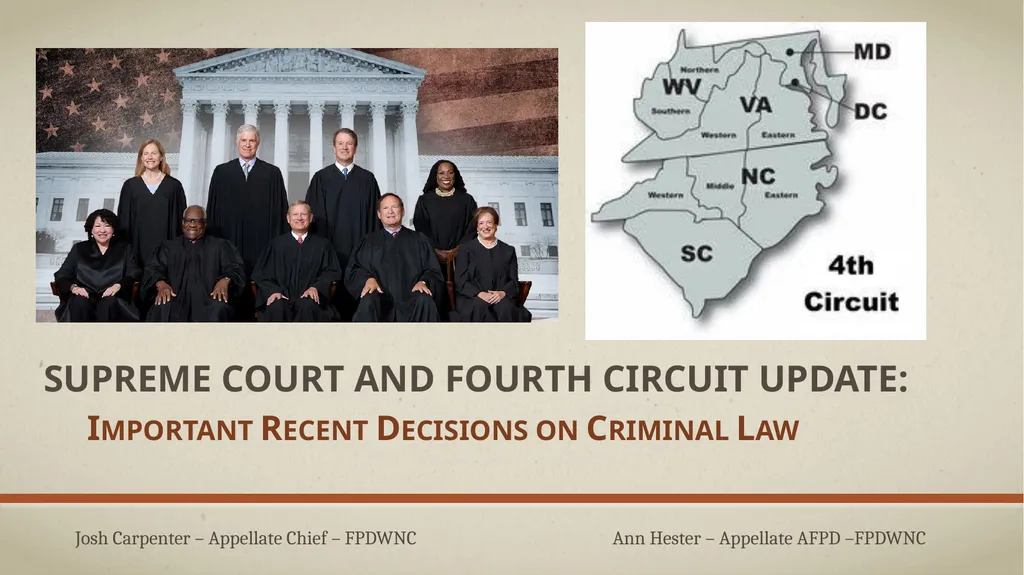
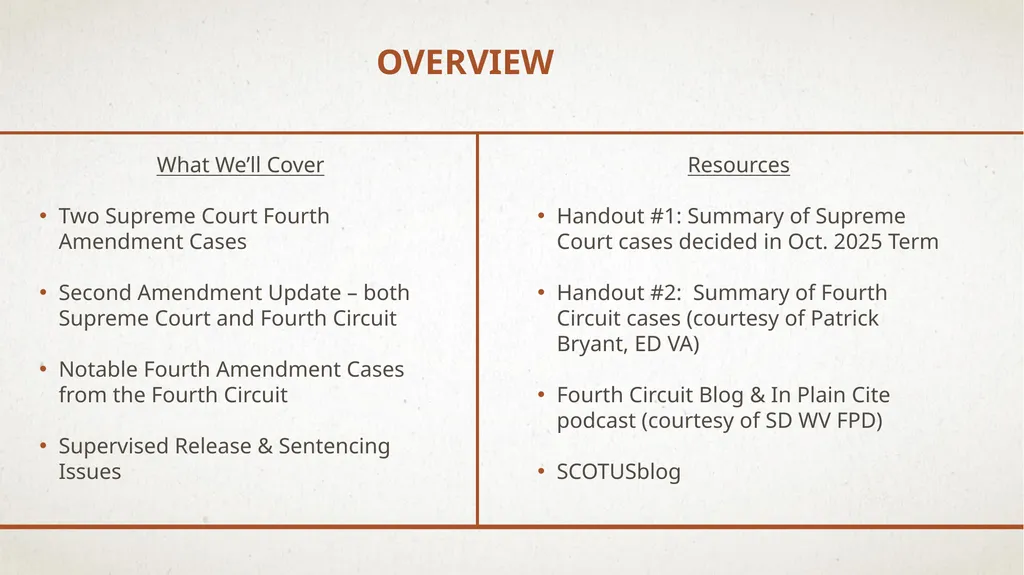
SUPREME Court and Fourth Circuit Update: Important Recent Decisions on Criminal Law Josh Carpenter – Appellate Chief – FPDWNC Ann Hester – Appellate AFPD –FPDWNC<br>
02
OVERVIEW What We’ll Cover
Two Supreme Court Fourth Amendment Cases
Second Amendment Update – both Supreme Court and Fourth Circuit
Notable Fourth Amendment Cases from the Fourth Circuit
Supervised Release & Sentencing Issues Resources
Handout #1: Summary of Supreme Court cases decided in Oct. 2025 Term
Handout #2: Summary of Fourth Circuit cases (courtesy of Patrick Bryant, ED VA)
Fourth Circuit Blog & In Plain Cite podcast (courtesy of SD WV FPD)
SCOTUSblog<br>
Two Supreme Court Fourth Amendment Cases
Second Amendment Update – both Supreme Court and Fourth Circuit
Notable Fourth Amendment Cases from the Fourth Circuit
Supervised Release & Sentencing Issues Resources
Handout #1: Summary of Supreme Court cases decided in Oct. 2025 Term
Handout #2: Summary of Fourth Circuit cases (courtesy of Patrick Bryant, ED VA)
Fourth Circuit Blog & In Plain Cite podcast (courtesy of SD WV FPD)
SCOTUSblog<br>
03
We will host three trivia breaks.
With prizes. All Moderator decisions are final. Ironically, there will be no appeals.
Must be present to win.<br>
Must be present to win.<br>
04
Two Observations about 2025-2026 SCOTUS Term #1 – It’s probably not as bad as you think
#2 – The Fourth Circuit is riding the StruggleBus<br>
#2 – The Fourth Circuit is riding the StruggleBus<br>
05
Two NEW SUPREME COURT
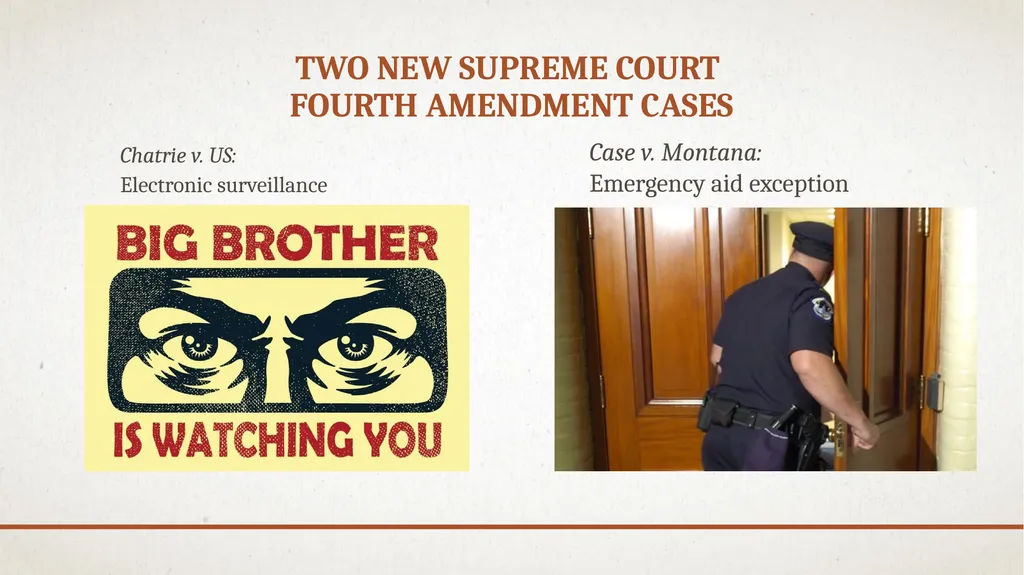
FOURTH AMENDMENT CASES Chatrie v. US:
Electronic surveillance Case v. Montana:
Emergency aid exception<br>
Electronic surveillance Case v. Montana:
Emergency aid exception<br>
06
Chatrie v. United States, 146 S. Ct. 2193 (2026)
(Kagan, J.) (6-3 opinion) Obtaining Location History data is a Fourth Amendment search.
People have a reasonable expectation of privacy in their cell-phone location history data.
Even if search covers a short period of time.
Expands Carpenter v. United States.
Even though data was stored with a third-party company in the cloud.
“a cell-phone user is not to be viewed a sharing private information with third parties . . . Just by doing the ordinary things cell-phone users do.”
Employs a two-part test instead of third-party doctrine
Suggests other data saved in the cloud is also protected.<br>
People have a reasonable expectation of privacy in their cell-phone location history data.
Even if search covers a short period of time.
Expands Carpenter v. United States.
Even though data was stored with a third-party company in the cloud.
“a cell-phone user is not to be viewed a sharing private information with third parties . . . Just by doing the ordinary things cell-phone users do.”
Employs a two-part test instead of third-party doctrine
Suggests other data saved in the cloud is also protected.<br>
07
Chatrie has implications for other digital searches. Challenge them. Tower dumps: seek identity of every device connected to specific cell towers over a relatively short period of time.
US District court held tower dumps per se unconstitutional general warrants: In re Four Applications for Search Warrants Seeking Info. Associated with Particular Cellular Towers, No. 3:25-CR-38 (S.D. Miss. Aug. 5, 2026).
Cell Site Simulators (Stingrays): simulating a cell tower to trick nearby cell phones to connect, used to locate and track a known cell phone or obtain a person’s phone number when it is unknown.
Automatic License Plate Readers (ALPRs) (Flock): can be used recreate the whole of a person’s past movements.
Keyword warrants/ AI chats: seek identity of everyone who searched for a particular keyword or phrase.<br>
US District court held tower dumps per se unconstitutional general warrants: In re Four Applications for Search Warrants Seeking Info. Associated with Particular Cellular Towers, No. 3:25-CR-38 (S.D. Miss. Aug. 5, 2026).
Cell Site Simulators (Stingrays): simulating a cell tower to trick nearby cell phones to connect, used to locate and track a known cell phone or obtain a person’s phone number when it is unknown.
Automatic License Plate Readers (ALPRs) (Flock): can be used recreate the whole of a person’s past movements.
Keyword warrants/ AI chats: seek identity of everyone who searched for a particular keyword or phrase.<br>
08
If you have a case involving any of these types of searches: NACDL’s Fourth Amendment Center is a great resource and offers direct assistance.
Email: 4AC@nacdl.org.
Website: https://www.nacdl.org/Landing/FourthAmendmentCenter
Chatrie practice advisory for more detail:
https://www.nacdl.org/Document/Practice-Advisory-Chatrie-v-United-States,-What-De
For a deep dive into the future implications of Chatrie:
Orin S. Kerr, The Fourth Amendment After Chatrie (still in draft form)<br>
Email: 4AC@nacdl.org.
Website: https://www.nacdl.org/Landing/FourthAmendmentCenter
Chatrie practice advisory for more detail:
https://www.nacdl.org/Document/Practice-Advisory-Chatrie-v-United-States,-What-De
For a deep dive into the future implications of Chatrie:
Orin S. Kerr, The Fourth Amendment After Chatrie (still in draft form)<br>
09
Chatrie still isn’t over…. Remanded to Fourth Circuit to decide:
Whether the warrant satisfied the Fourth Amendment’s probable cause and particularity requirements.
Whether the good-faith exception applies.<br>
Whether the warrant satisfied the Fourth Amendment’s probable cause and particularity requirements.
Whether the good-faith exception applies.<br>
10
Case v. Montana, 146 S. Ct. 500 (2026)
(Kagan, J.) (9-0) Emergency-aid exception
Police may enter a home without a warrant if they have an “objectively reasonable basis for believing” that someone inside needs emergency assistance. Brigham City v. Stuart, 547 U.S. 398 (2006)
“Objectively reasonable basis for believing” isn’t probable cause.
It isn’t Terry reasonable-suspicion, either.
Evaluated under totality of the circumstances.
Important limitation: Officers can’s search “beyond what is reasonably needed to deal with the emergency while maintaining the officers’ safety.”<br>
Police may enter a home without a warrant if they have an “objectively reasonable basis for believing” that someone inside needs emergency assistance. Brigham City v. Stuart, 547 U.S. 398 (2006)
“Objectively reasonable basis for believing” isn’t probable cause.
It isn’t Terry reasonable-suspicion, either.
Evaluated under totality of the circumstances.
Important limitation: Officers can’s search “beyond what is reasonably needed to deal with the emergency while maintaining the officers’ safety.”<br>
11
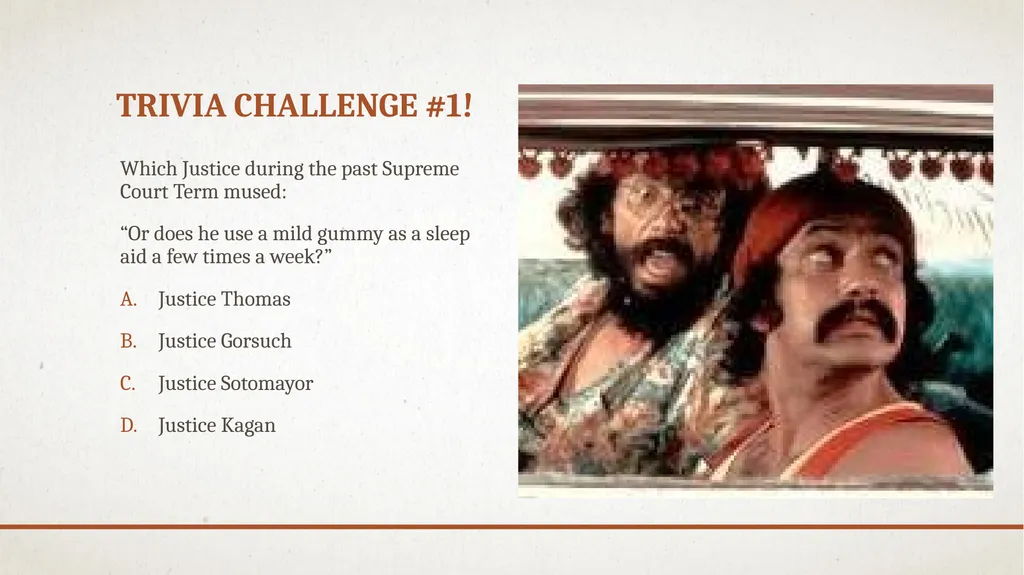
Trivia challenge #1! Which Justice during the past Supreme Court Term mused:
“Or does he use a mild gummy as a sleep aid a few times a week?”
Justice Thomas
Justice Gorsuch
Justice Sotomayor
Justice Kagan<br>
“Or does he use a mild gummy as a sleep aid a few times a week?”
Justice Thomas
Justice Gorsuch
Justice Sotomayor
Justice Kagan<br>
12
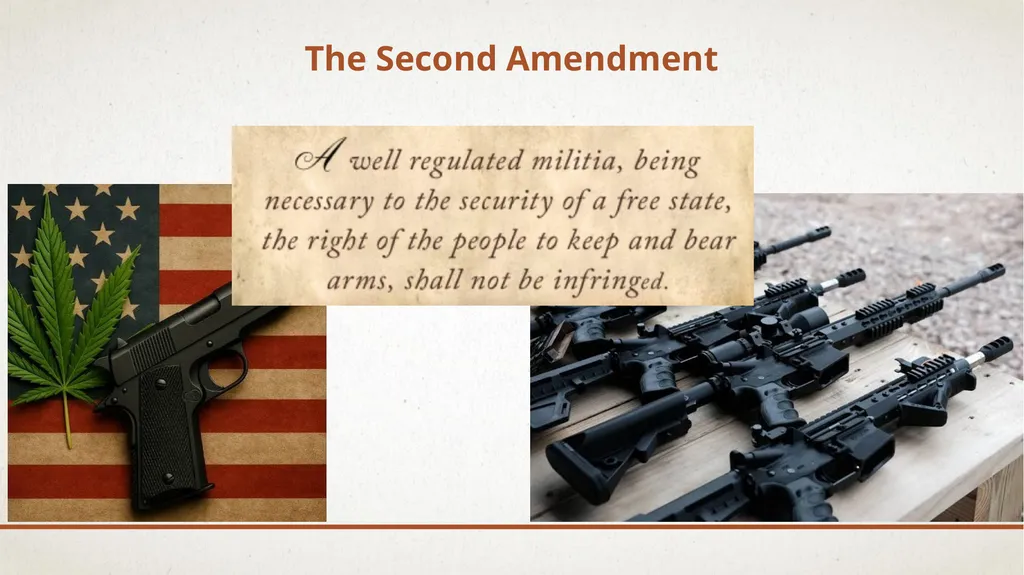
The Second Amendment<br>
13
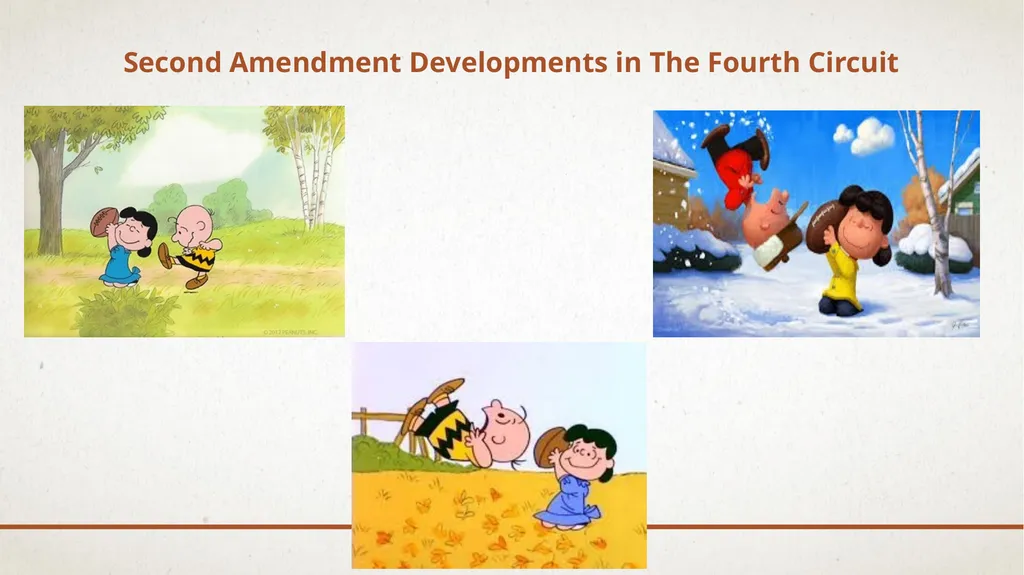
Second Amendment Developments in The Fourth Circuit<br>
14
12 published criminal opinions addressing 2A issues
75 unpublished criminal opinions on 2A issues
Defendants have compiled a total of ZERO wins
Similar results in civil cases: only one partial win for a 2A challenge Second Amendment Developments in The Fourth Circuit<br>
75 unpublished criminal opinions on 2A issues
Defendants have compiled a total of ZERO wins
Similar results in civil cases: only one partial win for a 2A challenge Second Amendment Developments in The Fourth Circuit<br>
15
United States v. Hemani (June 18, 2026) (9-0) Hemani: admitted using marijuana “about every other day”
922(g)(3): “an unlawful user of or addicted to any controlled substance”
Gov’t Theory: (g)(3) = founding-era “habitual drunkard” laws
Holding: violates Second Amendment as applied because “habitual drunkard” laws are not sufficiently analogous<br>
922(g)(3): “an unlawful user of or addicted to any controlled substance”
Gov’t Theory: (g)(3) = founding-era “habitual drunkard” laws
Holding: violates Second Amendment as applied because “habitual drunkard” laws are not sufficiently analogous<br>
16
Hemani: Open Questions Majority says “narrow” holding that doesn’t address:
“those presently intoxicated”
“individualized proof” that use renders person “a danger to himself or others”
“proof that a certain drug always renders its users dangerous”
Opinion does not mention statutory issues / vagueness challenges<br>
“those presently intoxicated”
“individualized proof” that use renders person “a danger to himself or others”
“proof that a certain drug always renders its users dangerous”
Opinion does not mention statutory issues / vagueness challenges<br>
17
Hemani: Thomas Concurrence Commerce Clause:
“922(g)(3) appears to exceed Congress’s enumerated power to regulate interstate commerce”
This theory could invalidate ALL of 922(g)
US v. Squire (CA5) (en banc review ordered July 20, 2026)<br>
“922(g)(3) appears to exceed Congress’s enumerated power to regulate interstate commerce”
This theory could invalidate ALL of 922(g)
US v. Squire (CA5) (en banc review ordered July 20, 2026)<br>
18
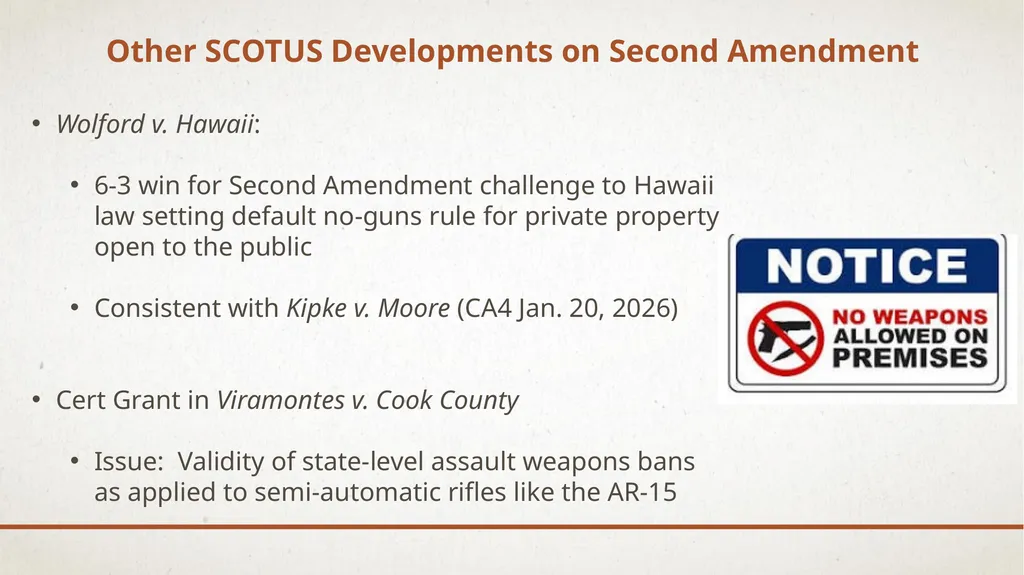
Other SCOTUS Developments on Second Amendment Wolford v. Hawaii:
6-3 win for Second Amendment challenge to Hawaii law setting default no-guns rule for private property open to the public
Consistent with Kipke v. Moore (CA4 Jan. 20, 2026)
Cert Grant in Viramontes v. Cook County
Issue: Validity of state-level assault weapons bans as applied to semi-automatic rifles like the AR-15<br>
6-3 win for Second Amendment challenge to Hawaii law setting default no-guns rule for private property open to the public
Consistent with Kipke v. Moore (CA4 Jan. 20, 2026)
Cert Grant in Viramontes v. Cook County
Issue: Validity of state-level assault weapons bans as applied to semi-automatic rifles like the AR-15<br>
19
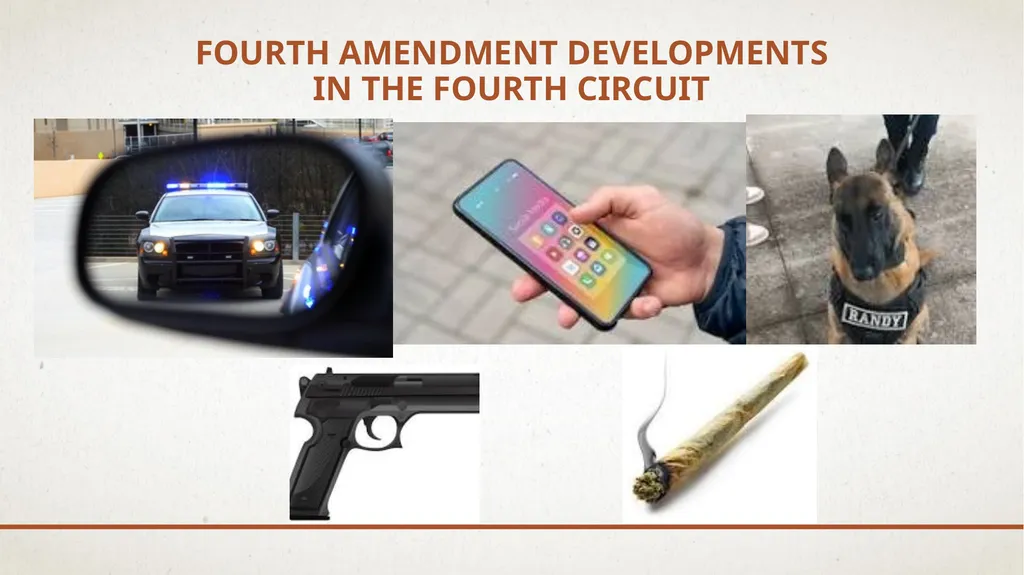
FOURTH AMENDMENT DEVELOPMENTS
IN THE FOURTH CIRCUIT<br>
20
Let’s talk about sakyi United States v. Sakyi, 160 F.3d 164 (4th Cir. 1998): allows officers to order everyone out of a vehicle and pat them down based on reasonable suspicion marijuana is present.
Sakyi says it creates a presumption, but in practice it’s a per se rule.
Sakyi is based on the idea that marijuana = guns = danger<br>
Sakyi says it creates a presumption, but in practice it’s a per se rule.
Sakyi is based on the idea that marijuana = guns = danger<br>
21
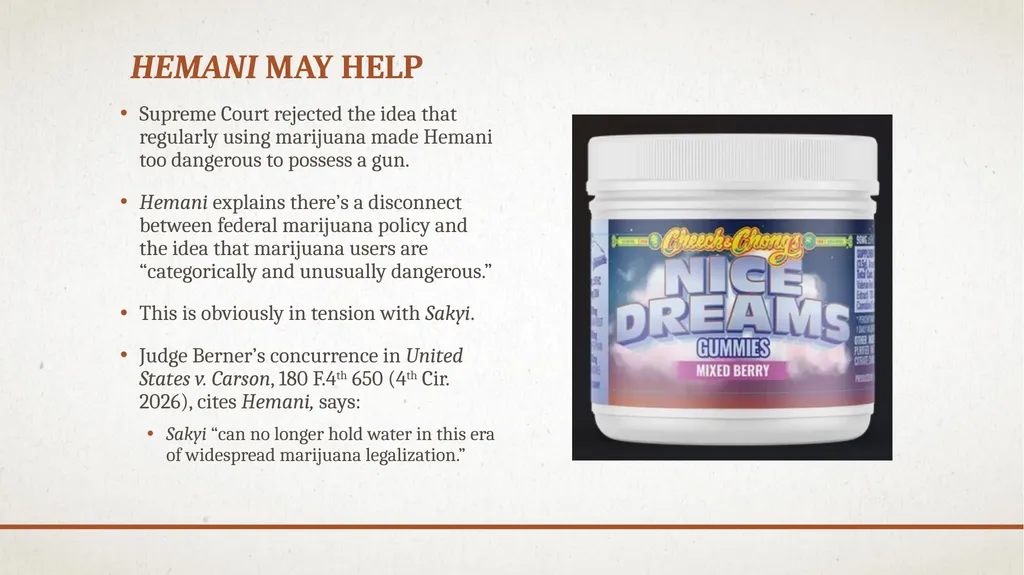
Hemani may help Supreme Court rejected the idea that regularly using marijuana made Hemani too dangerous to possess a gun.
Hemani explains there’s a disconnect between federal marijuana policy and the idea that marijuana users are “categorically and unusually dangerous.”
This is obviously in tension with Sakyi.
Judge Berner’s concurrence in United States v. Carson, 180 F.4th 650 (4th Cir. 2026), cites Hemani, says:
Sakyi “can no longer hold water in this era of widespread marijuana legalization.”<br>
Hemani explains there’s a disconnect between federal marijuana policy and the idea that marijuana users are “categorically and unusually dangerous.”
This is obviously in tension with Sakyi.
Judge Berner’s concurrence in United States v. Carson, 180 F.4th 650 (4th Cir. 2026), cites Hemani, says:
Sakyi “can no longer hold water in this era of widespread marijuana legalization.”<br>
22
First, the good news!<br>
23
Trivia challenge #2! Which Fourth Circuit judge has authored the most Fourth Amendment decisions ruling for defendants in the past year?
Judge Wilkinson
Judge Benjamin
Judge Richardson
Judge Berner<br>
Judge Wilkinson
Judge Benjamin
Judge Richardson
Judge Berner<br>
24
United States v. Hawkins, 161 F.4th 242 (4th Cir. 2025) (Benjamin, J.) Pretext traffic stop, really for drugs.
Held: Officers unlawfully extended the stop w/o reasonable suspicion.
Prior drug convictions and federal supervised release get “little weight” in totality of circumstances.
Officers’ “I know it when I see it”/ “knowledge and experience” testimony doesn’t cut it when the didn’t see anything passed hand-to-hand.<br>
Held: Officers unlawfully extended the stop w/o reasonable suspicion.
Prior drug convictions and federal supervised release get “little weight” in totality of circumstances.
Officers’ “I know it when I see it”/ “knowledge and experience” testimony doesn’t cut it when the didn’t see anything passed hand-to-hand.<br>
25
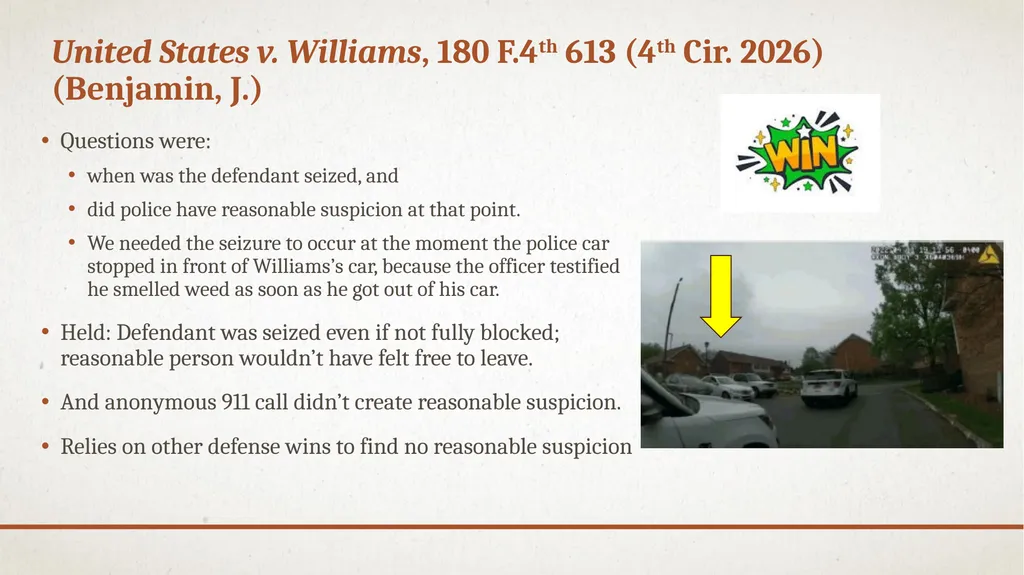
United States v. Williams, 180 F.4th 613 (4th Cir. 2026) (Benjamin, J.) Questions were:
when was the defendant seized, and
did police have reasonable suspicion at that point.
We needed the seizure to occur at the moment the police car stopped in front of Williams’s car, because the officer testified he smelled weed as soon as he got out of his car.
Held: Defendant was seized even if not fully blocked; reasonable person wouldn’t have felt free to leave.
And anonymous 911 call didn’t create reasonable suspicion.
Relies on other defense wins to find no reasonable suspicion<br>
when was the defendant seized, and
did police have reasonable suspicion at that point.
We needed the seizure to occur at the moment the police car stopped in front of Williams’s car, because the officer testified he smelled weed as soon as he got out of his car.
Held: Defendant was seized even if not fully blocked; reasonable person wouldn’t have felt free to leave.
And anonymous 911 call didn’t create reasonable suspicion.
Relies on other defense wins to find no reasonable suspicion<br>
26
United States v. Martin, 173 F.4th 110 (4th Cir. 2026) (Benjamin, J.) Officer impermissibly prolonged the traffic stop without reasonable suspicion by asking driver and passenger about the presence of guns.
Shows a detour for any length establishes a Rodriguez violation.
Officers can ask these questions if they do so without prolonging the stop.
Whether officer can prolong stop to ask about weapons depends on the totality of the circumstances.
Rejects per se rule that officers can ask about weapons for safety reasons<br>
Shows a detour for any length establishes a Rodriguez violation.
Officers can ask these questions if they do so without prolonging the stop.
Whether officer can prolong stop to ask about weapons depends on the totality of the circumstances.
Rejects per se rule that officers can ask about weapons for safety reasons<br>
27
United States v. Ray, 141 F.4th 129 (4th Cir. 2025) (Thacker, J.) Naval investigator searched defendant’s phone even though warrant only allowed seizure.
Government lost, appealed to the 4th Cir. arguing good-faith exception applies.
Good faith requires a defective warrant. This warrant wasn’t defective.
“A lack of competence . . . Cannot be converted into good faith.”<br>
Government lost, appealed to the 4th Cir. arguing good-faith exception applies.
Good faith requires a defective warrant. This warrant wasn’t defective.
“A lack of competence . . . Cannot be converted into good faith.”<br>
28
Now for the bad news….<br>
29
United States v. Belmonte Cardozo, 181 F.4th 461 (4th Cir. Jul. 13, 2026) (Quattlebaum, J.) Cell-phone border searches
Existing rule: Forensic searches are nonroutine and require individualized suspicion.
This case: Manual searches are routine and don’t require individualized suspicion.
Proviso: if a manual search takes too long, Fourth Amendment may come into play.<br>
Existing rule: Forensic searches are nonroutine and require individualized suspicion.
This case: Manual searches are routine and don’t require individualized suspicion.
Proviso: if a manual search takes too long, Fourth Amendment may come into play.<br>
30
United States v. Johnson, 148 F.4th 287 (4th Cir. 2025) (Harris, J.) K-9 sniff next to defendant’s door in apartment hallway wasn’t a search.
No reasonable expectation of privacy because the dog could only detect contraband.
Johnson had no curtilage outside his apartment door because that area was part of a common hallway.
Deciding what is curtilage requires a fact-based analysis. Some apartments have curtilage.<br>
No reasonable expectation of privacy because the dog could only detect contraband.
Johnson had no curtilage outside his apartment door because that area was part of a common hallway.
Deciding what is curtilage requires a fact-based analysis. Some apartments have curtilage.<br>
31
United States v. Lowers, 170 F.4th 134 (4th Cir. 2025) (Thacker, J.) Defendant had reasonable expectation of privacy in files stored in Google Drive:
Google drive is like a filing cabinet.
Digital files are like sealed manila envelopes—a container.
Container searches require a warrant, and so did this one.
Hash-matching digital files doesn’t support private search doctrine. A visual inspection is required.
Lowers loses because of attenuation exception to the exclusionary rule.<br>
Google drive is like a filing cabinet.
Digital files are like sealed manila envelopes—a container.
Container searches require a warrant, and so did this one.
Hash-matching digital files doesn’t support private search doctrine. A visual inspection is required.
Lowers loses because of attenuation exception to the exclusionary rule.<br>
32
Sentencing, Supervision, and Other Issues<br>
33
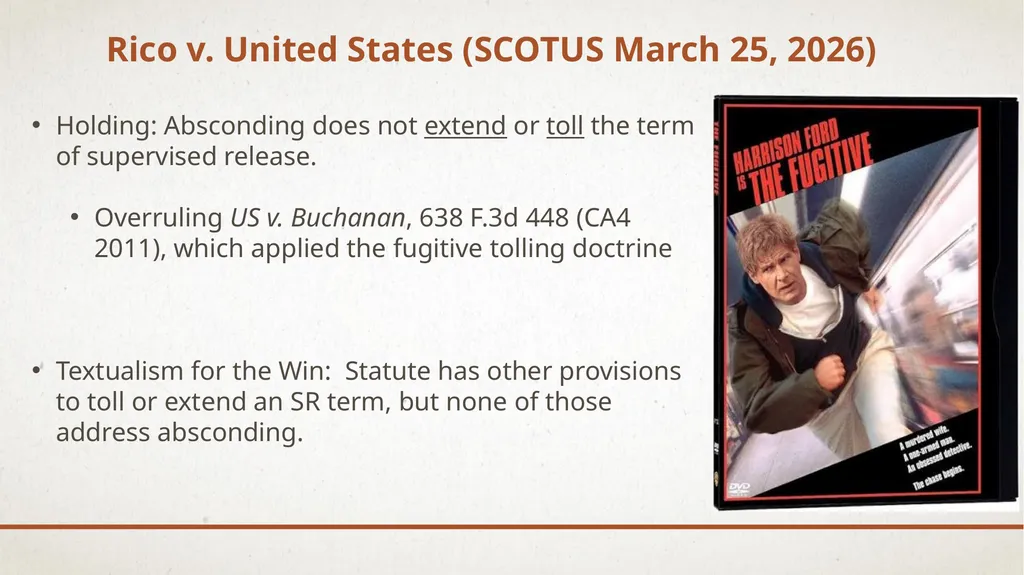
Rico v. United States (SCOTUS March 25, 2026) Holding: Absconding does not extend or toll the term of supervised release.
Overruling US v. Buchanan, 638 F.3d 448 (CA4 2011), which applied the fugitive tolling doctrine
Textualism for the Win: Statute has other provisions to toll or extend an SR term, but none of those address absconding.<br>
Overruling US v. Buchanan, 638 F.3d 448 (CA4 2011), which applied the fugitive tolling doctrine
Textualism for the Win: Statute has other provisions to toll or extend an SR term, but none of those address absconding.<br>
34
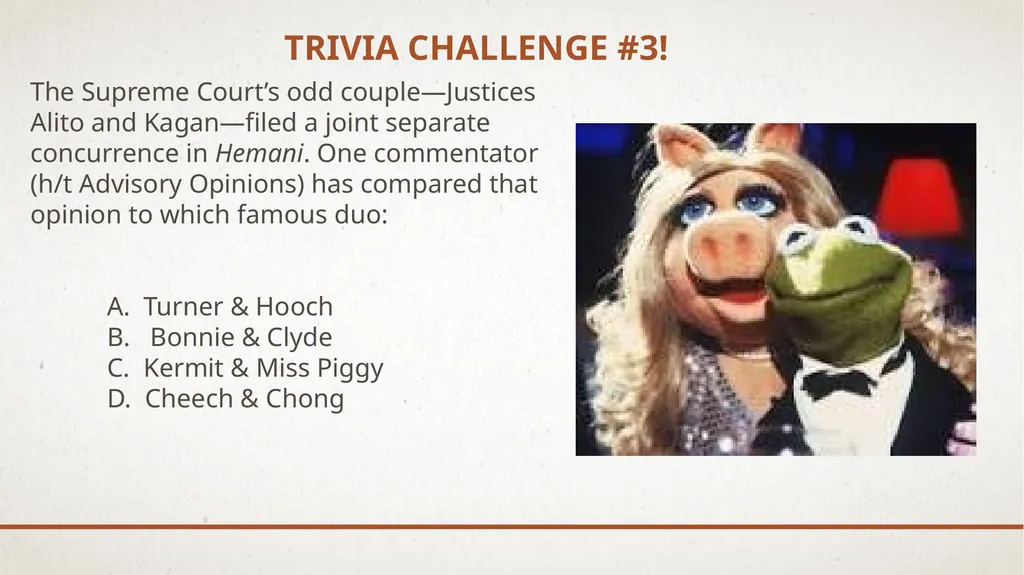
TRIVIA CHALLENGE #3! The Supreme Court’s odd couple—Justices Alito and Kagan—filed a joint separate concurrence in Hemani. One commentator (h/t Advisory Opinions) has compared that opinion to which famous duo:
A. Turner & Hooch
B. Bonnie & Clyde
C. Kermit & Miss Piggy
D. Cheech & Chong<br>
A. Turner & Hooch
B. Bonnie & Clyde
C. Kermit & Miss Piggy
D. Cheech & Chong<br>
35
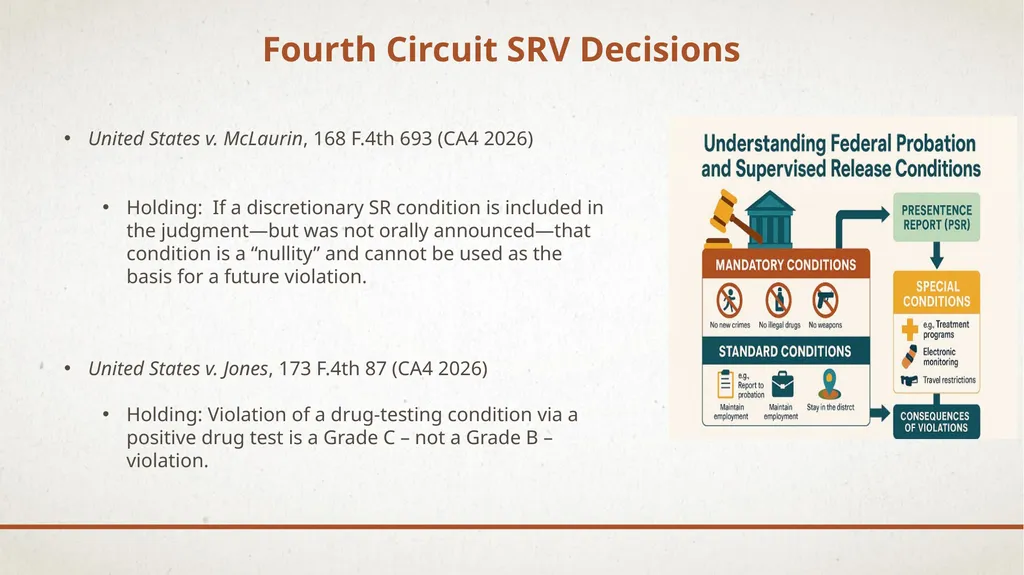
Fourth Circuit SRV Decisions United States v. McLaurin, 168 F.4th 693 (CA4 2026)
Holding: If a discretionary SR condition is included in the judgment—but was not orally announced—that condition is a “nullity” and cannot be used as the basis for a future violation.
United States v. Jones, 173 F.4th 87 (CA4 2026)
Holding: Violation of a drug-testing condition via a positive drug test is a Grade C – not a Grade B – violation.<br>
Holding: If a discretionary SR condition is included in the judgment—but was not orally announced—that condition is a “nullity” and cannot be used as the basis for a future violation.
United States v. Jones, 173 F.4th 87 (CA4 2026)
Holding: Violation of a drug-testing condition via a positive drug test is a Grade C – not a Grade B – violation.<br>
36
Sentencing: Commentary Challenges Refresher: When the commentary is worse for the a than the text, defendants have argued – sometimes with success – that the courts must follow the text rather than the commentary.
Most prominent example: “attempt” offenses under career-offender guideline in commentary until 2023 (Amendment 822)
United States v. Hodges, 171 F.4th 291 (CA4 2026)
Commentary defines “minor” in CP guideline to include fictional minors
United States v. Holman, 171 F.4th 303 (CA4 2026)
Commentary defines “large capacity” in gun guideline as “more than 15 rounds”<br>
Most prominent example: “attempt” offenses under career-offender guideline in commentary until 2023 (Amendment 822)
United States v. Hodges, 171 F.4th 291 (CA4 2026)
Commentary defines “minor” in CP guideline to include fictional minors
United States v. Holman, 171 F.4th 303 (CA4 2026)
Commentary defines “large capacity” in gun guideline as “more than 15 rounds”<br>
37
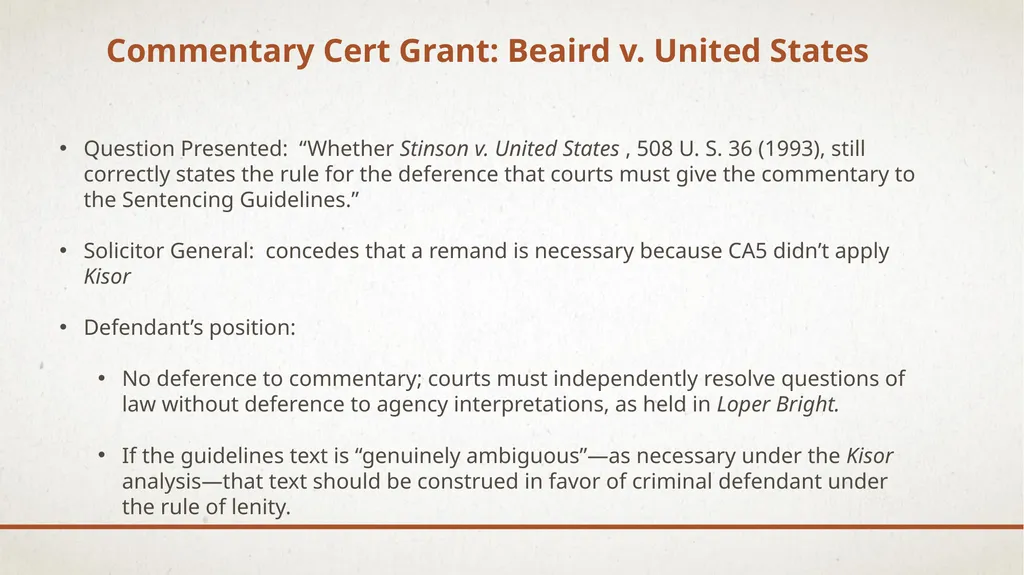
Commentary Cert Grant: Beaird v. United States Question Presented: “Whether Stinson v. United States , 508 U. S. 36 (1993), still correctly states the rule for the deference that courts must give the commentary to the Sentencing Guidelines.”
Solicitor General: concedes that a remand is necessary because CA5 didn’t apply Kisor
Defendant’s position:
No deference to commentary; courts must independently resolve questions of law without deference to agency interpretations, as held in Loper Bright.
If the guidelines text is “genuinely ambiguous”—as necessary under the Kisor analysis—that text should be construed in favor of criminal defendant under the rule of lenity.<br>
Solicitor General: concedes that a remand is necessary because CA5 didn’t apply Kisor
Defendant’s position:
No deference to commentary; courts must independently resolve questions of law without deference to agency interpretations, as held in Loper Bright.
If the guidelines text is “genuinely ambiguous”—as necessary under the Kisor analysis—that text should be construed in favor of criminal defendant under the rule of lenity.<br>
38
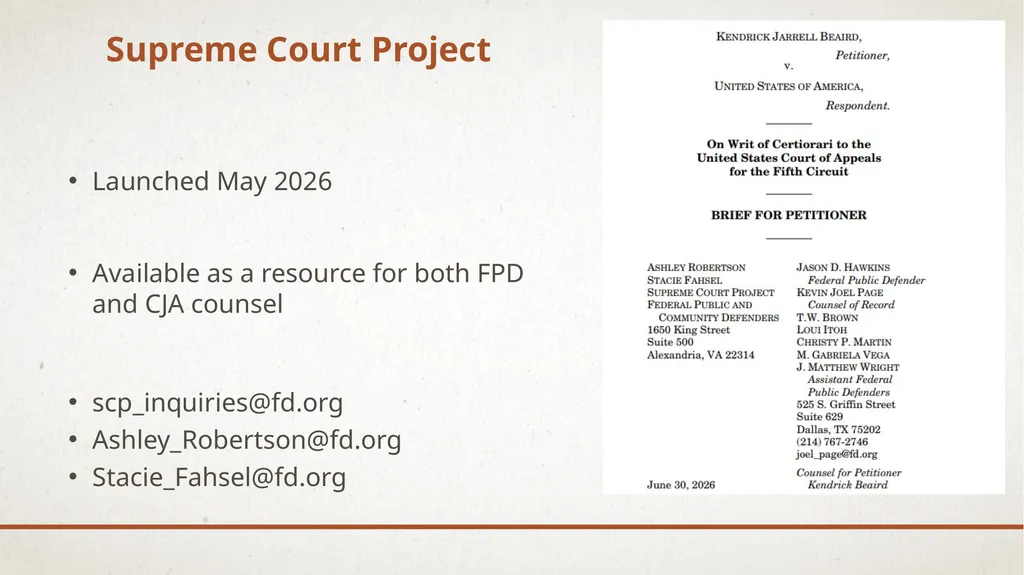
Supreme Court Project Launched May 2026
Available as a resource for both FPD and CJA counsel
scp_inquiries@fd.org
Ashley_Robertson@fd.org
Stacie_Fahsel@fd.org<br>
Available as a resource for both FPD and CJA counsel
scp_inquiries@fd.org
Ashley_Robertson@fd.org
Stacie_Fahsel@fd.org<br>