
Survey Says! Effective and Promising Practices for
EM
Published · 37 slides · 0 views

1 / 1
Description
Survey Says! Effective and Promising Practices for Online Oral Communication and Laboratory Science Anna Bruzzese, ASCCC South Representative Sam Foster, ASCCC Area D Representative Julie Oliver, Cosumnes River College Geoffrey Dyer, ASCCC
Related Topics
Share
Embed code
Download this presentation From Below
"Survey Says! Effective and Promising Practices for" is the property of its rightful owner. Permission is granted to download and print the materials on this website for personal, non-commercial use only, and to display it on your personal computer provided you do not modify the materials and that you retain all copyright notices contained in the materials. By downloading content from our website, you accept the terms of this agreement.
Presentation Transcript
01
Survey Says! Effective and Promising Practices for Online Oral Communication and Laboratory Science Anna Bruzzese, ASCCC South Representative
Sam Foster, ASCCC Area D Representative
Julie Oliver, Cosumnes River College
Geoffrey Dyer, ASCCC Area A Representative<br>
02
Why are you here?<br>
03
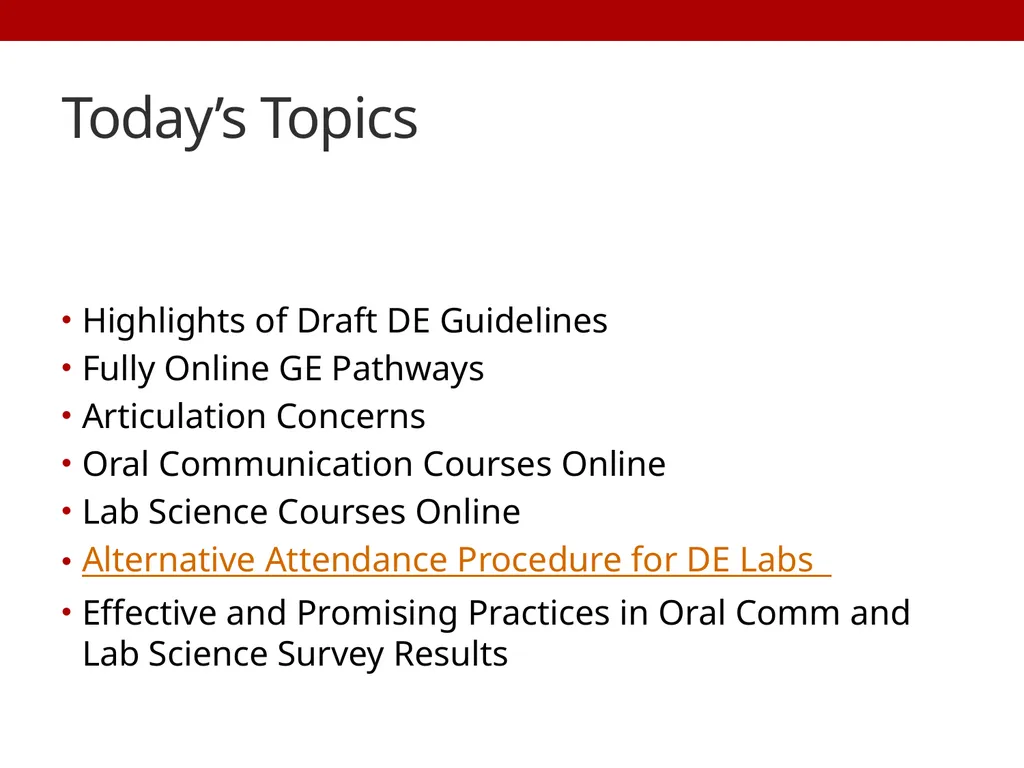
Today’s Topics Highlights of Draft DE Guidelines
Fully Online GE Pathways
Articulation Concerns
Oral Communication Courses Online
Lab Science Courses Online
Alternative Attendance Procedure for DE Labs
Effective and Promising Practices in Oral Comm and Lab Science Survey Results<br>
Fully Online GE Pathways
Articulation Concerns
Oral Communication Courses Online
Lab Science Courses Online
Alternative Attendance Procedure for DE Labs
Effective and Promising Practices in Oral Comm and Lab Science Survey Results<br>
04
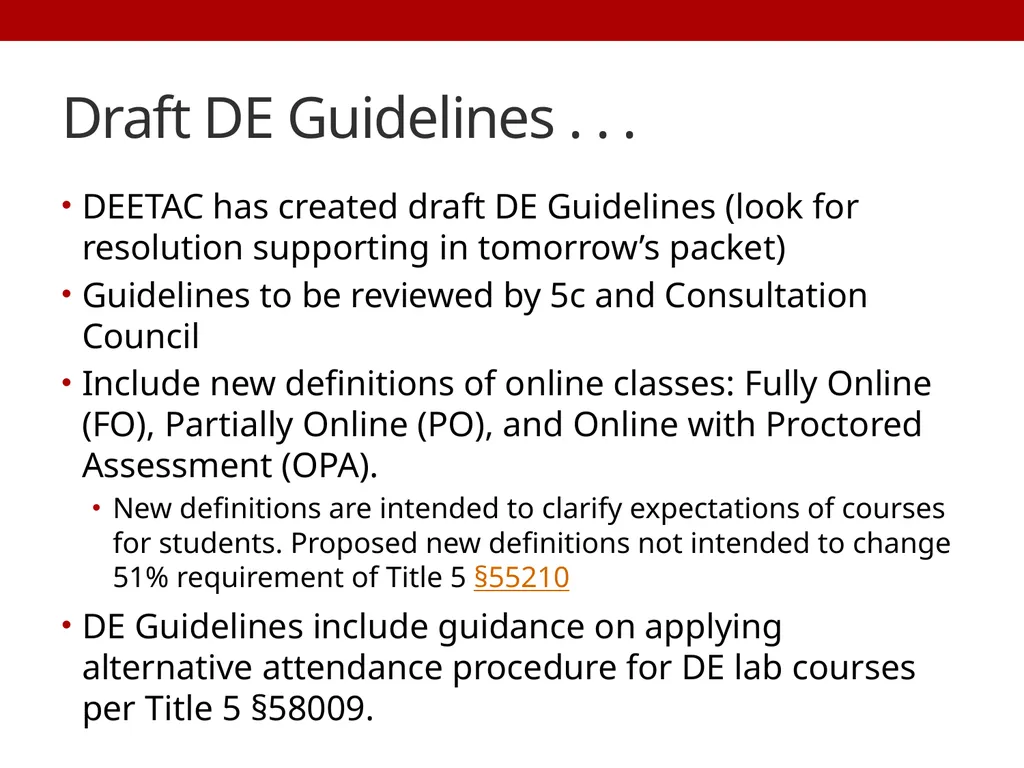
Draft DE Guidelines . . . DEETAC has created draft DE Guidelines (look for resolution supporting in tomorrow’s packet)
Guidelines to be reviewed by 5c and Consultation Council
Include new definitions of online classes: Fully Online (FO), Partially Online (PO), and Online with Proctored Assessment (OPA).
New definitions are intended to clarify expectations of courses for students. Proposed new definitions not intended to change 51% requirement of Title 5 §55210
DE Guidelines include guidance on applying alternative attendance procedure for DE lab courses per Title 5 §58009.<br>
Guidelines to be reviewed by 5c and Consultation Council
Include new definitions of online classes: Fully Online (FO), Partially Online (PO), and Online with Proctored Assessment (OPA).
New definitions are intended to clarify expectations of courses for students. Proposed new definitions not intended to change 51% requirement of Title 5 §55210
DE Guidelines include guidance on applying alternative attendance procedure for DE lab courses per Title 5 §58009.<br>
05
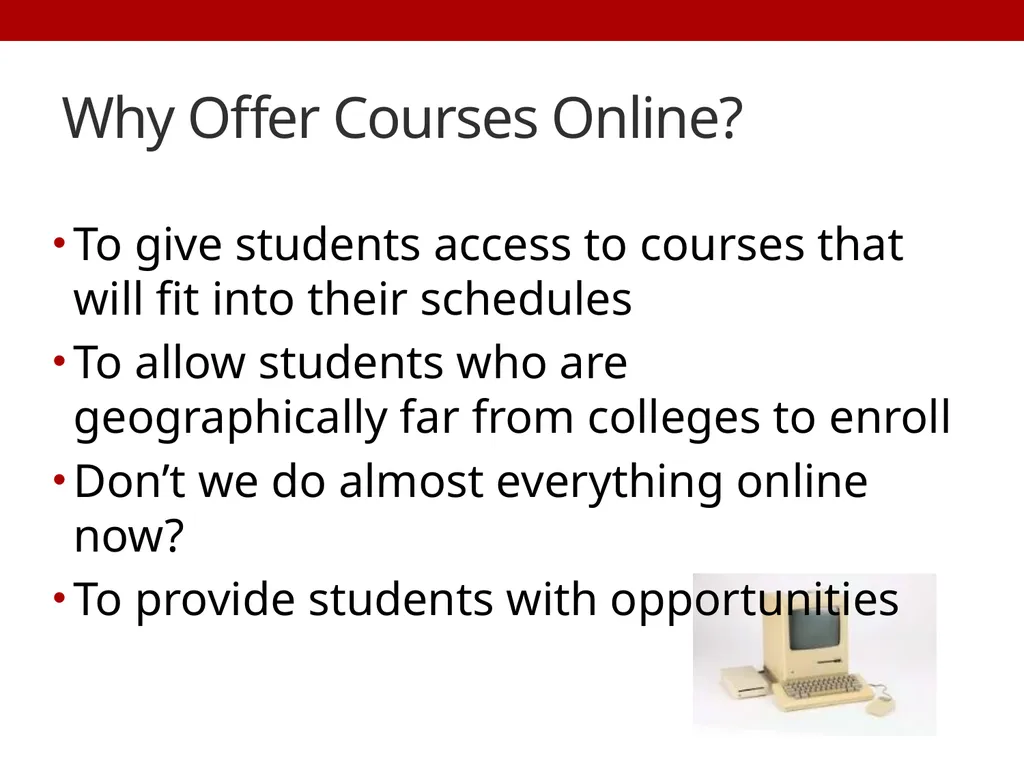
Why Offer Courses Online? To give students access to courses that will fit into their schedules
To allow students who are geographically far from colleges to enroll
Don’t we do almost everything online now?
To provide students with opportunities<br>
To allow students who are geographically far from colleges to enroll
Don’t we do almost everything online now?
To provide students with opportunities<br>
06
What happens when we exclude GE requirements? Creates barrier for students who seek to complete their degree fully online
Ultimately a local decision—faculty expertise must be honored<br>
Ultimately a local decision—faculty expertise must be honored<br>
07
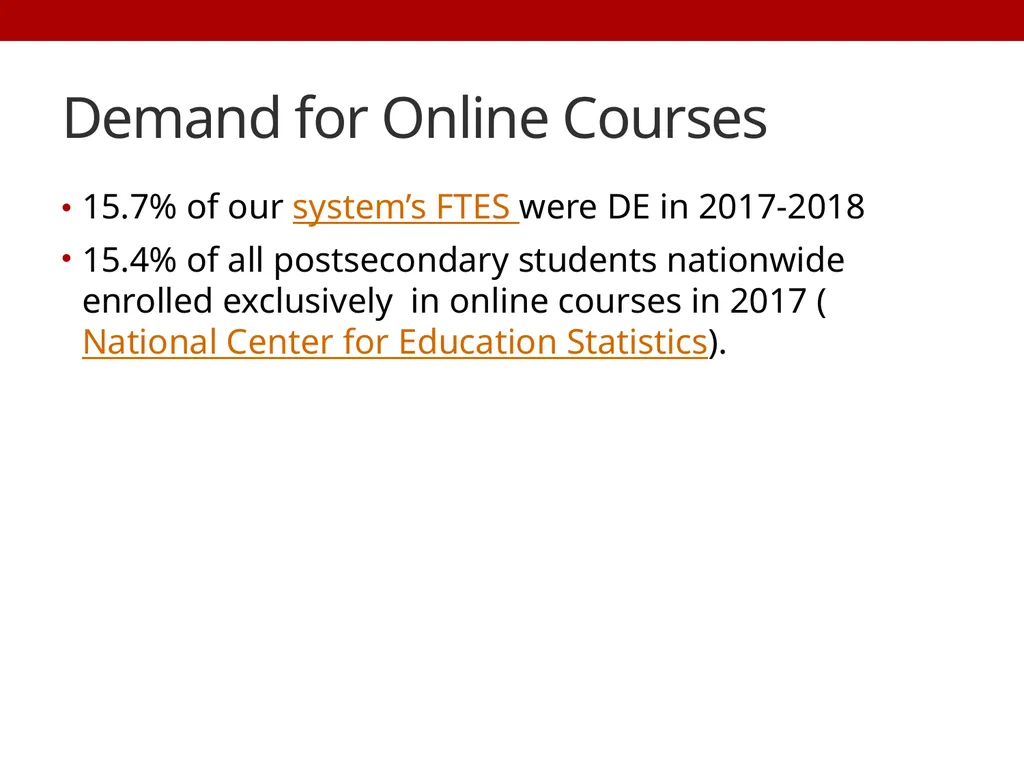
Demand for Online Courses 15.7% of our system’s FTES were DE in 2017-2018
15.4% of all postsecondary students nationwide enrolled exclusively in online courses in 2017 (National Center for Education Statistics).<br>
15.4% of all postsecondary students nationwide enrolled exclusively in online courses in 2017 (National Center for Education Statistics).<br>
08
What Do Fully-Online Pathways Look Like in Your District? Is it possible for students to complete GE requirements fully online without looking elsewhere?
If your district offers a fully online course meeting the lab science requirement, is the course appropriate for diverse majors and goals?
Is your college a CVC-OEI consortium college?
Are students using Finish Faster Online to search for needed online courses elsewhere in the system?<br>
If your district offers a fully online course meeting the lab science requirement, is the course appropriate for diverse majors and goals?
Is your college a CVC-OEI consortium college?
Are students using Finish Faster Online to search for needed online courses elsewhere in the system?<br>
09
What do Fully-Online Pathways Look Like in Your District? How do students who intend to complete their ADT online in your district meet the CSU A1 requirement?
The B3?<br>
The B3?<br>
10
Did You Say Speech and Lab? CSU Executive Order 1100 (August, 2017) allows that GE courses taught in any modality are accepted by CSU
Title 5 §58009 allows alternative attendance procedures for DE labs
Some CCCs offer courses that meet the A1 and the B3 fully online (Visit cvc.edu)
Ultimately a local decision, per Title 5 §55202<br>
Title 5 §58009 allows alternative attendance procedures for DE labs
Some CCCs offer courses that meet the A1 and the B3 fully online (Visit cvc.edu)
Ultimately a local decision, per Title 5 §55202<br>
11
ASCCC ACTION Resolutions 9.03 S18 directed the ASCCC to gather and share effective and promising practices for teaching oral communication courses online.
Resolution 9.04 S18 directed the ASCCC to ask science faculty “to make recommendations regarding lab science courses most adaptable to online instruction without compromising outcomes” and gather and share effective and promising practices for teaching lab science courses online.
ASCCC Online Education Committee designed and administered two surveys. Results are reported in April, 2019 Rostrum.<br>
Resolution 9.04 S18 directed the ASCCC to ask science faculty “to make recommendations regarding lab science courses most adaptable to online instruction without compromising outcomes” and gather and share effective and promising practices for teaching lab science courses online.
ASCCC Online Education Committee designed and administered two surveys. Results are reported in April, 2019 Rostrum.<br>
12
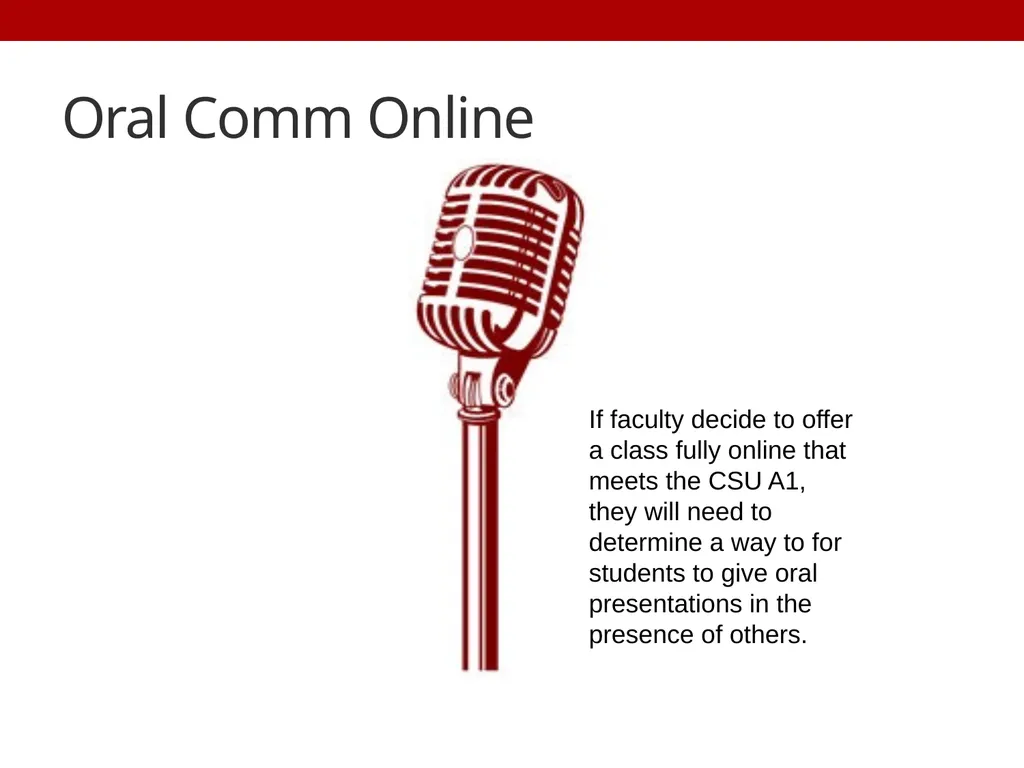
Oral Comm Online If faculty decide to offer a class fully online that meets the CSU A1, they will need to determine a way to for students to give oral presentations in the presence of others.<br>
13
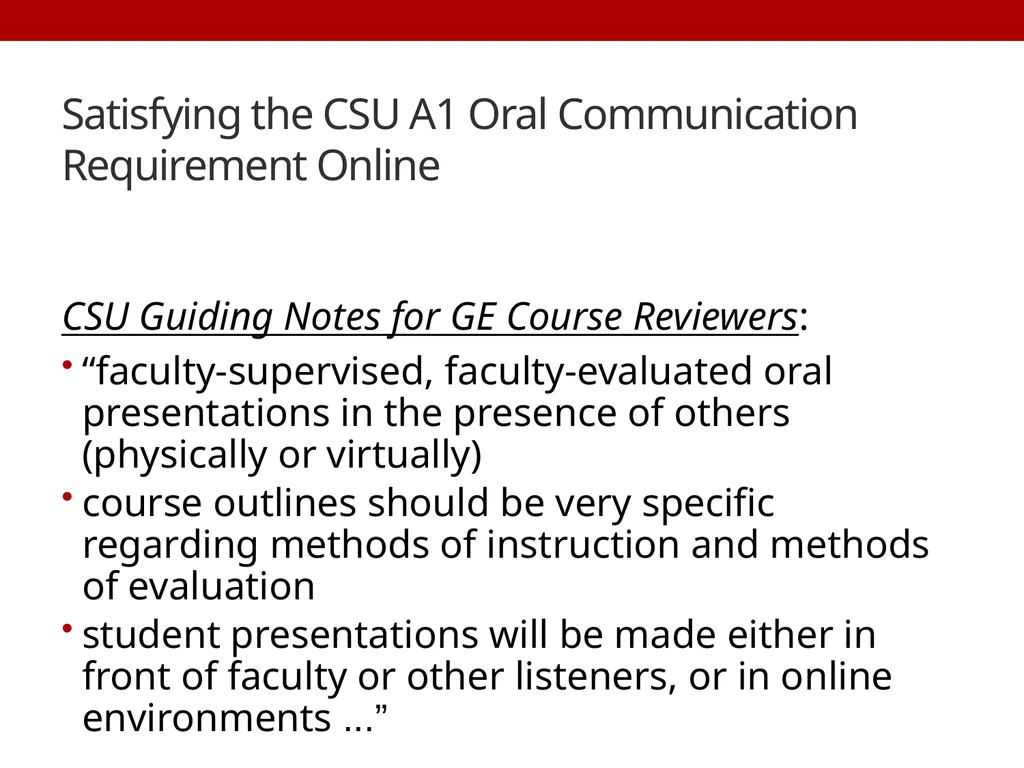
Satisfying the CSU A1 Oral Communication Requirement Online CSU Guiding Notes for GE Course Reviewers:
“faculty-supervised, faculty-evaluated oral presentations in the presence of others (physically or virtually)
course outlines should be very specific regarding methods of instruction and methods of evaluation
student presentations will be made either in front of faculty or other listeners, or in online environments ...”<br>
“faculty-supervised, faculty-evaluated oral presentations in the presence of others (physically or virtually)
course outlines should be very specific regarding methods of instruction and methods of evaluation
student presentations will be made either in front of faculty or other listeners, or in online environments ...”<br>
14
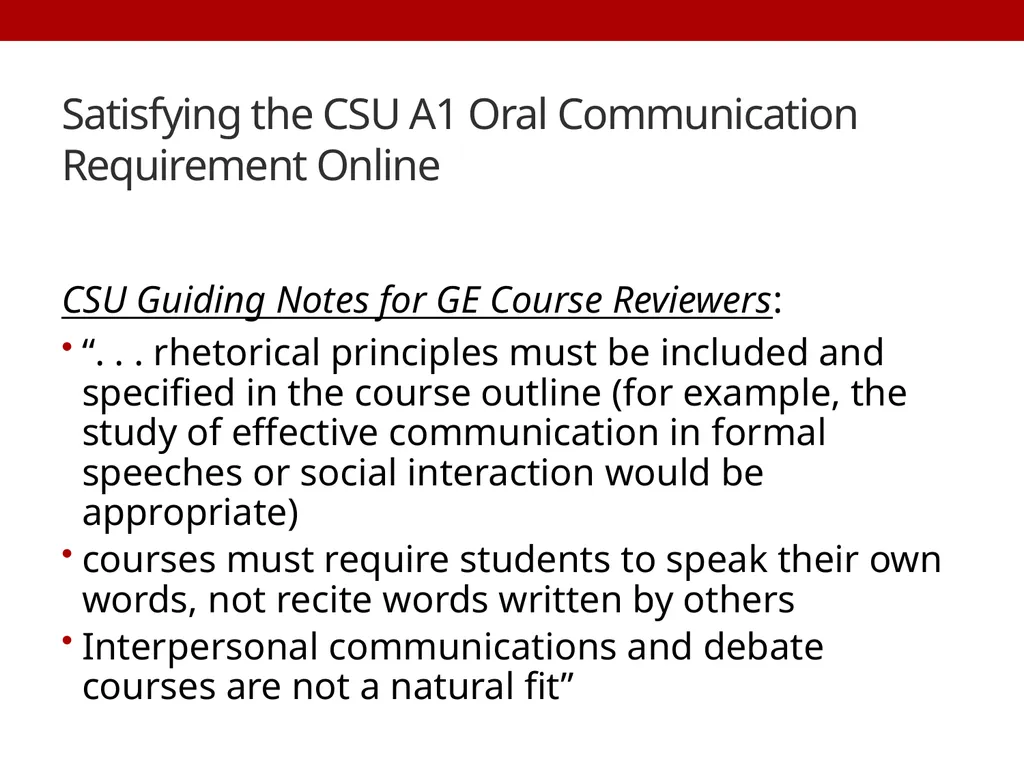
Satisfying the CSU A1 Oral Communication Requirement Online CSU Guiding Notes for GE Course Reviewers:
“. . . rhetorical principles must be included and specified in the course outline (for example, the study of effective communication in formal speeches or social interaction would be appropriate)
courses must require students to speak their own words, not recite words written by others
Interpersonal communications and debate courses are not a natural fit”<br>
“. . . rhetorical principles must be included and specified in the course outline (for example, the study of effective communication in formal speeches or social interaction would be appropriate)
courses must require students to speak their own words, not recite words written by others
Interpersonal communications and debate courses are not a natural fit”<br>
15
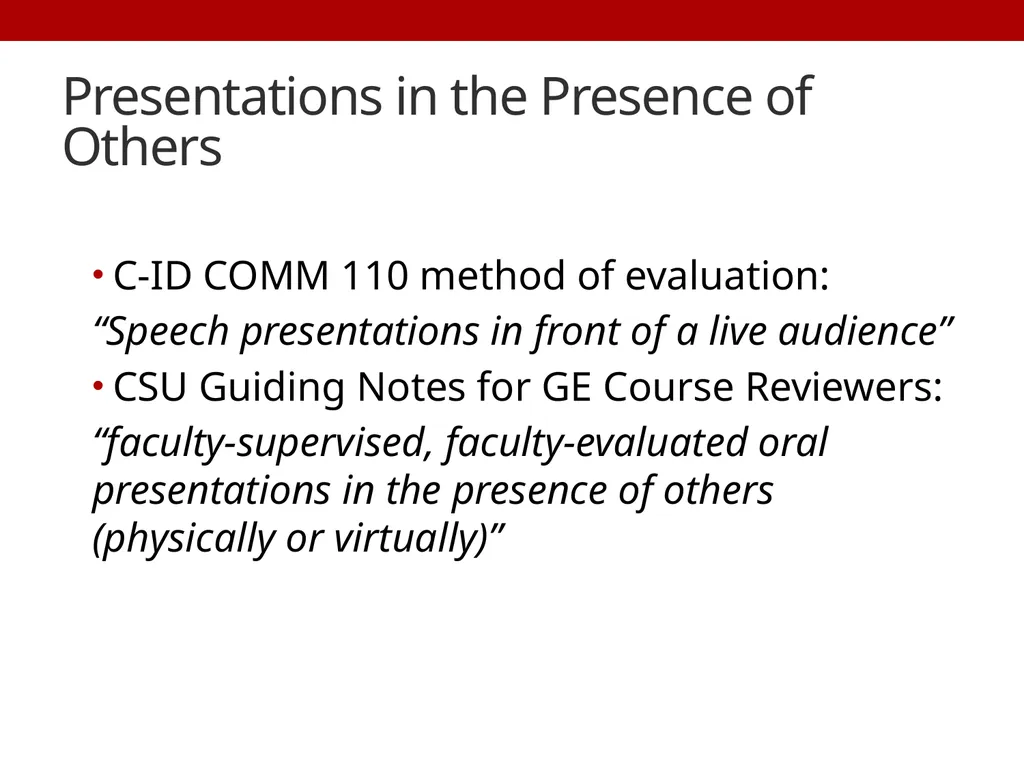
Presentations in the Presence of Others C-ID COMM 110 method of evaluation:
“Speech presentations in front of a live audience”
CSU Guiding Notes for GE Course Reviewers:
“faculty-supervised, faculty-evaluated oral presentations in the presence of others (physically or virtually)”<br>
“Speech presentations in front of a live audience”
CSU Guiding Notes for GE Course Reviewers:
“faculty-supervised, faculty-evaluated oral presentations in the presence of others (physically or virtually)”<br>
16
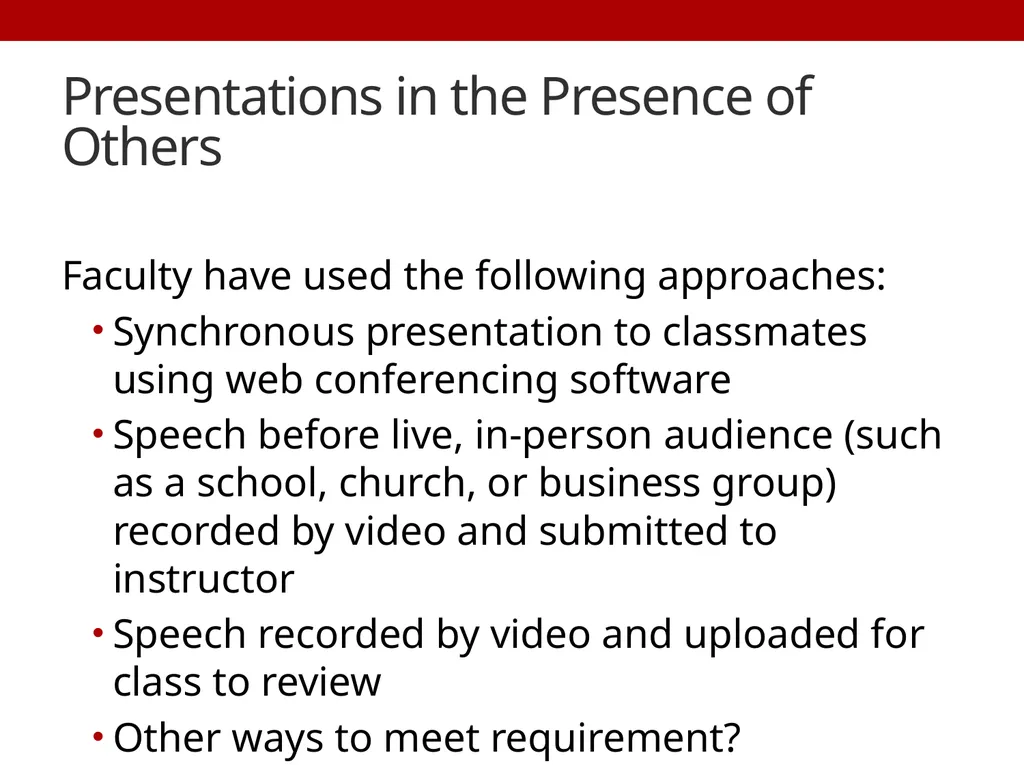
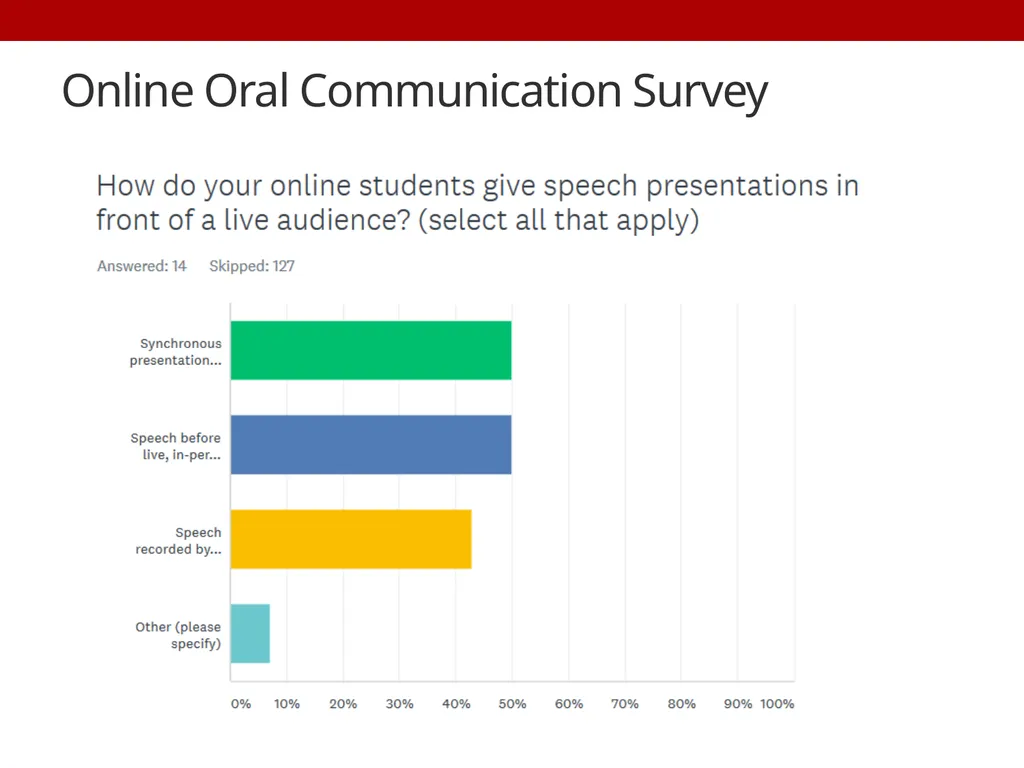
Presentations in the Presence of Others Faculty have used the following approaches:
Synchronous presentation to classmates using web conferencing software
Speech before live, in-person audience (such as a school, church, or business group) recorded by video and submitted to instructor
Speech recorded by video and uploaded for class to review
Other ways to meet requirement?<br>
Synchronous presentation to classmates using web conferencing software
Speech before live, in-person audience (such as a school, church, or business group) recorded by video and submitted to instructor
Speech recorded by video and uploaded for class to review
Other ways to meet requirement?<br>
17
Online Oral Communication Survey Survey Sent to Field on October 3, 2018
141 Responses<br>
141 Responses<br>
18
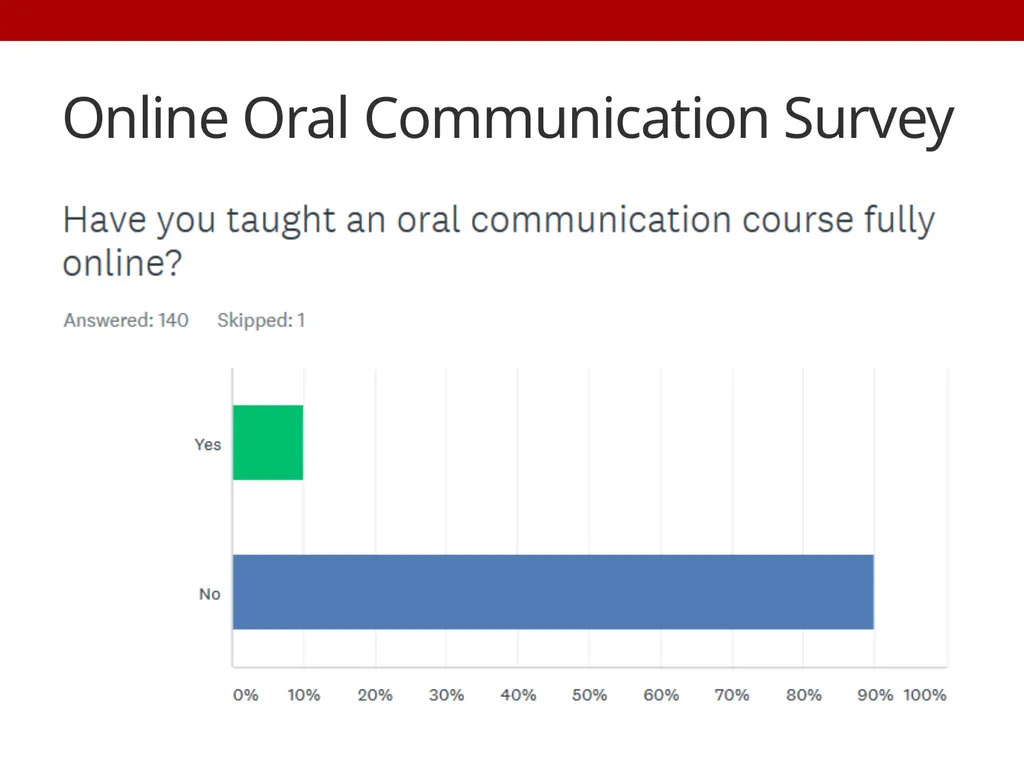
Online Oral Communication Survey<br>
19
Online Oral Communication Survey<br>
20
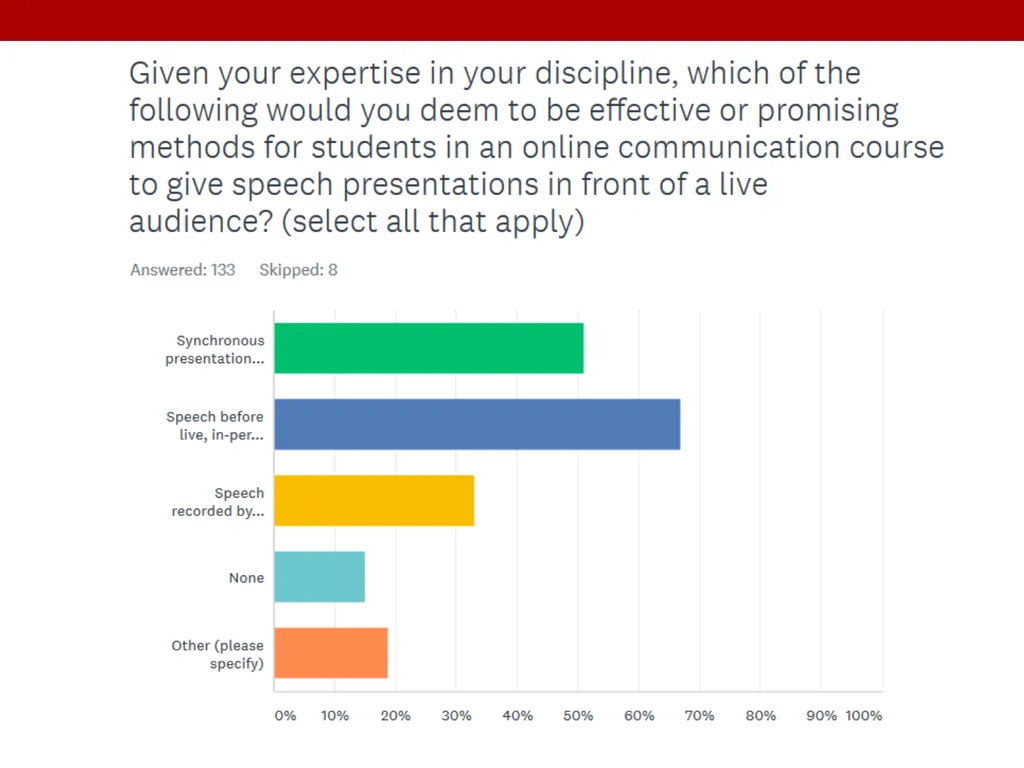
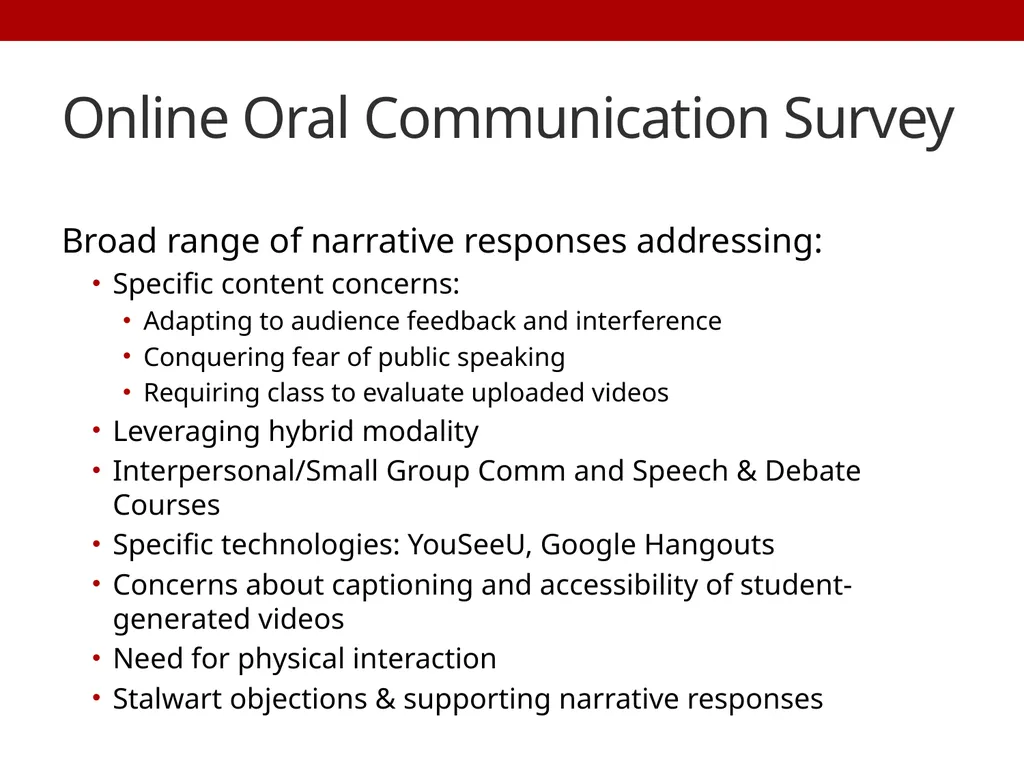
Online Oral Communication Survey Broad range of narrative responses addressing:
Specific content concerns:
Adapting to audience feedback and interference
Conquering fear of public speaking
Requiring class to evaluate uploaded videos
Leveraging hybrid modality
Interpersonal/Small Group Comm and Speech & Debate Courses
Specific technologies: YouSeeU, Google Hangouts
Concerns about captioning and accessibility of student-generated videos
Need for physical interaction
Stalwart objections & supporting narrative responses<br>
Specific content concerns:
Adapting to audience feedback and interference
Conquering fear of public speaking
Requiring class to evaluate uploaded videos
Leveraging hybrid modality
Interpersonal/Small Group Comm and Speech & Debate Courses
Specific technologies: YouSeeU, Google Hangouts
Concerns about captioning and accessibility of student-generated videos
Need for physical interaction
Stalwart objections & supporting narrative responses<br>
21
Lab Science Online<br>
22
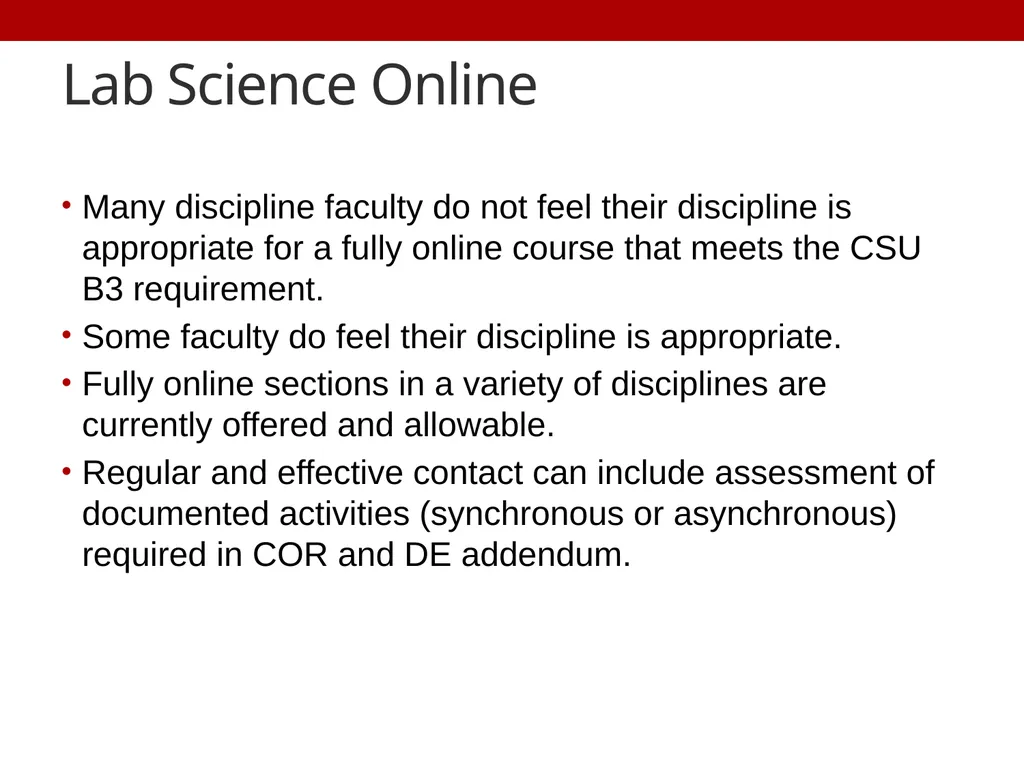
Lab Science Online Many discipline faculty do not feel their discipline is appropriate for a fully online course that meets the CSU B3 requirement.
Some faculty do feel their discipline is appropriate.
Fully online sections in a variety of disciplines are currently offered and allowable.
Regular and effective contact can include assessment of documented activities (synchronous or asynchronous) required in COR and DE addendum.<br>
Some faculty do feel their discipline is appropriate.
Fully online sections in a variety of disciplines are currently offered and allowable.
Regular and effective contact can include assessment of documented activities (synchronous or asynchronous) required in COR and DE addendum.<br>
23
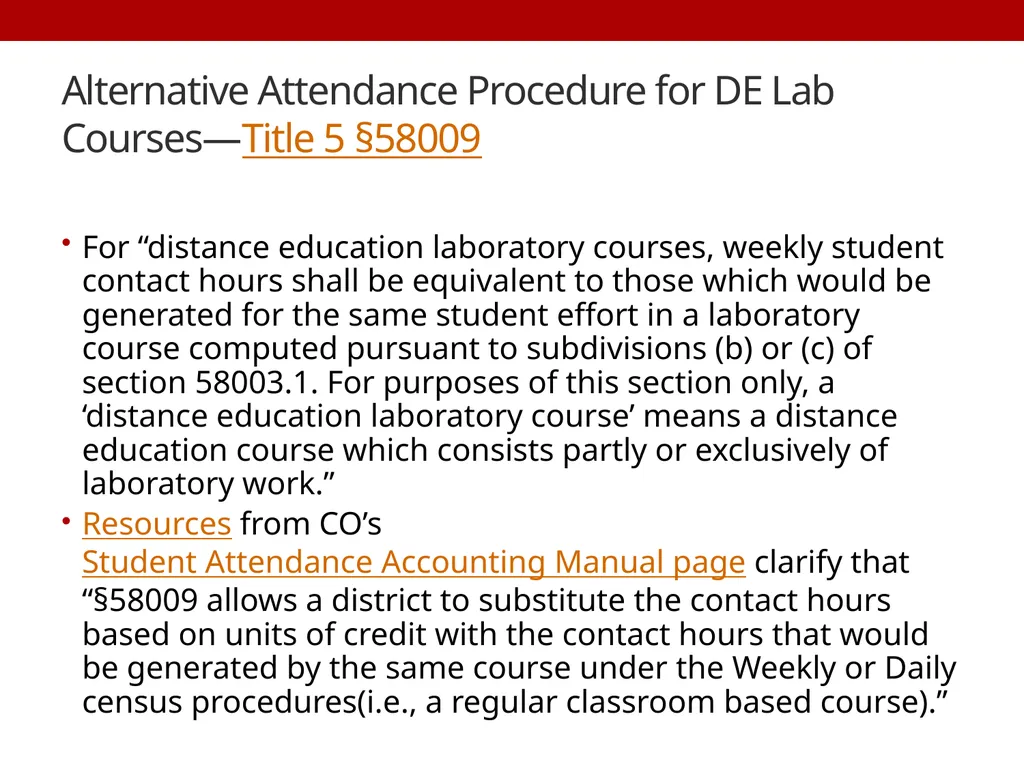
Alternative Attendance Procedure for DE Lab Courses—Title 5 §58009 For “distance education laboratory courses, weekly student contact hours shall be equivalent to those which would be generated for the same student effort in a laboratory course computed pursuant to subdivisions (b) or (c) of section 58003.1. For purposes of this section only, a ‘distance education laboratory course’ means a distance education course which consists partly or exclusively of laboratory work.”
Resources from CO’s Student Attendance Accounting Manual page clarify that “§58009 allows a district to substitute the contact hours based on units of credit with the contact hours that would be generated by the same course under the Weekly or Daily census procedures(i.e., a regular classroom based course).”<br>
Resources from CO’s Student Attendance Accounting Manual page clarify that “§58009 allows a district to substitute the contact hours based on units of credit with the contact hours that would be generated by the same course under the Weekly or Daily census procedures(i.e., a regular classroom based course).”<br>
24
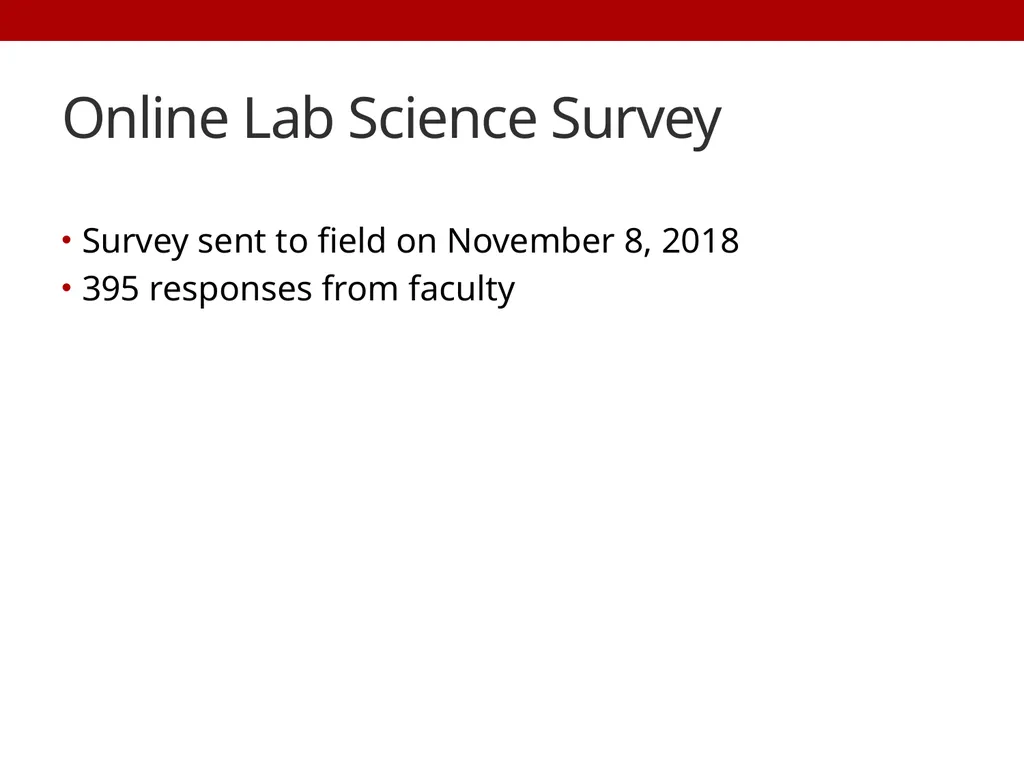
Online Lab Science Survey Survey sent to field on November 8, 2018
395 responses from faculty<br>
395 responses from faculty<br>
25
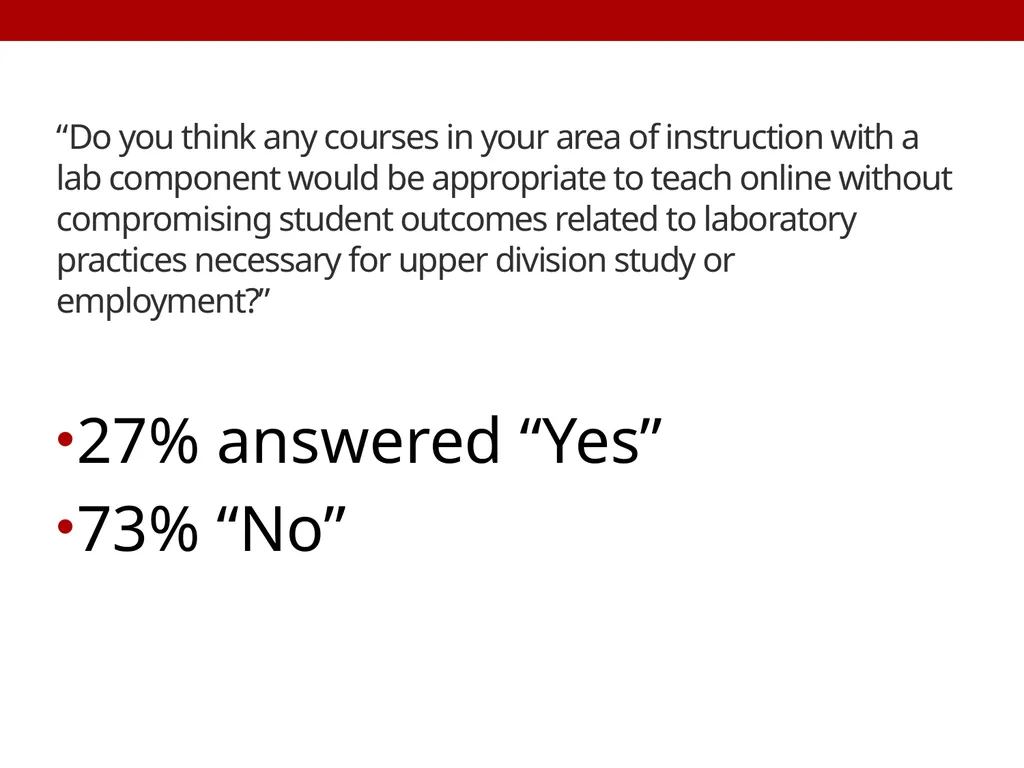
“Do you think any courses in your area of instruction with a lab component would be appropriate to teach online without compromising student outcomes related to laboratory practices necessary for upper division study or employment?” 27% answered “Yes”
73% “No”<br>
73% “No”<br>
26
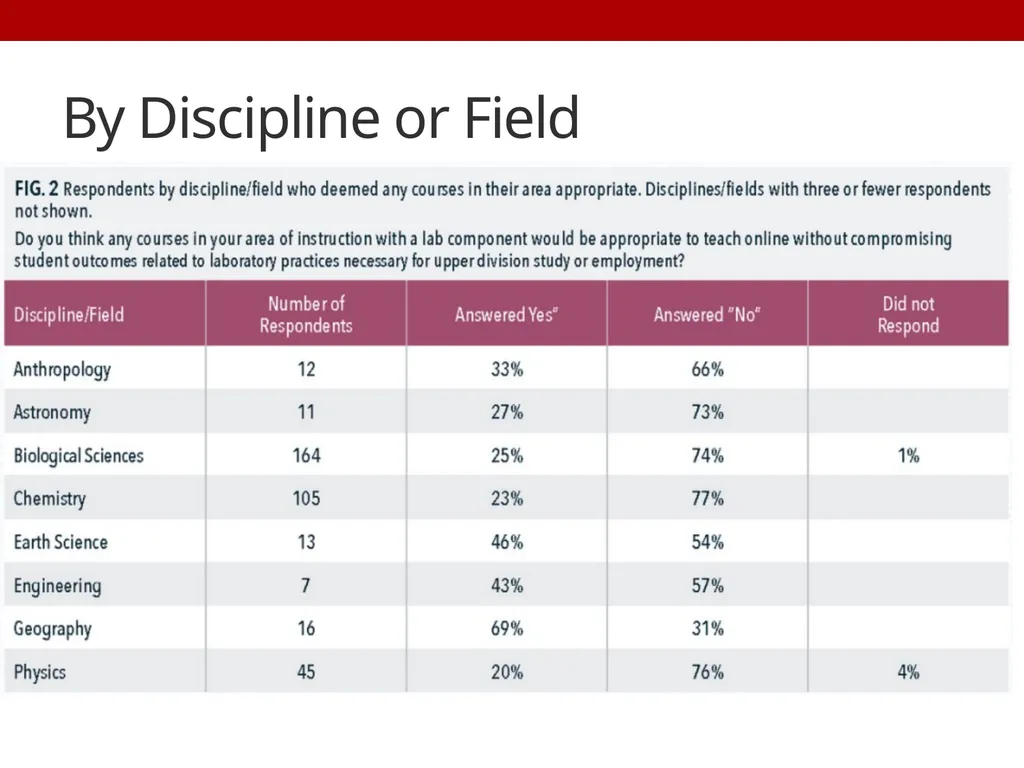
By Discipline or Field<br>
27
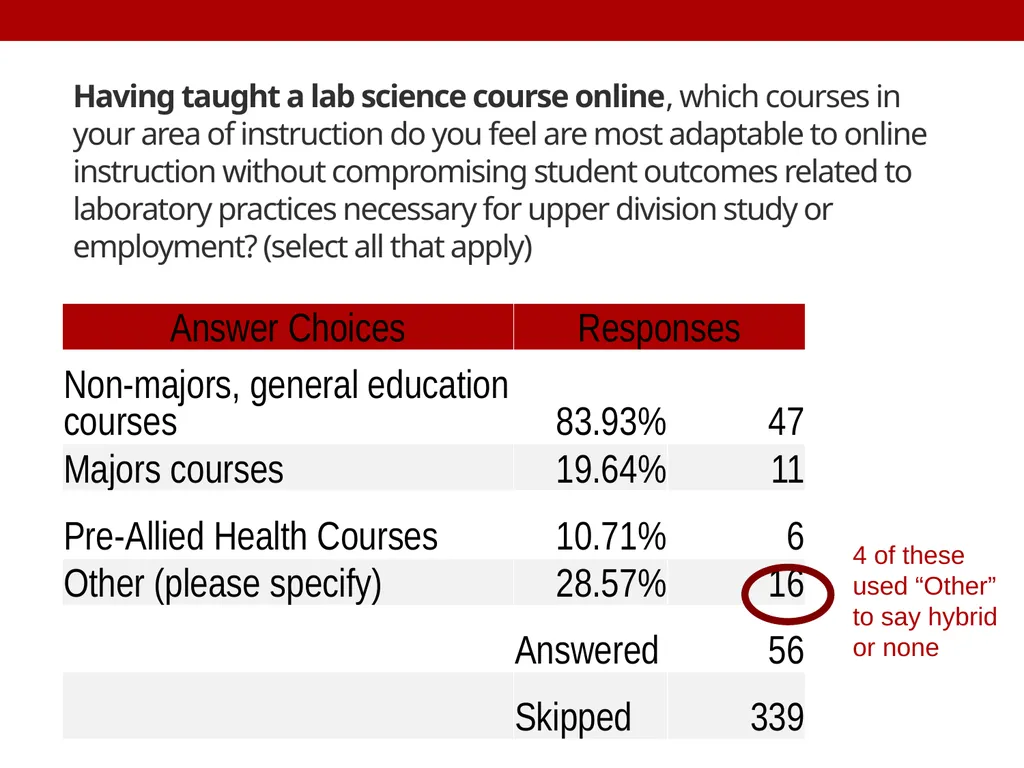
Having taught a lab science course online, which courses in your area of instruction do you feel are most adaptable to online instruction without compromising student outcomes related to laboratory practices necessary for upper division study or employment? (select all that apply) 4 of these used “Other” to say hybrid or none<br>
28
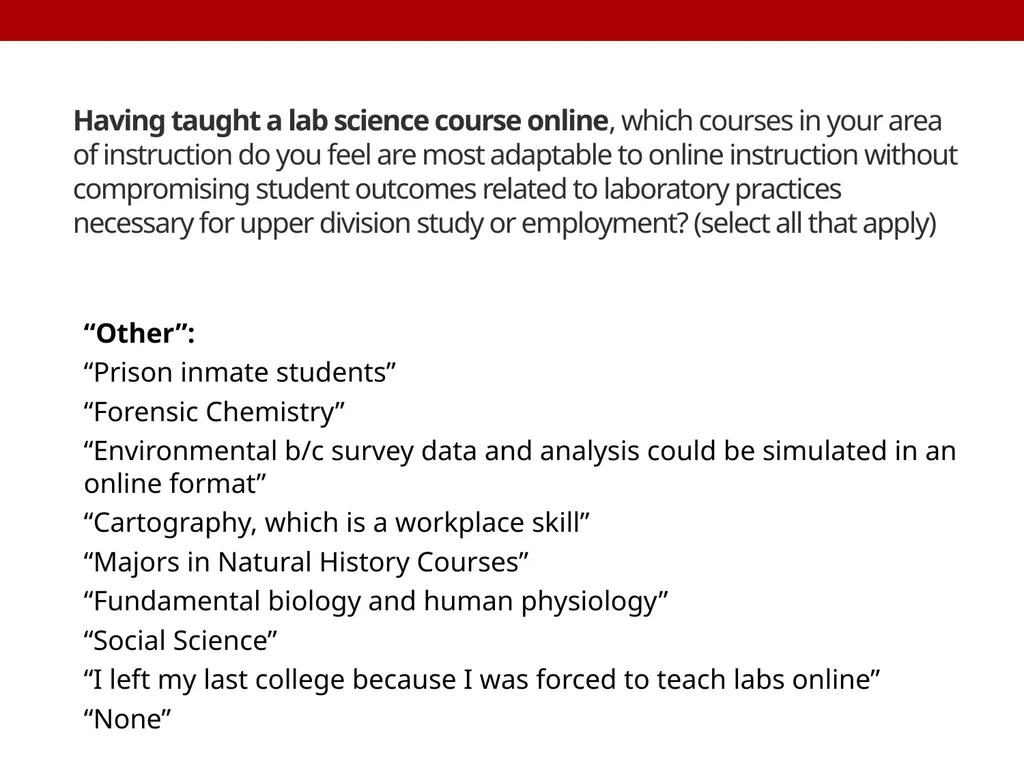
Having taught a lab science course online, which courses in your area of instruction do you feel are most adaptable to online instruction without compromising student outcomes related to laboratory practices necessary for upper division study or employment? (select all that apply) “Other”:
“Prison inmate students”
“Forensic Chemistry”
“Environmental b/c survey data and analysis could be simulated in an online format”
“Cartography, which is a workplace skill”
“Majors in Natural History Courses”
“Fundamental biology and human physiology”
“Social Science”
“I left my last college because I was forced to teach labs online”
“None”<br>
“Prison inmate students”
“Forensic Chemistry”
“Environmental b/c survey data and analysis could be simulated in an online format”
“Cartography, which is a workplace skill”
“Majors in Natural History Courses”
“Fundamental biology and human physiology”
“Social Science”
“I left my last college because I was forced to teach labs online”
“None”<br>
29
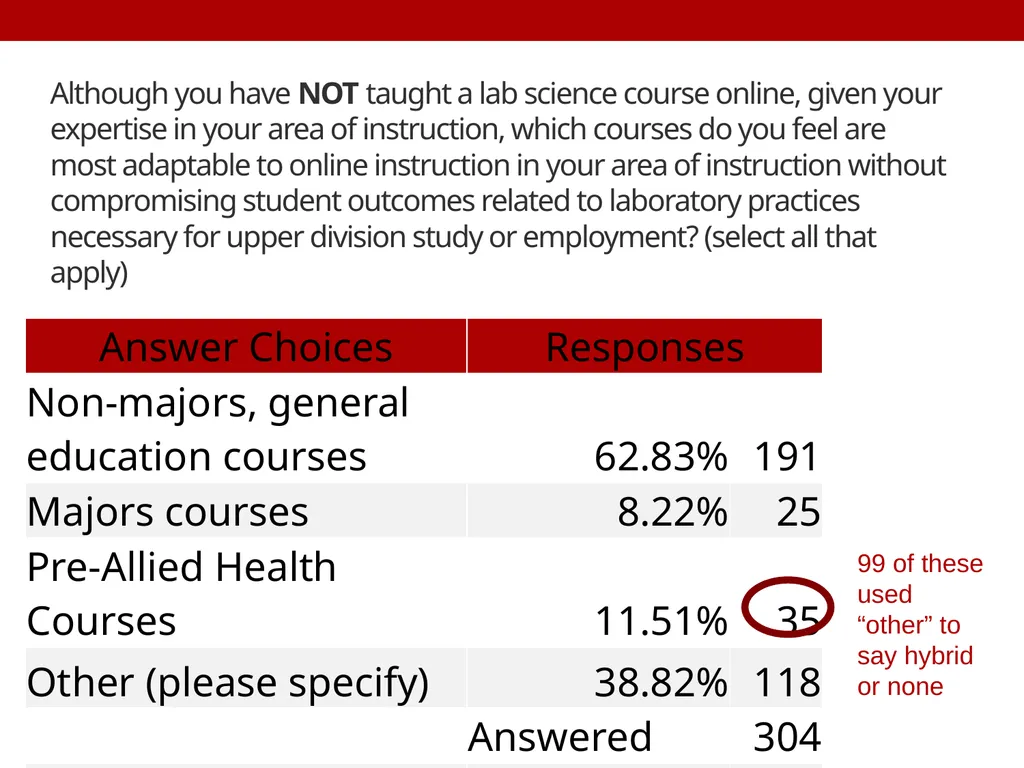
Although you have NOT taught a lab science course online, given your expertise in your area of instruction, which courses do you feel are most adaptable to online instruction in your area of instruction without compromising student outcomes related to laboratory practices necessary for upper division study or employment? (select all that apply) 99 of these used “other” to say hybrid or none<br>
30
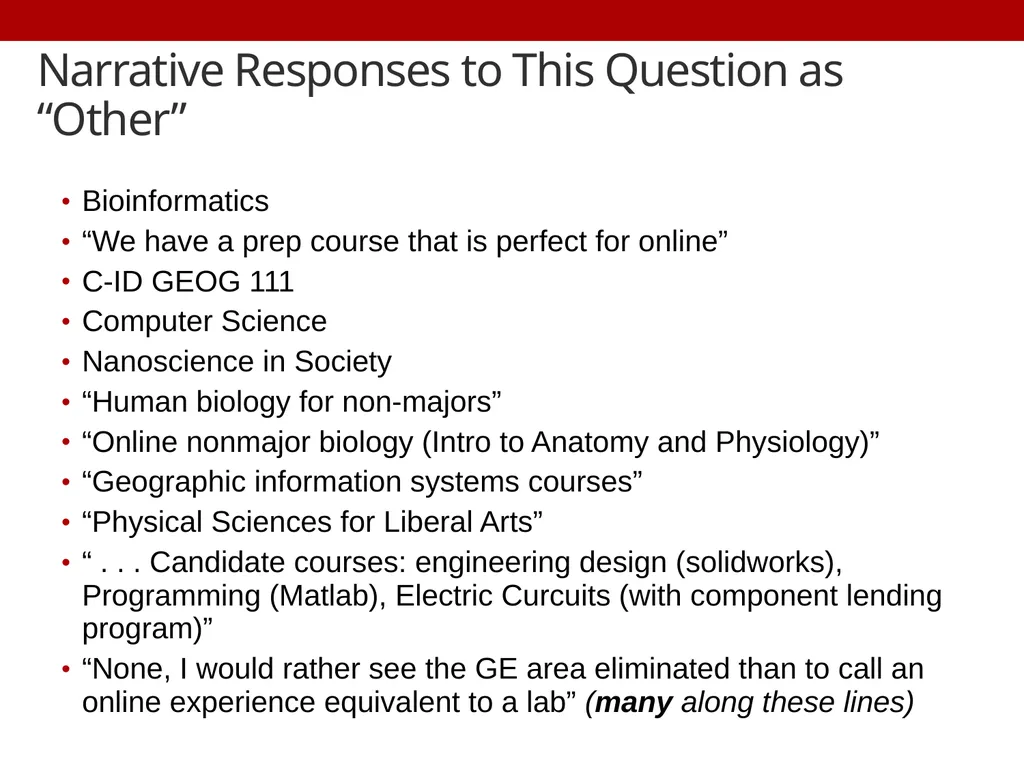
Narrative Responses to This Question as “Other” Bioinformatics
“We have a prep course that is perfect for online”
C-ID GEOG 111
Computer Science
Nanoscience in Society
“Human biology for non-majors”
“Online nonmajor biology (Intro to Anatomy and Physiology)”
“Geographic information systems courses”
“Physical Sciences for Liberal Arts”
“ . . . Candidate courses: engineering design (solidworks), Programming (Matlab), Electric Curcuits (with component lending program)”
“None, I would rather see the GE area eliminated than to call an online experience equivalent to a lab” (many along these lines)<br>
“We have a prep course that is perfect for online”
C-ID GEOG 111
Computer Science
Nanoscience in Society
“Human biology for non-majors”
“Online nonmajor biology (Intro to Anatomy and Physiology)”
“Geographic information systems courses”
“Physical Sciences for Liberal Arts”
“ . . . Candidate courses: engineering design (solidworks), Programming (Matlab), Electric Curcuits (with component lending program)”
“None, I would rather see the GE area eliminated than to call an online experience equivalent to a lab” (many along these lines)<br>
31
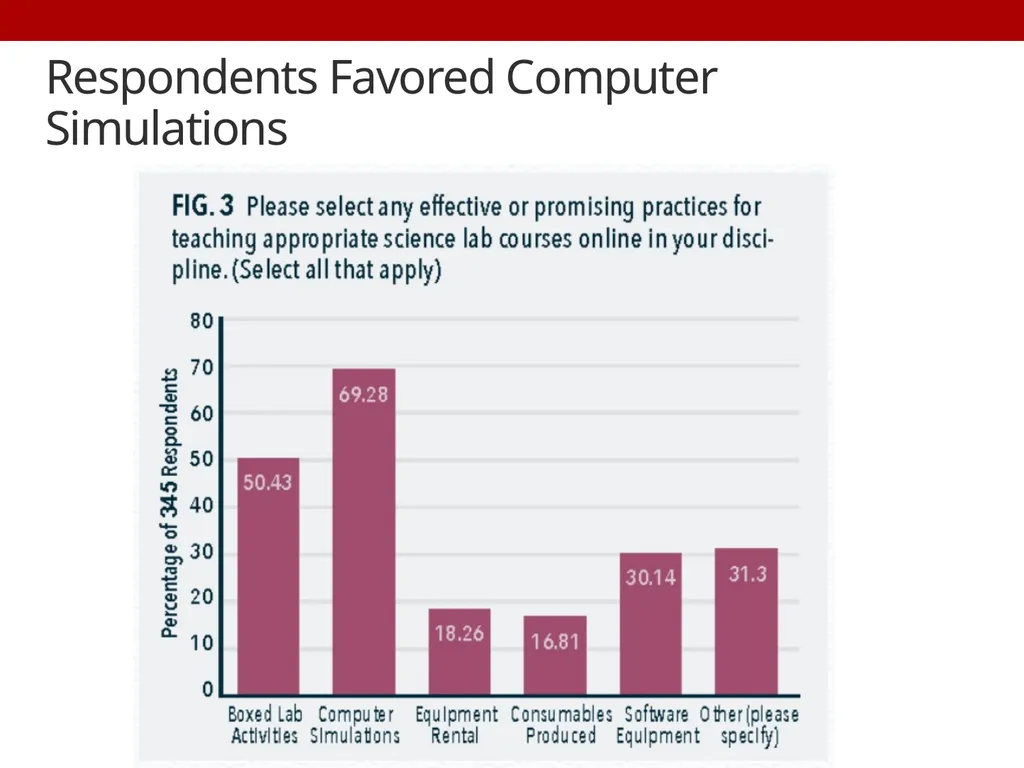
Respondents Favored Computer Simulations<br>
32
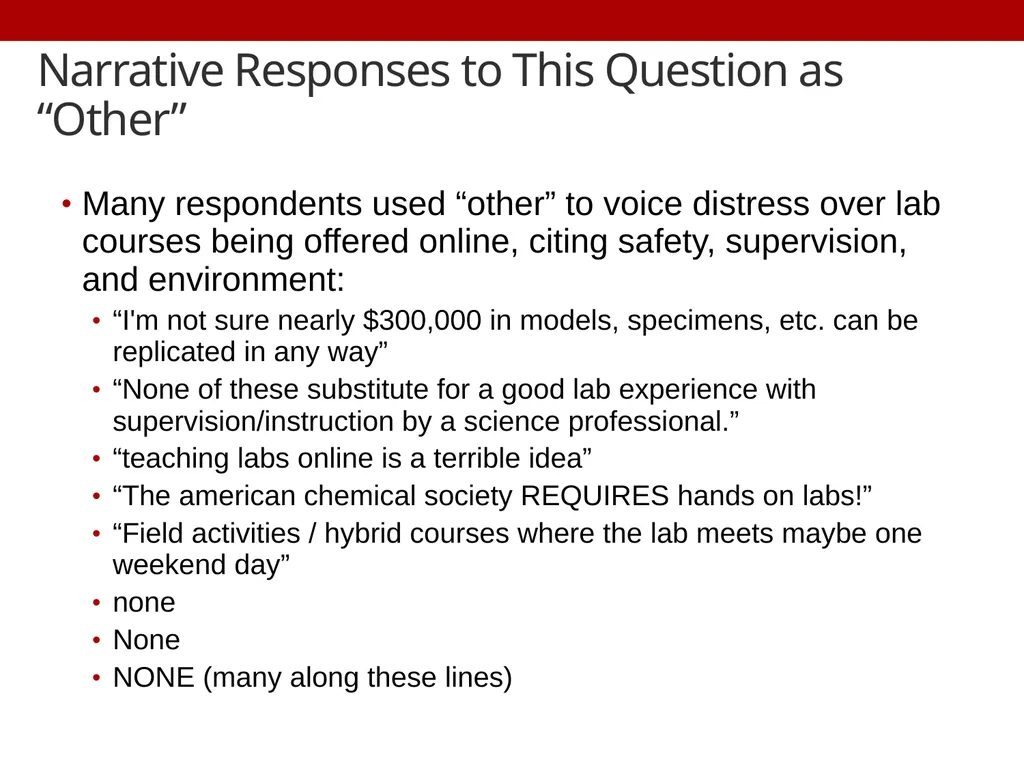
Narrative Responses to This Question as “Other” Many respondents used “other” to voice distress over lab courses being offered online, citing safety, supervision, and environment:
“I'm not sure nearly $300,000 in models, specimens, etc. can be replicated in any way”
“None of these substitute for a good lab experience with supervision/instruction by a science professional.”
“teaching labs online is a terrible idea”
“The american chemical society REQUIRES hands on labs!”
“Field activities / hybrid courses where the lab meets maybe one weekend day”
none
None
NONE (many along these lines)<br>
“I'm not sure nearly $300,000 in models, specimens, etc. can be replicated in any way”
“None of these substitute for a good lab experience with supervision/instruction by a science professional.”
“teaching labs online is a terrible idea”
“The american chemical society REQUIRES hands on labs!”
“Field activities / hybrid courses where the lab meets maybe one weekend day”
none
None
NONE (many along these lines)<br>
33
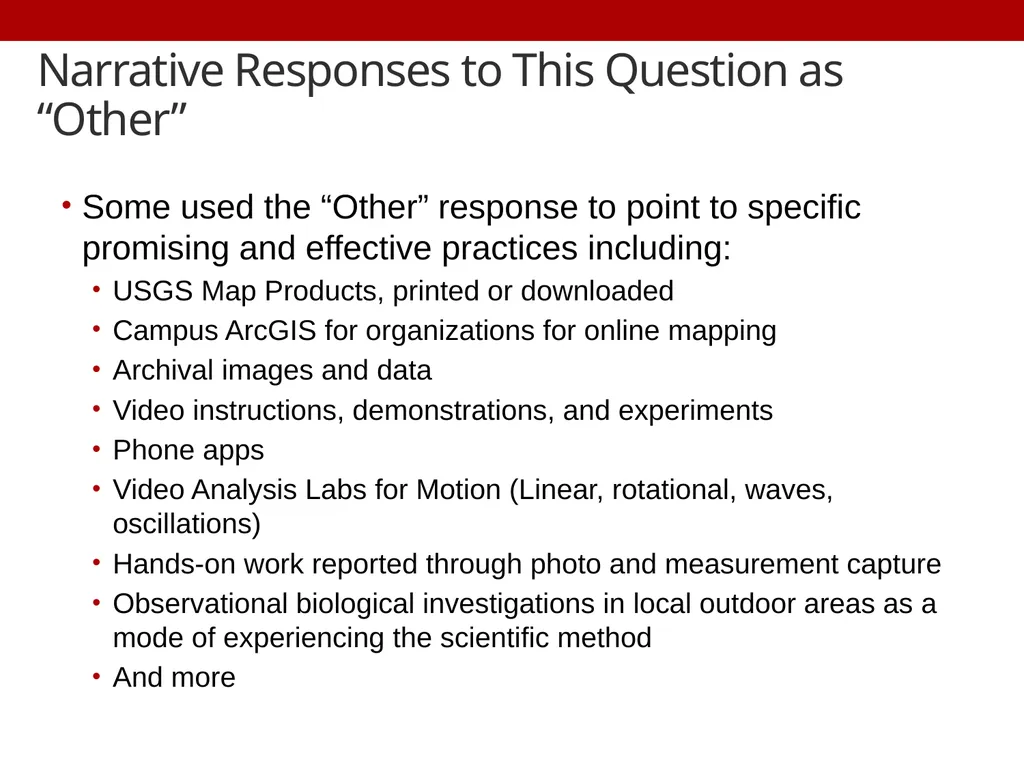
Narrative Responses to This Question as “Other” Some used the “Other” response to point to specific promising and effective practices including:
USGS Map Products, printed or downloaded
Campus ArcGIS for organizations for online mapping
Archival images and data
Video instructions, demonstrations, and experiments
Phone apps
Video Analysis Labs for Motion (Linear, rotational, waves, oscillations)
Hands-on work reported through photo and measurement capture
Observational biological investigations in local outdoor areas as a mode of experiencing the scientific method
And more<br>
USGS Map Products, printed or downloaded
Campus ArcGIS for organizations for online mapping
Archival images and data
Video instructions, demonstrations, and experiments
Phone apps
Video Analysis Labs for Motion (Linear, rotational, waves, oscillations)
Hands-on work reported through photo and measurement capture
Observational biological investigations in local outdoor areas as a mode of experiencing the scientific method
And more<br>
34
Other Findings 15% of respondents indicated that they had taught a lab science course online.
Many of these also did not feel any course in their discipline was adaptable to online without compromising quality<br>
Many of these also did not feel any course in their discipline was adaptable to online without compromising quality<br>
35
Considerations What is your local DE review process like?
Can oral comm and lab science courses be uniquely addressed on DE Addendum so that live presentations in the presence of others and appropriate supervision of laboratory activities are included, if that is faculty’s intent?
How do we serve our students who intend to complete their degrees completely online?<br>
Can oral comm and lab science courses be uniquely addressed on DE Addendum so that live presentations in the presence of others and appropriate supervision of laboratory activities are included, if that is faculty’s intent?
How do we serve our students who intend to complete their degrees completely online?<br>
36
Thank You! Anna Bruzzese, bruzzeaa@piercecollege.edu
Geoffrey Dyer, gdyer@taftcollege.edu
Sam Foster, sfoster@fullcoll.edu
Julie Oliver, OliverJ@CRC.losrios.edu<br>
Geoffrey Dyer, gdyer@taftcollege.edu
Sam Foster, sfoster@fullcoll.edu
Julie Oliver, OliverJ@CRC.losrios.edu<br>