Sustainability Agreements assessment of agreements between competitors that pursue one or more sustainability objectives Discussion by Natalia Fabra EAGCP, June 2022 Overview Overarching question: How competition rules can help
"Sustainability Agreements “assessment of" is the property of its rightful owner. Permission is granted to
download and print the materials on this website for personal, non-commercial use only, and to display it
on your personal computer provided you do not modify the materials and that you retain all copyright
notices contained in the materials. By downloading content from our website, you accept the terms of this
agreement.
Presentation Transcript
01
Sustainability Agreements “assessment of agreements between competitors that pursue one or more sustainability objectives” Discussion by Natalia Fabra
EAGCP, June 2022<br>
02
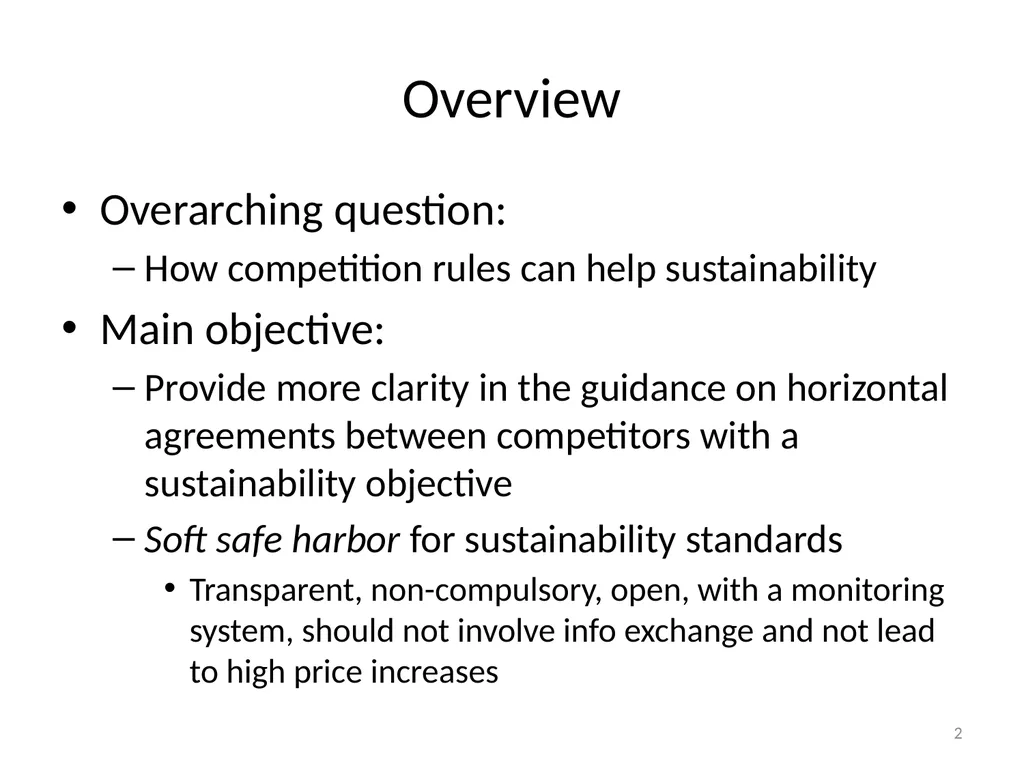
Overview Overarching question:
How competition rules can help sustainability
Main objective:
Provide more clarity in the guidance on horizontal agreements between competitors with a sustainability objective
Soft safe harbor for sustainability standards
Transparent, non-compulsory, open, with a monitoring system, should not involve info exchange and not lead to high price increases 2<br>
03
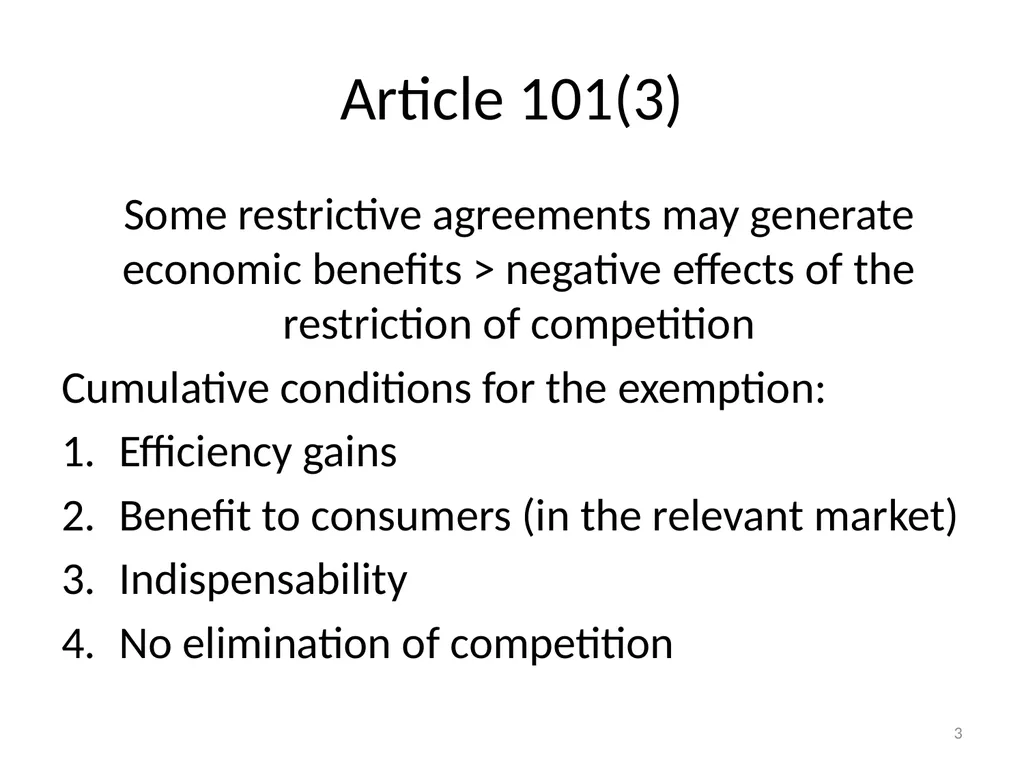
Article 101(3) Some restrictive agreements may generate economic benefits > negative effects of the restriction of competition
Cumulative conditions for the exemption:
Efficiency gains
Benefit to consumers (in the relevant market)
Indispensability
No elimination of competition 3<br>
04
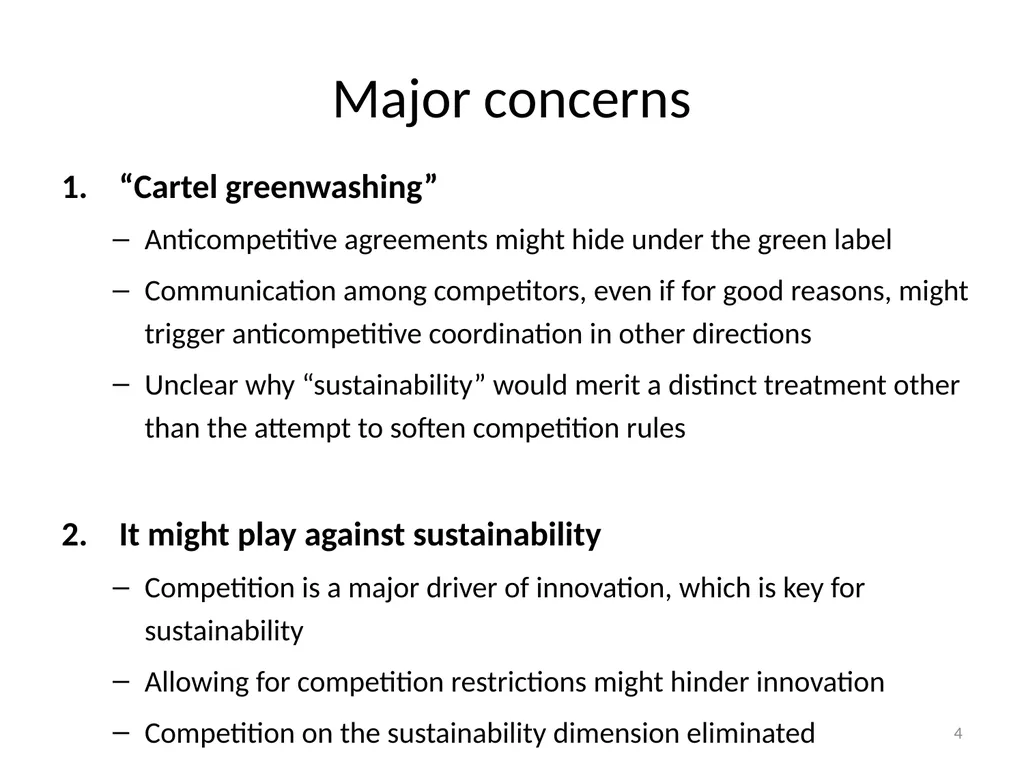
Major concerns “Cartel greenwashing”
Anticompetitive agreements might hide under the green label
Communication among competitors, even if for good reasons, might trigger anticompetitive coordination in other directions
Unclear why “sustainability” would merit a distinct treatment other than the attempt to soften competition rules
It might play against sustainability
Competition is a major driver of innovation, which is key for sustainability
Allowing for competition restrictions might hinder innovation
Competition on the sustainability dimension eliminated 4<br>
05
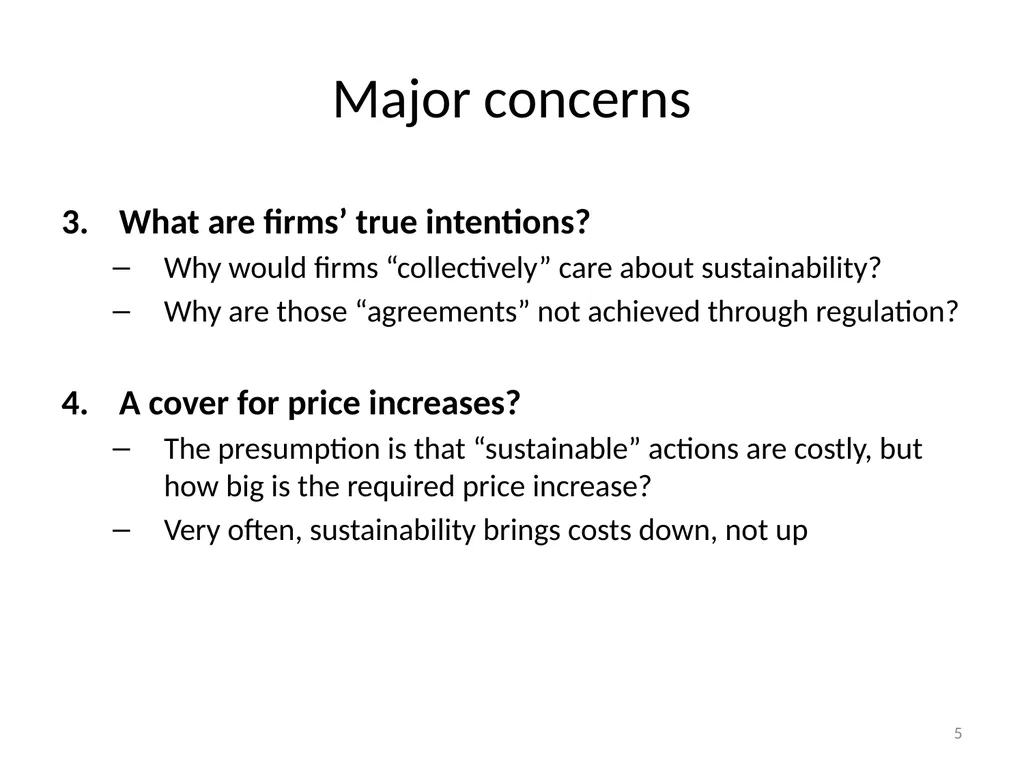
Major concerns What are firms’ true intentions?
Why would firms “collectively” care about sustainability?
Why are those “agreements” not achieved through regulation?
A cover for price increases?
The presumption is that “sustainable” actions are costly, but how big is the required price increase?
Very often, sustainability brings costs down, not up 5<br>
06
A very cautious assessment of
the sustainability agreements is required! 6<br>
07
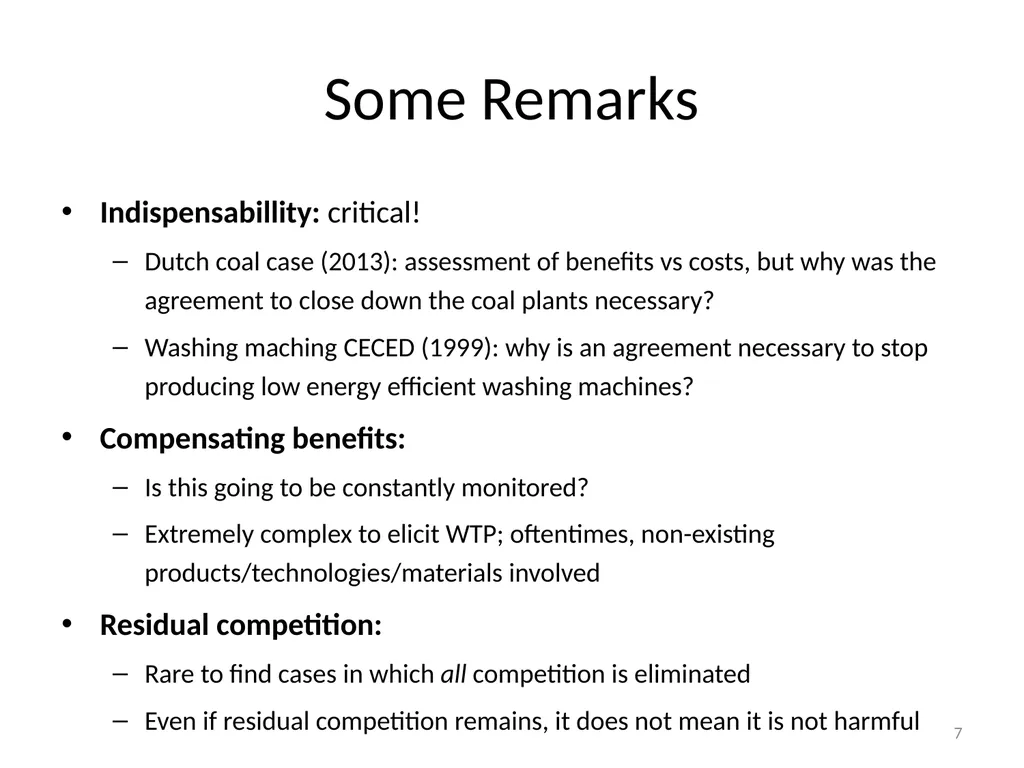
Some Remarks Indispensabillity: critical!
Dutch coal case (2013): assessment of benefits vs costs, but why was the agreement to close down the coal plants necessary?
Washing maching CECED (1999): why is an agreement necessary to stop producing low energy efficient washing machines?
Compensating benefits:
Is this going to be constantly monitored?
Extremely complex to elicit WTP; oftentimes, non-existing products/technologies/materials involved
Residual competition:
Rare to find cases in which all competition is eliminated
Even if residual competition remains, it does not mean it is not harmful 7<br>
08
Sustainability efforts bring in positive externalities but it is unclear whether the way to foster them is through a lenient interpretation of competition policy 8<br>