Sustainability in Economic and Social Context - Rocky Mehera, USQ Multiple Case Explorations of Australian Banking Organisations Creating Social and Economic Value: Application of Shared Value Framework International Sustainability
"Sustainability in Economic and Social Context -" is the property of its rightful owner. Permission is granted to
download and print the materials on this website for personal, non-commercial use only, and to display it
on your personal computer provided you do not modify the materials and that you retain all copyright
notices contained in the materials. By downloading content from our website, you accept the terms of this
agreement.
Presentation Transcript
01
Sustainability in Economic and Social Context - Rocky Mehera, USQ Multiple Case Explorations of Australian Banking Organisations Creating Social and Economic Value: Application of Shared Value Framework
International Sustainability Conference
Cairns, 17-19 Jan<br>
02
Harvard Academics in Value Creation Total firm-value leading to maximisation of social welfare (Jensen, 2010)
Collective Impact movement (Kania and Kramer, 2011) for competitive advantage
investments in long-term business competitiveness that addresses social and environmental objectives (Bockstette and Stamp, (2011)
points of leverage to redefine corporate business strategies for emerging markets (Hill et al., 2012)
embedding social purpose in strategic planning and optimal innovation agenda for co-creation (Pfizer et al.,2013)
Customers’ and investors' interests (Simmons, 2013)<br>
03
Shared Value Creation Model: Definition, Positioning and Avenues Definition: Shared value is a business model encompassing "policies and operating practices that enhance the competitiveness of a company while simultaneously advancing the economic and social conditions in the communities in which it operates" (Porter & Kramer, 2011, p. 66).
Positioning:
Interactive zone of strategy, competitiveness, and innovation for solving unmet social problems while simultaneously creating social and economic value (Presenter, 2018)
interactive arena of social value (social and environmental investments) and business value (competitiveness investments) [Bockstette and Stamp, 2011]
Avenues:
new products/services, customer value/base, efficiency of value chain (Lee et al., 2012)
improving the financial health, extending banking services to financially excluded segment, and impact investing for industry, and regional community (Bockstette et al. 2014)<br>
04
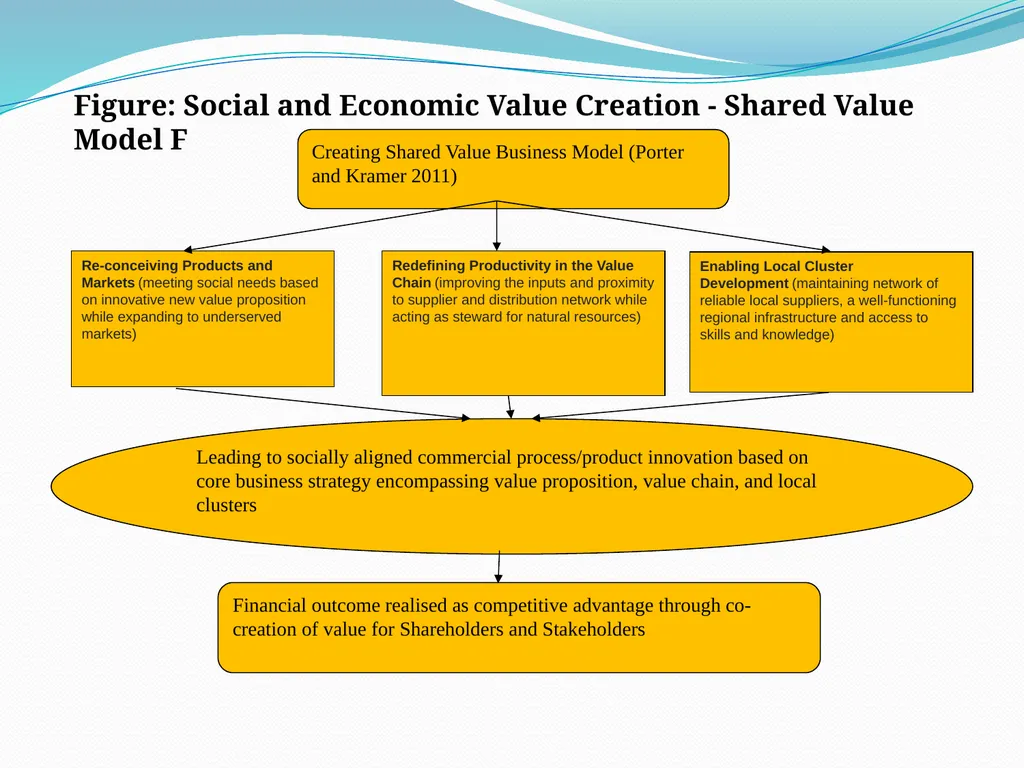
Three Levels: Shared Value Model Re-conceiving products and markets -upgrading value propositions for satisfying unmet social needs by embedding social dimensions in to the socially-aligned commercial product
Re-defining the value-chain- re-configuration of operational practices and productivity (input access, resource utilization, innovation and efficiency) and reduction of socio-environmental constraints in the value chain
Enabling Local Cluster Development- aligning innovative business interests with broader socio-economic issues to strengthen competitive context of regionally concentrated firms and interconnected communities<br>
05
Figure: Social and Economic Value Creation - Shared Value Model F<br>
06
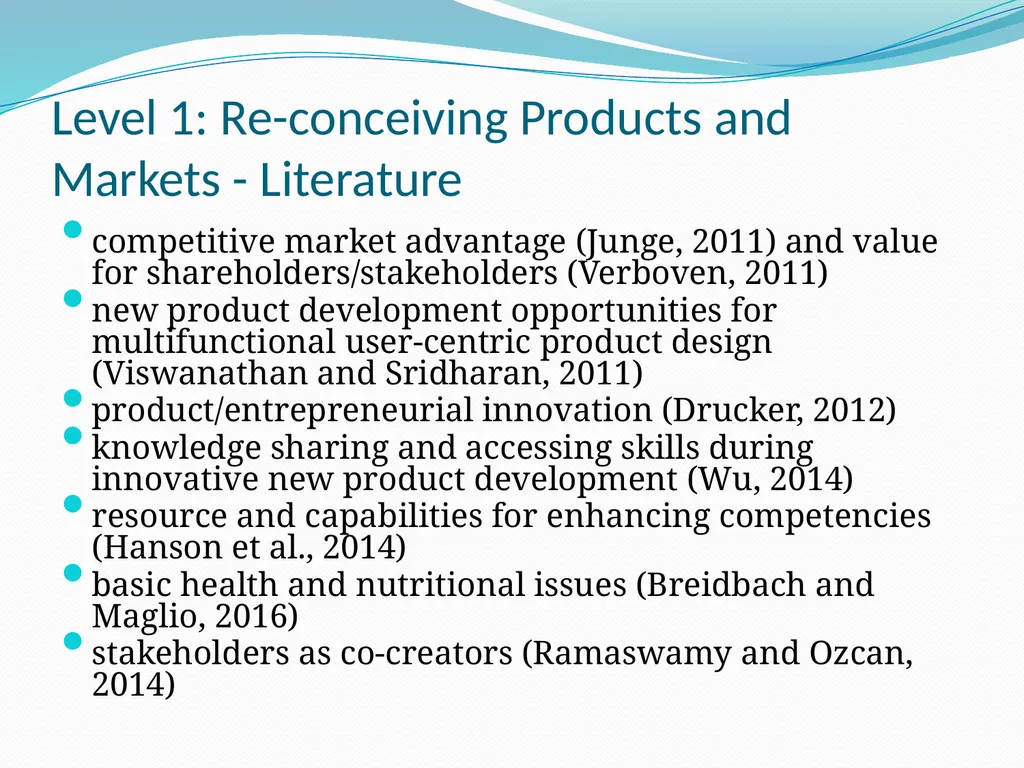
Level 1: Re-conceiving Products and Markets - Literature competitive market advantage (Junge, 2011) and value for shareholders/stakeholders (Verboven, 2011)
new product development opportunities for multifunctional user-centric product design (Viswanathan and Sridharan, 2011)
product/entrepreneurial innovation (Drucker, 2012)
knowledge sharing and accessing skills during innovative new product development (Wu, 2014)
resource and capabilities for enhancing competencies (Hanson et al., 2014)
basic health and nutritional issues (Breidbach and Maglio, 2016)
stakeholders as co-creators (Ramaswamy and Ozcan, 2014)<br>
07
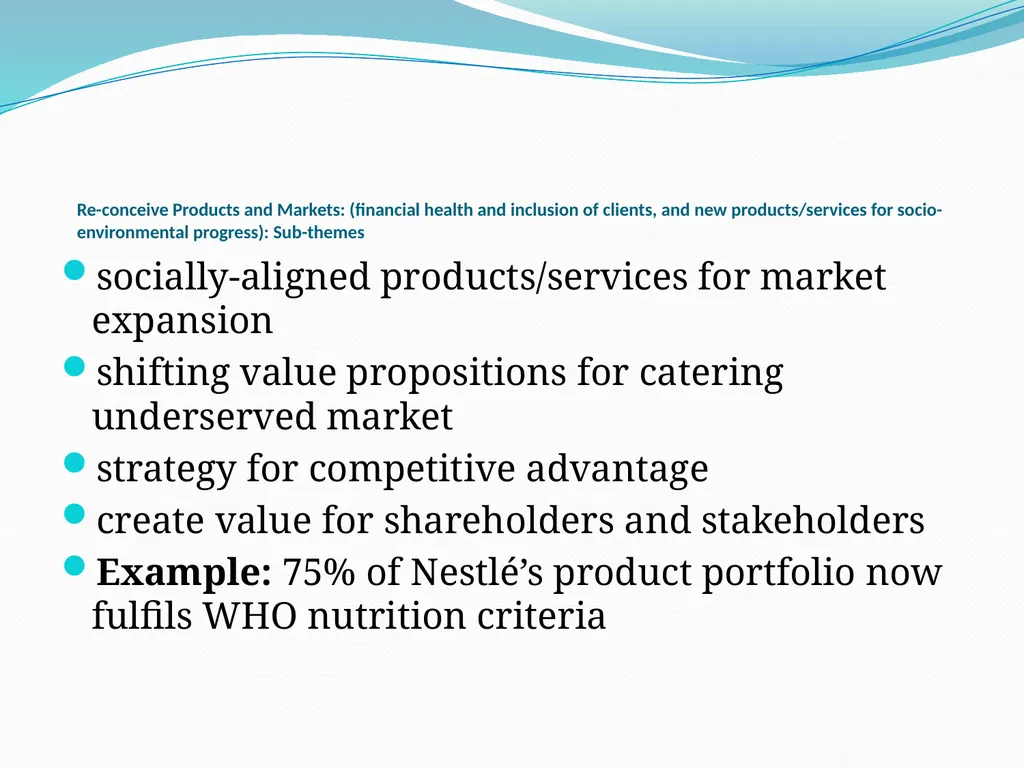
Re-conceive Products and Markets: (financial health and inclusion of clients, and new products/services for socio-environmental progress): Sub-themes socially-aligned products/services for market expansion
shifting value propositions for catering underserved market
strategy for competitive advantage
create value for shareholders and stakeholders
Example: 75% of Nestlé’s product portfolio now fulfils WHO nutrition criteria<br>
08
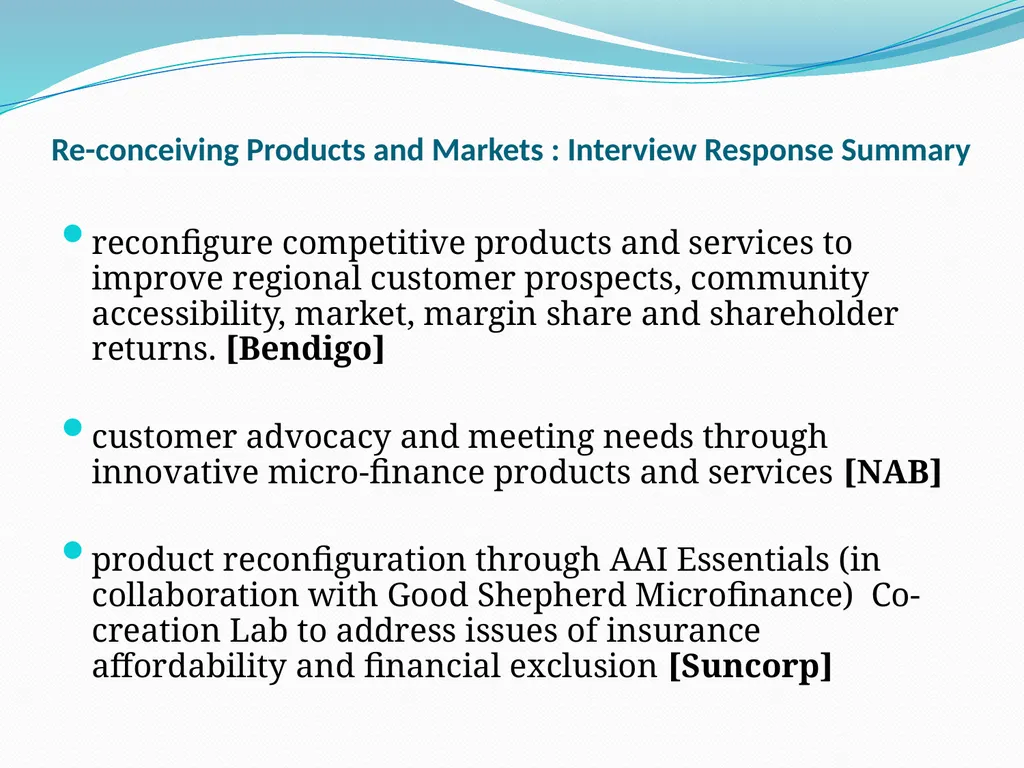
Re-conceiving Products and Markets : Interview Response Summary reconfigure competitive products and services to improve regional customer prospects, community accessibility, market, margin share and shareholder returns. [Bendigo]
customer advocacy and meeting needs through innovative micro-finance products and services [NAB]
product reconfiguration through AAI Essentials (in collaboration with Good Shepherd Microfinance) Co-creation Lab to address issues of insurance affordability and financial exclusion [Suncorp]<br>
09
Level 2: Re-configuration of Value Chain - Literature process efficiency, employee productivity, resource utilisation, sustainable procurement, and localised production (Porter and Kramer, 2011)
supply chain collaboration (Zhang and Huo, 2013), resilience (Golgeci and Ponomarov, 2013), integration (Kamal and Irani, 2014), agility (Harrison et al.,2014), skills access for shared decision (Wu, 2014), optimisation (Von Liel, 2016), and socio-environmental impact (O’Riordan and Fairbrass, 2014)<br>
10
Redefine Productivity in the Value Chain (innovating around financial products, business mechanisms across the entire supply chain): Sub-themes supply chain re-configuration
skills and infrastructural development for supply chain continuity
Example: Yara Fertiliser invested $60 million in building value chain in Africa by creating an agricultural growth corridor<br>
11
Redefining Productivity in the Value Chain: Interview Response Summary Equip Resilience -skills to build up regional resilience through community owned branches [Bendigo]
supplier diversity for collective bargaining for wages, and safety standards [NAB]
addressing skills shortages within organizational supply chain mechanism - example Capital SMART and Synergy Smash Repairs[Suncorp]<br>
12
Level 3: Enabling Local Cluster Development - Literature collaborative supply chain model for regional clusters of related businesses and logistical infrastructure (Kindemann, 2013)
industry clusters (Slaper and Ortuzar,2015) and regional economic development (Slaper and Ortuzar, 2015)
socio-economic inclusion of communities (Dembek et al., 2016)
inclusive local partnerships (United Nations, 2017)<br>
13
Enable Local Cluster Development (Creating an enabling environment: strengthening key players and institutions by clustered collaboration at regional level): Sub-themes Collaboration for Innovative Capabilities
Regional Development
Example: Nestle set out to build agricultural, technical, financial and logistical firms and capabilities in each coffee region<br>
14
Enable Local Cluster Development: Interview Responses local shareholders and governance structure for empowering local communities with jobs, governance, community investment [Bendigo]
innovation fund for research partnership to link natural capital and digital healthcare management with positive financial performance. [NAB]
collaboration with Good Shepherd Microfinance to develop disaster preparedness product for insuring two million excluded low-income people [Suncorp]<br>
15
Areas of Shared Value Opportunities for Banks Furthering Client Prosperity - understanding of customer needs and extending banking services to financially excluded segment
Fuelling Growth of Regional Economies - growing local relationship and economies by banking on industry clusters or supply chains, and long-term financing of under-banked individuals/SMEs
Financing Solutions to Global Challenges - investment to serve the un-catered market and banking client segments, and impact investing markets to finance solutions to critical social and environmental needs<br>
16
Banking Initiatives for Shared Value Creation: Bendigo, NAB, and Suncorp Bendigo Community Engagement Model - community branch (local shareholders) profits reinvested back into community projects (135 million) with growth rate of 18%
NAB Financial Inclusion and Resilience - climate bond, loans for low income earners, and support for loan defaulters (NAB Care)
Suncorp Financial Inclusion, Diversity and Governance - disaster preparedness, community resilience and insurance for low earners<br>
17
Conclusion: partnered and enabled communities to negotiate better terms and conditions with suppliers (Stubbs and Cocklin, 2008) [Bendigo]
aligned customer prosperity with banks initiatives in micro-finance and natural value (NAB)
tap new areas of affordable insurance through community resilience and partnerships (Suncorp)<br>