
SWT04211 SOCIAL WORK FIELD INSTRUCTION Topic 1 :
CB
Published · 264 slides · 0 views

1 / 1































Description
SWT04211 SOCIAL WORK FIELD INSTRUCTION Topic 1 : Concepts of Social Work Field Practice Learning Tasks By the end of the topic learners are expected to: Explain the meaning of social work field education Explain aims of Social Work Field
Related Topics
Share
Embed code
Download this presentation From Below
"SWT04211 SOCIAL WORK FIELD INSTRUCTION Topic 1 :" is the property of its rightful owner. Permission is granted to download and print the materials on this website for personal, non-commercial use only, and to display it on your personal computer provided you do not modify the materials and that you retain all copyright notices contained in the materials. By downloading content from our website, you accept the terms of this agreement.
Presentation Transcript
01
SWT04211
SOCIAL WORK FIELD INSTRUCTION<br>
02
Topic 1 : Concepts of Social Work Field Practice<br>
03
Learning Tasks By the end of the topic learners are expected to:
Explain the meaning of social work field education
Explain aims of Social Work Field Education
Explain objectives of Fieldwork Practicum<br>
Explain the meaning of social work field education
Explain aims of Social Work Field Education
Explain objectives of Fieldwork Practicum<br>
04
Cont… Explain importance of Fieldwork
Identify key Actors in Fieldwork Practice
Identify roles of key actors in fieldwork<br>
Identify key Actors in Fieldwork Practice
Identify roles of key actors in fieldwork<br>
05
Definition of Social Work Field Education<br>
06
Activity1: Buzzing Buzz on the following question:
Define Social Work, Social Work Field Education and related terms (if any)<br>
Define Social Work, Social Work Field Education and related terms (if any)<br>
07
Social work Social work is the professional activity of helping individuals, groups, or communities to enhance or restore their capacity for social functioning and creating societal conditions favorable.<br>
08
Field education Field education in social work is experiential form teaching and learning in which the student (learner) is helped to:-
Consciously bring selected knowledge to the practice situation.<br>
Consciously bring selected knowledge to the practice situation.<br>
09
Cont… Develop competence in performing practice skills
Learn to practice within the frame-work of social work values and ethics<br>
Learn to practice within the frame-work of social work values and ethics<br>
10
Cont… Develop a professional commitment to social work practice
Evolve a practice style consistent with personal strengths and capacities
Develop the ability to work effectively within a social agency.<br>
Evolve a practice style consistent with personal strengths and capacities
Develop the ability to work effectively within a social agency.<br>
11
Aims of Social Work Field Education The overall aim of Social Work field education is to produce professionally reflective, self-evaluating, knowledgeable and competent social workers. Through field education, students are oriented to field work rules and procedures as they are planning to undergo practical training.<br>
12
Cont… It is an instrument that is used to initiate students into the profession through among others, inculcation and assimilation of social work values, ethics and principles. Aims of field instruction can be summarized in the following manner:<br>
13
Cont… To enable the students apply, (in real life situations but under the careful guidance of a social work agency) some of the knowledge, skills and attitudes acquired in the classroom.
To enable the school to evaluate the student’s ability to perform grow and develop as a professional person and at the same time to evaluate the school educational programme.<br>
To enable the school to evaluate the student’s ability to perform grow and develop as a professional person and at the same time to evaluate the school educational programme.<br>
14
Cont… To serve as channel of information in feeding back to the school the changing needs of the field which can then be meaningfully incorporated in the social work educational programme.<br>
15
Objectives of Fieldwork Practicum<br>
16
Activity: Small group discussion Discuss the following question below:
Discuss the objectives of field education<br>
Discuss the objectives of field education<br>
17
Objectives of Fieldwork Practicum The overall objective of field work practicum is to give students an opportunity to apply theories and knowledge leant in class room into real life setting. The main objectives of field practicum at NTA level 4, 5 and 6 are:-<br>
18
Cont… To enable students apply, (in real life situations but under the careful guidance and supervision of a competent social worker) some of the knowledge, skills and attitudes acquired in the classroom.<br>
19
Cont… To enable the school to evaluate the student’s ability to perform, grow and develop as a professional person and at the same time to evaluate the school educational programme.<br>
20
Cont… To serve as channel of information in feeding back to the school the changing needs of the field which can then be meaningfully incorporated in the social work educational programme.<br>
21
Importance of Fieldwork Fieldwork as a method of instruction in social work training has many benefits which include the following:-<br>
22
Opportunity to translate theoretical knowledge into practice Fieldwork is intended to help a student to translate theoretical content covered in the classroom to real life situations as part of a student’s preparation to become a professional social worker.<br>
23
cont… It is through opportunities to practice that students assimilate the social work principles, values and ethics of the profession. It takes more than academic fitness, but also evidence-based knowledge, field- tested skills and a wealth of hands- on-experience to become a fully backed social worker<br>
24
Alignment and appropriateness Fieldwork is an opportunity for bring into line theoretical knowledge and learning with the needs of society and the marketplace. Through fieldwork students have opportunities to translate the acquired theory into practice which affords them a chance to realize what works and what may not work in different social work settings.<br>
25
Cont… Fieldwork also provides students with the opportunity to take responsibility for addressing people’s problems. Theory informs practice and practice informs theory so through fieldwork, new knowledge is developed while testing the already acquired knowledge.<br>
26
Cont… Therefore, if executed effectively, fieldwork becomes an important tool in developing a social work curriculum that is appropriate and responsive to topical social development issues.<br>
27
Socialization Fieldwork is an instrument of socialization since it prepares the student for future roles as a social work practitioner. It also contributes to the development of a professional identity, using critical self-reflection in their practice at an early stage.<br>
28
Cont… “In social work, field education is the signature pedagogy, the central form of instruction and learning in which a profession socializes its students” (CSWE EPAS, 2008, p.8). The general purpose of fieldwork is therefore, to acquaint students with actual social work situations in preparation for professional social work practice.<br>
29
Skills building Fieldwork also enables students to acquire skills for responding appropriately to the needs of clients and society in general. Examples of such skills include engagement and rapport building, assessment, intervention and termination that are central to the problem solving process.<br>
30
Key Actors in Fieldwork Practice and their Roles The main actors in the field work include; department of social work, Fieldwork coordinator, Field work consultant, social service agency, agency supervisor and social work students.<br>
31
Cont… The roles of each actor need to be properly understood from the onset in order to facilitate a meaningful organization and experience of fieldwork.<br>
32
Activity: Small group discussion Into small manageable groups discuss the following question below:
Discuss the roles of key implementers in field education<br>
Discuss the roles of key implementers in field education<br>
33
Roles of key implementers in field education<br>
34
The Agency The social agency in which the placement occurs also plays a significant role. The agency must be committed to participating in the educational effort from its board down to its staff if the student is to have the maximum opportunity of learning.<br>
35
Cont… The agency must be ready to offer or provide quality services to its clientele for the benefit of the student. The agency administrator (field coordinator) is the central person who can assist the field instructor to prepare for the role, provide space, resources for care and maintenance of field program.<br>
36
The Field Instructor The field instructor has the role of teaching the student, read the student’s work and at the same time participate in the school’s varied activities for Field Instructors.<br>
37
Cont… He or she is a link between the school and the agency in the instructional process. This is a difficult task which requires knowledge of both the school and the agency.<br>
38
Cont… As a field instructor, he/ she has the responsibility for individualizing the learning opportunities to best meet the needs of each student.
She should acquire skills in educational assessment as well as skills in teaching in order to be the competent field instructor.<br>
She should acquire skills in educational assessment as well as skills in teaching in order to be the competent field instructor.<br>
39
The Student The student cannot be a passive learner in field instruction. He or she is required to participate in shaping the learning experience to meet his or her individual learning needs.<br>
40
Cont… Though their learning objectives developed by the school, and service orientation and goals of the agency, the student as an adult learner should be ready to negotiate and seek for an individualized learning experience.<br>
41
Cont… Field instruction is often an assumption and expectations that the students are functioning as an adult learner and who is able to assume responsibility for the learning experience.<br>
42
The Client The client or client system cannot be ignored in the process of Field Instruction. There has to be careful planning by all parties to assure that the quality of service to clients is not seriously compromised for the sake of student learning.<br>
43
Cont… Clients have a right to expect when they seek help from social agencies. Therefore the field instructor the agency administrator, and student should meet and discuss if there are problems regarding the service delivery by the student or agency.<br>
44
Cont… Once roles and responsibilities of each party in field instruction are clear considerable effort is still required to establish and maintain linkages which facilitate the desired interaction of the parties.<br>
45
Cont… The process is sometimes loaded with issues which demand constant attention. All parties should devote considerable effort to resolve or minimize problems by maintaining positive working relationships.<br>
46
Key Points Field instruction is a central part of social-work professional education and provides students with an opportunity to practice and integrate theory in the field under the guidance and instruction of an experienced field instructor.<br>
47
Evaluation What is social work field education?
What are the aims of Social Work Field Education?
What are the objectives of Fieldwork Practicum?
What is the importance of Fieldwork?<br>
What are the aims of Social Work Field Education?
What are the objectives of Fieldwork Practicum?
What is the importance of Fieldwork?<br>
48
References: Cooper L & Briggy L (2000) Fieldwork in the human services, theory and practice for field educators, practice teachers and supervisors, Allen & Unwin, St. Leonards
Dhemba, J. (2012). Fieldwork in social work education and training: issues and challenges in the Case of Eastern and Southern Africa. Available on www.socwork.net/sws/article/ view/310. Accessed on 3, December 2016.<br>
Dhemba, J. (2012). Fieldwork in social work education and training: issues and challenges in the Case of Eastern and Southern Africa. Available on www.socwork.net/sws/article/ view/310. Accessed on 3, December 2016.<br>
49
Cont… Parker J (2008).Effective practice learning in social work, Learning Matters Ltd, Southernhay East.
URT(2017) Field practicum manual for certificate and diploma in social work<br>
URT(2017) Field practicum manual for certificate and diploma in social work<br>
50
End of topic 1 Questions/comments<br>
51
Topic 2a: Field PracticumOrganization and Requirements<br>
52
Learning Tasks: By the end of the topic Learners are expected to:
Explain Social service agency structure
Describe procedures for Seeking field placement Agencies<br>
Explain Social service agency structure
Describe procedures for Seeking field placement Agencies<br>
53
Cont… Describe Guidelines on the Selection of Field Agencies
List Expectations from Fieldwork Experience (training institutions, placement agencies and students)<br>
List Expectations from Fieldwork Experience (training institutions, placement agencies and students)<br>
54
Definition of Social services, Social Services agency<br>
55
Activity: Think, Pair and Share Think in pair on the following question:
Definition of Social services and Social Services agency, (if any)<br>
Definition of Social services and Social Services agency, (if any)<br>
56
Social services Social services are a range of public services provided by the government, private, and non-profit organizations<br>
57
Social Service Agency Social Service Agency It is an instrument of the people, who represent organized efforts of the people who meet specific purpose in order to meet specific human needs.<br>
58
Composition Social Service Agency structure<br>
59
Activity: Buzzing Buzz on the following question:
What is the composition Social Service Agency structure?<br>
What is the composition Social Service Agency structure?<br>
60
Social Service Agency structure is composed of the following:-<br>
61
Staff It is always advisable for a social agency to employ a receptionist and other staff members such as social worker, IT personnel, office attendant etc.<br>
62
Physical Surroundings It is important that, the social agency has a small room/library where reading materials - books and newspapers can be available for the client’s use.<br>
63
Cont… The office should have necessary materials like table, chairs, benches, stationery.
A separate toilet or latrine for male and female clients to use when they come to the agency<br>
A separate toilet or latrine for male and female clients to use when they come to the agency<br>
64
Cont… Television, Toys or play materials for children to keep them busy, while their parents are attending to an interview or group discussion at the agency. This will allow the parents to concentrate with the interview/discussion with a few interruptions from their children.<br>
65
Cont... A sign board to show the location of the Agency should be in place. Also it is good to have brochures and leaflets which show the types of services offered<br>
66
Procedures for Seeking field placement Agencies The current practice by most of social work training institutions in Tanzania is that individual students are responsible for securing their own placements.<br>
67
Cont… Students are advised to start seeking placement sites immediately after commencement of semester two of their studies. Field coordinators are responsible for offering field introduction letters for field work placement seeking.<br>
68
Cont…. In case of difficulties in securing placements, students are advised to contact the fieldwork coordinator for assistance in securing appropriate placements but this should be after proven effort by the student.<br>
69
Cont… In order to ensure that appropriate placements are secured, there are some guidelines to follow when selecting and applying for placements in various agencies.<br>
70
Cont… After being accepted at a particular Agency for field practice, students are required to submit their field work placement information to the Field coordinator or Head of Department for onward arrangements prior to commencement of field practicum.<br>
71
Cont… The fieldwork placement information to be submitted includes; agency name, address and contact personnel.<br>
72
Guidelines on the Selection of Field Agencies<br>
73
Activity: Brainstorming Brainstorm on the following question:
Discuss the key issues that should be considered in the selection of a fieldwork agency.<br>
Discuss the key issues that should be considered in the selection of a fieldwork agency.<br>
74
Fieldwork agency. Apart from government institutions, Tanzania has also a wide range of NGOs which usually offer placements to social workers; these also provide an opportunity for practicing fieldwork. Some general features upon which selection of a fieldwork agency should be based include the following:-<br>
75
a: Relevance to Social Work/Social Work Orientation Social work students need to select organizations that will provide them with the appropriate opportunities to put into practice what they are learning and also be able to acquire new knowledge and practical skills.<br>
76
Cont… Students should select organizations where they can get exposure to a wide range of social work roles and responsibilities in their work within the agencies and in the communities.<br>
77
b: Agency’s Commitment to Social Work Values, and Ethics Students need to assess the organizations’ commitment to social work values before they finally select the organization. In case of doubt, they should consult with the fieldwork coordinator for guidance.<br>
78
c: Commitment to Professional Standards of Practice The agency should not discriminate with respect to tribe, gender, age, disability, ethnicity, religion or sex. The primary concern of the agency should be the welfare of clients, which includes the concept of social and economic justice and relevant social action on behalf of clients.<br>
79
d: Willingness to Provide Qualified Personnel and Time for Supervision of the Students. Field supervisors need to allocate some time to fulfill this additional responsibility of helping and mentoring the students in their field practice education.<br>
80
Cont… They need adequate time for this responsibility which may call for some adjusting of the staff roles to what can be accommodated. It is very important that the agency supervisor is willing to supervise the student.<br>
81
e: Willingness to offer Learning Opportunities Agencies should offer students learning opportunities as available, such as staff meetings, in-service programs, student group supervision and seminars, interdisciplinary consultation and meetings, community meetings and events.<br>
82
Expectations of training institutions from students Be professional by dressing appropriately, be dependable and prompt, respectful and receptive.
Bring evidence-informed information from the classroom to the field agency.<br>
Bring evidence-informed information from the classroom to the field agency.<br>
83
Cont… Communicate often and openly with their Field Instructor/supervisor
Be committed to social and economic justice.
Approach those they serve with compassion and a willingness to help.<br>
Be committed to social and economic justice.
Approach those they serve with compassion and a willingness to help.<br>
84
Cont… Talk with their Field Coordinator if students have any concerns.
Be receptive to feedback from their Field Instructor, others in the agency, and the Field Coordinator.<br>
Be receptive to feedback from their Field Instructor, others in the agency, and the Field Coordinator.<br>
85
Cont… Bring “cultural humility” to working with diverse groups, as they learn about various cultures other than their own
Complete all required written work for field thoughtfully and on time.<br>
Complete all required written work for field thoughtfully and on time.<br>
86
Expectations of Fieldwork placement agencies from students Be cooperative and active participant in the learning process.
Able to receive instructions, directives and assignments and complete timely.
Work actively to develop skills and integrate classroom knowledge in the field agency.<br>
Able to receive instructions, directives and assignments and complete timely.
Work actively to develop skills and integrate classroom knowledge in the field agency.<br>
87
Cont… Grow where they are planted (be open and receptive to learning).
Additional member for some tasks but under supervision
Clearly understand and follow social service agency policies and procedures.<br>
Additional member for some tasks but under supervision
Clearly understand and follow social service agency policies and procedures.<br>
88
Expectations of students from Fieldwork Experience<br>
89
Activity: Think, Pair and Share Think on the following question:
Discuss the expectations learners have from fieldwork experiences (if any)<br>
Discuss the expectations learners have from fieldwork experiences (if any)<br>
90
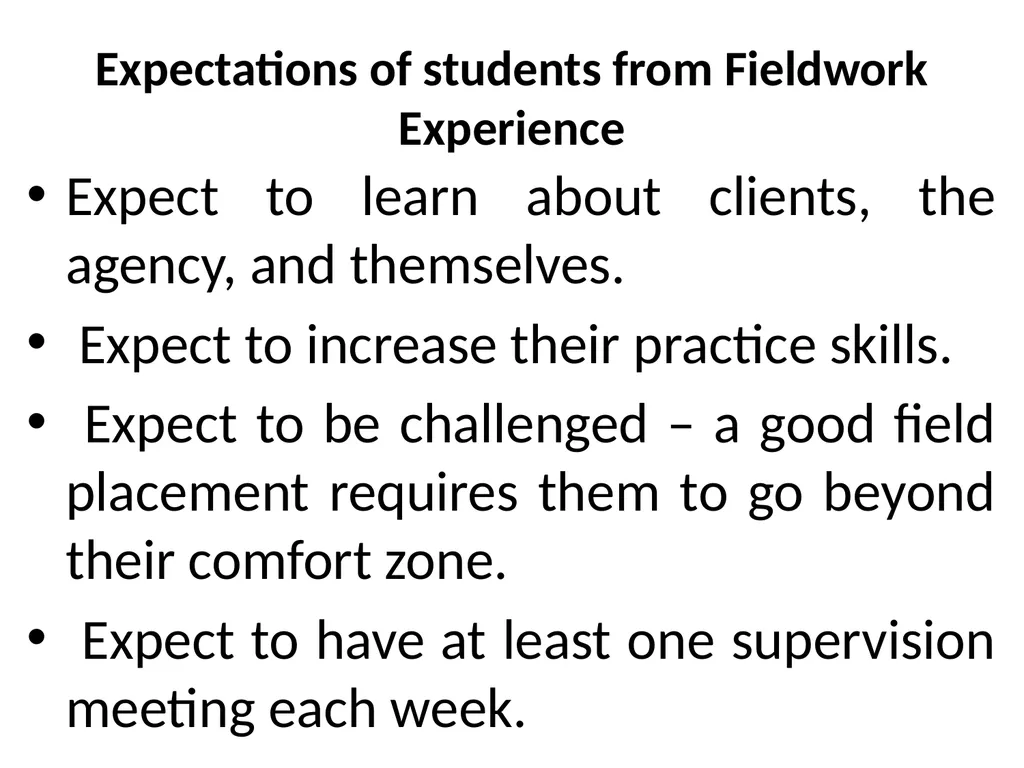
Expectations of students from Fieldwork Experience Expect to learn about clients, the agency, and themselves.
Expect to increase their practice skills.
Expect to be challenged – a good field placement requires them to go beyond their comfort zone.
Expect to have at least one supervision meeting each week.<br>
Expect to increase their practice skills.
Expect to be challenged – a good field placement requires them to go beyond their comfort zone.
Expect to have at least one supervision meeting each week.<br>
91
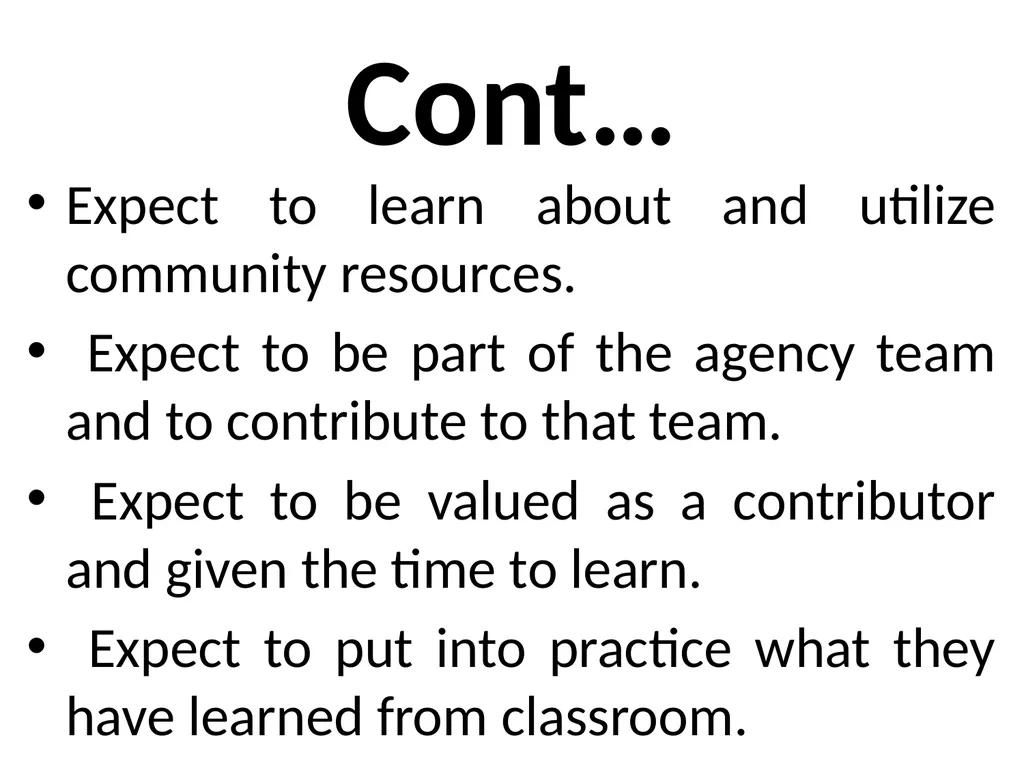
Cont… Expect to learn about and utilize community resources.
Expect to be part of the agency team and to contribute to that team.
Expect to be valued as a contributor and given the time to learn.
Expect to put into practice what they have learned from classroom.<br>
Expect to be part of the agency team and to contribute to that team.
Expect to be valued as a contributor and given the time to learn.
Expect to put into practice what they have learned from classroom.<br>
92
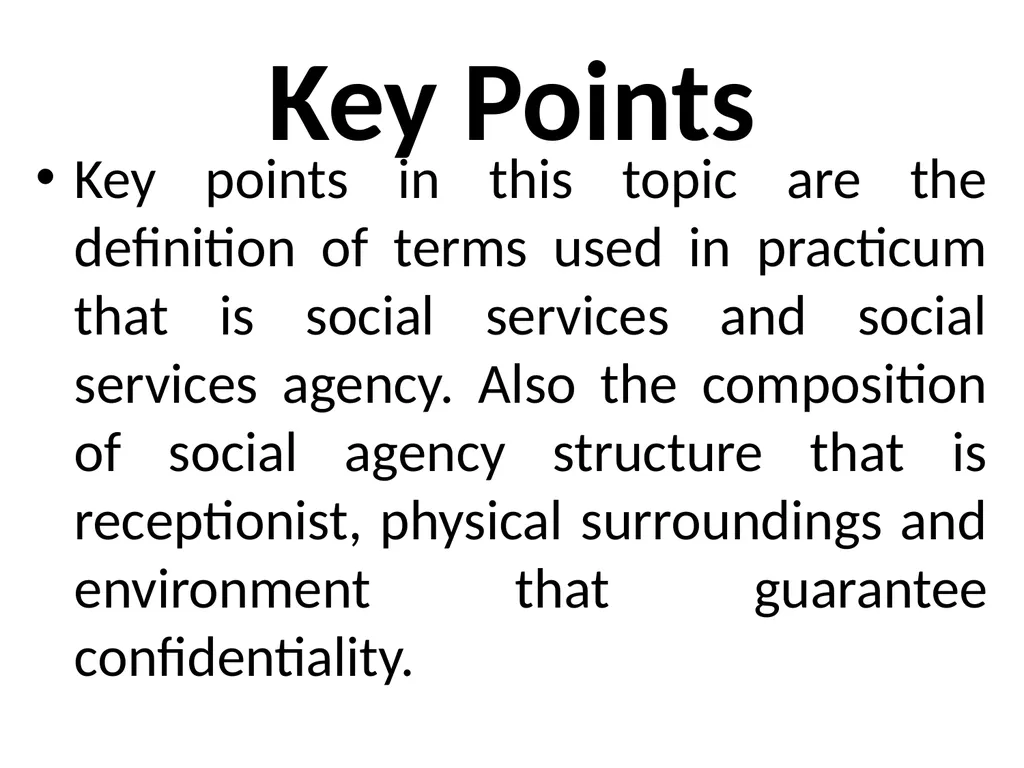
Key Points Key points in this topic are the definition of terms used in practicum that is social services and social services agency. Also the composition of social agency structure that is receptionist, physical surroundings and environment that guarantee confidentiality.<br>
93
Evaluation What are social services?
Which procedures students had to follow when seeking field placement?
What expectations students have from fieldwork experiences?<br>
Which procedures students had to follow when seeking field placement?
What expectations students have from fieldwork experiences?<br>
94
References Cooper L., & Briggy L., (2000). Fieldwork in the human services, theory and practice for field educators, practice teachers and supervisors, Allen & Unwin, St. Leonards
Parker J., (2008).Effective Practice Learning in Social Work, Learning Matters Ltd, Southernhay East.
URT(2017) Field Practicum Manual for Certificate and Diploma in Social Work<br>
Parker J., (2008).Effective Practice Learning in Social Work, Learning Matters Ltd, Southernhay East.
URT(2017) Field Practicum Manual for Certificate and Diploma in Social Work<br>
95
End of topic 2a Questions/comments<br>
96
Topic 2b: The National Task sharing policy guideline; a response to human resources for health shortage<br>
97
Learning Tasks By the end of the topic Learners are expected to:
Explain Task sharing Policy
Describe the objectives of Task sharing Policy
Explain tasks assigned to social workers in Task sharing policy<br>
Explain Task sharing Policy
Describe the objectives of Task sharing Policy
Explain tasks assigned to social workers in Task sharing policy<br>
98
Explanation of Task Sharing Policy Policy is a plan or course of action, as of a government, political party, or business, intended to influence and determine decisions, actions, and other matters.<br>
99
Cont… Task sharing is a systematic process in which specific clinical tasks normally performed solely by health personnel with extensive qualifications are shared with health personnel that have lower qualifications, less specialization, or limited scopes of training.<br>
100
The objectives of Task sharing Policy The overall objective of the task sharing policy guidelines is to accelerate universal health coverage and more effectively respond to the health needs of Tanzanians through the mobilization of available human resources to ensure equity, accessibility, effectiveness and quality in the delivery of essential health care services.<br>
101
This overall objective includes the following specific objectives: Mobilize policy makers and stakeholders to implement task sharing.
Provide a framework to operationalise the policy.<br>
Provide a framework to operationalise the policy.<br>
102
Cont… Promote the best use of the knowledge, skills, and competencies of well-trained mid-level cadres to address health needs of Tanzanians.
Ensure effective implementation through a rigorous monitoring and evaluation plan.<br>
Ensure effective implementation through a rigorous monitoring and evaluation plan.<br>
103
Cont… Students on field work should be aware that, a situation may arise when they can be mentored and oriented and then assigned to share different tasks apart from their specific social work profession.<br>
104
Tasks assigned to social welfare assistants in Task sharing
policy With Task sharing approach mid-level health care professionals, after being on job trained or oriented and demonstrate some sort of competency in the task assigned are allowed to perform some of the clinical tasks and procedures that were restricted to the higher level clinical professionals.<br>
105
Recommended tasks to be shared by Social Welfare Assistants at dispensary level include: Provision of Preventive & Curative Services at Dispensary and community
Family history taking and social diagnostic
ii. HIV/AIDS
Provision of Anti-Retroviral Treatment (Refill)<br>
Family history taking and social diagnostic
ii. HIV/AIDS
Provision of Anti-Retroviral Treatment (Refill)<br>
106
Cont… iii. Reproductive and Child Health Services
Provision of basic Family Planning commodities
Health education / health talk
Filling of Health Management Information System/District Health
Information System (HMIS/DHIS)<br>
Provision of basic Family Planning commodities
Health education / health talk
Filling of Health Management Information System/District Health
Information System (HMIS/DHIS)<br>
107
Cont… iv. Deliveries
Filling of Health Management Information System/District Health Information System (HMIS/DHIS)<br>
Filling of Health Management Information System/District Health Information System (HMIS/DHIS)<br>
108
Cont… v. Postnatal Care
Weighing of under-fives and growth monitoring
Filling of Health Management Information System/District Health Information System (HMIS/DHIS)
Health Talk<br>
Weighing of under-fives and growth monitoring
Filling of Health Management Information System/District Health Information System (HMIS/DHIS)
Health Talk<br>
109
Cont… vi. Safety Precautions and Quality Improvement Services
Decontamination process using four buckets and Jik/Chlorine 0.5%
Sterilization<br>
Decontamination process using four buckets and Jik/Chlorine 0.5%
Sterilization<br>
110
Cont… Waste Management (segregation, transportation, storage and disposal)
Ensuring 5s (Sort, Set in order, Shine, Standardize and Sustain) implementation
Cleaning environment<br>
Ensuring 5s (Sort, Set in order, Shine, Standardize and Sustain) implementation
Cleaning environment<br>
111
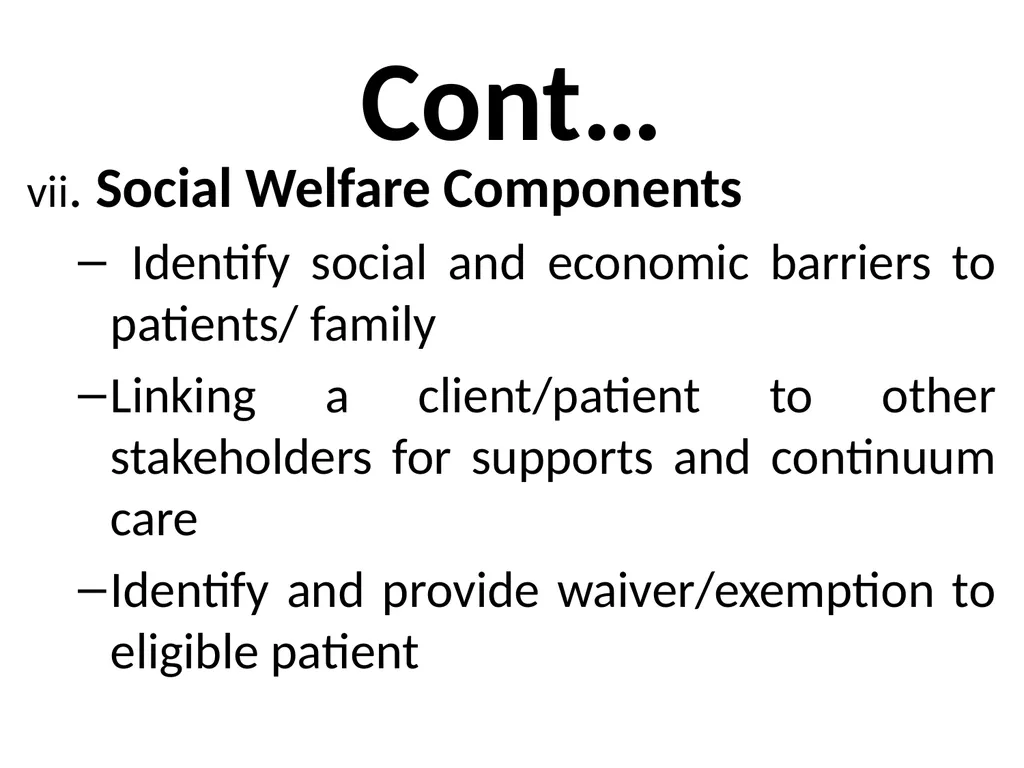
Cont… vii. Social Welfare Components
Identify social and economic barriers to patients/ family
Linking a client/patient to other stakeholders for supports and continuum care
Identify and provide waiver/exemption to eligible patient<br>
Identify social and economic barriers to patients/ family
Linking a client/patient to other stakeholders for supports and continuum care
Identify and provide waiver/exemption to eligible patient<br>
112
Key Points Task sharing involves the rational redistribution of tasks among health workforce teams at various levels within the health system.<br>
113
Cont… Specific tasks related to health care delivery are shared, where appropriate, among health workers with different qualification levels in the same profession or in other profession including social work in order to make more efficient use of the available human resources for health.<br>
114
Evaluation What is Policy?
What is task sharing policy?
What are the objectives of task sharing policy?
What are the tasks assigned to social welfare assistants in Task sharing policy?<br>
What is task sharing policy?
What are the objectives of task sharing policy?
What are the tasks assigned to social welfare assistants in Task sharing policy?<br>
115
References Cooper L., & Briggy L., (2000). Fieldwork in the human services, theory and practice for field educators, practice teachers and supervisors, Allen & Unwin, St. Leonards
Parker J., (2008). Effective practice learning in social work, Learning Matters Ltd, Southernhay East.<br>
Parker J., (2008). Effective practice learning in social work, Learning Matters Ltd, Southernhay East.<br>
116
Cont… URT (2017). Field practicum manual for certificate and diploma in social work
URT (2016). Task sharing policy guidelines for health sector services intanzania, Ministry of Health, Community Development, Gender, Eldersand Children<br>
URT (2016). Task sharing policy guidelines for health sector services intanzania, Ministry of Health, Community Development, Gender, Eldersand Children<br>
117
End of topic 2b Questions/comments<br>
118
Topic 3: Concepts of Social Work Field Practice<br>
119
Learning Tasks By the end of the topic learners are expected to:
Explain the meaning of Self-preparation for a positive entry into the agency
Explain Orientation and familiarization into the Agency<br>
Explain the meaning of Self-preparation for a positive entry into the agency
Explain Orientation and familiarization into the Agency<br>
120
Cont… Demonstrate Ethical Conduct in Field Work Practicum
Apply Safety Guidelines in the Field practicum agency<br>
Apply Safety Guidelines in the Field practicum agency<br>
121
Explanation of self preparation and its steps<br>
122
Activity: Think, Pair and Share What is self preparation in field instruction?<br>
123
Self preparation in field instruction All necessary arrangements and information a social work student is required to know in a certain social agency in order to fit better in the agency.<br>
124
Cont… When we talk about fitting in an agency, we are referring to the way social workers are employed in agency as new workers and how they are going to know the office policies, the client systems and the other helping social agencies in the community and how they are going to work with, and how they are supposed to be part of the agency workforce.<br>
125
Things to consider during self preparation The first thing is that a student needs to have a good understanding of the agency/organization which he/she would like to be attached. This means that a student must take sometimes to study the organization by reading documents, reports and any information that may be relevant.<br>
126
Cont… Also talk to people within and outside the organization about the nature and services offered by the organization. It is important to understand the functions, policies and the structure of the organization.<br>
127
Cont… It is also very relevant for a student to have an understanding of the target population (the client/consumers). This is important because some organizations are not flexible as they maybe just providing some of the services and not all; and they may be providing services to a specific group of people<br>
128
Orientation and familiarization into the Agency Orientation means getting the basic information that tells the learner where you are and to get where you want to go. In practicum orientation give a social work student the basic information about the agency, his/her position, the target population so she can understand how to go where she want to go.<br>
129
Cont… Familiarization means to make something well known, for the case of field practicum it mean that to make all issues necessary for practicum are well known to students.<br>
130
Ethical Conduct in Field Work Practicum<br>
131
Activity: Role Play Role play on the following scenario:
A social worker attending client with mental illness,
one volunteer to be social worker and client and the rest to observe ethical conduct of social worker while attending client<br>
A social worker attending client with mental illness,
one volunteer to be social worker and client and the rest to observe ethical conduct of social worker while attending client<br>
132
The role play should depict the following elements of ethical conduct:- Social Work Profession code of conduct
Tanzania Public service code of conduct
Agency code of conduct<br>
Tanzania Public service code of conduct
Agency code of conduct<br>
133
Cont…. Students should know that they not only represent the profession, they also represent their institutions as well as themselves and their families, so they should adhere to the-<br>
134
Cont… professional code of conduct in the course of their fieldwork and at all times (see Tanzania Association of Social Workers (TASWO) and International Federation of Social Workers (IFSW) Code of conduct.<br>
135
Cont… Students should also observe the Tanzania public service code of conduct while attending clients. Students are expected to conduct themselves professionally, responsibly and ethically at all times.<br>
136
Cont… Students should adhere to the code of conduct of the agency in which they are placed. A professional appearance may be essential because students will actually interact with different categories of people, and get involved in a variety of tasks at their placements.<br>
137
Cont… Learner should observe Social work core values of: Service for all in need, Human dignity and worth of every individual; Social justice, professional Integrity, importance of human relationship and competency must guide all practice during fieldwork as much as they do for all social workers.<br>
138
Cont… Social work students should be aware of and adhere to the professional obligations linked to protection of the rights of those they are serving. In some agencies for example, students would be required to sign commitments for child protection agreements; confidentiality clauses and similar documents.-<br>
139
Cont… These must be adhered to. Any involvement in corruption and misappropriation of resources, abuse and violation of client rights and any other conduct contrary to the professional and agency code of conduct will lead to automatic disqualification of the student and termination from field work practice.<br>
140
Safety Guidelines in the Field practicum agency<br>
141
Activity: Role Playing Role on the following scenario:
A student social worker attending drug addict client, students to discuss if a social worker observe the safety guidelines<br>
A student social worker attending drug addict client, students to discuss if a social worker observe the safety guidelines<br>
142
The role play should depict the following safety guidelines in the field practicum: - Agency Protocol, It is important for students to know the agency’s protocol for safety and security. The following are guidelines and suggestions that may be helpful to students, field instructors, and faculty advisors as they consider the particular safety issues in their settings.<br>
143
Cont… Specific steps taken by students or agency personnel will obviously have to be determined by the individual situation, the nature of the setting, etc. The agency should know the student’ schedule and whereabouts at all times, especially when the student is working outside the building.<br>
144
Cont… Security of Belongings; Students; are advised not to bring their personal belongings to placement settings unless they are intended to use them for field work purposes. In this case the agency may provide students with a secure place to keep belongings while at placement. It is preferable that the space be one that can be locked for example a desk drawer or filing cabinet.<br>
145
Cont… Safety Issues Related to Working with Clients; Social work students work with clients/consumers in a range of settings and situations. Some of these include work with individuals dealing with overwhelming emotions and environmental stressors that result in behaviors that are or appear to be threatening.<br>
146
Cont… These behaviors may include:-swearing, yelling, insulting, threatening or acting to cause physical harm, and other out-of-control behavior. Some individuals may be prone to violence and may possess a weapon.<br>
147
Cont… Others may be intoxicated, high on drugs, in withdrawal, or may have other medical, psychiatric, or neurological disorders. Students should always consult with agency field<br>
148
instructors regarding preparation for and handling of specific situations that are potentially difficult or threatening, such as medical emergencies, suicide or homicide risks, potential abuse of others, and the presence of weapons.<br>
149
Key Points The steps in self preparation includes good understanding of the agency, be aware of the services offered and types of clients served.
Also in practicum settings social work professional values, ethical principles, professional and agency code of conduct are essential to be observed.<br>
Also in practicum settings social work professional values, ethical principles, professional and agency code of conduct are essential to be observed.<br>
150
Evaluation What is self-preparation?
What is orientation and familiarization?
What are the safety guidelines in the field practicum agency?<br>
What is orientation and familiarization?
What are the safety guidelines in the field practicum agency?<br>
151
References Baird, B. N., (2005). The internship, practicum, and field placement handbook: a guide for the helping professions, (4th ed) Upper Saddle River, NJ: Practice Hall
Corey,G. et al, (2003). Issues & Ethics in the helping professions, Pacific Grove, CA: Wadsworth Group<br>
Corey,G. et al, (2003). Issues & Ethics in the helping professions, Pacific Grove, CA: Wadsworth Group<br>
152
Cont… Cournoyer, B. (2000). The social work skills workbook, (3rd ed). Belmont, CA: Wadsworth
Royse D., Dhooper S. S., & Rompf E. L (2012). Field instruction, a guide for social work student, Pearson Education Inc, USA<br>
Royse D., Dhooper S. S., & Rompf E. L (2012). Field instruction, a guide for social work student, Pearson Education Inc, USA<br>
153
End of topic 3 Questions /comments<br>
154
Learning Tasks By the end of the topic learners are expected to:
Explain the Purpose of Field Practicum Supervision
Define Agency based supervision
Explain the meaning of Consultant supervision<br>
Explain the Purpose of Field Practicum Supervision
Define Agency based supervision
Explain the meaning of Consultant supervision<br>
155
Cont… Explain Criteria for Allocation of Work to the Students
Explain the Focus of supervision
List the Methods of academic supervision
Explain the Assessment and Grading of field practicum activities<br>
Explain the Focus of supervision
List the Methods of academic supervision
Explain the Assessment and Grading of field practicum activities<br>
156
Activity: Buzzing Buzz on the following question:
Definition of supervision and purpose of field practicum supervision<br>
Definition of supervision and purpose of field practicum supervision<br>
157
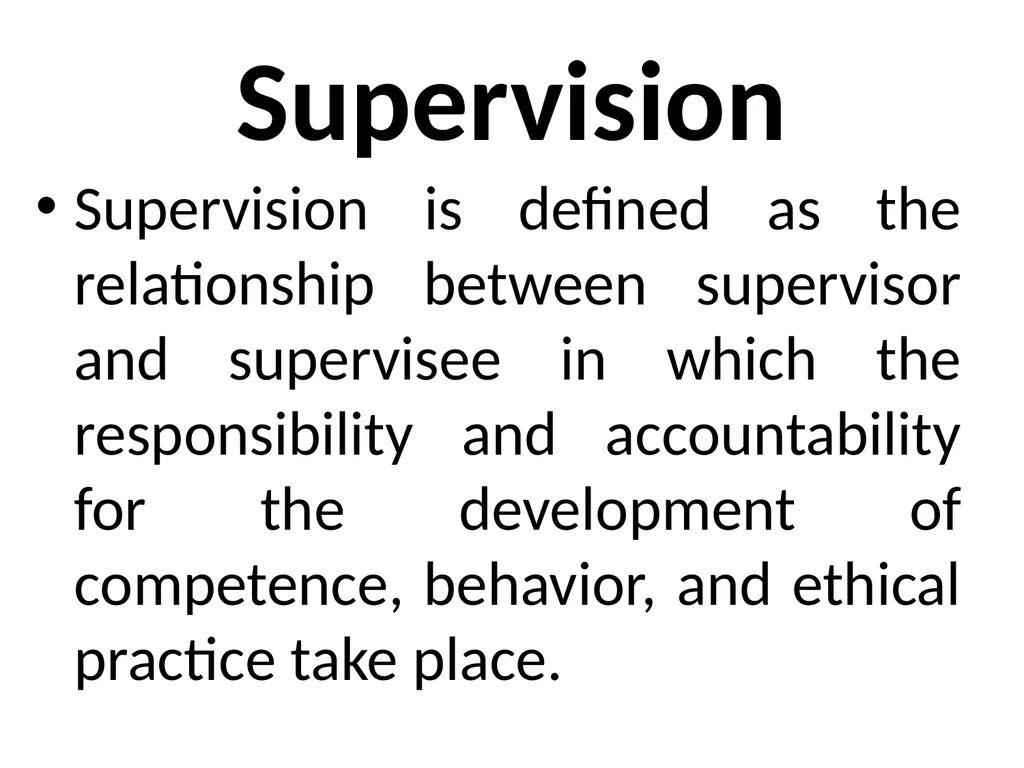
Supervision Supervision is defined as the relationship between supervisor and supervisee in which the responsibility and accountability for the development of competence, behavior, and ethical practice take place.<br>
158
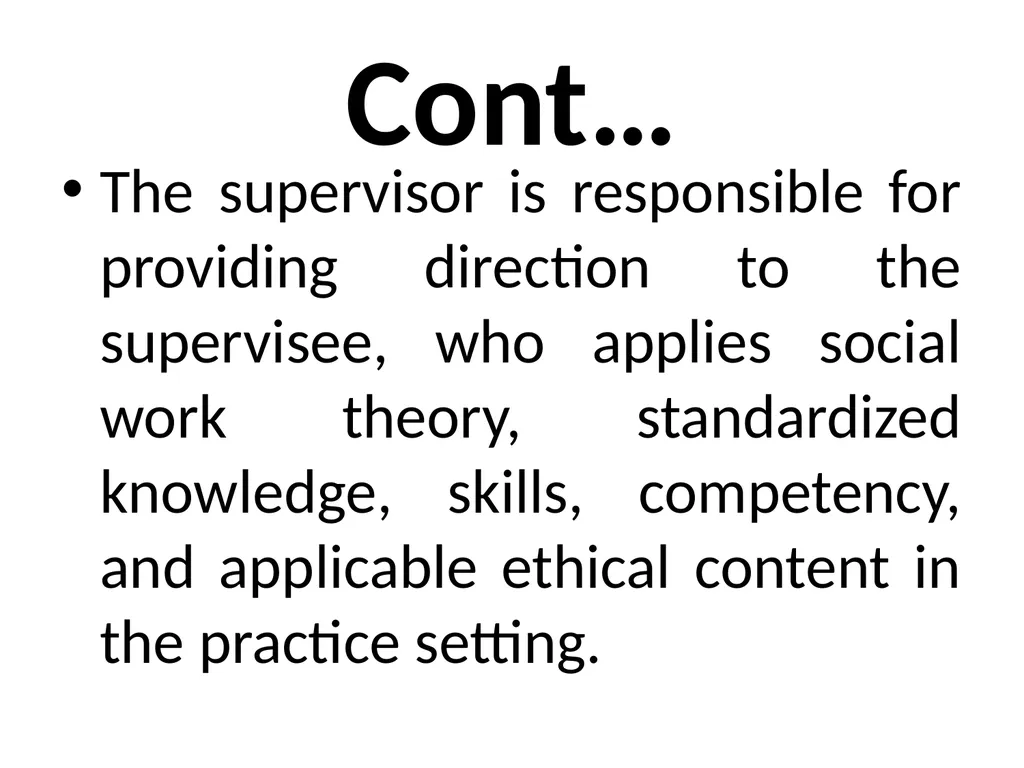
Cont… The supervisor is responsible for providing direction to the supervisee, who applies social work theory, standardized knowledge, skills, competency, and applicable ethical content in the practice setting.<br>
159
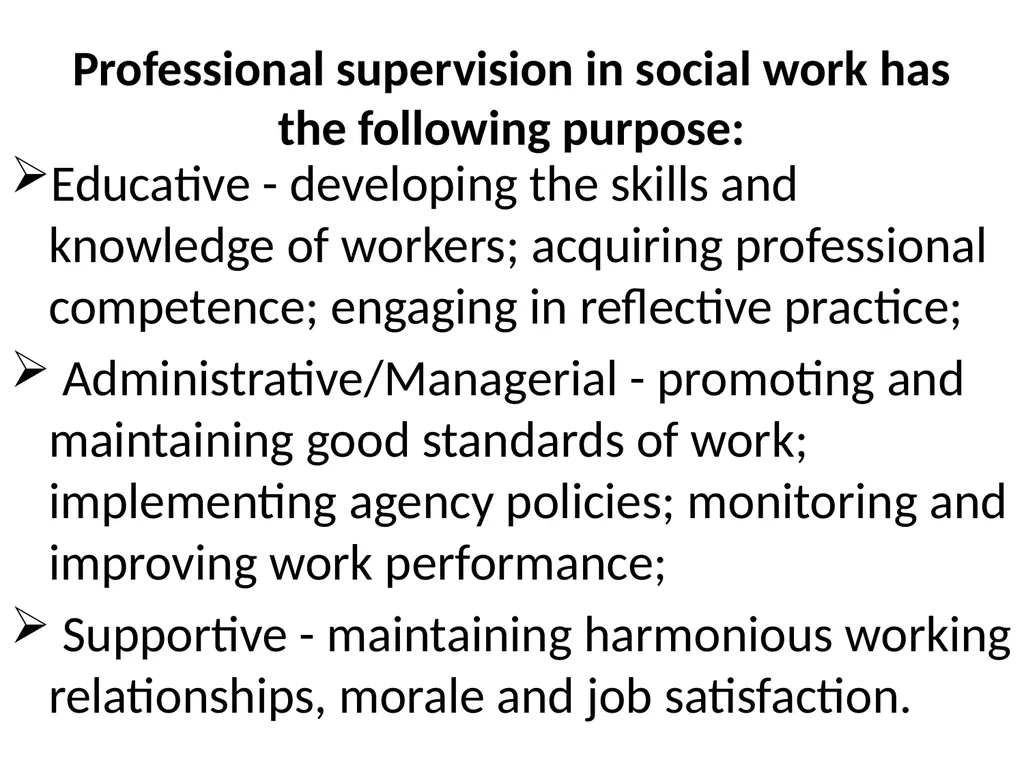
Professional supervision in social work has the following purpose: Educative - developing the skills and knowledge of workers; acquiring professional competence; engaging in reflective practice;
Administrative/Managerial - promoting and maintaining good standards of work; implementing agency policies; monitoring and improving work performance;
Supportive - maintaining harmonious working relationships, morale and job satisfaction.<br>
Administrative/Managerial - promoting and maintaining good standards of work; implementing agency policies; monitoring and improving work performance;
Supportive - maintaining harmonious working relationships, morale and job satisfaction.<br>
160
Agency based supervision<br>
161
Activity: Brainstorming Brainstorm on the following question:
Purpose of agency supervision<br>
Purpose of agency supervision<br>
162
Cont… Students must have agency supervisors to guide them during their placement. The purpose of agency supervision:-
To oversee the learning tasks of the students,
To assist the students with any concerns or dilemmas,
To evaluate the students and provide guidance.<br>
To oversee the learning tasks of the students,
To assist the students with any concerns or dilemmas,
To evaluate the students and provide guidance.<br>
163
Cont… The student should assume increasing responsibility for the focus and content of the supervision meetings. This would include drafting an agenda, providing notes or discussion points prior to the meeting and taking an active role in the meeting.<br>
164
Cont… The agency supervisor should also use the supervisory meetings to raise concerns about the student’s performance.<br>
165
The meaning of Consultant supervision<br>
166
Activity: Buzzing Buzz on the following question:
Describe the meaning of consultant supervision<br>
Describe the meaning of consultant supervision<br>
167
Cont… The consultant is an academic supervisor responsible to visit the agency at least twice (preferably at the beginning and near end) to assist the students to put their practical experience into a theoretical perspective.<br>
168
Criteria for Allocation of Work to the Students Some field supervisors may have issues regarding how much and what kind of work they should give to the students who come for placement. Below are some of the points that may guide the agency supervisor in easing this process:-<br>
169
Cont… Student’s interest; the student’s own expressed area of interest as well as the areas that the student feels confident to explore and those they feel less confident.<br>
170
cont… The student’s capacity; the work offered to the student at any time should be within the student’s capacity with some balance between quality and quantity.<br>
171
Cont… Supervisor’s capacity; to study the work given so as to provide sound evaluation of the student should also be an issue to consider.
Previous knowledge, the extent of the student’s previous knowledge of the agency’s work or particular aspects of it.<br>
Previous knowledge, the extent of the student’s previous knowledge of the agency’s work or particular aspects of it.<br>
172
Focus of supervision The focus of supervision should base on the following:-
The capacity to formulate goals, plan strategies of action and initiate and carry them out.
The capacity to form and maintain relationships necessary to enable the particular task to be carried out to completion.<br>
The capacity to formulate goals, plan strategies of action and initiate and carry them out.
The capacity to form and maintain relationships necessary to enable the particular task to be carried out to completion.<br>
173
Cont… The student’s capacity to understand the nature of the problem, the knowledge requirements of particular cases/problems, as well as the student’s ability to handle problems presented at the different stages of the work.<br>
174
Cont… Indications that the student is expressing professional values and ethics in the work or is aware of threats to them from other people.<br>
175
Methods of Academic Supervision A mandatory field visit to each student placement agency can be the primary method of supervision. However, the following methods can be applied as methods of academic supervision.<br>
176
i. Using Work Records In this method, supervision is made based on written accounts by the student submitted before the supervision session.<br>
177
Cont… One way of ensuring proper records is to keep a log book. This log book specifies basic guidelines on what should be recorded. The student explains or analyze why they did particular things in their work as reflected in their records.<br>
178
ii. Sitting in a Student’s Interview with a Client It is possible and allowed with prior arrangement for the supervisor (either the agency or academic supervisor) to sit in the same room as the student in a non- or semi- participative way or can watch a student’s intervention from a distance.<br>
179
Cont… Here the supervisor gets direct access to the student’s ability to apply knowledge, skills and techniques of practice in a particular situation. For Further information please read Field Practicum Manual for Certificate and Diploma in Social Work<br>
180
iii. Use of Video Tape or Audio Recording The student video-tapes or voice records an interview or piece of the intervention they are engaged in. He/she makes this available to the supervisor who then gives feedback and supervisory remarks basing on this particular recording.<br>
181
Cont… The emphasis is on the interaction between the student and the client and their skill in the approach used. It is a useful tool for self learning for any student. The tape can be stored and referred to later in leisure time, played and used as a source of reference.<br>
182
iv. Group Supervision Commonly, supervision tends to be a one to one activity that is between a student and a supervisor. Apart from that, group supervision also exists. Group supervision is a regular pattern of a focused discussion, shared between a fieldwork supervisor and two or more students.<br>
183
Cont… Different models of group supervision exist. For example, it could be a group of students and a supervisor; a group of students supervised individually by their field supervisors; or a meeting as a group with field supervisors.<br>
184
v. Co-working The student and the supervisor can intentionally work together on a problem or project as a method of enhancing the student’s learning. The supervisor provides direct support and guidance to the student as the case or project goes on.<br>
185
vi. Role-playing and Modeling In role-playing, participants try to portray a situation as if it were real, using their knowledge and experience to convey how they think the person they are role playing would behave, think or feel.<br>
186
Cont… Modeling goes on indirectly all the time in a placement, students sharing a room with a colleague will learn and copy their telephone response for example. Modeling may, however, be used for rehearsal (practice how a certain interview might go), for demonstration where the supervisor helps the student through different role plays and modeling on how to handle the situation.<br>
187
The Assessment and Grading of field practicum activities<br>
188
Activity: Buzzing Buzz on the following question:
Definition of assessment, evaluation and grading in field practicum<br>
Definition of assessment, evaluation and grading in field practicum<br>
189
The Assessment and Grading of field practicum activities Assessment is a part of evaluation that specifically refers to assessment type activities, such as the mid and final placement assessments.<br>
190
Cont… The term ‘assessment’ includes any activity that a student undertakes where there is an agreement that an assessment will be made about learning and performance in relation to the specified activity.<br>
191
Cont… Evaluation of student learning refers to an on-going process of making judgments about the value or worth of a student’s learning. It is a collaborative process between the student, field educator and consultant, which is built into the entire placement and starts from the beginning of a student’s placement.<br>
192
Cont… Grading in social work practicum refers to the process of judging the quality of work a student, performance in practicum setting.<br>
193
Key Points Learner should be aware of the reasons for them being placed in a certain agency which includes the following:- student interest, capacity of the student and supervisor and previous knowledge.<br>
194
Evaluation What are the methods of academic supervision?
What are the criteria for allocation of work to the student in a practicum setting?
What is the purpose of field work supervision?<br>
What are the criteria for allocation of work to the student in a practicum setting?
What is the purpose of field work supervision?<br>
195
References Australian Learning and Teaching Council 2010). A Guide to Supervision in social work field education, Australian Learning and Teaching Council, Australia
Royse D., Dhooper S. S., & Rompf E. L., (2012). Field instruction, a guide for social work student, Pearson Education Inc, USA
URT (2017). Field practicum manual for certificate and diploma in social work<br>
Royse D., Dhooper S. S., & Rompf E. L., (2012). Field instruction, a guide for social work student, Pearson Education Inc, USA
URT (2017). Field practicum manual for certificate and diploma in social work<br>
196
End of topic 4 Questions/comments<br>
197
Topic 5: Field Practicum Tools in Recording Field Work Activities and
Report Writing<br>
198
Learning Tasks By the end of the topic learners are expected to:-
Define the Log book
Explain Service Delivery Recording and Reporting at the Agency<br>
Define the Log book
Explain Service Delivery Recording and Reporting at the Agency<br>
199
Cont… Describe Field Work Report Writing Guidelines
Describe The format of the Final Report<br>
Describe The format of the Final Report<br>
200
The Log book<br>
201
Activity: Buzzing Buzz on the following question:
Definition of Log book<br>
Definition of Log book<br>
202
The Log book Log book is a systematic way of recording daily/weekly activities or assignments with the aim of helping students to plan and implementation of activities in practicum setting. The student is required to keep a record of the tasks and activities pursued every day in a Log book.<br>
203
Cont… This Log-Book is part of the official student assessment process. It must not be lost and you are advised to photocopy sig off pages on a regular basis. It should be available for inspection on the day of your assessment.<br>
204
Content of Log book In the log book student should record the following:-
What he/she has done,
How it was done,
Methods used,<br>
What he/she has done,
How it was done,
Methods used,<br>
205
Cont… What was good, what was not good/what went wrong and
Lesson learnt.<br>
Lesson learnt.<br>
206
Cont… The Log book should be signed by the agency supervisor and the academic
supervisor when he/she goes to supervise the student.<br>
supervisor when he/she goes to supervise the student.<br>
207
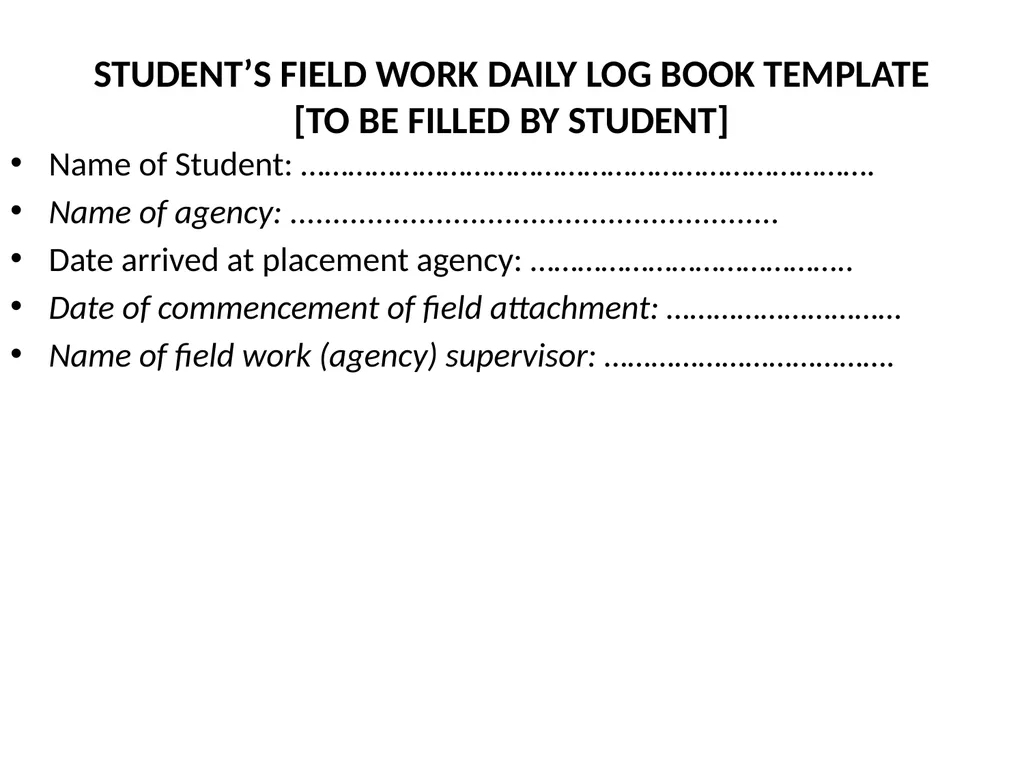
STUDENT’S FIELD WORK DAILY LOG BOOK TEMPLATE
[TO BE FILLED BY STUDENT] Name of Student: ……………………………………………………………….
Name of agency: .........................................................
Date arrived at placement agency: …………………………………..
Date of commencement of field attachment: …………………………
Name of field work (agency) supervisor: ……………………………….<br>
Name of agency: .........................................................
Date arrived at placement agency: …………………………………..
Date of commencement of field attachment: …………………………
Name of field work (agency) supervisor: ……………………………….<br>
208
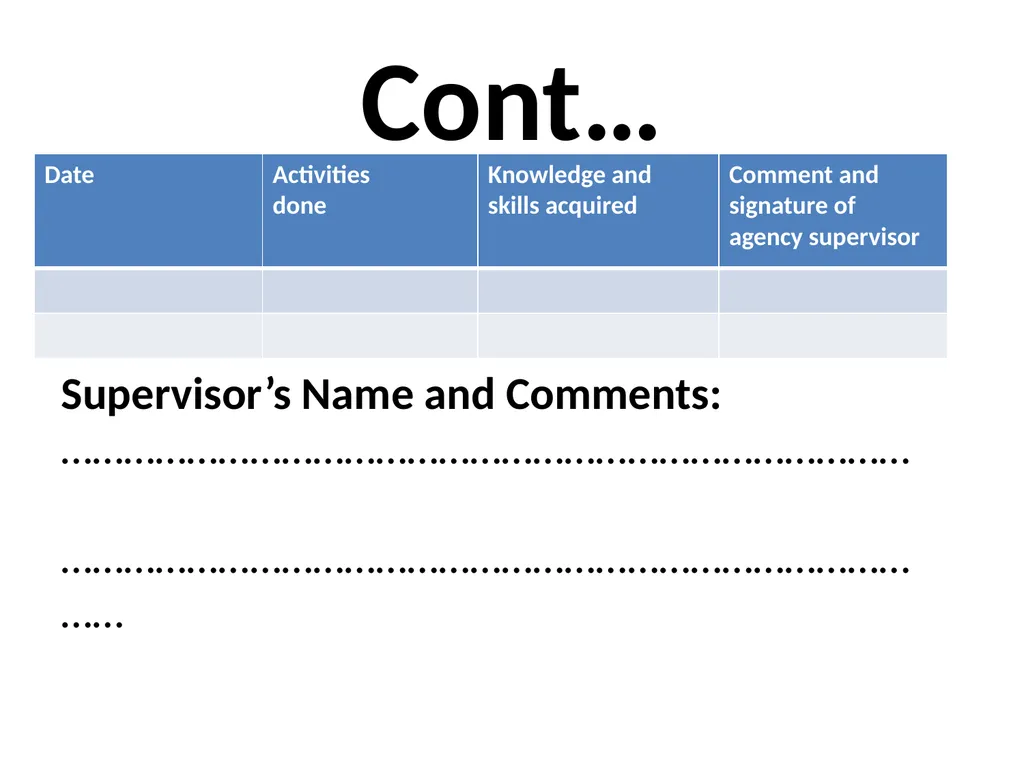
Cont… Supervisor’s Name and Comments:
………………………………………………………………………
……………………………………………………………………………<br>
………………………………………………………………………
……………………………………………………………………………<br>
209
Service Delivery Recording and Reporting at the Agency Recording is mainly the content committed to paper. This may include short historical background of the client, the present problem which he has made him come to the agency, the type of help given, etc. All this information will help both the client and social worker to find a better solution of the problem.<br>
210
The main uses or purposes for keeping records can be summarized as follows:- Records are kept for the purpose of practice, that they ensure adequate services to the clients that is there is proper accountability efficiency and privacy.<br>
211
Cont… Records are kept for administrative purposes that are to review and evaluate the way in which the responsibility or providing services to clients is being provided.<br>
212
Cont… Records are used for teaching and supervision purposes in a way they communicate knowledge and improve skills.
Researchers are helped by records to discover new knowledge which in the long run will assist in social work planning and prevention of social problems occurring in the future.<br>
Researchers are helped by records to discover new knowledge which in the long run will assist in social work planning and prevention of social problems occurring in the future.<br>
213
Cont… Potential Social Workers or trainees learn how to record by writing process records, and record of service during their field work assignments.<br>
214
Reporting at the agency Apart from daily records in the Log book, students are also required to write service delivery reports (weekly or daily) basing on the available policy and format of the hosting agency and submit it to the respective personnel in the organization<br>
215
Report Report is an account of something or a statement about something heard, seen or done.<br>
216
Field Work Report Writing Guidelines<br>
217
Activity: Brainstorming Brainstorm on the following question:
List guidelines to consider when writing field work report<br>
List guidelines to consider when writing field work report<br>
218
Cont… The field work report is the general report of the activities done in the field. This indicates the capacity of the student in performing social work activities. It reflects the academic competency at that level of the student.<br>
219
REPORT WRITING GUIDELINES A report is always addressed to someone thus it is important to analyze the reports audience and determine what information they really need<br>
220
Cont… Determine whether the report you prepare may be passed on to other organizations and possible clients. Keep the reader or readers in mind as you write. In writing a field work report student should consider the following guidelines<br>
221
Cont… A report is always addressed to someone thus it is important to analyze the reports audience and determine what information they really need. Determine whether the report you prepare may be passed on to other organizations and possible clients. Keep the reader or readers in mind as you write.<br>
222
Cont… Decide whether a formal report or just a memo is required. A formal report usually follows the format prescribed by the agency. Before you begin to write, organize the information to be presented in a logical structure. Construct an outline. If you present your ideas in an orderly way, the reader will be more likely to understand you.<br>
223
Cont... Two or three drafts or revisions may be needed before the final version. Ask your peers to review your drafts. Also read the drafts aloud and if it does not sound right, revise it.<br>
224
Cont… Use language that is simple and clear. Avoid words that have different meaning in different contexts. Also avoid using slang or phrases that might offend the reader.<br>
225
The format of the Final Report The following is the proposed format of field work report for Basic certificate and Ordinary Diploma of Social Work students. The format indicates at least the main areas or components of the good report at these social Work levels of study.<br>
226
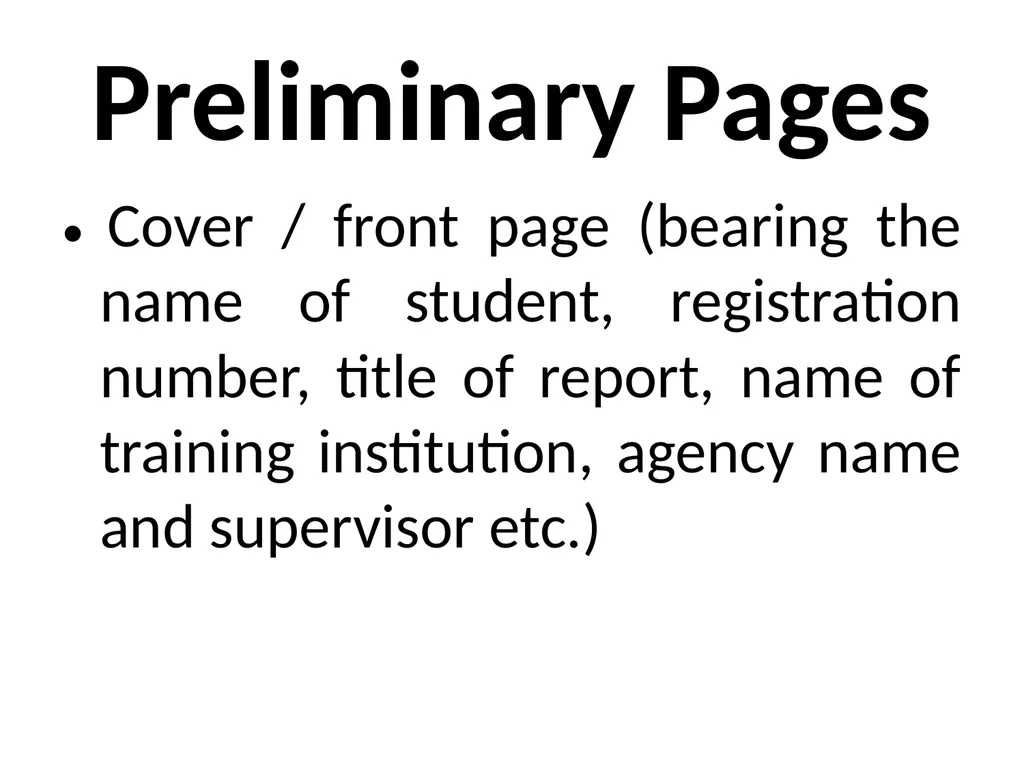
Preliminary Pages • Cover / front page (bearing the name of student, registration number, title of report, name of training institution, agency name and supervisor etc.)<br>
227
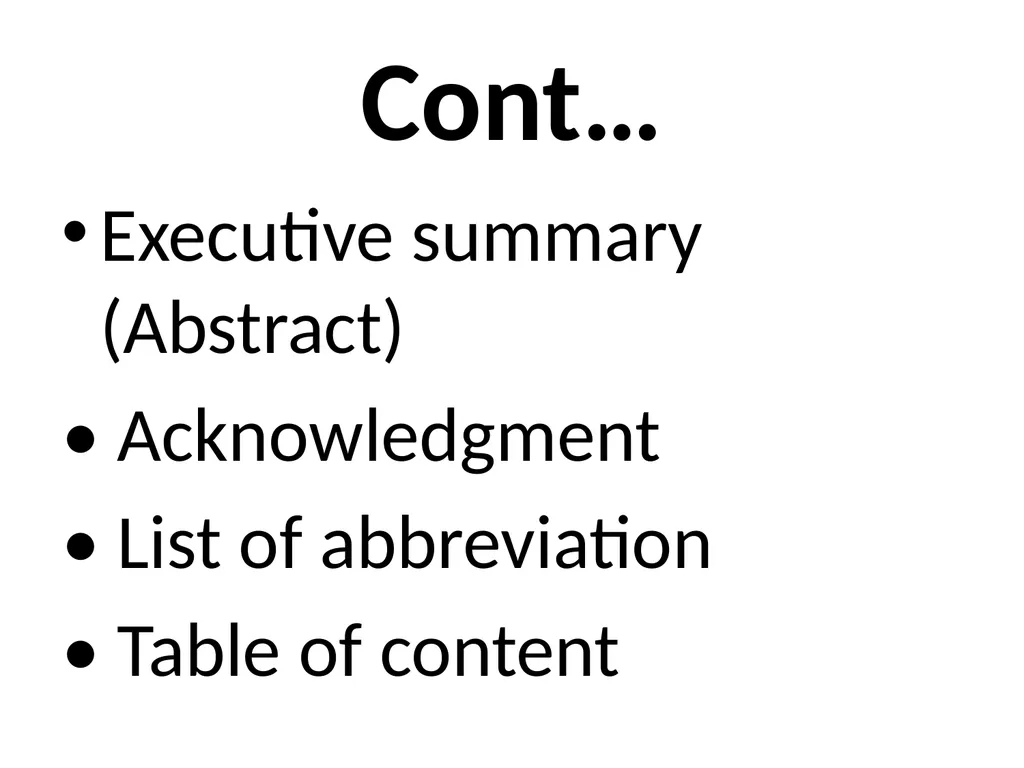
Cont… Executive summary (Abstract)
• Acknowledgment
• List of abbreviation
• Table of content<br>
• Acknowledgment
• List of abbreviation
• Table of content<br>
228
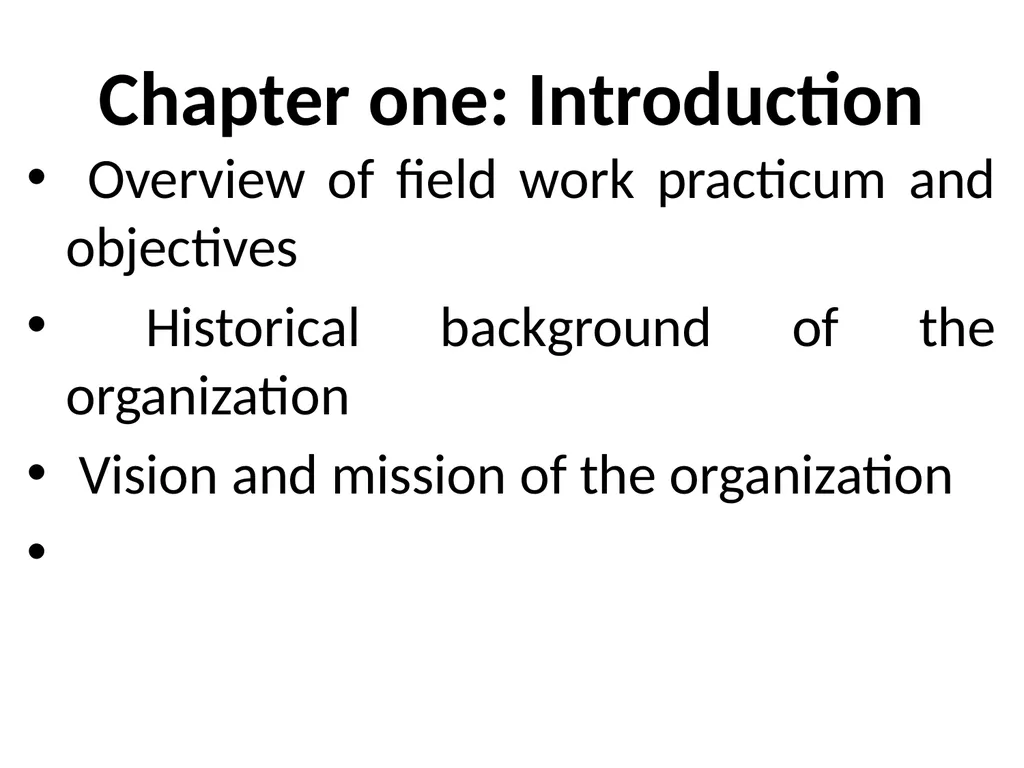
Chapter one: Introduction Overview of field work practicum and objectives
Historical background of the organization
Vision and mission of the organization<br>
Historical background of the organization
Vision and mission of the organization<br>
229
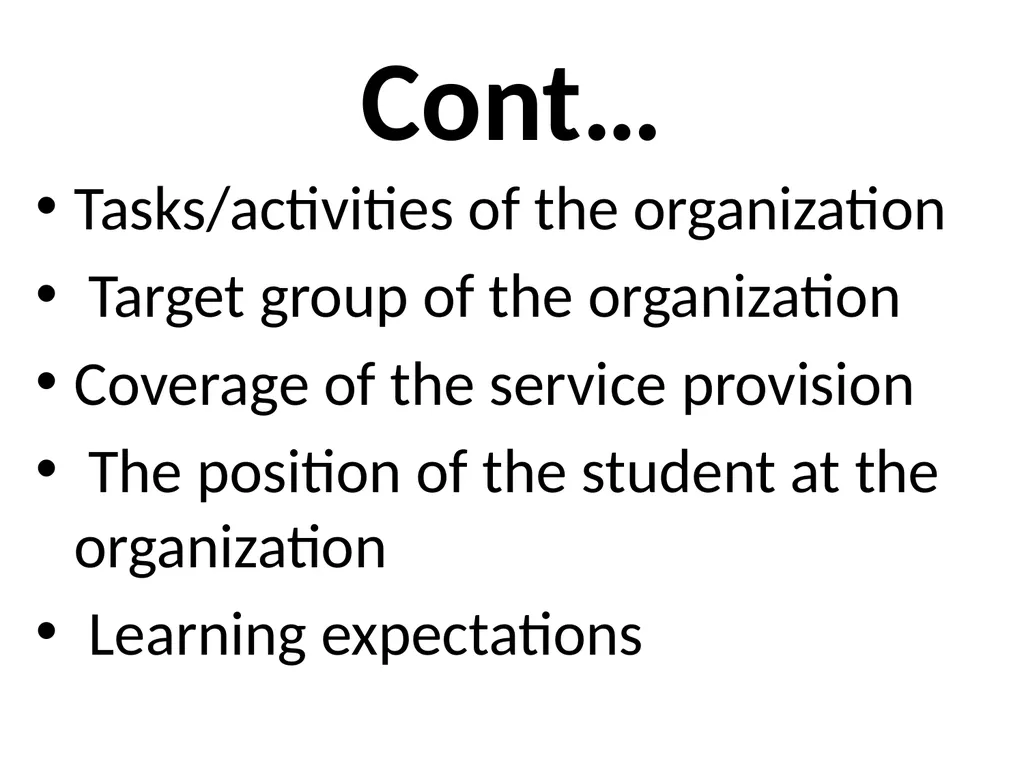
Cont… Tasks/activities of the organization
Target group of the organization
Coverage of the service provision
The position of the student at the organization
Learning expectations<br>
Target group of the organization
Coverage of the service provision
The position of the student at the organization
Learning expectations<br>
230
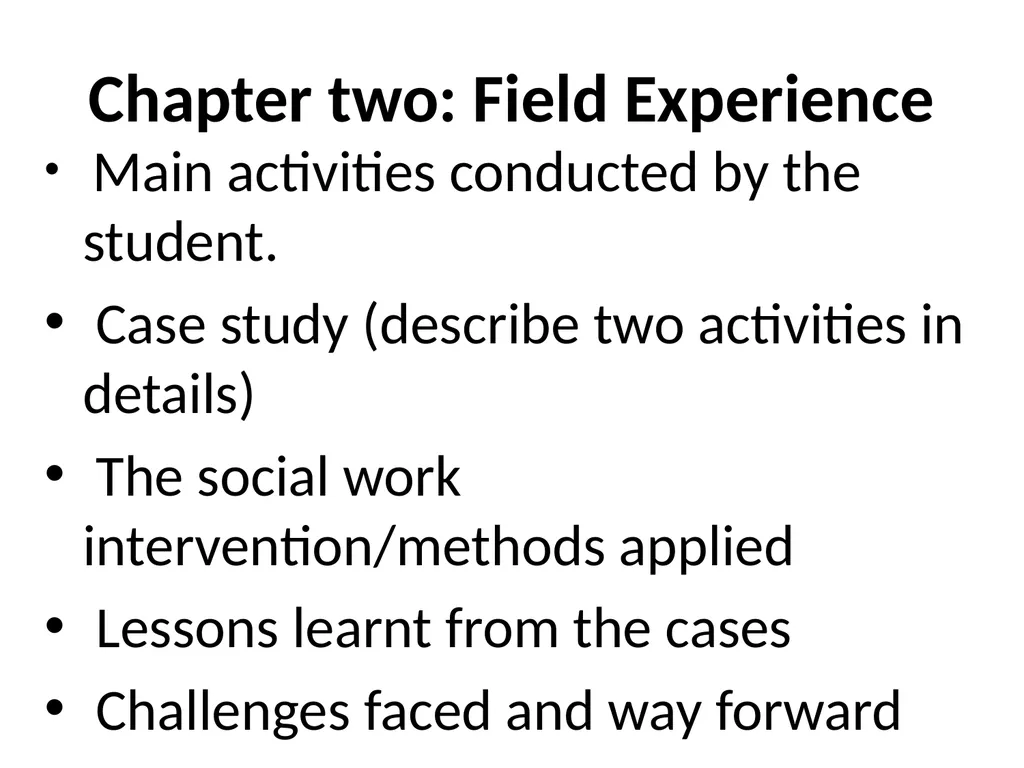
Chapter two: Field Experience Main activities conducted by the student.
Case study (describe two activities in details)
The social work intervention/methods applied
Lessons learnt from the cases
Challenges faced and way forward<br>
Case study (describe two activities in details)
The social work intervention/methods applied
Lessons learnt from the cases
Challenges faced and way forward<br>
231
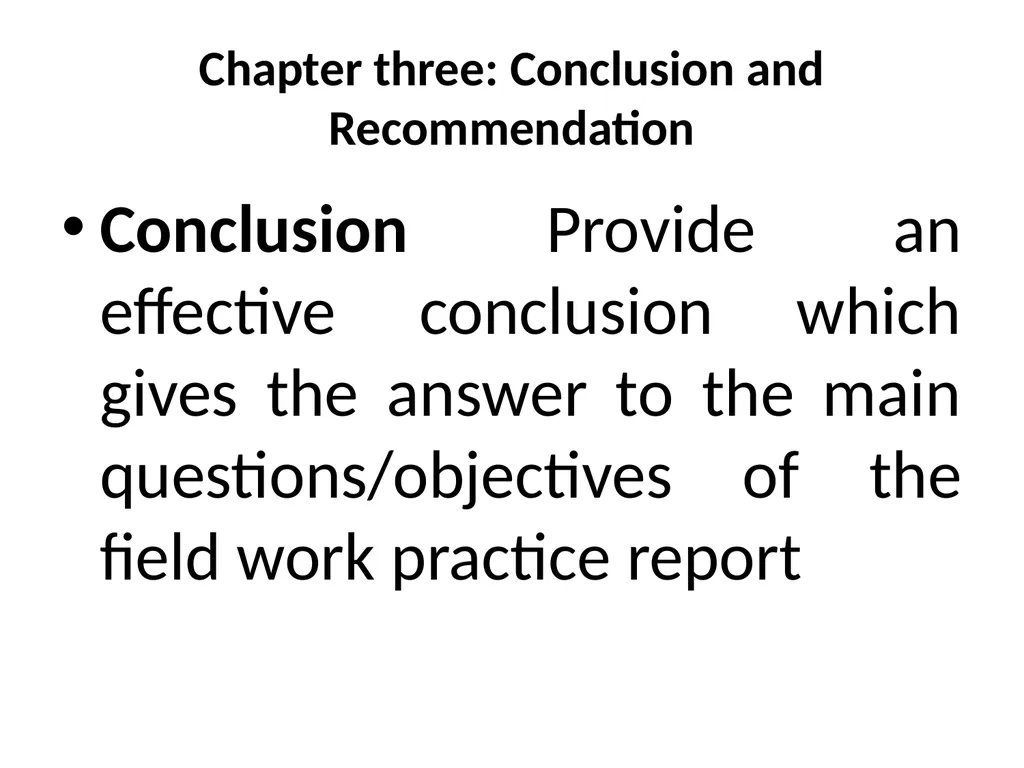
Chapter three: Conclusion and Recommendation Conclusion Provide an effective conclusion which gives the answer to the main questions/objectives of the field work practice report<br>
232
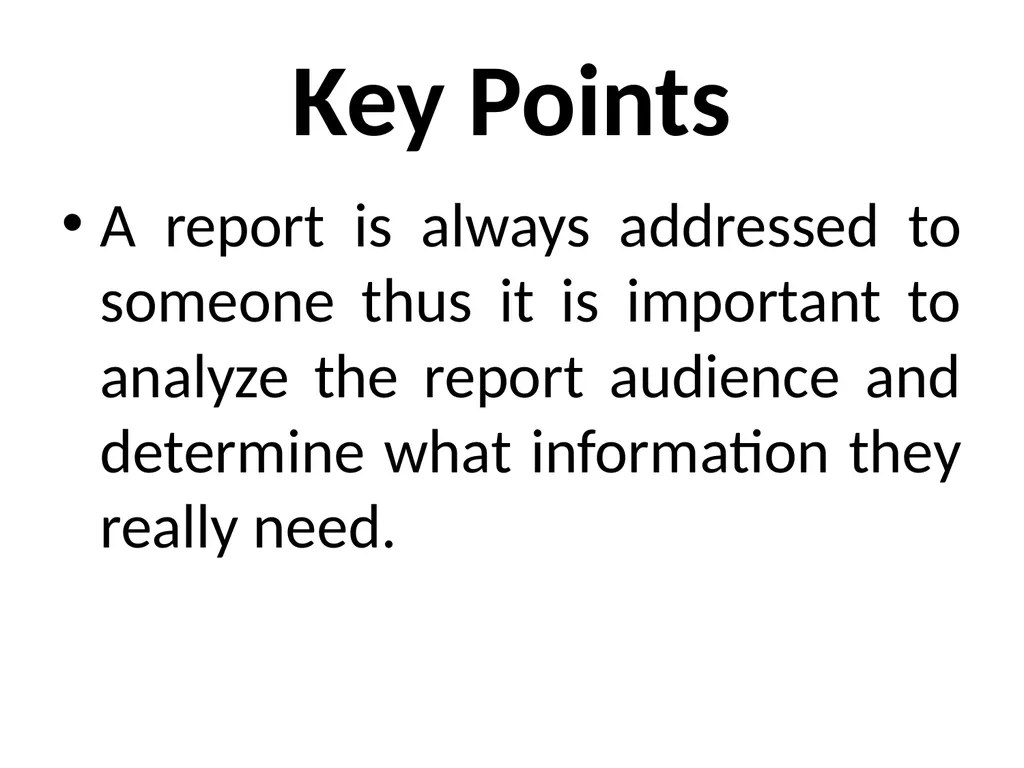
Key Points A report is always addressed to someone thus it is important to analyze the report audience and determine what information they really need.<br>
233
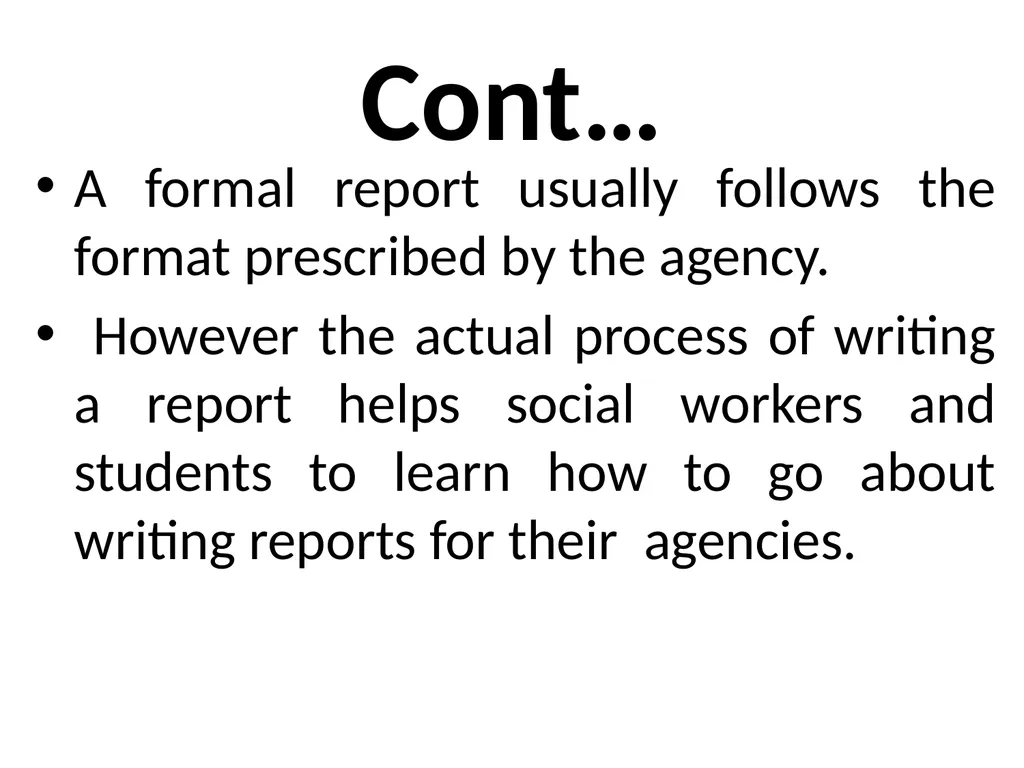
Cont… A formal report usually follows the format prescribed by the agency.
However the actual process of writing a report helps social workers and students to learn how to go about writing reports for their agencies.<br>
However the actual process of writing a report helps social workers and students to learn how to go about writing reports for their agencies.<br>
234
Evaluation What is report?
What is recording?
What are the fieldwork report guidelines?
What is the content of the preliminary pages of final field report?<br>
What is recording?
What are the fieldwork report guidelines?
What is the content of the preliminary pages of final field report?<br>
235
References Australian Learning and Teaching Council (2010.) A Guide to Supervision in social work field education, Australian Learning and Teaching Council, Australia.
Ngalula T F (2008). Introduction to field instruction, The Open University of Tanzania, Dar es salaam.
Royse D., Dhooper S. S., & Rompf E. L., (2012). field instruction, a guide for social work student, Pearson Education Inc, USA
URT (2017) Field practicum manual for certificate and diploma in social work<br>
Ngalula T F (2008). Introduction to field instruction, The Open University of Tanzania, Dar es salaam.
Royse D., Dhooper S. S., & Rompf E. L., (2012). field instruction, a guide for social work student, Pearson Education Inc, USA
URT (2017) Field practicum manual for certificate and diploma in social work<br>
236
End of topic 5 Questions/comments<br>
237
Topic 6: Termination and Handing over Process of Field Practicum<br>
238
Learning Tasks By the end of the topic learners are expected to:-
Explain termination with the client
Explain termination with the agency
Explain the importance of proper termination and handover of field practicum services and Resources<br>
Explain termination with the client
Explain termination with the agency
Explain the importance of proper termination and handover of field practicum services and Resources<br>
239
Termination with clients<br>
240
Activity: Think, Pair and Share Think on the following question:
Definition of termination, (if any)<br>
Definition of termination, (if any)<br>
241
Cont… Termination is a systematic procedure for disengaging the working relationship with client. It occurs when goals are reached, when the specified time for working has ended, or when the client is no longer interested in continuing.<br>
242
Cont… This planned ending allows social workers to review the work they have done, and to highlight accomplishments. They discuss how the person is going to consolidate their gains, and plan next steps.<br>
243
Termination with the client There are several issues to address when considering termination which include preparation for termination plan. If you think a client may be ready for termination, the following guidelines may be helpful to social workers as termination is explored in practicum setting:-<br>
244
Cont… Acknowledge the importance of closure and terminations in social work practice.
Integrate conversations about the termination of the social worker client relationship in the informed consent process.<br>
Integrate conversations about the termination of the social worker client relationship in the informed consent process.<br>
245
Cont… Document all decisions and actions related to termination in the client record (i.e, reasons for termination, summary of progress (or lack of progress) and referral/resources offered).<br>
246
Cont… When ending the professional relationship because treatment goals are not being met, clearly articulate and discuss this with the client and explore alternative options (i.e., referral to another professional).<br>
247
Cont… Consult with a colleague or manager when complex termination matters are being addressed.
Maintain boundaries and keep relationships professional.<br>
Maintain boundaries and keep relationships professional.<br>
248
Termination with the agency As completion of the practicum is a critical step in the education of future social workers, field supervisors and student should ensure ample time is set aside for evaluation and discussion of the student’s development before termination occurs. In practicum settings termination occurs based on the following incidences:-<br>
249
Cont… When the supervisor or supervisee leaves the organization or is promoted or when the supervisee finished the practicum period. Termination also can be due to death or illness of client or Care Provider.<br>
250
Cont… It may also occur when the goals are achieved in the agreement between the supervisor and supervisee.<br>
251
Cont… It is important for supervisors to identify early on the dynamics of termination as they emerge and assist supervisees in learning specific skills to deal with termination. Helping supervisees to address their concerns about termination can help make termination a good experience.<br>
252
Cont… All documentation by the supervisor should be completed by the time of termination. It is unprofessional and possibly unethical to withhold status or final reports, particularly where such reports are required for licensing documentation or completion of study.<br>
253
The importance of proper termination and handover of field practicum services and resources Generally, once the placement is over, students should not have further contact with agency clientele. There is no insurance cover for students and they may be placing themselves or their clients at risk by further contact. Such contact may also inadvertently undermine interventions the agency is making.<br>
254
Cont… There may also be other legal implications, depending on the practice setting. In some situations students do stay in touch with clients in a different role from their student identity. If so, the relationship between student, field educator and organization transforms into something else, and has to be negotiated as such.<br>
255
Cont… If the student continues as a worker or a volunteer they may have different lines of accountability and different roles. It is important to make such transitions as explicit and smooth as possible, to reduce the danger of blurring boundaries with the next professional roles.<br>
256
The following are the importance of Proper Termination:- Clients feel they have been well-supported
The ending enhances the earlier gains made<br>
The ending enhances the earlier gains made<br>
257
Cont… The client feels more aware of their own contribution and wisdom from time together
Client departs with an enhanced sense of self<br>
Client departs with an enhanced sense of self<br>
258
Key Points During terminating students are required to know the following, the importance of documenting all decisions related to termination in the client’s records, reasons and importance for termination.<br>
259
Cont… Student should handover cases to other staff members at the field setting when they leave field practicum<br>
260
Evaluation What is termination?
What is the importance of proper termination to client and social service agency?
What is handover?<br>
What is the importance of proper termination to client and social service agency?
What is handover?<br>
261
References Australian Learning and Teaching Council (2010) A Guide to Supervision in social work field education, Australian Learning and Teaching Council, Australia.
Ngalula T. F., (2008.) Introduction to Field Instruction, The Open University of Tanzania, Dar es salaam.<br>
Ngalula T. F., (2008.) Introduction to Field Instruction, The Open University of Tanzania, Dar es salaam.<br>
262
Cont… Royse D, Dhooper S. S., & Rompf E. L., (2012). Field Instruction, A guide for social Work student, Pearson Education Inc, USA
URT (2017). Field Practicum Manual for Certificate and Diploma in Social Work.<br>
URT (2017). Field Practicum Manual for Certificate and Diploma in Social Work.<br>
263
End of module Question/comments<br>