
SYLLABUS: CHEM 101TH; SECTION-C Fundamentals of


Description: SYLLABUS: CHEM 101TH; SECTION-C Fundamentals of Organic Chemistry Physical Effects, Electronic Displacements: Inductive Effect, Electromeric Effect, Resonance and Hyperconjugation. Cleavage of Bonds: Homolysis and Heterolysis. Structure,
Related Topics
Download Presentation
"SYLLABUS: CHEM 101TH; SECTION-C Fundamentals of" is the property of its rightful owner. Permission is granted to download and print the materials on this website for personal, non-commercial use only, and to display it on your personal computer provided you do not modify the materials and that you retain all copyright notices contained in the materials. By downloading content from our website, you accept the terms of this agreement.
Presentation Transcript
slide1. SYLLABUS: CHEM 101TH; SECTION-C Fundamentals of Organic Chemistry
Physical Effects, Electronic Displacements: Inductive Effect, Electromeric Effect, Resonance and Hyperconjugation. Cleavage of Bonds: Homolysis and Heterolysis.
Structure, shape and reactivity of organic molecules: Nucleophiles and electrophiles. Reactive Intermediates: Carbocations, Carbanions and free radicals.
Strength of organic acids and bases: Comparative study with emphasis on factors affecting pK values. Aromaticity: Benzenoids and Hückel’s rule. Stereochemistry
Conformations with respect to ethane, butane and cyclohexane. Interconversion of Wedge Formula, Newman, Sawhorse and Fischer projections. Concept of chirality (upto two carbon atoms). Configuration: Geometrical and Optical isomerism; Enantiomerism, Diastereomerism and Meso compounds). Threo and erythro; D and L; cis - trans nomenclature; CIP Rules: R/ S (for upto 2 chiral carbon atoms) and E / Z Nomenclature (for upto two C=C systems). DEPARTMENT OF CHEMISTRY SGGSJ GC PAONTA SAHIB<br>
slide2. Introduction to organic chemistry
Physical Effects
Electronic Displacements: Inductive Effect, TOPICS COVERED IN THIS LECTURE DEPARTMENT OF CHEMISTRY SGGSJ GC PAONTA SAHIB<br>
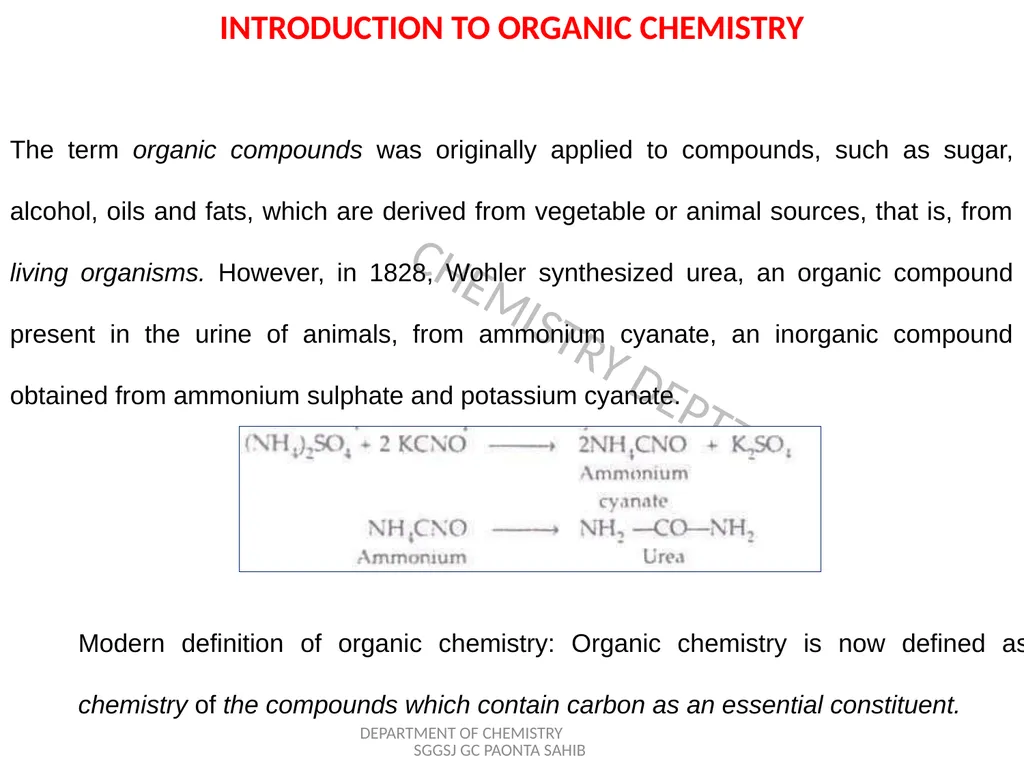
slide3. INTRODUCTION TO ORGANIC CHEMISTRY The term organic compounds was originally applied to compounds, such as sugar, alcohol, oils and fats, which are derived from vegetable or animal sources, that is, from living organisms. However, in 1828, Wohler synthesized urea, an organic compound present in the urine of animals, from ammonium cyanate, an inorganic compound obtained from ammonium sulphate and potassium cyanate. Modern definition of organic chemistry: Organic chemistry is now defined as the chemistry of the compounds which contain carbon as an essential constituent. DEPARTMENT OF CHEMISTRY SGGSJ GC PAONTA SAHIB<br>
slide4. Nature of bonding in organic compounds The carbon atom (atomic number 6), which is the common feature of all organic compound, has the electronic configuration
1s2, 2s2, 2px1, 2py1, 2pz0
Thus it has got four electrons in the valence shell. In order to acquire a stable noble gas configuration in its compounds, carbon should either loss or gain four electrons or alternately share four electrons. But the loss or gain of four electrons leading to the formation of C+4 or C-4 ions would require the supply of a very large amount of energy which is not available during ordinary chemical processes. This implies that carbon cannot form ionic bonds in its compounds and must form only covalent bonds.
In other words, covalent bond is the bond of main importance in organic chemistry.
The covalent bond itself may be polar or non-polar in nature depending upon the electronegativities of the bonded atoms. DEPARTMENT OF CHEMISTRY SGGSJ GC PAONTA SAHIB<br>
slide5. There are certain physical effects operating in organic molecules which strongly influence the physical properties and reactivity of organic compounds. Intermolecular forces are primarily electrostatic forces of attraction which hold together the individual molecules of the same or different substances.
Dipole-dipole Interactions
Van der Waals Interactions
Hydrogen Bonding PHYSICAL EFFECTS DEPARTMENT OF CHEMISTRY SGGSJ GC PAONTA SAHIB<br>
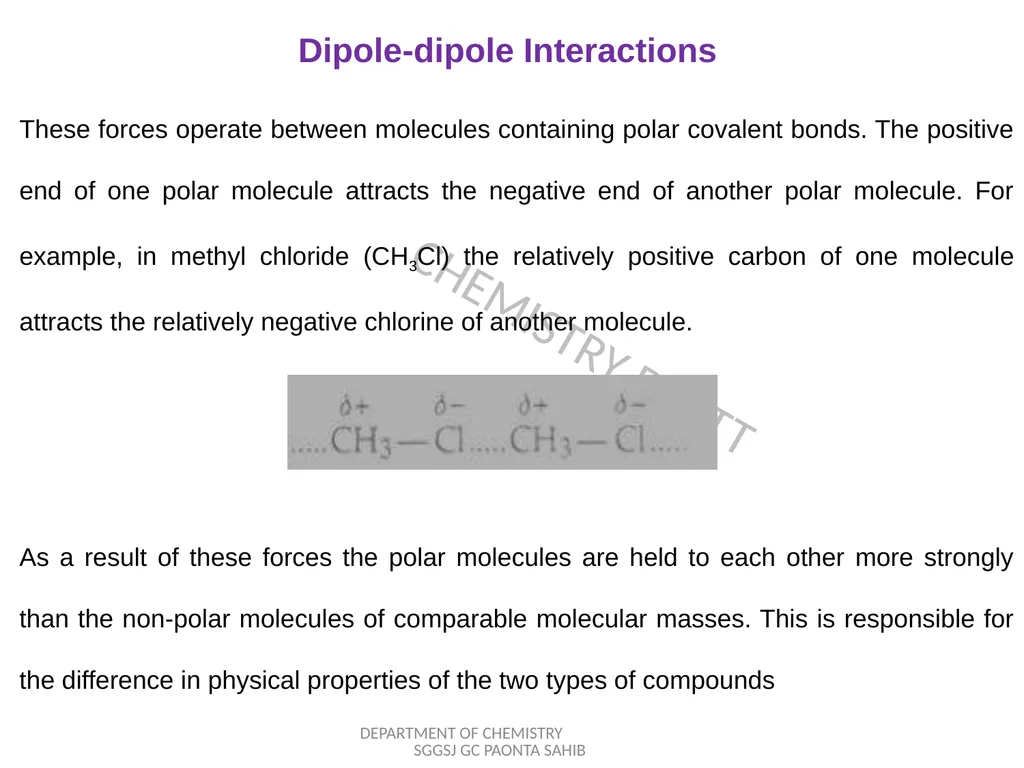
slide6. These forces operate between molecules containing polar covalent bonds. The positive end of one polar molecule attracts the negative end of another polar molecule. For example, in methyl chloride (CH3Cl) the relatively positive carbon of one molecule attracts the relatively negative chlorine of another molecule.
As a result of these forces the polar molecules are held to each other more strongly than the non-polar molecules of comparable molecular masses. This is responsible for the difference in physical properties of the two types of compounds Dipole-dipole Interactions DEPARTMENT OF CHEMISTRY SGGSJ GC PAONTA SAHIB<br>
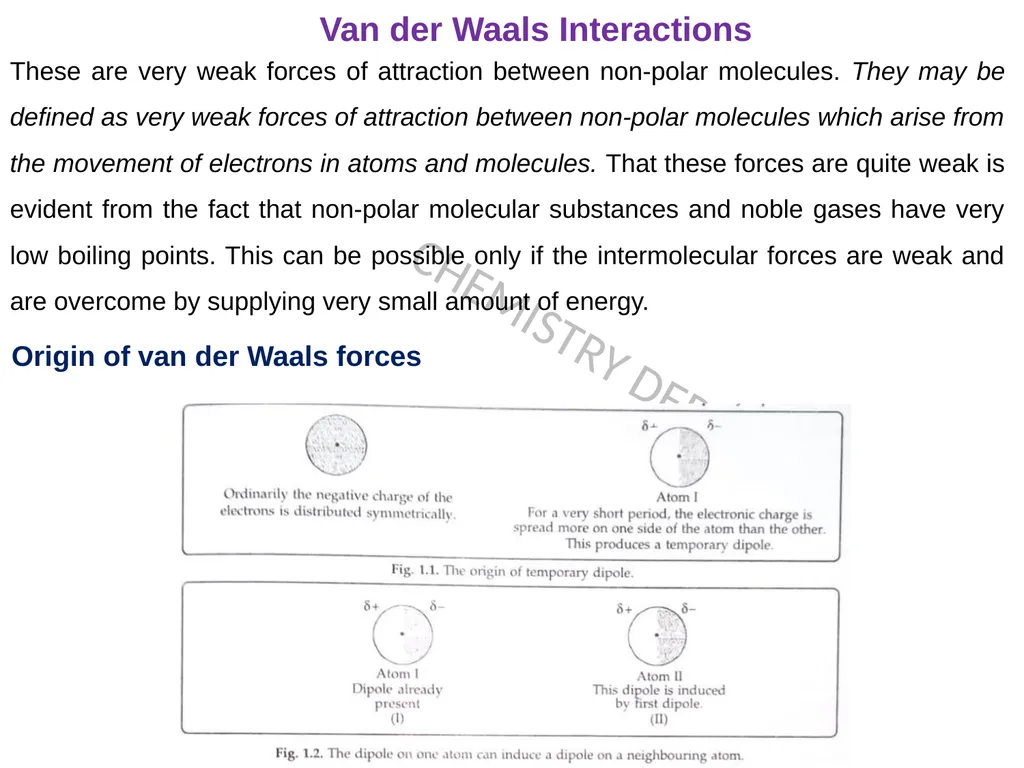
slide7. These are very weak forces of attraction between non-polar molecules. They may be defined as very weak forces of attraction between non-polar molecules which arise from the movement of electrons in atoms and molecules. That these forces are quite weak is evident from the fact that non-polar molecular substances and noble gases have very low boiling points. This can be possible only if the intermolecular forces are weak and are overcome by supplying very small amount of energy. Van der Waals Interactions Origin of van der Waals forces DEPARTMENT OF CHEMISTRY SGGSJ GC PAONTA SAHIB<br>
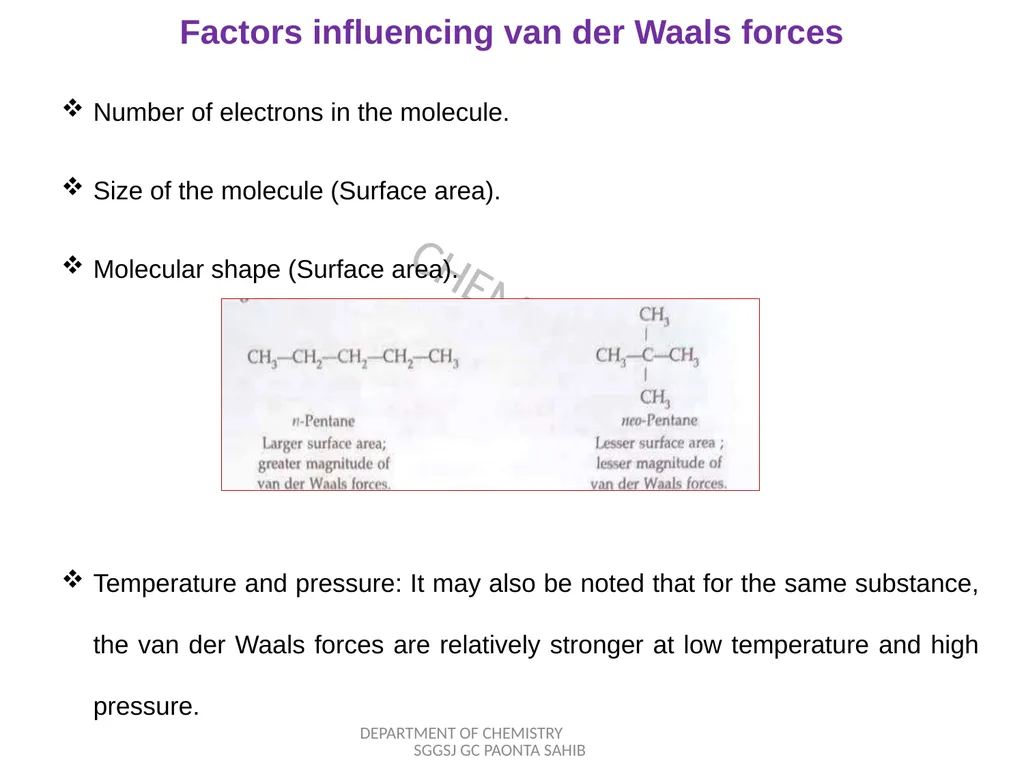
slide8. Factors influencing van der Waals forces Number of electrons in the molecule.
Size of the molecule (Surface area).
Molecular shape (Surface area).
Temperature and pressure: It may also be noted that for the same substance, the van der Waals forces are relatively stronger at low temperature and high pressure. DEPARTMENT OF CHEMISTRY SGGSJ GC PAONTA SAHIB<br>
slide9. HYDROGEN BONDING:
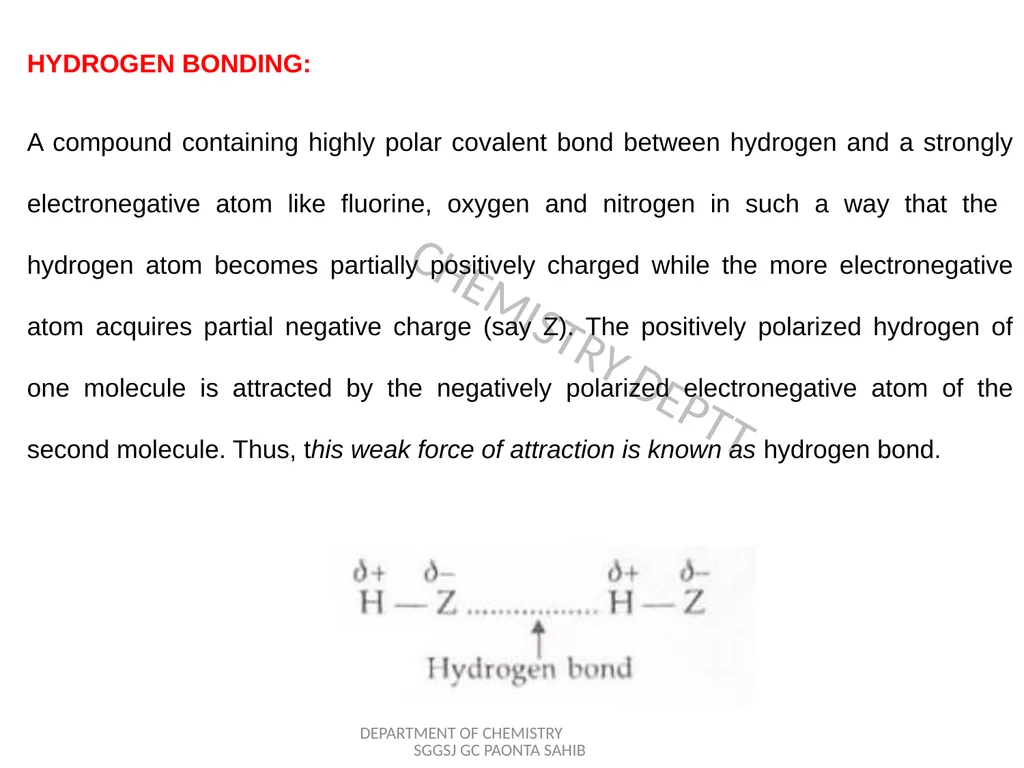
A compound containing highly polar covalent bond between hydrogen and a strongly electronegative atom like fluorine, oxygen and nitrogen in such a way that the hydrogen atom becomes partially positively charged while the more electronegative atom acquires partial negative charge (say Z). The positively polarized hydrogen of one molecule is attracted by the negatively polarized electronegative atom of the second molecule. Thus, this weak force of attraction is known as hydrogen bond. DEPARTMENT OF CHEMISTRY SGGSJ GC PAONTA SAHIB<br>
slide10. ELECTRONIC EFFECTS IN ORGANIC COMPOUNDS
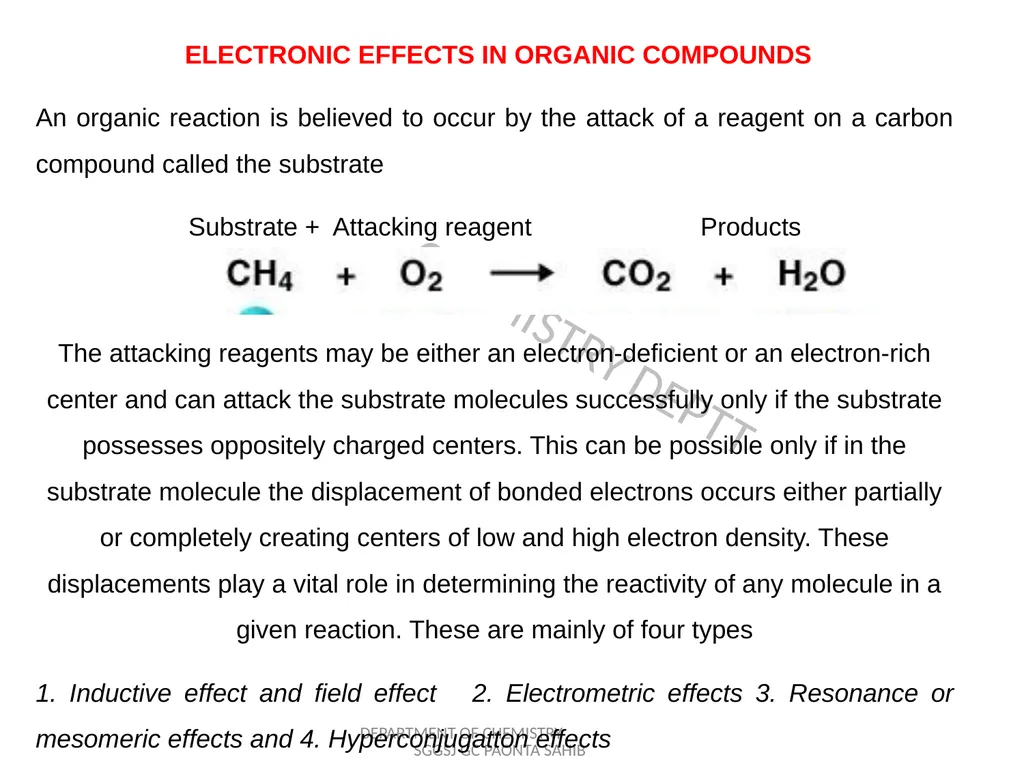
An organic reaction is believed to occur by the attack of a reagent on a carbon compound called the substrate
Substrate + Attacking reagent Products
The attacking reagents may be either an electron-deficient or an electron-rich center and can attack the substrate molecules successfully only if the substrate possesses oppositely charged centers. This can be possible only if in the substrate molecule the displacement of bonded electrons occurs either partially or completely creating centers of low and high electron density. These displacements play a vital role in determining the reactivity of any molecule in a given reaction. These are mainly of four types
1. Inductive effect and field effect 2. Electrometric effects 3. Resonance or mesomeric effects and 4. Hyperconjugatton effects DEPARTMENT OF CHEMISTRY SGGSJ GC PAONTA SAHIB<br>
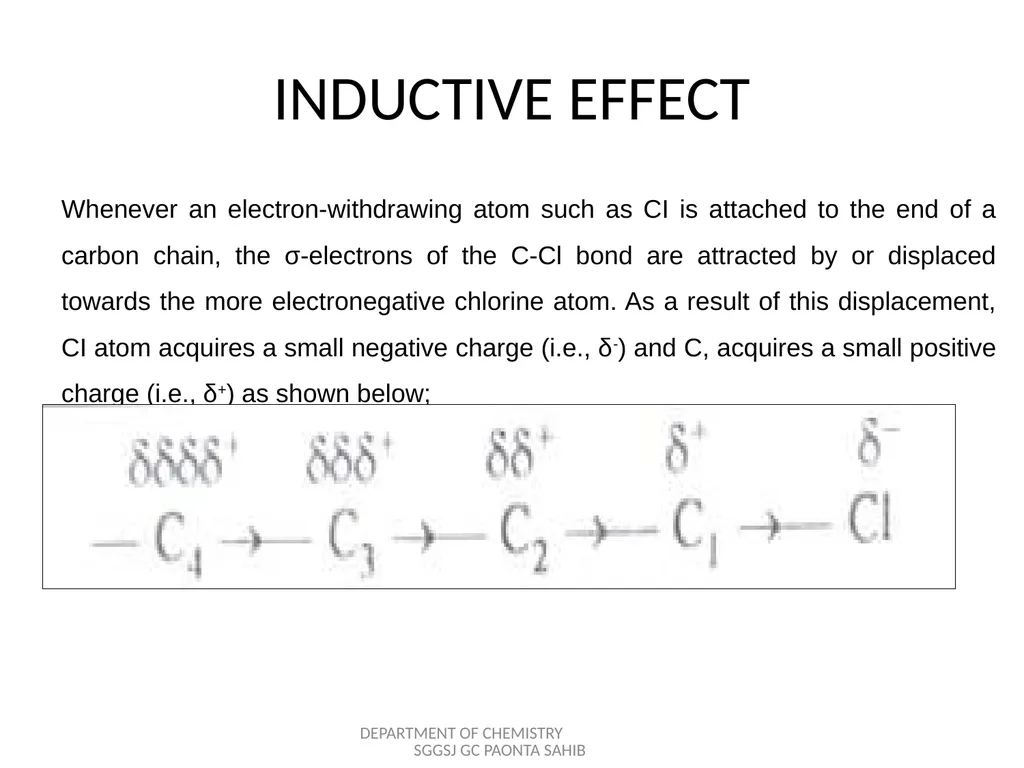
slide11. Whenever an electron-withdrawing atom such as CI is attached to the end of a carbon chain, the σ-electrons of the C-Cl bond are attracted by or displaced towards the more electronegative chlorine atom. As a result of this displacement, CI atom acquires a small negative charge (i.e., δ-) and C, acquires a small positive charge (i.e., δ+) as shown below; INDUCTIVE EFFECT DEPARTMENT OF CHEMISTRY SGGSJ GC PAONTA SAHIB<br>
slide12. INDUCTIVE EFFECT This effect can still be transmitted further but the intensity goes on decreasing considerably with distance. This type of σ-electron displacements along a saturated chain of atoms due to the presence of a polar covalent bond is called inductive effect or simply I-effect. Sometimes inductive effect is also called transmission effect or T-effect.
NOTE: The inductive effect is almost negligible beyond two carbon atoms from the heteroatom. DEPARTMENT OF CHEMISTRY SGGSJ GC PAONTA SAHIB<br>
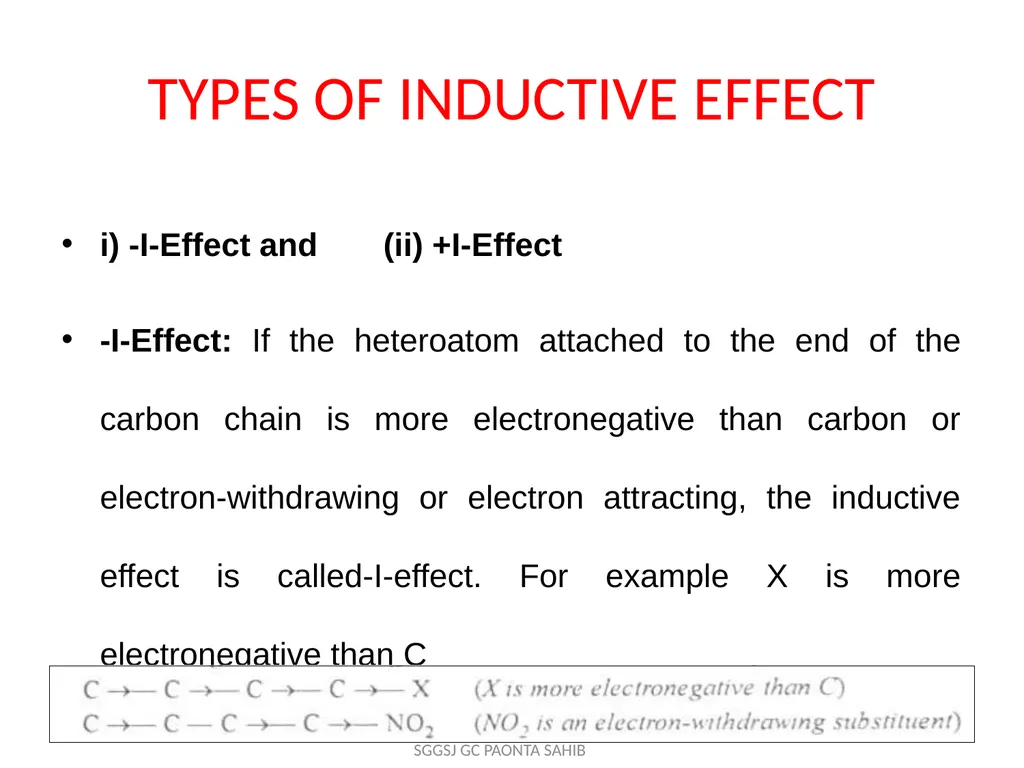
slide13. TYPES OF INDUCTIVE EFFECT i) -I-Effect and (ii) +I-Effect
-I-Effect: If the heteroatom attached to the end of the carbon chain is more electronegative than carbon or electron-withdrawing or electron attracting, the inductive effect is called-I-effect. For example X is more electronegative than C DEPARTMENT OF CHEMISTRY SGGSJ GC PAONTA SAHIB<br>
slide14. +I-Effect: If the heteroatom attached to the end of the carbon chain is less electronegative than carbon, or electron-donating or electron-releasing the inductive effect is called +I-effect. The only electron-donating groups and low electronegativity are Li, Si, Mg, etc. and alkyl groups. DEPARTMENT OF CHEMISTRY SGGSJ GC PAONTA SAHIB<br>
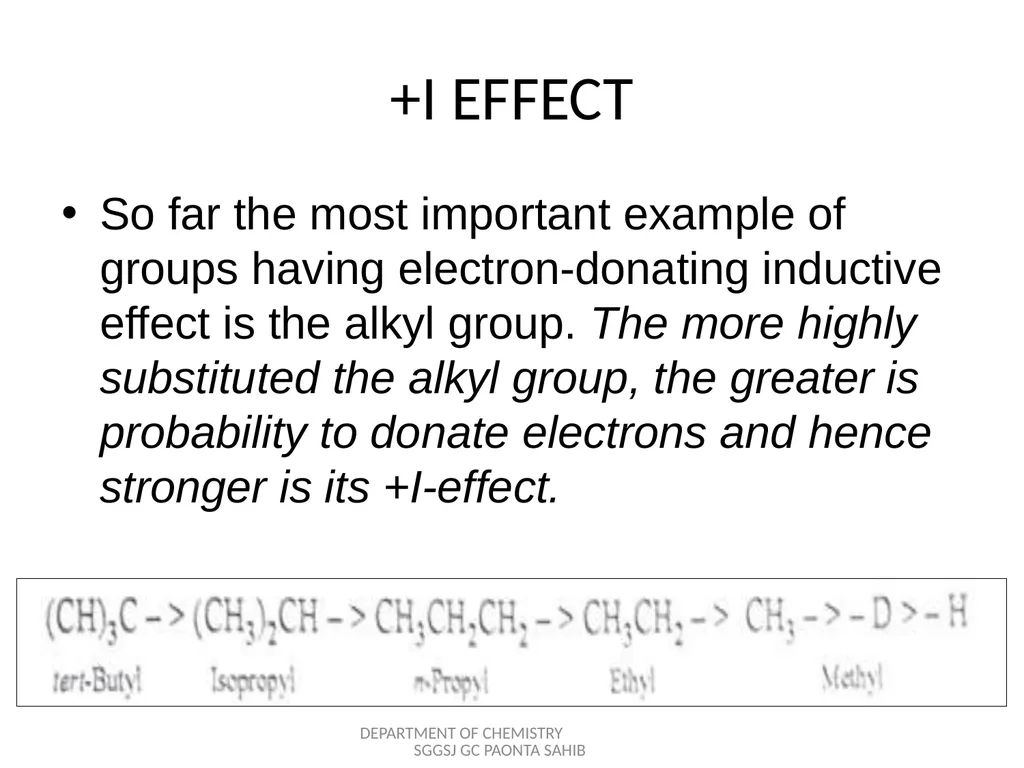
slide15. +I EFFECT So far the most important example of groups having electron-donating inductive effect is the alkyl group. The more highly substituted the alkyl group, the greater is probability to donate electrons and hence stronger is its +I-effect. DEPARTMENT OF CHEMISTRY SGGSJ GC PAONTA SAHIB<br>
slide16. Characteristics of inductive effect Inductive effect involves only displacement of σ-electrons and occurs in polar single covalent bonds.
The inductive effect is a permanent effect and cannot be reversed.
The inductive effect decreases progressively as the distance between the carbon atom and the electron-withdrawing or the electron-donating atom or the group increases.
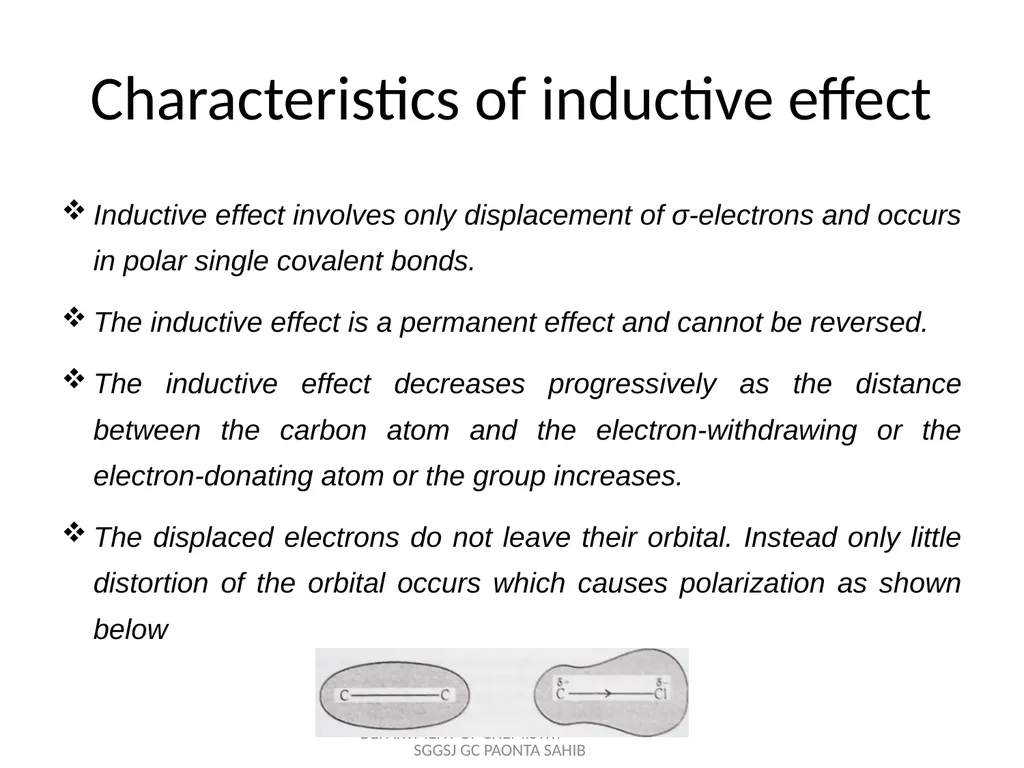
The displaced electrons do not leave their orbital. Instead only little distortion of the orbital occurs which causes polarization as shown below DEPARTMENT OF CHEMISTRY SGGSJ GC PAONTA SAHIB<br>
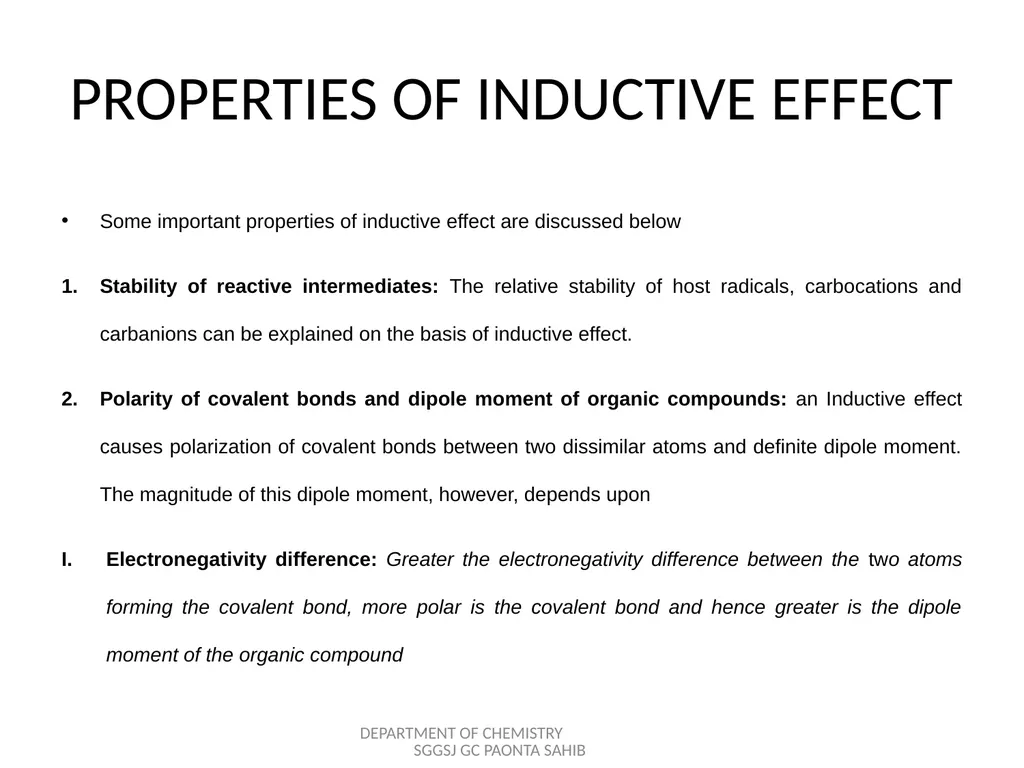
slide17. PROPERTIES OF INDUCTIVE EFFECT Some important properties of inductive effect are discussed below
Stability of reactive intermediates: The relative stability of host radicals, carbocations and carbanions can be explained on the basis of inductive effect.
Polarity of covalent bonds and dipole moment of organic compounds: an Inductive effect causes polarization of covalent bonds between two dissimilar atoms and definite dipole moment. The magnitude of this dipole moment, however, depends upon
Electronegativity difference: Greater the electronegativity difference between the two atoms forming the covalent bond, more polar is the covalent bond and hence greater is the dipole moment of the organic compound DEPARTMENT OF CHEMISTRY SGGSJ GC PAONTA SAHIB<br>
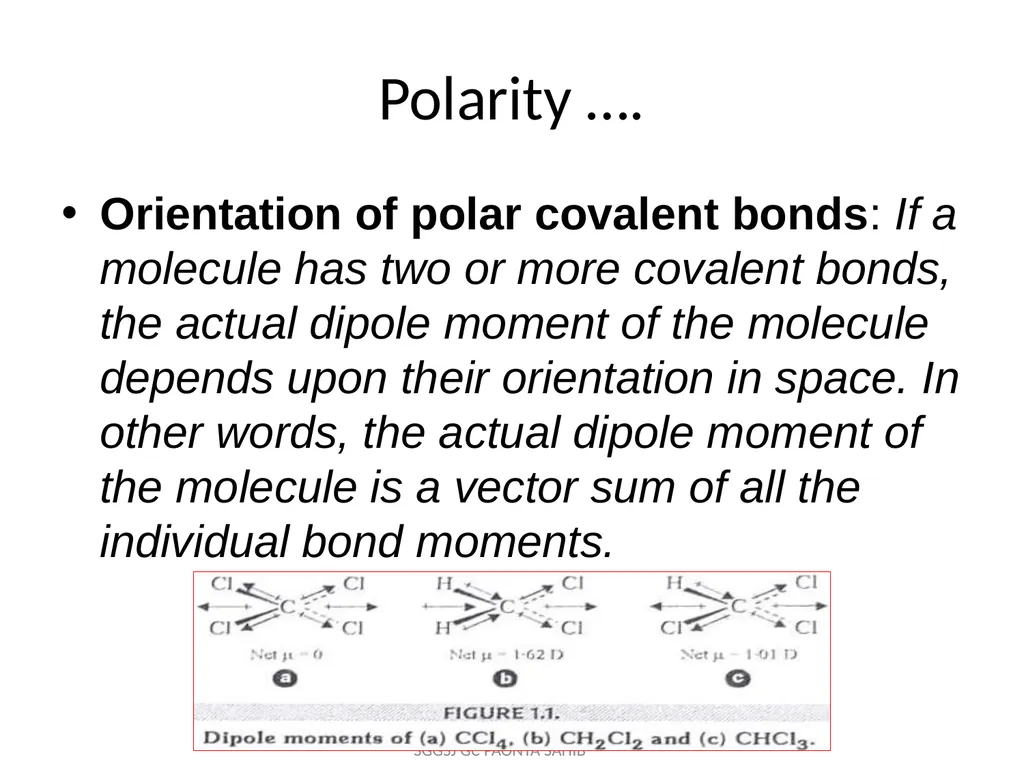
slide18. Polarity …. Orientation of polar covalent bonds: If a molecule has two or more covalent bonds, the actual dipole moment of the molecule depends upon their orientation in space. In other words, the actual dipole moment of the molecule is a vector sum of all the individual bond moments. DEPARTMENT OF CHEMISTRY SGGSJ GC PAONTA SAHIB<br>
slide19. IMPORTANT RULE Stability of reactive intermediates: The common rule followed is:
GREATER THE DISPERSAL OF CHARGE ,GREATER THE STABILITY.
GREATER THE INTENSIFICATION OF CHARGE ,LESSER THE STABILITY. DEPARTMENT OF CHEMISTRY SGGSJ GC PAONTA SAHIB<br>
slide20. ON SIMILAR LINES AS YOU HAVE STUDIED INDUCTIVE EFFECT ,YOU HAVE TO STUDY THE ELECTROMERIC EFFECT,RESONANCE EFFECT AND HYPERCONJUGATION AS DISCUSSED IN THE OFFLINE CLASS . DEPARTMENT OF CHEMISTRY SGGSJ GC PAONTA SAHIB<br>
Physical Effects, Electronic Displacements: Inductive Effect, Electromeric Effect, Resonance and Hyperconjugation. Cleavage of Bonds: Homolysis and Heterolysis.
Structure, shape and reactivity of organic molecules: Nucleophiles and electrophiles. Reactive Intermediates: Carbocations, Carbanions and free radicals.
Strength of organic acids and bases: Comparative study with emphasis on factors affecting pK values. Aromaticity: Benzenoids and Hückel’s rule. Stereochemistry
Conformations with respect to ethane, butane and cyclohexane. Interconversion of Wedge Formula, Newman, Sawhorse and Fischer projections. Concept of chirality (upto two carbon atoms). Configuration: Geometrical and Optical isomerism; Enantiomerism, Diastereomerism and Meso compounds). Threo and erythro; D and L; cis - trans nomenclature; CIP Rules: R/ S (for upto 2 chiral carbon atoms) and E / Z Nomenclature (for upto two C=C systems). DEPARTMENT OF CHEMISTRY SGGSJ GC PAONTA SAHIB<br>
slide2. Introduction to organic chemistry
Physical Effects
Electronic Displacements: Inductive Effect, TOPICS COVERED IN THIS LECTURE DEPARTMENT OF CHEMISTRY SGGSJ GC PAONTA SAHIB<br>
slide3. INTRODUCTION TO ORGANIC CHEMISTRY The term organic compounds was originally applied to compounds, such as sugar, alcohol, oils and fats, which are derived from vegetable or animal sources, that is, from living organisms. However, in 1828, Wohler synthesized urea, an organic compound present in the urine of animals, from ammonium cyanate, an inorganic compound obtained from ammonium sulphate and potassium cyanate. Modern definition of organic chemistry: Organic chemistry is now defined as the chemistry of the compounds which contain carbon as an essential constituent. DEPARTMENT OF CHEMISTRY SGGSJ GC PAONTA SAHIB<br>
slide4. Nature of bonding in organic compounds The carbon atom (atomic number 6), which is the common feature of all organic compound, has the electronic configuration
1s2, 2s2, 2px1, 2py1, 2pz0
Thus it has got four electrons in the valence shell. In order to acquire a stable noble gas configuration in its compounds, carbon should either loss or gain four electrons or alternately share four electrons. But the loss or gain of four electrons leading to the formation of C+4 or C-4 ions would require the supply of a very large amount of energy which is not available during ordinary chemical processes. This implies that carbon cannot form ionic bonds in its compounds and must form only covalent bonds.
In other words, covalent bond is the bond of main importance in organic chemistry.
The covalent bond itself may be polar or non-polar in nature depending upon the electronegativities of the bonded atoms. DEPARTMENT OF CHEMISTRY SGGSJ GC PAONTA SAHIB<br>
slide5. There are certain physical effects operating in organic molecules which strongly influence the physical properties and reactivity of organic compounds. Intermolecular forces are primarily electrostatic forces of attraction which hold together the individual molecules of the same or different substances.
Dipole-dipole Interactions
Van der Waals Interactions
Hydrogen Bonding PHYSICAL EFFECTS DEPARTMENT OF CHEMISTRY SGGSJ GC PAONTA SAHIB<br>
slide6. These forces operate between molecules containing polar covalent bonds. The positive end of one polar molecule attracts the negative end of another polar molecule. For example, in methyl chloride (CH3Cl) the relatively positive carbon of one molecule attracts the relatively negative chlorine of another molecule.
As a result of these forces the polar molecules are held to each other more strongly than the non-polar molecules of comparable molecular masses. This is responsible for the difference in physical properties of the two types of compounds Dipole-dipole Interactions DEPARTMENT OF CHEMISTRY SGGSJ GC PAONTA SAHIB<br>
slide7. These are very weak forces of attraction between non-polar molecules. They may be defined as very weak forces of attraction between non-polar molecules which arise from the movement of electrons in atoms and molecules. That these forces are quite weak is evident from the fact that non-polar molecular substances and noble gases have very low boiling points. This can be possible only if the intermolecular forces are weak and are overcome by supplying very small amount of energy. Van der Waals Interactions Origin of van der Waals forces DEPARTMENT OF CHEMISTRY SGGSJ GC PAONTA SAHIB<br>
slide8. Factors influencing van der Waals forces Number of electrons in the molecule.
Size of the molecule (Surface area).
Molecular shape (Surface area).
Temperature and pressure: It may also be noted that for the same substance, the van der Waals forces are relatively stronger at low temperature and high pressure. DEPARTMENT OF CHEMISTRY SGGSJ GC PAONTA SAHIB<br>
slide9. HYDROGEN BONDING:
A compound containing highly polar covalent bond between hydrogen and a strongly electronegative atom like fluorine, oxygen and nitrogen in such a way that the hydrogen atom becomes partially positively charged while the more electronegative atom acquires partial negative charge (say Z). The positively polarized hydrogen of one molecule is attracted by the negatively polarized electronegative atom of the second molecule. Thus, this weak force of attraction is known as hydrogen bond. DEPARTMENT OF CHEMISTRY SGGSJ GC PAONTA SAHIB<br>
slide10. ELECTRONIC EFFECTS IN ORGANIC COMPOUNDS
An organic reaction is believed to occur by the attack of a reagent on a carbon compound called the substrate
Substrate + Attacking reagent Products
The attacking reagents may be either an electron-deficient or an electron-rich center and can attack the substrate molecules successfully only if the substrate possesses oppositely charged centers. This can be possible only if in the substrate molecule the displacement of bonded electrons occurs either partially or completely creating centers of low and high electron density. These displacements play a vital role in determining the reactivity of any molecule in a given reaction. These are mainly of four types
1. Inductive effect and field effect 2. Electrometric effects 3. Resonance or mesomeric effects and 4. Hyperconjugatton effects DEPARTMENT OF CHEMISTRY SGGSJ GC PAONTA SAHIB<br>
slide11. Whenever an electron-withdrawing atom such as CI is attached to the end of a carbon chain, the σ-electrons of the C-Cl bond are attracted by or displaced towards the more electronegative chlorine atom. As a result of this displacement, CI atom acquires a small negative charge (i.e., δ-) and C, acquires a small positive charge (i.e., δ+) as shown below; INDUCTIVE EFFECT DEPARTMENT OF CHEMISTRY SGGSJ GC PAONTA SAHIB<br>
slide12. INDUCTIVE EFFECT This effect can still be transmitted further but the intensity goes on decreasing considerably with distance. This type of σ-electron displacements along a saturated chain of atoms due to the presence of a polar covalent bond is called inductive effect or simply I-effect. Sometimes inductive effect is also called transmission effect or T-effect.
NOTE: The inductive effect is almost negligible beyond two carbon atoms from the heteroatom. DEPARTMENT OF CHEMISTRY SGGSJ GC PAONTA SAHIB<br>
slide13. TYPES OF INDUCTIVE EFFECT i) -I-Effect and (ii) +I-Effect
-I-Effect: If the heteroatom attached to the end of the carbon chain is more electronegative than carbon or electron-withdrawing or electron attracting, the inductive effect is called-I-effect. For example X is more electronegative than C DEPARTMENT OF CHEMISTRY SGGSJ GC PAONTA SAHIB<br>
slide14. +I-Effect: If the heteroatom attached to the end of the carbon chain is less electronegative than carbon, or electron-donating or electron-releasing the inductive effect is called +I-effect. The only electron-donating groups and low electronegativity are Li, Si, Mg, etc. and alkyl groups. DEPARTMENT OF CHEMISTRY SGGSJ GC PAONTA SAHIB<br>
slide15. +I EFFECT So far the most important example of groups having electron-donating inductive effect is the alkyl group. The more highly substituted the alkyl group, the greater is probability to donate electrons and hence stronger is its +I-effect. DEPARTMENT OF CHEMISTRY SGGSJ GC PAONTA SAHIB<br>
slide16. Characteristics of inductive effect Inductive effect involves only displacement of σ-electrons and occurs in polar single covalent bonds.
The inductive effect is a permanent effect and cannot be reversed.
The inductive effect decreases progressively as the distance between the carbon atom and the electron-withdrawing or the electron-donating atom or the group increases.
The displaced electrons do not leave their orbital. Instead only little distortion of the orbital occurs which causes polarization as shown below DEPARTMENT OF CHEMISTRY SGGSJ GC PAONTA SAHIB<br>
slide17. PROPERTIES OF INDUCTIVE EFFECT Some important properties of inductive effect are discussed below
Stability of reactive intermediates: The relative stability of host radicals, carbocations and carbanions can be explained on the basis of inductive effect.
Polarity of covalent bonds and dipole moment of organic compounds: an Inductive effect causes polarization of covalent bonds between two dissimilar atoms and definite dipole moment. The magnitude of this dipole moment, however, depends upon
Electronegativity difference: Greater the electronegativity difference between the two atoms forming the covalent bond, more polar is the covalent bond and hence greater is the dipole moment of the organic compound DEPARTMENT OF CHEMISTRY SGGSJ GC PAONTA SAHIB<br>
slide18. Polarity …. Orientation of polar covalent bonds: If a molecule has two or more covalent bonds, the actual dipole moment of the molecule depends upon their orientation in space. In other words, the actual dipole moment of the molecule is a vector sum of all the individual bond moments. DEPARTMENT OF CHEMISTRY SGGSJ GC PAONTA SAHIB<br>
slide19. IMPORTANT RULE Stability of reactive intermediates: The common rule followed is:
GREATER THE DISPERSAL OF CHARGE ,GREATER THE STABILITY.
GREATER THE INTENSIFICATION OF CHARGE ,LESSER THE STABILITY. DEPARTMENT OF CHEMISTRY SGGSJ GC PAONTA SAHIB<br>
slide20. ON SIMILAR LINES AS YOU HAVE STUDIED INDUCTIVE EFFECT ,YOU HAVE TO STUDY THE ELECTROMERIC EFFECT,RESONANCE EFFECT AND HYPERCONJUGATION AS DISCUSSED IN THE OFFLINE CLASS . DEPARTMENT OF CHEMISTRY SGGSJ GC PAONTA SAHIB<br>