
Symbols to support learning Listen Class
BR
Published · 28 slides · 0 views
1 / 1
Description
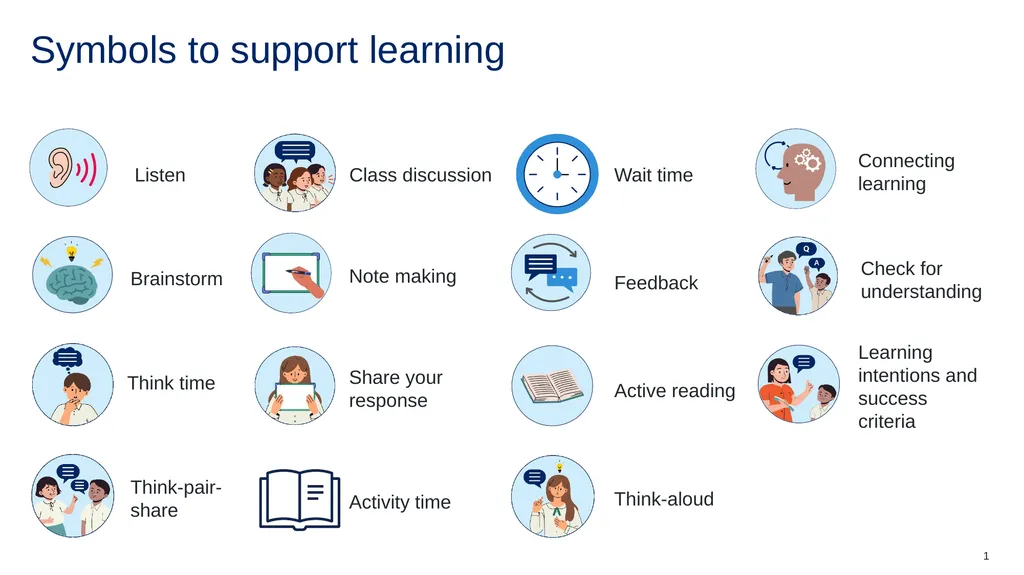
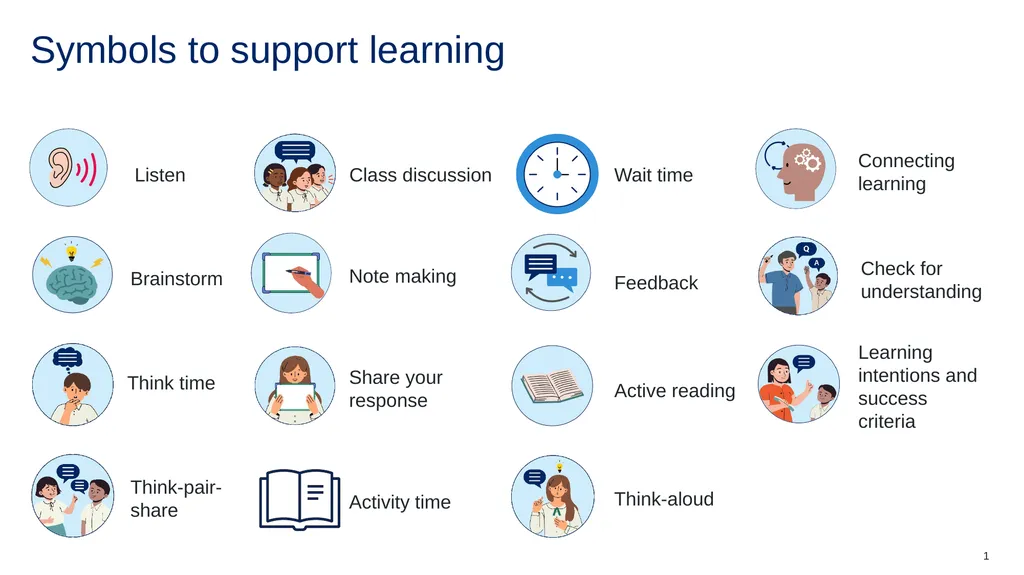
Symbols to support learning Listen Class discussion Wait time Connecting learning Brainstorm Note making Feedback Check for understanding Think time Share your response Active reading Learning intentions and success criteria
Related Topics
Share
Embed code
Download this presentation From Below
"Symbols to support learning Listen Class" is the property of its rightful owner. Permission is granted to download and print the materials on this website for personal, non-commercial use only, and to display it on your personal computer provided you do not modify the materials and that you retain all copyright notices contained in the materials. By downloading content from our website, you accept the terms of this agreement.
Presentation Transcript
01
Symbols to support learning Listen Class discussion Wait time Connecting learning Brainstorm Note making Feedback Check for understanding Think time Share your response Active reading Learning intentions and success criteria Think-pair-share Activity time Think-aloud 1<br>
02
Instructions for use This resource is not a teaching and learning program. It should be used in conjunction with 12.1 ‒ Introduction to Literary worlds program, available on the English Extension page of Planning, programming and assessing English 11–12.
Classroom teachers are encouraged to add and adapt slides as required to meet the needs of their students.
Save a copy of the file to make changes to the slide deck. Go to File > Download a Copy (this downloads a copy to the computer to edit in the PowerPoint app).
To convert the PowerPoint to Google Slides:
Upload the file into Google Drive and open it.
Go to File > Save as Google Slides.
(Note – conversion may cause formatting changes in the slides.) 2<br>
Classroom teachers are encouraged to add and adapt slides as required to meet the needs of their students.
Save a copy of the file to make changes to the slide deck. Go to File > Download a Copy (this downloads a copy to the computer to edit in the PowerPoint app).
To convert the PowerPoint to Google Slides:
Upload the file into Google Drive and open it.
Go to File > Save as Google Slides.
(Note – conversion may cause formatting changes in the slides.) 2<br>
03
Literary worlds – audio recording assessment support Stage 6 English Extension 1 – 12.1 ‘Introduction to Literary worlds’ Year 12, Program 12.1 Photo by Logan Voss on Unsplash<br>
04
Sharing learning intentions and success criteria 4<br>
05
Learning intentions and success criteria We are learning to:
refine creative and reflective compositions to communicate a literary world with clarity, coherence and control
adapt oral and audio delivery choices to shape meaning for an intended audience and purpose
use feedback, marking criteria and the student-facing rubric to evaluate and improve the final submissions.
We can:
[classroom teacher to insert sample success criteria]
[classroom teacher to insert sample success criteria]
[classroom teacher to insert sample success criteria]. 5<br>
refine creative and reflective compositions to communicate a literary world with clarity, coherence and control
adapt oral and audio delivery choices to shape meaning for an intended audience and purpose
use feedback, marking criteria and the student-facing rubric to evaluate and improve the final submissions.
We can:
[classroom teacher to insert sample success criteria]
[classroom teacher to insert sample success criteria]
[classroom teacher to insert sample success criteria]. 5<br>
06
Phase 6, sequence 1 – preparing for the formal assessment task submission Section 1 Taking notes with a pencil by Thought Catalog on Unsplash<br>
07
Chunking and sequencing learning 7<br>
08
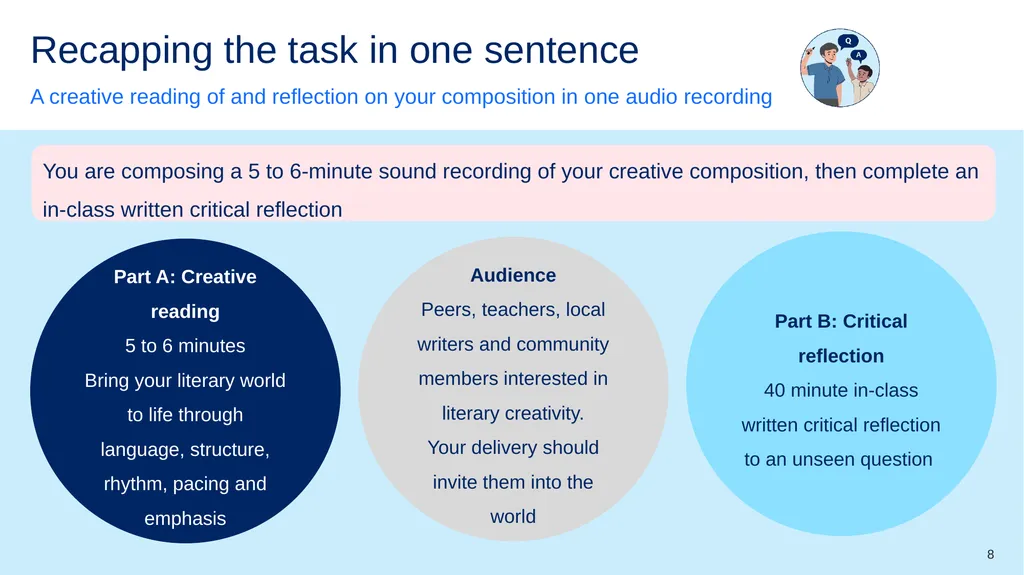
Recapping the task in one sentence A creative reading of and reflection on your composition in one audio recording You are composing a 5 to 6-minute sound recording of your creative composition, then complete an in-class written critical reflection Part A: Creative reading
5 to 6 minutes
Bring your literary world to life through language, structure, rhythm, pacing and emphasis Audience
Peers, teachers, local writers and community members interested in literary creativity.
Your delivery should invite them into the world Part B: Critical reflection
40 minute in-class written critical reflection to an unseen question 8<br>
5 to 6 minutes
Bring your literary world to life through language, structure, rhythm, pacing and emphasis Audience
Peers, teachers, local writers and community members interested in literary creativity.
Your delivery should invite them into the world Part B: Critical reflection
40 minute in-class written critical reflection to an unseen question 8<br>
09
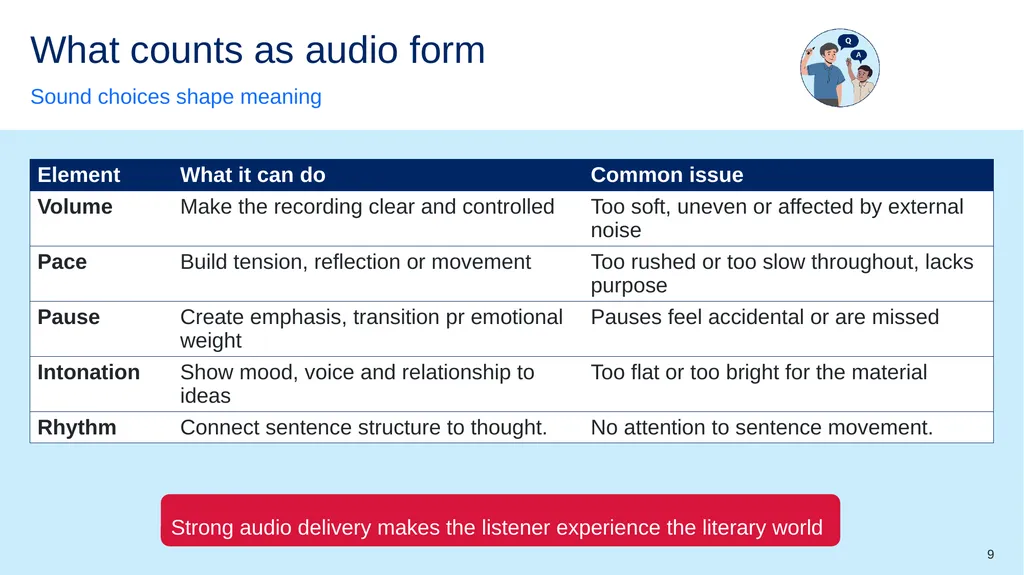
What counts as audio form Sound choices shape meaning Strong audio delivery makes the listener experience the literary world 9<br>
10
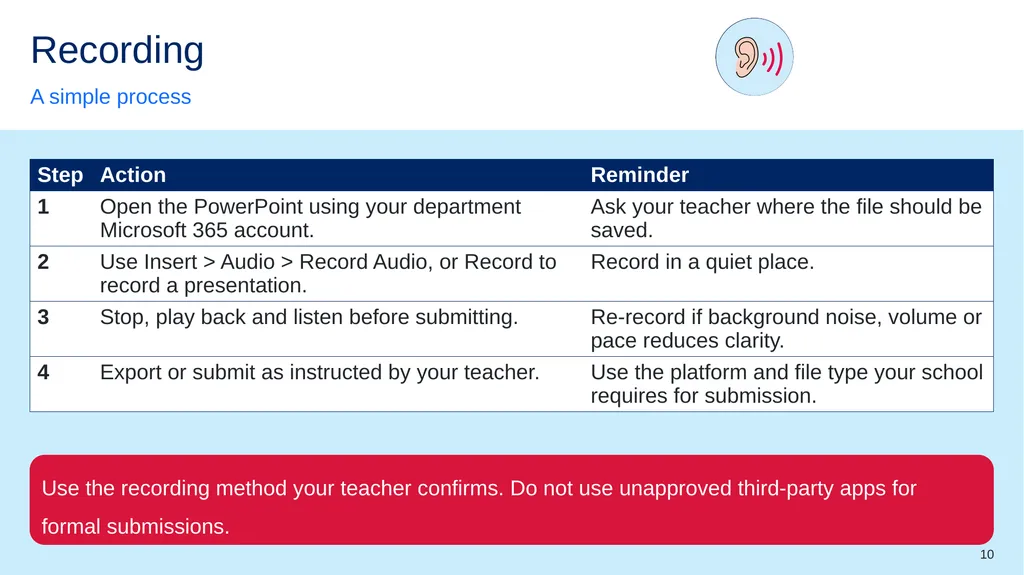
Recording A simple process Use the recording method your teacher confirms. Do not use unapproved third-party apps for formal submissions. 10<br>
11
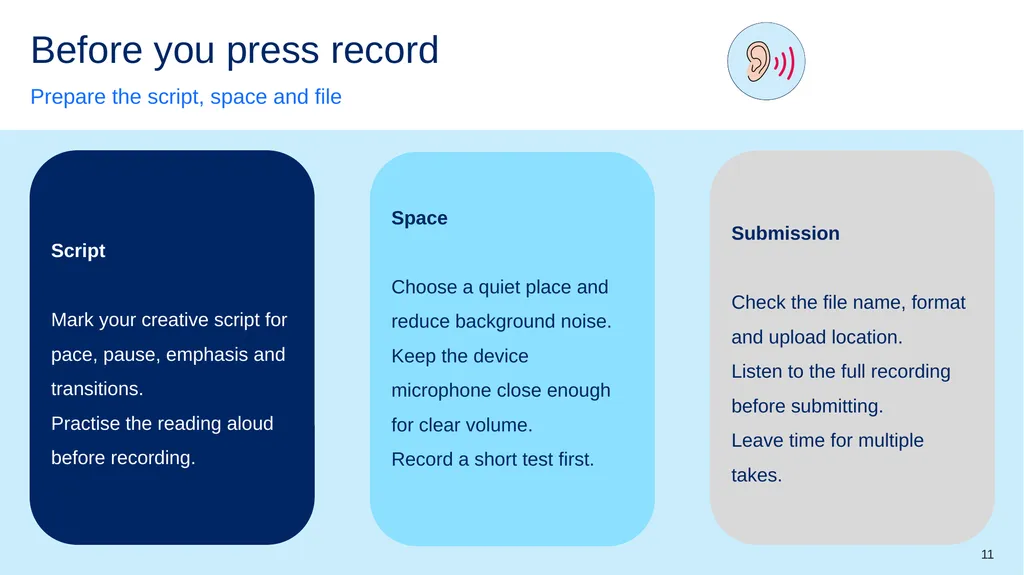
Before you press record Prepare the script, space and file Script
Mark your creative script for pace, pause, emphasis and transitions.
Practise the reading aloud before recording. Space
Choose a quiet place and reduce background noise.
Keep the device microphone close enough for clear volume.
Record a short test first. Submission
Check the file name, format and upload location.
Listen to the full recording before submitting.
Leave time for multiple takes. 11<br>
Mark your creative script for pace, pause, emphasis and transitions.
Practise the reading aloud before recording. Space
Choose a quiet place and reduce background noise.
Keep the device microphone close enough for clear volume.
Record a short test first. Submission
Check the file name, format and upload location.
Listen to the full recording before submitting.
Leave time for multiple takes. 11<br>
12
Phase 6, sequence 1 – preparing for the formal assessment task submission Section 2 Taking notes with a pencil by Thought Catalog on Unsplash<br>
13
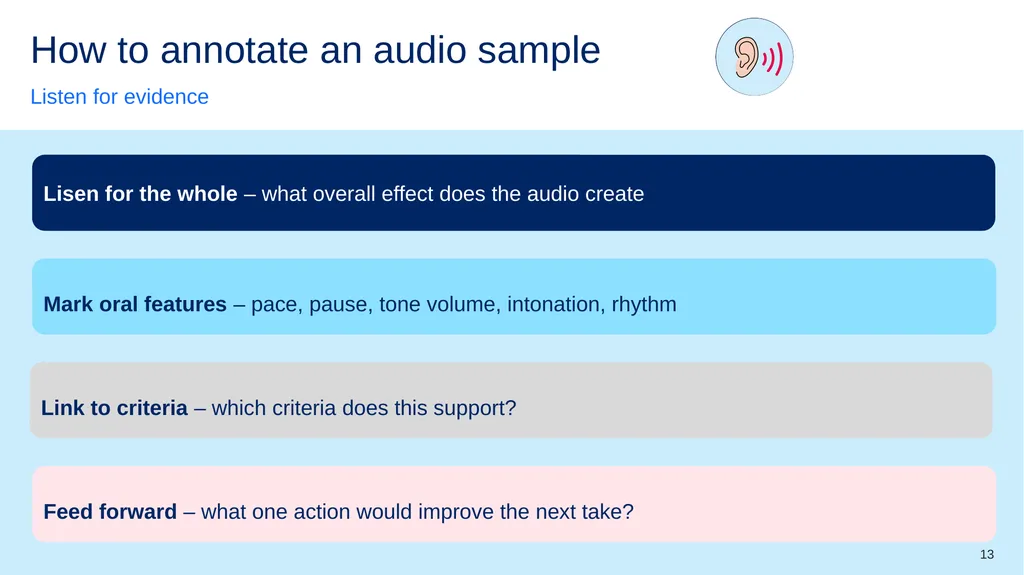
How to annotate an audio sample Listen for evidence Lisen for the whole – what overall effect does the audio create Mark oral features – pace, pause, tone volume, intonation, rhythm Link to criteria – which criteria does this support? Feed forward – what one action would improve the next take? 13<br>
14
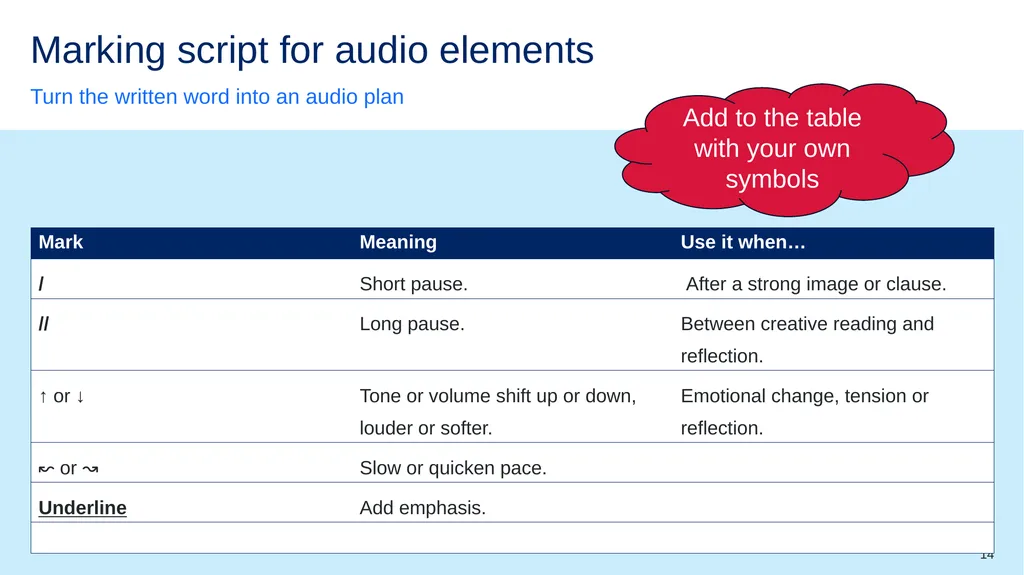
Marking script for audio elements Turn the written word into an audio plan Add to the table with your own symbols 14<br>
15
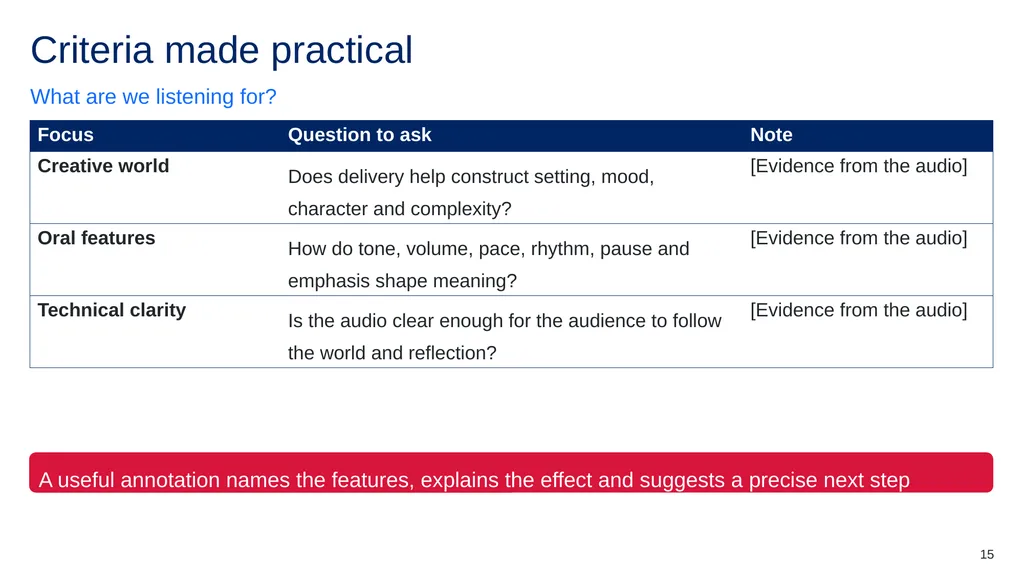
Criteria made practical What are we listening for? A useful annotation names the features, explains the effect and suggests a precise next step 15<br>
16
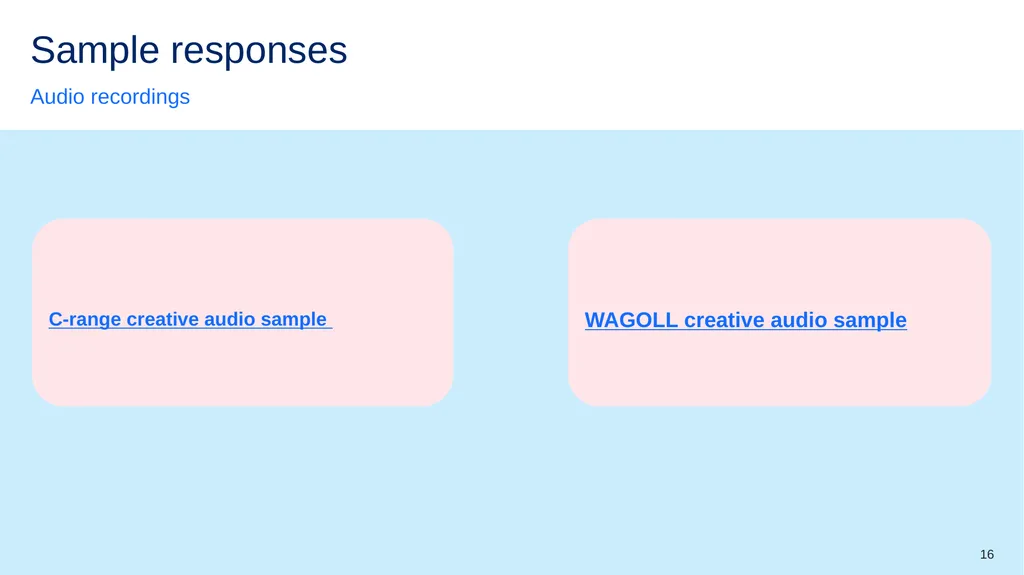
Sample responses Audio recordings C-range creative audio sample WAGOLL creative audio sample 16<br>
17
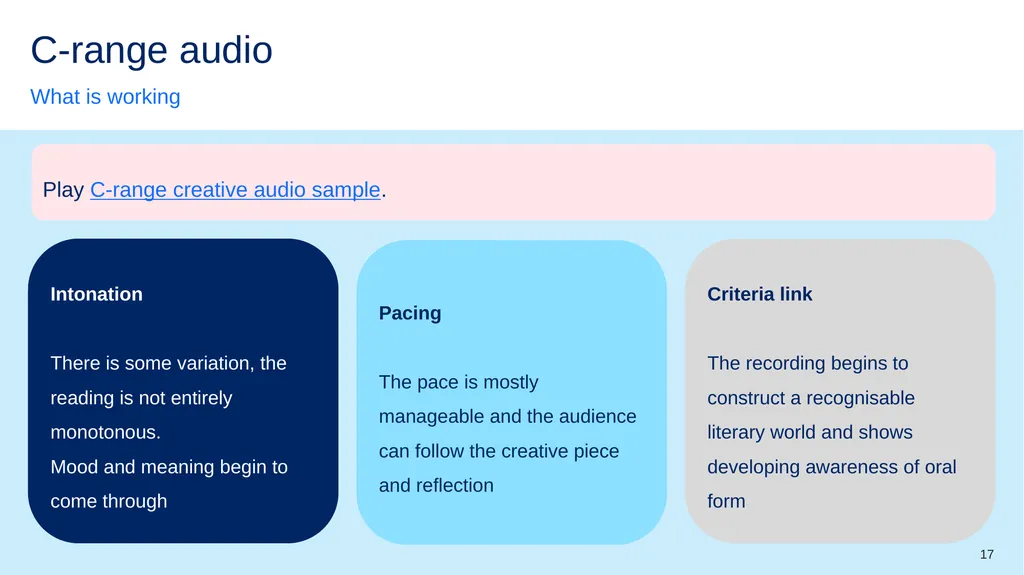
C-range audio What is working Play C-range creative audio sample. Intonation
There is some variation, the reading is not entirely monotonous.
Mood and meaning begin to come through Pacing
The pace is mostly manageable and the audience can follow the creative piece and reflection Criteria link
The recording begins to construct a recognisable literary world and shows developing awareness of oral form 17<br>
There is some variation, the reading is not entirely monotonous.
Mood and meaning begin to come through Pacing
The pace is mostly manageable and the audience can follow the creative piece and reflection Criteria link
The recording begins to construct a recognisable literary world and shows developing awareness of oral form 17<br>
18
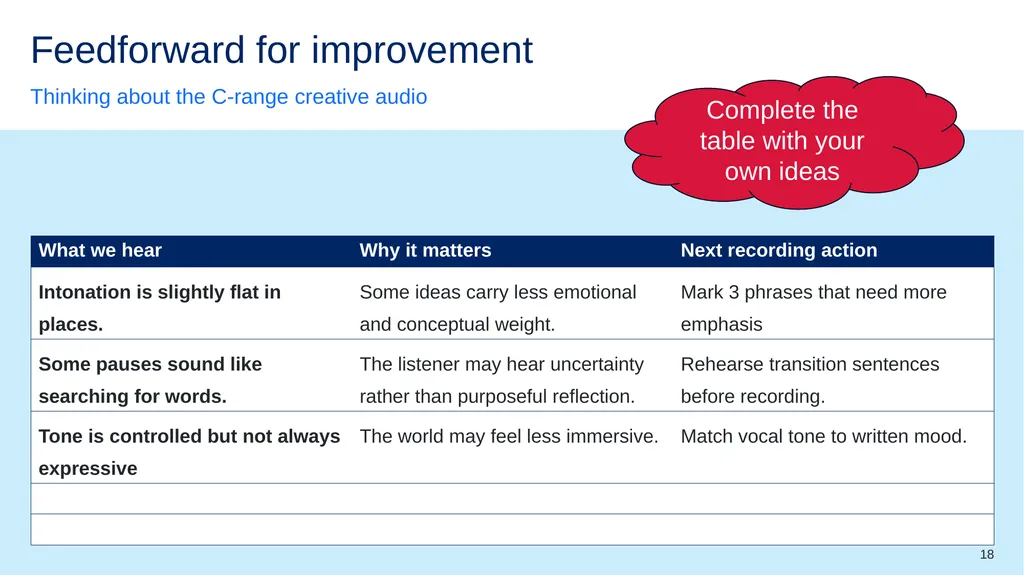
Feedforward for improvement Thinking about the C-range creative audio Complete the table with your own ideas 18<br>
19
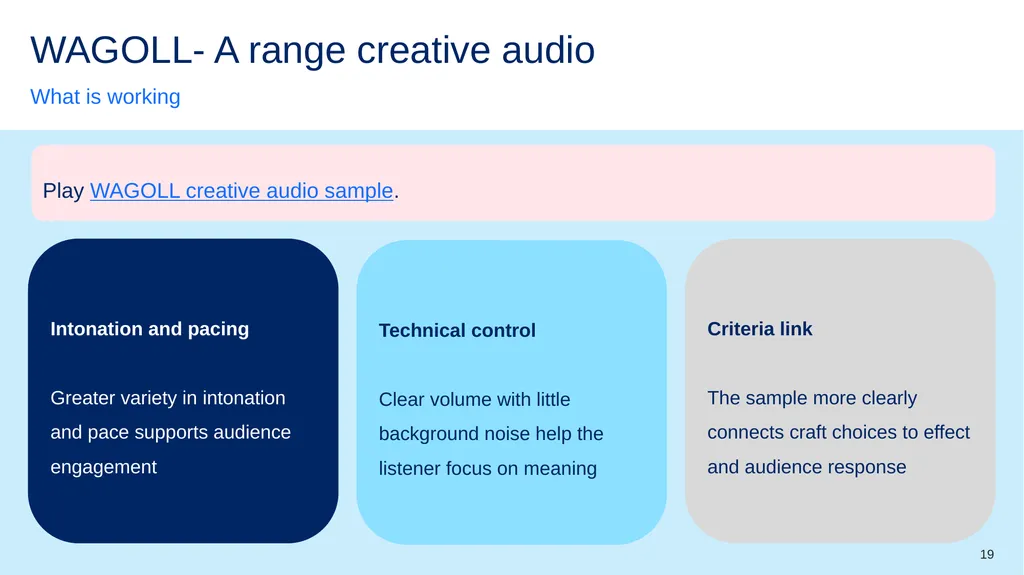
WAGOLL- A range creative audio What is working Play WAGOLL creative audio sample. Intonation and pacing
Greater variety in intonation and pace supports audience engagement Technical control
Clear volume with little background noise help the listener focus on meaning Criteria link
The sample more clearly connects craft choices to effect and audience response 19<br>
Greater variety in intonation and pace supports audience engagement Technical control
Clear volume with little background noise help the listener focus on meaning Criteria link
The sample more clearly connects craft choices to effect and audience response 19<br>
20
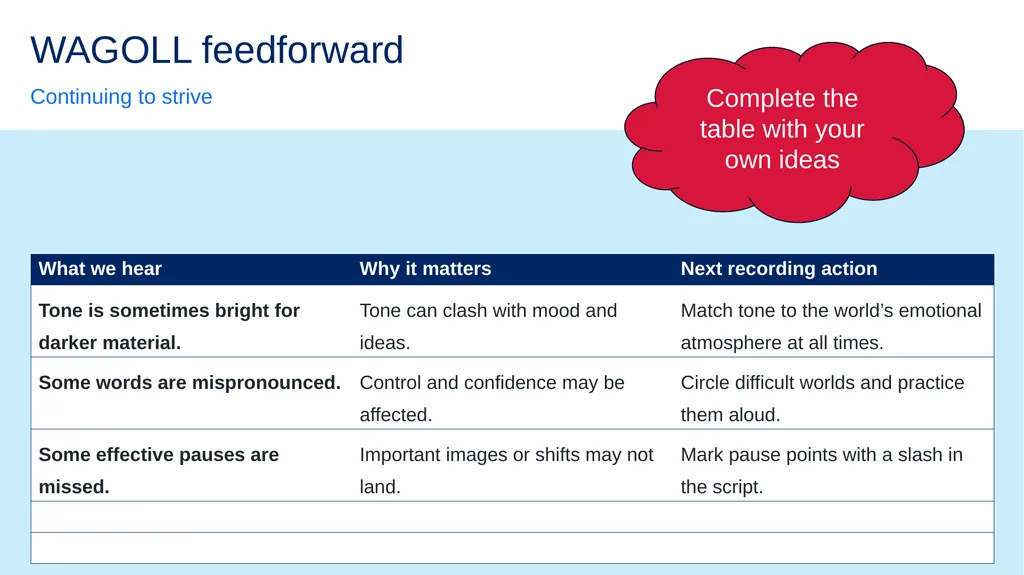
WAGOLL feedforward Continuing to strive Complete the table with your own ideas 20<br>
21
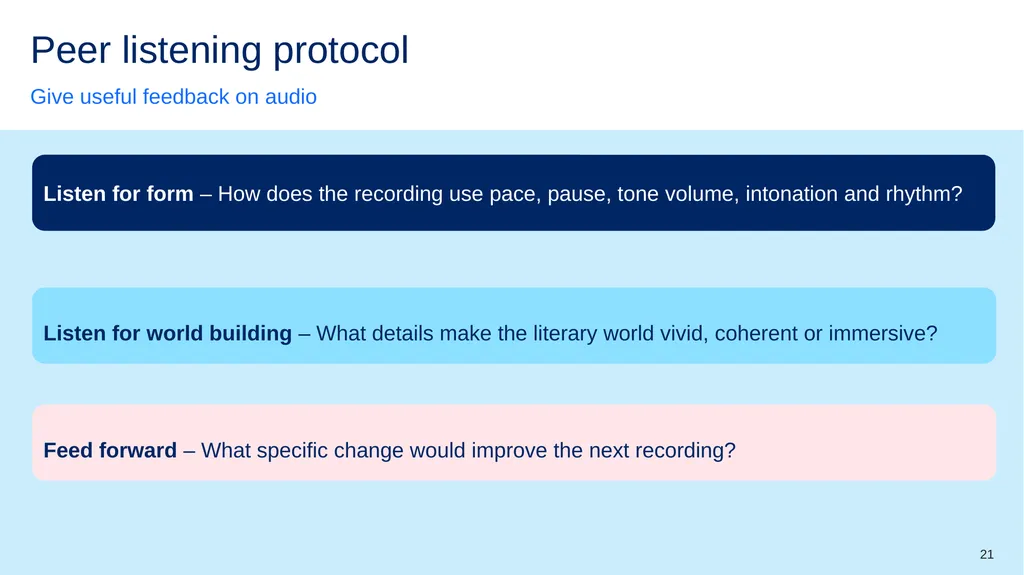
Peer listening protocol Give useful feedback on audio Listen for form – How does the recording use pace, pause, tone volume, intonation and rhythm? Listen for world building – What details make the literary world vivid, coherent or immersive? Feed forward – What specific change would improve the next recording? 21<br>
22
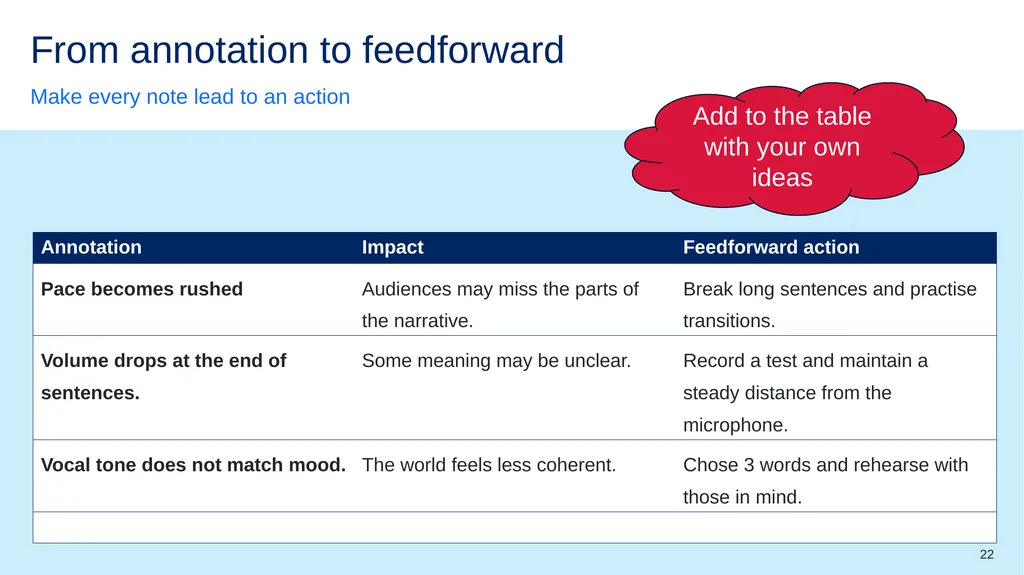
From annotation to feedforward Make every note lead to an action Add to the table with your own ideas 22<br>
23
Phase 6, sequence 1 – preparing for the formal assessment task submission Section 3 Taking notes with a pencil by Thought Catalog on Unsplash<br>
24
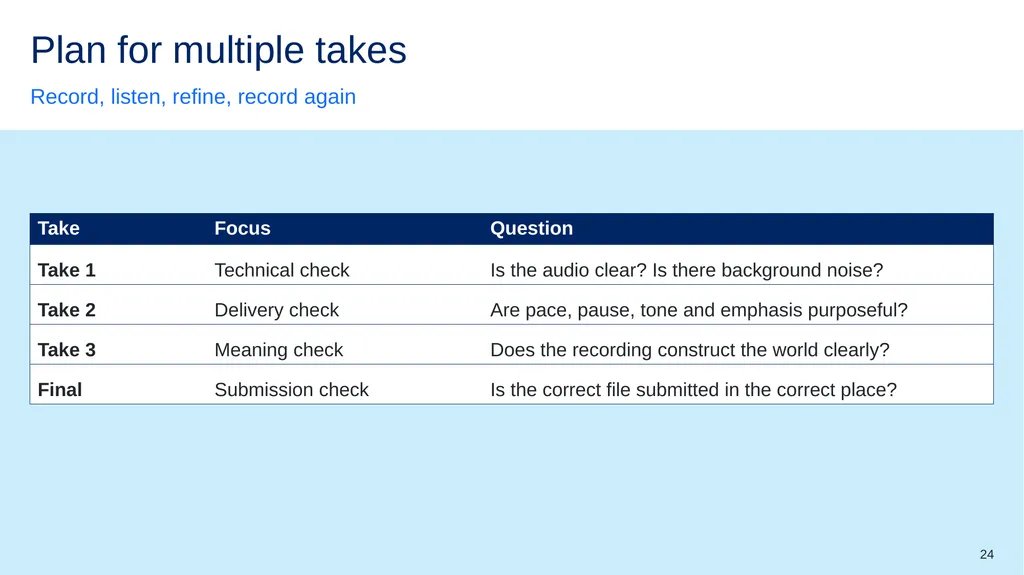
Plan for multiple takes Record, listen, refine, record again 24<br>
25
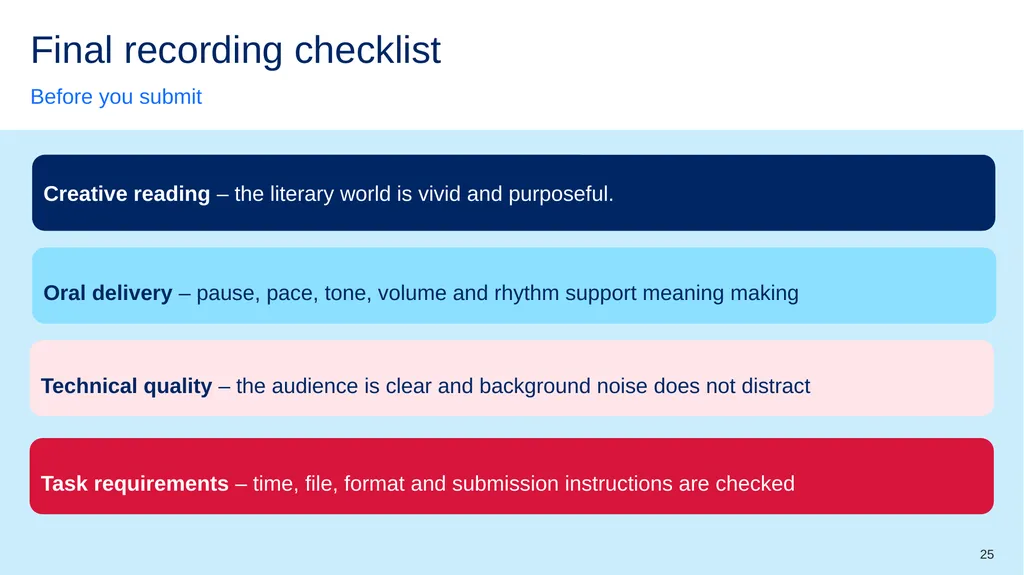
Final recording checklist Before you submit Creative reading – the literary world is vivid and purposeful. Oral delivery – pause, pace, tone, volume and rhythm support meaning making Technical quality – the audience is clear and background noise does not distract Task requirements – time, file, format and submission instructions are checked 25<br>
26
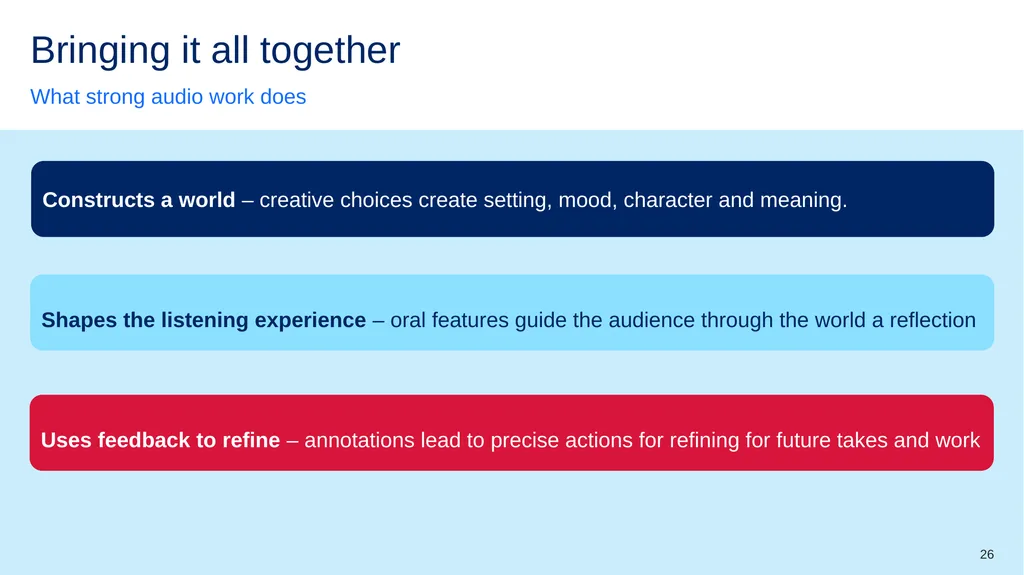
Bringing it all together What strong audio work does Constructs a world – creative choices create setting, mood, character and meaning. Shapes the listening experience – oral features guide the audience through the world a reflection Uses feedback to refine – annotations lead to precise actions for refining for future takes and work 26<br>
27
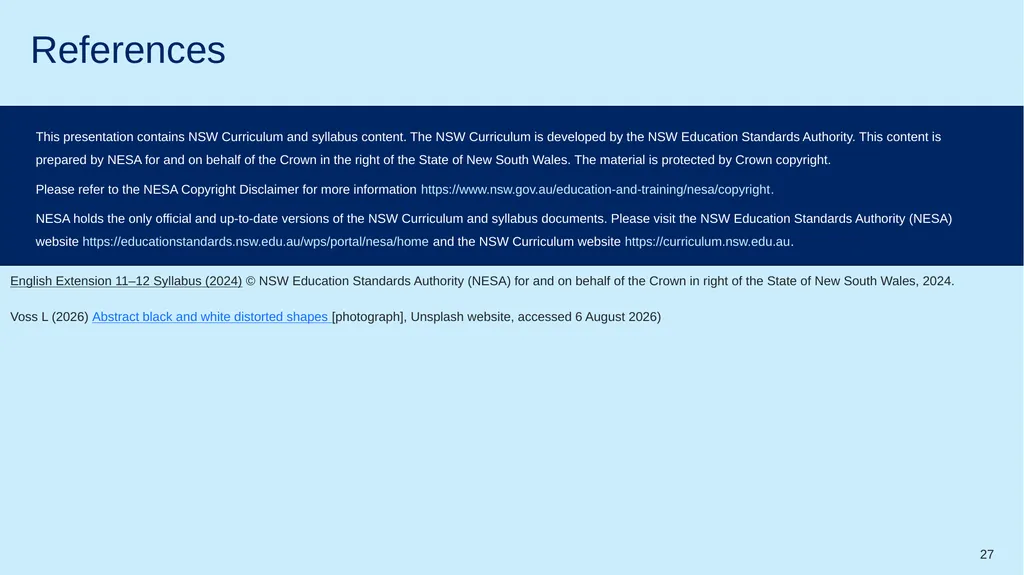
References This presentation contains NSW Curriculum and syllabus content. The NSW Curriculum is developed by the NSW Education Standards Authority. This content is prepared by NESA for and on behalf of the Crown in the right of the State of New South Wales. The material is protected by Crown copyright.
Please refer to the NESA Copyright Disclaimer for more information https://www.nsw.gov.au/education-and-training/nesa/copyright.
NESA holds the only official and up-to-date versions of the NSW Curriculum and syllabus documents. Please visit the NSW Education Standards Authority (NESA) website https://educationstandards.nsw.edu.au/wps/portal/nesa/home and the NSW Curriculum website https://curriculum.nsw.edu.au. English Extension 11–12 Syllabus (2024) © NSW Education Standards Authority (NESA) for and on behalf of the Crown in right of the State of New South Wales, 2024.
Voss L (2026) Abstract black and white distorted shapes [photograph], Unsplash website, accessed 6 August 2026) 27<br>
Please refer to the NESA Copyright Disclaimer for more information https://www.nsw.gov.au/education-and-training/nesa/copyright.
NESA holds the only official and up-to-date versions of the NSW Curriculum and syllabus documents. Please visit the NSW Education Standards Authority (NESA) website https://educationstandards.nsw.edu.au/wps/portal/nesa/home and the NSW Curriculum website https://curriculum.nsw.edu.au. English Extension 11–12 Syllabus (2024) © NSW Education Standards Authority (NESA) for and on behalf of the Crown in right of the State of New South Wales, 2024.
Voss L (2026) Abstract black and white distorted shapes [photograph], Unsplash website, accessed 6 August 2026) 27<br>
28
Copyright © State of New South Wales (Department of Education), 2026 The copyright material published in this resource is subject to the Copyright Act 1968 (Cth) and is owned by the NSW Department of Education or, where indicated, by a party other than the NSW Department of Education (third-party material).
Copyright material available in this resource and owned by the NSW Department of Education is licensed under a Creative Commons Attribution 4.0 International (CC BY 4.0) license.
This license allows you to share and adapt the material for any purpose, even commercially.
Attribution should be given to © State of New South Wales (Department of Education), 2026.
Material in this resource not available under a Creative Commons license:
the NSW Department of Education logo, other logos and trademark-protected material
Material owned by a third party that has been reproduced with permission. You will need to obtain permission from the third party to reuse its material.
Links to third-party material and websites
Please note that the provided (reading/viewing material/list/links/texts) are a suggestion only and implies no endorsement, by the New South Wales Department of Education, of any author, publisher, or book title. School principals and teachers are best placed to assess the suitability of resources that would complement the curriculum and reflect the needs and interests of their students.
If you use the links provided in this document to access a third-party’s website, you acknowledge that the terms of use, including licence terms set out on the third-party’s website apply to the use which may be made of the materials on that third-party website or where permitted by the Copyright Act 1968 (Cth). The department accepts no responsibility for content on third-party websites.<br>
Copyright material available in this resource and owned by the NSW Department of Education is licensed under a Creative Commons Attribution 4.0 International (CC BY 4.0) license.
This license allows you to share and adapt the material for any purpose, even commercially.
Attribution should be given to © State of New South Wales (Department of Education), 2026.
Material in this resource not available under a Creative Commons license:
the NSW Department of Education logo, other logos and trademark-protected material
Material owned by a third party that has been reproduced with permission. You will need to obtain permission from the third party to reuse its material.
Links to third-party material and websites
Please note that the provided (reading/viewing material/list/links/texts) are a suggestion only and implies no endorsement, by the New South Wales Department of Education, of any author, publisher, or book title. School principals and teachers are best placed to assess the suitability of resources that would complement the curriculum and reflect the needs and interests of their students.
If you use the links provided in this document to access a third-party’s website, you acknowledge that the terms of use, including licence terms set out on the third-party’s website apply to the use which may be made of the materials on that third-party website or where permitted by the Copyright Act 1968 (Cth). The department accepts no responsibility for content on third-party websites.<br>