
Synchronization CPEN 331, UBC Alexandra Fedorova
MT
Published · 33 slides · 0 views

1 / 1





Description
Synchronization CPEN 331, UBC Alexandra Fedorova Shared Resources Basic problem: Two concurrent threads are accessing a shared variable If the variable is readmodifiedwritten by both threads, then access to the variable must be controlled
Related Topics
Share
Embed code
Download this presentation From Below
"Synchronization CPEN 331, UBC Alexandra Fedorova" is the property of its rightful owner. Permission is granted to download and print the materials on this website for personal, non-commercial use only, and to display it on your personal computer provided you do not modify the materials and that you retain all copyright notices contained in the materials. By downloading content from our website, you accept the terms of this agreement.
Presentation Transcript
01
Synchronization CPEN 331, UBC
Alexandra Fedorova<br>
Alexandra Fedorova<br>
02
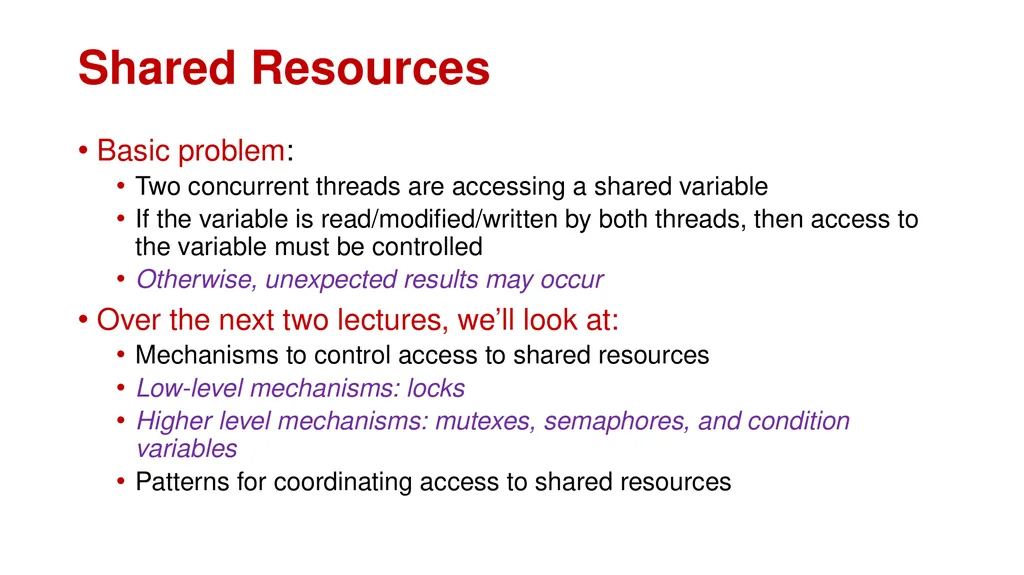
Shared Resources Basic problem:
Two concurrent threads are accessing a shared variable
If the variable is read/modified/written by both threads, then access to the variable must be controlled
Otherwise, unexpected results may occur
Over the next two lectures, we’ll look at:
Mechanisms to control access to shared resources
Low-level mechanisms: locks
Higher level mechanisms: mutexes, semaphores, and condition variables
Patterns for coordinating access to shared resources<br>
Two concurrent threads are accessing a shared variable
If the variable is read/modified/written by both threads, then access to the variable must be controlled
Otherwise, unexpected results may occur
Over the next two lectures, we’ll look at:
Mechanisms to control access to shared resources
Low-level mechanisms: locks
Higher level mechanisms: mutexes, semaphores, and condition variables
Patterns for coordinating access to shared resources<br>
03
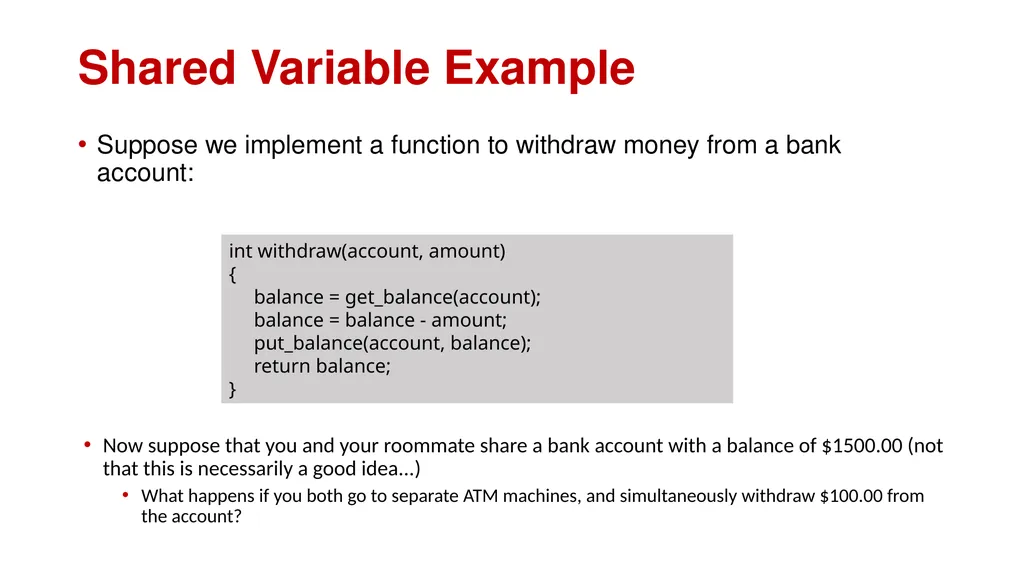
Shared Variable Example Suppose we implement a function to withdraw money from a bank account: int withdraw(account, amount)
{
balance = get_balance(account);
balance = balance - amount;
put_balance(account, balance);
return balance;
} Now suppose that you and your roommate share a bank account with a balance of $1500.00 (not that this is necessarily a good idea...)
What happens if you both go to separate ATM machines, and simultaneously withdraw $100.00 from the account?<br>
{
balance = get_balance(account);
balance = balance - amount;
put_balance(account, balance);
return balance;
} Now suppose that you and your roommate share a bank account with a balance of $1500.00 (not that this is necessarily a good idea...)
What happens if you both go to separate ATM machines, and simultaneously withdraw $100.00 from the account?<br>
04
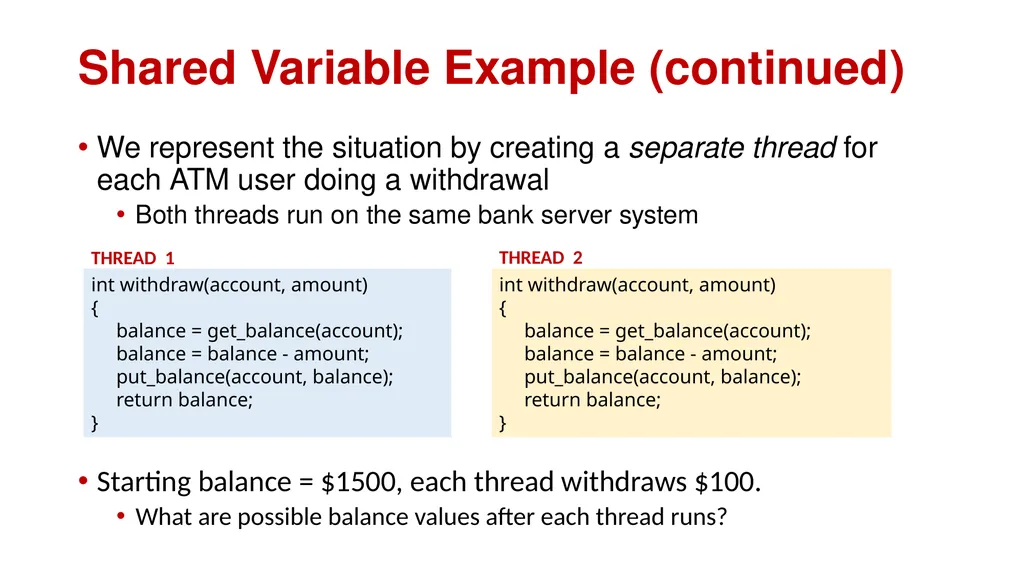
Shared Variable Example (continued) We represent the situation by creating a separate thread for each ATM user doing a withdrawal
Both threads run on the same bank server system int withdraw(account, amount)
{
balance = get_balance(account);
balance = balance - amount;
put_balance(account, balance);
return balance;
} int withdraw(account, amount)
{
balance = get_balance(account);
balance = balance - amount;
put_balance(account, balance);
return balance;
} Starting balance = $1500, each thread withdraws $100.
What are possible balance values after each thread runs? THREAD 1 THREAD 2<br>
Both threads run on the same bank server system int withdraw(account, amount)
{
balance = get_balance(account);
balance = balance - amount;
put_balance(account, balance);
return balance;
} int withdraw(account, amount)
{
balance = get_balance(account);
balance = balance - amount;
put_balance(account, balance);
return balance;
} Starting balance = $1500, each thread withdraws $100.
What are possible balance values after each thread runs? THREAD 1 THREAD 2<br>
05
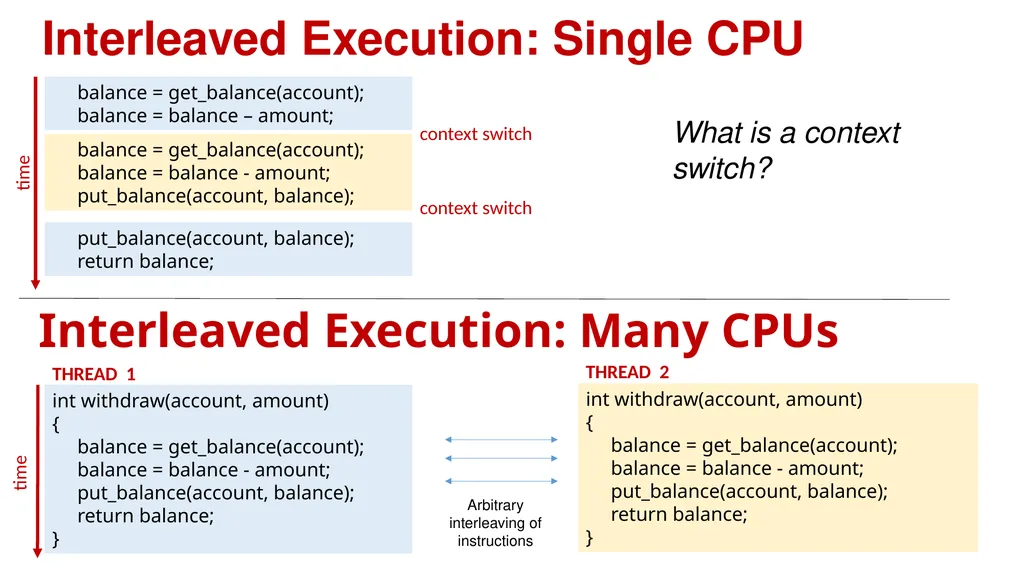
Interleaved Execution: Single CPU balance = get_balance(account);
balance = balance – amount; put_balance(account, balance);
return balance; balance = get_balance(account);
balance = balance - amount;
put_balance(account, balance); context switch context switch time What is a context switch? Interleaved Execution: Many CPUs int withdraw(account, amount)
{
balance = get_balance(account);
balance = balance - amount;
put_balance(account, balance);
return balance;
} int withdraw(account, amount)
{
balance = get_balance(account);
balance = balance - amount;
put_balance(account, balance);
return balance;
} THREAD 1 THREAD 2 time Arbitrary interleaving of instructions<br>
balance = balance – amount; put_balance(account, balance);
return balance; balance = get_balance(account);
balance = balance - amount;
put_balance(account, balance); context switch context switch time What is a context switch? Interleaved Execution: Many CPUs int withdraw(account, amount)
{
balance = get_balance(account);
balance = balance - amount;
put_balance(account, balance);
return balance;
} int withdraw(account, amount)
{
balance = get_balance(account);
balance = balance - amount;
put_balance(account, balance);
return balance;
} THREAD 1 THREAD 2 time Arbitrary interleaving of instructions<br>
06
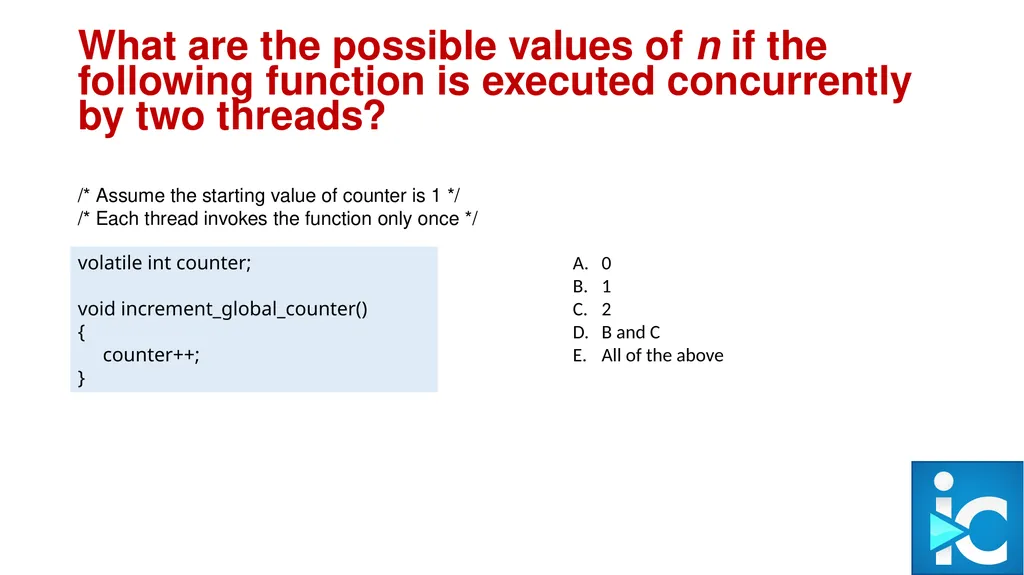
What are the possible values of n if the following function is executed concurrently by two threads? volatile int counter;
void increment_global_counter()
{
counter++;
} /* Assume the starting value of counter is 1 */
/* Each thread invokes the function only once */ 0
1
2
B and C
All of the above<br>
void increment_global_counter()
{
counter++;
} /* Assume the starting value of counter is 1 */
/* Each thread invokes the function only once */ 0
1
2
B and C
All of the above<br>
07
What are the possible values of n if the following function is executed concurrently by two threads? volatile uint16_t counter;
void increment_global_counter()
{
counter++;
} /* Assume the starting value of counter is 255 */
/* Assume a processor with 8-bit registers */
/* Each thread invokes the function only once */ 256
257
Some other value
A and B only
A, B or C<br>
void increment_global_counter()
{
counter++;
} /* Assume the starting value of counter is 255 */
/* Assume a processor with 8-bit registers */
/* Each thread invokes the function only once */ 256
257
Some other value
A and B only
A, B or C<br>
08
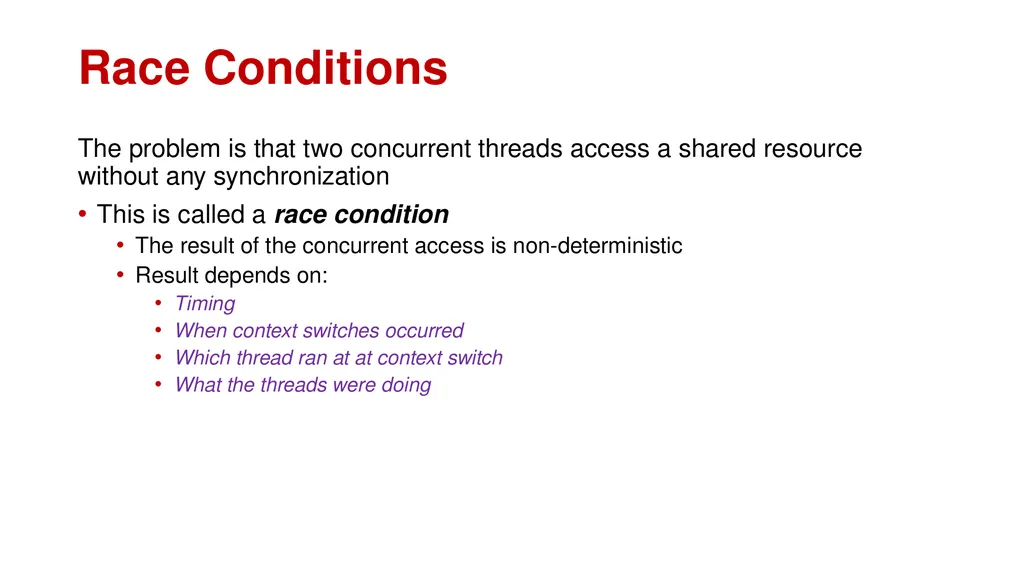
Race Conditions The problem is that two concurrent threads access a shared resource without any synchronization
This is called a race condition
The result of the concurrent access is non-deterministic
Result depends on:
Timing
When context switches occurred
Which thread ran at at context switch
What the threads were doing<br>
This is called a race condition
The result of the concurrent access is non-deterministic
Result depends on:
Timing
When context switches occurred
Which thread ran at at context switch
What the threads were doing<br>
09
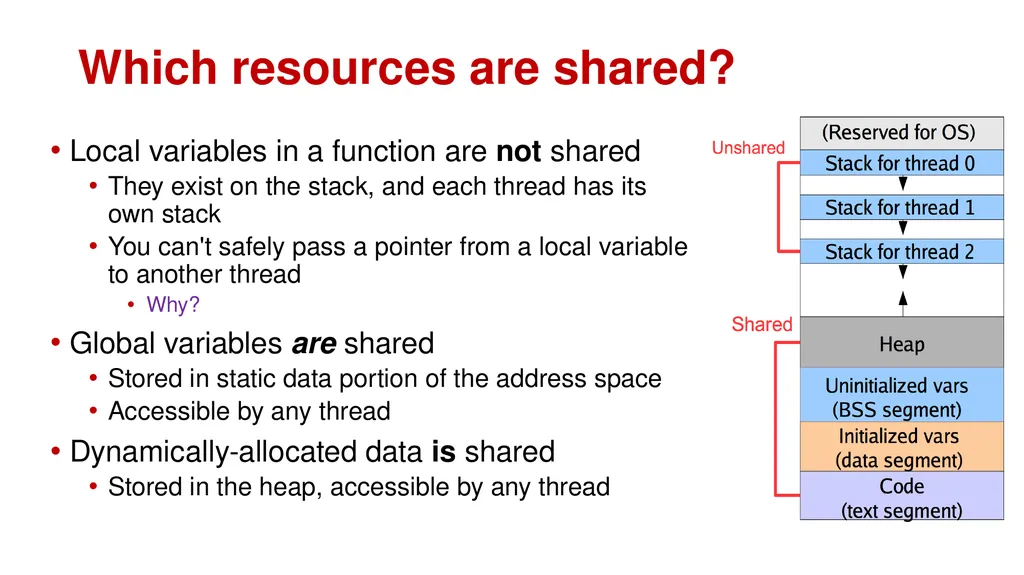
Which resources are shared? Local variables in a function are not shared
They exist on the stack, and each thread has its own stack
You can't safely pass a pointer from a local variable to another thread
Why?
Global variables are shared
Stored in static data portion of the address space
Accessible by any thread
Dynamically-allocated data is shared
Stored in the heap, accessible by any thread<br>
They exist on the stack, and each thread has its own stack
You can't safely pass a pointer from a local variable to another thread
Why?
Global variables are shared
Stored in static data portion of the address space
Accessible by any thread
Dynamically-allocated data is shared
Stored in the heap, accessible by any thread<br>
10
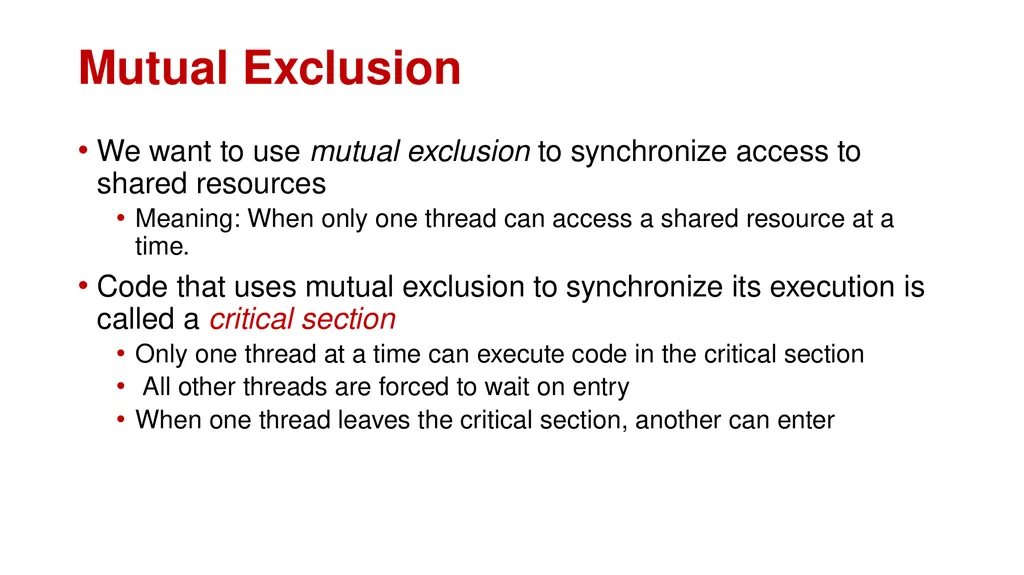
Mutual Exclusion We want to use mutual exclusion to synchronize access to shared resources
Meaning: When only one thread can access a shared resource at a time.
Code that uses mutual exclusion to synchronize its execution is called a critical section
Only one thread at a time can execute code in the critical section
All other threads are forced to wait on entry
When one thread leaves the critical section, another can enter<br>
Meaning: When only one thread can access a shared resource at a time.
Code that uses mutual exclusion to synchronize its execution is called a critical section
Only one thread at a time can execute code in the critical section
All other threads are forced to wait on entry
When one thread leaves the critical section, another can enter<br>
11
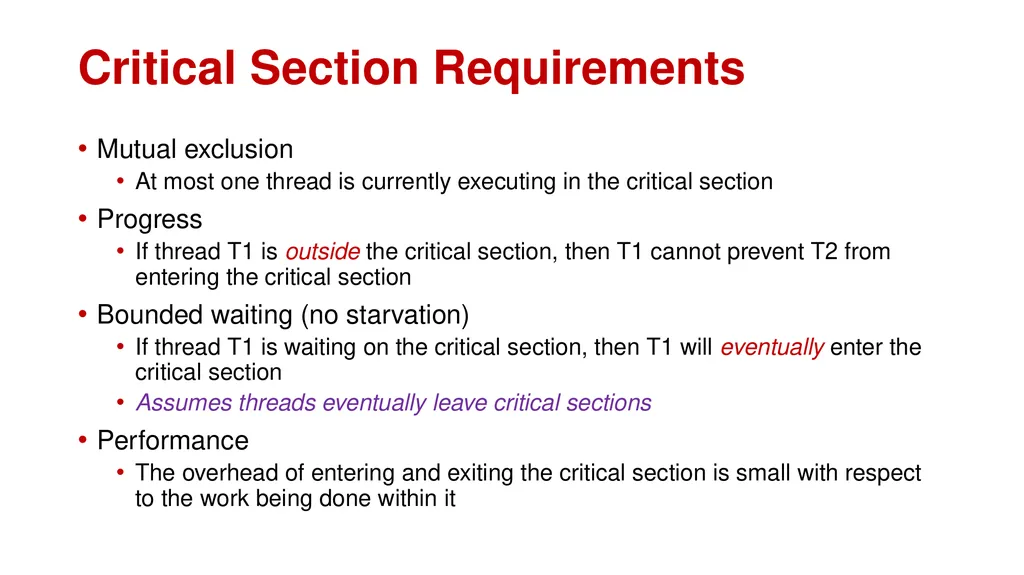
Critical Section Requirements Mutual exclusion
At most one thread is currently executing in the critical section
Progress
If thread T1 is outside the critical section, then T1 cannot prevent T2 from entering the critical section
Bounded waiting (no starvation)
If thread T1 is waiting on the critical section, then T1 will eventually enter the critical section
Assumes threads eventually leave critical sections
Performance
The overhead of entering and exiting the critical section is small with respect to the work being done within it<br>
At most one thread is currently executing in the critical section
Progress
If thread T1 is outside the critical section, then T1 cannot prevent T2 from entering the critical section
Bounded waiting (no starvation)
If thread T1 is waiting on the critical section, then T1 will eventually enter the critical section
Assumes threads eventually leave critical sections
Performance
The overhead of entering and exiting the critical section is small with respect to the work being done within it<br>
12
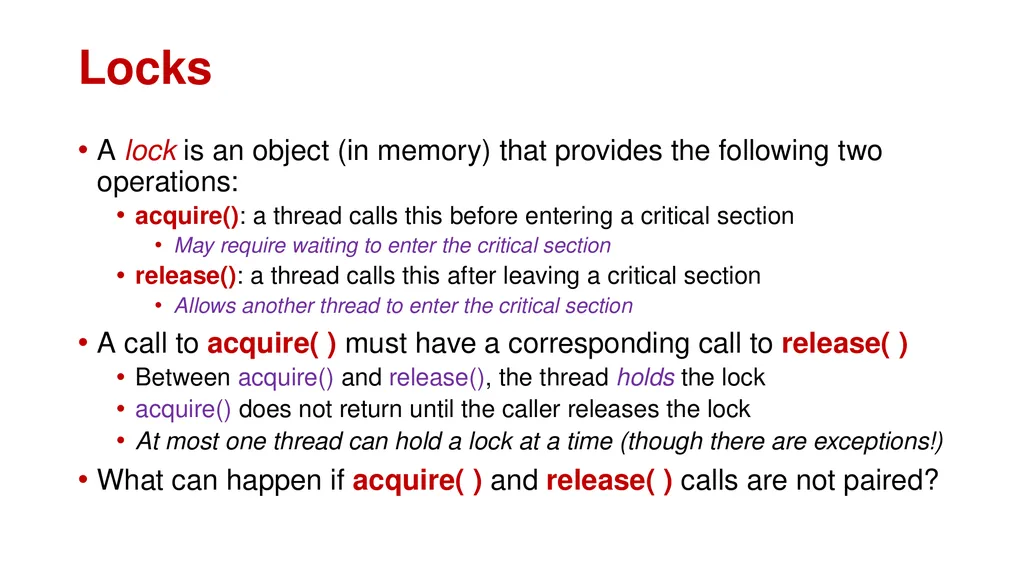
Locks A lock is an object (in memory) that provides the following two operations:
acquire(): a thread calls this before entering a critical section
May require waiting to enter the critical section
release(): a thread calls this after leaving a critical section
Allows another thread to enter the critical section
A call to acquire( ) must have a corresponding call to release( )
Between acquire() and release(), the thread holds the lock
acquire() does not return until the caller releases the lock
At most one thread can hold a lock at a time (though there are exceptions!)
What can happen if acquire( ) and release( ) calls are not paired?<br>
acquire(): a thread calls this before entering a critical section
May require waiting to enter the critical section
release(): a thread calls this after leaving a critical section
Allows another thread to enter the critical section
A call to acquire( ) must have a corresponding call to release( )
Between acquire() and release(), the thread holds the lock
acquire() does not return until the caller releases the lock
At most one thread can hold a lock at a time (though there are exceptions!)
What can happen if acquire( ) and release( ) calls are not paired?<br>
13
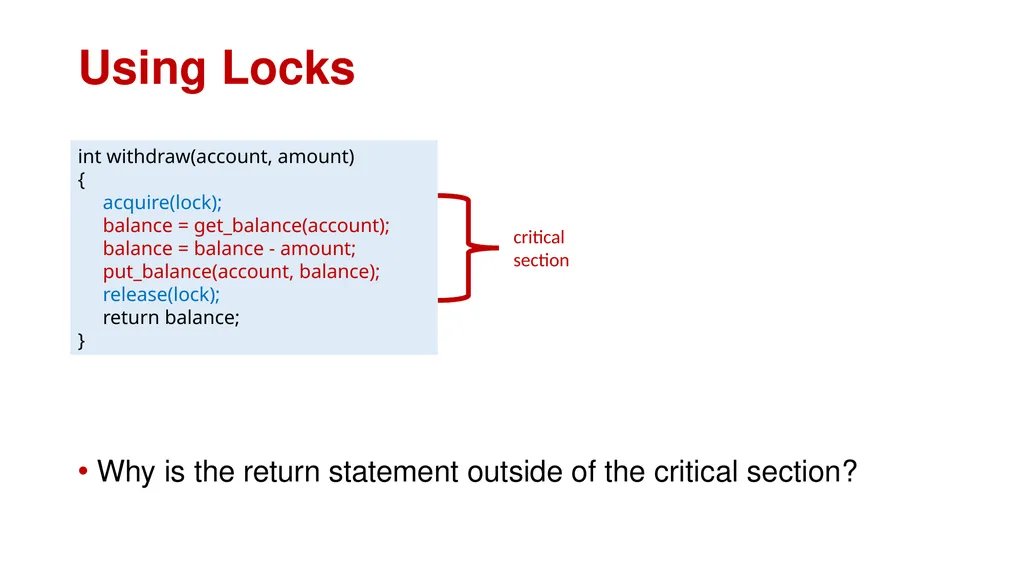
Using Locks Why is the return statement outside of the critical section? int withdraw(account, amount)
{
acquire(lock);
balance = get_balance(account);
balance = balance - amount;
put_balance(account, balance);
release(lock);
return balance;
} critical
section<br>
{
acquire(lock);
balance = get_balance(account);
balance = balance - amount;
put_balance(account, balance);
release(lock);
return balance;
} critical
section<br>
14
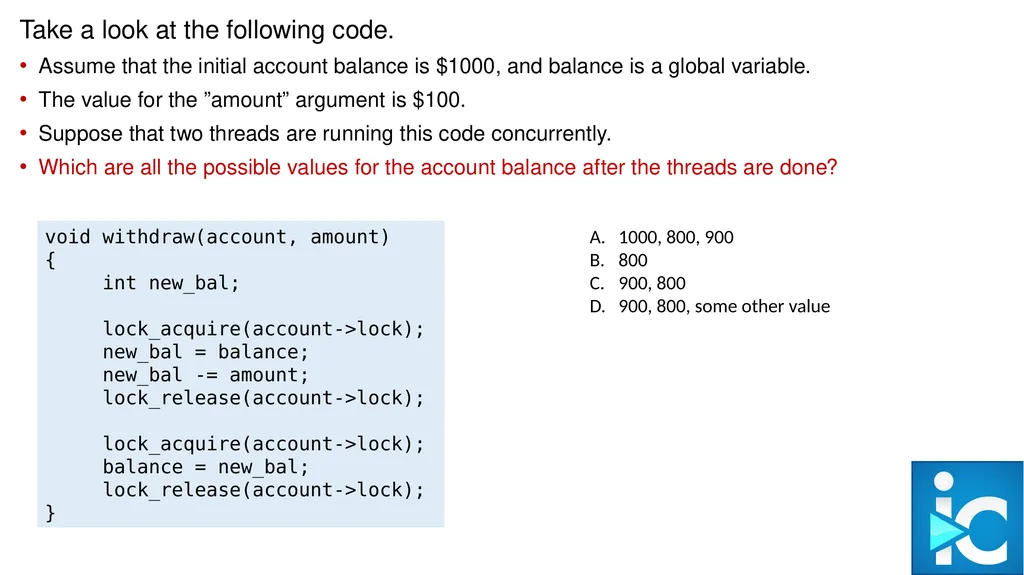
Take a look at the following code.
Assume that the initial account balance is $1000, and balance is a global variable.
The value for the ”amount” argument is $100.
Suppose that two threads are running this code concurrently.
Which are all the possible values for the account balance after the threads are done? void withdraw(account, amount)
{
int new_bal;
lock_acquire(account->lock);
new_bal = balance;
new_bal -= amount;
lock_release(account->lock);
lock_acquire(account->lock);
balance = new_bal;
lock_release(account->lock);
} 1000, 800, 900
800
900, 800
900, 800, some other value<br>
Assume that the initial account balance is $1000, and balance is a global variable.
The value for the ”amount” argument is $100.
Suppose that two threads are running this code concurrently.
Which are all the possible values for the account balance after the threads are done? void withdraw(account, amount)
{
int new_bal;
lock_acquire(account->lock);
new_bal = balance;
new_bal -= amount;
lock_release(account->lock);
lock_acquire(account->lock);
balance = new_bal;
lock_release(account->lock);
} 1000, 800, 900
800
900, 800
900, 800, some other value<br>
15
A Common Pitfall Suppose you wanted to add some error-checking to your code: int withdraw(account, amount)
{
acquire(lock);
balance = get_balance(account);
if(balance < 0)
return ERROR;
balance = balance - amount;
ret = put_balance(account, balance);
if(ret < 0)
return ERROR;
release(lock);
return balance;
} Do you see a problem with this code?<br>
{
acquire(lock);
balance = get_balance(account);
if(balance < 0)
return ERROR;
balance = balance - amount;
ret = put_balance(account, balance);
if(ret < 0)
return ERROR;
release(lock);
return balance;
} Do you see a problem with this code?<br>
16
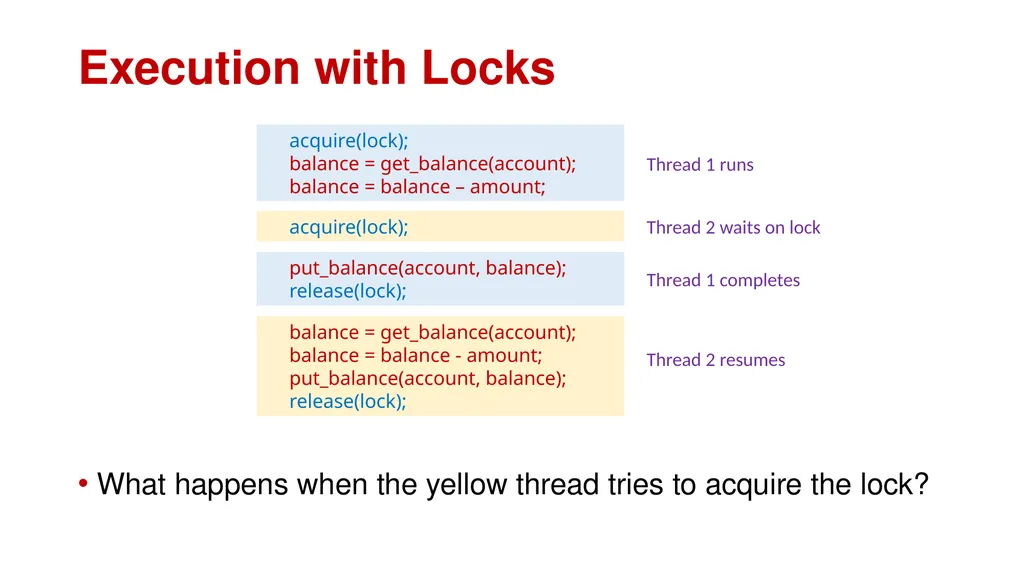
Execution with Locks What happens when the yellow thread tries to acquire the lock? acquire(lock);
balance = get_balance(account);
balance = balance – amount; put_balance(account, balance);
release(lock); acquire(lock); balance = get_balance(account);
balance = balance - amount;
put_balance(account, balance);
release(lock); Thread 1 runs Thread 2 waits on lock Thread 1 completes Thread 2 resumes<br>
balance = get_balance(account);
balance = balance – amount; put_balance(account, balance);
release(lock); acquire(lock); balance = get_balance(account);
balance = balance - amount;
put_balance(account, balance);
release(lock); Thread 1 runs Thread 2 waits on lock Thread 1 completes Thread 2 resumes<br>
17
Implementing Synchronization Primitives Subject of Assignment 2<br>
18
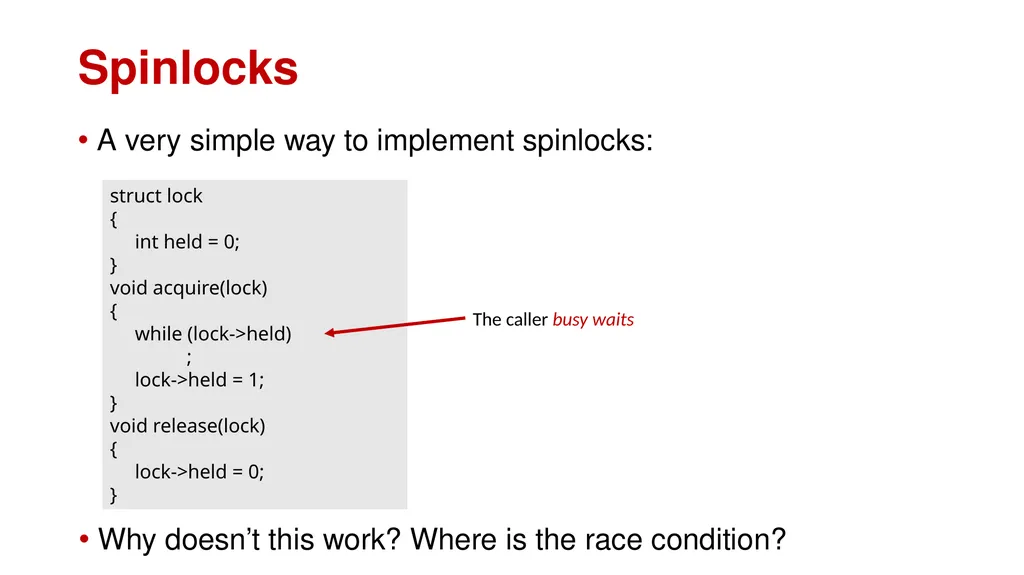
Spinlocks A very simple way to implement spinlocks: struct lock
{
int held = 0;
}
void acquire(lock)
{
while (lock->held)
;
lock->held = 1;
}
void release(lock)
{
lock->held = 0;
} The caller busy waits Why doesn’t this work? Where is the race condition?<br>
{
int held = 0;
}
void acquire(lock)
{
while (lock->held)
;
lock->held = 1;
}
void release(lock)
{
lock->held = 0;
} The caller busy waits Why doesn’t this work? Where is the race condition?<br>
19
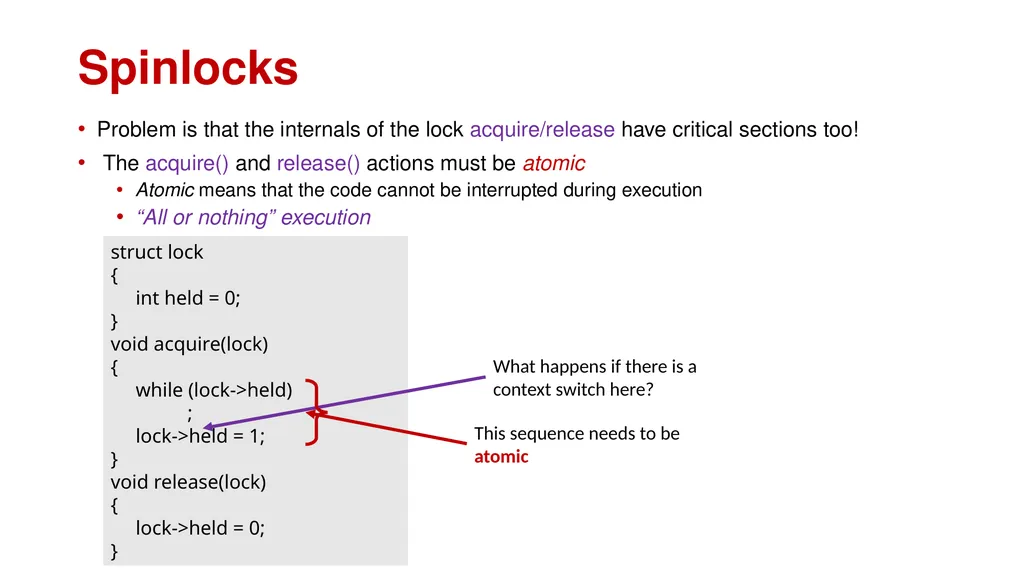
Spinlocks Problem is that the internals of the lock acquire/release have critical sections too!
The acquire() and release() actions must be atomic
Atomic means that the code cannot be interrupted during execution
“All or nothing” execution struct lock
{
int held = 0;
}
void acquire(lock)
{
while (lock->held)
;
lock->held = 1;
}
void release(lock)
{
lock->held = 0;
} What happens if there is a context switch here?<br>
The acquire() and release() actions must be atomic
Atomic means that the code cannot be interrupted during execution
“All or nothing” execution struct lock
{
int held = 0;
}
void acquire(lock)
{
while (lock->held)
;
lock->held = 1;
}
void release(lock)
{
lock->held = 0;
} What happens if there is a context switch here?<br>
20
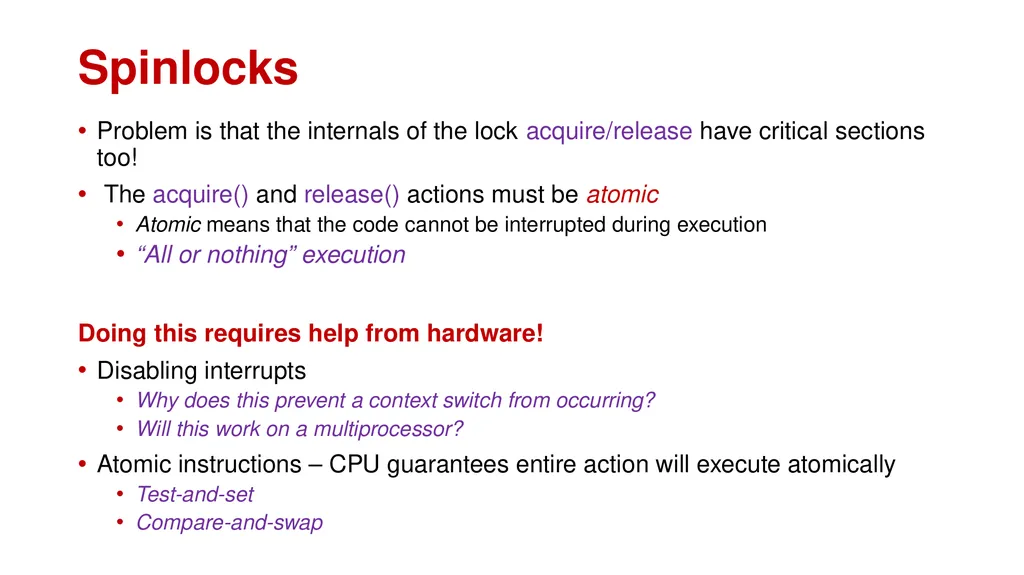
Spinlocks Problem is that the internals of the lock acquire/release have critical sections too!
The acquire() and release() actions must be atomic
Atomic means that the code cannot be interrupted during execution
“All or nothing” execution
Doing this requires help from hardware!
Disabling interrupts
Why does this prevent a context switch from occurring?
Will this work on a multiprocessor?
Atomic instructions – CPU guarantees entire action will execute atomically
Test-and-set
Compare-and-swap<br>
The acquire() and release() actions must be atomic
Atomic means that the code cannot be interrupted during execution
“All or nothing” execution
Doing this requires help from hardware!
Disabling interrupts
Why does this prevent a context switch from occurring?
Will this work on a multiprocessor?
Atomic instructions – CPU guarantees entire action will execute atomically
Test-and-set
Compare-and-swap<br>
21
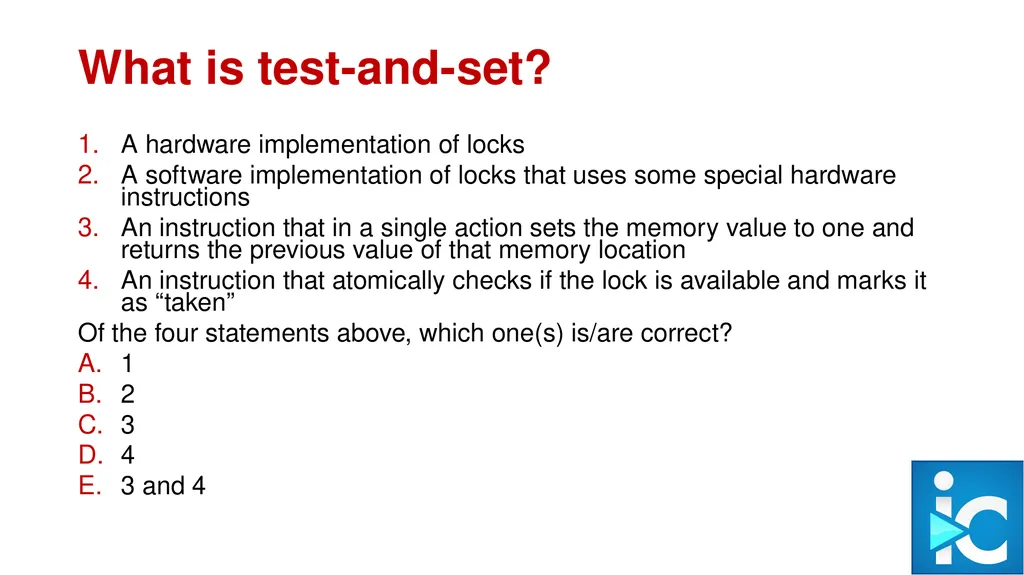
What is test-and-set? A hardware implementation of locks
A software implementation of locks that uses some special hardware instructions
An instruction that in a single action sets the memory value to one and returns the previous value of that memory location
An instruction that atomically checks if the lock is available and marks it as “taken”
Of the four statements above, which one(s) is/are correct?
1
2
3
4
3 and 4<br>
A software implementation of locks that uses some special hardware instructions
An instruction that in a single action sets the memory value to one and returns the previous value of that memory location
An instruction that atomically checks if the lock is available and marks it as “taken”
Of the four statements above, which one(s) is/are correct?
1
2
3
4
3 and 4<br>
22
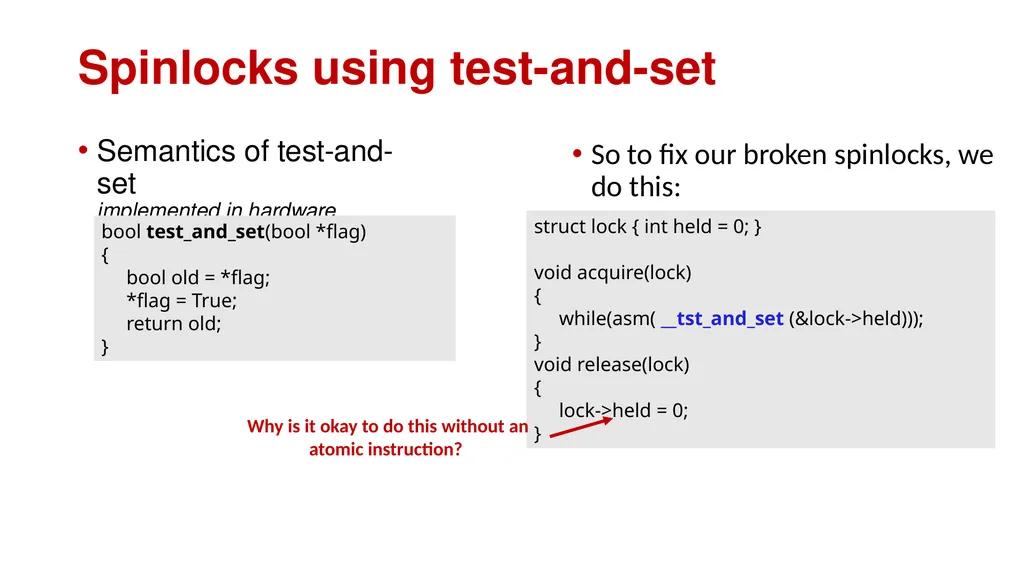
Spinlocks using test-and-set Semantics of test-and-set
implemented in hardware So to fix our broken spinlocks, we do this: bool test_and_set(bool *flag)
{
bool old = *flag; *flag = True; return old;
} struct lock { int held = 0; }
void acquire(lock)
{
while(asm( __tst_and_set (&lock->held)));
}
void release(lock)
{
lock->held = 0;
}<br>
{
bool old = *flag; *flag = True; return old;
} struct lock { int held = 0; }
void acquire(lock)
{
while(asm( __tst_and_set (&lock->held)));
}
void release(lock)
{
lock->held = 0;
}<br>
23
Actually, there is still a bug in the code I have shown you!<br>
24
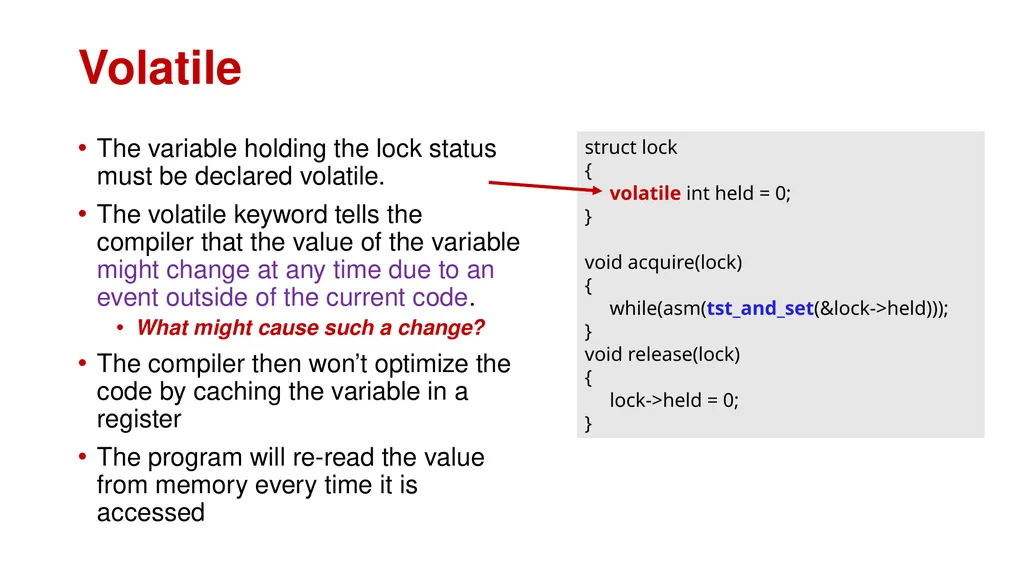
Volatile The variable holding the lock status must be declared volatile.
The volatile keyword tells the compiler that the value of the variable might change at any time due to an event outside of the current code.
What might cause such a change?
The compiler then won’t optimize the code by caching the variable in a register
The program will re-read the value from memory every time it is accessed struct lock
{
volatile int held = 0;
}
void acquire(lock)
{
while(asm(tst_and_set(&lock->held)));
}
void release(lock)
{
lock->held = 0;
}<br>
The volatile keyword tells the compiler that the value of the variable might change at any time due to an event outside of the current code.
What might cause such a change?
The compiler then won’t optimize the code by caching the variable in a register
The program will re-read the value from memory every time it is accessed struct lock
{
volatile int held = 0;
}
void acquire(lock)
{
while(asm(tst_and_set(&lock->held)));
}
void release(lock)
{
lock->held = 0;
}<br>
25
Problems with spinlocks (1) struct lock
{
volatile int held = 0;
}
void acquire(lock)
{
while(asm(tst_and_set(&lock->held)));
}
void release(lock)
{
lock->held = 0;
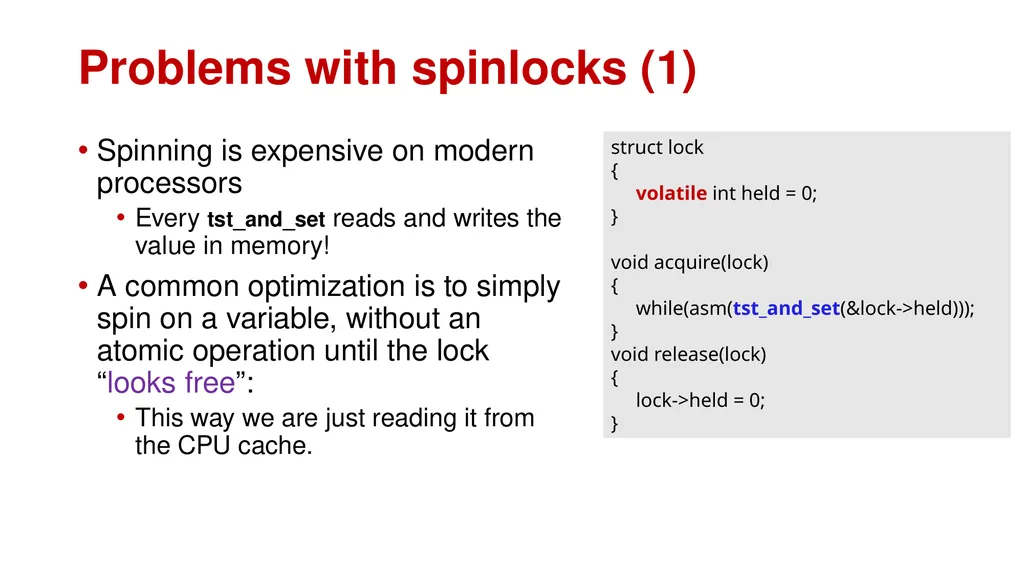
} Spinning is expensive on modern processors
Every tst_and_set reads and writes the value in memory!
A common optimization is to simply spin on a variable, without an atomic operation until the lock “looks free”:
This way we are just reading it from the CPU cache.<br>
{
volatile int held = 0;
}
void acquire(lock)
{
while(asm(tst_and_set(&lock->held)));
}
void release(lock)
{
lock->held = 0;
} Spinning is expensive on modern processors
Every tst_and_set reads and writes the value in memory!
A common optimization is to simply spin on a variable, without an atomic operation until the lock “looks free”:
This way we are just reading it from the CPU cache.<br>
26
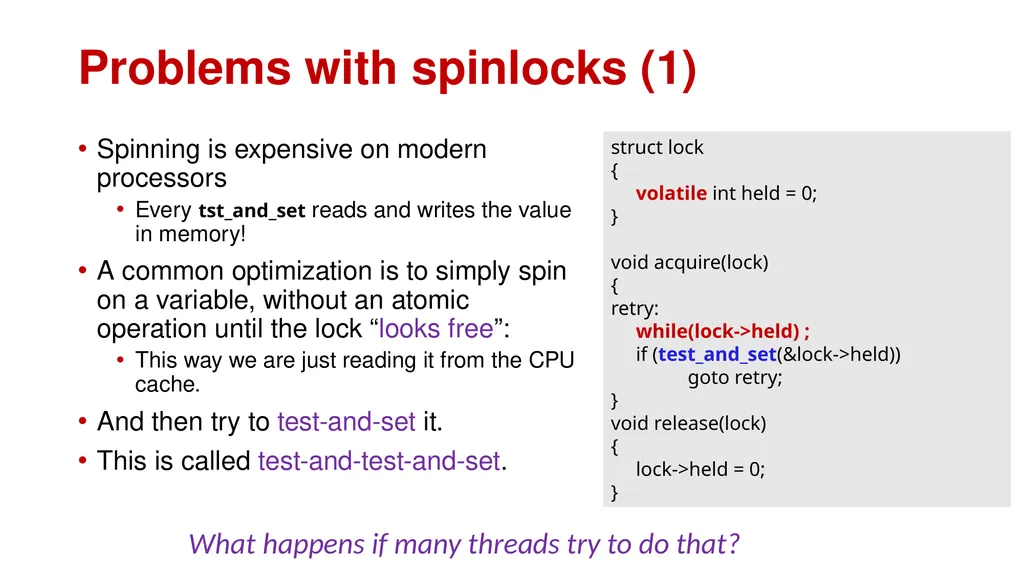
Problems with spinlocks (1) Spinning is expensive on modern processors
Every tst_and_set reads and writes the value in memory!
A common optimization is to simply spin on a variable, without an atomic operation until the lock “looks free”:
This way we are just reading it from the CPU cache.
And then try to test-and-set it.
This is called test-and-test-and-set. struct lock
{
volatile int held = 0;
}
void acquire(lock)
{
retry:
while(lock->held) ;
if (test_and_set(&lock->held))
goto retry;
}
void release(lock)
{
lock->held = 0;
} What happens if many threads try to do that?<br>
Every tst_and_set reads and writes the value in memory!
A common optimization is to simply spin on a variable, without an atomic operation until the lock “looks free”:
This way we are just reading it from the CPU cache.
And then try to test-and-set it.
This is called test-and-test-and-set. struct lock
{
volatile int held = 0;
}
void acquire(lock)
{
retry:
while(lock->held) ;
if (test_and_set(&lock->held))
goto retry;
}
void release(lock)
{
lock->held = 0;
} What happens if many threads try to do that?<br>
27
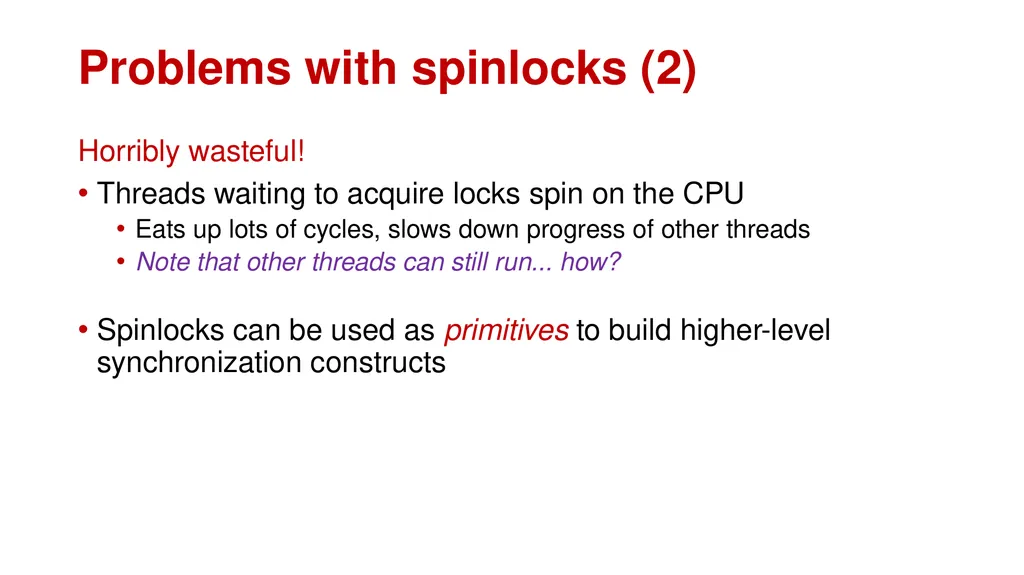
Problems with spinlocks (2) Horribly wasteful!
Threads waiting to acquire locks spin on the CPU
Eats up lots of cycles, slows down progress of other threads
Note that other threads can still run... how?
Spinlocks can be used as primitives to build higher-level synchronization constructs<br>
Threads waiting to acquire locks spin on the CPU
Eats up lots of cycles, slows down progress of other threads
Note that other threads can still run... how?
Spinlocks can be used as primitives to build higher-level synchronization constructs<br>
28
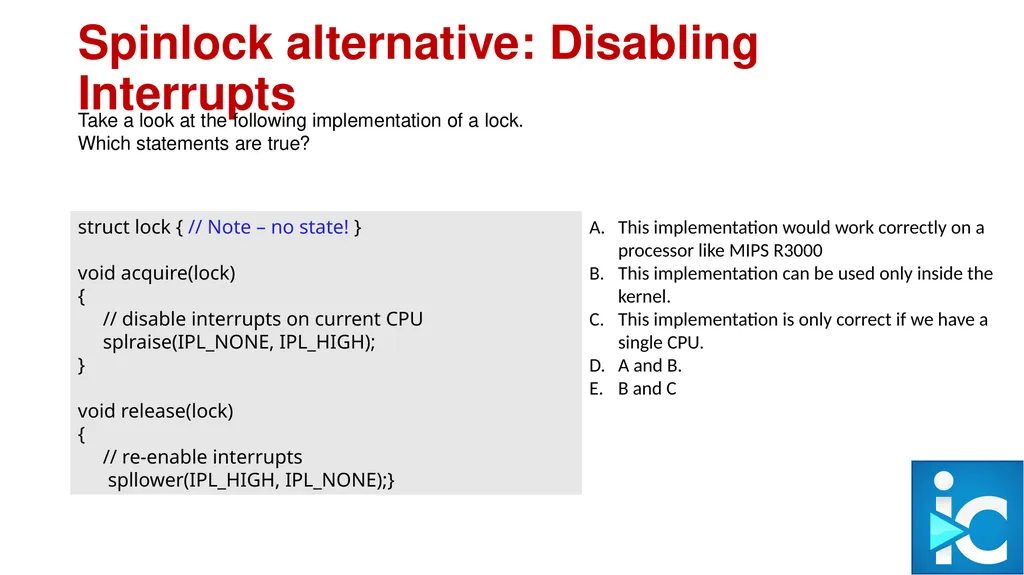
Spinlock alternative: Disabling Interrupts struct lock { // Note – no state! }
void acquire(lock)
{
// disable interrupts on current CPU
splraise(IPL_NONE, IPL_HIGH);
}
void release(lock)
{
// re-enable interrupts
spllower(IPL_HIGH, IPL_NONE);} This implementation would work correctly on a processor like MIPS R3000
This implementation can be used only inside the kernel.
This implementation is only correct if we have a single CPU.
A and B.
B and C Take a look at the following implementation of a lock.
Which statements are true?<br>
void acquire(lock)
{
// disable interrupts on current CPU
splraise(IPL_NONE, IPL_HIGH);
}
void release(lock)
{
// re-enable interrupts
spllower(IPL_HIGH, IPL_NONE);} This implementation would work correctly on a processor like MIPS R3000
This implementation can be used only inside the kernel.
This implementation is only correct if we have a single CPU.
A and B.
B and C Take a look at the following implementation of a lock.
Which statements are true?<br>
29
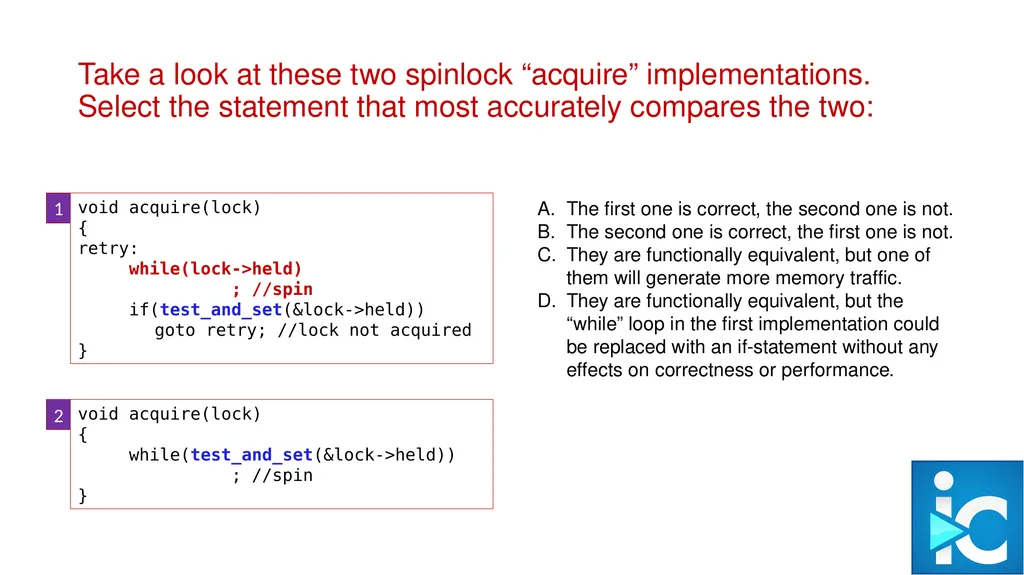
Take a look at these two spinlock “acquire” implementations. Select the statement that most accurately compares the two: void acquire(lock)
{
retry:
while(lock->held)
; //spin
if(test_and_set(&lock->held))
goto retry; //lock not acquired
} void acquire(lock)
{
while(test_and_set(&lock->held))
; //spin
} 1 2 The first one is correct, the second one is not.
The second one is correct, the first one is not.
They are functionally equivalent, but one of them will generate more memory traffic.
They are functionally equivalent, but the “while” loop in the first implementation could be replaced with an if-statement without any effects on correctness or performance.<br>
{
retry:
while(lock->held)
; //spin
if(test_and_set(&lock->held))
goto retry; //lock not acquired
} void acquire(lock)
{
while(test_and_set(&lock->held))
; //spin
} 1 2 The first one is correct, the second one is not.
The second one is correct, the first one is not.
They are functionally equivalent, but one of them will generate more memory traffic.
They are functionally equivalent, but the “while” loop in the first implementation could be replaced with an if-statement without any effects on correctness or performance.<br>
30
Test-and-test-and-set in OS161? Exercise: find the spinlock implementation in OS161, read the code and understand what it does.<br>
31
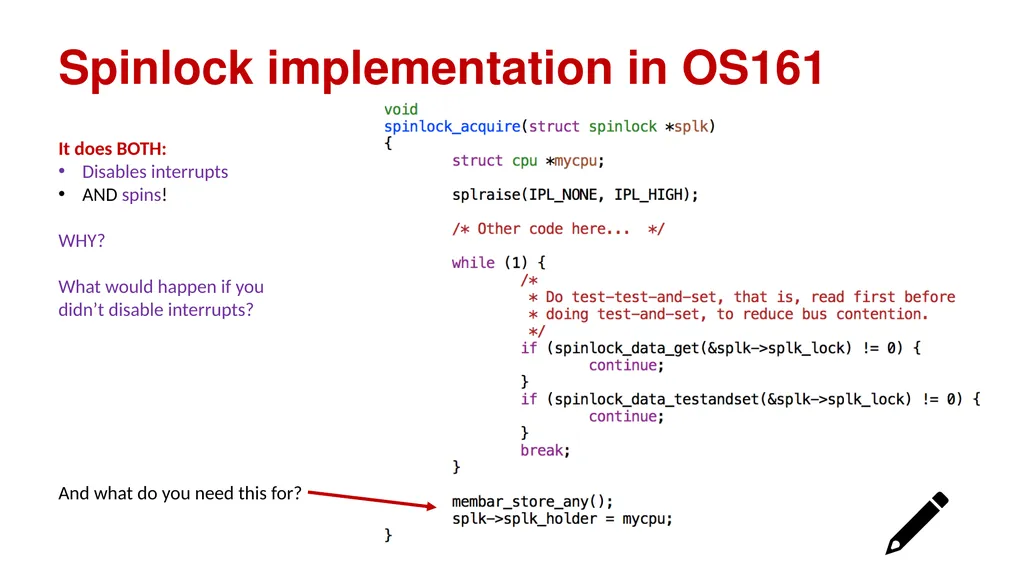
Spinlock implementation in OS161 It does BOTH:
Disables interrupts
AND spins!
WHY?
What would happen if you didn’t disable interrupts? And what do you need this for?<br>
Disables interrupts
AND spins!
WHY?
What would happen if you didn’t disable interrupts? And what do you need this for?<br>
32
Quiz on your own time! To prepare:
Think about and try to answer the Why? question on the previous slide.<br>
Think about and try to answer the Why? question on the previous slide.<br>
33
Blocking Synchronization Primitives Blocking is an alternative to spinning (or busy-waiting)
A thread that cannot immediately acquire the lock gives up the CPU
Other threads can run on that CPU in the meantime (including the thread holding the lock)
Why does spinning NOT make sense on a uniprocessor?
When the lock is released, the thread is awaken
How to implement the blocking-awakening?
Requires careful synchronization of its own.
How to make sure that the thread does not miss the signal and stay blocked forever?<br>
A thread that cannot immediately acquire the lock gives up the CPU
Other threads can run on that CPU in the meantime (including the thread holding the lock)
Why does spinning NOT make sense on a uniprocessor?
When the lock is released, the thread is awaken
How to implement the blocking-awakening?
Requires careful synchronization of its own.
How to make sure that the thread does not miss the signal and stay blocked forever?<br>
34
Implementing a blocking semaphore What is a semaphore:
If semaphore count is zero, threads wait.
If semaphore count is above zero, they can enter critical section.
P() – decrement the semaphore count (try to enter critical section)
V() – increment the semaphore count (exit from critical section)
Exercise: let’s try to implement it together and then go over the implementation is OS161. Your should now be ready to implement locks and condition variables for Assignment 2! I expect that you are familiar with semaphores from watching the videos!<br>
If semaphore count is zero, threads wait.
If semaphore count is above zero, they can enter critical section.
P() – decrement the semaphore count (try to enter critical section)
V() – increment the semaphore count (exit from critical section)
Exercise: let’s try to implement it together and then go over the implementation is OS161. Your should now be ready to implement locks and condition variables for Assignment 2! I expect that you are familiar with semaphores from watching the videos!<br>