
Synonyymeja 1. Which word means the same as
CP
Published · 494 slides · 0 views

1 / 1
Description
Synonyymeja 1. Which word means the same as erroneous? a. digressive b. confused c. impenetrable d. incorrect Synonyymeja 1. Which word means the same as erroneous? a. digressive b. confused c. impenetrable d. incorrect 1. d. Erroneous
Related Topics
Share
Embed code
Download this presentation From Below
"Synonyymeja 1. Which word means the same as" is the property of its rightful owner. Permission is granted to download and print the materials on this website for personal, non-commercial use only, and to display it on your personal computer provided you do not modify the materials and that you retain all copyright notices contained in the materials. By downloading content from our website, you accept the terms of this agreement.
Presentation Transcript
01
Synonyymeja 1. Which word means the same as erroneous?
a. digressive
b. confused
c. impenetrable
d. incorrect<br>
a. digressive
b. confused
c. impenetrable
d. incorrect<br>
02
Synonyymeja 1. Which word means the same as erroneous?
a. digressive
b. confused
c. impenetrable
d. incorrect
1. d. Erroneous means inaccurate, faulty, or
incorrect<br>
a. digressive
b. confused
c. impenetrable
d. incorrect
1. d. Erroneous means inaccurate, faulty, or
incorrect<br>
03
Synonyymeja 2. Which word means the same as grotesque?
a. extreme
b. frenzied
c. hideous
d. typical<br>
a. extreme
b. frenzied
c. hideous
d. typical<br>
04
Synonyymeja 2. Which word means the same as grotesque?
a. extreme
b. frenzied
c. hideous
d. typical
2. c. Grotesque means freakish, distorted, or hideous.<br>
a. extreme
b. frenzied
c. hideous
d. typical
2. c. Grotesque means freakish, distorted, or hideous.<br>
05
Synonyymeja 3. Which word means the same as garbled?
a. lucid
b. unintelligible
c. devoured
d. outrageous<br>
a. lucid
b. unintelligible
c. devoured
d. outrageous<br>
06
Synonyymeja 3. Which word means the same as garbled?
a. lucid
b. unintelligible
c. devoured
d. outrageous
3. b. If something is garbled, it is unintentionally distorted, jumbled or unintelligible.<br>
a. lucid
b. unintelligible
c. devoured
d. outrageous
3. b. If something is garbled, it is unintentionally distorted, jumbled or unintelligible.<br>
07
Synonyymeja 4. Which word means the same as expose?
a. relate
b. develop
c. reveal
d. pretend<br>
a. relate
b. develop
c. reveal
d. pretend<br>
08
Synonyymeja 4. Which word means the same as expose?
a. relate
b. develop
c. reveal
d. pretend
4. c. If you expose something, you reveal it.<br>
a. relate
b. develop
c. reveal
d. pretend
4. c. If you expose something, you reveal it.<br>
09
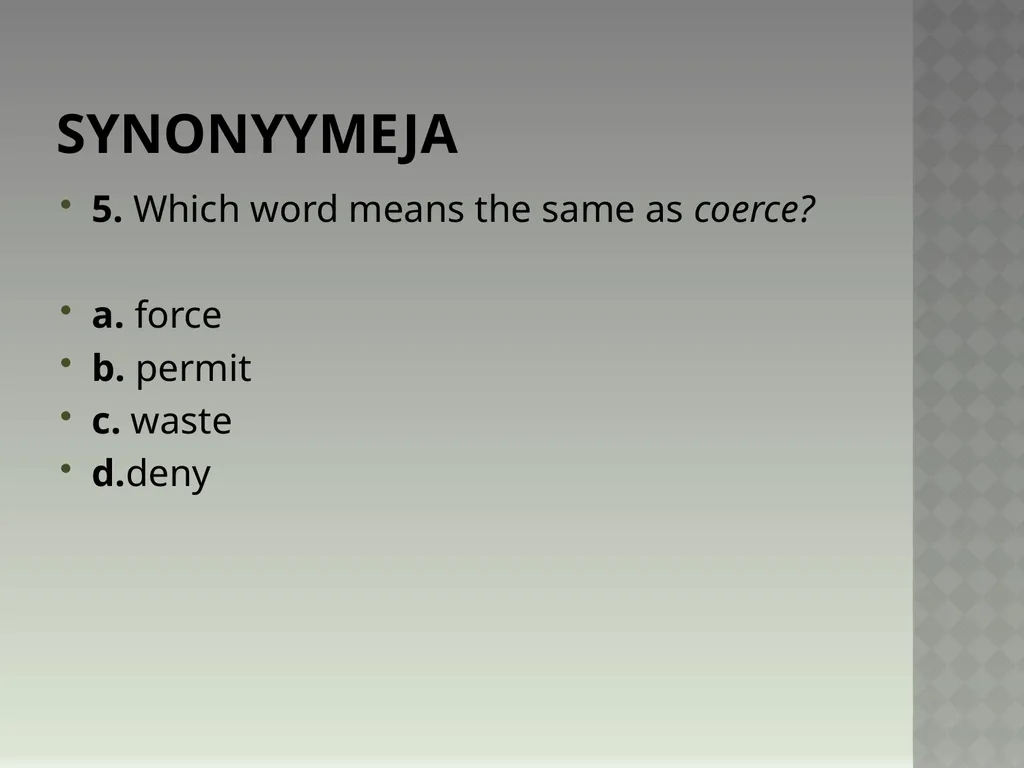
Synonyymeja 5. Which word means the same as coerce?
a. force
b. permit
c. waste
d.deny<br>
a. force
b. permit
c. waste
d.deny<br>
10
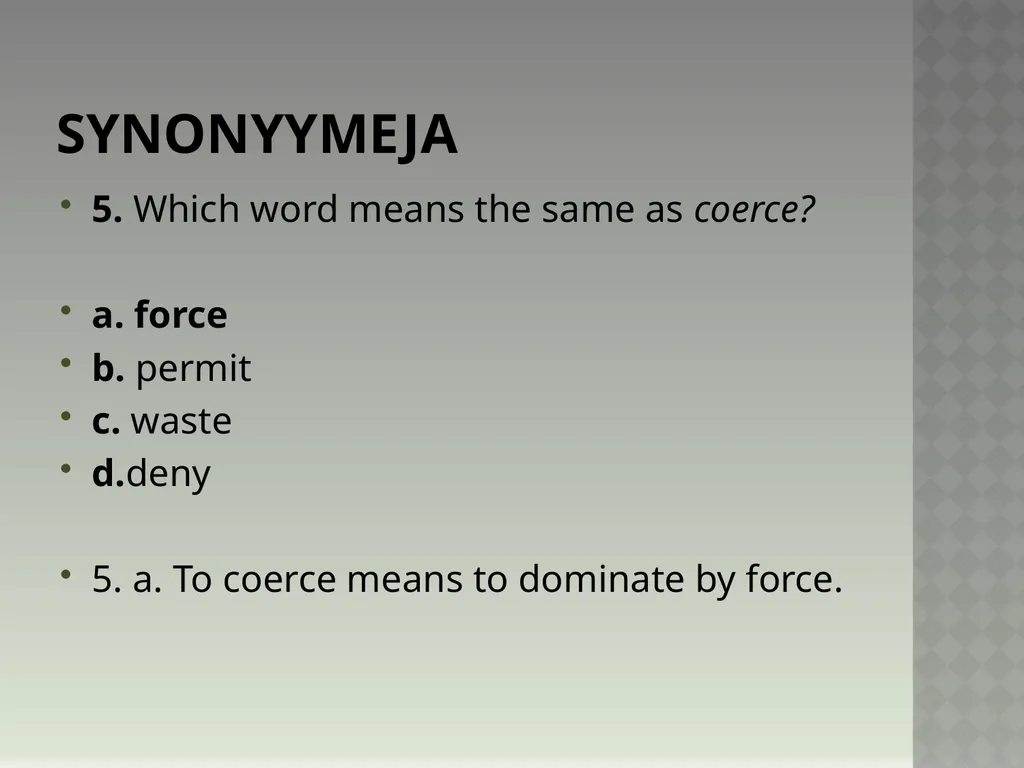
Synonyymeja 5. Which word means the same as coerce?
a. force
b. permit
c. waste
d.deny
5. a. To coerce means to dominate by force.<br>
a. force
b. permit
c. waste
d.deny
5. a. To coerce means to dominate by force.<br>
11
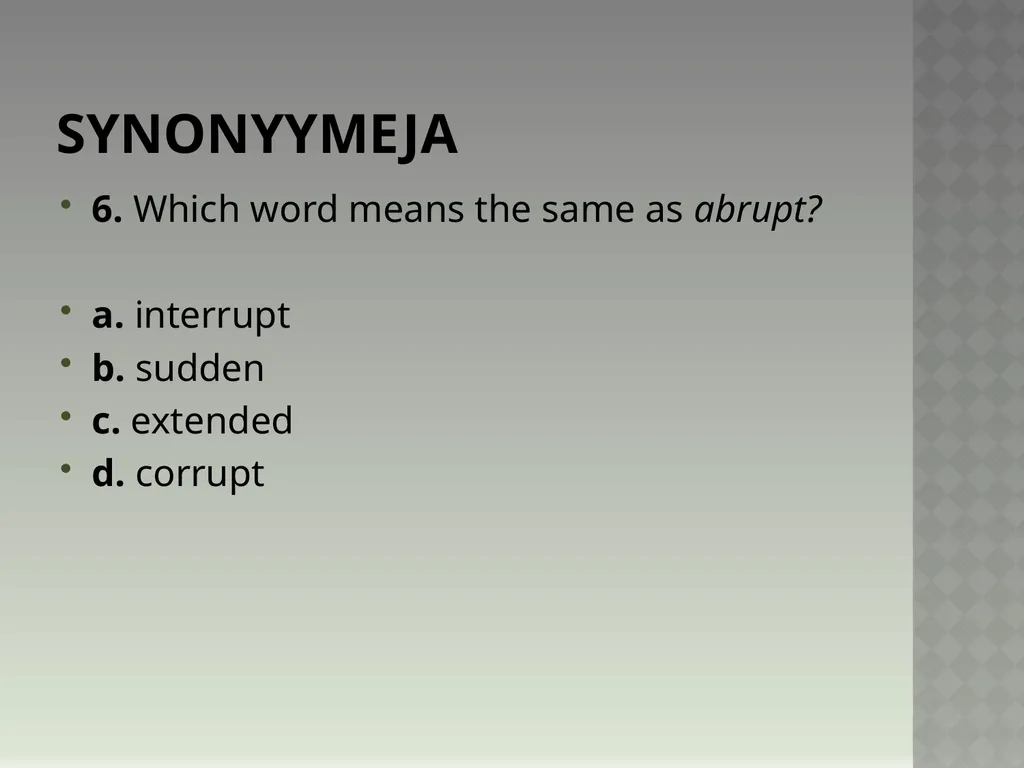
Synonyymeja 6. Which word means the same as abrupt?
a. interrupt
b. sudden
c. extended
d. corrupt<br>
a. interrupt
b. sudden
c. extended
d. corrupt<br>
12
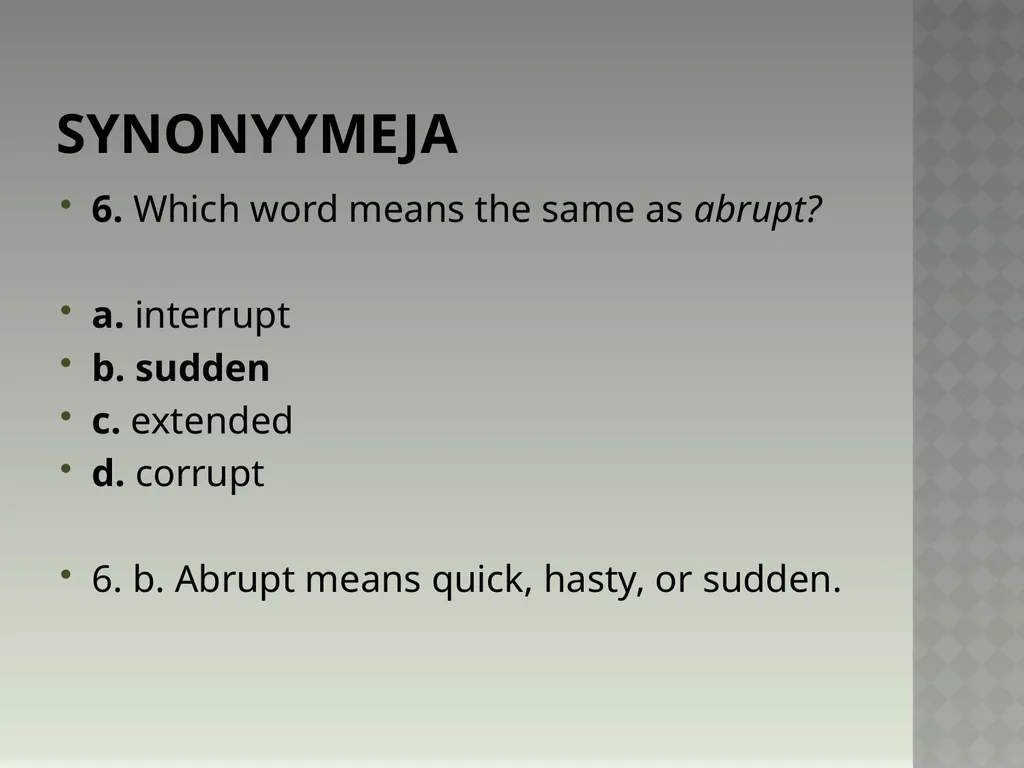
Synonyymeja 6. Which word means the same as abrupt?
a. interrupt
b. sudden
c. extended
d. corrupt
6. b. Abrupt means quick, hasty, or sudden.<br>
a. interrupt
b. sudden
c. extended
d. corrupt
6. b. Abrupt means quick, hasty, or sudden.<br>
13
Synonyymeja 7. Which word means the same as apathy?
a. hostility
b. depression
c. indifference
d. concern<br>
a. hostility
b. depression
c. indifference
d. concern<br>
14
Synonyymeja 7. Which word means the same as apathy?
a. hostility
b. depression
c. indifference
d. concern
7. c. Apathy means a lack of interest or concern; indifference.<br>
a. hostility
b. depression
c. indifference
d. concern
7. c. Apathy means a lack of interest or concern; indifference.<br>
15
Synonyymeja 8. Which word means the same as despair?
a. mourning
b. disregard
c. hopelessness
d. loneliness<br>
a. mourning
b. disregard
c. hopelessness
d. loneliness<br>
16
Synonyymeja 8. Which word means the same as despair?
a. mourning
b. disregard
c. hopelessness
d. loneliness
8. c. Despair means the same as hopelessness.<br>
a. mourning
b. disregard
c. hopelessness
d. loneliness
8. c. Despair means the same as hopelessness.<br>
17
Synonyymeja 9. Which word means the same as
contemptuous?
a. respectful
b. unique
c. scornful
d. insecure<br>
contemptuous?
a. respectful
b. unique
c. scornful
d. insecure<br>
18
Synonyymeja 9. Which word means the same as
contemptuous?
a. respectful
b. unique
c. scornful
d. insecure
9. c. A contemptuous person would be disdainful or scornful.<br>
contemptuous?
a. respectful
b. unique
c. scornful
d. insecure
9. c. A contemptuous person would be disdainful or scornful.<br>
19
Synonyymeja 10. Which word means the same as tote?
a. acquire
b. carry
c. tremble
d.abandon<br>
a. acquire
b. carry
c. tremble
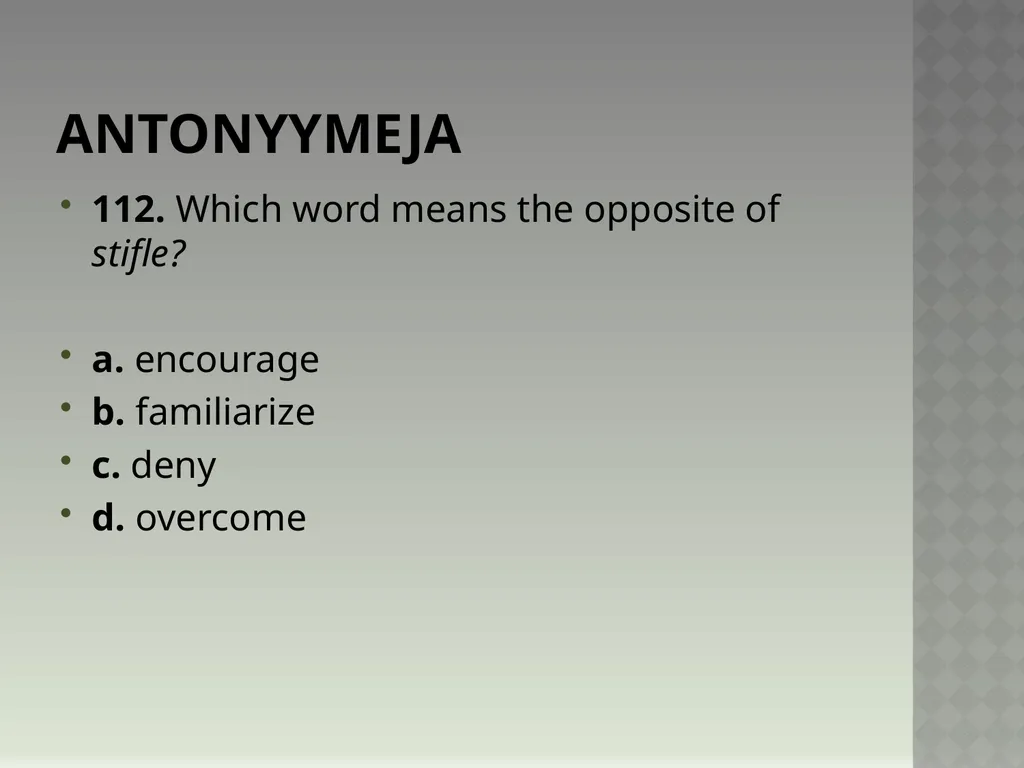
d.abandon<br>
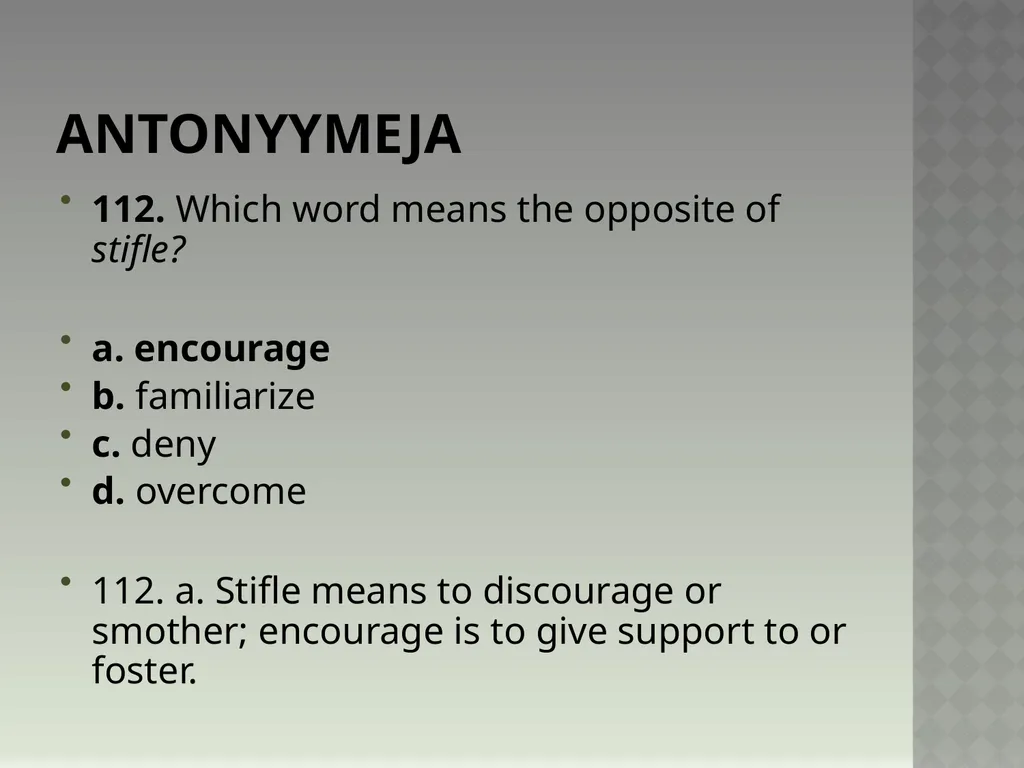
20
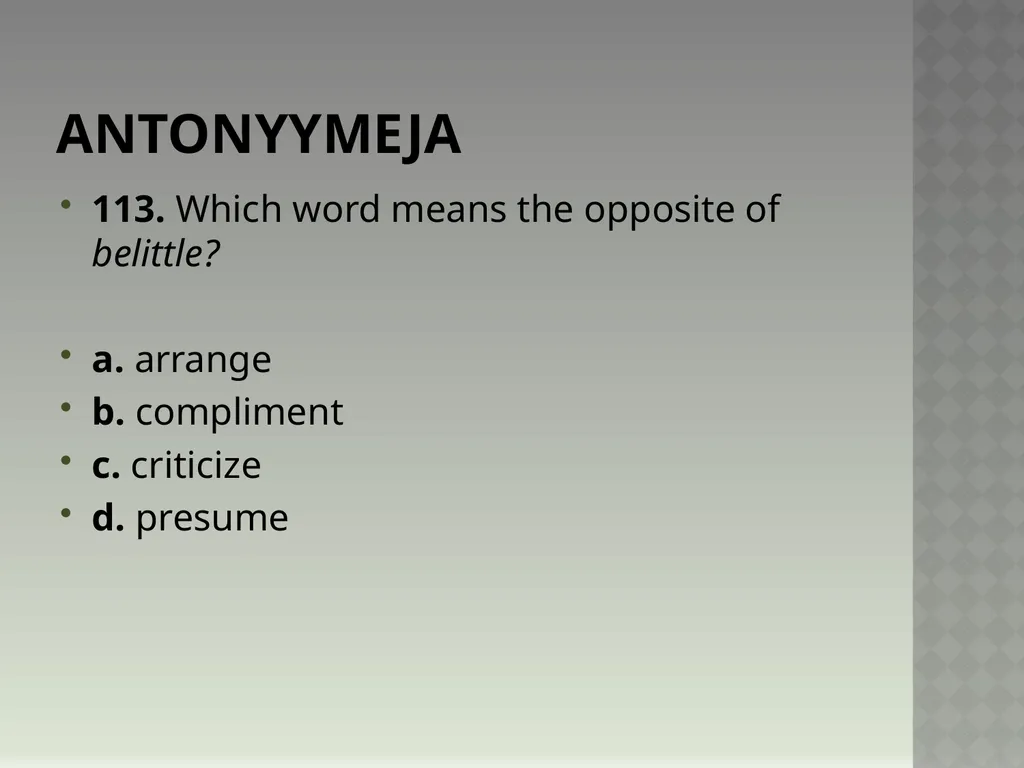
Synonyymeja 10. Which word means the same as tote?
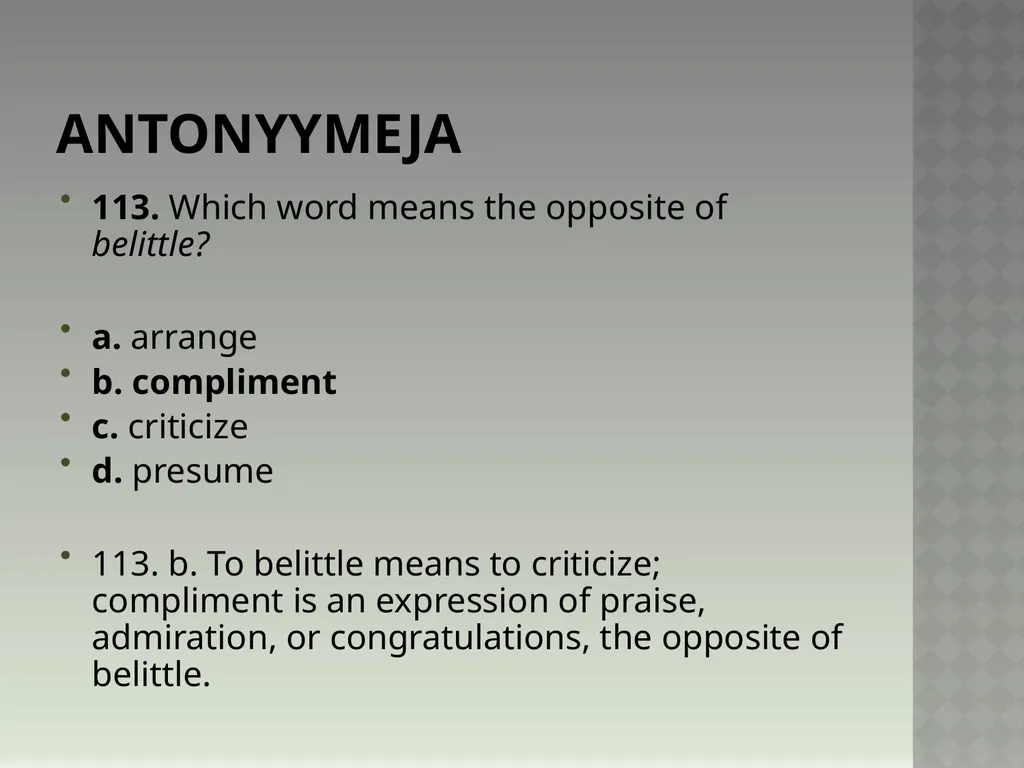
a. acquire
b. carry
c. tremble
d.abandon
10. b. To tote means to carry.<br>
a. acquire
b. carry
c. tremble
d.abandon
10. b. To tote means to carry.<br>
21
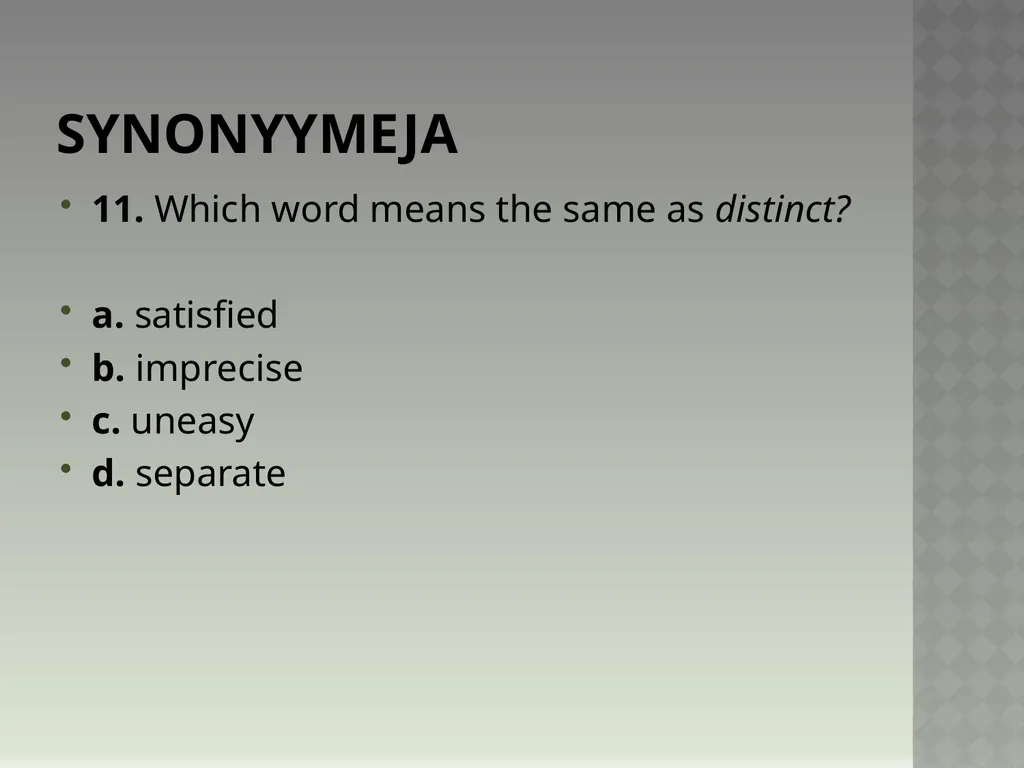
Synonyymeja 11. Which word means the same as distinct?
a. satisfied
b. imprecise
c. uneasy
d. separate<br>
a. satisfied
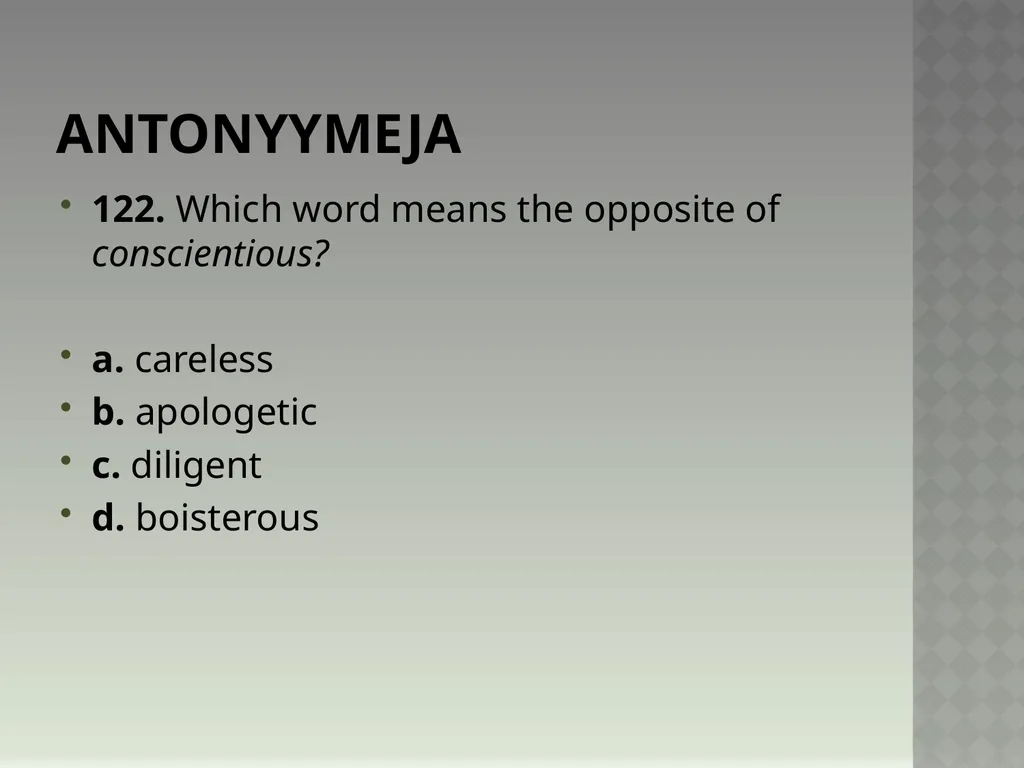
b. imprecise
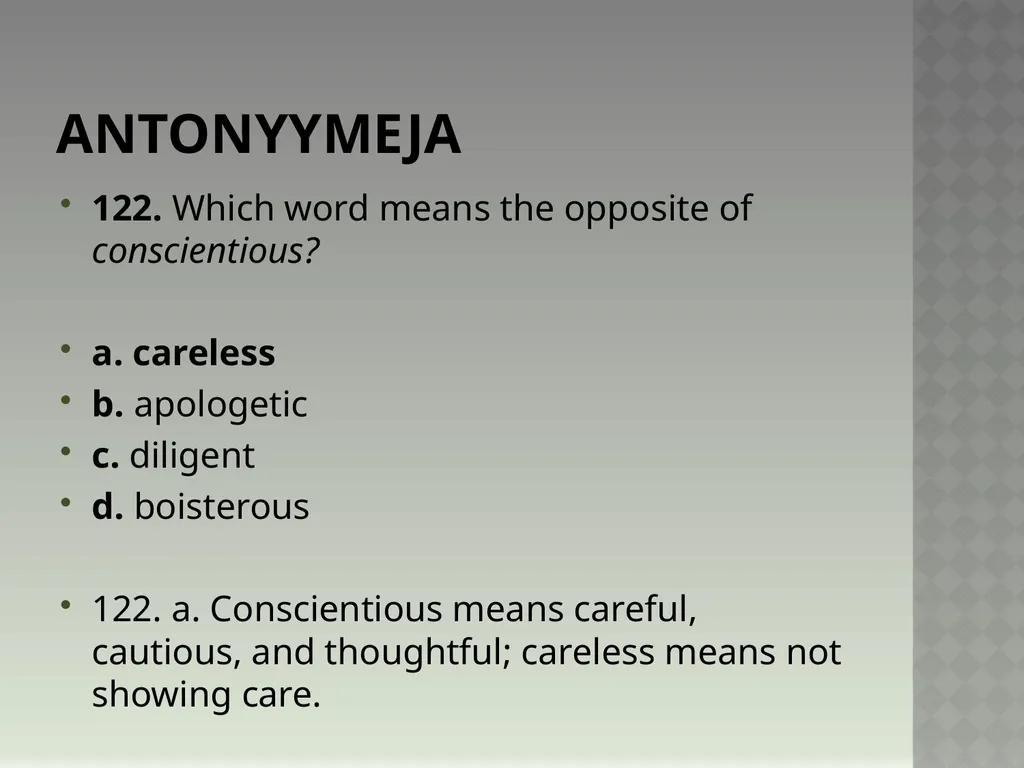
c. uneasy
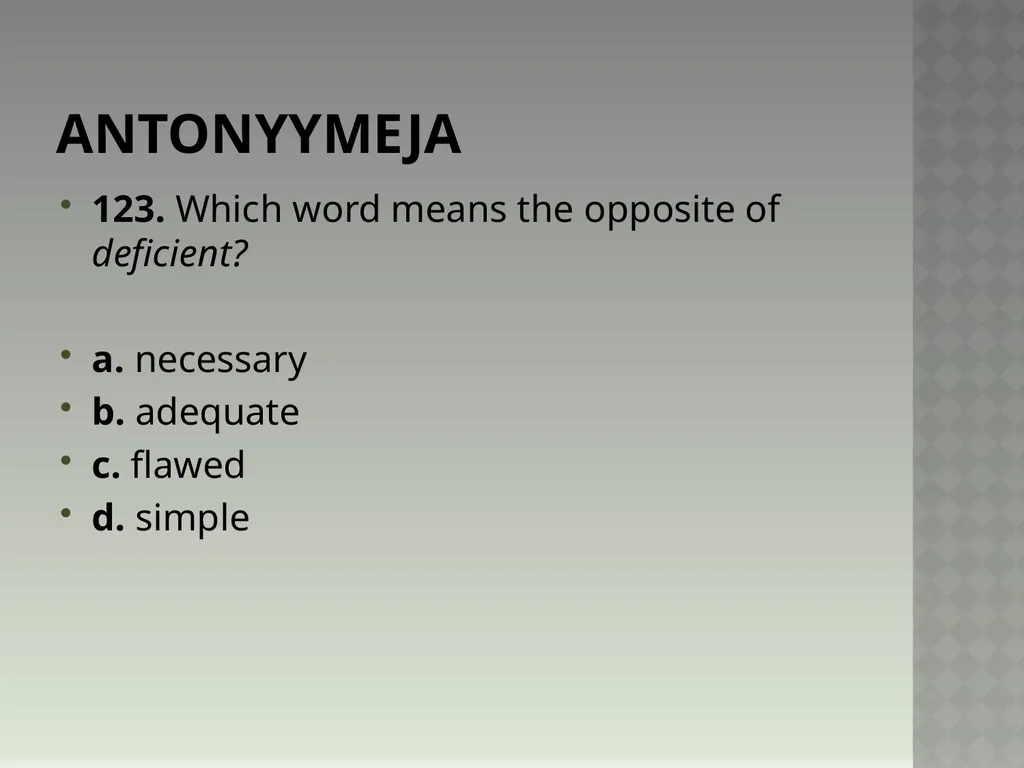
d. separate<br>
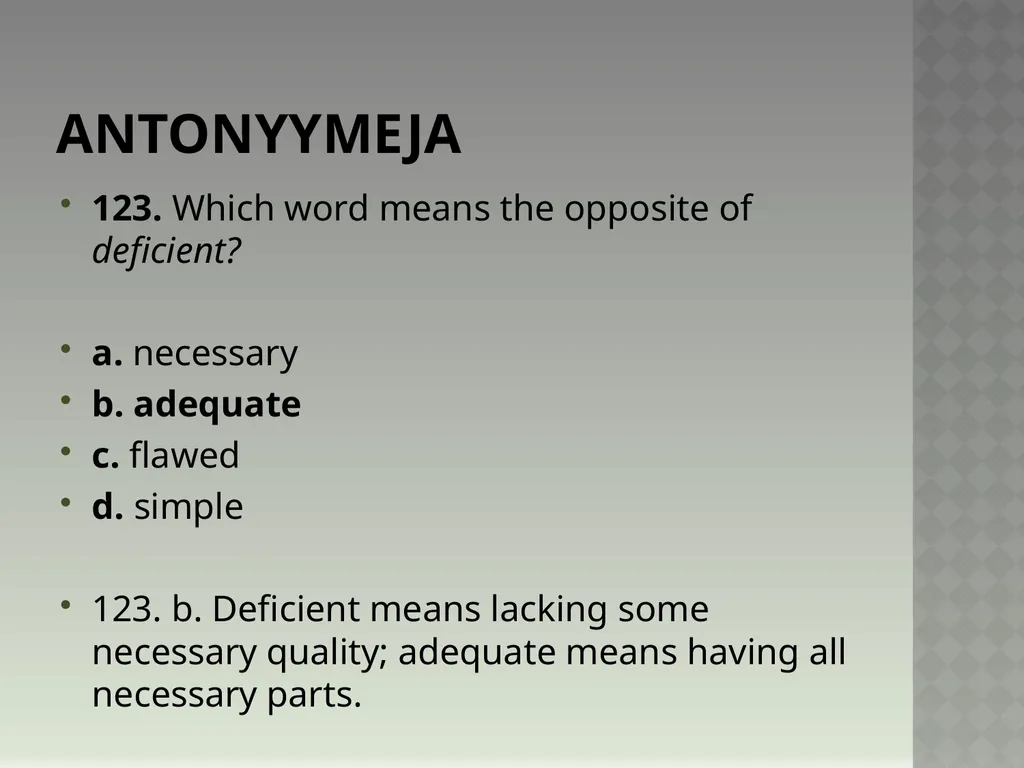
22
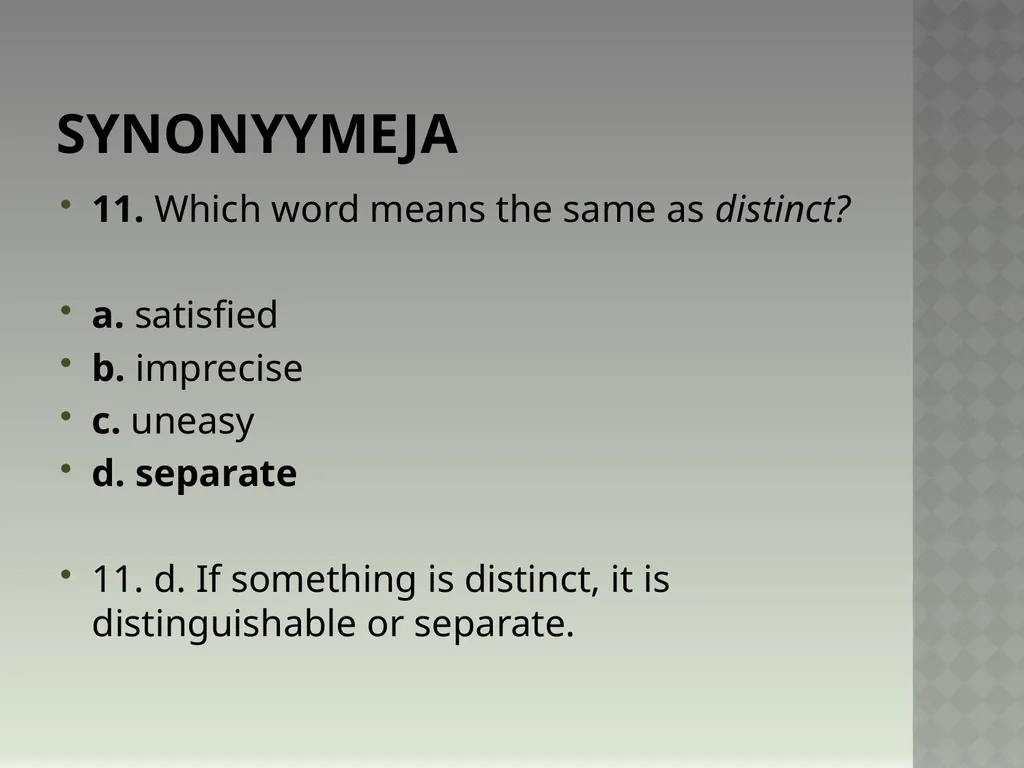
Synonyymeja 11. Which word means the same as distinct?
a. satisfied
b. imprecise
c. uneasy
d. separate
11. d. If something is distinct, it is distinguishable or separate.<br>
a. satisfied
b. imprecise
c. uneasy
d. separate
11. d. If something is distinct, it is distinguishable or separate.<br>
23
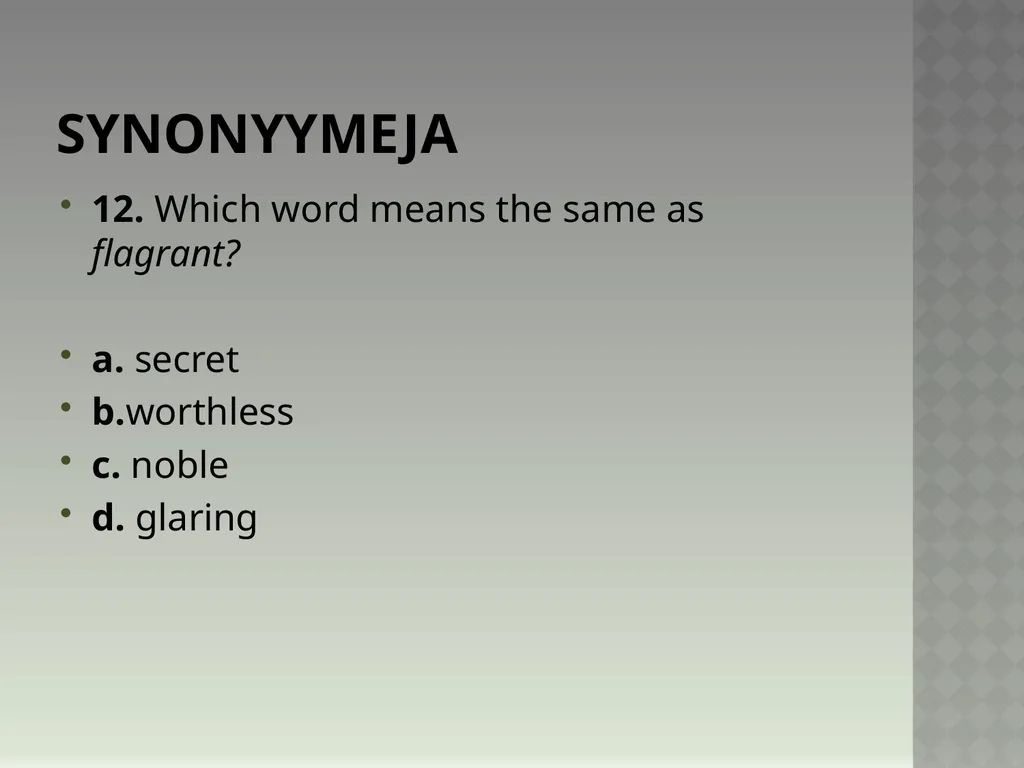
Synonyymeja 12. Which word means the same as flagrant?
a. secret
b.worthless
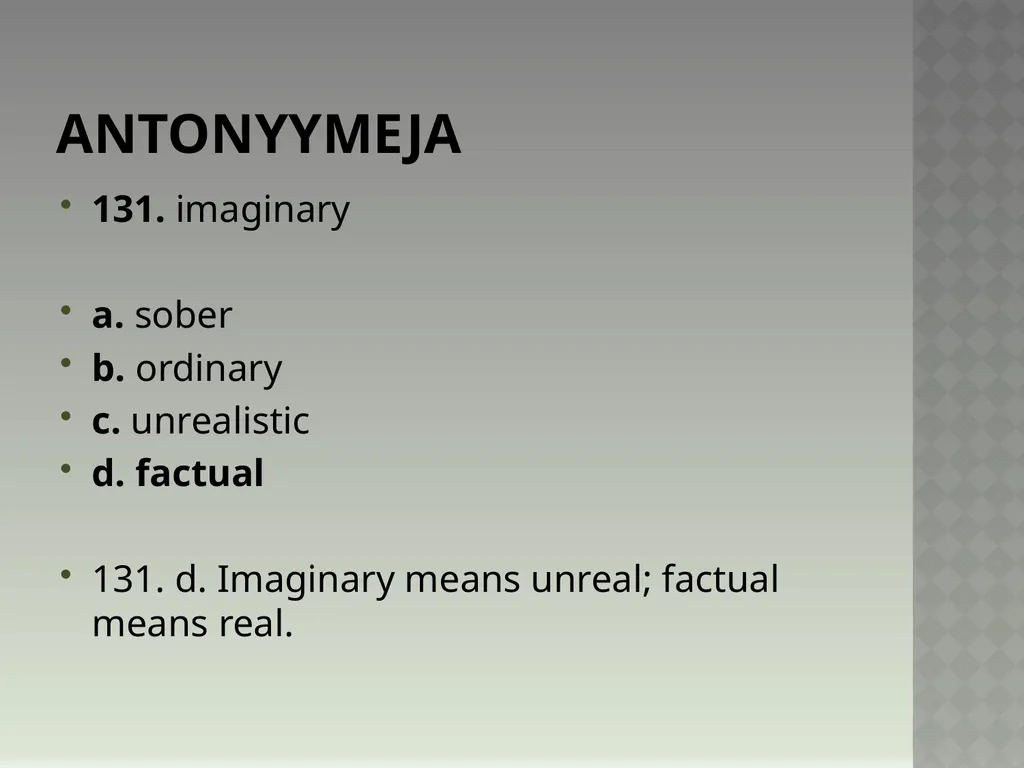
c. noble
d. glaring<br>
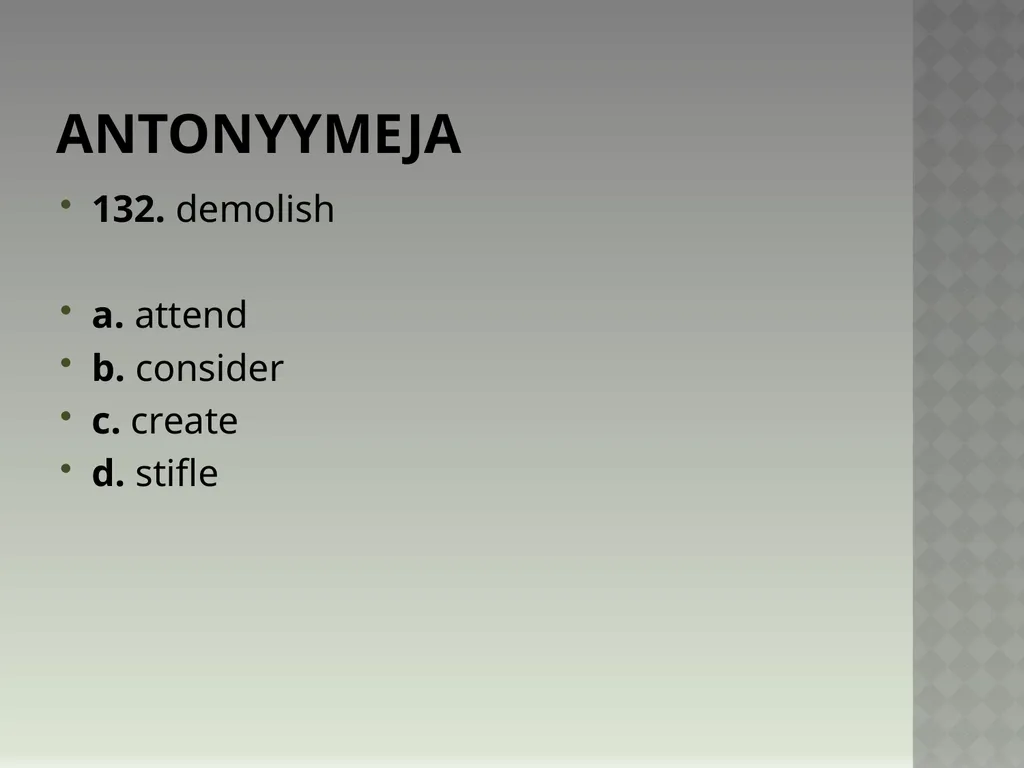
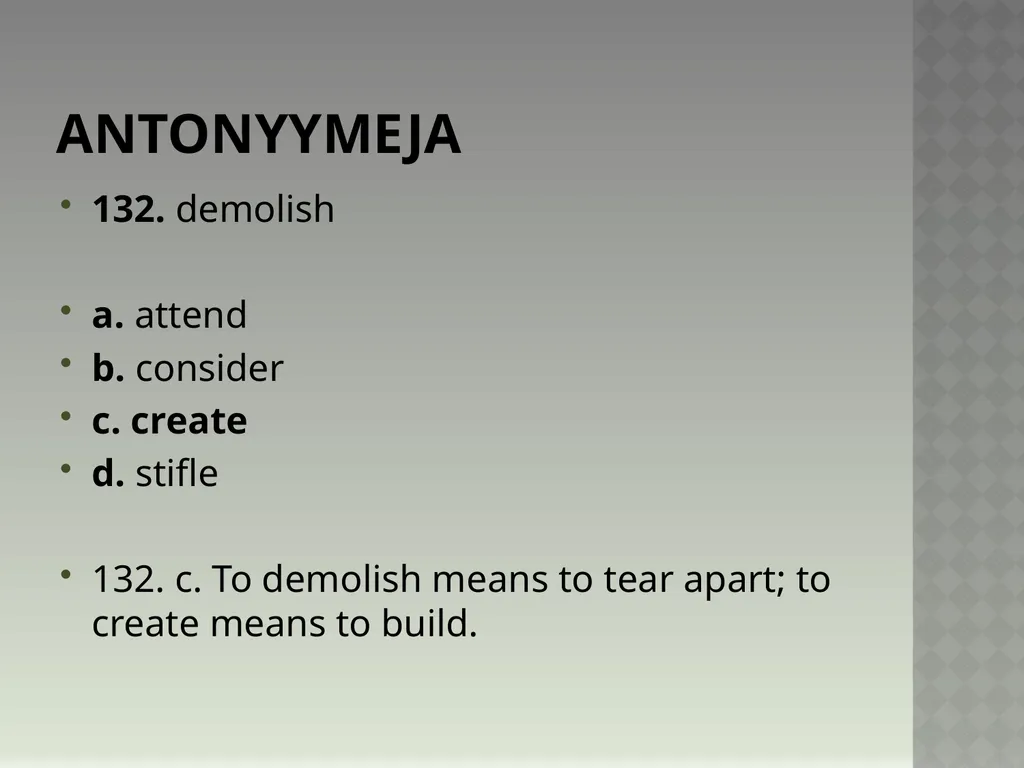
a. secret
b.worthless
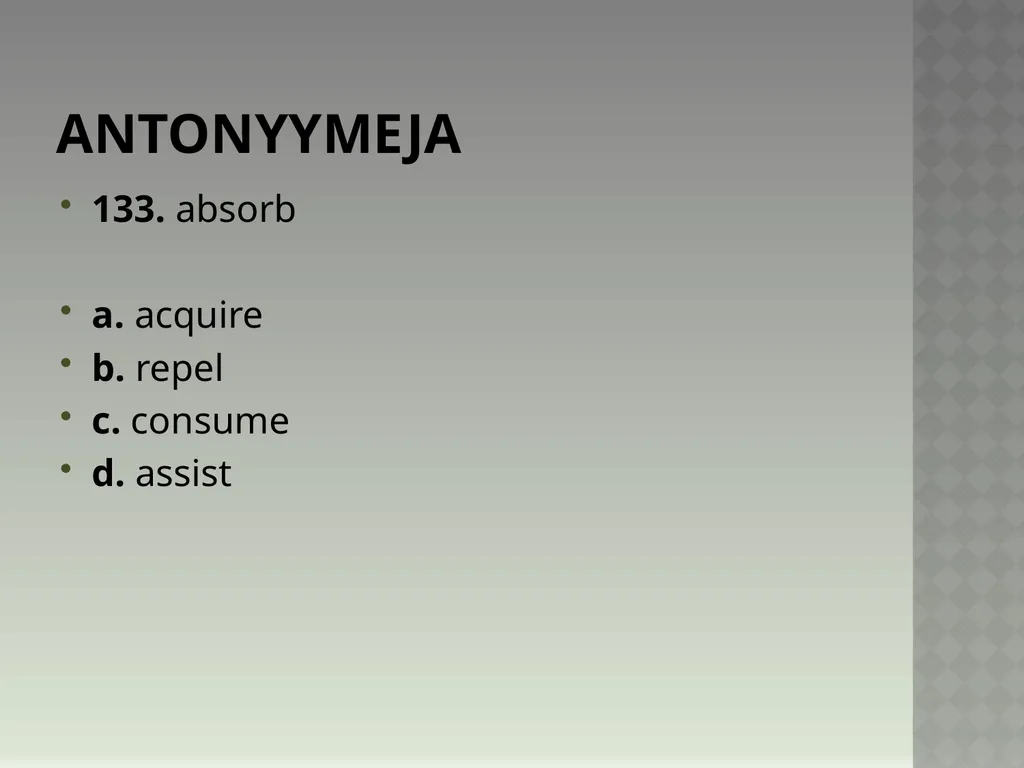
c. noble
d. glaring<br>
24
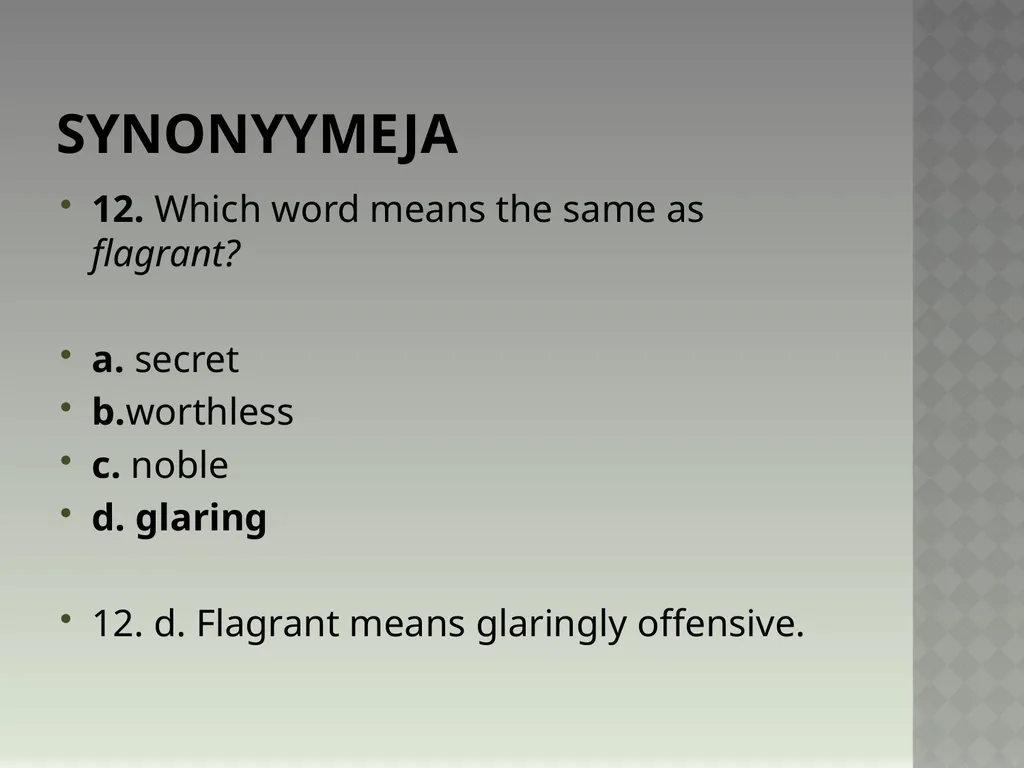
Synonyymeja 12. Which word means the same as flagrant?
a. secret
b.worthless
c. noble
d. glaring
12. d. Flagrant means glaringly offensive.<br>
a. secret
b.worthless
c. noble
d. glaring
12. d. Flagrant means glaringly offensive.<br>
25
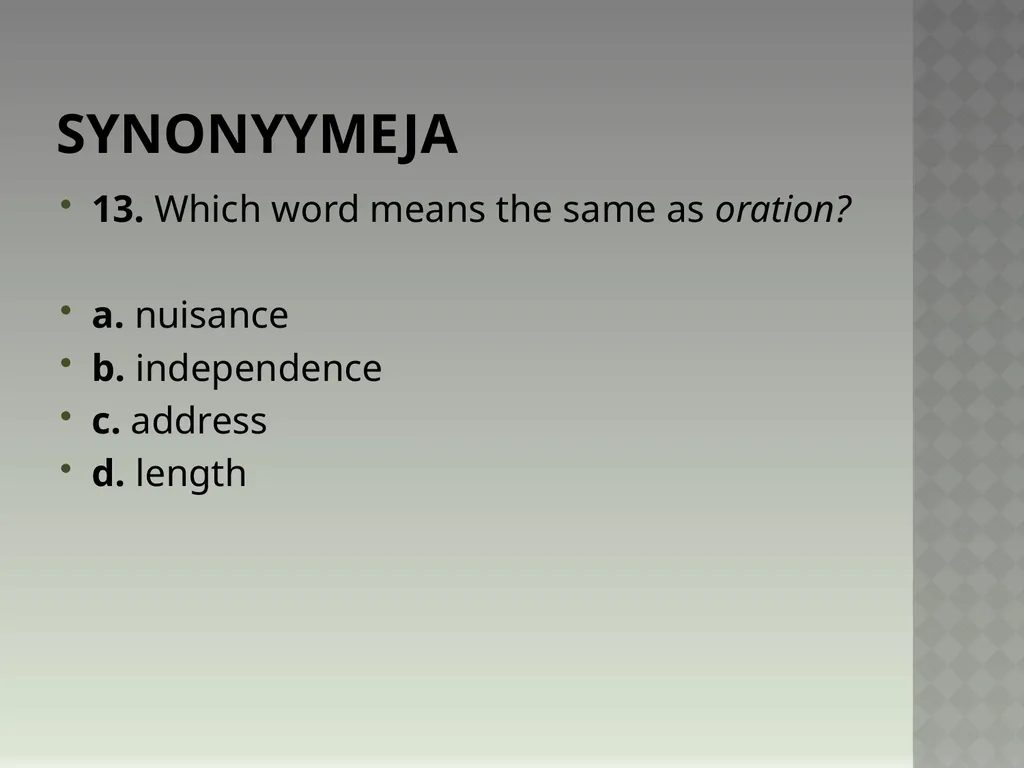
Synonyymeja 13. Which word means the same as oration?
a. nuisance
b. independence
c. address
d. length<br>
a. nuisance
b. independence
c. address
d. length<br>
26
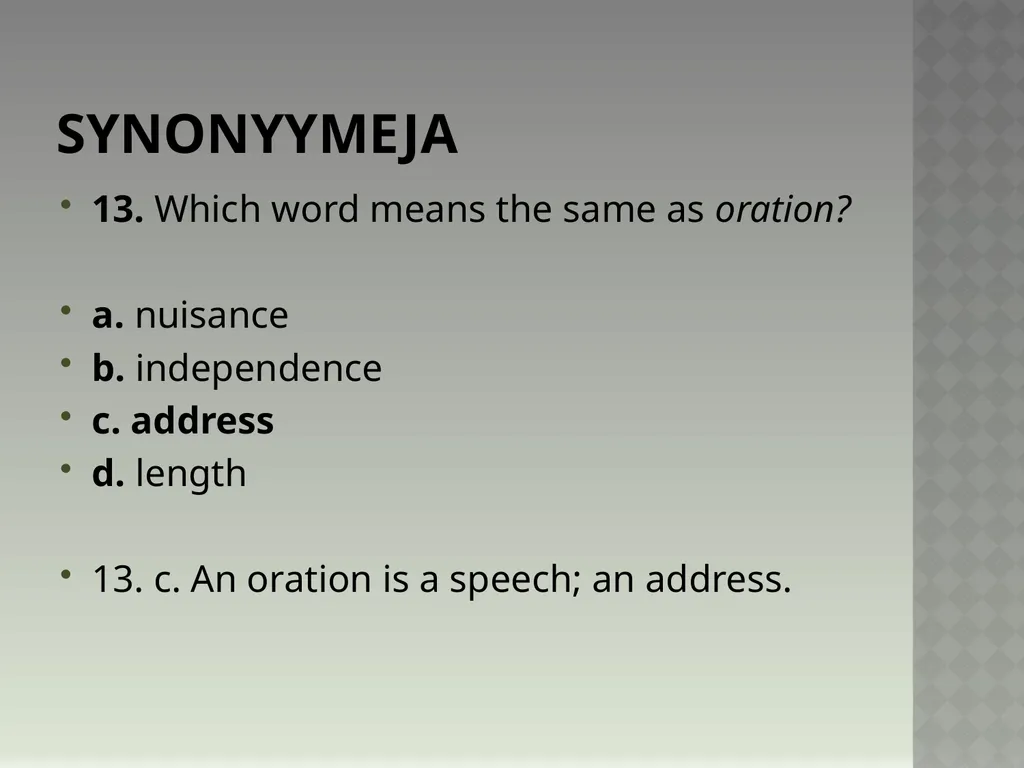
Synonyymeja 13. Which word means the same as oration?
a. nuisance
b. independence
c. address
d. length
13. c. An oration is a speech; an address.<br>
a. nuisance
b. independence
c. address
d. length
13. c. An oration is a speech; an address.<br>
27
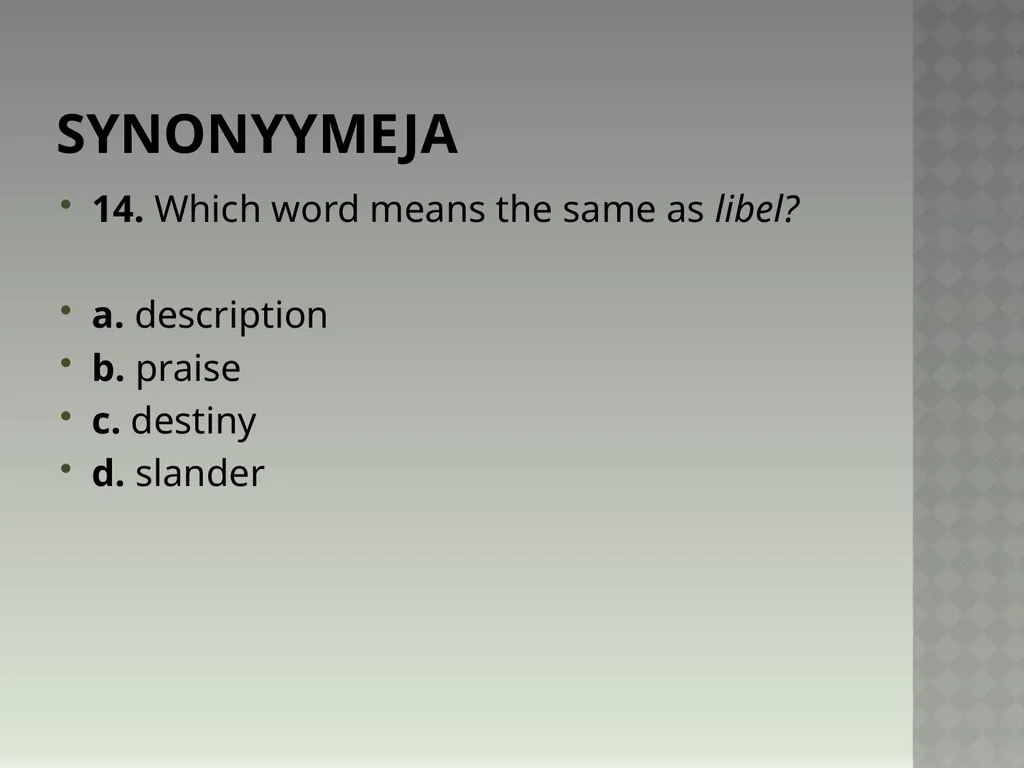
Synonyymeja 14. Which word means the same as libel?
a. description
b. praise
c. destiny
d. slander<br>
a. description
b. praise
c. destiny
d. slander<br>
28
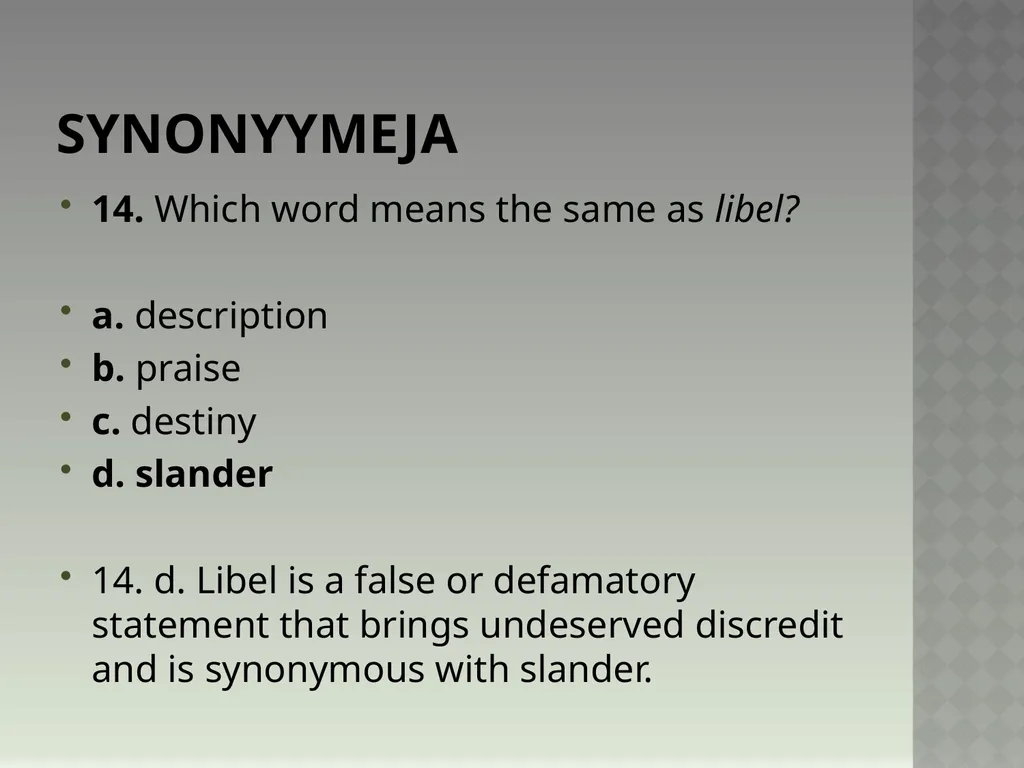
Synonyymeja 14. Which word means the same as libel?
a. description
b. praise
c. destiny
d. slander
14. d. Libel is a false or defamatory statement that brings undeserved discredit and is synonymous with slander.<br>
a. description
b. praise
c. destiny
d. slander
14. d. Libel is a false or defamatory statement that brings undeserved discredit and is synonymous with slander.<br>
29
Synonyymeja 15. Which word means the same as philanthropy?
a. selfishness
b. fascination
c. disrespect
d. charity<br>
a. selfishness
b. fascination
c. disrespect
d. charity<br>
30
Synonyymeja 15. Which word means the same as philanthropy?
a. selfishness
b. fascination
c. disrespect
d. charity
15. d. Philanthropy is characterized by goodwill, humanitarianism, and charity.<br>
a. selfishness
b. fascination
c. disrespect
d. charity
15. d. Philanthropy is characterized by goodwill, humanitarianism, and charity.<br>
31
Synonyymeja 16. Which word means the same as proximity?
a. distance
b. agreement
c. nearness
d. intelligence<br>
a. distance
b. agreement
c. nearness
d. intelligence<br>
32
Synonyymeja 16. Which word means the same as proximity?
a. distance
b. agreement
c. nearness
d. intelligence
16. c. Proximity means the same as nearness.<br>
a. distance
b. agreement
c. nearness
d. intelligence
16. c. Proximity means the same as nearness.<br>
33
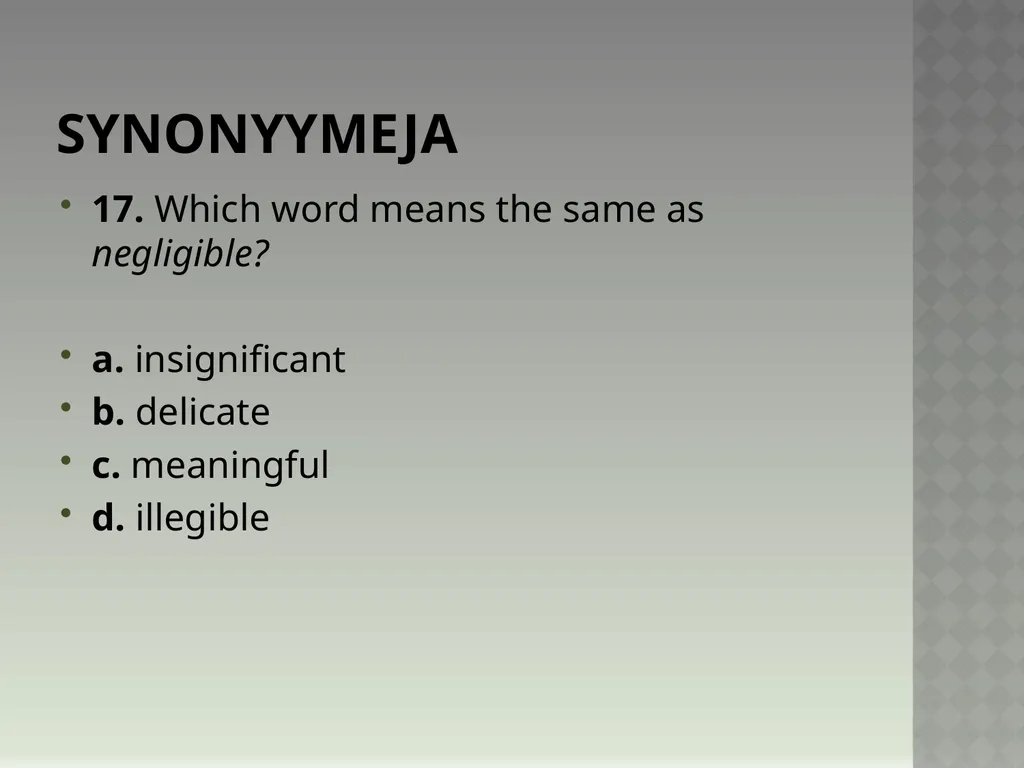
Synonyymeja 17. Which word means the same as negligible?
a. insignificant
b. delicate
c. meaningful
d. illegible<br>
a. insignificant
b. delicate
c. meaningful
d. illegible<br>
34
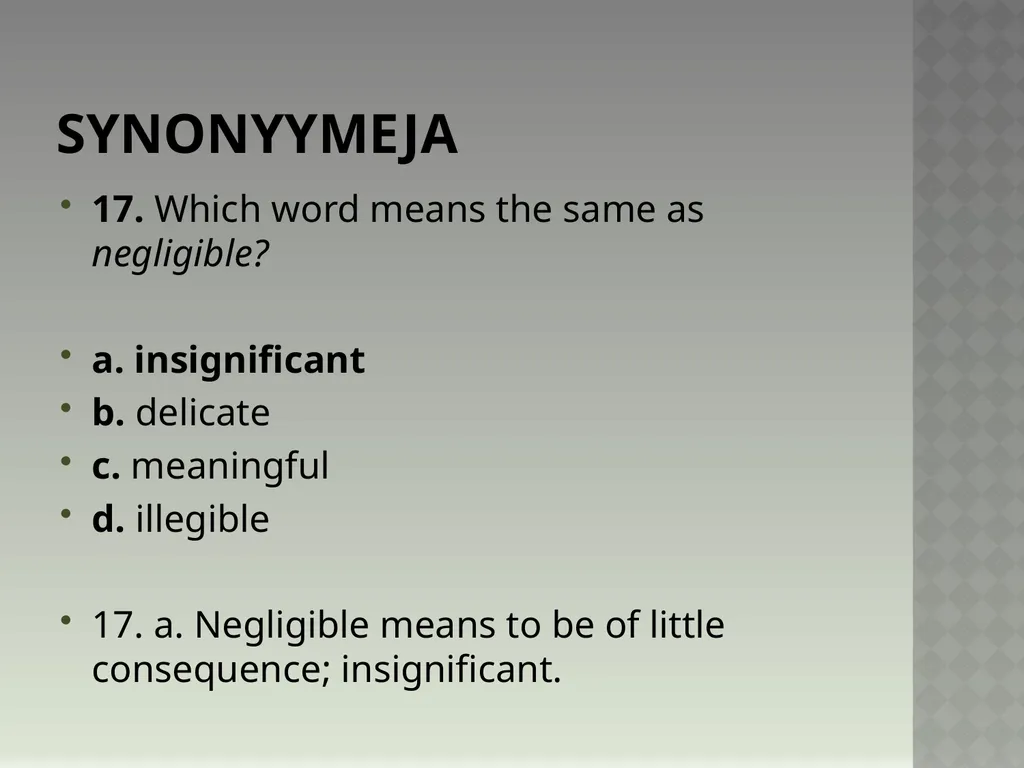
Synonyymeja 17. Which word means the same as negligible?
a. insignificant
b. delicate
c. meaningful
d. illegible
17. a. Negligible means to be of little consequence; insignificant.<br>
a. insignificant
b. delicate
c. meaningful
d. illegible
17. a. Negligible means to be of little consequence; insignificant.<br>
35
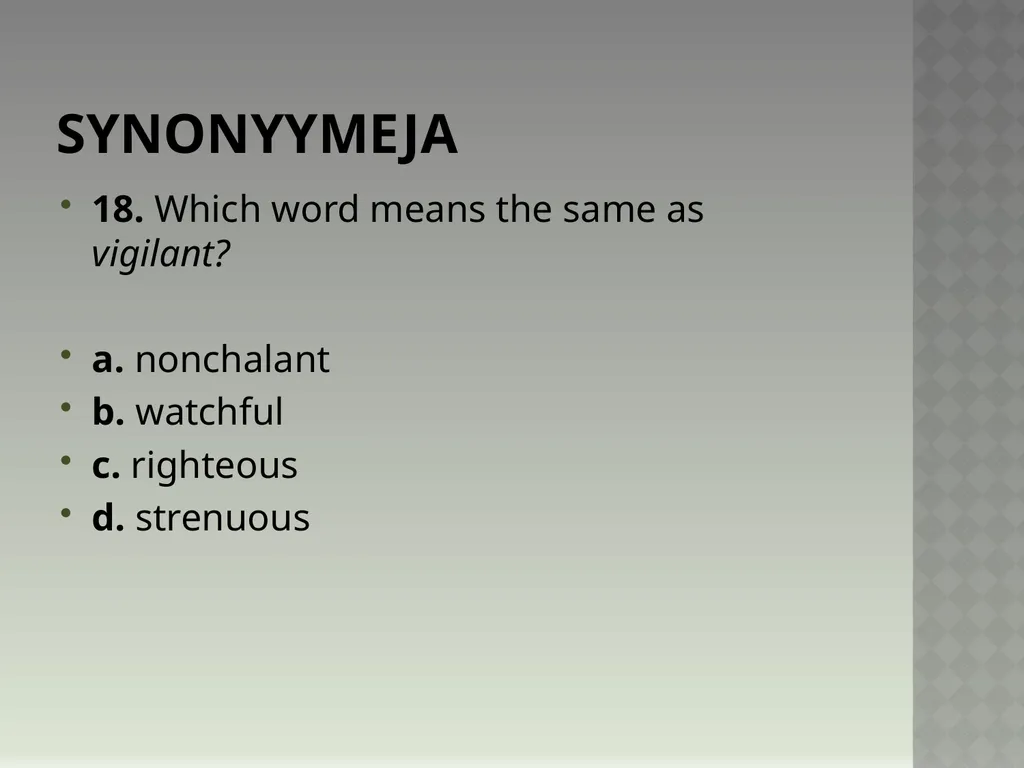
Synonyymeja 18. Which word means the same as vigilant?
a. nonchalant
b. watchful
c. righteous
d. strenuous<br>
a. nonchalant
b. watchful
c. righteous
d. strenuous<br>
36
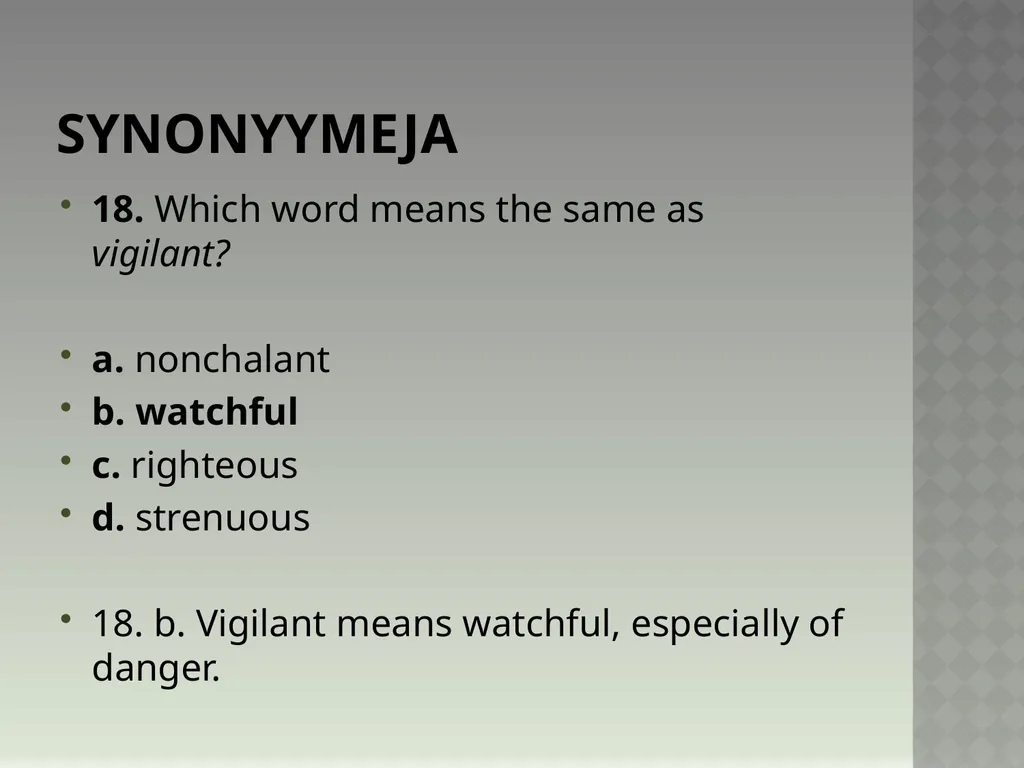
Synonyymeja 18. Which word means the same as vigilant?
a. nonchalant
b. watchful
c. righteous
d. strenuous
18. b. Vigilant means watchful, especially of danger.<br>
a. nonchalant
b. watchful
c. righteous
d. strenuous
18. b. Vigilant means watchful, especially of danger.<br>
37
Synonyymeja 19. Which word means the same as astute?
a. perceptive
b. inattentive
c. stubborn
d. elegant<br>
a. perceptive
b. inattentive
c. stubborn
d. elegant<br>
38
Synonyymeja 19. Which word means the same as astute?
a. perceptive
b. inattentive
c. stubborn
d. elegant
19. a. Astute means to have or show a keen awareness; perceptive.<br>
a. perceptive
b. inattentive
c. stubborn
d. elegant
19. a. Astute means to have or show a keen awareness; perceptive.<br>
39
Synonyymeja 20. Which word means the same as collaborate?
a. cooperate
b. convince
c. entice
d. elaborate<br>
a. cooperate
b. convince
c. entice
d. elaborate<br>
40
Synonyymeja 20. Which word means the same as collaborate?
a. cooperate
b. convince
c. entice
d. elaborate
20. a. To collaborate means to work jointly with others; to cooperate.<br>
a. cooperate
b. convince
c. entice
d. elaborate
20. a. To collaborate means to work jointly with others; to cooperate.<br>
41
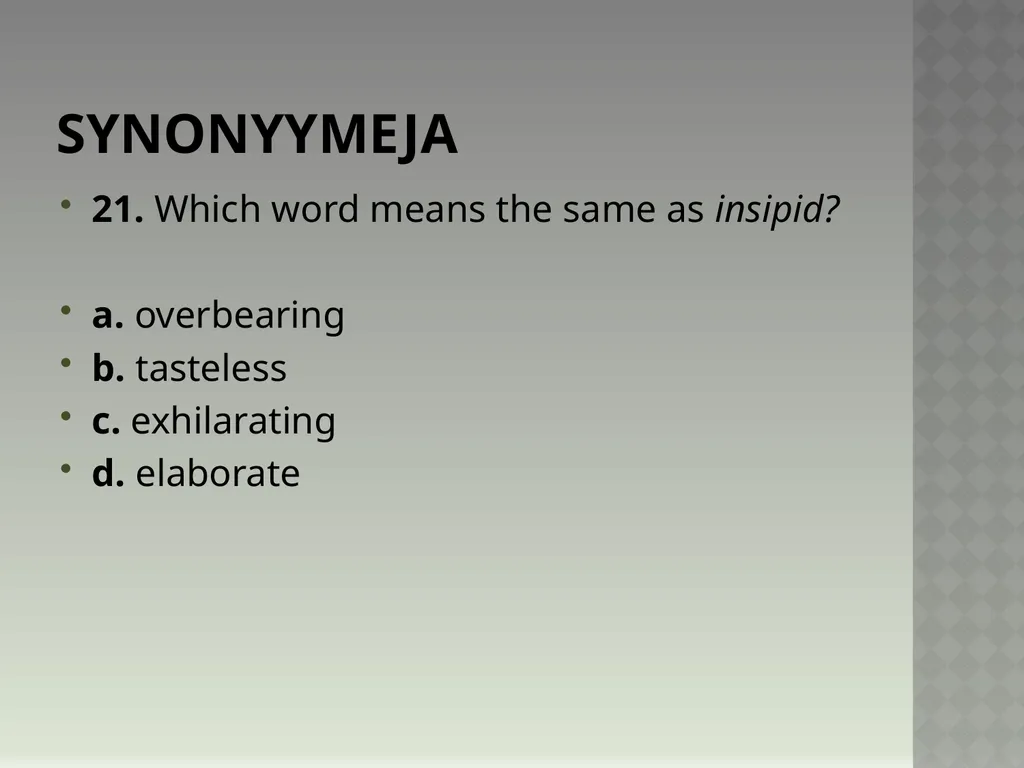
Synonyymeja 21. Which word means the same as insipid?
a. overbearing
b. tasteless
c. exhilarating
d. elaborate<br>
a. overbearing
b. tasteless
c. exhilarating
d. elaborate<br>
42
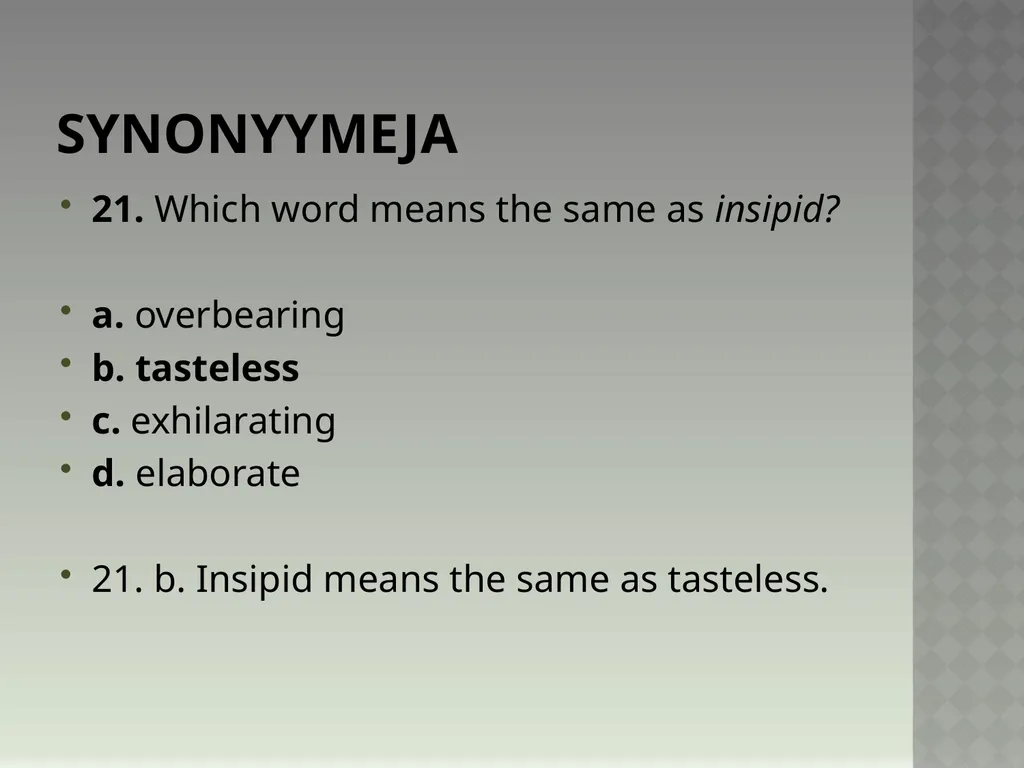
Synonyymeja 21. Which word means the same as insipid?
a. overbearing
b. tasteless
c. exhilarating
d. elaborate
21. b. Insipid means the same as tasteless.<br>
a. overbearing
b. tasteless
c. exhilarating
d. elaborate
21. b. Insipid means the same as tasteless.<br>
43
For each of the following words, choose the word that has the same or nearly the same meaning.<br>
44
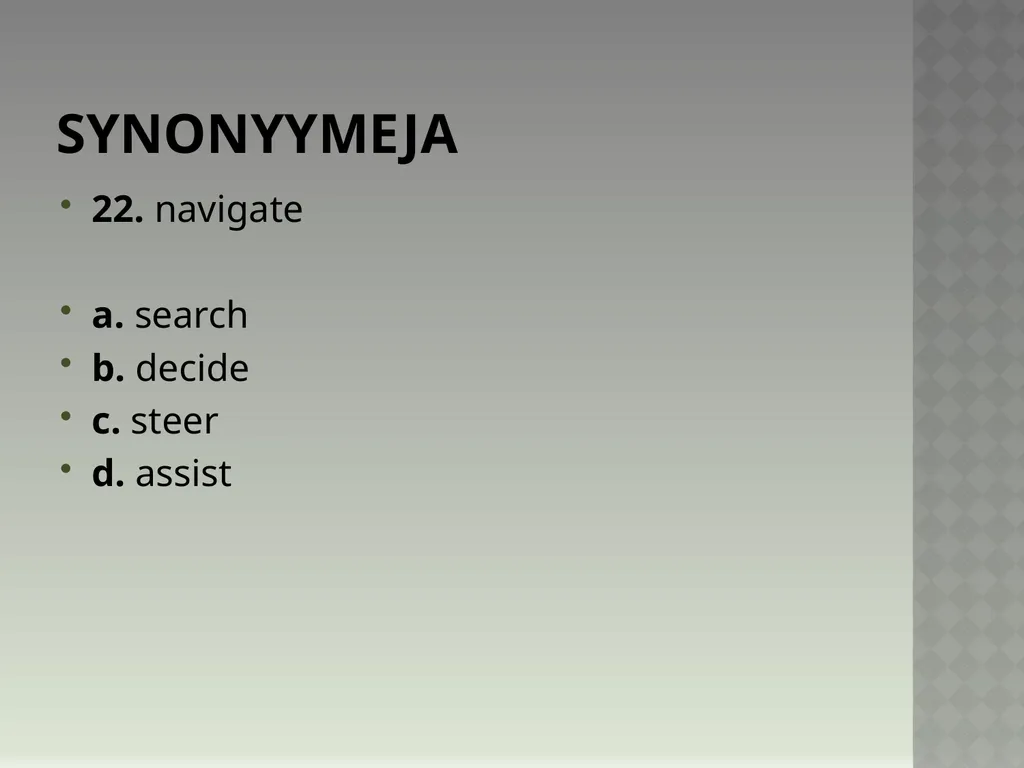
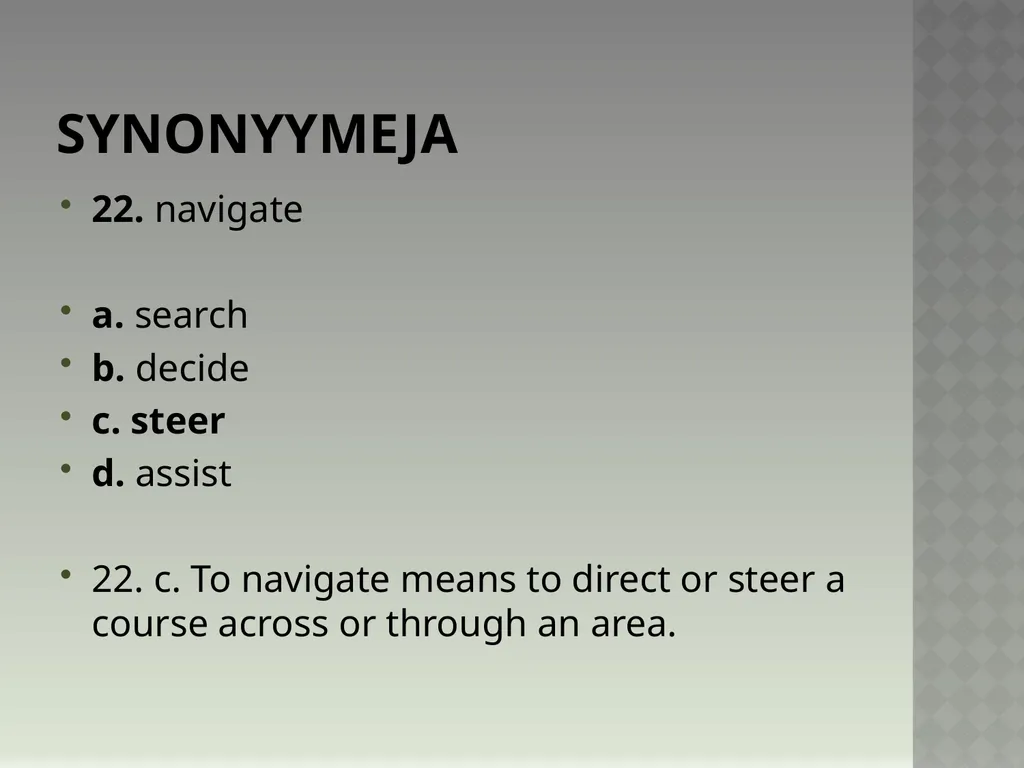
Synonyymeja 22. navigate
a. search
b. decide
c. steer
d. assist<br>
a. search
b. decide
c. steer
d. assist<br>
45
Synonyymeja 22. navigate
a. search
b. decide
c. steer
d. assist
22. c. To navigate means to direct or steer a course across or through an area.<br>
a. search
b. decide
c. steer
d. assist
22. c. To navigate means to direct or steer a course across or through an area.<br>
46
Synonyymeja 23. tailor
a. measure
b. construct
c. launder
d. alter<br>
a. measure
b. construct
c. launder
d. alter<br>
47
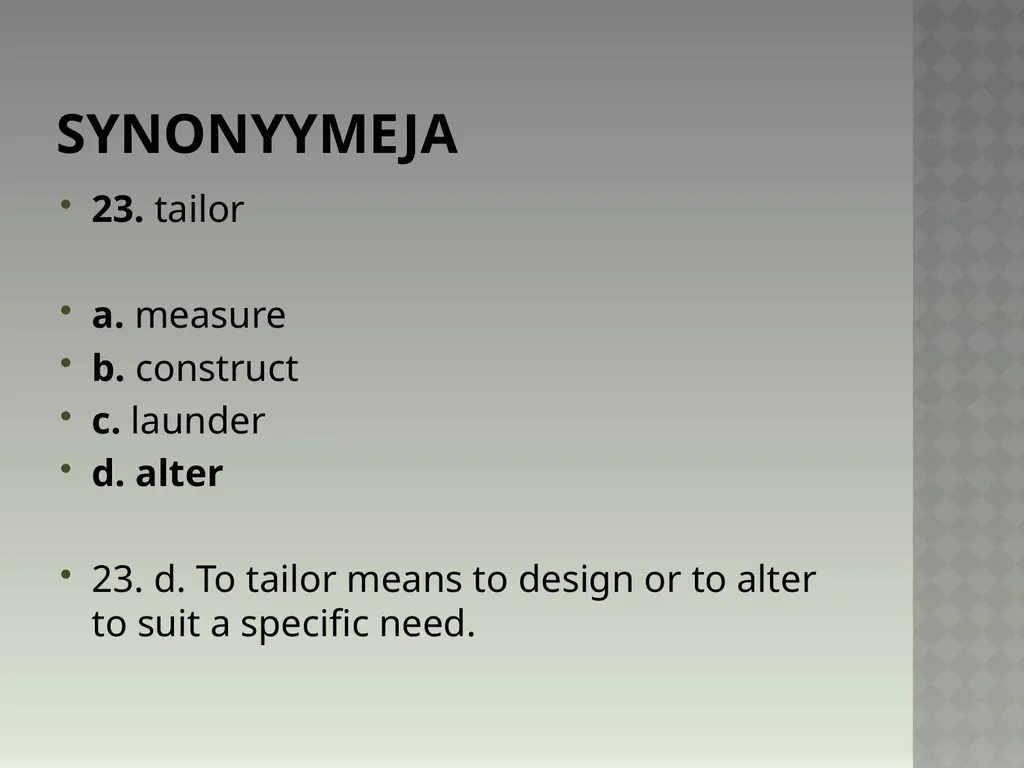
Synonyymeja 23. tailor
a. measure
b. construct
c. launder
d. alter
23. d. To tailor means to design or to alter to suit a specific need.<br>
a. measure
b. construct
c. launder
d. alter
23. d. To tailor means to design or to alter to suit a specific need.<br>
48
Synonyymeja 24. yield
a. merge
b. relinquish
c. destroy
d. hinder<br>
a. merge
b. relinquish
c. destroy
d. hinder<br>
49
Synonyymeja 24. yield
a. merge
b. relinquish
c. destroy
d. hinder
24. b. To yield means to give up or to relinquish.<br>
a. merge
b. relinquish
c. destroy
d. hinder
24. b. To yield means to give up or to relinquish.<br>
50
Synonyymeja 25. eternal
a. timeless
b. heavenly
c. loving
d.wealthy<br>
a. timeless
b. heavenly
c. loving
d.wealthy<br>
51
Synonyymeja 25. eternal
a. timeless
b. heavenly
c. loving
d.wealthy
25. a. Eternal means to be without end or to be timeless.<br>
a. timeless
b. heavenly
c. loving
d.wealthy
25. a. Eternal means to be without end or to be timeless.<br>
52
Synonyymeja 26. stow
a. pack
b. curtsy
c. fool
d. trample<br>
a. pack
b. curtsy
c. fool
d. trample<br>
53
Synonyymeja 26. stow
a. pack
b. curtsy
c. fool
d. trample
26. a. To stow means to store or pack away.<br>
a. pack
b. curtsy
c. fool
d. trample
26. a. To stow means to store or pack away.<br>
54
Synonyymeja 27. intimate
a. frightening
b. curious
c. private
d. characteristic<br>
a. frightening
b. curious
c. private
d. characteristic<br>
55
Synonyymeja 27. intimate
a. frightening
b. curious
c. private
d. characteristic
27. c. Intimate means personal or private.<br>
a. frightening
b. curious
c. private
d. characteristic
27. c. Intimate means personal or private.<br>
56
Synonyymeja 28. consider
a. promote
b. require
c. adjust
d. ponder<br>
a. promote
b. require
c. adjust
d. ponder<br>
57
Synonyymeja 28. consider
a. promote
b. require
c. adjust
d. ponder
28. d. To consider means to regard or judge;
ponder.<br>
a. promote
b. require
c. adjust
d. ponder
28. d. To consider means to regard or judge;
ponder.<br>
58
Synonyymeja 29. humidify
a. moisten
b. warm
c. gather
d. spray<br>
a. moisten
b. warm
c. gather
d. spray<br>
59
Synonyymeja 29. humidify
a. moisten
b. warm
c. gather
d. spray
29. a. To humidify means to dampen or moisten.<br>
a. moisten
b. warm
c. gather
d. spray
29. a. To humidify means to dampen or moisten.<br>
60
Synonyymeja 30. arouse
a. inform
b. abuse
c. waken
d. deceive<br>
a. inform
b. abuse
c. waken
d. deceive<br>
61
Synonyymeja 30. arouse
a. inform
b. abuse
c. waken
d. deceive
30. c. To arouse means to stir or cause to become alert; waken.<br>
a. inform
b. abuse
c. waken
d. deceive
30. c. To arouse means to stir or cause to become alert; waken.<br>
62
Synonyymeja 31. harass
a. trick
b. confuse
c. betray
d. pester<br>
a. trick
b. confuse
c. betray
d. pester<br>
63
Synonyymeja 31. harass
a. trick
b. confuse
c. betray
d. pester
31. d. To harass means to torment or pester.<br>
a. trick
b. confuse
c. betray
d. pester
31. d. To harass means to torment or pester.<br>
64
Synonyymeja 32. fortified
a. reinforced
b. distorted
c. disputed
d. developed<br>
a. reinforced
b. distorted
c. disputed
d. developed<br>
65
Synonyymeja 32. fortified
a. reinforced
b. distorted
c. disputed
d. developed
32. a. Fortified means strengthened or reinforced.<br>
a. reinforced
b. distorted
c. disputed
d. developed
32. a. Fortified means strengthened or reinforced.<br>
66
Synonyymeja 33. delegate
a. analyze
b. respect
c. criticize
d. assign<br>
a. analyze
b. respect
c. criticize
d. assign<br>
67
Synonyymeja 33. delegate
a. analyze
b. respect
c. criticize
d. assign
33. d. To delegate means to authorize, appoint, or assign.<br>
a. analyze
b. respect
c. criticize
d. assign
33. d. To delegate means to authorize, appoint, or assign.<br>
68
Synonyymeja 34. accountable
a. applauded
b. compensated
c. responsible
d. approached<br>
a. applauded
b. compensated
c. responsible
d. approached<br>
69
Synonyymeja 34. accountable
a. applauded
b. compensated
c. responsible
d. approached
34. c. To be held accountable means to be held responsible.<br>
a. applauded
b. compensated
c. responsible
d. approached
34. c. To be held accountable means to be held responsible.<br>
70
Synonyymeja 35. philosophy
a. bias
b. principles
c. evidence
d. process<br>
a. bias
b. principles
c. evidence
d. process<br>
71
Synonyymeja 35. philosophy
a. bias
b. principles
c. evidence
d. process
35. b. A philosophy is a system of motivating principles.<br>
a. bias
b. principles
c. evidence
d. process
35. b. A philosophy is a system of motivating principles.<br>
72
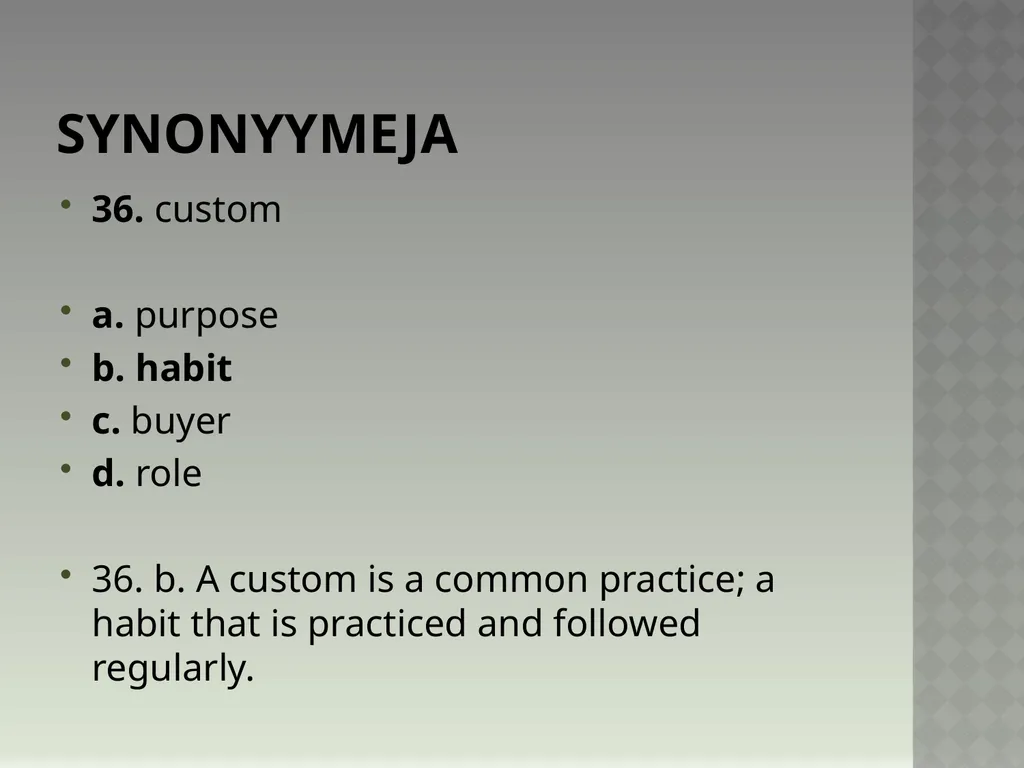
Synonyymeja 36. custom
a. purpose
b. habit
c. buyer
d. role<br>
a. purpose
b. habit
c. buyer
d. role<br>
73
Synonyymeja 36. custom
a. purpose
b. habit
c. buyer
d. role
36. b. A custom is a common practice; a habit that is practiced and followed regularly.<br>
a. purpose
b. habit
c. buyer
d. role
36. b. A custom is a common practice; a habit that is practiced and followed regularly.<br>
74
Synonyymeja 37. harbor
a. halter
b. statement
c. refuge
d.garment<br>
a. halter
b. statement
c. refuge
d.garment<br>
75
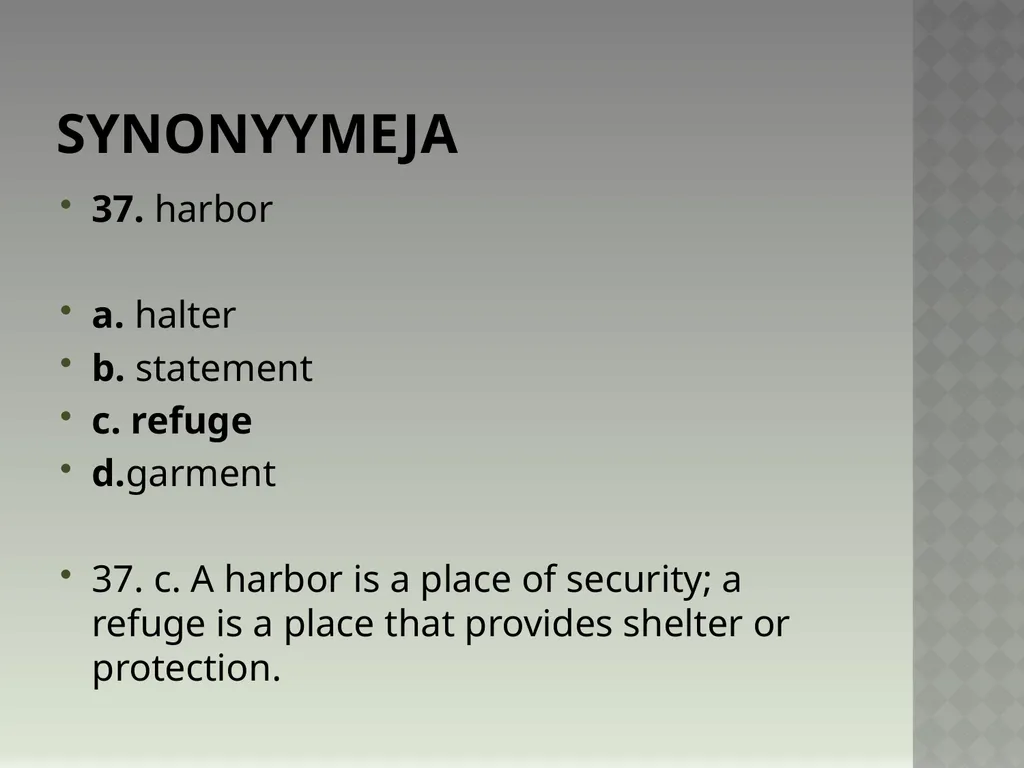
Synonyymeja 37. harbor
a. halter
b. statement
c. refuge
d.garment
37. c. A harbor is a place of security; a refuge is a place that provides shelter or protection.<br>
a. halter
b. statement
c. refuge
d.garment
37. c. A harbor is a place of security; a refuge is a place that provides shelter or protection.<br>
76
Synonyymeja 38. muse
a. tune
b. ponder
c. encourage
d. read<br>
a. tune
b. ponder
c. encourage
d. read<br>
77
Synonyymeja 38. muse
a. tune
b. ponder
c. encourage
d. read
38. b. To muse means to consider carefully or at length; to ponder.<br>
a. tune
b. ponder
c. encourage
d. read
38. b. To muse means to consider carefully or at length; to ponder.<br>
78
Synonyymeja 39. vessel
a. container
b. furniture
c. garment
d. branch<br>
a. container
b. furniture
c. garment
d. branch<br>
79
Synonyymeja 39. vessel
a. container
b. furniture
c. garment
d. branch
39. a. A vessel and a container are both receptacles<br>
a. container
b. furniture
c. garment
d. branch
39. a. A vessel and a container are both receptacles<br>
80
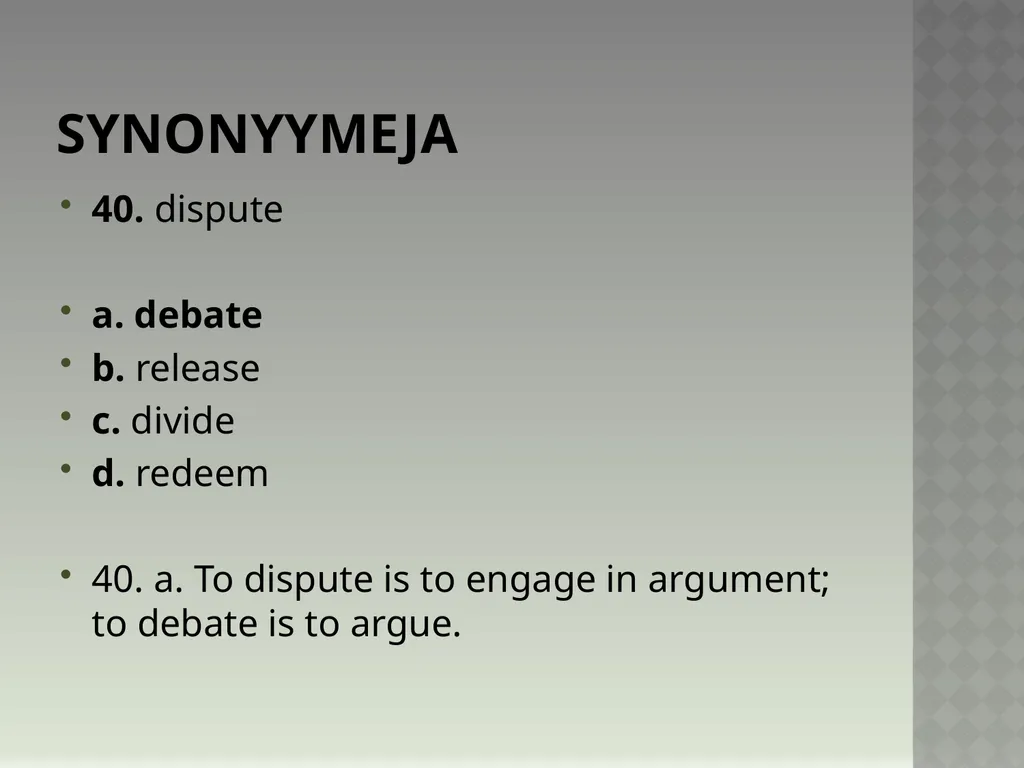
Synonyymeja 40. dispute
a. debate
b. release
c. divide
d. redeem<br>
a. debate
b. release
c. divide
d. redeem<br>
81
Synonyymeja 40. dispute
a. debate
b. release
c. divide
d. redeem
40. a. To dispute is to engage in argument; to debate is to argue.<br>
a. debate
b. release
c. divide
d. redeem
40. a. To dispute is to engage in argument; to debate is to argue.<br>
82
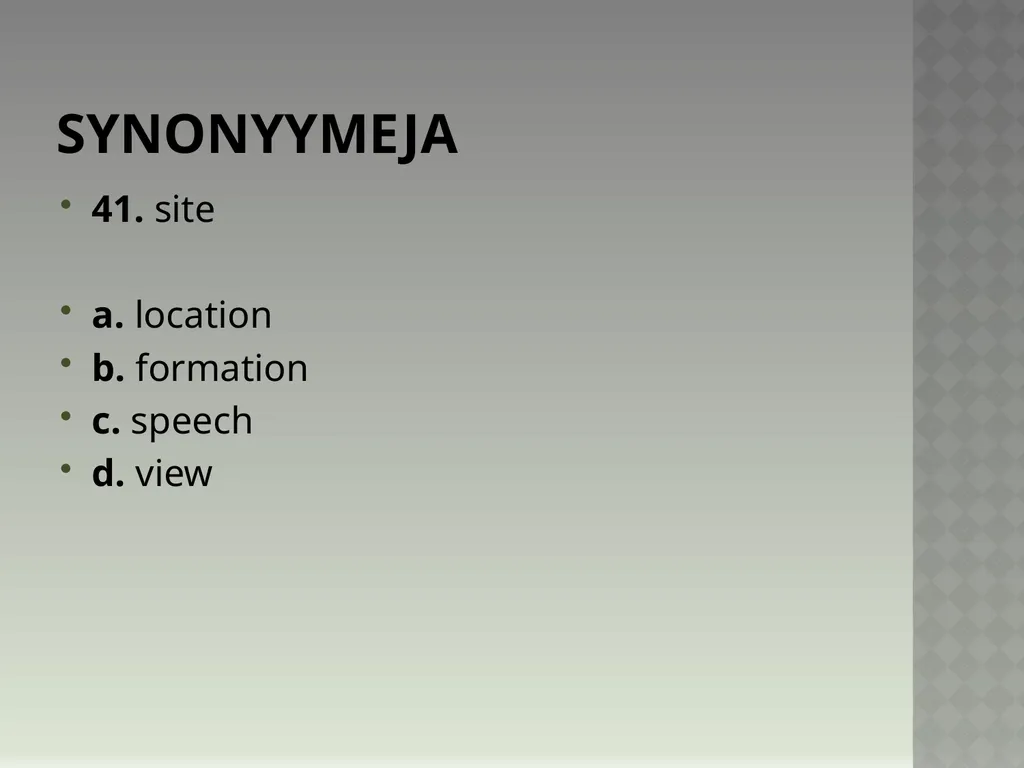
Synonyymeja 41. site
a. location
b. formation
c. speech
d. view<br>
a. location
b. formation
c. speech
d. view<br>
83
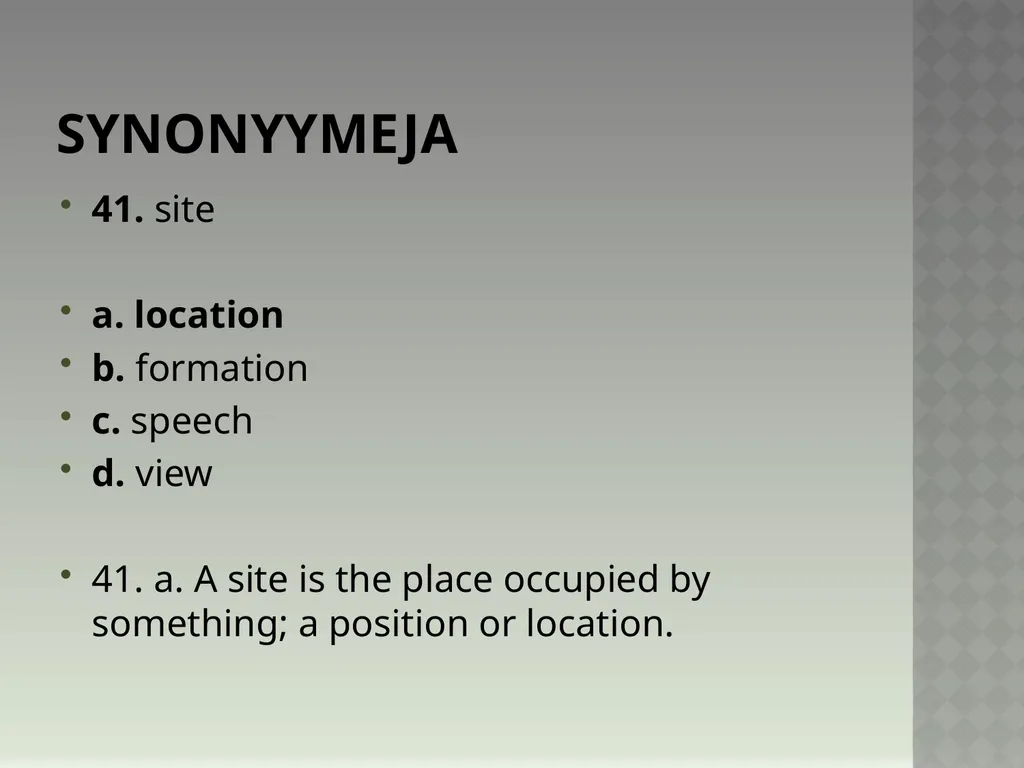
Synonyymeja 41. site
a. location
b. formation
c. speech
d. view
41. a. A site is the place occupied by something; a position or location.<br>
a. location
b. formation
c. speech
d. view
41. a. A site is the place occupied by something; a position or location.<br>
84
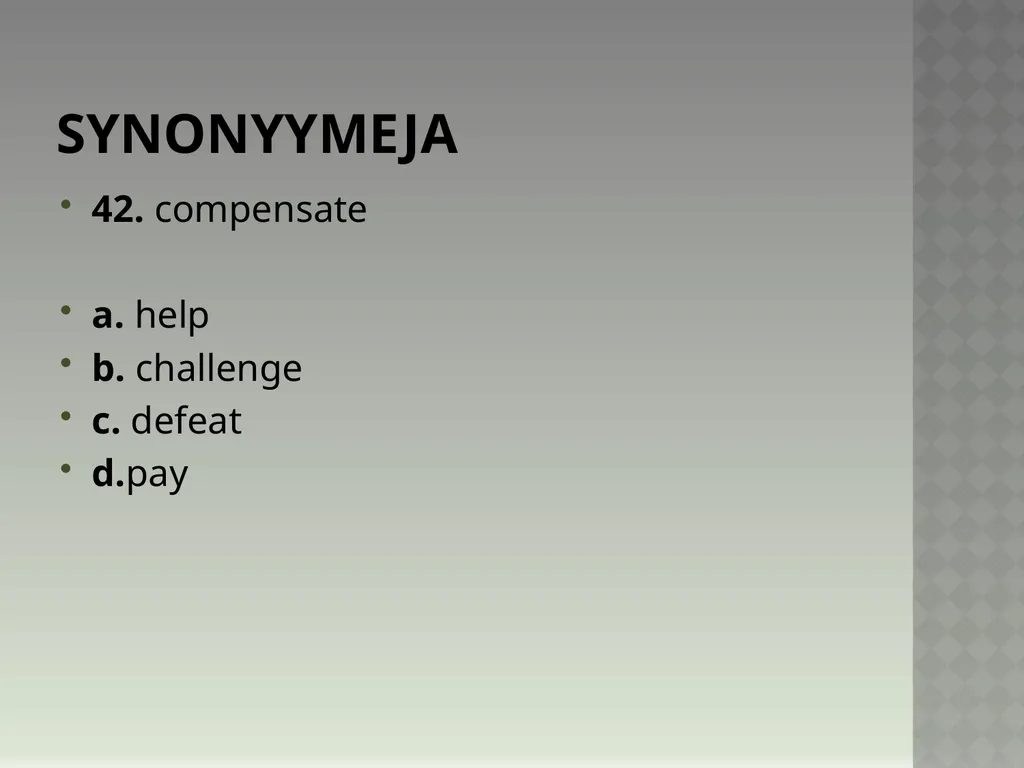
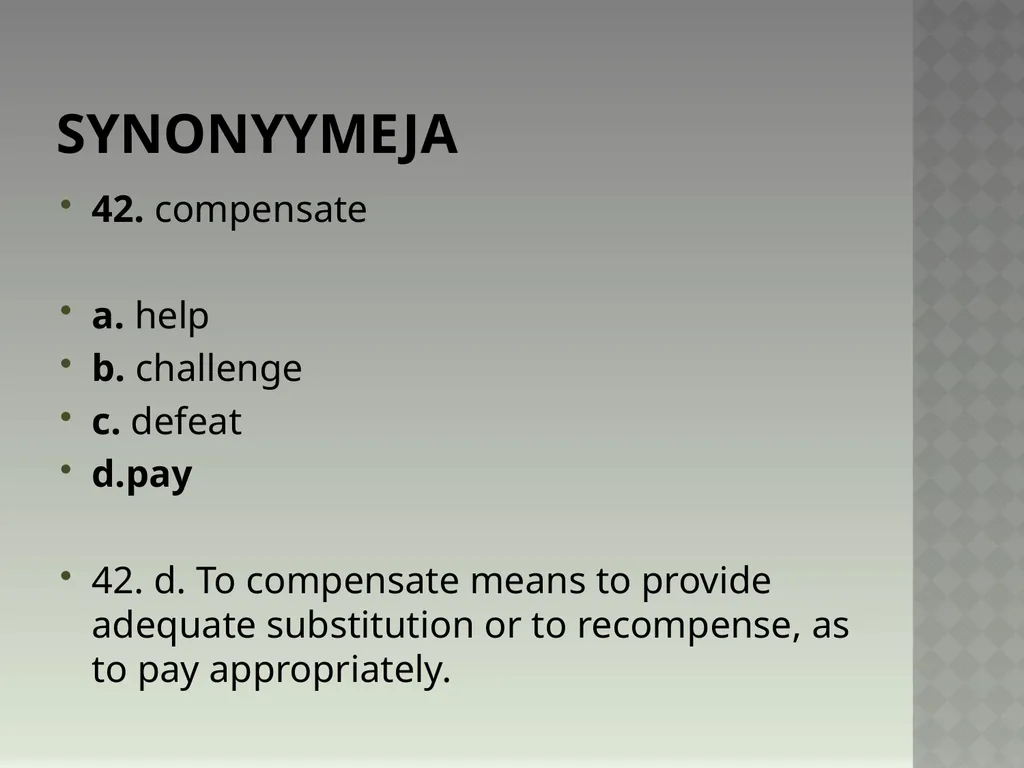
Synonyymeja 42. compensate
a. help
b. challenge
c. defeat
d.pay<br>
a. help
b. challenge
c. defeat
d.pay<br>
85
Synonyymeja 42. compensate
a. help
b. challenge
c. defeat
d.pay
42. d. To compensate means to provide adequate substitution or to recompense, as to pay appropriately.<br>
a. help
b. challenge
c. defeat
d.pay
42. d. To compensate means to provide adequate substitution or to recompense, as to pay appropriately.<br>
86
Synonyymeja 43. journal
a. trip
b. receipt
c. diary
d. list<br>
a. trip
b. receipt
c. diary
d. list<br>
87
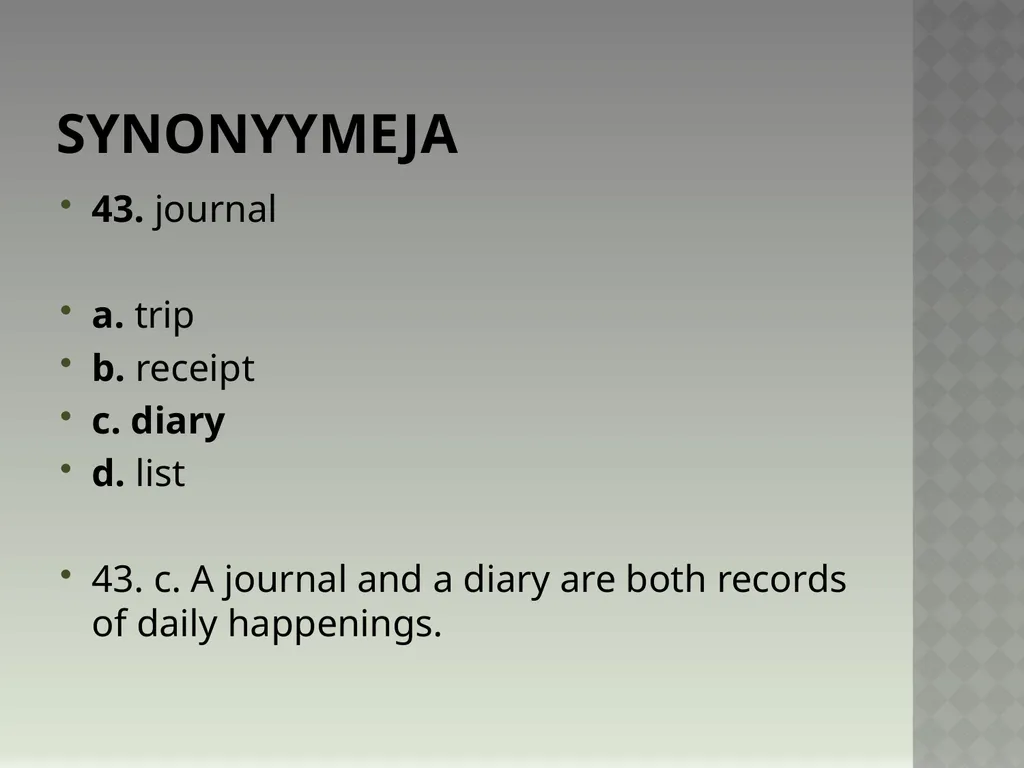
Synonyymeja 43. journal
a. trip
b. receipt
c. diary
d. list
43. c. A journal and a diary are both records of daily happenings.<br>
a. trip
b. receipt
c. diary
d. list
43. c. A journal and a diary are both records of daily happenings.<br>
88
Synonyymeja 44. opportunity
a. sensitivity
b. arrogance
c. chance
d. reference<br>
a. sensitivity
b. arrogance
c. chance
d. reference<br>
89
Synonyymeja 44. opportunity
a. sensitivity
b. arrogance
c. chance
d. reference
44. c. An opportunity to do something is the same as a chance to do it.<br>
a. sensitivity
b. arrogance
c. chance
d. reference
44. c. An opportunity to do something is the same as a chance to do it.<br>
90
Synonyymeja 45. invent
a. insert
b. discover
c. apply
d. allow<br>
a. insert
b. discover
c. apply
d. allow<br>
91
Synonyymeja 45. invent
a. insert
b. discover
c. apply
d. allow
45. b. Invent means to create or to discover.<br>
a. insert
b. discover
c. apply
d. allow
45. b. Invent means to create or to discover.<br>
92
Synonyymeja 46. sphere
a. air
b. spread
c. globe
d. enclosure<br>
a. air
b. spread
c. globe
d. enclosure<br>
93
Synonyymeja 46. sphere
a. air
b. spread
c. globe
d. enclosure
46. c. A sphere is a figure formed by the revolution of a circle about its diameter and is synonymous with globe.<br>
a. air
b. spread
c. globe
d. enclosure
46. c. A sphere is a figure formed by the revolution of a circle about its diameter and is synonymous with globe.<br>
94
Synonyymeja 47. refine
a. condone
b. provide
c. change
d. purify<br>
a. condone
b. provide
c. change
d. purify<br>
95
Synonyymeja 47. refine
a. condone
b. provide
c. change
d. purify
47. d. To refine means to remove impurities; to purify.<br>
a. condone
b. provide
c. change
d. purify
47. d. To refine means to remove impurities; to purify.<br>
96
Synonyymeja 48. pledge
a. picture
b. idea
c. quote
d. promise<br>
a. picture
b. idea
c. quote
d. promise<br>
97
Synonyymeja 48. pledge
a. picture
b. idea
c. quote
d. promise
48. d. To pledge means to make a declaration or a promise to do something.<br>
a. picture
b. idea
c. quote
d. promise
48. d. To pledge means to make a declaration or a promise to do something.<br>
98
Synonyymeja 49. gangly
a. illegally
b. closely
c. ugly
d. lanky<br>
a. illegally
b. closely
c. ugly
d. lanky<br>
99
Synonyymeja 49. gangly
a. illegally
b. closely
c. ugly
d. lanky
49. d. Gangly means tall, thin, and awkward; lanky.<br>
a. illegally
b. closely
c. ugly
d. lanky
49. d. Gangly means tall, thin, and awkward; lanky.<br>
100
Synonyymeja 50. sage
a. wise
b. obnoxious
c. conceited
d. heartless<br>
a. wise
b. obnoxious
c. conceited
d. heartless<br>
101
Synonyymeja 50. sage
a. wise
b. obnoxious
c. conceited
d. heartless
50. a. A sage is a wise, intelligent, or perceptive person.<br>
a. wise
b. obnoxious
c. conceited
d. heartless
50. a. A sage is a wise, intelligent, or perceptive person.<br>
102
Synonyymeja 51. dormant
a. hidden
b. slumbering
c. rigid
d. misplaced<br>
a. hidden
b. slumbering
c. rigid
d. misplaced<br>
103
Synonyymeja 51. dormant
a. hidden
b. slumbering
c. rigid
d. misplaced
51. b. To be dormant is to be sleeping or slumbering.<br>
a. hidden
b. slumbering
c. rigid
d. misplaced
51. b. To be dormant is to be sleeping or slumbering.<br>
104
Synonyymeja 52. banish
a. exile
b. decorate
c. succumb
d. encourage<br>
a. exile
b. decorate
c. succumb
d. encourage<br>
105
Synonyymeja 52. banish
a. exile
b. decorate
c. succumb
d. encourage
52. a. To banish means to condemn to removal or to exile.<br>
a. exile
b. decorate
c. succumb
d. encourage
52. a. To banish means to condemn to removal or to exile.<br>
106
Synonyymeja 53. croon
a. swim
b. sing
c. stroke
d. yell<br>
a. swim
b. sing
c. stroke
d. yell<br>
107
Synonyymeja 53. croon
a. swim
b. sing
c. stroke
d. yell
53. b. To croon means to vocalize or to sing.<br>
a. swim
b. sing
c. stroke
d. yell
53. b. To croon means to vocalize or to sing.<br>
108
Synonyymeja 54. hostel
a. turnstile
b. cot
c. trek
d. inn<br>
a. turnstile
b. cot
c. trek
d. inn<br>
109
Synonyymeja 54. hostel
a. turnstile
b. cot
c. trek
d. inn
54. d. A hostel and an inn are both lodging places.<br>
a. turnstile
b. cot
c. trek
d. inn
54. d. A hostel and an inn are both lodging places.<br>
110
Synonyymeja 55. mesa
a. brain
b. plateau
c. wagon
d.dwelling<br>
a. brain
b. plateau
c. wagon
d.dwelling<br>
111
Synonyymeja 55. mesa
a. brain
b. plateau
c. wagon
d.dwelling
55. b. A mesa and a plateau are both high tablelands; flat-topped hills with precipitous sides.<br>
a. brain
b. plateau
c. wagon
d.dwelling
55. b. A mesa and a plateau are both high tablelands; flat-topped hills with precipitous sides.<br>
112
Synonyymeja 56. ado
a. idiom
b. punishment
c. cost
d. fuss<br>
a. idiom
b. punishment
c. cost
d. fuss<br>
113
Synonyymeja 56. ado
a. idiom
b. punishment
c. cost
d. fuss
56. d. Ado means a hubbub or commotion; fuss.<br>
a. idiom
b. punishment
c. cost
d. fuss
56. d. Ado means a hubbub or commotion; fuss.<br>
114
Synonyymeja 57. obscure
a. concealed
b. obvious
c. reckless
d. subjective<br>
a. concealed
b. obvious
c. reckless
d. subjective<br>
115
Synonyymeja 57. obscure
a. concealed
b. obvious
c. reckless
d. subjective
57. a. Obscure means concealed or hidden.<br>
a. concealed
b. obvious
c. reckless
d. subjective
57. a. Obscure means concealed or hidden.<br>
116
Synonyymeja 58. malicious
a. spiteful
b. changeable
c. murderous
d. dangerous<br>
a. spiteful
b. changeable
c. murderous
d. dangerous<br>
117
Synonyymeja 58. malicious
a. spiteful
b. changeable
c. murderous
d. dangerous
58. a. A malicious action is intended to harm, as is a spiteful action.<br>
a. spiteful
b. changeable
c. murderous
d. dangerous
58. a. A malicious action is intended to harm, as is a spiteful action.<br>
118
Synonyymeja 59. obsolete
a. current
b. dedicated
c. unnecessary
d. outmoded<br>
a. current
b. dedicated
c. unnecessary
d. outmoded<br>
119
Synonyymeja 59. obsolete
a. current
b. dedicated
c. unnecessary
d. outmoded
59. d. Obsolete and outmoded both mean no longer in use.<br>
a. current
b. dedicated
c. unnecessary
d. outmoded
59. d. Obsolete and outmoded both mean no longer in use.<br>
120
Synonyymeja 60. expansive
a. talkative
b. relaxed
c. humorous
d. grateful<br>
a. talkative
b. relaxed
c. humorous
d. grateful<br>
121
Synonyymeja 60. expansive
a. talkative
b. relaxed
c. humorous
d. grateful
60. a. An expansive personality is talkative, open, and sociable.<br>
a. talkative
b. relaxed
c. humorous
d. grateful
60. a. An expansive personality is talkative, open, and sociable.<br>
122
Synonyymeja 61. relinquish
a. abandon
b. report
c. commence
d. abide<br>
a. abandon
b. report
c. commence
d. abide<br>
123
Synonyymeja 61. relinquish
a. abandon
b. report
c. commence
d. abide
61. a. Relinquish means to let go or release; abandon means to desert.<br>
a. abandon
b. report
c. commence
d. abide
61. a. Relinquish means to let go or release; abandon means to desert.<br>
124
Synonyymeja 62. submissive
a. raucous
b. obedient
c. virtuous
d. selfish<br>
a. raucous
b. obedient
c. virtuous
d. selfish<br>
125
Synonyymeja 62. submissive
a. raucous
b. obedient
c. virtuous
d. selfish
62. b. Submissive means acting in submission to others; obedient implies compliance as well.<br>
a. raucous
b. obedient
c. virtuous
d. selfish
62. b. Submissive means acting in submission to others; obedient implies compliance as well.<br>
126
Synonyymeja 63. ponderous
a. heavy
b. thoughtful
c. hearty
d. generous<br>
a. heavy
b. thoughtful
c. hearty
d. generous<br>
127
Synonyymeja 63. ponderous
a. heavy
b. thoughtful
c. hearty
d. generous
63. a. Ponderous means heavy; unwieldy or clumsy because of weight or size.<br>
a. heavy
b. thoughtful
c. hearty
d. generous
63. a. Ponderous means heavy; unwieldy or clumsy because of weight or size.<br>
128
Synonyymeja 64. stoical
a. impassive
b. loud
c. curious
d. intense<br>
a. impassive
b. loud
c. curious
d. intense<br>
129
Synonyymeja 64. stoical
a. impassive
b. loud
c. curious
d. intense
64. a. Stoical means not showing passion or feeling; impassive means expressionless.<br>
a. impassive
b. loud
c. curious
d. intense
64. a. Stoical means not showing passion or feeling; impassive means expressionless.<br>
130
Synonyymeja 65. haggard
a. handsome
b. honest
c. gaunt
d. intense<br>
a. handsome
b. honest
c. gaunt
d. intense<br>
131
Synonyymeja 65. haggard
a. handsome
b. honest
c. gaunt
d. intense
65. c. Haggard means having a worn or an emaciated appearance; gaunt means excessively thin.<br>
a. handsome
b. honest
c. gaunt
d. intense
65. c. Haggard means having a worn or an emaciated appearance; gaunt means excessively thin.<br>
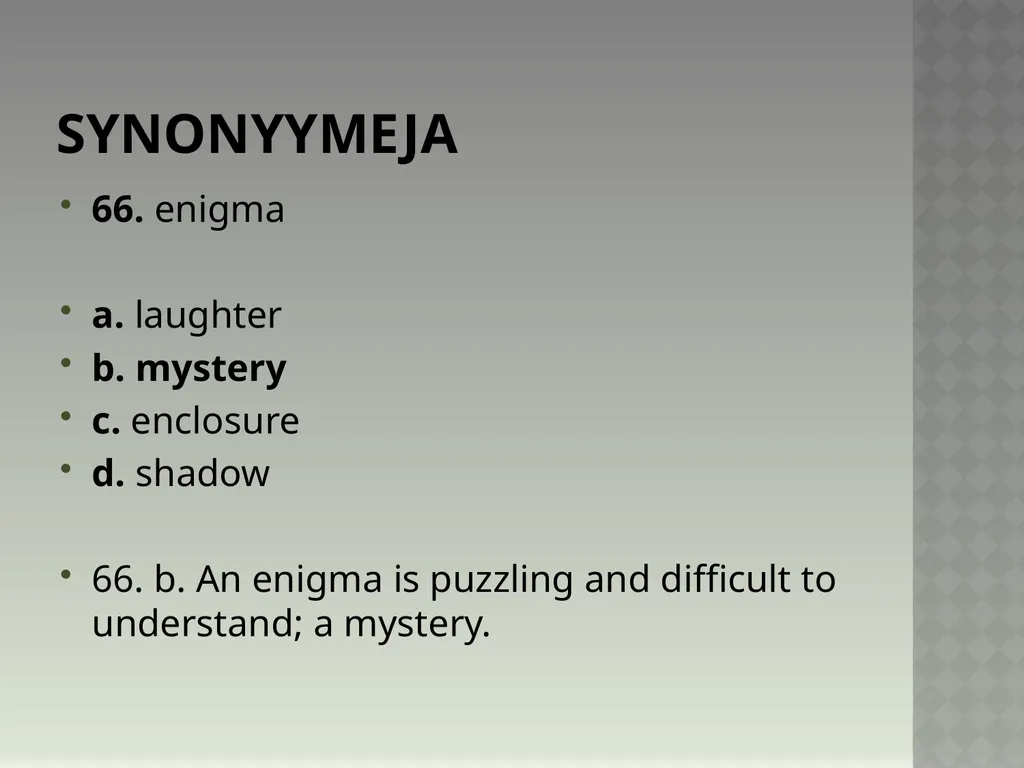
132
Synonyymeja 66. enigma
a. laughter
b. mystery
c. enclosure
d. shadow<br>
a. laughter
b. mystery
c. enclosure
d. shadow<br>
133
Synonyymeja 66. enigma
a. laughter
b. mystery
c. enclosure
d. shadow
66. b. An enigma is puzzling and difficult to understand; a mystery.<br>
a. laughter
b. mystery
c. enclosure
d. shadow
66. b. An enigma is puzzling and difficult to understand; a mystery.<br>
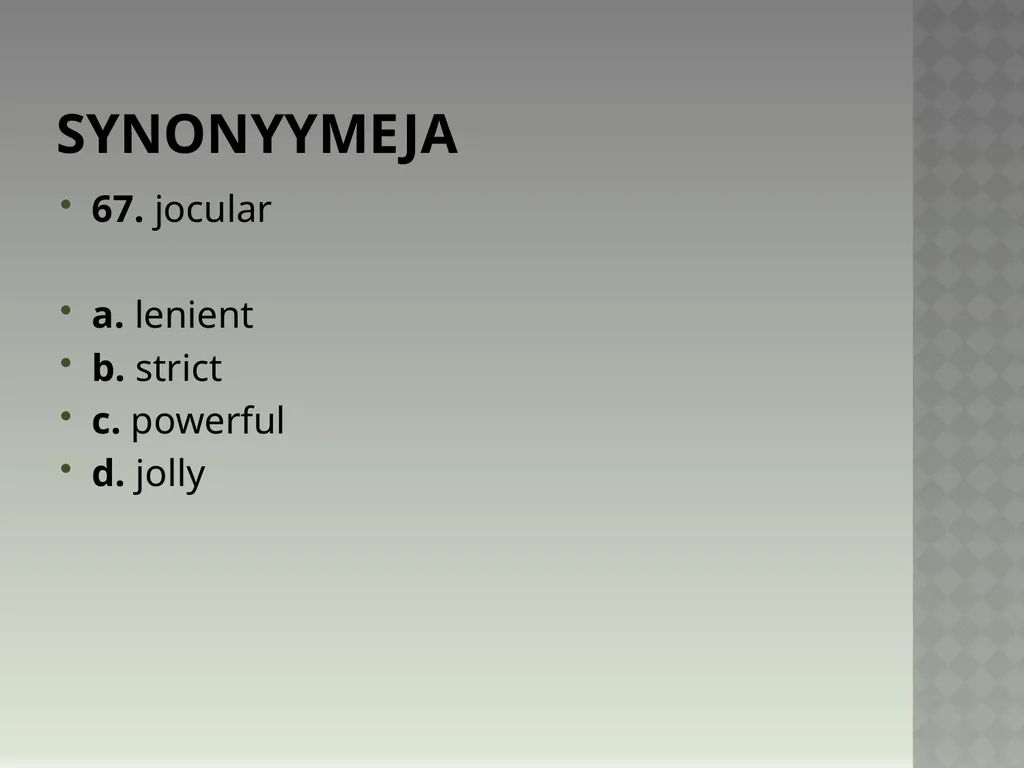
134
Synonyymeja 67. jocular
a. lenient
b. strict
c. powerful
d. jolly<br>
a. lenient
b. strict
c. powerful
d. jolly<br>
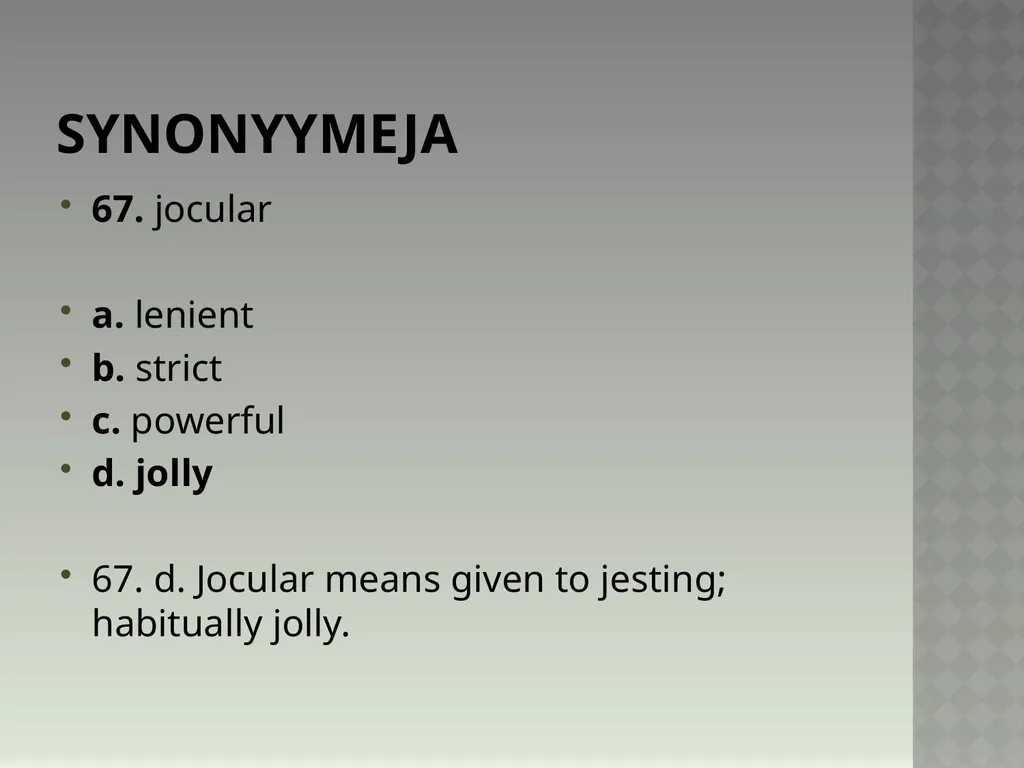
135
Synonyymeja 67. jocular
a. lenient
b. strict
c. powerful
d. jolly
67. d. Jocular means given to jesting; habitually jolly.<br>
a. lenient
b. strict
c. powerful
d. jolly
67. d. Jocular means given to jesting; habitually jolly.<br>
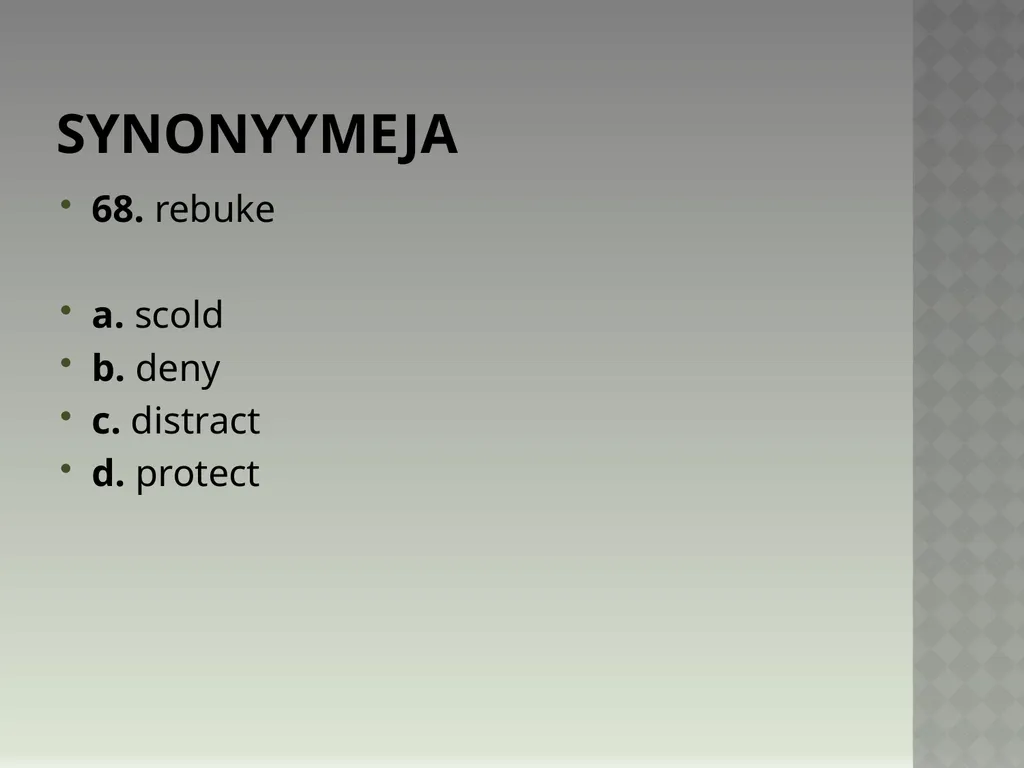
136
Synonyymeja 68. rebuke
a. scold
b. deny
c. distract
d. protect<br>
a. scold
b. deny
c. distract
d. protect<br>
137
Synonyymeja 68. rebuke
a. scold
b. deny
c. distract
d. protect
68. a. To rebuke is to censure angrily; to scold is to reproach abusively.<br>
a. scold
b. deny
c. distract
d. protect
68. a. To rebuke is to censure angrily; to scold is to reproach abusively.<br>
138
Synonyymeja 69. renown
a. attitude
b. fame
c. health
d. strength<br>
a. attitude
b. fame
c. health
d. strength<br>
139
Synonyymeja 69. renown
a. attitude
b. fame
c. health
d. strength
69. b. Renown is a state of honor; fame means to achieve popular acclaim.<br>
a. attitude
b. fame
c. health
d. strength
69. b. Renown is a state of honor; fame means to achieve popular acclaim.<br>
140
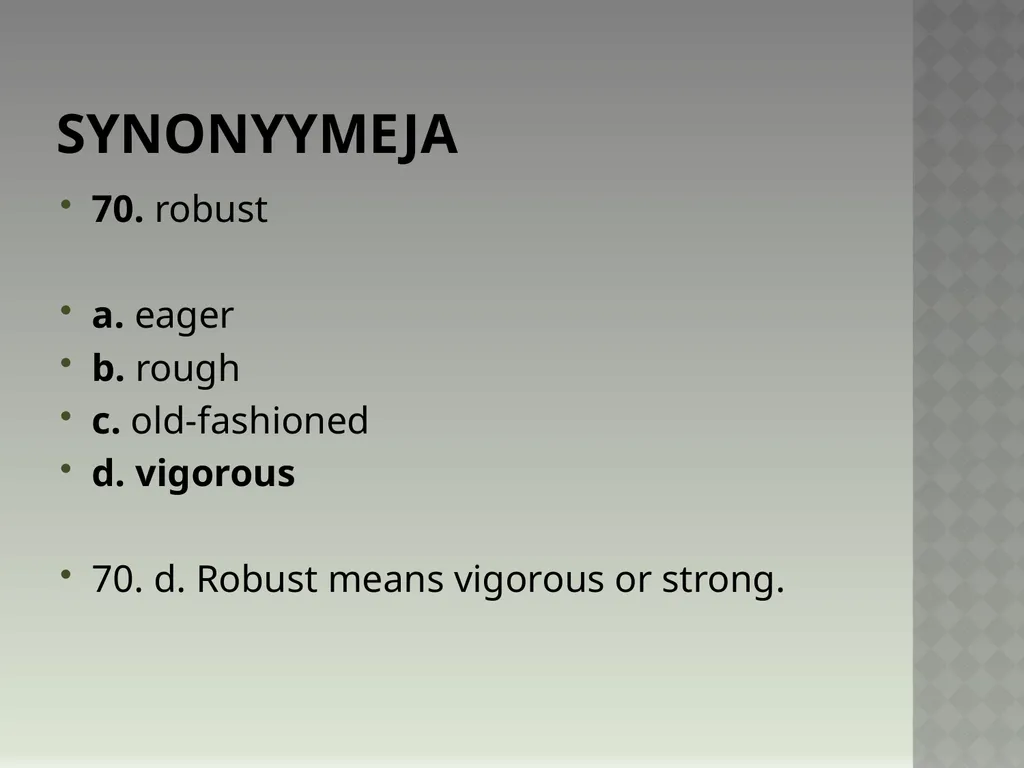
Synonyymeja 70. robust
a. eager
b. rough
c. old-fashioned
d. vigorous<br>
a. eager
b. rough
c. old-fashioned
d. vigorous<br>
141
Synonyymeja 70. robust
a. eager
b. rough
c. old-fashioned
d. vigorous
70. d. Robust means vigorous or strong.<br>
a. eager
b. rough
c. old-fashioned
d. vigorous
70. d. Robust means vigorous or strong.<br>
142
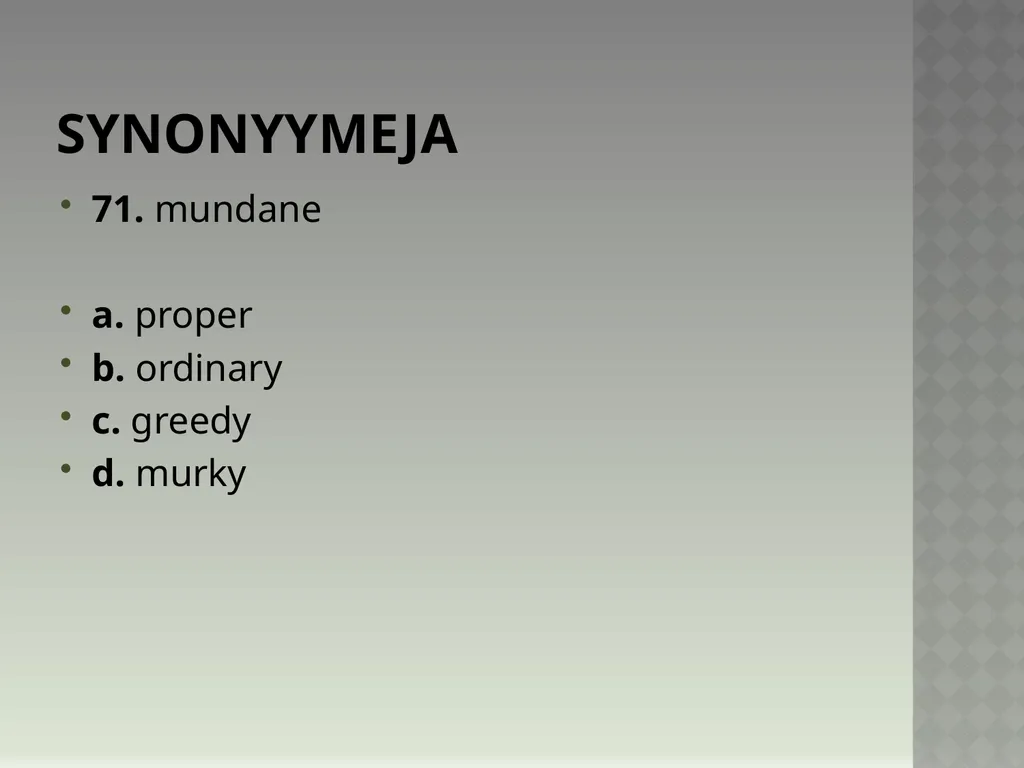
Synonyymeja 71. mundane
a. proper
b. ordinary
c. greedy
d. murky<br>
a. proper
b. ordinary
c. greedy
d. murky<br>
143
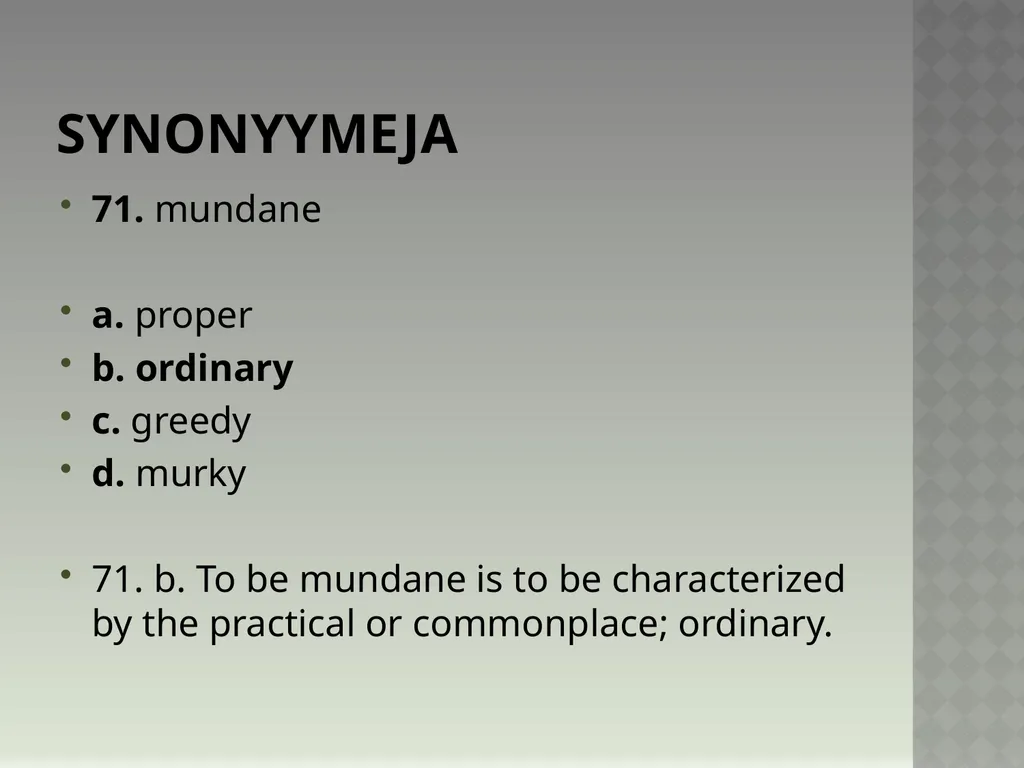
Synonyymeja 71. mundane
a. proper
b. ordinary
c. greedy
d. murky
71. b. To be mundane is to be characterized by the practical or commonplace; ordinary.<br>
a. proper
b. ordinary
c. greedy
d. murky
71. b. To be mundane is to be characterized by the practical or commonplace; ordinary.<br>
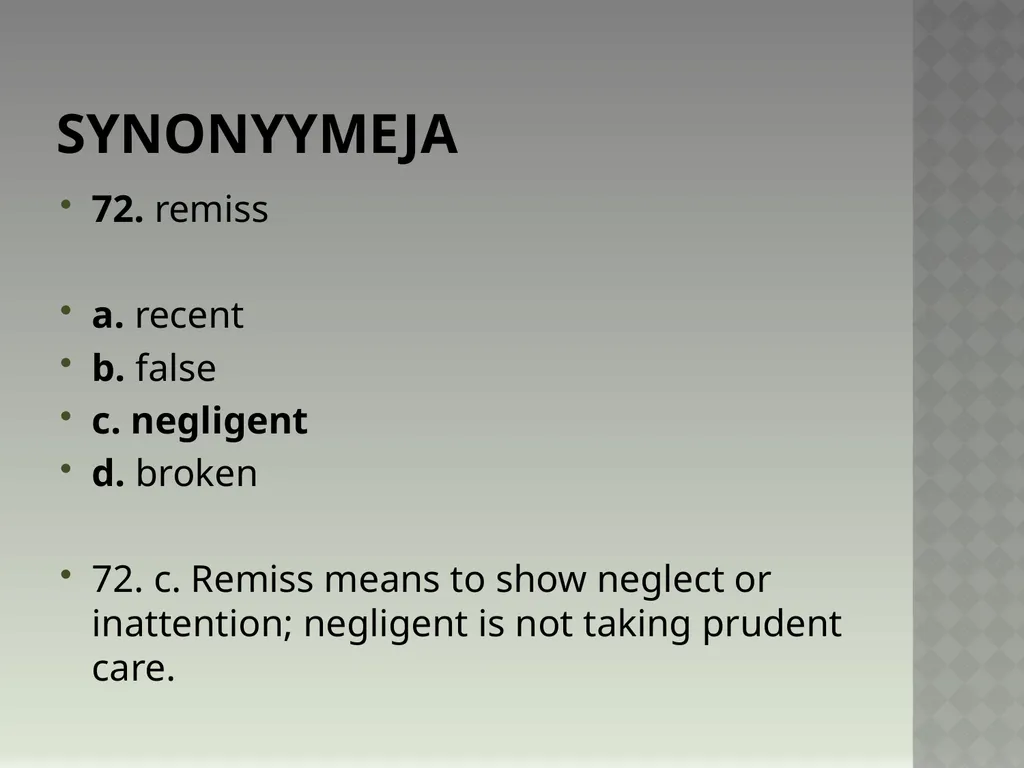
144
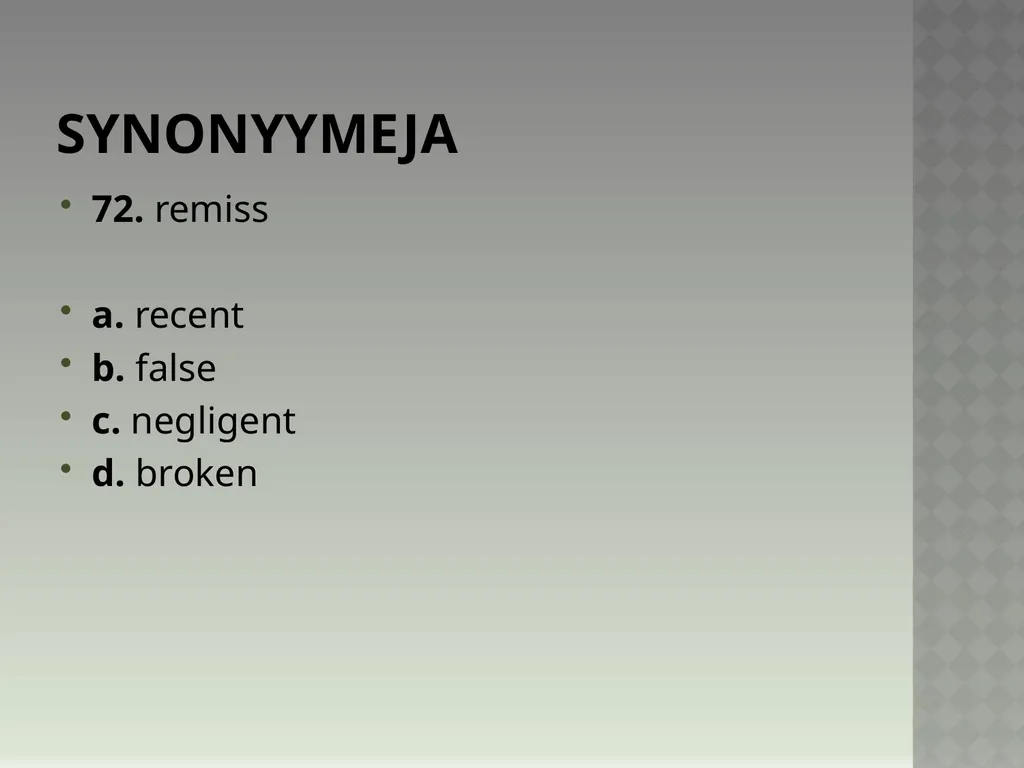
Synonyymeja 72. remiss
a. recent
b. false
c. negligent
d. broken<br>
a. recent
b. false
c. negligent
d. broken<br>
145
Synonyymeja 72. remiss
a. recent
b. false
c. negligent
d. broken
72. c. Remiss means to show neglect or inattention; negligent is not taking prudent care.<br>
a. recent
b. false
c. negligent
d. broken
72. c. Remiss means to show neglect or inattention; negligent is not taking prudent care.<br>
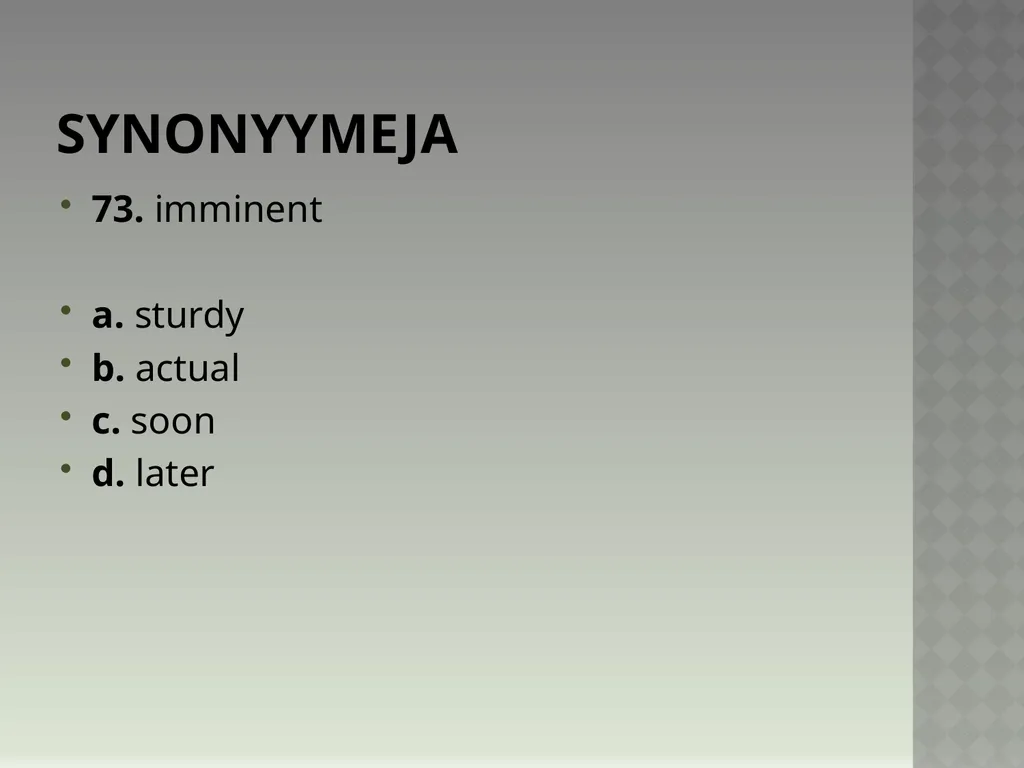
146
Synonyymeja 73. imminent
a. sturdy
b. actual
c. soon
d. later<br>
a. sturdy
b. actual
c. soon
d. later<br>
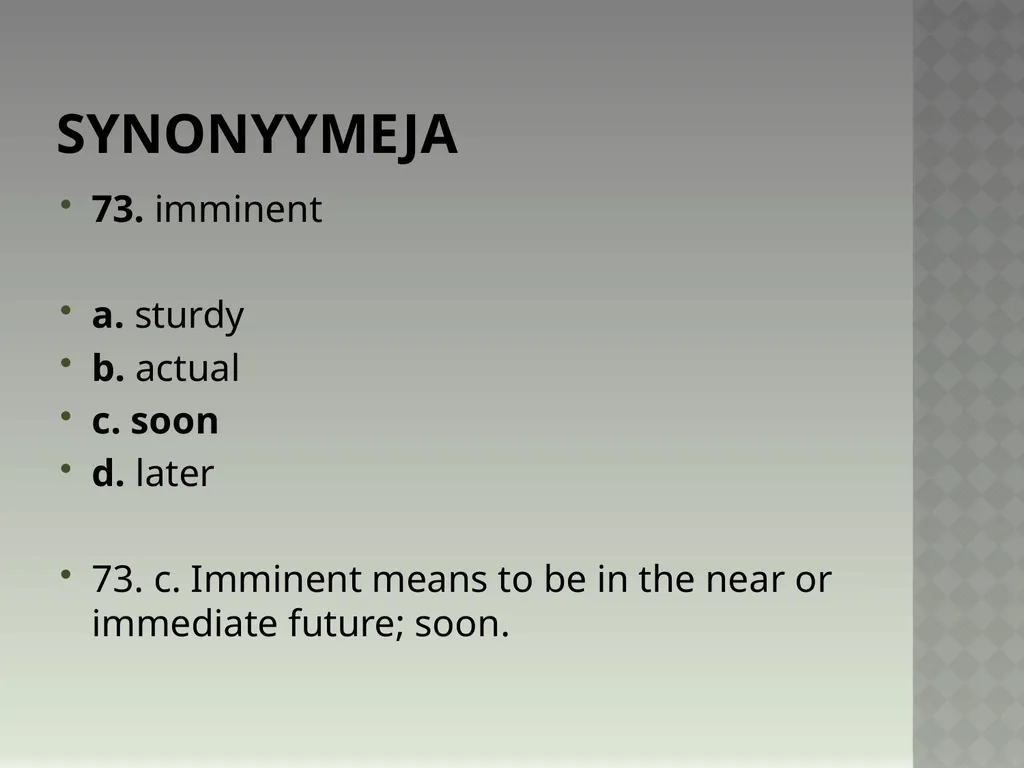
147
Synonyymeja 73. imminent
a. sturdy
b. actual
c. soon
d. later
73. c. Imminent means to be in the near or immediate future; soon.<br>
a. sturdy
b. actual
c. soon
d. later
73. c. Imminent means to be in the near or immediate future; soon.<br>
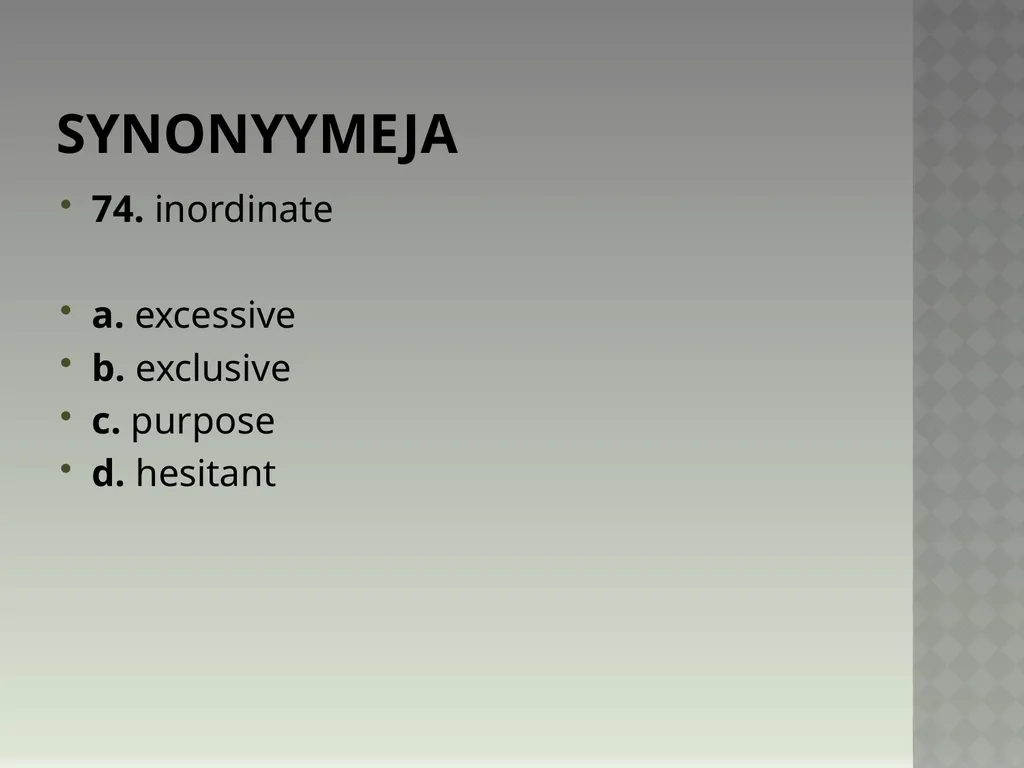
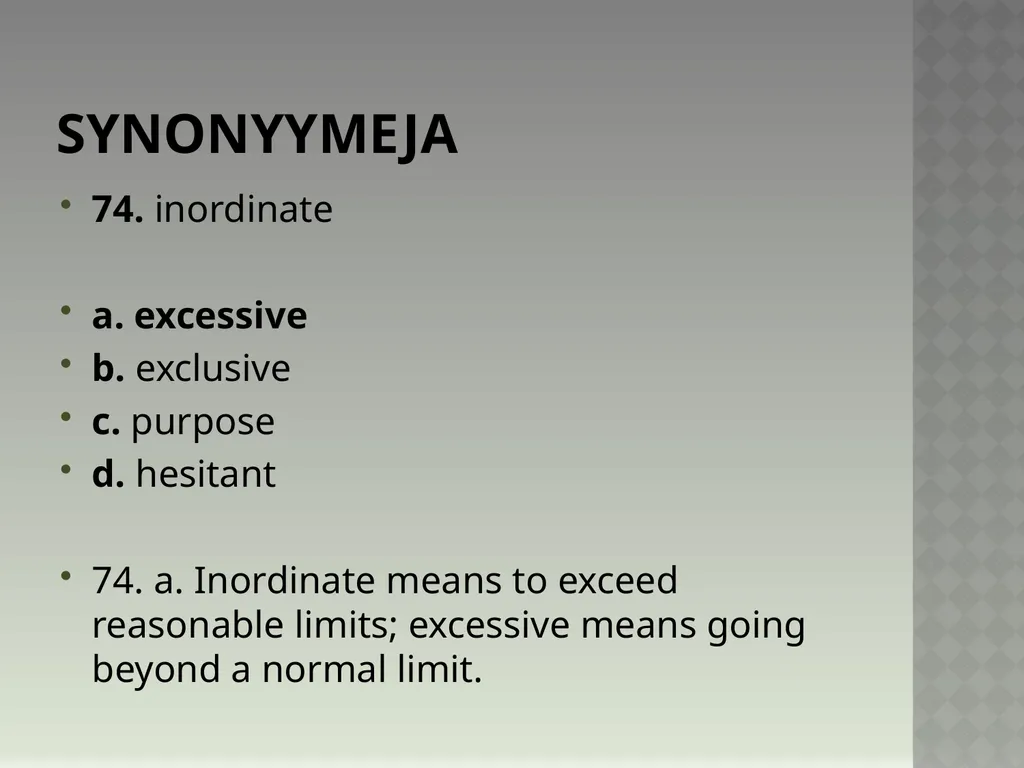
148
Synonyymeja 74. inordinate
a. excessive
b. exclusive
c. purpose
d. hesitant<br>
a. excessive
b. exclusive
c. purpose
d. hesitant<br>
149
Synonyymeja 74. inordinate
a. excessive
b. exclusive
c. purpose
d. hesitant
74. a. Inordinate means to exceed reasonable limits; excessive means going beyond a normal limit.<br>
a. excessive
b. exclusive
c. purpose
d. hesitant
74. a. Inordinate means to exceed reasonable limits; excessive means going beyond a normal limit.<br>
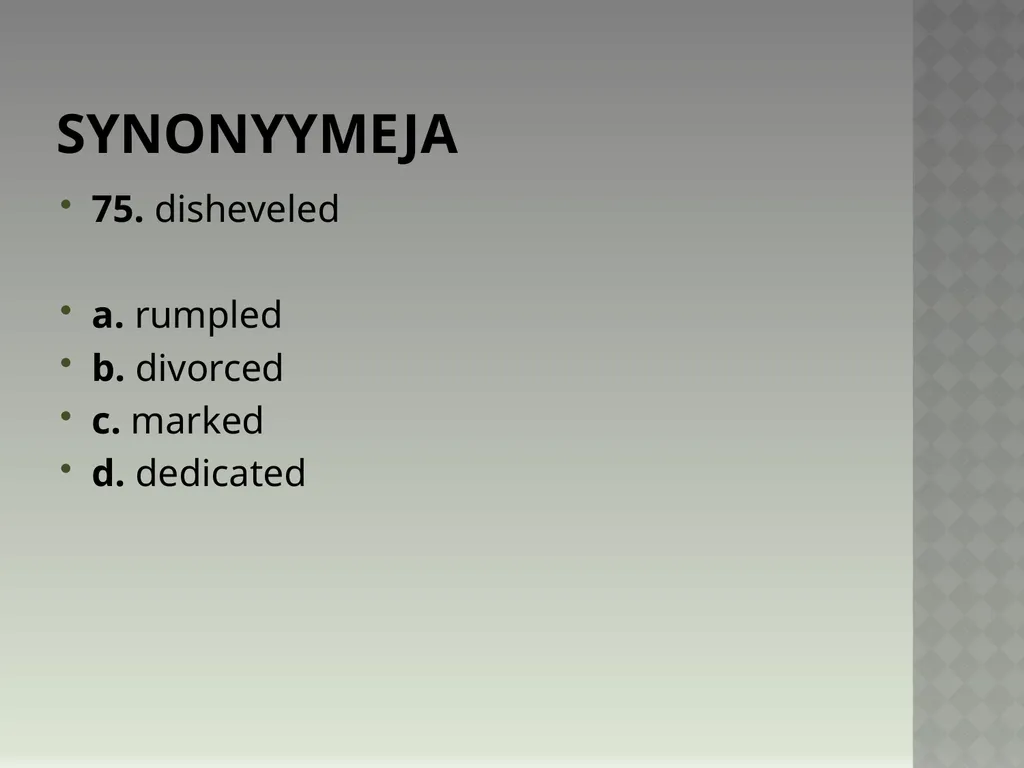
150
Synonyymeja 75. disheveled
a. rumpled
b. divorced
c. marked
d. dedicated<br>
a. rumpled
b. divorced
c. marked
d. dedicated<br>
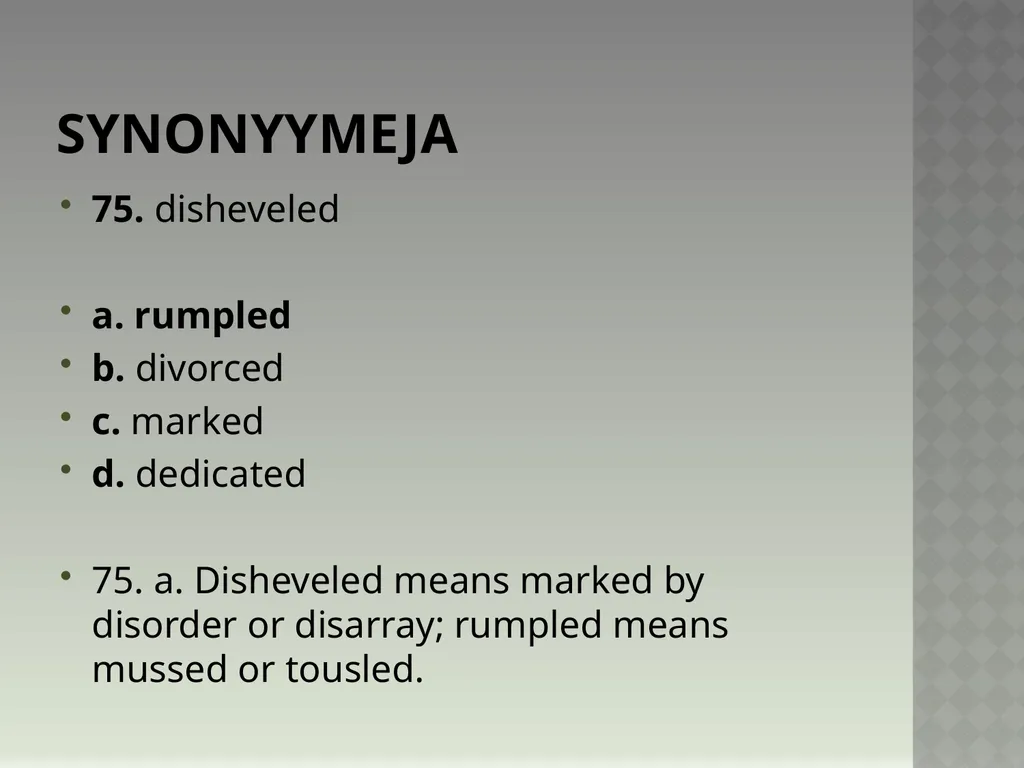
151
Synonyymeja 75. disheveled
a. rumpled
b. divorced
c. marked
d. dedicated
75. a. Disheveled means marked by disorder or disarray; rumpled means mussed or tousled.<br>
a. rumpled
b. divorced
c. marked
d. dedicated
75. a. Disheveled means marked by disorder or disarray; rumpled means mussed or tousled.<br>
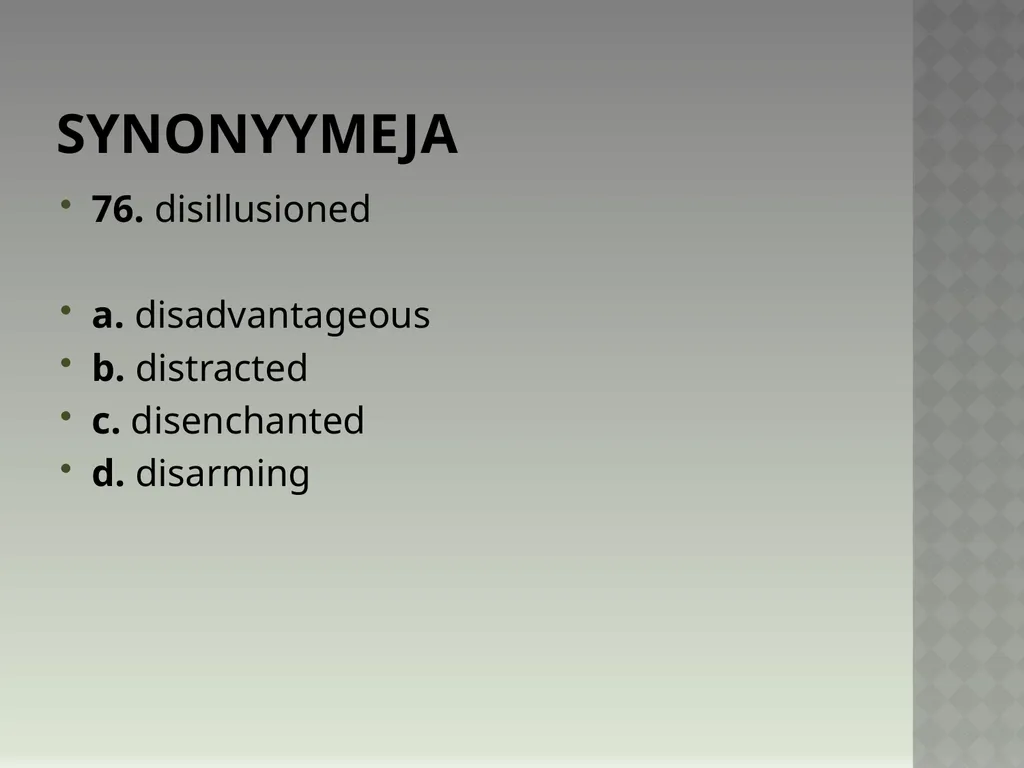
152
Synonyymeja 76. disillusioned
a. disadvantageous
b. distracted
c. disenchanted
d. disarming<br>
a. disadvantageous
b. distracted
c. disenchanted
d. disarming<br>
153
Synonyymeja 76. disillusioned
a. disadvantageous
b. distracted
c. disenchanted
d. disarming
76. c. Disillusioned is the condition of being disappointed or disenchanted.<br>
a. disadvantageous
b. distracted
c. disenchanted
d. disarming
76. c. Disillusioned is the condition of being disappointed or disenchanted.<br>
154
Synonyymeja 77. query
a. inspect
b. quote
c. succeed
d. inquire<br>
a. inspect
b. quote
c. succeed
d. inquire<br>
155
Synonyymeja 77. query
a. inspect
b. quote
c. succeed
d. inquire
77. d. Query means to ask questions; inquire.<br>
a. inspect
b. quote
c. succeed
d. inquire
77. d. Query means to ask questions; inquire.<br>
156
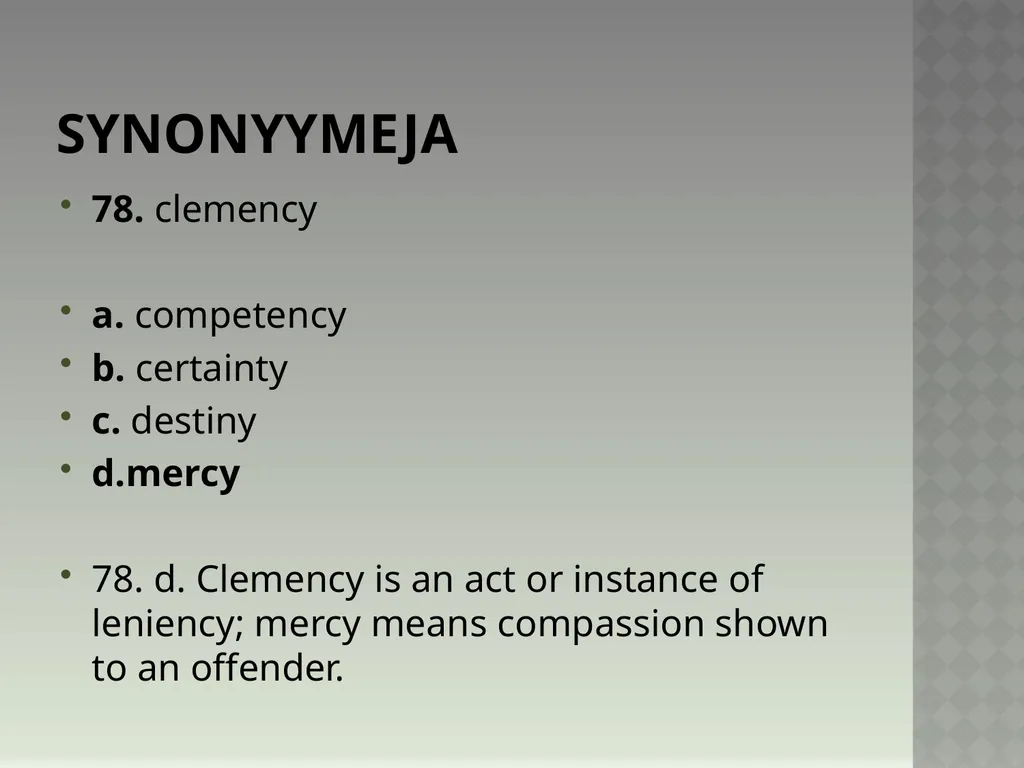
Synonyymeja 78. clemency
a. competency
b. certainty
c. destiny
d.mercy<br>
a. competency
b. certainty
c. destiny
d.mercy<br>
157
Synonyymeja 78. clemency
a. competency
b. certainty
c. destiny
d.mercy
78. d. Clemency is an act or instance of leniency; mercy means compassion shown to an offender.<br>
a. competency
b. certainty
c. destiny
d.mercy
78. d. Clemency is an act or instance of leniency; mercy means compassion shown to an offender.<br>
158
antonyymeja Choose the antonym for each of the words in italics.<br>
159
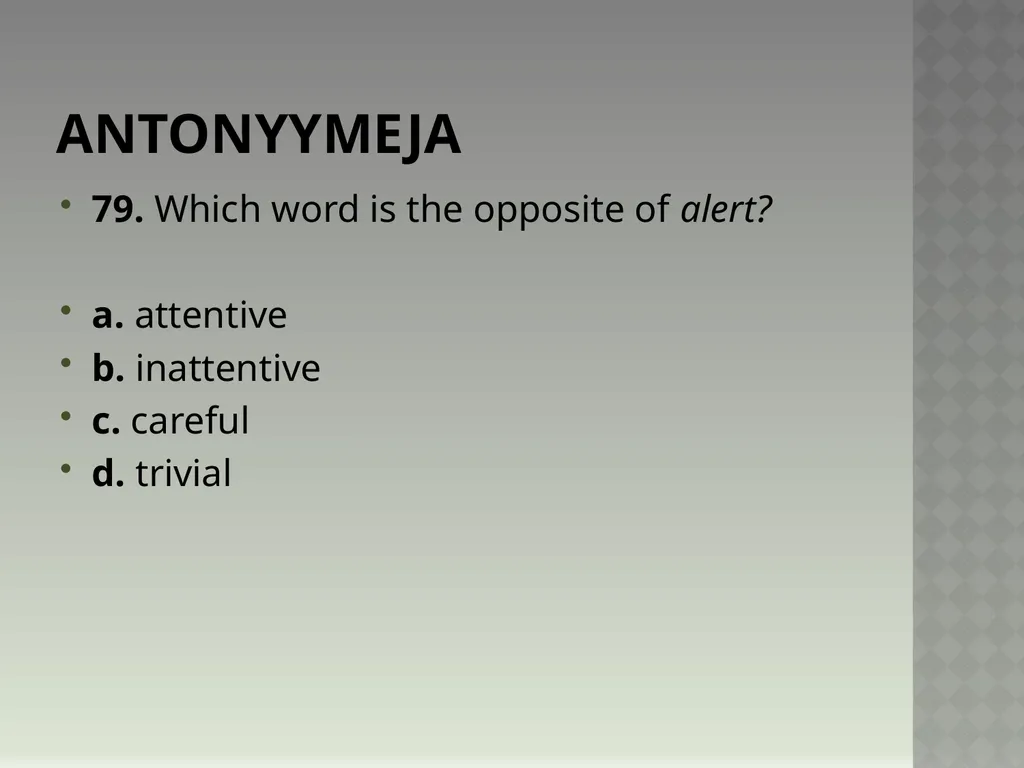
antonyymeja 79. Which word is the opposite of alert?
a. attentive
b. inattentive
c. careful
d. trivial<br>
a. attentive
b. inattentive
c. careful
d. trivial<br>
160
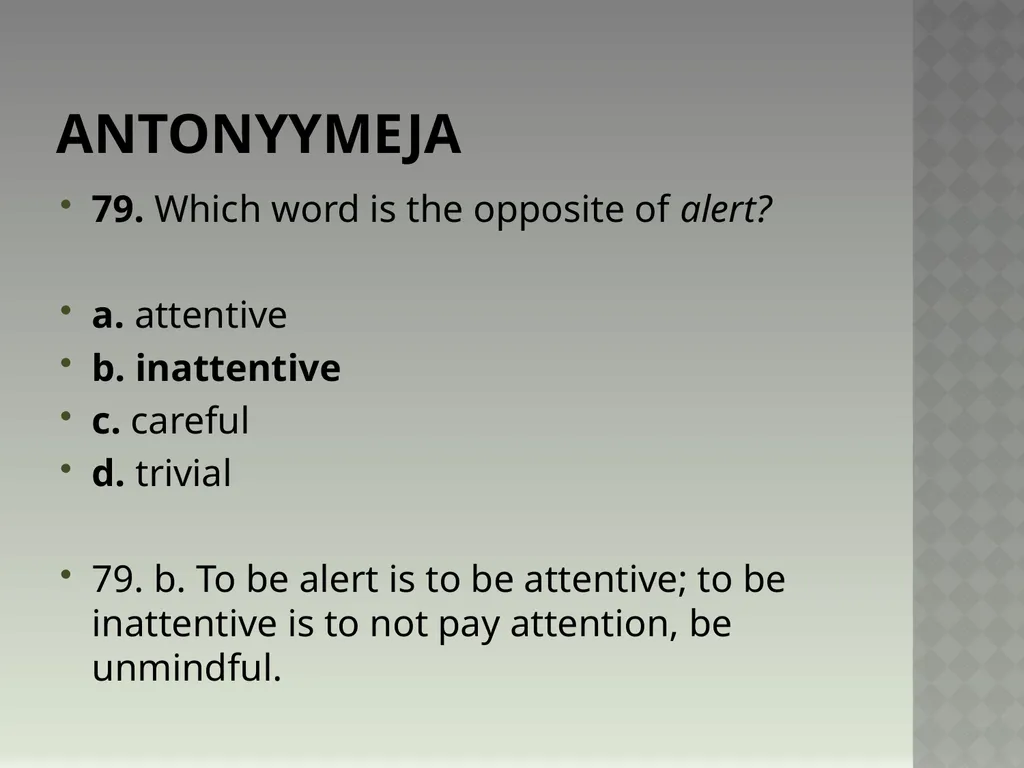
antonyymeja 79. Which word is the opposite of alert?
a. attentive
b. inattentive
c. careful
d. trivial
79. b. To be alert is to be attentive; to be inattentive is to not pay attention, be unmindful.<br>
a. attentive
b. inattentive
c. careful
d. trivial
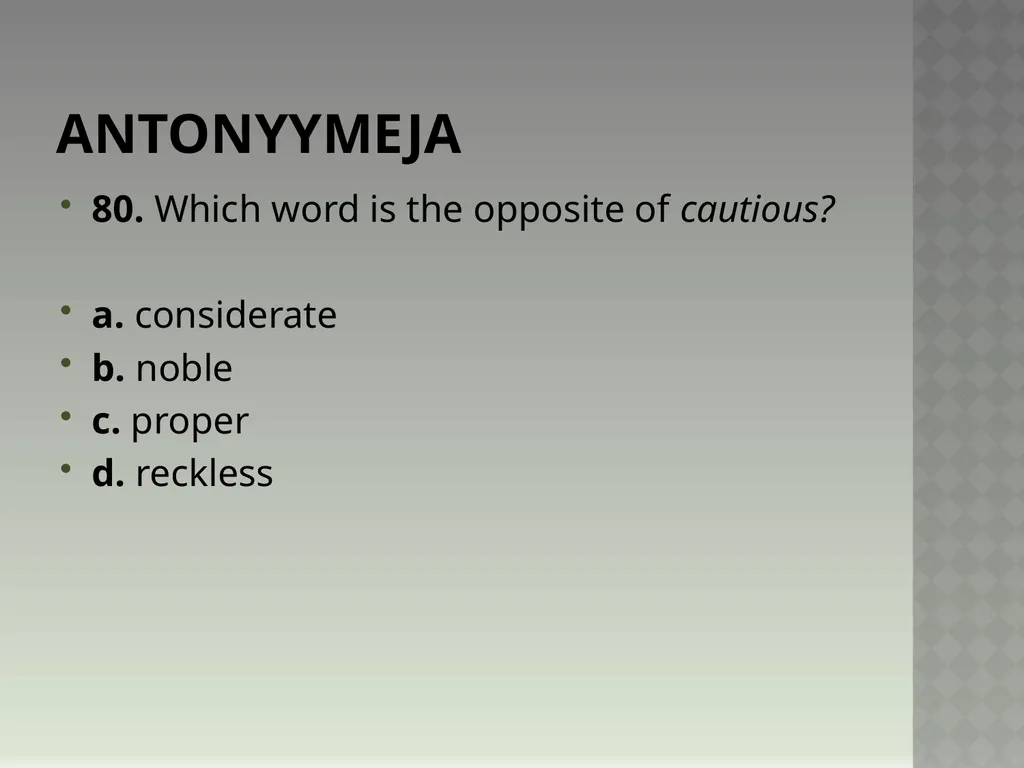
79. b. To be alert is to be attentive; to be inattentive is to not pay attention, be unmindful.<br>
161
antonyymeja 80. Which word is the opposite of cautious?
a. considerate
b. noble
c. proper
d. reckless<br>
a. considerate
b. noble
c. proper
d. reckless<br>
162
antonyymeja 80. Which word is the opposite of cautious?
a. considerate
b. noble
c. proper
d. reckless
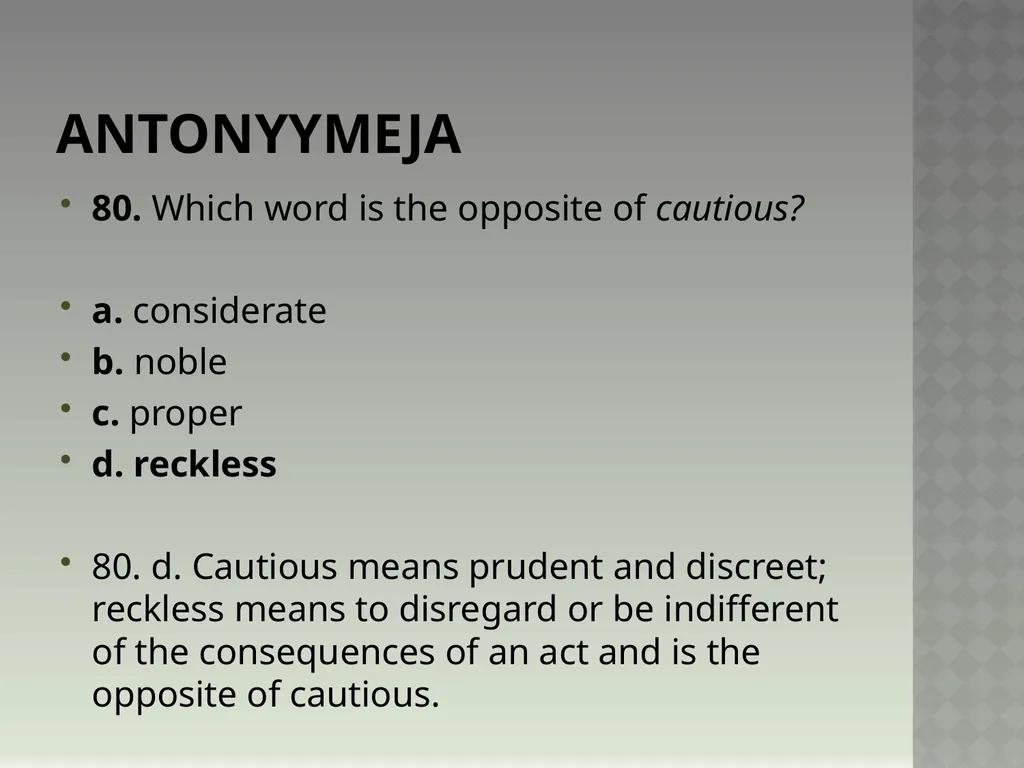
80. d. Cautious means prudent and discreet; reckless means to disregard or be indifferent of the consequences of an act and is the opposite of cautious.<br>
a. considerate
b. noble
c. proper
d. reckless
80. d. Cautious means prudent and discreet; reckless means to disregard or be indifferent of the consequences of an act and is the opposite of cautious.<br>
163
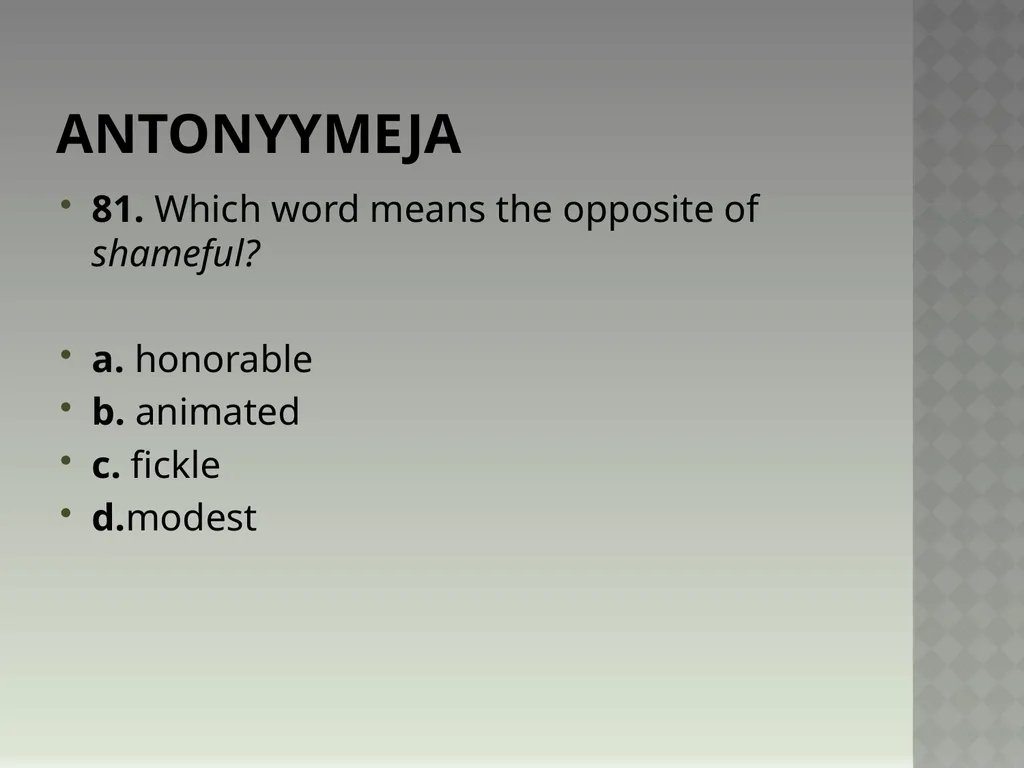
antonyymeja 81. Which word means the opposite of shameful?
a. honorable
b. animated
c. fickle
d.modest<br>
a. honorable
b. animated
c. fickle
d.modest<br>
164
antonyymeja 81. Which word means the opposite of shameful?
a. honorable
b. animated
c. fickle
d.modest
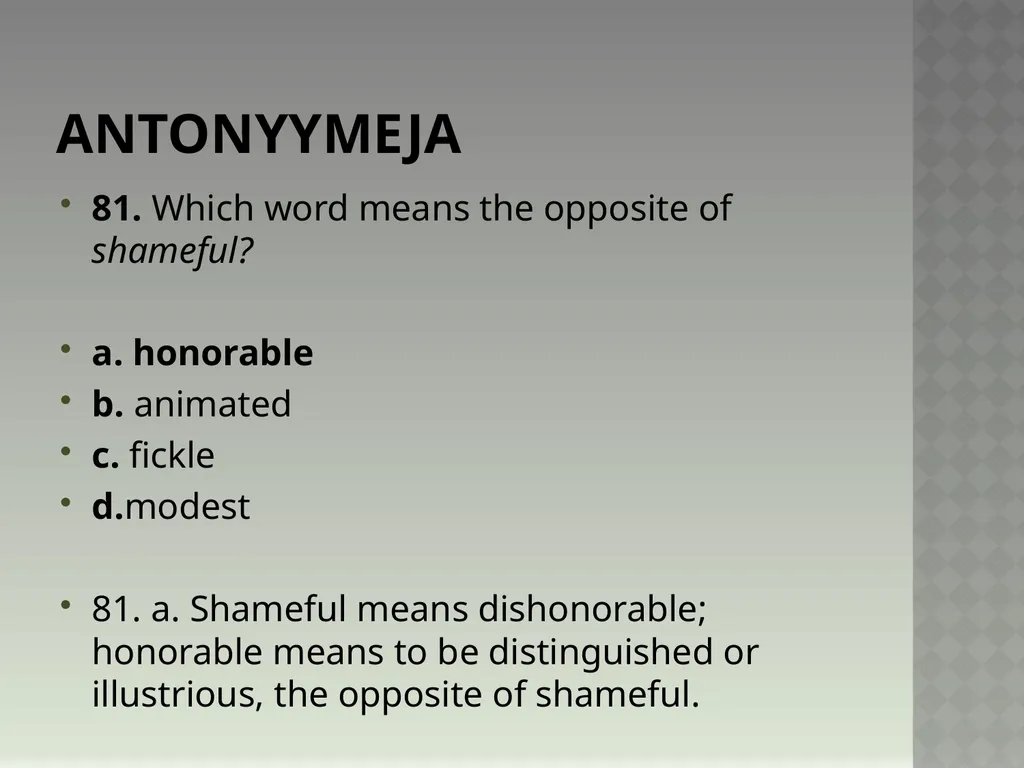
81. a. Shameful means dishonorable; honorable means to be distinguished or illustrious, the opposite of shameful.<br>
a. honorable
b. animated
c. fickle
d.modest
81. a. Shameful means dishonorable; honorable means to be distinguished or illustrious, the opposite of shameful.<br>
165
antonyymeja 82. Which word means the opposite of vague?
a. hazy
b. skilled
c. definite
d. tender<br>
a. hazy
b. skilled
c. definite
d. tender<br>
166
antonyymeja 82. Which word means the opposite of vague?
a. hazy
b. skilled
c. definite
d. tender
82. c. Vague means not clear or definite; definite means clearly defined.<br>
a. hazy
b. skilled
c. definite
d. tender
82. c. Vague means not clear or definite; definite means clearly defined.<br>
167
antonyymeja 83. Which word means the opposite of
vulnerable?
a. frantic
b. feeble
c. secure
d. complicated<br>
vulnerable?
a. frantic
b. feeble
c. secure
d. complicated<br>
168
antonyymeja 83. Which word means the opposite of
vulnerable?
a. frantic
b. feeble
c. secure
d. complicated
83. c. Vulnerable means open to attack or weak; secure is the opposite of weak.<br>
vulnerable?
a. frantic
b. feeble
c. secure
d. complicated
83. c. Vulnerable means open to attack or weak; secure is the opposite of weak.<br>
169
antonyymeja 84. Which word means the opposite of distress?
a. comfort
b. reward
c. trouble
d. compromise<br>
a. comfort
b. reward
c. trouble
d. compromise<br>
170
antonyymeja 84. Which word means the opposite of distress?
a. comfort
b. reward
c. trouble
d. compromise
84. a. Distress means great strain, upset; comfort means calmness and peace.<br>
a. comfort
b. reward
c. trouble
d. compromise
84. a. Distress means great strain, upset; comfort means calmness and peace.<br>
171
antonyymeja 85. Which word means the opposite of unity?
a. discord
b. stimulation
c. consent
d. neglect<br>
a. discord
b. stimulation
c. consent
d. neglect<br>
172
antonyymeja 85. Which word means the opposite of unity?
a. discord
b. stimulation
c. consent
d. neglect
85. a. Unity means harmony or compatibility; discord means a lack of harmony.<br>
a. discord
b. stimulation
c. consent
d. neglect
85. a. Unity means harmony or compatibility; discord means a lack of harmony.<br>
173
antonyymeja 86. Which word means the opposite of clarify?
a. explain
b. dismay
c. obscure
d. provide<br>
a. explain
b. dismay
c. obscure
d. provide<br>
174
antonyymeja 86. Which word means the opposite of clarify?
a. explain
b. dismay
c. obscure
d. provide
86. c. Clarify means to make clear; obscure means to make dark, dim, or indistinct.<br>
a. explain
b. dismay
c. obscure
d. provide
86. c. Clarify means to make clear; obscure means to make dark, dim, or indistinct.<br>
175
antonyymeja 87. Which word means the opposite of grant?
a. deny
b. consume
c. allocate
d. provoke<br>
a. deny
b. consume
c. allocate
d. provoke<br>
176
antonyymeja 87. Which word means the opposite of grant?
a. deny
b. consume
c. allocate
d. provoke
87. a. To grant is to permit; to deny is to refuse to permit.<br>
a. deny
b. consume
c. allocate
d. provoke
87. a. To grant is to permit; to deny is to refuse to permit.<br>
177
antonyymeja 88. Which word means the opposite of
impartial?
a. complete
b. prejudiced
c. unbiased
d. erudite<br>
impartial?
a. complete
b. prejudiced
c. unbiased
d. erudite<br>
178
antonyymeja 88. Which word means the opposite of
impartial?
a. complete
b. prejudiced
c. unbiased
d. erudite
88. b. Impartial means not partial or biased; prejudiced means biased.<br>
impartial?
a. complete
b. prejudiced
c. unbiased
d. erudite
88. b. Impartial means not partial or biased; prejudiced means biased.<br>
179
antonyymeja 89. Which word means the opposite of prompt?
a. punctual
b. slack
c. tardy
d. regular<br>
a. punctual
b. slack
c. tardy
d. regular<br>
180
antonyymeja 89. Which word means the opposite of prompt?
a. punctual
b. slack
c. tardy
d. regular
89. c. Prompt means punctual; tardy means late.<br>
a. punctual
b. slack
c. tardy
d. regular
89. c. Prompt means punctual; tardy means late.<br>
181
antonyymeja 90. Which word is the opposite of delay?
a. slow
b. hasten
c. pause
d. desist<br>
a. slow
b. hasten
c. pause
d. desist<br>
182
antonyymeja 90. Which word is the opposite of delay?
a. slow
b. hasten
c. pause
d. desist
90. b. To delay is to slow; to hasten is to hurry.<br>
a. slow
b. hasten
c. pause
d. desist
90. b. To delay is to slow; to hasten is to hurry.<br>
183
antonyymeja 91. Which word is the opposite of soothe?
a. increase
b. comfort
c. aggravate
d. delight<br>
a. increase
b. comfort
c. aggravate
d. delight<br>
184
antonyymeja 91. Which word is the opposite of soothe?
a. increase
b. comfort
c. aggravate
d. delight
91. c. To soothe is to comfort; to aggravate is to irritate.<br>
a. increase
b. comfort
c. aggravate
d. delight
91. c. To soothe is to comfort; to aggravate is to irritate.<br>
185
antonyymeja 92. Which word means the opposite of
moderate?
a. original
b. average
c. final
d. excessive<br>
moderate?
a. original
b. average
c. final
d. excessive<br>
186
antonyymeja 92. Which word means the opposite of
moderate?
a. original
b. average
c. final
d. excessive
92. d. Moderate means average; excessive means extreme.<br>
moderate?
a. original
b. average
c. final
d. excessive
92. d. Moderate means average; excessive means extreme.<br>
187
antonyymeja 93. Which word means the opposite of reveal?
a. disclose
b. achieve
c. retreat
d. conceal<br>
a. disclose
b. achieve
c. retreat
d. conceal<br>
188
antonyymeja 93. Which word means the opposite of reveal?
a. disclose
b. achieve
c. retreat
d. conceal
93. d. To reveal is to disclose; to conceal is to hide.<br>
a. disclose
b. achieve
c. retreat
d. conceal
93. d. To reveal is to disclose; to conceal is to hide.<br>
189
antonyymeja 94. Which word means the opposite of initial?
a. first
b. crisis
c. final
d. right<br>
a. first
b. crisis
c. final
d. right<br>
190
antonyymeja 94. Which word means the opposite of initial?
a. first
b. crisis
c. final
d. right
94. c. Initial means first; final means last.<br>
a. first
b. crisis
c. final
d. right
94. c. Initial means first; final means last.<br>
191
antonyymeja 95. Which word means the opposite of brittle?
a. flexible
b. breakable
c. grating
d. thin<br>
a. flexible
b. breakable
c. grating
d. thin<br>
192
antonyymeja 95. Which word means the opposite of brittle?
a. flexible
b. breakable
c. grating
d. thin
95. a. Brittle means breakable, frail; flexible means bendable, pliable.<br>
a. flexible
b. breakable
c. grating
d. thin
95. a. Brittle means breakable, frail; flexible means bendable, pliable.<br>
193
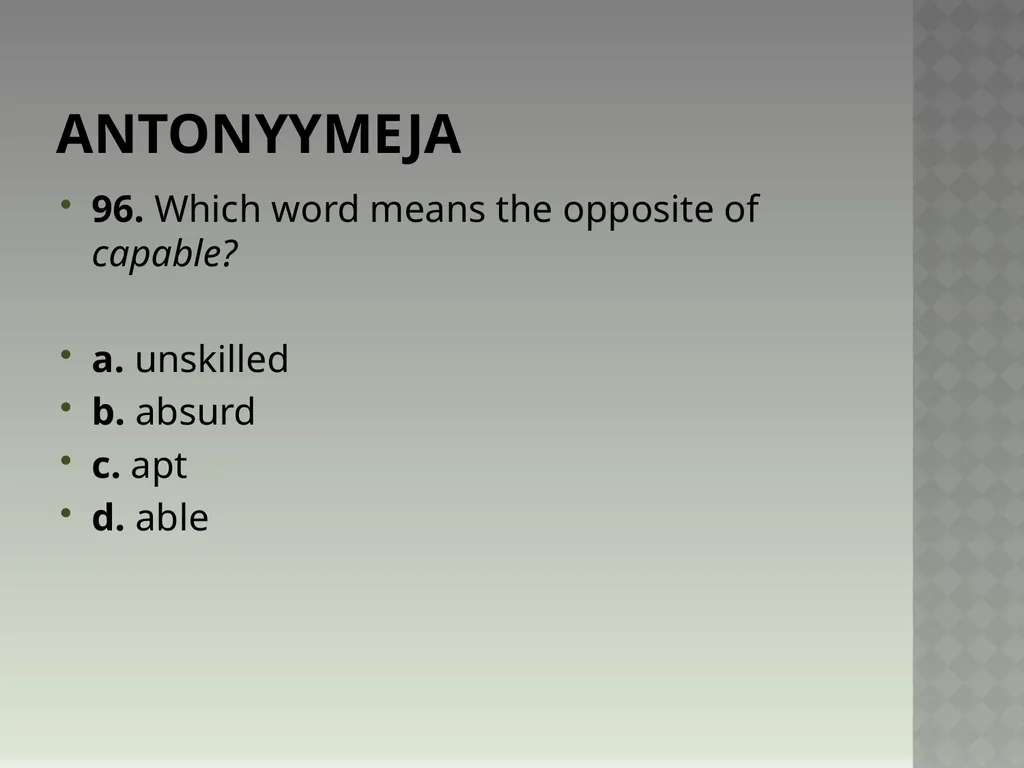
antonyymeja 96. Which word means the opposite of capable?
a. unskilled
b. absurd
c. apt
d. able<br>
a. unskilled
b. absurd
c. apt
d. able<br>
194
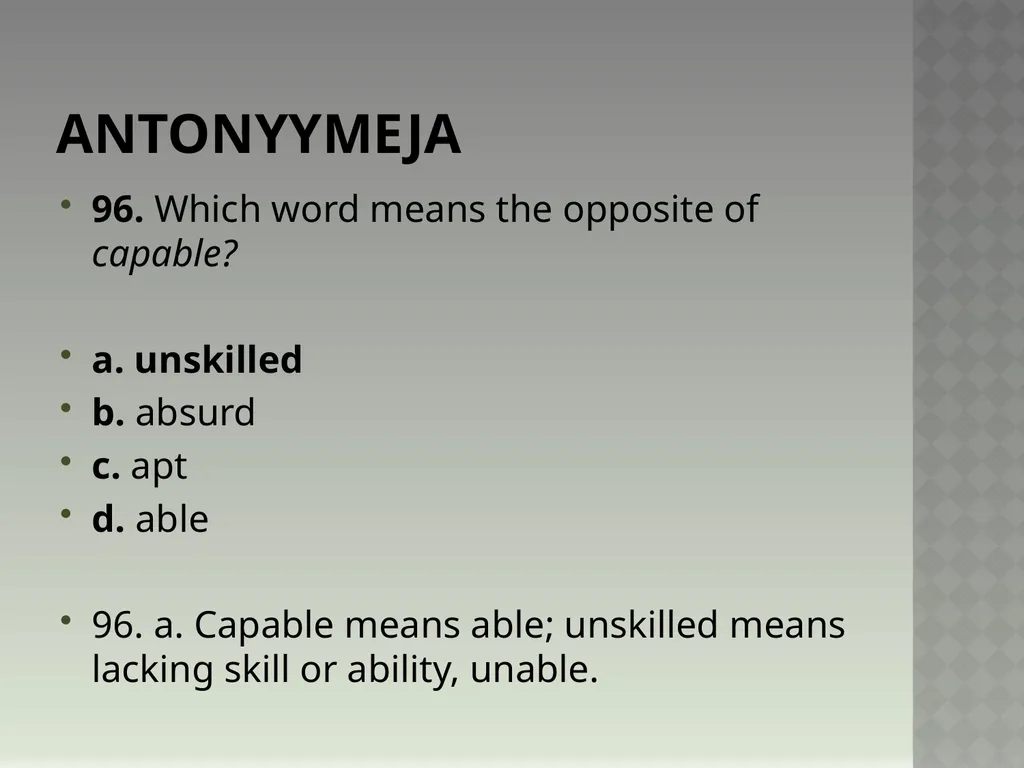
antonyymeja 96. Which word means the opposite of capable?
a. unskilled
b. absurd
c. apt
d. able
96. a. Capable means able; unskilled means lacking skill or ability, unable.<br>
a. unskilled
b. absurd
c. apt
d. able
96. a. Capable means able; unskilled means lacking skill or ability, unable.<br>
195
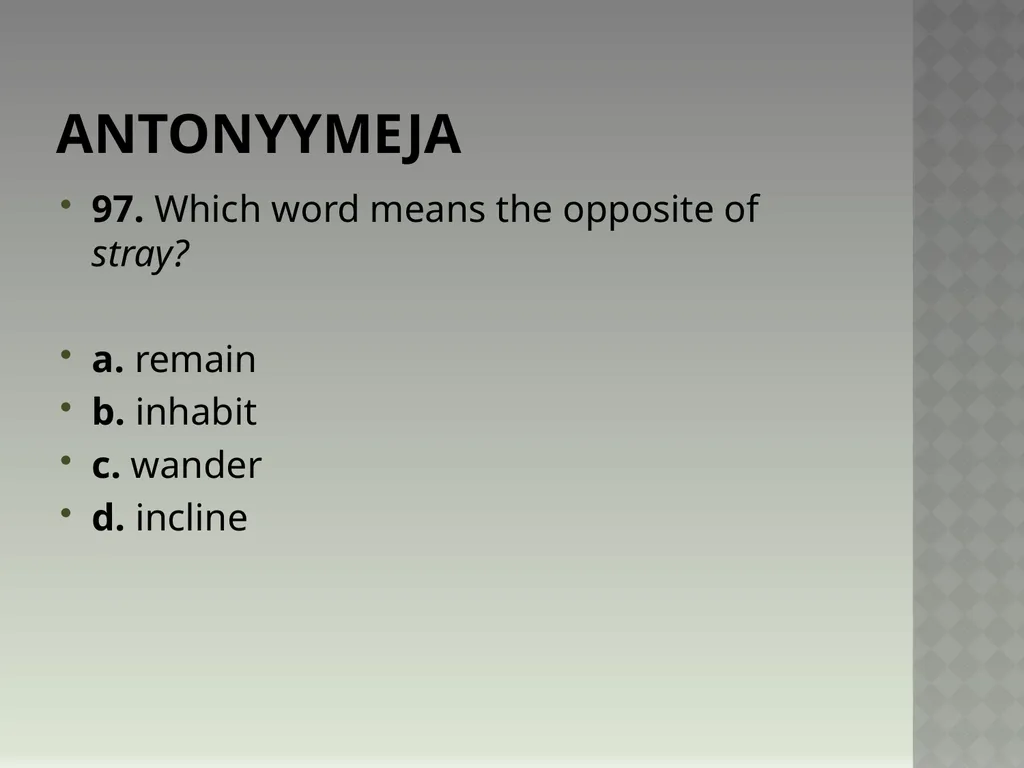
antonyymeja 97. Which word means the opposite of stray?
a. remain
b. inhabit
c. wander
d. incline<br>
a. remain
b. inhabit
c. wander
d. incline<br>
196
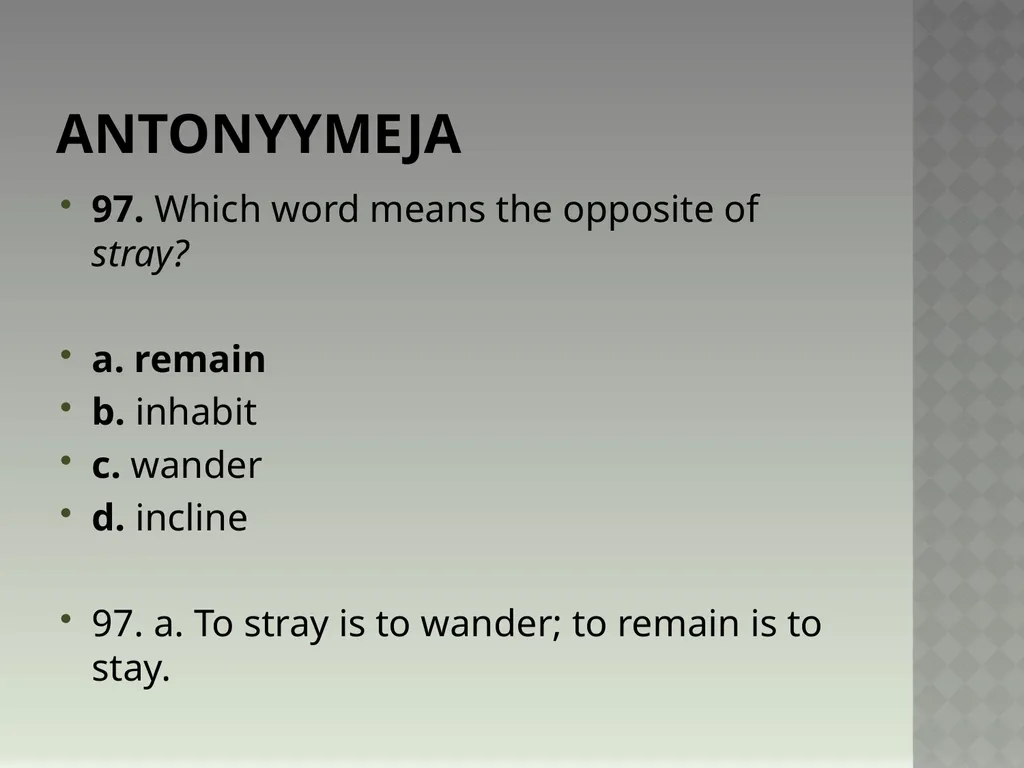
antonyymeja 97. Which word means the opposite of stray?
a. remain
b. inhabit
c. wander
d. incline
97. a. To stray is to wander; to remain is to stay.<br>
a. remain
b. inhabit
c. wander
d. incline
97. a. To stray is to wander; to remain is to stay.<br>
197
antonyymeja 98. Which word is the opposite of dainty?
a. delicate
b. coarse
c. harsh
d. delicious<br>
a. delicate
b. coarse
c. harsh
d. delicious<br>
198
antonyymeja 98. Which word is the opposite of dainty?
a. delicate
b. coarse
c. harsh
d. delicious
98. b. Dainty means delicate; coarse means rude, rough, indelicate.<br>
a. delicate
b. coarse
c. harsh
d. delicious
98. b. Dainty means delicate; coarse means rude, rough, indelicate.<br>
199
antonyymeja 99. Which word means the opposite of craving?
a. desire
b. repudiation
c. motive
d. revulsion<br>
a. desire
b. repudiation
c. motive
d. revulsion<br>
200
antonyymeja 99. Which word means the opposite of craving?
a. desire
b. repudiation
c. motive
d. revulsion
99. d. Craving means desire; revulsion means aversion<br>
a. desire
b. repudiation
c. motive
d. revulsion
99. d. Craving means desire; revulsion means aversion<br>
201
antonyymeja 100. Which word means the opposite of
ferocious?
a. docile
b. savage
c. explosive
d. noble<br>
ferocious?
a. docile
b. savage
c. explosive
d. noble<br>
202
antonyymeja 100. Which word means the opposite of
ferocious?
a. docile
b. savage
c. explosive
d. noble
100. a. Ferocious means savage; docile means tame.<br>
ferocious?
a. docile
b. savage
c. explosive
d. noble
100. a. Ferocious means savage; docile means tame.<br>
203
antonyymeja 101. Which word means the opposite of grueling?
a. effortless
b. casual
c. exhausting
d.empty<br>
a. effortless
b. casual
c. exhausting
d.empty<br>
204
antonyymeja 101. Which word means the opposite of grueling?
a. effortless
b. casual
c. exhausting
d.empty
101. a. Grueling means exhausting; effortless means easy.<br>
a. effortless
b. casual
c. exhausting
d.empty
101. a. Grueling means exhausting; effortless means easy.<br>
205
antonyymeja 102. Which word means the opposite of forsake?
a. admit
b. abandon
c. submit
d. cherish<br>
a. admit
b. abandon
c. submit
d. cherish<br>
206
antonyymeja 102. Which word means the opposite of forsake?
a. admit
b. abandon
c. submit
d. cherish
102. d. To forsake is to abandon; to cherish is to hold dear, to nurture.<br>
a. admit
b. abandon
c. submit
d. cherish
102. d. To forsake is to abandon; to cherish is to hold dear, to nurture.<br>
207
antonyymeja 103. Which word is the opposite of restrain?
a. control
b. liberate
c. maintain
d. distract<br>
a. control
b. liberate
c. maintain
d. distract<br>
208
antonyymeja 103. Which word is the opposite of restrain?
a. control
b. liberate
c. maintain
d. distract
103. b. To restrain is to hold back, control; to liberate is to release.<br>
a. control
b. liberate
c. maintain
d. distract
103. b. To restrain is to hold back, control; to liberate is to release.<br>
209
antonyymeja 104. Which word is the opposite of bleak?
a. desperate
b. dreary
c. bright
d. fond<br>
a. desperate
b. dreary
c. bright
d. fond<br>
210
antonyymeja 104. Which word is the opposite of bleak?
a. desperate
b. dreary
c. bright
d. fond
104. c. To be bleak is to be dreary; to be bright is to be brilliant.<br>
a. desperate
b. dreary
c. bright
d. fond
104. c. To be bleak is to be dreary; to be bright is to be brilliant.<br>
211
antonyymeja 105. Which word is the opposite of unruly?
a. controllable
b. disorderly
c. honest
d. covered<br>
a. controllable
b. disorderly
c. honest
d. covered<br>
212
antonyymeja 105. Which word is the opposite of unruly?
a. controllable
b. disorderly
c. honest
d. covered
105. a. Unruly means not easily managed, controlled, or disciplined; controllable is the opposite.<br>
a. controllable
b. disorderly
c. honest
d. covered
105. a. Unruly means not easily managed, controlled, or disciplined; controllable is the opposite.<br>
213
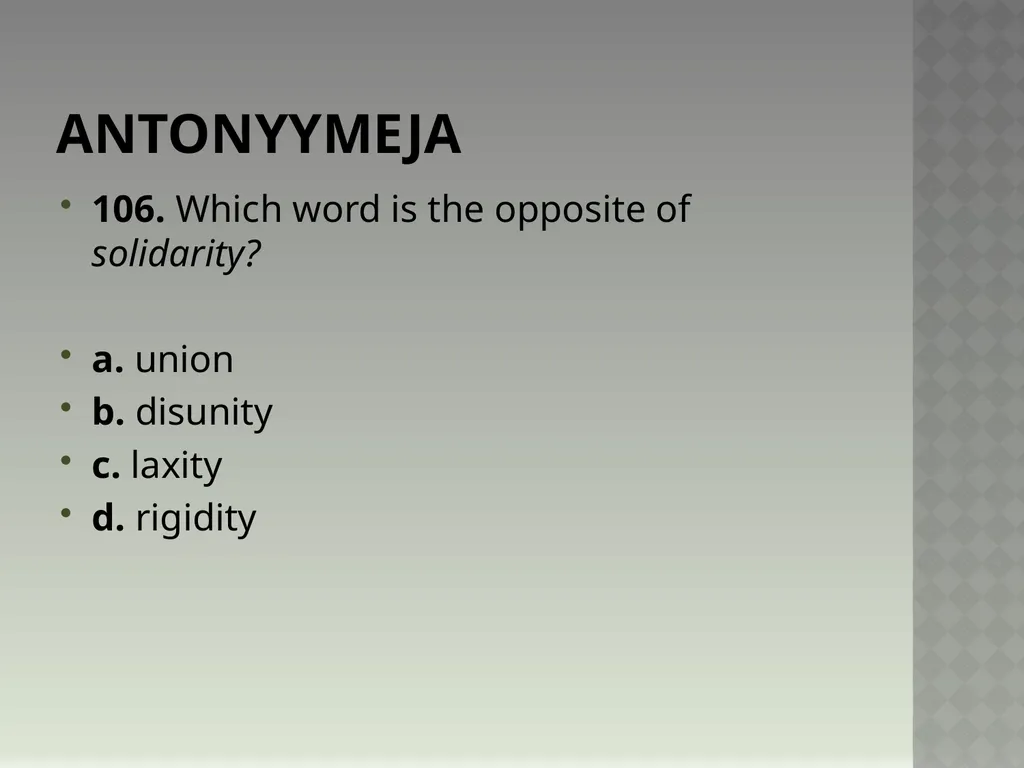
antonyymeja 106. Which word is the opposite of solidarity?
a. union
b. disunity
c. laxity
d. rigidity<br>
a. union
b. disunity
c. laxity
d. rigidity<br>
214
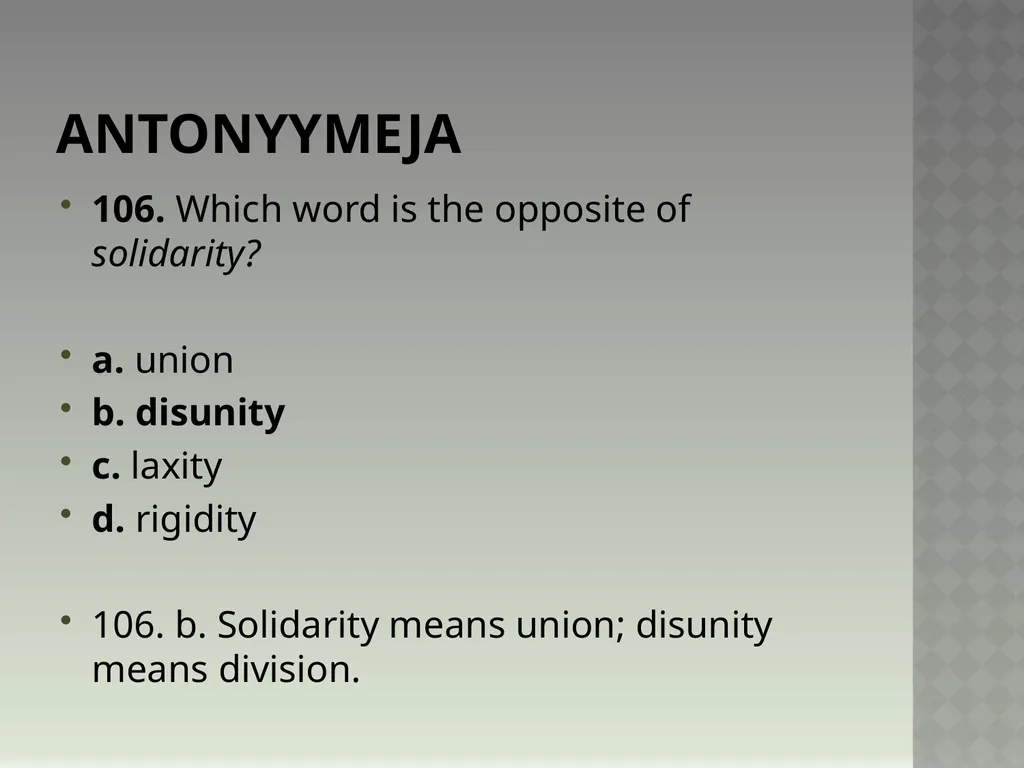
antonyymeja 106. Which word is the opposite of solidarity?
a. union
b. disunity
c. laxity
d. rigidity
106. b. Solidarity means union; disunity means division.<br>
a. union
b. disunity
c. laxity
d. rigidity
106. b. Solidarity means union; disunity means division.<br>
215
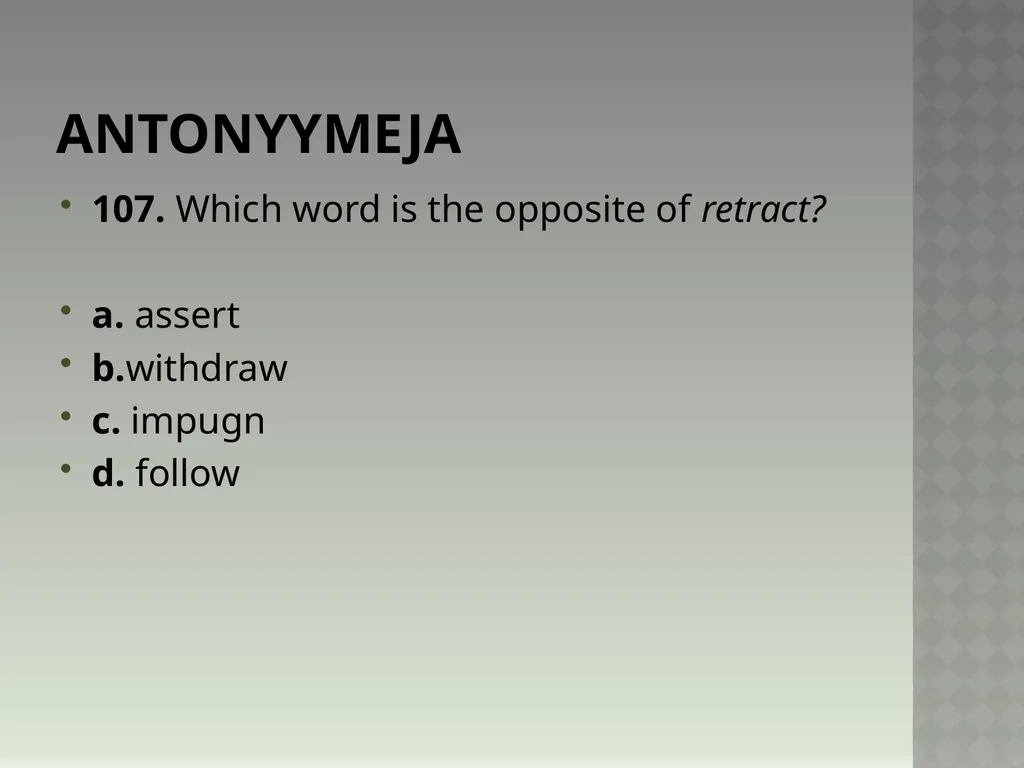
antonyymeja 107. Which word is the opposite of retract?
a. assert
b.withdraw
c. impugn
d. follow<br>
a. assert
b.withdraw
c. impugn
d. follow<br>
216
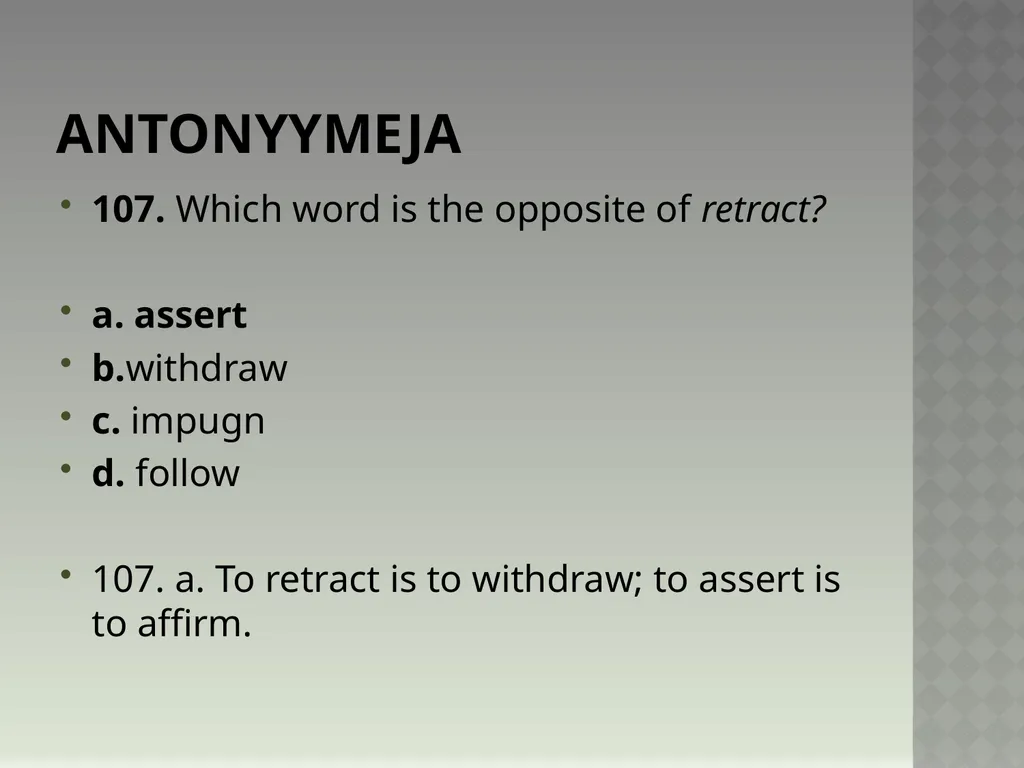
antonyymeja 107. Which word is the opposite of retract?
a. assert
b.withdraw
c. impugn
d. follow
107. a. To retract is to withdraw; to assert is to affirm.<br>
a. assert
b.withdraw
c. impugn
d. follow
107. a. To retract is to withdraw; to assert is to affirm.<br>
217
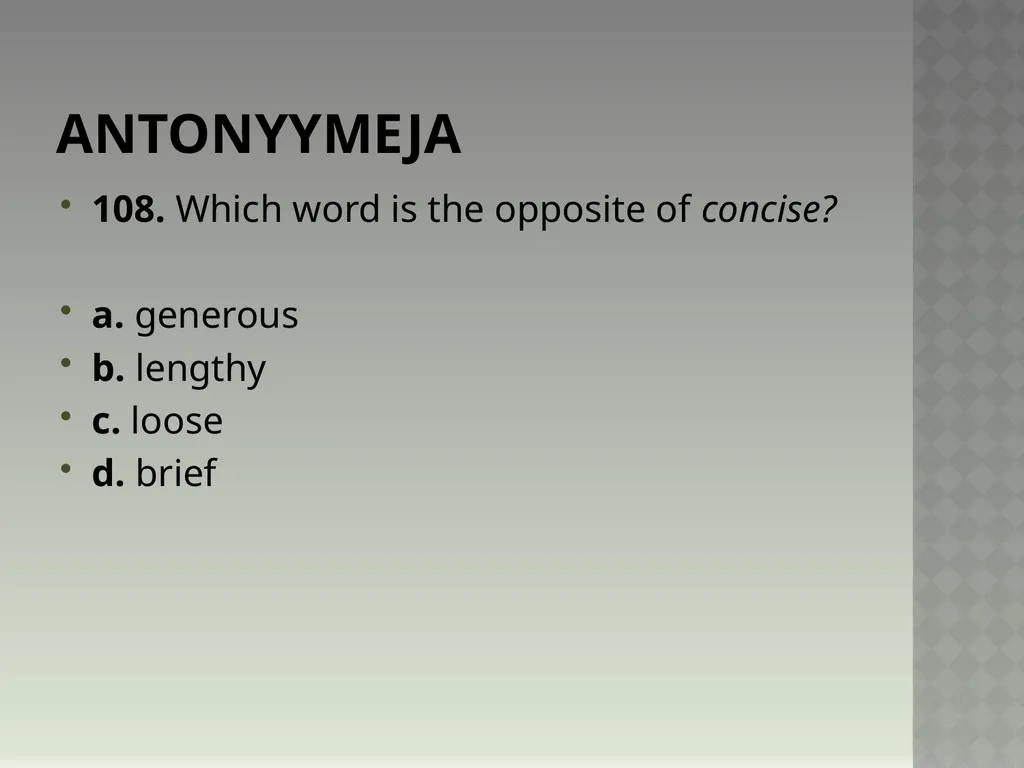
antonyymeja 108. Which word is the opposite of concise?
a. generous
b. lengthy
c. loose
d. brief<br>
a. generous
b. lengthy
c. loose
d. brief<br>
218
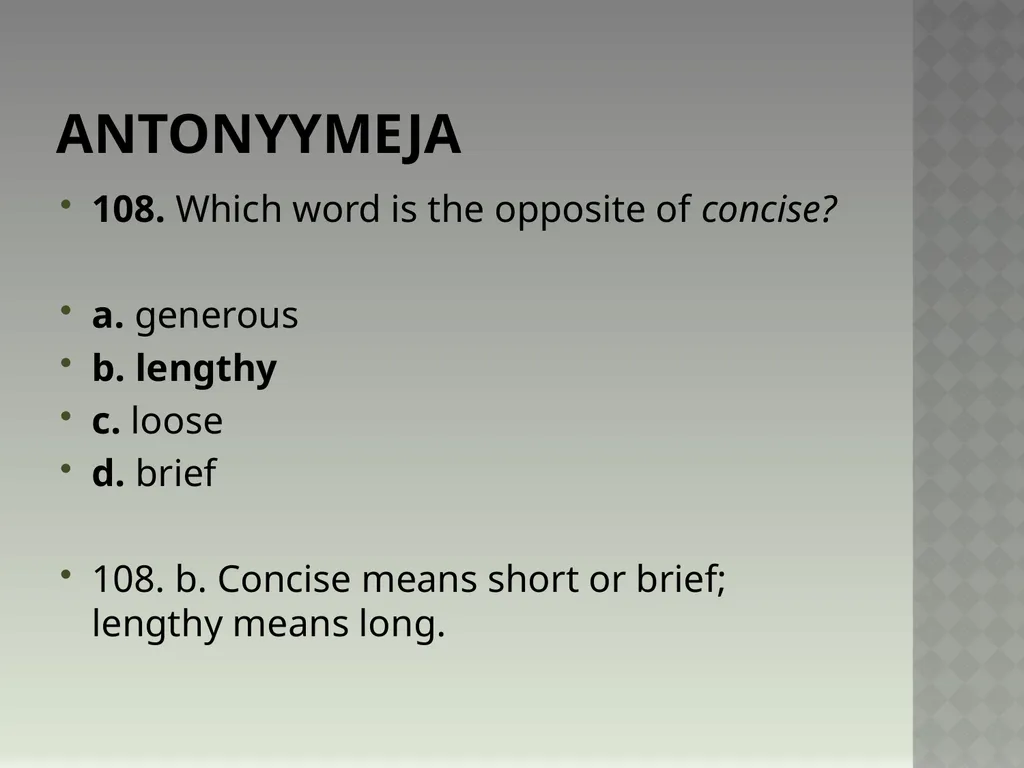
antonyymeja 108. Which word is the opposite of concise?
a. generous
b. lengthy
c. loose
d. brief
108. b. Concise means short or brief; lengthy means long.<br>
a. generous
b. lengthy
c. loose
d. brief
108. b. Concise means short or brief; lengthy means long.<br>
219
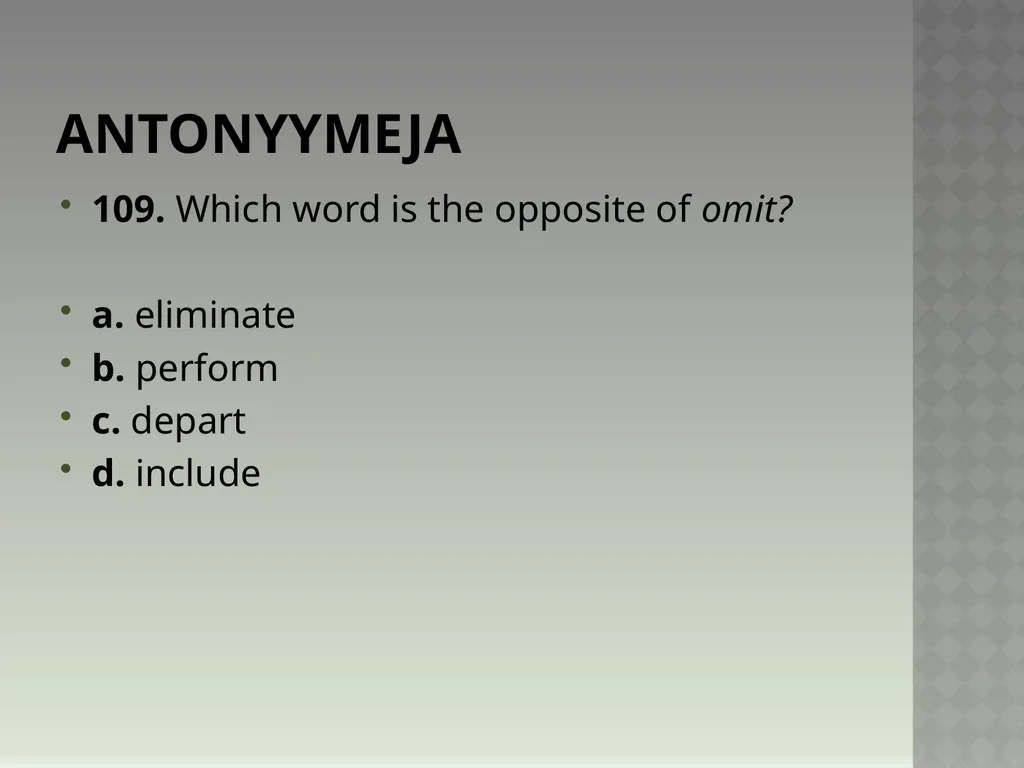
antonyymeja 109. Which word is the opposite of omit?
a. eliminate
b. perform
c. depart
d. include<br>
a. eliminate
b. perform
c. depart
d. include<br>
220
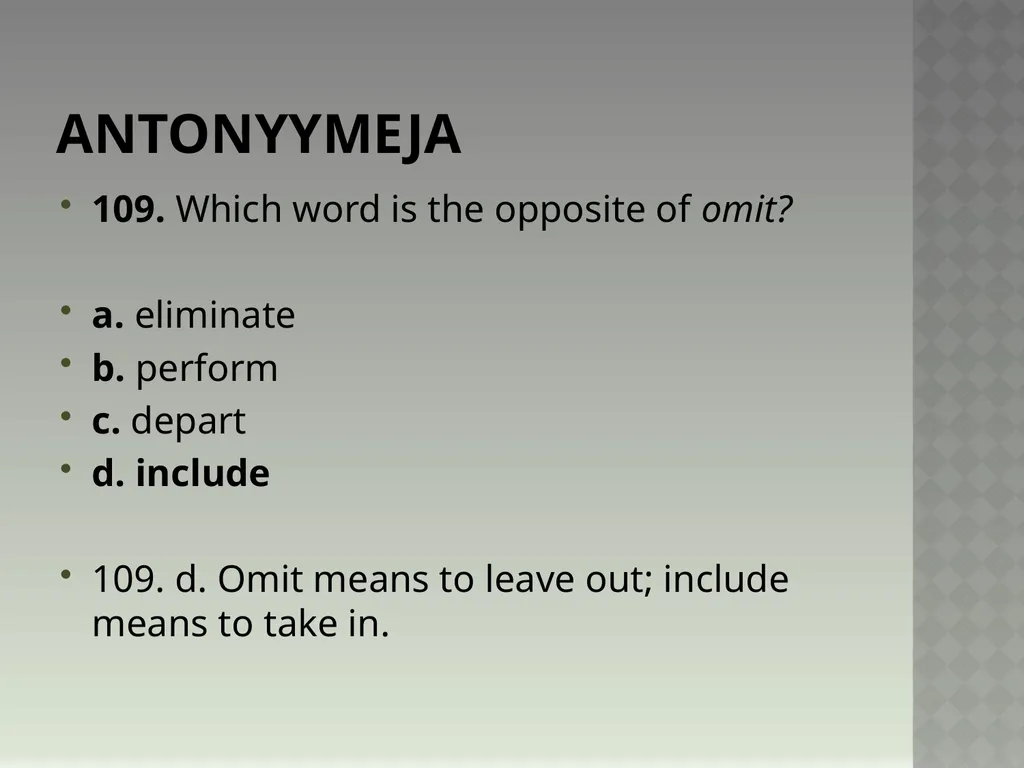
antonyymeja 109. Which word is the opposite of omit?
a. eliminate
b. perform
c. depart
d. include
109. d. Omit means to leave out; include means to take in.<br>
a. eliminate
b. perform
c. depart
d. include
109. d. Omit means to leave out; include means to take in.<br>
221
antonyymeja 110. Which word means the opposite of prohibit?
a. surrender
b. permit
c. involve
d.embrace<br>
a. surrender
b. permit
c. involve
d.embrace<br>
222
antonyymeja 110. Which word means the opposite of prohibit?
a. surrender
b. permit
c. involve
d.embrace
110. b. Prohibit means to forbid; permit means to allow.<br>
a. surrender
b. permit
c. involve
d.embrace
110. b. Prohibit means to forbid; permit means to allow.<br>
223
antonyymeja 111. Which word means the opposite of disclose?
a. succeed
b. conceal
c. restrain
d. possess<br>
a. succeed
b. conceal
c. restrain
d. possess<br>
224
antonyymeja 111. Which word means the opposite of disclose?
a. succeed
b. conceal
c. restrain
d. possess
111. b. Disclose means to reveal; conceal means to cover or hide, to prevent disclosure.<br>
a. succeed
b. conceal
c. restrain
d. possess
111. b. Disclose means to reveal; conceal means to cover or hide, to prevent disclosure.<br>
225
antonyymeja 112. Which word means the opposite of stifle?
a. encourage
b. familiarize
c. deny
d. overcome<br>
a. encourage
b. familiarize
c. deny
d. overcome<br>
226
antonyymeja 112. Which word means the opposite of stifle?
a. encourage
b. familiarize
c. deny
d. overcome
112. a. Stifle means to discourage or smother; encourage is to give support to or foster.<br>
a. encourage
b. familiarize
c. deny
d. overcome
112. a. Stifle means to discourage or smother; encourage is to give support to or foster.<br>
227
antonyymeja 113. Which word means the opposite of belittle?
a. arrange
b. compliment
c. criticize
d. presume<br>
a. arrange
b. compliment
c. criticize
d. presume<br>
228
antonyymeja 113. Which word means the opposite of belittle?
a. arrange
b. compliment
c. criticize
d. presume
113. b. To belittle means to criticize; compliment is an expression of praise, admiration, or congratulations, the opposite of belittle.<br>
a. arrange
b. compliment
c. criticize
d. presume
113. b. To belittle means to criticize; compliment is an expression of praise, admiration, or congratulations, the opposite of belittle.<br>
229
antonyymeja 114. Which word means the opposite of aimless?
a. inactive
b. faithful
c. purposeful
d.impartial<br>
a. inactive
b. faithful
c. purposeful
d.impartial<br>
230
antonyymeja 114. Which word means the opposite of aimless?
a. inactive
b. faithful
c. purposeful
d.impartial
114. c. Aimless means lacking in purpose; purposeful means having an aim or purpose.<br>
a. inactive
b. faithful
c. purposeful
d.impartial
114. c. Aimless means lacking in purpose; purposeful means having an aim or purpose.<br>
231
antonyymeja 115. Which word means the opposite of detest?
a. prohibit
b. hate
c. examine
d. admire<br>
a. prohibit
b. hate
c. examine
d. admire<br>
232
antonyymeja 115. Which word means the opposite of detest?
a. prohibit
b. hate
c. examine
d. admire
115. d. Detest means to feel hostility toward, to strongly dislike; to admire is to have a high opinion of or to hold in great esteem or respect.<br>
a. prohibit
b. hate
c. examine
d. admire
115. d. Detest means to feel hostility toward, to strongly dislike; to admire is to have a high opinion of or to hold in great esteem or respect.<br>
233
antonyymeja 116. Which word means the opposite of valiant?
a. instinctive
b. cowardly
c. cynical
d.worthy<br>
a. instinctive
b. cowardly
c. cynical
d.worthy<br>
234
antonyymeja 116. Which word means the opposite of valiant?
a. instinctive
b. cowardly
c. cynical
d.worthy
116. b. Valiant means acting with bravery or boldness; cowardly is to act with ignoble fear or to exhibit the characteristics of a coward.<br>
a. instinctive
b. cowardly
c. cynical
d.worthy
116. b. Valiant means acting with bravery or boldness; cowardly is to act with ignoble fear or to exhibit the characteristics of a coward.<br>
235
antonyymeja 117. Which word means the opposite of lenient?
a. capable
b. impractical
c. merciful
d. domineering<br>
a. capable
b. impractical
c. merciful
d. domineering<br>
236
antonyymeja 117. Which word means the opposite of lenient?
a. capable
b. impractical
c. merciful
d. domineering
117. d. Lenient means permissive, tolerant, or easy-going; domineering means exercising overbearing control.<br>
a. capable
b. impractical
c. merciful
d. domineering
117. d. Lenient means permissive, tolerant, or easy-going; domineering means exercising overbearing control.<br>
237
antonyymeja 118. Which word means the opposite of tarnish?
a. absorb
b. endure
c. shine
d. sully<br>
a. absorb
b. endure
c. shine
d. sully<br>
238
antonyymeja 118. Which word means the opposite of tarnish?
a. absorb
b. endure
c. shine
d. sully
118. c. Tarnish means to destroy the luster of; shine means to make bright by polishing.<br>
a. absorb
b. endure
c. shine
d. sully
118. c. Tarnish means to destroy the luster of; shine means to make bright by polishing.<br>
239
antonyymeja 119. Which word means the opposite of
mandatory?
a. apparent
b. equal
c. optional
d. required<br>
mandatory?
a. apparent
b. equal
c. optional
d. required<br>
240
antonyymeja 119. Which word means the opposite of
mandatory?
a. apparent
b. equal
c. optional
d. required
119. c. Mandatory means containing a command; optional means having a choice.<br>
mandatory?
a. apparent
b. equal
c. optional
d. required
119. c. Mandatory means containing a command; optional means having a choice.<br>
241
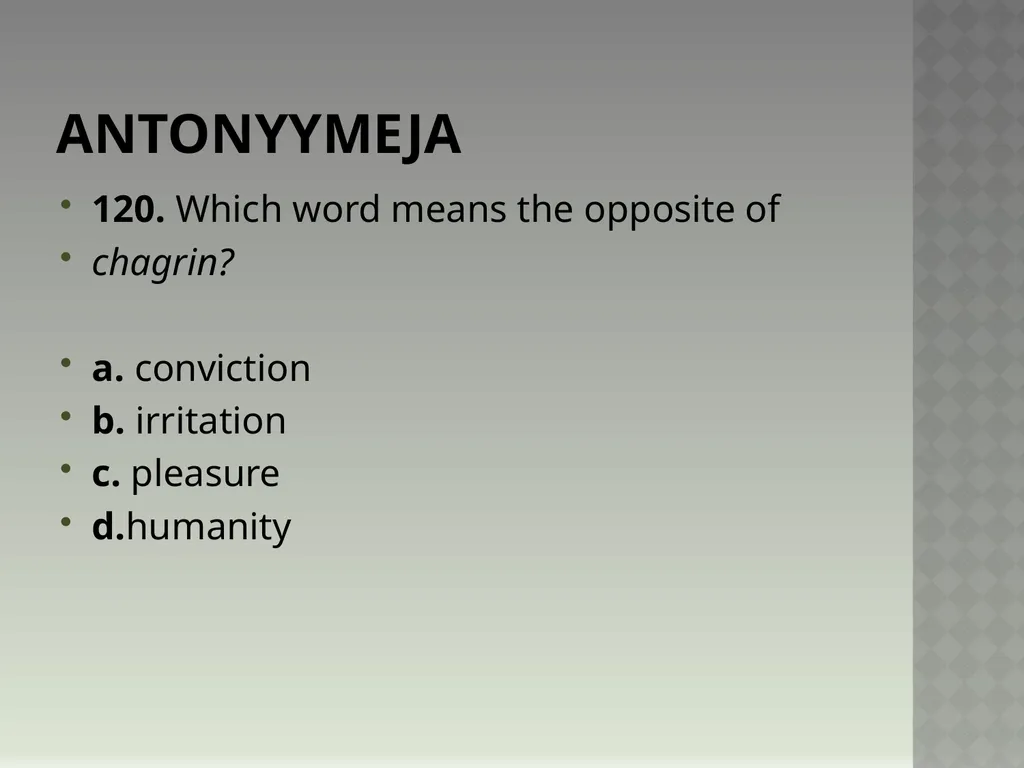
antonyymeja 120. Which word means the opposite of
chagrin?
a. conviction
b. irritation
c. pleasure
d.humanity<br>
chagrin?
a. conviction
b. irritation
c. pleasure
d.humanity<br>
242
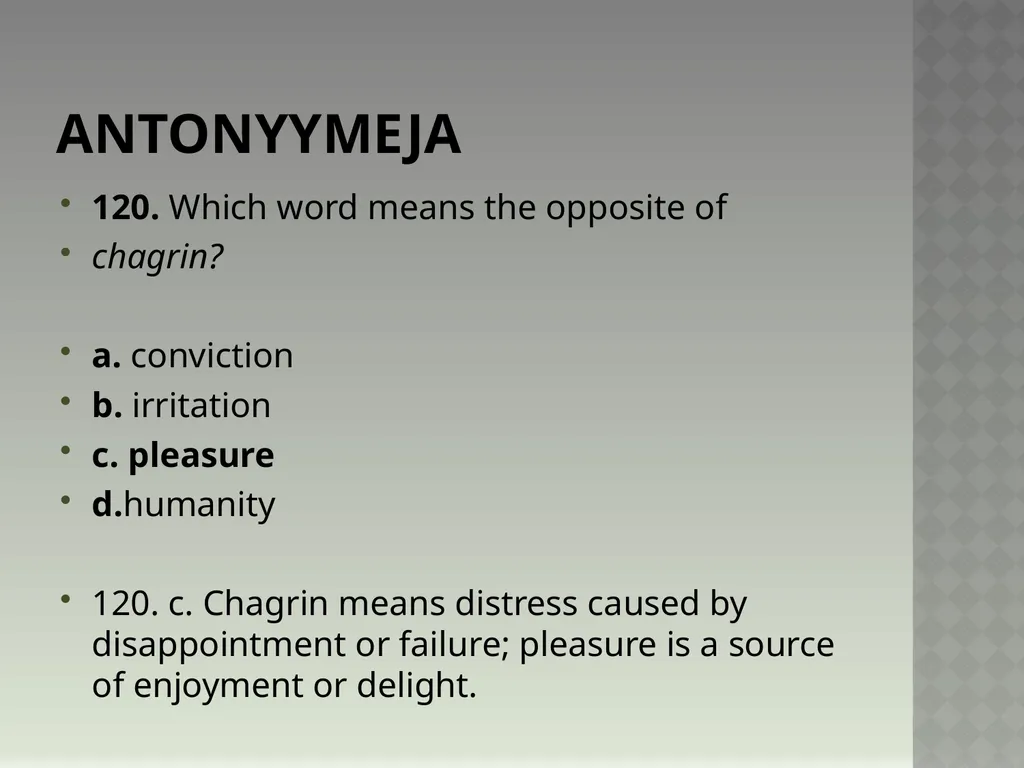
antonyymeja 120. Which word means the opposite of
chagrin?
a. conviction
b. irritation
c. pleasure
d.humanity
120. c. Chagrin means distress caused by disappointment or failure; pleasure is a source of enjoyment or delight.<br>
chagrin?
a. conviction
b. irritation
c. pleasure
d.humanity
120. c. Chagrin means distress caused by disappointment or failure; pleasure is a source of enjoyment or delight.<br>
243
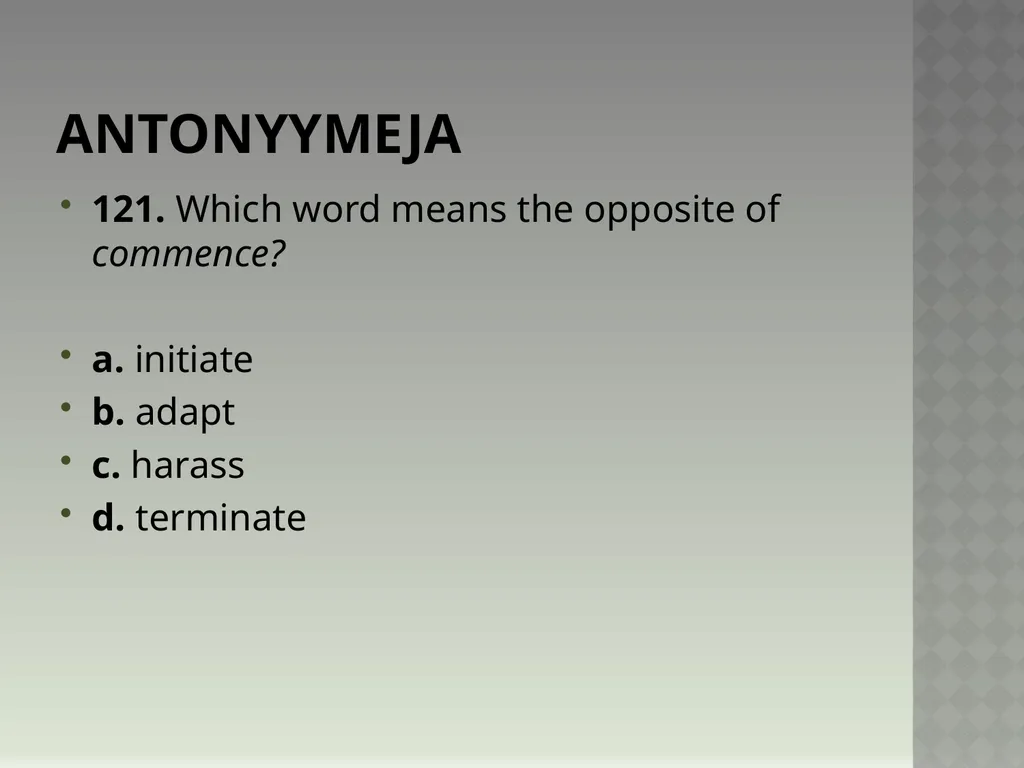
antonyymeja 121. Which word means the opposite of commence?
a. initiate
b. adapt
c. harass
d. terminate<br>
a. initiate
b. adapt
c. harass
d. terminate<br>
244
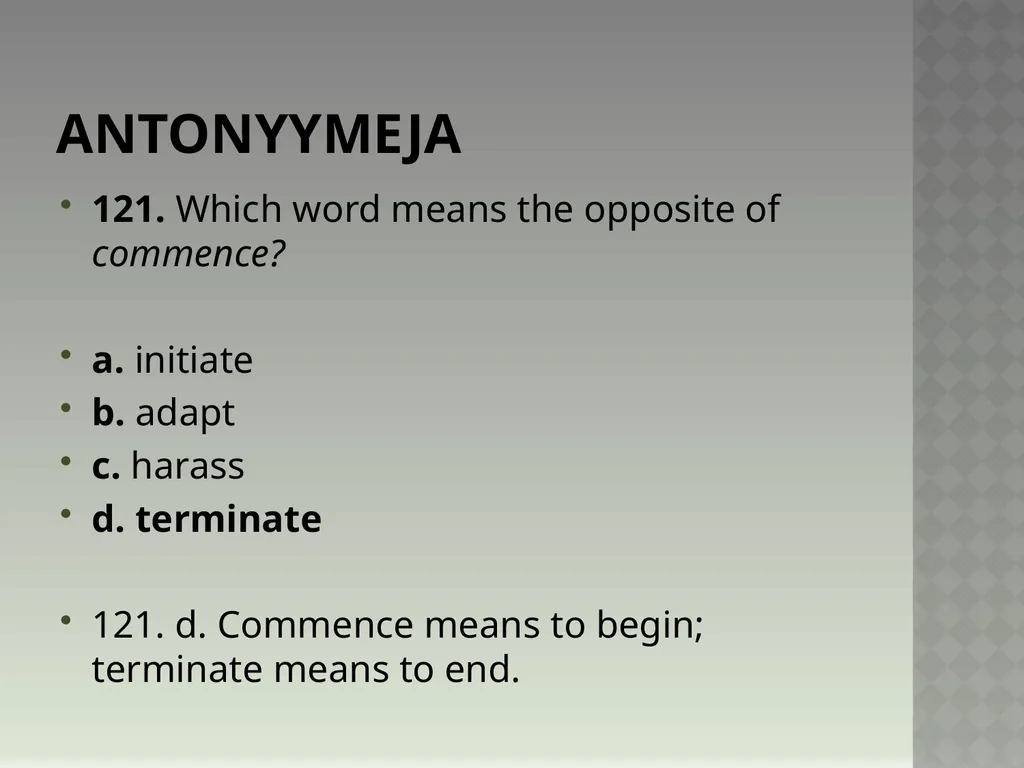
antonyymeja 121. Which word means the opposite of commence?
a. initiate
b. adapt
c. harass
d. terminate
121. d. Commence means to begin; terminate means to end.<br>
a. initiate
b. adapt
c. harass
d. terminate
121. d. Commence means to begin; terminate means to end.<br>
245
antonyymeja 122. Which word means the opposite of conscientious?
a. careless
b. apologetic
c. diligent
d. boisterous<br>
a. careless
b. apologetic
c. diligent
d. boisterous<br>
246
antonyymeja 122. Which word means the opposite of conscientious?
a. careless
b. apologetic
c. diligent
d. boisterous
122. a. Conscientious means careful, cautious, and thoughtful; careless means not showing care.<br>
a. careless
b. apologetic
c. diligent
d. boisterous
122. a. Conscientious means careful, cautious, and thoughtful; careless means not showing care.<br>
247
antonyymeja 123. Which word means the opposite of deficient?
a. necessary
b. adequate
c. flawed
d. simple<br>
a. necessary
b. adequate
c. flawed
d. simple<br>
248
antonyymeja 123. Which word means the opposite of deficient?
a. necessary
b. adequate
c. flawed
d. simple
123. b. Deficient means lacking some necessary quality; adequate means having all necessary parts.<br>
a. necessary
b. adequate
c. flawed
d. simple
123. b. Deficient means lacking some necessary quality; adequate means having all necessary parts.<br>
249
antonyymeja 124. Which word means the opposite of lucid?
a. ordinary
b. turbulent
c. implausible
d. vague<br>
a. ordinary
b. turbulent
c. implausible
d. vague<br>
250
antonyymeja 124. Which word means the opposite of lucid?
a. ordinary
b. turbulent
c. implausible
d. vague
124. d. Lucid means clear; the opposite is vague, not clearly expressed.<br>
a. ordinary
b. turbulent
c. implausible
d. vague
124. d. Lucid means clear; the opposite is vague, not clearly expressed.<br>
251
antonyymeja 125. Which word means the opposite of
judicious?
a. partial
b. litigious
c. imprudent
d.unrestrained<br>
judicious?
a. partial
b. litigious
c. imprudent
d.unrestrained<br>
252
antonyymeja 125. Which word means the opposite of
judicious?
a. partial
b. litigious
c. imprudent
d.unrestrained
125. c. Judicious means wise or prudent;
imprudent is to be indiscreet or unwise, the opposite of judicious.<br>
judicious?
a. partial
b. litigious
c. imprudent
d.unrestrained
125. c. Judicious means wise or prudent;
imprudent is to be indiscreet or unwise, the opposite of judicious.<br>
253
antonyymeja 126. Which word means the opposite of
dissonance?
a. harmony
b. carefulness
c. specificity
d. value<br>
dissonance?
a. harmony
b. carefulness
c. specificity
d. value<br>
254
antonyymeja 126. Which word means the opposite of
dissonance?
a. harmony
b. carefulness
c. specificity
d. value
126. a. Dissonance means disagreement or discord; harmony means to be in agreement or accord, to have the same feeling or opinion.<br>
dissonance?
a. harmony
b. carefulness
c. specificity
d. value
126. a. Dissonance means disagreement or discord; harmony means to be in agreement or accord, to have the same feeling or opinion.<br>
255
antonyymeja 127. Which word means the opposite of erudite?
a. uneducated
b. polite
c. unknown
d. agitated<br>
a. uneducated
b. polite
c. unknown
d. agitated<br>
256
antonyymeja 127. Which word means the opposite of erudite?
a. uneducated
b. polite
c. unknown
d. agitated
127. a. Erudite means learned or possessing knowledge; uneducated is a lack of training or knowledge.<br>
a. uneducated
b. polite
c. unknown
d. agitated
127. a. Erudite means learned or possessing knowledge; uneducated is a lack of training or knowledge.<br>
257
antonyymeja For each of the following words, choose the word that means the opposite or most nearly the opposite.<br>
258
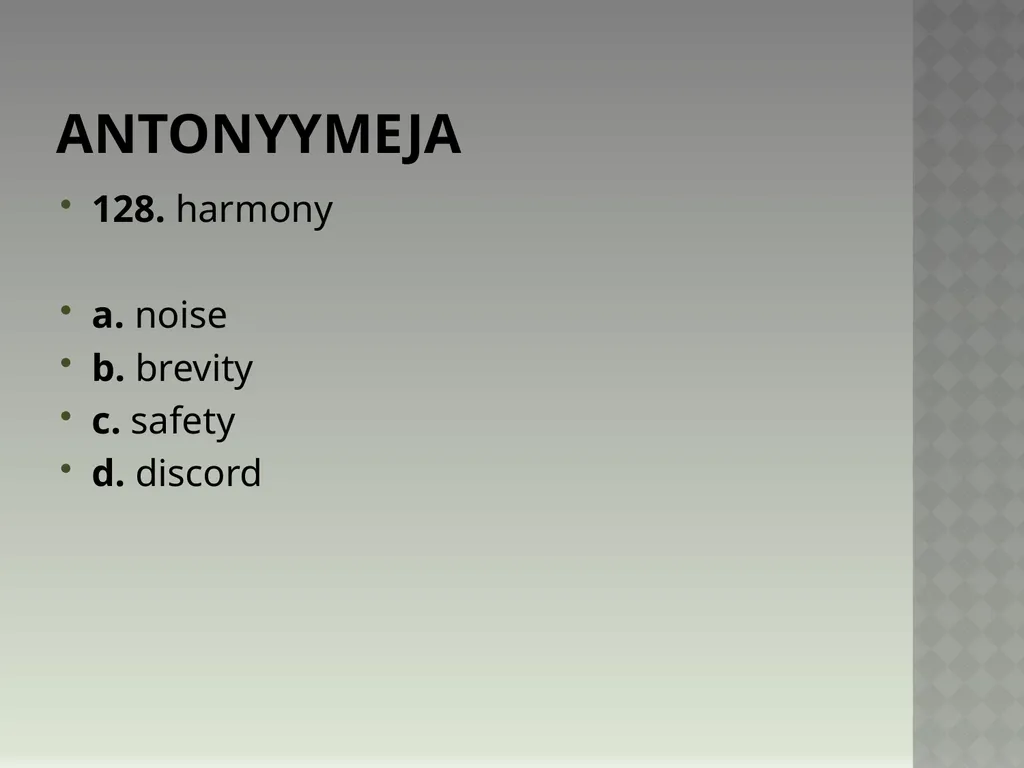
antonyymeja 128. harmony
a. noise
b. brevity
c. safety
d. discord<br>
a. noise
b. brevity
c. safety
d. discord<br>
259
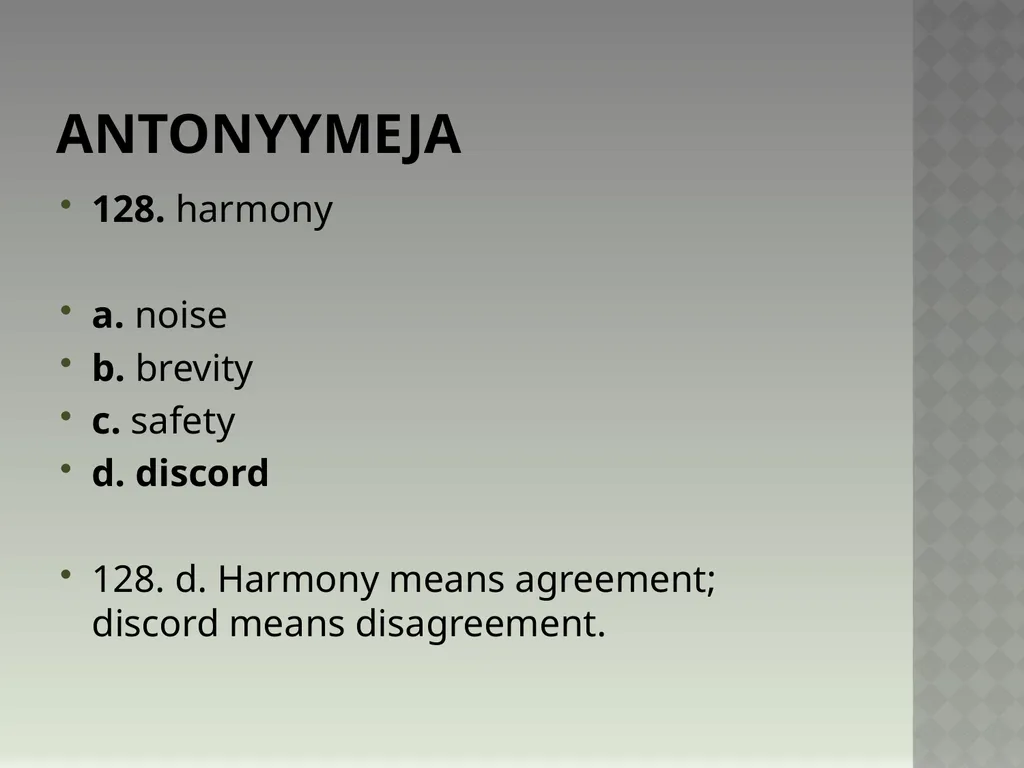
antonyymeja 128. harmony
a. noise
b. brevity
c. safety
d. discord
128. d. Harmony means agreement; discord means disagreement.<br>
a. noise
b. brevity
c. safety
d. discord
128. d. Harmony means agreement; discord means disagreement.<br>
260
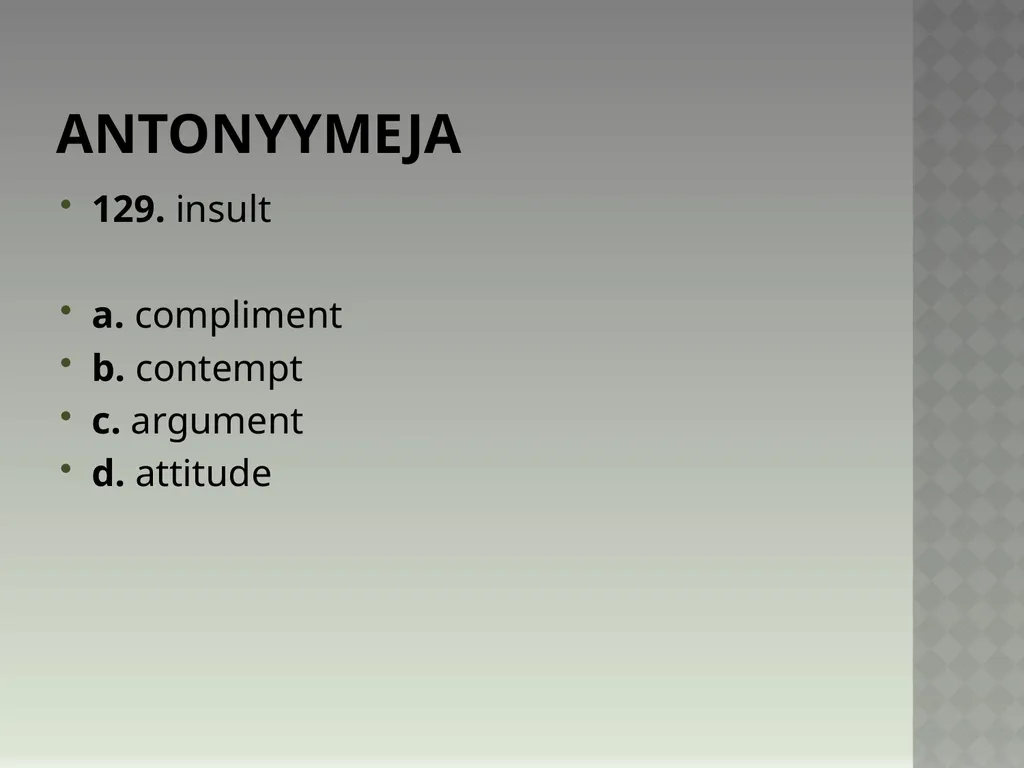
antonyymeja 129. insult
a. compliment
b. contempt
c. argument
d. attitude<br>
a. compliment
b. contempt
c. argument
d. attitude<br>
261
antonyymeja 129. insult
a. compliment
b. contempt
c. argument
d. attitude
129. a. An insult is a gross indignity; a compliment is a remark of admiration.<br>
a. compliment
b. contempt
c. argument
d. attitude
129. a. An insult is a gross indignity; a compliment is a remark of admiration.<br>
262
antonyymeja 130. general
a. specific
b. total
c. insignificant
d. substantial<br>
a. specific
b. total
c. insignificant
d. substantial<br>
263
antonyymeja 130. general
a. specific
b. total
c. insignificant
d. substantial
130. a. General means not limited to one class or thing; specific means particular.<br>
a. specific
b. total
c. insignificant
d. substantial
130. a. General means not limited to one class or thing; specific means particular.<br>
264
antonyymeja 131. imaginary
a. sober
b. ordinary
c. unrealistic
d. factual<br>
a. sober
b. ordinary
c. unrealistic
d. factual<br>
265
antonyymeja 131. imaginary
a. sober
b. ordinary
c. unrealistic
d. factual
131. d. Imaginary means unreal; factual means real.<br>
a. sober
b. ordinary
c. unrealistic
d. factual
131. d. Imaginary means unreal; factual means real.<br>
266
antonyymeja 132. demolish
a. attend
b. consider
c. create
d. stifle<br>
a. attend
b. consider
c. create
d. stifle<br>
267
antonyymeja 132. demolish
a. attend
b. consider
c. create
d. stifle
132. c. To demolish means to tear apart; to create means to build.<br>
a. attend
b. consider
c. create
d. stifle
132. c. To demolish means to tear apart; to create means to build.<br>
268
antonyymeja 133. absorb
a. acquire
b. repel
c. consume
d. assist<br>
a. acquire
b. repel
c. consume
d. assist<br>
269
antonyymeja 133. absorb
a. acquire
b. repel
c. consume
d. assist
133. b. Absorb means to take in or consume; to repel is to reject or force away.<br>
a. acquire
b. repel
c. consume
d. assist
133. b. Absorb means to take in or consume; to repel is to reject or force away.<br>
270
antonyymeja 134. critical
a. inimical
b. judgmental
c. massive
d. trivial<br>
a. inimical
b. judgmental
c. massive
d. trivial<br>
271
antonyymeja 134. critical
a. inimical
b. judgmental
c. massive
d. trivial
134. d. To be critical is to be important or vital; to be trivial is to be unimportant.<br>
a. inimical
b. judgmental
c. massive
d. trivial
134. d. To be critical is to be important or vital; to be trivial is to be unimportant.<br>
272
antonyymeja 135. infantile
a. despicable
b. adolescent
c. mature
d. perpetual<br>
a. despicable
b. adolescent
c. mature
d. perpetual<br>
273
antonyymeja 135. infantile
a. despicable
b. adolescent
c. mature
d. perpetual
135. c. Infantile means childish; mature means grown-up.<br>
a. despicable
b. adolescent
c. mature
d. perpetual
135. c. Infantile means childish; mature means grown-up.<br>
274
antonyymeja 136. retain
a. withhold
b. release
c. succumb
d. incise<br>
a. withhold
b. release
c. succumb
d. incise<br>
275
antonyymeja 136. retain
a. withhold
b. release
c. succumb
d. incise
136. b. To retain is to keep or hold; to release is to let go.<br>
a. withhold
b. release
c. succumb
d. incise
136. b. To retain is to keep or hold; to release is to let go.<br>
276
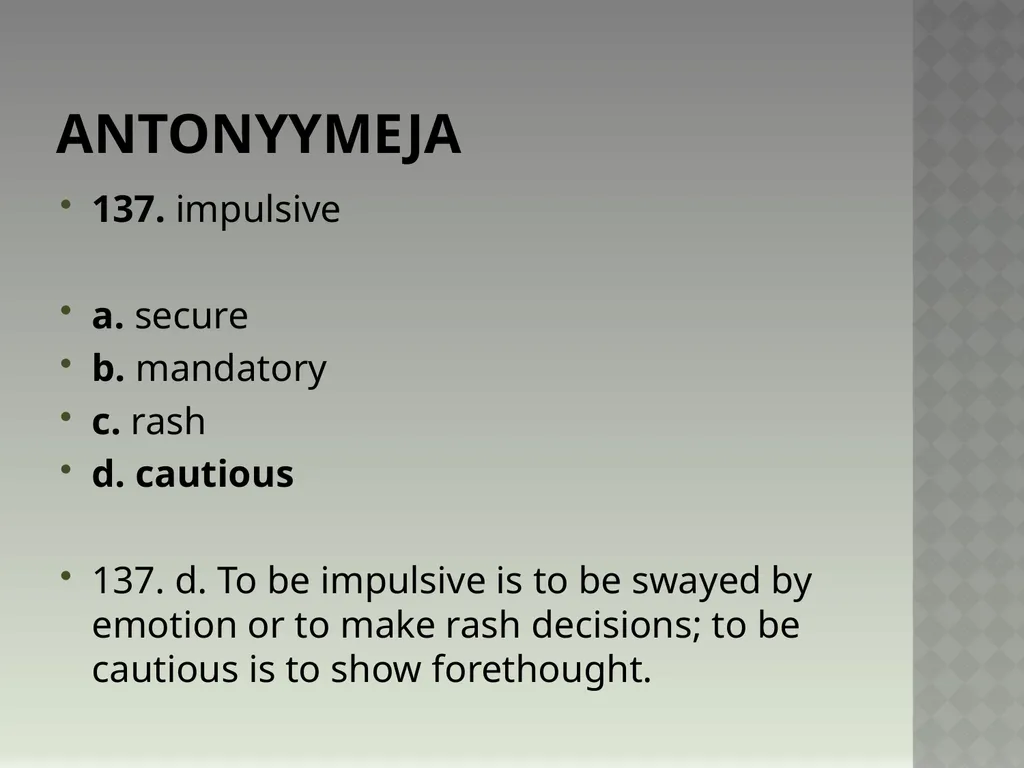
antonyymeja 137. impulsive
a. secure
b. mandatory
c. rash
d. cautious<br>
a. secure
b. mandatory
c. rash
d. cautious<br>
277
antonyymeja 137. impulsive
a. secure
b. mandatory
c. rash
d. cautious
137. d. To be impulsive is to be swayed by emotion or to make rash decisions; to be cautious is to show forethought.<br>
a. secure
b. mandatory
c. rash
d. cautious
137. d. To be impulsive is to be swayed by emotion or to make rash decisions; to be cautious is to show forethought.<br>
278
antonyymeja 138. competent
a. incomplete
b. intense
c. inept
d. massive<br>
a. incomplete
b. intense
c. inept
d. massive<br>
279
antonyymeja 138. competent
a. incomplete
b. intense
c. inept
d. massive
138. c. Competent means having adequate abilities; inept means incapable or incompetent.<br>
a. incomplete
b. intense
c. inept
d. massive
138. c. Competent means having adequate abilities; inept means incapable or incompetent.<br>
280
antonyymeja 139. promote
a. explicate
b. downgrade
c. concede
d. retain<br>
a. explicate
b. downgrade
c. concede
d. retain<br>
281
antonyymeja 139. promote
a. explicate
b. downgrade
c. concede
d. retain
139. b. To promote is to advance someone to a higher rank or to advocate; to downgrade is to cut something short.<br>
a. explicate
b. downgrade
c. concede
d. retain
139. b. To promote is to advance someone to a higher rank or to advocate; to downgrade is to cut something short.<br>
282
antonyymeja 140. requirement
a. plan
b. consequence
c. option
d. accident<br>
a. plan
b. consequence
c. option
d. accident<br>
283
antonyymeja 140. requirement
a. plan
b. consequence
c. option
d. accident
140. c. Requirement means something obligatory; option means something that can be chosen.<br>
a. plan
b. consequence
c. option
d. accident
140. c. Requirement means something obligatory; option means something that can be chosen.<br>
284
antonyymeja 141. irritate
a. soothe
b. drain
c. resist
d. solve<br>
a. soothe
b. drain
c. resist
d. solve<br>
285
antonyymeja 141. irritate
a. soothe
b. drain
c. resist
d. solve
141. a. To irritate means to annoy; to soothe means to calm.<br>
a. soothe
b. drain
c. resist
d. solve
141. a. To irritate means to annoy; to soothe means to calm.<br>
286
antonyymeja 142. punctual
a. random
b. smooth
c. intermittent
d. tardy<br>
a. random
b. smooth
c. intermittent
d. tardy<br>
287
antonyymeja 142. punctual
a. random
b. smooth
c. intermittent
d. tardy
142. d. To be punctual means to be on time; to be tardy means to be late.<br>
a. random
b. smooth
c. intermittent
d. tardy
142. d. To be punctual means to be on time; to be tardy means to be late.<br>
288
antonyymeja 143. virtue
a. reality
b. fact
c. vice
d.amateur<br>
a. reality
b. fact
c. vice
d.amateur<br>
289
antonyymeja 143. virtue
a. reality
b. fact
c. vice
d.amateur
143. c. Virtue is a moral goodness; vice is a moral failing.<br>
a. reality
b. fact
c. vice
d.amateur
143. c. Virtue is a moral goodness; vice is a moral failing.<br>
290
antonyymeja 144. fortunate
a. excluded
b. hapless
c. hardworking
d. lucky<br>
a. excluded
b. hapless
c. hardworking
d. lucky<br>
291
antonyymeja 144. fortunate
a. excluded
b. hapless
c. hardworking
d. lucky
144. b. To be fortunate is to have good luck; to be hapless is to be unlucky.<br>
a. excluded
b. hapless
c. hardworking
d. lucky
144. b. To be fortunate is to have good luck; to be hapless is to be unlucky.<br>
292
antonyymeja 145. notable
a. oral
b. graceful
c. legal
d. ordinary<br>
a. oral
b. graceful
c. legal
d. ordinary<br>
293
antonyymeja 145. notable
a. oral
b. graceful
c. legal
d. ordinary
145. d. Notable means distinguished or unusual; ordinary means usual, plain.<br>
a. oral
b. graceful
c. legal
d. ordinary
145. d. Notable means distinguished or unusual; ordinary means usual, plain.<br>
294
antonyymeja 146. prim
a. outrageous
b. last
c. ugly
d. cantankerous<br>
a. outrageous
b. last
c. ugly
d. cantankerous<br>
295
antonyymeja 146. prim
a. outrageous
b. last
c. ugly
d. cantankerous
146. a. Prim means stiffly formal and proper; outrageous means horrendous, shocking.<br>
a. outrageous
b. last
c. ugly
d. cantankerous
146. a. Prim means stiffly formal and proper; outrageous means horrendous, shocking.<br>
296
antonyymeja 147. prosperous
a. affluent
b. destitute
c. cowardly
d. receptive<br>
a. affluent
b. destitute
c. cowardly
d. receptive<br>
297
antonyymeja 147. prosperous
a. affluent
b. destitute
c. cowardly
d. receptive
147. b. Prosperous means rich or affluent; destitute means very poor.<br>
a. affluent
b. destitute
c. cowardly
d. receptive
147. b. Prosperous means rich or affluent; destitute means very poor.<br>
298
antonyymeja 148. nimble
a. sturdy
b. sluggish
c. thoughtless
d. relaxed<br>
a. sturdy
b. sluggish
c. thoughtless
d. relaxed<br>
299
antonyymeja 148. nimble
a. sturdy
b. sluggish
c. thoughtless
d. relaxed
148. b. Nimble means quick and light in motion; sluggish means slow or inactive.<br>
a. sturdy
b. sluggish
c. thoughtless
d. relaxed
148. b. Nimble means quick and light in motion; sluggish means slow or inactive.<br>
300
antonyymeja 149. tranquil
a. agitated
b. explicit
c. sluggish
d. composed<br>
a. agitated
b. explicit
c. sluggish
d. composed<br>
301
antonyymeja 149. tranquil
a. agitated
b. explicit
c. sluggish
d. composed
149. a. Tranquil means peaceful; agitated means disturbed or excited.<br>
a. agitated
b. explicit
c. sluggish
d. composed
149. a. Tranquil means peaceful; agitated means disturbed or excited.<br>
302
antonyymeja 150. sprightly
a. eager
b. lofty
c. dull
d. local<br>
a. eager
b. lofty
c. dull
d. local<br>
303
antonyymeja 150. sprightly
a. eager
b. lofty
c. dull
d. local
150. c. Sprightly means lively; dull suggests a lack or loss of keenness or zest.<br>
a. eager
b. lofty
c. dull
d. local
150. c. Sprightly means lively; dull suggests a lack or loss of keenness or zest.<br>
304
antonyymeja 151. amiable
a. dangerous
b. permissive
c. aloof
d. congenial<br>
a. dangerous
b. permissive
c. aloof
d. congenial<br>
305
antonyymeja 151. amiable
a. dangerous
b. permissive
c. aloof
d. congenial
151. c. Amiable means friendly; aloof means to be physically or emotionally distant or remote.<br>
a. dangerous
b. permissive
c. aloof
d. congenial
151. c. Amiable means friendly; aloof means to be physically or emotionally distant or remote.<br>
306
antonyymeja 152. prudent
a. rash
b. licentious
c. libertine
d. demonstrative<br>
a. rash
b. licentious
c. libertine
d. demonstrative<br>
307
antonyymeja 152. prudent
a. rash
b. licentious
c. libertine
d. demonstrative
152. a. To be prudent is to exercise good judgment; to be rash is to show ill-considered haste.<br>
a. rash
b. licentious
c. libertine
d. demonstrative
152. a. To be prudent is to exercise good judgment; to be rash is to show ill-considered haste.<br>
308
antonyymeja 153. scant
a. pellucid
b. meager
c. copious
d. vocal<br>
a. pellucid
b. meager
c. copious
d. vocal<br>
309
antonyymeja 153. scant
a. pellucid
b. meager
c. copious
d. vocal
153. c. Scant means meager; copious means abundant.<br>
a. pellucid
b. meager
c. copious
d. vocal
153. c. Scant means meager; copious means abundant.<br>
310
antonyymeja 154. steadfast
a. envious
b. fickle
c. improvident
d. sluggish<br>
a. envious
b. fickle
c. improvident
d. sluggish<br>
311
antonyymeja 154. steadfast
a. envious
b. fickle
c. improvident
d. sluggish
154. b. To be steadfast is to be fixed or unchanging; to be fickle is characterized by constant change or instability, the opposite of steadfast.<br>
a. envious
b. fickle
c. improvident
d. sluggish
154. b. To be steadfast is to be fixed or unchanging; to be fickle is characterized by constant change or instability, the opposite of steadfast.<br>
312
antonyymeja 155. stringent
a. obese
b. lax
c. obtuse
d. fluid<br>
a. obese
b. lax
c. obtuse
d. fluid<br>
313
antonyymeja 155. stringent
a. obese
b. lax
c. obtuse
d. fluid
155. b. To be stringent is to be rigorous or severe; to be lax is to be lacking in rigor or strictness.<br>
a. obese
b. lax
c. obtuse
d. fluid
155. b. To be stringent is to be rigorous or severe; to be lax is to be lacking in rigor or strictness.<br>
314
Synonyymi vai antonyymi? Read each question carefully and select the word that is most similar or most dissimilar in meaning to the word provided.<br>
315
Synonyymi vai antonyymi? 156. Rational is most similar to
a. deliberate.
b. invalid.
c. prompt.
d. sound.
156. d. A rational decision is one that exercises the ability to reason, a sound decision is one that has a firm basis.<br>
a. deliberate.
b. invalid.
c. prompt.
d. sound.
156. d. A rational decision is one that exercises the ability to reason, a sound decision is one that has a firm basis.<br>
316
Synonyymi vai antonyymi? 156. Rational is most similar to
a. deliberate.
b. invalid.
c. prompt.
d. sound.<br>
a. deliberate.
b. invalid.
c. prompt.
d. sound.<br>
317
Synonyymi vai antonyymi? 157. Attribute is most similar to
a. quality.
b. penalty.
c. speech.
d. admission.<br>
a. quality.
b. penalty.
c. speech.
d. admission.<br>
318
Synonyymi vai antonyymi? 157. Attribute is most similar to
a. quality.
b. penalty.
c. speech.
d. admission.
157. a. An attribute is a characteristic or quality belonging to a person or thing.<br>
a. quality.
b. penalty.
c. speech.
d. admission.
157. a. An attribute is a characteristic or quality belonging to a person or thing.<br>
319
Synonyymi vai antonyymi? 158. Subdue is most similar to
a. conquer.
b. complain.
c. deny.
d. respect.<br>
a. conquer.
b. complain.
c. deny.
d. respect.<br>
320
Synonyymi vai antonyymi? 158. Subdue is most similar to
a. conquer.
b. complain.
c. deny.
d. respect.
158. a. To subdue means to bring under control; conquer means to defeat by force.<br>
a. conquer.
b. complain.
c. deny.
d. respect.
158. a. To subdue means to bring under control; conquer means to defeat by force.<br>
321
Synonyymi vai antonyymi? 159. Animated is most similar to
a. abbreviated.
b. civil.
c. secret.
d. lively.<br>
a. abbreviated.
b. civil.
c. secret.
d. lively.<br>
322
Synonyymi vai antonyymi? 159. Animated is most similar to
a. abbreviated.
b. civil.
c. secret.
d. lively.
159. d. To be animated is to be filled with activity or vigor; lively is to be filled with energy.<br>
a. abbreviated.
b. civil.
c. secret.
d. lively.
159. d. To be animated is to be filled with activity or vigor; lively is to be filled with energy.<br>
323
Synonyymi vai antonyymi? 160. Awe is most dissimilar to
a. contempt.
b. reverence.
c. valor.
d. distortion.<br>
a. contempt.
b. reverence.
c. valor.
d. distortion.<br>
324
Synonyymi vai antonyymi? 160. Awe is most dissimilar to
a. contempt.
b. reverence.
c. valor.
d. distortion.
160. a. To be in awe of something is to admire it; to have contempt for something is to consider it worthless.<br>
a. contempt.
b. reverence.
c. valor.
d. distortion.
160. a. To be in awe of something is to admire it; to have contempt for something is to consider it worthless.<br>
325
Synonyymi vai antonyymi? 161. Intricate is most similar to
a. delicate.
b. costly.
c. prim.
d. complex.<br>
a. delicate.
b. costly.
c. prim.
d. complex.<br>
326
Synonyymi vai antonyymi? 161. Intricate is most similar to
a. delicate.
b. costly.
c. prim.
d. complex.
161. d. Intricate means having many elaborately arranged elements; complex means complicated or involved.<br>
a. delicate.
b. costly.
c. prim.
d. complex.
161. d. Intricate means having many elaborately arranged elements; complex means complicated or involved.<br>
327
Synonyymi vai antonyymi? 162. Skeptic is most dissimilar to
a. innovator.
b. friend.
c. politician.
d. believer.<br>
a. innovator.
b. friend.
c. politician.
d. believer.<br>
328
Synonyymi vai antonyymi? 162. Skeptic is most dissimilar to
a. innovator.
b. friend.
c. politician.
d. believer.
162. d. A skeptic is someone who doubts; a believer is one who thinks something is true.<br>
a. innovator.
b. friend.
c. politician.
d. believer.
162. d. A skeptic is someone who doubts; a believer is one who thinks something is true.<br>
329
Synonyymi vai antonyymi? 163. Hypothetical is most dissimilar to
a. uncritical.
b. actual.
c. specific.
d.imaginary.<br>
a. uncritical.
b. actual.
c. specific.
d.imaginary.<br>
330
Synonyymi vai antonyymi? 163. Hypothetical is most dissimilar to
a. uncritical.
b. actual.
c. specific.
d.imaginary.
163. b. To be hypothetical is to be suppositional or contingent on being tested; to be actual is to exist in fact or reality.<br>
a. uncritical.
b. actual.
c. specific.
d.imaginary.
163. b. To be hypothetical is to be suppositional or contingent on being tested; to be actual is to exist in fact or reality.<br>
331
Synonyymi vai antonyymi? 164. Enhance is most dissimilar to
a. diminish.
b. improve.
c. digress.
d. deprive.<br>
a. diminish.
b. improve.
c. digress.
d. deprive.<br>
332
Synonyymi vai antonyymi? 164. Enhance is most dissimilar to
a. diminish.
b. improve.
c. digress.
d. deprive.
164. a. To enhance is to increase or augment; to diminish is to make smaller.<br>
a. diminish.
b. improve.
c. digress.
d. deprive.
164. a. To enhance is to increase or augment; to diminish is to make smaller.<br>
333
Synonyymi vai antonyymi? 165. Manipulate is most similar to
a. simplify.
b. deplete.
c. nurture.
d. handle.<br>
a. simplify.
b. deplete.
c. nurture.
d. handle.<br>
334
Synonyymi vai antonyymi? 165. Manipulate is most similar to
a. simplify.
b. deplete.
c. nurture.
d. handle.
165. d. To manipulate is to manage or to handle in a controlling manner.<br>
a. simplify.
b. deplete.
c. nurture.
d. handle.
165. d. To manipulate is to manage or to handle in a controlling manner.<br>
335
Synonyymi vai antonyymi? 166. Subjective is most dissimilar to
a. invective.
b. objectionable.
c. unbiased.
d. obedient.<br>
a. invective.
b. objectionable.
c. unbiased.
d. obedient.<br>
336
Synonyymi vai antonyymi? 166. Subjective is most dissimilar to
a. invective.
b. objectionable.
c. unbiased.
d. obedient.
166. c. To be subjective is to be influenced by one’s own emotions or beliefs without strict regard to evidence in the outside world; to be unbiased is to be objective or impartial.<br>
a. invective.
b. objectionable.
c. unbiased.
d. obedient.
166. c. To be subjective is to be influenced by one’s own emotions or beliefs without strict regard to evidence in the outside world; to be unbiased is to be objective or impartial.<br>
337
Synonyymi vai antonyymi? 167. Succinct is most dissimilar to
a. distinct.
b. laconic.
c. feeble.
d. verbose.<br>
a. distinct.
b. laconic.
c. feeble.
d. verbose.<br>
338
Synonyymi vai antonyymi? 167. Succinct is most dissimilar to
a. distinct.
b. laconic.
c. feeble.
d. verbose.
167. d. To be succinct is to be concise; to be verbose is to use excessive words, to be wordy.<br>
a. distinct.
b. laconic.
c. feeble.
d. verbose.
167. d. To be succinct is to be concise; to be verbose is to use excessive words, to be wordy.<br>
339
Synonyymi vai antonyymi? 168. Enthusiastic is most similar to
a. adamant.
b. available.
c. cheerful.
d. eager<br>
a. adamant.
b. available.
c. cheerful.
d. eager<br>
340
Synonyymi vai antonyymi? 168. Enthusiastic is most similar to
a. adamant.
b. available.
c. cheerful.
d. eager
168. d. Enthusiastic means eager, to show keen interest or desire.<br>
a. adamant.
b. available.
c. cheerful.
d. eager
168. d. Enthusiastic means eager, to show keen interest or desire.<br>
341
Synonyymi vai antonyymi? 169. Adequate is most similar to
a. sufficient.
b. mediocre.
c. proficient.
d. average.<br>
a. sufficient.
b. mediocre.
c. proficient.
d. average.<br>
342
Synonyymi vai antonyymi? 169. Adequate is most similar to
a. sufficient.
b. mediocre.
c. proficient.
d. average.
169. a. If something is adequate, it is sufficient, or as much as needed.<br>
a. sufficient.
b. mediocre.
c. proficient.
d. average.
169. a. If something is adequate, it is sufficient, or as much as needed.<br>
343
Synonyymi vai antonyymi? 170. Uniform is most dissimilar to
a. dissembling.
b. diverse.
c. bizarre.
d. slovenly.<br>
a. dissembling.
b. diverse.
c. bizarre.
d. slovenly.<br>
344
Synonyymi vai antonyymi? 170. Uniform is most dissimilar to
a. dissembling.
b. diverse.
c. bizarre.
d. slovenly.
170. b. To be uniform is be consistent or the same as others; to be diverse is to have variety.<br>
a. dissembling.
b. diverse.
c. bizarre.
d. slovenly.
170. b. To be uniform is be consistent or the same as others; to be diverse is to have variety.<br>
345
Synonyymi vai antonyymi? 171. Ecstatic is most similar to
a. inconsistent.
b. positive.
c. wild.
d. thrilled.<br>
a. inconsistent.
b. positive.
c. wild.
d. thrilled.<br>
346
Synonyymi vai antonyymi? 171. Ecstatic is most similar to
a. inconsistent.
b. positive.
c. wild.
d. thrilled.
171. d. A person who is ecstatic has great pleasure or delight or is thrilled.<br>
a. inconsistent.
b. positive.
c. wild.
d. thrilled.
171. d. A person who is ecstatic has great pleasure or delight or is thrilled.<br>
347
Synonyymi vai antonyymi? 172. Affect is most similar to
a. accomplish.
b. cause.
c. sicken.
d. influence.<br>
a. accomplish.
b. cause.
c. sicken.
d. influence.<br>
348
Synonyymi vai antonyymi? 172. Affect is most similar to
a. accomplish.
b. cause.
c. sicken.
d. influence.
172. d. To affect means to influence a person, thing, or course of events.<br>
a. accomplish.
b. cause.
c. sicken.
d. influence.
172. d. To affect means to influence a person, thing, or course of events.<br>
349
Synonyymi vai antonyymi? 173. Wary is most dissimilar to
a. alert.
b. leery.
c. worried.
d. careless.<br>
a. alert.
b. leery.
c. worried.
d. careless.<br>
350
Synonyymi vai antonyymi? 173. Wary is most dissimilar to
a. alert.
b. leery.
c. worried.
d. careless.
173. d. To be wary is to be on guard or watchful; to be careless is to have lack of forethought.<br>
a. alert.
b. leery.
c. worried.
d. careless.
173. d. To be wary is to be on guard or watchful; to be careless is to have lack of forethought.<br>
351
Synonyymi vai antonyymi? 174. Novel is most dissimilar to
a. dangerous.
b. unsettled.
c. suitable.
d. old.<br>
a. dangerous.
b. unsettled.
c. suitable.
d. old.<br>
352
Synonyymi vai antonyymi? 174. Novel is most dissimilar to
a. dangerous.
b. unsettled.
c. suitable.
d. old.
174. d. To be novel is to be new; the opposite is old, existing for a long time.<br>
a. dangerous.
b. unsettled.
c. suitable.
d. old.
174. d. To be novel is to be new; the opposite is old, existing for a long time.<br>
353
Synonyymi vai antonyymi? 175. Continuous is most similar to
a. intermittent.
b. adjacent.
c. uninterrupted.
d. contiguous.<br>
a. intermittent.
b. adjacent.
c. uninterrupted.
d. contiguous.<br>
354
Synonyymi vai antonyymi? 175. Continuous is most similar to
a. intermittent.
b. adjacent.
c. uninterrupted.
d. contiguous.
175. c. Continuous means to be marked by uninterrupted extension in space and time.<br>
a. intermittent.
b. adjacent.
c. uninterrupted.
d. contiguous.
175. c. Continuous means to be marked by uninterrupted extension in space and time.<br>
355
Synonyymi vai antonyymi? 176. Courtesy is most similar to
a. civility.
b. congruity.
c. conviviality.
d. rudeness.<br>
a. civility.
b. congruity.
c. conviviality.
d. rudeness.<br>
356
Synonyymi vai antonyymi? 176. Courtesy is most similar to
a. civility.
b. congruity.
c. conviviality.
d. rudeness.
176. a. Both courtesy and civility imply being polite, considerate, or mannerly.<br>
a. civility.
b. congruity.
c. conviviality.
d. rudeness.
176. a. Both courtesy and civility imply being polite, considerate, or mannerly.<br>
357
Synonyymi vai antonyymi? 177. Fallacy is most dissimilar to
a. truth.
b. blessing.
c. weakness.
d. fable.<br>
a. truth.
b. blessing.
c. weakness.
d. fable.<br>
358
Synonyymi vai antonyymi? 177. Fallacy is most dissimilar to
a. truth.
b. blessing.
c. weakness.
d. fable.
177. a. A fallacy is a false or mistaken idea, trickery; a truth is something which conforms to the facts.<br>
a. truth.
b. blessing.
c. weakness.
d. fable.
177. a. A fallacy is a false or mistaken idea, trickery; a truth is something which conforms to the facts.<br>
359
Synonyymi vai antonyymi? 178. Frail is most similar to
a. vivid.
b. delicate.
c. robust.
d. adaptable.<br>
a. vivid.
b. delicate.
c. robust.
d. adaptable.<br>
360
Synonyymi vai antonyymi? 178. Frail is most similar to
a. vivid.
b. delicate.
c. robust.
d. adaptable.
178. b. A frail person is weak and delicate or frail in constitution or health.<br>
a. vivid.
b. delicate.
c. robust.
d. adaptable.
178. b. A frail person is weak and delicate or frail in constitution or health.<br>
361
Synonyymi vai antonyymi? 179. Recuperate is most similar to
a. recover.
b. endorse.
c. persist.
d.worsen.<br>
a. recover.
b. endorse.
c. persist.
d.worsen.<br>
362
Synonyymi vai antonyymi? 179. Recuperate is most similar to
a. recover.
b. endorse.
c. persist.
d.worsen.
179. a. Recuperate means to heal; to recover means to restore or get back again<br>
a. recover.
b. endorse.
c. persist.
d.worsen.
179. a. Recuperate means to heal; to recover means to restore or get back again<br>
363
Synonyymi vai antonyymi? 180. Subsequent is most dissimilar to
a. necessary.
b. insignificant.
c. primary.
d. previous.<br>
a. necessary.
b. insignificant.
c. primary.
d. previous.<br>
364
Synonyymi vai antonyymi? 180. Subsequent is most dissimilar to
a. necessary.
b. insignificant.
c. primary.
d. previous.
180. d. Subsequent means coming after or following; previous means coming before.<br>
a. necessary.
b. insignificant.
c. primary.
d. previous.
180. d. Subsequent means coming after or following; previous means coming before.<br>
365
Synonyymi vai antonyymi? 181. Nonchalant is most dissimilar to
a. intelligent.
b. popular.
c. concerned.
d. reckless.<br>
a. intelligent.
b. popular.
c. concerned.
d. reckless.<br>
366
Synonyymi vai antonyymi? 181. Nonchalant is most dissimilar to
a. intelligent.
b. popular.
c. concerned.
d. reckless.
181. c. To be nonchalant means to have an air of easy indifference; to be concerned means to be interested and involved.<br>
a. intelligent.
b. popular.
c. concerned.
d. reckless.
181. c. To be nonchalant means to have an air of easy indifference; to be concerned means to be interested and involved.<br>
367
Synonyymi vai antonyymi? 182. Hoax is most similar to
a. logic.
b. crusade.
c. embargo.
d. ruse.<br>
a. logic.
b. crusade.
c. embargo.
d. ruse.<br>
368
Synonyymi vai antonyymi? 182. Hoax is most similar to
a. logic.
b. crusade.
c. embargo.
d. ruse.
182. d. A hoax and a ruse are both tricks designed to confuse or mislead.<br>
a. logic.
b. crusade.
c. embargo.
d. ruse.
182. d. A hoax and a ruse are both tricks designed to confuse or mislead.<br>
369
Synonyymi vai antonyymi? 183. Composure is most similar to
a. agitation.
b. poise.
c. liveliness.
d. stimulation.<br>
a. agitation.
b. poise.
c. liveliness.
d. stimulation.<br>
370
Synonyymi vai antonyymi? 183. Composure is most similar to
a. agitation.
b. poise.
c. liveliness.
d. stimulation.
183. b. If you gain composure, you have poise, a manner of acting that is free from affectation or embarrassment.<br>
a. agitation.
b. poise.
c. liveliness.
d. stimulation.
183. b. If you gain composure, you have poise, a manner of acting that is free from affectation or embarrassment.<br>
371
Synonyymi vai antonyymi? 184. Excise is most dissimilar to
a. sleep.
b. retain.
c. organize.
d. staple.<br>
a. sleep.
b. retain.
c. organize.
d. staple.<br>
372
Synonyymi vai antonyymi? 184. Excise is most dissimilar to
a. sleep.
b. retain.
c. organize.
d. staple.
184. b. To excise means to remove; to retain means to keep.<br>
a. sleep.
b. retain.
c. organize.
d. staple.
184. b. To excise means to remove; to retain means to keep.<br>
373
Synonyymi vai antonyymi? 185. Disperse is most dissimilar to
a. gather.
b. agree.
c. praise.
d. satisfy.<br>
a. gather.
b. agree.
c. praise.
d. satisfy.<br>
374
Synonyymi vai antonyymi? 185. Disperse is most dissimilar to
a. gather.
b. agree.
c. praise.
d. satisfy.
185. a. Disperse means to scatter; to gather means to collect in one place.<br>
a. gather.
b. agree.
c. praise.
d. satisfy.
185. a. Disperse means to scatter; to gather means to collect in one place.<br>
375
Synonyymi vai antonyymi? 186. Eccentric is most similar to
a. normal.
b. frugal.
c. peculiar.
d. selective.<br>
a. normal.
b. frugal.
c. peculiar.
d. selective.<br>
376
Synonyymi vai antonyymi? 186. Eccentric is most similar to
a. normal.
b. frugal.
c. peculiar.
d. selective.
186. c. An eccentric person is considered to be odd, unusual, eccentric, or peculiar.<br>
a. normal.
b. frugal.
c. peculiar.
d. selective.
186. c. An eccentric person is considered to be odd, unusual, eccentric, or peculiar.<br>
377
Synonyymi vai antonyymi? 187. Commendable is most similar to
a. admirable.
b. accountable.
c. irresponsible.
d. noticeable.<br>
a. admirable.
b. accountable.
c. irresponsible.
d. noticeable.<br>
378
Synonyymi vai antonyymi? 187. Commendable is most similar to
a. admirable.
b. accountable.
c. irresponsible.
d. noticeable.
187. a. Both commendable and admirable mean worthy, qualified, or desirable.<br>
a. admirable.
b. accountable.
c. irresponsible.
d. noticeable.
187. a. Both commendable and admirable mean worthy, qualified, or desirable.<br>
379
Synonyymi vai antonyymi? 188. Domain is most similar to
a. entrance.
b. rebellion.
c. formation.
d. territory.<br>
a. entrance.
b. rebellion.
c. formation.
d. territory.<br>
380
Synonyymi vai antonyymi? 188. Domain is most similar to
a. entrance.
b. rebellion.
c. formation.
d. territory.
188. d. A domain is an area governed by a ruler; a territory is an area for which someone is responsible.<br>
a. entrance.
b. rebellion.
c. formation.
d. territory.
188. d. A domain is an area governed by a ruler; a territory is an area for which someone is responsible.<br>
381
Synonyymi vai antonyymi? 189. Passive is most similar to
a. inactive.
b. emotional.
c. lively.
d.woeful.<br>
a. inactive.
b. emotional.
c. lively.
d.woeful.<br>
382
Synonyymi vai antonyymi? 189. Passive is most similar to
a. inactive.
b. emotional.
c. lively.
d.woeful.
189. a. Passive is to fail to respond or react to an action; inactive means not functioning or operating.<br>
a. inactive.
b. emotional.
c. lively.
d.woeful.
189. a. Passive is to fail to respond or react to an action; inactive means not functioning or operating.<br>
383
Synonyymi vai antonyymi? 190. Liberate is most dissimilar to
a. conserve.
b. restrain.
c. attack.
d. ruin.<br>
a. conserve.
b. restrain.
c. attack.
d. ruin.<br>
384
Synonyymi vai antonyymi? 190. Liberate is most dissimilar to
a. conserve.
b. restrain.
c. attack.
d. ruin.
190. b. To liberate means to release; to restrain means to deprive of liberty.<br>
a. conserve.
b. restrain.
c. attack.
d. ruin.
190. b. To liberate means to release; to restrain means to deprive of liberty.<br>
385
Synonyymi vai antonyymi? 191. Faltering is most dissimilar to
a. steady.
b. adoring.
c. explanatory.
d. reluctant.<br>
a. steady.
b. adoring.
c. explanatory.
d. reluctant.<br>
386
Synonyymi vai antonyymi? 191. Faltering is most dissimilar to
a. steady.
b. adoring.
c. explanatory.
d. reluctant.
191. a. Faltering means to be unsteady in purpose or action, stumbling; steady means firm in position or place, direct, or unfaltering.<br>
a. steady.
b. adoring.
c. explanatory.
d. reluctant.
191. a. Faltering means to be unsteady in purpose or action, stumbling; steady means firm in position or place, direct, or unfaltering.<br>
387
Synonyymi vai antonyymi? 192. Vast is most similar to
a. attentive.
b. immense.
c. steady.
d. slight.<br>
a. attentive.
b. immense.
c. steady.
d. slight.<br>
388
Synonyymi vai antonyymi? 192. Vast is most similar to
a. attentive.
b. immense.
c. steady.
d. slight.
192. b. Vast means very great in size; immense means to be immeasurable in size or extent.<br>
a. attentive.
b. immense.
c. steady.
d. slight.
192. b. Vast means very great in size; immense means to be immeasurable in size or extent.<br>
389
Synonyymi vai antonyymi? 193. Comply is most similar to
a. subdue.
b. entertain.
c. flatter.
d. obey.<br>
a. subdue.
b. entertain.
c. flatter.
d. obey.<br>
390
Synonyymi vai antonyymi? 193. Comply is most similar to
a. subdue.
b. entertain.
c. flatter.
d. obey.
193. d. Comply means to act in accordance with a command and is synonymous with obey, to carry out or fulfill an order.<br>
a. subdue.
b. entertain.
c. flatter.
d. obey.
193. d. Comply means to act in accordance with a command and is synonymous with obey, to carry out or fulfill an order.<br>
391
Synonyymi vai antonyymi? 194. Optimum is most dissimilar to
a. mediocre.
b. victorious.
c. worst.
d. rational.<br>
a. mediocre.
b. victorious.
c. worst.
d. rational.<br>
392
Synonyymi vai antonyymi? 194. Optimum is most dissimilar to
a. mediocre.
b. victorious.
c. worst.
d. rational.
194. c. Optimum means the most desirable; worst means the least desirable.<br>
a. mediocre.
b. victorious.
c. worst.
d. rational.
194. c. Optimum means the most desirable; worst means the least desirable.<br>
393
Synonyymi vai antonyymi? 195. Enlighten is most similar to
a. relocate.
b. confuse.
c. comply.
d. teach.<br>
a. relocate.
b. confuse.
c. comply.
d. teach.<br>
394
Synonyymi vai antonyymi? 195. Enlighten is most similar to
a. relocate.
b. confuse.
c. comply.
d. teach.
195. d. If you enlighten someone, you instruct, inform, or teach them to make them free of ignorance, prejudice, or superstition.<br>
a. relocate.
b. confuse.
c. comply.
d. teach.
195. d. If you enlighten someone, you instruct, inform, or teach them to make them free of ignorance, prejudice, or superstition.<br>
395
Synonyymi vai antonyymi? 196. Tedious is most dissimilar to
a. stimulating.
b. alarming.
c. intemperate.
d. tranquil.<br>
a. stimulating.
b. alarming.
c. intemperate.
d. tranquil.<br>
396
Synonyymi vai antonyymi? 196. Tedious is most dissimilar to
a. stimulating.
b. alarming.
c. intemperate.
d. tranquil.
196. a. To be tedious is to be tiresome; to be stimulating is to be exciting.<br>
a. stimulating.
b. alarming.
c. intemperate.
d. tranquil.
196. a. To be tedious is to be tiresome; to be stimulating is to be exciting.<br>
397
Synonyymi vai antonyymi? 197. Exonerate is most dissimilar to
a. minimize.
b. respect.
c. irritate.
d. blame.<br>
a. minimize.
b. respect.
c. irritate.
d. blame.<br>
398
Synonyymi vai antonyymi? 197. Exonerate is most dissimilar to
a. minimize.
b. respect.
c. irritate.
d. blame.
197. d. To exonerate means to clear from accusation or guilt; to blame is to accuse or hold responsible.<br>
a. minimize.
b. respect.
c. irritate.
d. blame.
197. d. To exonerate means to clear from accusation or guilt; to blame is to accuse or hold responsible.<br>
399
Synonyymi vai antonyymi? 198. Ephemeral is most dissimilar to
a. internal.
b. enduring.
c. temporary.
d. hidden.<br>
a. internal.
b. enduring.
c. temporary.
d. hidden.<br>
400
Synonyymi vai antonyymi? 198. Ephemeral is most dissimilar to
a. internal.
b. enduring.
c. temporary.
d. hidden.
198. b. Ephemeral means short-lived; enduring means without end.<br>
a. internal.
b. enduring.
c. temporary.
d. hidden.
198. b. Ephemeral means short-lived; enduring means without end.<br>
401
Synonyymi vai antonyymi? 199. Predecessor is most dissimilar to
a. successor.
b. antecedent.
c. descendant.
d. ancestor.<br>
a. successor.
b. antecedent.
c. descendant.
d. ancestor.<br>
402
Synonyymi vai antonyymi? 199. Predecessor is most dissimilar to
a. successor.
b. antecedent.
c. descendant.
d. ancestor.
199. a. To be a predecessor is to be one who precedes or comes before another; to be a successor is to be one who succeeds or comes after another.<br>
a. successor.
b. antecedent.
c. descendant.
d. ancestor.
199. a. To be a predecessor is to be one who precedes or comes before another; to be a successor is to be one who succeeds or comes after another.<br>
403
Synonyymi vai antonyymi? 200. Refrain is most similar to
a. desist.
b. secure.
c. glimpse.
d.persevere.<br>
a. desist.
b. secure.
c. glimpse.
d.persevere.<br>
404
Synonyymi vai antonyymi? 200. Refrain is most similar to
a. desist.
b. secure.
c. glimpse.
d.persevere.
200. a. To refrain is to hold back; to desist is to cease, stop, or forbear.<br>
a. desist.
b. secure.
c. glimpse.
d.persevere.
200. a. To refrain is to hold back; to desist is to cease, stop, or forbear.<br>
405
Synonyymi vai antonyymi? 201. Affable is most dissimilar to
a. disagreeable.
b. hollow.
c. simple.
d. eager.<br>
a. disagreeable.
b. hollow.
c. simple.
d. eager.<br>
406
Synonyymi vai antonyymi? 201. Affable is most dissimilar to
a. disagreeable.
b. hollow.
c. simple.
d. eager.
201. a. Affable means pleasant and at ease or agreeable; the opposite is disagreeable or not to one’s liking, unpleasant.<br>
a. disagreeable.
b. hollow.
c. simple.
d. eager.
201. a. Affable means pleasant and at ease or agreeable; the opposite is disagreeable or not to one’s liking, unpleasant.<br>
407
Synonyymi vai antonyymi? 202. Rigorous is most similar to
a. demanding.
b. tolerable.
c. lenient.
d. disorderly.<br>
a. demanding.
b. tolerable.
c. lenient.
d. disorderly.<br>
408
Synonyymi vai antonyymi? 202. Rigorous is most similar to
a. demanding.
b. tolerable.
c. lenient.
d. disorderly.
202. a. Rigorous is to be rigid or harsh and is synonymous with demanding, to request urgently.<br>
a. demanding.
b. tolerable.
c. lenient.
d. disorderly.
202. a. Rigorous is to be rigid or harsh and is synonymous with demanding, to request urgently.<br>
409
Synonyymi vai antonyymi? 203. Orient is most dissimilar to
a. confuse.
b. arouse.
c. deter.
d. simplify.<br>
a. confuse.
b. arouse.
c. deter.
d. simplify.<br>
410
Synonyymi vai antonyymi? 203. Orient is most dissimilar to
a. confuse.
b. arouse.
c. deter.
d. simplify.
203. a. To orient means to adjust, become familiar; to confuse means to bewilder.<br>
a. confuse.
b. arouse.
c. deter.
d. simplify.
203. a. To orient means to adjust, become familiar; to confuse means to bewilder.<br>
411
Synonyymi vai antonyymi? 204. Levitate is most dissimilar to
a. plod.
b. undulate.
c. whisper.
d. sink.<br>
a. plod.
b. undulate.
c. whisper.
d. sink.<br>
412
Synonyymi vai antonyymi? 204. Levitate is most dissimilar to
a. plod.
b. undulate.
c. whisper.
d. sink.
204. d. To levitate means to rise and float; to sink means to be submerged.<br>
a. plod.
b. undulate.
c. whisper.
d. sink.
204. d. To levitate means to rise and float; to sink means to be submerged.<br>
413
Synonyymi vai antonyymi? 205. Oblivious is most similar to
a. visible.
b. sinister.
c. conscious.
d. unaware.<br>
a. visible.
b. sinister.
c. conscious.
d. unaware.<br>
414
Synonyymi vai antonyymi? 205. Oblivious is most similar to
a. visible.
b. sinister.
c. conscious.
d. unaware.
205. d. If you are oblivious to your surroundings, you are unaware or not cognizant of them.<br>
a. visible.
b. sinister.
c. conscious.
d. unaware.
205. d. If you are oblivious to your surroundings, you are unaware or not cognizant of them.<br>
415
Synonyymi vai antonyymi? 206. Verify is most similar to
a. disclose.
b. confirm.
c. refute.
d. unite.<br>
a. disclose.
b. confirm.
c. refute.
d. unite.<br>
416
Synonyymi vai antonyymi? 206. Verify is most similar to
a. disclose.
b. confirm.
c. refute.
d. unite.
206. b. To verify means to establish truth or accuracy; to confirm means to support or establish the validity of.<br>
a. disclose.
b. confirm.
c. refute.
d. unite.
206. b. To verify means to establish truth or accuracy; to confirm means to support or establish the validity of.<br>
417
Synonyymi vai antonyymi? 207. Pacify is most dissimilar to
a. complicate.
b. dismiss.
c. excite.
d. atomize<br>
a. complicate.
b. dismiss.
c. excite.
d. atomize<br>
418
Synonyymi vai antonyymi? 207. Pacify is most dissimilar to
a. complicate.
b. dismiss.
c. excite.
d. atomize
207. c. To pacify means to calm; to excite means to stir up.<br>
a. complicate.
b. dismiss.
c. excite.
d. atomize
207. c. To pacify means to calm; to excite means to stir up.<br>
419
Synonyymi vai antonyymi? 208. Plausible is most dissimilar to
a. insufficient.
b. apologetic.
c. unbelievable.
d. credible.<br>
a. insufficient.
b. apologetic.
c. unbelievable.
d. credible.<br>
420
Synonyymi vai antonyymi? 208. Plausible is most dissimilar to
a. insufficient.
b. apologetic.
c. unbelievable.
d. credible.
208. c. Plausible means likely or credible; unbelievable is incredible, not to be believed, unlikely.<br>
a. insufficient.
b. apologetic.
c. unbelievable.
d. credible.
208. c. Plausible means likely or credible; unbelievable is incredible, not to be believed, unlikely.<br>
421
Synonyymi vai antonyymi? 209. Idle is most similar to
a. working.
b. effective.
c. immobile.
d. functional.<br>
a. working.
b. effective.
c. immobile.
d. functional.<br>
422
Synonyymi vai antonyymi? 209. Idle is most similar to
a. working.
b. effective.
c. immobile.
d. functional.
209. c. Idle means not in use or operation; immobile means immovable or fixed.<br>
a. working.
b. effective.
c. immobile.
d. functional.
209. c. Idle means not in use or operation; immobile means immovable or fixed.<br>
423
Synonyymi vai antonyymi? 210. Avid is most dissimilar to
a. partial.
b. unenthusiastic.
c. equal.
d. unkind.<br>
a. partial.
b. unenthusiastic.
c. equal.
d. unkind.<br>
424
Synonyymi vai antonyymi? 210. Avid is most dissimilar to
a. partial.
b. unenthusiastic.
c. equal.
d. unkind.
210. b. Someone who is avid has enthusiasm and pursues things vigorously; the opposite would be unenthusiastic, lacking excitement or ardor.<br>
a. partial.
b. unenthusiastic.
c. equal.
d. unkind.
210. b. Someone who is avid has enthusiasm and pursues things vigorously; the opposite would be unenthusiastic, lacking excitement or ardor.<br>
425
Synonyymi vai antonyymi? 211. Meek is most dissimilar to
a. mild.
b. painful.
c. forceful.
d. polite.<br>
a. mild.
b. painful.
c. forceful.
d. polite.<br>
426
Synonyymi vai antonyymi? 211. Meek is most dissimilar to
a. mild.
b. painful.
c. forceful.
d. polite.
211. c. Meek means not violent or not strong; forceful means powerful.<br>
a. mild.
b. painful.
c. forceful.
d. polite.
211. c. Meek means not violent or not strong; forceful means powerful.<br>
427
Synonyymi vai antonyymi? 212. Complacent is most dissimilar to
a. concerned.
b. pleasant.
c. happy.
d. convinced.<br>
a. concerned.
b. pleasant.
c. happy.
d. convinced.<br>
428
Synonyymi vai antonyymi? 212. Complacent is most dissimilar to
a. concerned.
b. pleasant.
c. happy.
d. convinced.
212. a. Complacent means self-satisfied, smug, or unworried; the opposite is concerned, which means interested and involved.<br>
a. concerned.
b. pleasant.
c. happy.
d. convinced.
212. a. Complacent means self-satisfied, smug, or unworried; the opposite is concerned, which means interested and involved.<br>
429
Synonyymi vai antonyymi? 213. Ambiguous is most dissimilar to
a. apathetic.
b. certain.
c. equivocal.
d. indefinite.<br>
a. apathetic.
b. certain.
c. equivocal.
d. indefinite.<br>
430
Synonyymi vai antonyymi? 213. Ambiguous is most dissimilar to
a. apathetic.
b. certain.
c. equivocal.
d. indefinite.
213. b. To be ambiguous is to be unclear, equivocal, or obscure; to be certain is to be definite or fixed.<br>
a. apathetic.
b. certain.
c. equivocal.
d. indefinite.
213. b. To be ambiguous is to be unclear, equivocal, or obscure; to be certain is to be definite or fixed.<br>
431
Synonyymi vai antonyymi? 214. Confer is most similar to
a. confide.
b. consult.
c. refuse.
d. promise.<br>
a. confide.
b. consult.
c. refuse.
d. promise.<br>
432
Synonyymi vai antonyymi? 214. Confer is most similar to
a. confide.
b. consult.
c. refuse.
d. promise.
214. b. Confer means to compare views or to take counsel; consult means to exchange views.<br>
a. confide.
b. consult.
c. refuse.
d. promise.
214. b. Confer means to compare views or to take counsel; consult means to exchange views.<br>
433
Synonyymi vai antonyymi? 215. Repast is most similar to
a. meal.
b. debt.
c. book.
d. goal.<br>
a. meal.
b. debt.
c. book.
d. goal.<br>
434
Synonyymi vai antonyymi? 215. Repast is most similar to
a. meal.
b. debt.
c. book.
d. goal.
215. a. A repast is a meal or the food eaten at a meal.<br>
a. meal.
b. debt.
c. book.
d. goal.
215. a. A repast is a meal or the food eaten at a meal.<br>
435
Synonyymi vai antonyymi? 216. Esteem is most dissimilar to
a. disrespect.
b. disregard.
c. dissent.
d. disabuse.<br>
a. disrespect.
b. disregard.
c. dissent.
d. disabuse.<br>
436
Synonyymi vai antonyymi? 216. Esteem is most dissimilar to
a. disrespect.
b. disregard.
c. dissent.
d. disabuse.
216. a. To be held in high esteem means to have a favorable regard; to disrespect is to lack courteous regard.<br>
a. disrespect.
b. disregard.
c. dissent.
d. disabuse.
216. a. To be held in high esteem means to have a favorable regard; to disrespect is to lack courteous regard.<br>
437
Synonyymi vai antonyymi? 217. Eloquent is most dissimilar to
a. shabby.
b. fluent.
c. inarticulate.
d. plain.<br>
a. shabby.
b. fluent.
c. inarticulate.
d. plain.<br>
438
Synonyymi vai antonyymi? 217. Eloquent is most dissimilar to
a. shabby.
b. fluent.
c. inarticulate.
d. plain.
217. c. To be eloquent is to be fluent; to be inarticulate is to speak hesitantly.<br>
a. shabby.
b. fluent.
c. inarticulate.
d. plain.
217. c. To be eloquent is to be fluent; to be inarticulate is to speak hesitantly.<br>
439
Synonyymi vai antonyymi? 218. Apathetic is most similar to
a. pitiable.
b. indifferent.
c. suspicious.
d. evasive.<br>
a. pitiable.
b. indifferent.
c. suspicious.
d. evasive.<br>
440
Synonyymi vai antonyymi? 218. Apathetic is most similar to
a. pitiable.
b. indifferent.
c. suspicious.
d. evasive.
218. b. To be apathetic is to show little emotion or interest; to be indifferent is to have no particular interest or concern.<br>
a. pitiable.
b. indifferent.
c. suspicious.
d. evasive.
218. b. To be apathetic is to show little emotion or interest; to be indifferent is to have no particular interest or concern.<br>
441
Synonyymi vai antonyymi? 219. Deterrent is most dissimilar to
a. encouragement.
b. obstacle.
c. proponent.
d. discomfort.<br>
a. encouragement.
b. obstacle.
c. proponent.
d. discomfort.<br>
442
Synonyymi vai antonyymi? 219. Deterrent is most dissimilar to
a. encouragement.
b. obstacle.
c. proponent.
d. discomfort.
219. a. A deterrent prevents or discourages; encouragement inspires or heartens.<br>
a. encouragement.
b. obstacle.
c. proponent.
d. discomfort.
219. a. A deterrent prevents or discourages; encouragement inspires or heartens.<br>
443
Synonyymi vai antonyymi? 220. Impertinent is most dissimilar to
a. animated.
b. rude.
c. relentless.
d. polite.<br>
a. animated.
b. rude.
c. relentless.
d. polite.<br>
444
Synonyymi vai antonyymi? 220. Impertinent is most dissimilar to
a. animated.
b. rude.
c. relentless.
d. polite.
220. d. Someone who is impertinent is rude; someone who is polite is courteous.<br>
a. animated.
b. rude.
c. relentless.
d. polite.
220. d. Someone who is impertinent is rude; someone who is polite is courteous.<br>
445
Synonyymi vai antonyymi? 221. Augment is most similar to
a. repeal.
b. evaluate.
c. increase.
d. criticize.<br>
a. repeal.
b. evaluate.
c. increase.
d. criticize.<br>
446
Synonyymi vai antonyymi? 221. Augment is most similar to
a. repeal.
b. evaluate.
c. increase.
d. criticize.
221. c. To augment means to increase or expand in size or extent.<br>
a. repeal.
b. evaluate.
c. increase.
d. criticize.
221. c. To augment means to increase or expand in size or extent.<br>
447
Synonyymi vai antonyymi? 222. Ludicrous is most dissimilar to
a. absurd.
b. somber.
c. reasonable.
d. charitable.<br>
a. absurd.
b. somber.
c. reasonable.
d. charitable.<br>
448
Synonyymi vai antonyymi? 222. Ludicrous is most dissimilar to
a. absurd.
b. somber.
c. reasonable.
d. charitable.
222. c. To be ludicrous is to be absurd; to be reasonable is to be rational.<br>
a. absurd.
b. somber.
c. reasonable.
d. charitable.
222. c. To be ludicrous is to be absurd; to be reasonable is to be rational.<br>
449
Synonyymi vai antonyymi? 223. Archaic is most dissimilar to
a. tangible.
b. modern.
c. ancient.
d. haunted.<br>
a. tangible.
b. modern.
c. ancient.
d. haunted.<br>
450
Synonyymi vai antonyymi? 223. Archaic is most dissimilar to
a. tangible.
b. modern.
c. ancient.
d. haunted.
223. b. Archaic means ancient or outdated; modern is current or contemporary.<br>
a. tangible.
b. modern.
c. ancient.
d. haunted.
223. b. Archaic means ancient or outdated; modern is current or contemporary.<br>
451
Synonyymi vai antonyymi? 224. Incredulous is most similar to
a. fearful.
b. outraged.
c. inconsolable.
d. disbelieving.<br>
a. fearful.
b. outraged.
c. inconsolable.
d. disbelieving.<br>
452
Synonyymi vai antonyymi? 224. Incredulous is most similar to
a. fearful.
b. outraged.
c. inconsolable.
d. disbelieving.
224. d. To be incredulous is to be skeptical; disbelieving is to refuse to believe in.<br>
a. fearful.
b. outraged.
c. inconsolable.
d. disbelieving.
224. d. To be incredulous is to be skeptical; disbelieving is to refuse to believe in.<br>
453
Synonyymi vai antonyymi? 225. Vindictive is most similar to
a. outrageous.
b. insulting.
c. spiteful.
d. offensive.<br>
a. outrageous.
b. insulting.
c. spiteful.
d. offensive.<br>
454
Synonyymi vai antonyymi? 225. Vindictive is most similar to
a. outrageous.
b. insulting.
c. spiteful.
d. offensive.
225. c. To be vindictive is to be vengeful; to be spiteful means to be malicious.<br>
a. outrageous.
b. insulting.
c. spiteful.
d. offensive.
225. c. To be vindictive is to be vengeful; to be spiteful means to be malicious.<br>
455
Synonyymi vai antonyymi? 226. Sullen is most dissimilar to
a. morose.
b. impetuous.
c. provocative.
d. jovial.<br>
a. morose.
b. impetuous.
c. provocative.
d. jovial.<br>
456
Synonyymi vai antonyymi? 226. Sullen is most dissimilar to
a. morose.
b. impetuous.
c. provocative.
d. jovial.
226. d. Sullen means gloomy or dismal; jovial means very happy.<br>
a. morose.
b. impetuous.
c. provocative.
d. jovial.
226. d. Sullen means gloomy or dismal; jovial means very happy.<br>
457
Synonyymi vai antonyymi? 227. Menial is most similar to
a. lowly.
b. boring.
c. dangerous.
d. rewarding.<br>
a. lowly.
b. boring.
c. dangerous.
d. rewarding.<br>
458
Synonyymi vai antonyymi? 227. Menial is most similar to
a. lowly.
b. boring.
c. dangerous.
d. rewarding.
227. a. Menial means servile, related to work done by a servant; lowly means humble or plain, suited for one of the lowest rank.<br>
a. lowly.
b. boring.
c. dangerous.
d. rewarding.
227. a. Menial means servile, related to work done by a servant; lowly means humble or plain, suited for one of the lowest rank.<br>
459
Synonyymi vai antonyymi? 228. Panacea is most similar to
a. cure.
b. result.
c. cause.
d. necessity.<br>
a. cure.
b. result.
c. cause.
d. necessity.<br>
460
Synonyymi vai antonyymi? 228. Panacea is most similar to
a. cure.
b. result.
c. cause.
d. necessity.
228. a. A panacea is an all-encompassing remedy; a cure is a remedy or restoration to health.<br>
a. cure.
b. result.
c. cause.
d. necessity.
228. a. A panacea is an all-encompassing remedy; a cure is a remedy or restoration to health.<br>
461
Synonyymi vai antonyymi? 229. Taut is most dissimilar to
a. neutral.
b. relaxed.
c. rigid.
d. vague.<br>
a. neutral.
b. relaxed.
c. rigid.
d. vague.<br>
462
Synonyymi vai antonyymi? 229. Taut is most dissimilar to
a. neutral.
b. relaxed.
c. rigid.
d. vague.
229. b. Taut means extremely tight, tense; relaxed means loose, not tense.<br>
a. neutral.
b. relaxed.
c. rigid.
d. vague.
229. b. Taut means extremely tight, tense; relaxed means loose, not tense.<br>
463
Synonyymi vai antonyymi? 230. Rile is most dissimilar to
a. appease.
b. prosper.
c. oppress.
d. irk.<br>
a. appease.
b. prosper.
c. oppress.
d. irk.<br>
464
Synonyymi vai antonyymi? 230. Rile is most dissimilar to
a. appease.
b. prosper.
c. oppress.
d. irk.
230. a. To rile is to upset; to appease is to pacify or satisfy.<br>
a. appease.
b. prosper.
c. oppress.
d. irk.
230. a. To rile is to upset; to appease is to pacify or satisfy.<br>
465
Synonyymi vai antonyymi? 231. Glib is most similar to
a. angry.
b. insulting.
c. dishonest.
d. insincere.<br>
a. angry.
b. insulting.
c. dishonest.
d. insincere.<br>
466
Synonyymi vai antonyymi? 231. Glib is most similar to
a. angry.
b. insulting.
c. dishonest.
d. insincere.
231. d. To be glib is to reply quickly with insincere or superficial, false words.<br>
a. angry.
b. insulting.
c. dishonest.
d. insincere.
231. d. To be glib is to reply quickly with insincere or superficial, false words.<br>
467
Synonyymi vai antonyymi? 232. Mar is most dissimilar to
a. delineate.
b. bolster.
c. clarify.
d. repair.<br>
a. delineate.
b. bolster.
c. clarify.
d. repair.<br>
468
Synonyymi vai antonyymi? 232. Mar is most dissimilar to
a. delineate.
b. bolster.
c. clarify.
d. repair.
232. d. To mar is to damage or deface; to repair is to restore or fix.<br>
a. delineate.
b. bolster.
c. clarify.
d. repair.
232. d. To mar is to damage or deface; to repair is to restore or fix.<br>
469
Synonyymi vai antonyymi? 233. Cognizant is most similar to
a. conscious.
b. educated.
c. mystified.
d. confused.<br>
a. conscious.
b. educated.
c. mystified.
d. confused.<br>
470
Synonyymi vai antonyymi? 233. Cognizant is most similar to
a. conscious.
b. educated.
c. mystified.
d. confused.
233. a. To be cognizant of something is to be aware; to be conscious is to be perceptive or alert.<br>
a. conscious.
b. educated.
c. mystified.
d. confused.
233. a. To be cognizant of something is to be aware; to be conscious is to be perceptive or alert.<br>
471
Synonyymi vai antonyymi? 234. Mediate is most similar to
a. ponder.
b. interfere.
c. reconcile.
d. dissolve.<br>
a. ponder.
b. interfere.
c. reconcile.
d. dissolve.<br>
472
Synonyymi vai antonyymi? 234. Mediate is most similar to
a. ponder.
b. interfere.
c. reconcile.
d. dissolve.
234. c. To mediate is to settle a dispute; to reconcile is to bring into agreement.<br>
a. ponder.
b. interfere.
c. reconcile.
d. dissolve.
234. c. To mediate is to settle a dispute; to reconcile is to bring into agreement.<br>
473
Synonyymi vai antonyymi? 235. Concurrent is most similar to
a. incidental.
b. simultaneous.
c. apprehensive.
d. substantial.<br>
a. incidental.
b. simultaneous.
c. apprehensive.
d. substantial.<br>
474
Synonyymi vai antonyymi? 235. Concurrent is most similar to
a. incidental.
b. simultaneous.
c. apprehensive.
d. substantial.
235. b. Concurrent and simultaneous both mean happening at the same time.<br>
a. incidental.
b. simultaneous.
c. apprehensive.
d. substantial.
235. b. Concurrent and simultaneous both mean happening at the same time.<br>
475
Synonyymi vai antonyymi? 236. Induce is most similar to
a. prompt.
b. withdraw.
c. presume.
d. represent.<br>
a. prompt.
b. withdraw.
c. presume.
d. represent.<br>
476
Synonyymi vai antonyymi? 236. Induce is most similar to
a. prompt.
b. withdraw.
c. presume.
d. represent.
236. a. To induce is to bring about; to prompt is to provoke or induce to action.<br>
a. prompt.
b. withdraw.
c. presume.
d. represent.
236. a. To induce is to bring about; to prompt is to provoke or induce to action.<br>
477
Synonyymi vai antonyymi? 237. Intrepid is most dissimilar to
a. belligerent.
b. consistent.
c. chivalrous.
d. fearful.<br>
a. belligerent.
b. consistent.
c. chivalrous.
d. fearful.<br>
478
Synonyymi vai antonyymi? 237. Intrepid is most dissimilar to
a. belligerent.
b. consistent.
c. chivalrous.
d. fearful.
237. d. Intrepid is fearless, undaunted, daring, or brave; the opposite of fearful or anxious, frightened, or terrified.<br>
a. belligerent.
b. consistent.
c. chivalrous.
d. fearful.
237. d. Intrepid is fearless, undaunted, daring, or brave; the opposite of fearful or anxious, frightened, or terrified.<br>
479
Synonyymi vai antonyymi? 238. Saturate is most similar to
a. deprive.
b. construe.
c. soak.
d. verify.<br>
a. deprive.
b. construe.
c. soak.
d. verify.<br>
480
Synonyymi vai antonyymi? 238. Saturate is most similar to
a. deprive.
b. construe.
c. soak.
d. verify.
238. c. To saturate is to fill or to load to capacity; to soak is to penetrate or permeate.<br>
a. deprive.
b. construe.
c. soak.
d. verify.
238. c. To saturate is to fill or to load to capacity; to soak is to penetrate or permeate.<br>
481
Synonyymi vai antonyymi? 239. Methodical is most dissimilar to
a. erratic.
b. deliberate.
c. hostile.
d. deformed.<br>
a. erratic.
b. deliberate.
c. hostile.
d. deformed.<br>
482
Synonyymi vai antonyymi? 239. Methodical is most dissimilar to
a. erratic.
b. deliberate.
c. hostile.
d. deformed.
239. a. Methodical is characterized by method or order; erratic is variable, inconsistent, and unpredictable.<br>
a. erratic.
b. deliberate.
c. hostile.
d. deformed.
239. a. Methodical is characterized by method or order; erratic is variable, inconsistent, and unpredictable.<br>
483
Synonyymi vai antonyymi? 240. Latent is most dissimilar to
a. slow.
b. tardy.
c. dormant.
d. active.<br>
a. slow.
b. tardy.
c. dormant.
d. active.<br>
484
Synonyymi vai antonyymi? 240. Latent is most dissimilar to
a. slow.
b. tardy.
c. dormant.
d. active.
240. d. Latent means present but not functioning; active means to be marked by energetic activity.<br>
a. slow.
b. tardy.
c. dormant.
d. active.
240. d. Latent means present but not functioning; active means to be marked by energetic activity.<br>
485
Synonyymi vai antonyymi? 241. Proscribe is most similar to
a. measure.
b. recommend.
c. detect.
d. forbid.<br>
a. measure.
b. recommend.
c. detect.
d. forbid.<br>
486
Synonyymi vai antonyymi? 241. Proscribe is most similar to
a. measure.
b. recommend.
c. detect.
d. forbid.
241. d. To proscribe means to reject, condemn, or denounce as unwanted or dangerous; to prohibit; to forbid is to command not to do. Proscribe should not be confused with prescribe, which means to advise the use of (e.g., a medication).<br>
a. measure.
b. recommend.
c. detect.
d. forbid.
241. d. To proscribe means to reject, condemn, or denounce as unwanted or dangerous; to prohibit; to forbid is to command not to do. Proscribe should not be confused with prescribe, which means to advise the use of (e.g., a medication).<br>
487
Synonyymi vai antonyymi? 242. Prevarication is most dissimilar to
a. accolade.
b. veracity.
c. deprecation.
d. mendacity.<br>
a. accolade.
b. veracity.
c. deprecation.
d. mendacity.<br>
488
Synonyymi vai antonyymi? 243. Mirth is most dissimilar to
a. pallor.
b. solemnity.
c. penury.
d. lethargy.<br>
a. pallor.
b. solemnity.
c. penury.
d. lethargy.<br>
489
Synonyymi vai antonyymi? 242. Prevarication is most dissimilar to
a. accolade.
b. veracity.
c. deprecation.
d. mendacity.
242. b. Prevarication is an evasion of the truth; veracity means truthfulness.<br>
a. accolade.
b. veracity.
c. deprecation.
d. mendacity.
242. b. Prevarication is an evasion of the truth; veracity means truthfulness.<br>
490
Synonyymi vai antonyymi? 243. Mirth is most dissimilar to
a. pallor.
b. solemnity.
c. penury.
d. lethargy.
243. b. Mirth means merriment; solemnity means seriousness.<br>
a. pallor.
b. solemnity.
c. penury.
d. lethargy.
243. b. Mirth means merriment; solemnity means seriousness.<br>
491
Synonyymi vai antonyymi? 244. Surreptitious is most similar to
a. expressive.
b. secretive.
c. emotional.
d. artistic.<br>
a. expressive.
b. secretive.
c. emotional.
d. artistic.<br>
492
Synonyymi vai antonyymi? 244. Surreptitious is most similar to
a. expressive.
b. secretive.
c. emotional.
d. artistic.
244. b. Surreptitious is acting in a stealthy or secretive manner.<br>
a. expressive.
b. secretive.
c. emotional.
d. artistic.
244. b. Surreptitious is acting in a stealthy or secretive manner.<br>
493
Synonyymi vai antonyymi? 245. Trepidation is most dissimilar to
a. distribution.
b. agitation.
c. fearlessness.
d. uniformity.<br>
a. distribution.
b. agitation.
c. fearlessness.
d. uniformity.<br>
494
Synonyymi vai antonyymi? 245. Trepidation is most dissimilar to
a. distribution.
b. agitation.
c. fearlessness.
d. uniformity.
245. c. Trepidation means fear; the opposite is fearlessness or having no fear.<br>
a. distribution.
b. agitation.
c. fearlessness.
d. uniformity.
245. c. Trepidation means fear; the opposite is fearlessness or having no fear.<br>