
SYSC 5608 Wireless Communication Systems
YM
Published · 23 slides · 0 views
1 / 1
Description
SYSC 5608 Wireless Communication Systems Engineering Introduction to the Course Halim Yanikomeroglu, PhD, PEng Professor Department of Systems Computer Engineering Carleton University Ottawa, Canada What is Wireless Communications? 12
Related Topics
Share
Embed code
Download this presentation From Below
"SYSC 5608 Wireless Communication Systems" is the property of its rightful owner. Permission is granted to download and print the materials on this website for personal, non-commercial use only, and to display it on your personal computer provided you do not modify the materials and that you retain all copyright notices contained in the materials. By downloading content from our website, you accept the terms of this agreement.
Presentation Transcript
01
SYSC 5608
Wireless Communication Systems Engineering
Introduction to the Course Halim Yanikomeroglu, PhD, PEng
Professor
Department of Systems & Computer Engineering
Carleton University
Ottawa, Canada<br>
Wireless Communication Systems Engineering
Introduction to the Course Halim Yanikomeroglu, PhD, PEng
Professor
Department of Systems & Computer Engineering
Carleton University
Ottawa, Canada<br>
02
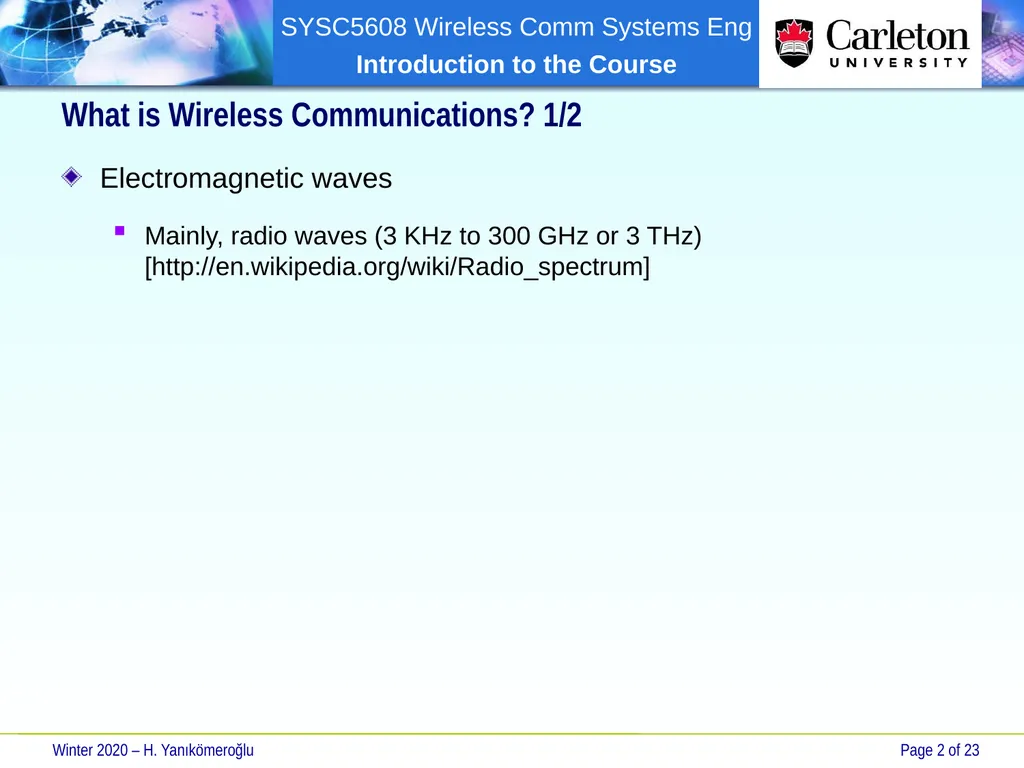
What is Wireless Communications? 1/2 Electromagnetic waves
Mainly, radio waves (3 KHz to 300 GHz or 3 THz) [http://en.wikipedia.org/wiki/Radio_spectrum]<br>
Mainly, radio waves (3 KHz to 300 GHz or 3 THz) [http://en.wikipedia.org/wiki/Radio_spectrum]<br>
03
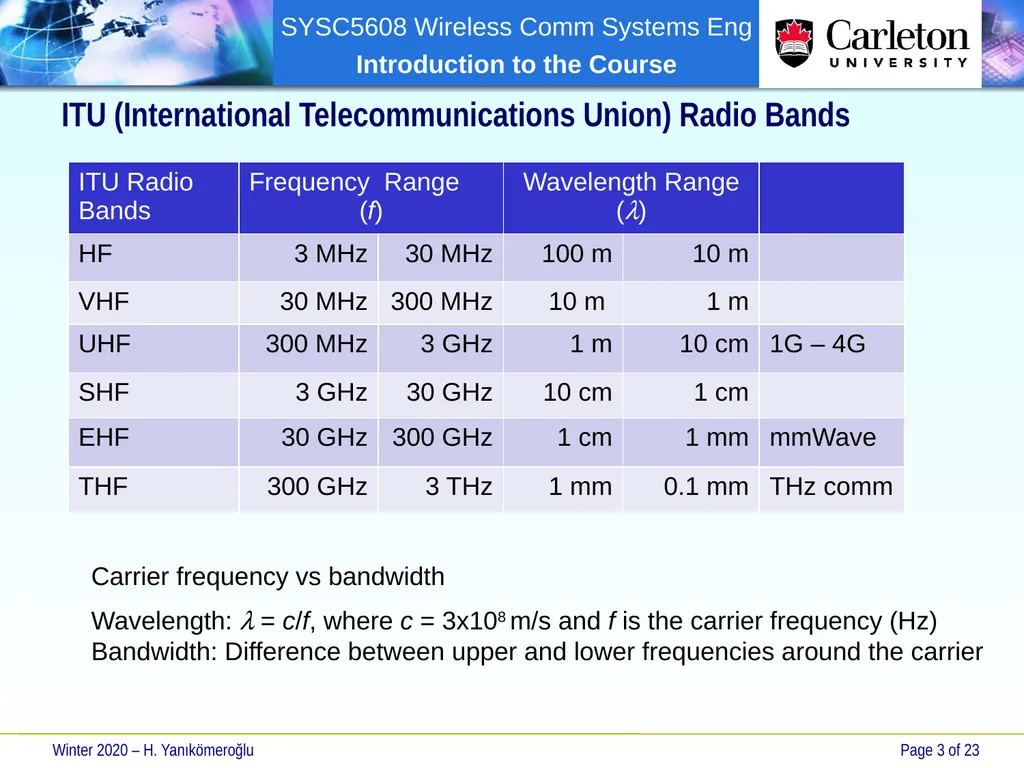
ITU (International Telecommunications Union) Radio Bands Carrier frequency vs bandwidth
Wavelength: l = c/f, where c = 3x10⁸ m/s and f is the carrier frequency (Hz)
Bandwidth: Difference between upper and lower frequencies around the carrier<br>
Wavelength: l = c/f, where c = 3x10⁸ m/s and f is the carrier frequency (Hz)
Bandwidth: Difference between upper and lower frequencies around the carrier<br>
04
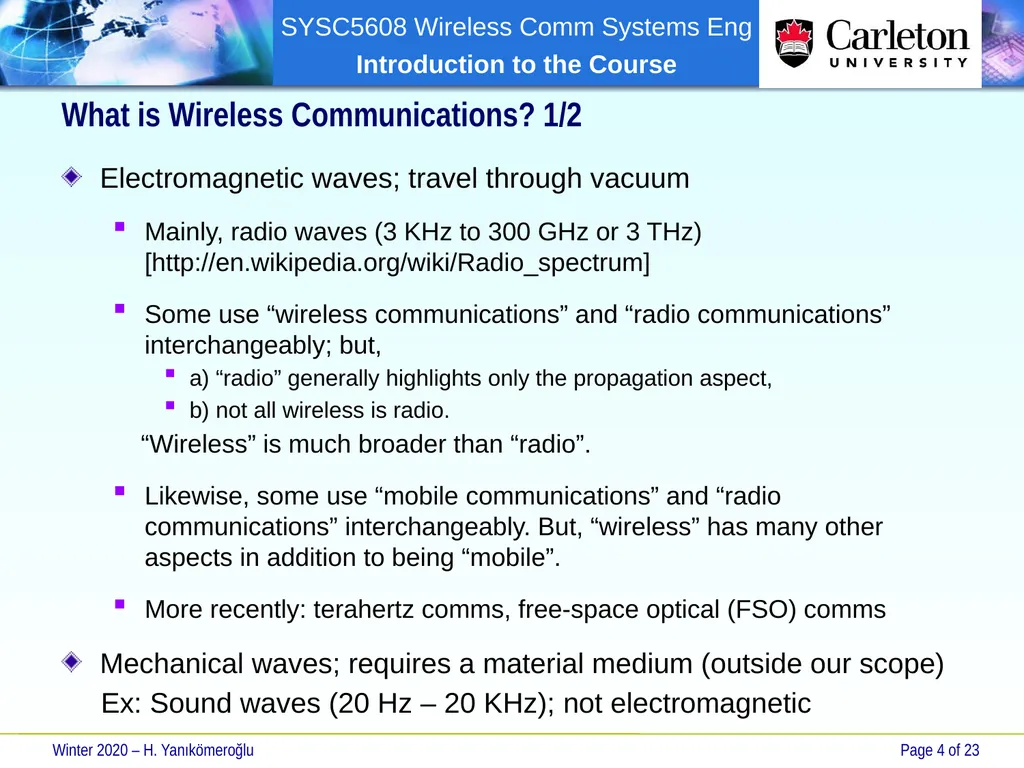
What is Wireless Communications? 1/2 Electromagnetic waves; travel through vacuum
Mainly, radio waves (3 KHz to 300 GHz or 3 THz) [http://en.wikipedia.org/wiki/Radio_spectrum]
Some use “wireless communications” and “radio communications” interchangeably; but,
a) “radio” generally highlights only the propagation aspect,
b) not all wireless is radio.
“Wireless” is much broader than “radio”.
Likewise, some use “mobile communications” and “radio communications” interchangeably. But, “wireless” has many other aspects in addition to being “mobile”.
More recently: terahertz comms, free-space optical (FSO) comms
Mechanical waves; requires a material medium (outside our scope)
Ex: Sound waves (20 Hz – 20 KHz); not electromagnetic<br>
Mainly, radio waves (3 KHz to 300 GHz or 3 THz) [http://en.wikipedia.org/wiki/Radio_spectrum]
Some use “wireless communications” and “radio communications” interchangeably; but,
a) “radio” generally highlights only the propagation aspect,
b) not all wireless is radio.
“Wireless” is much broader than “radio”.
Likewise, some use “mobile communications” and “radio communications” interchangeably. But, “wireless” has many other aspects in addition to being “mobile”.
More recently: terahertz comms, free-space optical (FSO) comms
Mechanical waves; requires a material medium (outside our scope)
Ex: Sound waves (20 Hz – 20 KHz); not electromagnetic<br>
05
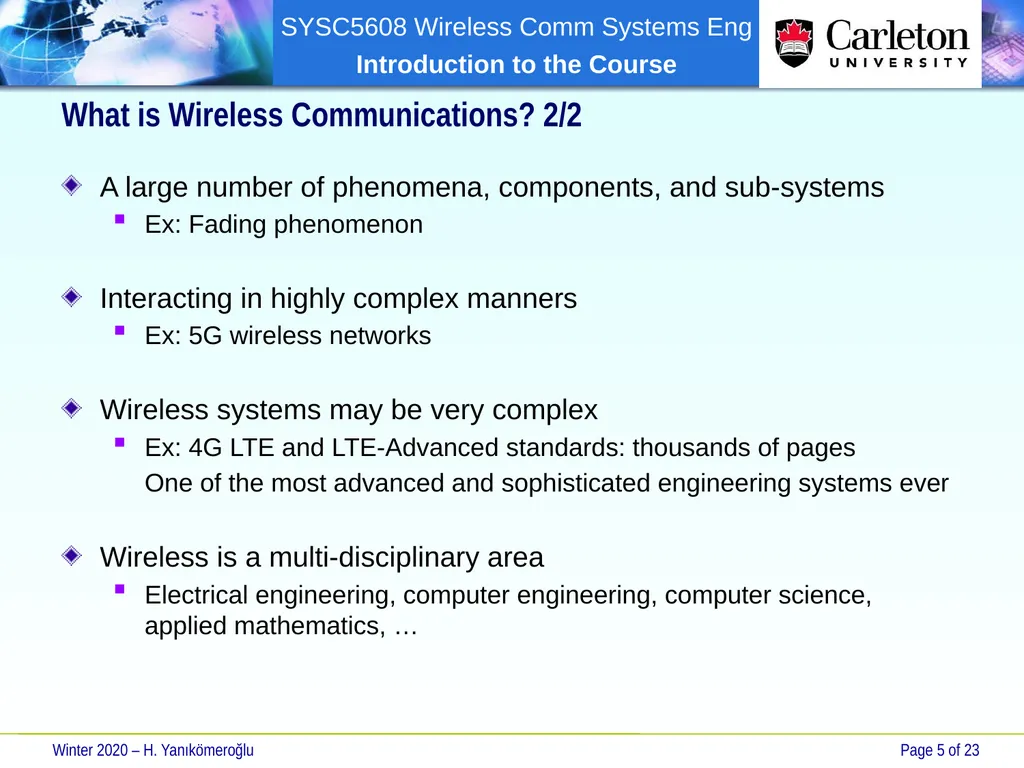
What is Wireless Communications? 2/2 A large number of phenomena, components, and sub-systems
Ex: Fading phenomenon
Interacting in highly complex manners
Ex: 5G wireless networks
Wireless systems may be very complex
Ex: 4G LTE and LTE-Advanced standards: thousands of pages
One of the most advanced and sophisticated engineering systems ever
Wireless is a multi-disciplinary area
Electrical engineering, computer engineering, computer science, applied mathematics, …<br>
Ex: Fading phenomenon
Interacting in highly complex manners
Ex: 5G wireless networks
Wireless systems may be very complex
Ex: 4G LTE and LTE-Advanced standards: thousands of pages
One of the most advanced and sophisticated engineering systems ever
Wireless is a multi-disciplinary area
Electrical engineering, computer engineering, computer science, applied mathematics, …<br>
06
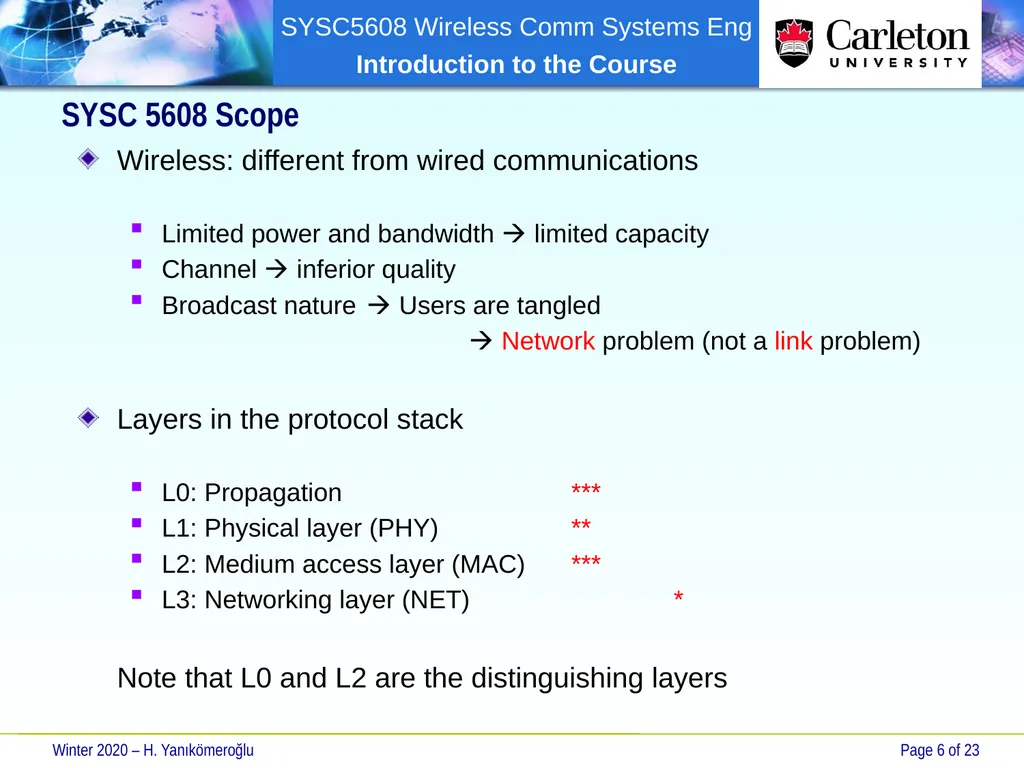
Wireless: different from wired communications
Limited power and bandwidth limited capacity
Channel inferior quality
Broadcast nature Users are tangled
Network problem (not a link problem)
Layers in the protocol stack
L0: Propagation ***
L1: Physical layer (PHY) **
L2: Medium access layer (MAC) ***
L3: Networking layer (NET) *
Note that L0 and L2 are the distinguishing layers SYSC 5608 Scope<br>
Limited power and bandwidth limited capacity
Channel inferior quality
Broadcast nature Users are tangled
Network problem (not a link problem)
Layers in the protocol stack
L0: Propagation ***
L1: Physical layer (PHY) **
L2: Medium access layer (MAC) ***
L3: Networking layer (NET) *
Note that L0 and L2 are the distinguishing layers SYSC 5608 Scope<br>
07
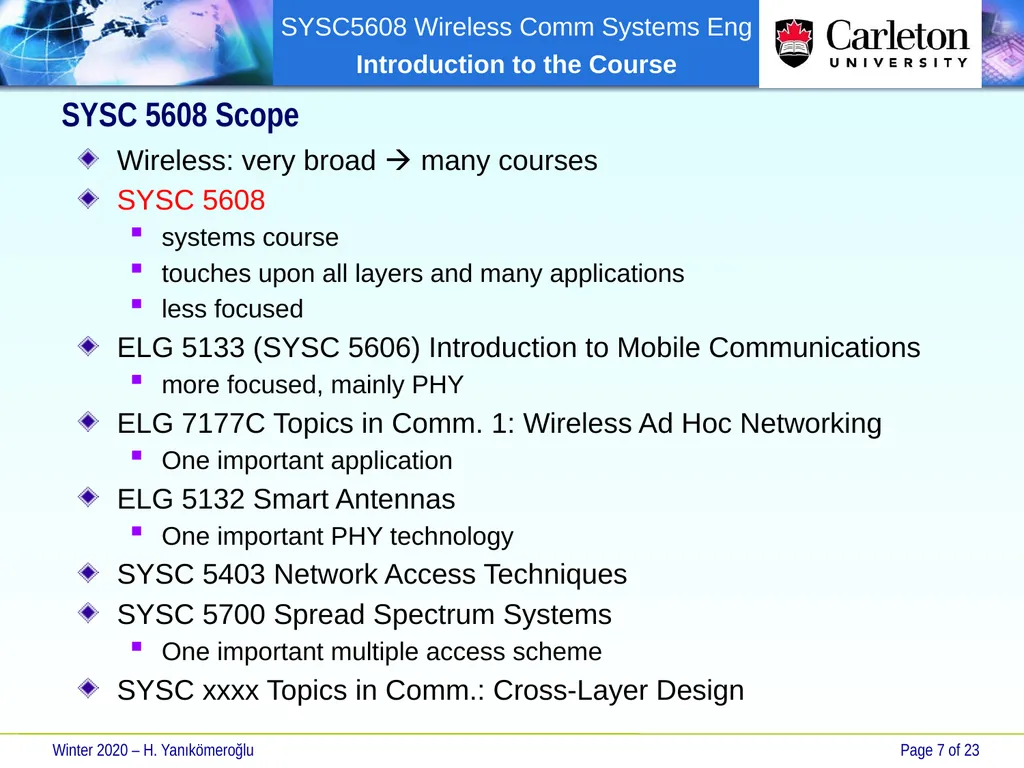
Wireless: very broad many courses
SYSC 5608
systems course
touches upon all layers and many applications
less focused
ELG 5133 (SYSC 5606) Introduction to Mobile Communications
more focused, mainly PHY
ELG 7177C Topics in Comm. 1: Wireless Ad Hoc Networking
One important application
ELG 5132 Smart Antennas
One important PHY technology
SYSC 5403 Network Access Techniques
SYSC 5700 Spread Spectrum Systems
One important multiple access scheme
SYSC xxxx Topics in Comm.: Cross-Layer Design SYSC 5608 Scope<br>
SYSC 5608
systems course
touches upon all layers and many applications
less focused
ELG 5133 (SYSC 5606) Introduction to Mobile Communications
more focused, mainly PHY
ELG 7177C Topics in Comm. 1: Wireless Ad Hoc Networking
One important application
ELG 5132 Smart Antennas
One important PHY technology
SYSC 5403 Network Access Techniques
SYSC 5700 Spread Spectrum Systems
One important multiple access scheme
SYSC xxxx Topics in Comm.: Cross-Layer Design SYSC 5608 Scope<br>
08
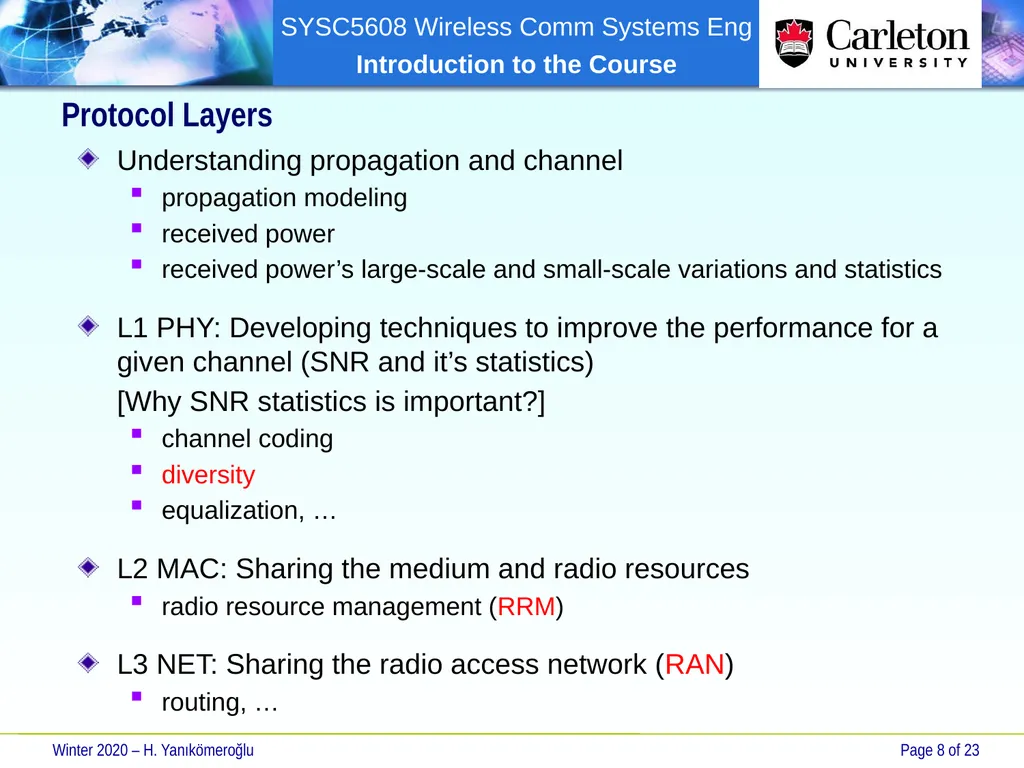
Understanding propagation and channel
propagation modeling
received power
received power’s large-scale and small-scale variations and statistics
L1 PHY: Developing techniques to improve the performance for a given channel (SNR and it’s statistics)
[Why SNR statistics is important?]
channel coding
diversity
equalization, …
L2 MAC: Sharing the medium and radio resources
radio resource management (RRM)
L3 NET: Sharing the radio access network (RAN)
routing, … Protocol Layers<br>
propagation modeling
received power
received power’s large-scale and small-scale variations and statistics
L1 PHY: Developing techniques to improve the performance for a given channel (SNR and it’s statistics)
[Why SNR statistics is important?]
channel coding
diversity
equalization, …
L2 MAC: Sharing the medium and radio resources
radio resource management (RRM)
L3 NET: Sharing the radio access network (RAN)
routing, … Protocol Layers<br>
09
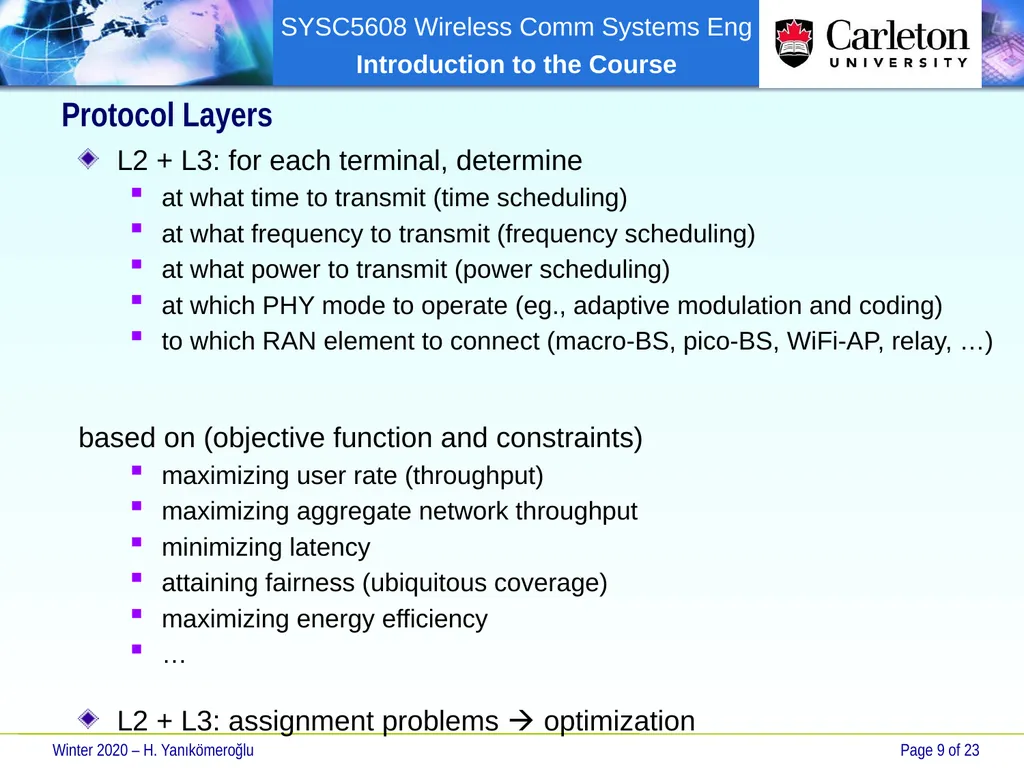
L2 + L3: for each terminal, determine
at what time to transmit (time scheduling)
at what frequency to transmit (frequency scheduling)
at what power to transmit (power scheduling)
at which PHY mode to operate (eg., adaptive modulation and coding)
to which RAN element to connect (macro-BS, pico-BS, WiFi-AP, relay, …)
based on (objective function and constraints)
maximizing user rate (throughput)
maximizing aggregate network throughput
minimizing latency
attaining fairness (ubiquitous coverage)
maximizing energy efficiency
…
L2 + L3: assignment problems optimization Protocol Layers<br>
at what time to transmit (time scheduling)
at what frequency to transmit (frequency scheduling)
at what power to transmit (power scheduling)
at which PHY mode to operate (eg., adaptive modulation and coding)
to which RAN element to connect (macro-BS, pico-BS, WiFi-AP, relay, …)
based on (objective function and constraints)
maximizing user rate (throughput)
maximizing aggregate network throughput
minimizing latency
attaining fairness (ubiquitous coverage)
maximizing energy efficiency
…
L2 + L3: assignment problems optimization Protocol Layers<br>
10
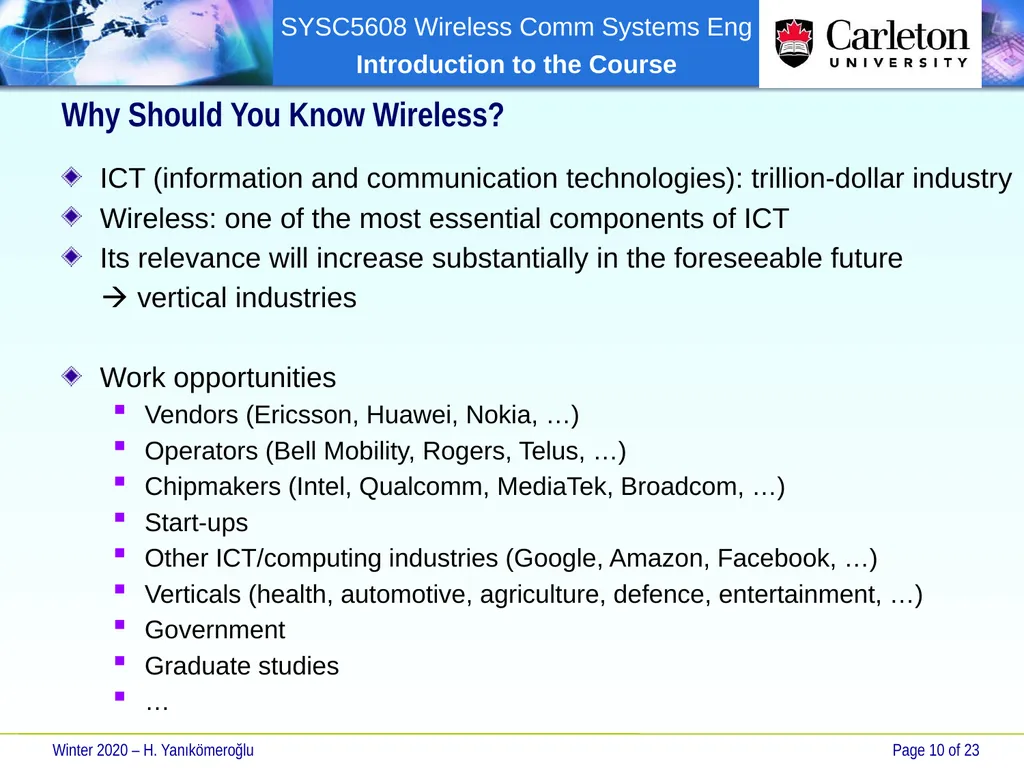
Why Should You Know Wireless? ICT (information and communication technologies): trillion-dollar industry
Wireless: one of the most essential components of ICT
Its relevance will increase substantially in the foreseeable future
vertical industries
Work opportunities
Vendors (Ericsson, Huawei, Nokia, …)
Operators (Bell Mobility, Rogers, Telus, …)
Chipmakers (Intel, Qualcomm, MediaTek, Broadcom, …)
Start-ups
Other ICT/computing industries (Google, Amazon, Facebook, …)
Verticals (health, automotive, agriculture, defence, entertainment, …)
Government
Graduate studies
…<br>
Wireless: one of the most essential components of ICT
Its relevance will increase substantially in the foreseeable future
vertical industries
Work opportunities
Vendors (Ericsson, Huawei, Nokia, …)
Operators (Bell Mobility, Rogers, Telus, …)
Chipmakers (Intel, Qualcomm, MediaTek, Broadcom, …)
Start-ups
Other ICT/computing industries (Google, Amazon, Facebook, …)
Verticals (health, automotive, agriculture, defence, entertainment, …)
Government
Graduate studies
…<br>
11
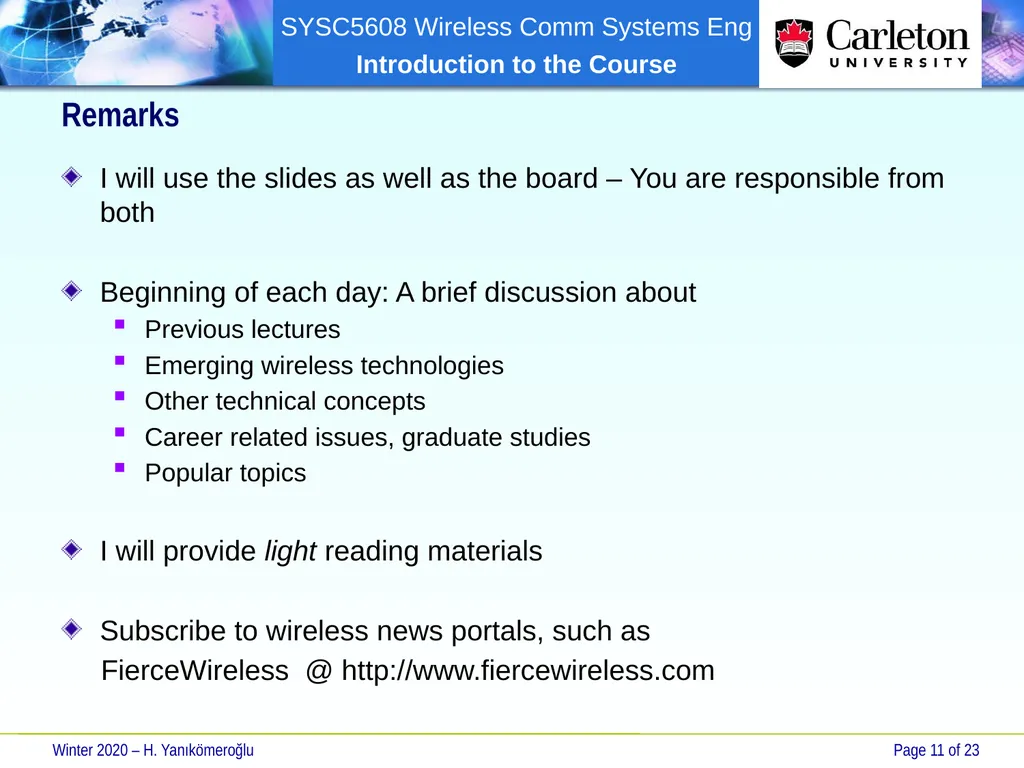
Remarks I will use the slides as well as the board – You are responsible from both
Beginning of each day: A brief discussion about
Previous lectures
Emerging wireless technologies
Other technical concepts
Career related issues, graduate studies
Popular topics
I will provide light reading materials
Subscribe to wireless news portals, such as
FierceWireless @ http://www.fiercewireless.com<br>
Beginning of each day: A brief discussion about
Previous lectures
Emerging wireless technologies
Other technical concepts
Career related issues, graduate studies
Popular topics
I will provide light reading materials
Subscribe to wireless news portals, such as
FierceWireless @ http://www.fiercewireless.com<br>
12
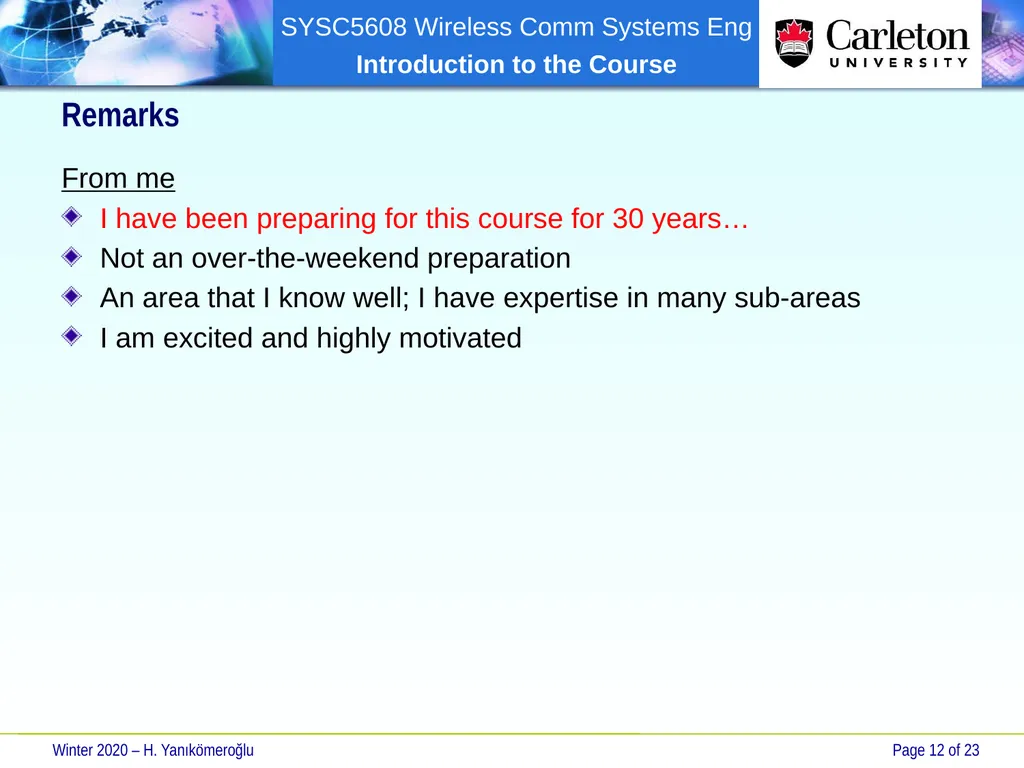
Remarks From me
I have been preparing for this course for 30 years…
Not an over-the-weekend preparation
An area that I know well; I have expertise in many sub-areas
I am excited and highly motivated<br>
I have been preparing for this course for 30 years…
Not an over-the-weekend preparation
An area that I know well; I have expertise in many sub-areas
I am excited and highly motivated<br>
13
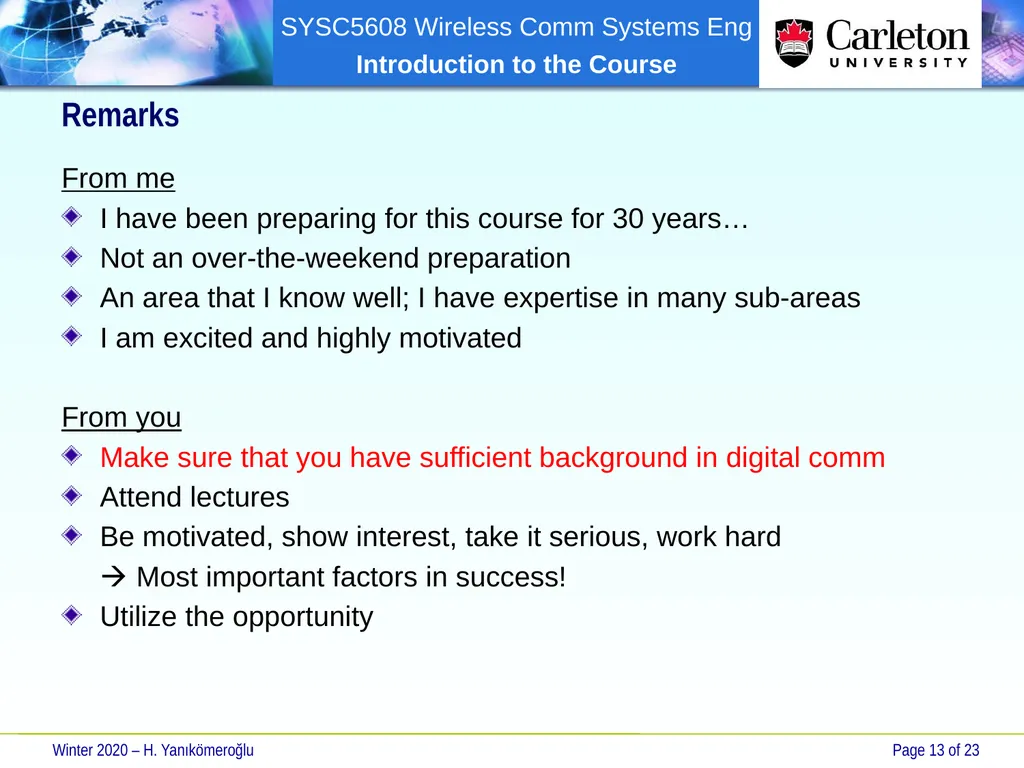
Remarks From me
I have been preparing for this course for 30 years…
Not an over-the-weekend preparation
An area that I know well; I have expertise in many sub-areas
I am excited and highly motivated
From you
Make sure that you have sufficient background in digital comm
Attend lectures
Be motivated, show interest, take it serious, work hard
Most important factors in success!
Utilize the opportunity<br>
I have been preparing for this course for 30 years…
Not an over-the-weekend preparation
An area that I know well; I have expertise in many sub-areas
I am excited and highly motivated
From you
Make sure that you have sufficient background in digital comm
Attend lectures
Be motivated, show interest, take it serious, work hard
Most important factors in success!
Utilize the opportunity<br>
14
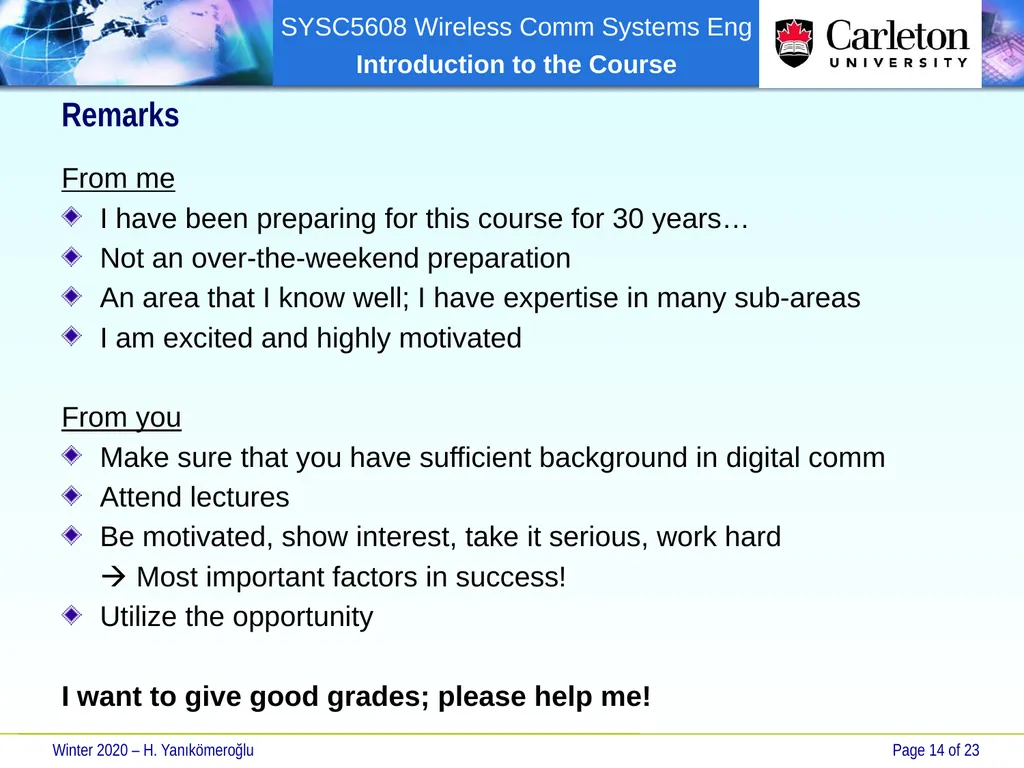
Remarks From me
I have been preparing for this course for 30 years…
Not an over-the-weekend preparation
An area that I know well; I have expertise in many sub-areas
I am excited and highly motivated
From you
Make sure that you have sufficient background in digital comm
Attend lectures
Be motivated, show interest, take it serious, work hard
Most important factors in success!
Utilize the opportunity
I want to give good grades; please help me!<br>
I have been preparing for this course for 30 years…
Not an over-the-weekend preparation
An area that I know well; I have expertise in many sub-areas
I am excited and highly motivated
From you
Make sure that you have sufficient background in digital comm
Attend lectures
Be motivated, show interest, take it serious, work hard
Most important factors in success!
Utilize the opportunity
I want to give good grades; please help me!<br>
15
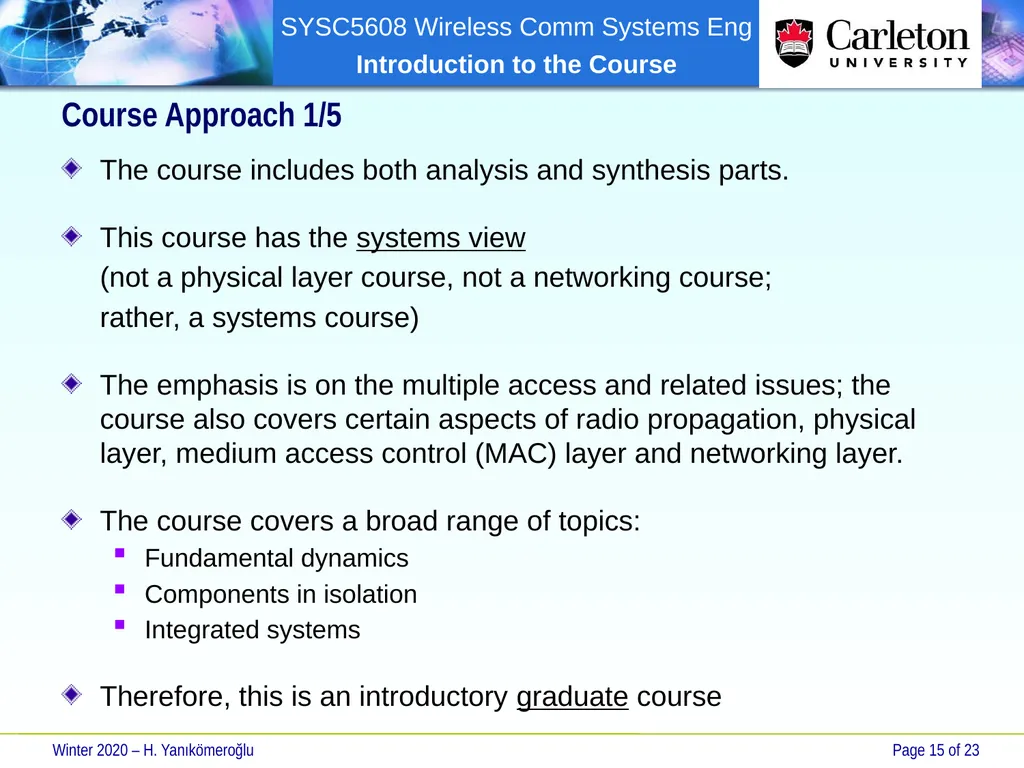
Course Approach 1/5 The course includes both analysis and synthesis parts.
This course has the systems view
(not a physical layer course, not a networking course;
rather, a systems course)
The emphasis is on the multiple access and related issues; the course also covers certain aspects of radio propagation, physical layer, medium access control (MAC) layer and networking layer.
The course covers a broad range of topics:
Fundamental dynamics
Components in isolation
Integrated systems
Therefore, this is an introductory graduate course<br>
This course has the systems view
(not a physical layer course, not a networking course;
rather, a systems course)
The emphasis is on the multiple access and related issues; the course also covers certain aspects of radio propagation, physical layer, medium access control (MAC) layer and networking layer.
The course covers a broad range of topics:
Fundamental dynamics
Components in isolation
Integrated systems
Therefore, this is an introductory graduate course<br>
16
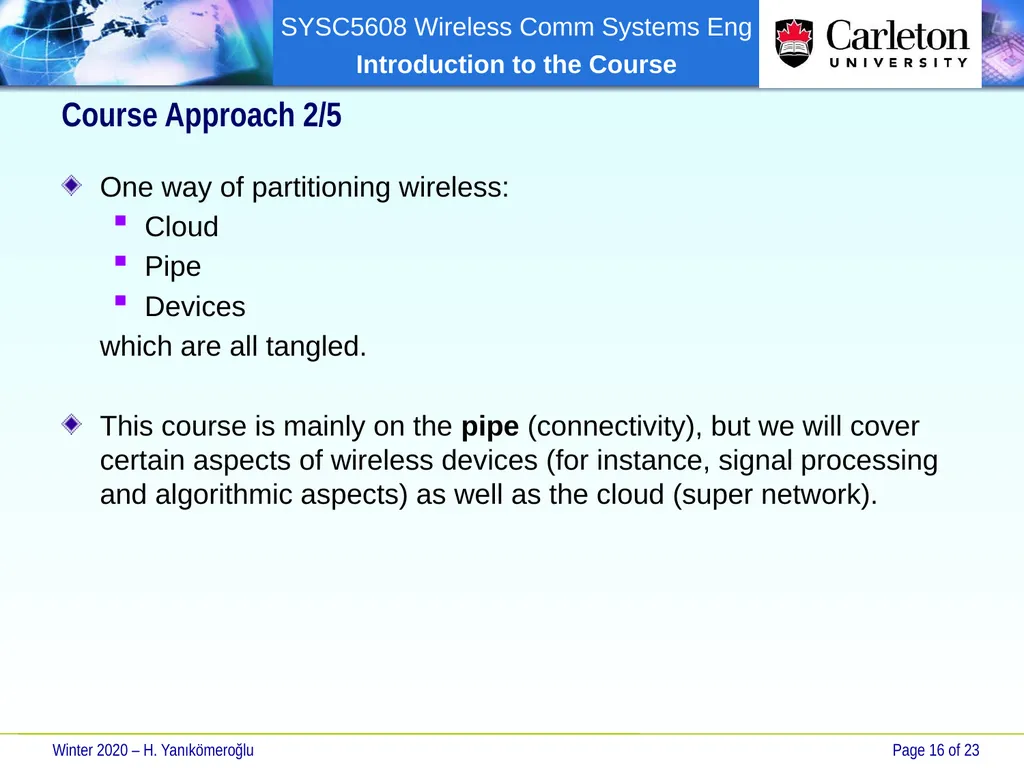
Course Approach 2/5 One way of partitioning wireless:
Cloud
Pipe
Devices
which are all tangled.
This course is mainly on the pipe (connectivity), but we will cover certain aspects of wireless devices (for instance, signal processing and algorithmic aspects) as well as the cloud (super network).<br>
Cloud
Pipe
Devices
which are all tangled.
This course is mainly on the pipe (connectivity), but we will cover certain aspects of wireless devices (for instance, signal processing and algorithmic aspects) as well as the cloud (super network).<br>
17
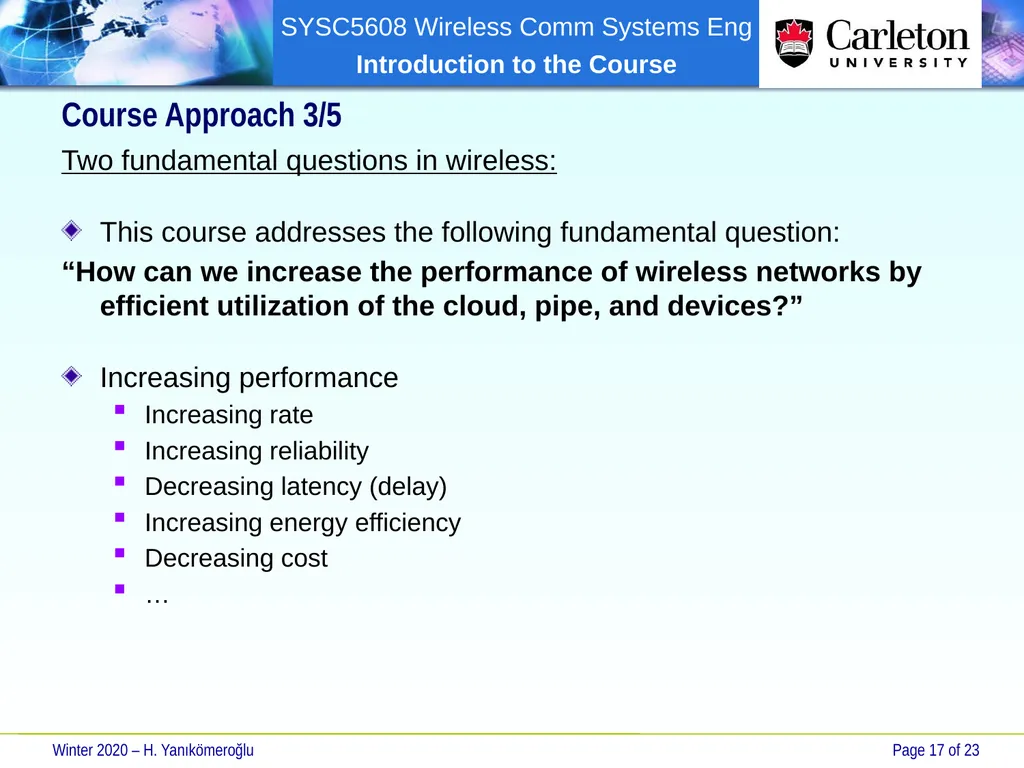
Course Approach 3/5 Two fundamental questions in wireless:
This course addresses the following fundamental question:
“How can we increase the performance of wireless networks by efficient utilization of the cloud, pipe, and devices?”
Increasing performance
Increasing rate
Increasing reliability
Decreasing latency (delay)
Increasing energy efficiency
Decreasing cost
…<br>
This course addresses the following fundamental question:
“How can we increase the performance of wireless networks by efficient utilization of the cloud, pipe, and devices?”
Increasing performance
Increasing rate
Increasing reliability
Decreasing latency (delay)
Increasing energy efficiency
Decreasing cost
…<br>
18
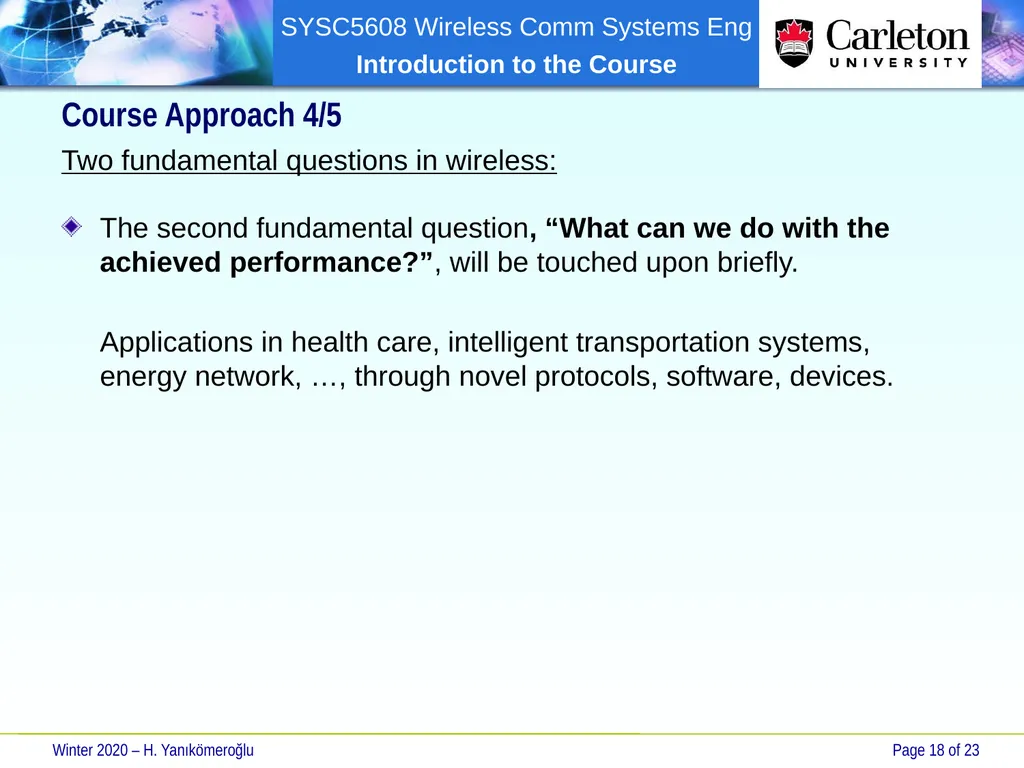
Course Approach 4/5 Two fundamental questions in wireless:
The second fundamental question, “What can we do with the achieved performance?”, will be touched upon briefly.
Applications in health care, intelligent transportation systems, energy network, …, through novel protocols, software, devices.<br>
The second fundamental question, “What can we do with the achieved performance?”, will be touched upon briefly.
Applications in health care, intelligent transportation systems, energy network, …, through novel protocols, software, devices.<br>
19
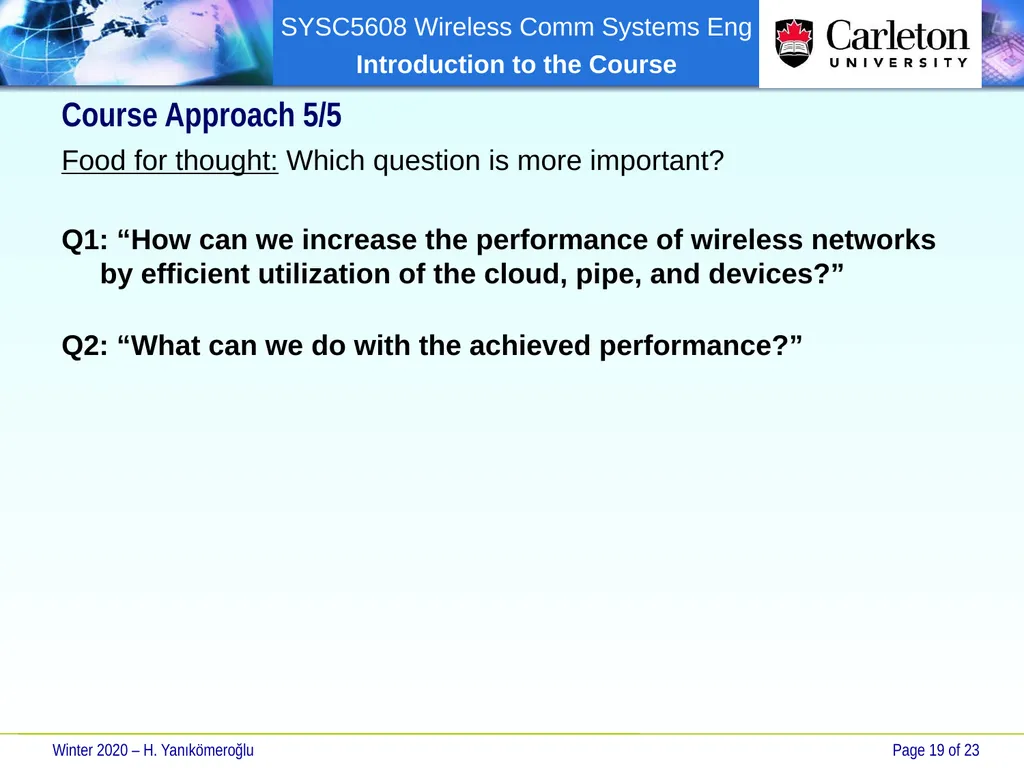
Course Approach 5/5 Food for thought: Which question is more important?
Q1: “How can we increase the performance of wireless networks by efficient utilization of the cloud, pipe, and devices?”
Q2: “What can we do with the achieved performance?”<br>
Q1: “How can we increase the performance of wireless networks by efficient utilization of the cloud, pipe, and devices?”
Q2: “What can we do with the achieved performance?”<br>
20
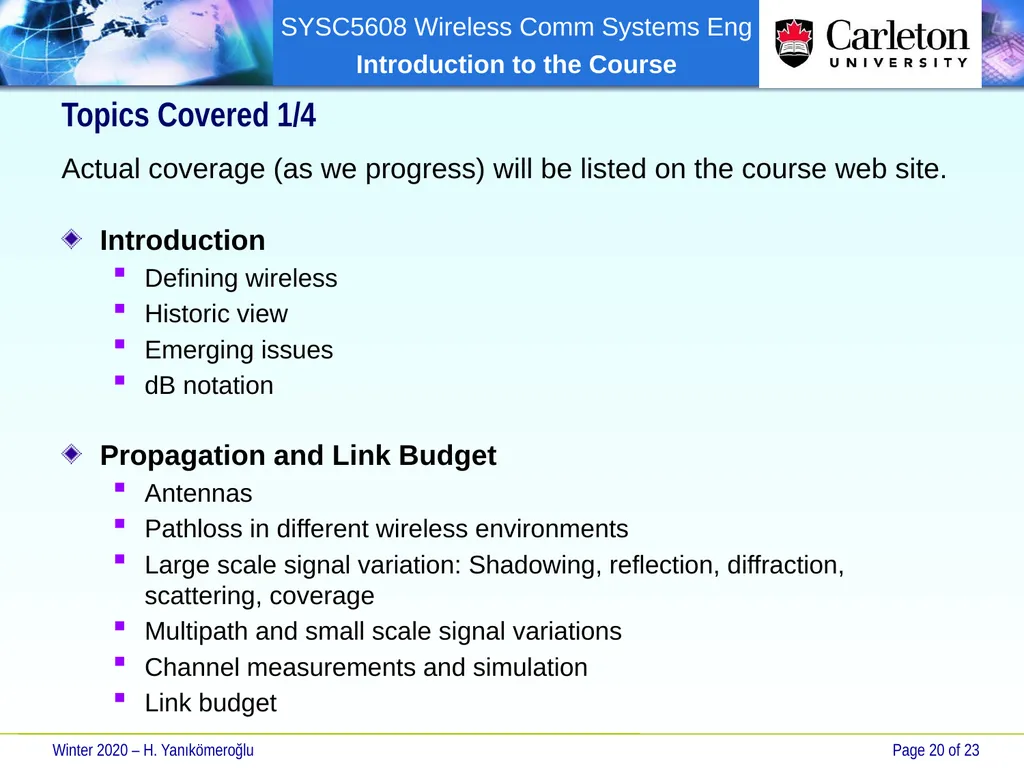
Topics Covered 1/4 Actual coverage (as we progress) will be listed on the course web site.
Introduction
Defining wireless
Historic view
Emerging issues
dB notation
Propagation and Link Budget
Antennas
Pathloss in different wireless environments
Large scale signal variation: Shadowing, reflection, diffraction, scattering, coverage
Multipath and small scale signal variations
Channel measurements and simulation
Link budget<br>
Introduction
Defining wireless
Historic view
Emerging issues
dB notation
Propagation and Link Budget
Antennas
Pathloss in different wireless environments
Large scale signal variation: Shadowing, reflection, diffraction, scattering, coverage
Multipath and small scale signal variations
Channel measurements and simulation
Link budget<br>
21
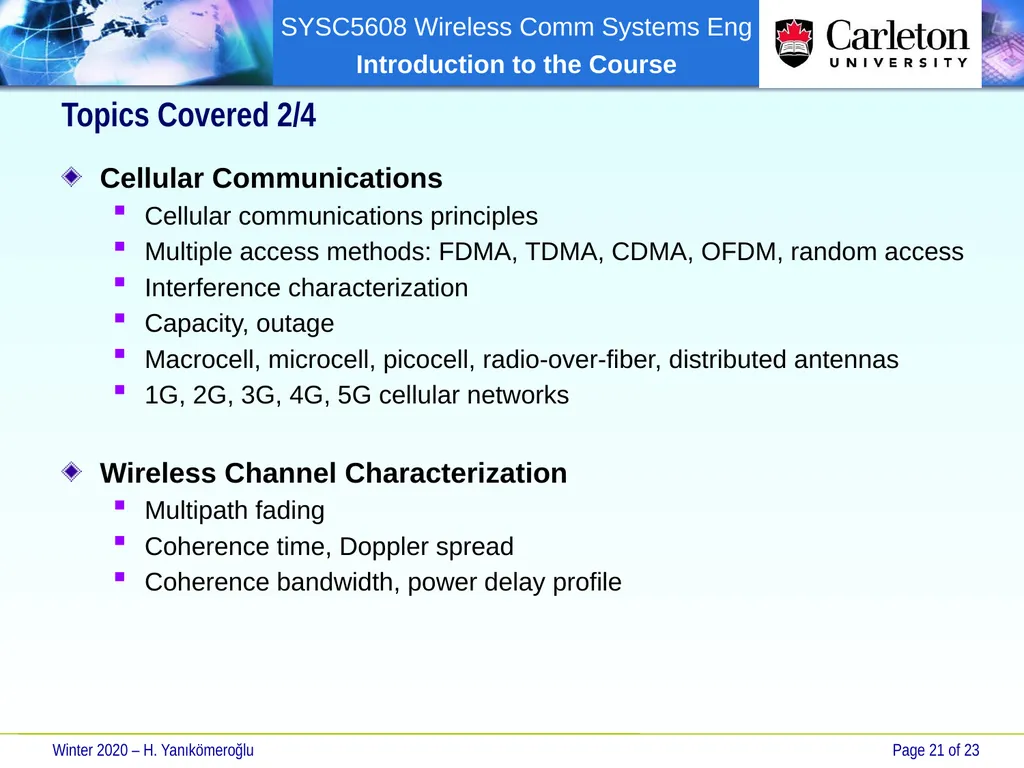
Topics Covered 2/4 Cellular Communications
Cellular communications principles
Multiple access methods: FDMA, TDMA, CDMA, OFDM, random access
Interference characterization
Capacity, outage
Macrocell, microcell, picocell, radio-over-fiber, distributed antennas
1G, 2G, 3G, 4G, 5G cellular networks
Wireless Channel Characterization
Multipath fading
Coherence time, Doppler spread
Coherence bandwidth, power delay profile<br>
Cellular communications principles
Multiple access methods: FDMA, TDMA, CDMA, OFDM, random access
Interference characterization
Capacity, outage
Macrocell, microcell, picocell, radio-over-fiber, distributed antennas
1G, 2G, 3G, 4G, 5G cellular networks
Wireless Channel Characterization
Multipath fading
Coherence time, Doppler spread
Coherence bandwidth, power delay profile<br>
22
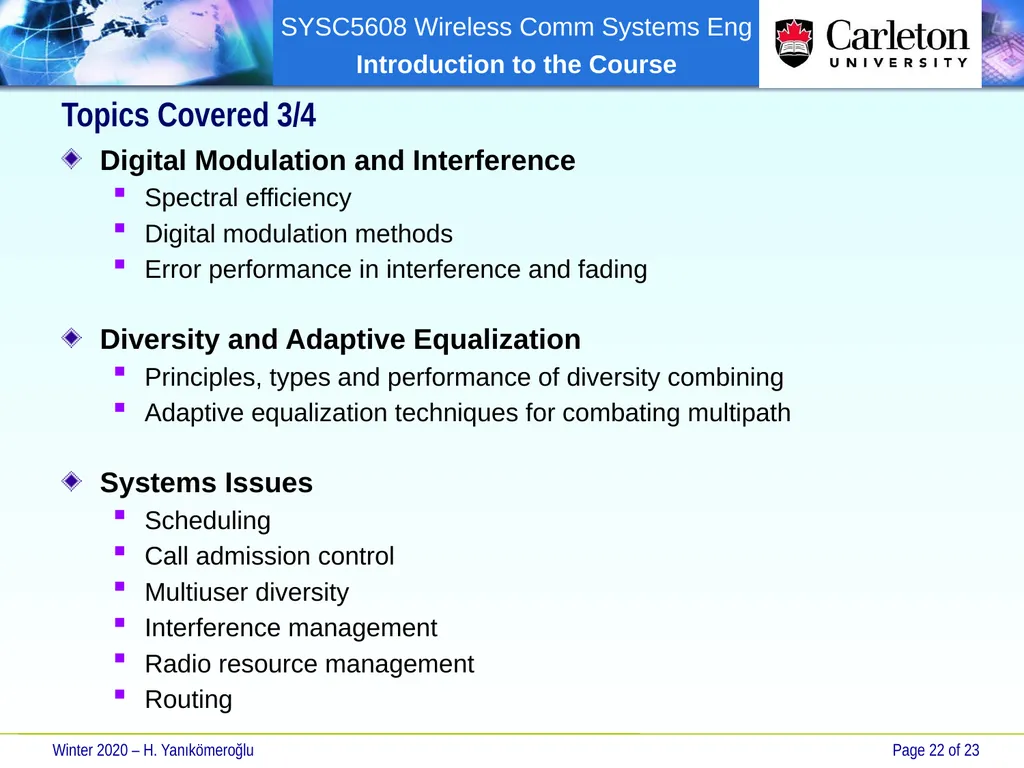
Topics Covered 3/4 Digital Modulation and Interference
Spectral efficiency
Digital modulation methods
Error performance in interference and fading
Diversity and Adaptive Equalization
Principles, types and performance of diversity combining
Adaptive equalization techniques for combating multipath
Systems Issues
Scheduling
Call admission control
Multiuser diversity
Interference management
Radio resource management
Routing<br>
Spectral efficiency
Digital modulation methods
Error performance in interference and fading
Diversity and Adaptive Equalization
Principles, types and performance of diversity combining
Adaptive equalization techniques for combating multipath
Systems Issues
Scheduling
Call admission control
Multiuser diversity
Interference management
Radio resource management
Routing<br>
23
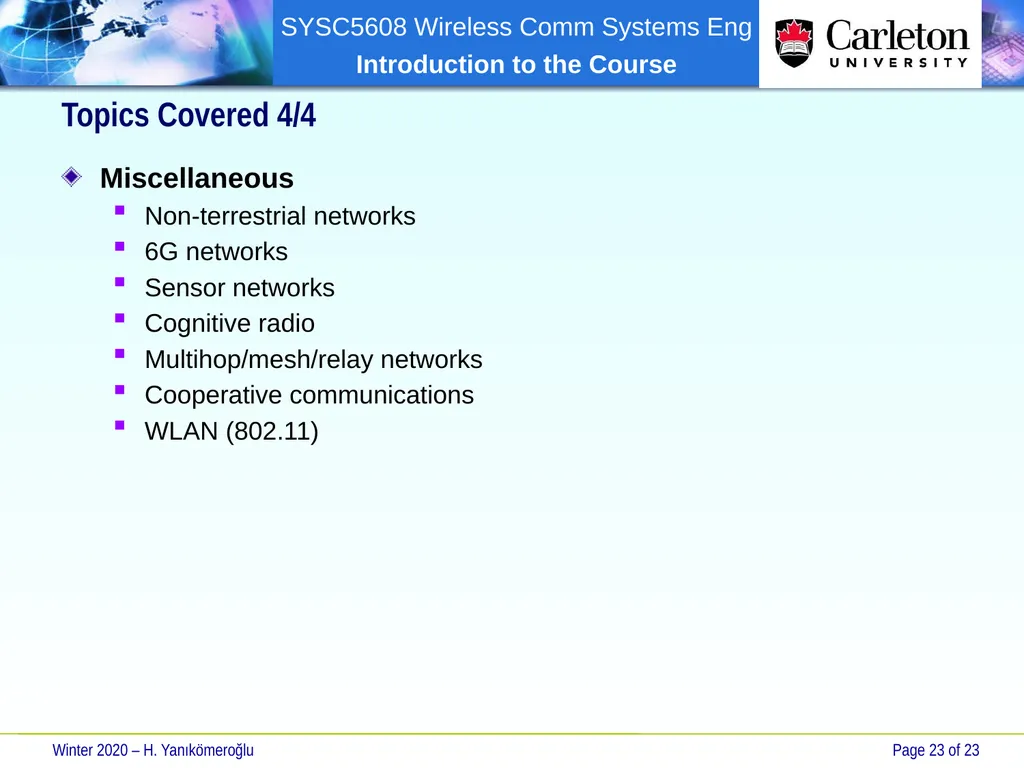
Topics Covered 4/4 Miscellaneous
Non-terrestrial networks
6G networks
Sensor networks
Cognitive radio
Multihop/mesh/relay networks
Cooperative communications
WLAN (802.11)<br>
Non-terrestrial networks
6G networks
Sensor networks
Cognitive radio
Multihop/mesh/relay networks
Cooperative communications
WLAN (802.11)<br>