
System-wide Action Plan for implementation of the
GB
Published · 30 slides · 0 views
1 / 1
Description
System-wide Action Plan for implementation of the CEB Policy on gender equality and the empowerment of women September2013 2 Part 1 What is the UN SWAP? Brief Overview On 13 April 2012 the UN-SWAP was adopted at a meeting of the United
Related Topics
Share
Embed code
Download this presentation From Below
"System-wide Action Plan for implementation of the" is the property of its rightful owner. Permission is granted to download and print the materials on this website for personal, non-commercial use only, and to display it on your personal computer provided you do not modify the materials and that you retain all copyright notices contained in the materials. By downloading content from our website, you accept the terms of this agreement.
Presentation Transcript
01
System-wide Action Plan for implementation of the CEB Policy on gender equality and the empowerment of women September2013<br>
02
2 Part 1
What is the UN SWAP?<br>
What is the UN SWAP?<br>
03
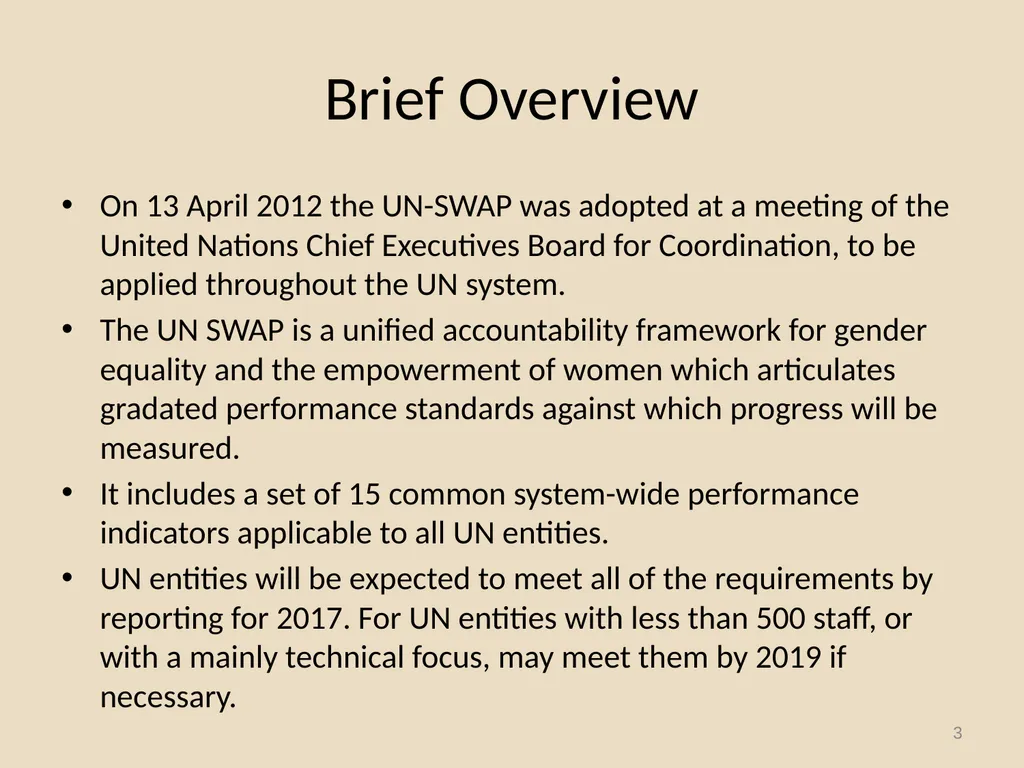
Brief Overview On 13 April 2012 the UN-SWAP was adopted at a meeting of the United Nations Chief Executives Board for Coordination, to be applied throughout the UN system.
The UN SWAP is a unified accountability framework for gender equality and the empowerment of women which articulates gradated performance standards against which progress will be measured.
It includes a set of 15 common system-wide performance indicators applicable to all UN entities.
UN entities will be expected to meet all of the requirements by reporting for 2017. For UN entities with less than 500 staff, or with a mainly technical focus, may meet them by 2019 if necessary. 3<br>
The UN SWAP is a unified accountability framework for gender equality and the empowerment of women which articulates gradated performance standards against which progress will be measured.
It includes a set of 15 common system-wide performance indicators applicable to all UN entities.
UN entities will be expected to meet all of the requirements by reporting for 2017. For UN entities with less than 500 staff, or with a mainly technical focus, may meet them by 2019 if necessary. 3<br>
04
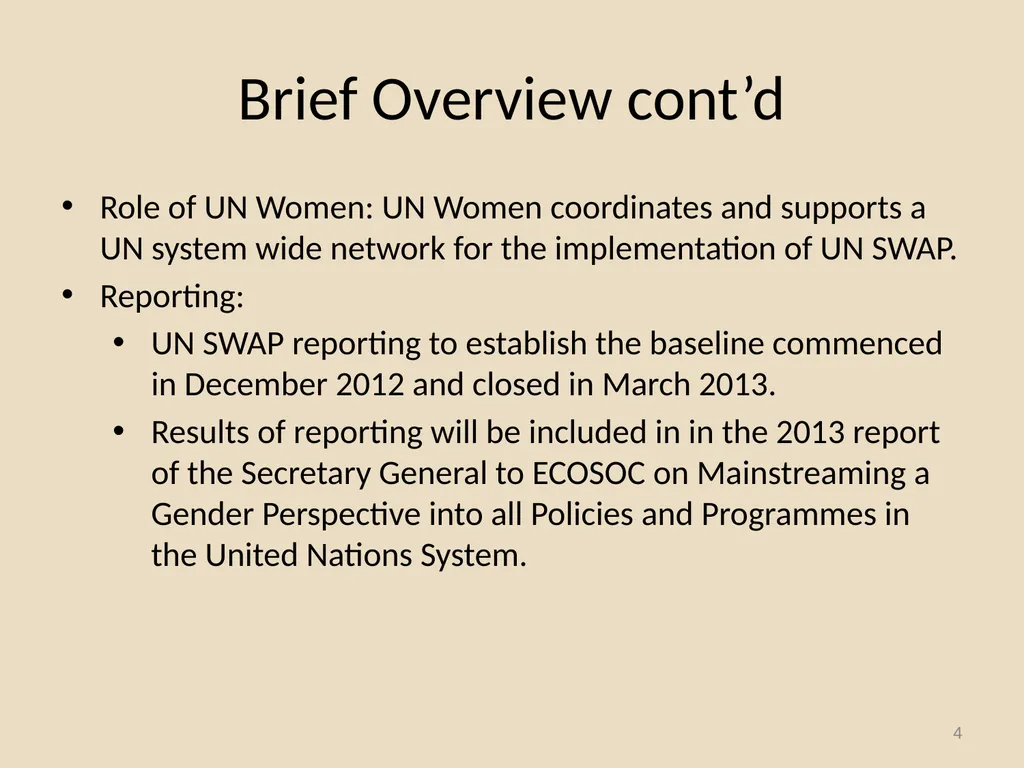
Brief Overview cont’d Role of UN Women: UN Women coordinates and supports a UN system wide network for the implementation of UN SWAP.
Reporting:
UN SWAP reporting to establish the baseline commenced in December 2012 and closed in March 2013.
Results of reporting will be included in in the 2013 report of the Secretary General to ECOSOC on Mainstreaming a Gender Perspective into all Policies and Programmes in the United Nations System. 4<br>
Reporting:
UN SWAP reporting to establish the baseline commenced in December 2012 and closed in March 2013.
Results of reporting will be included in in the 2013 report of the Secretary General to ECOSOC on Mainstreaming a Gender Perspective into all Policies and Programmes in the United Nations System. 4<br>
05
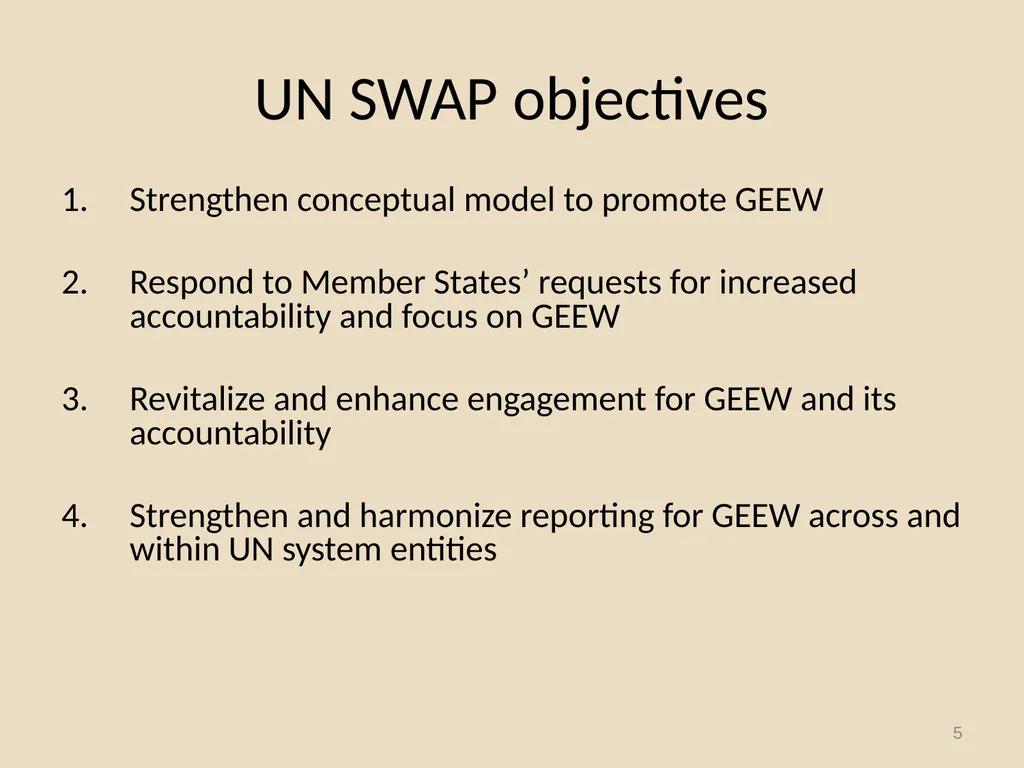
UN SWAP objectives Strengthen conceptual model to promote GEEW
Respond to Member States’ requests for increased accountability and focus on GEEW
Revitalize and enhance engagement for GEEW and its accountability
Strengthen and harmonize reporting for GEEW across and within UN system entities 5<br>
Respond to Member States’ requests for increased accountability and focus on GEEW
Revitalize and enhance engagement for GEEW and its accountability
Strengthen and harmonize reporting for GEEW across and within UN system entities 5<br>
06
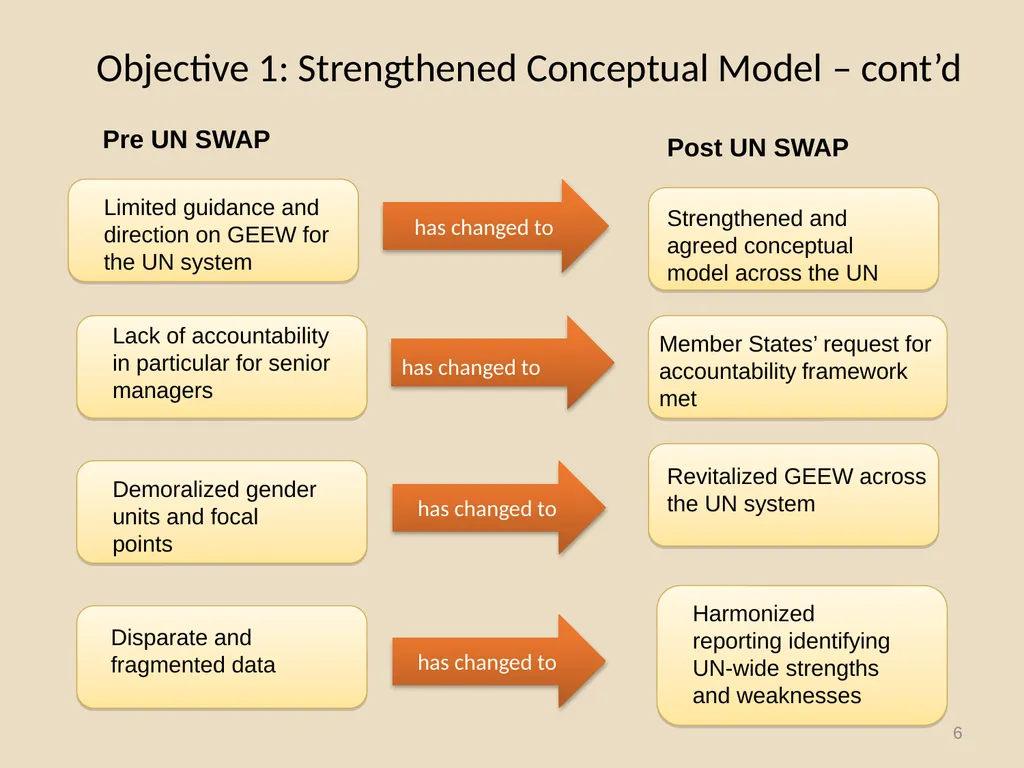
Objective 1: Strengthened Conceptual Model – cont’d 6 has changed to Strengthened and agreed conceptual model across the UN has changed to Lack of accountability in particular for senior managers Member States’ request for accountability framework
met Demoralized gender units and focal points Revitalized GEEW across the UN system Limited guidance and direction on GEEW for the UN system has changed to Harmonized reporting identifying UN-wide strengths and weaknesses Disparate and fragmented data has changed to Pre UN SWAP Post UN SWAP<br>
met Demoralized gender units and focal points Revitalized GEEW across the UN system Limited guidance and direction on GEEW for the UN system has changed to Harmonized reporting identifying UN-wide strengths and weaknesses Disparate and fragmented data has changed to Pre UN SWAP Post UN SWAP<br>
07
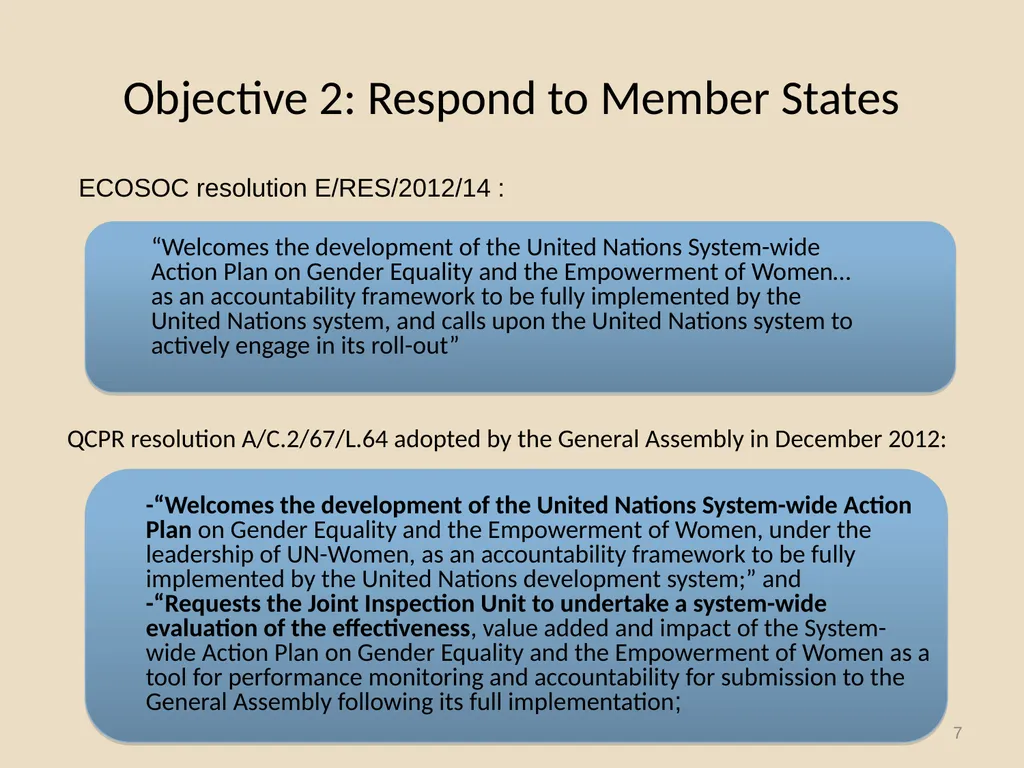
Objective 2: Respond to Member States QCPR resolution A/C.2/67/L.64 adopted by the General Assembly in December 2012: 7 “Welcomes the development of the United Nations System-wide Action Plan on Gender Equality and the Empowerment of Women… as an accountability framework to be fully implemented by the United Nations system, and calls upon the United Nations system to actively engage in its roll-out” ECOSOC resolution E/RES/2012/14 : -“Welcomes the development of the United Nations System-wide Action Plan on Gender Equality and the Empowerment of Women, under the leadership of UN-Women, as an accountability framework to be fully implemented by the United Nations development system;” and
-“Requests the Joint Inspection Unit to undertake a system-wide evaluation of the effectiveness, value added and impact of the System-wide Action Plan on Gender Equality and the Empowerment of Women as a tool for performance monitoring and accountability for submission to the General Assembly following its full implementation;<br>
-“Requests the Joint Inspection Unit to undertake a system-wide evaluation of the effectiveness, value added and impact of the System-wide Action Plan on Gender Equality and the Empowerment of Women as a tool for performance monitoring and accountability for submission to the General Assembly following its full implementation;<br>
08
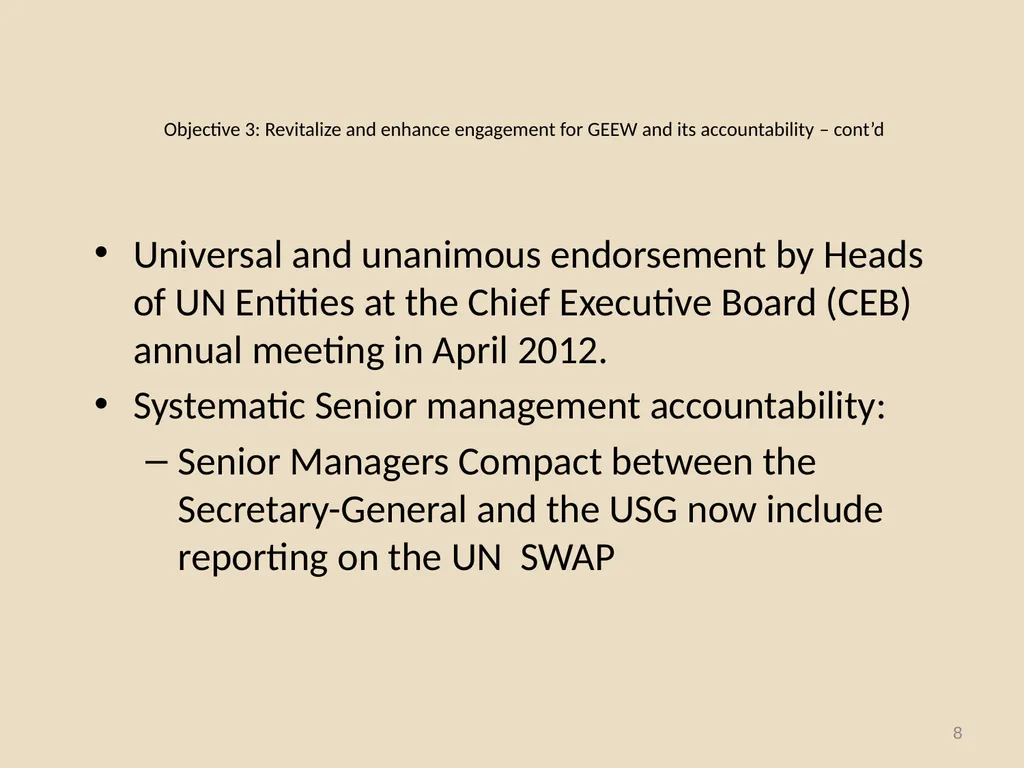
Objective 3: Revitalize and enhance engagement for GEEW and its accountability – cont’d Universal and unanimous endorsement by Heads of UN Entities at the Chief Executive Board (CEB) annual meeting in April 2012.
Systematic Senior management accountability:
Senior Managers Compact between the Secretary-General and the USG now include reporting on the UN SWAP 8<br>
Systematic Senior management accountability:
Senior Managers Compact between the Secretary-General and the USG now include reporting on the UN SWAP 8<br>
09
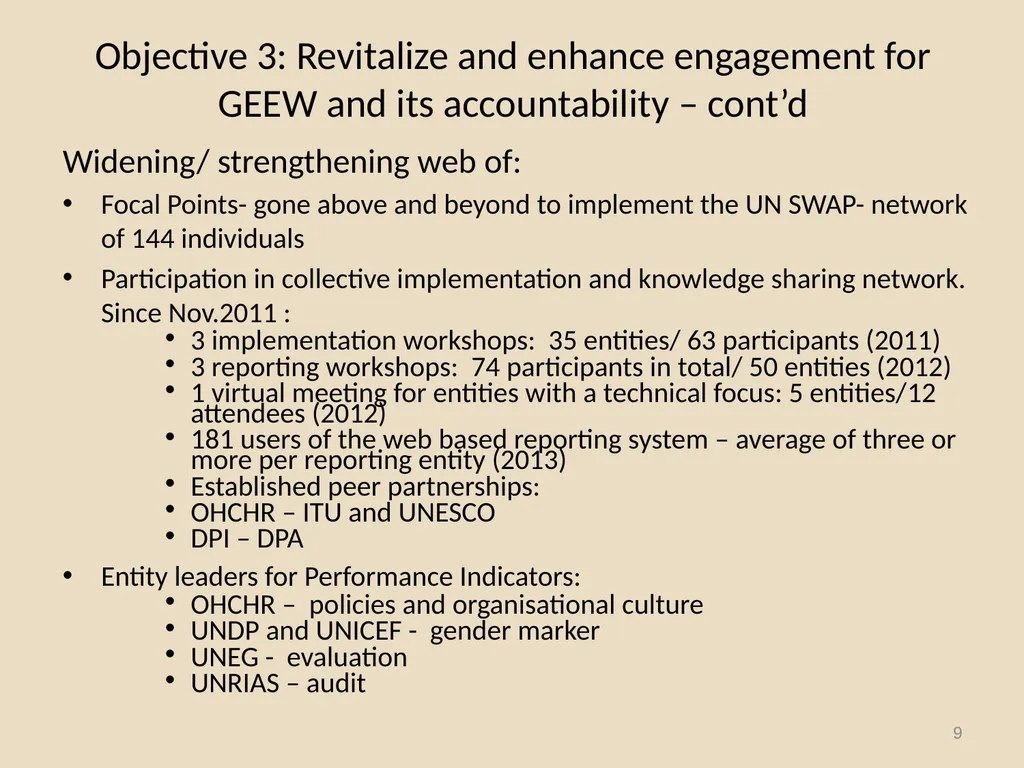
Objective 3: Revitalize and enhance engagement for GEEW and its accountability – cont’d Widening/ strengthening web of:
Focal Points- gone above and beyond to implement the UN SWAP- network of 144 individuals
Participation in collective implementation and knowledge sharing network. Since Nov.2011 :
3 implementation workshops: 35 entities/ 63 participants (2011)
3 reporting workshops: 74 participants in total/ 50 entities (2012)
1 virtual meeting for entities with a technical focus: 5 entities/12 attendees (2012)
181 users of the web based reporting system – average of three or more per reporting entity (2013)
Established peer partnerships:
OHCHR – ITU and UNESCO
DPI – DPA
Entity leaders for Performance Indicators:
OHCHR – policies and organisational culture
UNDP and UNICEF - gender marker
UNEG - evaluation
UNRIAS – audit 9<br>
Focal Points- gone above and beyond to implement the UN SWAP- network of 144 individuals
Participation in collective implementation and knowledge sharing network. Since Nov.2011 :
3 implementation workshops: 35 entities/ 63 participants (2011)
3 reporting workshops: 74 participants in total/ 50 entities (2012)
1 virtual meeting for entities with a technical focus: 5 entities/12 attendees (2012)
181 users of the web based reporting system – average of three or more per reporting entity (2013)
Established peer partnerships:
OHCHR – ITU and UNESCO
DPI – DPA
Entity leaders for Performance Indicators:
OHCHR – policies and organisational culture
UNDP and UNICEF - gender marker
UNEG - evaluation
UNRIAS – audit 9<br>
10
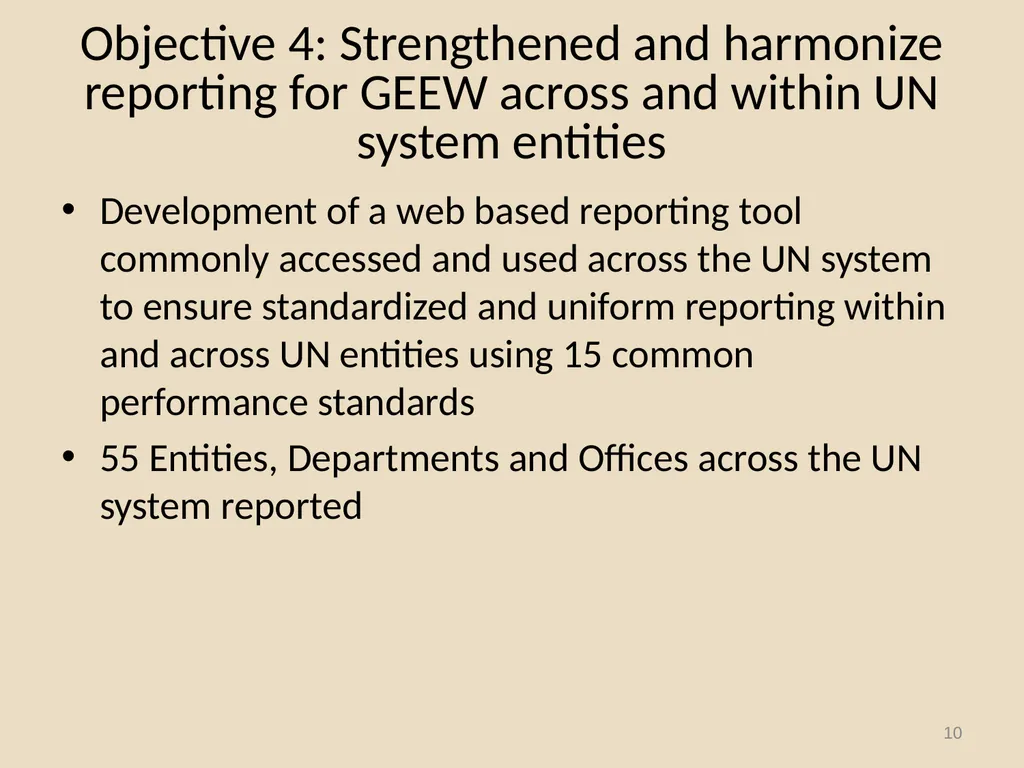
Objective 4: Strengthened and harmonize reporting for GEEW across and within UN system entities Development of a web based reporting tool commonly accessed and used across the UN system to ensure standardized and uniform reporting within and across UN entities using 15 common performance standards
55 Entities, Departments and Offices across the UN system reported 10<br>
55 Entities, Departments and Offices across the UN system reported 10<br>
11
UN SWAP Reporting:
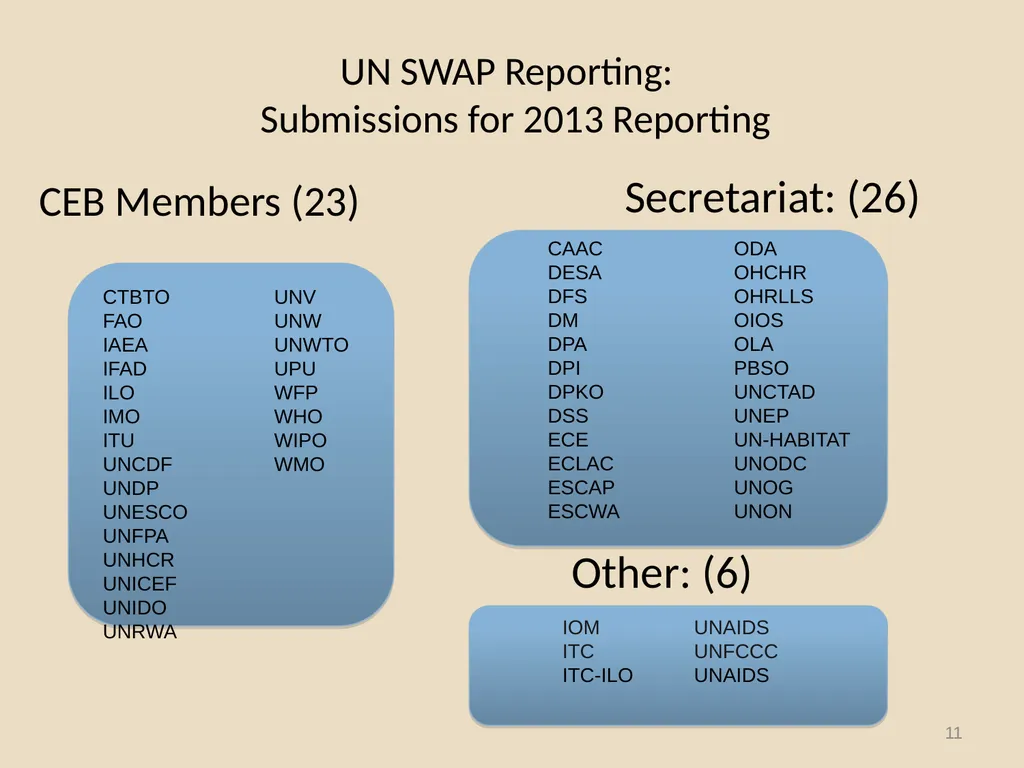
Submissions for 2013 Reporting 11 CEB Members (23) Secretariat: (26) Other: (6) CTBTO
FAO
IAEA
IFAD
ILO
IMO
ITU
UNCDF
UNDP
UNESCO
UNFPA
UNHCR
UNICEF
UNIDO
UNRWA
UNV
UNW
UNWTO
UPU
WFP
WHO
WIPO
WMO CAAC
DESA
DFS
DM
DPA
DPI
DPKO
DSS
ECE
ECLAC
ESCAP
ESCWA
OAJ
OCHA
ODA
OHCHR
OHRLLS
OIOS
OLA
PBSO
UNCTAD
UNEP
UN-HABITAT
UNODC
UNOG
UNON IOM UNAIDS
ITC UNFCCC
ITC-ILO UNAIDS<br>
FAO
IAEA
IFAD
ILO
IMO
ITU
UNCDF
UNDP
UNESCO
UNFPA
UNHCR
UNICEF
UNIDO
UNRWA
UNV
UNW
UNWTO
UPU
WFP
WHO
WIPO
WMO CAAC
DESA
DFS
DM
DPA
DPI
DPKO
DSS
ECE
ECLAC
ESCAP
ESCWA
OAJ
OCHA
ODA
OHCHR
OHRLLS
OIOS
OLA
PBSO
UNCTAD
UNEP
UN-HABITAT
UNODC
UNOG
UNON IOM UNAIDS
ITC UNFCCC
ITC-ILO UNAIDS<br>
12
12 Part 2
2013 UN SWAP Reporting Results<br>
2013 UN SWAP Reporting Results<br>
13
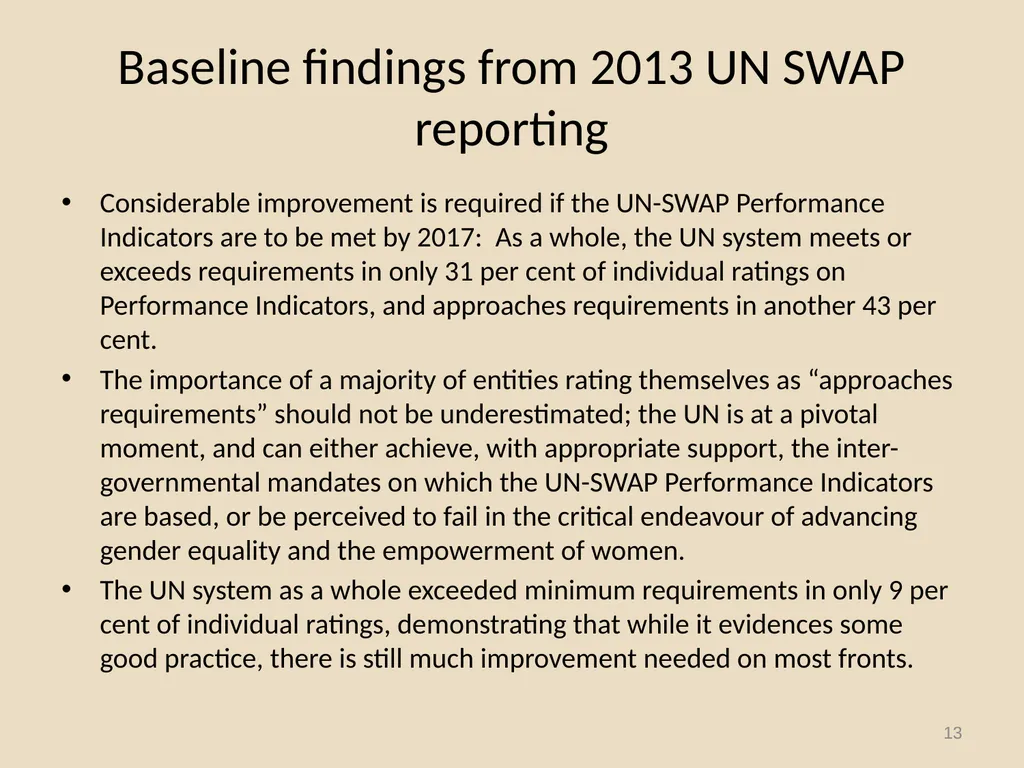
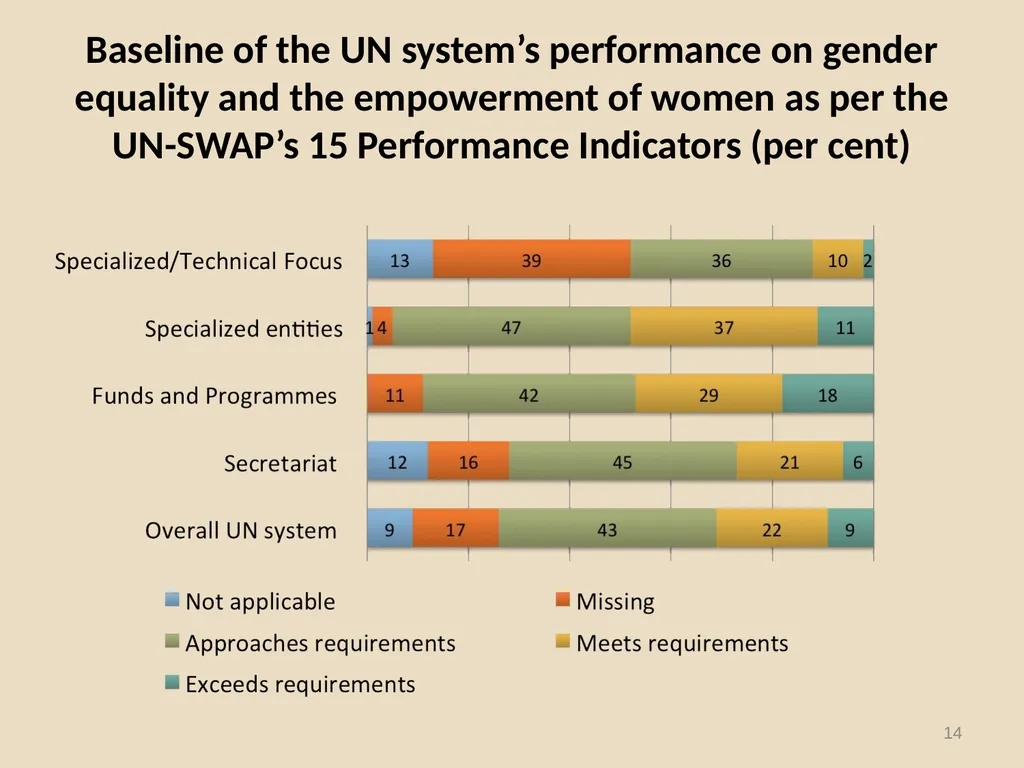
Baseline findings from 2013 UN SWAP reporting Considerable improvement is required if the UN-SWAP Performance Indicators are to be met by 2017: As a whole, the UN system meets or exceeds requirements in only 31 per cent of individual ratings on Performance Indicators, and approaches requirements in another 43 per cent.
The importance of a majority of entities rating themselves as “approaches requirements” should not be underestimated; the UN is at a pivotal moment, and can either achieve, with appropriate support, the inter-governmental mandates on which the UN-SWAP Performance Indicators are based, or be perceived to fail in the critical endeavour of advancing gender equality and the empowerment of women.
The UN system as a whole exceeded minimum requirements in only 9 per cent of individual ratings, demonstrating that while it evidences some good practice, there is still much improvement needed on most fronts. 13<br>
The importance of a majority of entities rating themselves as “approaches requirements” should not be underestimated; the UN is at a pivotal moment, and can either achieve, with appropriate support, the inter-governmental mandates on which the UN-SWAP Performance Indicators are based, or be perceived to fail in the critical endeavour of advancing gender equality and the empowerment of women.
The UN system as a whole exceeded minimum requirements in only 9 per cent of individual ratings, demonstrating that while it evidences some good practice, there is still much improvement needed on most fronts. 13<br>
14
Baseline of the UN system’s performance on gender equality and the empowerment of women as per the UN-SWAP’s 15 Performance Indicators (per cent) 14<br>
15
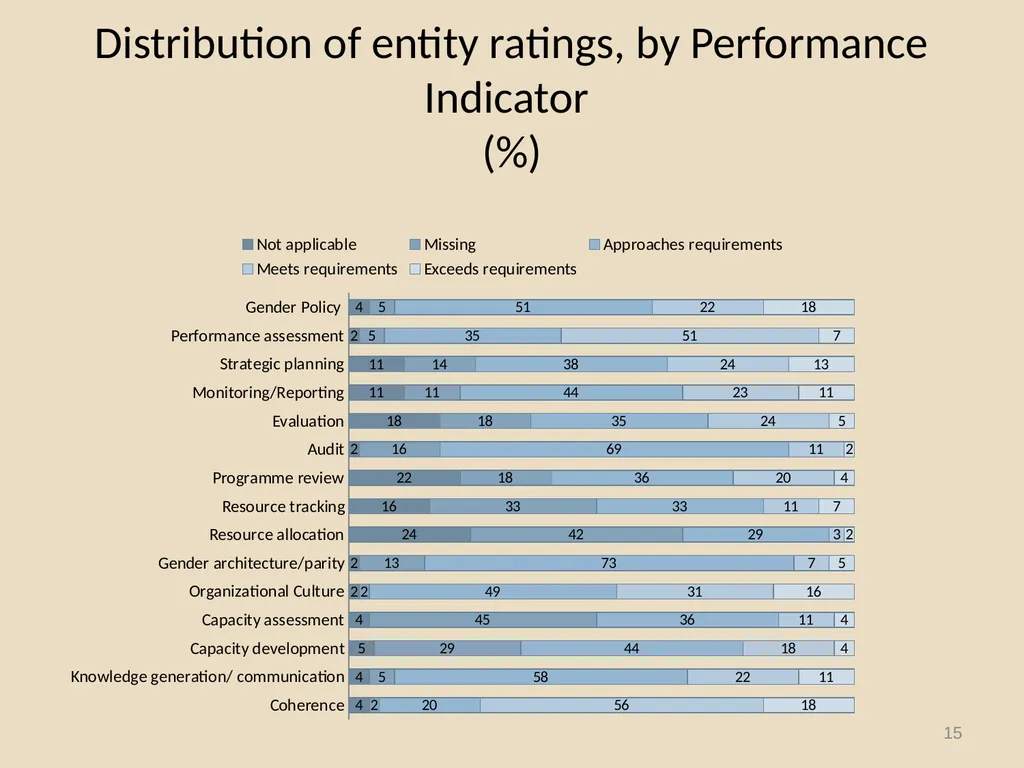
Distribution of entity ratings, by Performance Indicator
(%) 15<br>
16
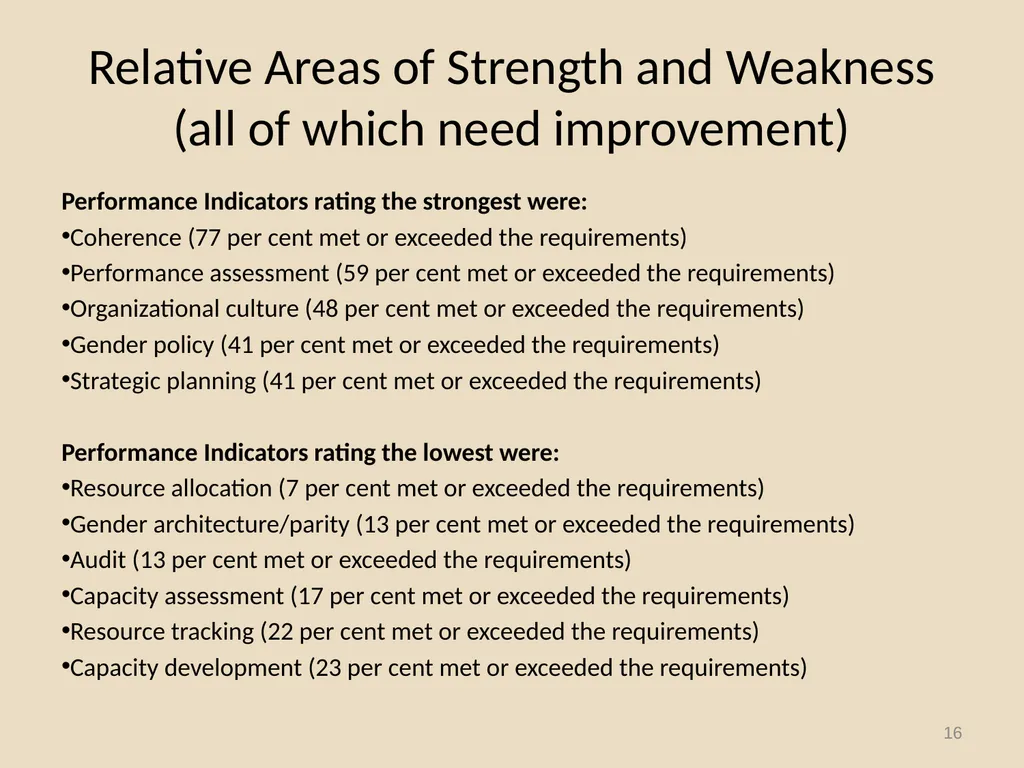
Relative Areas of Strength and Weakness
(all of which need improvement) Performance Indicators rating the strongest were:
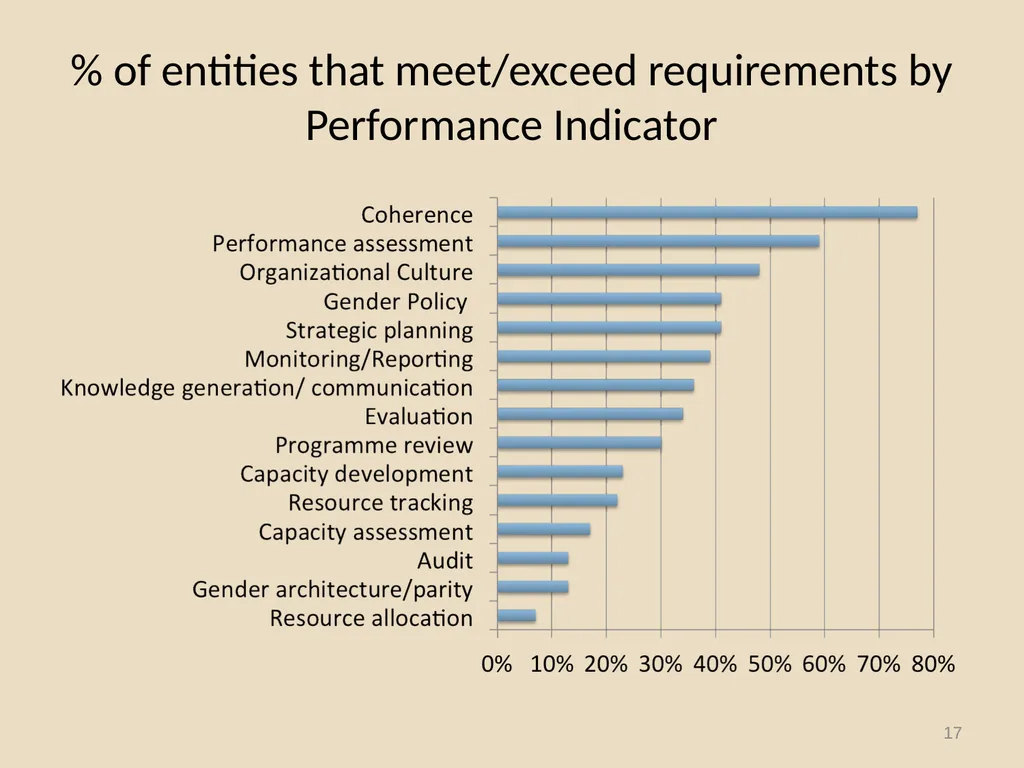
Coherence (77 per cent met or exceeded the requirements)
Performance assessment (59 per cent met or exceeded the requirements)
Organizational culture (48 per cent met or exceeded the requirements)
Gender policy (41 per cent met or exceeded the requirements)
Strategic planning (41 per cent met or exceeded the requirements)
Performance Indicators rating the lowest were:
Resource allocation (7 per cent met or exceeded the requirements)
Gender architecture/parity (13 per cent met or exceeded the requirements)
Audit (13 per cent met or exceeded the requirements)
Capacity assessment (17 per cent met or exceeded the requirements)
Resource tracking (22 per cent met or exceeded the requirements)
Capacity development (23 per cent met or exceeded the requirements) 16<br>
Coherence (77 per cent met or exceeded the requirements)
Performance assessment (59 per cent met or exceeded the requirements)
Organizational culture (48 per cent met or exceeded the requirements)
Gender policy (41 per cent met or exceeded the requirements)
Strategic planning (41 per cent met or exceeded the requirements)
Performance Indicators rating the lowest were:
Resource allocation (7 per cent met or exceeded the requirements)
Gender architecture/parity (13 per cent met or exceeded the requirements)
Audit (13 per cent met or exceeded the requirements)
Capacity assessment (17 per cent met or exceeded the requirements)
Resource tracking (22 per cent met or exceeded the requirements)
Capacity development (23 per cent met or exceeded the requirements) 16<br>
17
% of entities that meet/exceed requirements by Performance Indicator 17<br>
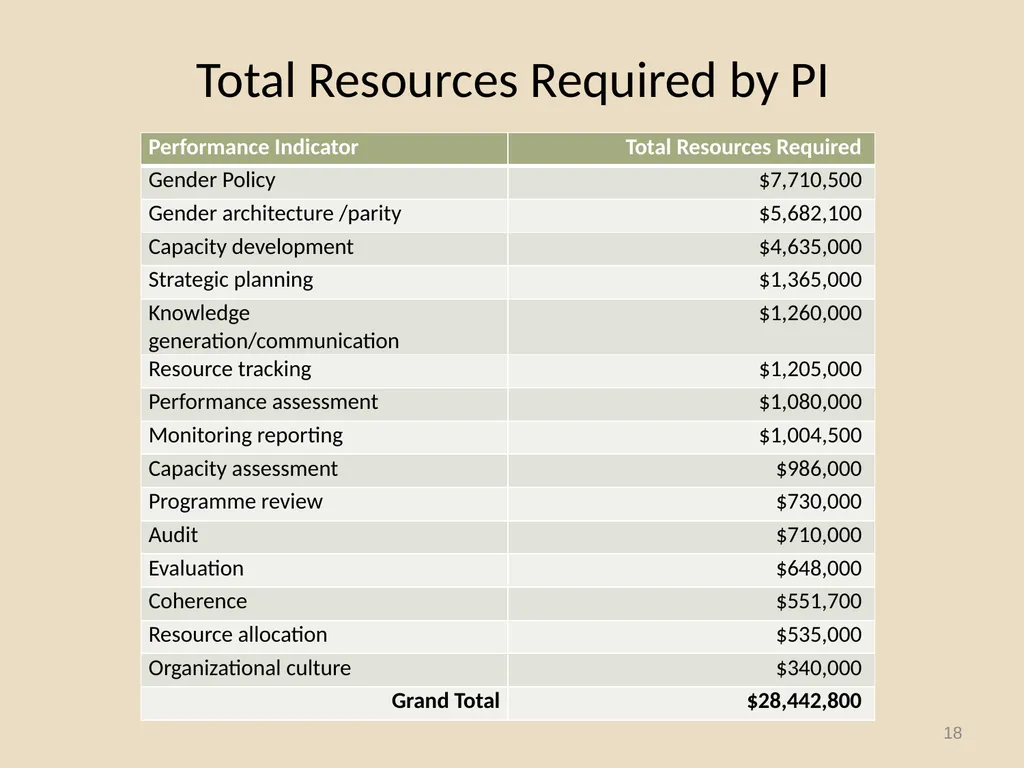
18
Total Resources Required by PI 18<br>
19
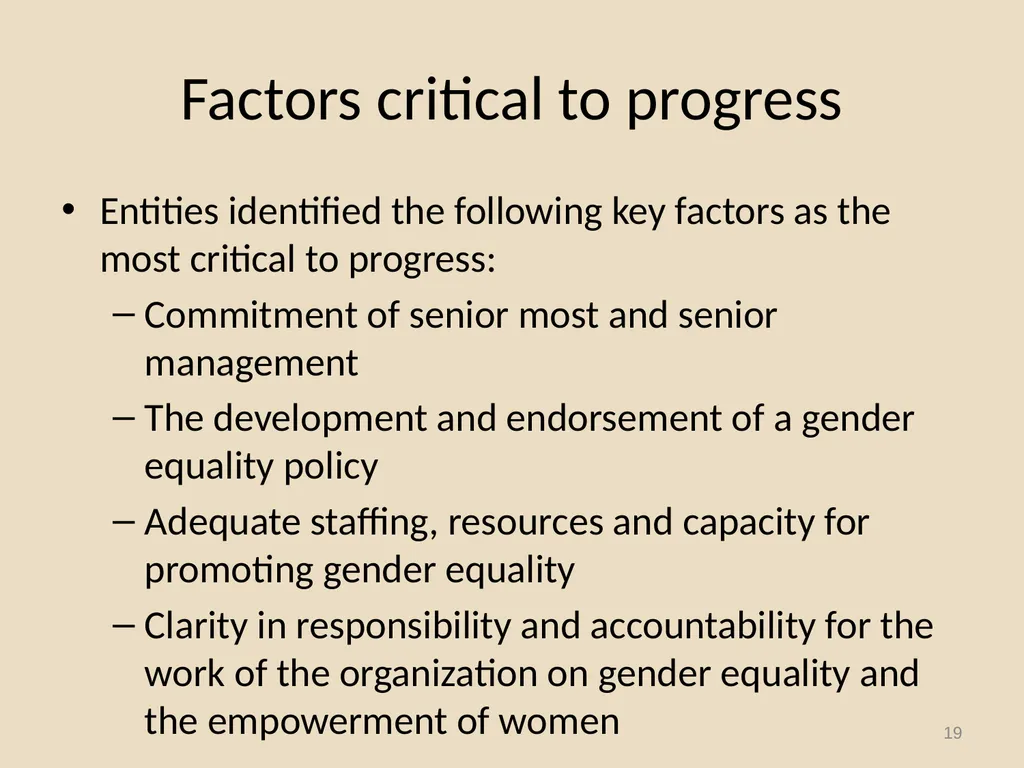
Factors critical to progress Entities identified the following key factors as the most critical to progress:
Commitment of senior most and senior management
The development and endorsement of a gender equality policy
Adequate staffing, resources and capacity for promoting gender equality
Clarity in responsibility and accountability for the work of the organization on gender equality and the empowerment of women 19<br>
Commitment of senior most and senior management
The development and endorsement of a gender equality policy
Adequate staffing, resources and capacity for promoting gender equality
Clarity in responsibility and accountability for the work of the organization on gender equality and the empowerment of women 19<br>
20
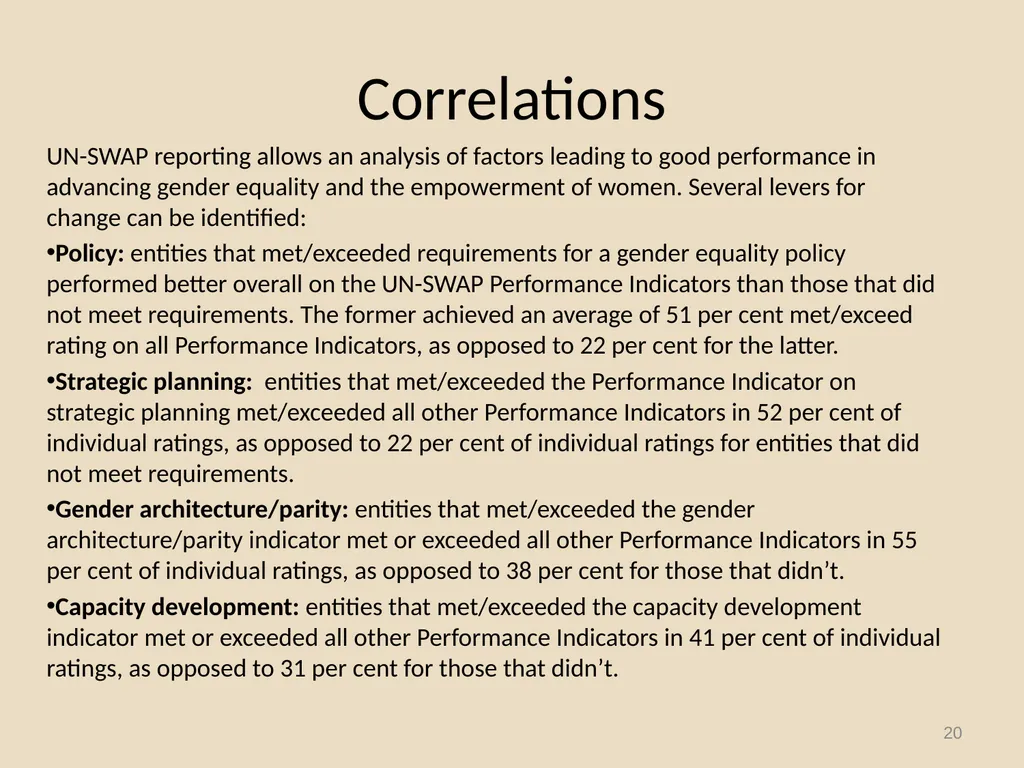
Correlations UN-SWAP reporting allows an analysis of factors leading to good performance in advancing gender equality and the empowerment of women. Several levers for change can be identified:
Policy: entities that met/exceeded requirements for a gender equality policy performed better overall on the UN-SWAP Performance Indicators than those that did not meet requirements. The former achieved an average of 51 per cent met/exceed rating on all Performance Indicators, as opposed to 22 per cent for the latter.
Strategic planning: entities that met/exceeded the Performance Indicator on strategic planning met/exceeded all other Performance Indicators in 52 per cent of individual ratings, as opposed to 22 per cent of individual ratings for entities that did not meet requirements.
Gender architecture/parity: entities that met/exceeded the gender architecture/parity indicator met or exceeded all other Performance Indicators in 55 per cent of individual ratings, as opposed to 38 per cent for those that didn’t.
Capacity development: entities that met/exceeded the capacity development indicator met or exceeded all other Performance Indicators in 41 per cent of individual ratings, as opposed to 31 per cent for those that didn’t. 20<br>
Policy: entities that met/exceeded requirements for a gender equality policy performed better overall on the UN-SWAP Performance Indicators than those that did not meet requirements. The former achieved an average of 51 per cent met/exceed rating on all Performance Indicators, as opposed to 22 per cent for the latter.
Strategic planning: entities that met/exceeded the Performance Indicator on strategic planning met/exceeded all other Performance Indicators in 52 per cent of individual ratings, as opposed to 22 per cent of individual ratings for entities that did not meet requirements.
Gender architecture/parity: entities that met/exceeded the gender architecture/parity indicator met or exceeded all other Performance Indicators in 55 per cent of individual ratings, as opposed to 38 per cent for those that didn’t.
Capacity development: entities that met/exceeded the capacity development indicator met or exceeded all other Performance Indicators in 41 per cent of individual ratings, as opposed to 31 per cent for those that didn’t. 20<br>
21
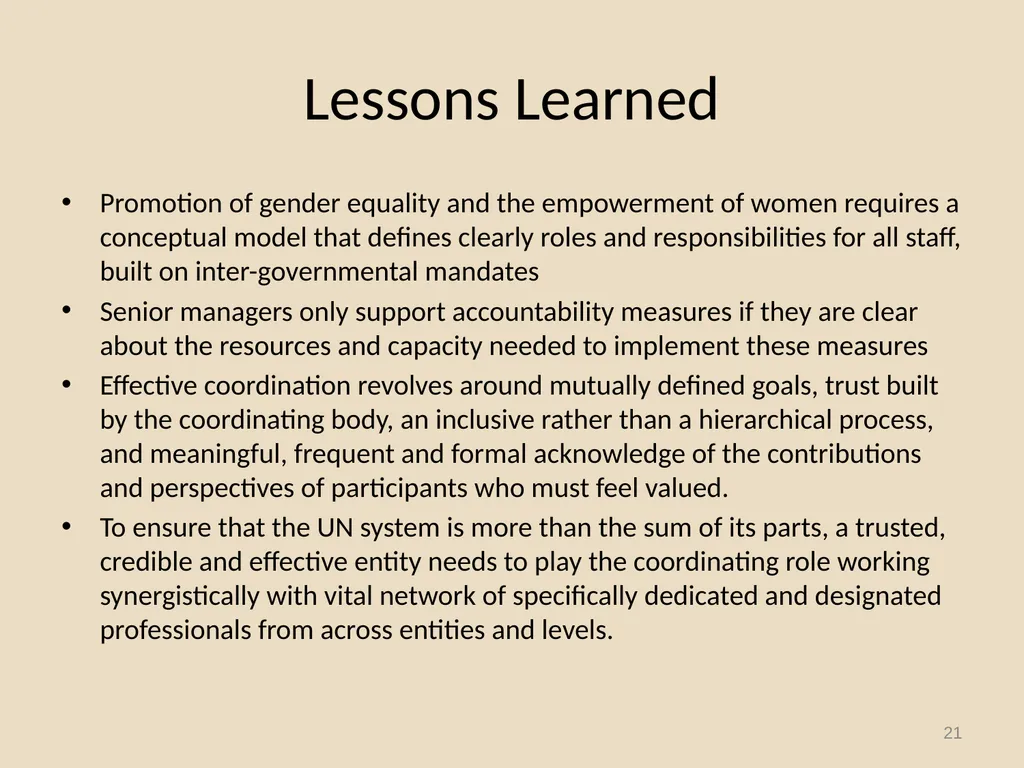
Lessons Learned Promotion of gender equality and the empowerment of women requires a conceptual model that defines clearly roles and responsibilities for all staff, built on inter-governmental mandates
Senior managers only support accountability measures if they are clear about the resources and capacity needed to implement these measures
Effective coordination revolves around mutually defined goals, trust built by the coordinating body, an inclusive rather than a hierarchical process, and meaningful, frequent and formal acknowledge of the contributions and perspectives of participants who must feel valued.
To ensure that the UN system is more than the sum of its parts, a trusted, credible and effective entity needs to play the coordinating role working synergistically with vital network of specifically dedicated and designated professionals from across entities and levels. 21<br>
Senior managers only support accountability measures if they are clear about the resources and capacity needed to implement these measures
Effective coordination revolves around mutually defined goals, trust built by the coordinating body, an inclusive rather than a hierarchical process, and meaningful, frequent and formal acknowledge of the contributions and perspectives of participants who must feel valued.
To ensure that the UN system is more than the sum of its parts, a trusted, credible and effective entity needs to play the coordinating role working synergistically with vital network of specifically dedicated and designated professionals from across entities and levels. 21<br>
22
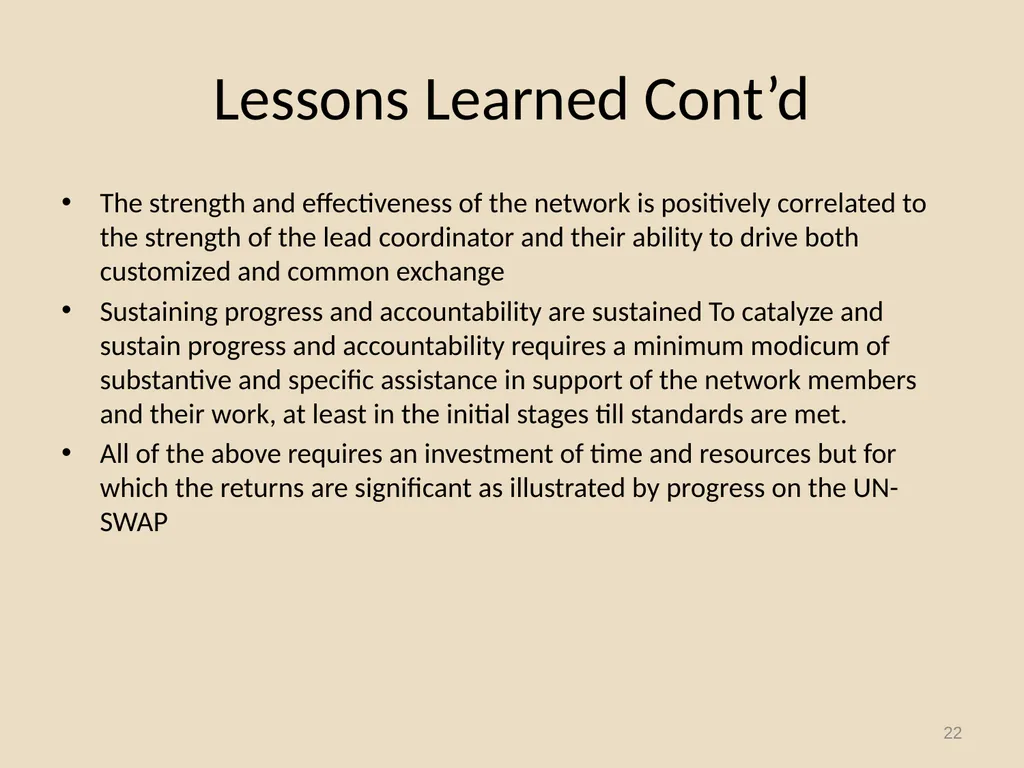
Lessons Learned Cont’d The strength and effectiveness of the network is positively correlated to the strength of the lead coordinator and their ability to drive both customized and common exchange
Sustaining progress and accountability are sustained To catalyze and sustain progress and accountability requires a minimum modicum of substantive and specific assistance in support of the network members and their work, at least in the initial stages till standards are met.
All of the above requires an investment of time and resources but for which the returns are significant as illustrated by progress on the UN-SWAP 22<br>
Sustaining progress and accountability are sustained To catalyze and sustain progress and accountability requires a minimum modicum of substantive and specific assistance in support of the network members and their work, at least in the initial stages till standards are met.
All of the above requires an investment of time and resources but for which the returns are significant as illustrated by progress on the UN-SWAP 22<br>
23
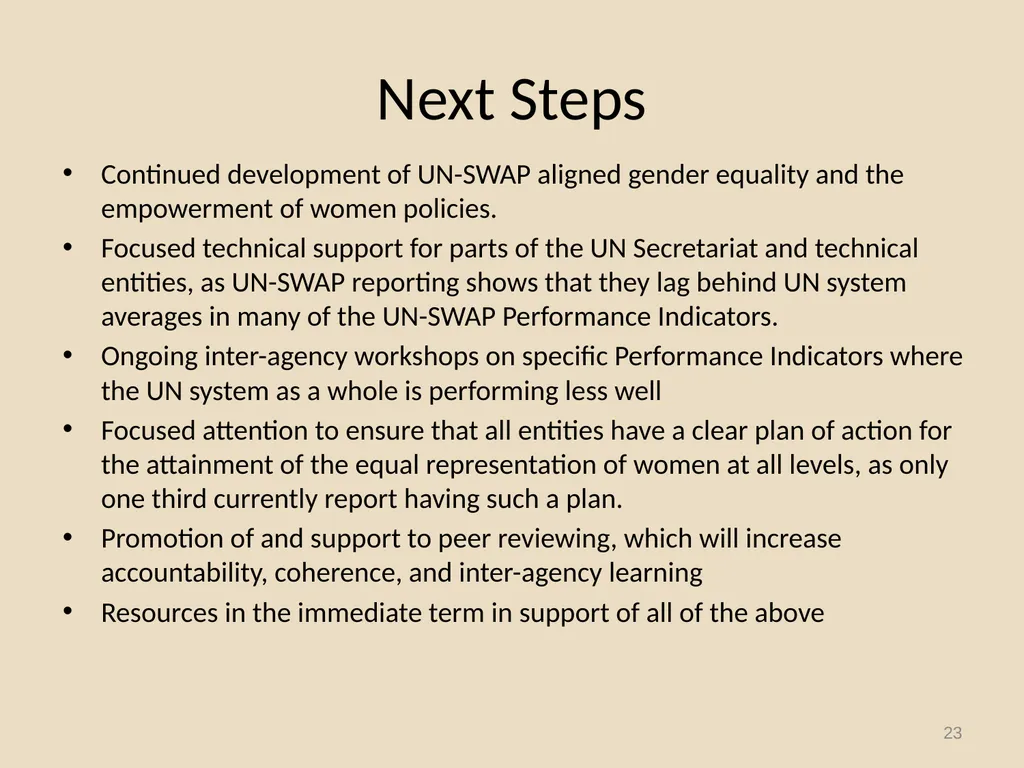
Next Steps Continued development of UN-SWAP aligned gender equality and the empowerment of women policies.
Focused technical support for parts of the UN Secretariat and technical entities, as UN-SWAP reporting shows that they lag behind UN system averages in many of the UN-SWAP Performance Indicators.
Ongoing inter-agency workshops on specific Performance Indicators where the UN system as a whole is performing less well
Focused attention to ensure that all entities have a clear plan of action for the attainment of the equal representation of women at all levels, as only one third currently report having such a plan.
Promotion of and support to peer reviewing, which will increase accountability, coherence, and inter-agency learning
Resources in the immediate term in support of all of the above 23<br>
Focused technical support for parts of the UN Secretariat and technical entities, as UN-SWAP reporting shows that they lag behind UN system averages in many of the UN-SWAP Performance Indicators.
Ongoing inter-agency workshops on specific Performance Indicators where the UN system as a whole is performing less well
Focused attention to ensure that all entities have a clear plan of action for the attainment of the equal representation of women at all levels, as only one third currently report having such a plan.
Promotion of and support to peer reviewing, which will increase accountability, coherence, and inter-agency learning
Resources in the immediate term in support of all of the above 23<br>
24
Part 3:
Resource Tracking 24<br>
Resource Tracking 24<br>
25
Resource tracking: Background Recent ECOSOC and General Assembly resolutions, including the QCPR have called on the UN System to track “gender-related resource allocation and expenditure, including through the promotion of the use where appropriate of gender markers (ECOSOC 2012/24 and A/Res/67/226 (QCPR).”
The UNDG Task Team on Gender Equality’s Subgroup on Accounting for Resources for Gender Equality is leading efforts across the UN system for resource tracking and is co-chaired by UNDP and UNICEF.
In 2012, the Subgroup developed a Gender equality marker guidance note.
The guidance note aims to guide the development of an effective and coherent UN system approach for tracking resources that support gender equality results. 25<br>
The UNDG Task Team on Gender Equality’s Subgroup on Accounting for Resources for Gender Equality is leading efforts across the UN system for resource tracking and is co-chaired by UNDP and UNICEF.
In 2012, the Subgroup developed a Gender equality marker guidance note.
The guidance note aims to guide the development of an effective and coherent UN system approach for tracking resources that support gender equality results. 25<br>
26
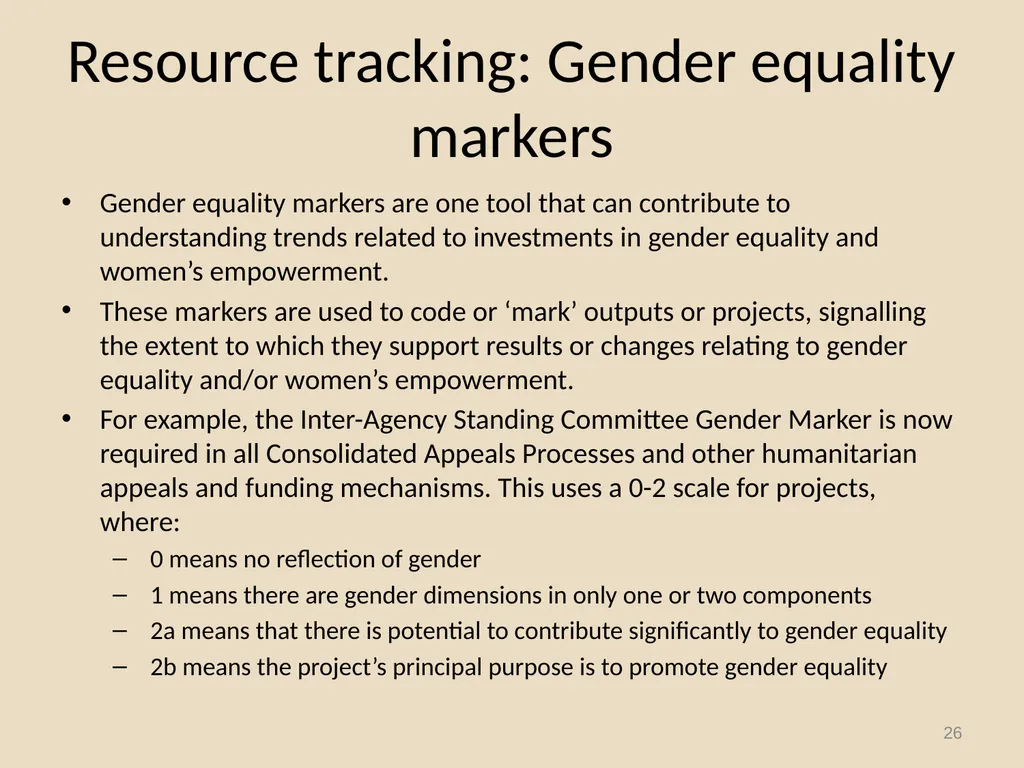
Resource tracking: Gender equality markers Gender equality markers are one tool that can contribute to understanding trends related to investments in gender equality and women’s empowerment.
These markers are used to code or ‘mark’ outputs or projects, signalling the extent to which they support results or changes relating to gender equality and/or women’s empowerment.
For example, the Inter-Agency Standing Committee Gender Marker is now required in all Consolidated Appeals Processes and other humanitarian appeals and funding mechanisms. This uses a 0-2 scale for projects, where:
0 means no reflection of gender
1 means there are gender dimensions in only one or two components
2a means that there is potential to contribute significantly to gender equality
2b means the project’s principal purpose is to promote gender equality 26<br>
These markers are used to code or ‘mark’ outputs or projects, signalling the extent to which they support results or changes relating to gender equality and/or women’s empowerment.
For example, the Inter-Agency Standing Committee Gender Marker is now required in all Consolidated Appeals Processes and other humanitarian appeals and funding mechanisms. This uses a 0-2 scale for projects, where:
0 means no reflection of gender
1 means there are gender dimensions in only one or two components
2a means that there is potential to contribute significantly to gender equality
2b means the project’s principal purpose is to promote gender equality 26<br>
27
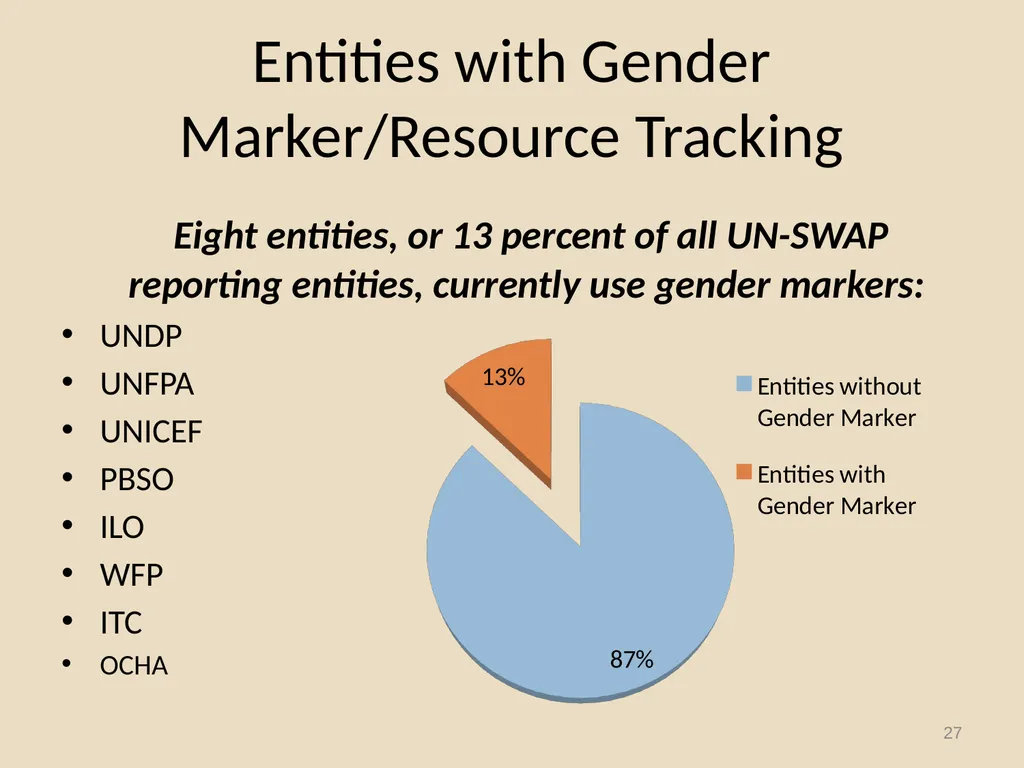
Entities with Gender Marker/Resource Tracking Eight entities, or 13 percent of all UN-SWAP reporting entities, currently use gender markers:
UNDP
UNFPA
UNICEF
PBSO
ILO
WFP
ITC
OCHA 27<br>
UNDP
UNFPA
UNICEF
PBSO
ILO
WFP
ITC
OCHA 27<br>
28
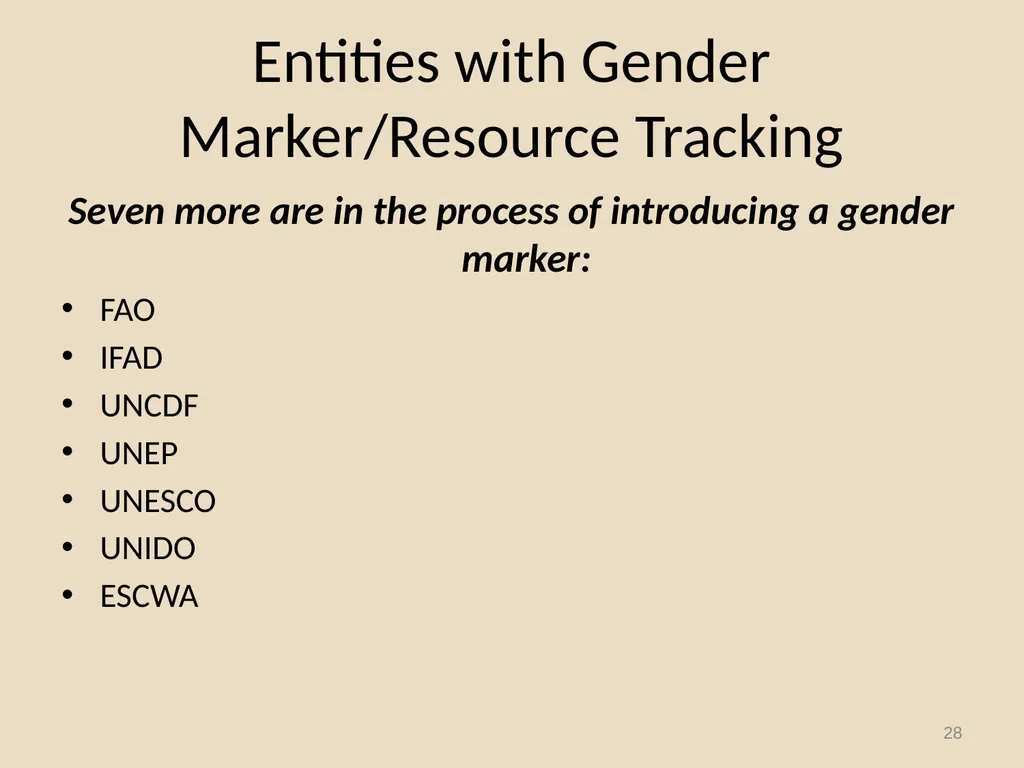
Entities with Gender Marker/Resource Tracking Seven more are in the process of introducing a gender marker:
FAO
IFAD
UNCDF
UNEP
UNESCO
UNIDO
ESCWA 28<br>
FAO
IFAD
UNCDF
UNEP
UNESCO
UNIDO
ESCWA 28<br>
29
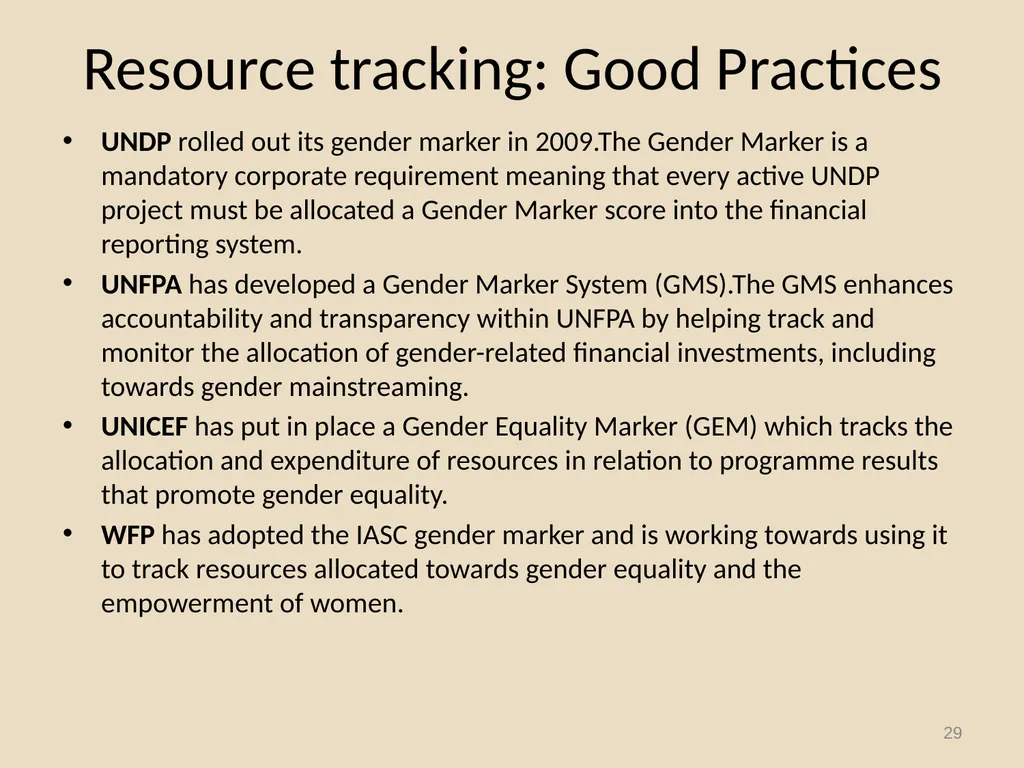
Resource tracking: Good Practices UNDP rolled out its gender marker in 2009.The Gender Marker is a mandatory corporate requirement meaning that every active UNDP project must be allocated a Gender Marker score into the financial reporting system.
UNFPA has developed a Gender Marker System (GMS).The GMS enhances accountability and transparency within UNFPA by helping track and monitor the allocation of gender-related financial investments, including towards gender mainstreaming.
UNICEF has put in place a Gender Equality Marker (GEM) which tracks the allocation and expenditure of resources in relation to programme results that promote gender equality.
WFP has adopted the IASC gender marker and is working towards using it to track resources allocated towards gender equality and the empowerment of women. 29<br>
UNFPA has developed a Gender Marker System (GMS).The GMS enhances accountability and transparency within UNFPA by helping track and monitor the allocation of gender-related financial investments, including towards gender mainstreaming.
UNICEF has put in place a Gender Equality Marker (GEM) which tracks the allocation and expenditure of resources in relation to programme results that promote gender equality.
WFP has adopted the IASC gender marker and is working towards using it to track resources allocated towards gender equality and the empowerment of women. 29<br>
30
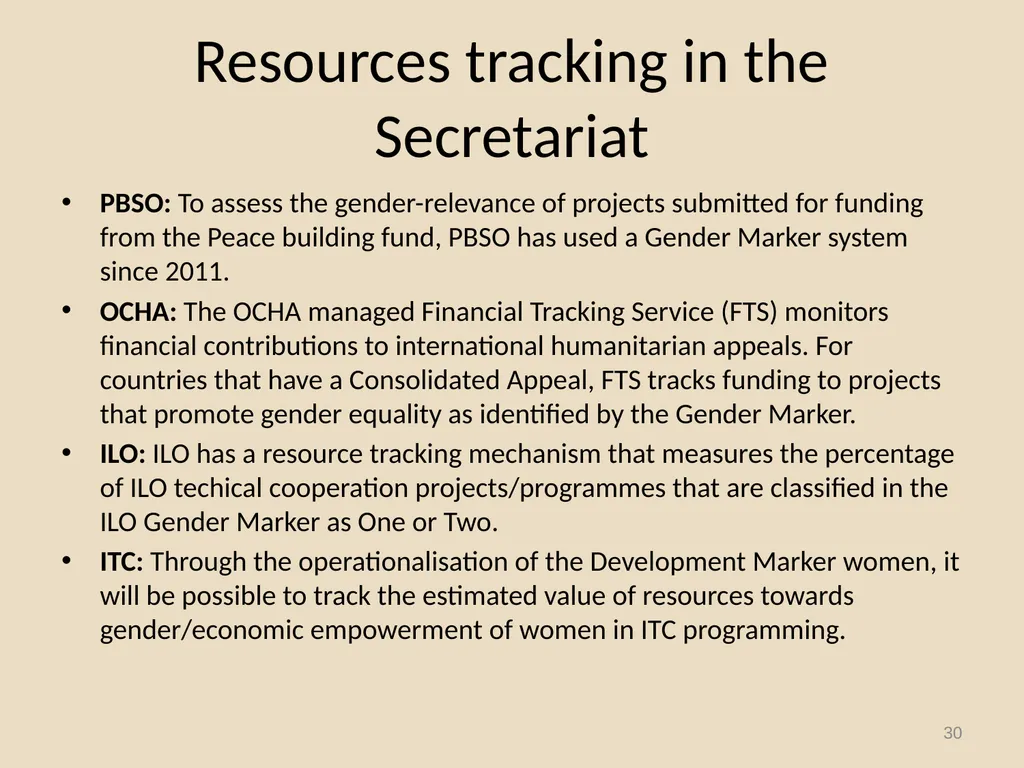
Resources tracking in the Secretariat PBSO: To assess the gender-relevance of projects submitted for funding from the Peace building fund, PBSO has used a Gender Marker system since 2011.
OCHA: The OCHA managed Financial Tracking Service (FTS) monitors financial contributions to international humanitarian appeals. For countries that have a Consolidated Appeal, FTS tracks funding to projects that promote gender equality as identified by the Gender Marker.
ILO: ILO has a resource tracking mechanism that measures the percentage of ILO techical cooperation projects/programmes that are classified in the ILO Gender Marker as One or Two.
ITC: Through the operationalisation of the Development Marker women, it will be possible to track the estimated value of resources towards gender/economic empowerment of women in ITC programming. 30<br>
OCHA: The OCHA managed Financial Tracking Service (FTS) monitors financial contributions to international humanitarian appeals. For countries that have a Consolidated Appeal, FTS tracks funding to projects that promote gender equality as identified by the Gender Marker.
ILO: ILO has a resource tracking mechanism that measures the percentage of ILO techical cooperation projects/programmes that are classified in the ILO Gender Marker as One or Two.
ITC: Through the operationalisation of the Development Marker women, it will be possible to track the estimated value of resources towards gender/economic empowerment of women in ITC programming. 30<br>