"SYSTEMATIC BOTANY Dr.Tripta Jain Asst. Professor" is the property of its rightful owner. Permission is granted to
download and print the materials on this website for personal, non-commercial use only, and to display it
on your personal computer provided you do not modify the materials and that you retain all copyright
notices contained in the materials. By downloading content from our website, you accept the terms of this
agreement.
Presentation Transcript
01
SYSTEMATIC BOTANY Dr.Tripta Jain
Asst. Professor
MLS University<br>
02
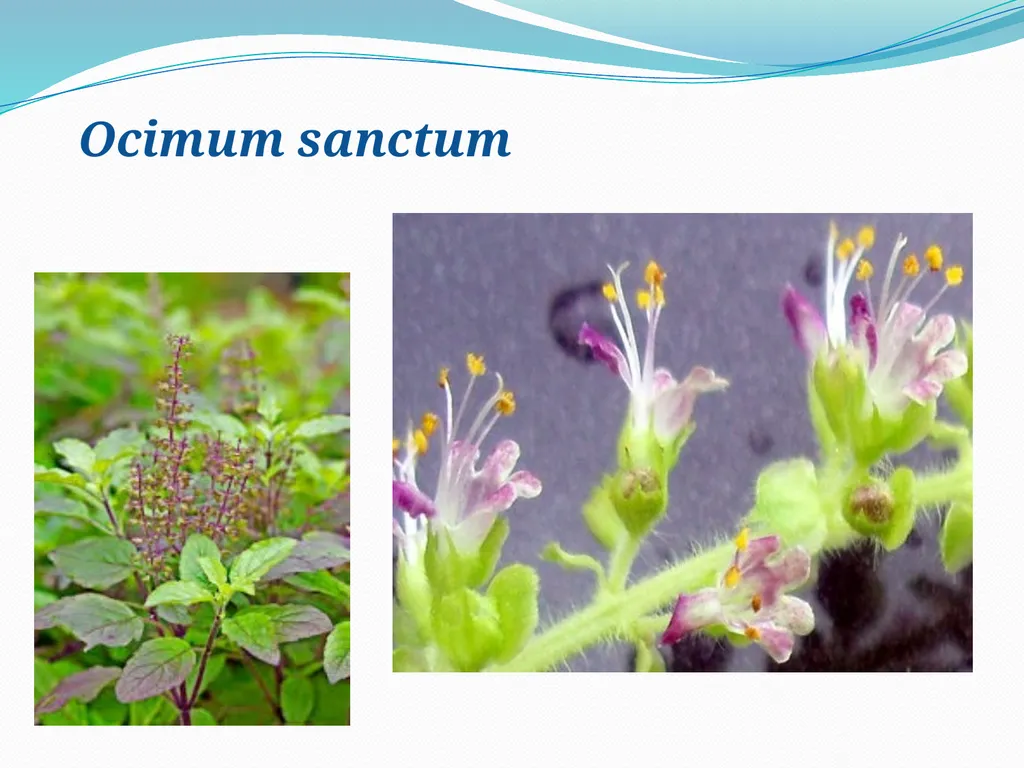
Ocimum sanctum<br>
03
Ocimum sanctum, (Verna.-Tuisi):
Habit:
A perennial herb with typical aromatic smell.
Stem:
Erect, branched, quadrangular, somewhat woody, solid, branches covered with soft hairs.
Leaf:
Simple, opposite, short petioled, exstipulate, ovate, serrate, acute, gland dotted, unicostate reticulate venation.<br>
04
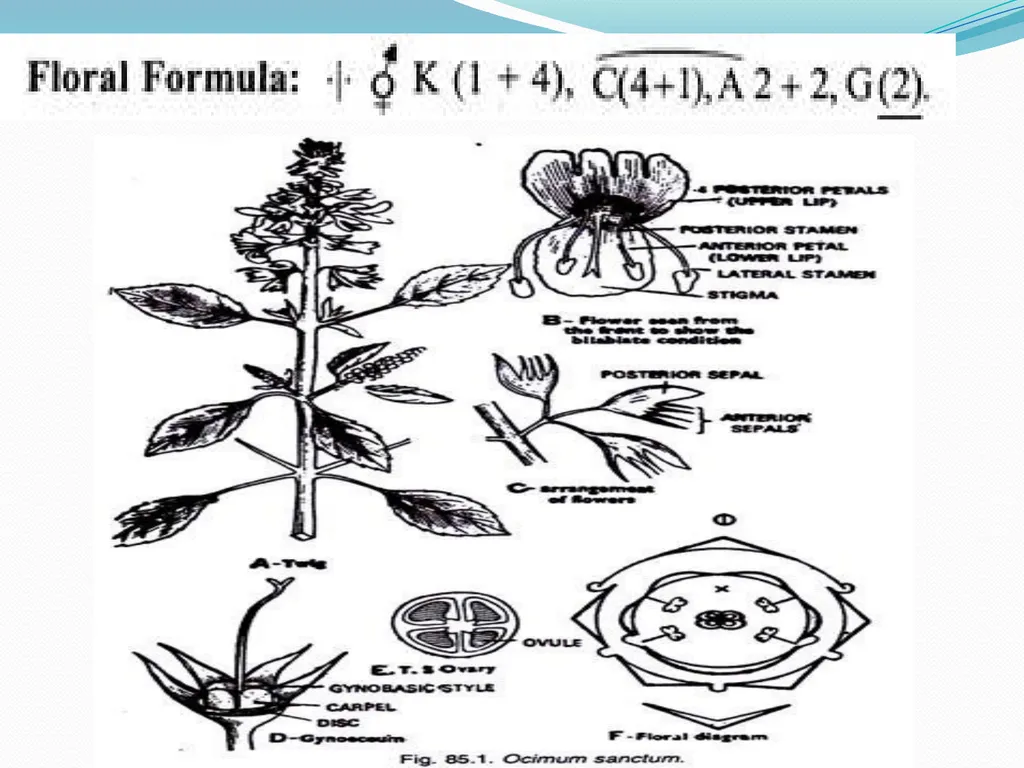
Inflorescence: Verticillaster, 6-10 flowered whorls present, emitting fine smell. Flower: Pedicellate, bracteate, bracts small and caducous, hermaphrodite, zygomorphic, complete, purple, hypogynous. Calyx: 5 sepals, gamosepalous, bilabiate, petaloid (purple coloured), posterior lip broad and boat shaped, anterior lip with 4 small lobes possessing mucronate teeth, gland dotted, imbricate aestivation, inferior. Corolla: 5 petals, gamopetalous, bilabiate, corolla tube short, upper lip four lobed, lower lip large, imbricate aestivation, inferior.<br>
05
Androecium: 4 stamens, polyandrous, didynamous, epipetalous, fifth posterior stamen completely suppressed, anthers bicelled, introrse, dorsifixed. Gynoecium: 2 carpels (bicarpellary), syncarpous, ovary bilocular in early stage but becomes tetralocular in later stage, ovary superior, four chambered, axile placentation, single ovule in each loculus, gynobasic style (i.e., it arises from the base of the ovary), stigma bifid. Fruit: Schizocarpic, carcerulus, 4 nutlets developed.<br>
06
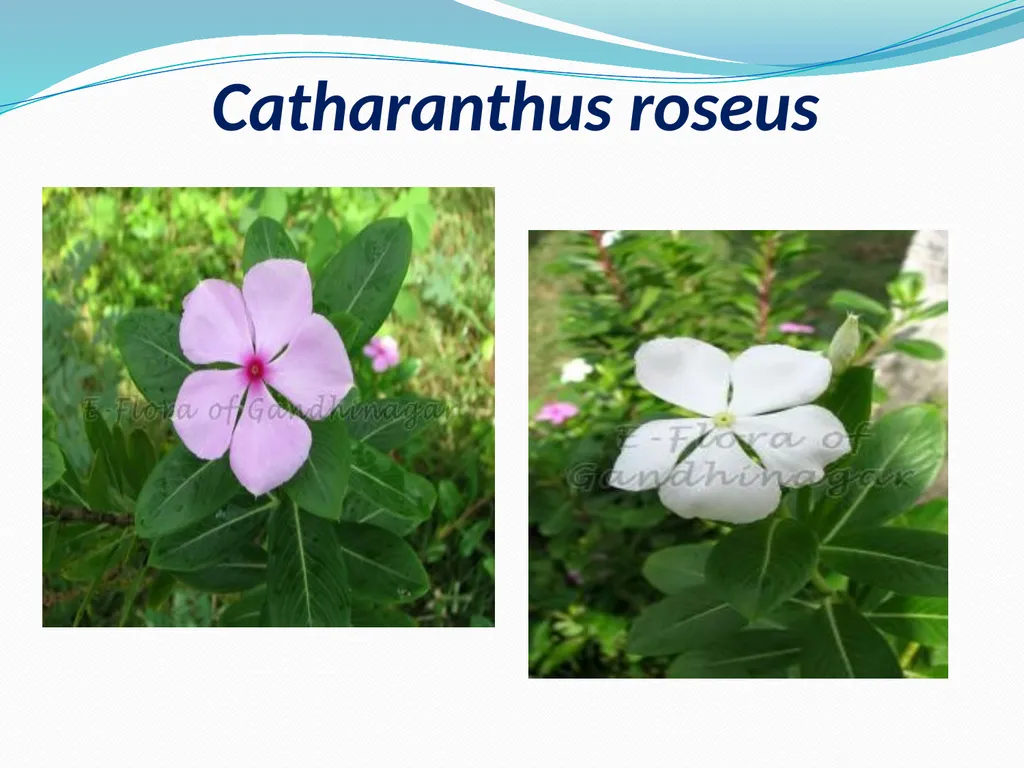
Catharanthus roseus<br>
07
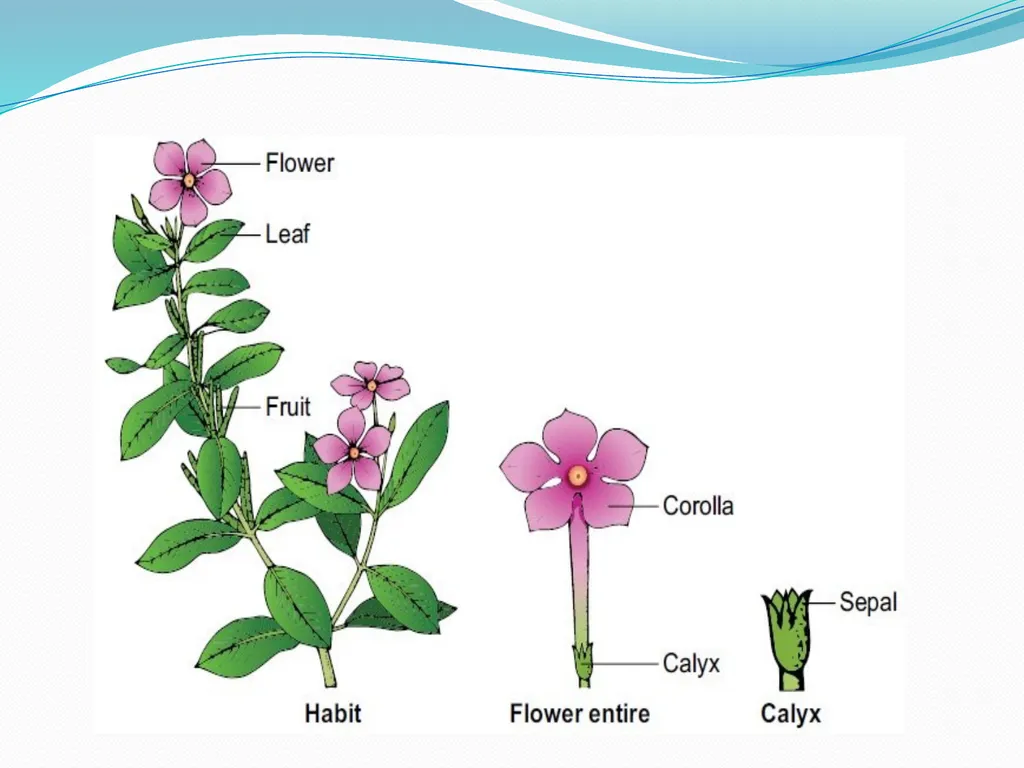
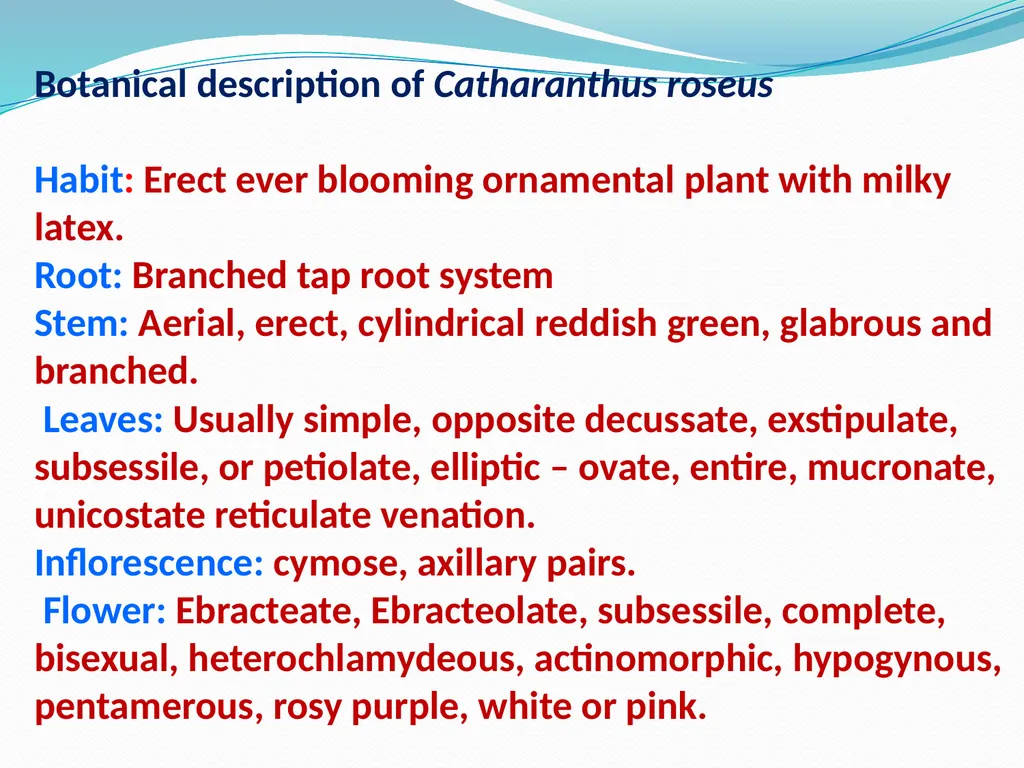
Botanical description of Catharanthus roseus Habit: Erect ever blooming ornamental plant with milky latex. Root: Branched tap root system Stem: Aerial, erect, cylindrical reddish green, glabrous and branched. Leaves: Usually simple, opposite decussate, exstipulate, subsessile, or petiolate, elliptic – ovate, entire, mucronate, unicostate reticulate venation. Inflorescence: cymose, axillary pairs. Flower: Ebracteate, Ebracteolate, subsessile, complete, bisexual, heterochlamydeous, actinomorphic, hypogynous, pentamerous, rosy purple, white or pink.<br>
08
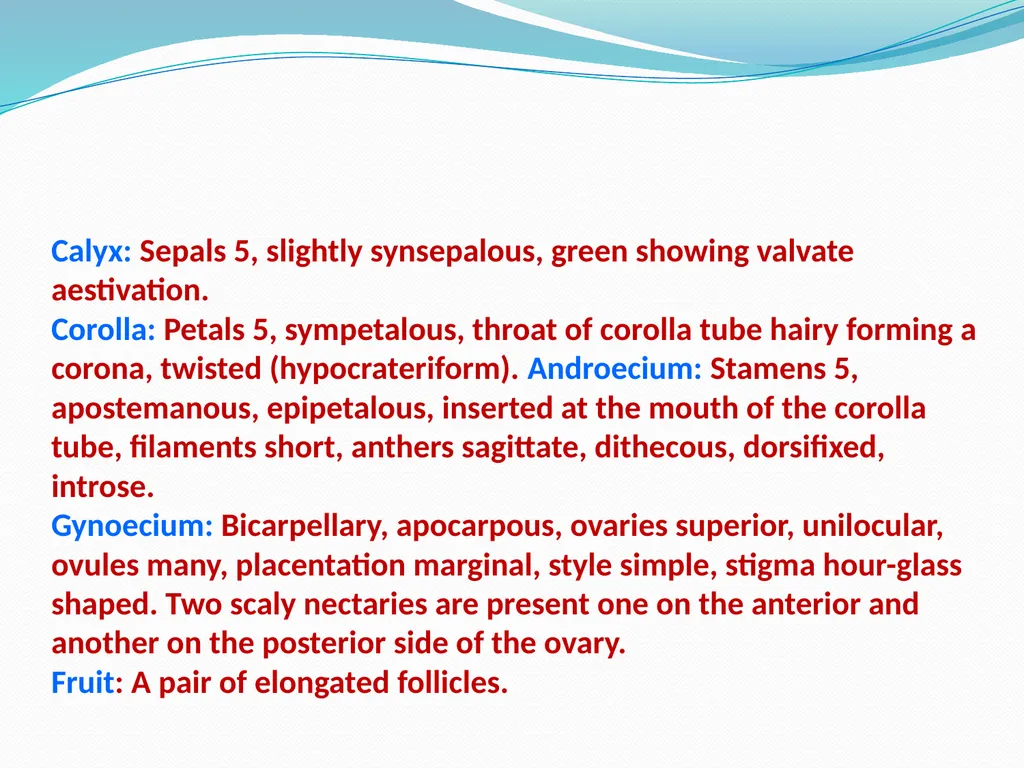
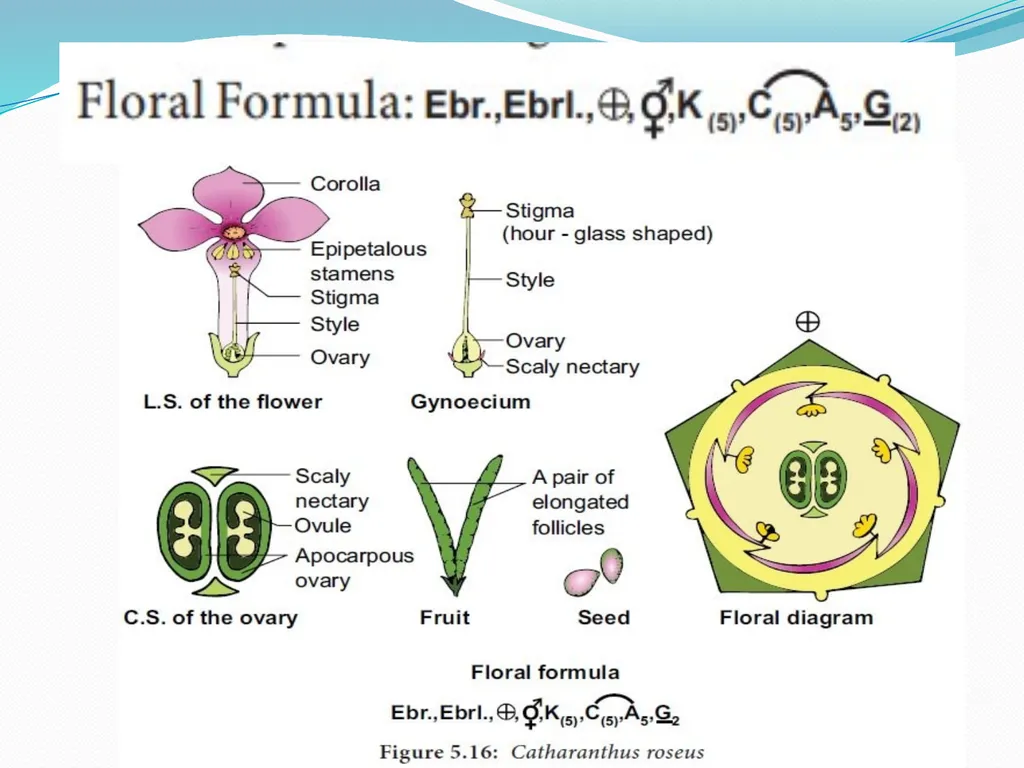
Calyx: Sepals 5, slightly synsepalous, green showing valvate aestivation. Corolla: Petals 5, sympetalous, throat of corolla tube hairy forming a corona, twisted (hypocrateriform). Androecium: Stamens 5, apostemanous, epipetalous, inserted at the mouth of the corolla tube, filaments short, anthers sagittate, dithecous, dorsifixed, introse. Gynoecium: Bicarpellary, apocarpous, ovaries superior, unilocular, ovules many, placentation marginal, style simple, stigma hour-glass shaped. Two scaly nectaries are present one on the anterior and another on the posterior side of the ovary. Fruit: A pair of elongated follicles.<br>