Tail Bounds CSE 312 Summer 21 Lecture 19 Announcements Point values for Question 4 in Problem Set 6 has been updated. The Distinct Elements question has been updated to direct you to the correct page on the textbook. Look for the CDF on
"Tail Bounds CSE 312 Summer 21 Lecture 19" is the property of its rightful owner. Permission is granted to
download and print the materials on this website for personal, non-commercial use only, and to display it
on your personal computer provided you do not modify the materials and that you retain all copyright
notices contained in the materials. By downloading content from our website, you accept the terms of this
agreement.
Presentation Transcript
01
Tail Bounds CSE 312 Summer 21
Lecture 19<br>
02
Announcements Point values for Question 4 in Problem Set 6 has been updated.
The Distinct Elements question has been updated to direct you to the correct page on the textbook. Look for the CDF on page 334.<br>
03
What’s a Tail Bound? When we were finding our margin of error, we didn’t need an exact calculation of the probability.
We needed an inequality: the probability of being outside the margin of error was at most 5% (the example discussed mentioned that most of the data lied within the margin of error at least 95% of the time).
A tail bound (or concentration inequality) is a statement that bounds the probability in the “tails” of the distribution (says there’s very little probability far from the center) or (equivalently) says that the probability is concentrated near the expectation.<br>
04
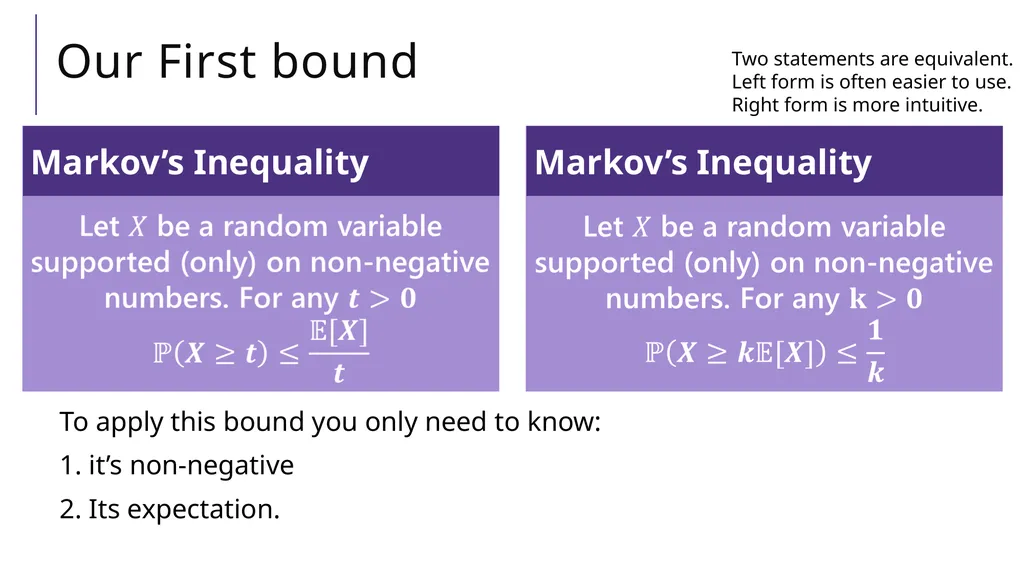
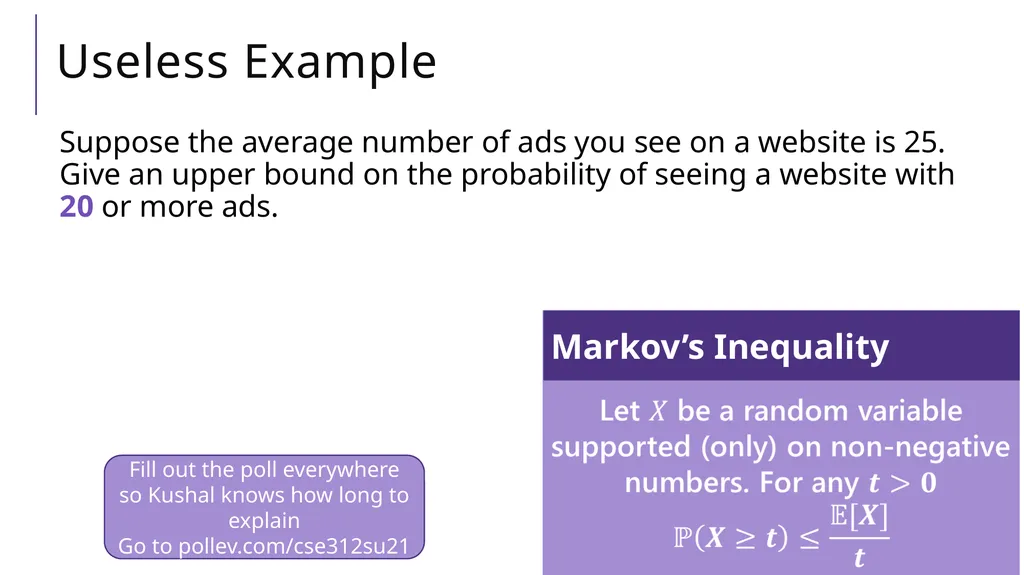
Our First bound To apply this bound you only need to know:
1. it’s non-negative
2. Its expectation. Two statements are equivalent. Left form is often easier to use. Right form is more intuitive.<br>
05
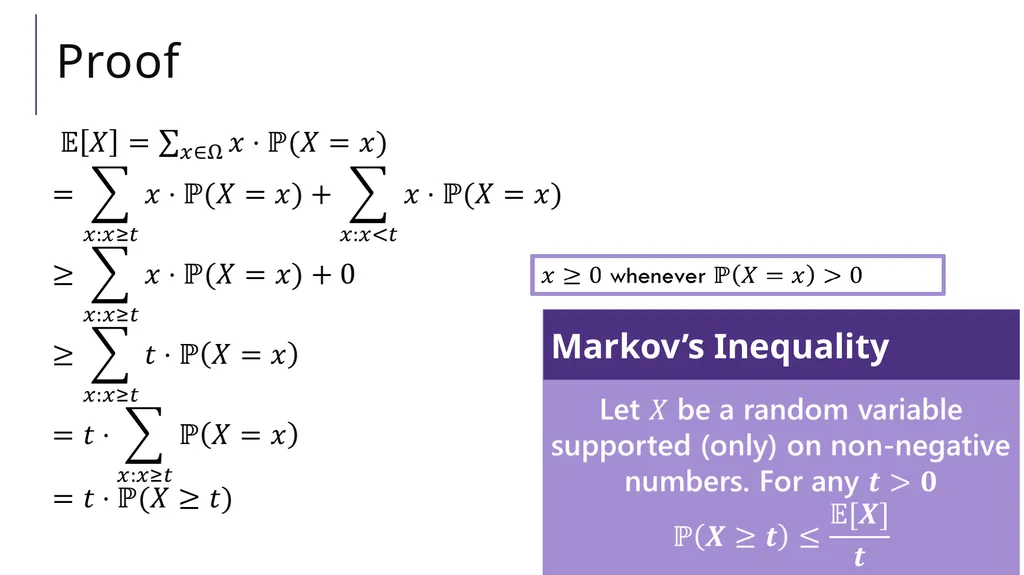
Proof<br>
06
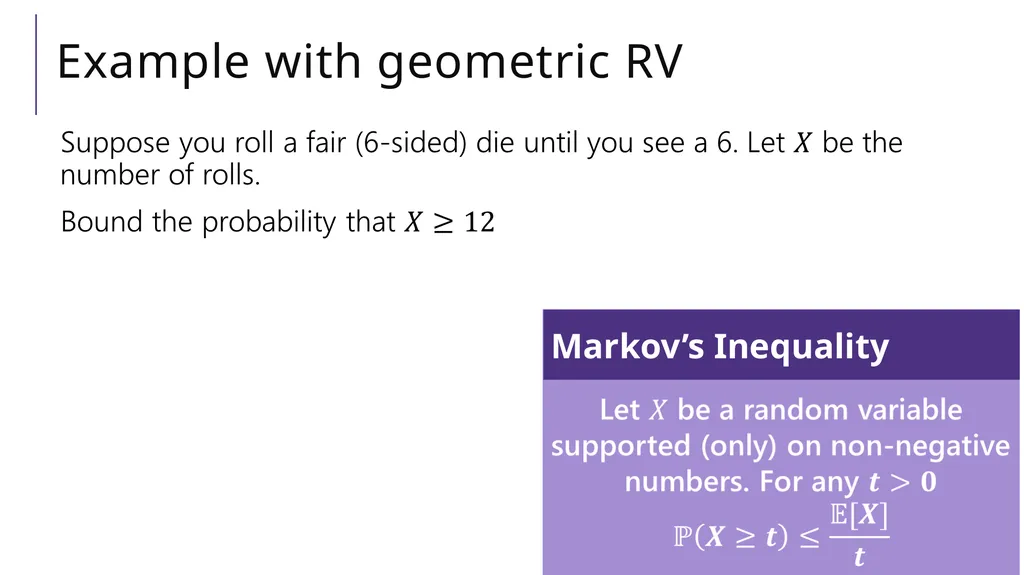
Example with geometric RV<br>
07
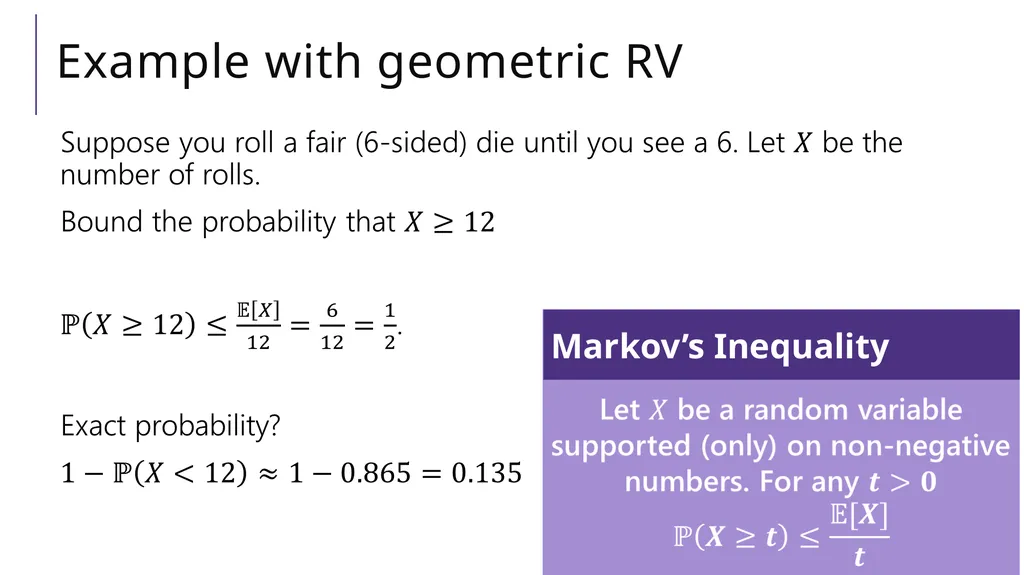
Example with geometric RV<br>
08
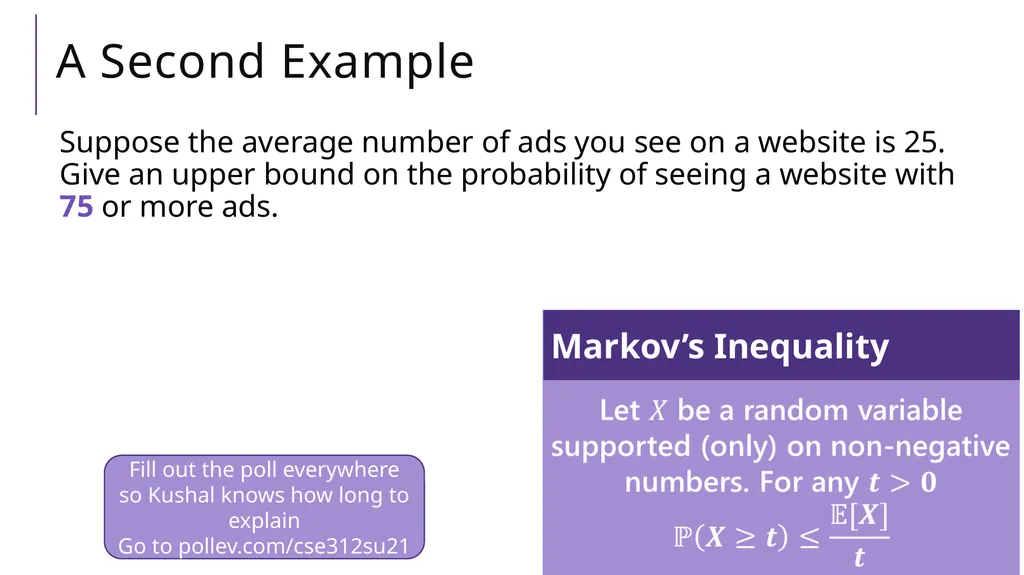
A Second Example Suppose the average number of ads you see on a website is 25. Give an upper bound on the probability of seeing a website with 75 or more ads. Fill out the poll everywhere so Kushal knows how long to explain
Go to pollev.com/cse312su21<br>
09
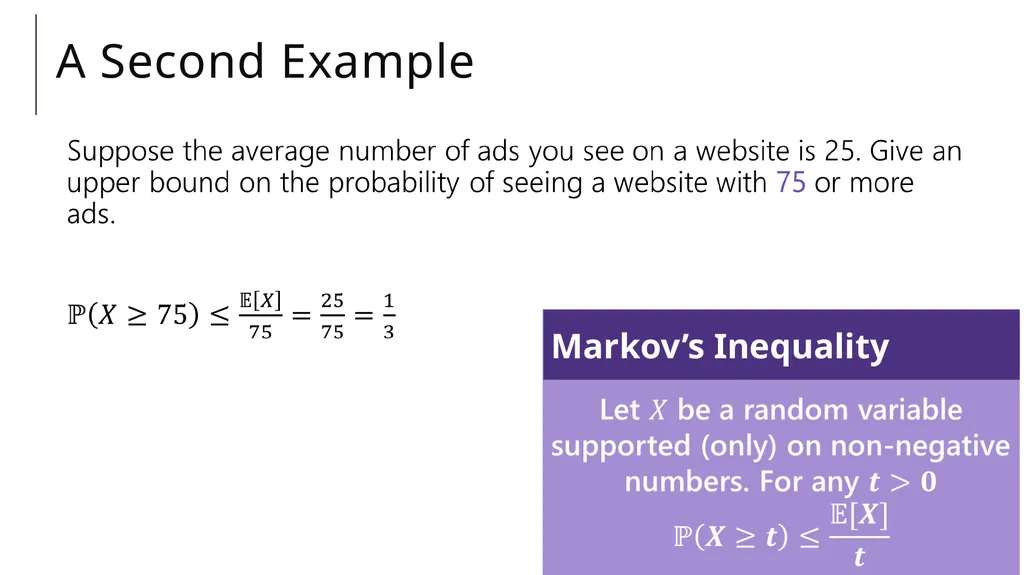
A Second Example<br>
10
Useless Example Suppose the average number of ads you see on a website is 25. Give an upper bound on the probability of seeing a website with 20 or more ads. Fill out the poll everywhere so Kushal knows how long to explain
Go to pollev.com/cse312su21<br>
11
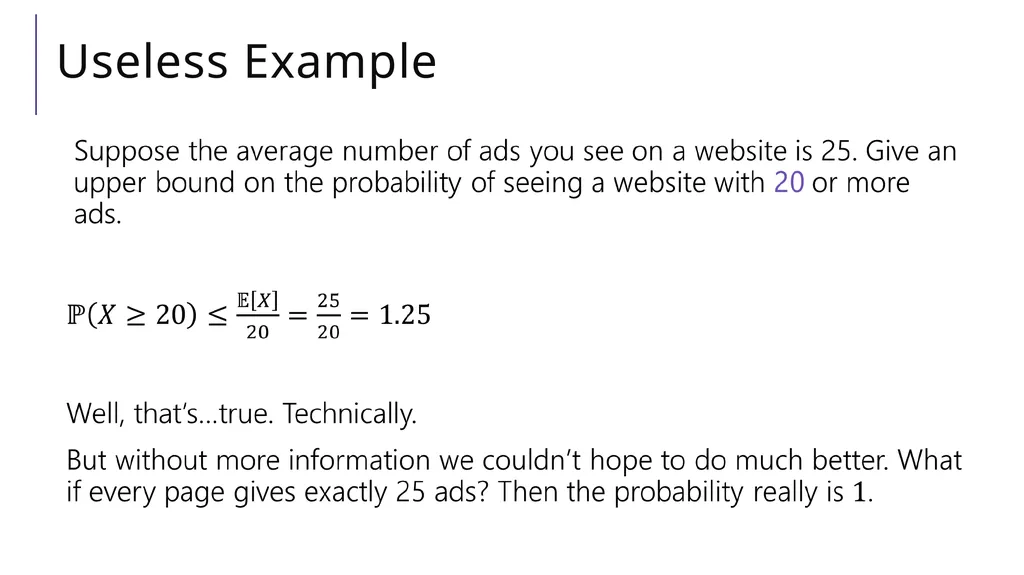
Useless Example<br>
12
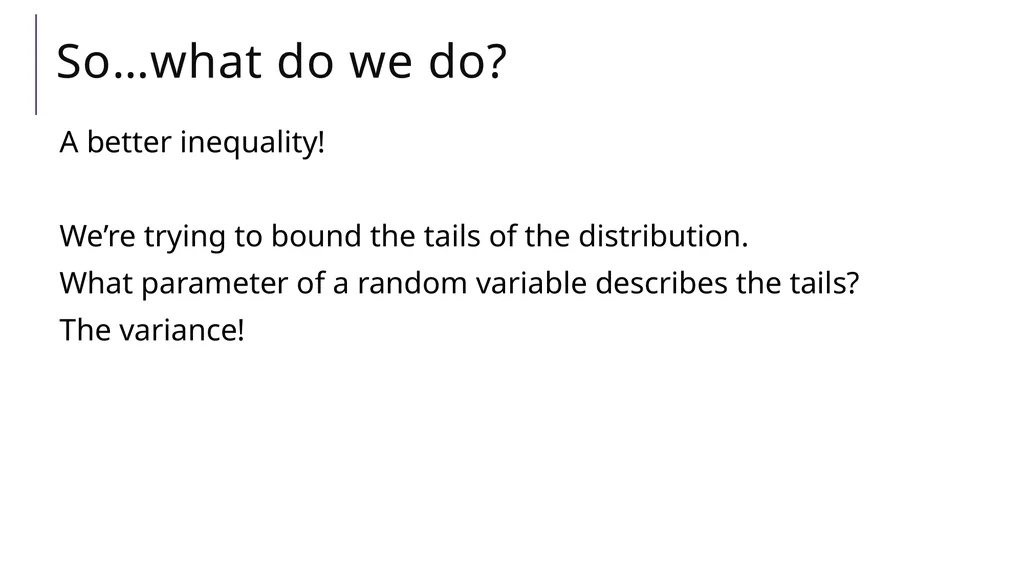
So…what do we do? A better inequality!
We’re trying to bound the tails of the distribution.
What parameter of a random variable describes the tails?
The variance!<br>
13
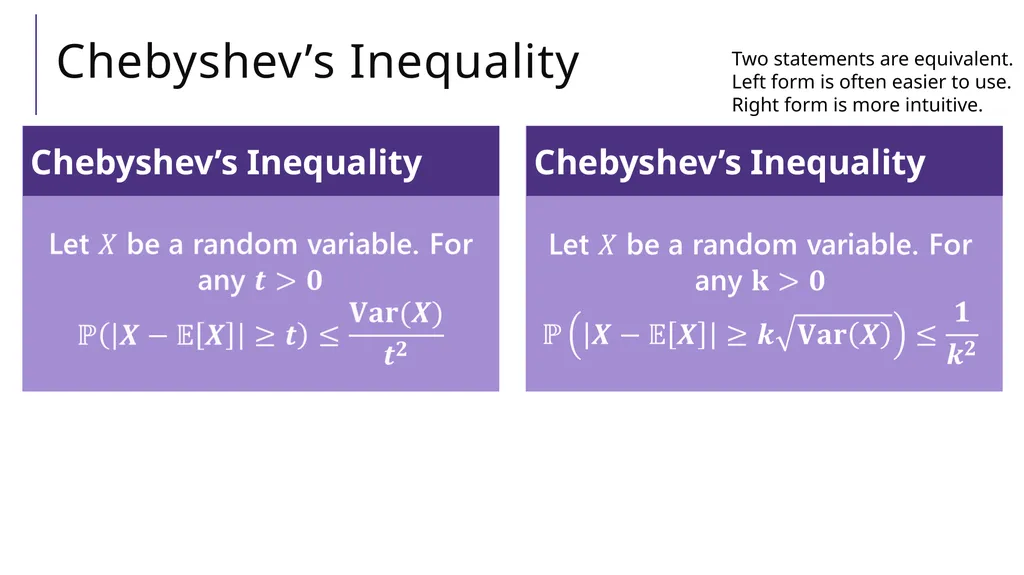
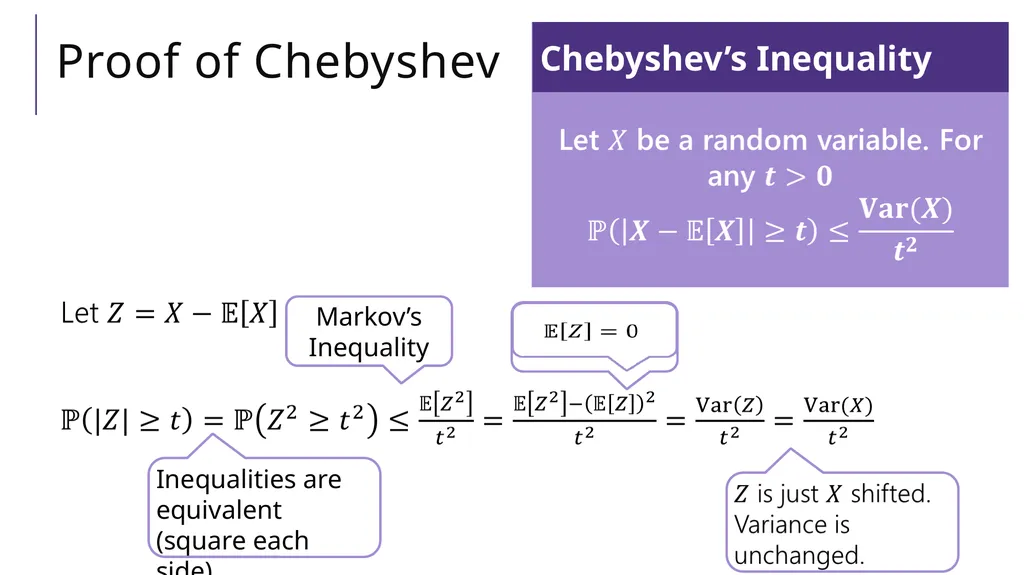
Chebyshev’s Inequality Two statements are equivalent. Left form is often easier to use. Right form is more intuitive.<br>
14
Proof of Chebyshev Inequalities are equivalent (square each side). Markov’s Inequality<br>
15
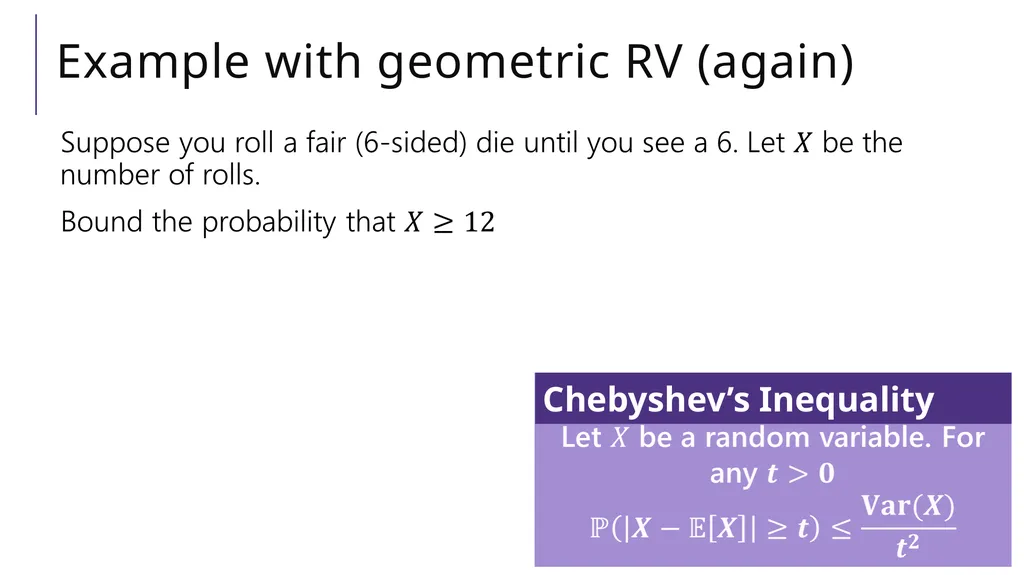
Example with geometric RV (again)<br>
16
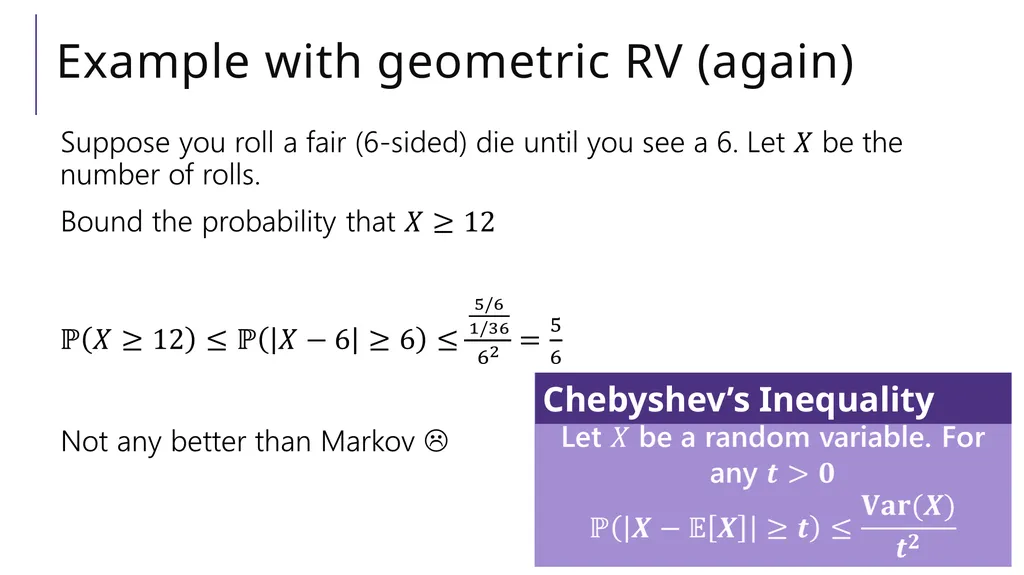
Example with geometric RV (again)<br>
17
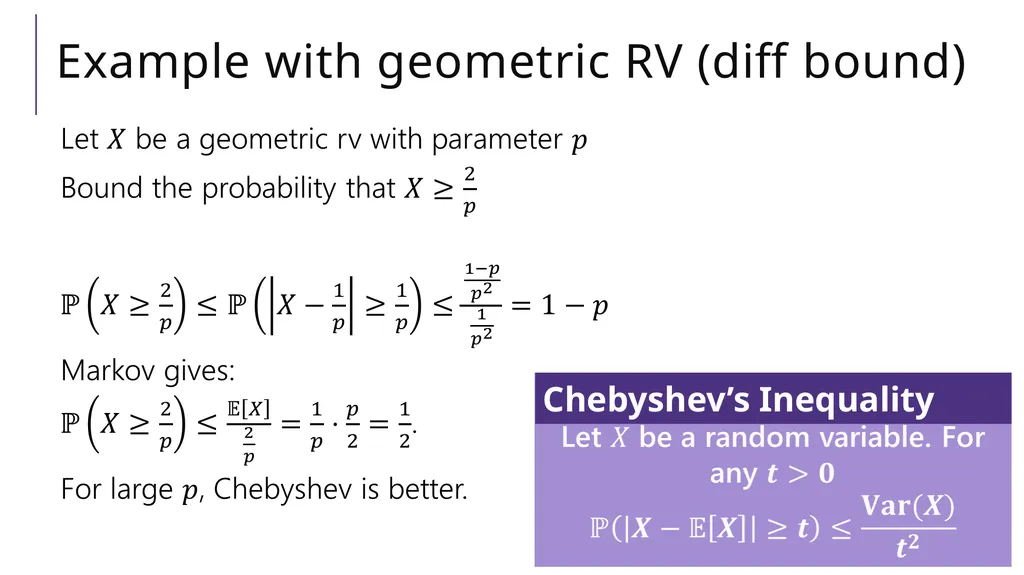
Example with geometric RV (diff bound)<br>
18
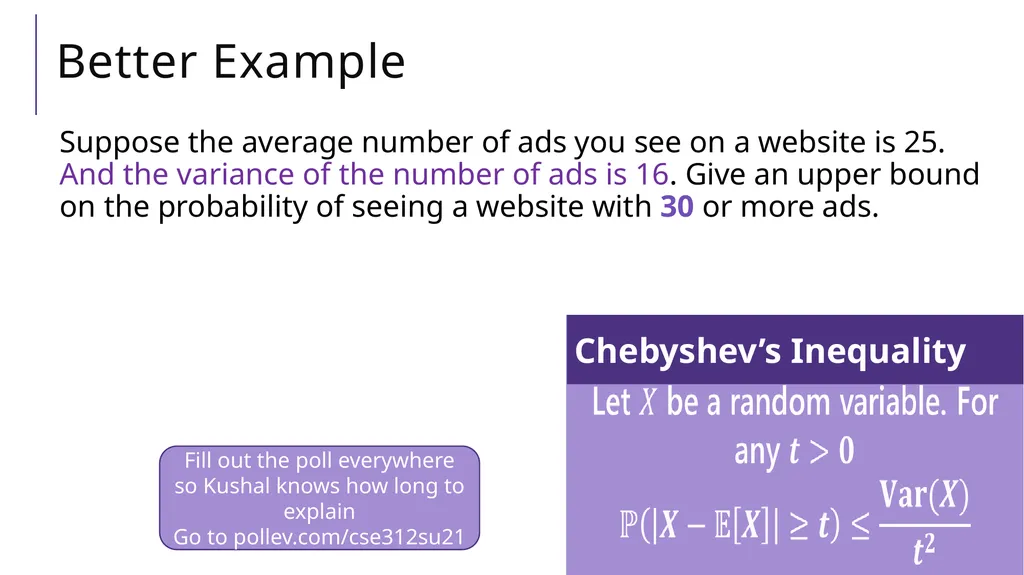
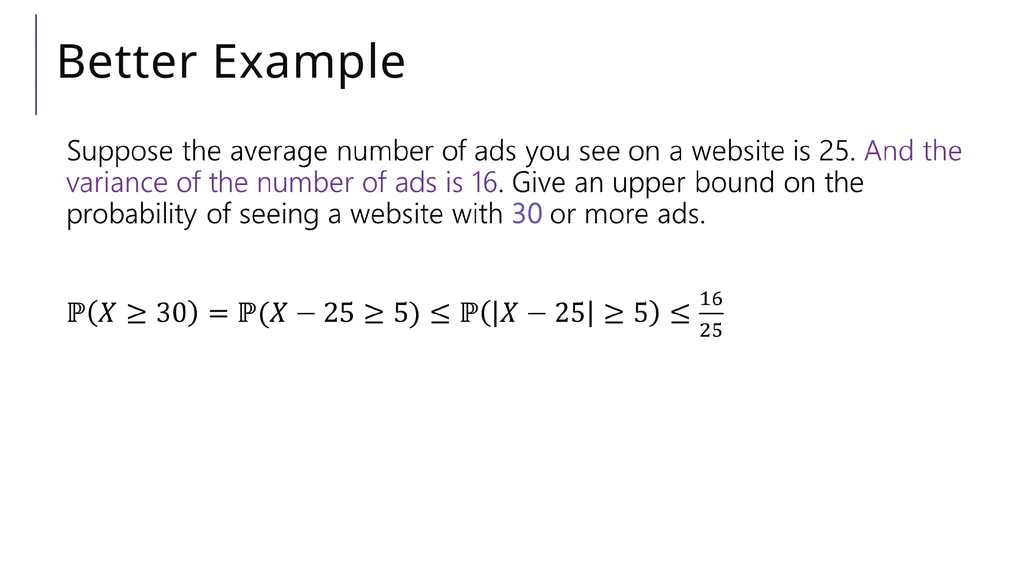
Better Example Suppose the average number of ads you see on a website is 25. And the variance of the number of ads is 16. Give an upper bound on the probability of seeing a website with 30 or more ads. Fill out the poll everywhere so Kushal knows how long to explain
Go to pollev.com/cse312su21<br>
19
Better Example<br>
20
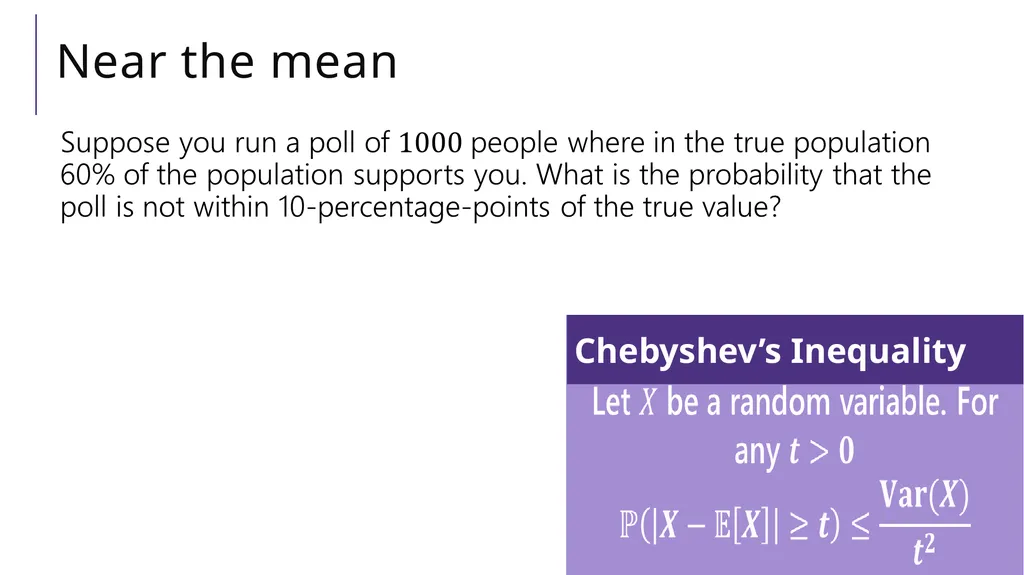
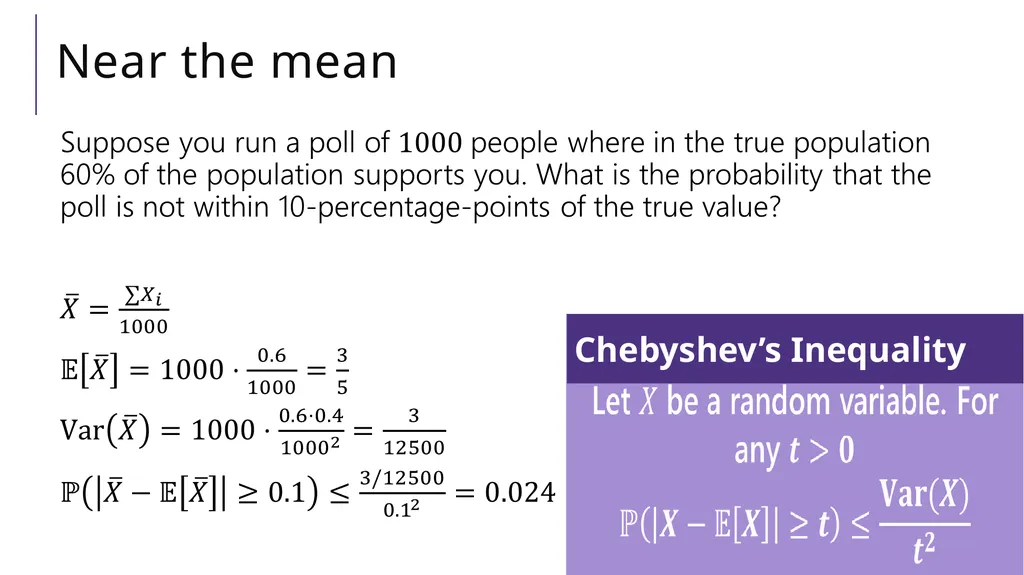
Near the mean<br>
21
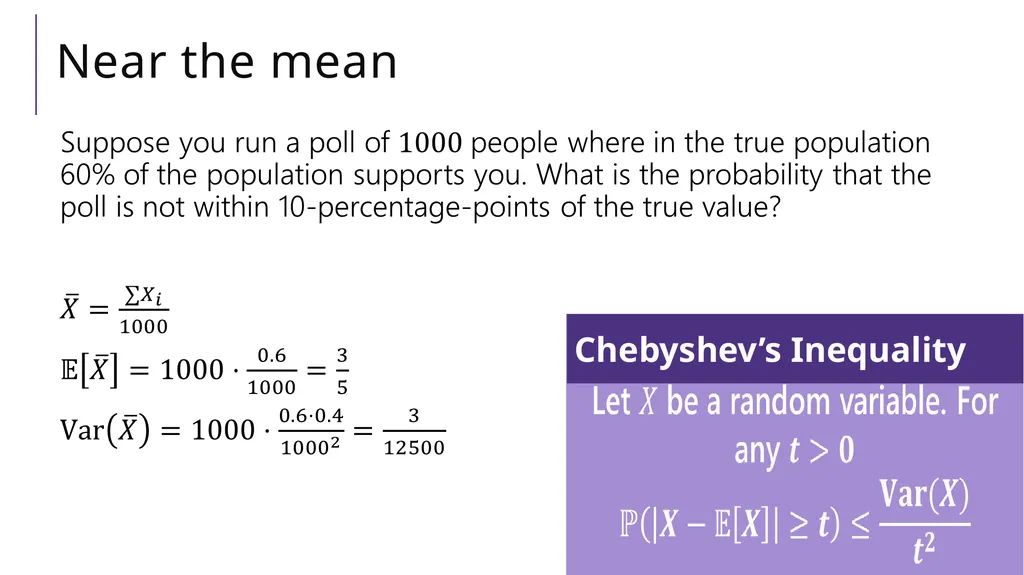
Near the mean<br>
22
Near the mean<br>
23
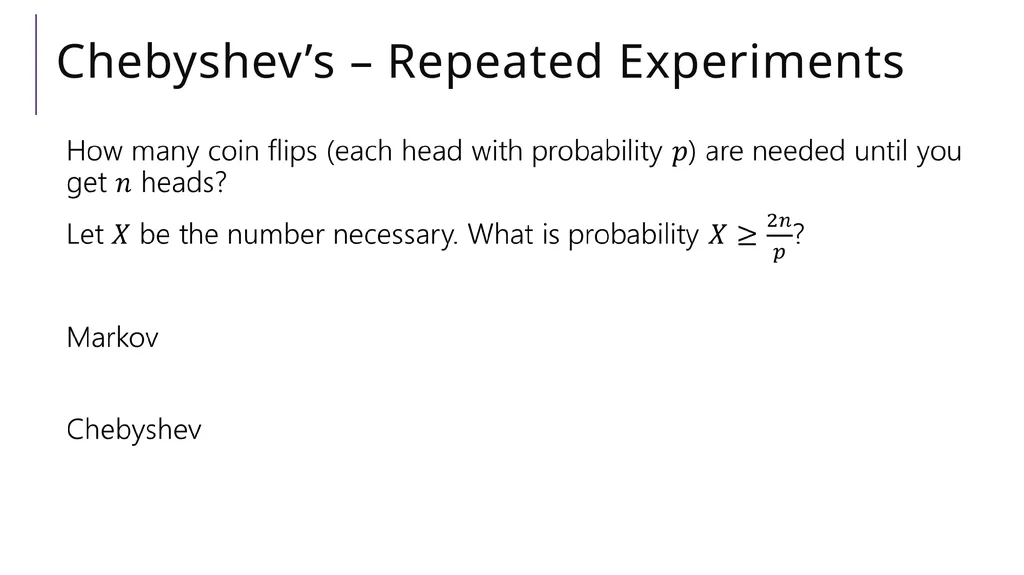
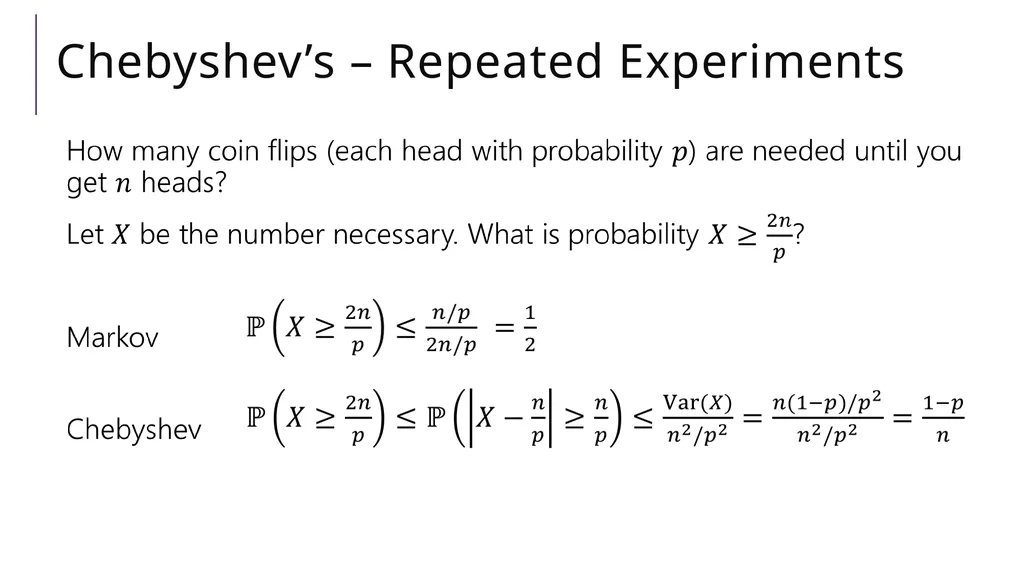
Chebyshev’s – Repeated Experiments<br>
24
Chebyshev’s – Repeated Experiments<br>
25
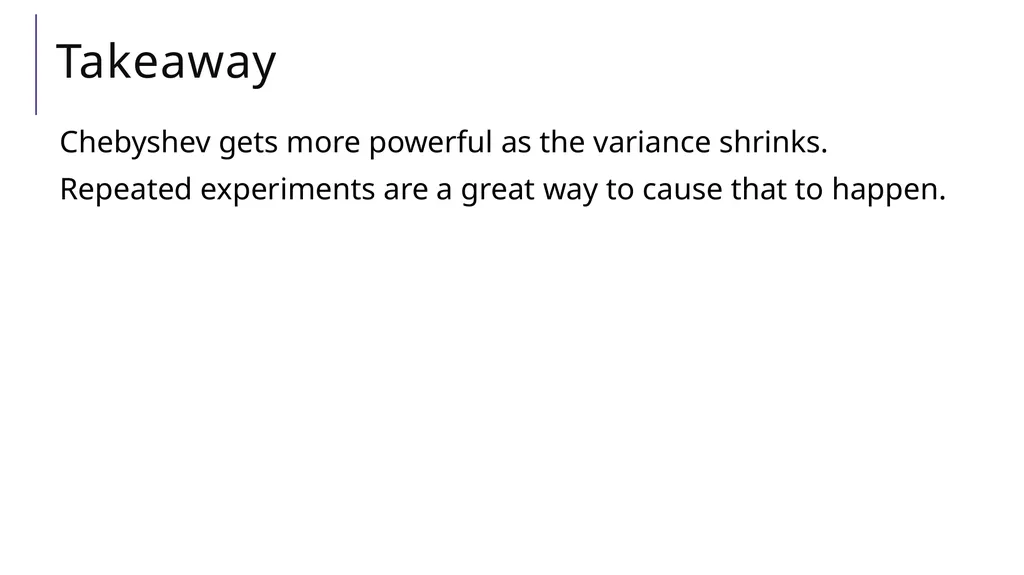
Takeaway Chebyshev gets more powerful as the variance shrinks.
Repeated experiments are a great way to cause that to happen.<br>