
Taking UNDRIP Seriously indigenous peoples have
T
Published · 17 slides · 0 views

1 / 1

Description
Taking UNDRIP Seriously indigenous peoples have the right to maintain, control and develop their cultural heritage Preston Hardison Tulalip Tribes WIPO IGC 24 April 22, 2013 Indigenous Peoples are a subject of international law and
Related Topics
Share
Embed code
Download this presentation From Below
"Taking UNDRIP Seriously indigenous peoples have" is the property of its rightful owner. Permission is granted to download and print the materials on this website for personal, non-commercial use only, and to display it on your personal computer provided you do not modify the materials and that you retain all copyright notices contained in the materials. By downloading content from our website, you accept the terms of this agreement.
Presentation Transcript
01
Taking UNDRIP Seriously indigenous peoples have the right to maintain, control and develop their cultural heritage Preston Hardison
Tulalip Tribes
WIPO IGC 24
April 22, 2013<br>
Tulalip Tribes
WIPO IGC 24
April 22, 2013<br>
02
Indigenous Peoples are a subject of international law and aspirations
1. UNDRIP (purposely) does not define who is Indigenous
2. Purpose was to give States and Indigenous Peoples the flexibility to work out their own constructive agreements in national contexts
3. Purpose was not to allow States the flexibility to circumvent the intentions of UNDRIP to promote State recognition of Indigenous Peoples where they occur and their rights
4. Martinez Cobo (1986) Study on the Problem of Discrimination against Indigenous Populations (E/CN.4/Sub.2/1986/Add.4) provides a “hallmark definition” that lists a number of criteria for identifying Indigenous Peoples
5. Being “autochtonous”, or “born from the earth of a place” is only one criteria<br>
03
Indigenous communities, peoples and nations are those which,
having a historical continuity with pre-invasion and pre-colonial societies that developed on their territories,
consider themselves distinct from other sectors of the societies now prevailing on those territories, or parts of them.
They form at present non-dominant sectors of society and are determined to preserve, develop and transmit to future generations their ancestral territories, and their ethnic identity, as the basis of their continued existence as peoples,
in accordance with their own cultural patterns, social institutions and legal system.<br>
04
FAO Policy on Indigenous and Tribal Peoples (2010)
• Priority in time, with respect to occupation and use of a specific territory;
• The voluntary perpetuation of cultural distinctiveness, which may include aspects of language, social organization, religion and spiritual values, modes of production, laws and institutions;
• Self-identification, as well as recognition by other groups, or by State authorities, as a distinct collectivity; and
• An experience of subjugation, marginalization, dispossession, exclusion or discrimination, whether or not these conditions persist.<br>
05
FAO Policy on Indigenous and Tribal Peoples (2010)
The following principles have been identified as the core rights and values to which indigenous peoples are entitled; these underlie the present policy:
• Self-determination [rights to self-governance and to freely pursue their destiny]
• Development with identity [right to dignity/to have their identity recognized]
• Free, prior and informed consent
• Participation and inclusion [procedural rights/procedural justice]
• Rights over land and other natural resources
• Cultural rights
• Collective rights
• Gender equality<br>
06
2003 Convention for the Safeguarding of the Intangible Cultural Heritage
Intangible Cultural Heritage means the practices, representations, expressions, knowledge, skills – as well as the instruments, objects, artifacts and cultural spaces associated therewith – that communities, groups and, in some cases, individuals recognize as part of their cultural heritage. This intangible cultural heritage, transmitted from generation to generation, is constantly recreated by communities and groups in response to their environment, their interaction with nature and their history, and provides them with a sense of identity and continuity, thus promoting respect for cultural diversity and human creativity. For the purposes of this Convention, consideration will be given solely to such intangible cultural heritage as is compatible with existing international human rights instruments, as well as with the requirements of mutual respect among communities, groups and individuals, and of sustainable development.<br>
07
Self-Determination
1. Jus cogens / ius cogens / peremptory norm
2. United Nations Charter appears as a principle of comity between nations
3. Respect for the principle of equal rights and fair equality of opportunity have the right to freely choose their sovereignty and international political status with no external compulsion or interference
4. Declaration on the Granting of Independence to Colonial Countries and Peoples (UN GAR 1514 (XV), 14 December 1960) extended to colonial countries and peoples
5. UNDRIP Article 2 recognizes the status for Indigenous Peoples<br>
08
UNDRIP Article 31
1. Indigenous peoples have the right to maintain, control, protect and develop their cultural heritage, traditional knowledge and traditional cultural expressions, as well as the manifestations of their sciences, technologies and cultures, including human and genetic resources, seeds, medicines, knowledge of the properties of fauna and flora, oral traditions, literatures, designs, sports and traditional games and visual and performing arts. They also have the right to maintain, control, protect and develop their intellectual property over such cultural heritage, traditional knowledge, and traditional cultural expressions.
2. In conjunction with indigenous peoples, States shall take effective measures to recognize and protect the exercise of these rights.<br>
09
UNDRIP Article 19
States shall consult and cooperate in good faith with the indigenous peoples concerned through their own representative institutions in order to obtain their free, prior and informed consent before adopting and implementing legislative or administrative measures that may affect them.
[FPIC, procedural rights, principle of procedural justice]<br>
10
The Declaration must not, however, be viewed in isolation. In doing so, one risks being distracted by discussions on the formal legal status of the Declaration. It is critical to recognize that the Declaration is not only important in itself, but is also significant because it reflects – in broad terms – a general global consensus on indigenous peoples' rights that is in significant part incorporated into contemporary international law.
[Although State sovereignty and Indigenous self-determination are distinct sets of rights, they are] “rooted in the same rationale: that peoples should be allowed to be in control of their own affairs under conditions of equality.” [right to non-discrimination]
Statement by Professor James Anaya, Special Rapporteur on the rights of indigenous peoples to the 23rd Session of the IGC, 4 February 2013<br>
11
The proposed international instrument or instruments
1. Encompasses multiple peoples, some governed fully by States, and others possessing inherent human rights of self-determination under their own self-governance structures
2. Contains elements that are potentially in conflict
Intangible cultural heritage as a human right
Inherent rights, not granted by States
Intangible cultural heritage as an intellectual property right
Civil right / public right
Public domain
Balance between private and public interest<br>
12
“Protection” of Traditional Knowledge
1. Extinction / Common Heritage of Mankind
2. Exclusion when granting of property rights to others
3. Any disclosure to outsiders
4. Erroneous granting of patents through prior art/public domain
5. Any use without FPIC
6. Any commercial use without FPIC
7. Any commercial use
8. Any use against customary law - Stewardship obligations<br>
13
“Public domain”
1. IP Concept, primarily copyright
2. Assumes IP law holds supremacy over the regulation of TK – risk of preemption as a granted right vs. respect for an inherent right and prejudicial against sui generis rights
3. Assumes Indigenous Peoples lack control or self-determination over TK that has been classified as being in the public domain
4. Some States have the ability to “claw back” materials from the public domain: e.g. USA: Golan et al. v. Holder (2012) the Court upheld Congress’s authority to withdraw works from the public domain and put them back under copyright protection, in pursuance of obligations of the Uruguay Round Agreements Act (URAA)(1994)<br>
14
“National Treatment”
1. Comity through nearest equivalent
2. Few nearest equivalents in existing national laws
3. Extraterritorial recognition by states without Indigenous Peoples
4. No nearest equivalents in previous international IP laws that did not consider traditional knowledge as either an IP or human right
5. States should not use lack of equivalent national treatment that recognizes and respects rights to TK to circumvent the intentions of the instrument or instruments<br>
15
Databases
1. Should not be based on any notion of traditional knowledge in the public domain when it applies to identifiable Indigenous Peoples
2. FPIC of Indigenous Peoples must be required for the design, governance and implementation of any proposed database
3. Indigenous Peoples may prefer to manage and maintain their own databases
4. The proposal to make the databases only available to patent offices is a step in the right direction, but provides no security from corruption, theft, hacking, leakage or changes in policy and law (flip-of-the-switch problem)
5. Customary law prevents much TK from entering databases<br>
16
The traditional knowledge of Indigenous Peoples must be negotiated in it full context, not just to solve IP problems
1. Risks of disclosure of unprotected traditional knowledge associated with unprotected cultural resources/heritage
2. Patents are a rare, 20 year problem of unjust enrichment
3. Petty, non-monopolistic and unsustainable uses are a common and potentially millennial problem that can dispossess Indigenous peoples of their identity, fiduciary resources, cultural heritage and human dignity.<br>
17
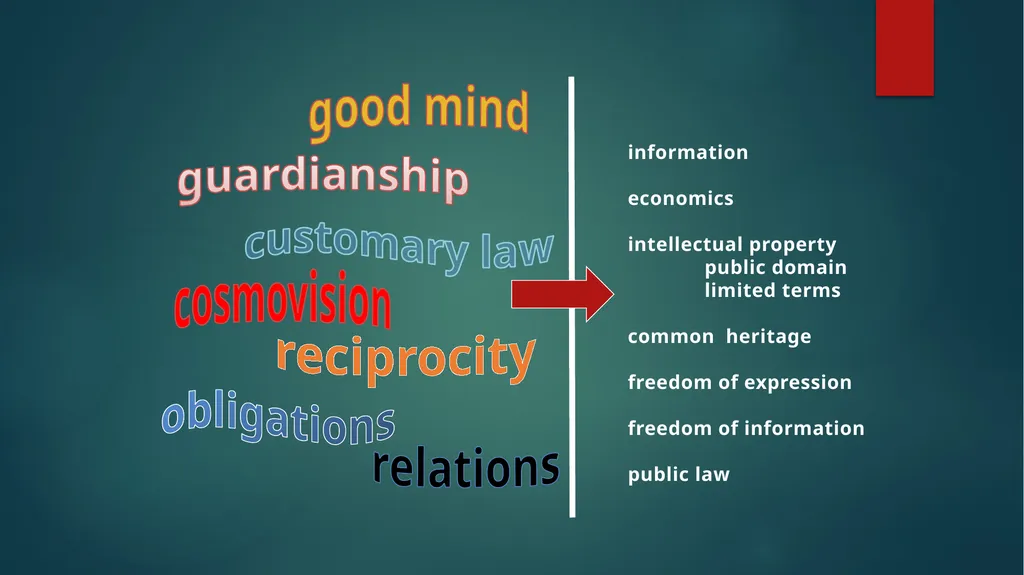
cosmovision reciprocity customary law obligations guardianship information
economics
intellectual property
public domain
limited terms
common heritage
freedom of expression
freedom of information
public law relations good mind<br>
economics
intellectual property
public domain
limited terms
common heritage
freedom of expression
freedom of information
public law relations good mind<br>