
TARGET2-Securities (T2S) is coming, get ready!
MT
Published · 27 slides · 0 views
1 / 1
Description
TARGET2-Securities (T2S) is coming, get ready! Thursday, 20 June 2013 Hosted by Welcome and opening remarks Nicholas Hamilton Executive Director EMEA Fixed Income Operations J.P. Morgan Corporate Investment Bank Introduction John Serocold
Related Topics
Share
Embed code
Download this presentation From Below
"TARGET2-Securities (T2S) is coming, get ready!" is the property of its rightful owner. Permission is granted to download and print the materials on this website for personal, non-commercial use only, and to display it on your personal computer provided you do not modify the materials and that you retain all copyright notices contained in the materials. By downloading content from our website, you accept the terms of this agreement.
Presentation Transcript
01
TARGET2-Securities (T2S) is coming, get ready! Thursday, 20 June 2013 Hosted by<br>
02
Welcome and opening remarks Nicholas Hamilton
Executive Director EMEA Fixed Income Operations
J.P. Morgan Corporate & Investment Bank<br>
03
Introduction John Serocold
Senior Director, Market Practice and Regulatory Policy
International Capital Market Association (ICMA)<br>
04
Overview on work of the T2S working group Robert Mason
Head of EMEA Securities Operations
RBS Markets & International Banking<br>
05
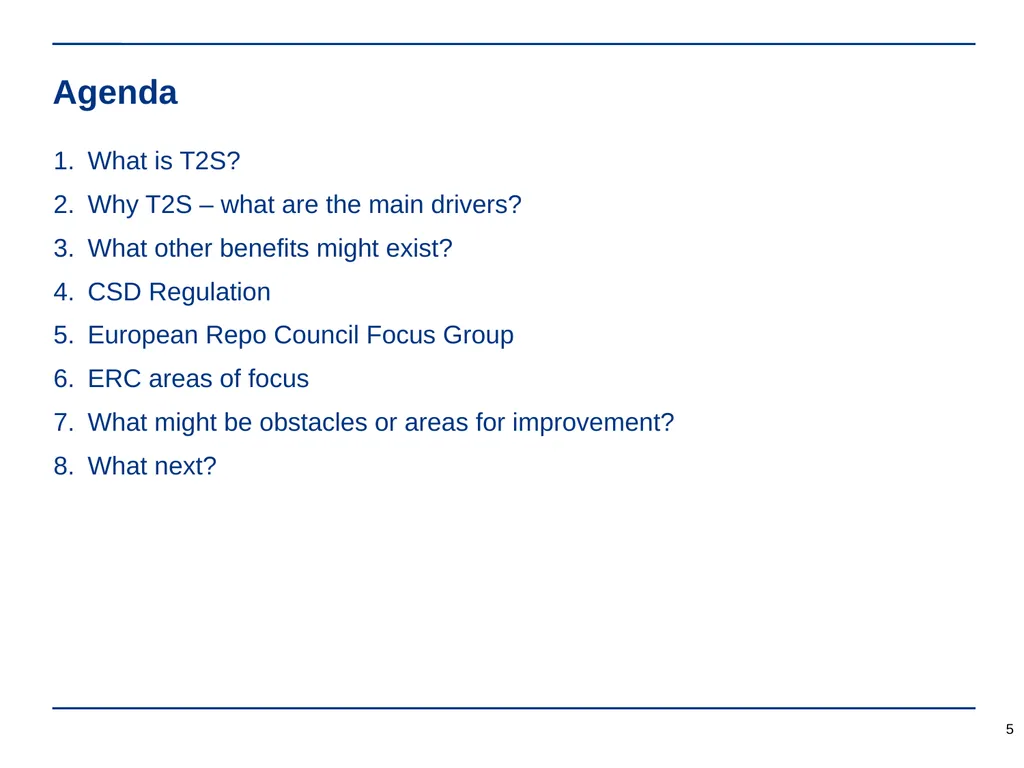
Agenda What is T2S?
Why T2S – what are the main drivers?
What other benefits might exist?
CSD Regulation
European Repo Council Focus Group
ERC areas of focus
What might be obstacles or areas for improvement?
What next? 5<br>
Why T2S – what are the main drivers?
What other benefits might exist?
CSD Regulation
European Repo Council Focus Group
ERC areas of focus
What might be obstacles or areas for improvement?
What next? 5<br>
06
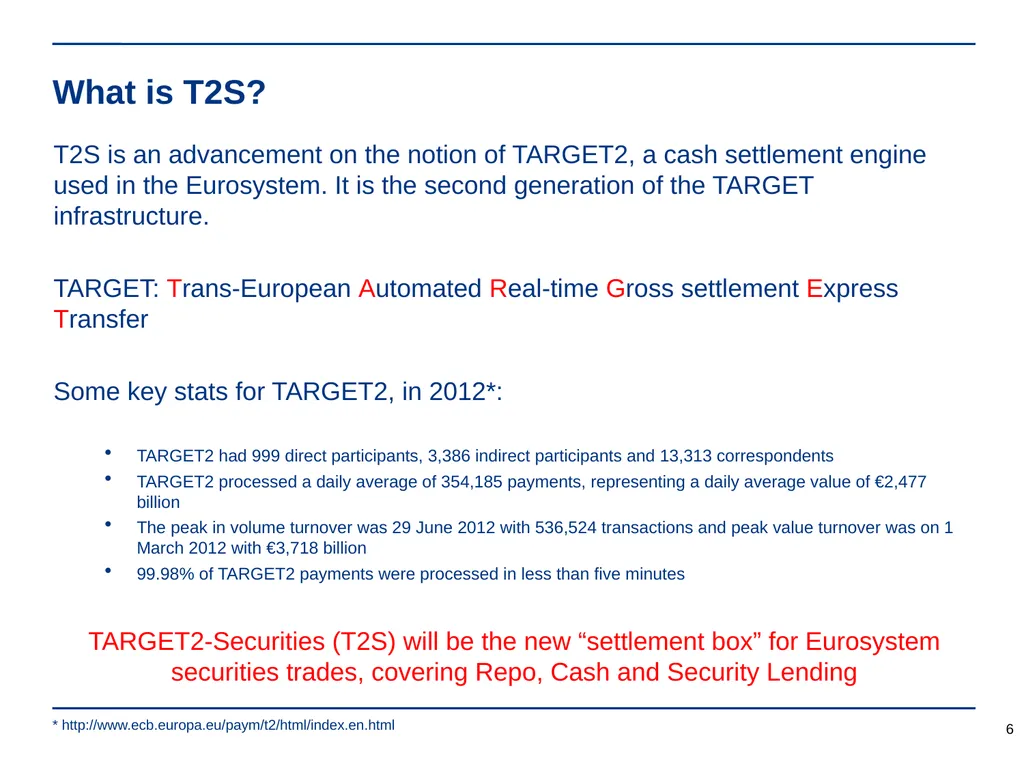
What is T2S? T2S is an advancement on the notion of TARGET2, a cash settlement engine used in the Eurosystem. It is the second generation of the TARGET infrastructure.
TARGET: Trans-European Automated Real-time Gross settlement Express Transfer
Some key stats for TARGET2, in 2012*:
TARGET2 had 999 direct participants, 3,386 indirect participants and 13,313 correspondents
TARGET2 processed a daily average of 354,185 payments, representing a daily average value of €2,477 billion
The peak in volume turnover was 29 June 2012 with 536,524 transactions and peak value turnover was on 1 March 2012 with €3,718 billion
99.98% of TARGET2 payments were processed in less than five minutes
TARGET2-Securities (T2S) will be the new “settlement box” for Eurosystem securities trades, covering Repo, Cash and Security Lending 6 * http://www.ecb.europa.eu/paym/t2/html/index.en.html<br>
TARGET: Trans-European Automated Real-time Gross settlement Express Transfer
Some key stats for TARGET2, in 2012*:
TARGET2 had 999 direct participants, 3,386 indirect participants and 13,313 correspondents
TARGET2 processed a daily average of 354,185 payments, representing a daily average value of €2,477 billion
The peak in volume turnover was 29 June 2012 with 536,524 transactions and peak value turnover was on 1 March 2012 with €3,718 billion
99.98% of TARGET2 payments were processed in less than five minutes
TARGET2-Securities (T2S) will be the new “settlement box” for Eurosystem securities trades, covering Repo, Cash and Security Lending 6 * http://www.ecb.europa.eu/paym/t2/html/index.en.html<br>
07
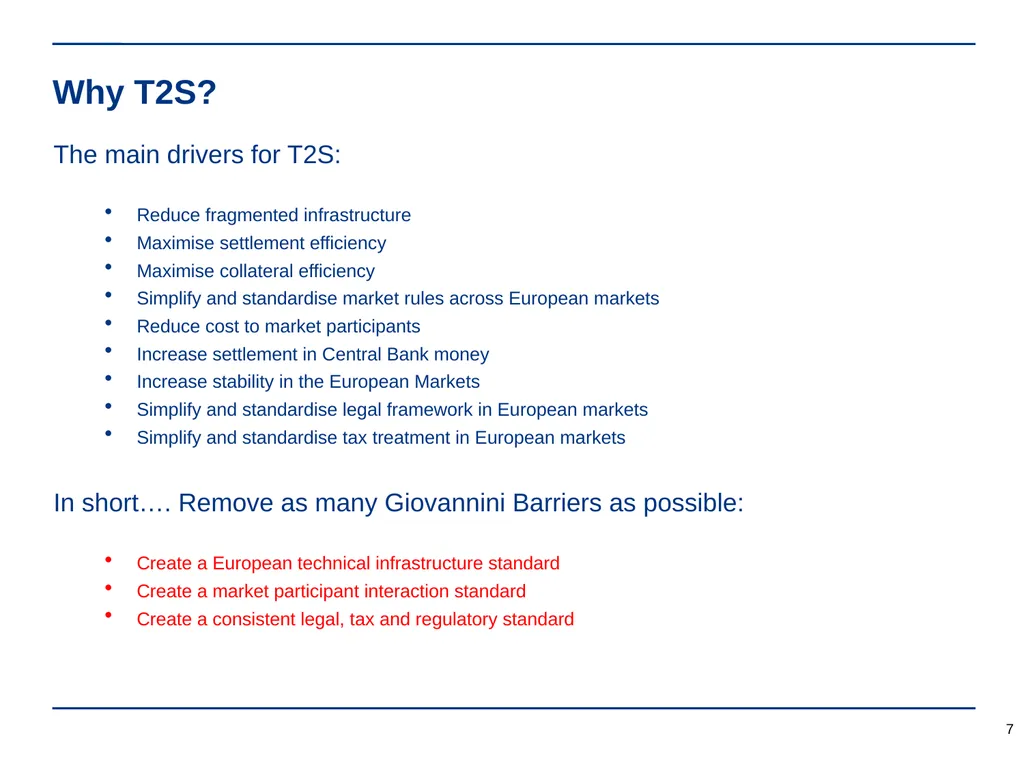
Why T2S? The main drivers for T2S:
Reduce fragmented infrastructure
Maximise settlement efficiency
Maximise collateral efficiency
Simplify and standardise market rules across European markets
Reduce cost to market participants
Increase settlement in Central Bank money
Increase stability in the European Markets
Simplify and standardise legal framework in European markets
Simplify and standardise tax treatment in European markets
In short…. Remove as many Giovannini Barriers as possible:
Create a European technical infrastructure standard
Create a market participant interaction standard
Create a consistent legal, tax and regulatory standard 7<br>
Reduce fragmented infrastructure
Maximise settlement efficiency
Maximise collateral efficiency
Simplify and standardise market rules across European markets
Reduce cost to market participants
Increase settlement in Central Bank money
Increase stability in the European Markets
Simplify and standardise legal framework in European markets
Simplify and standardise tax treatment in European markets
In short…. Remove as many Giovannini Barriers as possible:
Create a European technical infrastructure standard
Create a market participant interaction standard
Create a consistent legal, tax and regulatory standard 7<br>
08
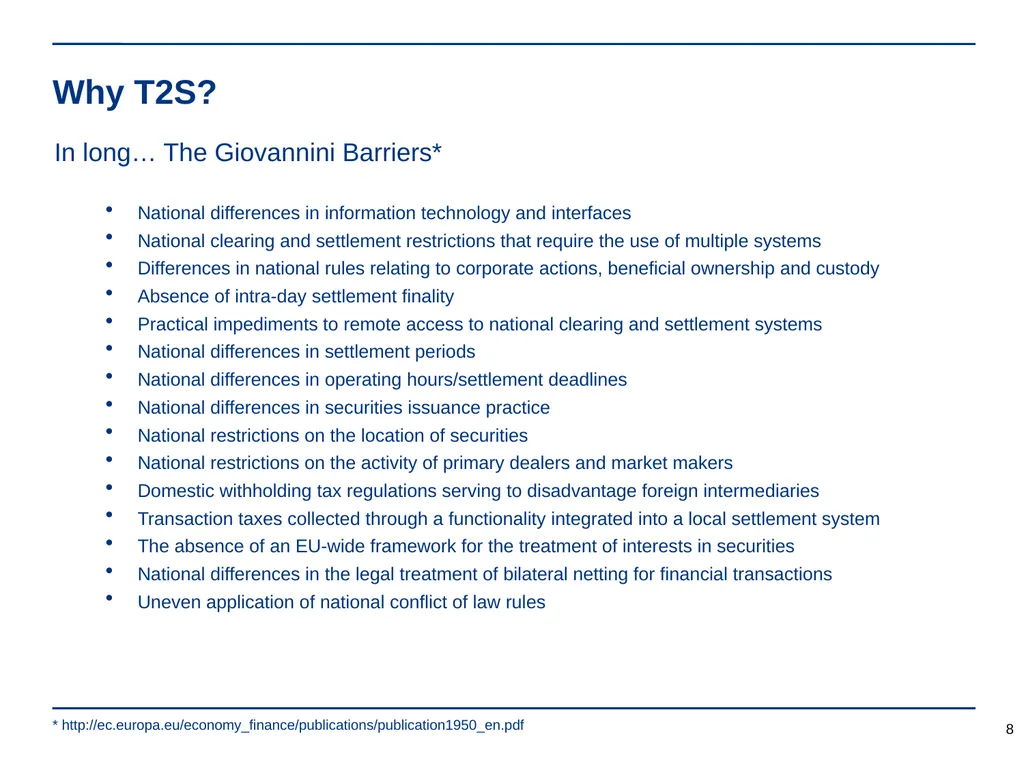
Why T2S? In long… The Giovannini Barriers*
National differences in information technology and interfaces
National clearing and settlement restrictions that require the use of multiple systems
Differences in national rules relating to corporate actions, beneficial ownership and custody
Absence of intra-day settlement finality
Practical impediments to remote access to national clearing and settlement systems
National differences in settlement periods
National differences in operating hours/settlement deadlines
National differences in securities issuance practice
National restrictions on the location of securities
National restrictions on the activity of primary dealers and market makers
Domestic withholding tax regulations serving to disadvantage foreign intermediaries
Transaction taxes collected through a functionality integrated into a local settlement system
The absence of an EU-wide framework for the treatment of interests in securities
National differences in the legal treatment of bilateral netting for financial transactions
Uneven application of national conflict of law rules 8 * http://ec.europa.eu/economy_finance/publications/publication1950_en.pdf<br>
National differences in information technology and interfaces
National clearing and settlement restrictions that require the use of multiple systems
Differences in national rules relating to corporate actions, beneficial ownership and custody
Absence of intra-day settlement finality
Practical impediments to remote access to national clearing and settlement systems
National differences in settlement periods
National differences in operating hours/settlement deadlines
National differences in securities issuance practice
National restrictions on the location of securities
National restrictions on the activity of primary dealers and market makers
Domestic withholding tax regulations serving to disadvantage foreign intermediaries
Transaction taxes collected through a functionality integrated into a local settlement system
The absence of an EU-wide framework for the treatment of interests in securities
National differences in the legal treatment of bilateral netting for financial transactions
Uneven application of national conflict of law rules 8 * http://ec.europa.eu/economy_finance/publications/publication1950_en.pdf<br>
09
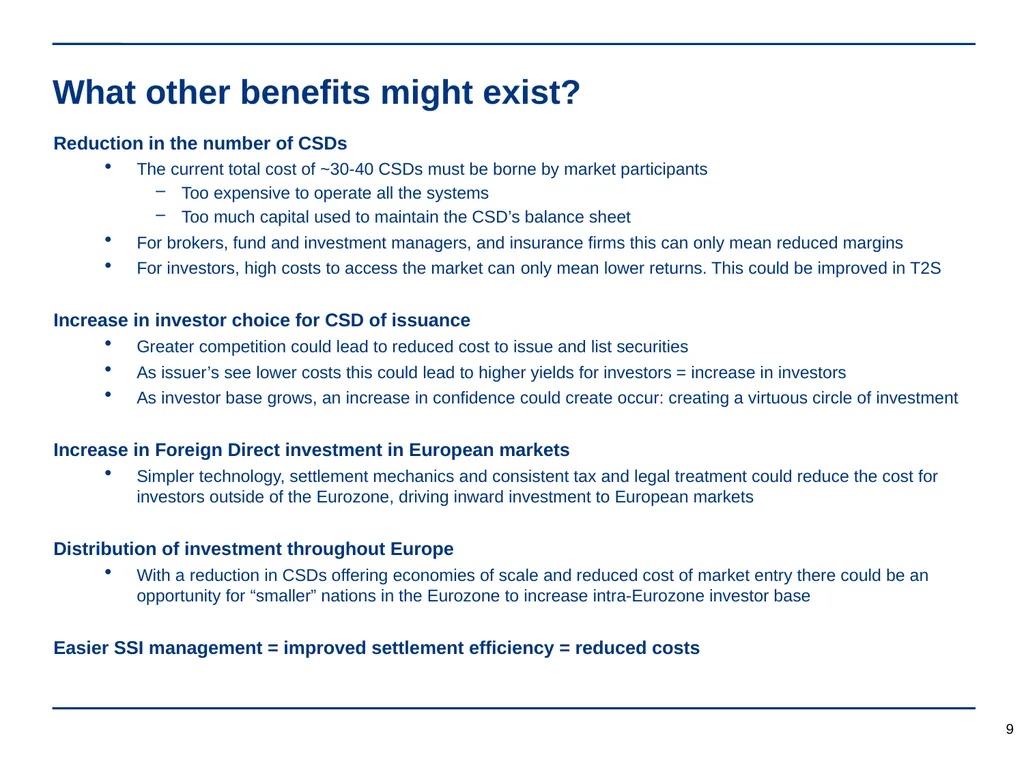
What other benefits might exist? Reduction in the number of CSDs
The current total cost of ~30-40 CSDs must be borne by market participants
Too expensive to operate all the systems
Too much capital used to maintain the CSD’s balance sheet
For brokers, fund and investment managers, and insurance firms this can only mean reduced margins
For investors, high costs to access the market can only mean lower returns. This could be improved in T2S
Increase in investor choice for CSD of issuance
Greater competition could lead to reduced cost to issue and list securities
As issuer’s see lower costs this could lead to higher yields for investors = increase in investors
As investor base grows, an increase in confidence could create occur: creating a virtuous circle of investment
Increase in Foreign Direct investment in European markets
Simpler technology, settlement mechanics and consistent tax and legal treatment could reduce the cost for investors outside of the Eurozone, driving inward investment to European markets
Distribution of investment throughout Europe
With a reduction in CSDs offering economies of scale and reduced cost of market entry there could be an opportunity for “smaller” nations in the Eurozone to increase intra-Eurozone investor base
Easier SSI management = improved settlement efficiency = reduced costs 9<br>
The current total cost of ~30-40 CSDs must be borne by market participants
Too expensive to operate all the systems
Too much capital used to maintain the CSD’s balance sheet
For brokers, fund and investment managers, and insurance firms this can only mean reduced margins
For investors, high costs to access the market can only mean lower returns. This could be improved in T2S
Increase in investor choice for CSD of issuance
Greater competition could lead to reduced cost to issue and list securities
As issuer’s see lower costs this could lead to higher yields for investors = increase in investors
As investor base grows, an increase in confidence could create occur: creating a virtuous circle of investment
Increase in Foreign Direct investment in European markets
Simpler technology, settlement mechanics and consistent tax and legal treatment could reduce the cost for investors outside of the Eurozone, driving inward investment to European markets
Distribution of investment throughout Europe
With a reduction in CSDs offering economies of scale and reduced cost of market entry there could be an opportunity for “smaller” nations in the Eurozone to increase intra-Eurozone investor base
Easier SSI management = improved settlement efficiency = reduced costs 9<br>
10
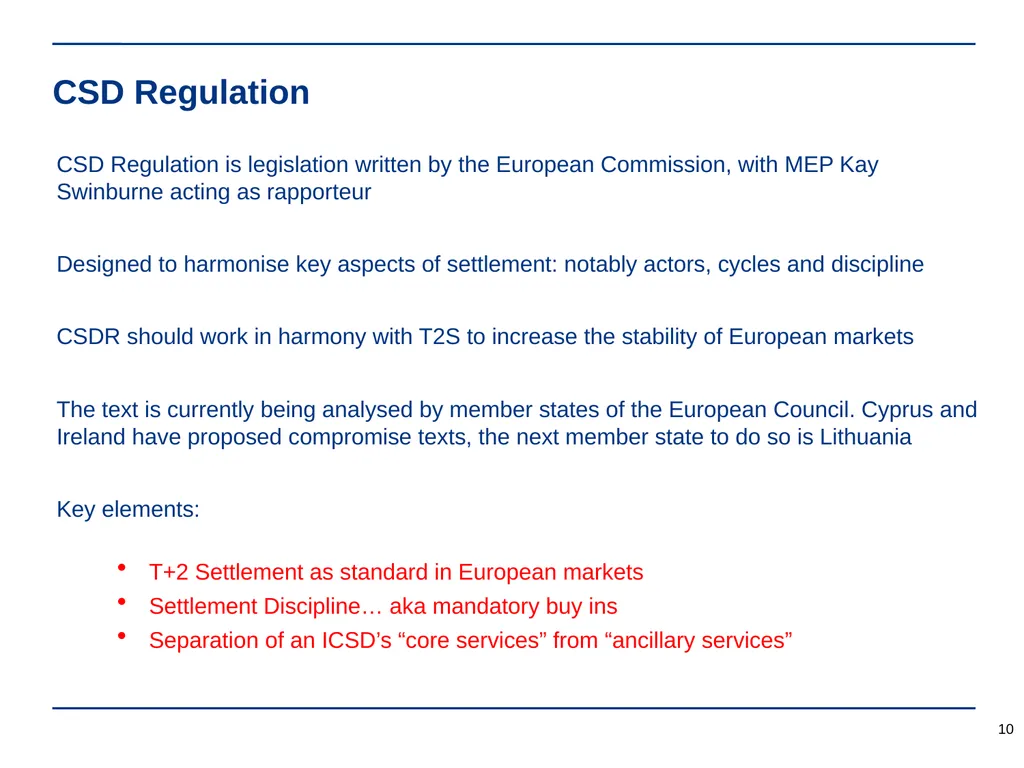
CSD Regulation CSD Regulation is legislation written by the European Commission, with MEP Kay Swinburne acting as rapporteur
Designed to harmonise key aspects of settlement: notably actors, cycles and discipline
CSDR should work in harmony with T2S to increase the stability of European markets
The text is currently being analysed by member states of the European Council. Cyprus and Ireland have proposed compromise texts, the next member state to do so is Lithuania
Key elements:
T+2 Settlement as standard in European markets
Settlement Discipline… aka mandatory buy ins
Separation of an ICSD’s “core services” from “ancillary services” 10<br>
Designed to harmonise key aspects of settlement: notably actors, cycles and discipline
CSDR should work in harmony with T2S to increase the stability of European markets
The text is currently being analysed by member states of the European Council. Cyprus and Ireland have proposed compromise texts, the next member state to do so is Lithuania
Key elements:
T+2 Settlement as standard in European markets
Settlement Discipline… aka mandatory buy ins
Separation of an ICSD’s “core services” from “ancillary services” 10<br>
11
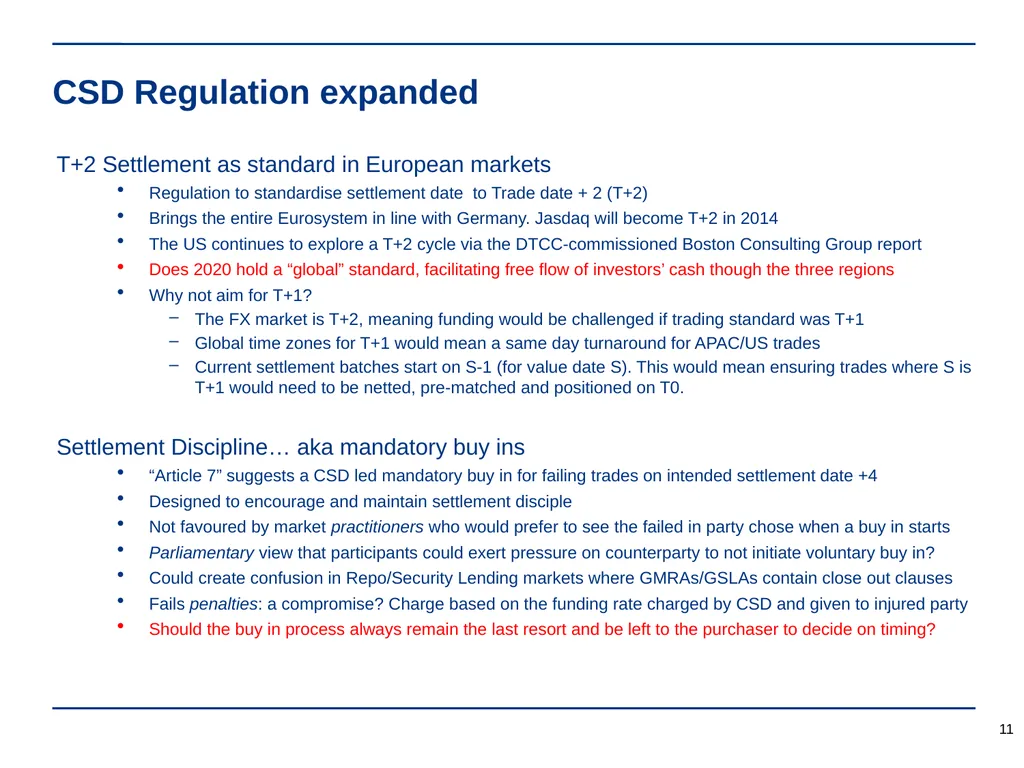
CSD Regulation expanded T+2 Settlement as standard in European markets
Regulation to standardise settlement date to Trade date + 2 (T+2)
Brings the entire Eurosystem in line with Germany. Jasdaq will become T+2 in 2014
The US continues to explore a T+2 cycle via the DTCC-commissioned Boston Consulting Group report
Does 2020 hold a “global” standard, facilitating free flow of investors’ cash though the three regions
Why not aim for T+1?
The FX market is T+2, meaning funding would be challenged if trading standard was T+1
Global time zones for T+1 would mean a same day turnaround for APAC/US trades
Current settlement batches start on S-1 (for value date S). This would mean ensuring trades where S is T+1 would need to be netted, pre-matched and positioned on T0.
Settlement Discipline… aka mandatory buy ins
“Article 7” suggests a CSD led mandatory buy in for failing trades on intended settlement date +4
Designed to encourage and maintain settlement disciple
Not favoured by market practitioners who would prefer to see the failed in party chose when a buy in starts
Parliamentary view that participants could exert pressure on counterparty to not initiate voluntary buy in?
Could create confusion in Repo/Security Lending markets where GMRAs/GSLAs contain close out clauses
Fails penalties: a compromise? Charge based on the funding rate charged by CSD and given to injured party
Should the buy in process always remain the last resort and be left to the purchaser to decide on timing? 11<br>
Regulation to standardise settlement date to Trade date + 2 (T+2)
Brings the entire Eurosystem in line with Germany. Jasdaq will become T+2 in 2014
The US continues to explore a T+2 cycle via the DTCC-commissioned Boston Consulting Group report
Does 2020 hold a “global” standard, facilitating free flow of investors’ cash though the three regions
Why not aim for T+1?
The FX market is T+2, meaning funding would be challenged if trading standard was T+1
Global time zones for T+1 would mean a same day turnaround for APAC/US trades
Current settlement batches start on S-1 (for value date S). This would mean ensuring trades where S is T+1 would need to be netted, pre-matched and positioned on T0.
Settlement Discipline… aka mandatory buy ins
“Article 7” suggests a CSD led mandatory buy in for failing trades on intended settlement date +4
Designed to encourage and maintain settlement disciple
Not favoured by market practitioners who would prefer to see the failed in party chose when a buy in starts
Parliamentary view that participants could exert pressure on counterparty to not initiate voluntary buy in?
Could create confusion in Repo/Security Lending markets where GMRAs/GSLAs contain close out clauses
Fails penalties: a compromise? Charge based on the funding rate charged by CSD and given to injured party
Should the buy in process always remain the last resort and be left to the purchaser to decide on timing? 11<br>
12
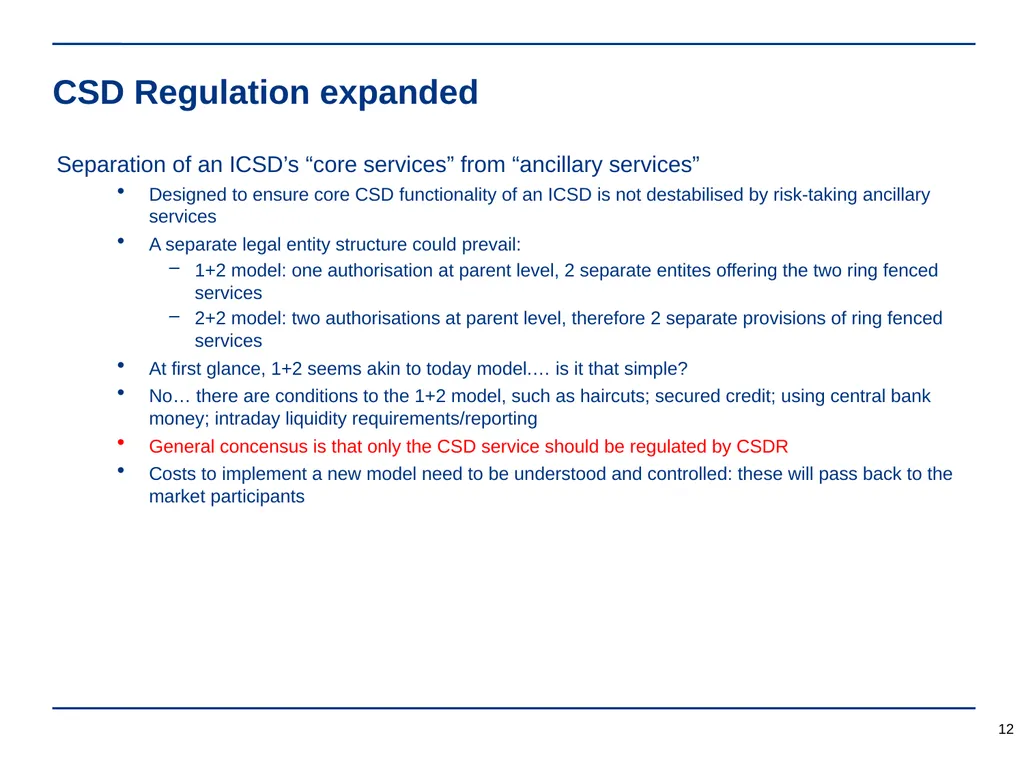
CSD Regulation expanded Separation of an ICSD’s “core services” from “ancillary services”
Designed to ensure core CSD functionality of an ICSD is not destabilised by risk-taking ancillary services
A separate legal entity structure could prevail:
1+2 model: one authorisation at parent level, 2 separate entites offering the two ring fenced services
2+2 model: two authorisations at parent level, therefore 2 separate provisions of ring fenced services
At first glance, 1+2 seems akin to today model.… is it that simple?
No… there are conditions to the 1+2 model, such as haircuts; secured credit; using central bank money; intraday liquidity requirements/reporting
General concensus is that only the CSD service should be regulated by CSDR
Costs to implement a new model need to be understood and controlled: these will pass back to the market participants 12<br>
Designed to ensure core CSD functionality of an ICSD is not destabilised by risk-taking ancillary services
A separate legal entity structure could prevail:
1+2 model: one authorisation at parent level, 2 separate entites offering the two ring fenced services
2+2 model: two authorisations at parent level, therefore 2 separate provisions of ring fenced services
At first glance, 1+2 seems akin to today model.… is it that simple?
No… there are conditions to the 1+2 model, such as haircuts; secured credit; using central bank money; intraday liquidity requirements/reporting
General concensus is that only the CSD service should be regulated by CSDR
Costs to implement a new model need to be understood and controlled: these will pass back to the market participants 12<br>
13
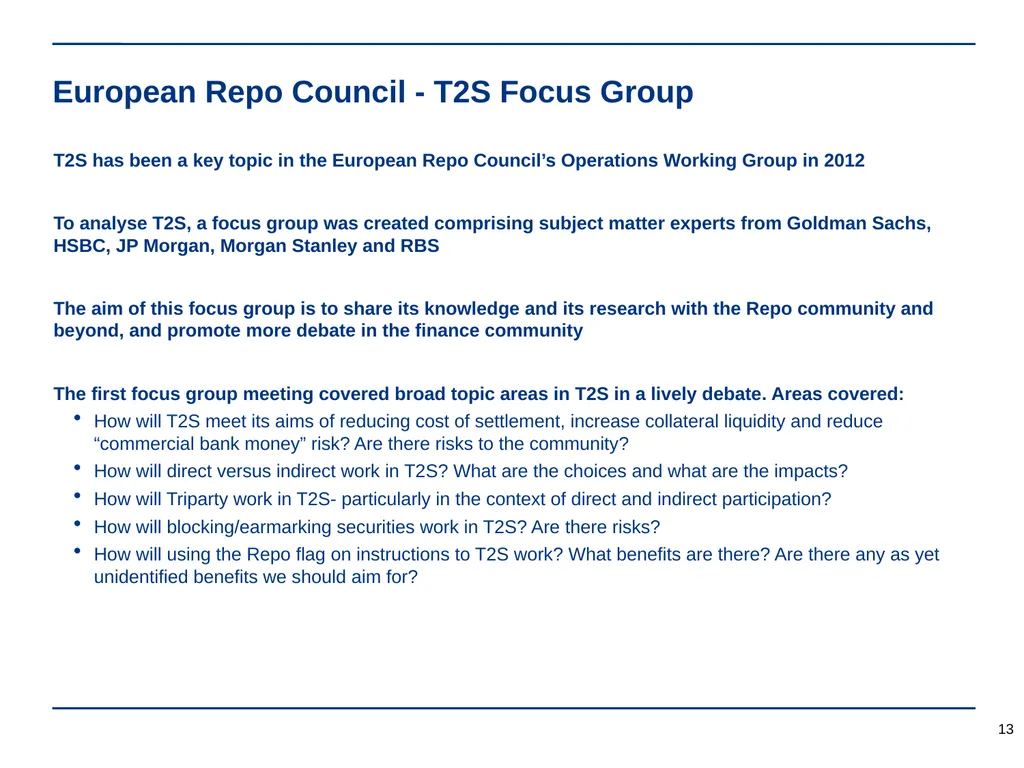
European Repo Council - T2S Focus Group T2S has been a key topic in the European Repo Council’s Operations Working Group in 2012
To analyse T2S, a focus group was created comprising subject matter experts from Goldman Sachs, HSBC, JP Morgan, Morgan Stanley and RBS
The aim of this focus group is to share its knowledge and its research with the Repo community and beyond, and promote more debate in the finance community
The first focus group meeting covered broad topic areas in T2S in a lively debate. Areas covered:
How will T2S meet its aims of reducing cost of settlement, increase collateral liquidity and reduce “commercial bank money” risk? Are there risks to the community?
How will direct versus indirect work in T2S? What are the choices and what are the impacts?
How will Triparty work in T2S- particularly in the context of direct and indirect participation?
How will blocking/earmarking securities work in T2S? Are there risks?
How will using the Repo flag on instructions to T2S work? What benefits are there? Are there any as yet unidentified benefits we should aim for? 13<br>
To analyse T2S, a focus group was created comprising subject matter experts from Goldman Sachs, HSBC, JP Morgan, Morgan Stanley and RBS
The aim of this focus group is to share its knowledge and its research with the Repo community and beyond, and promote more debate in the finance community
The first focus group meeting covered broad topic areas in T2S in a lively debate. Areas covered:
How will T2S meet its aims of reducing cost of settlement, increase collateral liquidity and reduce “commercial bank money” risk? Are there risks to the community?
How will direct versus indirect work in T2S? What are the choices and what are the impacts?
How will Triparty work in T2S- particularly in the context of direct and indirect participation?
How will blocking/earmarking securities work in T2S? Are there risks?
How will using the Repo flag on instructions to T2S work? What benefits are there? Are there any as yet unidentified benefits we should aim for? 13<br>
14
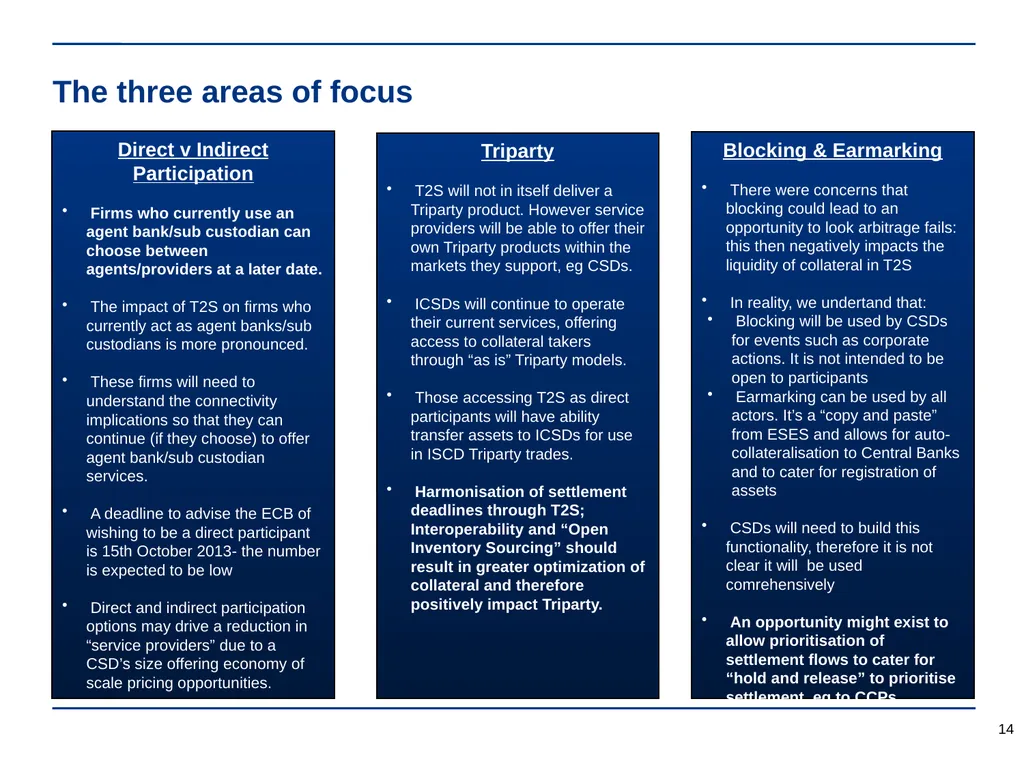
14 Direct v Indirect Participation
Firms who currently use an agent bank/sub custodian can choose between agents/providers at a later date.
The impact of T2S on firms who currently act as agent banks/sub custodians is more pronounced.
These firms will need to understand the connectivity implications so that they can continue (if they choose) to offer agent bank/sub custodian services.
A deadline to advise the ECB of wishing to be a direct participant is 15th October 2013- the number is expected to be low
Direct and indirect participation options may drive a reduction in “service providers” due to a CSD’s size offering economy of scale pricing opportunities. Triparty
T2S will not in itself deliver a Triparty product. However service providers will be able to offer their own Triparty products within the markets they support, eg CSDs.
ICSDs will continue to operate their current services, offering access to collateral takers through “as is” Triparty models.
Those accessing T2S as direct participants will have ability transfer assets to ICSDs for use in ISCD Triparty trades.
Harmonisation of settlement deadlines through T2S; Interoperability and “Open Inventory Sourcing” should result in greater optimization of collateral and therefore positively impact Triparty. Blocking & Earmarking
There were concerns that blocking could lead to an opportunity to look arbitrage fails: this then negatively impacts the liquidity of collateral in T2S
In reality, we undertand that:
Blocking will be used by CSDs for events such as corporate actions. It is not intended to be open to participants
Earmarking can be used by all actors. It’s a “copy and paste” from ESES and allows for auto-collateralisation to Central Banks and to cater for registration of assets
CSDs will need to build this functionality, therefore it is not clear it will be used comrehensively
An opportunity might exist to allow prioritisation of settlement flows to cater for “hold and release” to prioritise settlement, eg to CCPs The three areas of focus<br>
Firms who currently use an agent bank/sub custodian can choose between agents/providers at a later date.
The impact of T2S on firms who currently act as agent banks/sub custodians is more pronounced.
These firms will need to understand the connectivity implications so that they can continue (if they choose) to offer agent bank/sub custodian services.
A deadline to advise the ECB of wishing to be a direct participant is 15th October 2013- the number is expected to be low
Direct and indirect participation options may drive a reduction in “service providers” due to a CSD’s size offering economy of scale pricing opportunities. Triparty
T2S will not in itself deliver a Triparty product. However service providers will be able to offer their own Triparty products within the markets they support, eg CSDs.
ICSDs will continue to operate their current services, offering access to collateral takers through “as is” Triparty models.
Those accessing T2S as direct participants will have ability transfer assets to ICSDs for use in ISCD Triparty trades.
Harmonisation of settlement deadlines through T2S; Interoperability and “Open Inventory Sourcing” should result in greater optimization of collateral and therefore positively impact Triparty. Blocking & Earmarking
There were concerns that blocking could lead to an opportunity to look arbitrage fails: this then negatively impacts the liquidity of collateral in T2S
In reality, we undertand that:
Blocking will be used by CSDs for events such as corporate actions. It is not intended to be open to participants
Earmarking can be used by all actors. It’s a “copy and paste” from ESES and allows for auto-collateralisation to Central Banks and to cater for registration of assets
CSDs will need to build this functionality, therefore it is not clear it will be used comrehensively
An opportunity might exist to allow prioritisation of settlement flows to cater for “hold and release” to prioritise settlement, eg to CCPs The three areas of focus<br>
15
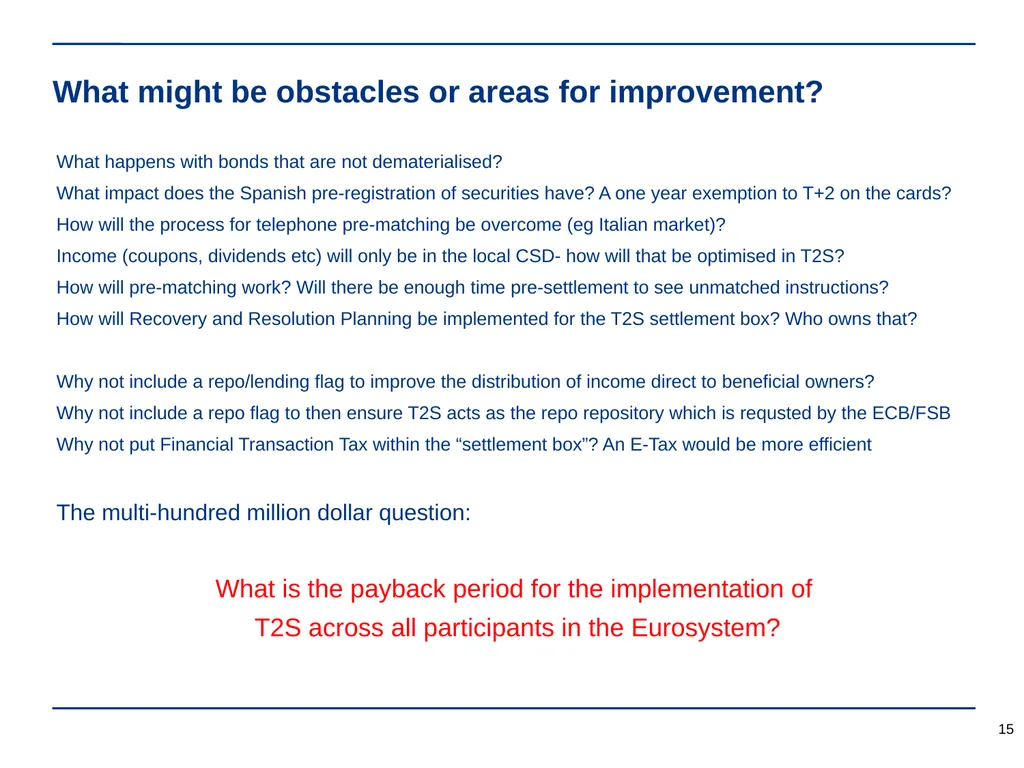
What might be obstacles or areas for improvement? 15 What happens with bonds that are not dematerialised?
What impact does the Spanish pre-registration of securities have? A one year exemption to T+2 on the cards?
How will the process for telephone pre-matching be overcome (eg Italian market)?
Income (coupons, dividends etc) will only be in the local CSD- how will that be optimised in T2S?
How will pre-matching work? Will there be enough time pre-settlement to see unmatched instructions?
How will Recovery and Resolution Planning be implemented for the T2S settlement box? Who owns that?
Why not include a repo/lending flag to improve the distribution of income direct to beneficial owners?
Why not include a repo flag to then ensure T2S acts as the repo repository which is requsted by the ECB/FSB
Why not put Financial Transaction Tax within the “settlement box”? An E-Tax would be more efficient
The multi-hundred million dollar question:
What is the payback period for the implementation of
T2S across all participants in the Eurosystem?<br>
What impact does the Spanish pre-registration of securities have? A one year exemption to T+2 on the cards?
How will the process for telephone pre-matching be overcome (eg Italian market)?
Income (coupons, dividends etc) will only be in the local CSD- how will that be optimised in T2S?
How will pre-matching work? Will there be enough time pre-settlement to see unmatched instructions?
How will Recovery and Resolution Planning be implemented for the T2S settlement box? Who owns that?
Why not include a repo/lending flag to improve the distribution of income direct to beneficial owners?
Why not include a repo flag to then ensure T2S acts as the repo repository which is requsted by the ECB/FSB
Why not put Financial Transaction Tax within the “settlement box”? An E-Tax would be more efficient
The multi-hundred million dollar question:
What is the payback period for the implementation of
T2S across all participants in the Eurosystem?<br>
16
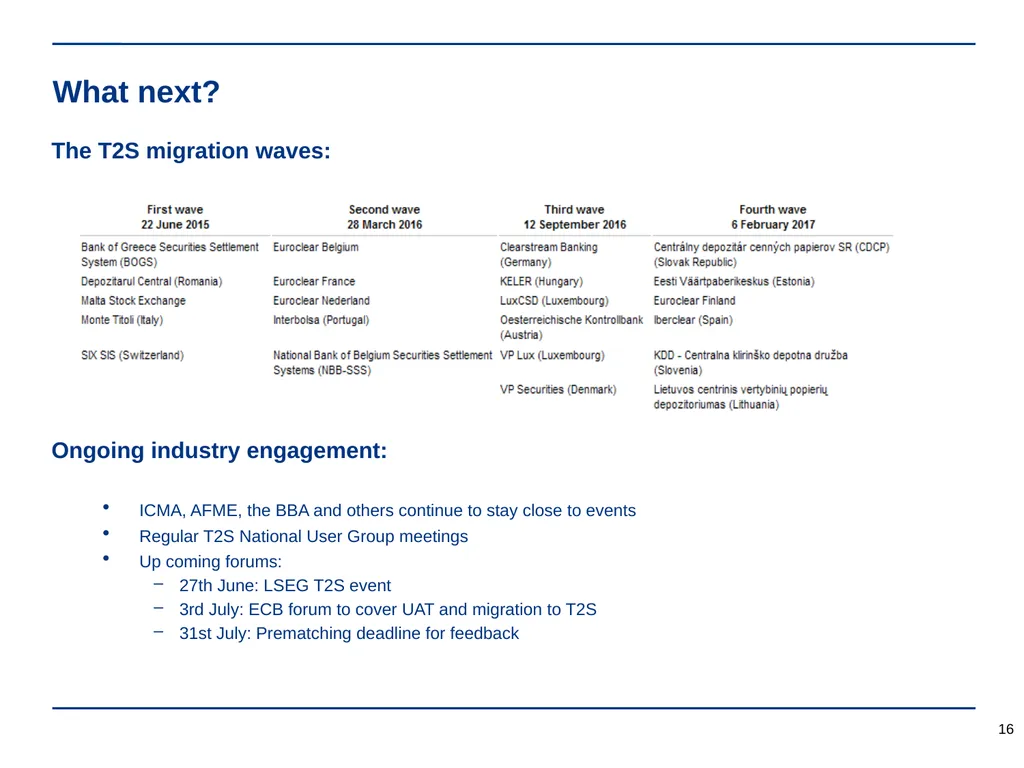
What next? 16 The T2S migration waves:
Ongoing industry engagement:
ICMA, AFME, the BBA and others continue to stay close to events
Regular T2S National User Group meetings
Up coming forums:
27th June: LSEG T2S event
3rd July: ECB forum to cover UAT and migration to T2S
31st July: Prematching deadline for feedback<br>
Ongoing industry engagement:
ICMA, AFME, the BBA and others continue to stay close to events
Regular T2S National User Group meetings
Up coming forums:
27th June: LSEG T2S event
3rd July: ECB forum to cover UAT and migration to T2S
31st July: Prematching deadline for feedback<br>
17
Presentation Giovanni Costantini
Senior Sales for Post Trade
London Stock Exchange Group<br>
18
T2S: a unique place where settling in Europe with efficiency and at low cost
ICMA Event, TARGET2-Securities (T2S) is coming, get ready! London, 20 June, 2013<br>
19
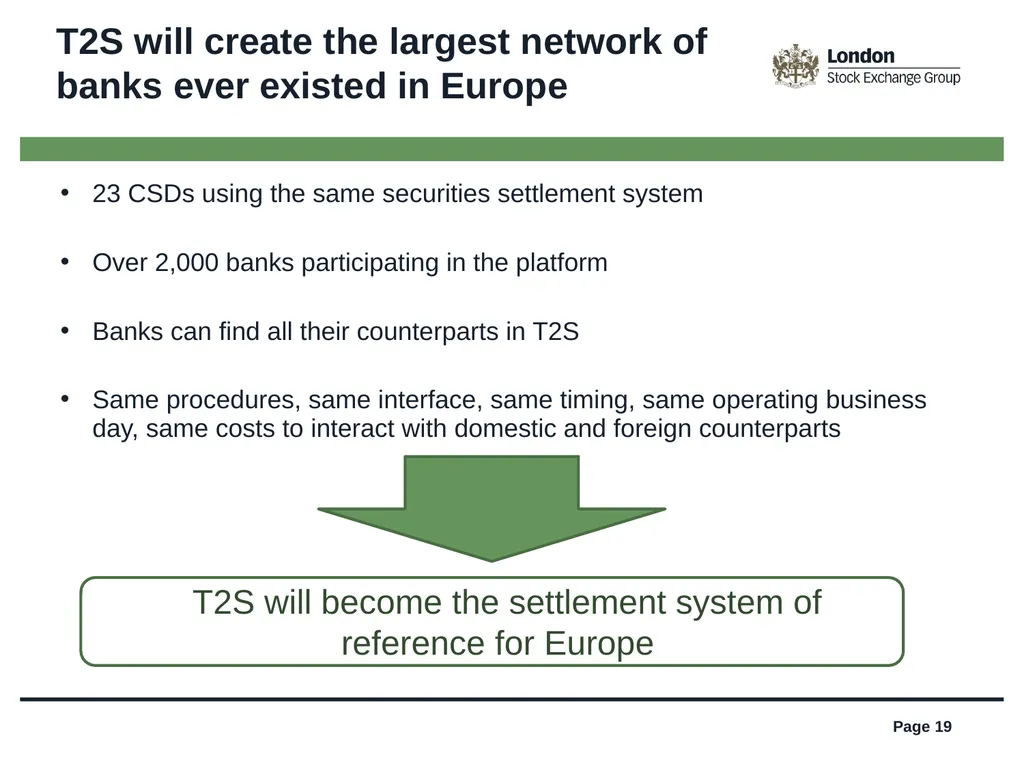
T2S will create the largest network of banks ever existed in Europe 23 CSDs using the same securities settlement system
Over 2,000 banks participating in the platform
Banks can find all their counterparts in T2S
Same procedures, same interface, same timing, same operating business day, same costs to interact with domestic and foreign counterparts T2S will become the settlement system of reference for Europe Page 19<br>
Over 2,000 banks participating in the platform
Banks can find all their counterparts in T2S
Same procedures, same interface, same timing, same operating business day, same costs to interact with domestic and foreign counterparts T2S will become the settlement system of reference for Europe Page 19<br>
20
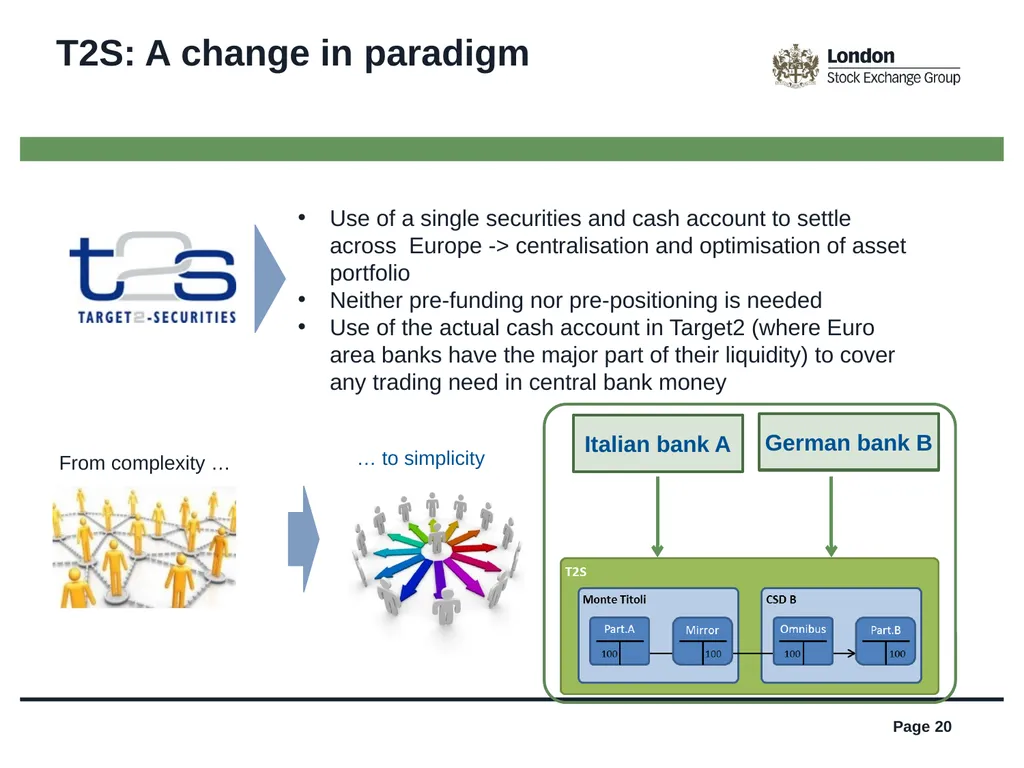
T2S: A change in paradigm Use of a single securities and cash account to settle across Europe -> centralisation and optimisation of asset portfolio
Neither pre-funding nor pre-positioning is needed
Use of the actual cash account in Target2 (where Euro area banks have the major part of their liquidity) to cover any trading need in central bank money Italian bank A German bank B Page 20<br>
Neither pre-funding nor pre-positioning is needed
Use of the actual cash account in Target2 (where Euro area banks have the major part of their liquidity) to cover any trading need in central bank money Italian bank A German bank B Page 20<br>
21
An effective functioning of T2S requires full harmonisation of corporate actions Full advantages from T2S only if a high level of harmonisation of corporate actions is reached
This means:
Reaching full compliance to international standards endorsed by the European Commission
Limiting at the minimum the so called «market specific attributes» without any impact on cross border settlement
From Monte Titoli and LSEG’s side
Monte Titoli is among the most compliant CSDs in Europe
Full compliance on corporate actions on stock by the end of this year
Full harmonisation of corporate actions on flow within T2S Wave 1
No so called market specific attributes have been raised at the European level Page 21<br>
This means:
Reaching full compliance to international standards endorsed by the European Commission
Limiting at the minimum the so called «market specific attributes» without any impact on cross border settlement
From Monte Titoli and LSEG’s side
Monte Titoli is among the most compliant CSDs in Europe
Full compliance on corporate actions on stock by the end of this year
Full harmonisation of corporate actions on flow within T2S Wave 1
No so called market specific attributes have been raised at the European level Page 21<br>
22
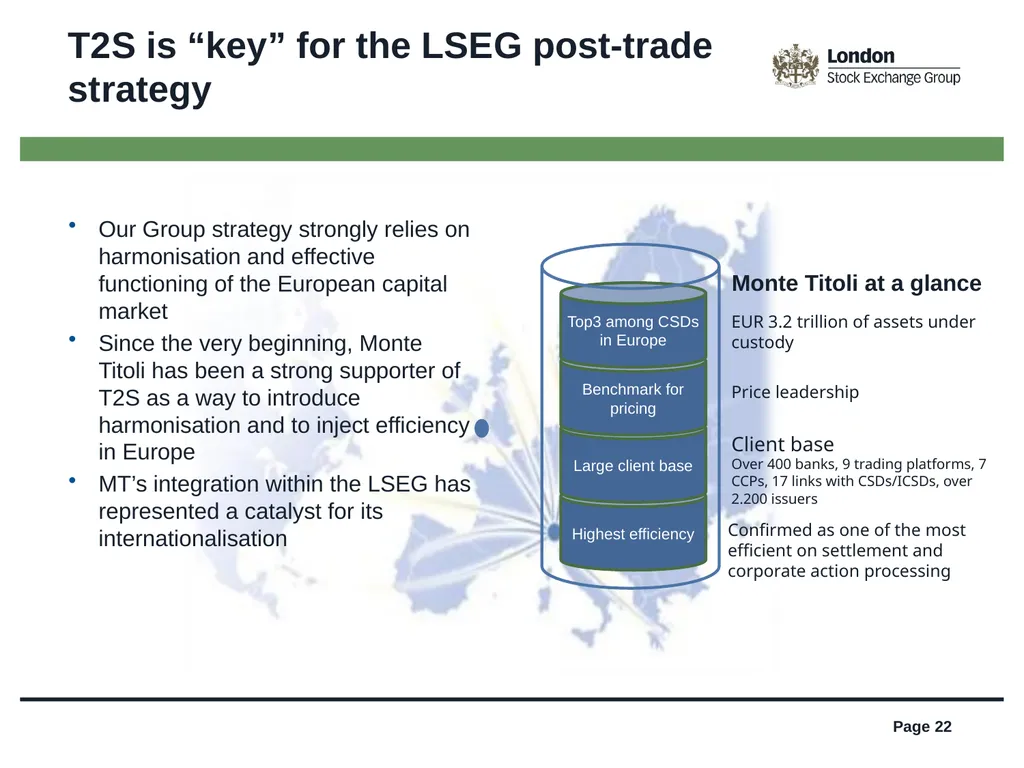
T2S is “key” for the LSEG post-trade strategy Our Group strategy strongly relies on harmonisation and effective functioning of the European capital market
Since the very beginning, Monte Titoli has been a strong supporter of T2S as a way to introduce harmonisation and to inject efficiency in Europe
MT’s integration within the LSEG has represented a catalyst for its internationalisation Confirmed as one of the most efficient on settlement and corporate action processing EUR 3.2 trillion of assets under custody Price leadership Client base Over 400 banks, 9 trading platforms, 7 CCPs, 17 links with CSDs/ICSDs, over 2.200 issuers Highest efficiency Large client base Benchmark for pricing Top3 among CSDs in Europe Monte Titoli at a glance Page 22<br>
Since the very beginning, Monte Titoli has been a strong supporter of T2S as a way to introduce harmonisation and to inject efficiency in Europe
MT’s integration within the LSEG has represented a catalyst for its internationalisation Confirmed as one of the most efficient on settlement and corporate action processing EUR 3.2 trillion of assets under custody Price leadership Client base Over 400 banks, 9 trading platforms, 7 CCPs, 17 links with CSDs/ICSDs, over 2.200 issuers Highest efficiency Large client base Benchmark for pricing Top3 among CSDs in Europe Monte Titoli at a glance Page 22<br>
23
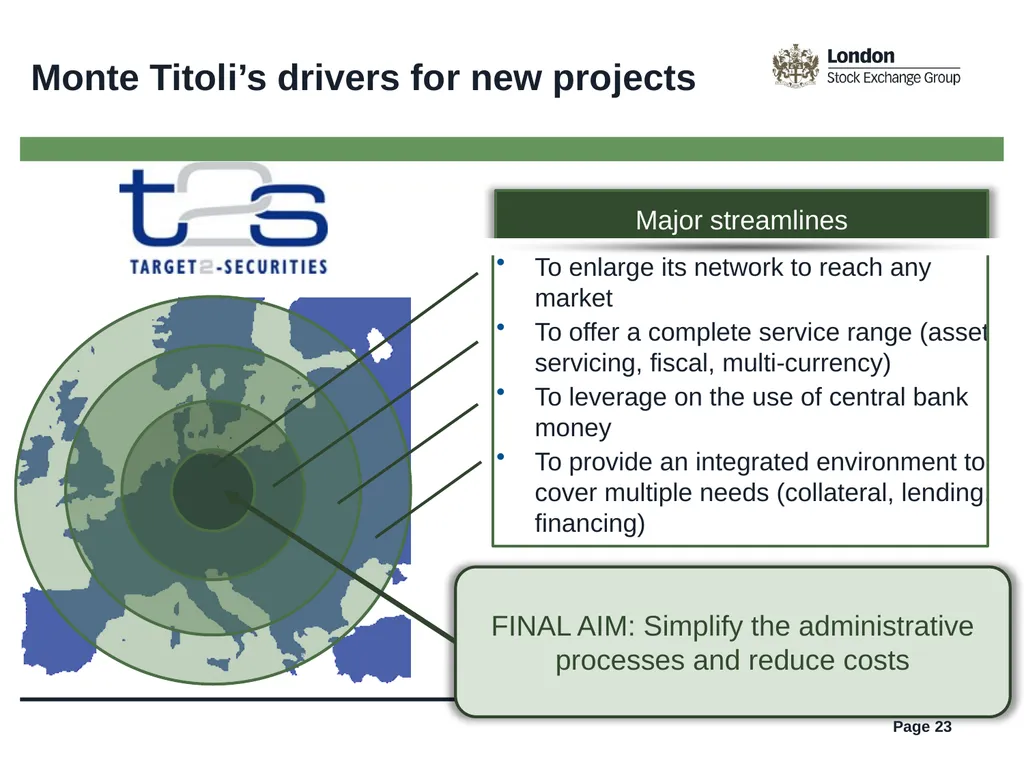
To enlarge its network to reach any market
To offer a complete service range (asset servicing, fiscal, multi-currency)
To leverage on the use of central bank money
To provide an integrated environment to cover multiple needs (collateral, lending, financing) Monte Titoli’s drivers for new projects FINAL AIM: Simplify the administrative processes and reduce costs Major streamlines Page 23<br>
To offer a complete service range (asset servicing, fiscal, multi-currency)
To leverage on the use of central bank money
To provide an integrated environment to cover multiple needs (collateral, lending, financing) Monte Titoli’s drivers for new projects FINAL AIM: Simplify the administrative processes and reduce costs Major streamlines Page 23<br>
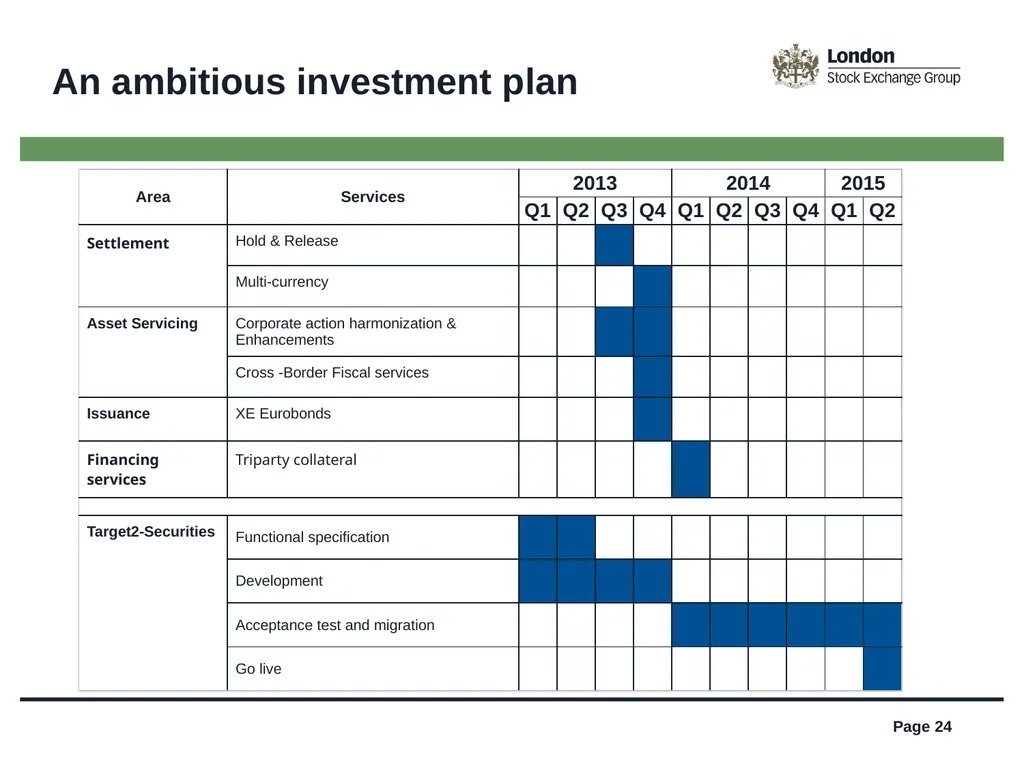
24
An ambitious investment plan Page 24<br>
25
The publication of this document does not represent solicitation, by Borsa Italiana S.p.A., of public saving and is not to be considered as a recommendation by Borsa Italiana as to the suitability of the investment, if any, herein described.This document has not to be considered complete and it is meant for information and discussion purposes only. Borsa Italiana accepts no liability, arising, without limitation to the generality of the foregoing, from inaccuracies and/or mistakes, for decisions and/or actions taken by any party based on this documents.
Trademarks Cassa di Compensazione e Garanzia and CC&G are owned by Cassa di Compensazione e Garanzia S.p.A.
Trademarks Monte Titoli, X-TRM and MT-X are owned by Monte Titoli S.p.A.
London Stock Exchange, the coat of arms device and AIM are a registered trade mark of London Stock Exchange plc.
The above trademarks and any other trademark owned by the London Stock Exchange Group cannot be used without express written consent by the Company having the ownership of the same.
Borsa Italiana S.p.A. and its subsidiaries are subject to direction and coordination of London Stock Exchange Group Holdings (Italy) Ltd – Italian branch.
The Group promotes and offers the post-trading services of Cassa di Compensazione e Garanzia S.p.A. and Monte Titoli S.p.A. in an equitable, transparent and non-discriminatory manner and on the basis of criteria and procedure aimed at assuring interoperability, security and equal treatment among market infrastructures, to all subjects who so request and are qualified in accordance with national and community legislation, applicable rules and decisions of the competent Authorities.<br>
Trademarks Cassa di Compensazione e Garanzia and CC&G are owned by Cassa di Compensazione e Garanzia S.p.A.
Trademarks Monte Titoli, X-TRM and MT-X are owned by Monte Titoli S.p.A.
London Stock Exchange, the coat of arms device and AIM are a registered trade mark of London Stock Exchange plc.
The above trademarks and any other trademark owned by the London Stock Exchange Group cannot be used without express written consent by the Company having the ownership of the same.
Borsa Italiana S.p.A. and its subsidiaries are subject to direction and coordination of London Stock Exchange Group Holdings (Italy) Ltd – Italian branch.
The Group promotes and offers the post-trading services of Cassa di Compensazione e Garanzia S.p.A. and Monte Titoli S.p.A. in an equitable, transparent and non-discriminatory manner and on the basis of criteria and procedure aimed at assuring interoperability, security and equal treatment among market infrastructures, to all subjects who so request and are qualified in accordance with national and community legislation, applicable rules and decisions of the competent Authorities.<br>
26
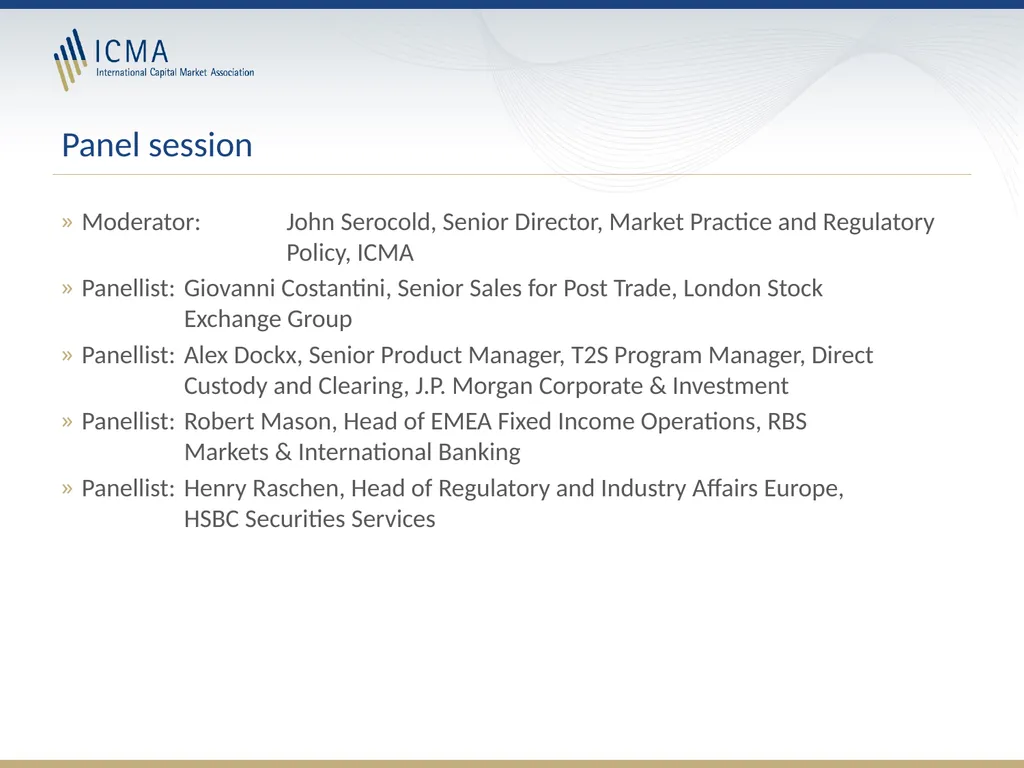
Panel session Moderator: John Serocold, Senior Director, Market Practice and Regulatory Policy, ICMA
Panellist: Giovanni Costantini, Senior Sales for Post Trade, London Stock Exchange Group
Panellist: Alex Dockx, Senior Product Manager, T2S Program Manager, Direct Custody and Clearing, J.P. Morgan Corporate & Investment
Panellist: Robert Mason, Head of EMEA Fixed Income Operations, RBS Markets & International Banking
Panellist: Henry Raschen, Head of Regulatory and Industry Affairs Europe, HSBC Securities Services<br>
Panellist: Giovanni Costantini, Senior Sales for Post Trade, London Stock Exchange Group
Panellist: Alex Dockx, Senior Product Manager, T2S Program Manager, Direct Custody and Clearing, J.P. Morgan Corporate & Investment
Panellist: Robert Mason, Head of EMEA Fixed Income Operations, RBS Markets & International Banking
Panellist: Henry Raschen, Head of Regulatory and Industry Affairs Europe, HSBC Securities Services<br>
27
Closing remarks John Serocold
Senior Director, Market Practice and Regulatory Policy
International Capital Market Association (ICMA)<br>