
Targeted Universalism Washington State Office of





Description: Targeted Universalism Washington State Office of Equity: Using Targeted Universalism to Improve Customer Experience Presented by Amber Ortiz Diaz (EQUITY) Prepared for Your Washington CX Community of Practice Amber Ortiz-Diaz Program
Related Topics
Download Presentation
"Targeted Universalism Washington State Office of" is the property of its rightful owner. Permission is granted to download and print the materials on this website for personal, non-commercial use only, and to display it on your personal computer provided you do not modify the materials and that you retain all copyright notices contained in the materials. By downloading content from our website, you accept the terms of this agreement.
Presentation Transcript
slide1. Targeted Universalism Washington State Office of Equity:
Using Targeted Universalism to Improve Customer Experience Presented by Amber Ortiz Diaz (EQUITY)
Prepared for Your Washington CX Community of Practice<br>
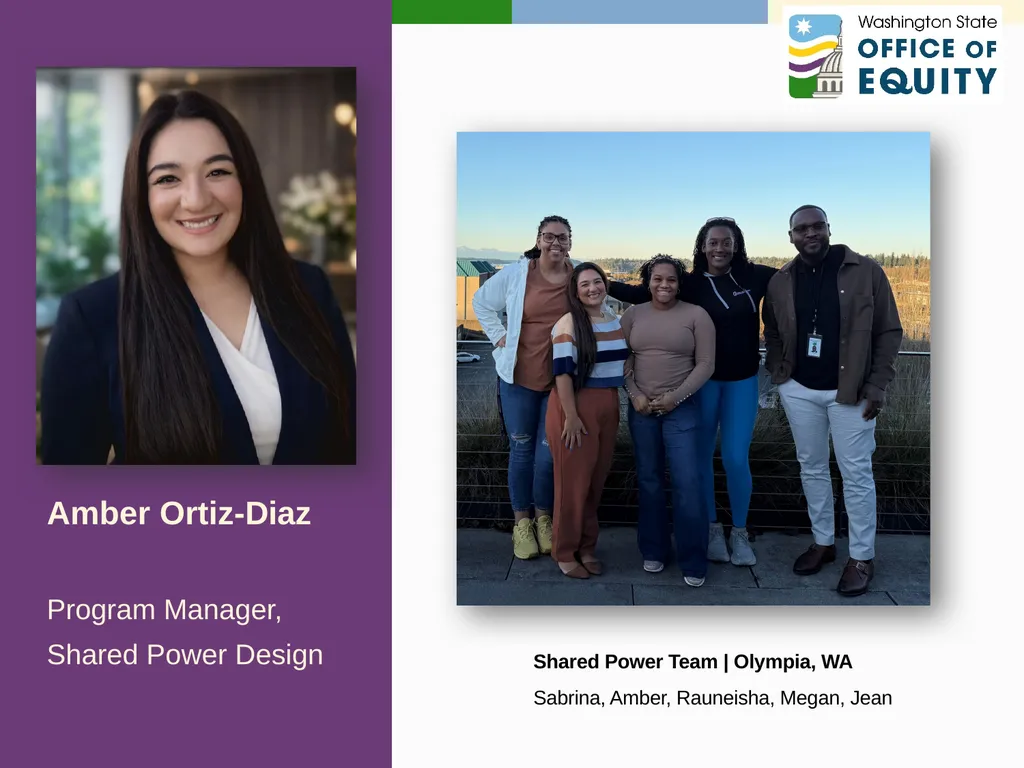
slide2. Amber Ortiz-Diaz
Program Manager,
Shared Power Design Shared Power Team | Olympia, WA
Sabrina, Amber, Rauneisha, Megan, Jean<br>
slide3. Introductions: Use the Chat Name + pronouns
Agency/organization
Shout out the county you live in!<br>
slide4. Learning Objectives Learners will develop an understanding of the concept of Targeted Universalism.
Learners will develop an understanding how it differs from both targeted and universal approaches.
Learners will understand why the Targeted Universalism approach is particularly useful for designing for equity.<br>
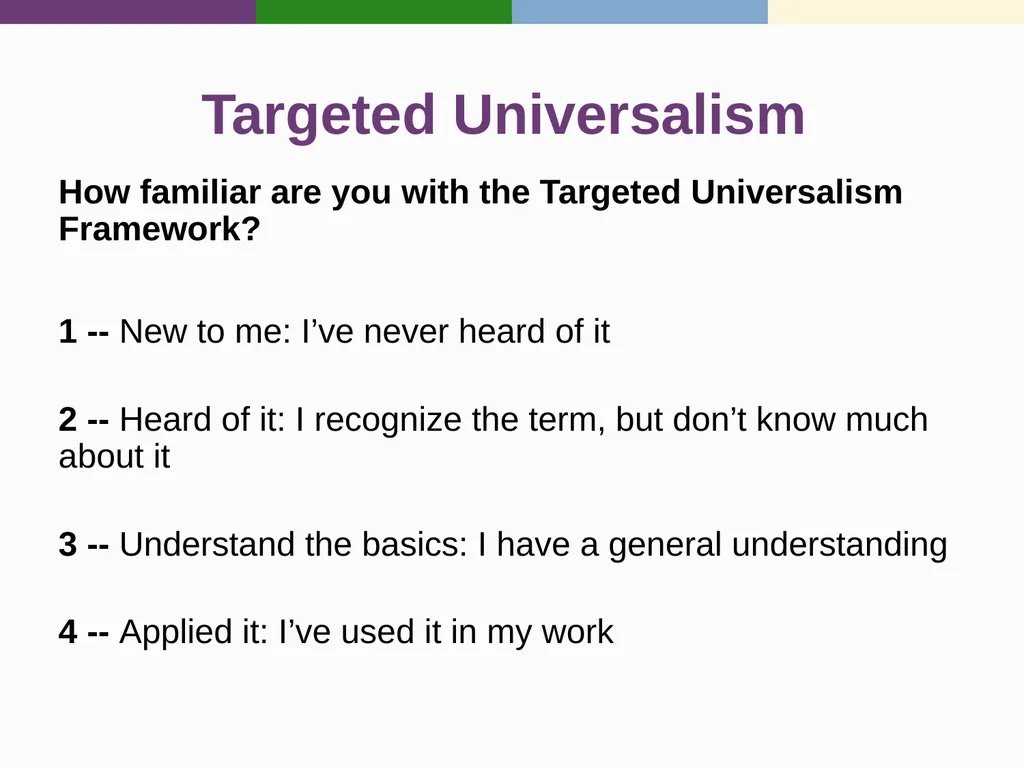
slide5. Targeted Universalism How familiar are you with the Targeted Universalism Framework?
1 -- New to me: I’ve never heard of it
2 -- Heard of it: I recognize the term, but don’t know much about it
3 -- Understand the basics: I have a general understanding
4 -- Applied it: I’ve used it in my work<br>
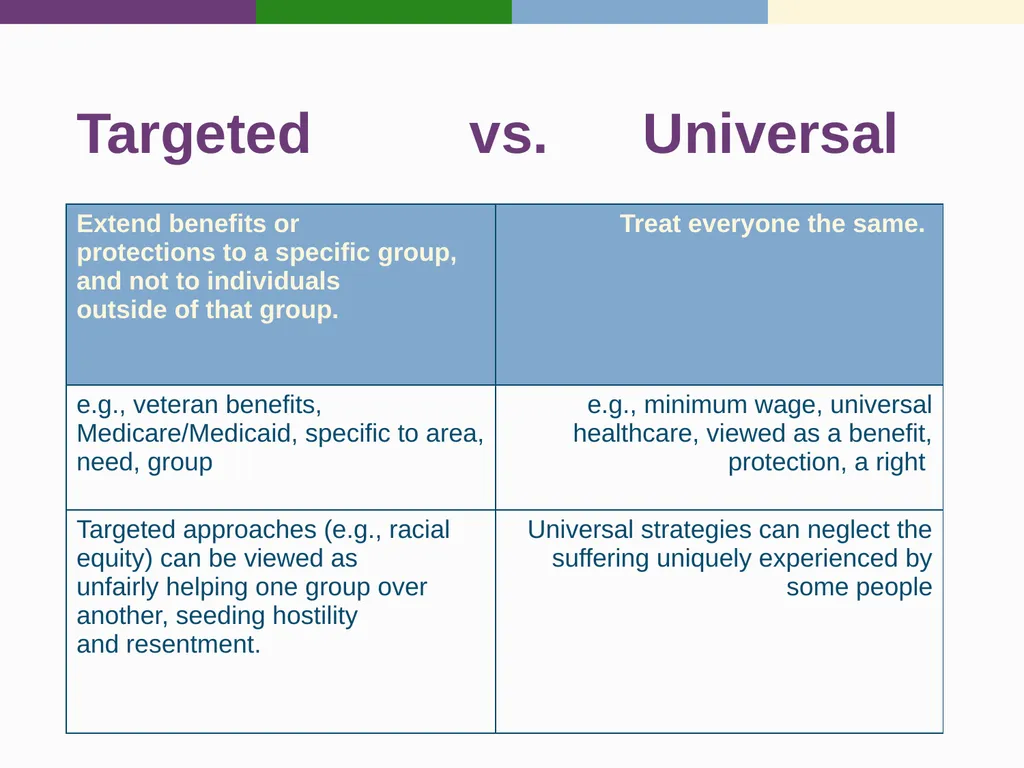
slide6. Targeted vs. Universal<br>
slide7. https://youtu.be/a0At2xbQB7w<br>
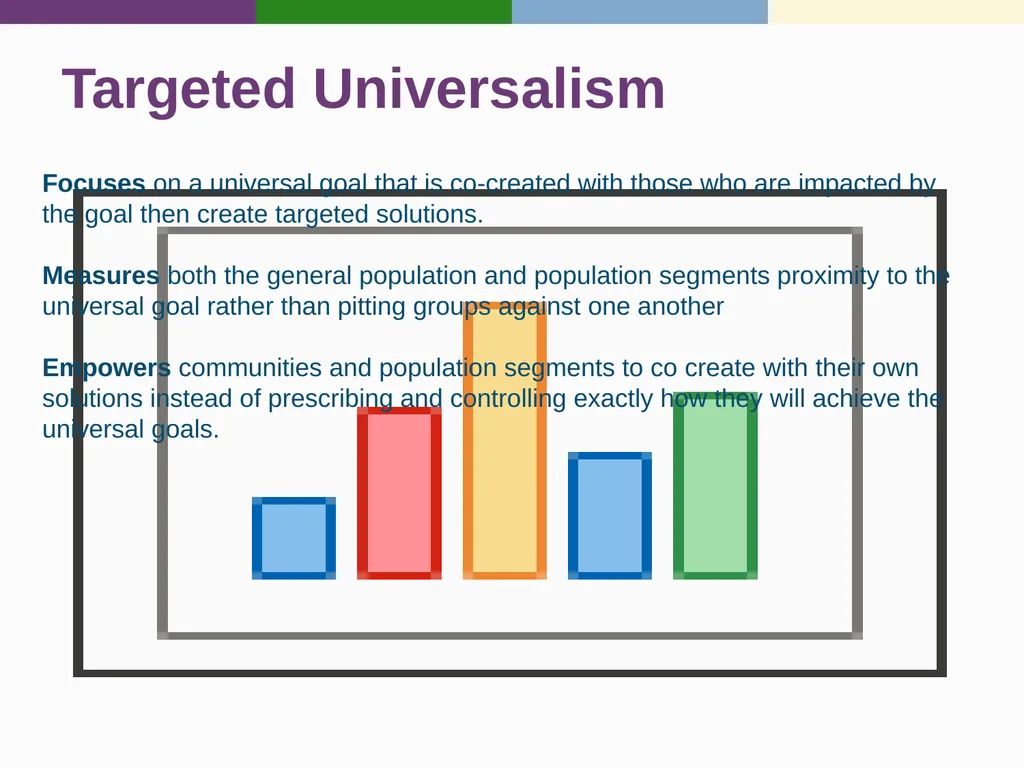
slide8. Targeted Universalism Focuses on a universal goal that is co-created with those who are impacted by the goal then create targeted solutions.
Measures both the general population and population segments proximity to the universal goal rather than pitting groups against one another
Empowers communities and population segments to co create with their own solutions instead of prescribing and controlling exactly how they will achieve the universal goals. <br>
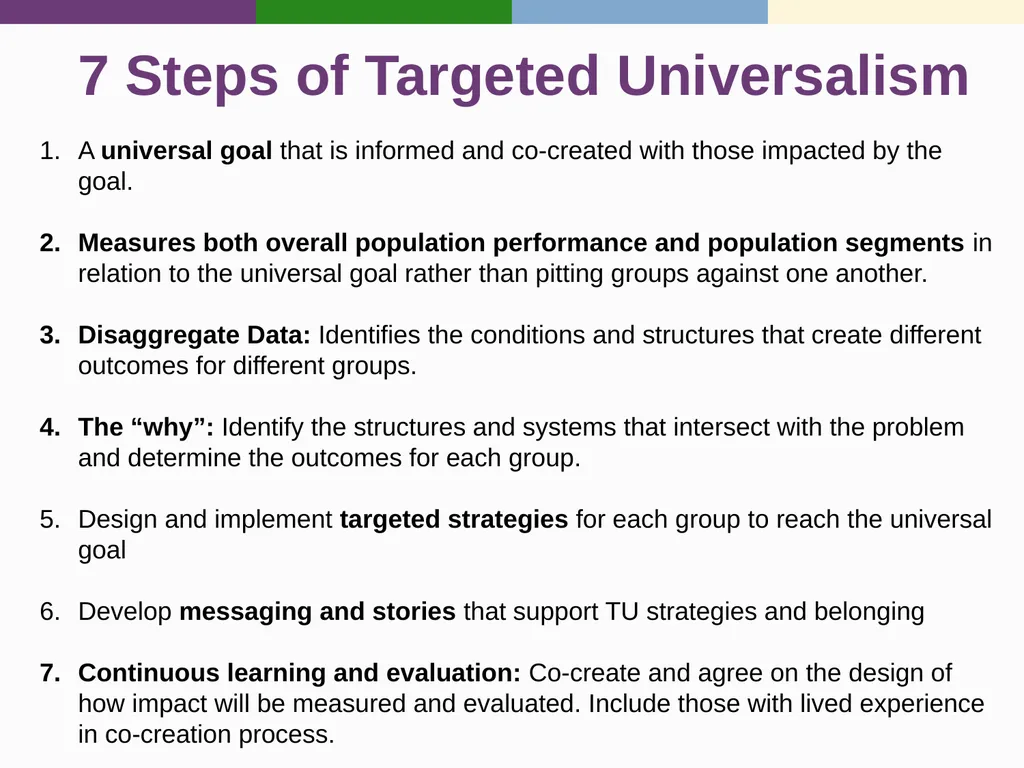
slide10. 7 Steps of Targeted Universalism A universal goal that is informed and co-created with those impacted by the goal.
Measures both overall population performance and population segments in relation to the universal goal rather than pitting groups against one another.
Disaggregate Data: Identifies the conditions and structures that create different outcomes for different groups.
The “why”: Identify the structures and systems that intersect with the problem and determine the outcomes for each group.
Design and implement targeted strategies for each group to reach the universal goal
Develop messaging and stories that support TU strategies and belonging
Continuous learning and evaluation: Co-create and agree on the design of how impact will be measured and evaluated. Include those with lived experience in co-creation process.<br>
slide11. Step 1: Co-create Universal Goal<br>
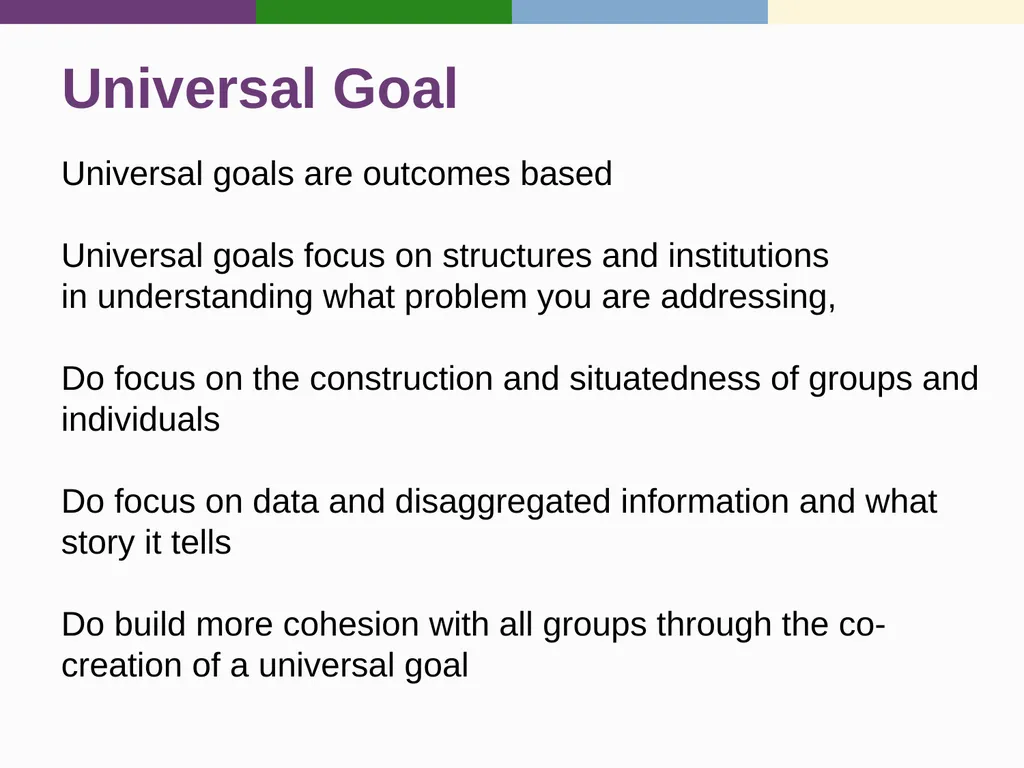
slide12. Universal Goal Universal goals are outcomes based
Universal goals focus on structures and institutions
in understanding what problem you are addressing,
Do focus on the construction and situatedness of groups and individuals
Do focus on data and disaggregated information and what story it tells
Do build more cohesion with all groups through the co-creation of a universal goal<br>
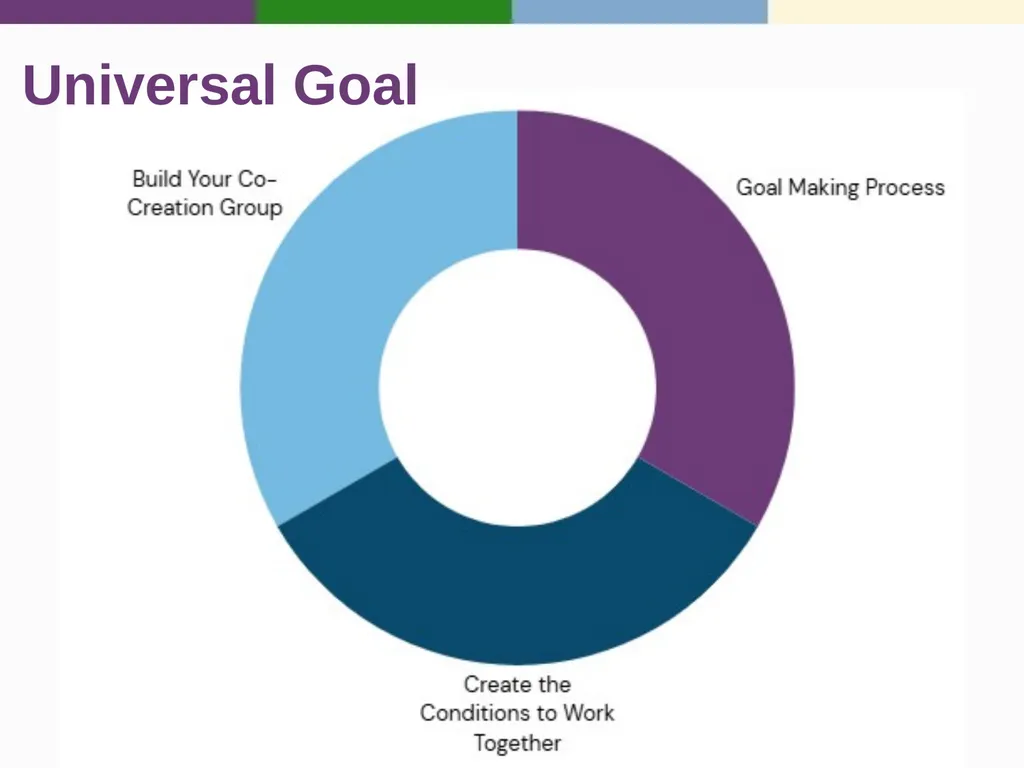
slide13. Universal Goal<br>
slide14. POLL / SURVEY Based on the information we went over select which are examples of universal goals.<br>
slide15. Step 2: Assess performance relative to the Universal Goal<br>
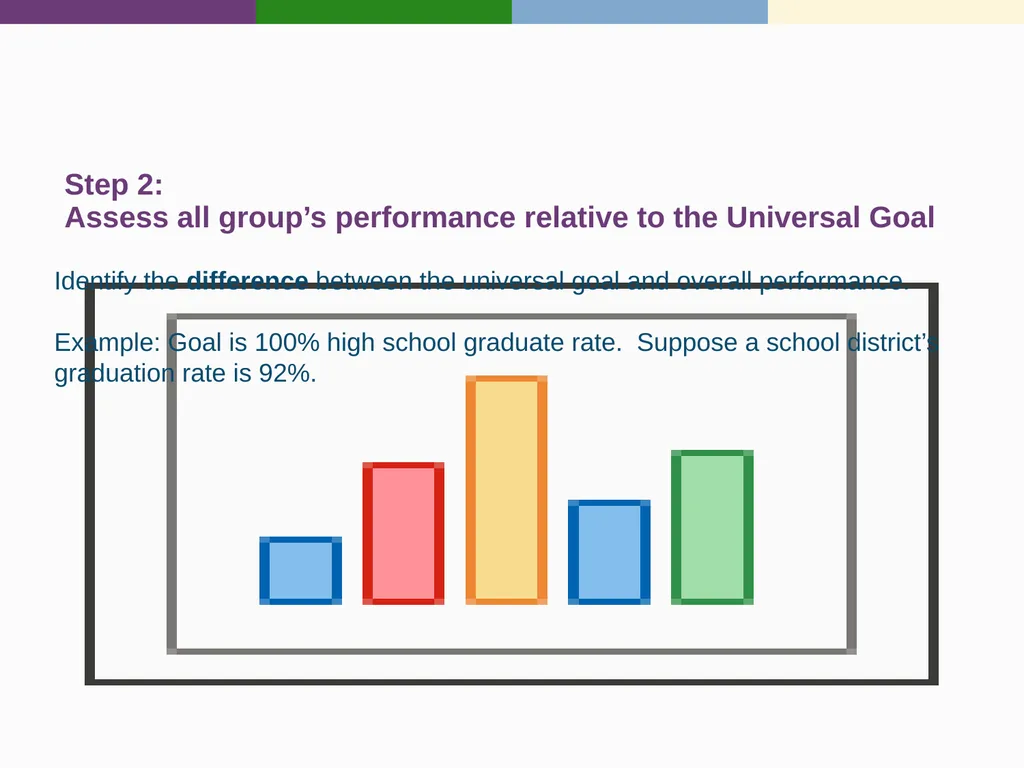
slide16. Step 2: Assess all group’s performance relative to the Universal Goal Identify the difference between the universal goal and overall performance.
Example: Goal is 100% high school graduate rate. Suppose a school district’s graduation rate is 92%.<br>
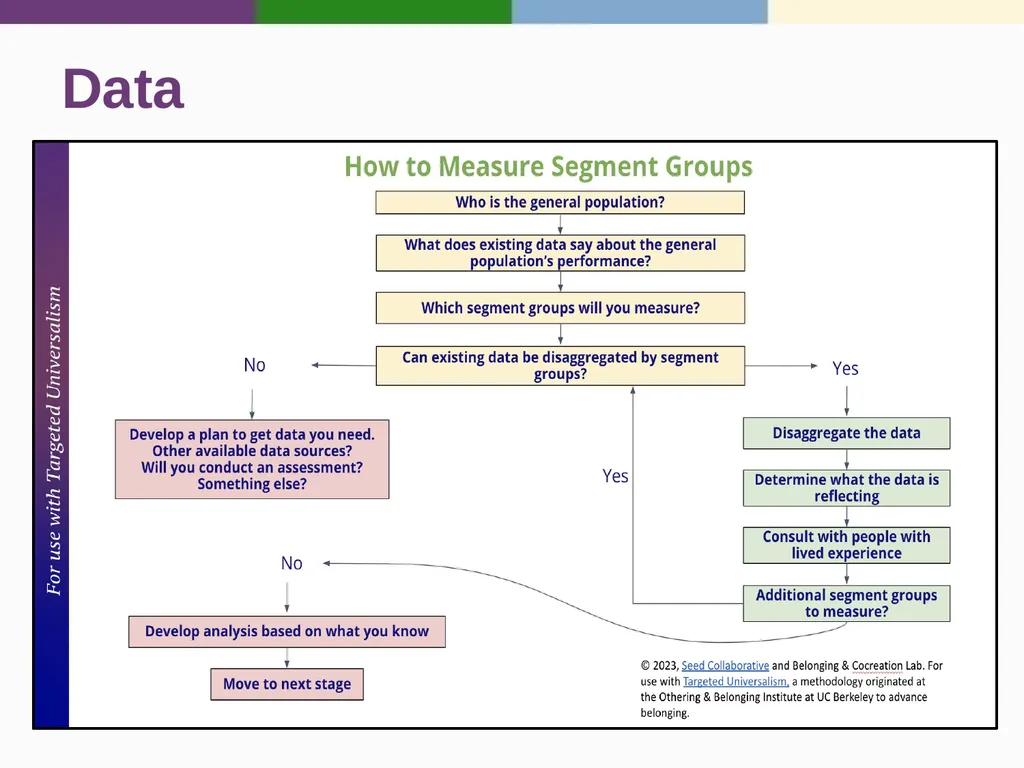
slide17. Data<br>
slide18. Step 3: Identifies the conditions & structures that create different outcomes for different groups.<br>
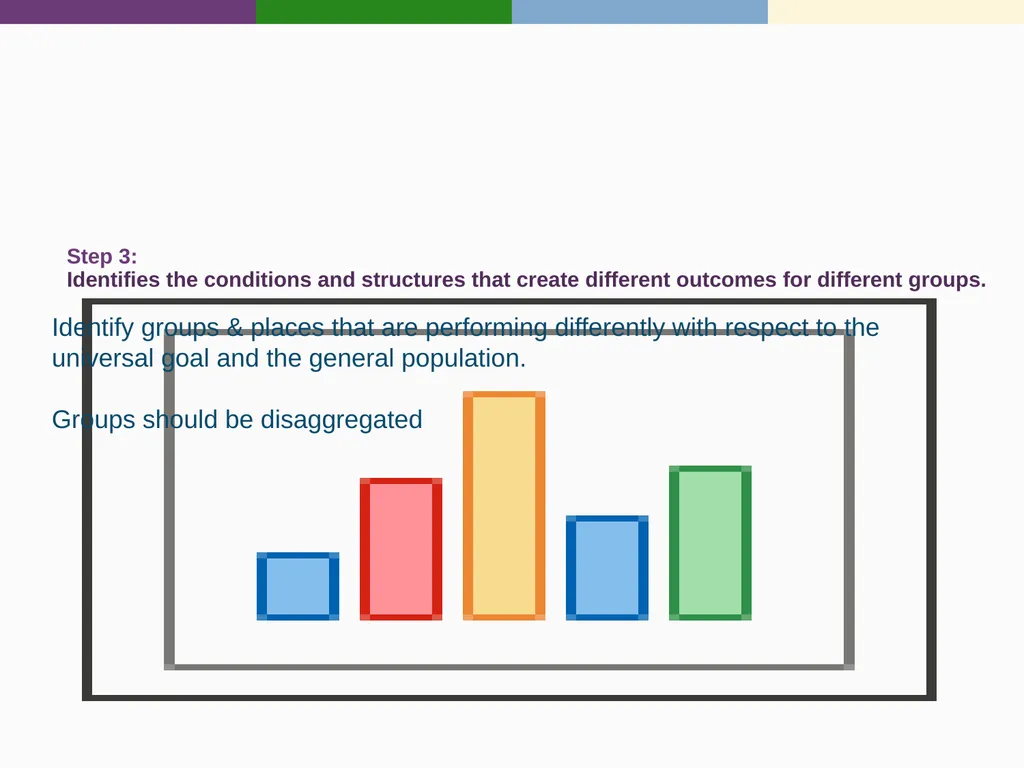
slide19. Identify groups & places that are performing differently with respect to the universal goal and the general population.
Groups should be disaggregated Step 3: Identifies the conditions and structures that create different outcomes for different groups.<br>
slide20. Disparities Analysis There is no prescribed formula.
In each situation, different groups may perform differently.
Isolate groupings that are performing further from the goal.
Social identity groups
Geographies
Socioeconomic circumstances
Other conditions/circumstances.<br>
slide21. Step 4: Identify Barriers & Resource Needs<br>
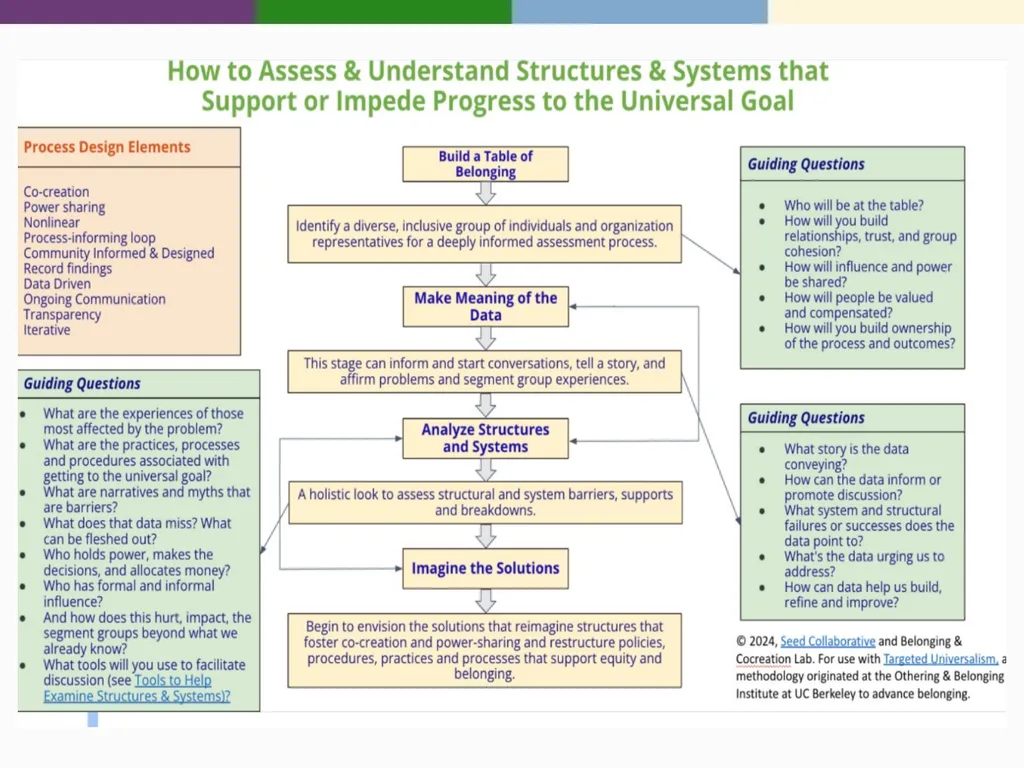
slide22. Step 4: Assess and understand the structures and systems the support or impede each group from achieving the Universal Goal. This is the WHY some groups are further from the universal goal.
SWOT Analysis
Iceberg Model
The 5 Why’s Analysis
Cause & Effect Diagram<br>
slide23. Whose perspective should be at the center? Education Sector Example:
To understand why a “x” group performs worse in a class:
Ask students, teachers, parents, counselors, and experts/researchers.
Maybe it has to do with nutrition, sleep, undiagnosed vision or hearing problems, English language difficulties, etc.,<br>
slide25. Step 5: Targeted Strategies<br>
slide26. Step 5: Targeted Strategies: Brainstorm, Select, Implement Brainstorm, select, and implement specific strategies tailored to the barriers or resource needs you identified in step 3-4 for each group analyzed.<br>
slide27. Develop outcome-focused targeted strategies based on categories.
Group together recommendations/goals organized by agency, area, or based on groups/people of influence and authority.
Prioritize need and urgency. Prioritization aligns with allocation of resources. Develop goals and subgoals, strategies or recommendations:<br>
slide28. Step 6: Communication & Messaging<br>
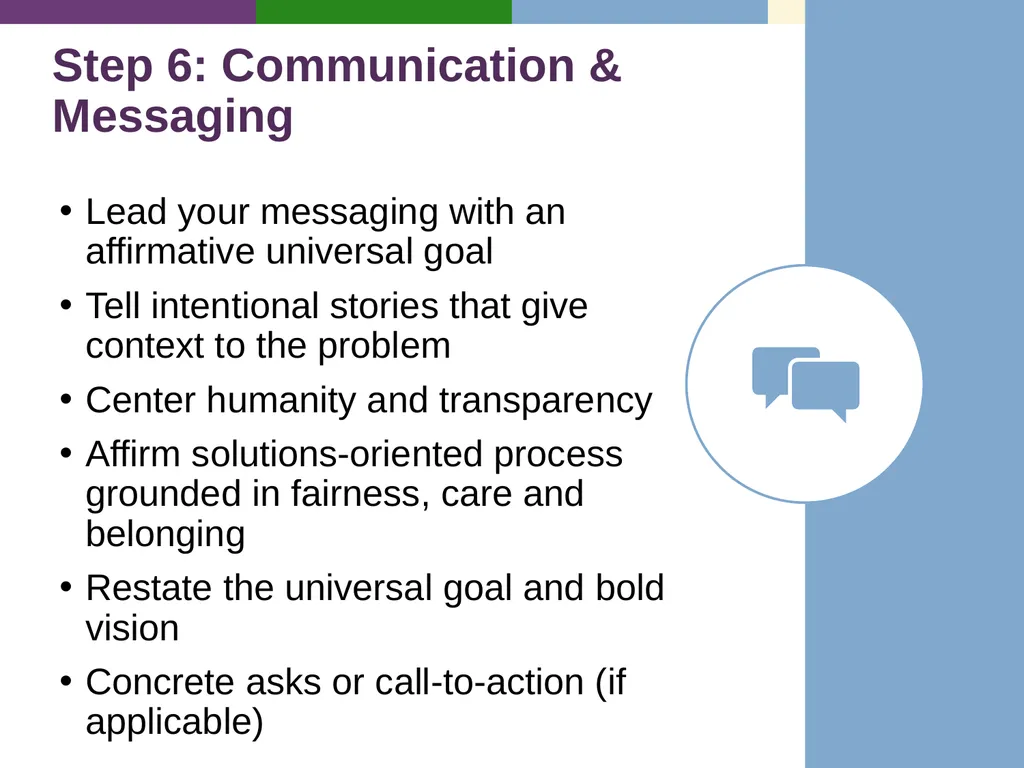
slide29. Step 6: Communication & Messaging Lead your messaging with an affirmative universal goal
Tell intentional stories that give context to the problem
Center humanity and transparency
Affirm solutions-oriented process grounded in fairness, care and belonging
Restate the universal goal and bold vision
Concrete asks or call-to-action (if applicable)<br>
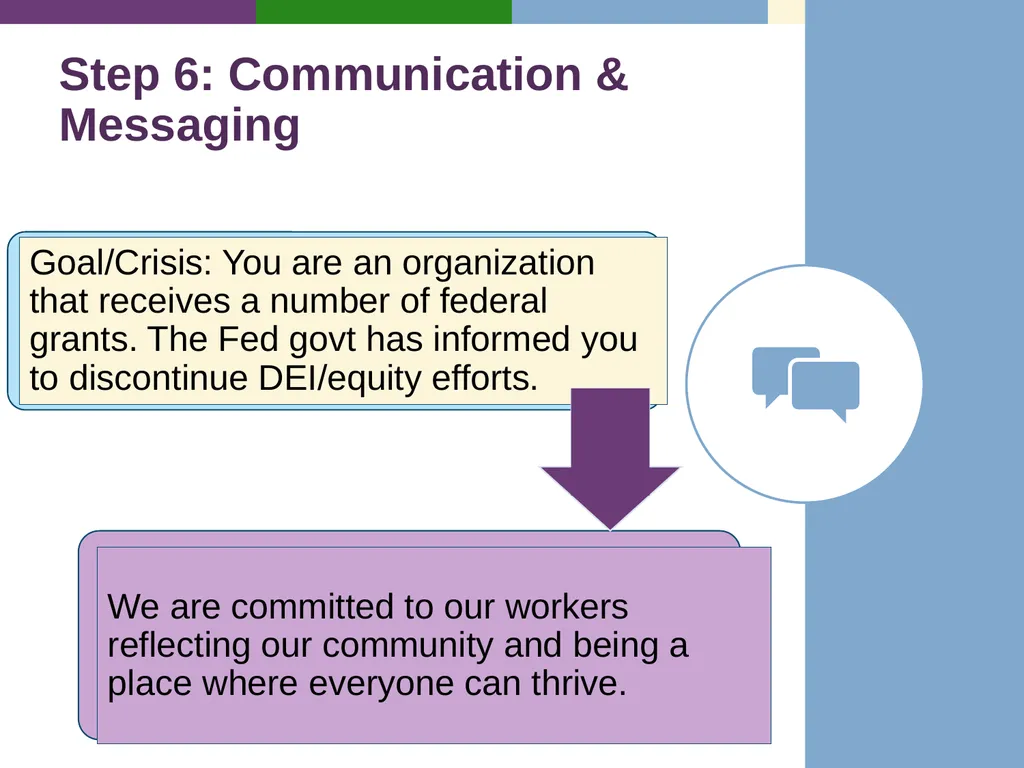
slide30. Step 6: Communication & Messaging<br>
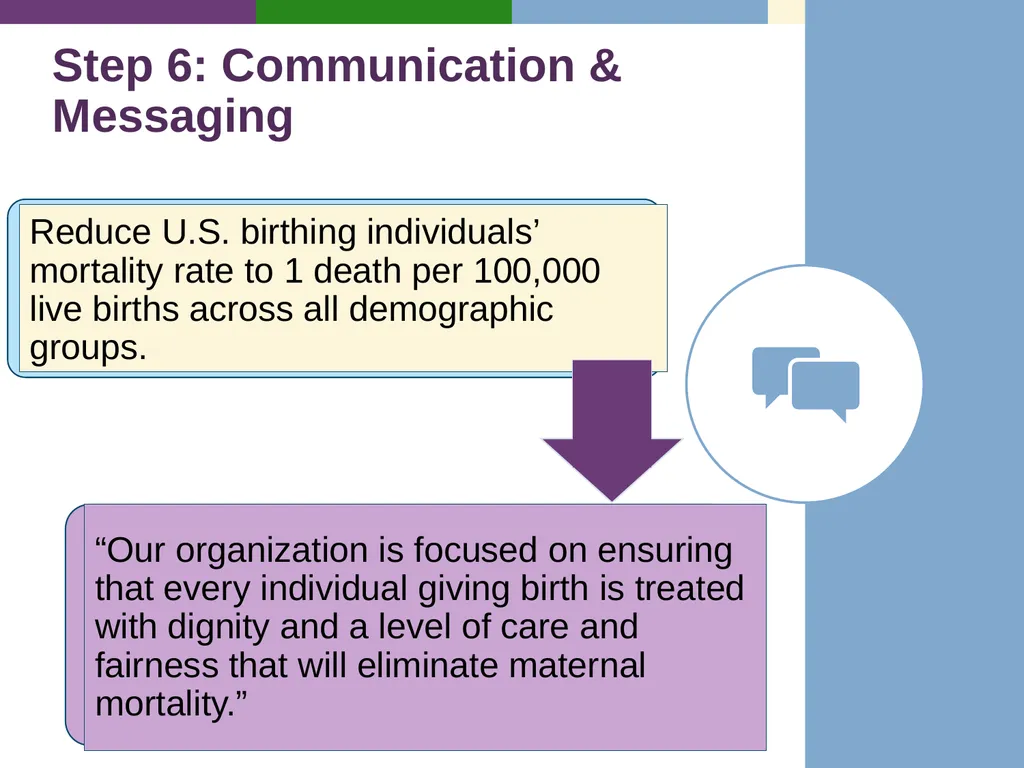
slide31. Step 6: Communication & Messaging<br>
slide32. Step 7: Continuous Measurement & Evaluation<br>
slide33. To what extent were structures and/or systems changed or transformed and did more people advance towards the universal goal as a result? Step 7: Evaluation of Process & Outcomes<br>
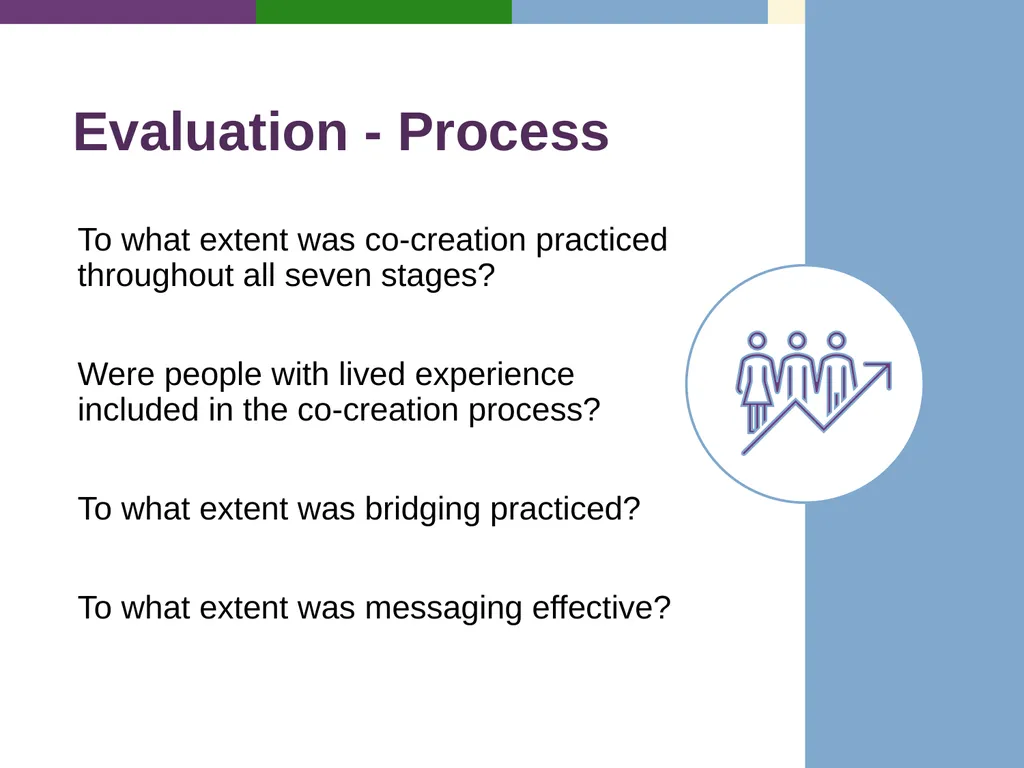
slide34. Evaluation - Process To what extent was co-creation practiced throughout all seven stages?
Were people with lived experience included in the co-creation process?
To what extent was bridging practiced?
To what extent was messaging effective?<br>
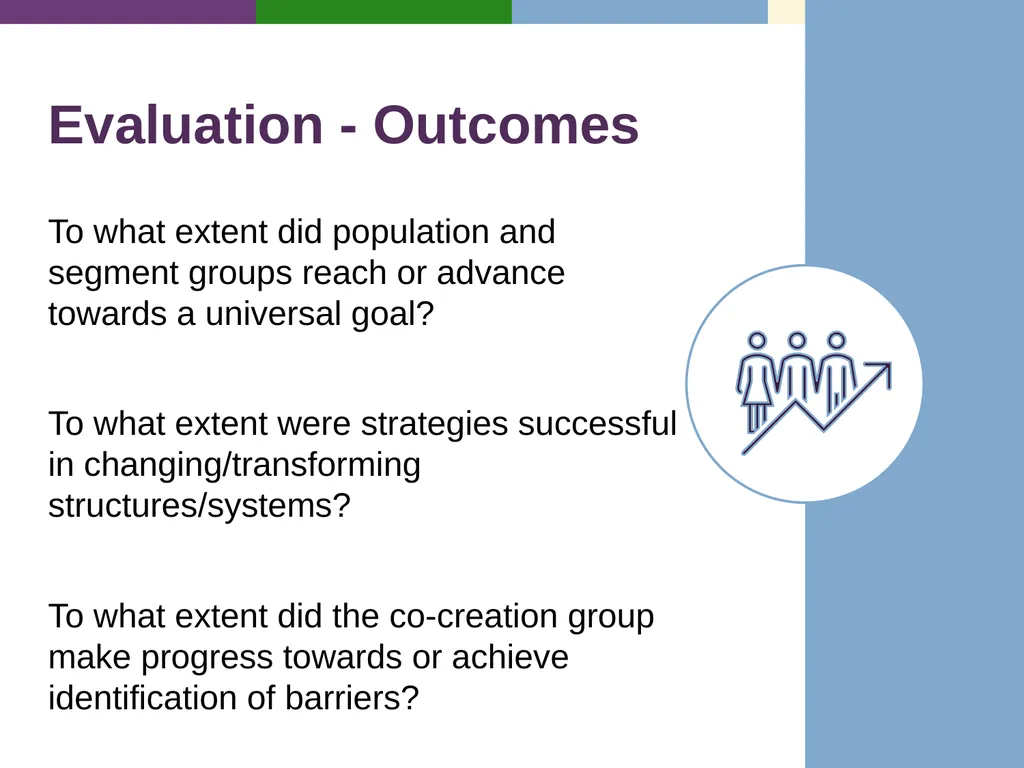
slide35. Evaluation - Outcomes To what extent did population and segment groups reach or advance towards a universal goal?
To what extent were strategies successful in changing/transforming structures/systems?
To what extent did the co-creation group make progress towards or achieve identification of barriers?<br>
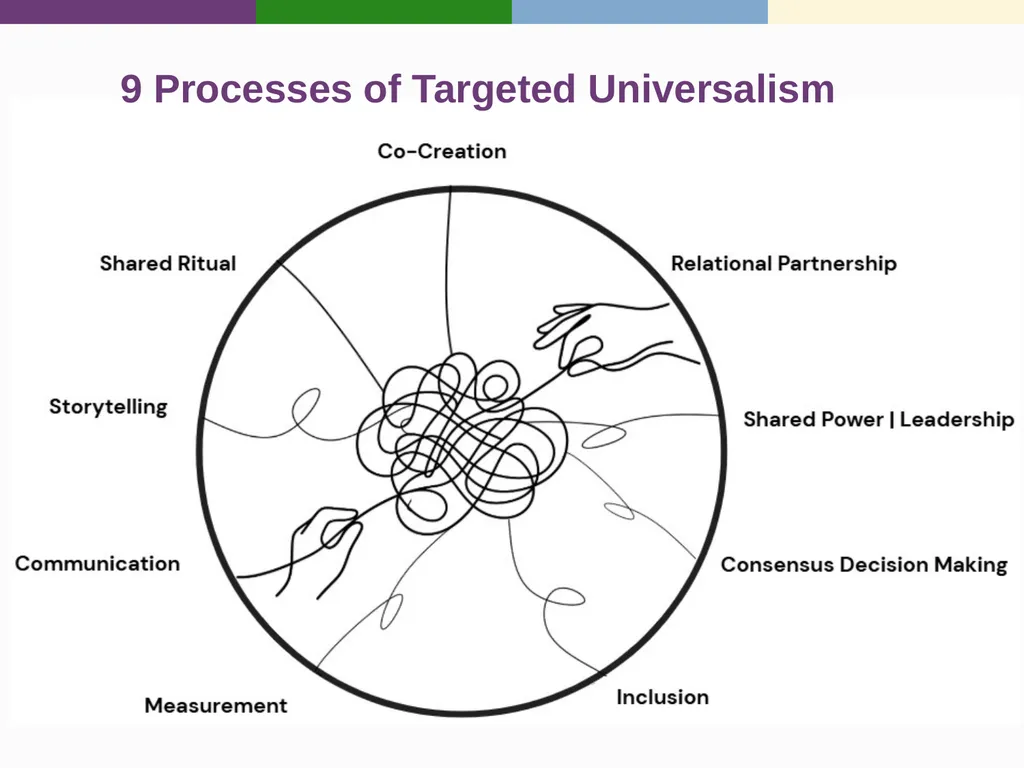
slide36. 9 Processes of Targeted Universalism<br>
slide37. Contact Information Amber Ortiz-Díaz, M.Ed, (She/Ella)
Program Manager, Shared Power Design
Washington State Office of Equity | Office of Governor Bob Ferguson
amber.ortiz-diaz@equity.wa.gov
sharedpower@equity.wa.gov
www.equity.wa.gov<br>
slide39. EQUITY Resources Community Engagement Toolkit
Relational Partnership Workbook
Coming Soon: Washington State Office of Equity Shared Power Guide<br>
slide40. Templates/Resources: Seed Collaborative & OBI Universal Goal Co-Creation Worksheet
Targeted Universalism Glossary
Flow Chart: Support or Impede Universal Goal
Flow Chart: How to measure segment groups
TU Communication Model template
Evaluation Metric template for process & outcomes<br>
slide41. Sources Othering & Belonging Institute. Frequently asked questions about Targeted Universalism. University of California, Berkeley. Retrieved from https://belonging.berkeley.edu/faq-targeted-universalism
Othering & Belonging Institute. Introduction. University of California, Berkeley. Retrieved from https://belonging.berkeley.edu/introduction
Othering & Belonging Institute. Targeted Universalism animated video. University of California, Berkeley. Retrieved from https://belonging.berkeley.edu/targeted-universalism-animated-video
Othering & Belonging Institute. Targeted Universalism case studies. University of California, Berkeley. Retrieved from https://belonging.berkeley.edu/tu-case-studies
Othering & Belonging Institute. Targeted Universalism primer (PDF). University of California, Berkeley. https://belonging.berkeley.edu/sites/default/files/ARCHIVE/targeted_universalism_primer.pdf?file=1&force=1
Othering & Belonging Institute. Targeted Universalism training courses. Retrieved from https://obiu.org/courses<br>
slide42. Special Thanks & Credit to: john a. powell
UC Berkeley
Othering & Belonging Institute
The Seed Collaborative
&
Washington State Office of Equity
Shared Power Design Team<br>
Prepared for Your Washington CX Community of Practice<br>
slide2. Amber Ortiz-Diaz
Program Manager,
Shared Power Design Shared Power Team | Olympia, WA
Sabrina, Amber, Rauneisha, Megan, Jean<br>
slide3. Introductions: Use the Chat Name + pronouns
Agency/organization
Shout out the county you live in!<br>
slide4. Learning Objectives Learners will develop an understanding of the concept of Targeted Universalism.
Learners will develop an understanding how it differs from both targeted and universal approaches.
Learners will understand why the Targeted Universalism approach is particularly useful for designing for equity.<br>
slide5. Targeted Universalism How familiar are you with the Targeted Universalism Framework?
1 -- New to me: I’ve never heard of it
2 -- Heard of it: I recognize the term, but don’t know much about it
3 -- Understand the basics: I have a general understanding
4 -- Applied it: I’ve used it in my work<br>
slide6. Targeted vs. Universal<br>
slide7. https://youtu.be/a0At2xbQB7w<br>
slide8. Targeted Universalism Focuses on a universal goal that is co-created with those who are impacted by the goal then create targeted solutions.
Measures both the general population and population segments proximity to the universal goal rather than pitting groups against one another
Empowers communities and population segments to co create with their own solutions instead of prescribing and controlling exactly how they will achieve the universal goals. <br>
slide10. 7 Steps of Targeted Universalism A universal goal that is informed and co-created with those impacted by the goal.
Measures both overall population performance and population segments in relation to the universal goal rather than pitting groups against one another.
Disaggregate Data: Identifies the conditions and structures that create different outcomes for different groups.
The “why”: Identify the structures and systems that intersect with the problem and determine the outcomes for each group.
Design and implement targeted strategies for each group to reach the universal goal
Develop messaging and stories that support TU strategies and belonging
Continuous learning and evaluation: Co-create and agree on the design of how impact will be measured and evaluated. Include those with lived experience in co-creation process.<br>
slide11. Step 1: Co-create Universal Goal<br>
slide12. Universal Goal Universal goals are outcomes based
Universal goals focus on structures and institutions
in understanding what problem you are addressing,
Do focus on the construction and situatedness of groups and individuals
Do focus on data and disaggregated information and what story it tells
Do build more cohesion with all groups through the co-creation of a universal goal<br>
slide13. Universal Goal<br>
slide14. POLL / SURVEY Based on the information we went over select which are examples of universal goals.<br>
slide15. Step 2: Assess performance relative to the Universal Goal<br>
slide16. Step 2: Assess all group’s performance relative to the Universal Goal Identify the difference between the universal goal and overall performance.
Example: Goal is 100% high school graduate rate. Suppose a school district’s graduation rate is 92%.<br>
slide17. Data<br>
slide18. Step 3: Identifies the conditions & structures that create different outcomes for different groups.<br>
slide19. Identify groups & places that are performing differently with respect to the universal goal and the general population.
Groups should be disaggregated Step 3: Identifies the conditions and structures that create different outcomes for different groups.<br>
slide20. Disparities Analysis There is no prescribed formula.
In each situation, different groups may perform differently.
Isolate groupings that are performing further from the goal.
Social identity groups
Geographies
Socioeconomic circumstances
Other conditions/circumstances.<br>
slide21. Step 4: Identify Barriers & Resource Needs<br>
slide22. Step 4: Assess and understand the structures and systems the support or impede each group from achieving the Universal Goal. This is the WHY some groups are further from the universal goal.
SWOT Analysis
Iceberg Model
The 5 Why’s Analysis
Cause & Effect Diagram<br>
slide23. Whose perspective should be at the center? Education Sector Example:
To understand why a “x” group performs worse in a class:
Ask students, teachers, parents, counselors, and experts/researchers.
Maybe it has to do with nutrition, sleep, undiagnosed vision or hearing problems, English language difficulties, etc.,<br>
slide25. Step 5: Targeted Strategies<br>
slide26. Step 5: Targeted Strategies: Brainstorm, Select, Implement Brainstorm, select, and implement specific strategies tailored to the barriers or resource needs you identified in step 3-4 for each group analyzed.<br>
slide27. Develop outcome-focused targeted strategies based on categories.
Group together recommendations/goals organized by agency, area, or based on groups/people of influence and authority.
Prioritize need and urgency. Prioritization aligns with allocation of resources. Develop goals and subgoals, strategies or recommendations:<br>
slide28. Step 6: Communication & Messaging<br>
slide29. Step 6: Communication & Messaging Lead your messaging with an affirmative universal goal
Tell intentional stories that give context to the problem
Center humanity and transparency
Affirm solutions-oriented process grounded in fairness, care and belonging
Restate the universal goal and bold vision
Concrete asks or call-to-action (if applicable)<br>
slide30. Step 6: Communication & Messaging<br>
slide31. Step 6: Communication & Messaging<br>
slide32. Step 7: Continuous Measurement & Evaluation<br>
slide33. To what extent were structures and/or systems changed or transformed and did more people advance towards the universal goal as a result? Step 7: Evaluation of Process & Outcomes<br>
slide34. Evaluation - Process To what extent was co-creation practiced throughout all seven stages?
Were people with lived experience included in the co-creation process?
To what extent was bridging practiced?
To what extent was messaging effective?<br>
slide35. Evaluation - Outcomes To what extent did population and segment groups reach or advance towards a universal goal?
To what extent were strategies successful in changing/transforming structures/systems?
To what extent did the co-creation group make progress towards or achieve identification of barriers?<br>
slide36. 9 Processes of Targeted Universalism<br>
slide37. Contact Information Amber Ortiz-Díaz, M.Ed, (She/Ella)
Program Manager, Shared Power Design
Washington State Office of Equity | Office of Governor Bob Ferguson
amber.ortiz-diaz@equity.wa.gov
sharedpower@equity.wa.gov
www.equity.wa.gov<br>
slide39. EQUITY Resources Community Engagement Toolkit
Relational Partnership Workbook
Coming Soon: Washington State Office of Equity Shared Power Guide<br>
slide40. Templates/Resources: Seed Collaborative & OBI Universal Goal Co-Creation Worksheet
Targeted Universalism Glossary
Flow Chart: Support or Impede Universal Goal
Flow Chart: How to measure segment groups
TU Communication Model template
Evaluation Metric template for process & outcomes<br>
slide41. Sources Othering & Belonging Institute. Frequently asked questions about Targeted Universalism. University of California, Berkeley. Retrieved from https://belonging.berkeley.edu/faq-targeted-universalism
Othering & Belonging Institute. Introduction. University of California, Berkeley. Retrieved from https://belonging.berkeley.edu/introduction
Othering & Belonging Institute. Targeted Universalism animated video. University of California, Berkeley. Retrieved from https://belonging.berkeley.edu/targeted-universalism-animated-video
Othering & Belonging Institute. Targeted Universalism case studies. University of California, Berkeley. Retrieved from https://belonging.berkeley.edu/tu-case-studies
Othering & Belonging Institute. Targeted Universalism primer (PDF). University of California, Berkeley. https://belonging.berkeley.edu/sites/default/files/ARCHIVE/targeted_universalism_primer.pdf?file=1&force=1
Othering & Belonging Institute. Targeted Universalism training courses. Retrieved from https://obiu.org/courses<br>
slide42. Special Thanks & Credit to: john a. powell
UC Berkeley
Othering & Belonging Institute
The Seed Collaborative
&
Washington State Office of Equity
Shared Power Design Team<br>