Tatsiana Rybak Head of Accounting, Reporting and
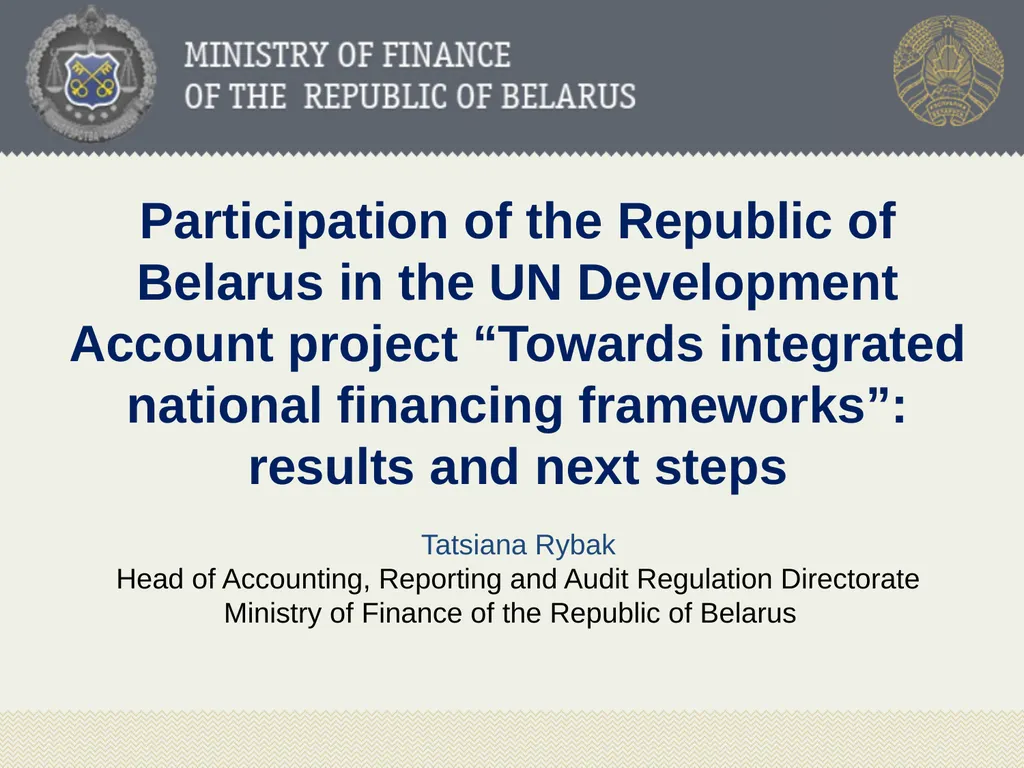
Description: Tatsiana Rybak Head of Accounting, Reporting and Audit Regulation Directorate Ministry of Finance of the Republic of Belarus Participation of the Republic of Belarus in the UN Development Account project Towards integrated national
Related Topics
Download Presentation
"Tatsiana Rybak Head of Accounting, Reporting and" is the property of its rightful owner. Permission is granted to download and print the materials on this website for personal, non-commercial use only, and to display it on your personal computer provided you do not modify the materials and that you retain all copyright notices contained in the materials. By downloading content from our website, you accept the terms of this agreement.
Presentation Transcript
slide1. Tatsiana Rybak
Head of Accounting, Reporting and Audit Regulation Directorate
Ministry of Finance of the Republic of Belarus Participation of the Republic of Belarus in the UN Development Account project “Towards integrated national financing frameworks”: results and next steps<br>
slide2. Sustainability reporting training for the private sector on contribution towards implementation of the Sustainable Development Goals
16 June 2023
Minsk
50 participants<br>
slide3. Sustainability reporting training The training's objective was to provide Key indicators for reporting on the Sustainable Development Goals (SDGs) that included:
SDGs key indicators for enterprise reporting
enterprise reporting on their contribution to the achievement of the SDGs in the Republic of Belarus
sustainability reporting of SMEs on their contribution to the achievement of the SDGs in the Eurasian region<br>
slide4. Presentation of consolidated results and assessment report of the national reporting infrastructure
in the Republic of Belarus<br>
slide5. ADT Belarus Project 2023 Selection and approval of the national consultant
Identification of key stakeholders
Kick-off meeting with focal points (26 May 2023)
Assignment of questionnaires / provide support in filling out forms
Coordination of respondents under the guidance of UNCTAD
Collecting responses to questionnaire questions
Final meeting with key stakeholders to discuss results and next steps (5 October 2023)
Preparation of the Interim Report and consolidation of the questionnaire for UNCTAD review
Discussion of the Interim Report at the ISAR Session (19 October 2023)<br>
slide6. Key stakeholders<br>
slide7. Questionnaire Structure<br>
slide8. Pillar A – Legal and Regulatory Framework<br>
slide9. Pillar A – Legal and Regulatory Framework:major achievements and problem areas<br>
slide10. Pillar A – Legal and Regulatory Framework:major achievements and problem areas<br>
slide11. Pillar В – Institutional Framework<br>
slide12. Pillar В – Institutional Frameworkmajor achievements and problem areas<br>
slide13. Pillar С – Human Capacity<br>
slide14. Pillar D – Capacity-building process<br>
slide15. Pillar D – Capacity-Building Process State Program
“Public Finance Management and Financial Market Regulation” Subprogram
“Regulation of accounting, reporting and auditing in the corporate sector” Non-financial reporting development concept and action plan for its implementation<br>
slide16. Addendum – Accounting and Reporting in the Public Sector<br>
slide17. Comparison of ADT assessment results in 2019 and in 2023<br>
slide18. Pillar A – Legal and Regulatory Frameworkrecommendations for next steps inclusion in the legislative of the Conceptual Framework for Financial Reporting, exploring the possibility of giving legal status to the documents «Management comments» and «Materiality Judgements»
exploring the possibility of establishing a formal due process for clarifying or resolving disagreements related to the application of IFRS and ISA
determining the feasibility of introducing IFRS for SMEs for use by domestic organizations
development of guidelines for the preparation of non-financial reporting and its standardized format
exploring the feasibility of including provisions in legislation to ensure compliance with non-financial reporting requirements<br>
slide19. Pillar В – Institutional Frameworkrecommendations for next steps creation of a system of national accounting and reporting standards
studying the feasibility of applying the Core Principles for Independent Audit Regulators, issued by the IFIAR
entry of professional public associations into the International Federation of Accountants
expanding the competencies of professional accountants and auditors through knowledge and practical skills in applying IFRS and ISA<br>
slide20. Pillar C – Human capacityrecommendations for next steps inclusion of non-financial reporting components and IFRS for SMEs in the professional training and advanced training program for accountants and auditors
inclusion of non-financial reporting components and IFRS for SMEs in educational programs of universities
increasing the duration of training while improving the qualifications of professional accountants and auditors<br>
slide21. Pillar D – Capacity-building processrecommendations for next steps development of the Concept for the development of non-financial reporting and an action plan for its implementation (hereinafter referred to as the plan) with a focus on the Sustainable Development Goals
identification of government bodies responsible for the implementation of plan activities
monitoring and control over the implementation of plan activities<br>
slide22. Addendum – Accounting and Reporting in the Public Sectorrecommendations for next steps creation of a system of national accounting and reporting standards for the general government sector based on International Financial Reporting Standards for the Public Sector
exploring the feasibility of establishing non-financial reporting requirements for the general government sector<br>
slide23. Training for lecturers on accounting for micro, small and medium enterprises in the Republic of Belarus
14 December 2023
Minsk
31 participants<br>
slide24. Training for lecturers As part of the project, the “Training Manual on Accounting for Micro, Small and Medium Enterprises with four modules was translated and adapted:
Module 1: Introduction to Accounting
Module 2: Accounting Cycle
Module 3: Elements of Financial Statements
Module 4: Interpretation of Financial Statements
The training allowed accounting and reporting trainers to orient themselves on how to use the training manual and gain additional knowledge and skills to conduct training on this manual for entrepreneurs and employees of small and medium companies.<br>
slide25. www.minfin.gov.by<br>
slide26. Thank you for your attention!<br>
Head of Accounting, Reporting and Audit Regulation Directorate
Ministry of Finance of the Republic of Belarus Participation of the Republic of Belarus in the UN Development Account project “Towards integrated national financing frameworks”: results and next steps<br>
slide2. Sustainability reporting training for the private sector on contribution towards implementation of the Sustainable Development Goals
16 June 2023
Minsk
50 participants<br>
slide3. Sustainability reporting training The training's objective was to provide Key indicators for reporting on the Sustainable Development Goals (SDGs) that included:
SDGs key indicators for enterprise reporting
enterprise reporting on their contribution to the achievement of the SDGs in the Republic of Belarus
sustainability reporting of SMEs on their contribution to the achievement of the SDGs in the Eurasian region<br>
slide4. Presentation of consolidated results and assessment report of the national reporting infrastructure
in the Republic of Belarus<br>
slide5. ADT Belarus Project 2023 Selection and approval of the national consultant
Identification of key stakeholders
Kick-off meeting with focal points (26 May 2023)
Assignment of questionnaires / provide support in filling out forms
Coordination of respondents under the guidance of UNCTAD
Collecting responses to questionnaire questions
Final meeting with key stakeholders to discuss results and next steps (5 October 2023)
Preparation of the Interim Report and consolidation of the questionnaire for UNCTAD review
Discussion of the Interim Report at the ISAR Session (19 October 2023)<br>
slide6. Key stakeholders<br>
slide7. Questionnaire Structure<br>
slide8. Pillar A – Legal and Regulatory Framework<br>
slide9. Pillar A – Legal and Regulatory Framework:major achievements and problem areas<br>
slide10. Pillar A – Legal and Regulatory Framework:major achievements and problem areas<br>
slide11. Pillar В – Institutional Framework<br>
slide12. Pillar В – Institutional Frameworkmajor achievements and problem areas<br>
slide13. Pillar С – Human Capacity<br>
slide14. Pillar D – Capacity-building process<br>
slide15. Pillar D – Capacity-Building Process State Program
“Public Finance Management and Financial Market Regulation” Subprogram
“Regulation of accounting, reporting and auditing in the corporate sector” Non-financial reporting development concept and action plan for its implementation<br>
slide16. Addendum – Accounting and Reporting in the Public Sector<br>
slide17. Comparison of ADT assessment results in 2019 and in 2023<br>
slide18. Pillar A – Legal and Regulatory Frameworkrecommendations for next steps inclusion in the legislative of the Conceptual Framework for Financial Reporting, exploring the possibility of giving legal status to the documents «Management comments» and «Materiality Judgements»
exploring the possibility of establishing a formal due process for clarifying or resolving disagreements related to the application of IFRS and ISA
determining the feasibility of introducing IFRS for SMEs for use by domestic organizations
development of guidelines for the preparation of non-financial reporting and its standardized format
exploring the feasibility of including provisions in legislation to ensure compliance with non-financial reporting requirements<br>
slide19. Pillar В – Institutional Frameworkrecommendations for next steps creation of a system of national accounting and reporting standards
studying the feasibility of applying the Core Principles for Independent Audit Regulators, issued by the IFIAR
entry of professional public associations into the International Federation of Accountants
expanding the competencies of professional accountants and auditors through knowledge and practical skills in applying IFRS and ISA<br>
slide20. Pillar C – Human capacityrecommendations for next steps inclusion of non-financial reporting components and IFRS for SMEs in the professional training and advanced training program for accountants and auditors
inclusion of non-financial reporting components and IFRS for SMEs in educational programs of universities
increasing the duration of training while improving the qualifications of professional accountants and auditors<br>
slide21. Pillar D – Capacity-building processrecommendations for next steps development of the Concept for the development of non-financial reporting and an action plan for its implementation (hereinafter referred to as the plan) with a focus on the Sustainable Development Goals
identification of government bodies responsible for the implementation of plan activities
monitoring and control over the implementation of plan activities<br>
slide22. Addendum – Accounting and Reporting in the Public Sectorrecommendations for next steps creation of a system of national accounting and reporting standards for the general government sector based on International Financial Reporting Standards for the Public Sector
exploring the feasibility of establishing non-financial reporting requirements for the general government sector<br>
slide23. Training for lecturers on accounting for micro, small and medium enterprises in the Republic of Belarus
14 December 2023
Minsk
31 participants<br>
slide24. Training for lecturers As part of the project, the “Training Manual on Accounting for Micro, Small and Medium Enterprises with four modules was translated and adapted:
Module 1: Introduction to Accounting
Module 2: Accounting Cycle
Module 3: Elements of Financial Statements
Module 4: Interpretation of Financial Statements
The training allowed accounting and reporting trainers to orient themselves on how to use the training manual and gain additional knowledge and skills to conduct training on this manual for entrepreneurs and employees of small and medium companies.<br>
slide25. www.minfin.gov.by<br>
slide26. Thank you for your attention!<br>