
Tax Implications of Recent Admin Law Cases
BR
Published · 47 slides · 0 views

1 / 1




Description
Tax Implications of Recent Admin Law Cases University of Chicago Tax Conference Pam Olson, Glen Kohl, David Schnabel, and Chris Bowers November 7, 2024 3:25 - 4:55 pm Contents Section 1 Background on Admin Law Challenges Section 2 Loper
Related Topics
Share
Embed code
Download this presentation From Below
"Tax Implications of Recent Admin Law Cases" is the property of its rightful owner. Permission is granted to download and print the materials on this website for personal, non-commercial use only, and to display it on your personal computer provided you do not modify the materials and that you retain all copyright notices contained in the materials. By downloading content from our website, you accept the terms of this agreement.
Presentation Transcript
01
Tax Implications of Recent Admin Law Cases University of Chicago Tax Conference Pam Olson, Glen Kohl, David Schnabel, and Chris Bowers November 7, 2024 | 3:25 - 4:55 pm<br>
02
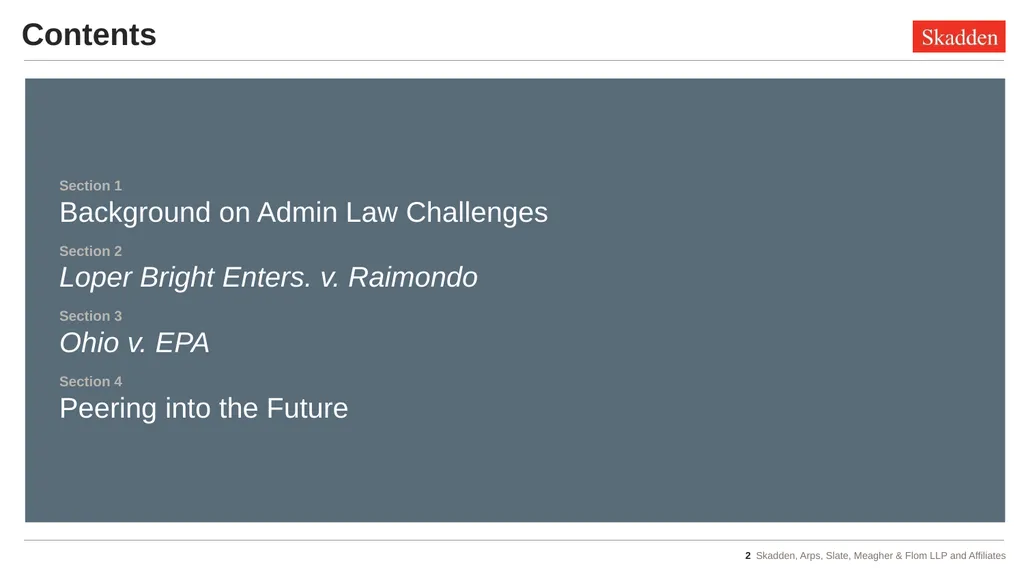
Contents Section 1
Background on Admin Law Challenges
Section 2
Loper Bright Enters. v. Raimondo
Section 3
Ohio v. EPA
Section 4
Peering into the Future<br>
Background on Admin Law Challenges
Section 2
Loper Bright Enters. v. Raimondo
Section 3
Ohio v. EPA
Section 4
Peering into the Future<br>
03
Background on Admin Law Challenges<br>
04
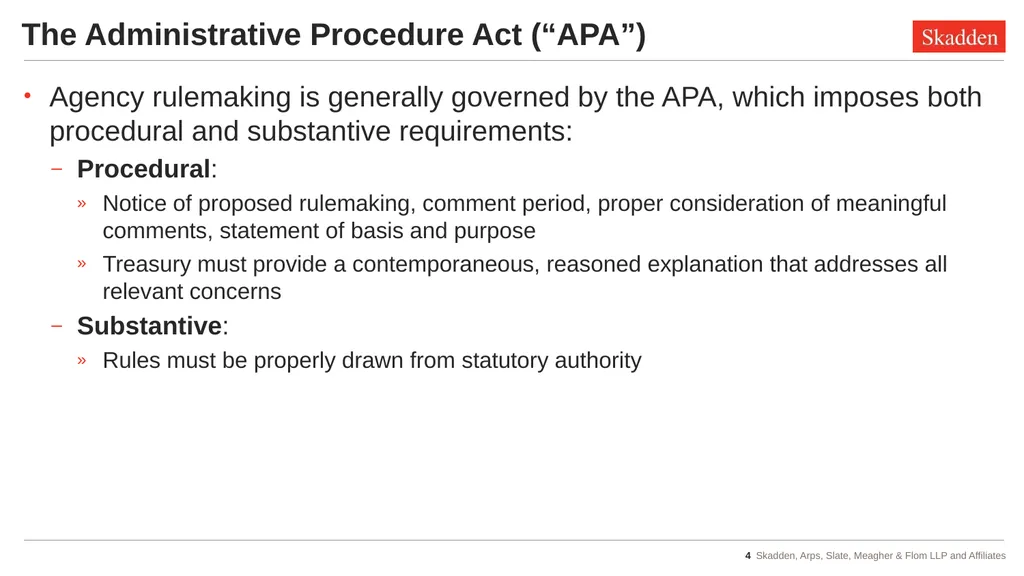
The Administrative Procedure Act (“APA”) Agency rulemaking is generally governed by the APA, which imposes both procedural and substantive requirements:
Procedural:
Notice of proposed rulemaking, comment period, proper consideration of meaningful comments, statement of basis and purpose
Treasury must provide a contemporaneous, reasoned explanation that addresses all relevant concerns
Substantive:
Rules must be properly drawn from statutory authority<br>
Procedural:
Notice of proposed rulemaking, comment period, proper consideration of meaningful comments, statement of basis and purpose
Treasury must provide a contemporaneous, reasoned explanation that addresses all relevant concerns
Substantive:
Rules must be properly drawn from statutory authority<br>
05
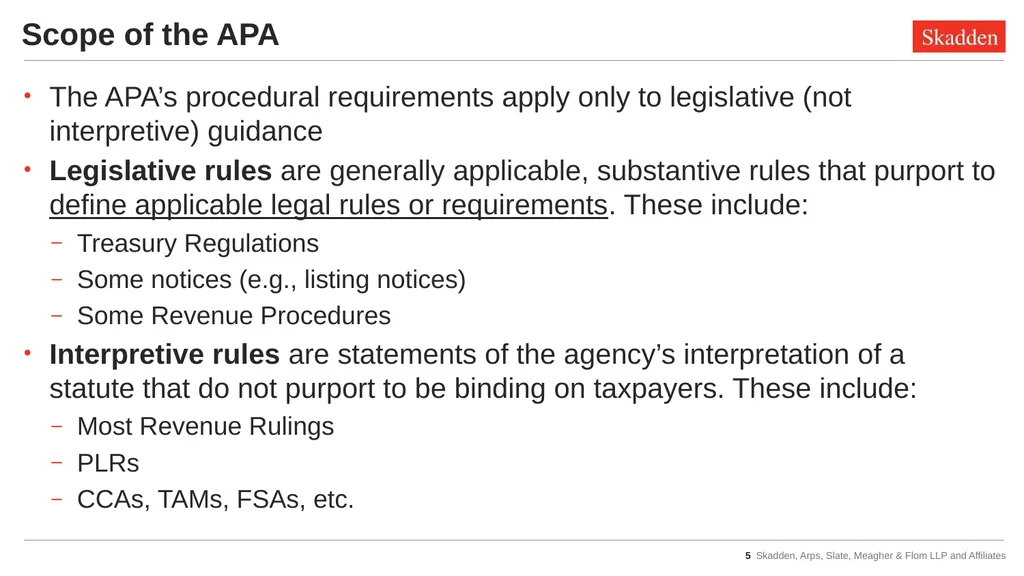
Scope of the APA The APA’s procedural requirements apply only to legislative (not interpretive) guidance
Legislative rules are generally applicable, substantive rules that purport to define applicable legal rules or requirements. These include:
Treasury Regulations
Some notices (e.g., listing notices)
Some Revenue Procedures
Interpretive rules are statements of the agency’s interpretation of a statute that do not purport to be binding on taxpayers. These include:
Most Revenue Rulings
PLRs
CCAs, TAMs, FSAs, etc.<br>
Legislative rules are generally applicable, substantive rules that purport to define applicable legal rules or requirements. These include:
Treasury Regulations
Some notices (e.g., listing notices)
Some Revenue Procedures
Interpretive rules are statements of the agency’s interpretation of a statute that do not purport to be binding on taxpayers. These include:
Most Revenue Rulings
PLRs
CCAs, TAMs, FSAs, etc.<br>
06
Loper Bright Enters. v. Raimondo<br>
07
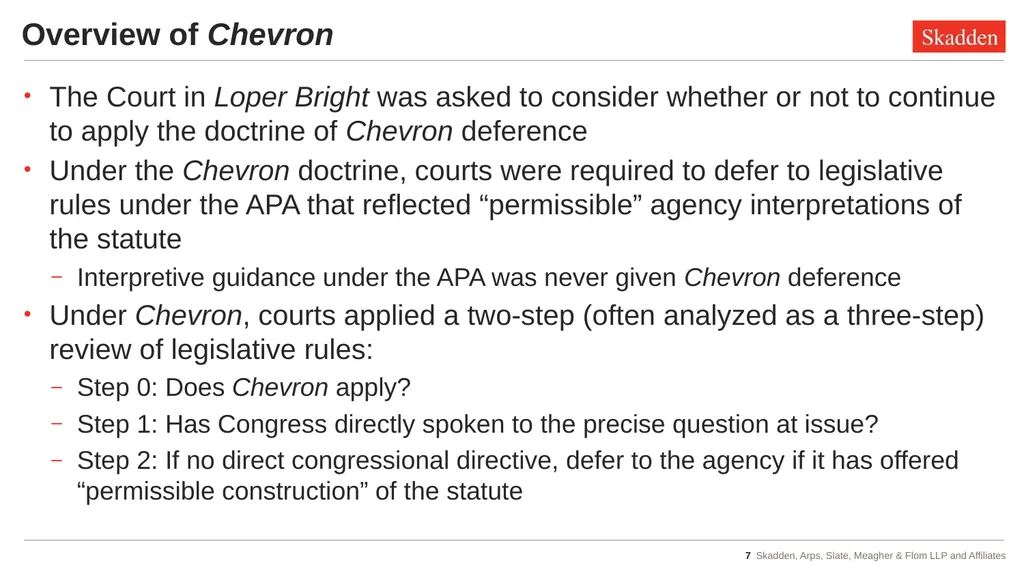
Overview of Chevron The Court in Loper Bright was asked to consider whether or not to continue to apply the doctrine of Chevron deference
Under the Chevron doctrine, courts were required to defer to legislative rules under the APA that reflected “permissible” agency interpretations of the statute
Interpretive guidance under the APA was never given Chevron deference
Under Chevron, courts applied a two-step (often analyzed as a three-step) review of legislative rules:
Step 0: Does Chevron apply?
Step 1: Has Congress directly spoken to the precise question at issue?
Step 2: If no direct congressional directive, defer to the agency if it has offered “permissible construction” of the statute<br>
Under the Chevron doctrine, courts were required to defer to legislative rules under the APA that reflected “permissible” agency interpretations of the statute
Interpretive guidance under the APA was never given Chevron deference
Under Chevron, courts applied a two-step (often analyzed as a three-step) review of legislative rules:
Step 0: Does Chevron apply?
Step 1: Has Congress directly spoken to the precise question at issue?
Step 2: If no direct congressional directive, defer to the agency if it has offered “permissible construction” of the statute<br>
08
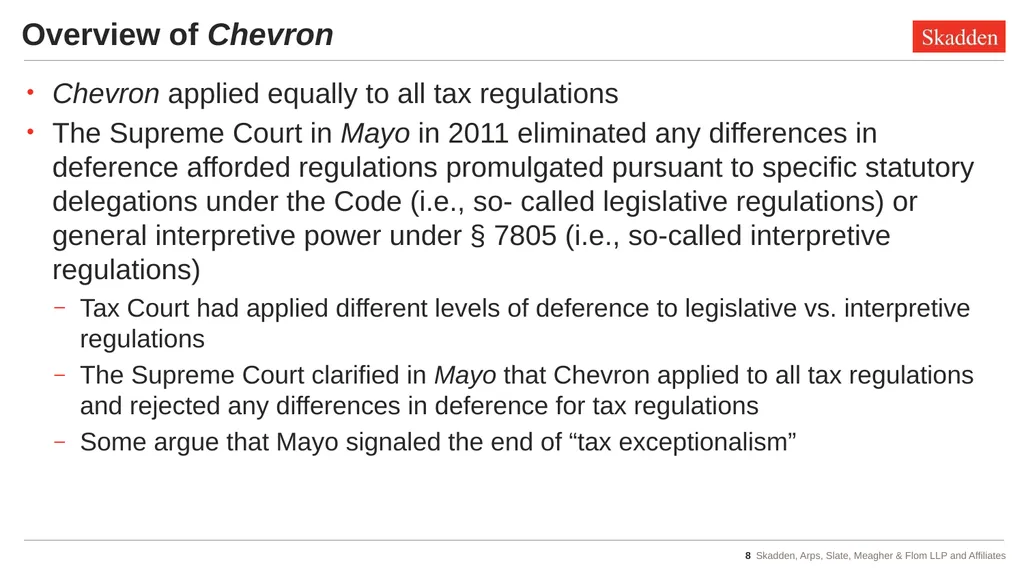
Overview of Chevron Chevron applied equally to all tax regulations
The Supreme Court in Mayo in 2011 eliminated any differences in deference afforded regulations promulgated pursuant to specific statutory delegations under the Code (i.e., so- called legislative regulations) or general interpretive power under § 7805 (i.e., so-called interpretive regulations)
Tax Court had applied different levels of deference to legislative vs. interpretive regulations
The Supreme Court clarified in Mayo that Chevron applied to all tax regulations and rejected any differences in deference for tax regulations
Some argue that Mayo signaled the end of “tax exceptionalism”<br>
The Supreme Court in Mayo in 2011 eliminated any differences in deference afforded regulations promulgated pursuant to specific statutory delegations under the Code (i.e., so- called legislative regulations) or general interpretive power under § 7805 (i.e., so-called interpretive regulations)
Tax Court had applied different levels of deference to legislative vs. interpretive regulations
The Supreme Court clarified in Mayo that Chevron applied to all tax regulations and rejected any differences in deference for tax regulations
Some argue that Mayo signaled the end of “tax exceptionalism”<br>
09
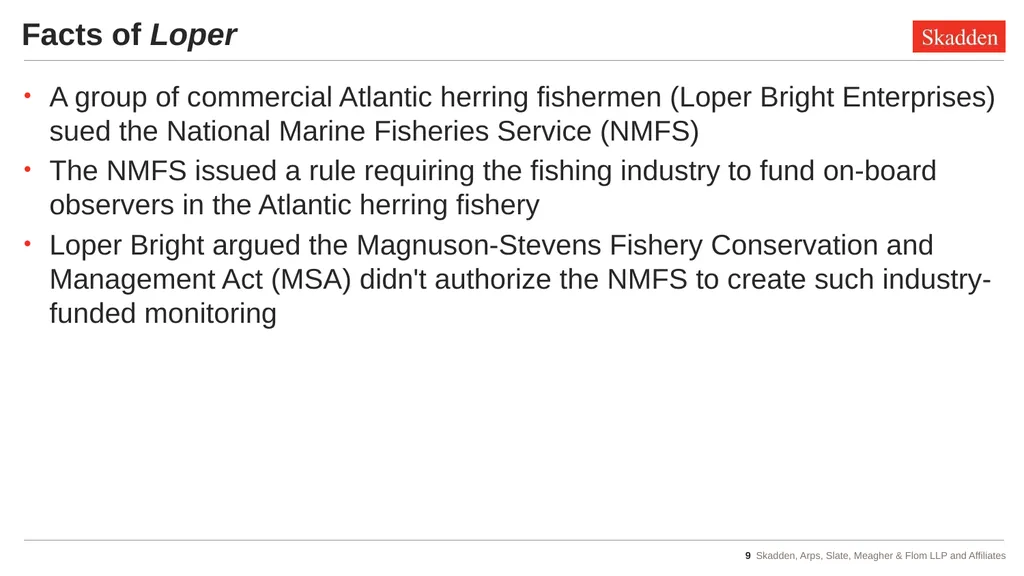
Facts of Loper A group of commercial Atlantic herring fishermen (Loper Bright Enterprises) sued the National Marine Fisheries Service (NMFS)
The NMFS issued a rule requiring the fishing industry to fund on-board observers in the Atlantic herring fishery
Loper Bright argued the Magnuson-Stevens Fishery Conservation and Management Act (MSA) didn't authorize the NMFS to create such industry-funded monitoring<br>
The NMFS issued a rule requiring the fishing industry to fund on-board observers in the Atlantic herring fishery
Loper Bright argued the Magnuson-Stevens Fishery Conservation and Management Act (MSA) didn't authorize the NMFS to create such industry-funded monitoring<br>
10
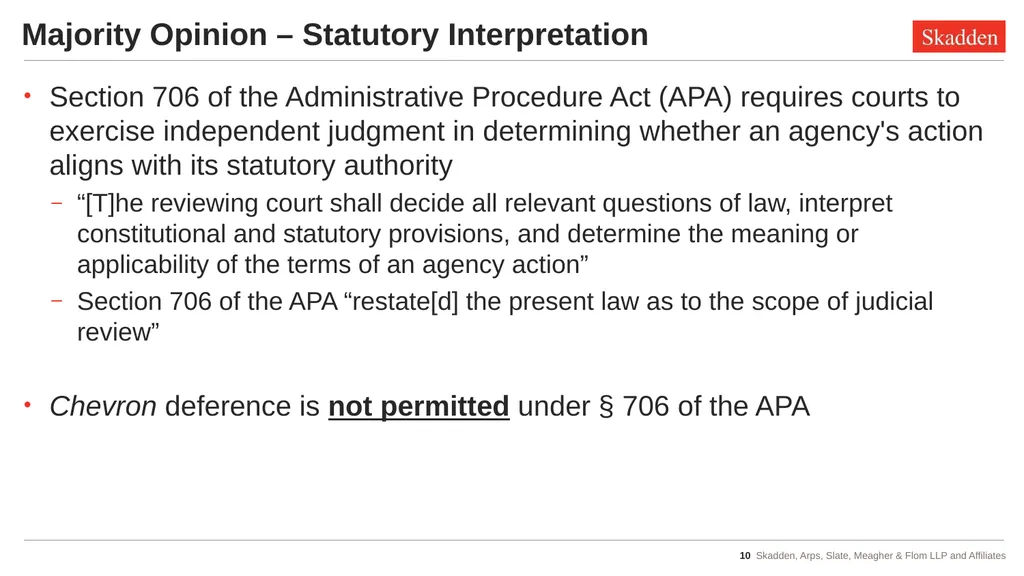
Majority Opinion – Statutory Interpretation Section 706 of the Administrative Procedure Act (APA) requires courts to exercise independent judgment in determining whether an agency's action aligns with its statutory authority
“[T]he reviewing court shall decide all relevant questions of law, interpret constitutional and statutory provisions, and determine the meaning or applicability of the terms of an agency action”
Section 706 of the APA “restate[d] the present law as to the scope of judicial review”
Chevron deference is not permitted under § 706 of the APA<br>
“[T]he reviewing court shall decide all relevant questions of law, interpret constitutional and statutory provisions, and determine the meaning or applicability of the terms of an agency action”
Section 706 of the APA “restate[d] the present law as to the scope of judicial review”
Chevron deference is not permitted under § 706 of the APA<br>
11
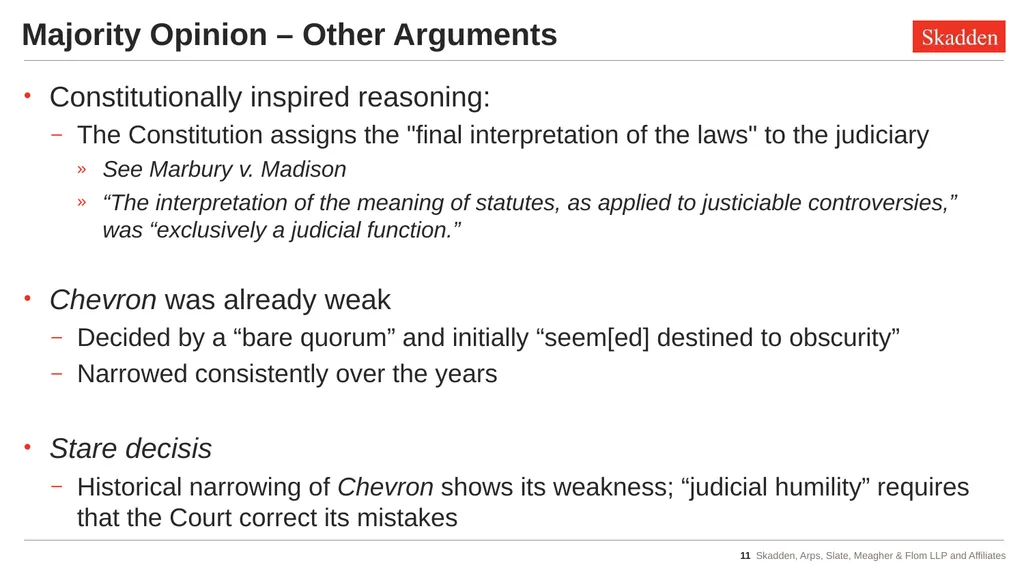
Majority Opinion – Other Arguments Constitutionally inspired reasoning:
The Constitution assigns the "final interpretation of the laws" to the judiciary
See Marbury v. Madison
“The interpretation of the meaning of statutes, as applied to justiciable controversies,” was “exclusively a judicial function.”
Chevron was already weak
Decided by a “bare quorum” and initially “seem[ed] destined to obscurity”
Narrowed consistently over the years
Stare decisis
Historical narrowing of Chevron shows its weakness; “judicial humility” requires that the Court correct its mistakes<br>
The Constitution assigns the "final interpretation of the laws" to the judiciary
See Marbury v. Madison
“The interpretation of the meaning of statutes, as applied to justiciable controversies,” was “exclusively a judicial function.”
Chevron was already weak
Decided by a “bare quorum” and initially “seem[ed] destined to obscurity”
Narrowed consistently over the years
Stare decisis
Historical narrowing of Chevron shows its weakness; “judicial humility” requires that the Court correct its mistakes<br>
12
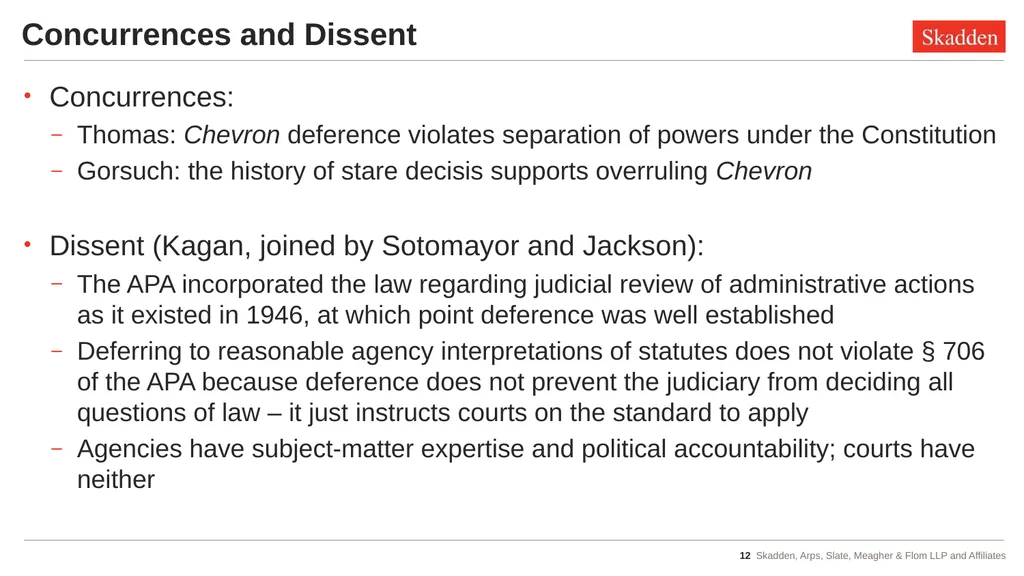
Concurrences and Dissent Concurrences:
Thomas: Chevron deference violates separation of powers under the Constitution
Gorsuch: the history of stare decisis supports overruling Chevron
Dissent (Kagan, joined by Sotomayor and Jackson):
The APA incorporated the law regarding judicial review of administrative actions as it existed in 1946, at which point deference was well established
Deferring to reasonable agency interpretations of statutes does not violate § 706 of the APA because deference does not prevent the judiciary from deciding all questions of law – it just instructs courts on the standard to apply
Agencies have subject-matter expertise and political accountability; courts have neither<br>
Thomas: Chevron deference violates separation of powers under the Constitution
Gorsuch: the history of stare decisis supports overruling Chevron
Dissent (Kagan, joined by Sotomayor and Jackson):
The APA incorporated the law regarding judicial review of administrative actions as it existed in 1946, at which point deference was well established
Deferring to reasonable agency interpretations of statutes does not violate § 706 of the APA because deference does not prevent the judiciary from deciding all questions of law – it just instructs courts on the standard to apply
Agencies have subject-matter expertise and political accountability; courts have neither<br>
13
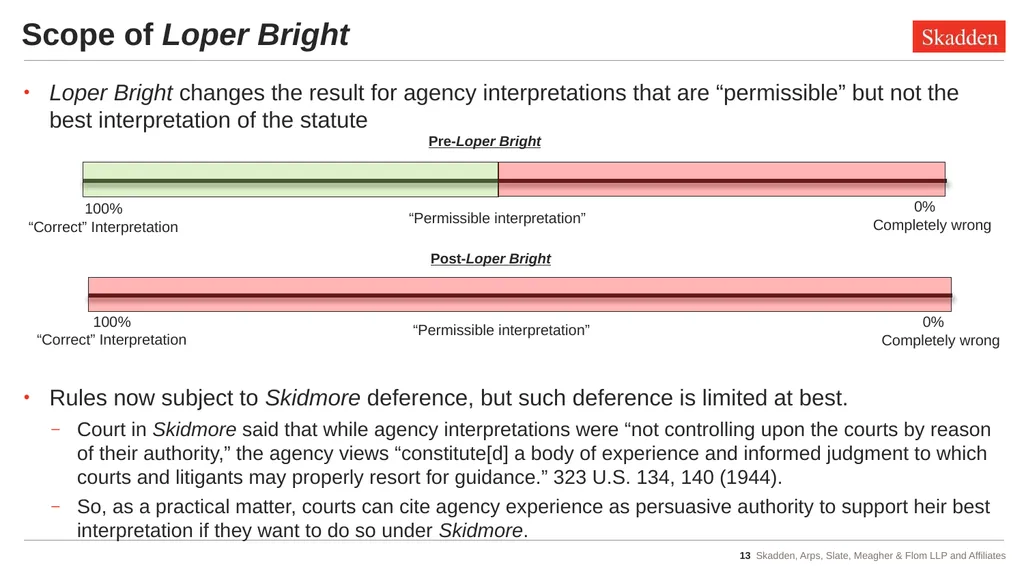
Scope of Loper Bright Loper Bright changes the result for agency interpretations that are “permissible” but not the best interpretation of the statute
Rules now subject to Skidmore deference, but such deference is limited at best.
Court in Skidmore said that while agency interpretations were “not controlling upon the courts by reason of their authority,” the agency views “constitute[d] a body of experience and informed judgment to which courts and litigants may properly resort for guidance.” 323 U.S. 134, 140 (1944).
So, as a practical matter, courts can cite agency experience as persuasive authority to support heir best interpretation if they want to do so under Skidmore. Pre-Loper Bright Post-Loper Bright 100%
“Correct” Interpretation<br>
Rules now subject to Skidmore deference, but such deference is limited at best.
Court in Skidmore said that while agency interpretations were “not controlling upon the courts by reason of their authority,” the agency views “constitute[d] a body of experience and informed judgment to which courts and litigants may properly resort for guidance.” 323 U.S. 134, 140 (1944).
So, as a practical matter, courts can cite agency experience as persuasive authority to support heir best interpretation if they want to do so under Skidmore. Pre-Loper Bright Post-Loper Bright 100%
“Correct” Interpretation<br>
14
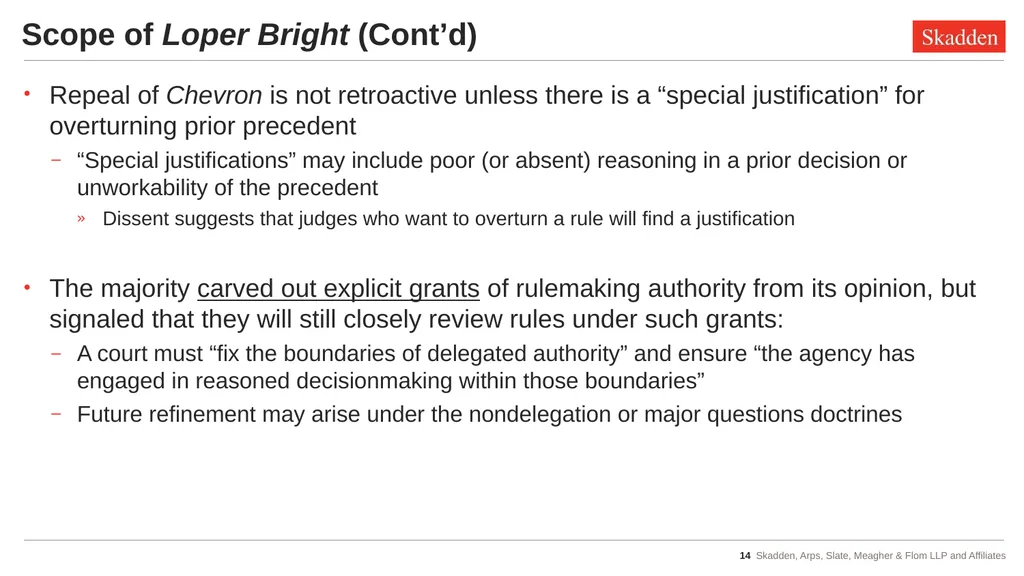
Scope of Loper Bright (Cont’d) Repeal of Chevron is not retroactive unless there is a “special justification” for overturning prior precedent
“Special justifications” may include poor (or absent) reasoning in a prior decision or unworkability of the precedent
Dissent suggests that judges who want to overturn a rule will find a justification
The majority carved out explicit grants of rulemaking authority from its opinion, but signaled that they will still closely review rules under such grants:
A court must “fix the boundaries of delegated authority” and ensure “the agency has engaged in reasoned decisionmaking within those boundaries”
Future refinement may arise under the nondelegation or major questions doctrines<br>
“Special justifications” may include poor (or absent) reasoning in a prior decision or unworkability of the precedent
Dissent suggests that judges who want to overturn a rule will find a justification
The majority carved out explicit grants of rulemaking authority from its opinion, but signaled that they will still closely review rules under such grants:
A court must “fix the boundaries of delegated authority” and ensure “the agency has engaged in reasoned decisionmaking within those boundaries”
Future refinement may arise under the nondelegation or major questions doctrines<br>
15
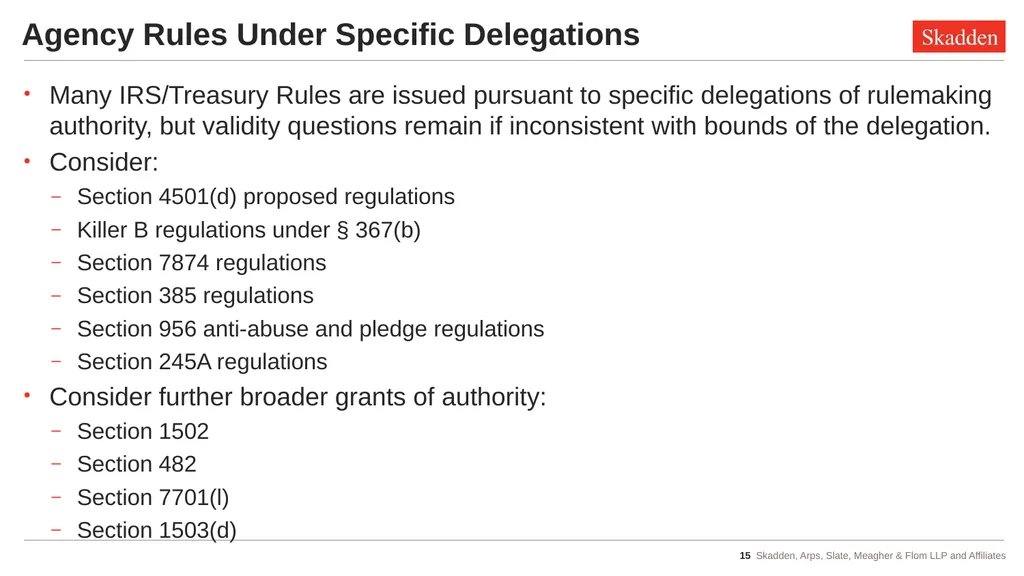
Agency Rules Under Specific Delegations Many IRS/Treasury Rules are issued pursuant to specific delegations of rulemaking authority, but validity questions remain if inconsistent with bounds of the delegation.
Consider:
Section 4501(d) proposed regulations
Killer B regulations under § 367(b)
Section 7874 regulations
Section 385 regulations
Section 956 anti-abuse and pledge regulations
Section 245A regulations
Consider further broader grants of authority:
Section 1502
Section 482
Section 7701(l)
Section 1503(d)<br>
Consider:
Section 4501(d) proposed regulations
Killer B regulations under § 367(b)
Section 7874 regulations
Section 385 regulations
Section 956 anti-abuse and pledge regulations
Section 245A regulations
Consider further broader grants of authority:
Section 1502
Section 482
Section 7701(l)
Section 1503(d)<br>
16
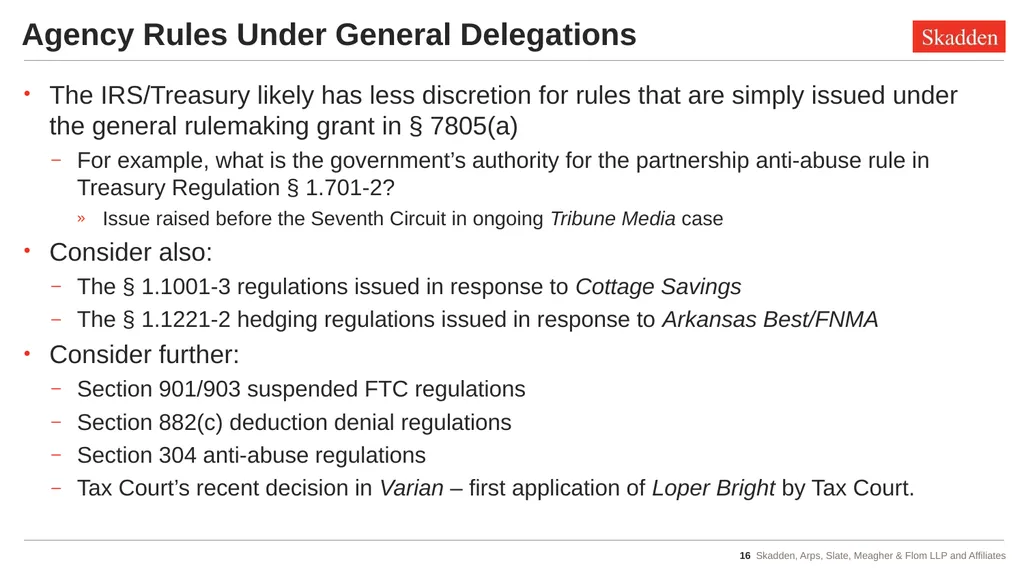
Agency Rules Under General Delegations The IRS/Treasury likely has less discretion for rules that are simply issued under the general rulemaking grant in § 7805(a)
For example, what is the government’s authority for the partnership anti-abuse rule in Treasury Regulation § 1.701-2?
Issue raised before the Seventh Circuit in ongoing Tribune Media case
Consider also:
The § 1.1001-3 regulations issued in response to Cottage Savings
The § 1.1221-2 hedging regulations issued in response to Arkansas Best/FNMA
Consider further:
Section 901/903 suspended FTC regulations
Section 882(c) deduction denial regulations
Section 304 anti-abuse regulations
Tax Court’s recent decision in Varian – first application of Loper Bright by Tax Court.<br>
For example, what is the government’s authority for the partnership anti-abuse rule in Treasury Regulation § 1.701-2?
Issue raised before the Seventh Circuit in ongoing Tribune Media case
Consider also:
The § 1.1001-3 regulations issued in response to Cottage Savings
The § 1.1221-2 hedging regulations issued in response to Arkansas Best/FNMA
Consider further:
Section 901/903 suspended FTC regulations
Section 882(c) deduction denial regulations
Section 304 anti-abuse regulations
Tax Court’s recent decision in Varian – first application of Loper Bright by Tax Court.<br>
17
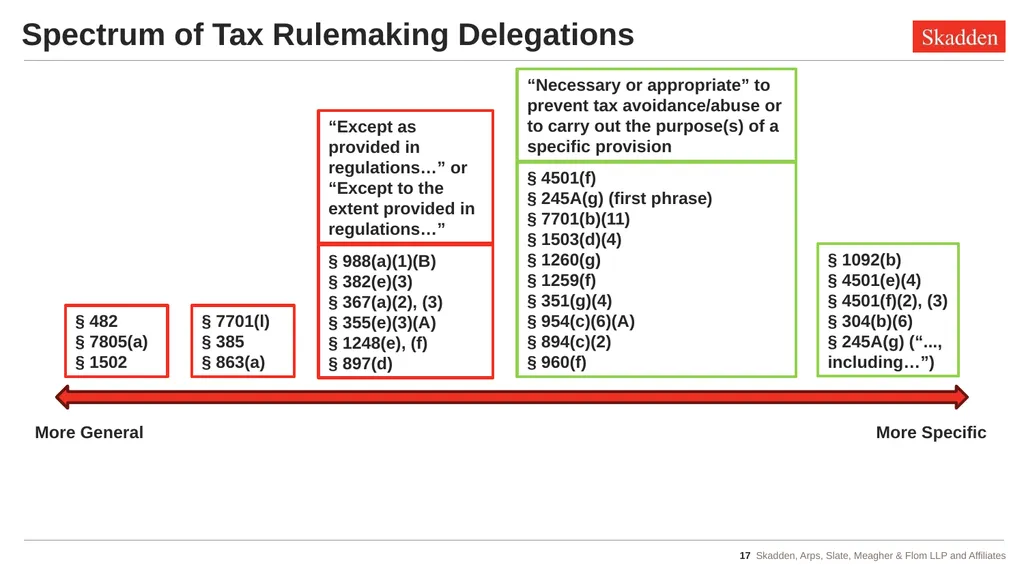
Spectrum of Tax Rulemaking Delegations More General More Specific § 482
§ 7805(a)
§ 1502 § 988(a)(1)(B)
§ 382(e)(3)
§ 367(a)(2), (3)
§ 355(e)(3)(A)
§ 1248(e), (f)
§ 897(d) § 1092(b)
§ 4501(e)(4)
§ 4501(f)(2), (3)
§ 304(b)(6)
§ 245A(g) (“..., including…”) “Except as provided in regulations…” or “Except to the extent provided in regulations…” § 4501(f)
§ 245A(g) (first phrase)
§ 7701(b)(11)
§ 1503(d)(4)
§ 1260(g)
§ 1259(f)
§ 351(g)(4)
§ 954(c)(6)(A)
§ 894(c)(2)
§ 960(f) “Necessary or appropriate” to prevent tax avoidance/abuse or to carry out the purpose(s) of a specific provision § 7701(l)
§ 385
§ 863(a)<br>
§ 7805(a)
§ 1502 § 988(a)(1)(B)
§ 382(e)(3)
§ 367(a)(2), (3)
§ 355(e)(3)(A)
§ 1248(e), (f)
§ 897(d) § 1092(b)
§ 4501(e)(4)
§ 4501(f)(2), (3)
§ 304(b)(6)
§ 245A(g) (“..., including…”) “Except as provided in regulations…” or “Except to the extent provided in regulations…” § 4501(f)
§ 245A(g) (first phrase)
§ 7701(b)(11)
§ 1503(d)(4)
§ 1260(g)
§ 1259(f)
§ 351(g)(4)
§ 954(c)(6)(A)
§ 894(c)(2)
§ 960(f) “Necessary or appropriate” to prevent tax avoidance/abuse or to carry out the purpose(s) of a specific provision § 7701(l)
§ 385
§ 863(a)<br>
18
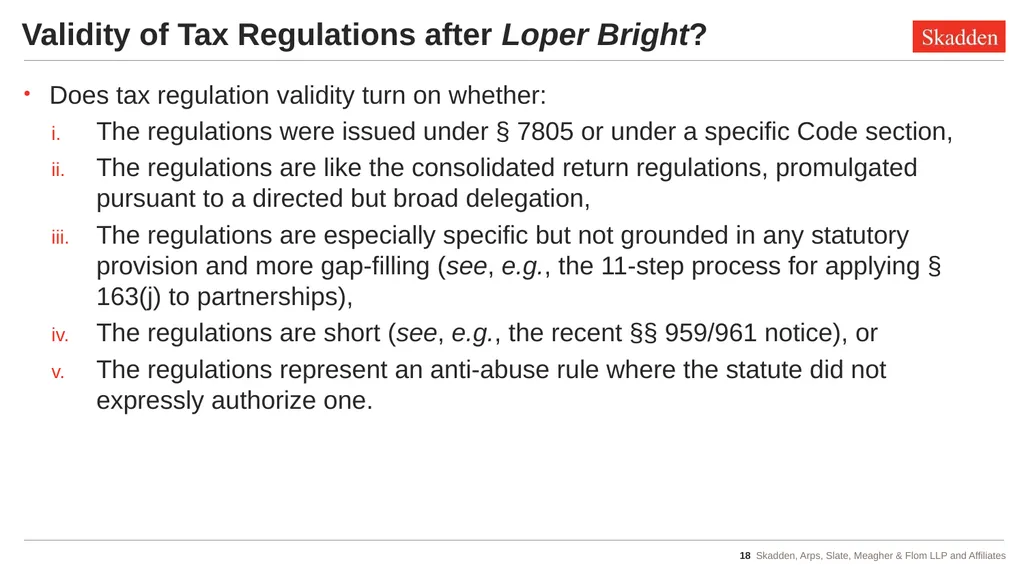
Validity of Tax Regulations after Loper Bright? Does tax regulation validity turn on whether:
The regulations were issued under § 7805 or under a specific Code section,
The regulations are like the consolidated return regulations, promulgated pursuant to a directed but broad delegation,
The regulations are especially specific but not grounded in any statutory provision and more gap-filling (see, e.g., the 11-step process for applying § 163(j) to partnerships),
The regulations are short (see, e.g., the recent §§ 959/961 notice), or
The regulations represent an anti-abuse rule where the statute did not expressly authorize one.<br>
The regulations were issued under § 7805 or under a specific Code section,
The regulations are like the consolidated return regulations, promulgated pursuant to a directed but broad delegation,
The regulations are especially specific but not grounded in any statutory provision and more gap-filling (see, e.g., the 11-step process for applying § 163(j) to partnerships),
The regulations are short (see, e.g., the recent §§ 959/961 notice), or
The regulations represent an anti-abuse rule where the statute did not expressly authorize one.<br>
19
Are the partnership anti-abuse rules in Treas. Reg. § 1.701-2 valid or invalid under Loper Bright? Please download and install the Slido app on all computers you use ⓘ Start presenting to display the poll results on this slide.<br>
20
Are Treasury’s proposed funding rule regulations in Prop. Treas. Reg. § 58.4501-7(e) valid or invalid under Loper Bright? Please download and install the Slido app on all computers you use ⓘ Start presenting to display the poll results on this slide.<br>
21
Are the extraordinary reduction and disposition rules in Treas. Reg. § 1.245A-5 valid or invalid under Loper Bright? Please download and install the Slido app on all computers you use ⓘ Start presenting to display the poll results on this slide.<br>
22
Are the debt modification rules in Treas. Reg. § 1.1001-3 issued in response to Cottage Savings valid or invalid under Loper Bright? Please download and install the Slido app on all computers you use ⓘ Start presenting to display the poll results on this slide.<br>
23
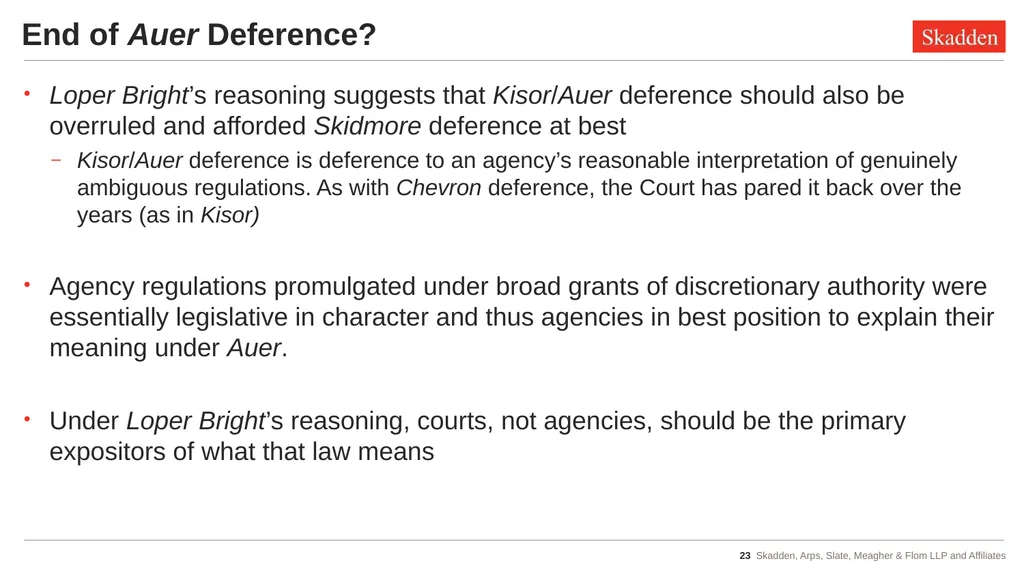
End of Auer Deference? Loper Bright’s reasoning suggests that Kisor/Auer deference should also be overruled and afforded Skidmore deference at best
Kisor/Auer deference is deference to an agency’s reasonable interpretation of genuinely ambiguous regulations. As with Chevron deference, the Court has pared it back over the years (as in Kisor)
Agency regulations promulgated under broad grants of discretionary authority were essentially legislative in character and thus agencies in best position to explain their meaning under Auer.
Under Loper Bright’s reasoning, courts, not agencies, should be the primary expositors of what that law means<br>
Kisor/Auer deference is deference to an agency’s reasonable interpretation of genuinely ambiguous regulations. As with Chevron deference, the Court has pared it back over the years (as in Kisor)
Agency regulations promulgated under broad grants of discretionary authority were essentially legislative in character and thus agencies in best position to explain their meaning under Auer.
Under Loper Bright’s reasoning, courts, not agencies, should be the primary expositors of what that law means<br>
24
Ohio v. EPA<br>
25
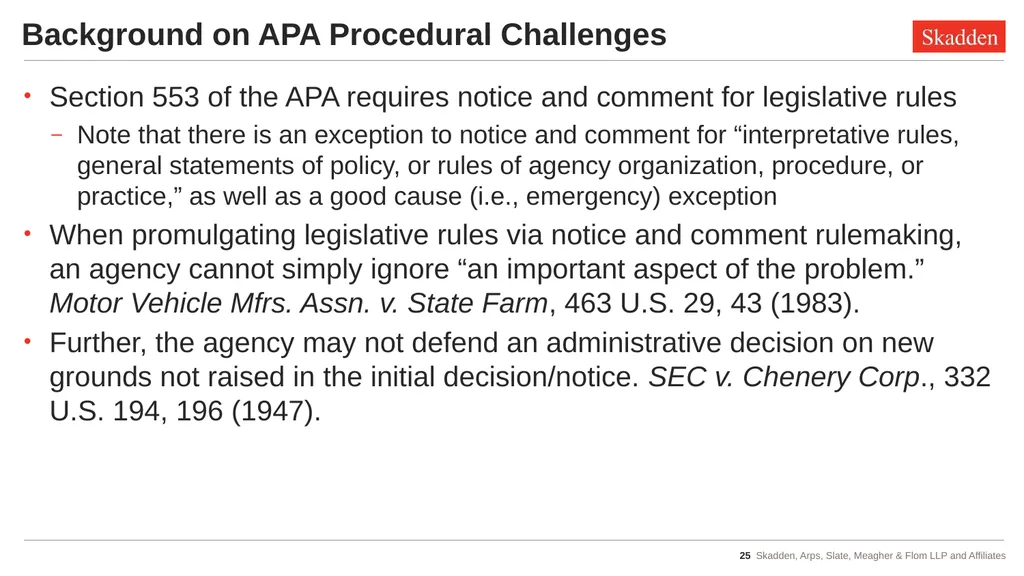
Background on APA Procedural Challenges Section 553 of the APA requires notice and comment for legislative rules
Note that there is an exception to notice and comment for “interpretative rules, general statements of policy, or rules of agency organization, procedure, or practice,” as well as a good cause (i.e., emergency) exception
When promulgating legislative rules via notice and comment rulemaking, an agency cannot simply ignore “an important aspect of the problem.” Motor Vehicle Mfrs. Assn. v. State Farm, 463 U.S. 29, 43 (1983).
Further, the agency may not defend an administrative decision on new grounds not raised in the initial decision/notice. SEC v. Chenery Corp., 332 U.S. 194, 196 (1947).<br>
Note that there is an exception to notice and comment for “interpretative rules, general statements of policy, or rules of agency organization, procedure, or practice,” as well as a good cause (i.e., emergency) exception
When promulgating legislative rules via notice and comment rulemaking, an agency cannot simply ignore “an important aspect of the problem.” Motor Vehicle Mfrs. Assn. v. State Farm, 463 U.S. 29, 43 (1983).
Further, the agency may not defend an administrative decision on new grounds not raised in the initial decision/notice. SEC v. Chenery Corp., 332 U.S. 194, 196 (1947).<br>
26
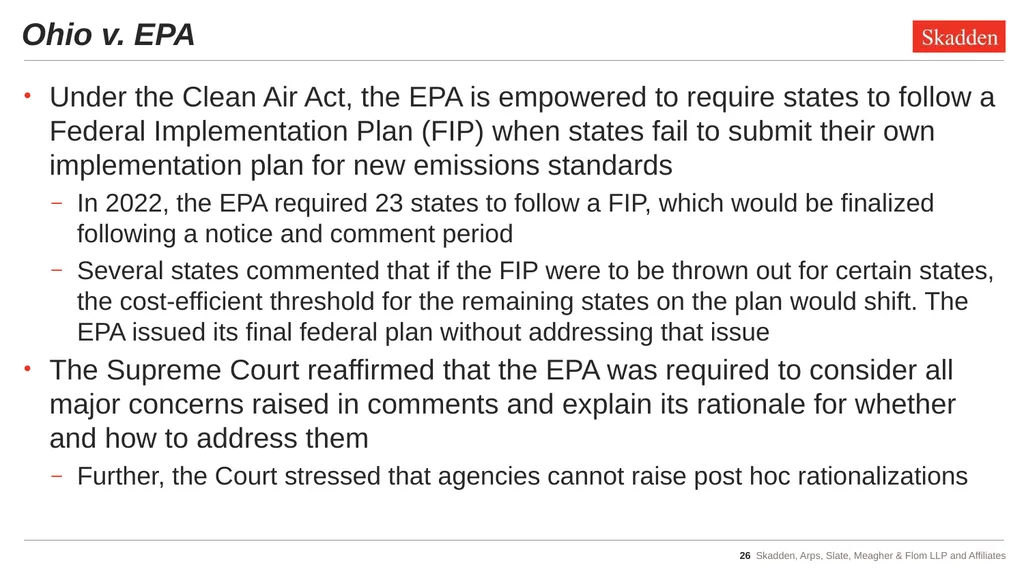
Ohio v. EPA Under the Clean Air Act, the EPA is empowered to require states to follow a Federal Implementation Plan (FIP) when states fail to submit their own implementation plan for new emissions standards
In 2022, the EPA required 23 states to follow a FIP, which would be finalized following a notice and comment period
Several states commented that if the FIP were to be thrown out for certain states, the cost-efficient threshold for the remaining states on the plan would shift. The EPA issued its final federal plan without addressing that issue
The Supreme Court reaffirmed that the EPA was required to consider all major concerns raised in comments and explain its rationale for whether and how to address them
Further, the Court stressed that agencies cannot raise post hoc rationalizations<br>
In 2022, the EPA required 23 states to follow a FIP, which would be finalized following a notice and comment period
Several states commented that if the FIP were to be thrown out for certain states, the cost-efficient threshold for the remaining states on the plan would shift. The EPA issued its final federal plan without addressing that issue
The Supreme Court reaffirmed that the EPA was required to consider all major concerns raised in comments and explain its rationale for whether and how to address them
Further, the Court stressed that agencies cannot raise post hoc rationalizations<br>
27
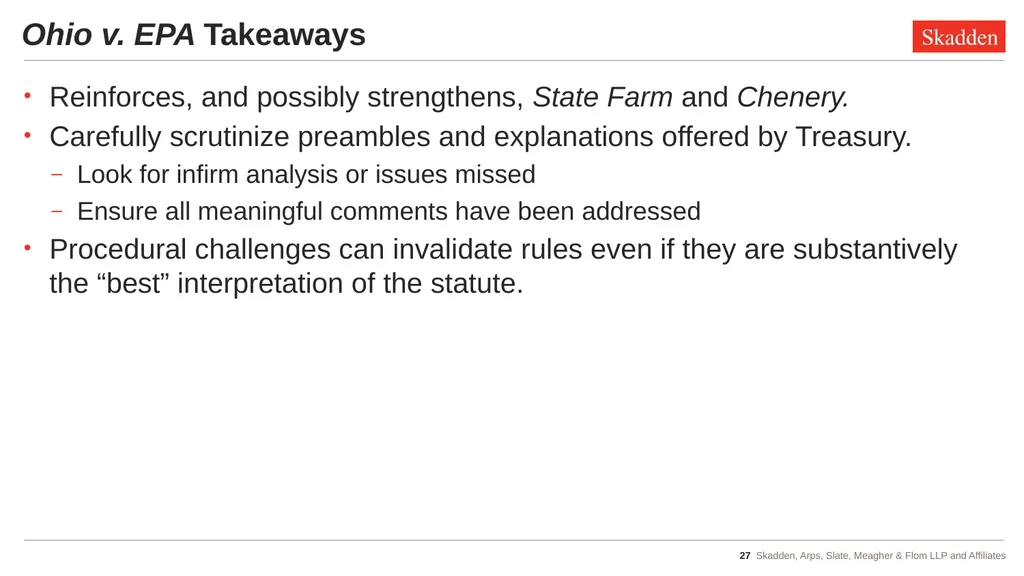
Ohio v. EPA Takeaways Reinforces, and possibly strengthens, State Farm and Chenery.
Carefully scrutinize preambles and explanations offered by Treasury.
Look for infirm analysis or issues missed
Ensure all meaningful comments have been addressed
Procedural challenges can invalidate rules even if they are substantively the “best” interpretation of the statute.<br>
Carefully scrutinize preambles and explanations offered by Treasury.
Look for infirm analysis or issues missed
Ensure all meaningful comments have been addressed
Procedural challenges can invalidate rules even if they are substantively the “best” interpretation of the statute.<br>
28
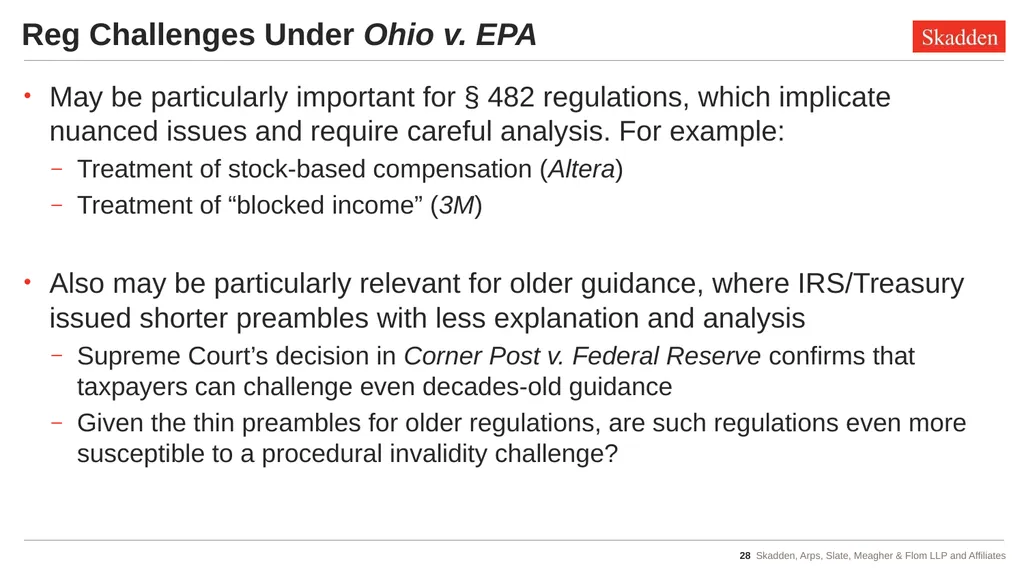
Reg Challenges Under Ohio v. EPA May be particularly important for § 482 regulations, which implicate nuanced issues and require careful analysis. For example:
Treatment of stock-based compensation (Altera)
Treatment of “blocked income” (3M)
Also may be particularly relevant for older guidance, where IRS/Treasury issued shorter preambles with less explanation and analysis
Supreme Court’s decision in Corner Post v. Federal Reserve confirms that taxpayers can challenge even decades-old guidance
Given the thin preambles for older regulations, are such regulations even more susceptible to a procedural invalidity challenge?<br>
Treatment of stock-based compensation (Altera)
Treatment of “blocked income” (3M)
Also may be particularly relevant for older guidance, where IRS/Treasury issued shorter preambles with less explanation and analysis
Supreme Court’s decision in Corner Post v. Federal Reserve confirms that taxpayers can challenge even decades-old guidance
Given the thin preambles for older regulations, are such regulations even more susceptible to a procedural invalidity challenge?<br>
29
Practice Points<br>
30
Is the Supreme Court's decision in Loper Bright a positive or negative development for the tax system? Please download and install the Slido app on all computers you use ⓘ Start presenting to display the poll results on this slide.<br>
31
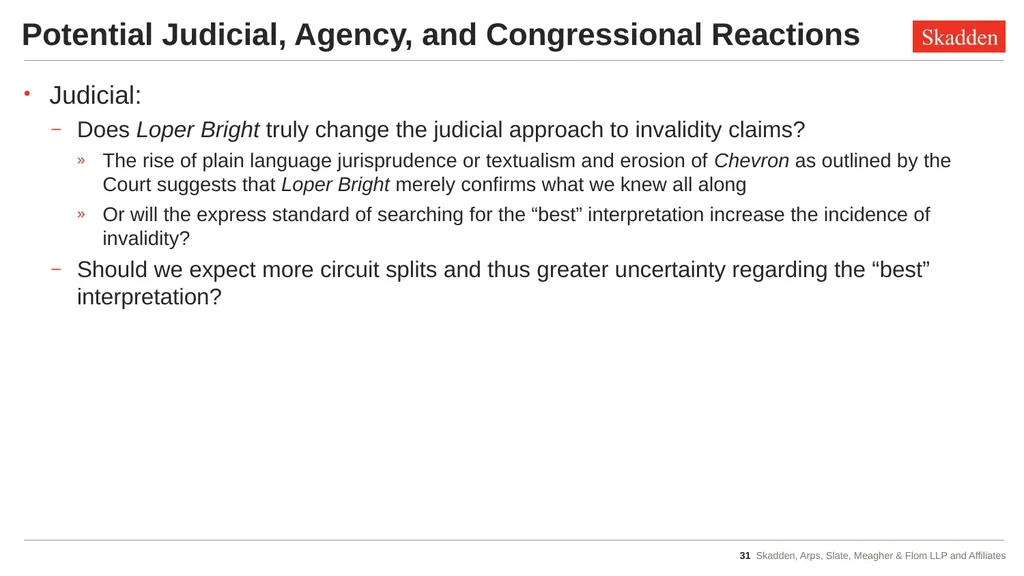
Potential Judicial, Agency, and Congressional Reactions Judicial:
Does Loper Bright truly change the judicial approach to invalidity claims?
The rise of plain language jurisprudence or textualism and erosion of Chevron as outlined by the Court suggests that Loper Bright merely confirms what we knew all along
Or will the express standard of searching for the “best” interpretation increase the incidence of invalidity?
Should we expect more circuit splits and thus greater uncertainty regarding the “best” interpretation?<br>
Does Loper Bright truly change the judicial approach to invalidity claims?
The rise of plain language jurisprudence or textualism and erosion of Chevron as outlined by the Court suggests that Loper Bright merely confirms what we knew all along
Or will the express standard of searching for the “best” interpretation increase the incidence of invalidity?
Should we expect more circuit splits and thus greater uncertainty regarding the “best” interpretation?<br>
32
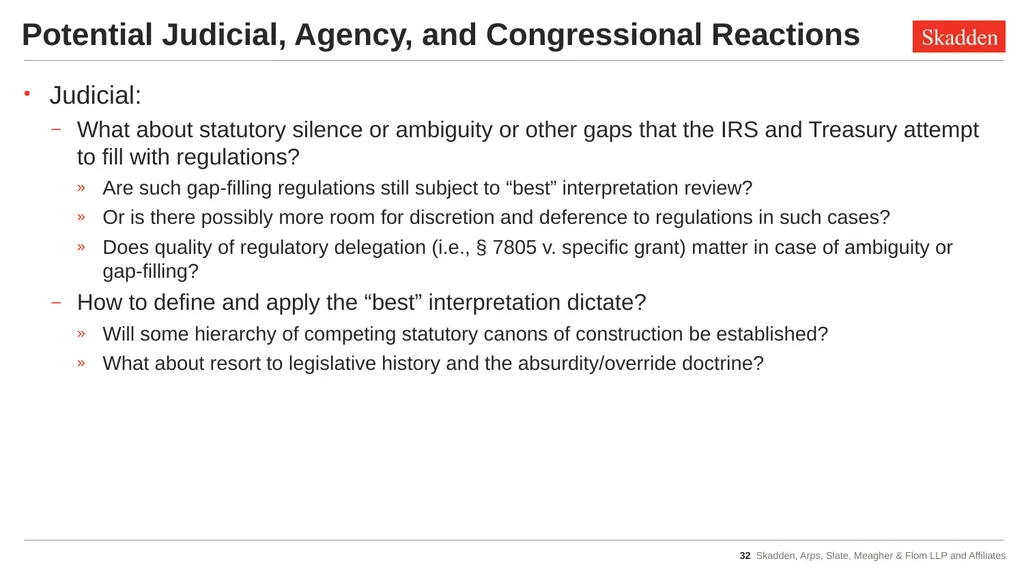
Potential Judicial, Agency, and Congressional Reactions Judicial:
What about statutory silence or ambiguity or other gaps that the IRS and Treasury attempt to fill with regulations?
Are such gap-filling regulations still subject to “best” interpretation review?
Or is there possibly more room for discretion and deference to regulations in such cases?
Does quality of regulatory delegation (i.e., § 7805 v. specific grant) matter in case of ambiguity or gap-filling?
How to define and apply the “best” interpretation dictate?
Will some hierarchy of competing statutory canons of construction be established?
What about resort to legislative history and the absurdity/override doctrine?<br>
What about statutory silence or ambiguity or other gaps that the IRS and Treasury attempt to fill with regulations?
Are such gap-filling regulations still subject to “best” interpretation review?
Or is there possibly more room for discretion and deference to regulations in such cases?
Does quality of regulatory delegation (i.e., § 7805 v. specific grant) matter in case of ambiguity or gap-filling?
How to define and apply the “best” interpretation dictate?
Will some hierarchy of competing statutory canons of construction be established?
What about resort to legislative history and the absurdity/override doctrine?<br>
33
Potential Judicial, Agency, and Congressional Reactions Judicial (cont.):
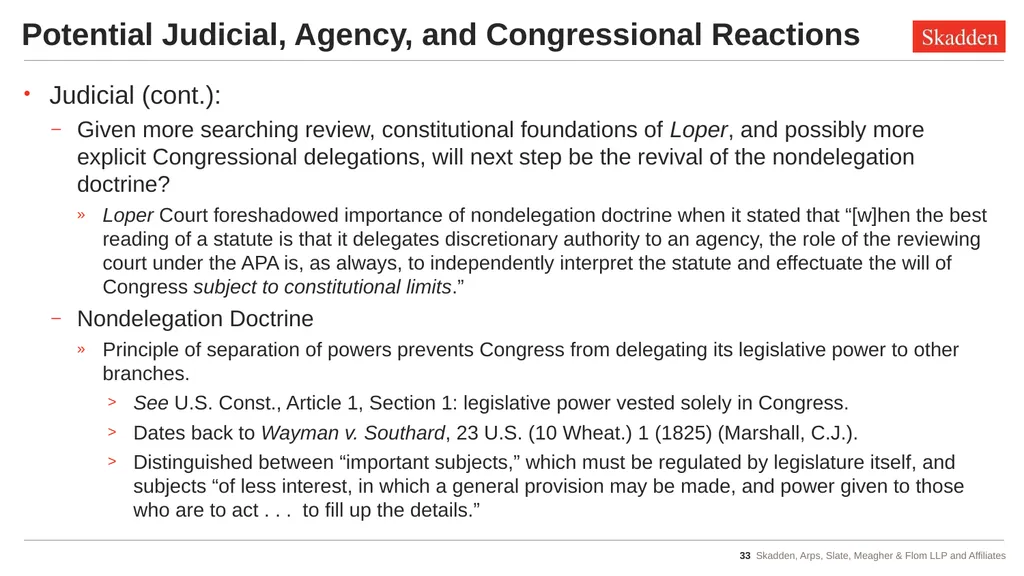
Given more searching review, constitutional foundations of Loper, and possibly more explicit Congressional delegations, will next step be the revival of the nondelegation doctrine?
Loper Court foreshadowed importance of nondelegation doctrine when it stated that “[w]hen the best reading of a statute is that it delegates discretionary authority to an agency, the role of the reviewing court under the APA is, as always, to independently interpret the statute and effectuate the will of Congress subject to constitutional limits.”
Nondelegation Doctrine
Principle of separation of powers prevents Congress from delegating its legislative power to other branches.
See U.S. Const., Article 1, Section 1: legislative power vested solely in Congress.
Dates back to Wayman v. Southard, 23 U.S. (10 Wheat.) 1 (1825) (Marshall, C.J.).
Distinguished between “important subjects,” which must be regulated by legislature itself, and subjects “of less interest, in which a general provision may be made, and power given to those who are to act . . . to fill up the details.”<br>
Given more searching review, constitutional foundations of Loper, and possibly more explicit Congressional delegations, will next step be the revival of the nondelegation doctrine?
Loper Court foreshadowed importance of nondelegation doctrine when it stated that “[w]hen the best reading of a statute is that it delegates discretionary authority to an agency, the role of the reviewing court under the APA is, as always, to independently interpret the statute and effectuate the will of Congress subject to constitutional limits.”
Nondelegation Doctrine
Principle of separation of powers prevents Congress from delegating its legislative power to other branches.
See U.S. Const., Article 1, Section 1: legislative power vested solely in Congress.
Dates back to Wayman v. Southard, 23 U.S. (10 Wheat.) 1 (1825) (Marshall, C.J.).
Distinguished between “important subjects,” which must be regulated by legislature itself, and subjects “of less interest, in which a general provision may be made, and power given to those who are to act . . . to fill up the details.”<br>
34
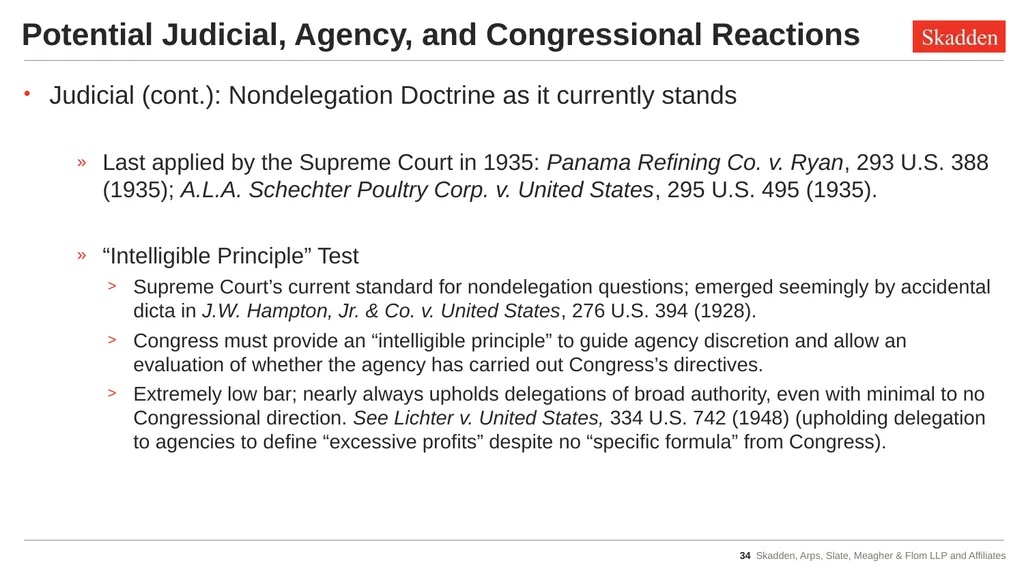
Potential Judicial, Agency, and Congressional Reactions Judicial (cont.): Nondelegation Doctrine as it currently stands
Last applied by the Supreme Court in 1935: Panama Refining Co. v. Ryan, 293 U.S. 388 (1935); A.L.A. Schechter Poultry Corp. v. United States, 295 U.S. 495 (1935).
“Intelligible Principle” Test
Supreme Court’s current standard for nondelegation questions; emerged seemingly by accidental dicta in J.W. Hampton, Jr. & Co. v. United States, 276 U.S. 394 (1928).
Congress must provide an “intelligible principle” to guide agency discretion and allow an evaluation of whether the agency has carried out Congress’s directives.
Extremely low bar; nearly always upholds delegations of broad authority, even with minimal to no Congressional direction. See Lichter v. United States, 334 U.S. 742 (1948) (upholding delegation to agencies to define “excessive profits” despite no “specific formula” from Congress).<br>
Last applied by the Supreme Court in 1935: Panama Refining Co. v. Ryan, 293 U.S. 388 (1935); A.L.A. Schechter Poultry Corp. v. United States, 295 U.S. 495 (1935).
“Intelligible Principle” Test
Supreme Court’s current standard for nondelegation questions; emerged seemingly by accidental dicta in J.W. Hampton, Jr. & Co. v. United States, 276 U.S. 394 (1928).
Congress must provide an “intelligible principle” to guide agency discretion and allow an evaluation of whether the agency has carried out Congress’s directives.
Extremely low bar; nearly always upholds delegations of broad authority, even with minimal to no Congressional direction. See Lichter v. United States, 334 U.S. 742 (1948) (upholding delegation to agencies to define “excessive profits” despite no “specific formula” from Congress).<br>
35
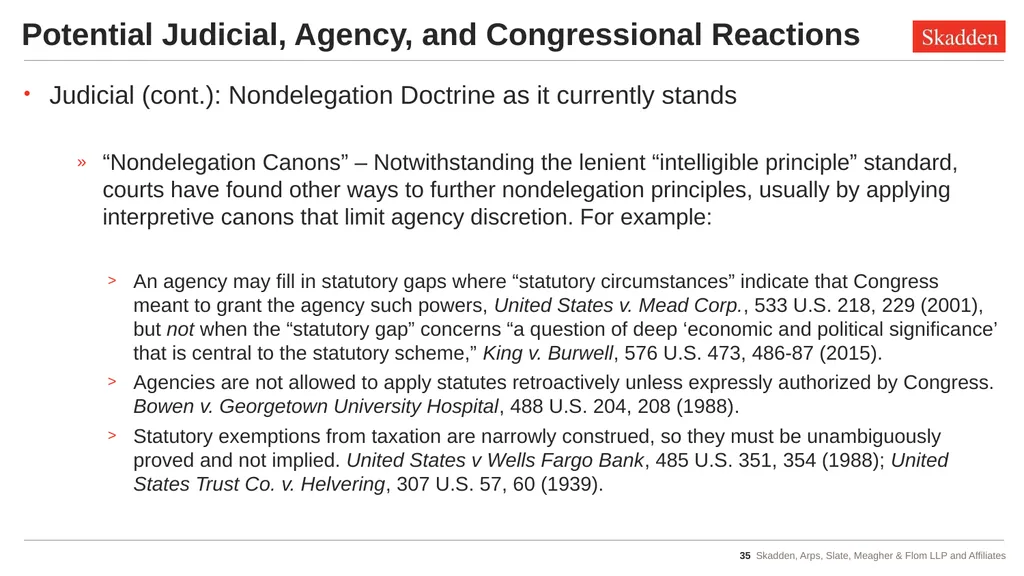
Potential Judicial, Agency, and Congressional Reactions Judicial (cont.): Nondelegation Doctrine as it currently stands
“Nondelegation Canons” – Notwithstanding the lenient “intelligible principle” standard, courts have found other ways to further nondelegation principles, usually by applying interpretive canons that limit agency discretion. For example:
An agency may fill in statutory gaps where “statutory circumstances” indicate that Congress meant to grant the agency such powers, United States v. Mead Corp., 533 U.S. 218, 229 (2001), but not when the “statutory gap” concerns “a question of deep ‘economic and political significance’ that is central to the statutory scheme,” King v. Burwell, 576 U.S. 473, 486-87 (2015).
Agencies are not allowed to apply statutes retroactively unless expressly authorized by Congress. Bowen v. Georgetown University Hospital, 488 U.S. 204, 208 (1988).
Statutory exemptions from taxation are narrowly construed, so they must be unambiguously proved and not implied. United States v Wells Fargo Bank, 485 U.S. 351, 354 (1988); United States Trust Co. v. Helvering, 307 U.S. 57, 60 (1939).<br>
“Nondelegation Canons” – Notwithstanding the lenient “intelligible principle” standard, courts have found other ways to further nondelegation principles, usually by applying interpretive canons that limit agency discretion. For example:
An agency may fill in statutory gaps where “statutory circumstances” indicate that Congress meant to grant the agency such powers, United States v. Mead Corp., 533 U.S. 218, 229 (2001), but not when the “statutory gap” concerns “a question of deep ‘economic and political significance’ that is central to the statutory scheme,” King v. Burwell, 576 U.S. 473, 486-87 (2015).
Agencies are not allowed to apply statutes retroactively unless expressly authorized by Congress. Bowen v. Georgetown University Hospital, 488 U.S. 204, 208 (1988).
Statutory exemptions from taxation are narrowly construed, so they must be unambiguously proved and not implied. United States v Wells Fargo Bank, 485 U.S. 351, 354 (1988); United States Trust Co. v. Helvering, 307 U.S. 57, 60 (1939).<br>
36
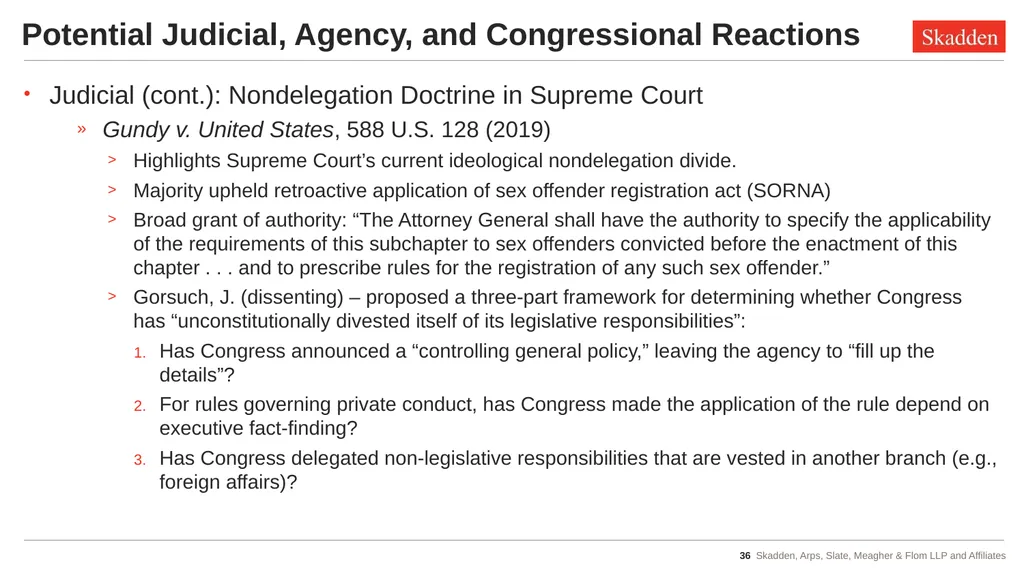
Potential Judicial, Agency, and Congressional Reactions Judicial (cont.): Nondelegation Doctrine in Supreme Court
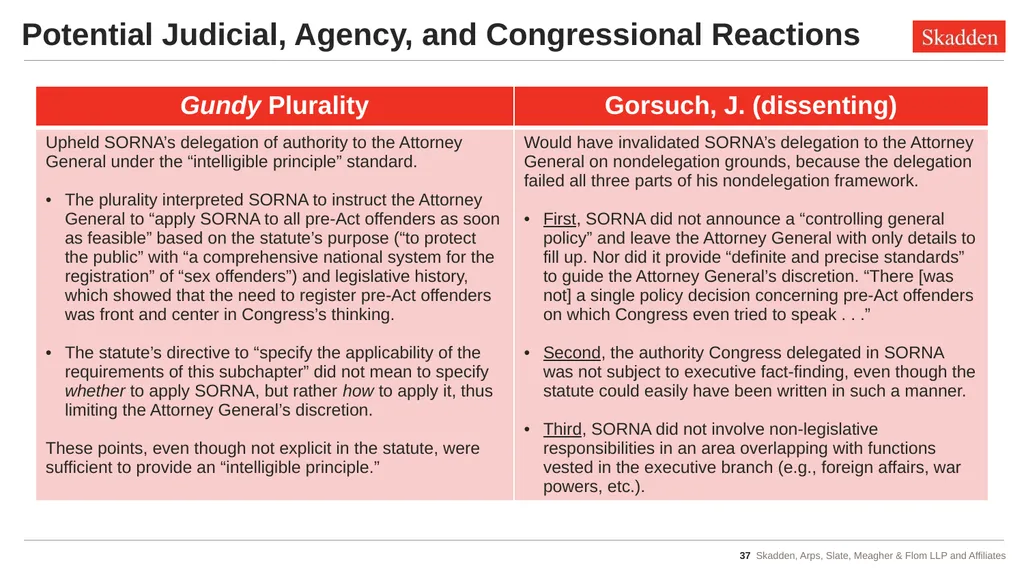
Gundy v. United States, 588 U.S. 128 (2019)
Highlights Supreme Court’s current ideological nondelegation divide.
Majority upheld retroactive application of sex offender registration act (SORNA)
Broad grant of authority: “The Attorney General shall have the authority to specify the applicability of the requirements of this subchapter to sex offenders convicted before the enactment of this chapter . . . and to prescribe rules for the registration of any such sex offender.”
Gorsuch, J. (dissenting) – proposed a three-part framework for determining whether Congress has “unconstitutionally divested itself of its legislative responsibilities”:
Has Congress announced a “controlling general policy,” leaving the agency to “fill up the details”?
For rules governing private conduct, has Congress made the application of the rule depend on executive fact-finding?
Has Congress delegated non-legislative responsibilities that are vested in another branch (e.g., foreign affairs)?<br>
Gundy v. United States, 588 U.S. 128 (2019)
Highlights Supreme Court’s current ideological nondelegation divide.
Majority upheld retroactive application of sex offender registration act (SORNA)
Broad grant of authority: “The Attorney General shall have the authority to specify the applicability of the requirements of this subchapter to sex offenders convicted before the enactment of this chapter . . . and to prescribe rules for the registration of any such sex offender.”
Gorsuch, J. (dissenting) – proposed a three-part framework for determining whether Congress has “unconstitutionally divested itself of its legislative responsibilities”:
Has Congress announced a “controlling general policy,” leaving the agency to “fill up the details”?
For rules governing private conduct, has Congress made the application of the rule depend on executive fact-finding?
Has Congress delegated non-legislative responsibilities that are vested in another branch (e.g., foreign affairs)?<br>
37
Potential Judicial, Agency, and Congressional Reactions<br>
38
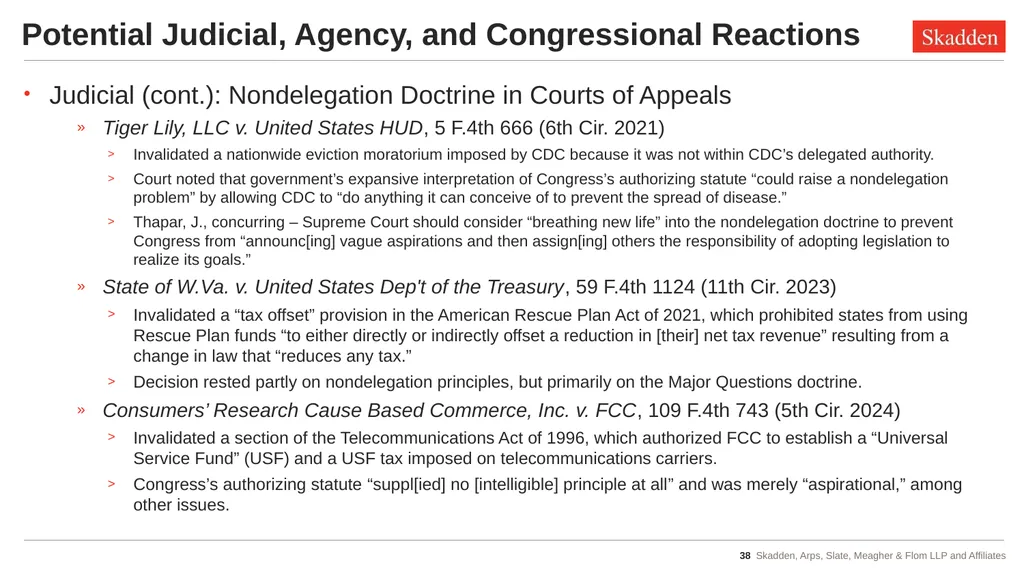
Potential Judicial, Agency, and Congressional Reactions Judicial (cont.): Nondelegation Doctrine in Courts of Appeals
Tiger Lily, LLC v. United States HUD, 5 F.4th 666 (6th Cir. 2021)
Invalidated a nationwide eviction moratorium imposed by CDC because it was not within CDC’s delegated authority.
Court noted that government’s expansive interpretation of Congress’s authorizing statute “could raise a nondelegation problem” by allowing CDC to “do anything it can conceive of to prevent the spread of disease.”
Thapar, J., concurring – Supreme Court should consider “breathing new life” into the nondelegation doctrine to prevent Congress from “announc[ing] vague aspirations and then assign[ing] others the responsibility of adopting legislation to realize its goals.”
State of W.Va. v. United States Dep't of the Treasury, 59 F.4th 1124 (11th Cir. 2023)
Invalidated a “tax offset” provision in the American Rescue Plan Act of 2021, which prohibited states from using Rescue Plan funds “to either directly or indirectly offset a reduction in [their] net tax revenue” resulting from a change in law that “reduces any tax.”
Decision rested partly on nondelegation principles, but primarily on the Major Questions doctrine.
Consumers’ Research Cause Based Commerce, Inc. v. FCC, 109 F.4th 743 (5th Cir. 2024)
Invalidated a section of the Telecommunications Act of 1996, which authorized FCC to establish a “Universal Service Fund” (USF) and a USF tax imposed on telecommunications carriers.
Congress’s authorizing statute “suppl[ied] no [intelligible] principle at all” and was merely “aspirational,” among other issues.<br>
Tiger Lily, LLC v. United States HUD, 5 F.4th 666 (6th Cir. 2021)
Invalidated a nationwide eviction moratorium imposed by CDC because it was not within CDC’s delegated authority.
Court noted that government’s expansive interpretation of Congress’s authorizing statute “could raise a nondelegation problem” by allowing CDC to “do anything it can conceive of to prevent the spread of disease.”
Thapar, J., concurring – Supreme Court should consider “breathing new life” into the nondelegation doctrine to prevent Congress from “announc[ing] vague aspirations and then assign[ing] others the responsibility of adopting legislation to realize its goals.”
State of W.Va. v. United States Dep't of the Treasury, 59 F.4th 1124 (11th Cir. 2023)
Invalidated a “tax offset” provision in the American Rescue Plan Act of 2021, which prohibited states from using Rescue Plan funds “to either directly or indirectly offset a reduction in [their] net tax revenue” resulting from a change in law that “reduces any tax.”
Decision rested partly on nondelegation principles, but primarily on the Major Questions doctrine.
Consumers’ Research Cause Based Commerce, Inc. v. FCC, 109 F.4th 743 (5th Cir. 2024)
Invalidated a section of the Telecommunications Act of 1996, which authorized FCC to establish a “Universal Service Fund” (USF) and a USF tax imposed on telecommunications carriers.
Congress’s authorizing statute “suppl[ied] no [intelligible] principle at all” and was merely “aspirational,” among other issues.<br>
39
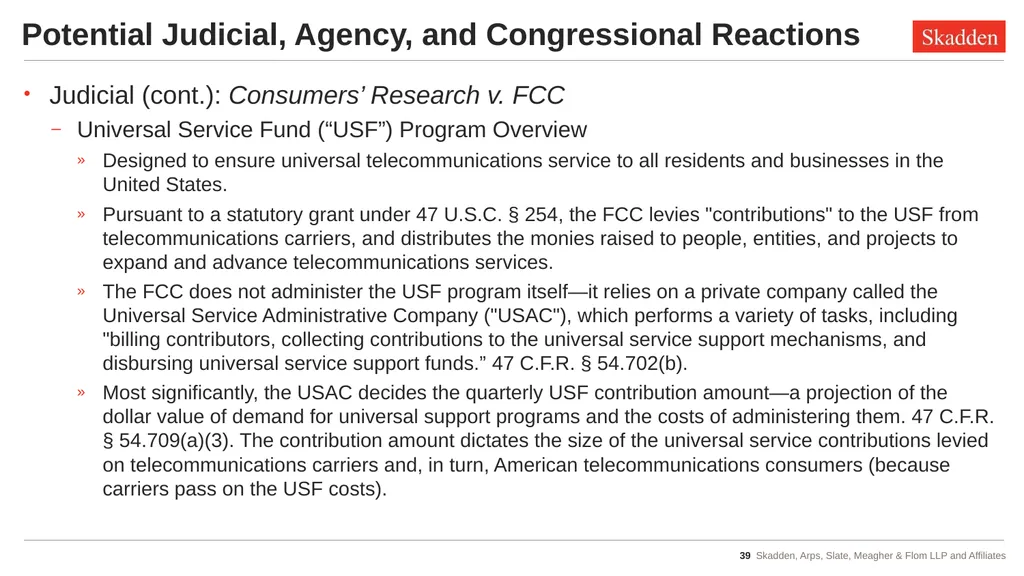
Potential Judicial, Agency, and Congressional Reactions Judicial (cont.): Consumers’ Research v. FCC
Universal Service Fund (“USF”) Program Overview
Designed to ensure universal telecommunications service to all residents and businesses in the United States.
Pursuant to a statutory grant under 47 U.S.C. § 254, the FCC levies "contributions" to the USF from telecommunications carriers, and distributes the monies raised to people, entities, and projects to expand and advance telecommunications services.
The FCC does not administer the USF program itself—it relies on a private company called the Universal Service Administrative Company ("USAC"), which performs a variety of tasks, including "billing contributors, collecting contributions to the universal service support mechanisms, and disbursing universal service support funds.” 47 C.F.R. § 54.702(b).
Most significantly, the USAC decides the quarterly USF contribution amount—a projection of the dollar value of demand for universal support programs and the costs of administering them. 47 C.F.R. § 54.709(a)(3). The contribution amount dictates the size of the universal service contributions levied on telecommunications carriers and, in turn, American telecommunications consumers (because carriers pass on the USF costs).<br>
Universal Service Fund (“USF”) Program Overview
Designed to ensure universal telecommunications service to all residents and businesses in the United States.
Pursuant to a statutory grant under 47 U.S.C. § 254, the FCC levies "contributions" to the USF from telecommunications carriers, and distributes the monies raised to people, entities, and projects to expand and advance telecommunications services.
The FCC does not administer the USF program itself—it relies on a private company called the Universal Service Administrative Company ("USAC"), which performs a variety of tasks, including "billing contributors, collecting contributions to the universal service support mechanisms, and disbursing universal service support funds.” 47 C.F.R. § 54.702(b).
Most significantly, the USAC decides the quarterly USF contribution amount—a projection of the dollar value of demand for universal support programs and the costs of administering them. 47 C.F.R. § 54.709(a)(3). The contribution amount dictates the size of the universal service contributions levied on telecommunications carriers and, in turn, American telecommunications consumers (because carriers pass on the USF costs).<br>
40
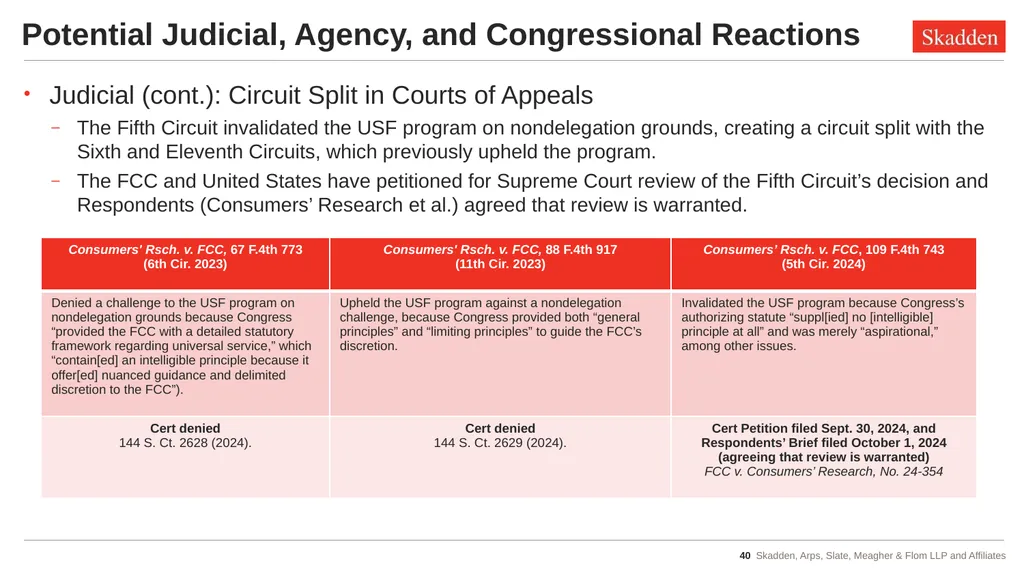
Potential Judicial, Agency, and Congressional Reactions Judicial (cont.): Circuit Split in Courts of Appeals
The Fifth Circuit invalidated the USF program on nondelegation grounds, creating a circuit split with the Sixth and Eleventh Circuits, which previously upheld the program.
The FCC and United States have petitioned for Supreme Court review of the Fifth Circuit’s decision and Respondents (Consumers’ Research et al.) agreed that review is warranted.<br>
The Fifth Circuit invalidated the USF program on nondelegation grounds, creating a circuit split with the Sixth and Eleventh Circuits, which previously upheld the program.
The FCC and United States have petitioned for Supreme Court review of the Fifth Circuit’s decision and Respondents (Consumers’ Research et al.) agreed that review is warranted.<br>
41
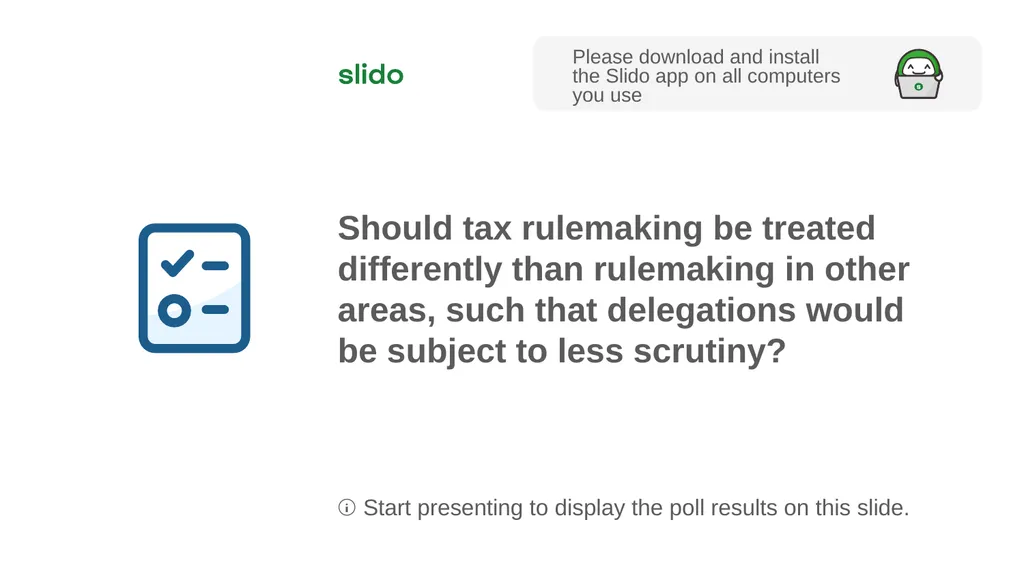
Should tax rulemaking be treated differently than rulemaking in other areas, such that delegations would be subject to less scrutiny? Please download and install the Slido app on all computers you use ⓘ Start presenting to display the poll results on this slide.<br>
42
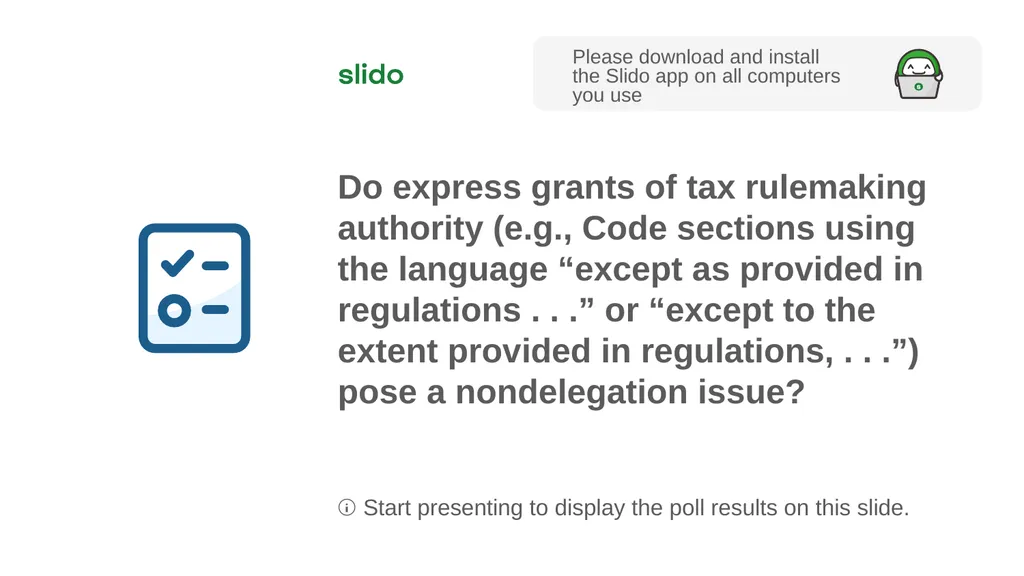
Do express grants of tax rulemaking authority (e.g., Code sections using the language “except as provided in regulations . . .” or “except to the extent provided in regulations, . . .”) pose a nondelegation issue? Please download and install the Slido app on all computers you use ⓘ Start presenting to display the poll results on this slide.<br>
43
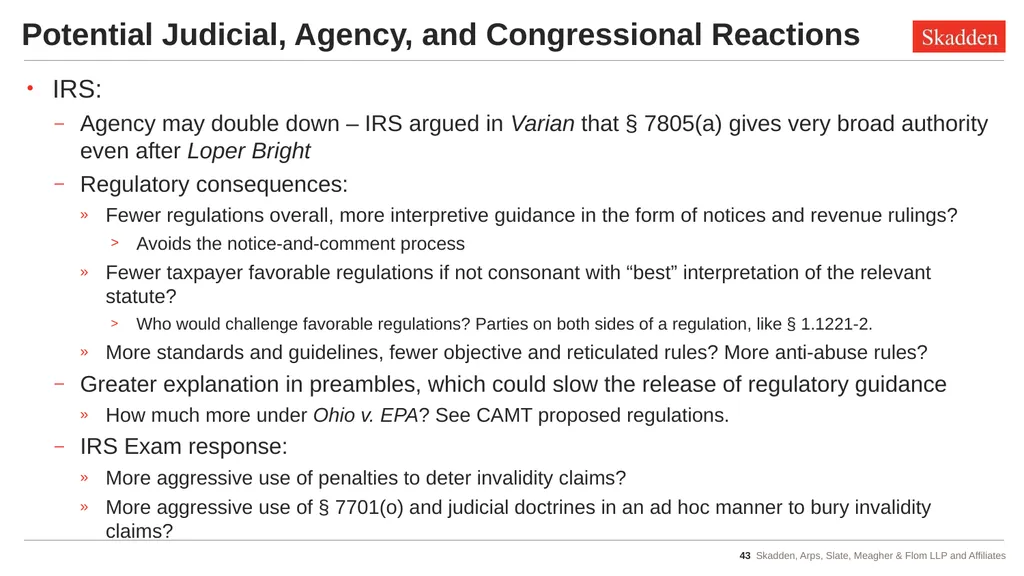
Potential Judicial, Agency, and Congressional Reactions IRS:
Agency may double down – IRS argued in Varian that § 7805(a) gives very broad authority even after Loper Bright
Regulatory consequences:
Fewer regulations overall, more interpretive guidance in the form of notices and revenue rulings?
Avoids the notice-and-comment process
Fewer taxpayer favorable regulations if not consonant with “best” interpretation of the relevant statute?
Who would challenge favorable regulations? Parties on both sides of a regulation, like § 1.1221-2.
More standards and guidelines, fewer objective and reticulated rules? More anti-abuse rules?
Greater explanation in preambles, which could slow the release of regulatory guidance
How much more under Ohio v. EPA? See CAMT proposed regulations.
IRS Exam response:
More aggressive use of penalties to deter invalidity claims?
More aggressive use of § 7701(o) and judicial doctrines in an ad hoc manner to bury invalidity claims?<br>
Agency may double down – IRS argued in Varian that § 7805(a) gives very broad authority even after Loper Bright
Regulatory consequences:
Fewer regulations overall, more interpretive guidance in the form of notices and revenue rulings?
Avoids the notice-and-comment process
Fewer taxpayer favorable regulations if not consonant with “best” interpretation of the relevant statute?
Who would challenge favorable regulations? Parties on both sides of a regulation, like § 1.1221-2.
More standards and guidelines, fewer objective and reticulated rules? More anti-abuse rules?
Greater explanation in preambles, which could slow the release of regulatory guidance
How much more under Ohio v. EPA? See CAMT proposed regulations.
IRS Exam response:
More aggressive use of penalties to deter invalidity claims?
More aggressive use of § 7701(o) and judicial doctrines in an ad hoc manner to bury invalidity claims?<br>
44
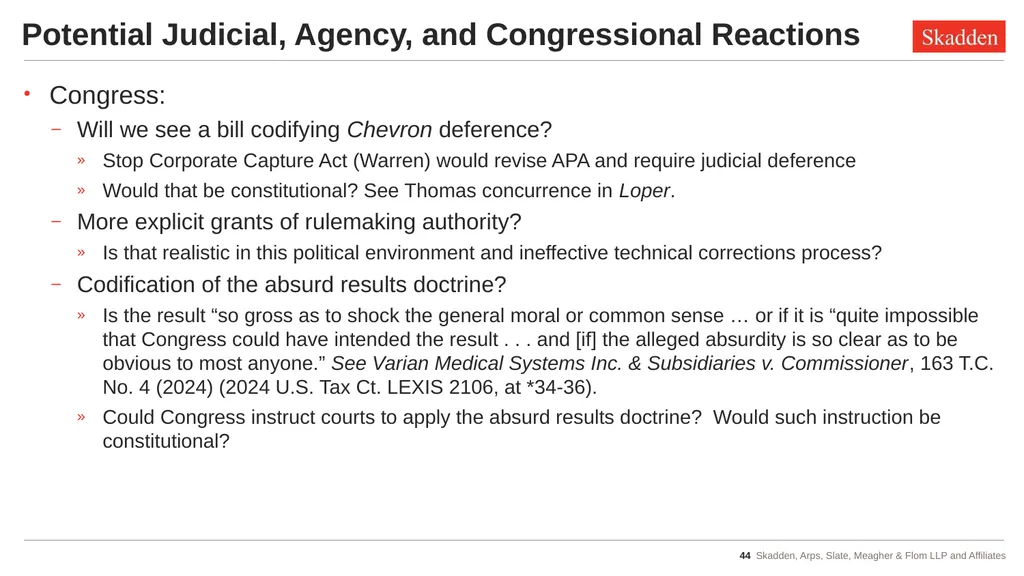
Potential Judicial, Agency, and Congressional Reactions Congress:
Will we see a bill codifying Chevron deference?
Stop Corporate Capture Act (Warren) would revise APA and require judicial deference
Would that be constitutional? See Thomas concurrence in Loper.
More explicit grants of rulemaking authority?
Is that realistic in this political environment and ineffective technical corrections process?
Codification of the absurd results doctrine?
Is the result “so gross as to shock the general moral or common sense … or if it is “quite impossible that Congress could have intended the result . . . and [if] the alleged absurdity is so clear as to be obvious to most anyone.” See Varian Medical Systems Inc. & Subsidiaries v. Commissioner, 163 T.C. No. 4 (2024) (2024 U.S. Tax Ct. LEXIS 2106, at *34-36).
Could Congress instruct courts to apply the absurd results doctrine? Would such instruction be constitutional?<br>
Will we see a bill codifying Chevron deference?
Stop Corporate Capture Act (Warren) would revise APA and require judicial deference
Would that be constitutional? See Thomas concurrence in Loper.
More explicit grants of rulemaking authority?
Is that realistic in this political environment and ineffective technical corrections process?
Codification of the absurd results doctrine?
Is the result “so gross as to shock the general moral or common sense … or if it is “quite impossible that Congress could have intended the result . . . and [if] the alleged absurdity is so clear as to be obvious to most anyone.” See Varian Medical Systems Inc. & Subsidiaries v. Commissioner, 163 T.C. No. 4 (2024) (2024 U.S. Tax Ct. LEXIS 2106, at *34-36).
Could Congress instruct courts to apply the absurd results doctrine? Would such instruction be constitutional?<br>
45
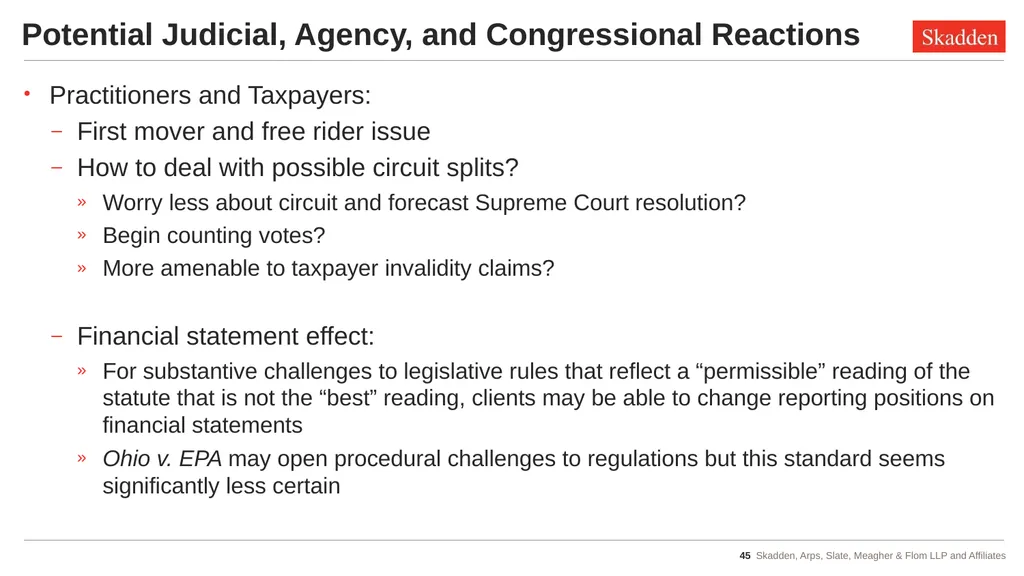
Potential Judicial, Agency, and Congressional Reactions Practitioners and Taxpayers:
First mover and free rider issue
How to deal with possible circuit splits?
Worry less about circuit and forecast Supreme Court resolution?
Begin counting votes?
More amenable to taxpayer invalidity claims?
Financial statement effect:
For substantive challenges to legislative rules that reflect a “permissible” reading of the statute that is not the “best” reading, clients may be able to change reporting positions on financial statements
Ohio v. EPA may open procedural challenges to regulations but this standard seems significantly less certain<br>
First mover and free rider issue
How to deal with possible circuit splits?
Worry less about circuit and forecast Supreme Court resolution?
Begin counting votes?
More amenable to taxpayer invalidity claims?
Financial statement effect:
For substantive challenges to legislative rules that reflect a “permissible” reading of the statute that is not the “best” reading, clients may be able to change reporting positions on financial statements
Ohio v. EPA may open procedural challenges to regulations but this standard seems significantly less certain<br>
46
Does Loper Bright materially change your evaluation of validity challenges to tax regulations when giving tax opinions? Please download and install the Slido app on all computers you use ⓘ Start presenting to display the poll results on this slide.<br>