
TBM Taxonomy Version 4.0 Date: December 16, 2020
GB
Published · 38 slides · 0 views
1 / 1
Description
TBM Taxonomy Version 4.0 Date: December 16, 2020 Table of Contents Introduction to TBM Taxonomy TBM Taxonomy v4.0 TBM Taxonomy v4.0 Annotated Appendix: Conceptual TBM Models IMPORTANT NOTICE: This document provides the graphics and
Related Topics
Share
Embed code
Download this presentation From Below
"TBM Taxonomy Version 4.0 Date: December 16, 2020" is the property of its rightful owner. Permission is granted to download and print the materials on this website for personal, non-commercial use only, and to display it on your personal computer provided you do not modify the materials and that you retain all copyright notices contained in the materials. By downloading content from our website, you accept the terms of this agreement.
Presentation Transcript
01
TBM Taxonomy Version 4.0 Date: December 16, 2020<br>
02
Table of Contents Introduction to TBM Taxonomy
TBM Taxonomy v4.0
TBM Taxonomy v4.0 Annotated
Appendix: Conceptual TBM Models
IMPORTANT NOTICE: This document provides the graphics and supplementary content that can be found in the TBM Taxonomy v4.0 specifications document, approved by the Standards Committee on December 16, 2020 and endorsed by the TBM Council Board of Directors on December 17, 2020. This is shared for community use, review and feedback. It is subject to change without notice.
Please contact us at standards@tbmcouncil.org with any feedback.<br>
TBM Taxonomy v4.0
TBM Taxonomy v4.0 Annotated
Appendix: Conceptual TBM Models
IMPORTANT NOTICE: This document provides the graphics and supplementary content that can be found in the TBM Taxonomy v4.0 specifications document, approved by the Standards Committee on December 16, 2020 and endorsed by the TBM Council Board of Directors on December 17, 2020. This is shared for community use, review and feedback. It is subject to change without notice.
Please contact us at standards@tbmcouncil.org with any feedback.<br>
03
Introduction to
TBM Taxonomy<br>
04
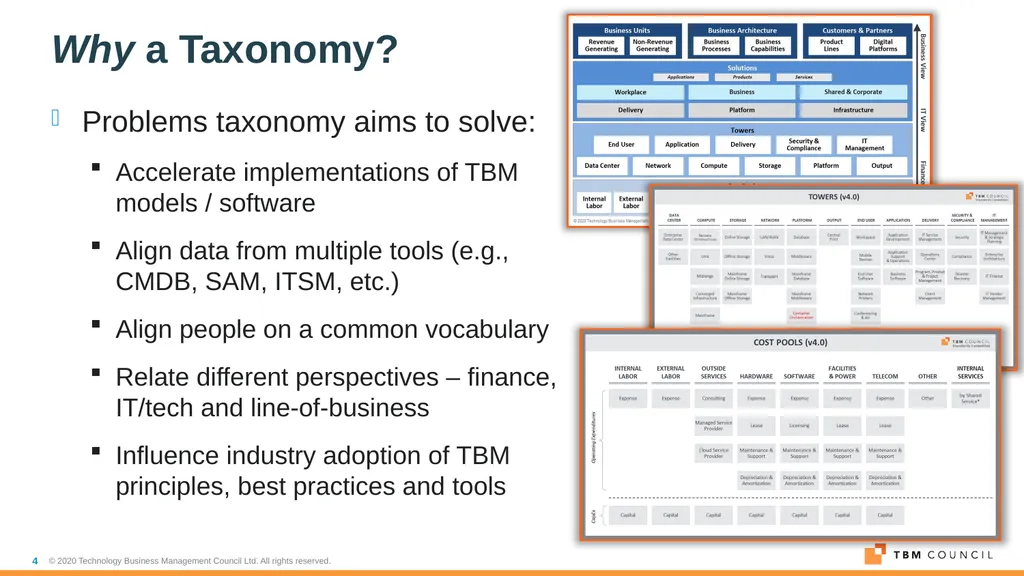
Why a Taxonomy? Problems taxonomy aims to solve:
Accelerate implementations of TBM models / software
Align data from multiple tools (e.g., CMDB, SAM, ITSM, etc.)
Align people on a common vocabulary
Relate different perspectives – finance, IT/tech and line-of-business
Influence industry adoption of TBM principles, best practices and tools<br>
Accelerate implementations of TBM models / software
Align data from multiple tools (e.g., CMDB, SAM, ITSM, etc.)
Align people on a common vocabulary
Relate different perspectives – finance, IT/tech and line-of-business
Influence industry adoption of TBM principles, best practices and tools<br>
05
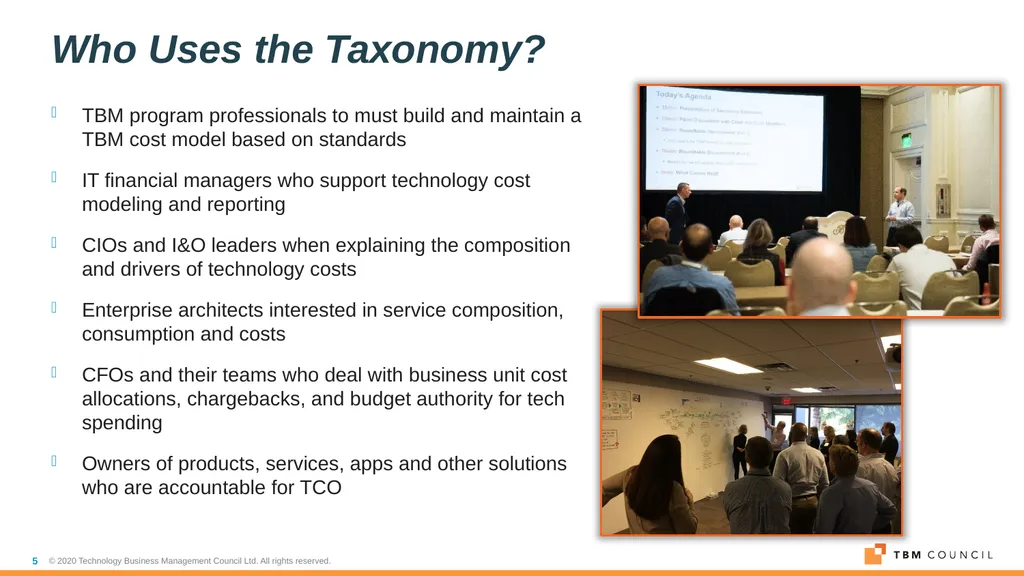
Who Uses the Taxonomy? TBM program professionals to must build and maintain a TBM cost model based on standards
IT financial managers who support technology cost modeling and reporting
CIOs and I&O leaders when explaining the composition and drivers of technology costs
Enterprise architects interested in service composition, consumption and costs
CFOs and their teams who deal with business unit cost allocations, chargebacks, and budget authority for tech spending
Owners of products, services, apps and other solutions who are accountable for TCO<br>
IT financial managers who support technology cost modeling and reporting
CIOs and I&O leaders when explaining the composition and drivers of technology costs
Enterprise architects interested in service composition, consumption and costs
CFOs and their teams who deal with business unit cost allocations, chargebacks, and budget authority for tech spending
Owners of products, services, apps and other solutions who are accountable for TCO<br>
06
TBM Taxonomy v4.0<br>
07
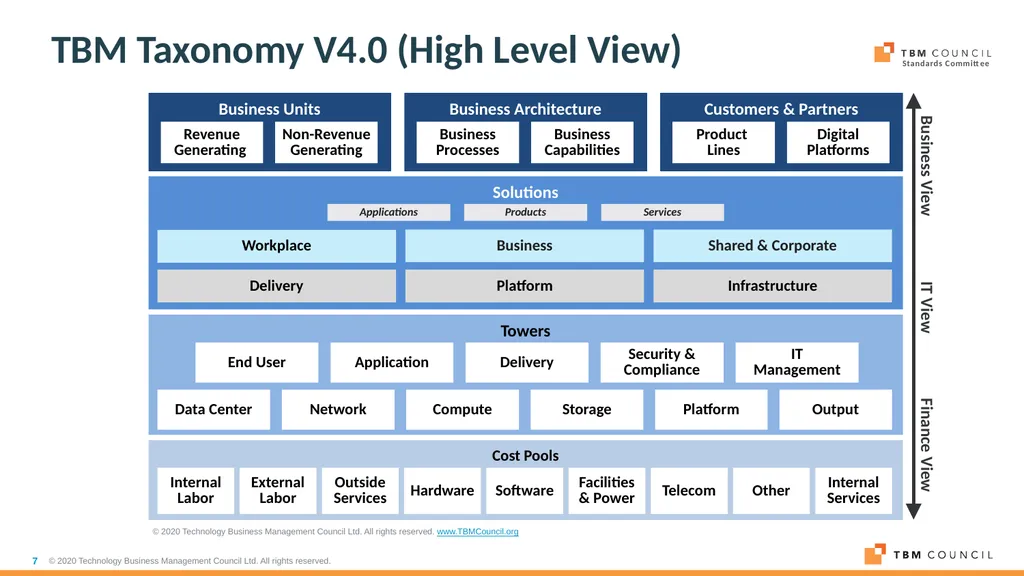
TBM Taxonomy V4.0 (High Level View)<br>
08
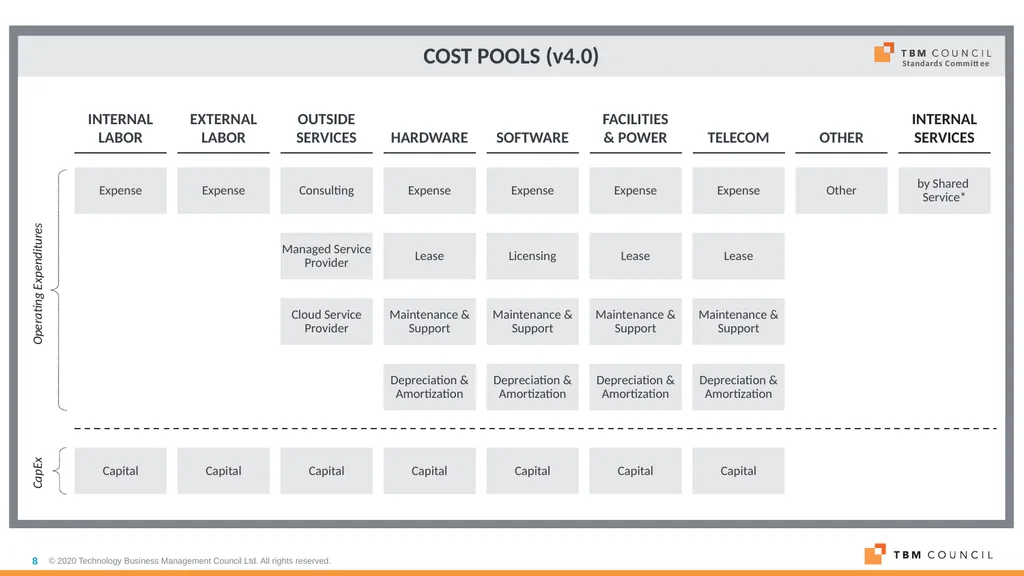
COST POOLS (v4.0)<br>
09
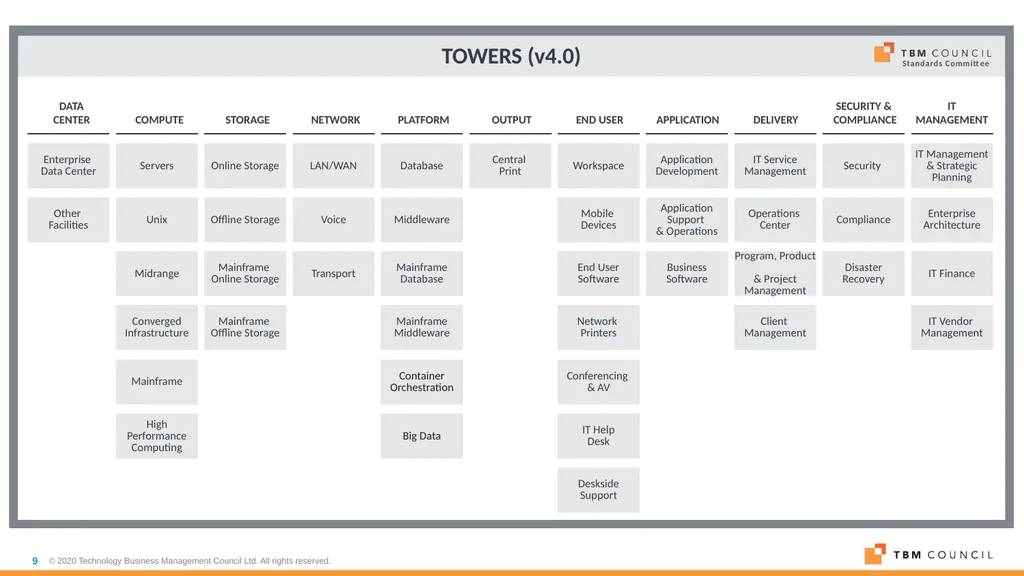
TOWERS (v4.0) DATA
CENTER STORAGE END USER DELIVERY APPLICATION OUTPUT NETWORK COMPUTE SECURITY &
COMPLIANCE IT
MANAGEMENT PLATFORM Enterprise
Data Center Online Storage IT Service
Management Offline Storage Operations
Center Disaster Recovery Program, Product
& Project Management Central
Print LAN/WAN Voice Servers Unix Mainframe Middleware Security Compliance IT Management & Strategic Planning Enterprise Architecture IT Finance IT Vendor
Management Workspace Mobile
Devices End User Software Conferencing
& AV Converged Infrastructure Mainframe Database Midrange Mainframe
Online Storage Mainframe
Offline Storage Mainframe Other
Facilities Application Development Application Support
& Operations Database Middleware IT Help
Desk Deskside
Support Client
Management Transport Network
Printers High Performance Computing Business Software Container Orchestration Big Data<br>
CENTER STORAGE END USER DELIVERY APPLICATION OUTPUT NETWORK COMPUTE SECURITY &
COMPLIANCE IT
MANAGEMENT PLATFORM Enterprise
Data Center Online Storage IT Service
Management Offline Storage Operations
Center Disaster Recovery Program, Product
& Project Management Central
Print LAN/WAN Voice Servers Unix Mainframe Middleware Security Compliance IT Management & Strategic Planning Enterprise Architecture IT Finance IT Vendor
Management Workspace Mobile
Devices End User Software Conferencing
& AV Converged Infrastructure Mainframe Database Midrange Mainframe
Online Storage Mainframe
Offline Storage Mainframe Other
Facilities Application Development Application Support
& Operations Database Middleware IT Help
Desk Deskside
Support Client
Management Transport Network
Printers High Performance Computing Business Software Container Orchestration Big Data<br>
10
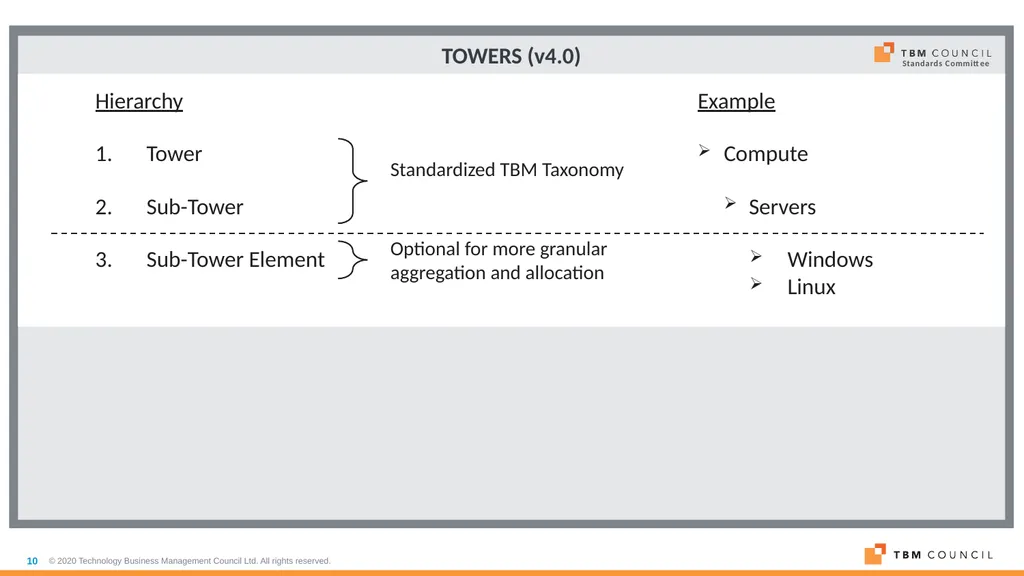
TOWERS (v4.0) Hierarchy
Tower
Sub-Tower
Sub-Tower Element Example
Compute
Servers
Windows
Linux Standardized TBM Taxonomy Optional for more granular aggregation and allocation<br>
Tower
Sub-Tower
Sub-Tower Element Example
Compute
Servers
Windows
Linux Standardized TBM Taxonomy Optional for more granular aggregation and allocation<br>
11
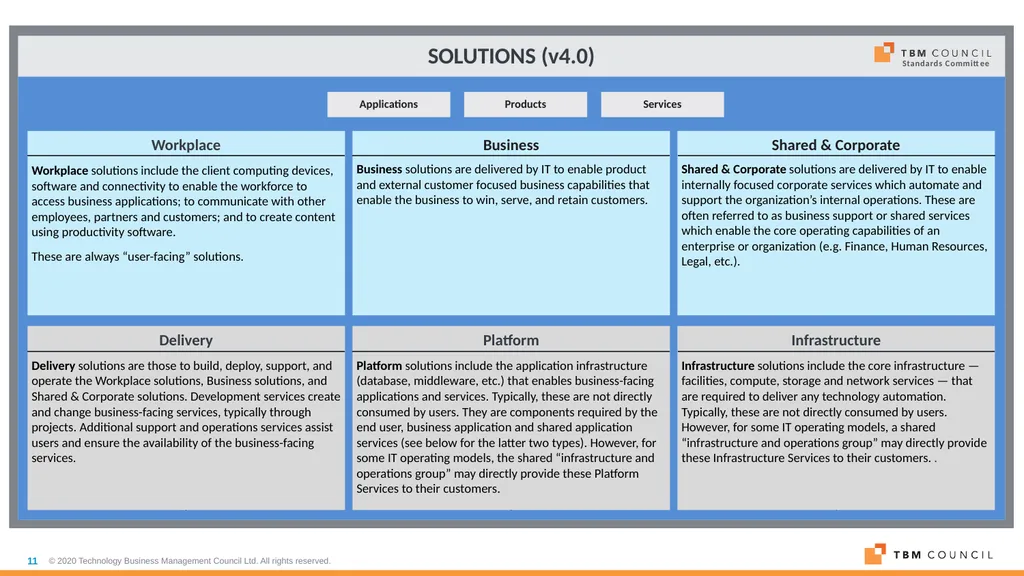
SOLUTIONS (v4.0) Applications Products Services<br>
12
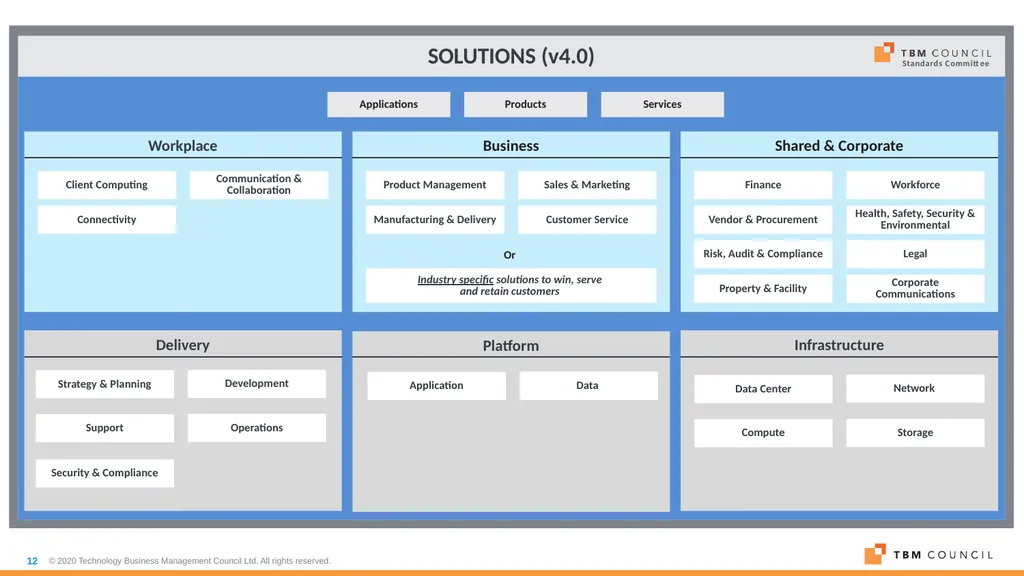
SOLUTIONS (v4.0) Applications Products Services<br>
13
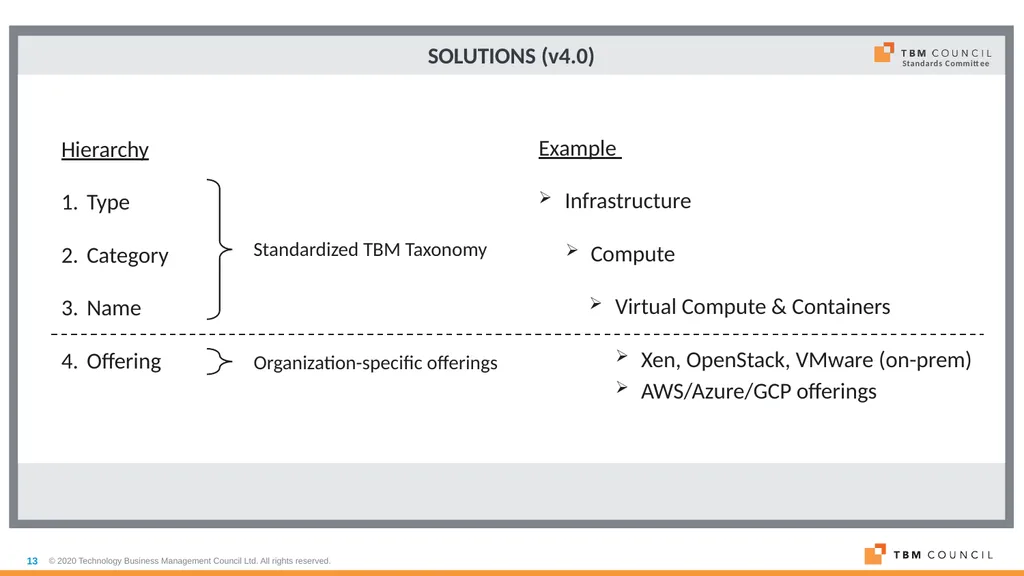
SOLUTIONS (v4.0) Hierarchy
Type
Category
Name
Offering Example
Infrastructure
Compute
Virtual Compute & Containers
Xen, OpenStack, VMware (on-prem)
AWS/Azure/GCP offerings<br>
Type
Category
Name
Offering Example
Infrastructure
Compute
Virtual Compute & Containers
Xen, OpenStack, VMware (on-prem)
AWS/Azure/GCP offerings<br>
14
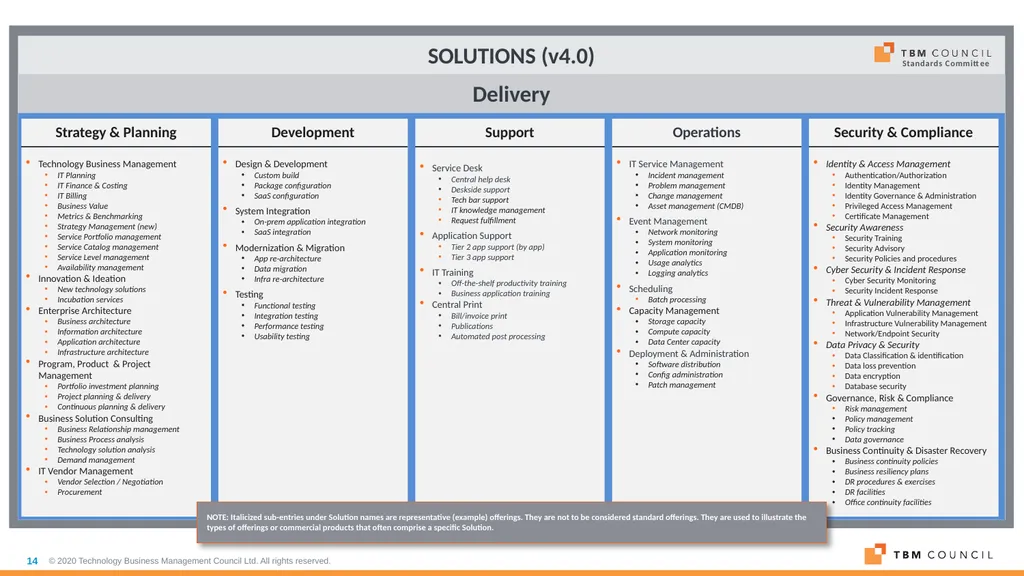
SOLUTIONS (v4.0) Delivery NOTE: Italicized sub-entries under Solution names are representative (example) offerings. They are not to be considered standard offerings. They are used to illustrate the types of offerings or commercial products that often comprise a specific Solution.<br>
15
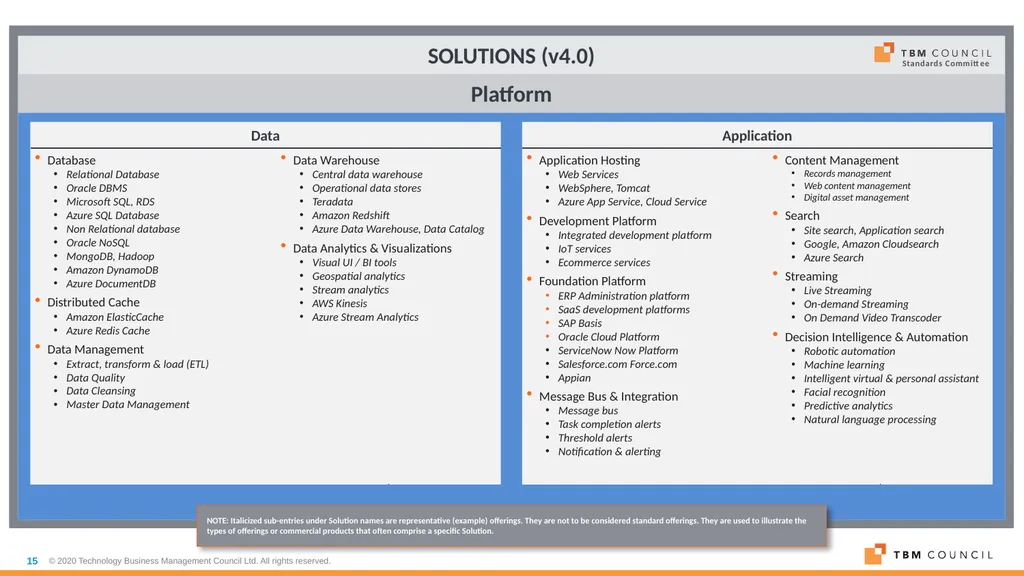
SOLUTIONS (v4.0) Platform NOTE: Italicized sub-entries under Solution names are representative (example) offerings. They are not to be considered standard offerings. They are used to illustrate the types of offerings or commercial products that often comprise a specific Solution.<br>
16
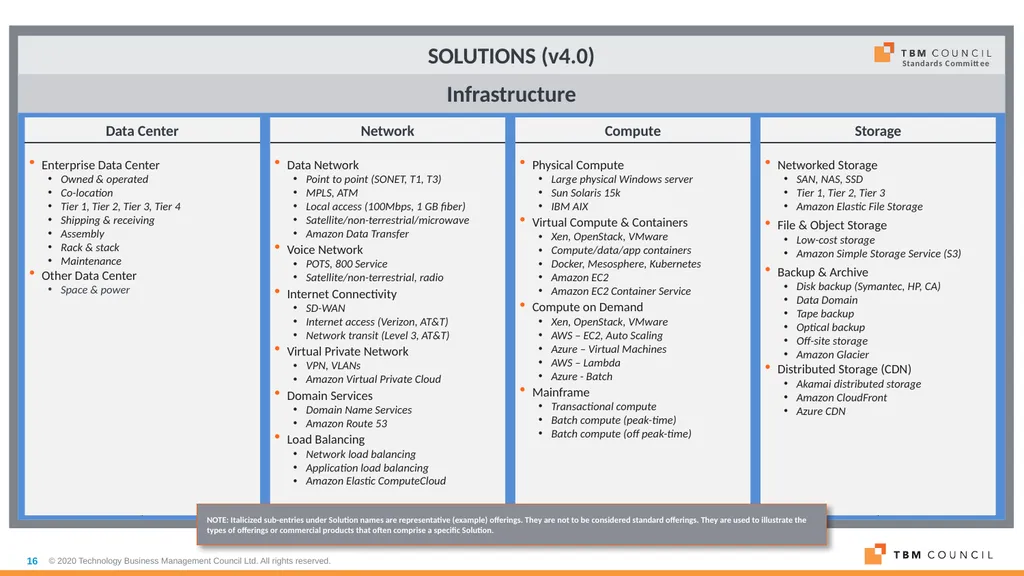
SOLUTIONS (v4.0) Infrastructure NOTE: Italicized sub-entries under Solution names are representative (example) offerings. They are not to be considered standard offerings. They are used to illustrate the types of offerings or commercial products that often comprise a specific Solution.<br>
17
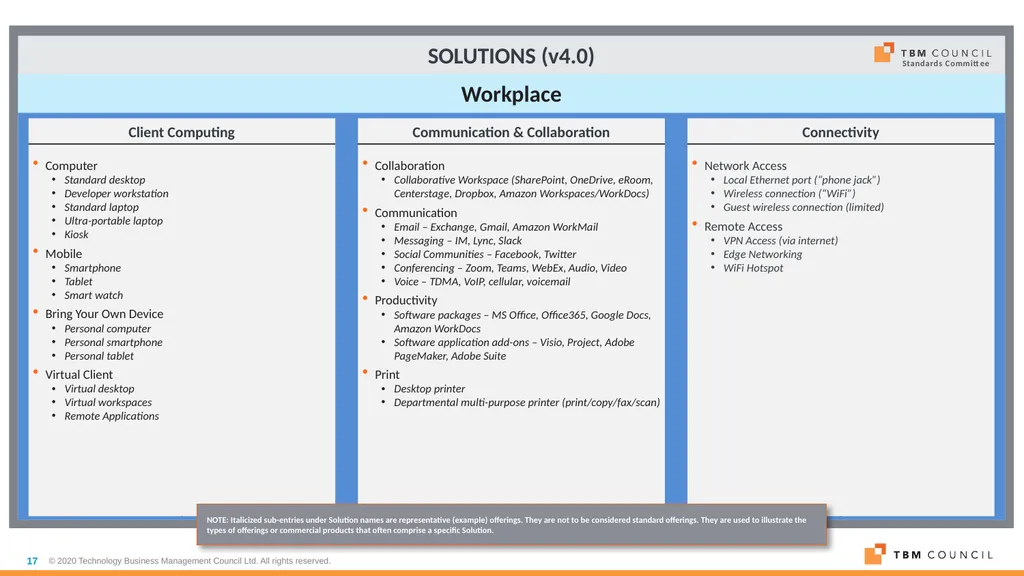
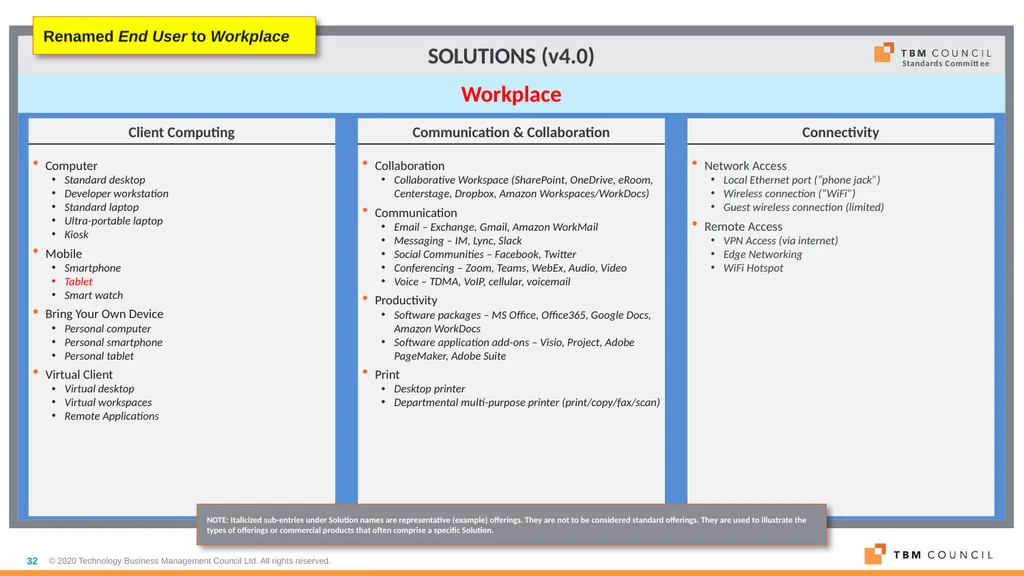
SOLUTIONS (v4.0) Workplace NOTE: Italicized sub-entries under Solution names are representative (example) offerings. They are not to be considered standard offerings. They are used to illustrate the types of offerings or commercial products that often comprise a specific Solution.<br>
18
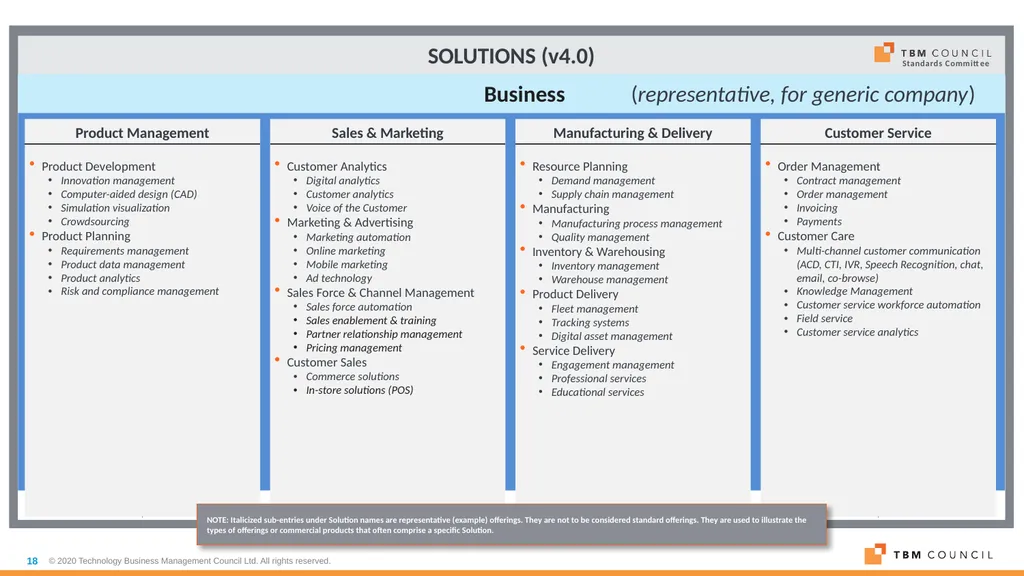
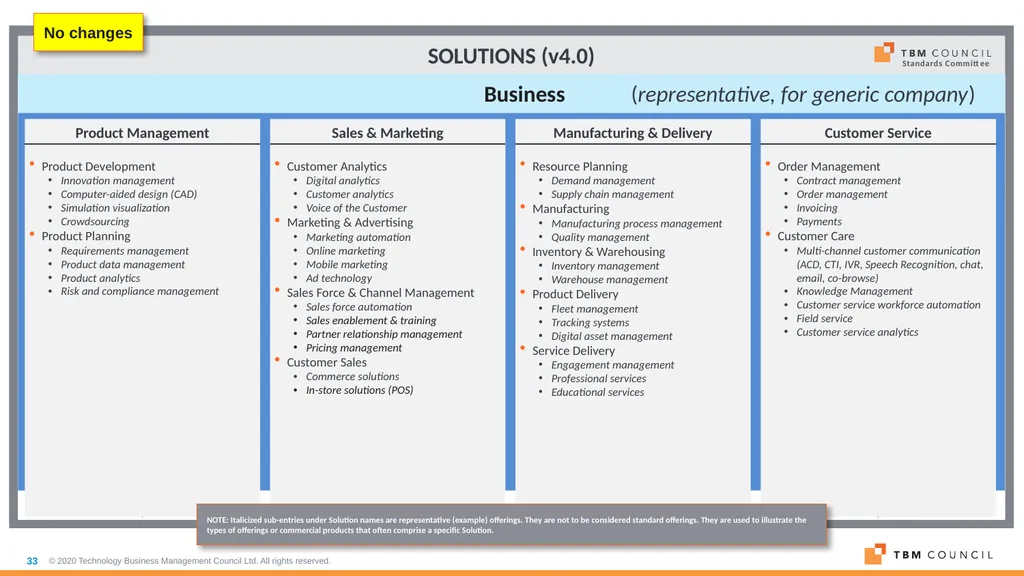
SOLUTIONS (v4.0) Business (representative, for generic company) NOTE: Italicized sub-entries under Solution names are representative (example) offerings. They are not to be considered standard offerings. They are used to illustrate the types of offerings or commercial products that often comprise a specific Solution.<br>
19
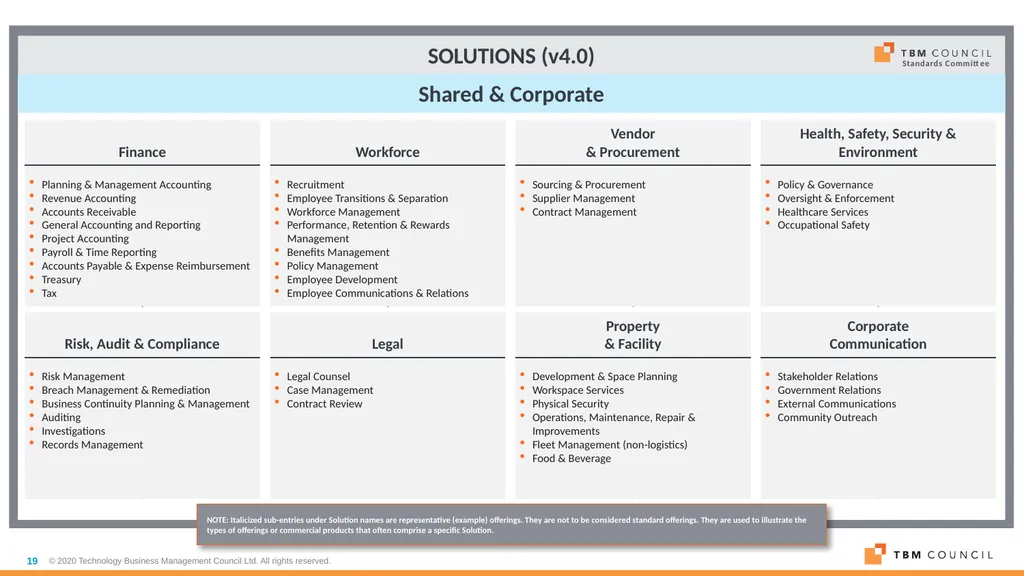
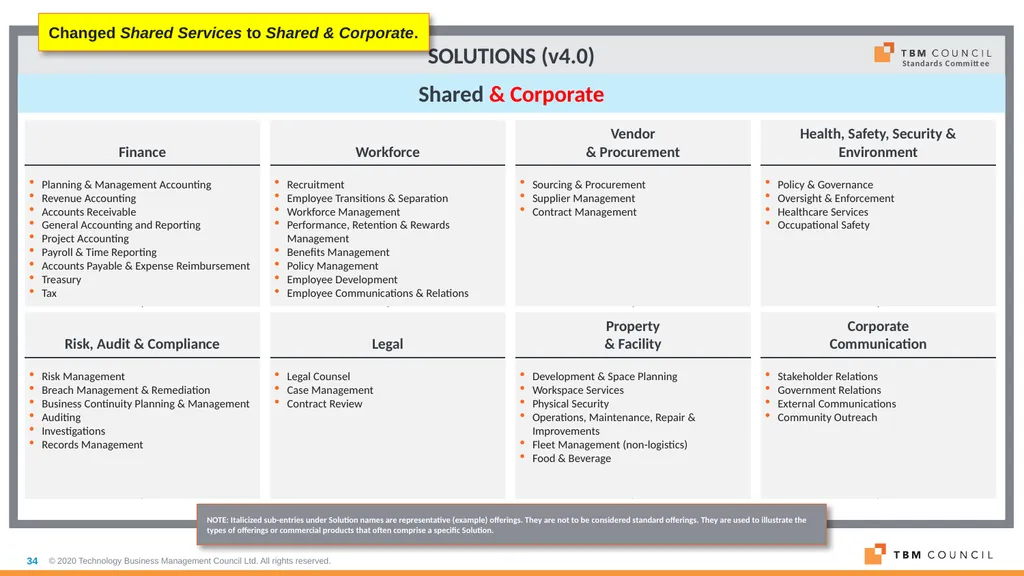
SOLUTIONS (v4.0) Shared & Corporate NOTE: Italicized sub-entries under Solution names are representative (example) offerings. They are not to be considered standard offerings. They are used to illustrate the types of offerings or commercial products that often comprise a specific Solution.<br>
20
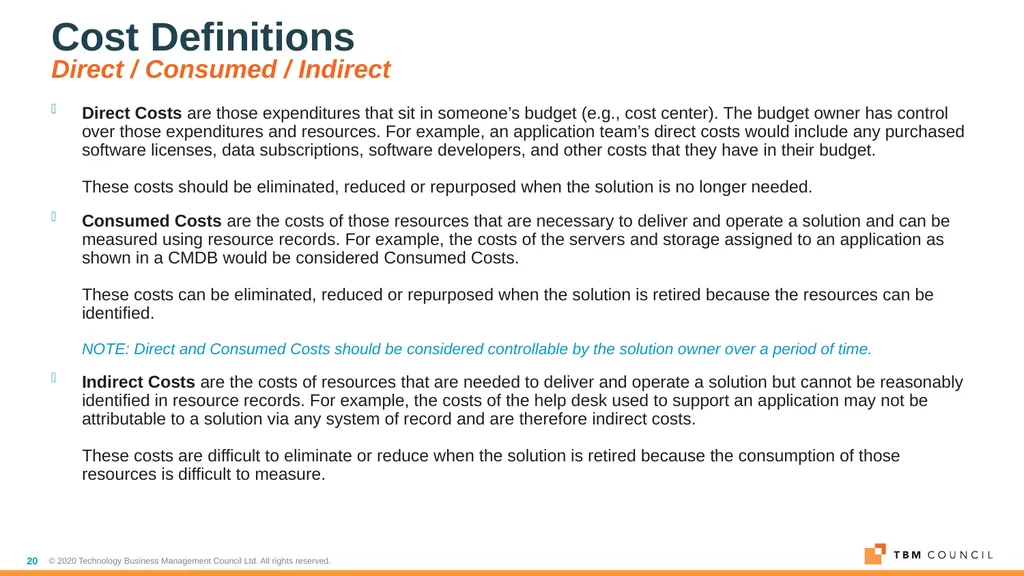
Cost Definitions
Direct / Consumed / Indirect Direct Costs are those expenditures that sit in someone’s budget (e.g., cost center). The budget owner has control over those expenditures and resources. For example, an application team’s direct costs would include any purchased software licenses, data subscriptions, software developers, and other costs that they have in their budget.
These costs should be eliminated, reduced or repurposed when the solution is no longer needed.
Consumed Costs are the costs of those resources that are necessary to deliver and operate a solution and can be measured using resource records. For example, the costs of the servers and storage assigned to an application as shown in a CMDB would be considered Consumed Costs. These costs can be eliminated, reduced or repurposed when the solution is retired because the resources can be identified. NOTE: Direct and Consumed Costs should be considered controllable by the solution owner over a period of time.
Indirect Costs are the costs of resources that are needed to deliver and operate a solution but cannot be reasonably identified in resource records. For example, the costs of the help desk used to support an application may not be attributable to a solution via any system of record and are therefore indirect costs. These costs are difficult to eliminate or reduce when the solution is retired because the consumption of those resources is difficult to measure.<br>
Consumed Costs are the costs of those resources that are necessary to deliver and operate a solution and can be measured using resource records. For example, the costs of the servers and storage assigned to an application as shown in a CMDB would be considered Consumed Costs. These costs can be eliminated, reduced or repurposed when the solution is retired because the resources can be identified. NOTE: Direct and Consumed Costs should be considered controllable by the solution owner over a period of time.
Indirect Costs are the costs of resources that are needed to deliver and operate a solution but cannot be reasonably identified in resource records. For example, the costs of the help desk used to support an application may not be attributable to a solution via any system of record and are therefore indirect costs. These costs are difficult to eliminate or reduce when the solution is retired because the consumption of those resources is difficult to measure.<br>
21
TBM Taxonomy v4.0 Annotated with Changes<br>
22
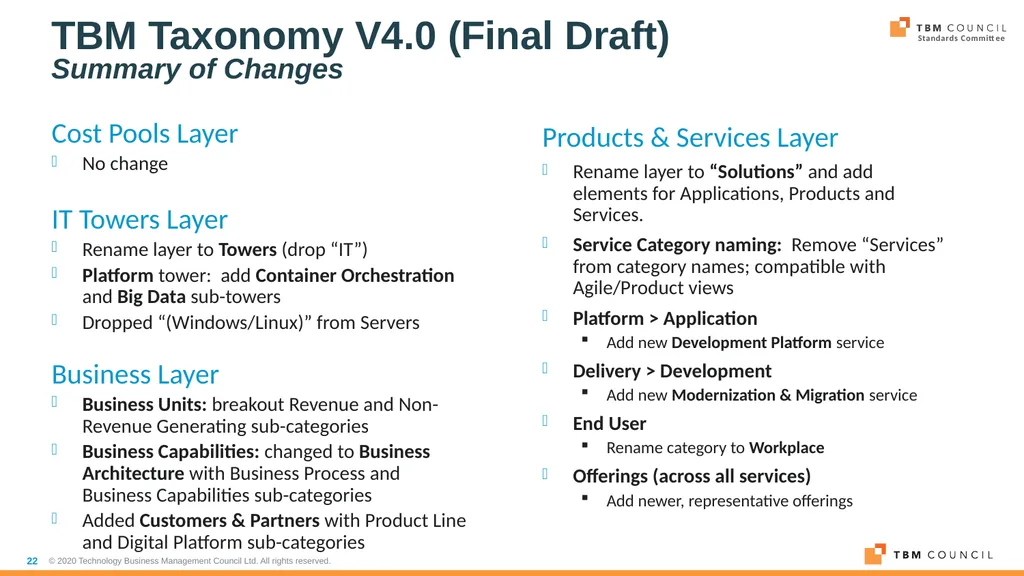
Cost Pools Layer
No change
IT Towers Layer
Rename layer to Towers (drop “IT”)
Platform tower: add Container Orchestration and Big Data sub-towers
Dropped “(Windows/Linux)” from Servers
Business Layer
Business Units: breakout Revenue and Non-Revenue Generating sub-categories
Business Capabilities: changed to Business Architecture with Business Process and Business Capabilities sub-categories
Added Customers & Partners with Product Line and Digital Platform sub-categories Products & Services Layer
Rename layer to “Solutions” and add elements for Applications, Products and Services.
Service Category naming: Remove “Services” from category names; compatible with Agile/Product views
Platform > Application
Add new Development Platform service
Delivery > Development
Add new Modernization & Migration service
End User
Rename category to Workplace
Offerings (across all services)
Add newer, representative offerings TBM Taxonomy V4.0 (Final Draft) Summary of Changes<br>
No change
IT Towers Layer
Rename layer to Towers (drop “IT”)
Platform tower: add Container Orchestration and Big Data sub-towers
Dropped “(Windows/Linux)” from Servers
Business Layer
Business Units: breakout Revenue and Non-Revenue Generating sub-categories
Business Capabilities: changed to Business Architecture with Business Process and Business Capabilities sub-categories
Added Customers & Partners with Product Line and Digital Platform sub-categories Products & Services Layer
Rename layer to “Solutions” and add elements for Applications, Products and Services.
Service Category naming: Remove “Services” from category names; compatible with Agile/Product views
Platform > Application
Add new Development Platform service
Delivery > Development
Add new Modernization & Migration service
End User
Rename category to Workplace
Offerings (across all services)
Add newer, representative offerings TBM Taxonomy V4.0 (Final Draft) Summary of Changes<br>
23
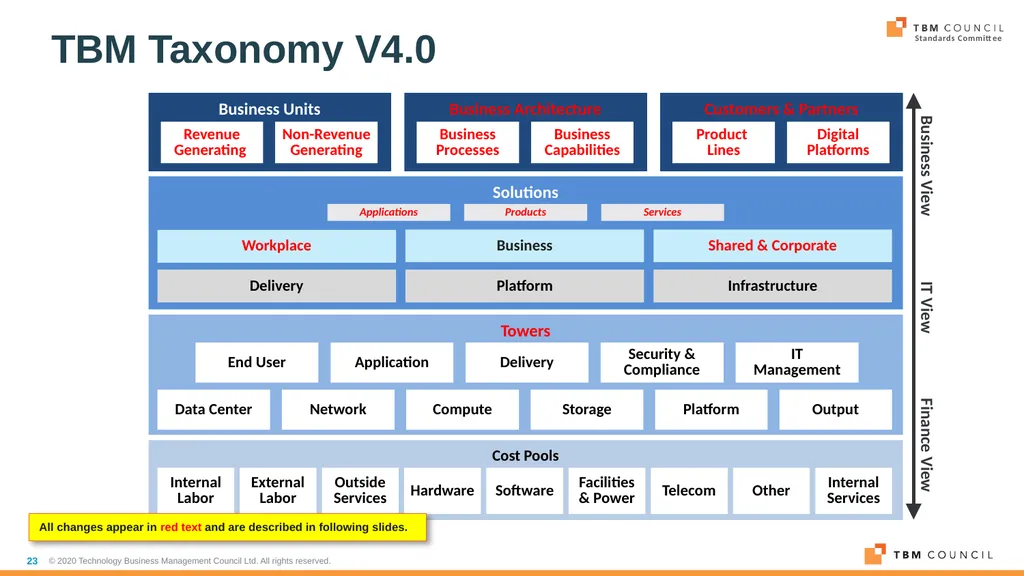
TBM Taxonomy V4.0 All changes appear in red text and are described in following slides.<br>
24
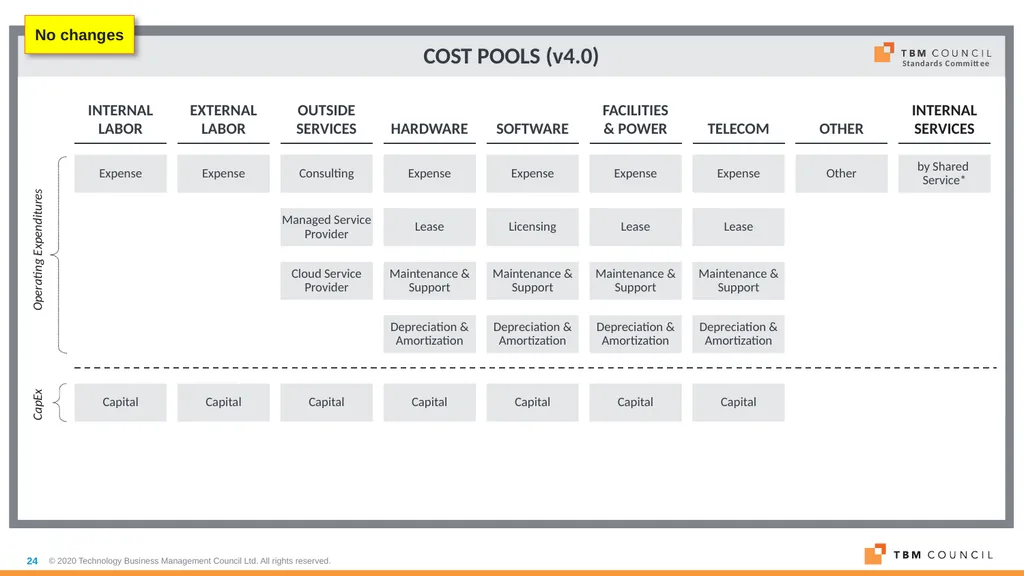
COST POOLS (v4.0) No changes INTERNAL LABOR OUTSIDE
SERVICES HARDWARE SOFTWARE FACILITIES
& POWER TELECOM Expense Consulting Expense Expense Licensing Lease Managed Service Provider Lease Expense Expense Expense Maintenance & Support Maintenance & Support Maintenance & Support EXTERNAL LABOR Cloud Service Provider OTHER Other Depreciation & Amortization Depreciation & Amortization Depreciation & Amortization Depreciation & Amortization Lease Maintenance & Support Capital Capital Capital Capital Capital Capital Capital CapEx Operating Expenditures by Shared
Service* INTERNAL SERVICES<br>
SERVICES HARDWARE SOFTWARE FACILITIES
& POWER TELECOM Expense Consulting Expense Expense Licensing Lease Managed Service Provider Lease Expense Expense Expense Maintenance & Support Maintenance & Support Maintenance & Support EXTERNAL LABOR Cloud Service Provider OTHER Other Depreciation & Amortization Depreciation & Amortization Depreciation & Amortization Depreciation & Amortization Lease Maintenance & Support Capital Capital Capital Capital Capital Capital Capital CapEx Operating Expenditures by Shared
Service* INTERNAL SERVICES<br>
25
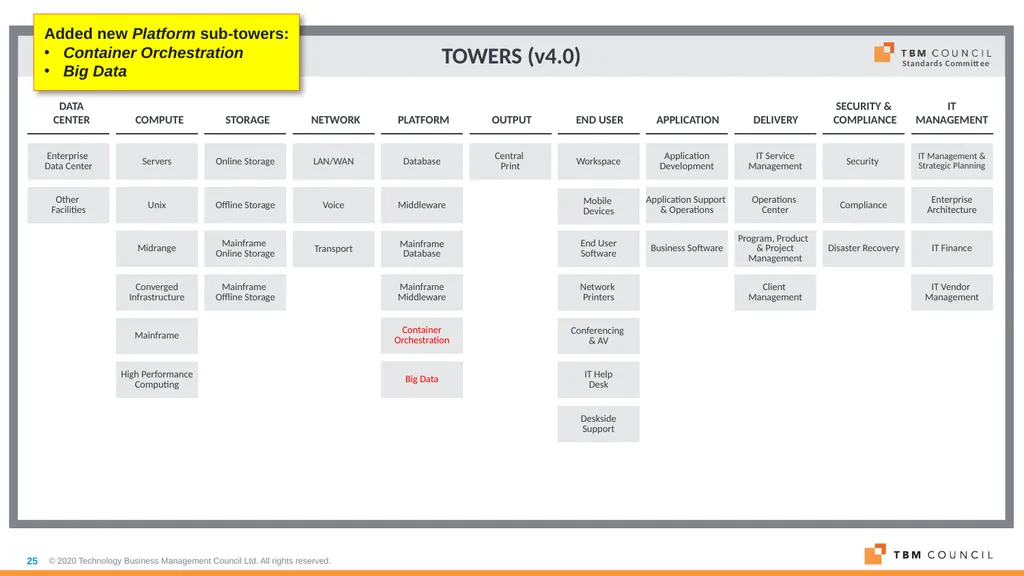
TOWERS (v4.0) DATA
CENTER STORAGE END USER DELIVERY APPLICATION OUTPUT NETWORK COMPUTE SECURITY &
COMPLIANCE IT
MANAGEMENT PLATFORM Added new Platform sub-towers:
Container Orchestration
Big Data<br>
CENTER STORAGE END USER DELIVERY APPLICATION OUTPUT NETWORK COMPUTE SECURITY &
COMPLIANCE IT
MANAGEMENT PLATFORM Added new Platform sub-towers:
Container Orchestration
Big Data<br>
26
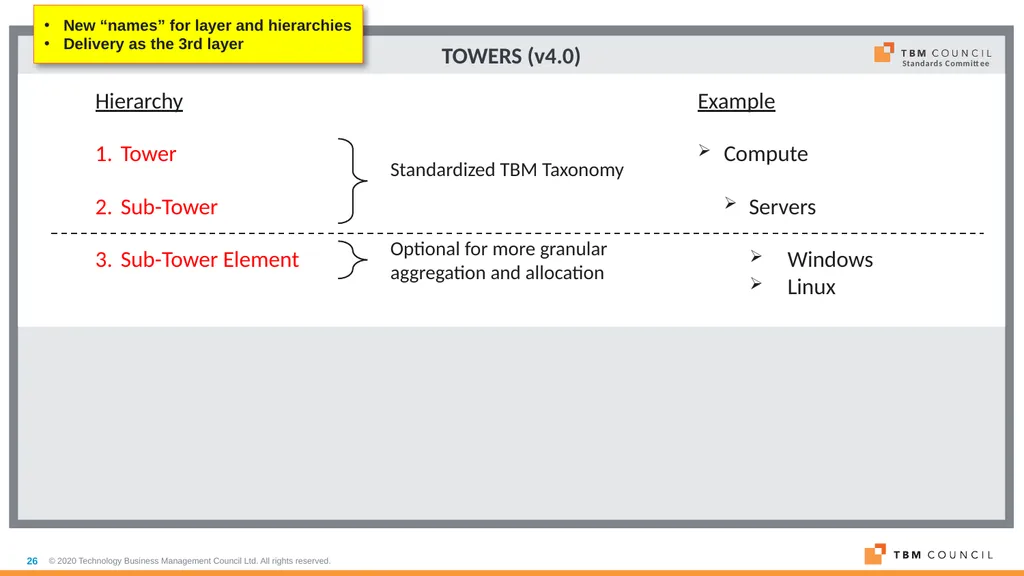
TOWERS (v4.0) Hierarchy
Tower
Sub-Tower
Sub-Tower Element New “names” for layer and hierarchies
Delivery as the 3rd layer Example
Compute
Servers
Windows
Linux Standardized TBM Taxonomy Optional for more granular aggregation and allocation<br>
Tower
Sub-Tower
Sub-Tower Element New “names” for layer and hierarchies
Delivery as the 3rd layer Example
Compute
Servers
Windows
Linux Standardized TBM Taxonomy Optional for more granular aggregation and allocation<br>
27
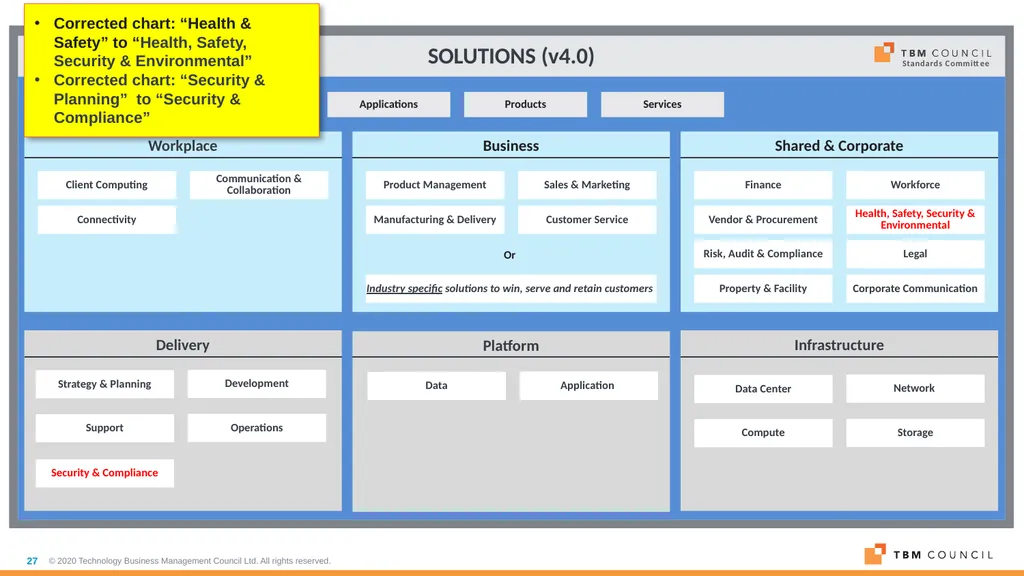
SOLUTIONS (v4.0) Applications Products Services Corrected chart: “Health & Safety” to “Health, Safety, Security & Environmental”
Corrected chart: “Security & Planning” to “Security & Compliance”<br>
Corrected chart: “Security & Planning” to “Security & Compliance”<br>
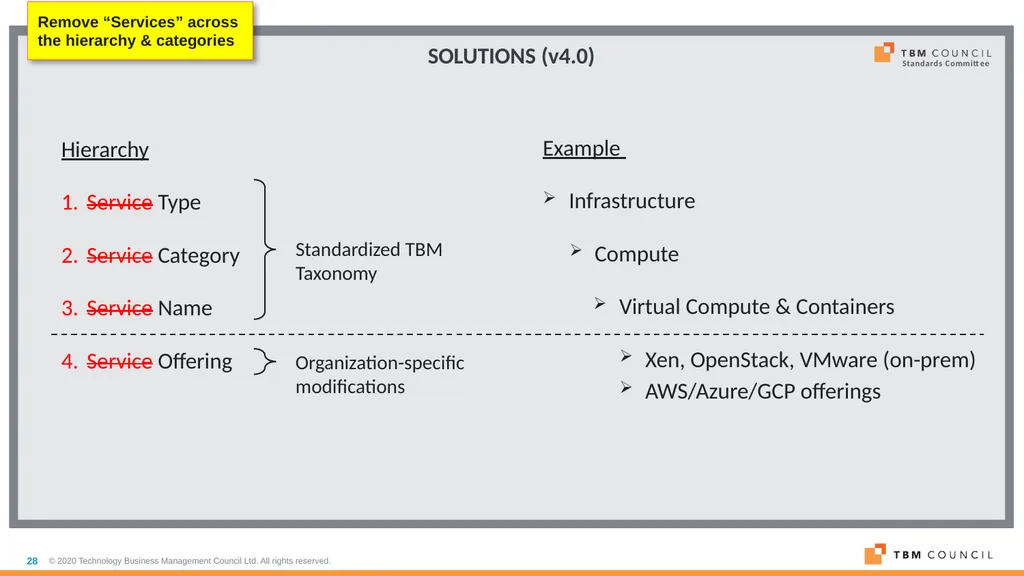
28
SOLUTIONS (v4.0) Hierarchy
Service Type
Service Category
Service Name
Service Offering Remove “Services” across
the hierarchy & categories Example
Infrastructure
Compute
Virtual Compute & Containers
Xen, OpenStack, VMware (on-prem)
AWS/Azure/GCP offerings<br>
Service Type
Service Category
Service Name
Service Offering Remove “Services” across
the hierarchy & categories Example
Infrastructure
Compute
Virtual Compute & Containers
Xen, OpenStack, VMware (on-prem)
AWS/Azure/GCP offerings<br>
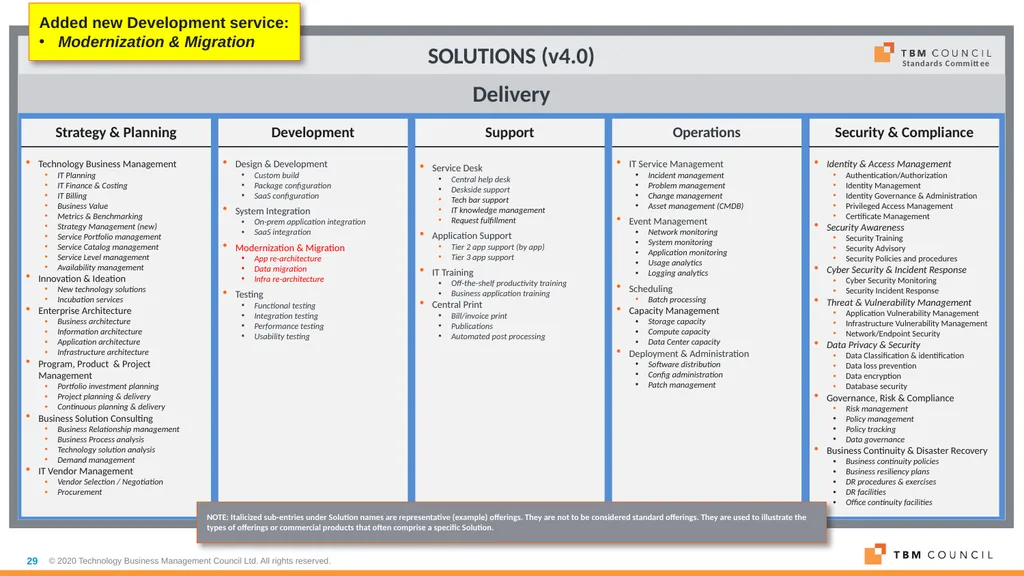
29
SOLUTIONS (v4.0) Delivery Added new Development service:
Modernization & Migration NOTE: Italicized sub-entries under Solution names are representative (example) offerings. They are not to be considered standard offerings. They are used to illustrate the types of offerings or commercial products that often comprise a specific Solution.<br>
Modernization & Migration NOTE: Italicized sub-entries under Solution names are representative (example) offerings. They are not to be considered standard offerings. They are used to illustrate the types of offerings or commercial products that often comprise a specific Solution.<br>
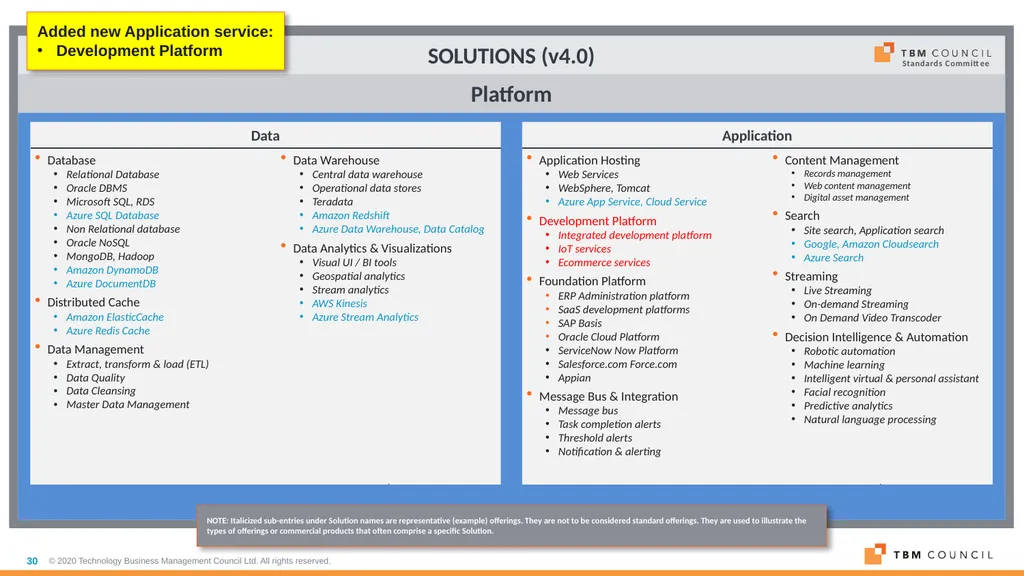
30
SOLUTIONS (v4.0) Platform Added new Application service:
Development Platform NOTE: Italicized sub-entries under Solution names are representative (example) offerings. They are not to be considered standard offerings. They are used to illustrate the types of offerings or commercial products that often comprise a specific Solution.<br>
Development Platform NOTE: Italicized sub-entries under Solution names are representative (example) offerings. They are not to be considered standard offerings. They are used to illustrate the types of offerings or commercial products that often comprise a specific Solution.<br>
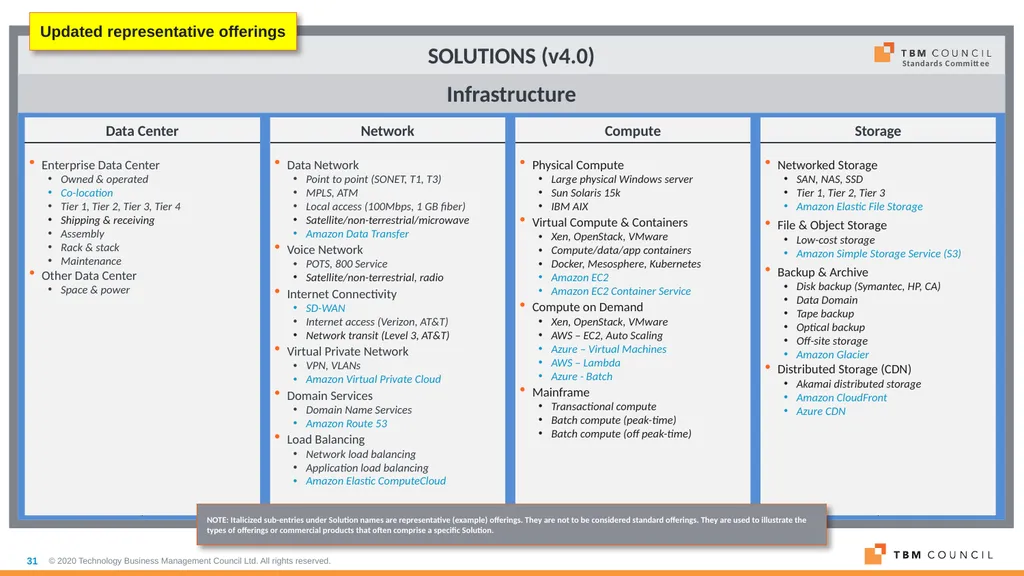
31
SOLUTIONS (v4.0) Infrastructure Updated representative offerings NOTE: Italicized sub-entries under Solution names are representative (example) offerings. They are not to be considered standard offerings. They are used to illustrate the types of offerings or commercial products that often comprise a specific Solution.<br>
32
SOLUTIONS (v4.0) Workplace Renamed End User to Workplace NOTE: Italicized sub-entries under Solution names are representative (example) offerings. They are not to be considered standard offerings. They are used to illustrate the types of offerings or commercial products that often comprise a specific Solution.<br>
33
SOLUTIONS (v4.0) Business (representative, for generic company) No changes NOTE: Italicized sub-entries under Solution names are representative (example) offerings. They are not to be considered standard offerings. They are used to illustrate the types of offerings or commercial products that often comprise a specific Solution.<br>
34
SOLUTIONS (v4.0) Shared & Corporate Changed Shared Services to Shared & Corporate. NOTE: Italicized sub-entries under Solution names are representative (example) offerings. They are not to be considered standard offerings. They are used to illustrate the types of offerings or commercial products that often comprise a specific Solution.<br>
35
Appendix Conceptual TBM Models<br>
36
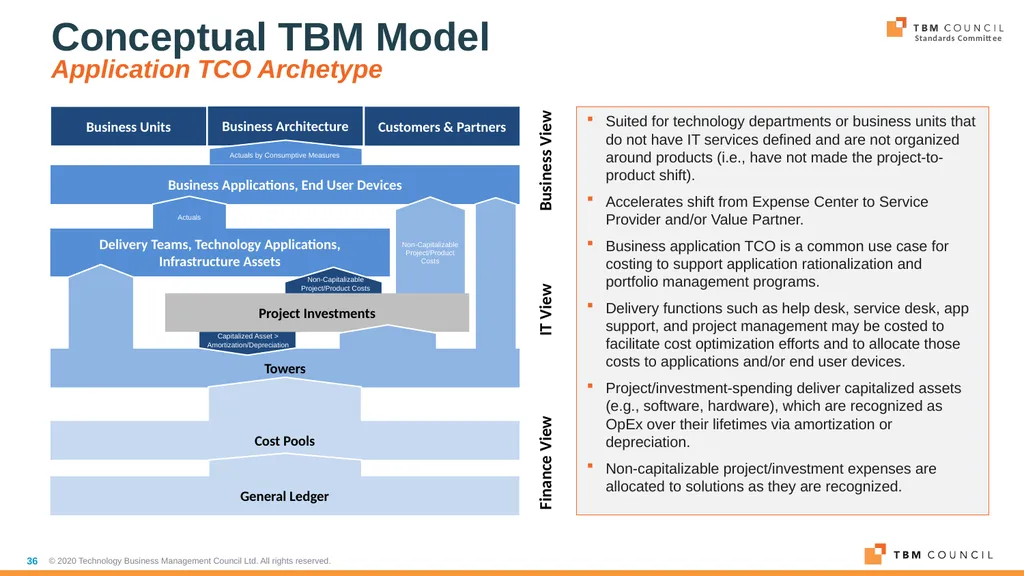
Conceptual TBM Model
Application TCO Archetype IT View Business View Business Architecture Business Units Business Applications, End User Devices Delivery Teams, Technology Applications, Infrastructure Assets Project Investments Towers Cost Pools General Ledger Finance View Customers & Partners Suited for technology departments or business units that do not have IT services defined and are not organized around products (i.e., have not made the project-to-product shift).
Accelerates shift from Expense Center to Service Provider and/or Value Partner.
Business application TCO is a common use case for costing to support application rationalization and portfolio management programs.
Delivery functions such as help desk, service desk, app support, and project management may be costed to facilitate cost optimization efforts and to allocate those costs to applications and/or end user devices.
Project/investment-spending deliver capitalized assets (e.g., software, hardware), which are recognized as OpEx over their lifetimes via amortization or depreciation.
Non-capitalizable project/investment expenses are allocated to solutions as they are recognized. Capitalized Asset > Amortization/Depreciation Non-Capitalizable Project/Product Costs Actuals Actuals by Consumptive Measures Non-Capitalizable Project/Product Costs<br>
Accelerates shift from Expense Center to Service Provider and/or Value Partner.
Business application TCO is a common use case for costing to support application rationalization and portfolio management programs.
Delivery functions such as help desk, service desk, app support, and project management may be costed to facilitate cost optimization efforts and to allocate those costs to applications and/or end user devices.
Project/investment-spending deliver capitalized assets (e.g., software, hardware), which are recognized as OpEx over their lifetimes via amortization or depreciation.
Non-capitalizable project/investment expenses are allocated to solutions as they are recognized. Capitalized Asset > Amortization/Depreciation Non-Capitalizable Project/Product Costs Actuals Actuals by Consumptive Measures Non-Capitalizable Project/Product Costs<br>
37
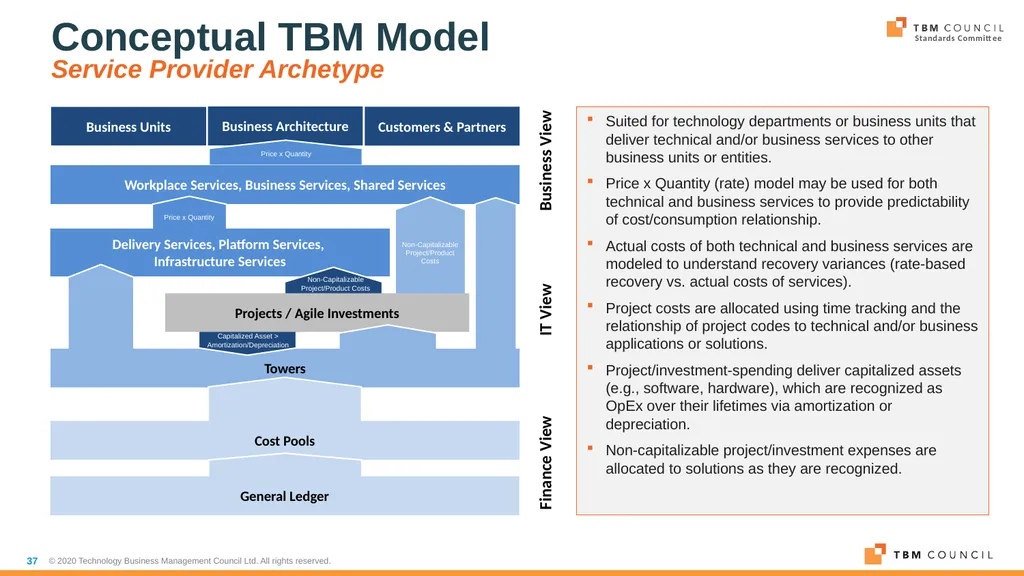
Conceptual TBM Model
Service Provider Archetype IT View Business View Business Architecture Business Units Workplace Services, Business Services, Shared Services Delivery Services, Platform Services,
Infrastructure Services Projects / Agile Investments Towers Cost Pools General Ledger Finance View Customers & Partners Suited for technology departments or business units that deliver technical and/or business services to other business units or entities.
Price x Quantity (rate) model may be used for both technical and business services to provide predictability of cost/consumption relationship.
Actual costs of both technical and business services are modeled to understand recovery variances (rate-based recovery vs. actual costs of services).
Project costs are allocated using time tracking and the relationship of project codes to technical and/or business applications or solutions.
Project/investment-spending deliver capitalized assets (e.g., software, hardware), which are recognized as OpEx over their lifetimes via amortization or depreciation.
Non-capitalizable project/investment expenses are allocated to solutions as they are recognized. Capitalized Asset > Amortization/Depreciation Non-Capitalizable Project/Product Costs Price x Quantity Price x Quantity Non-Capitalizable Project/Product Costs<br>
Price x Quantity (rate) model may be used for both technical and business services to provide predictability of cost/consumption relationship.
Actual costs of both technical and business services are modeled to understand recovery variances (rate-based recovery vs. actual costs of services).
Project costs are allocated using time tracking and the relationship of project codes to technical and/or business applications or solutions.
Project/investment-spending deliver capitalized assets (e.g., software, hardware), which are recognized as OpEx over their lifetimes via amortization or depreciation.
Non-capitalizable project/investment expenses are allocated to solutions as they are recognized. Capitalized Asset > Amortization/Depreciation Non-Capitalizable Project/Product Costs Price x Quantity Price x Quantity Non-Capitalizable Project/Product Costs<br>
38
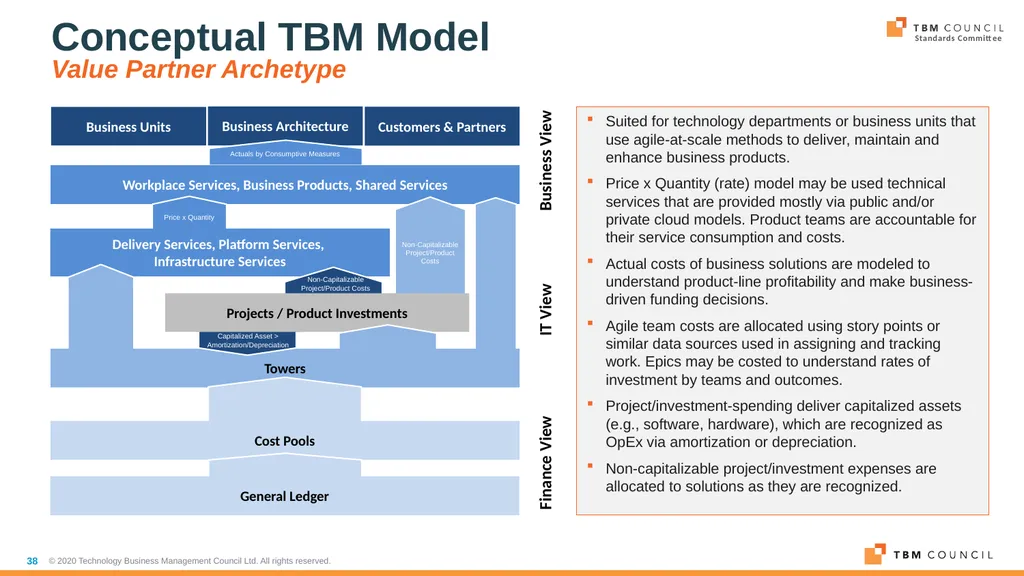
Conceptual TBM Model
Value Partner Archetype IT View Business View Business Architecture Business Units Workplace Services, Business Products, Shared Services Delivery Services, Platform Services,
Infrastructure Services Projects / Product Investments Towers Cost Pools General Ledger Finance View Customers & Partners Suited for technology departments or business units that use agile-at-scale methods to deliver, maintain and enhance business products.
Price x Quantity (rate) model may be used technical services that are provided mostly via public and/or private cloud models. Product teams are accountable for their service consumption and costs.
Actual costs of business solutions are modeled to understand product-line profitability and make business-driven funding decisions.
Agile team costs are allocated using story points or similar data sources used in assigning and tracking work. Epics may be costed to understand rates of investment by teams and outcomes.
Project/investment-spending deliver capitalized assets (e.g., software, hardware), which are recognized as OpEx via amortization or depreciation.
Non-capitalizable project/investment expenses are allocated to solutions as they are recognized. Capitalized Asset > Amortization/Depreciation Non-Capitalizable Project/Product Costs Price x Quantity Actuals by Consumptive Measures Non-Capitalizable Project/Product Costs<br>
Price x Quantity (rate) model may be used technical services that are provided mostly via public and/or private cloud models. Product teams are accountable for their service consumption and costs.
Actual costs of business solutions are modeled to understand product-line profitability and make business-driven funding decisions.
Agile team costs are allocated using story points or similar data sources used in assigning and tracking work. Epics may be costed to understand rates of investment by teams and outcomes.
Project/investment-spending deliver capitalized assets (e.g., software, hardware), which are recognized as OpEx via amortization or depreciation.
Non-capitalizable project/investment expenses are allocated to solutions as they are recognized. Capitalized Asset > Amortization/Depreciation Non-Capitalizable Project/Product Costs Price x Quantity Actuals by Consumptive Measures Non-Capitalizable Project/Product Costs<br>