
TDTS21: Advanced Networking Lecture 7: IP and
TA
Published · 70 slides · 0 views

1 / 1
Description
TDTS21: Advanced Networking Lecture 7: IP and Intra Domain Routing Based on slides from P. Gill and D. Choffnes Revised 2015 by N. Carlsson Internet Routing Internet organized as a two level hierarchy First level autonomous systems (ASs)
Related Topics
Share
Embed code
Download this presentation From Below
"TDTS21: Advanced Networking Lecture 7: IP and" is the property of its rightful owner. Permission is granted to download and print the materials on this website for personal, non-commercial use only, and to display it on your personal computer provided you do not modify the materials and that you retain all copyright notices contained in the materials. By downloading content from our website, you accept the terms of this agreement.
Presentation Transcript
01
TDTS21: Advanced Networking Lecture 7: IP and Intra Domain Routing Based on slides from P. Gill and D. Choffnes
Revised 2015 by N. Carlsson<br>
Revised 2015 by N. Carlsson<br>
02
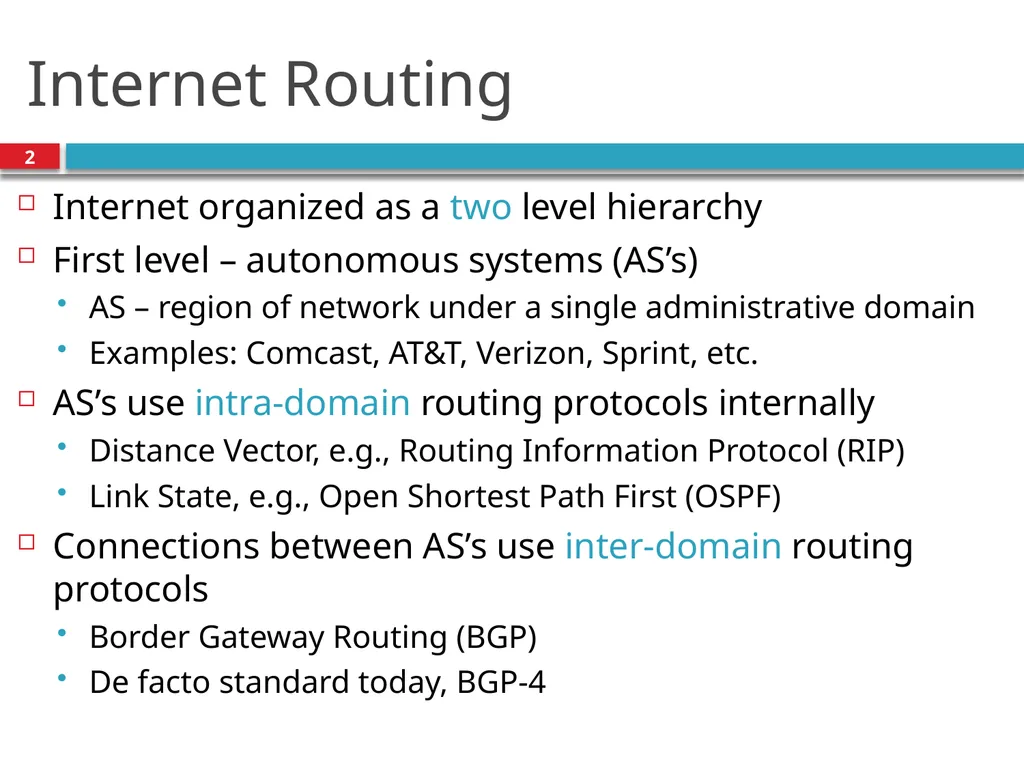
Internet Routing Internet organized as a two level hierarchy
First level – autonomous systems (AS’s)
AS – region of network under a single administrative domain
Examples: Comcast, AT&T, Verizon, Sprint, etc.
AS’s use intra-domain routing protocols internally
Distance Vector, e.g., Routing Information Protocol (RIP)
Link State, e.g., Open Shortest Path First (OSPF)
Connections between AS’s use inter-domain routing protocols
Border Gateway Routing (BGP)
De facto standard today, BGP-4 2<br>
First level – autonomous systems (AS’s)
AS – region of network under a single administrative domain
Examples: Comcast, AT&T, Verizon, Sprint, etc.
AS’s use intra-domain routing protocols internally
Distance Vector, e.g., Routing Information Protocol (RIP)
Link State, e.g., Open Shortest Path First (OSPF)
Connections between AS’s use inter-domain routing protocols
Border Gateway Routing (BGP)
De facto standard today, BGP-4 2<br>
03
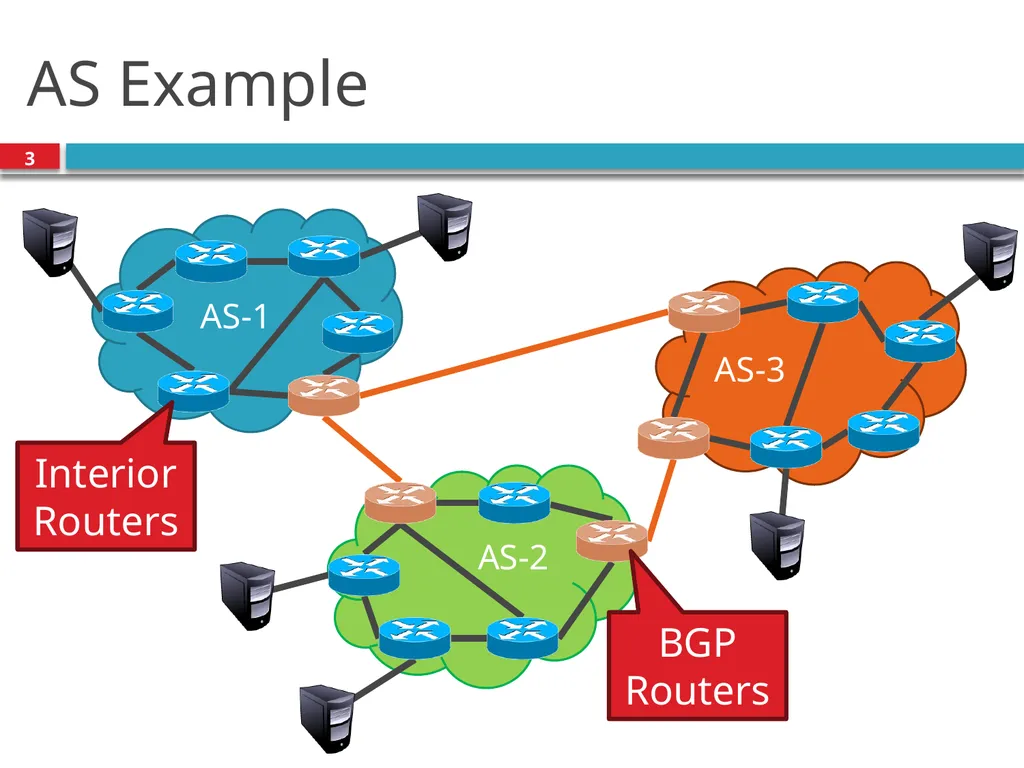
AS Example 3 AS-1 AS-2 AS-3<br>
04
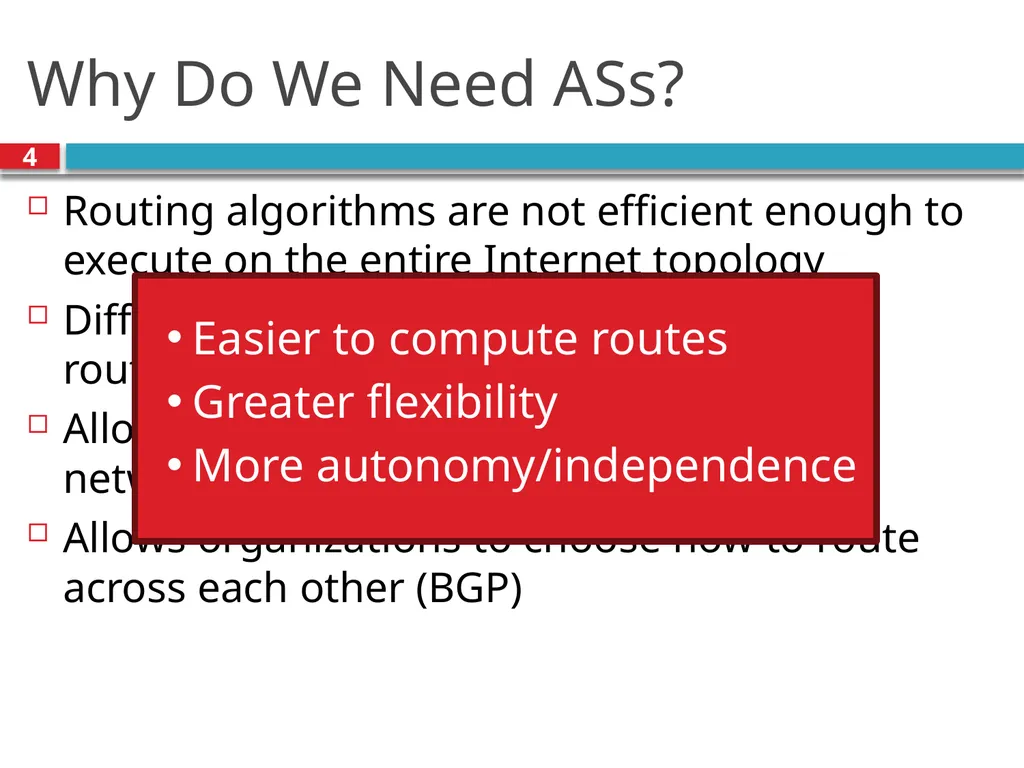
Why Do We Need ASs? 4 Routing algorithms are not efficient enough to execute on the entire Internet topology
Different organizations may use different routing policies
Allows organizations to hide their internal network structure
Allows organizations to choose how to route across each other (BGP)<br>
Different organizations may use different routing policies
Allows organizations to hide their internal network structure
Allows organizations to choose how to route across each other (BGP)<br>
05
5<br>
06
How to find a good path? 6<br>
07
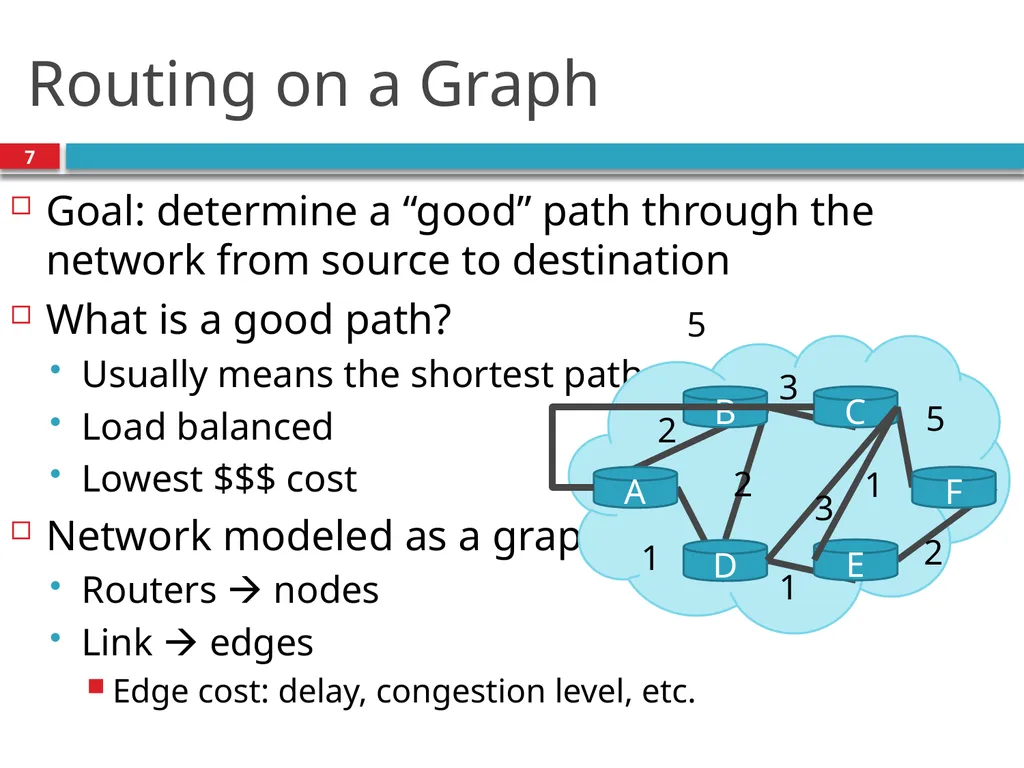
Routing on a Graph Goal: determine a “good” path through the network from source to destination
What is a good path?
Usually means the shortest path
Load balanced
Lowest $$$ cost
Network modeled as a graph
Routers nodes
Link edges
Edge cost: delay, congestion level, etc. A B C D E F 5 2 3 5 2 1 1 2 3 1 7<br>
What is a good path?
Usually means the shortest path
Load balanced
Lowest $$$ cost
Network modeled as a graph
Routers nodes
Link edges
Edge cost: delay, congestion level, etc. A B C D E F 5 2 3 5 2 1 1 2 3 1 7<br>
08
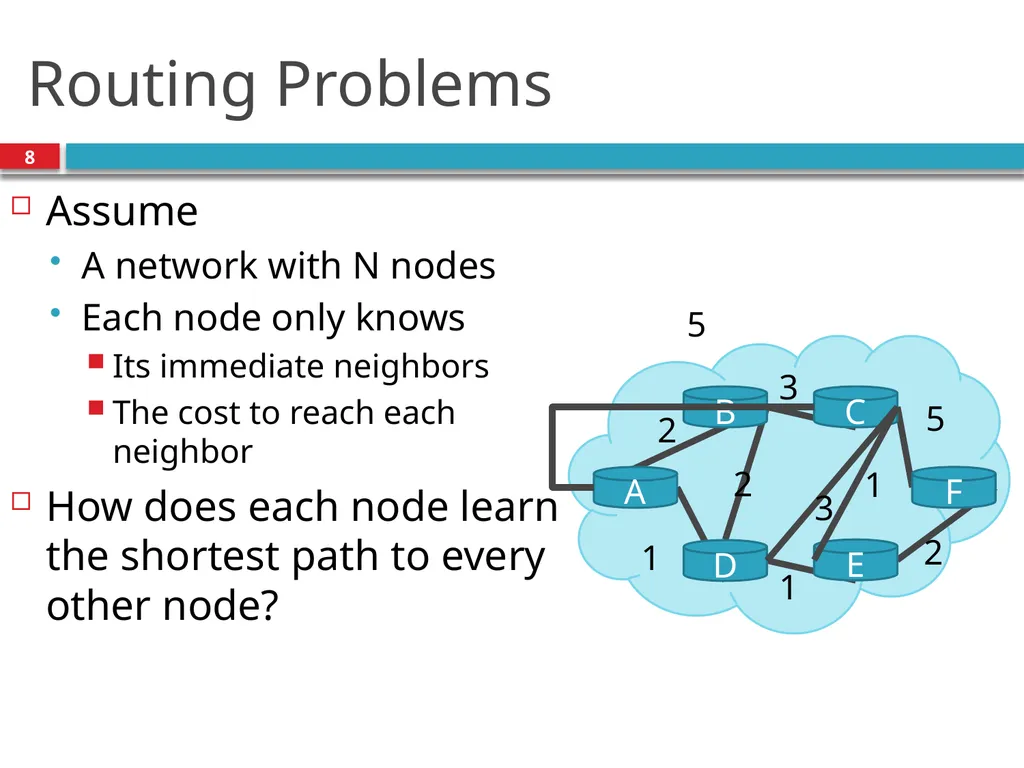
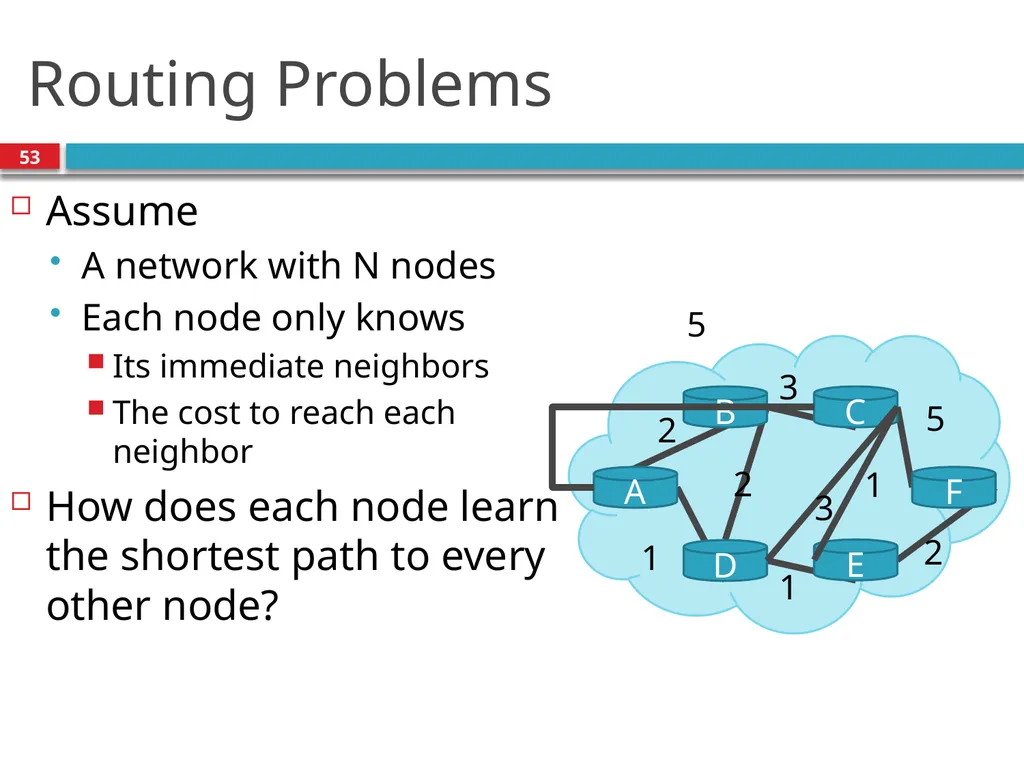
Routing Problems Assume
A network with N nodes
Each node only knows
Its immediate neighbors
The cost to reach each neighbor
How does each node learn the shortest path to every other node? A B C D E F 5 2 3 5 2 1 1 2 3 1 8<br>
A network with N nodes
Each node only knows
Its immediate neighbors
The cost to reach each neighbor
How does each node learn the shortest path to every other node? A B C D E F 5 2 3 5 2 1 1 2 3 1 8<br>
09
9<br>
10
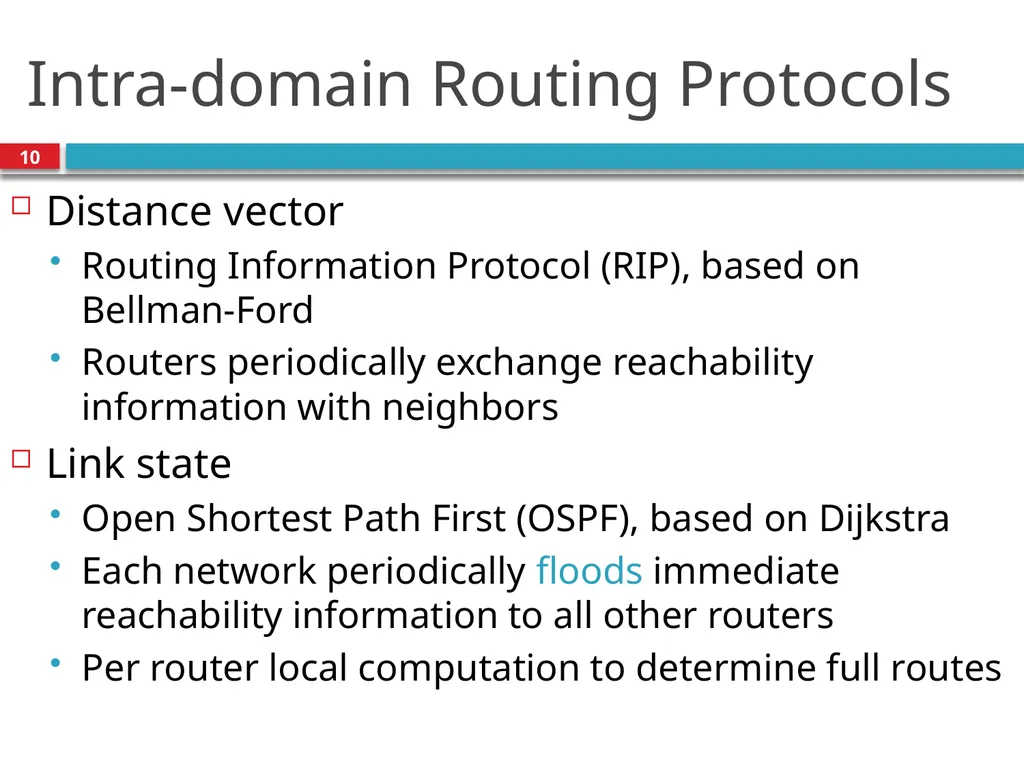
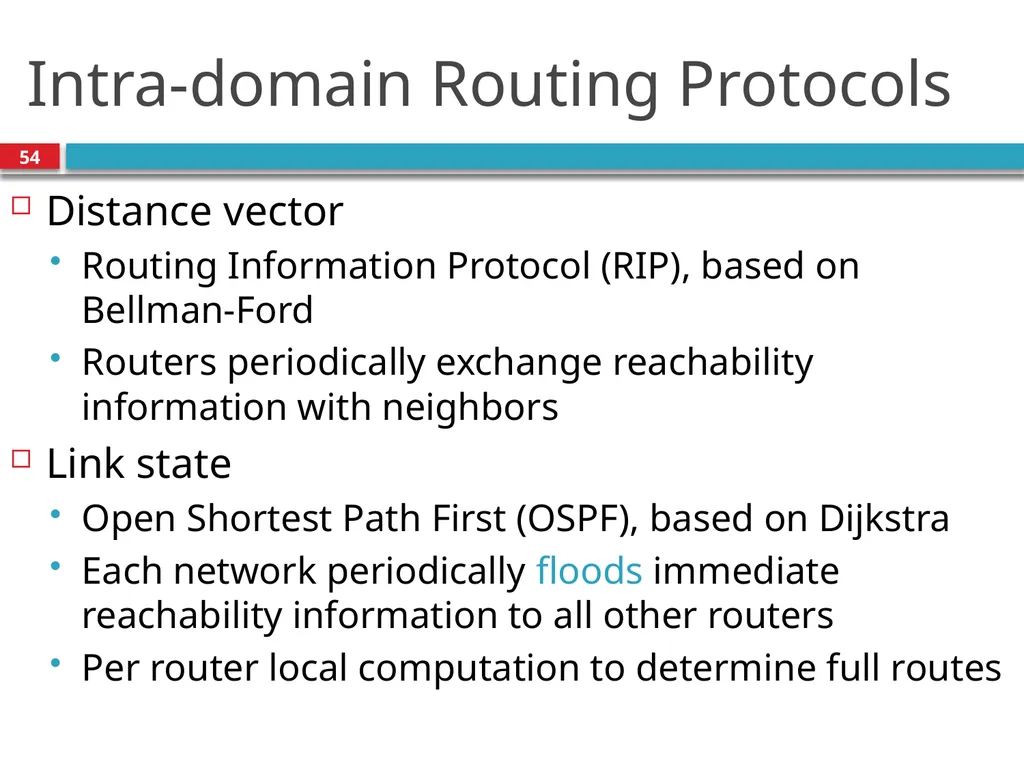
Intra-domain Routing Protocols Distance vector
Routing Information Protocol (RIP), based on Bellman-Ford
Routers periodically exchange reachability information with neighbors
Link state
Open Shortest Path First (OSPF), based on Dijkstra
Each network periodically floods immediate reachability information to all other routers
Per router local computation to determine full routes 10 10<br>
Routing Information Protocol (RIP), based on Bellman-Ford
Routers periodically exchange reachability information with neighbors
Link state
Open Shortest Path First (OSPF), based on Dijkstra
Each network periodically floods immediate reachability information to all other routers
Per router local computation to determine full routes 10 10<br>
11
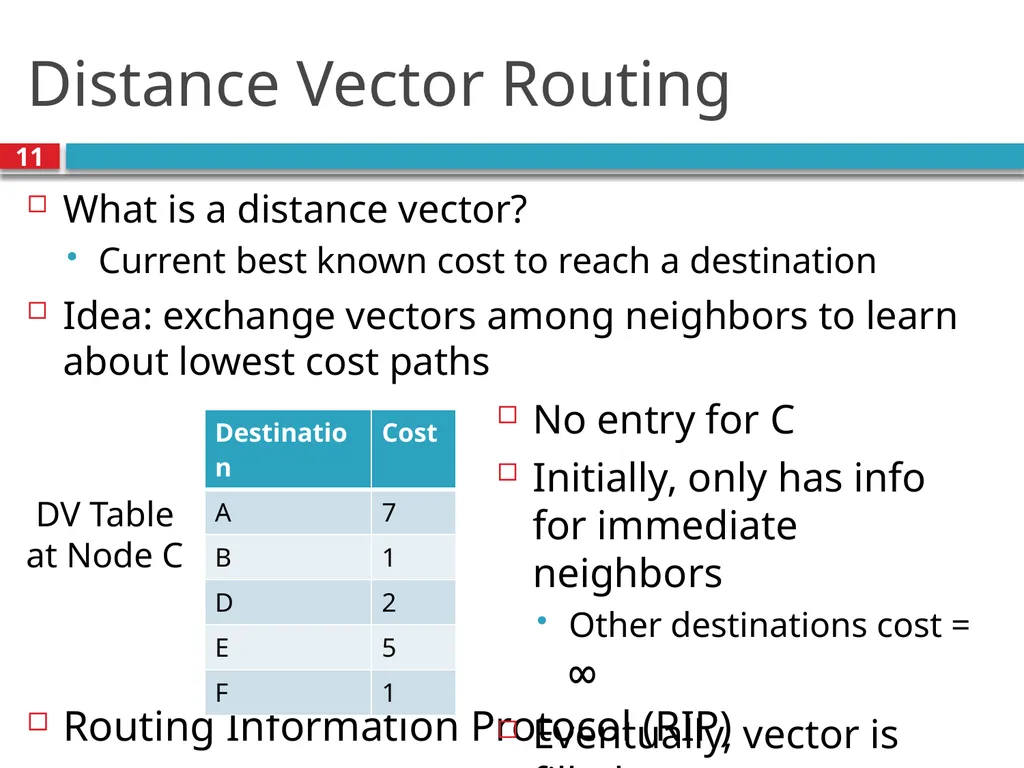
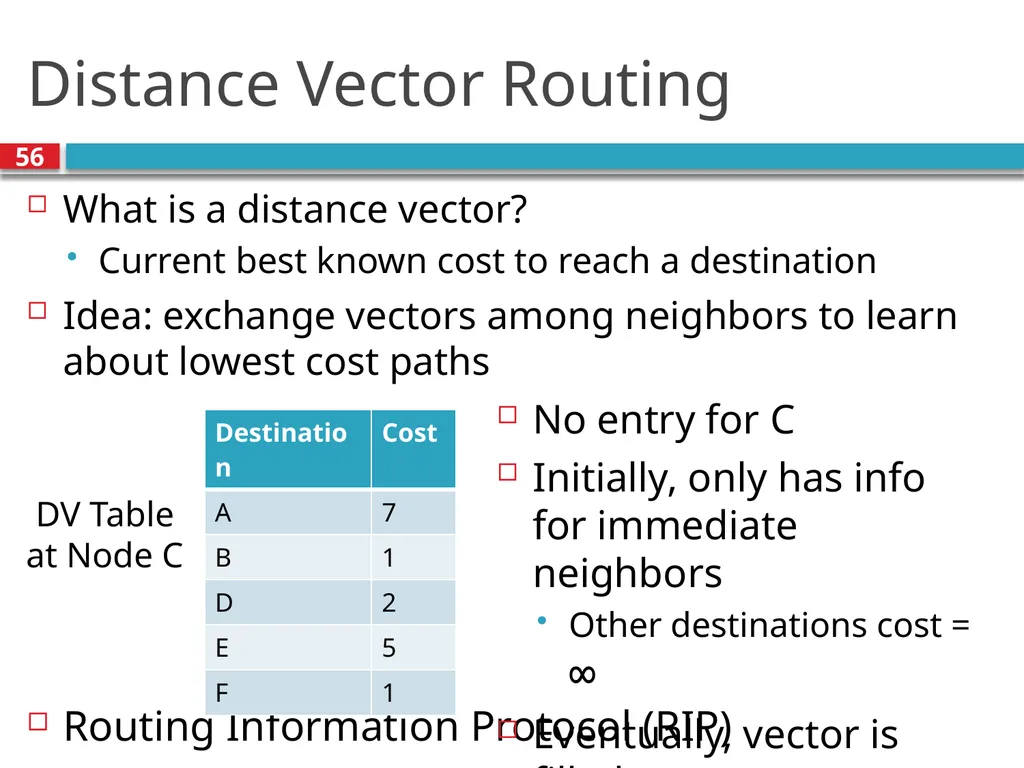
Distance Vector Routing 11 What is a distance vector?
Current best known cost to reach a destination
Idea: exchange vectors among neighbors to learn about lowest cost paths Routing Information Protocol (RIP) DV Table
at Node C No entry for C
Initially, only has info for immediate neighbors
Other destinations cost = ∞
Eventually, vector is filled<br>
Current best known cost to reach a destination
Idea: exchange vectors among neighbors to learn about lowest cost paths Routing Information Protocol (RIP) DV Table
at Node C No entry for C
Initially, only has info for immediate neighbors
Other destinations cost = ∞
Eventually, vector is filled<br>
12
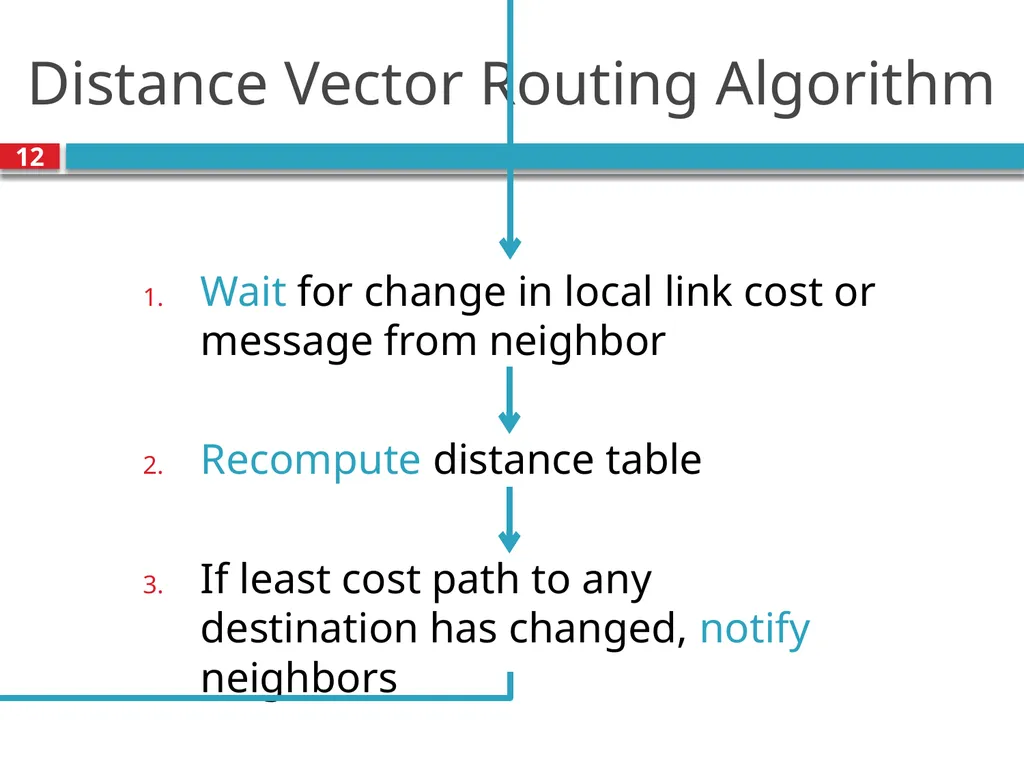
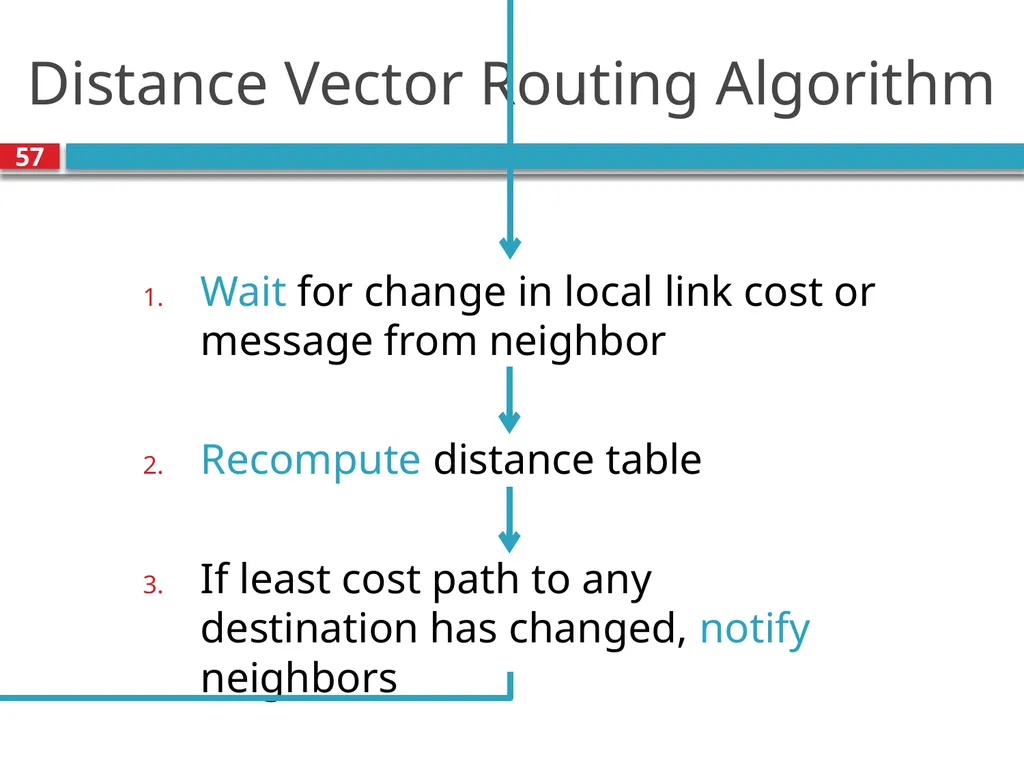
Distance Vector Routing Algorithm 12 Wait for change in local link cost or message from neighbor
Recompute distance table
If least cost path to any destination has changed, notify neighbors<br>
Recompute distance table
If least cost path to any destination has changed, notify neighbors<br>
13
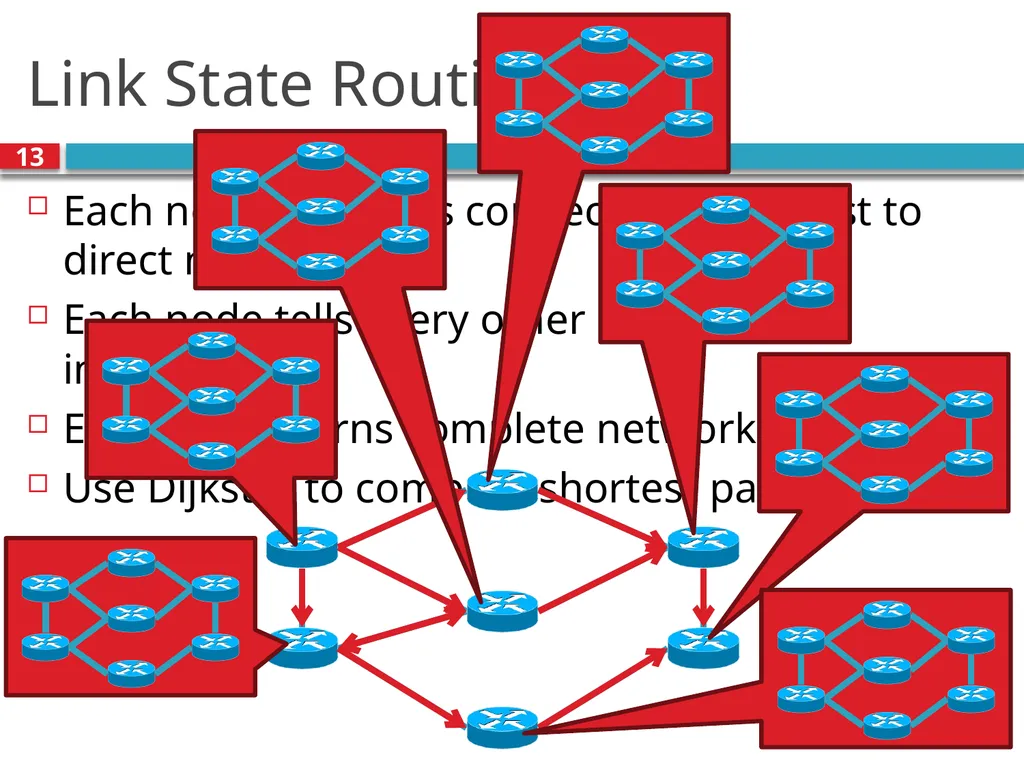
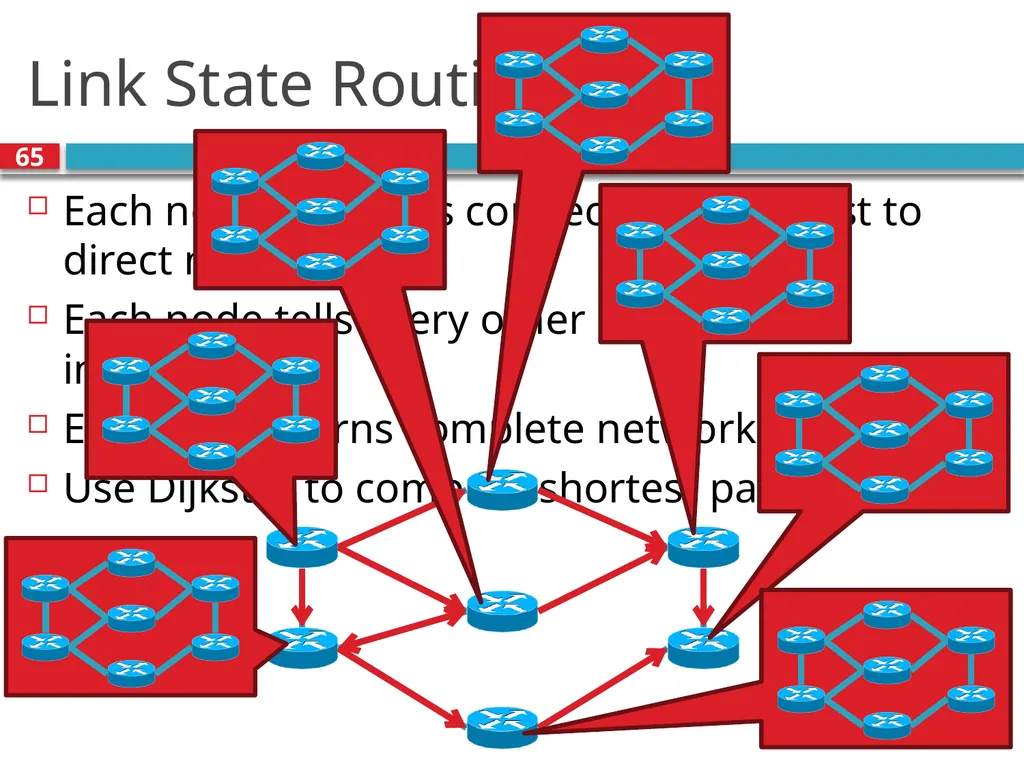
Each node knows its connectivity and cost to direct neighbors
Each node tells every other node this information
Each node learns complete network topology
Use Dijkstra to compute shortest paths Link State Routing 13<br>
Each node tells every other node this information
Each node learns complete network topology
Use Dijkstra to compute shortest paths Link State Routing 13<br>
14
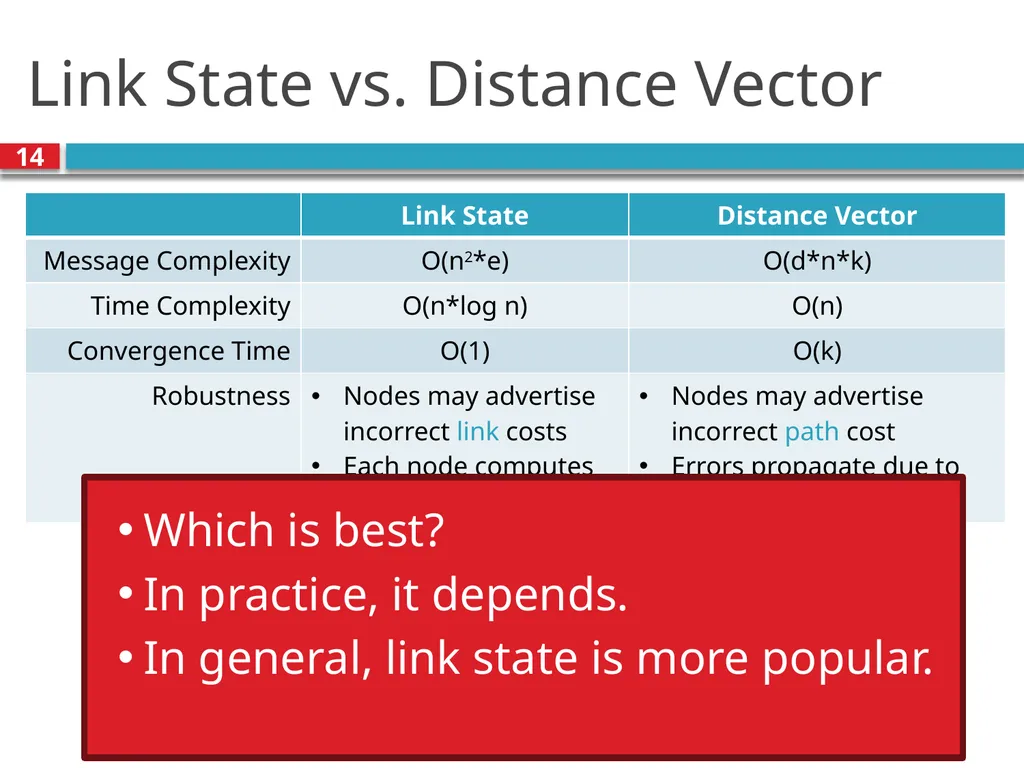
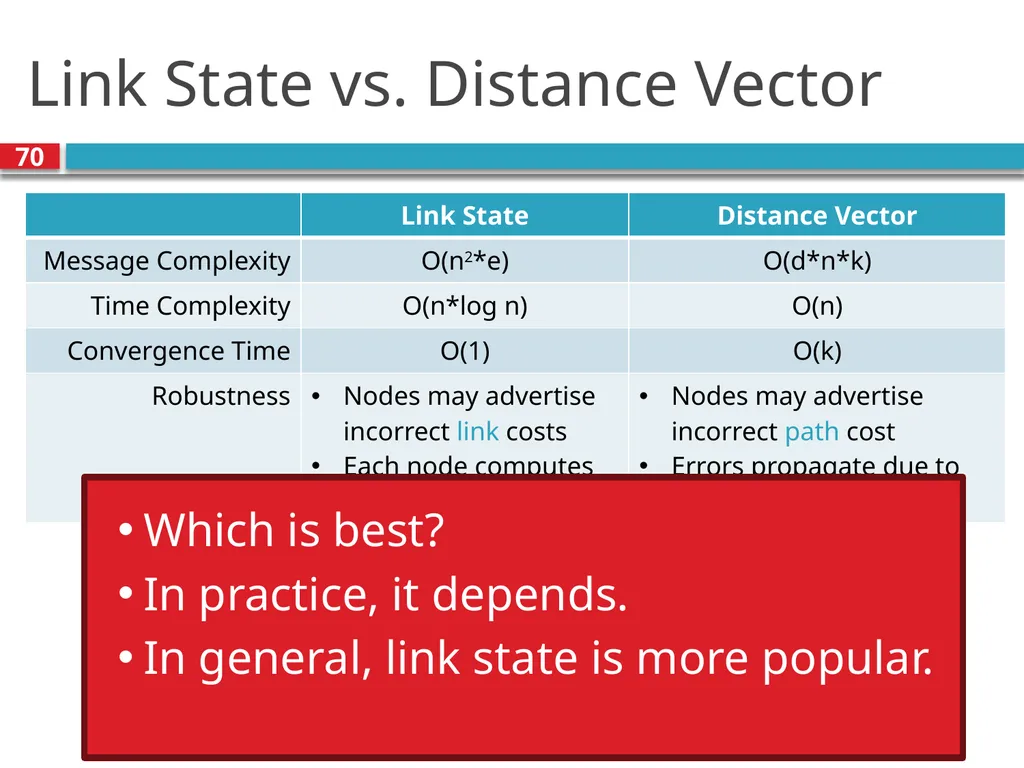
Link State vs. Distance Vector 14 n = number of nodes in the graph
d = degree of a given node
k = number of rounds<br>
d = degree of a given node
k = number of rounds<br>
15
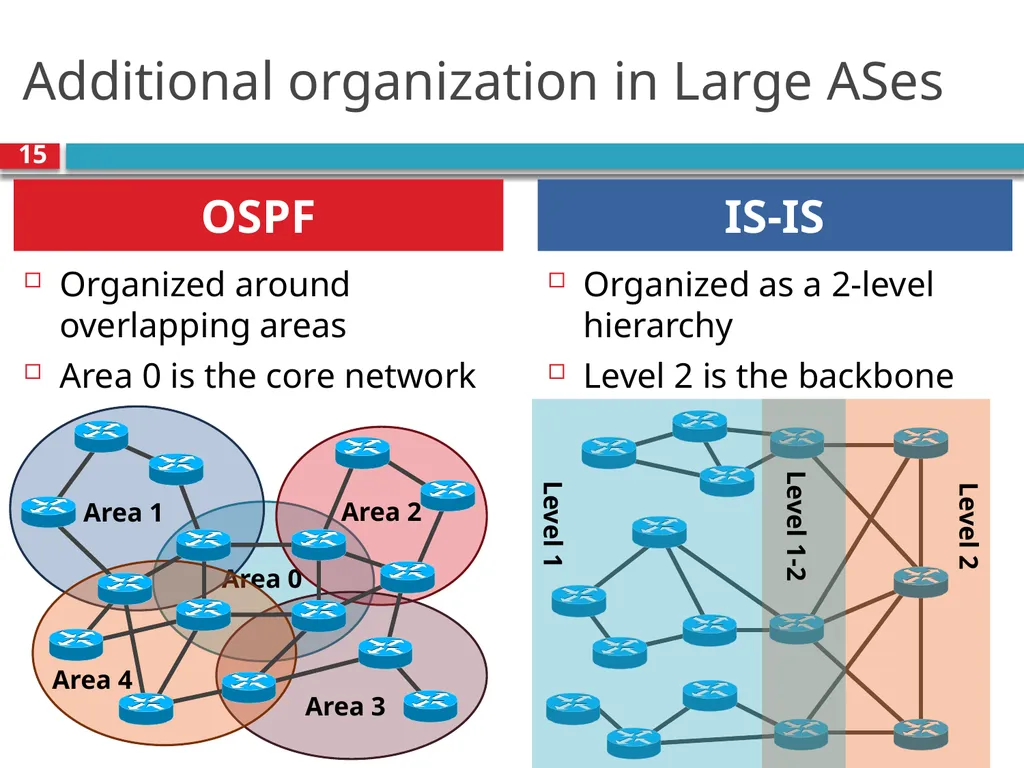
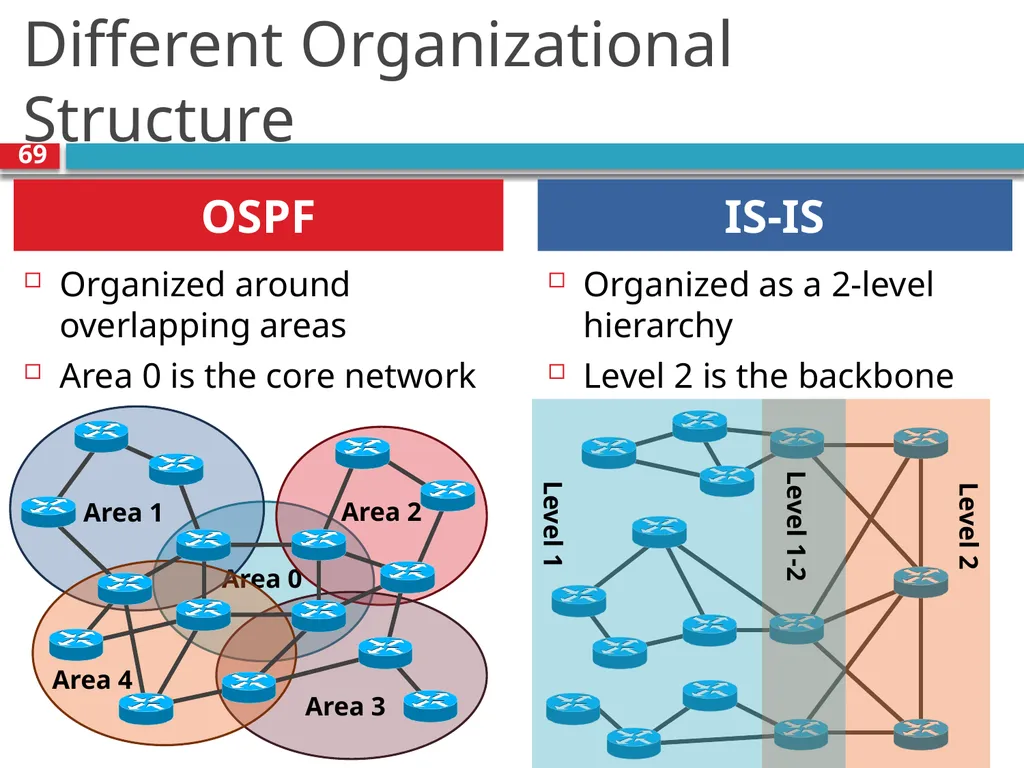
Additional organization in Large ASes 15 OSPF IS-IS Organized around overlapping areas
Area 0 is the core network Organized as a 2-level hierarchy
Level 2 is the backbone Level 1-2<br>
Area 0 is the core network Organized as a 2-level hierarchy
Level 2 is the backbone Level 1-2<br>
16
16<br>
17
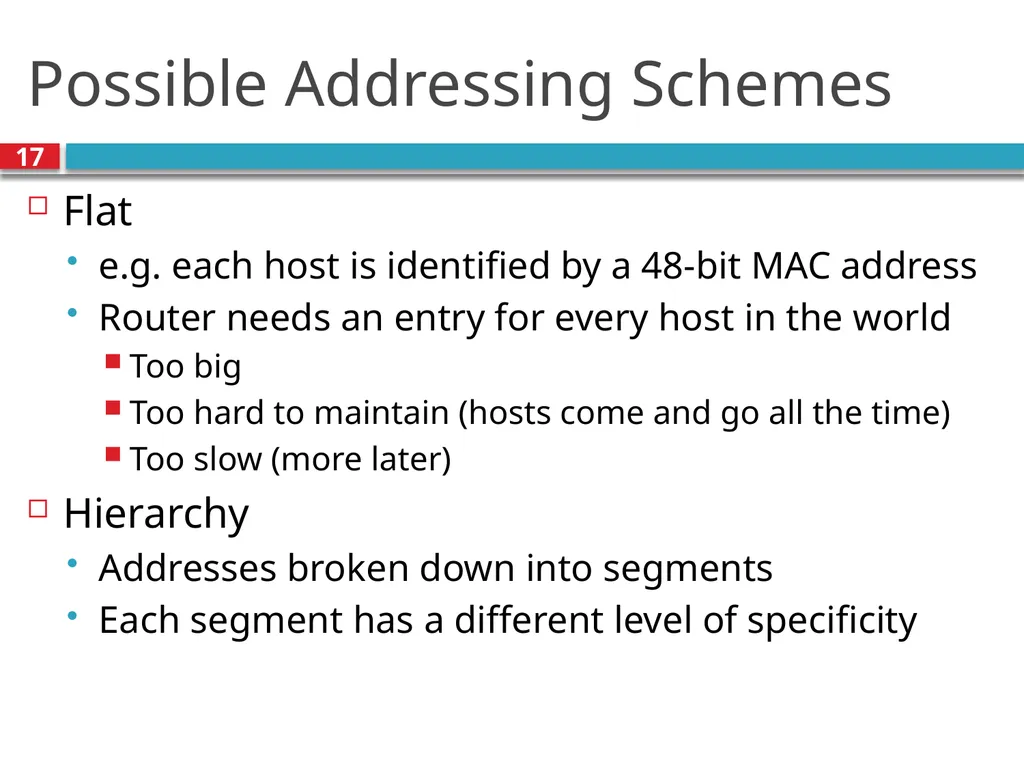
Possible Addressing Schemes 17 Flat
e.g. each host is identified by a 48-bit MAC address
Router needs an entry for every host in the world
Too big
Too hard to maintain (hosts come and go all the time)
Too slow (more later)
Hierarchy
Addresses broken down into segments
Each segment has a different level of specificity<br>
e.g. each host is identified by a 48-bit MAC address
Router needs an entry for every host in the world
Too big
Too hard to maintain (hosts come and go all the time)
Too slow (more later)
Hierarchy
Addresses broken down into segments
Each segment has a different level of specificity<br>
18
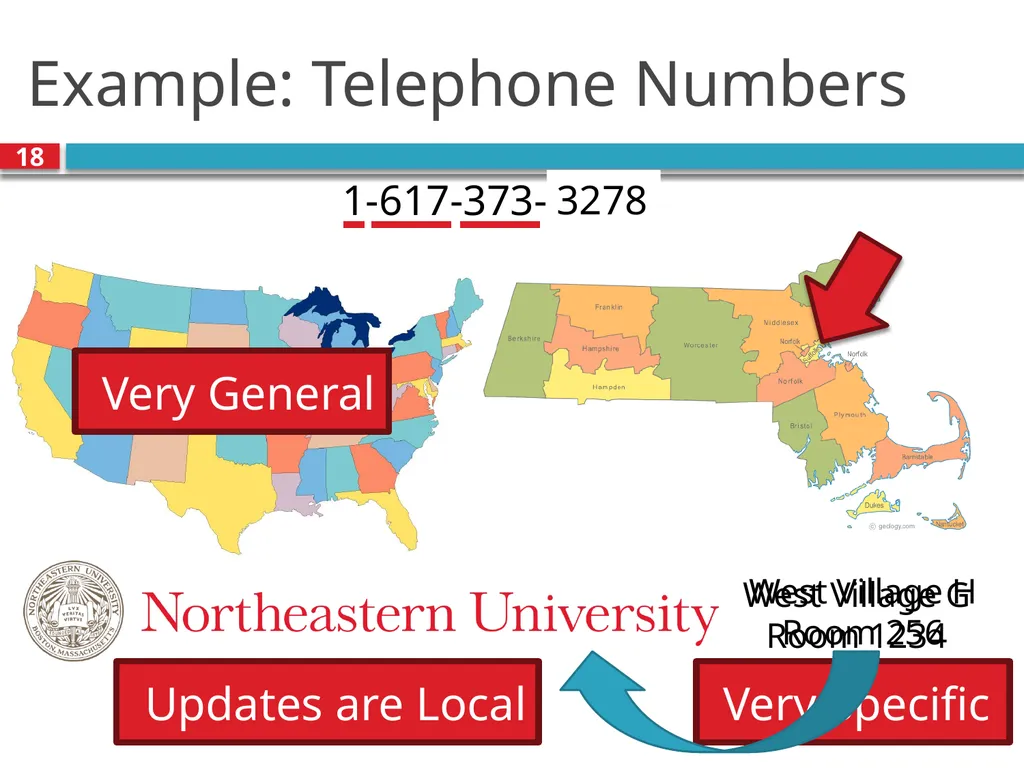
Example: Telephone Numbers 18 1-617-373-1234 West Village H
Room 256 West Village G
Room 1234 3278<br>
Room 256 West Village G
Room 1234 3278<br>
19
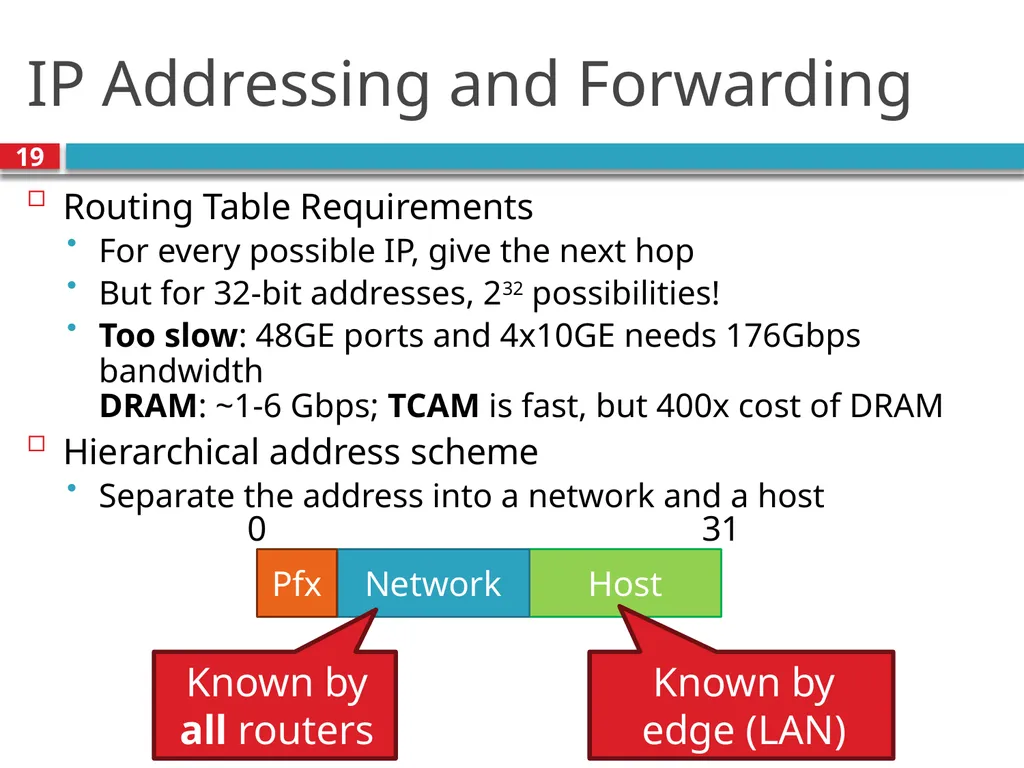
IP Addressing and Forwarding 19 Routing Table Requirements
For every possible IP, give the next hop
But for 32-bit addresses, 232 possibilities!
Too slow: 48GE ports and 4x10GE needs 176Gbps bandwidth DRAM: ~1-6 Gbps; TCAM is fast, but 400x cost of DRAM
Hierarchical address scheme
Separate the address into a network and a host Host Network Pfx 0 31<br>
For every possible IP, give the next hop
But for 32-bit addresses, 232 possibilities!
Too slow: 48GE ports and 4x10GE needs 176Gbps bandwidth DRAM: ~1-6 Gbps; TCAM is fast, but 400x cost of DRAM
Hierarchical address scheme
Separate the address into a network and a host Host Network Pfx 0 31<br>
20
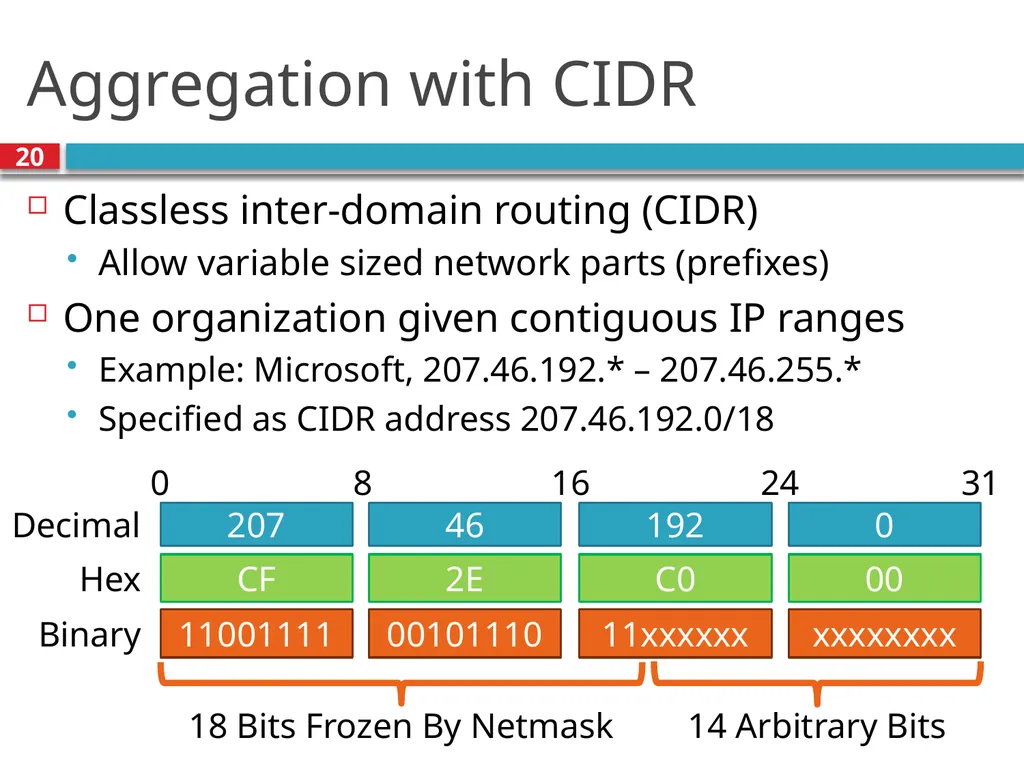
Aggregation with CIDR 20 Classless inter-domain routing (CIDR)
Allow variable sized network parts (prefixes)
One organization given contiguous IP ranges
Example: Microsoft, 207.46.192.* – 207.46.255.*
Specified as CIDR address 207.46.192.0/18 11001111 CF 207 00101110 2E 46 11xxxxxx C0 192 xxxxxxxx 00 0 Decimal Hex Binary 0 8 16 24 31 18 Bits Frozen By Netmask 14 Arbitrary Bits<br>
Allow variable sized network parts (prefixes)
One organization given contiguous IP ranges
Example: Microsoft, 207.46.192.* – 207.46.255.*
Specified as CIDR address 207.46.192.0/18 11001111 CF 207 00101110 2E 46 11xxxxxx C0 192 xxxxxxxx 00 0 Decimal Hex Binary 0 8 16 24 31 18 Bits Frozen By Netmask 14 Arbitrary Bits<br>
21
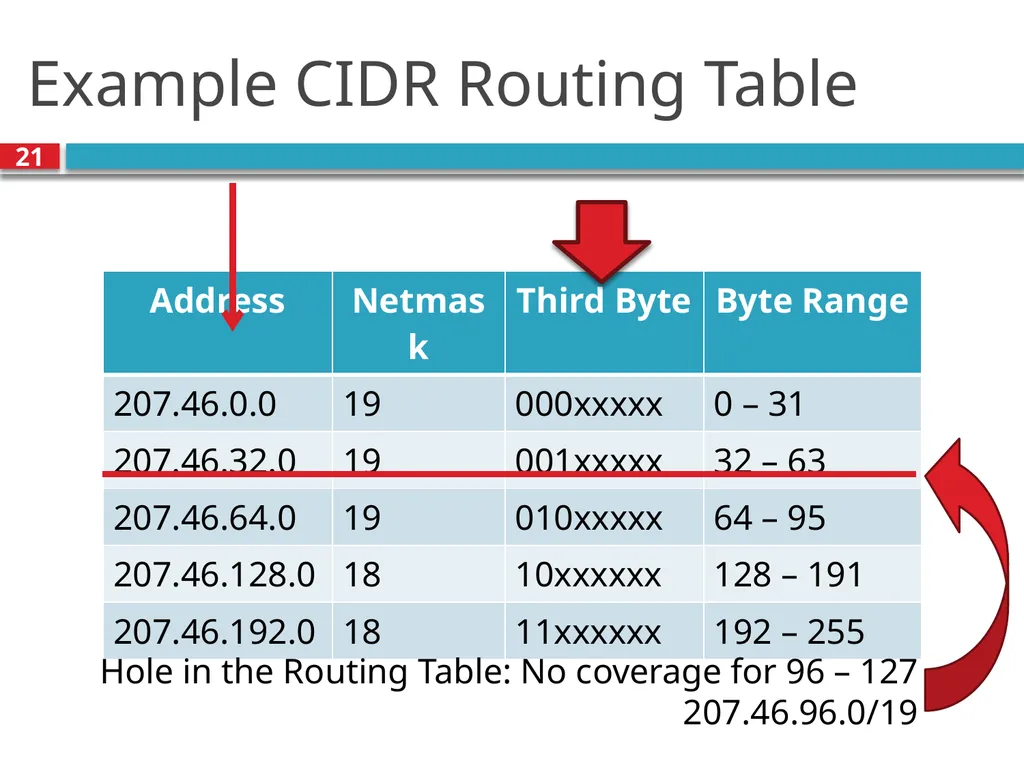
Example CIDR Routing Table 21 Hole in the Routing Table: No coverage for 96 – 127
207.46.96.0/19<br>
207.46.96.0/19<br>
22
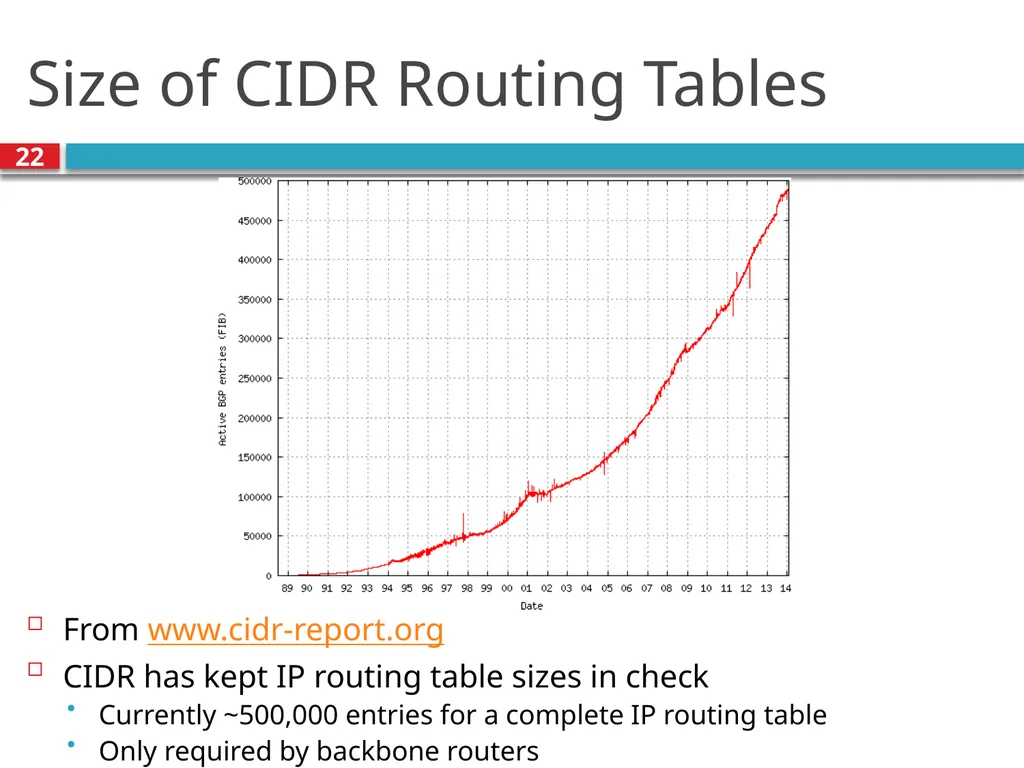
Size of CIDR Routing Tables 22 From www.cidr-report.org
CIDR has kept IP routing table sizes in check
Currently ~500,000 entries for a complete IP routing table
Only required by backbone routers<br>
CIDR has kept IP routing table sizes in check
Currently ~500,000 entries for a complete IP routing table
Only required by backbone routers<br>
23
We had a special day this summer! 23 512K day – August 12, 2014
Default threshold size for IPv4 route data in older Cisco routers 512K routes
Some routers failed over to slower memory
RAM vs. CAM (content addressable memory)
Some routes dropped
Cisco issues update in May anticipating this issue
Reallocated some IPv6 space for IPv4 routes
http://cacm.acm.org/news/178293-internet-routing-failures-bring-architecture-changes-back-to-the-table/fulltext<br>
Default threshold size for IPv4 route data in older Cisco routers 512K routes
Some routers failed over to slower memory
RAM vs. CAM (content addressable memory)
Some routes dropped
Cisco issues update in May anticipating this issue
Reallocated some IPv6 space for IPv4 routes
http://cacm.acm.org/news/178293-internet-routing-failures-bring-architecture-changes-back-to-the-table/fulltext<br>
24
How Do You Get IPs? 24 IP address ranges controlled by IANA
Internet Assigned Number Authority
Roots go back to 1972, ARPANET, UCLA
Today, part of ICANN
IANA grants IPs to regional authorities (RIRs)
E.g., RIPE (Europe, Middle East), ARIN (North America), APNIC (Asia/Pacific), AfriNIC (Africa), and LACNIC (Latin America) may grant you a range of IPs
You may then advertise routes to your new IP range
There are now secondary markets, auctions, …<br>
Internet Assigned Number Authority
Roots go back to 1972, ARPANET, UCLA
Today, part of ICANN
IANA grants IPs to regional authorities (RIRs)
E.g., RIPE (Europe, Middle East), ARIN (North America), APNIC (Asia/Pacific), AfriNIC (Africa), and LACNIC (Latin America) may grant you a range of IPs
You may then advertise routes to your new IP range
There are now secondary markets, auctions, …<br>
25
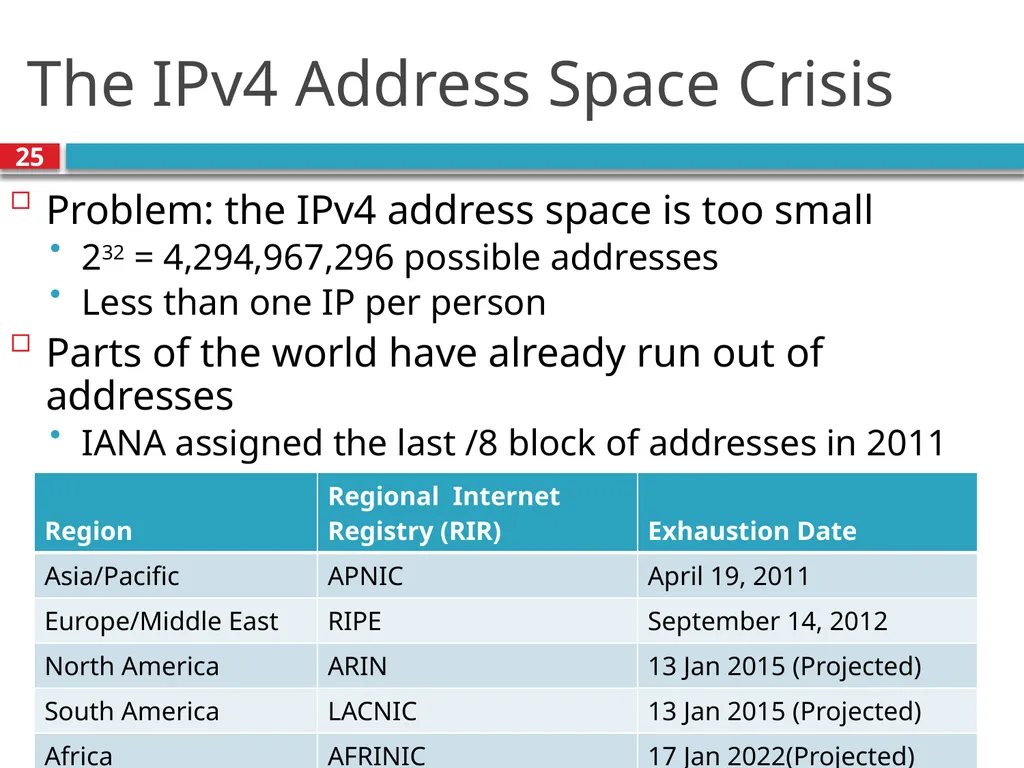
The IPv4 Address Space Crisis 25 Problem: the IPv4 address space is too small
232 = 4,294,967,296 possible addresses
Less than one IP per person
Parts of the world have already run out of addresses
IANA assigned the last /8 block of addresses in 2011<br>
232 = 4,294,967,296 possible addresses
Less than one IP per person
Parts of the world have already run out of addresses
IANA assigned the last /8 block of addresses in 2011<br>
26
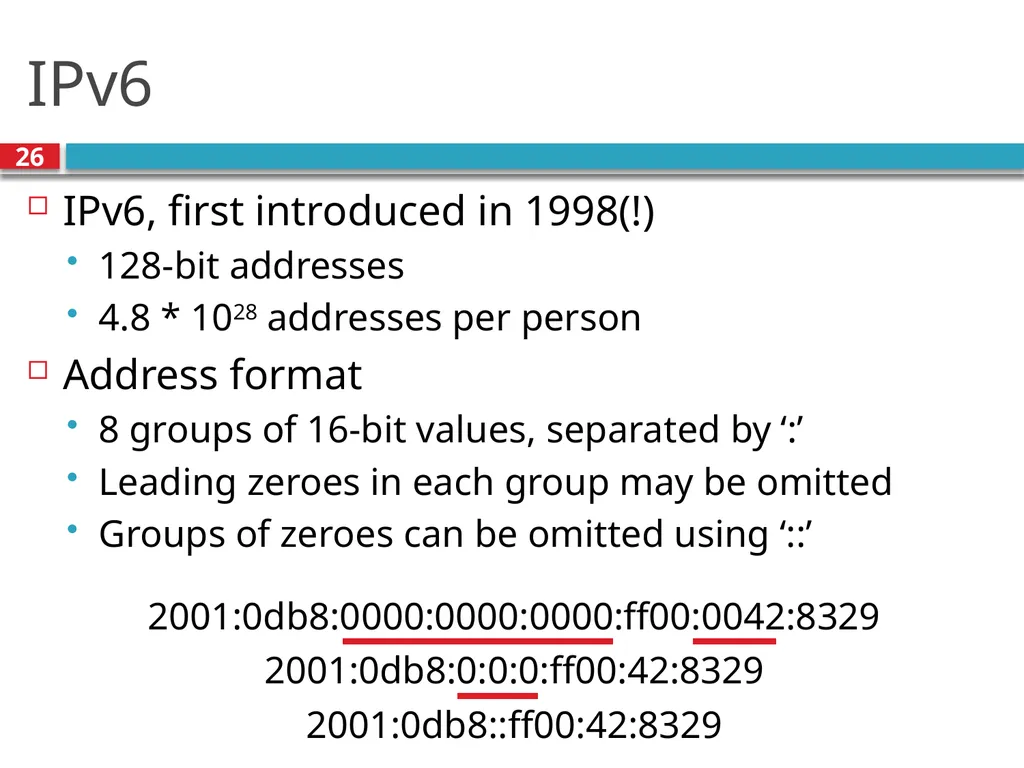
IPv6 26 IPv6, first introduced in 1998(!)
128-bit addresses
4.8 * 1028 addresses per person
Address format
8 groups of 16-bit values, separated by ‘:’
Leading zeroes in each group may be omitted
Groups of zeroes can be omitted using ‘::’
2001:0db8:0000:0000:0000:ff00:0042:8329
2001:0db8:0:0:0:ff00:42:8329
2001:0db8::ff00:42:8329<br>
128-bit addresses
4.8 * 1028 addresses per person
Address format
8 groups of 16-bit values, separated by ‘:’
Leading zeroes in each group may be omitted
Groups of zeroes can be omitted using ‘::’
2001:0db8:0000:0000:0000:ff00:0042:8329
2001:0db8:0:0:0:ff00:42:8329
2001:0db8::ff00:42:8329<br>
27
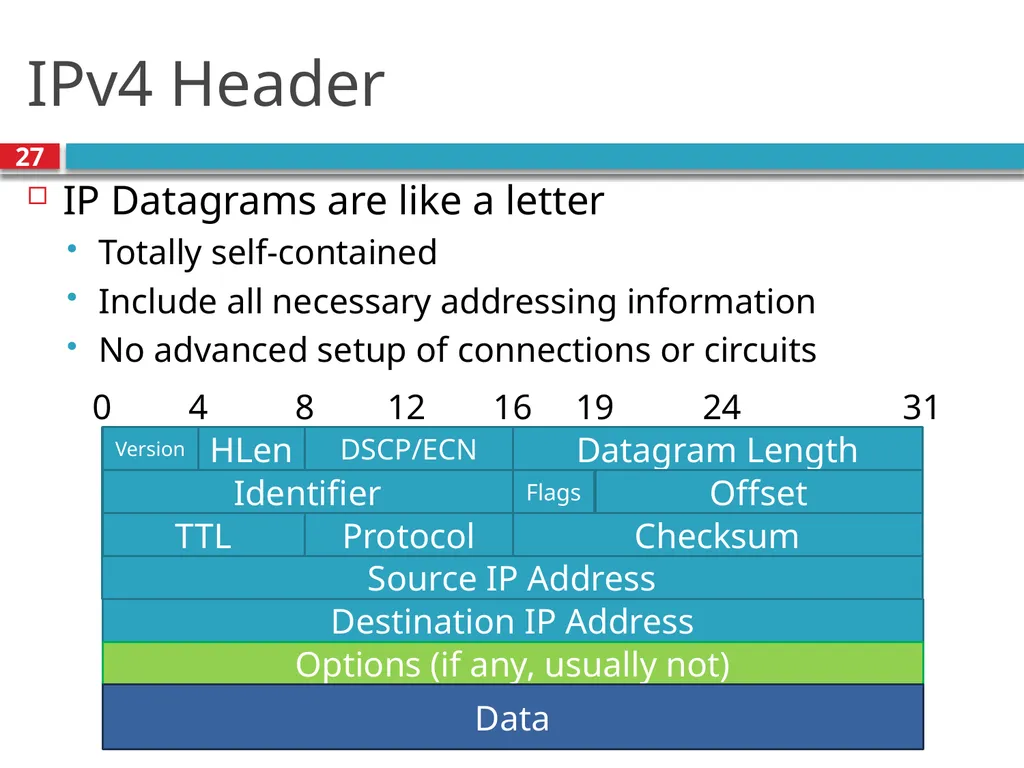
IPv4 Header 27 IP Datagrams are like a letter
Totally self-contained
Include all necessary addressing information
No advanced setup of connections or circuits Version HLen DSCP/ECN Datagram Length 0 8 16 24 31 4 12 19 Identifier Flags Offset TTL Protocol Checksum Source IP Address Destination IP Address Options (if any, usually not) Data<br>
Totally self-contained
Include all necessary addressing information
No advanced setup of connections or circuits Version HLen DSCP/ECN Datagram Length 0 8 16 24 31 4 12 19 Identifier Flags Offset TTL Protocol Checksum Source IP Address Destination IP Address Options (if any, usually not) Data<br>
28
IPv4 Header 28 IP Datagrams are like a letter
Totally self-contained
Include all necessary addressing information
No advanced setup of connections or circuits Version HLen DSCP/ECN Datagram Length 0 8 16 24 31 4 12 19 Identifier Flags Offset TTL Protocol Checksum Source IP Address Destination IP Address Options (if any, usually not) Data<br>
Totally self-contained
Include all necessary addressing information
No advanced setup of connections or circuits Version HLen DSCP/ECN Datagram Length 0 8 16 24 31 4 12 19 Identifier Flags Offset TTL Protocol Checksum Source IP Address Destination IP Address Options (if any, usually not) Data<br>
29
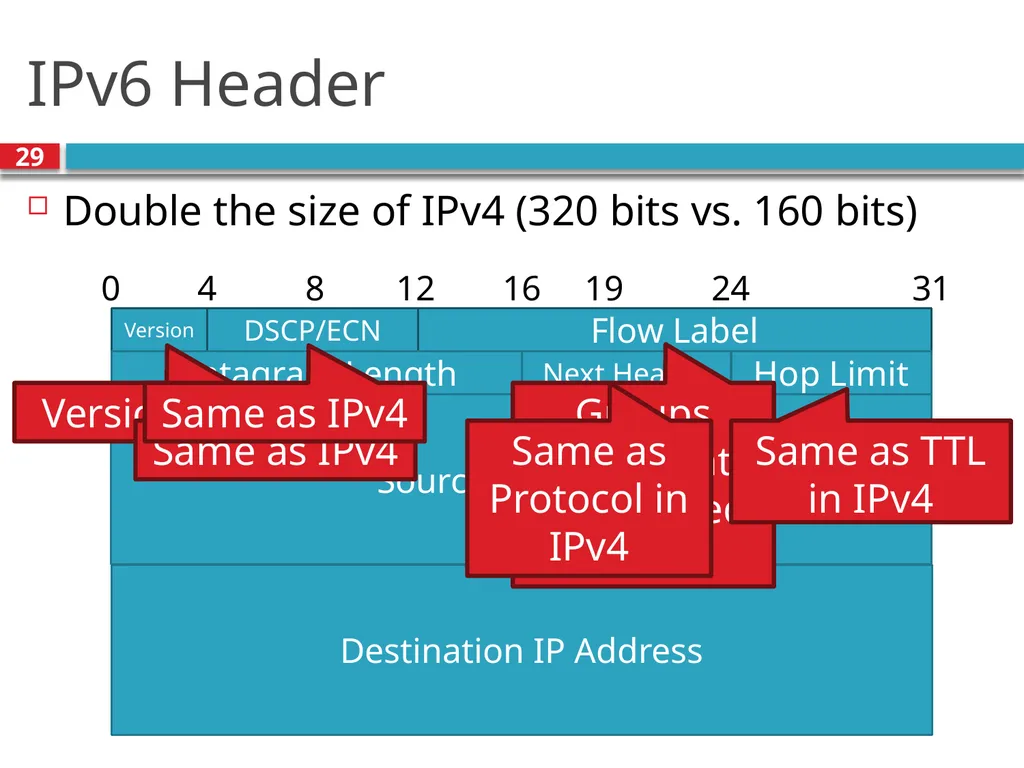
IPv6 Header 29 Double the size of IPv4 (320 bits vs. 160 bits) Version DSCP/ECN Flow Label 0 8 16 24 31 4 12 19 Datagram Length Next Header Hop Limit Source IP Address Destination IP Address<br>
30
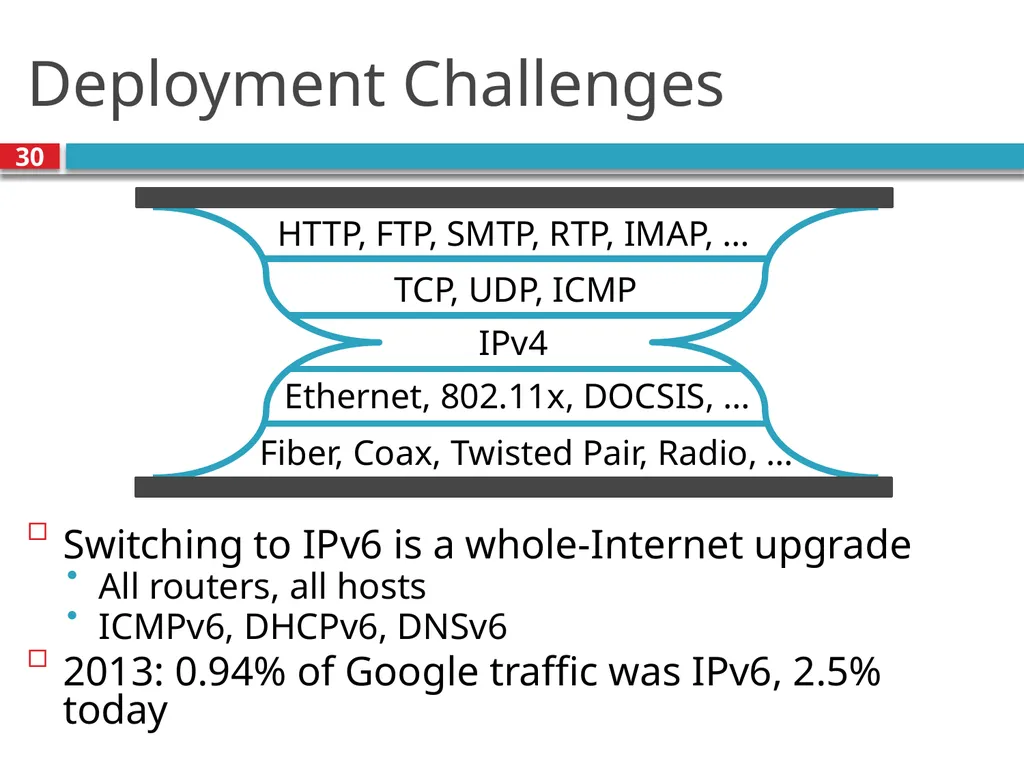
Deployment Challenges 30 Switching to IPv6 is a whole-Internet upgrade
All routers, all hosts
ICMPv6, DHCPv6, DNSv6
2013: 0.94% of Google traffic was IPv6, 2.5% today IPv4 TCP, UDP, ICMP HTTP, FTP, SMTP, RTP, IMAP, … Ethernet, 802.11x, DOCSIS, … Fiber, Coax, Twisted Pair, Radio, …<br>
All routers, all hosts
ICMPv6, DHCPv6, DNSv6
2013: 0.94% of Google traffic was IPv6, 2.5% today IPv4 TCP, UDP, ICMP HTTP, FTP, SMTP, RTP, IMAP, … Ethernet, 802.11x, DOCSIS, … Fiber, Coax, Twisted Pair, Radio, …<br>
31
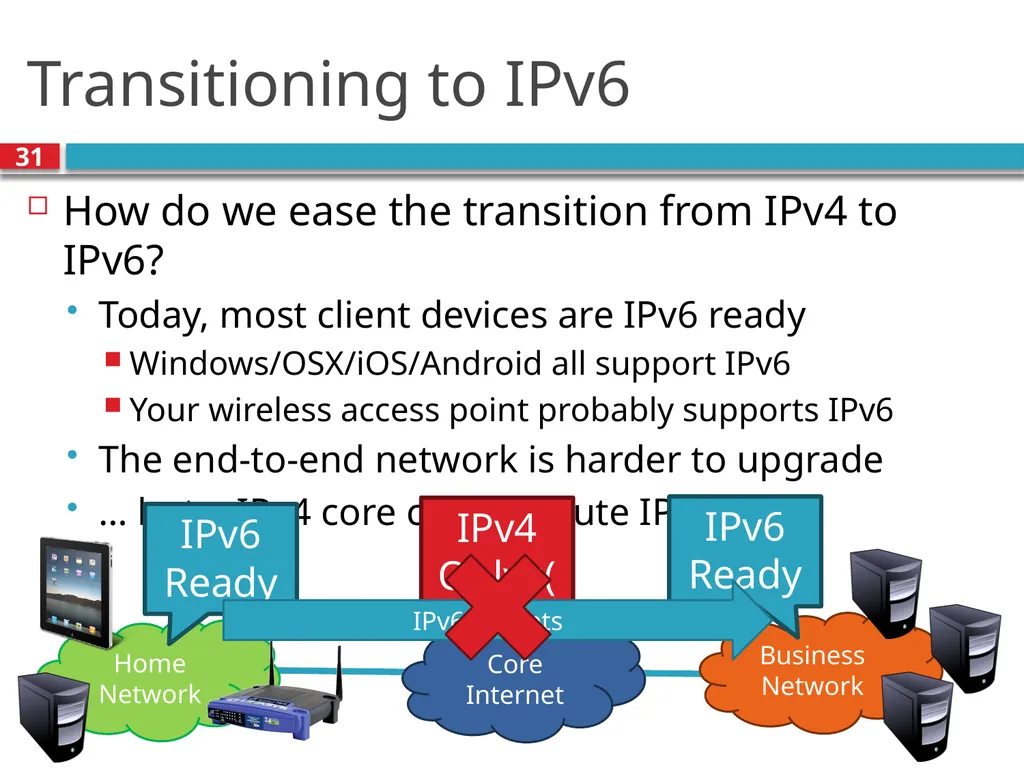
Transitioning to IPv6 31 How do we ease the transition from IPv4 to IPv6?
Today, most client devices are IPv6 ready
Windows/OSX/iOS/Android all support IPv6
Your wireless access point probably supports IPv6
The end-to-end network is harder to upgrade
… but a IPv4 core cannot route IPv6 traffic Core
Internet Business
Network Home
Network IPv6 Packets<br>
Today, most client devices are IPv6 ready
Windows/OSX/iOS/Android all support IPv6
Your wireless access point probably supports IPv6
The end-to-end network is harder to upgrade
… but a IPv4 core cannot route IPv6 traffic Core
Internet Business
Network Home
Network IPv6 Packets<br>
32
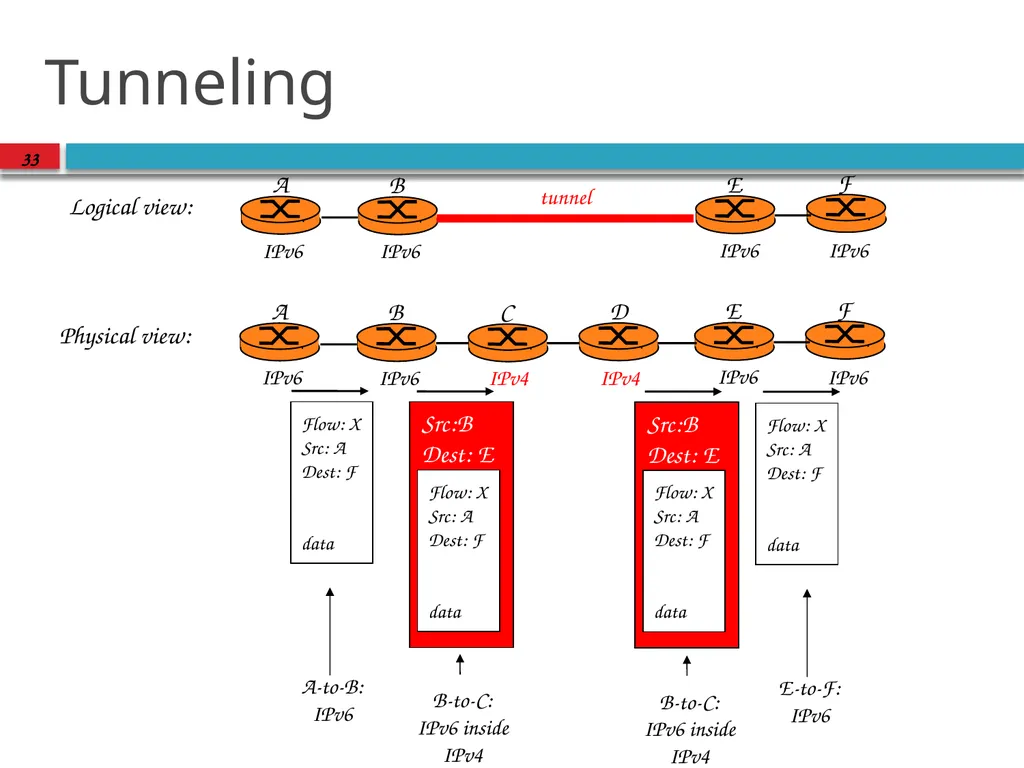
Transition Technologies 32 How do you route IPv6 packets over an IPv4 Internet?
Transition Technologies
Use tunnels to encapsulate and route IPv6 packets over the IPv4 Internet
Several different implementations
6to4
IPv6 Rapid Deployment (6rd)
Teredo
… etc.<br>
Transition Technologies
Use tunnels to encapsulate and route IPv6 packets over the IPv4 Internet
Several different implementations
6to4
IPv6 Rapid Deployment (6rd)
Teredo
… etc.<br>
33
33 Tunneling IPv6 IPv6 IPv6 IPv6 tunnel Logical view: Physical view: IPv6 IPv6 IPv6 IPv6 IPv4 IPv4 A-to-B:
IPv6 E-to-F:
IPv6 B-to-C:
IPv6 inside
IPv4 B-to-C:
IPv6 inside
IPv4<br>
IPv6 E-to-F:
IPv6 B-to-C:
IPv6 inside
IPv4 B-to-C:
IPv6 inside
IPv4<br>
34
34<br>
35
35<br>
36
More slides … 36<br>
37
37<br>
38
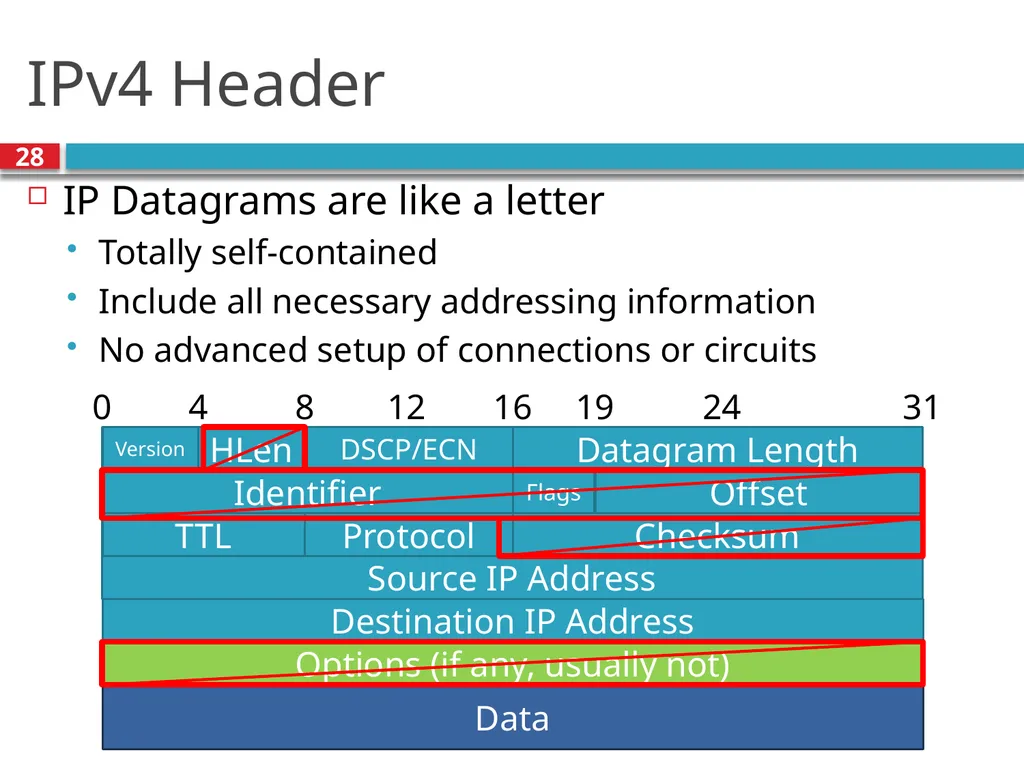
Differences from IPv4 Header 38 Several header fields are missing in IPv6
Header length – rolled into Next Header field
Checksum – was useless, so why keep it
Identifier, Flags, Offset
IPv6 routers do not support fragmentation
Hosts are expected to use path MTU discovery
Reflects changing Internet priorities
Today’s networks are more homogeneous
Instead, routing cost and complexity dominate<br>
Header length – rolled into Next Header field
Checksum – was useless, so why keep it
Identifier, Flags, Offset
IPv6 routers do not support fragmentation
Hosts are expected to use path MTU discovery
Reflects changing Internet priorities
Today’s networks are more homogeneous
Instead, routing cost and complexity dominate<br>
39
Performance Improvements 39 No checksums to verify
No need for routers to handle fragmentation
Simplified routing table design
Address space is huge
No need for CIDR (but need for aggregation)
Standard subnet size is 264 addresses
Simplified auto-configuration<br>
No need for routers to handle fragmentation
Simplified routing table design
Address space is huge
No need for CIDR (but need for aggregation)
Standard subnet size is 264 addresses
Simplified auto-configuration<br>
40
Additional IPv6 Features 40 Source Routing
Host specifies the route to wants packet to take
Mobile IP
Hosts can take their IP with them to other networks
Use source routing to direct packets
Privacy Extensions
Randomly generate host identifiers
Make it difficult to associate one IP to a host
Jumbograms
Support for 4Gb datagrams<br>
Host specifies the route to wants packet to take
Mobile IP
Hosts can take their IP with them to other networks
Use source routing to direct packets
Privacy Extensions
Randomly generate host identifiers
Make it difficult to associate one IP to a host
Jumbograms
Support for 4Gb datagrams<br>
41
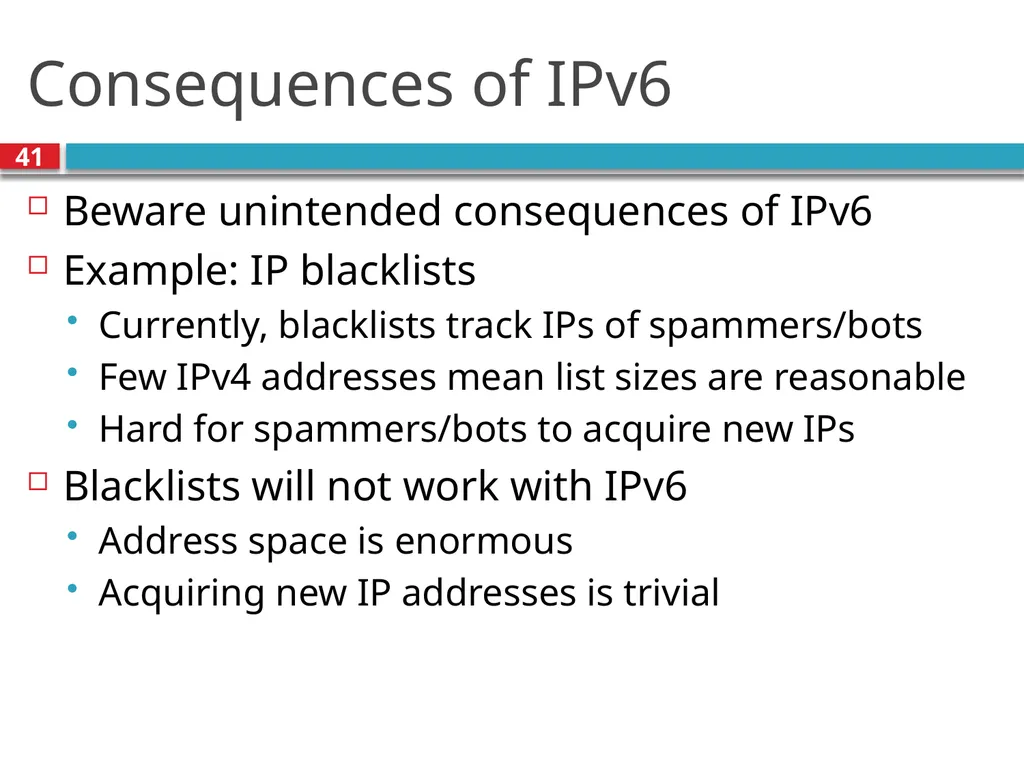
Consequences of IPv6 41 Beware unintended consequences of IPv6
Example: IP blacklists
Currently, blacklists track IPs of spammers/bots
Few IPv4 addresses mean list sizes are reasonable
Hard for spammers/bots to acquire new IPs
Blacklists will not work with IPv6
Address space is enormous
Acquiring new IP addresses is trivial<br>
Example: IP blacklists
Currently, blacklists track IPs of spammers/bots
Few IPv4 addresses mean list sizes are reasonable
Hard for spammers/bots to acquire new IPs
Blacklists will not work with IPv6
Address space is enormous
Acquiring new IP addresses is trivial<br>
42
42<br>
43
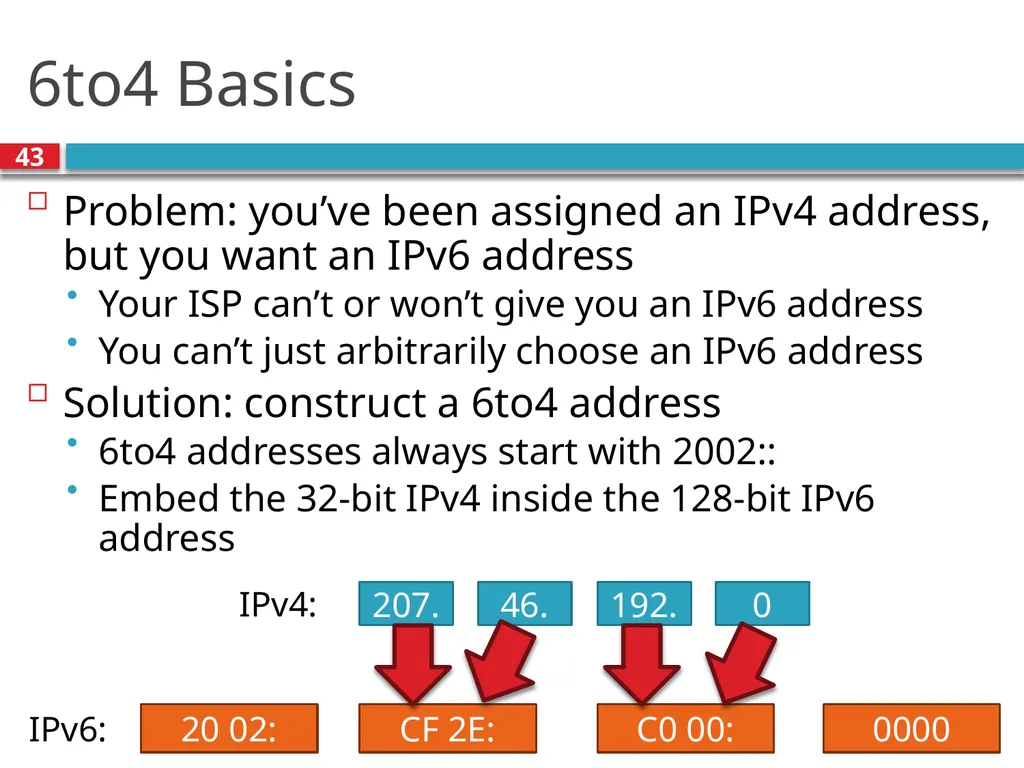
6to4 Basics 43 Problem: you’ve been assigned an IPv4 address, but you want an IPv6 address
Your ISP can’t or won’t give you an IPv6 address
You can’t just arbitrarily choose an IPv6 address
Solution: construct a 6to4 address
6to4 addresses always start with 2002::
Embed the 32-bit IPv4 inside the 128-bit IPv6 address 20 02: 207. CF 2E: 46. C0 00: 192. 0000 0 IPv4: IPv6:<br>
Your ISP can’t or won’t give you an IPv6 address
You can’t just arbitrarily choose an IPv6 address
Solution: construct a 6to4 address
6to4 addresses always start with 2002::
Embed the 32-bit IPv4 inside the 128-bit IPv6 address 20 02: 207. CF 2E: 46. C0 00: 192. 0000 0 IPv4: IPv6:<br>
44
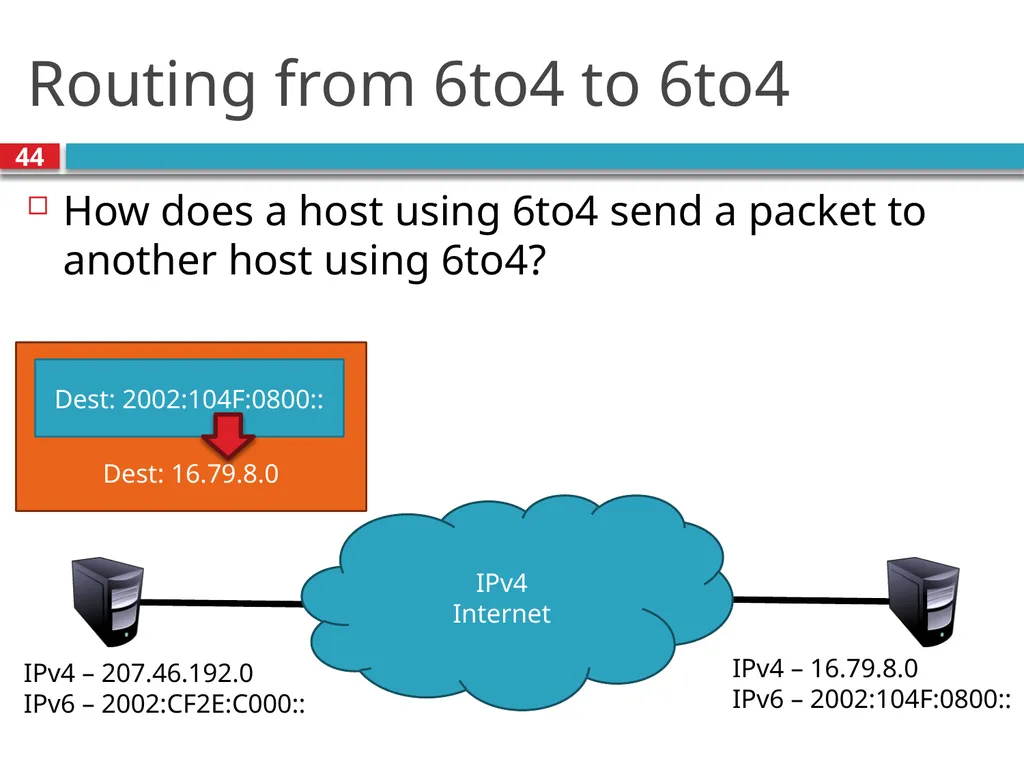
IPv4
Internet Dest: 16.79.8.0 Routing from 6to4 to 6to4 44 IPv4 – 207.46.192.0
IPv6 – 2002:CF2E:C000:: IPv4 – 16.79.8.0
IPv6 – 2002:104F:0800:: Dest: 2002:104F:0800:: How does a host using 6to4 send a packet to another host using 6to4?<br>
Internet Dest: 16.79.8.0 Routing from 6to4 to 6to4 44 IPv4 – 207.46.192.0
IPv6 – 2002:CF2E:C000:: IPv4 – 16.79.8.0
IPv6 – 2002:104F:0800:: Dest: 2002:104F:0800:: How does a host using 6to4 send a packet to another host using 6to4?<br>
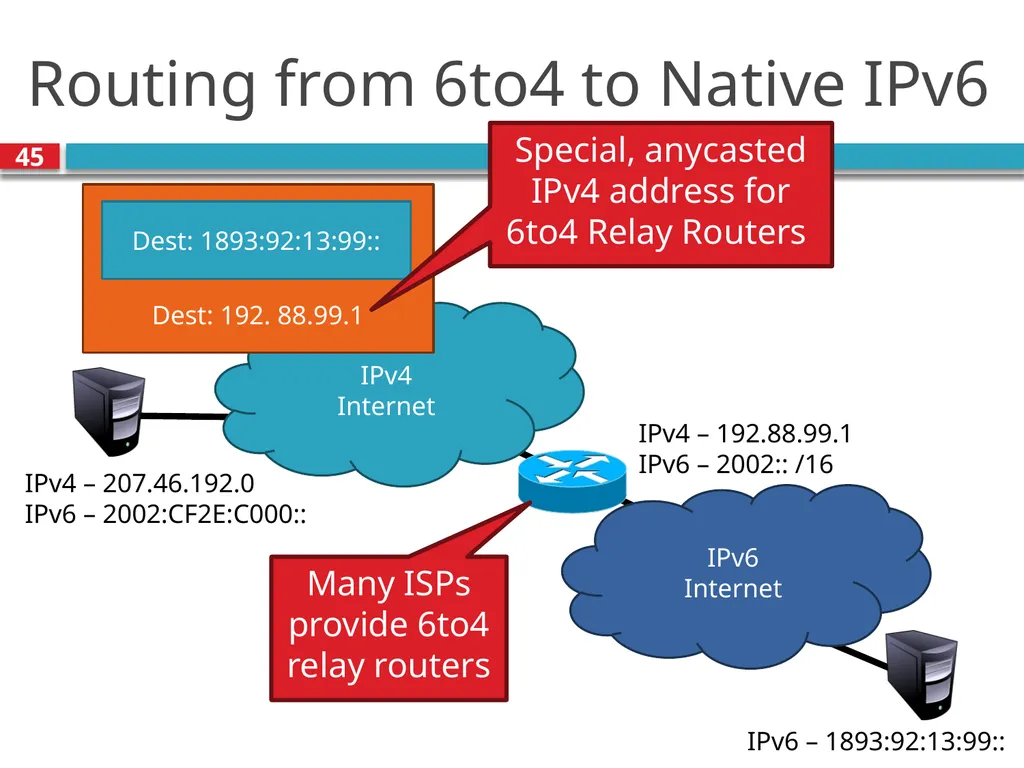
45
IPv4 – 192.88.99.1
IPv6 – 2002:: /16 IPv4
Internet IPv6
Internet Dest: 192. 88.99.1 Routing from 6to4 to Native IPv6 45 IPv4 – 207.46.192.0
IPv6 – 2002:CF2E:C000:: IPv6 – 1893:92:13:99:: Dest: 1893:92:13:99::<br>
IPv6 – 2002:: /16 IPv4
Internet IPv6
Internet Dest: 192. 88.99.1 Routing from 6to4 to Native IPv6 45 IPv4 – 207.46.192.0
IPv6 – 2002:CF2E:C000:: IPv6 – 1893:92:13:99:: Dest: 1893:92:13:99::<br>
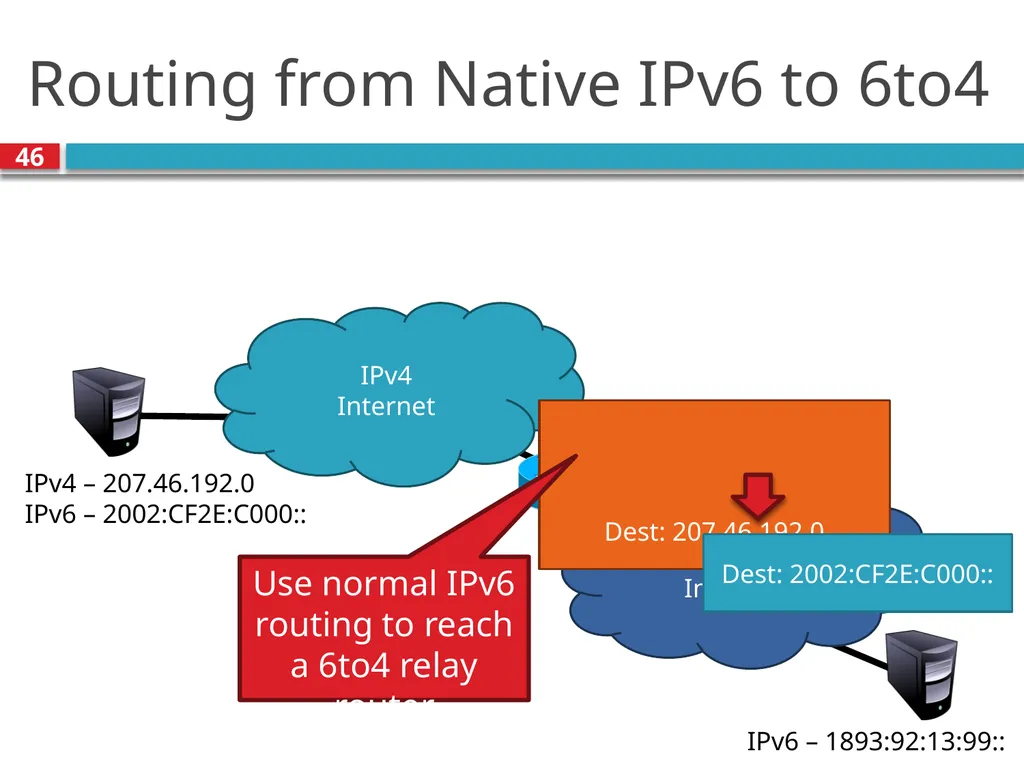
46
Routing from Native IPv6 to 6to4 46 IPv4 – 192.88.99.1
IPv6 – 2002:: /16 IPv4
Internet IPv6
Internet Dest: 207.46.192.0 IPv4 – 207.46.192.0
IPv6 – 2002:CF2E:C000:: IPv6 – 1893:92:13:99:: Dest: 2002:CF2E:C000::<br>
IPv6 – 2002:: /16 IPv4
Internet IPv6
Internet Dest: 207.46.192.0 IPv4 – 207.46.192.0
IPv6 – 2002:CF2E:C000:: IPv6 – 1893:92:13:99:: Dest: 2002:CF2E:C000::<br>
47
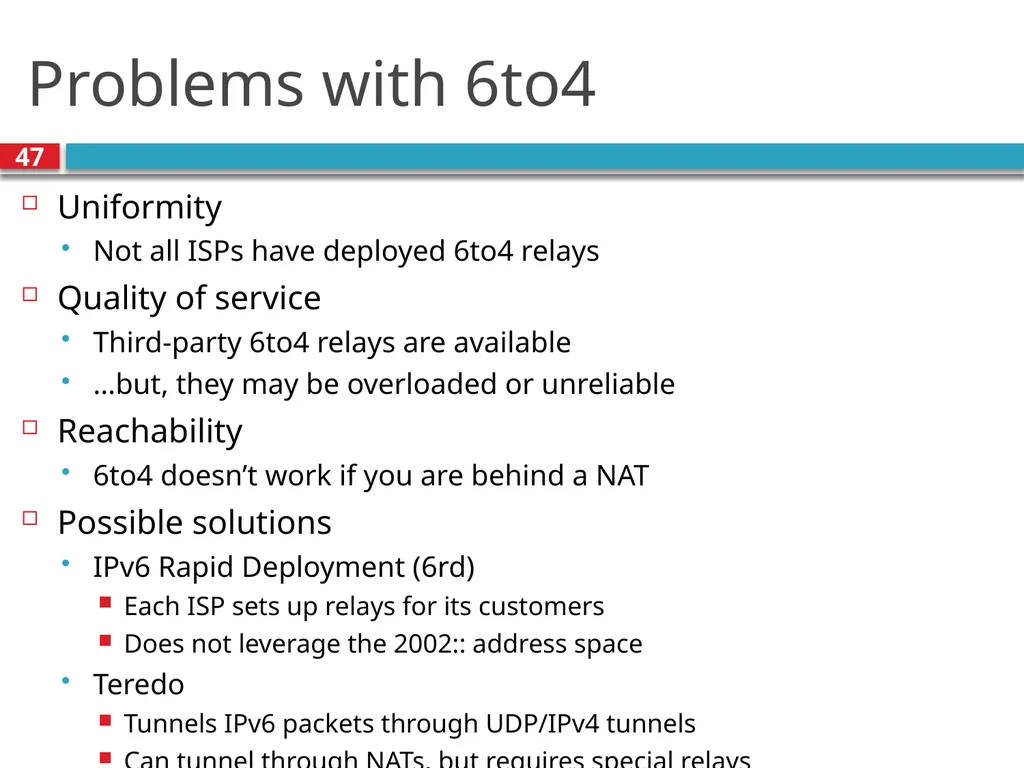
Problems with 6to4 47 Uniformity
Not all ISPs have deployed 6to4 relays
Quality of service
Third-party 6to4 relays are available
…but, they may be overloaded or unreliable
Reachability
6to4 doesn’t work if you are behind a NAT
Possible solutions
IPv6 Rapid Deployment (6rd)
Each ISP sets up relays for its customers
Does not leverage the 2002:: address space
Teredo
Tunnels IPv6 packets through UDP/IPv4 tunnels
Can tunnel through NATs, but requires special relays<br>
Not all ISPs have deployed 6to4 relays
Quality of service
Third-party 6to4 relays are available
…but, they may be overloaded or unreliable
Reachability
6to4 doesn’t work if you are behind a NAT
Possible solutions
IPv6 Rapid Deployment (6rd)
Each ISP sets up relays for its customers
Does not leverage the 2002:: address space
Teredo
Tunnels IPv6 packets through UDP/IPv4 tunnels
Can tunnel through NATs, but requires special relays<br>
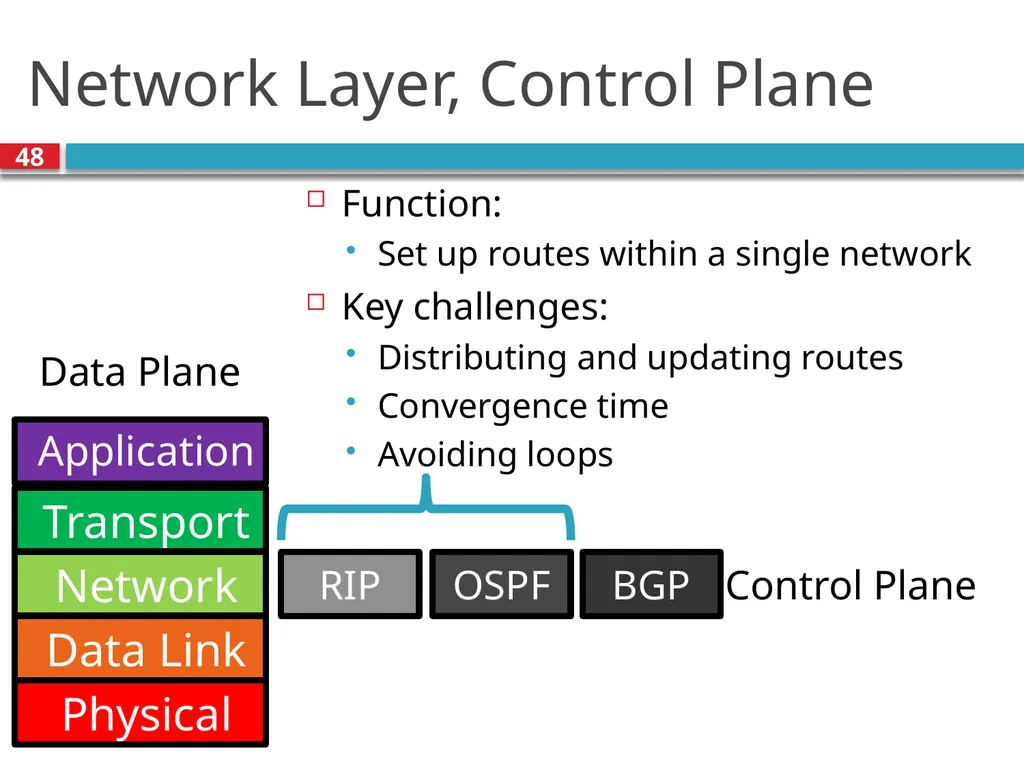
48
Network Layer, Control Plane 48 Function:
Set up routes within a single network
Key challenges:
Distributing and updating routes
Convergence time
Avoiding loops Application Transport Network Data Link Physical BGP RIP OSPF Control Plane Data Plane<br>
Set up routes within a single network
Key challenges:
Distributing and updating routes
Convergence time
Avoiding loops Application Transport Network Data Link Physical BGP RIP OSPF Control Plane Data Plane<br>
49
Internet Routing Internet organized as a two level hierarchy
First level – autonomous systems (AS’s)
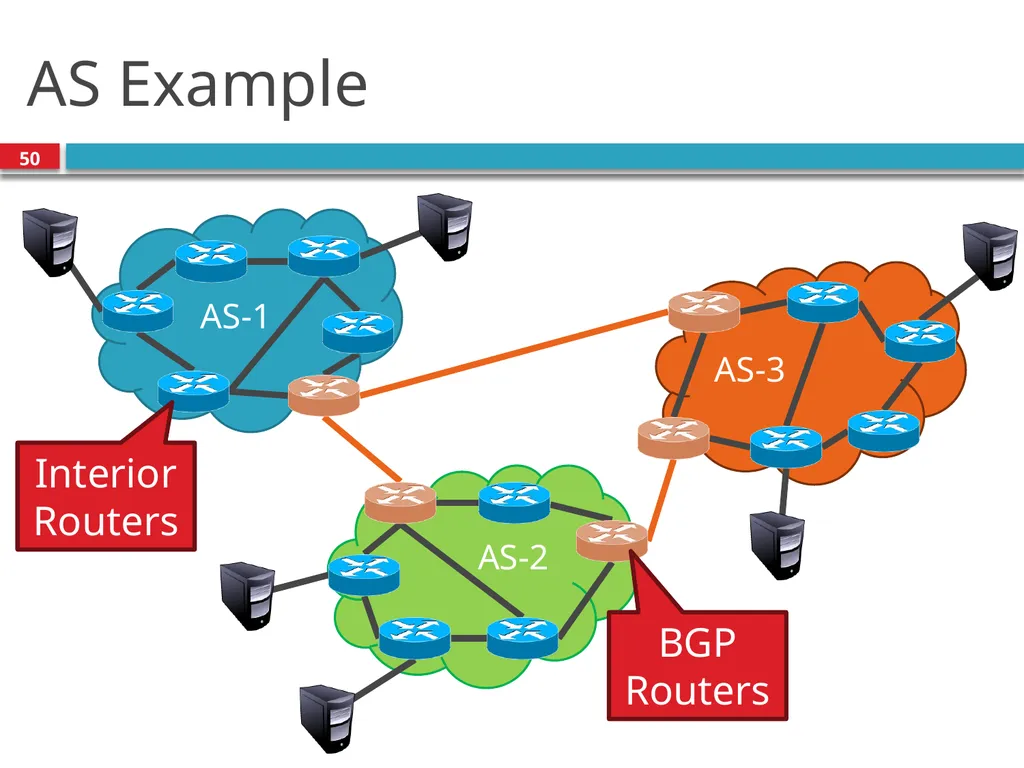
AS – region of network under a single administrative domain
Examples: Comcast, AT&T, Verizon, Sprint, etc.
AS’s use intra-domain routing protocols internally
Distance Vector, e.g., Routing Information Protocol (RIP)
Link State, e.g., Open Shortest Path First (OSPF)
Connections between AS’s use inter-domain routing protocols
Border Gateway Routing (BGP)
De facto standard today, BGP-4 49<br>
First level – autonomous systems (AS’s)
AS – region of network under a single administrative domain
Examples: Comcast, AT&T, Verizon, Sprint, etc.
AS’s use intra-domain routing protocols internally
Distance Vector, e.g., Routing Information Protocol (RIP)
Link State, e.g., Open Shortest Path First (OSPF)
Connections between AS’s use inter-domain routing protocols
Border Gateway Routing (BGP)
De facto standard today, BGP-4 49<br>
50
AS Example 50 AS-1 AS-2 AS-3<br>
51
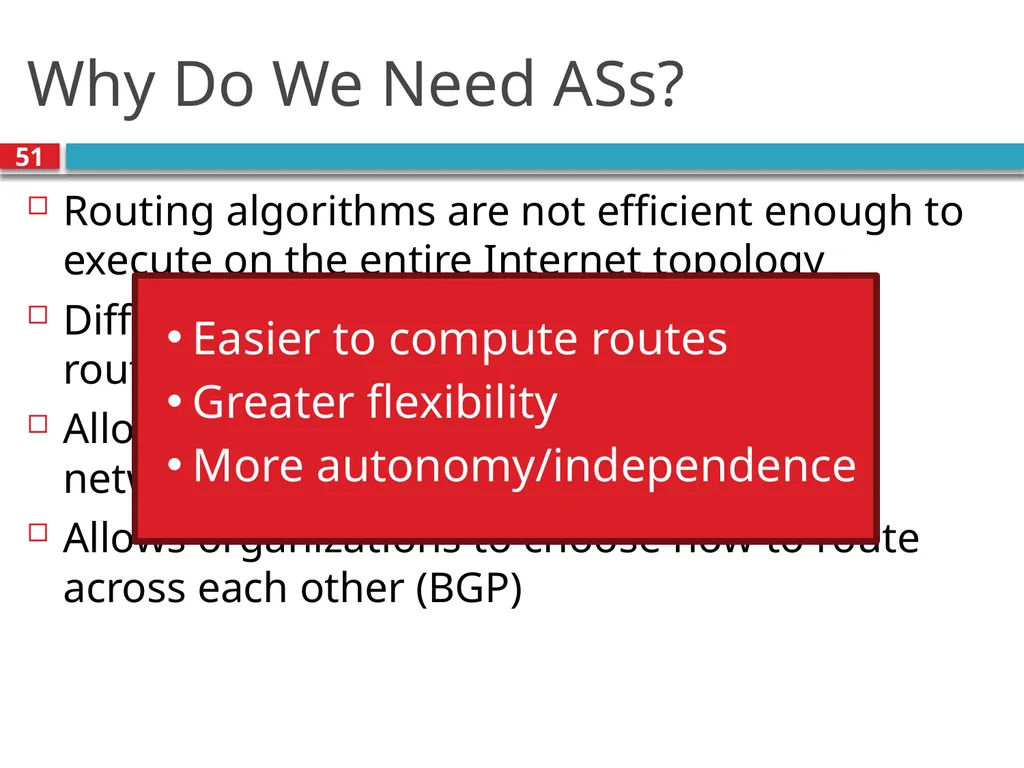
Why Do We Need ASs? 51 Routing algorithms are not efficient enough to execute on the entire Internet topology
Different organizations may use different routing policies
Allows organizations to hide their internal network structure
Allows organizations to choose how to route across each other (BGP)<br>
Different organizations may use different routing policies
Allows organizations to hide their internal network structure
Allows organizations to choose how to route across each other (BGP)<br>
52
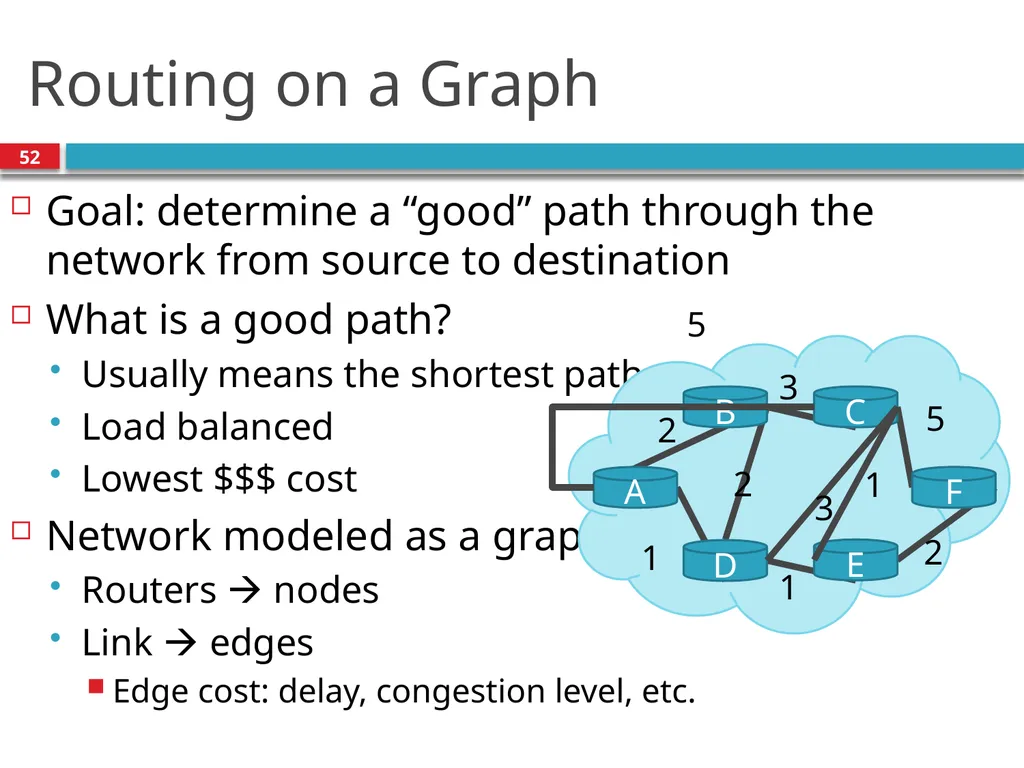
Routing on a Graph Goal: determine a “good” path through the network from source to destination
What is a good path?
Usually means the shortest path
Load balanced
Lowest $$$ cost
Network modeled as a graph
Routers nodes
Link edges
Edge cost: delay, congestion level, etc. A B C D E F 5 2 3 5 2 1 1 2 3 1 52<br>
What is a good path?
Usually means the shortest path
Load balanced
Lowest $$$ cost
Network modeled as a graph
Routers nodes
Link edges
Edge cost: delay, congestion level, etc. A B C D E F 5 2 3 5 2 1 1 2 3 1 52<br>
53
Routing Problems Assume
A network with N nodes
Each node only knows
Its immediate neighbors
The cost to reach each neighbor
How does each node learn the shortest path to every other node? A B C D E F 5 2 3 5 2 1 1 2 3 1 53<br>
A network with N nodes
Each node only knows
Its immediate neighbors
The cost to reach each neighbor
How does each node learn the shortest path to every other node? A B C D E F 5 2 3 5 2 1 1 2 3 1 53<br>
54
Intra-domain Routing Protocols Distance vector
Routing Information Protocol (RIP), based on Bellman-Ford
Routers periodically exchange reachability information with neighbors
Link state
Open Shortest Path First (OSPF), based on Dijkstra
Each network periodically floods immediate reachability information to all other routers
Per router local computation to determine full routes 54 54<br>
Routing Information Protocol (RIP), based on Bellman-Ford
Routers periodically exchange reachability information with neighbors
Link state
Open Shortest Path First (OSPF), based on Dijkstra
Each network periodically floods immediate reachability information to all other routers
Per router local computation to determine full routes 54 54<br>
55
Distance Vector Routing
RIP
Link State Routing
OSPF
IS-IS Outline 55<br>
RIP
Link State Routing
OSPF
IS-IS Outline 55<br>
56
Distance Vector Routing 56 What is a distance vector?
Current best known cost to reach a destination
Idea: exchange vectors among neighbors to learn about lowest cost paths Routing Information Protocol (RIP) DV Table
at Node C No entry for C
Initially, only has info for immediate neighbors
Other destinations cost = ∞
Eventually, vector is filled<br>
Current best known cost to reach a destination
Idea: exchange vectors among neighbors to learn about lowest cost paths Routing Information Protocol (RIP) DV Table
at Node C No entry for C
Initially, only has info for immediate neighbors
Other destinations cost = ∞
Eventually, vector is filled<br>
57
Distance Vector Routing Algorithm 57 Wait for change in local link cost or message from neighbor
Recompute distance table
If least cost path to any destination has changed, notify neighbors<br>
Recompute distance table
If least cost path to any destination has changed, notify neighbors<br>
58
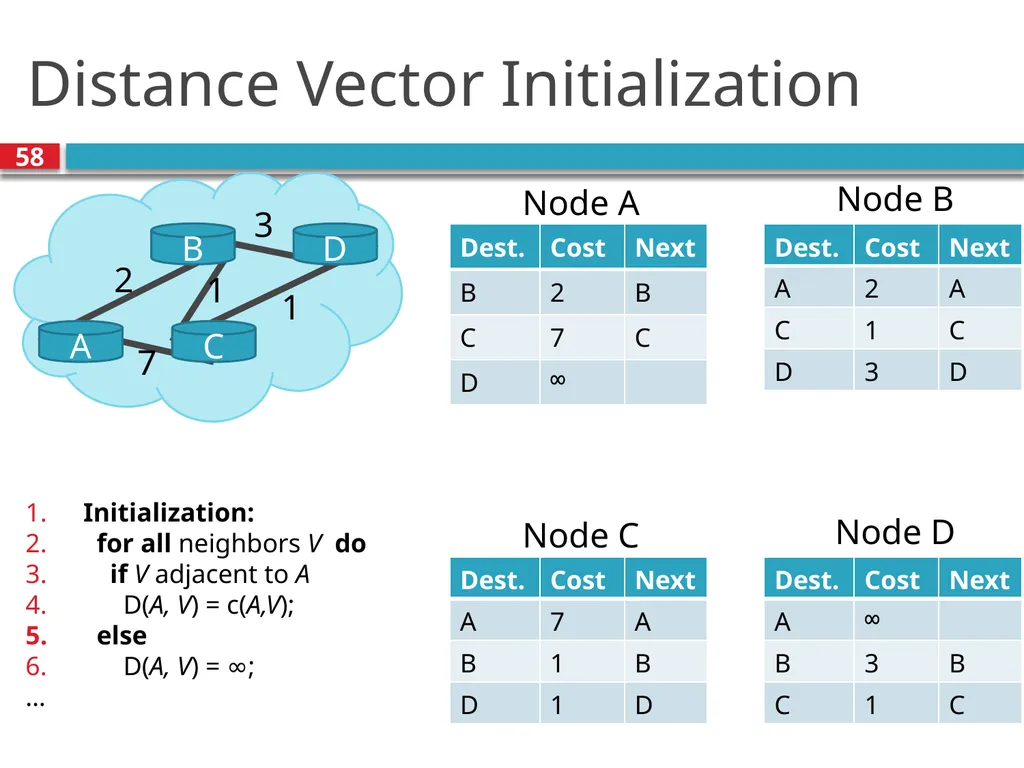
Distance Vector Initialization 58 2 3 1 A B C D 1 7 Node A Node B Node C Node D Initialization:
for all neighbors V do
if V adjacent to A
D(A, V) = c(A,V);
else
D(A, V) = ∞;
…<br>
for all neighbors V do
if V adjacent to A
D(A, V) = c(A,V);
else
D(A, V) = ∞;
…<br>
59
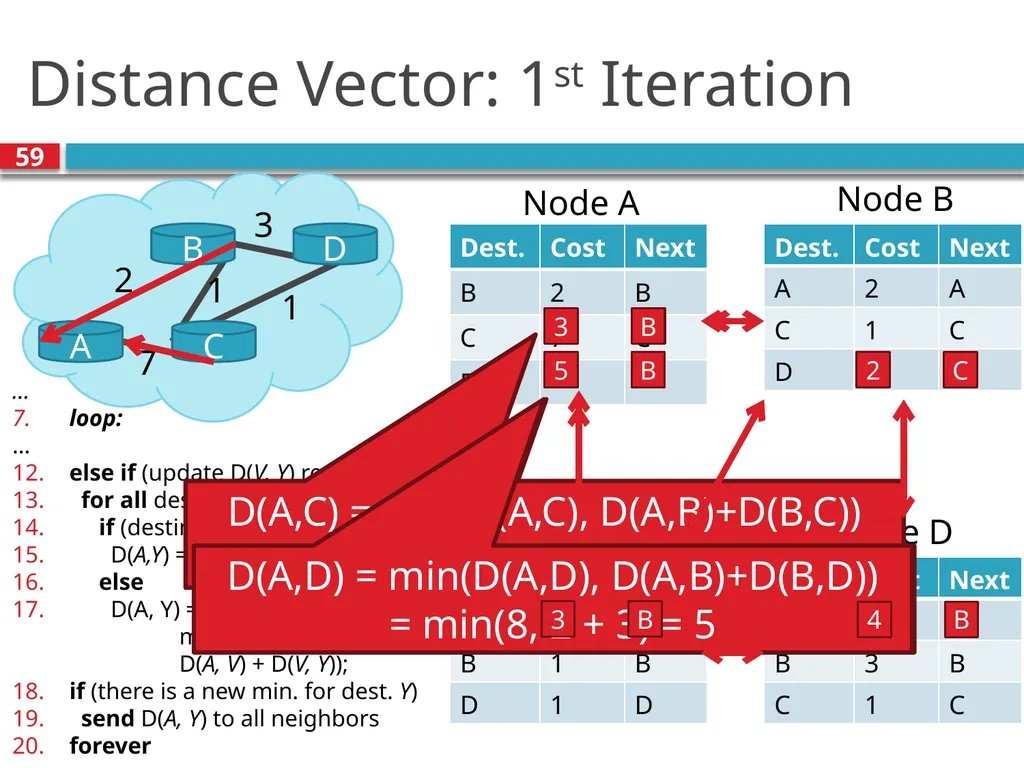
Distance Vector: 1st Iteration 59 2 3 1 A B C D 1 7 Node A Node B Node C Node D …
loop:
…
else if (update D(V, Y) received from V)
for all destinations Y do
if (destination Y through V)
D(A,Y) = D(A,V) + D(V, Y);
else
D(A, Y) =
min(D(A, Y),
D(A, V) + D(V, Y));
if (there is a new min. for dest. Y)
send D(A, Y) to all neighbors
forever<br>
loop:
…
else if (update D(V, Y) received from V)
for all destinations Y do
if (destination Y through V)
D(A,Y) = D(A,V) + D(V, Y);
else
D(A, Y) =
min(D(A, Y),
D(A, V) + D(V, Y));
if (there is a new min. for dest. Y)
send D(A, Y) to all neighbors
forever<br>
60
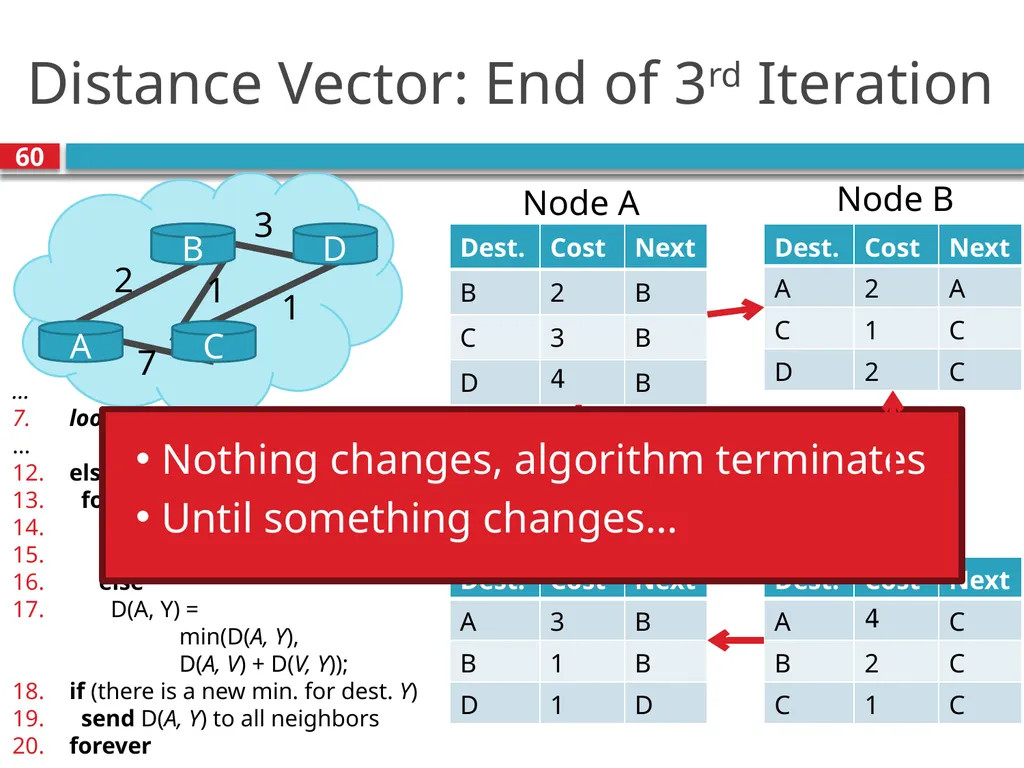
Distance Vector: End of 3rd Iteration 60 2 3 1 A B C D 1 7 Node A Node B Node C Node D …
loop:
…
else if (update D(V, Y) received from V)
for all destinations Y do
if (destination Y through V)
D(A,Y) = D(A,V) + D(V, Y);
else
D(A, Y) =
min(D(A, Y),
D(A, V) + D(V, Y));
if (there is a new min. for dest. Y)
send D(A, Y) to all neighbors
forever<br>
loop:
…
else if (update D(V, Y) received from V)
for all destinations Y do
if (destination Y through V)
D(A,Y) = D(A,V) + D(V, Y);
else
D(A, Y) =
min(D(A, Y),
D(A, V) + D(V, Y));
if (there is a new min. for dest. Y)
send D(A, Y) to all neighbors
forever<br>
61
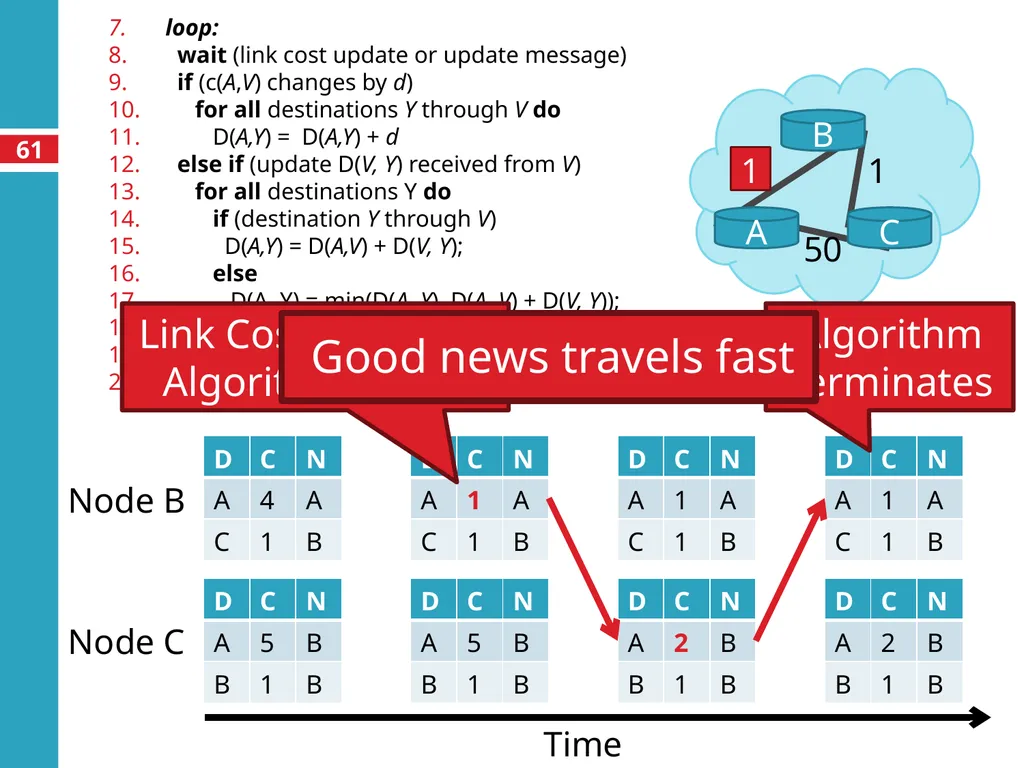
61 4 1 A B C 50 loop:
wait (link cost update or update message)
if (c(A,V) changes by d)
for all destinations Y through V do
D(A,Y) = D(A,Y) + d
else if (update D(V, Y) received from V)
for all destinations Y do
if (destination Y through V)
D(A,Y) = D(A,V) + D(V, Y);
else
D(A, Y) = min(D(A, Y), D(A, V) + D(V, Y));
if (there is a new minimum for destination Y)
send D(A, Y) to all neighbors
forever Node B Node C Time<br>
wait (link cost update or update message)
if (c(A,V) changes by d)
for all destinations Y through V do
D(A,Y) = D(A,Y) + d
else if (update D(V, Y) received from V)
for all destinations Y do
if (destination Y through V)
D(A,Y) = D(A,V) + D(V, Y);
else
D(A, Y) = min(D(A, Y), D(A, V) + D(V, Y));
if (there is a new minimum for destination Y)
send D(A, Y) to all neighbors
forever Node B Node C Time<br>
62
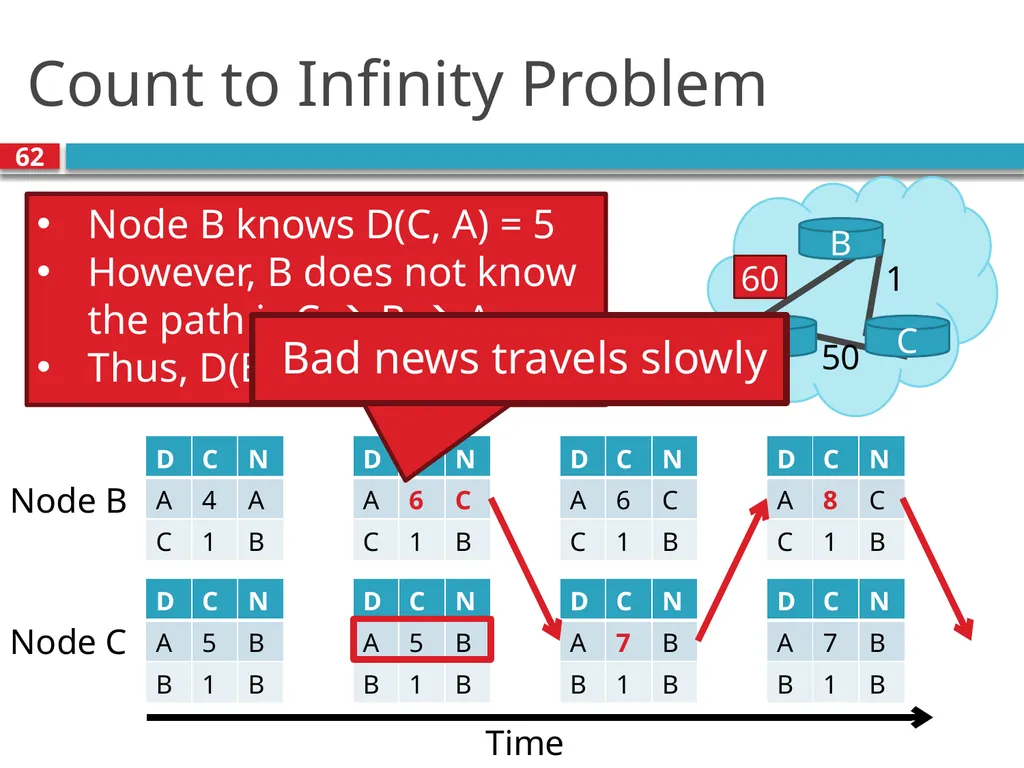
Count to Infinity Problem 62 4 1 A B C 50 Node B Node C Time<br>
63
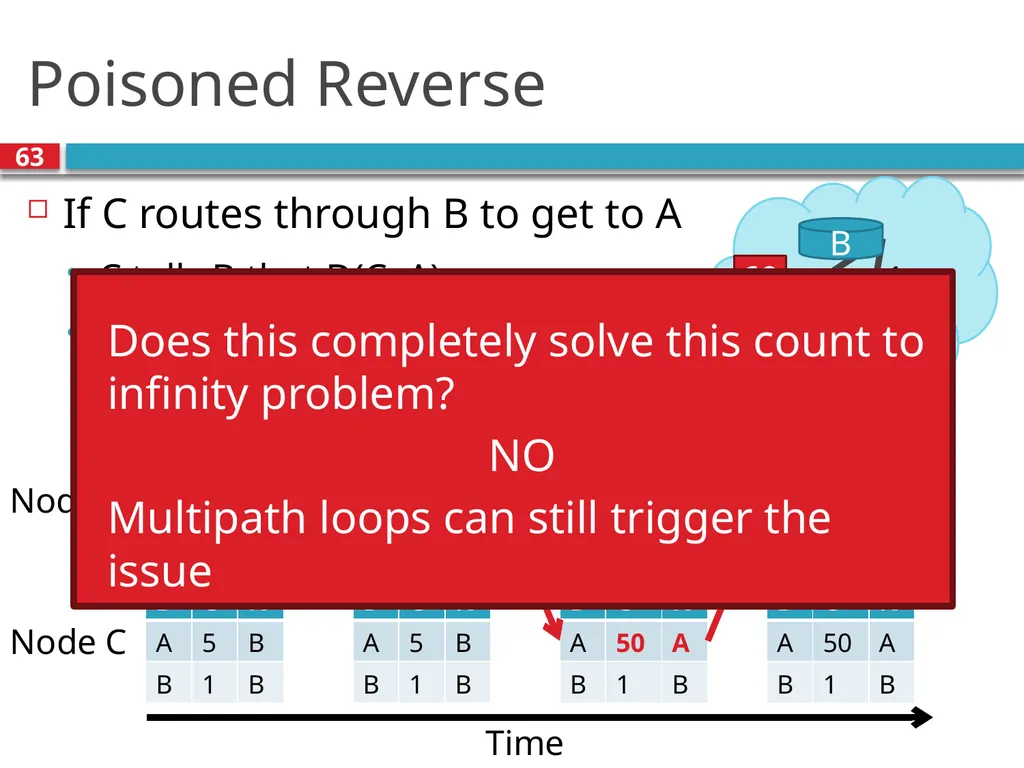
Poisoned Reverse 63 4 1 A B C 50 Node B Node C Time If C routes through B to get to A
C tells B that D(C, A) = ∞
Thus, B won’t route to A via C<br>
C tells B that D(C, A) = ∞
Thus, B won’t route to A via C<br>
64
Distance Vector Routing
RIP
Link State Routing
OSPF
IS-IS Outline 64<br>
RIP
Link State Routing
OSPF
IS-IS Outline 64<br>
65
Each node knows its connectivity and cost to direct neighbors
Each node tells every other node this information
Each node learns complete network topology
Use Dijkstra to compute shortest paths Link State Routing 65<br>
Each node tells every other node this information
Each node learns complete network topology
Use Dijkstra to compute shortest paths Link State Routing 65<br>
66
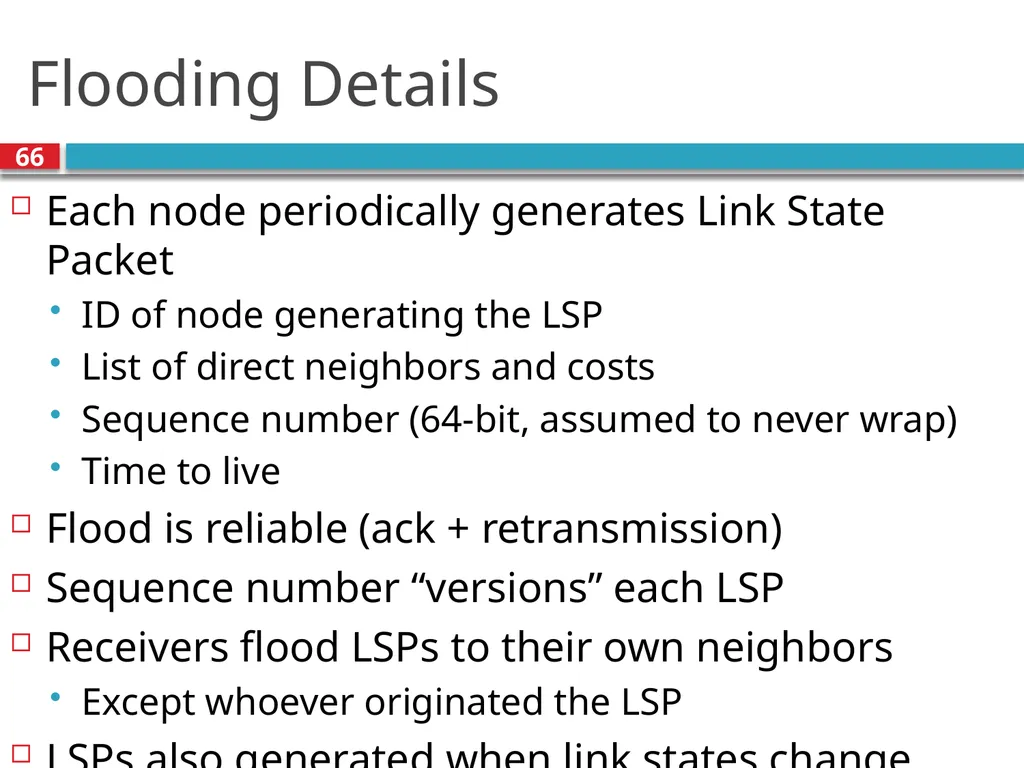
Flooding Details 66 Each node periodically generates Link State Packet
ID of node generating the LSP
List of direct neighbors and costs
Sequence number (64-bit, assumed to never wrap)
Time to live
Flood is reliable (ack + retransmission)
Sequence number “versions” each LSP
Receivers flood LSPs to their own neighbors
Except whoever originated the LSP
LSPs also generated when link states change<br>
ID of node generating the LSP
List of direct neighbors and costs
Sequence number (64-bit, assumed to never wrap)
Time to live
Flood is reliable (ack + retransmission)
Sequence number “versions” each LSP
Receivers flood LSPs to their own neighbors
Except whoever originated the LSP
LSPs also generated when link states change<br>
67
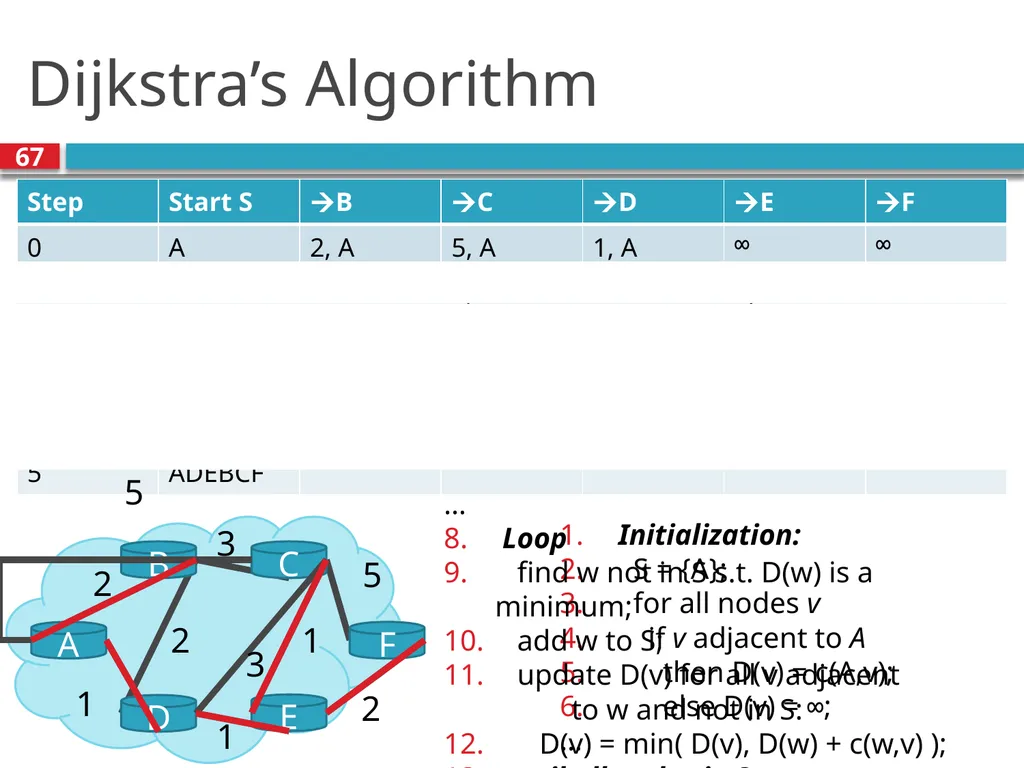
Dijkstra’s Algorithm 67 A B C D E F 5 2 3 5 2 1 1 2 3 1 Initialization:
S = {A};
for all nodes v
if v adjacent to A
then D(v) = c(A,v);
else D(v) = ∞;
… …
Loop
find w not in S s.t. D(w) is a minimum;
add w to S;
update D(v) for all v adjacent
to w and not in S:
D(v) = min( D(v), D(w) + c(w,v) );
until all nodes in S;<br>
S = {A};
for all nodes v
if v adjacent to A
then D(v) = c(A,v);
else D(v) = ∞;
… …
Loop
find w not in S s.t. D(w) is a minimum;
add w to S;
update D(v) for all v adjacent
to w and not in S:
D(v) = min( D(v), D(w) + c(w,v) );
until all nodes in S;<br>
68
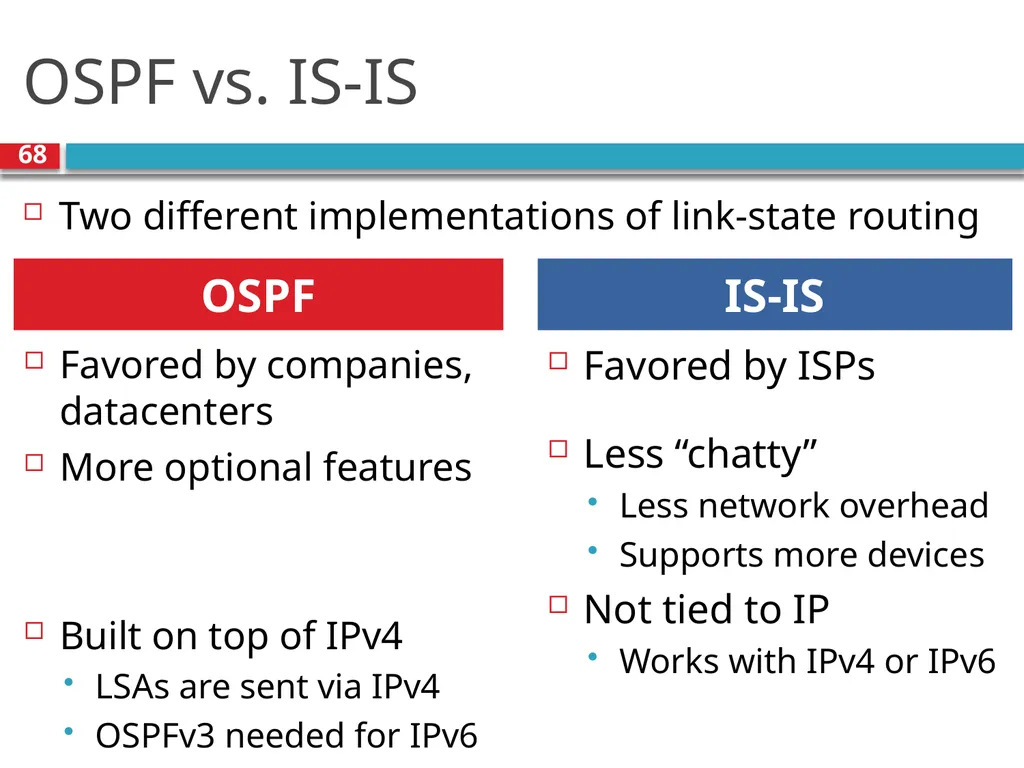
OSPF vs. IS-IS Favored by companies, datacenters
More optional features
Built on top of IPv4
LSAs are sent via IPv4
OSPFv3 needed for IPv6 Favored by ISPs
Less “chatty”
Less network overhead
Supports more devices
Not tied to IP
Works with IPv4 or IPv6 68 OSPF IS-IS Two different implementations of link-state routing<br>
More optional features
Built on top of IPv4
LSAs are sent via IPv4
OSPFv3 needed for IPv6 Favored by ISPs
Less “chatty”
Less network overhead
Supports more devices
Not tied to IP
Works with IPv4 or IPv6 68 OSPF IS-IS Two different implementations of link-state routing<br>
69
Different Organizational Structure 69 OSPF IS-IS Organized around overlapping areas
Area 0 is the core network Organized as a 2-level hierarchy
Level 2 is the backbone Level 1-2<br>
Area 0 is the core network Organized as a 2-level hierarchy
Level 2 is the backbone Level 1-2<br>
70
Link State vs. Distance Vector 70 n = number of nodes in the graph
d = degree of a given node
k = number of rounds<br>
d = degree of a given node
k = number of rounds<br>