
TEACH-ing Video Online? ALA CopyTalk Webinar May
CB
Published · 47 slides · 0 views

1 / 1

Description
TEACH-ing Video Online? ALA CopyTalk Webinar May 7, 2020 Today TEACH Act Fair use Additional options for connecting students with video online Putting it all together Setting the Stage When using video as part of online instruction: A copy
Related Topics
Share
Embed code
Download this presentation From Below
"TEACH-ing Video Online? ALA CopyTalk Webinar May" is the property of its rightful owner. Permission is granted to download and print the materials on this website for personal, non-commercial use only, and to display it on your personal computer provided you do not modify the materials and that you retain all copyright notices contained in the materials. By downloading content from our website, you accept the terms of this agreement.
Presentation Transcript
01
TEACH-ing Video Online? ALA CopyTalk Webinar
May 7, 2020<br>
May 7, 2020<br>
02
Today TEACH Act
Fair use
Additional options for connecting students with video online
Putting it all together<br>
Fair use
Additional options for connecting students with video online
Putting it all together<br>
03
Setting the Stage When using video as part of online instruction:
A copy is often made
That copy is being distributed to students
Infringement can occur when we copy and distribute a protected work in a way that does not fall within the scope of one of the user rights (exceptions) found in the law or without obtaining permission or a license from the rightsholder.<br>
A copy is often made
That copy is being distributed to students
Infringement can occur when we copy and distribute a protected work in a way that does not fall within the scope of one of the user rights (exceptions) found in the law or without obtaining permission or a license from the rightsholder.<br>
04
The Technology, Education and Copyright Harmonization (TEACH) Act 17 U.S.C. § 110(2)<br>
05
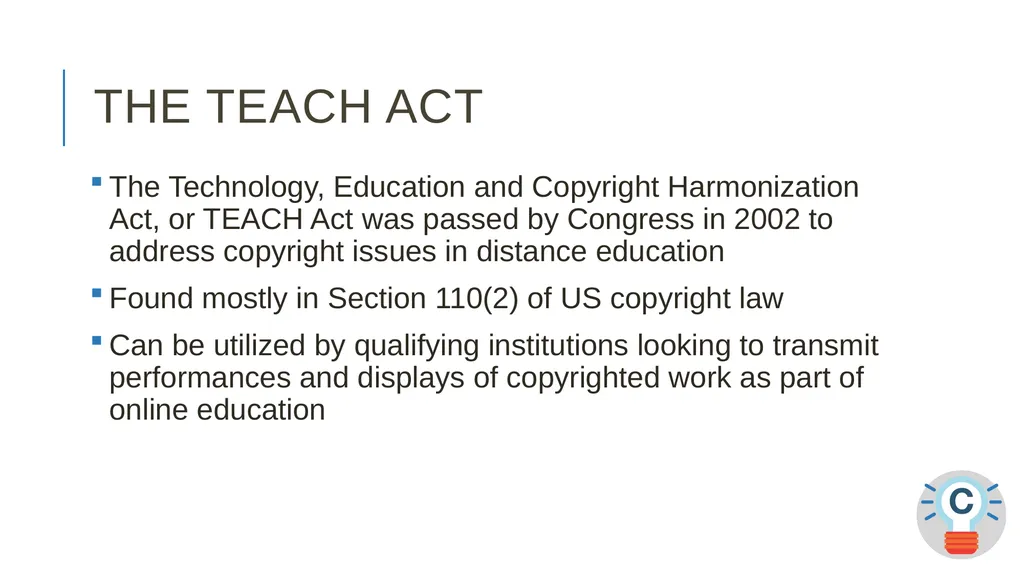
The TEACH Act The Technology, Education and Copyright Harmonization Act, or TEACH Act was passed by Congress in 2002 to address copyright issues in distance education
Found mostly in Section 110(2) of US copyright law
Can be utilized by qualifying institutions looking to transmit performances and displays of copyrighted work as part of online education<br>
Found mostly in Section 110(2) of US copyright law
Can be utilized by qualifying institutions looking to transmit performances and displays of copyrighted work as part of online education<br>
06
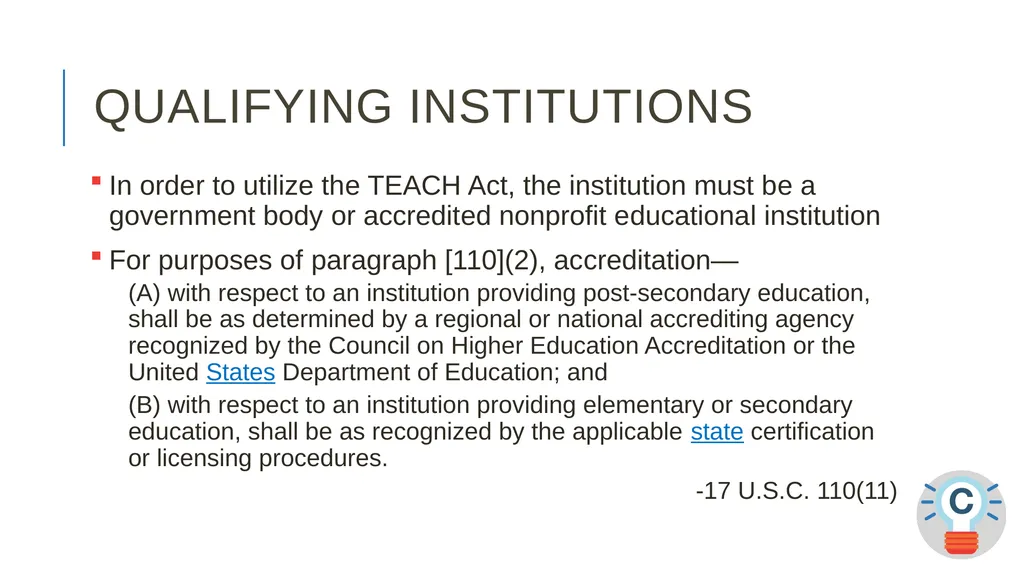
Qualifying Institutions In order to utilize the TEACH Act, the institution must be a government body or accredited nonprofit educational institution
For purposes of paragraph [110](2), accreditation—
(A) with respect to an institution providing post-secondary education, shall be as determined by a regional or national accrediting agency recognized by the Council on Higher Education Accreditation or the United States Department of Education; and
(B) with respect to an institution providing elementary or secondary education, shall be as recognized by the applicable state certification or licensing procedures.
-17 U.S.C. 110(11)<br>
For purposes of paragraph [110](2), accreditation—
(A) with respect to an institution providing post-secondary education, shall be as determined by a regional or national accrediting agency recognized by the Council on Higher Education Accreditation or the United States Department of Education; and
(B) with respect to an institution providing elementary or secondary education, shall be as recognized by the applicable state certification or licensing procedures.
-17 U.S.C. 110(11)<br>
07
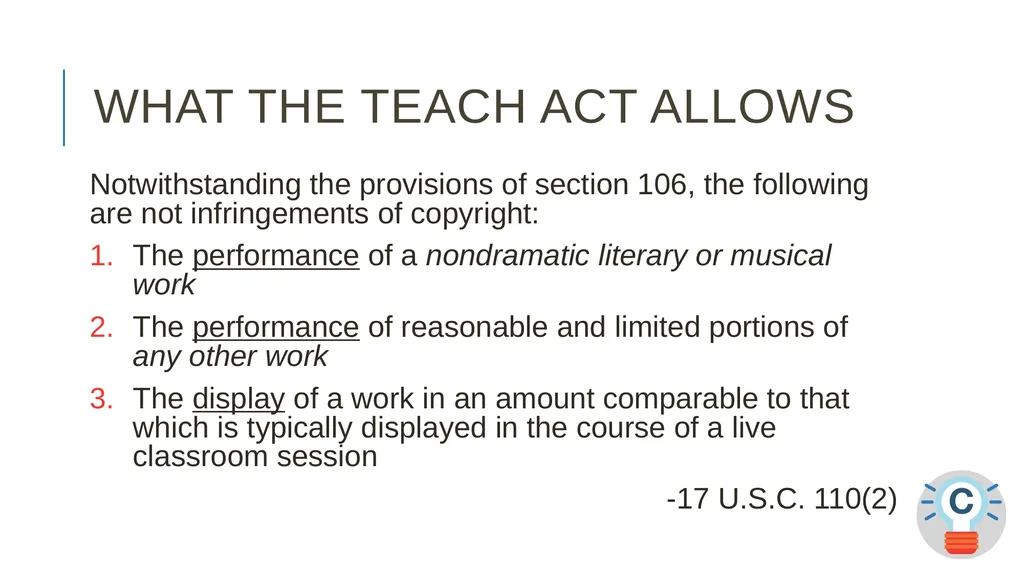
What the TEACH Act Allows Notwithstanding the provisions of section 106, the following are not infringements of copyright:
The performance of a nondramatic literary or musical work
The performance of reasonable and limited portions of any other work
The display of a work in an amount comparable to that which is typically displayed in the course of a live classroom session
-17 U.S.C. 110(2)<br>
The performance of a nondramatic literary or musical work
The performance of reasonable and limited portions of any other work
The display of a work in an amount comparable to that which is typically displayed in the course of a live classroom session
-17 U.S.C. 110(2)<br>
08
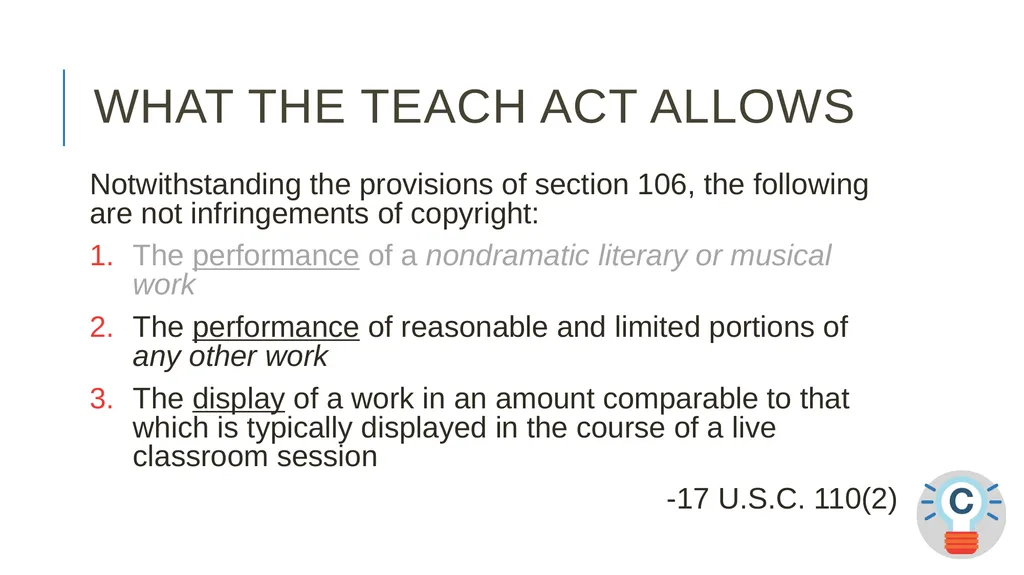
What the TEACH Act Allows Notwithstanding the provisions of section 106, the following are not infringements of copyright:
The performance of a nondramatic literary or musical work
The performance of reasonable and limited portions of any other work
The display of a work in an amount comparable to that which is typically displayed in the course of a live classroom session
-17 U.S.C. 110(2)<br>
The performance of a nondramatic literary or musical work
The performance of reasonable and limited portions of any other work
The display of a work in an amount comparable to that which is typically displayed in the course of a live classroom session
-17 U.S.C. 110(2)<br>
09
Performances of reasonable and limited portions of any other work Perform-in the case of a motion picture to show images in any sequence or to make accompanying sounds audible.
17 USC 101<br>
17 USC 101<br>
10
Performances of reasonable and limited portions of any other work “What constitutes a ‘‘reasonable and limited’’ portion should take into account both the nature of the market for that type of work and the pedagogical purposes of the performance.”
-U.S. Congress, Senate, Technology, Education and Copyright Harmonization Act of 2001. 107th Cong., 1st sess., 2001, S. Doc. 7, serial 107-31
“The exhibition of an entire film may possibly constitute a ‘reasonable and limited’ demonstration if the film’s entire viewing is exceedingly relevant toward achieving a educational goal; however, the likelihood of an entire film portrayal being ‘reasonable and limited” may be rare.”
-Copyright Exemptions for Distance Education: 17 U.S.C. § 110(2), the Technology, Education, and Copyright Harmonization Act of 2002 (CRS)<br>
-U.S. Congress, Senate, Technology, Education and Copyright Harmonization Act of 2001. 107th Cong., 1st sess., 2001, S. Doc. 7, serial 107-31
“The exhibition of an entire film may possibly constitute a ‘reasonable and limited’ demonstration if the film’s entire viewing is exceedingly relevant toward achieving a educational goal; however, the likelihood of an entire film portrayal being ‘reasonable and limited” may be rare.”
-Copyright Exemptions for Distance Education: 17 U.S.C. § 110(2), the Technology, Education, and Copyright Harmonization Act of 2002 (CRS)<br>
11
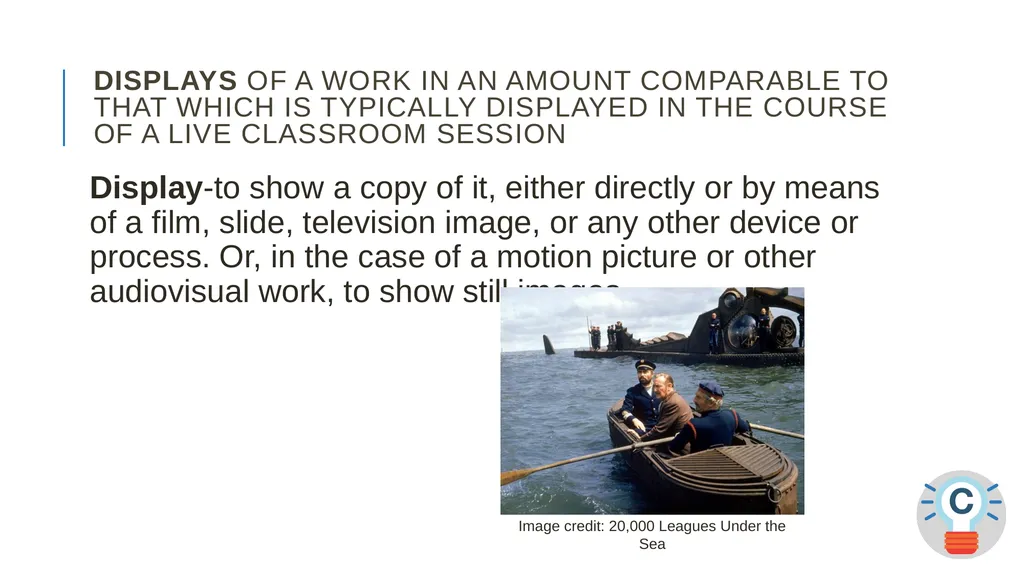
Displays of a work in an amount comparable to that which is typically displayed in the course of a live classroom session Display-to show a copy of it, either directly or by means of a film, slide, television image, or any other device or process. Or, in the case of a motion picture or other audiovisual work, to show still images.<br>
12
The TEACH Act does not Allow The sharing of works produced or marketed primarily for performance or display as part of mediated instructional activities transmitted via digital networks
Performances or displays that is given by means of a copy or phonorecord that is not lawfully made and acquired under this title, and the transmitting government body or accredited nonprofit educational institution knew or had reason to believe was not lawfully made and acquired
Sharing of works such as textbooks, course packs, or other material in any media, copies or phonorecords of which are typically purchased or acquired by the students in higher education for their independent use and retention or are typically purchased or acquired for elementary and secondary students for their possession and independent use.
Is it analogous to the type of performance or display that would take place in a live classroom setting?<br>
Performances or displays that is given by means of a copy or phonorecord that is not lawfully made and acquired under this title, and the transmitting government body or accredited nonprofit educational institution knew or had reason to believe was not lawfully made and acquired
Sharing of works such as textbooks, course packs, or other material in any media, copies or phonorecords of which are typically purchased or acquired by the students in higher education for their independent use and retention or are typically purchased or acquired for elementary and secondary students for their possession and independent use.
Is it analogous to the type of performance or display that would take place in a live classroom setting?<br>
13
Instructor Responsibilities The performance or display is made by, at the direction of, or under the actual supervision of an instructor
It is as an integral part of a class session offered
The performance or display is directly related and of material assistance to the teaching content of the transmission<br>
It is as an integral part of a class session offered
The performance or display is directly related and of material assistance to the teaching content of the transmission<br>
14
Technology Requirements To the extent technologically feasible:
The reception of works is limited to students officially enrolled in the course;
Measures are put into place to prevent the retention and unauthorized further dissemination of the work by recipients for longer than the class session; and
The institution does not engage in conduct that could reasonably be expected to interfere with technological measures used by copyright owners to prevent such retention or unauthorized further dissemination;<br>
The reception of works is limited to students officially enrolled in the course;
Measures are put into place to prevent the retention and unauthorized further dissemination of the work by recipients for longer than the class session; and
The institution does not engage in conduct that could reasonably be expected to interfere with technological measures used by copyright owners to prevent such retention or unauthorized further dissemination;<br>
15
Institutional Requirements The transmitting body or institution—
Institutes policies regarding copyright
Provides informational materials to faculty, students, and relevant staff members that accurately describe, and promote compliance with, the laws of the United States relating to copyright, and
Provides notice to students that materials used in connection with the course may be subject to copyright protection<br>
Institutes policies regarding copyright
Provides informational materials to faculty, students, and relevant staff members that accurately describe, and promote compliance with, the laws of the United States relating to copyright, and
Provides notice to students that materials used in connection with the course may be subject to copyright protection<br>
16
Yikes! TEACH Act Pro’s and Cons<br>
17
TEACH Act Pro’s If you do everything required, then your performances and displays “are not infringements of copyright”
If you like lots of rules, the TEACH Act is for you<br>
If you like lots of rules, the TEACH Act is for you<br>
18
Recommendations Only digitize as much as needed to teach a work, though full work may be justifiable!
Stream all media files
Use a Content Management System/Learning Management System to limit access to the video
Work with school administrators to provide some type of copyright education
Recommended resource: TEACH Act Toolkit: https://www.lib.lsu.edu/services/copyright/teach/index<br>
Stream all media files
Use a Content Management System/Learning Management System to limit access to the video
Work with school administrators to provide some type of copyright education
Recommended resource: TEACH Act Toolkit: https://www.lib.lsu.edu/services/copyright/teach/index<br>
19
Cons It’s complicated!
No one person can be compliant with the TEACH Act on their own
It takes an institutional effort to become compliant
It may take an individual/department administering the service to remain compliant<br>
No one person can be compliant with the TEACH Act on their own
It takes an institutional effort to become compliant
It may take an individual/department administering the service to remain compliant<br>
20
However Can the TEACH Act be useful in other ways, e.g., helping us make thoughtful applications of other user rights found in the law?<br>
21
Fair Use 17 U.S.C. 107<br>
22
Fair Use (17 U.S.C. § 107) Notwithstanding the provisions of sections 106 and 106A, the fair use of a copyrighted work, including such use by reproduction in copies or phonorecords or by any other means specified by that section, for purposes such as criticism, comment, news reporting, teaching (including multiple copies for classroom use), scholarship, or research, is not an infringement of copyright.<br>
23
Fair Use (17 U.S.C. § 107) In determining whether the use made of a work in any particular case is a fair use the factors to be considered shall include—
(1) the purpose and character of the use, including whether such use is of a commercial nature or is for nonprofit educational purposes;
(2) the nature of the copyrighted work;
(3) the amount and substantiality of the portion used in relation to the copyrighted work as a whole; and
(4) the effect of the use upon the potential market for or value of the copyrighted work.
The fact that a work is unpublished shall not itself bar a finding of fair use if such finding is made upon consideration of all the above factors.<br>
(1) the purpose and character of the use, including whether such use is of a commercial nature or is for nonprofit educational purposes;
(2) the nature of the copyrighted work;
(3) the amount and substantiality of the portion used in relation to the copyrighted work as a whole; and
(4) the effect of the use upon the potential market for or value of the copyrighted work.
The fact that a work is unpublished shall not itself bar a finding of fair use if such finding is made upon consideration of all the above factors.<br>
24
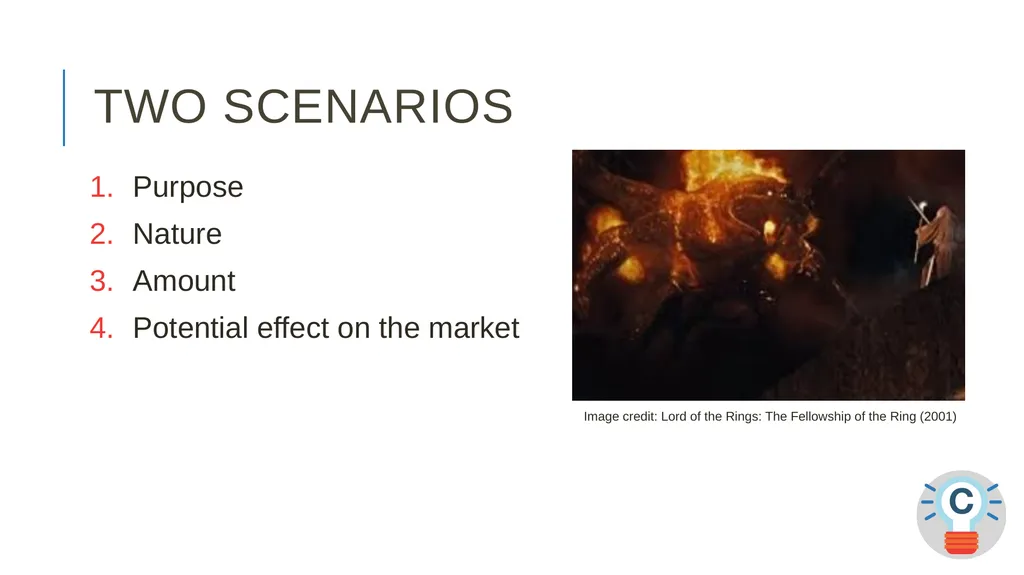
Two Scenarios Purpose
Nature
Amount
Potential effect on the market<br>
Nature
Amount
Potential effect on the market<br>
25
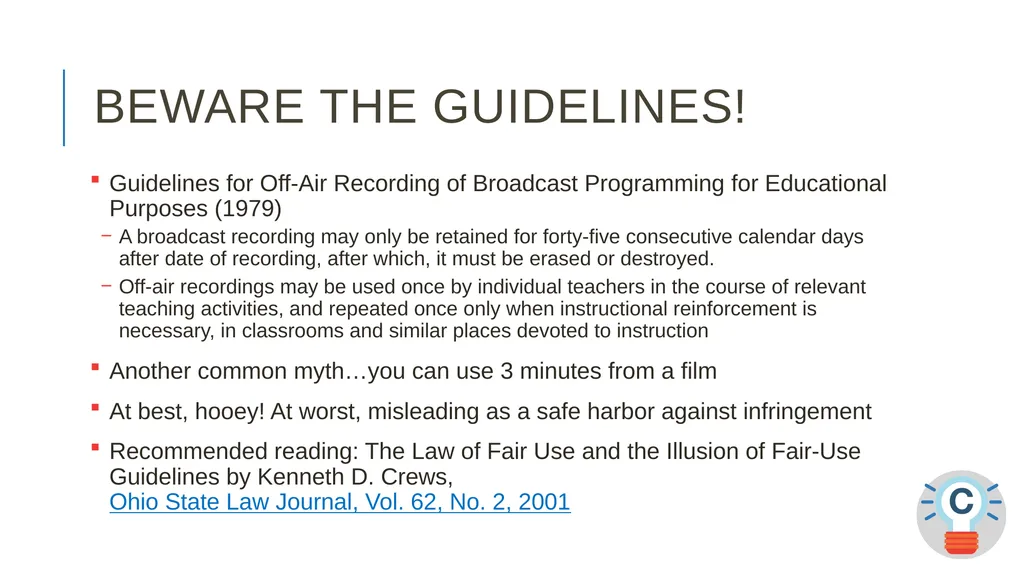
Beware the Guidelines! Guidelines for Off-Air Recording of Broadcast Programming for Educational Purposes (1979)
A broadcast recording may only be retained for forty-five consecutive calendar days after date of recording, after which, it must be erased or destroyed.
Off-air recordings may be used once by individual teachers in the course of relevant teaching activities, and repeated once only when instructional reinforcement is necessary, in classrooms and similar places devoted to instruction
Another common myth…you can use 3 minutes from a film
At best, hooey! At worst, misleading as a safe harbor against infringement
Recommended reading: The Law of Fair Use and the Illusion of Fair-Use Guidelines by Kenneth D. Crews, Ohio State Law Journal, Vol. 62, No. 2, 2001<br>
A broadcast recording may only be retained for forty-five consecutive calendar days after date of recording, after which, it must be erased or destroyed.
Off-air recordings may be used once by individual teachers in the course of relevant teaching activities, and repeated once only when instructional reinforcement is necessary, in classrooms and similar places devoted to instruction
Another common myth…you can use 3 minutes from a film
At best, hooey! At worst, misleading as a safe harbor against infringement
Recommended reading: The Law of Fair Use and the Illusion of Fair-Use Guidelines by Kenneth D. Crews, Ohio State Law Journal, Vol. 62, No. 2, 2001<br>
26
Making Fair Use Determinations Must be made on a case-by-case basis
Thoughtfully work through the four factors, weighing them in balance with each other
Act in good faith!<br>
Thoughtfully work through the four factors, weighing them in balance with each other
Act in good faith!<br>
27
Insight from our Colleagues Code of Best Practices in Fair Use for Academic and Research Libraries: https://cmsimpact.org/code/code-best-practices-fair-use-academic-research-libraries/
Among other things:
This is a code of best practices in fair use devised specifically by and for the academic and research library community. It enhances the ability of librarians to rely on fair use by documenting the considered views of the library community about best practices in fair use, drawn from the actual practices and experience of the library community itself.
The objective of this code is not to constrain librarians’ reliance on fair use<br>
Among other things:
This is a code of best practices in fair use devised specifically by and for the academic and research library community. It enhances the ability of librarians to rely on fair use by documenting the considered views of the library community about best practices in fair use, drawn from the actual practices and experience of the library community itself.
The objective of this code is not to constrain librarians’ reliance on fair use<br>
28
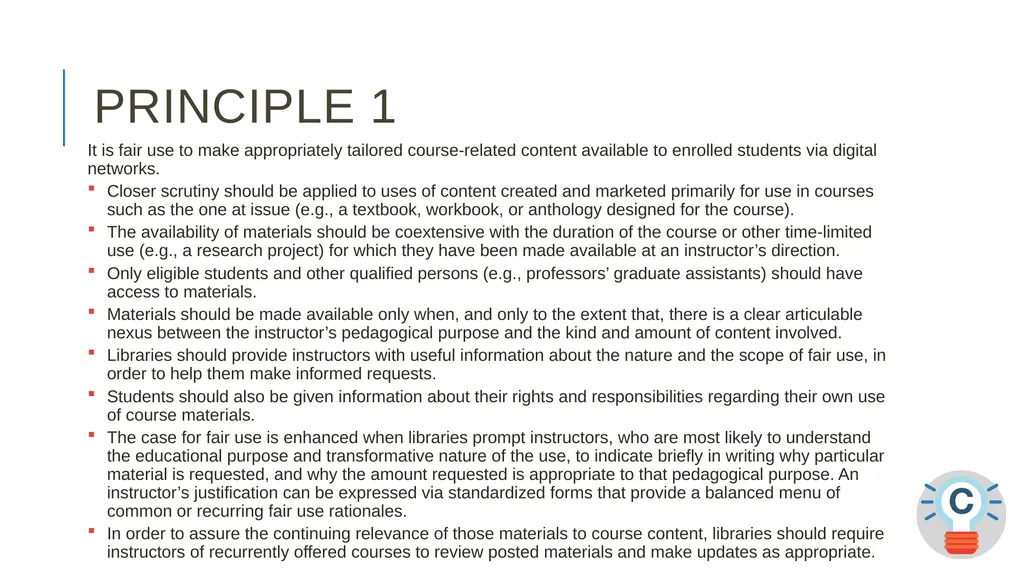
Principle 1 It is fair use to make appropriately tailored course-related content available to enrolled students via digital networks.
Closer scrutiny should be applied to uses of content created and marketed primarily for use in courses such as the one at issue (e.g., a textbook, workbook, or anthology designed for the course).
The availability of materials should be coextensive with the duration of the course or other time-limited use (e.g., a research project) for which they have been made available at an instructor’s direction.
Only eligible students and other qualified persons (e.g., professors’ graduate assistants) should have access to materials.
Materials should be made available only when, and only to the extent that, there is a clear articulable nexus between the instructor’s pedagogical purpose and the kind and amount of content involved.
Libraries should provide instructors with useful information about the nature and the scope of fair use, in order to help them make informed requests.
Students should also be given information about their rights and responsibilities regarding their own use of course materials.
The case for fair use is enhanced when libraries prompt instructors, who are most likely to understand the educational purpose and transformative nature of the use, to indicate briefly in writing why particular material is requested, and why the amount requested is appropriate to that pedagogical purpose. An instructor’s justification can be expressed via standardized forms that provide a balanced menu of common or recurring fair use rationales.
In order to assure the continuing relevance of those materials to course content, libraries should require instructors of recurrently offered courses to review posted materials and make updates as appropriate.<br>
Closer scrutiny should be applied to uses of content created and marketed primarily for use in courses such as the one at issue (e.g., a textbook, workbook, or anthology designed for the course).
The availability of materials should be coextensive with the duration of the course or other time-limited use (e.g., a research project) for which they have been made available at an instructor’s direction.
Only eligible students and other qualified persons (e.g., professors’ graduate assistants) should have access to materials.
Materials should be made available only when, and only to the extent that, there is a clear articulable nexus between the instructor’s pedagogical purpose and the kind and amount of content involved.
Libraries should provide instructors with useful information about the nature and the scope of fair use, in order to help them make informed requests.
Students should also be given information about their rights and responsibilities regarding their own use of course materials.
The case for fair use is enhanced when libraries prompt instructors, who are most likely to understand the educational purpose and transformative nature of the use, to indicate briefly in writing why particular material is requested, and why the amount requested is appropriate to that pedagogical purpose. An instructor’s justification can be expressed via standardized forms that provide a balanced menu of common or recurring fair use rationales.
In order to assure the continuing relevance of those materials to course content, libraries should require instructors of recurrently offered courses to review posted materials and make updates as appropriate.<br>
29
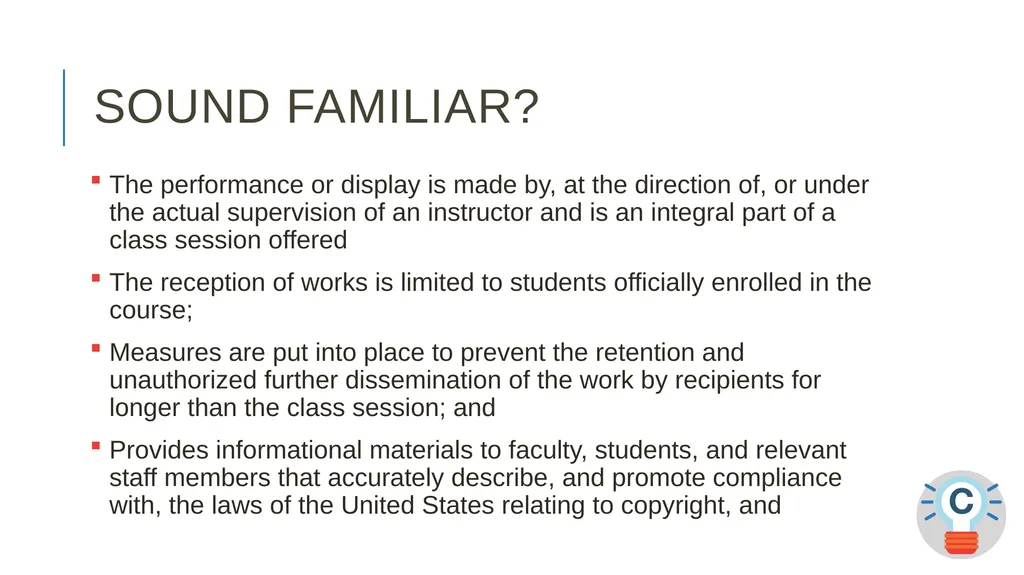
Sound Familiar? The performance or display is made by, at the direction of, or under the actual supervision of an instructor and is an integral part of a class session offered
The reception of works is limited to students officially enrolled in the course;
Measures are put into place to prevent the retention and unauthorized further dissemination of the work by recipients for longer than the class session; and
Provides informational materials to faculty, students, and relevant staff members that accurately describe, and promote compliance with, the laws of the United States relating to copyright, and<br>
The reception of works is limited to students officially enrolled in the course;
Measures are put into place to prevent the retention and unauthorized further dissemination of the work by recipients for longer than the class session; and
Provides informational materials to faculty, students, and relevant staff members that accurately describe, and promote compliance with, the laws of the United States relating to copyright, and<br>
30
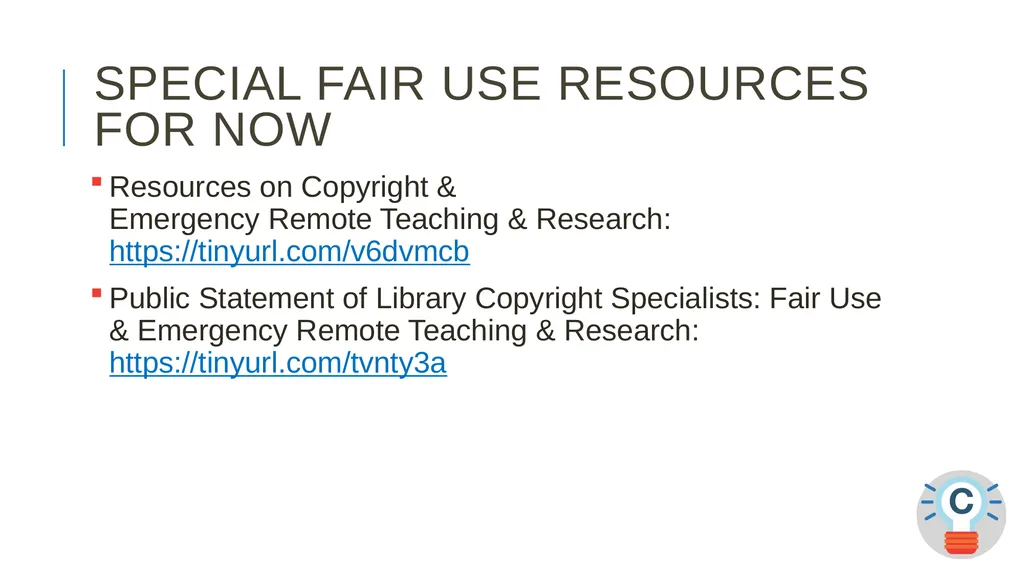
Special Fair Use Resources for Now Resources on Copyright &
Emergency Remote Teaching & Research: https://tinyurl.com/v6dvmcb
Public Statement of Library Copyright Specialists: Fair Use & Emergency Remote Teaching & Research: https://tinyurl.com/tvnty3a<br>
Public Statement of Library Copyright Specialists: Fair Use & Emergency Remote Teaching & Research: https://tinyurl.com/tvnty3a<br>
31
NOTE: DMCA Considerations Digital Millennium Copyright Act (17 U.S.C. 1201)<br>
32
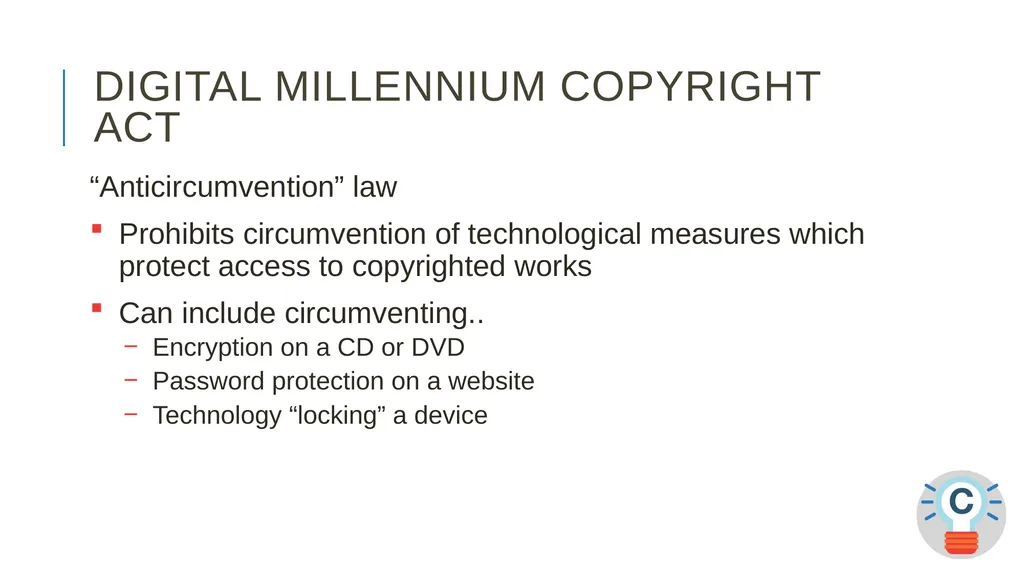
Digital Millennium Copyright Act “Anticircumvention” law
Prohibits circumvention of technological measures which protect access to copyrighted works
Can include circumventing..
Encryption on a CD or DVD
Password protection on a website
Technology “locking” a device<br>
Prohibits circumvention of technological measures which protect access to copyrighted works
Can include circumventing..
Encryption on a CD or DVD
Password protection on a website
Technology “locking” a device<br>
33
How Does the DMCA Apply Here? One circuit has argued that a “nexus to infringement” is required in order to find liability for circumvention under Section 1201 (Chamberlain v. Skylink, 381 F.3d 1178 (Fed. Cir. 2004)), while others have held that fair use is not a defense to a claim of unlawful circumvention (MDY v. Blizzard, 629 F.3d 928 (9th Cir. 2010); Universal Studios, Inc. v. Corley, 273 F.3d 429 (2d Cir. 2001)).
-Butler, B., Aufderheide, P., Jaszi, P., & Cox, K. (2019). Cracking the Copyright Dilemma in Software Preservation: Protecting Digital Culture through Fair Use Consensus? Journal of Copyright in Education and Librarianship, 3(3), 1-23. https://doi.org/10.17161/jcel.v3i3.10267
Talk this over with administrators/legal counsel?<br>
-Butler, B., Aufderheide, P., Jaszi, P., & Cox, K. (2019). Cracking the Copyright Dilemma in Software Preservation: Protecting Digital Culture through Fair Use Consensus? Journal of Copyright in Education and Librarianship, 3(3), 1-23. https://doi.org/10.17161/jcel.v3i3.10267
Talk this over with administrators/legal counsel?<br>
34
DMCA Rulemaking Process https://www.copyright.gov/1201/2018/
Exceptions written into the law
New exceptions considered by the Registrar of Copyrights and the Librarian of Congress every 3 years
Need an exception…pursue it!<br>
Exceptions written into the law
New exceptions considered by the Registrar of Copyrights and the Librarian of Congress every 3 years
Need an exception…pursue it!<br>
35
Other Options More Ways to Lawfully Connect Students with Video<br>
36
Instructor is the Rightsholder Recorded presentations
The occasional documentary film?<br>
The occasional documentary film?<br>
37
Library Electronic Resources Resources we’ve licensed for our patrons to use
Alexander Street Press
Films on Demand
Swank
Kanopy
MOST will allow linking/embedding
Keep an eye on those license agreements!<br>
Alexander Street Press
Films on Demand
Swank
Kanopy
MOST will allow linking/embedding
Keep an eye on those license agreements!<br>
38
Linking Generally, there are no copyright infringement considerations with linking to works made legally and freely available online, e.g., news stories, blog posts, TV shows, films<br>
39
Openly Licensed Works Works protected by copyright, but that are licensed in a way that allows them to be reused in a variety of ways, e.g., making copies, distributing them, editing and remixing them, the creation of derivatives (e.g., translations), often via Creative Commons licenses
Share in compliance with the license terms
For example, Open Educational Resource (OER) video found via, e.g., OASIS, https://oasis.geneseo.edu/index.php<br>
Share in compliance with the license terms
For example, Open Educational Resource (OER) video found via, e.g., OASIS, https://oasis.geneseo.edu/index.php<br>
40
Obtaining Permission Not required to be in writing for nonexclusive licenses, but it’s a good idea to have it documented in writing
This includes student work!
Securing Permission
Contact the rightsholder
Request their permission to use the work providing detailed info on who, what, and how
Sample permissions letters available via Columbia’ Copyright Advisory Services Office: http://copyright.columbia.edu/copyright/permissions/requesting-permission/model-forms/<br>
This includes student work!
Securing Permission
Contact the rightsholder
Request their permission to use the work providing detailed info on who, what, and how
Sample permissions letters available via Columbia’ Copyright Advisory Services Office: http://copyright.columbia.edu/copyright/permissions/requesting-permission/model-forms/<br>
41
Public Domain Works Works whose term of copyright protection has expired
Copyright Term and the Public Domain in the United States, https://copyright.cornell.edu/publicdomain
Per Section 105, Works of the United States Government, which are works prepared by an officer or employee of the United States Government as part of that person’s official duties, e.g., reports by the EPA, images from NIH and NASA<br>
Copyright Term and the Public Domain in the United States, https://copyright.cornell.edu/publicdomain
Per Section 105, Works of the United States Government, which are works prepared by an officer or employee of the United States Government as part of that person’s official duties, e.g., reports by the EPA, images from NIH and NASA<br>
42
Putting it all Together In Summary…<br>
43
TEACH Act Not the worst law on the books!
It’s far from the best though
It’s complexity makes it difficult to follow
It’s complexity makes it difficulty to be fully compliant with it (and remain so)
Reasonable and limited debate
If it does not work for you, that’s ok! We have other options<br>
It’s far from the best though
It’s complexity makes it difficult to follow
It’s complexity makes it difficulty to be fully compliant with it (and remain so)
Reasonable and limited debate
If it does not work for you, that’s ok! We have other options<br>
44
Fair Use Oh so flexible!
Can serve as the basis of a library service that supports online education, like electronic reserves or media reserves
Can also be independently used by faculty and students looking to utilize copyrighted works as part of online education and the creation of new scholarship<br>
Can serve as the basis of a library service that supports online education, like electronic reserves or media reserves
Can also be independently used by faculty and students looking to utilize copyrighted works as part of online education and the creation of new scholarship<br>
45
Tips and best Practices Provide access to quality copyright info!
There is so much bad information out there that is perceived as being law
Seek out allies to help with education!
Knowledgeable folks around the institution, e.g., attorneys who represent your institution, folks who work with IP law (e.g., Tech Transfer Office), folks in the law school, if you have one
Colleagues within the profession<br>
There is so much bad information out there that is perceived as being law
Seek out allies to help with education!
Knowledgeable folks around the institution, e.g., attorneys who represent your institution, folks who work with IP law (e.g., Tech Transfer Office), folks in the law school, if you have one
Colleagues within the profession<br>
46
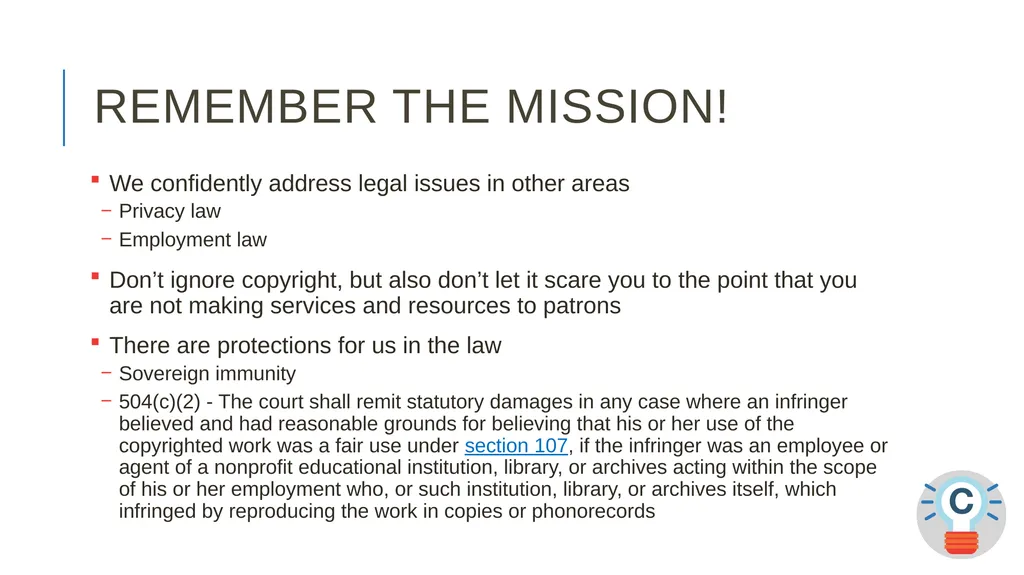
Remember the Mission! We confidently address legal issues in other areas
Privacy law
Employment law
Don’t ignore copyright, but also don’t let it scare you to the point that you are not making services and resources to patrons
There are protections for us in the law
Sovereign immunity
504(c)(2) - The court shall remit statutory damages in any case where an infringer believed and had reasonable grounds for believing that his or her use of the copyrighted work was a fair use under section 107, if the infringer was an employee or agent of a nonprofit educational institution, library, or archives acting within the scope of his or her employment who, or such institution, library, or archives itself, which infringed by reproducing the work in copies or phonorecords<br>
Privacy law
Employment law
Don’t ignore copyright, but also don’t let it scare you to the point that you are not making services and resources to patrons
There are protections for us in the law
Sovereign immunity
504(c)(2) - The court shall remit statutory damages in any case where an infringer believed and had reasonable grounds for believing that his or her use of the copyrighted work was a fair use under section 107, if the infringer was an employee or agent of a nonprofit educational institution, library, or archives acting within the scope of his or her employment who, or such institution, library, or archives itself, which infringed by reproducing the work in copies or phonorecords<br>
47
Questions? Carla Myers
Coordinator of Scholarly Communications
Miami University
myersc2@miamioh.edu<br>
Coordinator of Scholarly Communications
Miami University
myersc2@miamioh.edu<br>