
Teacher Directions, Handouts, and Answer Key

Description: Teacher Directions, Handouts, and Answer Key Answer keys for this lesson are found at the end of these Teacher Directions pages. Learning Objective: Why is a hand warmer designed the way it is? NGSS Standard: MSPS1-6: Undertake a design
Related Topics
Download Presentation
"Teacher Directions, Handouts, and Answer Key" is the property of its rightful owner. Permission is granted to download and print the materials on this website for personal, non-commercial use only, and to display it on your personal computer provided you do not modify the materials and that you retain all copyright notices contained in the materials. By downloading content from our website, you accept the terms of this agreement.
Presentation Transcript
slide1. Teacher Directions, Handouts, and
Answer Key<br>
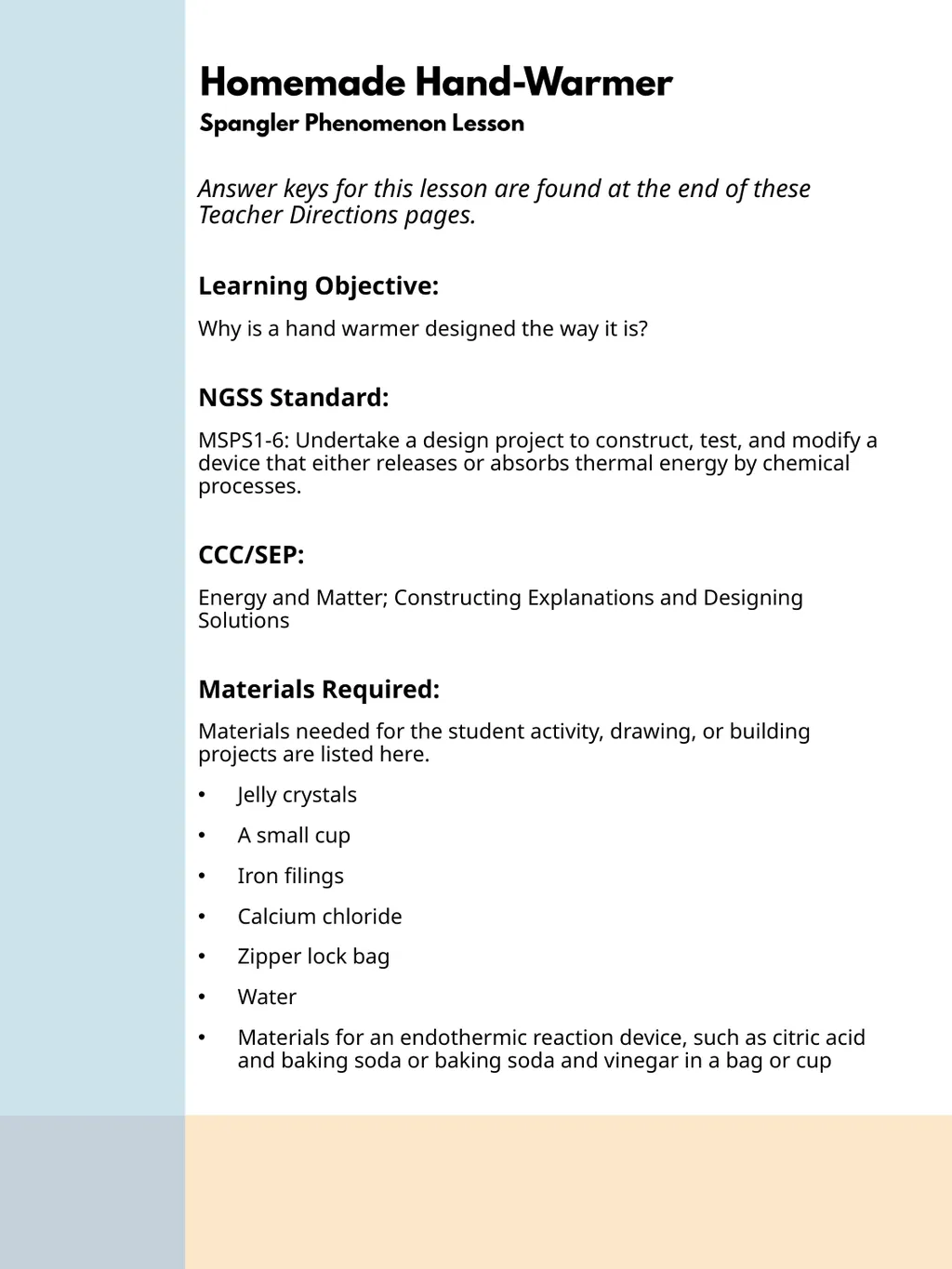
slide2. Answer keys for this lesson are found at the end of these Teacher Directions pages.
Learning Objective:
Why is a hand warmer designed the way it is?
NGSS Standard:
MSPS1-6: Undertake a design project to construct, test, and modify a device that either releases or absorbs thermal energy by chemical processes.
CCC/SEP:
Energy and Matter; Constructing Explanations and Designing Solutions
Materials Required:
Materials needed for the student activity, drawing, or building projects are listed here.
Jelly crystals
A small cup
Iron filings
Calcium chloride
Zipper lock bag
Water
Materials for an endothermic reaction device, such as citric acid and baking soda or baking soda and vinegar in a bag or cup<br>
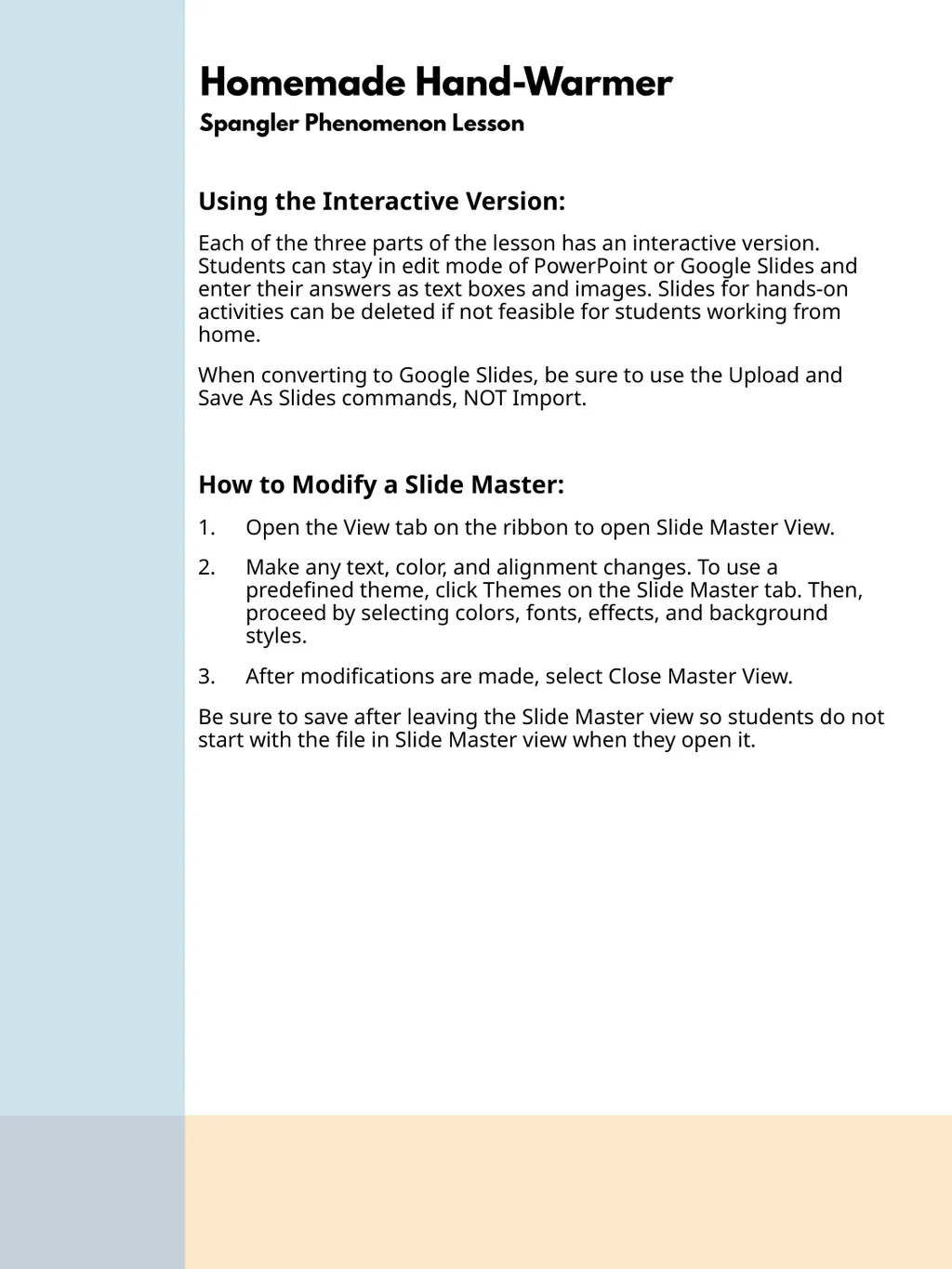
slide3. Using the Interactive Version:
Each of the three parts of the lesson has an interactive version. Students can stay in edit mode of PowerPoint or Google Slides and enter their answers as text boxes and images. Slides for hands-on activities can be deleted if not feasible for students working from home.
When converting to Google Slides, be sure to use the Upload and Save As Slides commands, NOT Import.
How to Modify a Slide Master:
Open the View tab on the ribbon to open Slide Master View.
Make any text, color, and alignment changes. To use a predefined theme, click Themes on the Slide Master tab. Then, proceed by selecting colors, fonts, effects, and background styles.
After modifications are made, select Close Master View.
Be sure to save after leaving the Slide Master view so students do not start with the file in Slide Master view when they open it.<br>
slide4. Lesson Contents
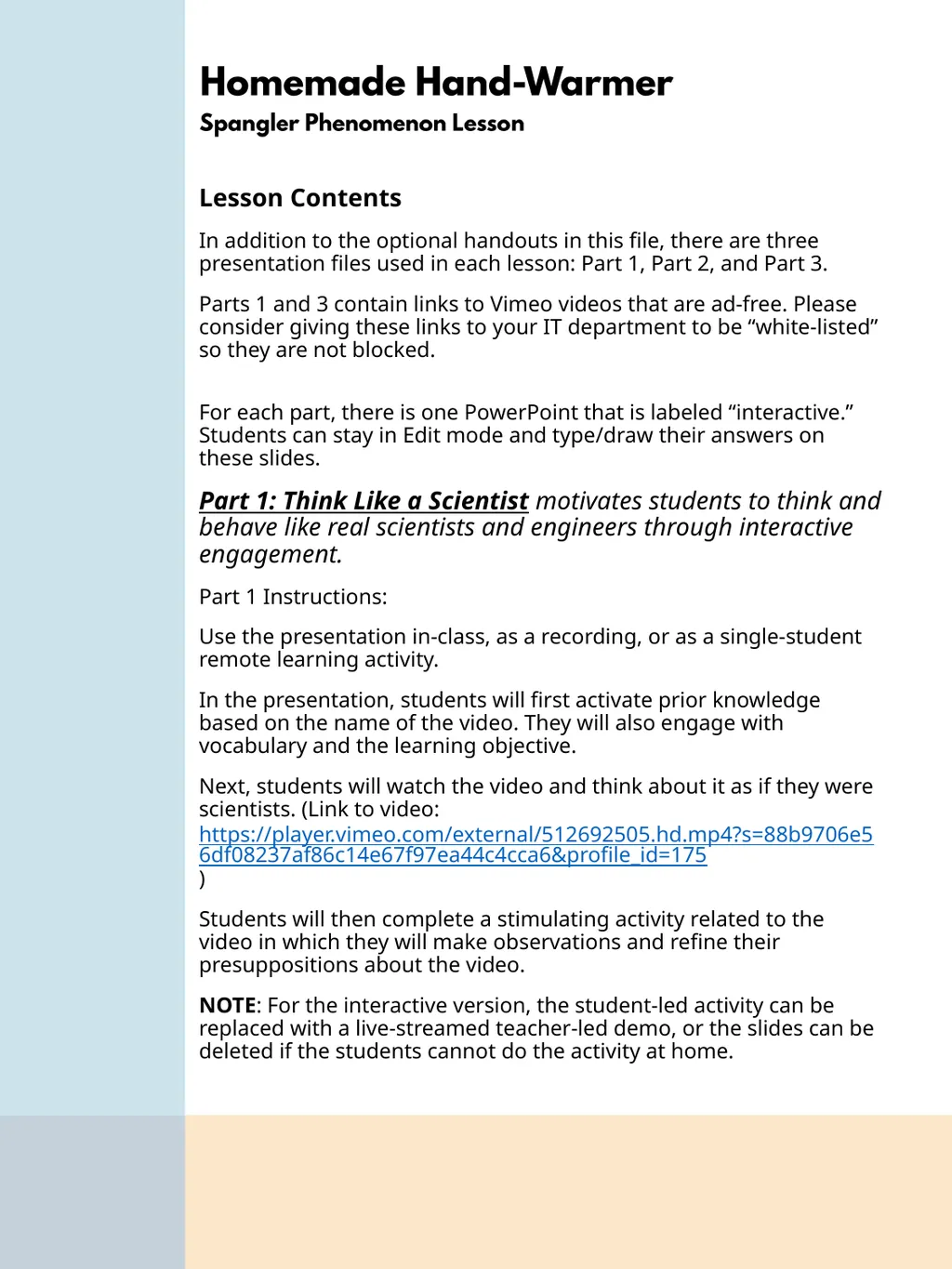
In addition to the optional handouts in this file, there are three presentation files used in each lesson: Part 1, Part 2, and Part 3.
Parts 1 and 3 contain links to Vimeo videos that are ad-free. Please consider giving these links to your IT department to be “white-listed” so they are not blocked.
For each part, there is one PowerPoint that is labeled “interactive.” Students can stay in Edit mode and type/draw their answers on these slides.
Part 1: Think Like a Scientist motivates students to think and behave like real scientists and engineers through interactive engagement.
Part 1 Instructions:
Use the presentation in-class, as a recording, or as a single-student remote learning activity.
In the presentation, students will first activate prior knowledge based on the name of the video. They will also engage with vocabulary and the learning objective.
Next, students will watch the video and think about it as if they were scientists. (Link to video: https://player.vimeo.com/external/512692505.hd.mp4?s=88b9706e56df08237af86c14e67f97ea44c4cca6&profile_id=175)
Students will then complete a stimulating activity related to the video in which they will make observations and refine their presuppositions about the video.
NOTE: For the interactive version, the student-led activity can be replaced with a live-streamed teacher-led demo, or the slides can be deleted if the students cannot do the activity at home.<br>
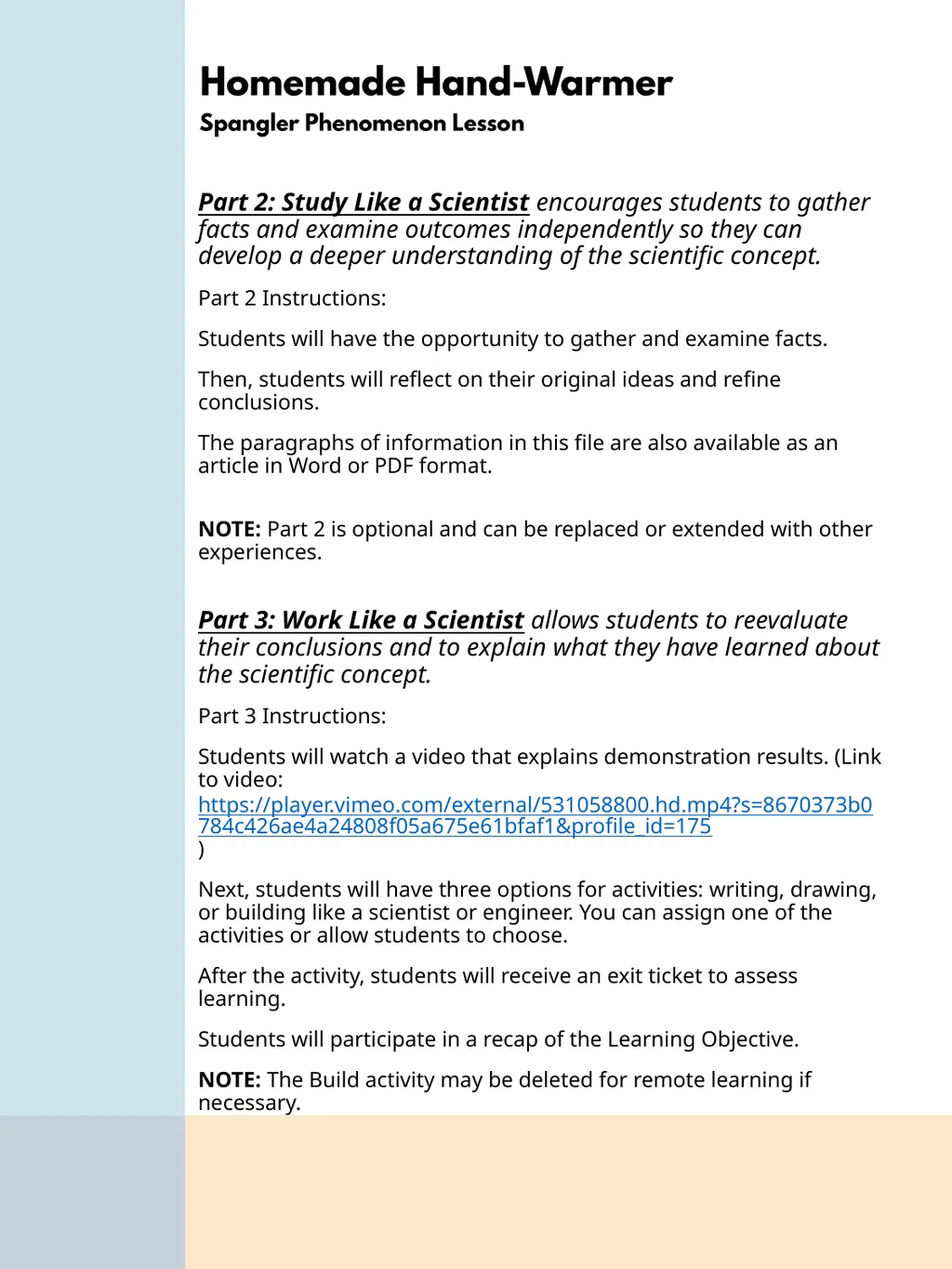
slide5. Part 2: Study Like a Scientist encourages students to gather facts and examine outcomes independently so they can develop a deeper understanding of the scientific concept.
Part 2 Instructions:
Students will have the opportunity to gather and examine facts.
Then, students will reflect on their original ideas and refine conclusions.
The paragraphs of information in this file are also available as an article in Word or PDF format.
NOTE: Part 2 is optional and can be replaced or extended with other experiences.
Part 3: Work Like a Scientist allows students to reevaluate their conclusions and to explain what they have learned about the scientific concept.
Part 3 Instructions:
Students will watch a video that explains demonstration results. (Link to video: https://player.vimeo.com/external/531058800.hd.mp4?s=8670373b0784c426ae4a24808f05a675e61bfaf1&profile_id=175)
Next, students will have three options for activities: writing, drawing, or building like a scientist or engineer. You can assign one of the activities or allow students to choose.
After the activity, students will receive an exit ticket to assess learning.
Students will participate in a recap of the Learning Objective.
NOTE: The Build activity may be deleted for remote learning if necessary.<br>
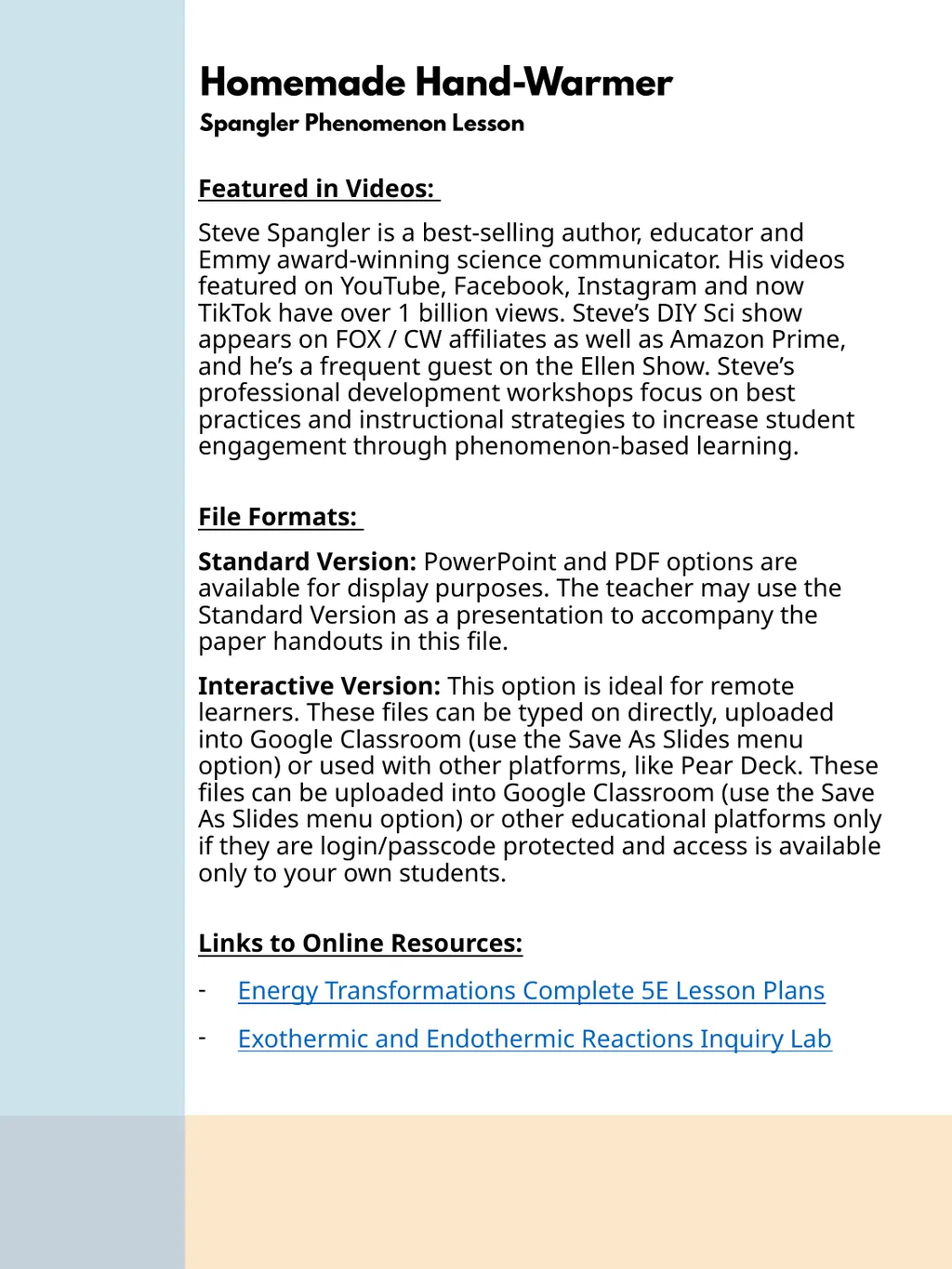
slide6. Featured in Videos:
Steve Spangler is a best-selling author, educator and Emmy award-winning science communicator. His videos featured on YouTube, Facebook, Instagram and now TikTok have over 1 billion views. Steve’s DIY Sci show appears on FOX / CW affiliates as well as Amazon Prime, and he’s a frequent guest on the Ellen Show. Steve’s professional development workshops focus on best practices and instructional strategies to increase student engagement through phenomenon-based learning.
File Formats:
Standard Version: PowerPoint and PDF options are available for display purposes. The teacher may use the Standard Version as a presentation to accompany the paper handouts in this file.
Interactive Version: This option is ideal for remote learners. These files can be typed on directly, uploaded into Google Classroom (use the Save As Slides menu option) or used with other platforms, like Pear Deck. These files can be uploaded into Google Classroom (use the Save As Slides menu option) or other educational platforms only if they are login/passcode protected and access is available only to your own students.
Links to Online Resources:
Energy Transformations Complete 5E Lesson Plans
Exothermic and Endothermic Reactions Inquiry Lab<br>
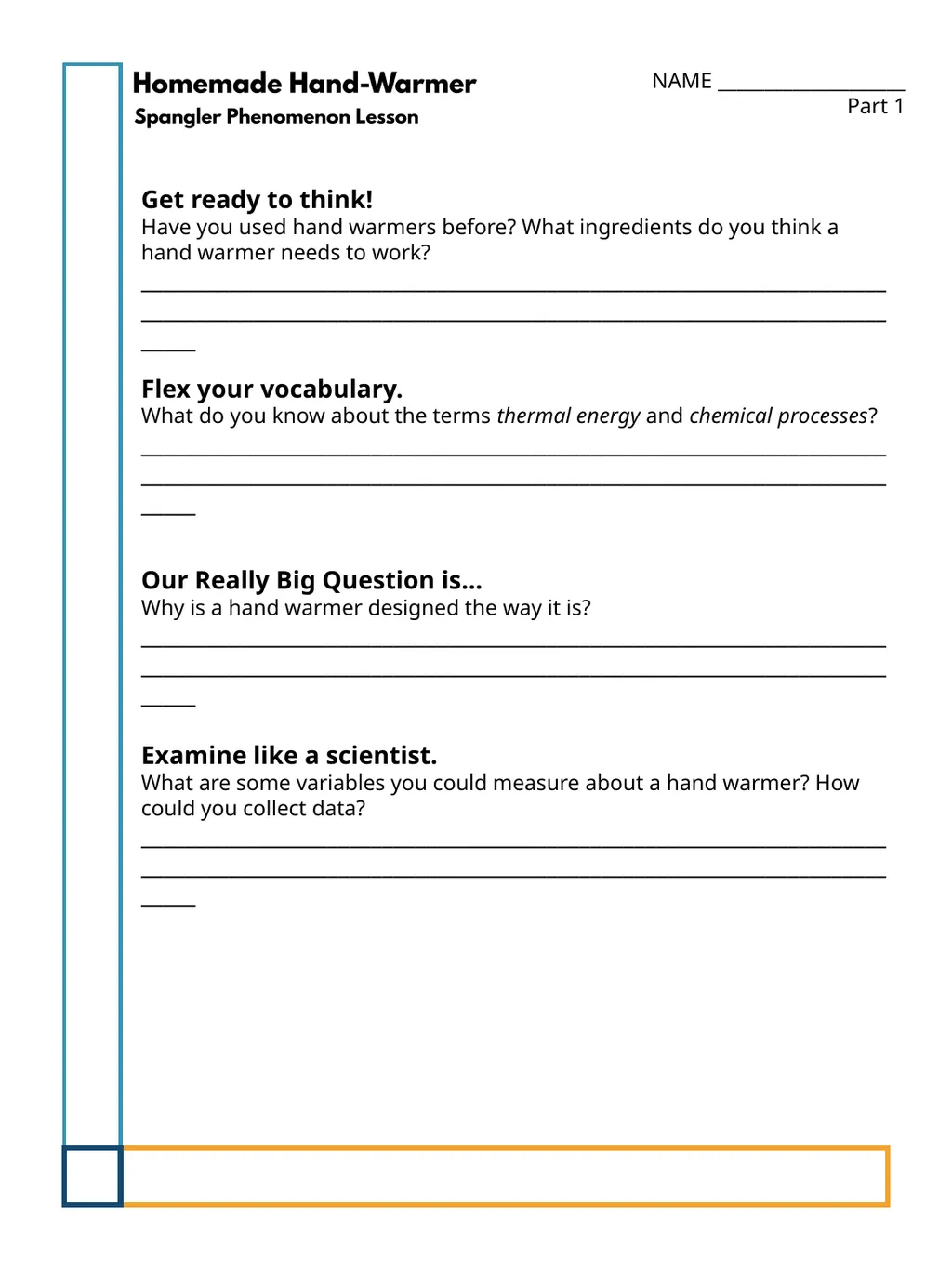
slide7. NAME ____________________
Part 1 Flex your vocabulary.
What do you know about the terms thermal energy and chemical processes?
_____________________________________________________________________________________________________________________________________________ Our Really Big Question is…
Why is a hand warmer designed the way it is?
_____________________________________________________________________________________________________________________________________________ Examine like a scientist.
What are some variables you could measure about a hand warmer? How could you collect data?
_____________________________________________________________________________________________________________________________________________ Get ready to think!
Have you used hand warmers before? What ingredients do you think a hand warmer needs to work?
_____________________________________________________________________________________________________________________________________________<br>
slide8. NAME ____________________
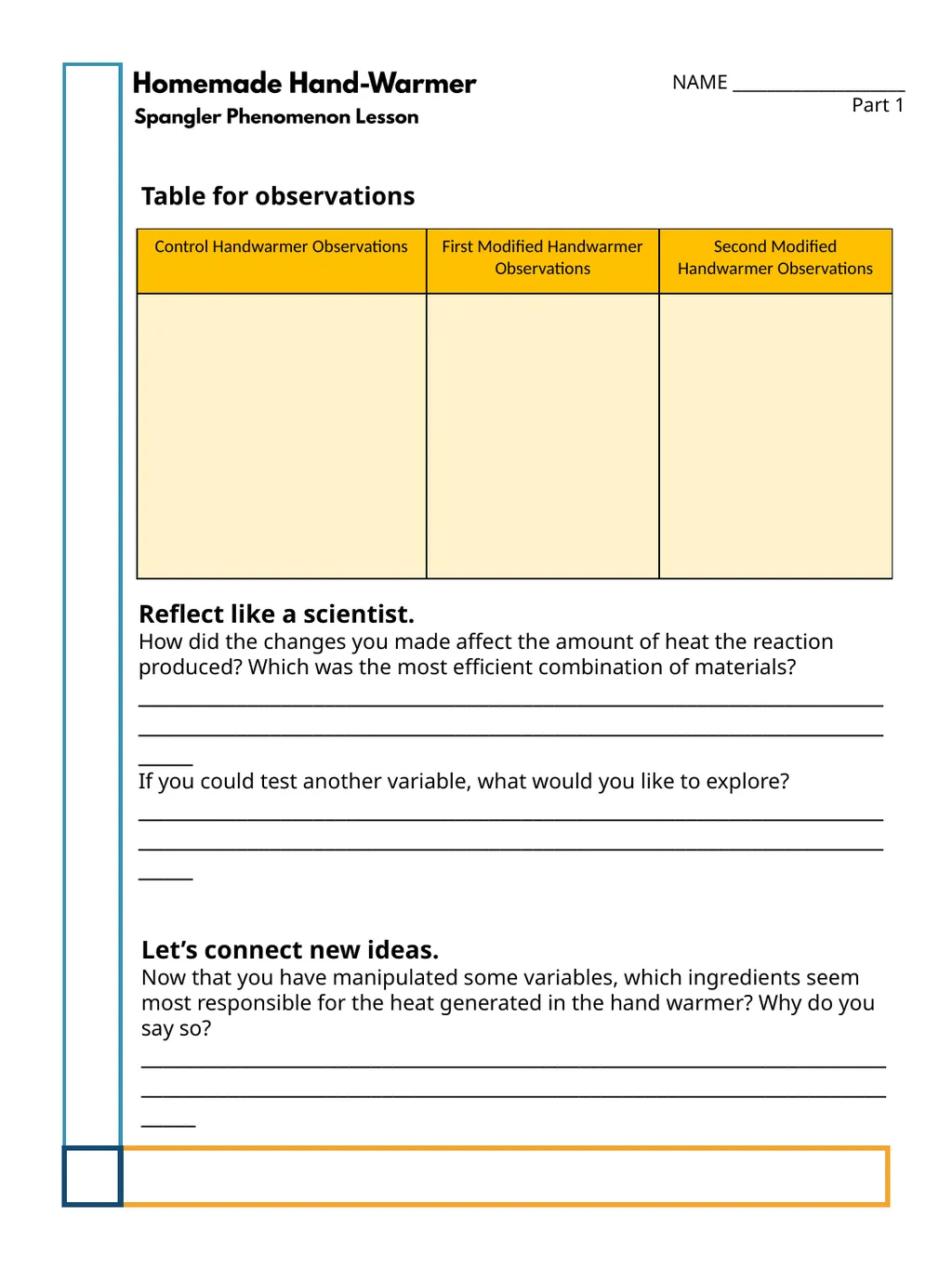
Part 1 Table for observations Reflect like a scientist.
How did the changes you made affect the amount of heat the reaction produced? Which was the most efficient combination of materials?
_____________________________________________________________________________________________________________________________________________
If you could test another variable, what would you like to explore?
_____________________________________________________________________________________________________________________________________________ Let’s connect new ideas.
Now that you have manipulated some variables, which ingredients seem most responsible for the heat generated in the hand warmer? Why do you say so?
_____________________________________________________________________________________________________________________________________________<br>
slide9. NAME ____________________
Part 2 Gather Your Facts Article
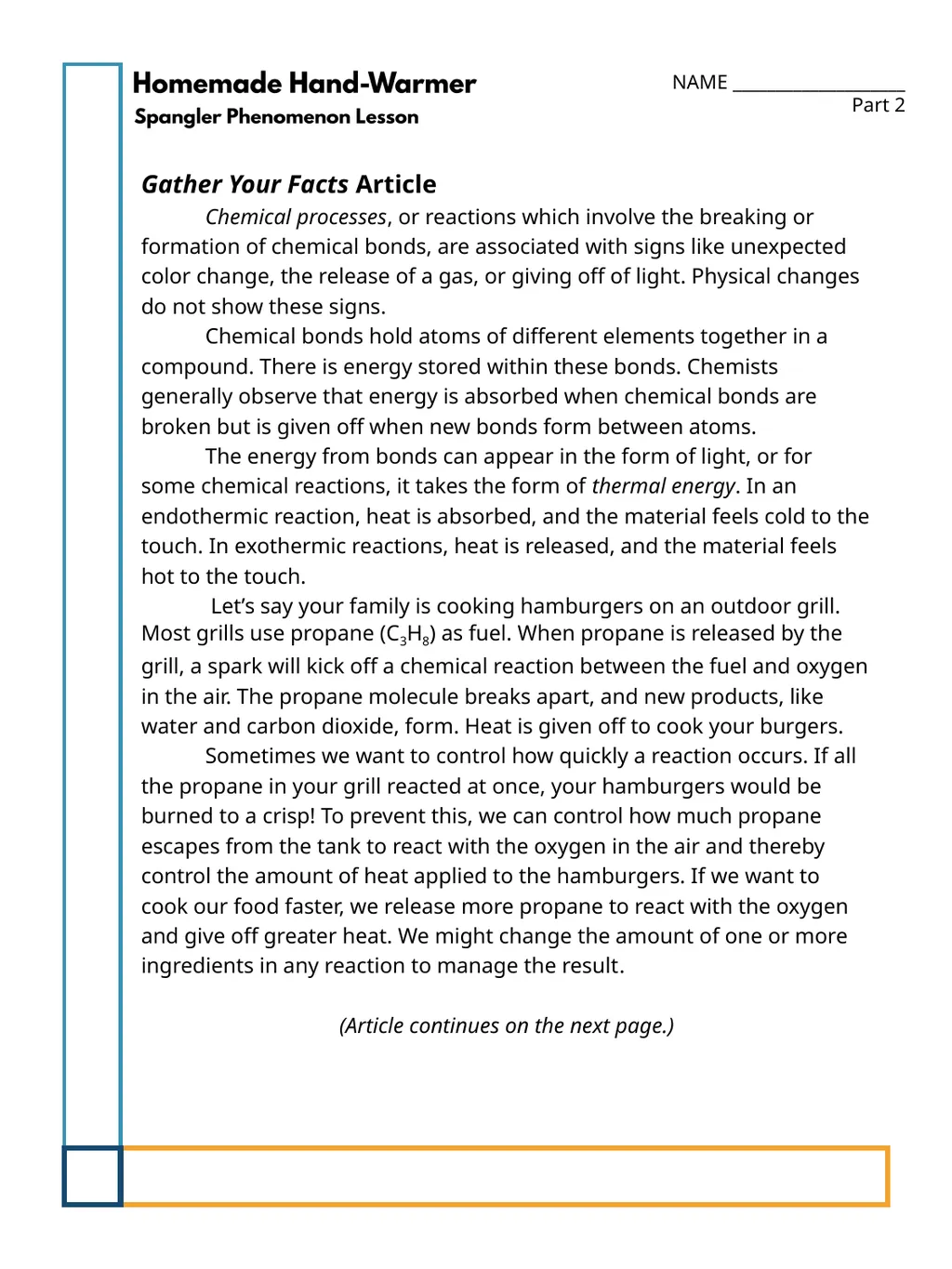
Chemical processes, or reactions which involve the breaking or formation of chemical bonds, are associated with signs like unexpected color change, the release of a gas, or giving off of light. Physical changes do not show these signs.
Chemical bonds hold atoms of different elements together in a compound. There is energy stored within these bonds. Chemists generally observe that energy is absorbed when chemical bonds are broken but is given off when new bonds form between atoms.
The energy from bonds can appear in the form of light, or for some chemical reactions, it takes the form of thermal energy. In an endothermic reaction, heat is absorbed, and the material feels cold to the touch. In exothermic reactions, heat is released, and the material feels hot to the touch.
Let’s say your family is cooking hamburgers on an outdoor grill. Most grills use propane (C3H8) as fuel. When propane is released by the grill, a spark will kick off a chemical reaction between the fuel and oxygen in the air. The propane molecule breaks apart, and new products, like water and carbon dioxide, form. Heat is given off to cook your burgers.
Sometimes we want to control how quickly a reaction occurs. If all the propane in your grill reacted at once, your hamburgers would be burned to a crisp! To prevent this, we can control how much propane escapes from the tank to react with the oxygen in the air and thereby control the amount of heat applied to the hamburgers. If we want to cook our food faster, we release more propane to react with the oxygen and give off greater heat. We might change the amount of one or more ingredients in any reaction to manage the result.
(Article continues on the next page.)<br>
slide10. NAME ____________________
Part 2 Gather Your Facts Article (continued)
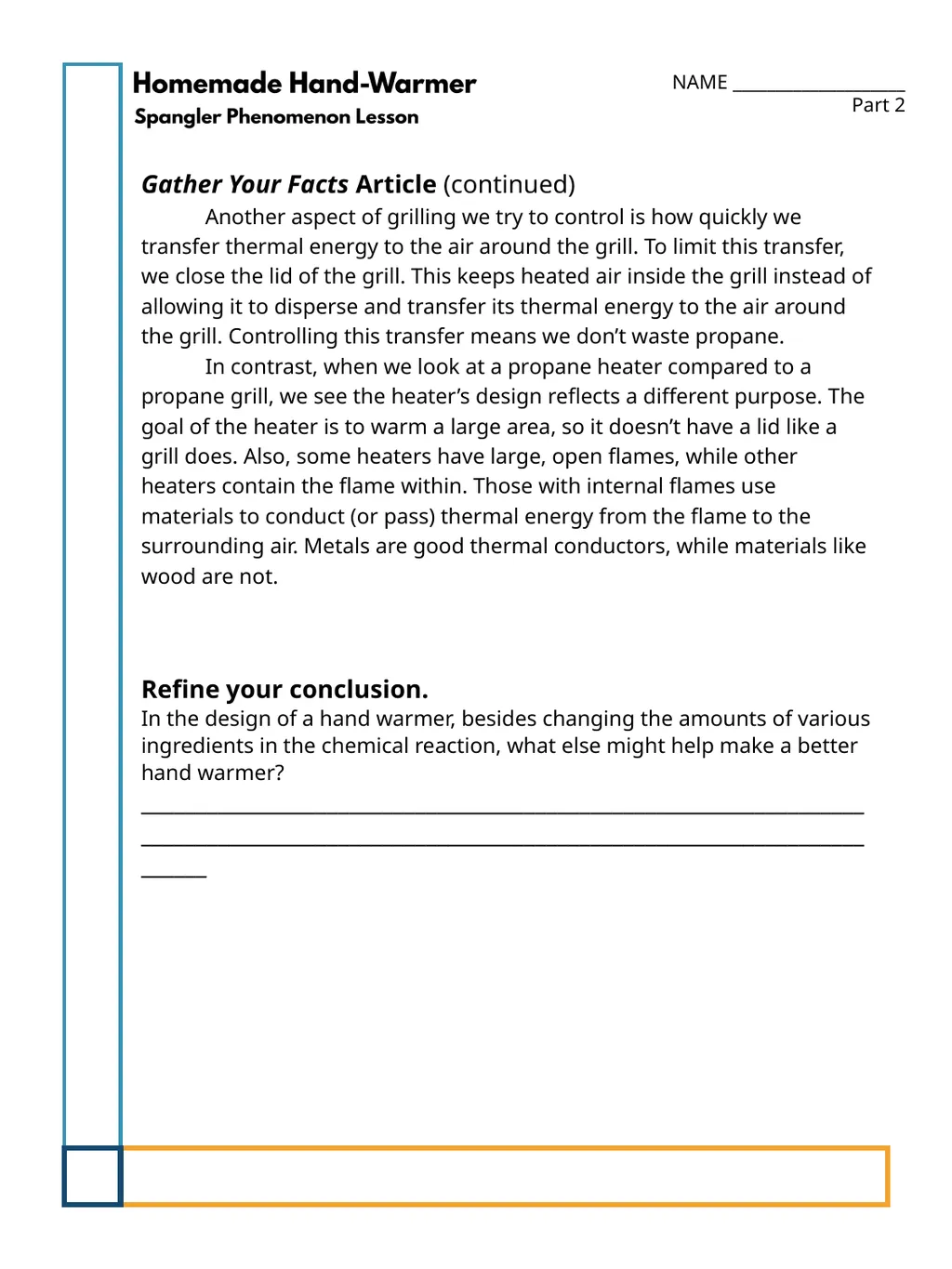
Another aspect of grilling we try to control is how quickly we transfer thermal energy to the air around the grill. To limit this transfer, we close the lid of the grill. This keeps heated air inside the grill instead of allowing it to disperse and transfer its thermal energy to the air around the grill. Controlling this transfer means we don’t waste propane.
In contrast, when we look at a propane heater compared to a propane grill, we see the heater’s design reflects a different purpose. The goal of the heater is to warm a large area, so it doesn’t have a lid like a grill does. Also, some heaters have large, open flames, while other heaters contain the flame within. Those with internal flames use materials to conduct (or pass) thermal energy from the flame to the surrounding air. Metals are good thermal conductors, while materials like wood are not. Refine your conclusion.
In the design of a hand warmer, besides changing the amounts of various ingredients in the chemical reaction, what else might help make a better hand warmer?
__________________________________________________________________________________________________________________________________________<br>
slide11. NAME ____________________
Part 3 Check your understanding.
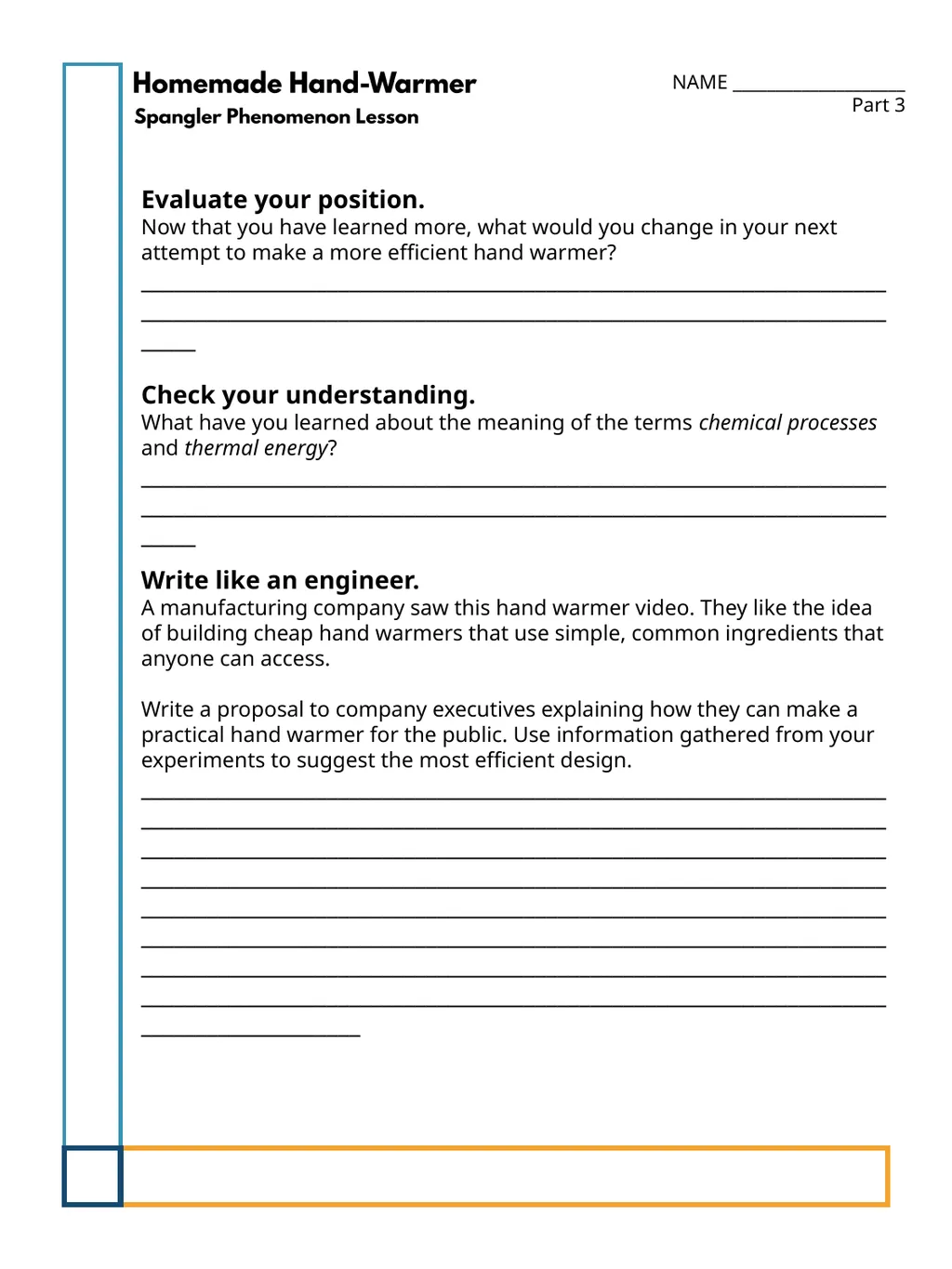
What have you learned about the meaning of the terms chemical processes and thermal energy?
_____________________________________________________________________________________________________________________________________________ Write like an engineer.
A manufacturing company saw this hand warmer video. They like the idea of building cheap hand warmers that use simple, common ingredients that anyone can access.
Write a proposal to company executives explaining how they can make a practical hand warmer for the public. Use information gathered from your experiments to suggest the most efficient design.
____________________________________________________________________________________________________________________________________________________________________________________________________________________________________________________________________________________________________________________________________________________________________________________________________________________________________________________________________________________________________________________________________________________________________________________ Evaluate your position.
Now that you have learned more, what would you change in your next attempt to make a more efficient hand warmer?
_____________________________________________________________________________________________________________________________________________<br>
slide12. NAME ____________________
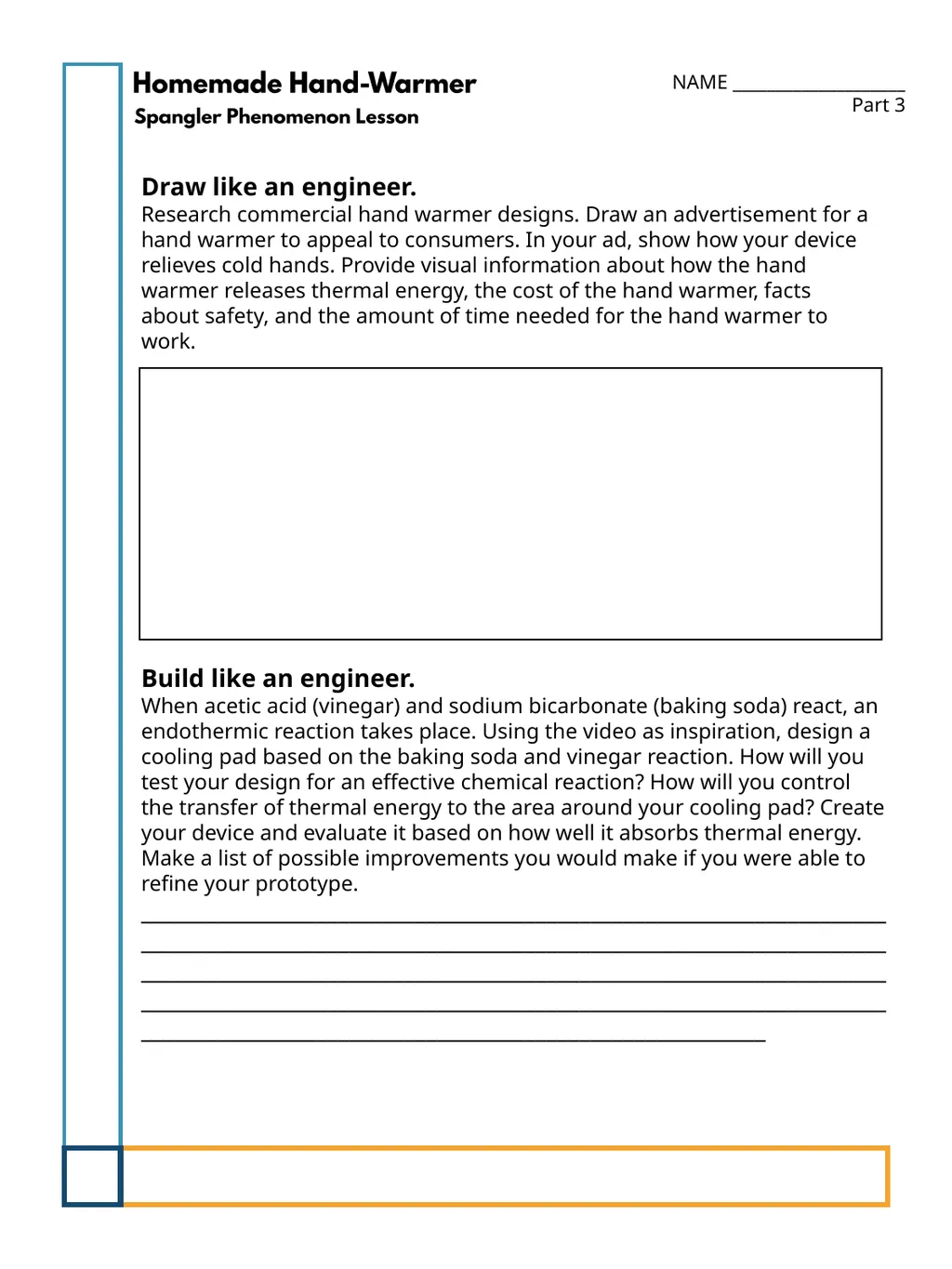
Part 3 Draw like an engineer.
Research commercial hand warmer designs. Draw an advertisement for a hand warmer to appeal to consumers. In your ad, show how your device relieves cold hands. Provide visual information about how the hand warmer releases thermal energy, the cost of the hand warmer, facts about safety, and the amount of time needed for the hand warmer to work. Build like an engineer.
When acetic acid (vinegar) and sodium bicarbonate (baking soda) react, an endothermic reaction takes place. Using the video as inspiration, design a cooling pad based on the baking soda and vinegar reaction. How will you test your design for an effective chemical reaction? How will you control the transfer of thermal energy to the area around your cooling pad? Create your device and evaluate it based on how well it absorbs thermal energy. Make a list of possible improvements you would make if you were able to refine your prototype.
_________________________________________________________________________________________________________________________________________________________________________________________________________________________________________________________________________________________________________________________________________<br>
slide13. NAME ____________________
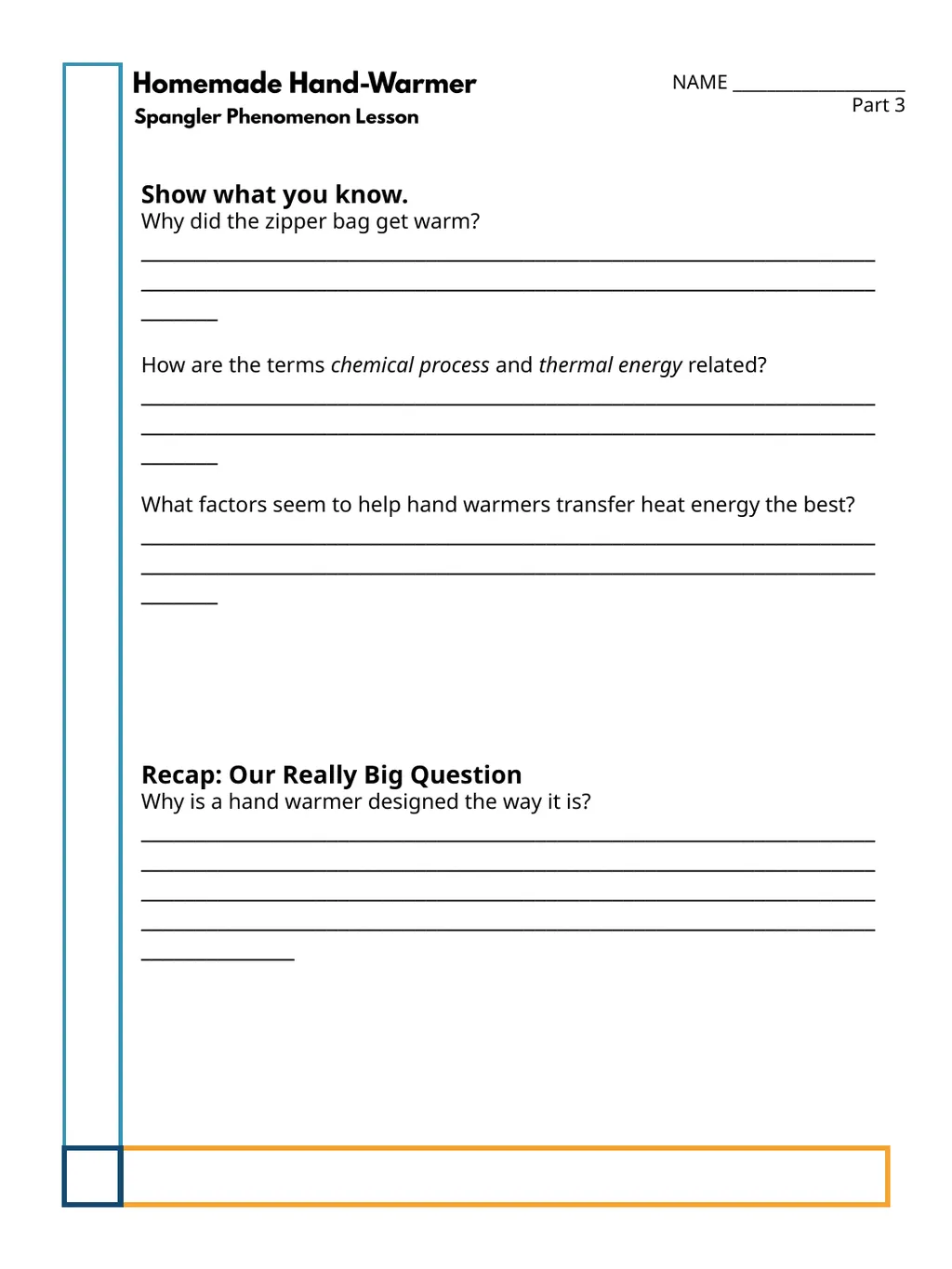
Part 3 Show what you know.
Why did the zipper bag get warm?
_____________________________________________________________________________________________________________________________________________
How are the terms chemical process and thermal energy related?
_____________________________________________________________________________________________________________________________________________
What factors seem to help hand warmers transfer heat energy the best?
_____________________________________________________________________________________________________________________________________________ Recap: Our Really Big Question
Why is a hand warmer designed the way it is?
__________________________________________________________________________________________________________________________________________________________________________________________________________________________________________________________________________________________<br>
slide14. Flex your vocabulary.
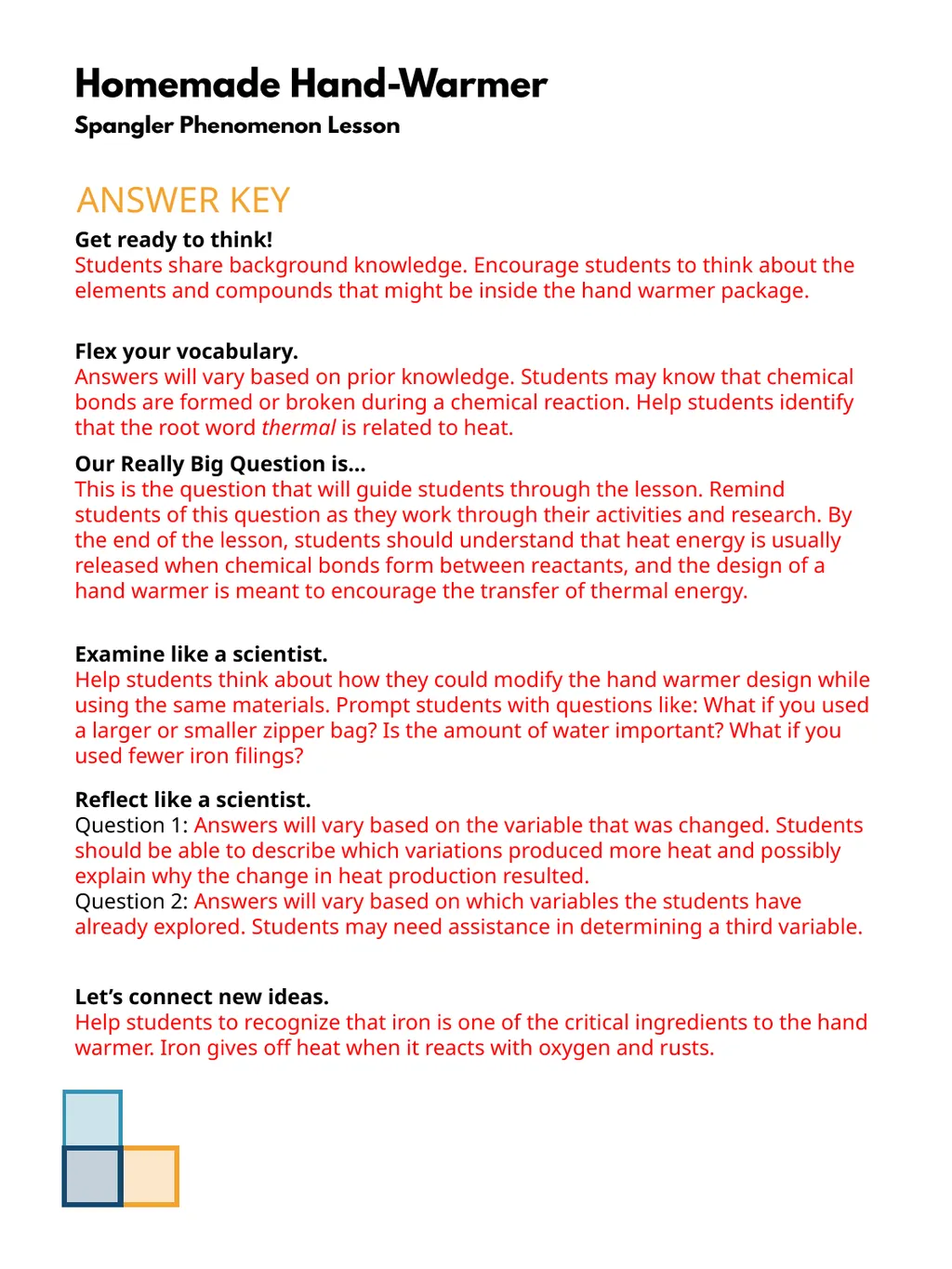
Answers will vary based on prior knowledge. Students may know that chemical bonds are formed or broken during a chemical reaction. Help students identify that the root word thermal is related to heat. Our Really Big Question is…
This is the question that will guide students through the lesson. Remind students of this question as they work through their activities and research. By the end of the lesson, students should understand that heat energy is usually released when chemical bonds form between reactants, and the design of a hand warmer is meant to encourage the transfer of thermal energy. Examine like a scientist.
Help students think about how they could modify the hand warmer design while using the same materials. Prompt students with questions like: What if you used a larger or smaller zipper bag? Is the amount of water important? What if you used fewer iron filings? Let’s connect new ideas.
Help students to recognize that iron is one of the critical ingredients to the hand warmer. Iron gives off heat when it reacts with oxygen and rusts. Get ready to think!
Students share background knowledge. Encourage students to think about the elements and compounds that might be inside the hand warmer package. Reflect like a scientist.
Question 1: Answers will vary based on the variable that was changed. Students should be able to describe which variations produced more heat and possibly explain why the change in heat production resulted.
Question 2: Answers will vary based on which variables the students have already explored. Students may need assistance in determining a third variable.<br>
slide15. Refine your conclusion.
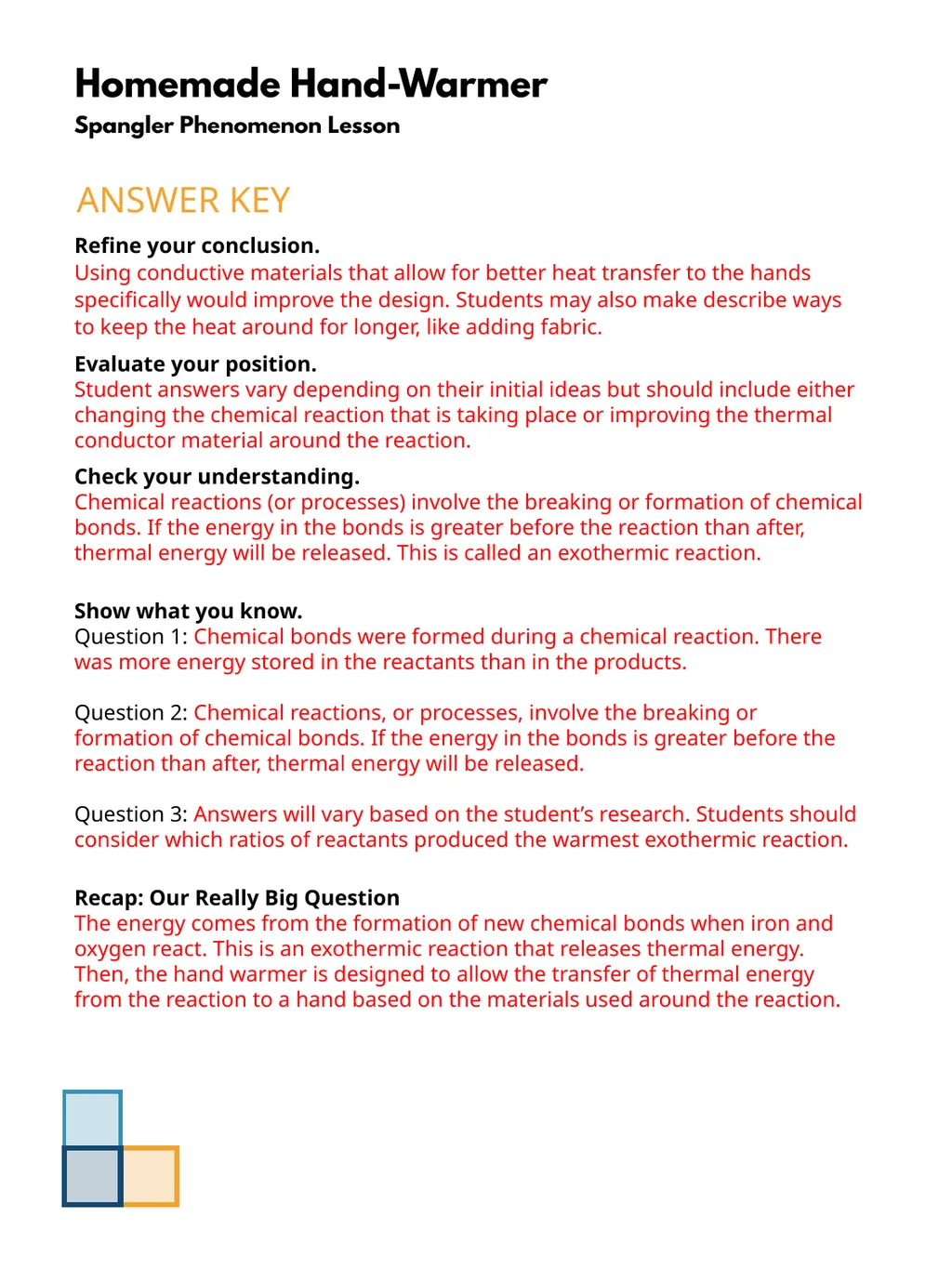
Using conductive materials that allow for better heat transfer to the hands specifically would improve the design. Students may also make describe ways to keep the heat around for longer, like adding fabric. Evaluate your position.
Student answers vary depending on their initial ideas but should include either changing the chemical reaction that is taking place or improving the thermal conductor material around the reaction. Check your understanding.
Chemical reactions (or processes) involve the breaking or formation of chemical bonds. If the energy in the bonds is greater before the reaction than after, thermal energy will be released. This is called an exothermic reaction. Show what you know.
Question 1: Chemical bonds were formed during a chemical reaction. There was more energy stored in the reactants than in the products.
Question 2: Chemical reactions, or processes, involve the breaking or formation of chemical bonds. If the energy in the bonds is greater before the reaction than after, thermal energy will be released.
Question 3: Answers will vary based on the student’s research. Students should consider which ratios of reactants produced the warmest exothermic reaction. Recap: Our Really Big Question
The energy comes from the formation of new chemical bonds when iron and oxygen react. This is an exothermic reaction that releases thermal energy. Then, the hand warmer is designed to allow the transfer of thermal energy from the reaction to a hand based on the materials used around the reaction.<br>
slide16. What are signs of a chemical change?
Color change, release of gas, and giving off light. Comprehension Check Questions (Interactive File Only) What are chemical bonds?
Bonds store energy and hold atoms together in a compound. How are exothermic and endothermic reactions different?
Exothermic reactions release heat while endothermic reactions absorb heat. What are signs of a chemical change?
Color change, release of gas, and giving off light. What products are formed when propane burns in the presence of oxygen?
Water, carbon dioxide, and heat. How can we control the rate of a chemical change like burning propane?
We can control the amount of reactants, like propane, that chemically react. Why do we close the lid of a grill when cooking?
This limits the amount of thermal energy that is transferred to the air. How is the design of a propane space heater different than a propane grill?
Space heaters are designed to transfer thermal energy to outside air.<br>
slide2. Answer keys for this lesson are found at the end of these Teacher Directions pages.
Learning Objective:
Why is a hand warmer designed the way it is?
NGSS Standard:
MSPS1-6: Undertake a design project to construct, test, and modify a device that either releases or absorbs thermal energy by chemical processes.
CCC/SEP:
Energy and Matter; Constructing Explanations and Designing Solutions
Materials Required:
Materials needed for the student activity, drawing, or building projects are listed here.
Jelly crystals
A small cup
Iron filings
Calcium chloride
Zipper lock bag
Water
Materials for an endothermic reaction device, such as citric acid and baking soda or baking soda and vinegar in a bag or cup<br>
slide3. Using the Interactive Version:
Each of the three parts of the lesson has an interactive version. Students can stay in edit mode of PowerPoint or Google Slides and enter their answers as text boxes and images. Slides for hands-on activities can be deleted if not feasible for students working from home.
When converting to Google Slides, be sure to use the Upload and Save As Slides commands, NOT Import.
How to Modify a Slide Master:
Open the View tab on the ribbon to open Slide Master View.
Make any text, color, and alignment changes. To use a predefined theme, click Themes on the Slide Master tab. Then, proceed by selecting colors, fonts, effects, and background styles.
After modifications are made, select Close Master View.
Be sure to save after leaving the Slide Master view so students do not start with the file in Slide Master view when they open it.<br>
slide4. Lesson Contents
In addition to the optional handouts in this file, there are three presentation files used in each lesson: Part 1, Part 2, and Part 3.
Parts 1 and 3 contain links to Vimeo videos that are ad-free. Please consider giving these links to your IT department to be “white-listed” so they are not blocked.
For each part, there is one PowerPoint that is labeled “interactive.” Students can stay in Edit mode and type/draw their answers on these slides.
Part 1: Think Like a Scientist motivates students to think and behave like real scientists and engineers through interactive engagement.
Part 1 Instructions:
Use the presentation in-class, as a recording, or as a single-student remote learning activity.
In the presentation, students will first activate prior knowledge based on the name of the video. They will also engage with vocabulary and the learning objective.
Next, students will watch the video and think about it as if they were scientists. (Link to video: https://player.vimeo.com/external/512692505.hd.mp4?s=88b9706e56df08237af86c14e67f97ea44c4cca6&profile_id=175)
Students will then complete a stimulating activity related to the video in which they will make observations and refine their presuppositions about the video.
NOTE: For the interactive version, the student-led activity can be replaced with a live-streamed teacher-led demo, or the slides can be deleted if the students cannot do the activity at home.<br>
slide5. Part 2: Study Like a Scientist encourages students to gather facts and examine outcomes independently so they can develop a deeper understanding of the scientific concept.
Part 2 Instructions:
Students will have the opportunity to gather and examine facts.
Then, students will reflect on their original ideas and refine conclusions.
The paragraphs of information in this file are also available as an article in Word or PDF format.
NOTE: Part 2 is optional and can be replaced or extended with other experiences.
Part 3: Work Like a Scientist allows students to reevaluate their conclusions and to explain what they have learned about the scientific concept.
Part 3 Instructions:
Students will watch a video that explains demonstration results. (Link to video: https://player.vimeo.com/external/531058800.hd.mp4?s=8670373b0784c426ae4a24808f05a675e61bfaf1&profile_id=175)
Next, students will have three options for activities: writing, drawing, or building like a scientist or engineer. You can assign one of the activities or allow students to choose.
After the activity, students will receive an exit ticket to assess learning.
Students will participate in a recap of the Learning Objective.
NOTE: The Build activity may be deleted for remote learning if necessary.<br>
slide6. Featured in Videos:
Steve Spangler is a best-selling author, educator and Emmy award-winning science communicator. His videos featured on YouTube, Facebook, Instagram and now TikTok have over 1 billion views. Steve’s DIY Sci show appears on FOX / CW affiliates as well as Amazon Prime, and he’s a frequent guest on the Ellen Show. Steve’s professional development workshops focus on best practices and instructional strategies to increase student engagement through phenomenon-based learning.
File Formats:
Standard Version: PowerPoint and PDF options are available for display purposes. The teacher may use the Standard Version as a presentation to accompany the paper handouts in this file.
Interactive Version: This option is ideal for remote learners. These files can be typed on directly, uploaded into Google Classroom (use the Save As Slides menu option) or used with other platforms, like Pear Deck. These files can be uploaded into Google Classroom (use the Save As Slides menu option) or other educational platforms only if they are login/passcode protected and access is available only to your own students.
Links to Online Resources:
Energy Transformations Complete 5E Lesson Plans
Exothermic and Endothermic Reactions Inquiry Lab<br>
slide7. NAME ____________________
Part 1 Flex your vocabulary.
What do you know about the terms thermal energy and chemical processes?
_____________________________________________________________________________________________________________________________________________ Our Really Big Question is…
Why is a hand warmer designed the way it is?
_____________________________________________________________________________________________________________________________________________ Examine like a scientist.
What are some variables you could measure about a hand warmer? How could you collect data?
_____________________________________________________________________________________________________________________________________________ Get ready to think!
Have you used hand warmers before? What ingredients do you think a hand warmer needs to work?
_____________________________________________________________________________________________________________________________________________<br>
slide8. NAME ____________________
Part 1 Table for observations Reflect like a scientist.
How did the changes you made affect the amount of heat the reaction produced? Which was the most efficient combination of materials?
_____________________________________________________________________________________________________________________________________________
If you could test another variable, what would you like to explore?
_____________________________________________________________________________________________________________________________________________ Let’s connect new ideas.
Now that you have manipulated some variables, which ingredients seem most responsible for the heat generated in the hand warmer? Why do you say so?
_____________________________________________________________________________________________________________________________________________<br>
slide9. NAME ____________________
Part 2 Gather Your Facts Article
Chemical processes, or reactions which involve the breaking or formation of chemical bonds, are associated with signs like unexpected color change, the release of a gas, or giving off of light. Physical changes do not show these signs.
Chemical bonds hold atoms of different elements together in a compound. There is energy stored within these bonds. Chemists generally observe that energy is absorbed when chemical bonds are broken but is given off when new bonds form between atoms.
The energy from bonds can appear in the form of light, or for some chemical reactions, it takes the form of thermal energy. In an endothermic reaction, heat is absorbed, and the material feels cold to the touch. In exothermic reactions, heat is released, and the material feels hot to the touch.
Let’s say your family is cooking hamburgers on an outdoor grill. Most grills use propane (C3H8) as fuel. When propane is released by the grill, a spark will kick off a chemical reaction between the fuel and oxygen in the air. The propane molecule breaks apart, and new products, like water and carbon dioxide, form. Heat is given off to cook your burgers.
Sometimes we want to control how quickly a reaction occurs. If all the propane in your grill reacted at once, your hamburgers would be burned to a crisp! To prevent this, we can control how much propane escapes from the tank to react with the oxygen in the air and thereby control the amount of heat applied to the hamburgers. If we want to cook our food faster, we release more propane to react with the oxygen and give off greater heat. We might change the amount of one or more ingredients in any reaction to manage the result.
(Article continues on the next page.)<br>
slide10. NAME ____________________
Part 2 Gather Your Facts Article (continued)
Another aspect of grilling we try to control is how quickly we transfer thermal energy to the air around the grill. To limit this transfer, we close the lid of the grill. This keeps heated air inside the grill instead of allowing it to disperse and transfer its thermal energy to the air around the grill. Controlling this transfer means we don’t waste propane.
In contrast, when we look at a propane heater compared to a propane grill, we see the heater’s design reflects a different purpose. The goal of the heater is to warm a large area, so it doesn’t have a lid like a grill does. Also, some heaters have large, open flames, while other heaters contain the flame within. Those with internal flames use materials to conduct (or pass) thermal energy from the flame to the surrounding air. Metals are good thermal conductors, while materials like wood are not. Refine your conclusion.
In the design of a hand warmer, besides changing the amounts of various ingredients in the chemical reaction, what else might help make a better hand warmer?
__________________________________________________________________________________________________________________________________________<br>
slide11. NAME ____________________
Part 3 Check your understanding.
What have you learned about the meaning of the terms chemical processes and thermal energy?
_____________________________________________________________________________________________________________________________________________ Write like an engineer.
A manufacturing company saw this hand warmer video. They like the idea of building cheap hand warmers that use simple, common ingredients that anyone can access.
Write a proposal to company executives explaining how they can make a practical hand warmer for the public. Use information gathered from your experiments to suggest the most efficient design.
____________________________________________________________________________________________________________________________________________________________________________________________________________________________________________________________________________________________________________________________________________________________________________________________________________________________________________________________________________________________________________________________________________________________________________________ Evaluate your position.
Now that you have learned more, what would you change in your next attempt to make a more efficient hand warmer?
_____________________________________________________________________________________________________________________________________________<br>
slide12. NAME ____________________
Part 3 Draw like an engineer.
Research commercial hand warmer designs. Draw an advertisement for a hand warmer to appeal to consumers. In your ad, show how your device relieves cold hands. Provide visual information about how the hand warmer releases thermal energy, the cost of the hand warmer, facts about safety, and the amount of time needed for the hand warmer to work. Build like an engineer.
When acetic acid (vinegar) and sodium bicarbonate (baking soda) react, an endothermic reaction takes place. Using the video as inspiration, design a cooling pad based on the baking soda and vinegar reaction. How will you test your design for an effective chemical reaction? How will you control the transfer of thermal energy to the area around your cooling pad? Create your device and evaluate it based on how well it absorbs thermal energy. Make a list of possible improvements you would make if you were able to refine your prototype.
_________________________________________________________________________________________________________________________________________________________________________________________________________________________________________________________________________________________________________________________________________<br>
slide13. NAME ____________________
Part 3 Show what you know.
Why did the zipper bag get warm?
_____________________________________________________________________________________________________________________________________________
How are the terms chemical process and thermal energy related?
_____________________________________________________________________________________________________________________________________________
What factors seem to help hand warmers transfer heat energy the best?
_____________________________________________________________________________________________________________________________________________ Recap: Our Really Big Question
Why is a hand warmer designed the way it is?
__________________________________________________________________________________________________________________________________________________________________________________________________________________________________________________________________________________________<br>
slide14. Flex your vocabulary.
Answers will vary based on prior knowledge. Students may know that chemical bonds are formed or broken during a chemical reaction. Help students identify that the root word thermal is related to heat. Our Really Big Question is…
This is the question that will guide students through the lesson. Remind students of this question as they work through their activities and research. By the end of the lesson, students should understand that heat energy is usually released when chemical bonds form between reactants, and the design of a hand warmer is meant to encourage the transfer of thermal energy. Examine like a scientist.
Help students think about how they could modify the hand warmer design while using the same materials. Prompt students with questions like: What if you used a larger or smaller zipper bag? Is the amount of water important? What if you used fewer iron filings? Let’s connect new ideas.
Help students to recognize that iron is one of the critical ingredients to the hand warmer. Iron gives off heat when it reacts with oxygen and rusts. Get ready to think!
Students share background knowledge. Encourage students to think about the elements and compounds that might be inside the hand warmer package. Reflect like a scientist.
Question 1: Answers will vary based on the variable that was changed. Students should be able to describe which variations produced more heat and possibly explain why the change in heat production resulted.
Question 2: Answers will vary based on which variables the students have already explored. Students may need assistance in determining a third variable.<br>
slide15. Refine your conclusion.
Using conductive materials that allow for better heat transfer to the hands specifically would improve the design. Students may also make describe ways to keep the heat around for longer, like adding fabric. Evaluate your position.
Student answers vary depending on their initial ideas but should include either changing the chemical reaction that is taking place or improving the thermal conductor material around the reaction. Check your understanding.
Chemical reactions (or processes) involve the breaking or formation of chemical bonds. If the energy in the bonds is greater before the reaction than after, thermal energy will be released. This is called an exothermic reaction. Show what you know.
Question 1: Chemical bonds were formed during a chemical reaction. There was more energy stored in the reactants than in the products.
Question 2: Chemical reactions, or processes, involve the breaking or formation of chemical bonds. If the energy in the bonds is greater before the reaction than after, thermal energy will be released.
Question 3: Answers will vary based on the student’s research. Students should consider which ratios of reactants produced the warmest exothermic reaction. Recap: Our Really Big Question
The energy comes from the formation of new chemical bonds when iron and oxygen react. This is an exothermic reaction that releases thermal energy. Then, the hand warmer is designed to allow the transfer of thermal energy from the reaction to a hand based on the materials used around the reaction.<br>
slide16. What are signs of a chemical change?
Color change, release of gas, and giving off light. Comprehension Check Questions (Interactive File Only) What are chemical bonds?
Bonds store energy and hold atoms together in a compound. How are exothermic and endothermic reactions different?
Exothermic reactions release heat while endothermic reactions absorb heat. What are signs of a chemical change?
Color change, release of gas, and giving off light. What products are formed when propane burns in the presence of oxygen?
Water, carbon dioxide, and heat. How can we control the rate of a chemical change like burning propane?
We can control the amount of reactants, like propane, that chemically react. Why do we close the lid of a grill when cooking?
This limits the amount of thermal energy that is transferred to the air. How is the design of a propane space heater different than a propane grill?
Space heaters are designed to transfer thermal energy to outside air.<br>