
Teacher Directions STEM Starters are activity
CP
Published · 41 slides · 0 views

1 / 1




Description
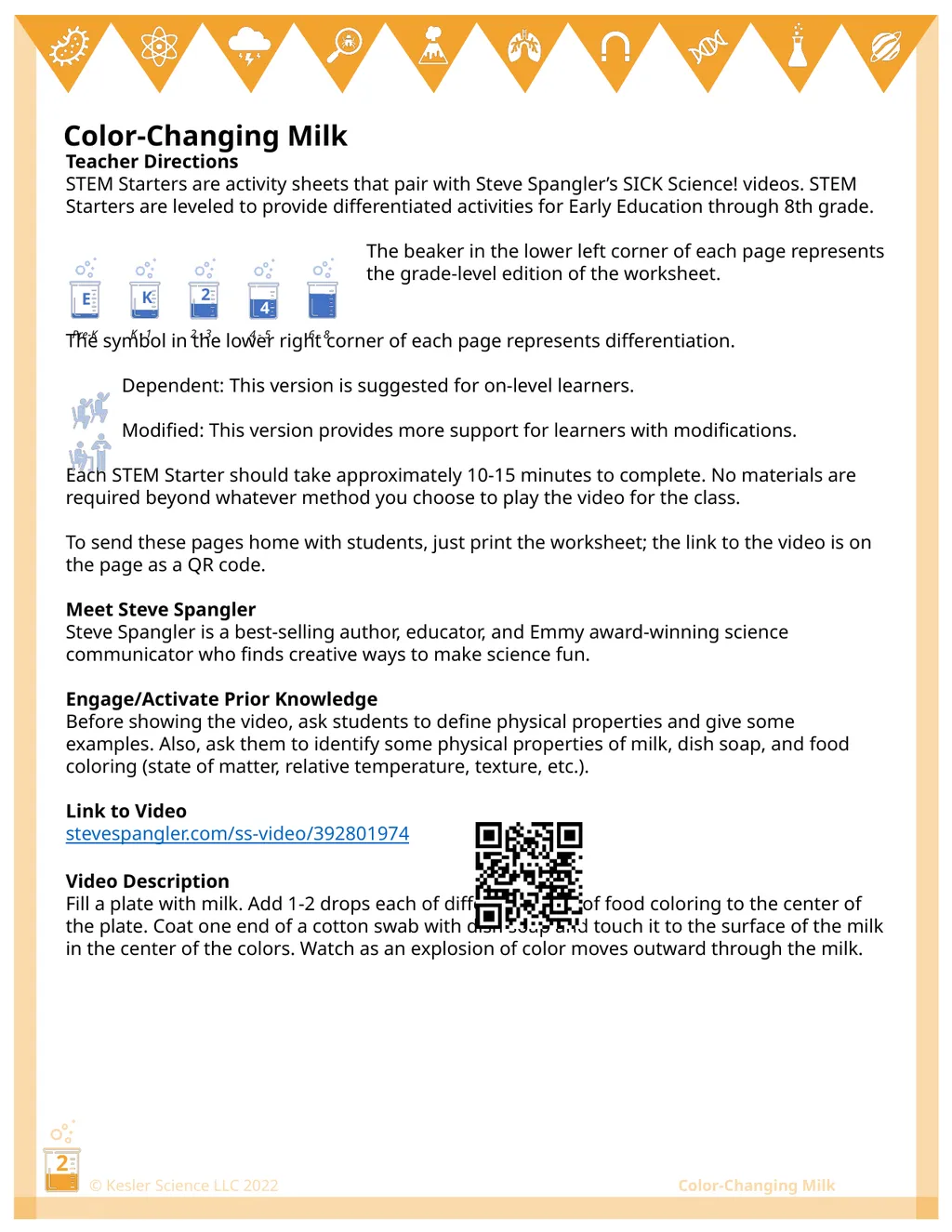
Teacher Directions STEM Starters are activity sheets that pair with Steve Spanglers SICK Science! videos. STEM Starters are leveled to provide differentiated activities for Early Education through 8th grade. The beaker in the lower left
Related Topics
Share
Embed code
Download this presentation From Below
"Teacher Directions STEM Starters are activity" is the property of its rightful owner. Permission is granted to download and print the materials on this website for personal, non-commercial use only, and to display it on your personal computer provided you do not modify the materials and that you retain all copyright notices contained in the materials. By downloading content from our website, you accept the terms of this agreement.
Presentation Transcript
01
Teacher Directions
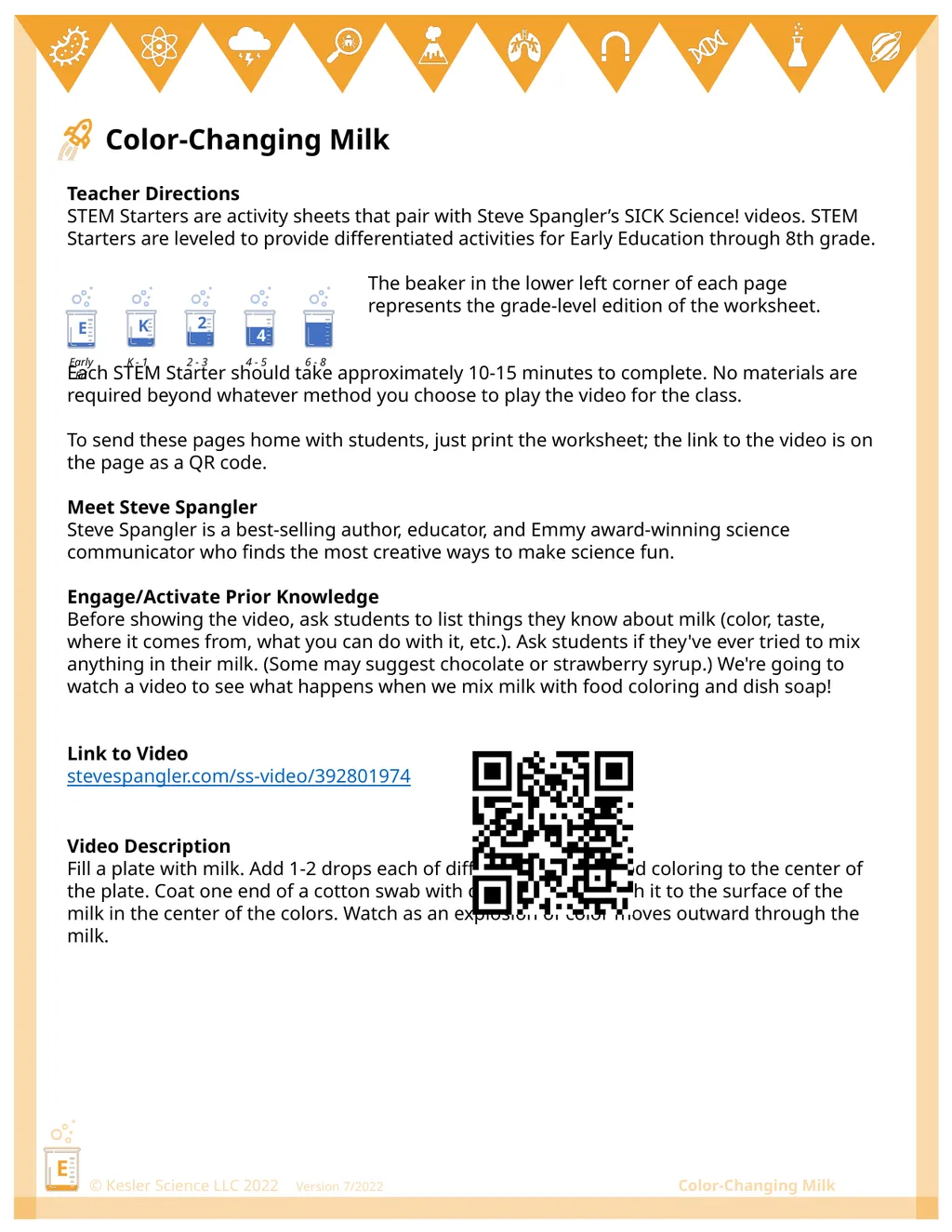
STEM Starters are activity sheets that pair with Steve Spangler’s SICK Science! videos. STEM Starters are leveled to provide differentiated activities for Early Education through 8th grade.
The beaker in the lower left corner of each page represents the grade-level edition of the worksheet.
Each STEM Starter should take approximately 10-15 minutes to complete. No materials are required beyond whatever method you choose to play the video for the class. To send these pages home with students, just print the worksheet; the link to the video is on the page as a QR code.
Meet Steve Spangler Steve Spangler is a best-selling author, educator, and Emmy award-winning science communicator who finds the most creative ways to make science fun.
Engage/Activate Prior Knowledge
Before showing the video, ask students to list things they know about milk (color, taste, where it comes from, what you can do with it, etc.). Ask students if they've ever tried to mix anything in their milk. (Some may suggest chocolate or strawberry syrup.) We're going to watch a video to see what happens when we mix milk with food coloring and dish soap!
Link to Video
stevespangler.com/ss-video/392801974
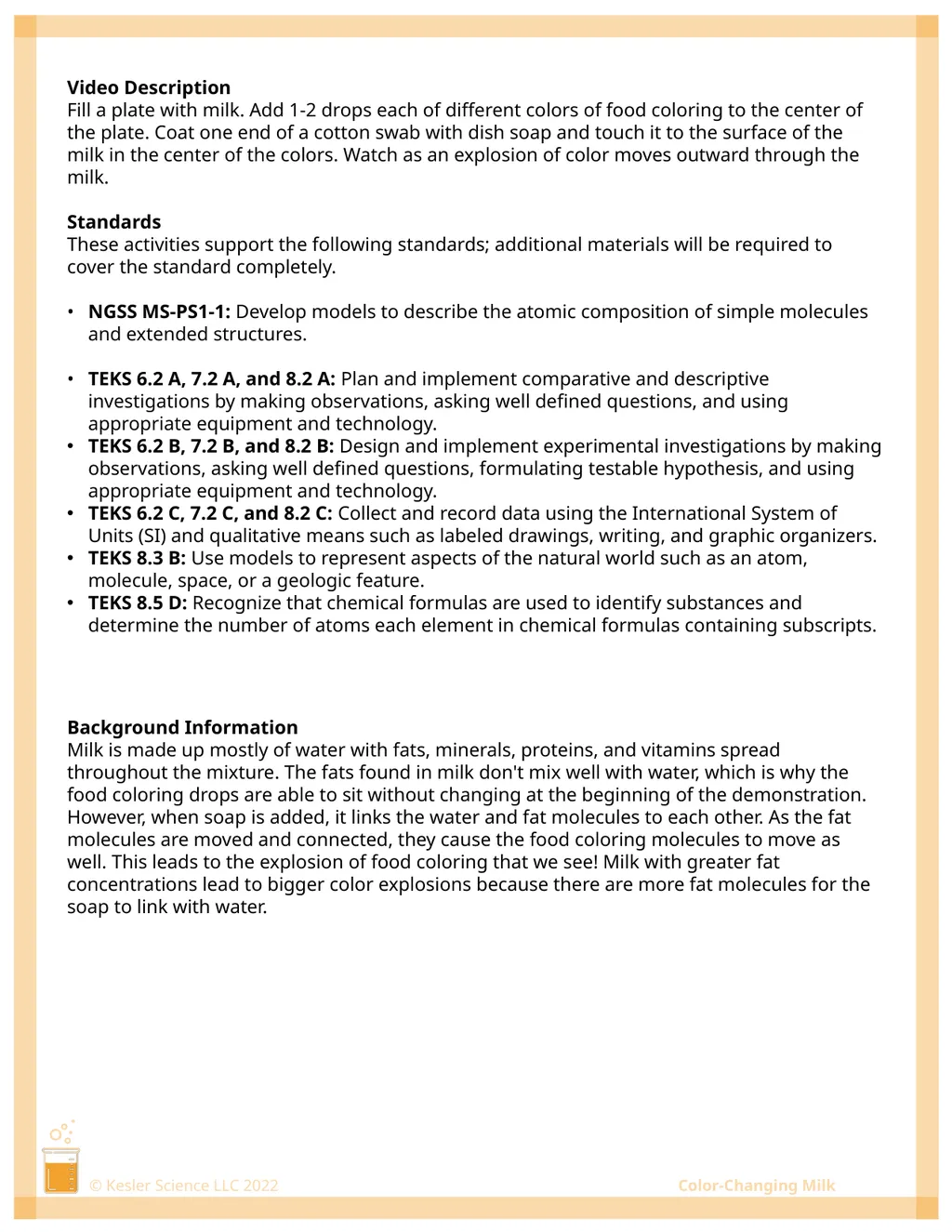
Video Description
Fill a plate with milk. Add 1-2 drops each of different colors of food coloring to the center of the plate. Coat one end of a cotton swab with dish soap and touch it to the surface of the milk in the center of the colors. Watch as an explosion of color moves outward through the milk. Version 7/2022<br>
The beaker in the lower left corner of each page represents the grade-level edition of the worksheet.
Each STEM Starter should take approximately 10-15 minutes to complete. No materials are required beyond whatever method you choose to play the video for the class. To send these pages home with students, just print the worksheet; the link to the video is on the page as a QR code.
Meet Steve Spangler Steve Spangler is a best-selling author, educator, and Emmy award-winning science communicator who finds the most creative ways to make science fun.
Engage/Activate Prior Knowledge
Before showing the video, ask students to list things they know about milk (color, taste, where it comes from, what you can do with it, etc.). Ask students if they've ever tried to mix anything in their milk. (Some may suggest chocolate or strawberry syrup.) We're going to watch a video to see what happens when we mix milk with food coloring and dish soap!
Link to Video
stevespangler.com/ss-video/392801974
Video Description
Fill a plate with milk. Add 1-2 drops each of different colors of food coloring to the center of the plate. Coat one end of a cotton swab with dish soap and touch it to the surface of the milk in the center of the colors. Watch as an explosion of color moves outward through the milk. Version 7/2022<br>
02
Standards
These activities support the following standards; additional materials will be required to cover the standard completely.
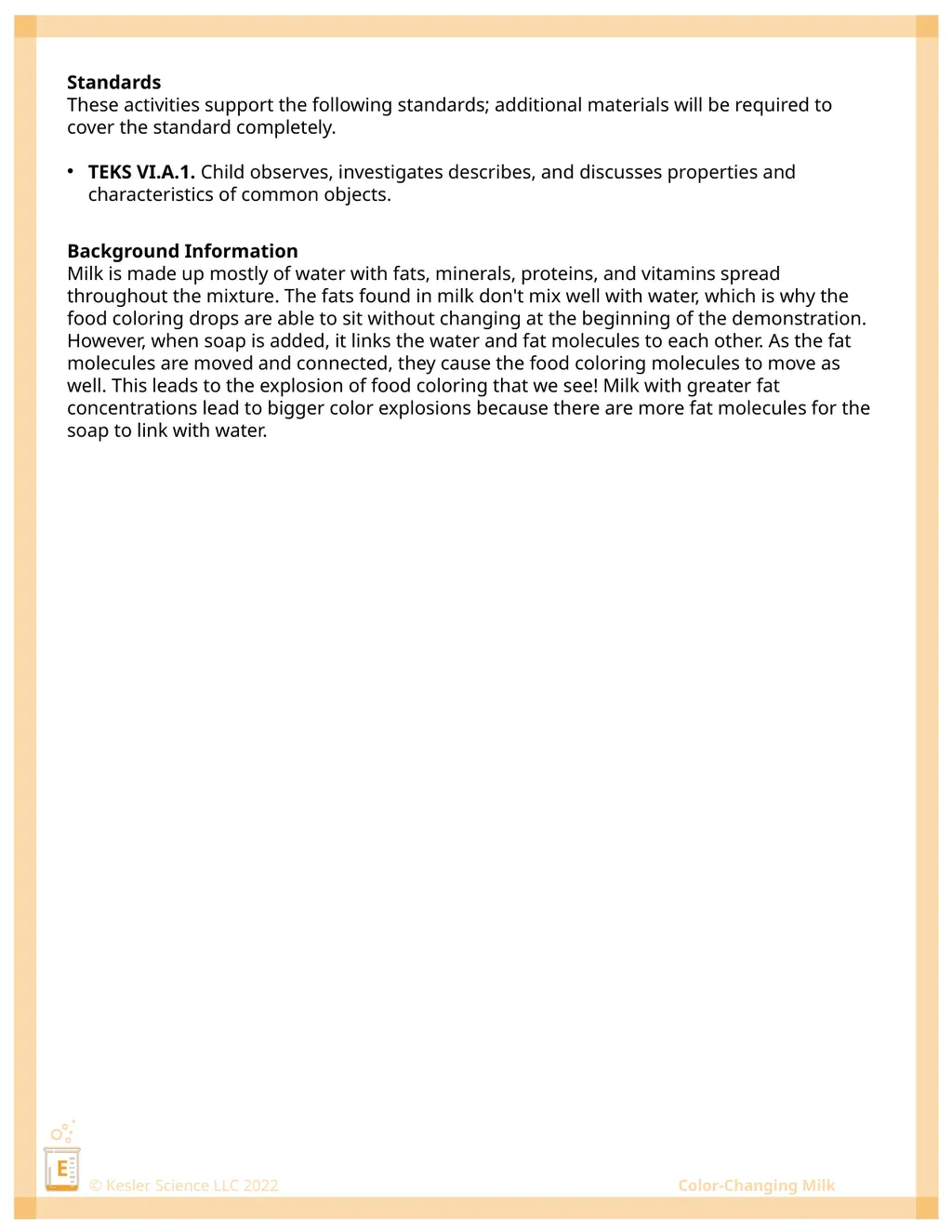
TEKS VI.A.1. Child observes, investigates describes, and discusses properties and characteristics of common objects. Background Information Milk is made up mostly of water with fats, minerals, proteins, and vitamins spread throughout the mixture. The fats found in milk don't mix well with water, which is why the food coloring drops are able to sit without changing at the beginning of the demonstration. However, when soap is added, it links the water and fat molecules to each other. As the fat molecules are moved and connected, they cause the food coloring molecules to move as well. This leads to the explosion of food coloring that we see! Milk with greater fat concentrations lead to bigger color explosions because there are more fat molecules for the soap to link with water.<br>
TEKS VI.A.1. Child observes, investigates describes, and discusses properties and characteristics of common objects. Background Information Milk is made up mostly of water with fats, minerals, proteins, and vitamins spread throughout the mixture. The fats found in milk don't mix well with water, which is why the food coloring drops are able to sit without changing at the beginning of the demonstration. However, when soap is added, it links the water and fat molecules to each other. As the fat molecules are moved and connected, they cause the food coloring molecules to move as well. This leads to the explosion of food coloring that we see! Milk with greater fat concentrations lead to bigger color explosions because there are more fat molecules for the soap to link with water.<br>
03
How many colors of food coloring were used? Fill in the number below. Draw a line from each word to its matching picture.<br>
04
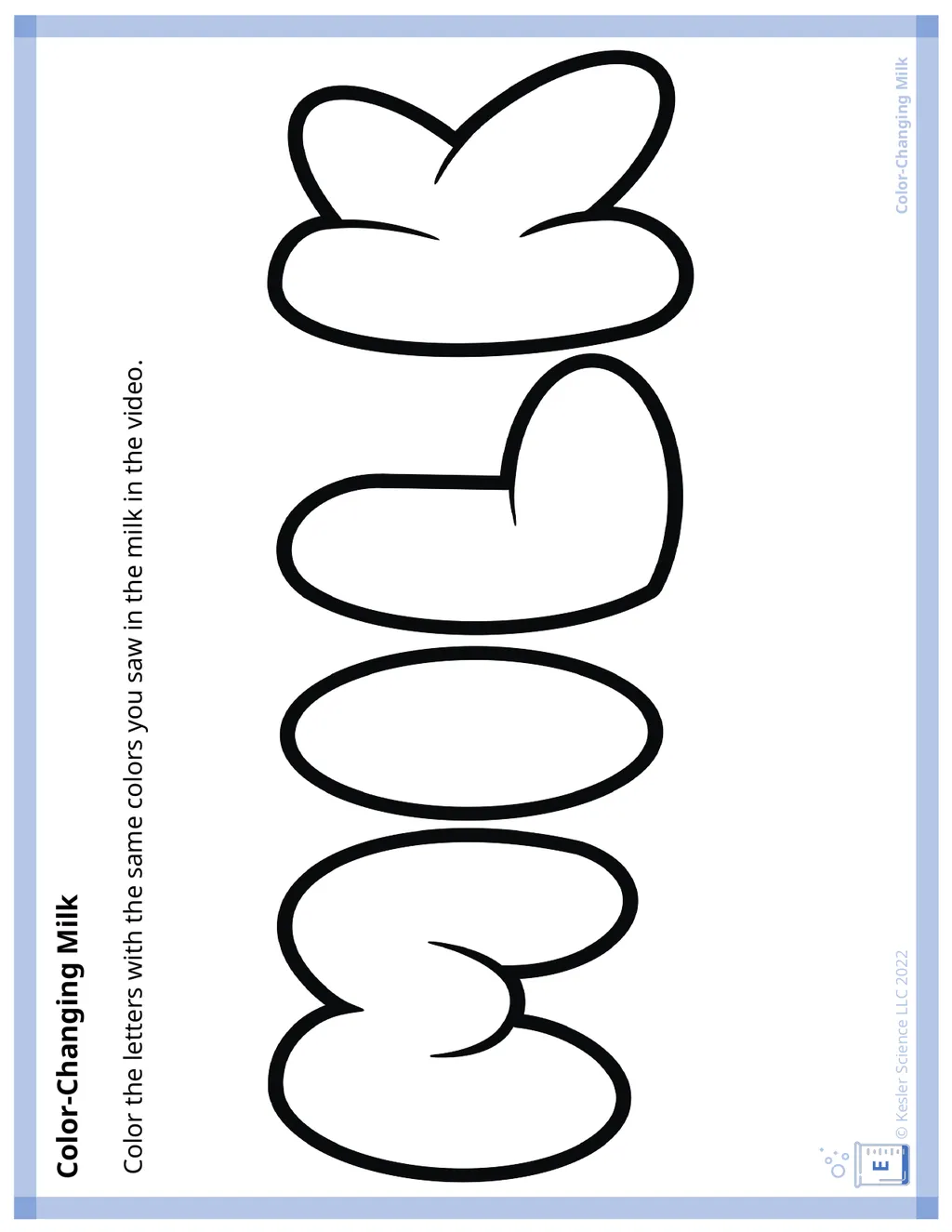
Color the letters with the same colors you saw in the milk in the video.<br>
05
Answer Key
Look
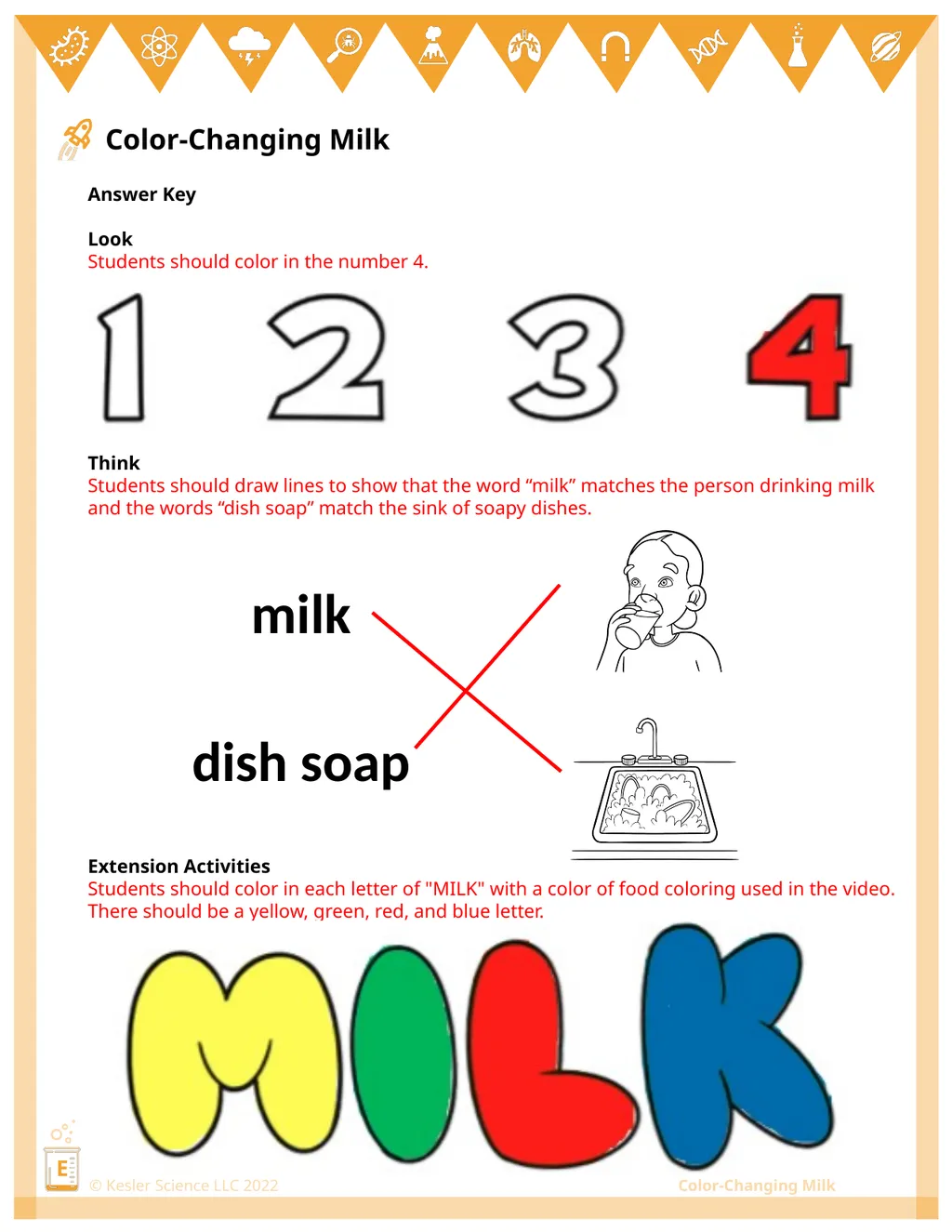
Students should color in the number 4.
Think
Students should draw lines to show that the word “milk” matches the person drinking milk and the words “dish soap” match the sink of soapy dishes.
Extension Activities
Students should color in each letter of "MILK" with a color of food coloring used in the video. There should be a yellow, green, red, and blue letter.<br>
Look
Students should color in the number 4.
Think
Students should draw lines to show that the word “milk” matches the person drinking milk and the words “dish soap” match the sink of soapy dishes.
Extension Activities
Students should color in each letter of "MILK" with a color of food coloring used in the video. There should be a yellow, green, red, and blue letter.<br>
06
Teacher Directions
STEM Starters are activity sheets that pair with Steve Spangler’s SICK Science! videos. STEM Starters are leveled to provide differentiated activities for Early Education through 8th grade.
The beaker in the lower left corner of each page represents the grade-level edition of the worksheet.
The symbol in the lower right corner of each page represents differentiation.
Dependent: This version is suggested for on-level learners.
Modified: This version provides more support for learners with modifications.
Each STEM Starter should take approximately 10-15 minutes to complete. No materials are required beyond whatever method you choose to play the video for the class. To send these pages home with students, just print the worksheet; the link to the video is on the page as a QR code.
Meet Steve Spangler Steve Spangler is a best-selling author, educator, and Emmy award-winning science communicator who finds creative ways to make science fun.
Engage/Activate Prior Knowledge
Before showing the video, ask students to describe which direction the water goes if you drop a water balloon on the ground or do a big cannonball splash into the pool. (The water all splashes outward from the center.)
Link to Video
stevespangler.com/ss-video/392801974<br>
The beaker in the lower left corner of each page represents the grade-level edition of the worksheet.
The symbol in the lower right corner of each page represents differentiation.
Dependent: This version is suggested for on-level learners.
Modified: This version provides more support for learners with modifications.
Each STEM Starter should take approximately 10-15 minutes to complete. No materials are required beyond whatever method you choose to play the video for the class. To send these pages home with students, just print the worksheet; the link to the video is on the page as a QR code.
Meet Steve Spangler Steve Spangler is a best-selling author, educator, and Emmy award-winning science communicator who finds creative ways to make science fun.
Engage/Activate Prior Knowledge
Before showing the video, ask students to describe which direction the water goes if you drop a water balloon on the ground or do a big cannonball splash into the pool. (The water all splashes outward from the center.)
Link to Video
stevespangler.com/ss-video/392801974<br>
07
Video Description
Fill a plate with milk. Add 1-2 drops each of different colors of food coloring to the center of the plate. Coat one end of a cotton swab with dish soap and touch it to the surface of the milk in the center of the colors. Watch as an explosion of color moves outward through the milk.
Standards These activities support the following standards; additional materials will be required to cover the standard completely.
NGSS K-2-ETS1-1: Develop a simple model based on evidence to represent a proposed object or tool.
TEKS K.2 D: Record and organize data and observations using pictures, numbers, and words.
TEKS 1.2 D: Record and organize data using pictures, numbers, and words. Background Information Milk is made up mostly of water with fats, minerals, proteins, and vitamins spread throughout the mixture. The fats found in milk don't mix well with water, which is why the food coloring drops are able to sit without changing at the beginning of the demonstration. However, when soap is added, it links the water and fat molecules to each other. As the fat molecules are moved and connected, they cause the food coloring molecules to move as well. This leads to the explosion of food coloring that we see! Milk with greater fat concentrations lead to bigger color explosions because there are more fat molecules for the soap to link with water.<br>
Fill a plate with milk. Add 1-2 drops each of different colors of food coloring to the center of the plate. Coat one end of a cotton swab with dish soap and touch it to the surface of the milk in the center of the colors. Watch as an explosion of color moves outward through the milk.
Standards These activities support the following standards; additional materials will be required to cover the standard completely.
NGSS K-2-ETS1-1: Develop a simple model based on evidence to represent a proposed object or tool.
TEKS K.2 D: Record and organize data and observations using pictures, numbers, and words.
TEKS 1.2 D: Record and organize data using pictures, numbers, and words. Background Information Milk is made up mostly of water with fats, minerals, proteins, and vitamins spread throughout the mixture. The fats found in milk don't mix well with water, which is why the food coloring drops are able to sit without changing at the beginning of the demonstration. However, when soap is added, it links the water and fat molecules to each other. As the fat molecules are moved and connected, they cause the food coloring molecules to move as well. This leads to the explosion of food coloring that we see! Milk with greater fat concentrations lead to bigger color explosions because there are more fat molecules for the soap to link with water.<br>
08
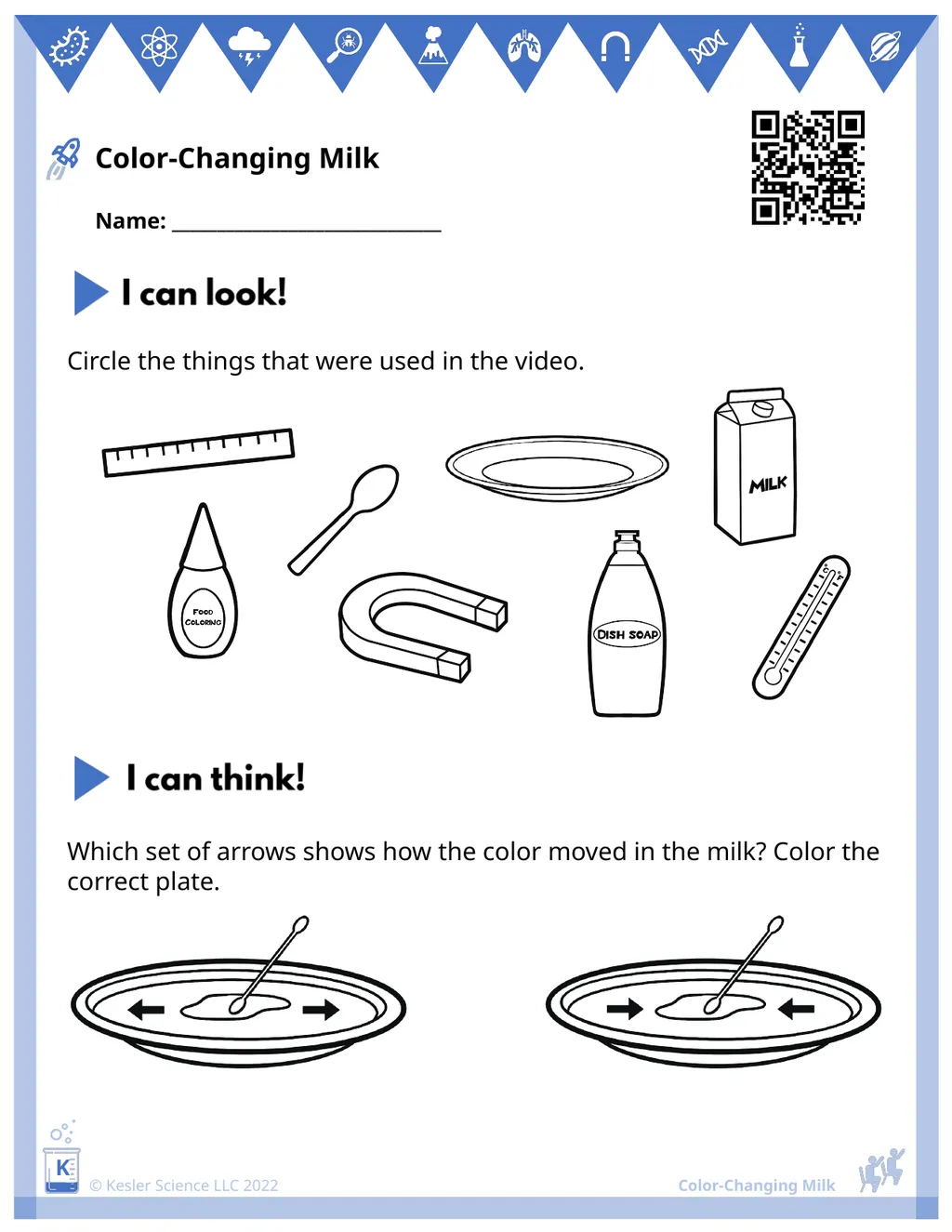
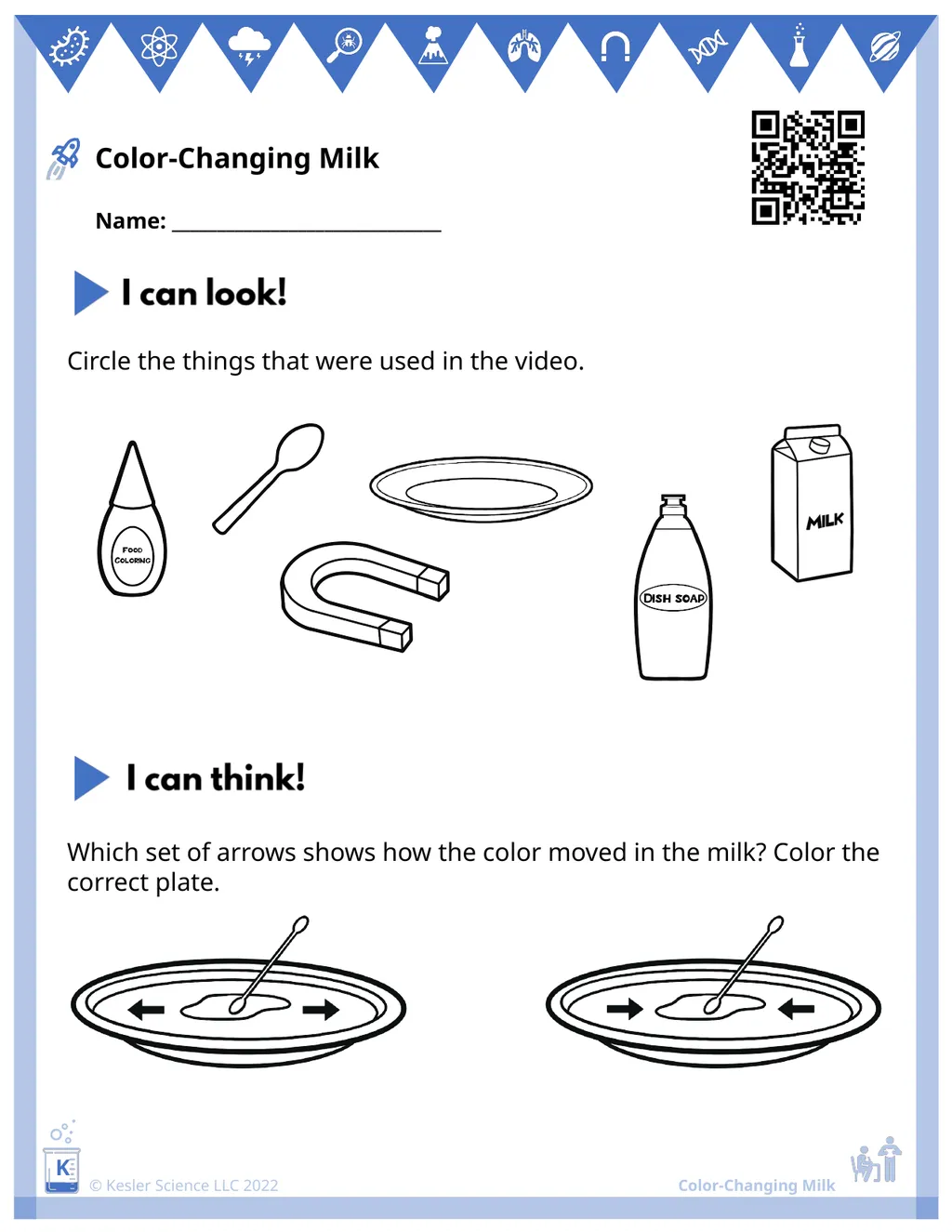
Circle the things that were used in the video. Which set of arrows shows how the color moved in the milk? Color the correct plate.<br>
09
Circle the things that were used in the video. Which set of arrows shows how the color moved in the milk? Color the correct plate.<br>
10
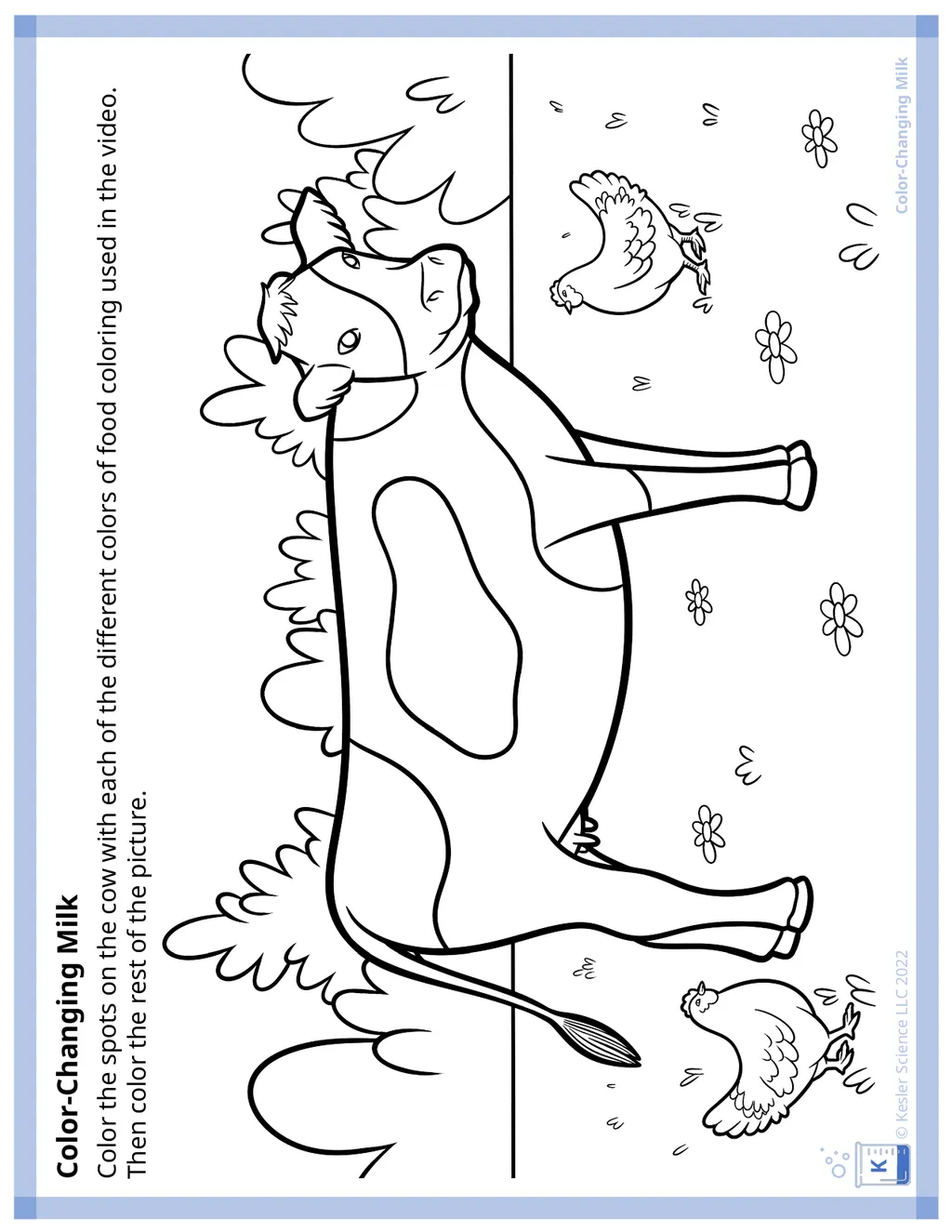
Color the spots on the cow with each of the different colors of food coloring used in the video. Then color the rest of the picture.<br>
11
Answer Key
I can look!
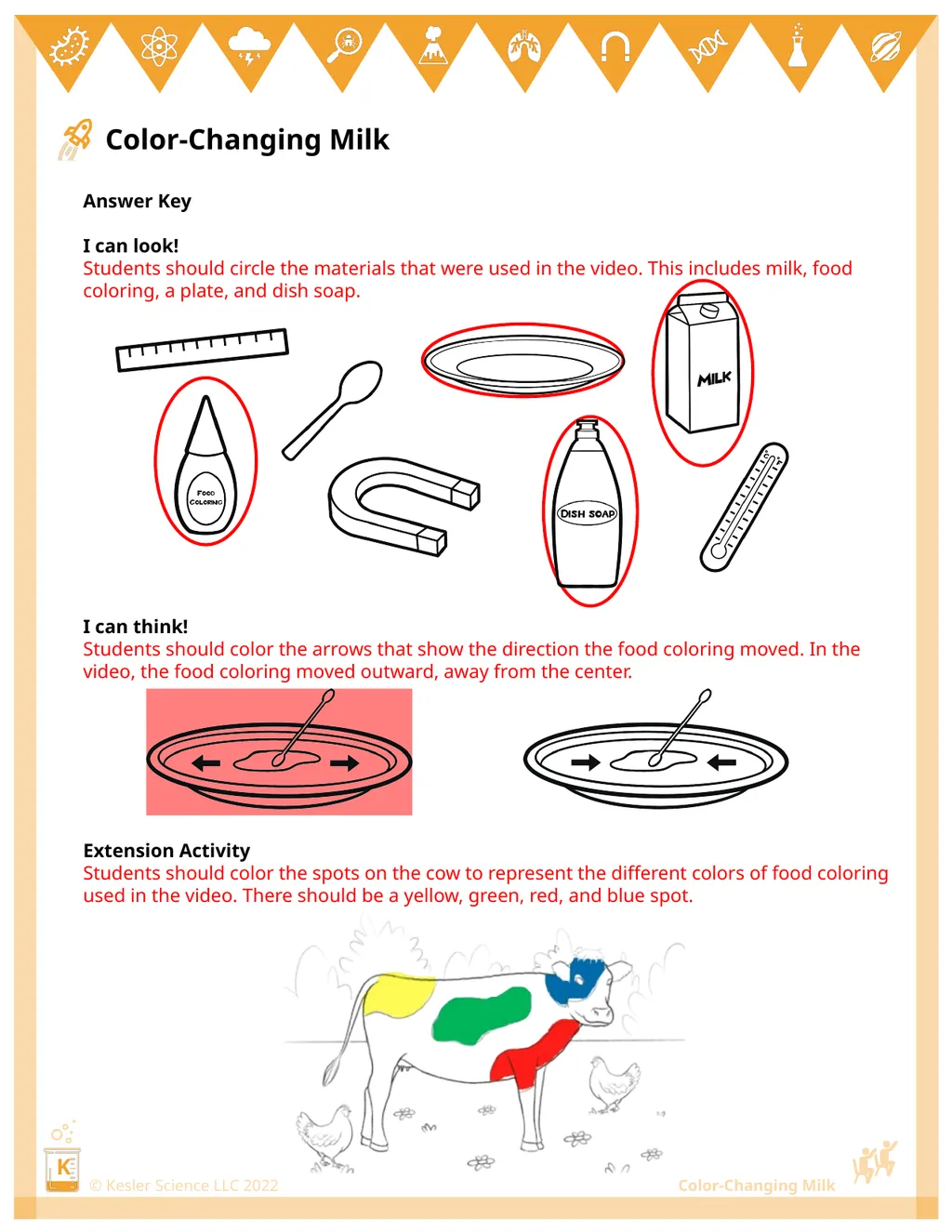
Students should circle the materials that were used in the video. This includes milk, food coloring, a plate, and dish soap.
I can think!
Students should color the arrows that show the direction the food coloring moved. In the video, the food coloring moved outward, away from the center.
Extension Activity
Students should color the spots on the cow to represent the different colors of food coloring used in the video. There should be a yellow, green, red, and blue spot.<br>
I can look!
Students should circle the materials that were used in the video. This includes milk, food coloring, a plate, and dish soap.
I can think!
Students should color the arrows that show the direction the food coloring moved. In the video, the food coloring moved outward, away from the center.
Extension Activity
Students should color the spots on the cow to represent the different colors of food coloring used in the video. There should be a yellow, green, red, and blue spot.<br>
12
Modified Answer Key
I can look!
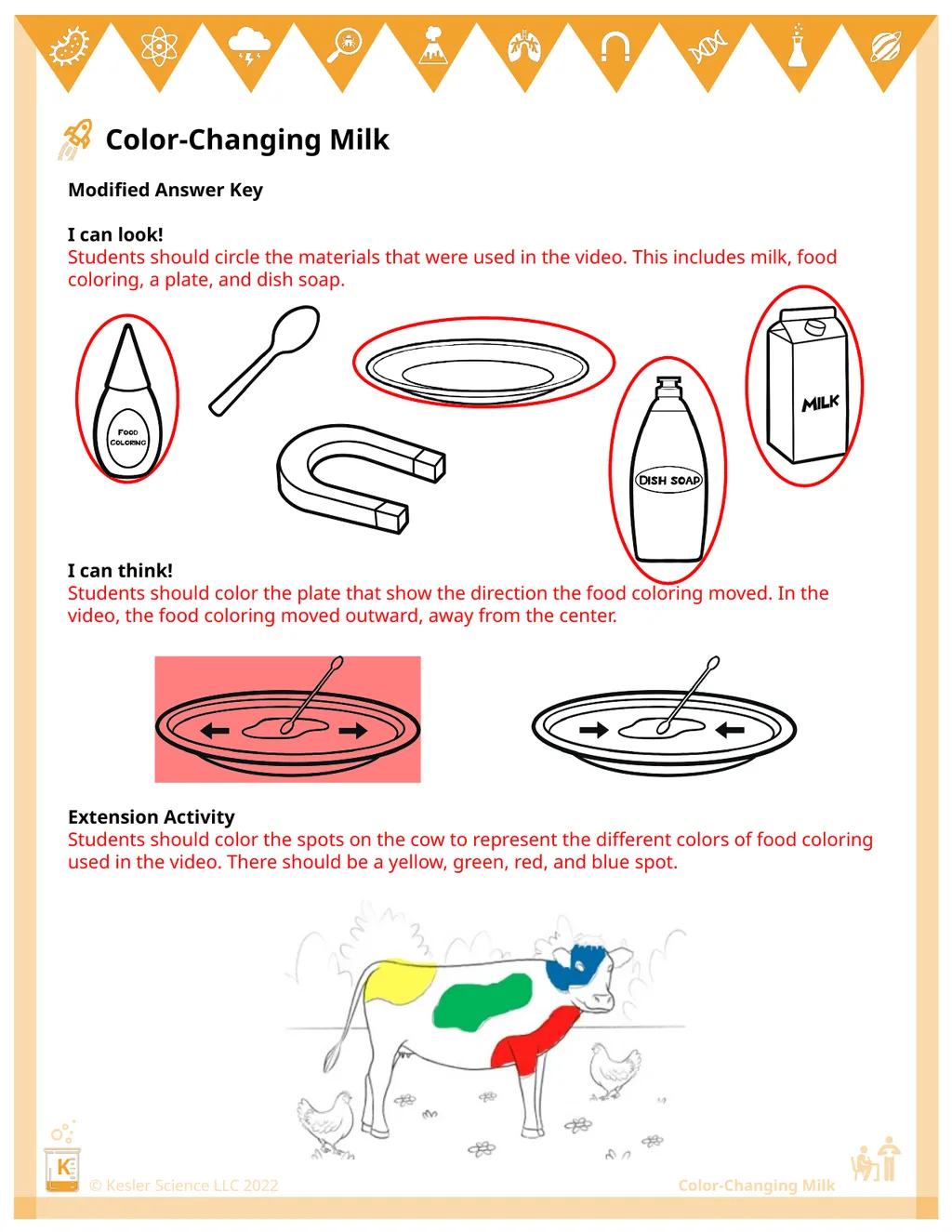
Students should circle the materials that were used in the video. This includes milk, food coloring, a plate, and dish soap.
I can think!
Students should color the plate that show the direction the food coloring moved. In the video, the food coloring moved outward, away from the center.
Extension Activity
Students should color the spots on the cow to represent the different colors of food coloring used in the video. There should be a yellow, green, red, and blue spot.<br>
I can look!
Students should circle the materials that were used in the video. This includes milk, food coloring, a plate, and dish soap.
I can think!
Students should color the plate that show the direction the food coloring moved. In the video, the food coloring moved outward, away from the center.
Extension Activity
Students should color the spots on the cow to represent the different colors of food coloring used in the video. There should be a yellow, green, red, and blue spot.<br>
13
Teacher Directions
STEM Starters are activity sheets that pair with Steve Spangler’s SICK Science! videos. STEM Starters are leveled to provide differentiated activities for Early Education through 8th grade.
The beaker in the lower left corner of each page represents the grade-level edition of the worksheet.
The symbol in the lower right corner of each page represents differentiation.
Dependent: This version is suggested for on-level learners.
Modified: This version provides more support for learners with modifications.
Each STEM Starter should take approximately 10-15 minutes to complete. No materials are required beyond whatever method you choose to play the video for the class. To send these pages home with students, just print the worksheet; the link to the video is on the page as a QR code.
Meet Steve Spangler Steve Spangler is a best-selling author, educator, and Emmy award-winning science communicator who finds creative ways to make science fun.
Engage/Activate Prior Knowledge
Before showing the video, ask students to define physical properties and give some examples. Also, ask them to identify some physical properties of milk, dish soap, and food coloring (state of matter, relative temperature, texture, etc.).
Link to Video
stevespangler.com/ss-video/392801974
Video Description
Fill a plate with milk. Add 1-2 drops each of different colors of food coloring to the center of the plate. Coat one end of a cotton swab with dish soap and touch it to the surface of the milk in the center of the colors. Watch as an explosion of color moves outward through the milk.<br>
The beaker in the lower left corner of each page represents the grade-level edition of the worksheet.
The symbol in the lower right corner of each page represents differentiation.
Dependent: This version is suggested for on-level learners.
Modified: This version provides more support for learners with modifications.
Each STEM Starter should take approximately 10-15 minutes to complete. No materials are required beyond whatever method you choose to play the video for the class. To send these pages home with students, just print the worksheet; the link to the video is on the page as a QR code.
Meet Steve Spangler Steve Spangler is a best-selling author, educator, and Emmy award-winning science communicator who finds creative ways to make science fun.
Engage/Activate Prior Knowledge
Before showing the video, ask students to define physical properties and give some examples. Also, ask them to identify some physical properties of milk, dish soap, and food coloring (state of matter, relative temperature, texture, etc.).
Link to Video
stevespangler.com/ss-video/392801974
Video Description
Fill a plate with milk. Add 1-2 drops each of different colors of food coloring to the center of the plate. Coat one end of a cotton swab with dish soap and touch it to the surface of the milk in the center of the colors. Watch as an explosion of color moves outward through the milk.<br>
14
Standards
These activities support the following standards; additional materials will be required to cover the standard completely.
NGSS K-2-ETS1-1: Ask questions, make observations, and gather information about a situation people want to change to define a simple problem that can be solved through the development of a new or improved object or tool.
NGSS 2-PS1-1: Plan and conduct an investigation to describe and classify different kinds of materials by their observable properties.
TEKS 2.2A: Ask questions about organisms, objects, and events during observations and investigations.
TEKS 2.2D: Record and organize data using pictures, numbers, and words.
TEKS 2.5A: Classify matter by physical properties, including relative temperature, texture, flexibility, and whether material is a solid or liquid.
TEKS 3.2A: Plan and implement descriptive investigations, including asking and answering questions, making inferences, and selecting and using equipment or technology needed, to solve a specific problem in the natural world.
TEKS 3.5B: Describe and classify samples of matter as solids, liquids, and gases and demonstrate that solids have a definite shape and that liquids and gases take the shape of their container. Background Information Milk is made up mostly of water with fats, minerals, proteins, and vitamins spread throughout the mixture. The fats found in milk don't mix well with water, which is why the food coloring drops are able to sit without changing at the beginning of the demonstration. However, when soap is added, it links the water and fat molecules to each other. As the fat molecules are moved and connected, they cause the food coloring molecules to move as well. This leads to the explosion of food coloring that we see! Milk with greater fat concentrations lead to bigger color explosions because there are more fat molecules for the soap to link with water.<br>
NGSS K-2-ETS1-1: Ask questions, make observations, and gather information about a situation people want to change to define a simple problem that can be solved through the development of a new or improved object or tool.
NGSS 2-PS1-1: Plan and conduct an investigation to describe and classify different kinds of materials by their observable properties.
TEKS 2.2A: Ask questions about organisms, objects, and events during observations and investigations.
TEKS 2.2D: Record and organize data using pictures, numbers, and words.
TEKS 2.5A: Classify matter by physical properties, including relative temperature, texture, flexibility, and whether material is a solid or liquid.
TEKS 3.2A: Plan and implement descriptive investigations, including asking and answering questions, making inferences, and selecting and using equipment or technology needed, to solve a specific problem in the natural world.
TEKS 3.5B: Describe and classify samples of matter as solids, liquids, and gases and demonstrate that solids have a definite shape and that liquids and gases take the shape of their container. Background Information Milk is made up mostly of water with fats, minerals, proteins, and vitamins spread throughout the mixture. The fats found in milk don't mix well with water, which is why the food coloring drops are able to sit without changing at the beginning of the demonstration. However, when soap is added, it links the water and fat molecules to each other. As the fat molecules are moved and connected, they cause the food coloring molecules to move as well. This leads to the explosion of food coloring that we see! Milk with greater fat concentrations lead to bigger color explosions because there are more fat molecules for the soap to link with water.<br>
15
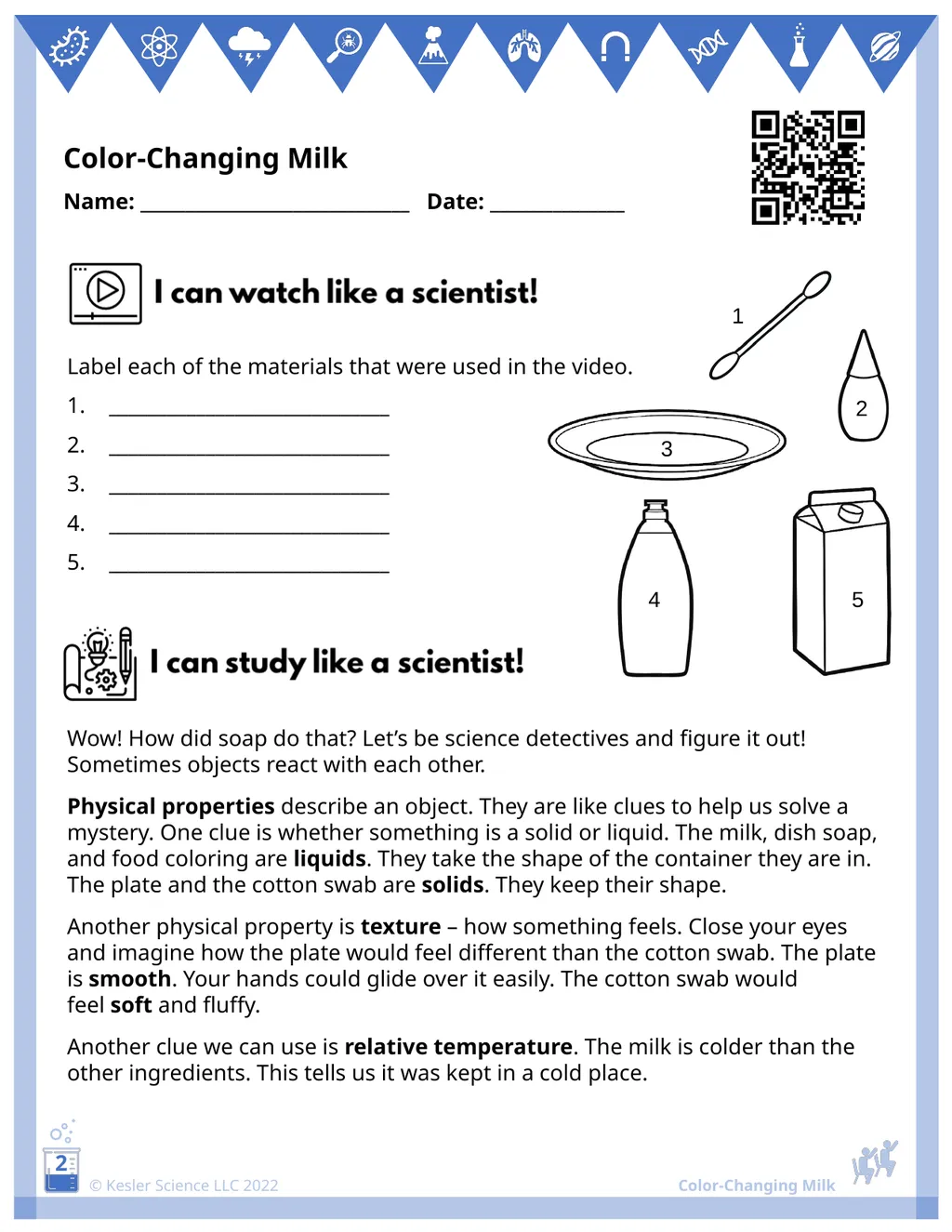
Label each of the materials that were used in the video.
_____________________________
_____________________________
_____________________________
_____________________________
_____________________________ Wow! How did soap do that? Let’s be science detectives and figure it out! Sometimes objects react with each other.
Physical properties describe an object. They are like clues to help us solve a mystery. One clue is whether something is a solid or liquid. The milk, dish soap, and food coloring are liquids. They take the shape of the container they are in. The plate and the cotton swab are solids. They keep their shape.
Another physical property is texture – how something feels. Close your eyes and imagine how the plate would feel different than the cotton swab. The plate is smooth. Your hands could glide over it easily. The cotton swab would feel soft and fluffy.
Another clue we can use is relative temperature. The milk is colder than the other ingredients. This tells us it was kept in a cold place. 1 2 3 4 5<br>
_____________________________
_____________________________
_____________________________
_____________________________
_____________________________ Wow! How did soap do that? Let’s be science detectives and figure it out! Sometimes objects react with each other.
Physical properties describe an object. They are like clues to help us solve a mystery. One clue is whether something is a solid or liquid. The milk, dish soap, and food coloring are liquids. They take the shape of the container they are in. The plate and the cotton swab are solids. They keep their shape.
Another physical property is texture – how something feels. Close your eyes and imagine how the plate would feel different than the cotton swab. The plate is smooth. Your hands could glide over it easily. The cotton swab would feel soft and fluffy.
Another clue we can use is relative temperature. The milk is colder than the other ingredients. This tells us it was kept in a cold place. 1 2 3 4 5<br>
16
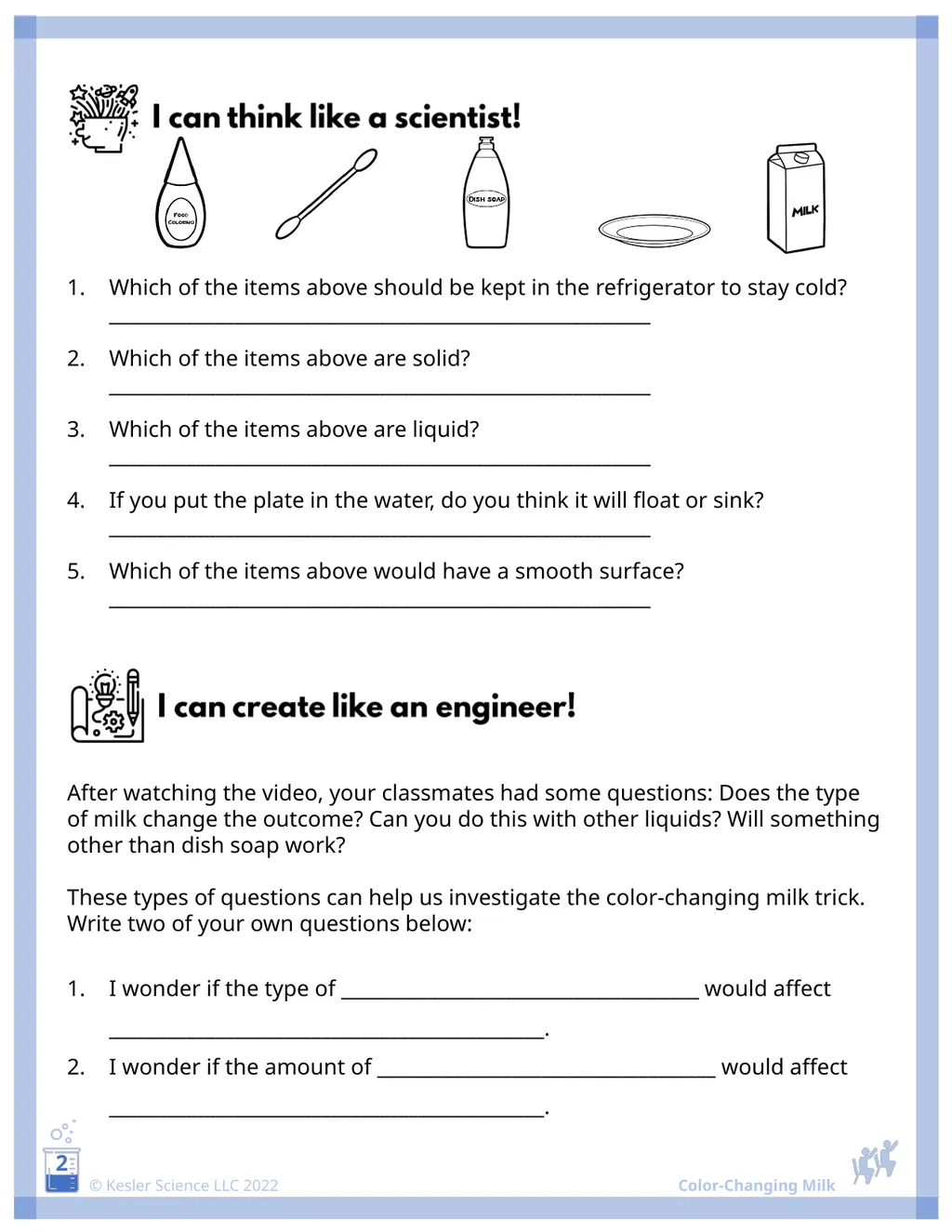
Which of the items above should be kept in the refrigerator to stay cold? ________________________________________________________
Which of the items above are solid? ________________________________________________________
Which of the items above are liquid? ________________________________________________________
If you put the plate in the water, do you think it will float or sink? ________________________________________________________
Which of the items above would have a smooth surface? ________________________________________________________ After watching the video, your classmates had some questions: Does the type of milk change the outcome? Can you do this with other liquids? Will something other than dish soap work?
These types of questions can help us investigate the color-changing milk trick. Write two of your own questions below:
I wonder if the type of _____________________________________ would affect _____________________________________________.
I wonder if the amount of ___________________________________ would affect _____________________________________________.<br>
Which of the items above are solid? ________________________________________________________
Which of the items above are liquid? ________________________________________________________
If you put the plate in the water, do you think it will float or sink? ________________________________________________________
Which of the items above would have a smooth surface? ________________________________________________________ After watching the video, your classmates had some questions: Does the type of milk change the outcome? Can you do this with other liquids? Will something other than dish soap work?
These types of questions can help us investigate the color-changing milk trick. Write two of your own questions below:
I wonder if the type of _____________________________________ would affect _____________________________________________.
I wonder if the amount of ___________________________________ would affect _____________________________________________.<br>
17
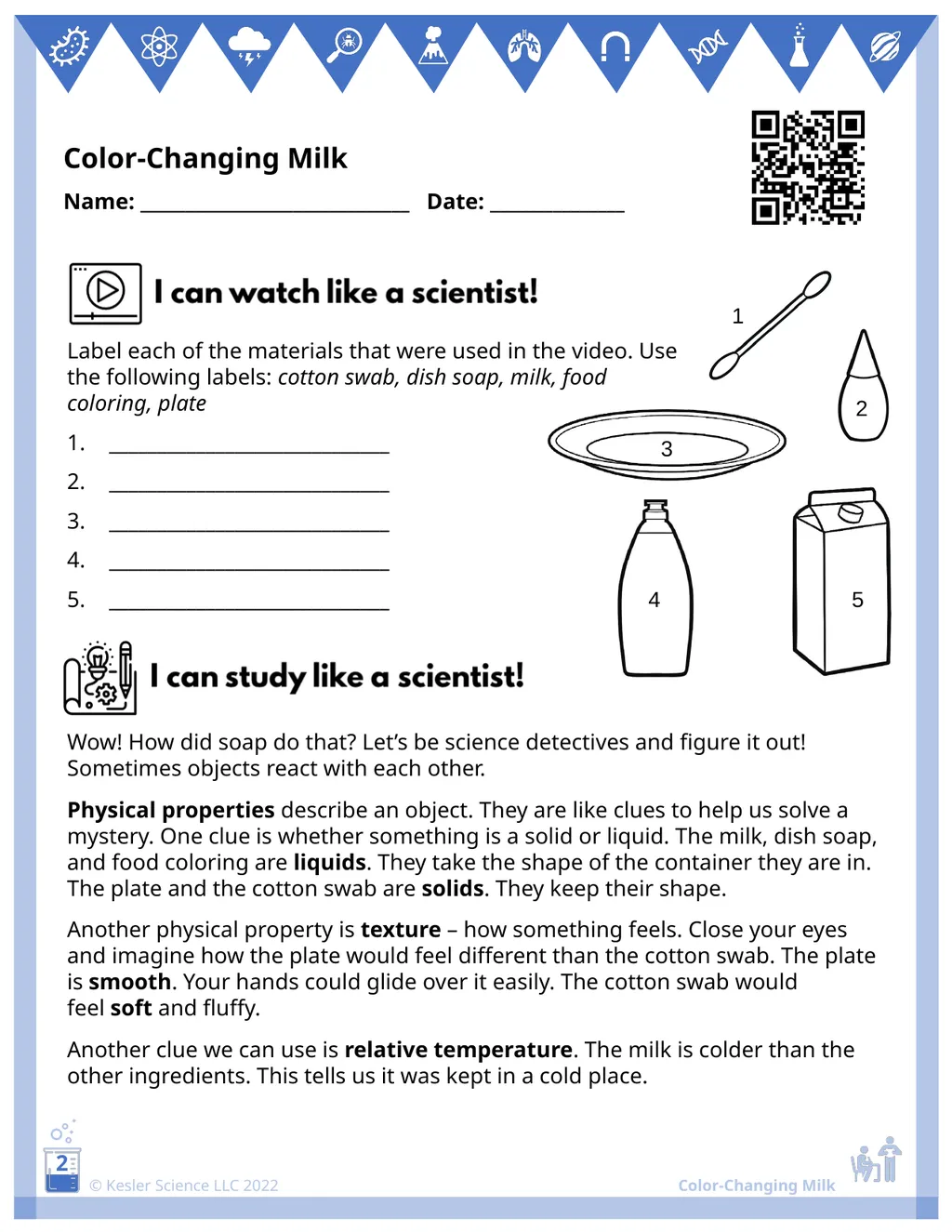
Label each of the materials that were used in the video. Use the following labels: cotton swab, dish soap, milk, food coloring, plate
_____________________________
_____________________________
_____________________________
_____________________________
_____________________________ Wow! How did soap do that? Let’s be science detectives and figure it out! Sometimes objects react with each other.
Physical properties describe an object. They are like clues to help us solve a mystery. One clue is whether something is a solid or liquid. The milk, dish soap, and food coloring are liquids. They take the shape of the container they are in. The plate and the cotton swab are solids. They keep their shape.
Another physical property is texture – how something feels. Close your eyes and imagine how the plate would feel different than the cotton swab. The plate is smooth. Your hands could glide over it easily. The cotton swab would feel soft and fluffy.
Another clue we can use is relative temperature. The milk is colder than the other ingredients. This tells us it was kept in a cold place. 1 2 3 4 5<br>
_____________________________
_____________________________
_____________________________
_____________________________
_____________________________ Wow! How did soap do that? Let’s be science detectives and figure it out! Sometimes objects react with each other.
Physical properties describe an object. They are like clues to help us solve a mystery. One clue is whether something is a solid or liquid. The milk, dish soap, and food coloring are liquids. They take the shape of the container they are in. The plate and the cotton swab are solids. They keep their shape.
Another physical property is texture – how something feels. Close your eyes and imagine how the plate would feel different than the cotton swab. The plate is smooth. Your hands could glide over it easily. The cotton swab would feel soft and fluffy.
Another clue we can use is relative temperature. The milk is colder than the other ingredients. This tells us it was kept in a cold place. 1 2 3 4 5<br>
18
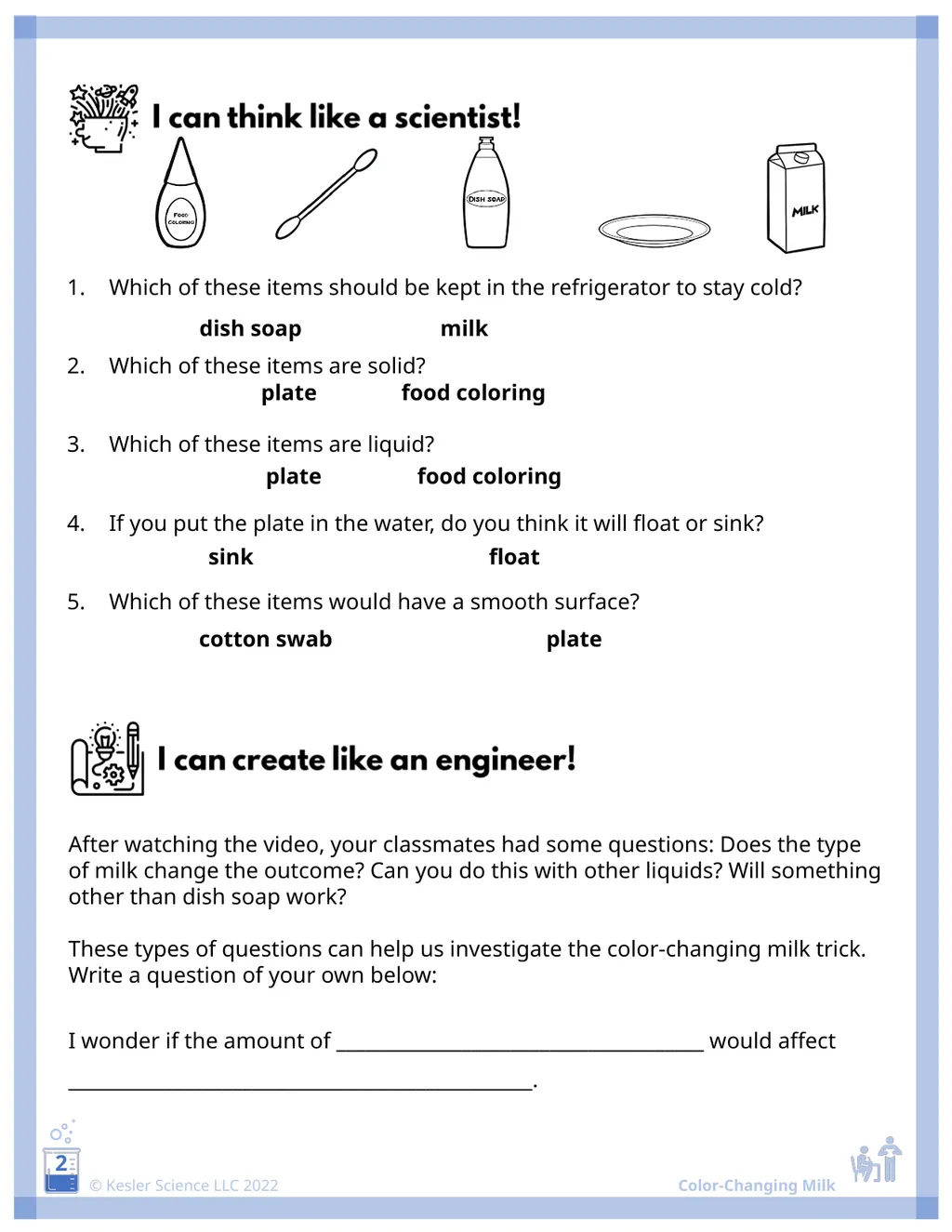
Which of these items should be kept in the refrigerator to stay cold?
Which of these items are solid?
Which of these items are liquid?
If you put the plate in the water, do you think it will float or sink?
Which of these items would have a smooth surface? After watching the video, your classmates had some questions: Does the type of milk change the outcome? Can you do this with other liquids? Will something other than dish soap work?
These types of questions can help us investigate the color-changing milk trick. Write a question of your own below:
I wonder if the amount of ______________________________________ would affect ________________________________________________. dish soap milk plate food coloring plate food coloring sink float cotton swab plate<br>
Which of these items are solid?
Which of these items are liquid?
If you put the plate in the water, do you think it will float or sink?
Which of these items would have a smooth surface? After watching the video, your classmates had some questions: Does the type of milk change the outcome? Can you do this with other liquids? Will something other than dish soap work?
These types of questions can help us investigate the color-changing milk trick. Write a question of your own below:
I wonder if the amount of ______________________________________ would affect ________________________________________________. dish soap milk plate food coloring plate food coloring sink float cotton swab plate<br>
19
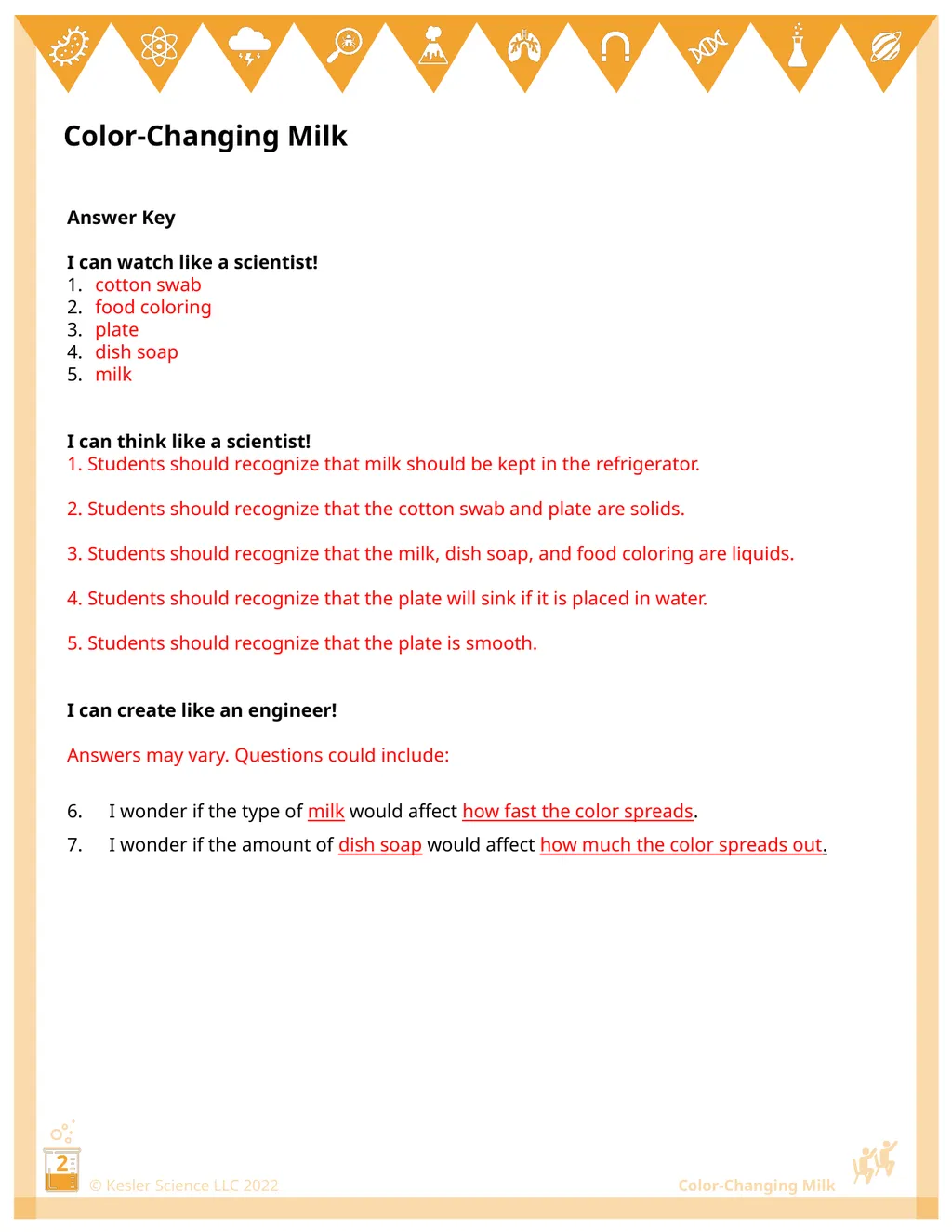
Answer Key
I can watch like a scientist!
cotton swab
food coloring
plate
dish soap
milk
I can think like a scientist!
1. Students should recognize that milk should be kept in the refrigerator.
2. Students should recognize that the cotton swab and plate are solids.
3. Students should recognize that the milk, dish soap, and food coloring are liquids.
4. Students should recognize that the plate will sink if it is placed in water.
5. Students should recognize that the plate is smooth.
I can create like an engineer!
Answers may vary. Questions could include:
I wonder if the type of milk would affect how fast the color spreads.
I wonder if the amount of dish soap would affect how much the color spreads out.<br>
I can watch like a scientist!
cotton swab
food coloring
plate
dish soap
milk
I can think like a scientist!
1. Students should recognize that milk should be kept in the refrigerator.
2. Students should recognize that the cotton swab and plate are solids.
3. Students should recognize that the milk, dish soap, and food coloring are liquids.
4. Students should recognize that the plate will sink if it is placed in water.
5. Students should recognize that the plate is smooth.
I can create like an engineer!
Answers may vary. Questions could include:
I wonder if the type of milk would affect how fast the color spreads.
I wonder if the amount of dish soap would affect how much the color spreads out.<br>
20
Modified Answer Key
I can watch like a scientist!
cotton swab
food coloring
plate
dish soap
milk
I can think like a scientist!
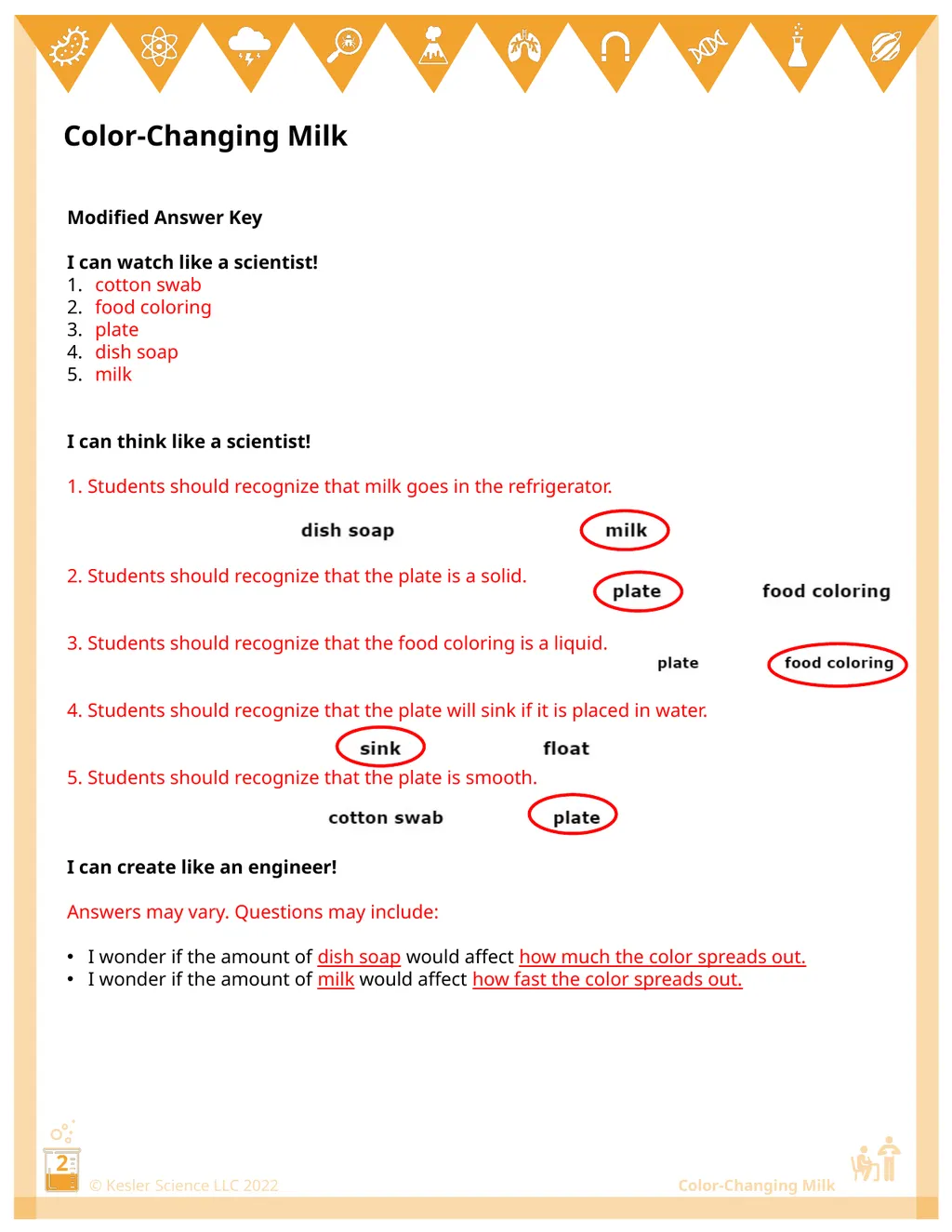
1. Students should recognize that milk goes in the refrigerator.
2. Students should recognize that the plate is a solid.
3. Students should recognize that the food coloring is a liquid.
4. Students should recognize that the plate will sink if it is placed in water.
5. Students should recognize that the plate is smooth.
I can create like an engineer!
Answers may vary. Questions may include:
I wonder if the amount of dish soap would affect how much the color spreads out.
I wonder if the amount of milk would affect how fast the color spreads out.<br>
I can watch like a scientist!
cotton swab
food coloring
plate
dish soap
milk
I can think like a scientist!
1. Students should recognize that milk goes in the refrigerator.
2. Students should recognize that the plate is a solid.
3. Students should recognize that the food coloring is a liquid.
4. Students should recognize that the plate will sink if it is placed in water.
5. Students should recognize that the plate is smooth.
I can create like an engineer!
Answers may vary. Questions may include:
I wonder if the amount of dish soap would affect how much the color spreads out.
I wonder if the amount of milk would affect how fast the color spreads out.<br>
21
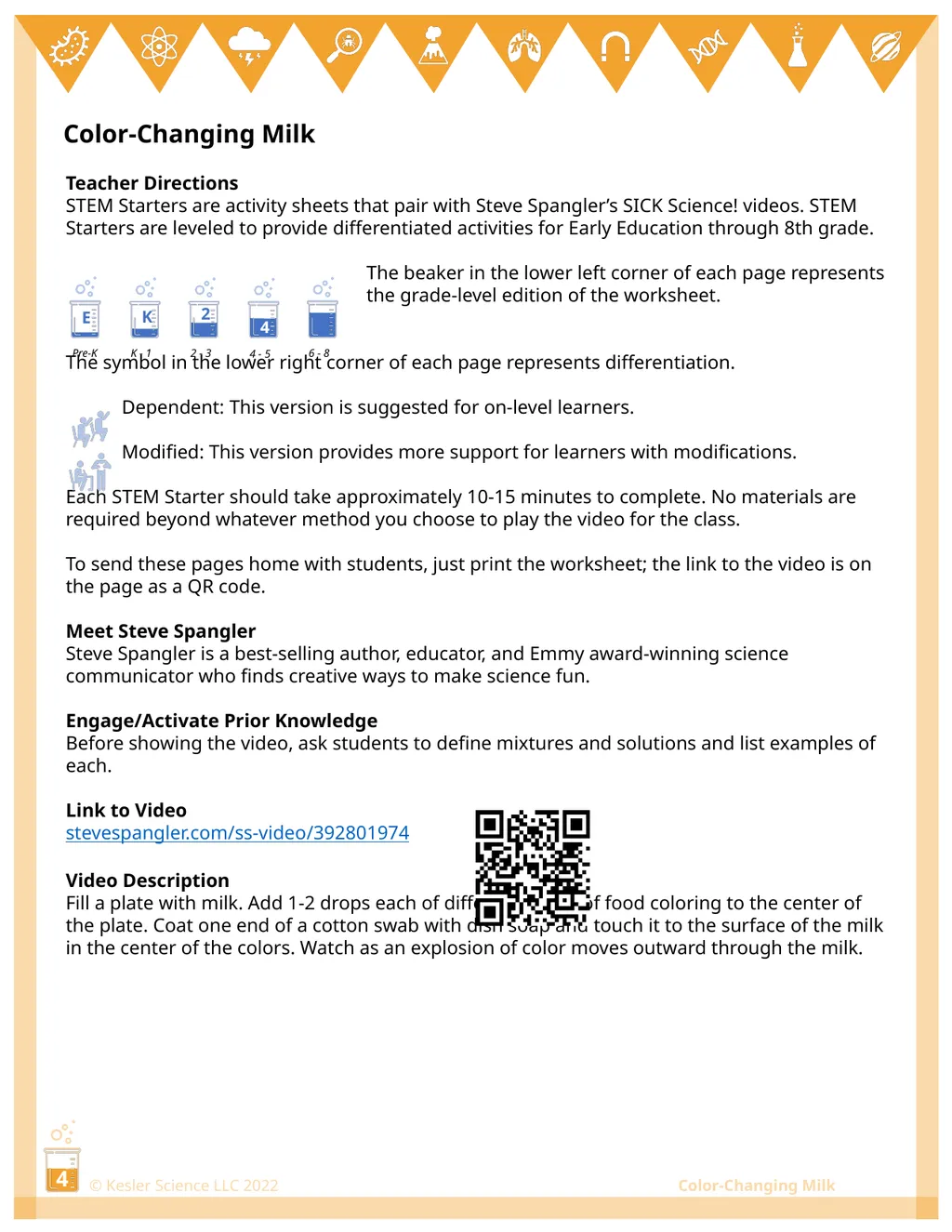
Teacher Directions
STEM Starters are activity sheets that pair with Steve Spangler’s SICK Science! videos. STEM Starters are leveled to provide differentiated activities for Early Education through 8th grade.
The beaker in the lower left corner of each page represents the grade-level edition of the worksheet.
The symbol in the lower right corner of each page represents differentiation.
Dependent: This version is suggested for on-level learners.
Modified: This version provides more support for learners with modifications.
Each STEM Starter should take approximately 10-15 minutes to complete. No materials are required beyond whatever method you choose to play the video for the class. To send these pages home with students, just print the worksheet; the link to the video is on the page as a QR code.
Meet Steve Spangler Steve Spangler is a best-selling author, educator, and Emmy award-winning science communicator who finds creative ways to make science fun.
Engage/Activate Prior Knowledge
Before showing the video, ask students to define mixtures and solutions and list examples of each.
Link to Video
stevespangler.com/ss-video/392801974
Video Description
Fill a plate with milk. Add 1-2 drops each of different colors of food coloring to the center of the plate. Coat one end of a cotton swab with dish soap and touch it to the surface of the milk in the center of the colors. Watch as an explosion of color moves outward through the milk.<br>
The beaker in the lower left corner of each page represents the grade-level edition of the worksheet.
The symbol in the lower right corner of each page represents differentiation.
Dependent: This version is suggested for on-level learners.
Modified: This version provides more support for learners with modifications.
Each STEM Starter should take approximately 10-15 minutes to complete. No materials are required beyond whatever method you choose to play the video for the class. To send these pages home with students, just print the worksheet; the link to the video is on the page as a QR code.
Meet Steve Spangler Steve Spangler is a best-selling author, educator, and Emmy award-winning science communicator who finds creative ways to make science fun.
Engage/Activate Prior Knowledge
Before showing the video, ask students to define mixtures and solutions and list examples of each.
Link to Video
stevespangler.com/ss-video/392801974
Video Description
Fill a plate with milk. Add 1-2 drops each of different colors of food coloring to the center of the plate. Coat one end of a cotton swab with dish soap and touch it to the surface of the milk in the center of the colors. Watch as an explosion of color moves outward through the milk.<br>
22
Standards
These activities support the following standards; additional materials will be required to cover the standard completely.
NGSS 5-PS1-3: Make observations and measurements to identify materials based on their properties.
NGSS 5-PS1-4: Conduct an investigation to determine whether the mixing of two or more substances results in new substances.
TEKS 4.2 C: Construct simple tables, charts, bar graphs, and maps using tools and current technology to organize, examine, and evaluate data.
TEKS 4.2 D: Analyze data and interpret patterns to construct reasonable explanations from data that can be observed and measured.
TEKS 4.5 B: Compare and contrast a variety of mixtures, including solutions.
TEKS 5.2 D: Analyze and interpret information to construct reasonable explanations from direct (observable) and indirect (inferred) evidence.
TEKS 5.2 G: Construct appropriate simple graphs, tables, maps, and charts using technology, including computers, to organize, examine, and evaluate information.
TEKS 5.5 B: Demonstrate that some mixtures maintain physical properties of their ingredients such as iron filings and sand and sand and water. Background Information Milk is made up mostly of water with fats, minerals, proteins, and vitamins spread throughout the mixture. The fats found in milk don't mix well with water, which is why the food coloring drops are able to sit without changing at the beginning of the demonstration. However, when soap is added, it links the water and fat molecules to each other. As the fat molecules are moved and connected, they cause the food coloring molecules to move as well. This leads to the explosion of food coloring that we see! Milk with greater fat concentrations lead to bigger color explosions because there are more fat molecules for the soap to link with water.<br>
NGSS 5-PS1-3: Make observations and measurements to identify materials based on their properties.
NGSS 5-PS1-4: Conduct an investigation to determine whether the mixing of two or more substances results in new substances.
TEKS 4.2 C: Construct simple tables, charts, bar graphs, and maps using tools and current technology to organize, examine, and evaluate data.
TEKS 4.2 D: Analyze data and interpret patterns to construct reasonable explanations from data that can be observed and measured.
TEKS 4.5 B: Compare and contrast a variety of mixtures, including solutions.
TEKS 5.2 D: Analyze and interpret information to construct reasonable explanations from direct (observable) and indirect (inferred) evidence.
TEKS 5.2 G: Construct appropriate simple graphs, tables, maps, and charts using technology, including computers, to organize, examine, and evaluate information.
TEKS 5.5 B: Demonstrate that some mixtures maintain physical properties of their ingredients such as iron filings and sand and sand and water. Background Information Milk is made up mostly of water with fats, minerals, proteins, and vitamins spread throughout the mixture. The fats found in milk don't mix well with water, which is why the food coloring drops are able to sit without changing at the beginning of the demonstration. However, when soap is added, it links the water and fat molecules to each other. As the fat molecules are moved and connected, they cause the food coloring molecules to move as well. This leads to the explosion of food coloring that we see! Milk with greater fat concentrations lead to bigger color explosions because there are more fat molecules for the soap to link with water.<br>
23
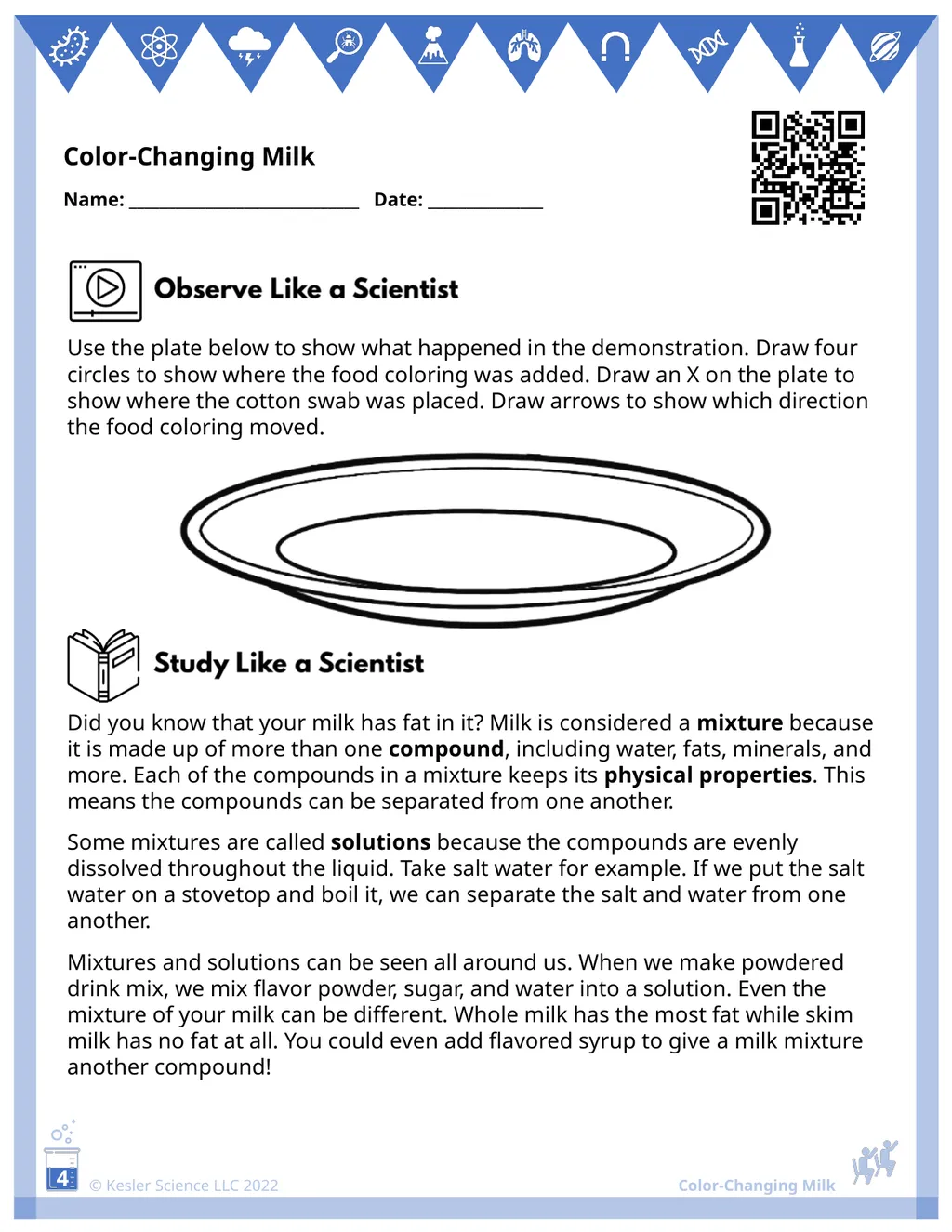
Use the plate below to show what happened in the demonstration. Draw four circles to show where the food coloring was added. Draw an X on the plate to show where the cotton swab was placed. Draw arrows to show which direction the food coloring moved. Did you know that your milk has fat in it? Milk is considered a mixture because it is made up of more than one compound, including water, fats, minerals, and more. Each of the compounds in a mixture keeps its physical properties. This means the compounds can be separated from one another.
Some mixtures are called solutions because the compounds are evenly dissolved throughout the liquid. Take salt water for example. If we put the salt water on a stovetop and boil it, we can separate the salt and water from one another.
Mixtures and solutions can be seen all around us. When we make powdered drink mix, we mix flavor powder, sugar, and water into a solution. Even the mixture of your milk can be different. Whole milk has the most fat while skim milk has no fat at all. You could even add flavored syrup to give a milk mixture another compound!<br>
Some mixtures are called solutions because the compounds are evenly dissolved throughout the liquid. Take salt water for example. If we put the salt water on a stovetop and boil it, we can separate the salt and water from one another.
Mixtures and solutions can be seen all around us. When we make powdered drink mix, we mix flavor powder, sugar, and water into a solution. Even the mixture of your milk can be different. Whole milk has the most fat while skim milk has no fat at all. You could even add flavored syrup to give a milk mixture another compound!<br>
24
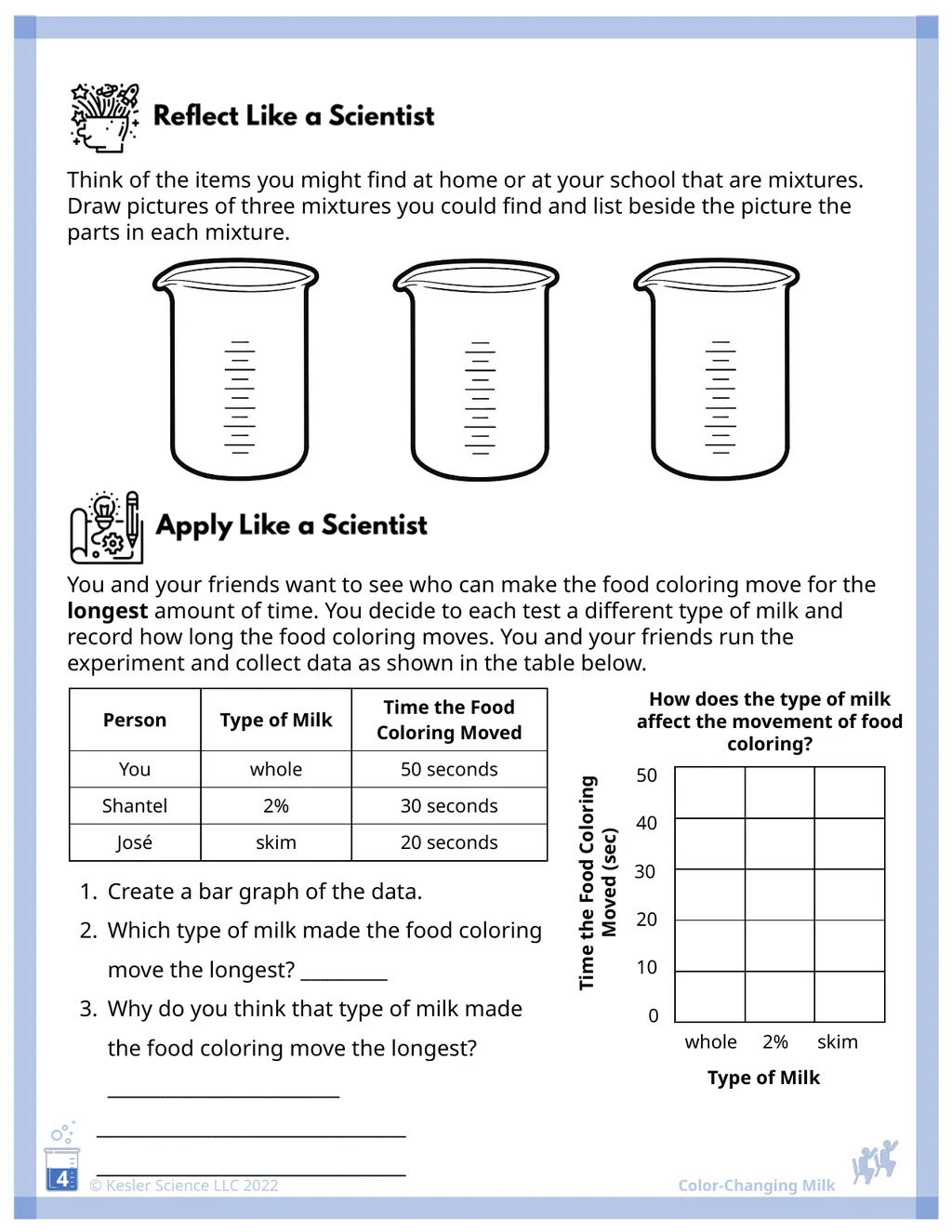
Think of the items you might find at home or at your school that are mixtures. Draw pictures of three mixtures you could find and list beside the picture the parts in each mixture. You and your friends want to see who can make the food coloring move for the longest amount of time. You decide to each test a different type of milk and record how long the food coloring moves. You and your friends run the experiment and collect data as shown in the table below. Create a bar graph of the data.
Which type of milk made the food coloring move the longest? _________
Why do you think that type of milk made the food coloring move the longest? ________________________
________________________________
________________________________ How does the type of milk affect the movement of food coloring?<br>
Which type of milk made the food coloring move the longest? _________
Why do you think that type of milk made the food coloring move the longest? ________________________
________________________________
________________________________ How does the type of milk affect the movement of food coloring?<br>
25
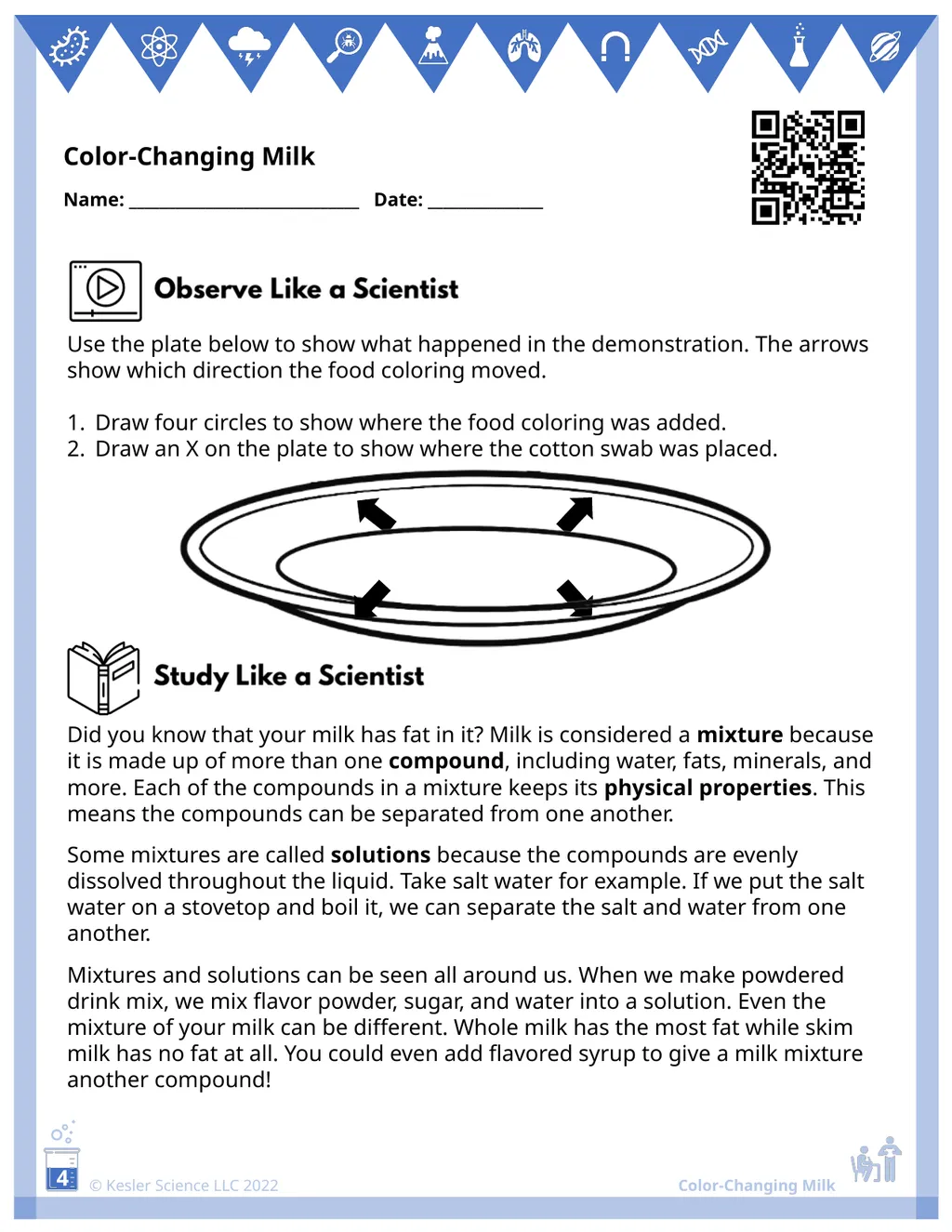
Use the plate below to show what happened in the demonstration. The arrows show which direction the food coloring moved.
Draw four circles to show where the food coloring was added.
Draw an X on the plate to show where the cotton swab was placed. Did you know that your milk has fat in it? Milk is considered a mixture because it is made up of more than one compound, including water, fats, minerals, and more. Each of the compounds in a mixture keeps its physical properties. This means the compounds can be separated from one another.
Some mixtures are called solutions because the compounds are evenly dissolved throughout the liquid. Take salt water for example. If we put the salt water on a stovetop and boil it, we can separate the salt and water from one another.
Mixtures and solutions can be seen all around us. When we make powdered drink mix, we mix flavor powder, sugar, and water into a solution. Even the mixture of your milk can be different. Whole milk has the most fat while skim milk has no fat at all. You could even add flavored syrup to give a milk mixture another compound!<br>
Draw four circles to show where the food coloring was added.
Draw an X on the plate to show where the cotton swab was placed. Did you know that your milk has fat in it? Milk is considered a mixture because it is made up of more than one compound, including water, fats, minerals, and more. Each of the compounds in a mixture keeps its physical properties. This means the compounds can be separated from one another.
Some mixtures are called solutions because the compounds are evenly dissolved throughout the liquid. Take salt water for example. If we put the salt water on a stovetop and boil it, we can separate the salt and water from one another.
Mixtures and solutions can be seen all around us. When we make powdered drink mix, we mix flavor powder, sugar, and water into a solution. Even the mixture of your milk can be different. Whole milk has the most fat while skim milk has no fat at all. You could even add flavored syrup to give a milk mixture another compound!<br>
26
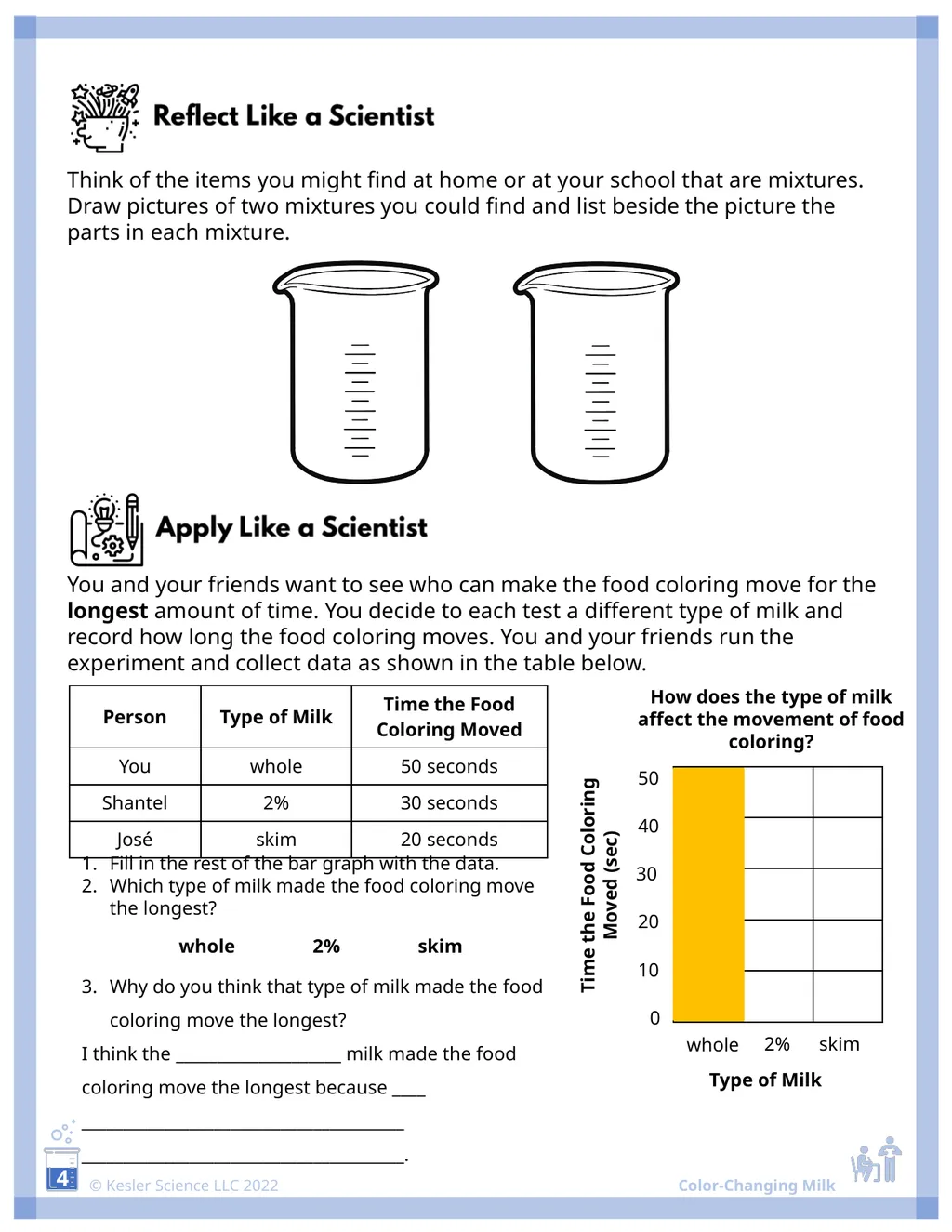
Think of the items you might find at home or at your school that are mixtures. Draw pictures of two mixtures you could find and list beside the picture the parts in each mixture. You and your friends want to see who can make the food coloring move for the longest amount of time. You decide to each test a different type of milk and record how long the food coloring moves. You and your friends run the experiment and collect data as shown in the table below. Fill in the rest of the bar graph with the data.
Which type of milk made the food coloring move the longest?
Why do you think that type of milk made the food coloring move the longest?
I think the ____________________ milk made the food coloring move the longest because ____
_______________________________________
_______________________________________. How does the type of milk affect the movement of food coloring? whole 2% skim<br>
Which type of milk made the food coloring move the longest?
Why do you think that type of milk made the food coloring move the longest?
I think the ____________________ milk made the food coloring move the longest because ____
_______________________________________
_______________________________________. How does the type of milk affect the movement of food coloring? whole 2% skim<br>
27
Answer Key
Observe Like a Scientist
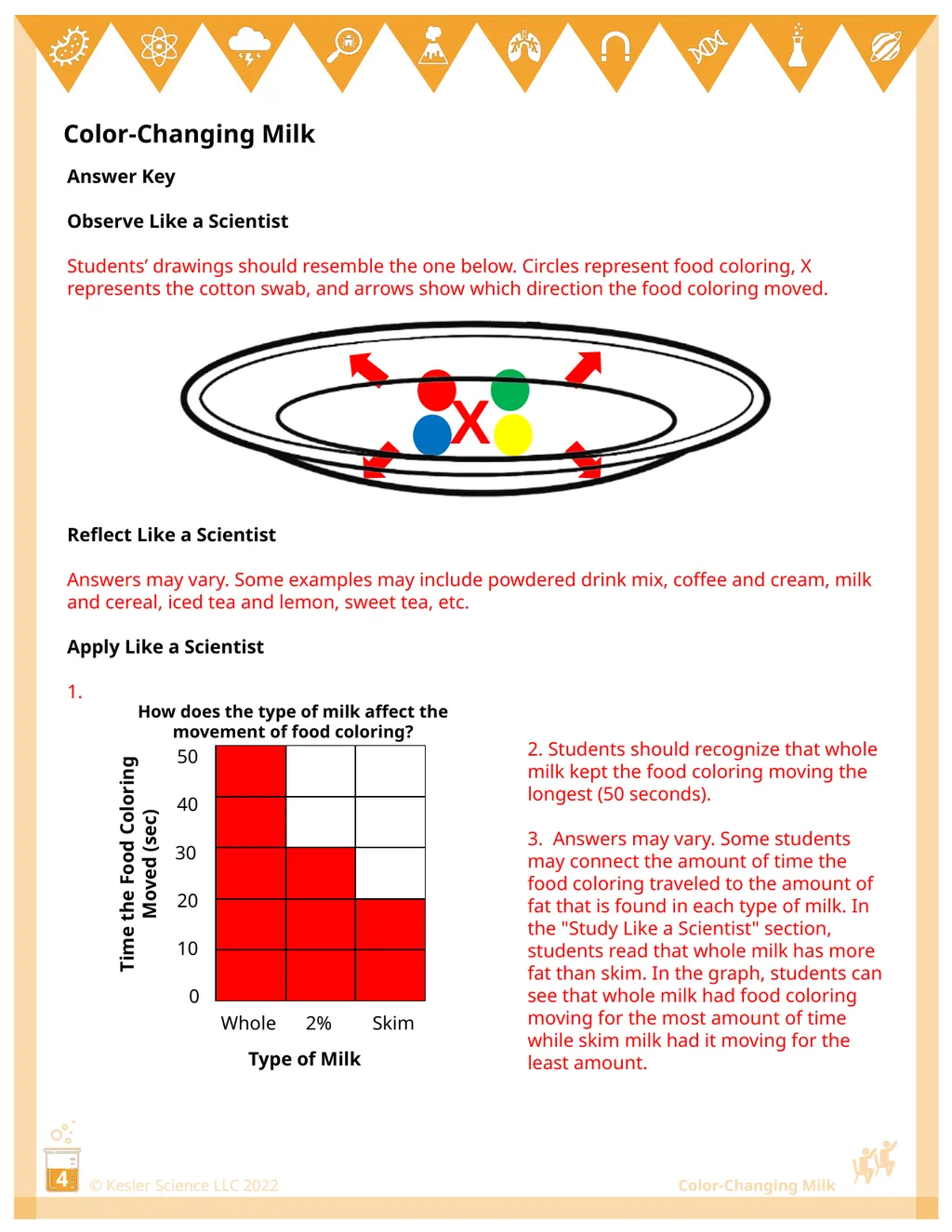
Students’ drawings should resemble the one below. Circles represent food coloring, X represents the cotton swab, and arrows show which direction the food coloring moved.
Reflect Like a Scientist
Answers may vary. Some examples may include powdered drink mix, coffee and cream, milk and cereal, iced tea and lemon, sweet tea, etc.
Apply Like a Scientist
1. X 2. Students should recognize that whole milk kept the food coloring moving the longest (50 seconds).
3. Answers may vary. Some students may connect the amount of time the food coloring traveled to the amount of fat that is found in each type of milk. In the "Study Like a Scientist" section, students read that whole milk has more fat than skim. In the graph, students can see that whole milk had food coloring moving for the most amount of time while skim milk had it moving for the least amount. How does the type of milk affect the movement of food coloring?<br>
Observe Like a Scientist
Students’ drawings should resemble the one below. Circles represent food coloring, X represents the cotton swab, and arrows show which direction the food coloring moved.
Reflect Like a Scientist
Answers may vary. Some examples may include powdered drink mix, coffee and cream, milk and cereal, iced tea and lemon, sweet tea, etc.
Apply Like a Scientist
1. X 2. Students should recognize that whole milk kept the food coloring moving the longest (50 seconds).
3. Answers may vary. Some students may connect the amount of time the food coloring traveled to the amount of fat that is found in each type of milk. In the "Study Like a Scientist" section, students read that whole milk has more fat than skim. In the graph, students can see that whole milk had food coloring moving for the most amount of time while skim milk had it moving for the least amount. How does the type of milk affect the movement of food coloring?<br>
28
Modified Answer Key
Observe Like a Scientist
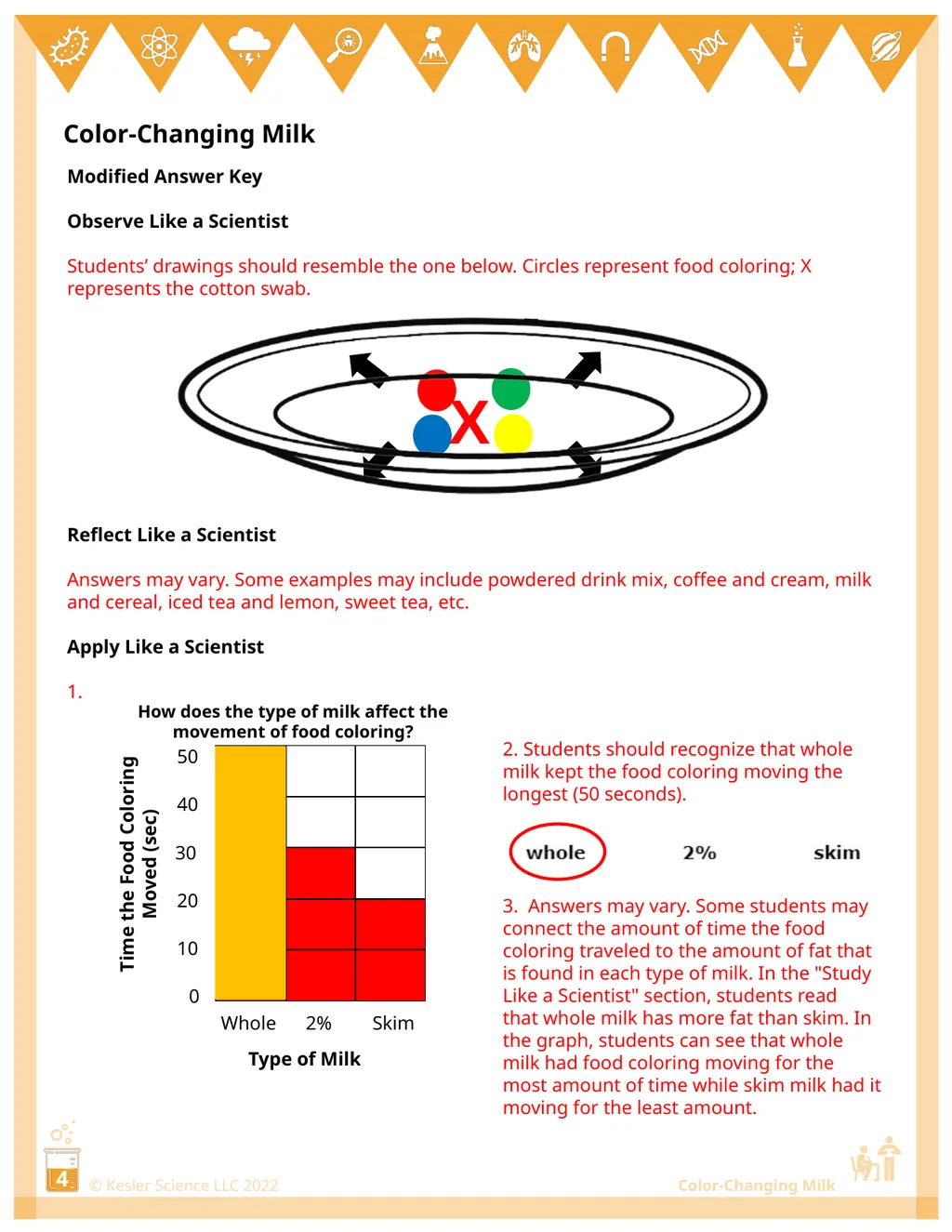
Students’ drawings should resemble the one below. Circles represent food coloring; X represents the cotton swab.
Reflect Like a Scientist
Answers may vary. Some examples may include powdered drink mix, coffee and cream, milk and cereal, iced tea and lemon, sweet tea, etc.
Apply Like a Scientist
1. 2. Students should recognize that whole milk kept the food coloring moving the longest (50 seconds).
3. Answers may vary. Some students may connect the amount of time the food coloring traveled to the amount of fat that is found in each type of milk. In the "Study Like a Scientist" section, students read that whole milk has more fat than skim. In the graph, students can see that whole milk had food coloring moving for the most amount of time while skim milk had it moving for the least amount. How does the type of milk affect the movement of food coloring? X<br>
Observe Like a Scientist
Students’ drawings should resemble the one below. Circles represent food coloring; X represents the cotton swab.
Reflect Like a Scientist
Answers may vary. Some examples may include powdered drink mix, coffee and cream, milk and cereal, iced tea and lemon, sweet tea, etc.
Apply Like a Scientist
1. 2. Students should recognize that whole milk kept the food coloring moving the longest (50 seconds).
3. Answers may vary. Some students may connect the amount of time the food coloring traveled to the amount of fat that is found in each type of milk. In the "Study Like a Scientist" section, students read that whole milk has more fat than skim. In the graph, students can see that whole milk had food coloring moving for the most amount of time while skim milk had it moving for the least amount. How does the type of milk affect the movement of food coloring? X<br>
29
Teacher Directions
STEM Starters are activity sheets that pair with Steve Spangler’s SICK Science! videos. STEM Starters are leveled to provide differentiated activities for Early Education through 8th grade.
The beaker in the lower left corner of each page represents the grade-level edition of the worksheet.
The symbol in the lower right corner of each page represents differentiation.
Dependent: This version is suggested for on-level learners.
Modified: This version provides more support for learners with modifications.
Each STEM Starter should take approximately 10-15 minutes to complete. No materials are required beyond whatever method you choose to play the video for the class. To send these pages home with students, just print the worksheet; the link to the video is on the page as a QR code.
Meet Steve Spangler Steve Spangler is a best-selling author, educator, and Emmy award-winning science communicator who finds creative ways to make science fun.
Engage/Activate Prior Knowledge
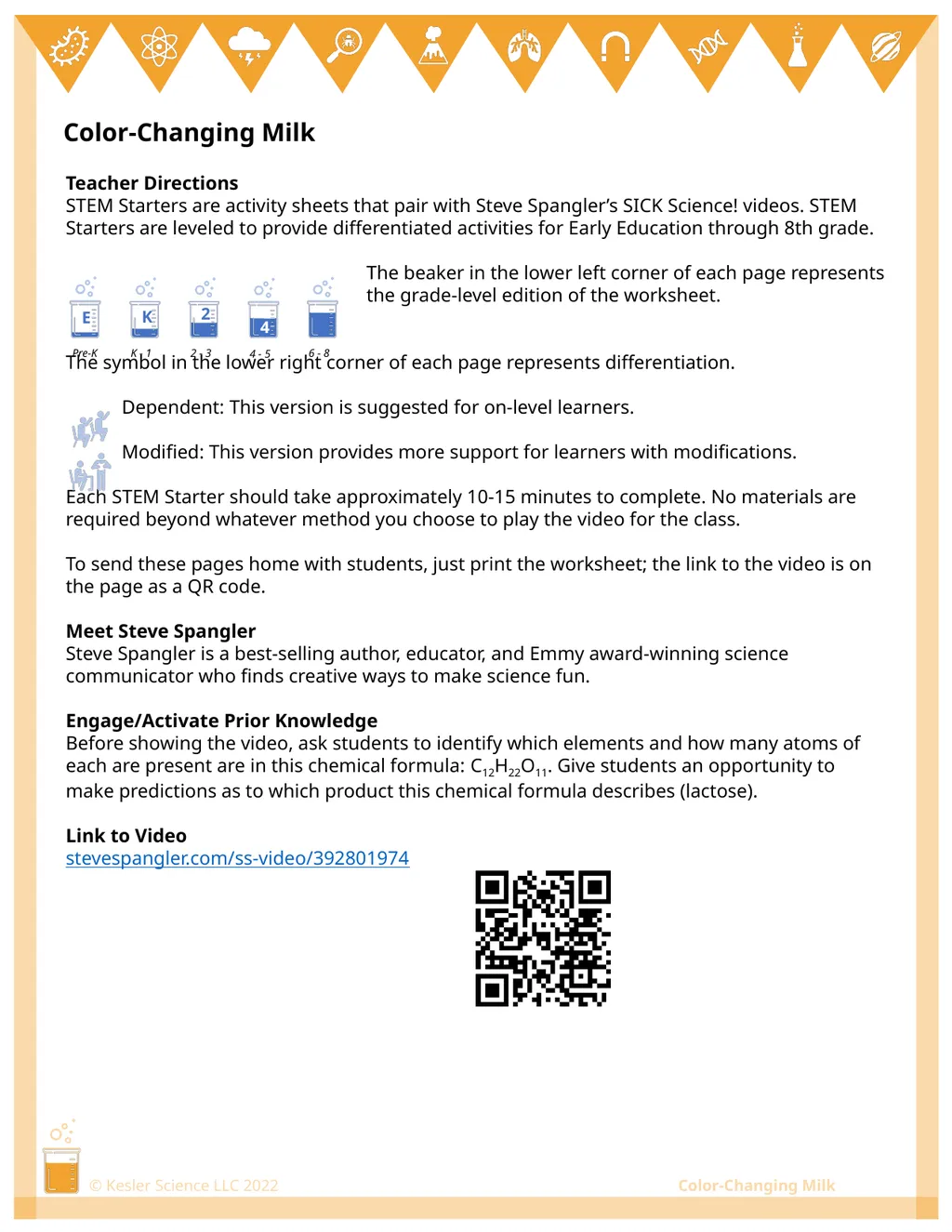
Before showing the video, ask students to identify which elements and how many atoms of each are present are in this chemical formula: C12H22O11. Give students an opportunity to make predictions as to which product this chemical formula describes (lactose).
Link to Video
stevespangler.com/ss-video/392801974<br>
The beaker in the lower left corner of each page represents the grade-level edition of the worksheet.
The symbol in the lower right corner of each page represents differentiation.
Dependent: This version is suggested for on-level learners.
Modified: This version provides more support for learners with modifications.
Each STEM Starter should take approximately 10-15 minutes to complete. No materials are required beyond whatever method you choose to play the video for the class. To send these pages home with students, just print the worksheet; the link to the video is on the page as a QR code.
Meet Steve Spangler Steve Spangler is a best-selling author, educator, and Emmy award-winning science communicator who finds creative ways to make science fun.
Engage/Activate Prior Knowledge
Before showing the video, ask students to identify which elements and how many atoms of each are present are in this chemical formula: C12H22O11. Give students an opportunity to make predictions as to which product this chemical formula describes (lactose).
Link to Video
stevespangler.com/ss-video/392801974<br>
30
Video Description
Fill a plate with milk. Add 1-2 drops each of different colors of food coloring to the center of the plate. Coat one end of a cotton swab with dish soap and touch it to the surface of the milk in the center of the colors. Watch as an explosion of color moves outward through the milk.
Standards These activities support the following standards; additional materials will be required to cover the standard completely.
NGSS MS-PS1-1: Develop models to describe the atomic composition of simple molecules and extended structures.
TEKS 6.2 A, 7.2 A, and 8.2 A: Plan and implement comparative and descriptive investigations by making observations, asking well defined questions, and using appropriate equipment and technology.
TEKS 6.2 B, 7.2 B, and 8.2 B: Design and implement experimental investigations by making observations, asking well defined questions, formulating testable hypothesis, and using appropriate equipment and technology.
TEKS 6.2 C, 7.2 C, and 8.2 C: Collect and record data using the International System of Units (SI) and qualitative means such as labeled drawings, writing, and graphic organizers.
TEKS 8.3 B: Use models to represent aspects of the natural world such as an atom, molecule, space, or a geologic feature.
TEKS 8.5 D: Recognize that chemical formulas are used to identify substances and determine the number of atoms each element in chemical formulas containing subscripts. Background Information Milk is made up mostly of water with fats, minerals, proteins, and vitamins spread throughout the mixture. The fats found in milk don't mix well with water, which is why the food coloring drops are able to sit without changing at the beginning of the demonstration. However, when soap is added, it links the water and fat molecules to each other. As the fat molecules are moved and connected, they cause the food coloring molecules to move as well. This leads to the explosion of food coloring that we see! Milk with greater fat concentrations lead to bigger color explosions because there are more fat molecules for the soap to link with water.<br>
Fill a plate with milk. Add 1-2 drops each of different colors of food coloring to the center of the plate. Coat one end of a cotton swab with dish soap and touch it to the surface of the milk in the center of the colors. Watch as an explosion of color moves outward through the milk.
Standards These activities support the following standards; additional materials will be required to cover the standard completely.
NGSS MS-PS1-1: Develop models to describe the atomic composition of simple molecules and extended structures.
TEKS 6.2 A, 7.2 A, and 8.2 A: Plan and implement comparative and descriptive investigations by making observations, asking well defined questions, and using appropriate equipment and technology.
TEKS 6.2 B, 7.2 B, and 8.2 B: Design and implement experimental investigations by making observations, asking well defined questions, formulating testable hypothesis, and using appropriate equipment and technology.
TEKS 6.2 C, 7.2 C, and 8.2 C: Collect and record data using the International System of Units (SI) and qualitative means such as labeled drawings, writing, and graphic organizers.
TEKS 8.3 B: Use models to represent aspects of the natural world such as an atom, molecule, space, or a geologic feature.
TEKS 8.5 D: Recognize that chemical formulas are used to identify substances and determine the number of atoms each element in chemical formulas containing subscripts. Background Information Milk is made up mostly of water with fats, minerals, proteins, and vitamins spread throughout the mixture. The fats found in milk don't mix well with water, which is why the food coloring drops are able to sit without changing at the beginning of the demonstration. However, when soap is added, it links the water and fat molecules to each other. As the fat molecules are moved and connected, they cause the food coloring molecules to move as well. This leads to the explosion of food coloring that we see! Milk with greater fat concentrations lead to bigger color explosions because there are more fat molecules for the soap to link with water.<br>
31
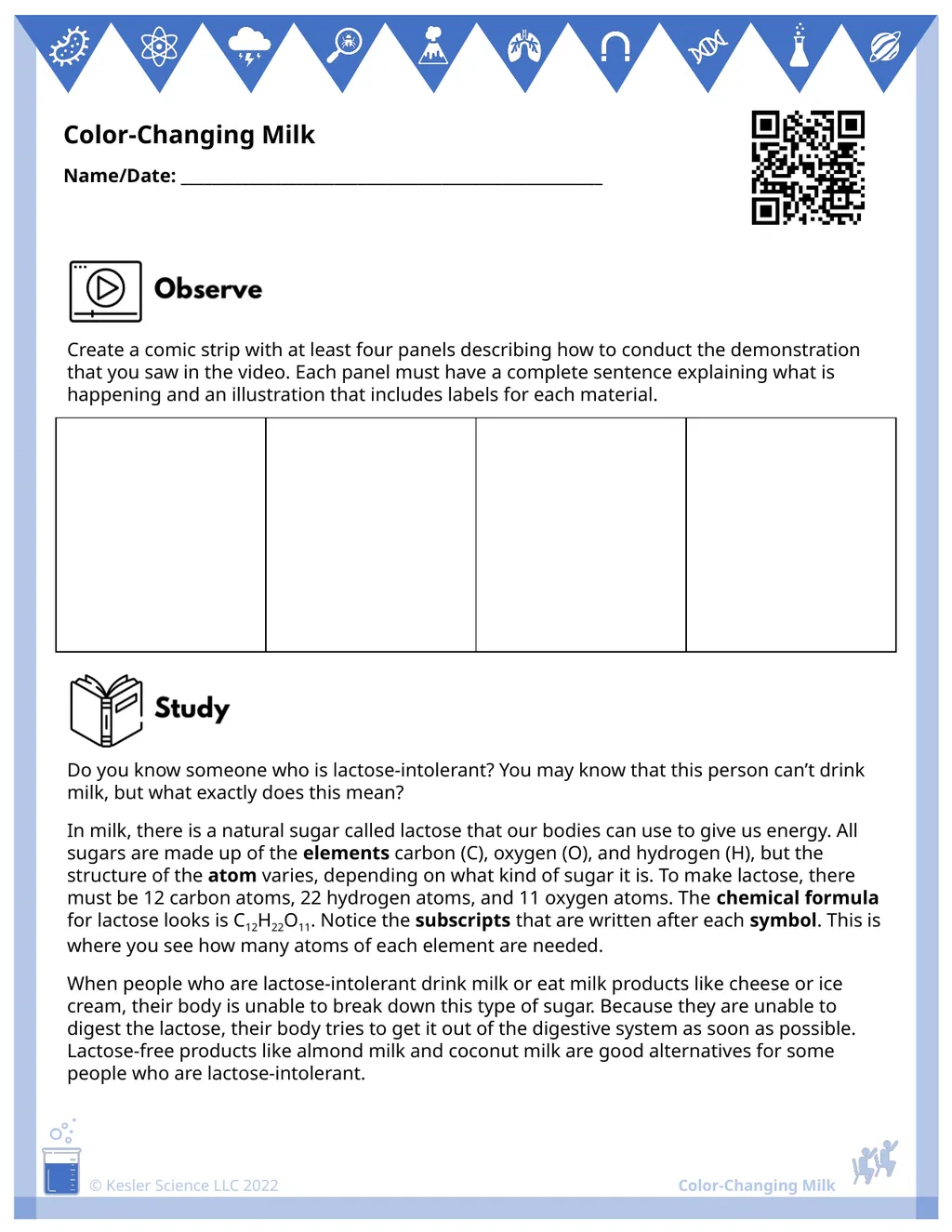
Create a comic strip with at least four panels describing how to conduct the demonstration that you saw in the video. Each panel must have a complete sentence explaining what is happening and an illustration that includes labels for each material. Do you know someone who is lactose-intolerant? You may know that this person can’t drink milk, but what exactly does this mean?
In milk, there is a natural sugar called lactose that our bodies can use to give us energy. All sugars are made up of the elements carbon (C), oxygen (O), and hydrogen (H), but the structure of the atom varies, depending on what kind of sugar it is. To make lactose, there must be 12 carbon atoms, 22 hydrogen atoms, and 11 oxygen atoms. The chemical formula for lactose looks is C12H22O11. Notice the subscripts that are written after each symbol. This is where you see how many atoms of each element are needed.
When people who are lactose-intolerant drink milk or eat milk products like cheese or ice cream, their body is unable to break down this type of sugar. Because they are unable to digest the lactose, their body tries to get it out of the digestive system as soon as possible. Lactose-free products like almond milk and coconut milk are good alternatives for some people who are lactose-intolerant.<br>
In milk, there is a natural sugar called lactose that our bodies can use to give us energy. All sugars are made up of the elements carbon (C), oxygen (O), and hydrogen (H), but the structure of the atom varies, depending on what kind of sugar it is. To make lactose, there must be 12 carbon atoms, 22 hydrogen atoms, and 11 oxygen atoms. The chemical formula for lactose looks is C12H22O11. Notice the subscripts that are written after each symbol. This is where you see how many atoms of each element are needed.
When people who are lactose-intolerant drink milk or eat milk products like cheese or ice cream, their body is unable to break down this type of sugar. Because they are unable to digest the lactose, their body tries to get it out of the digestive system as soon as possible. Lactose-free products like almond milk and coconut milk are good alternatives for some people who are lactose-intolerant.<br>
32
Sketch a zoomed-in picture of the milk, soap, and food coloring molecules to show what is happening at the end of the demonstration. After watching the video with your class, your friends had some questions:
Does the type of milk change the outcome?
Can you do this with other liquids?
Does the type of soap make a difference?
Does the temperature of the milk make a difference?
Pick one of the questions above and design an experiment to test the question:
What is your hypothesis? If ___________________________________________, then _______________________________________________________ because _________________________________________________________________.
What materials will you need? __________________________________________________________________
What procedures will you follow? ____________________________________________________________________________________________________________________________________
What quantitative and qualitative data will you collect? ____________________________________________________________________________________________________________________________________<br>
Does the type of milk change the outcome?
Can you do this with other liquids?
Does the type of soap make a difference?
Does the temperature of the milk make a difference?
Pick one of the questions above and design an experiment to test the question:
What is your hypothesis? If ___________________________________________, then _______________________________________________________ because _________________________________________________________________.
What materials will you need? __________________________________________________________________
What procedures will you follow? ____________________________________________________________________________________________________________________________________
What quantitative and qualitative data will you collect? ____________________________________________________________________________________________________________________________________<br>
33
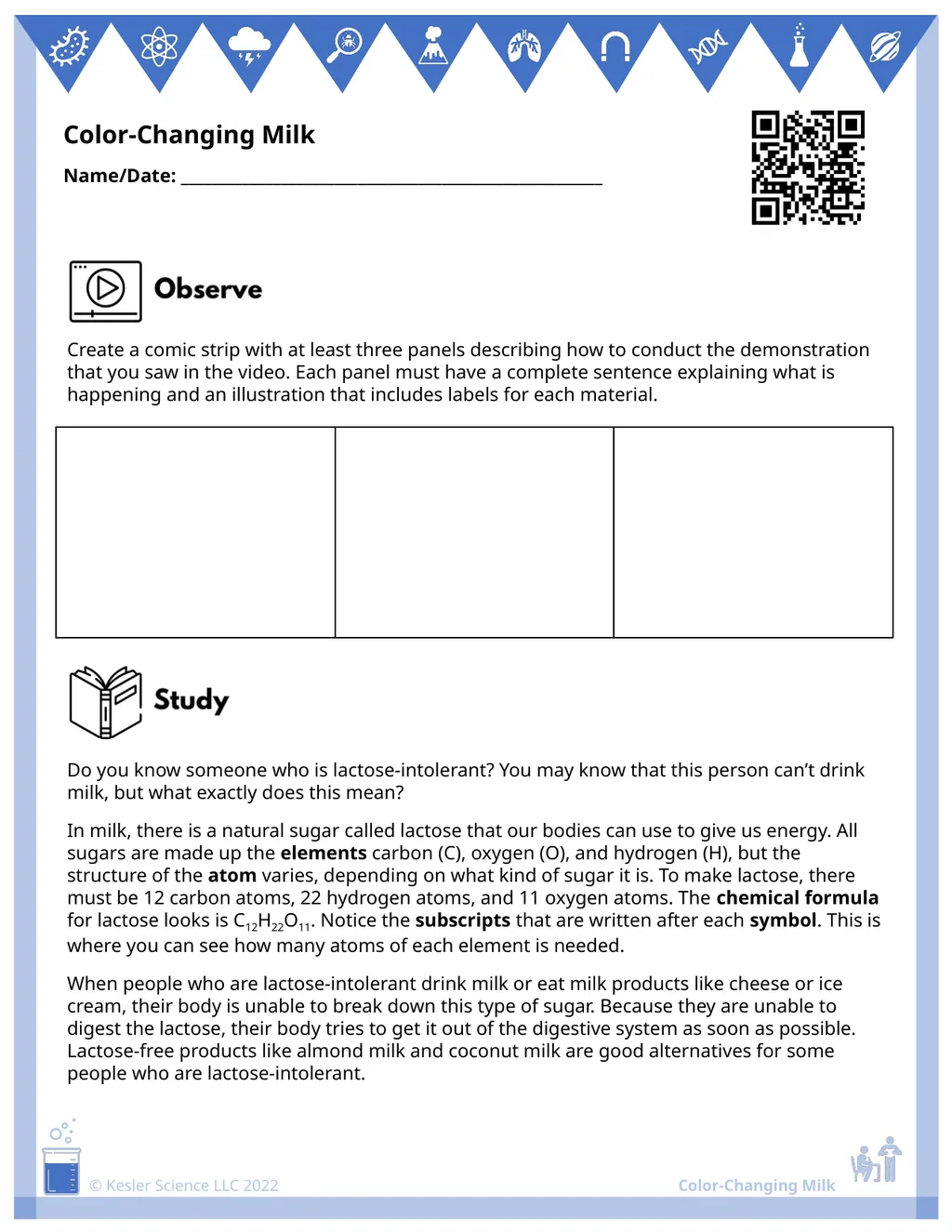
Create a comic strip with at least three panels describing how to conduct the demonstration that you saw in the video. Each panel must have a complete sentence explaining what is happening and an illustration that includes labels for each material. Do you know someone who is lactose-intolerant? You may know that this person can’t drink milk, but what exactly does this mean?
In milk, there is a natural sugar called lactose that our bodies can use to give us energy. All sugars are made up the elements carbon (C), oxygen (O), and hydrogen (H), but the structure of the atom varies, depending on what kind of sugar it is. To make lactose, there must be 12 carbon atoms, 22 hydrogen atoms, and 11 oxygen atoms. The chemical formula for lactose looks is C12H22O11. Notice the subscripts that are written after each symbol. This is where you can see how many atoms of each element is needed.
When people who are lactose-intolerant drink milk or eat milk products like cheese or ice cream, their body is unable to break down this type of sugar. Because they are unable to digest the lactose, their body tries to get it out of the digestive system as soon as possible. Lactose-free products like almond milk and coconut milk are good alternatives for some people who are lactose-intolerant.<br>
In milk, there is a natural sugar called lactose that our bodies can use to give us energy. All sugars are made up the elements carbon (C), oxygen (O), and hydrogen (H), but the structure of the atom varies, depending on what kind of sugar it is. To make lactose, there must be 12 carbon atoms, 22 hydrogen atoms, and 11 oxygen atoms. The chemical formula for lactose looks is C12H22O11. Notice the subscripts that are written after each symbol. This is where you can see how many atoms of each element is needed.
When people who are lactose-intolerant drink milk or eat milk products like cheese or ice cream, their body is unable to break down this type of sugar. Because they are unable to digest the lactose, their body tries to get it out of the digestive system as soon as possible. Lactose-free products like almond milk and coconut milk are good alternatives for some people who are lactose-intolerant.<br>
34
Sketch a zoomed-in picture of the milk, soap, and food coloring molecules to show what is happening at the end of the demonstration. After watching the video with your class, your friends had some questions:
Does the type of milk change the outcome?
Can you do this with other liquids?
Does the type of soap make a difference?
Does the temperature of the milk make a difference?
Pick one of the questions above and design an experiment to test the question:
What is your hypothesis? If ___________________________________________, then _______________________________________________________ because _________________________________________________________________.
What materials will you need? Materials I might need include _________________ _________________________________________________________________.
What procedures will you follow? Procedures I will need to follow include ________ ___________________________________________________________________________________________________________________________________.
What quantitative and qualitative data will you collect? Some data I will need to collect include ______________________________________________________ _________________________________________________________________.<br>
Does the type of milk change the outcome?
Can you do this with other liquids?
Does the type of soap make a difference?
Does the temperature of the milk make a difference?
Pick one of the questions above and design an experiment to test the question:
What is your hypothesis? If ___________________________________________, then _______________________________________________________ because _________________________________________________________________.
What materials will you need? Materials I might need include _________________ _________________________________________________________________.
What procedures will you follow? Procedures I will need to follow include ________ ___________________________________________________________________________________________________________________________________.
What quantitative and qualitative data will you collect? Some data I will need to collect include ______________________________________________________ _________________________________________________________________.<br>
35
Answer Key
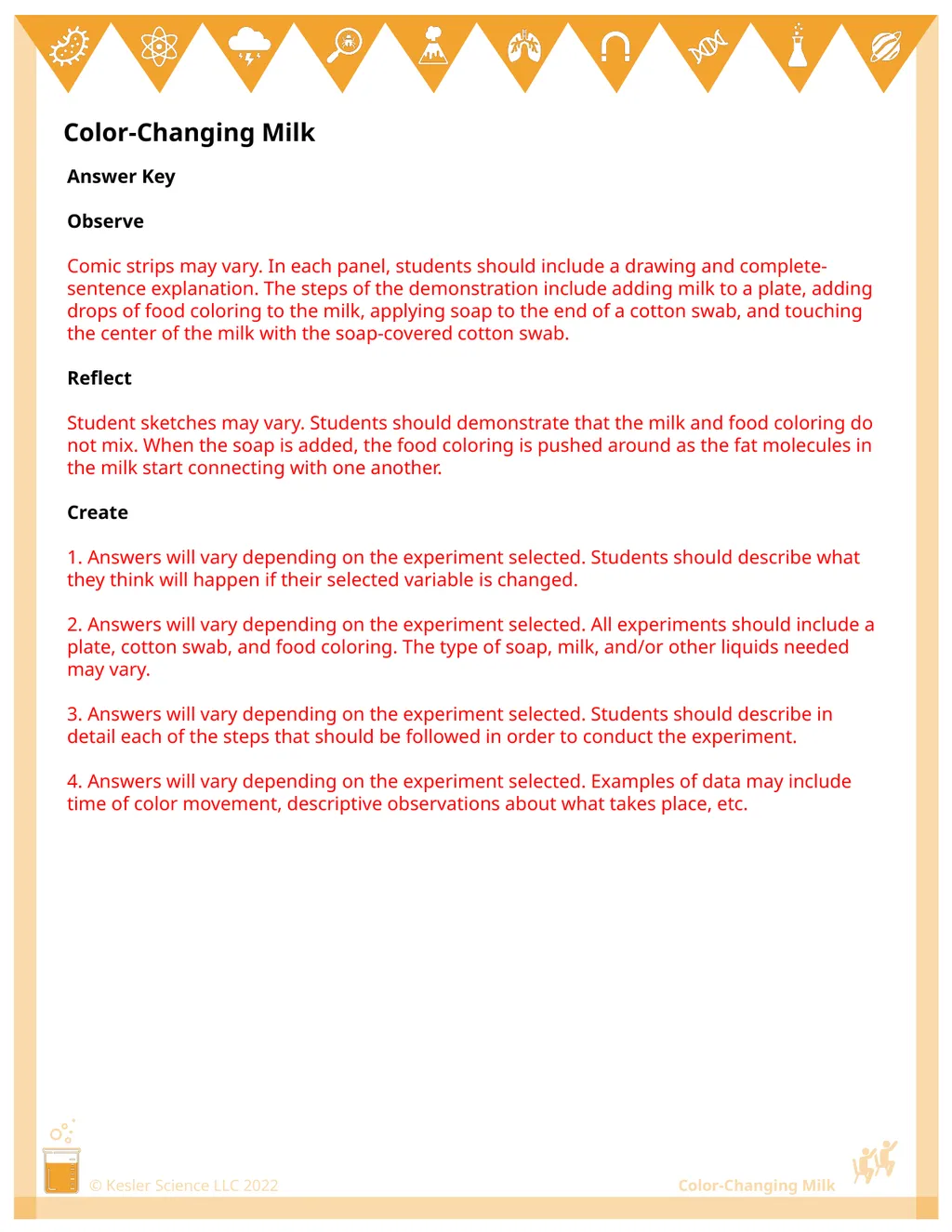
Observe
Comic strips may vary. In each panel, students should include a drawing and complete-sentence explanation. The steps of the demonstration include adding milk to a plate, adding drops of food coloring to the milk, applying soap to the end of a cotton swab, and touching the center of the milk with the soap-covered cotton swab.
Reflect
Student sketches may vary. Students should demonstrate that the milk and food coloring do not mix. When the soap is added, the food coloring is pushed around as the fat molecules in the milk start connecting with one another.
Create
1. Answers will vary depending on the experiment selected. Students should describe what they think will happen if their selected variable is changed.
2. Answers will vary depending on the experiment selected. All experiments should include a plate, cotton swab, and food coloring. The type of soap, milk, and/or other liquids needed may vary.
3. Answers will vary depending on the experiment selected. Students should describe in detail each of the steps that should be followed in order to conduct the experiment.
4. Answers will vary depending on the experiment selected. Examples of data may include time of color movement, descriptive observations about what takes place, etc.<br>
Observe
Comic strips may vary. In each panel, students should include a drawing and complete-sentence explanation. The steps of the demonstration include adding milk to a plate, adding drops of food coloring to the milk, applying soap to the end of a cotton swab, and touching the center of the milk with the soap-covered cotton swab.
Reflect
Student sketches may vary. Students should demonstrate that the milk and food coloring do not mix. When the soap is added, the food coloring is pushed around as the fat molecules in the milk start connecting with one another.
Create
1. Answers will vary depending on the experiment selected. Students should describe what they think will happen if their selected variable is changed.
2. Answers will vary depending on the experiment selected. All experiments should include a plate, cotton swab, and food coloring. The type of soap, milk, and/or other liquids needed may vary.
3. Answers will vary depending on the experiment selected. Students should describe in detail each of the steps that should be followed in order to conduct the experiment.
4. Answers will vary depending on the experiment selected. Examples of data may include time of color movement, descriptive observations about what takes place, etc.<br>
36
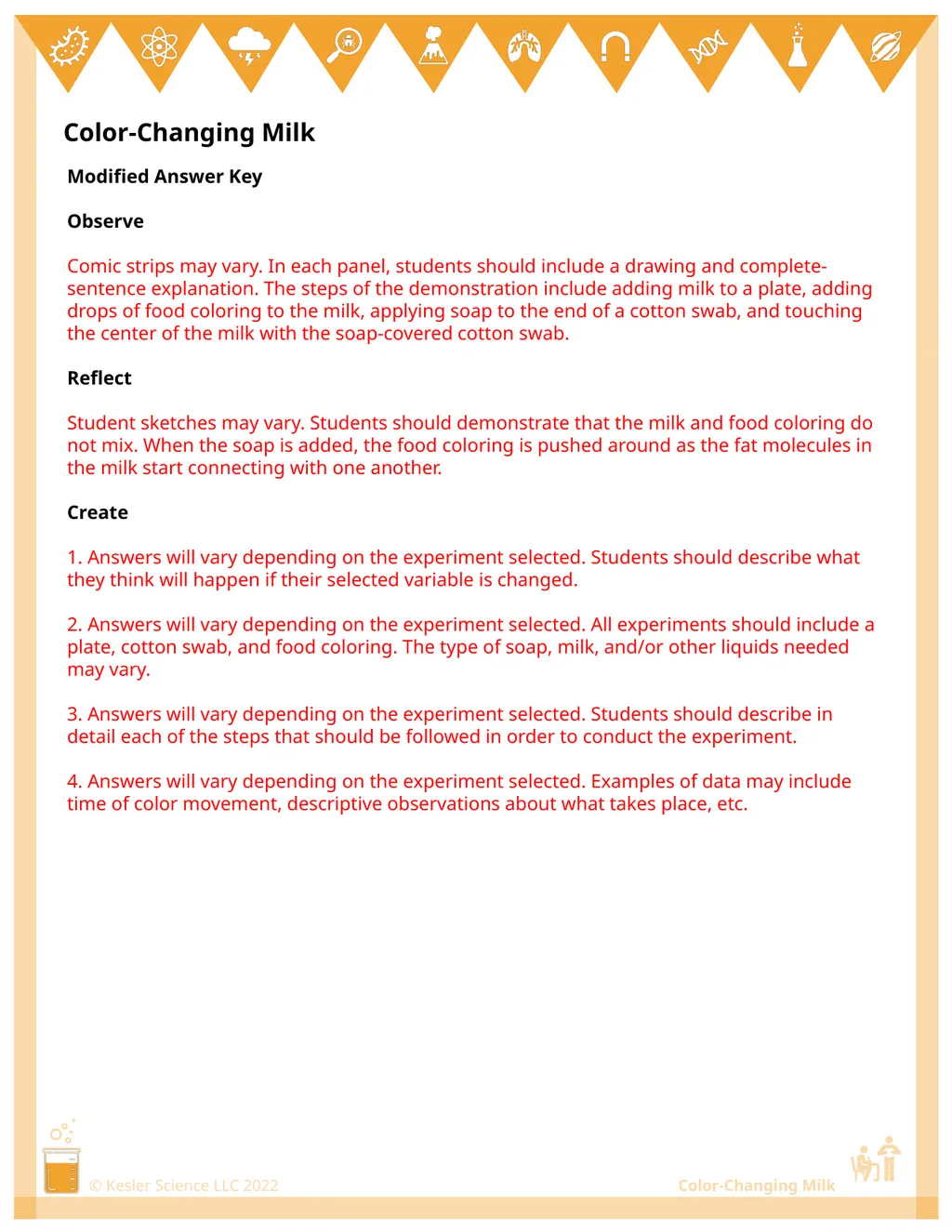
Modified Answer Key
Observe
Comic strips may vary. In each panel, students should include a drawing and complete-sentence explanation. The steps of the demonstration include adding milk to a plate, adding drops of food coloring to the milk, applying soap to the end of a cotton swab, and touching the center of the milk with the soap-covered cotton swab.
Reflect
Student sketches may vary. Students should demonstrate that the milk and food coloring do not mix. When the soap is added, the food coloring is pushed around as the fat molecules in the milk start connecting with one another.
Create
1. Answers will vary depending on the experiment selected. Students should describe what they think will happen if their selected variable is changed.
2. Answers will vary depending on the experiment selected. All experiments should include a plate, cotton swab, and food coloring. The type of soap, milk, and/or other liquids needed may vary.
3. Answers will vary depending on the experiment selected. Students should describe in detail each of the steps that should be followed in order to conduct the experiment.
4. Answers will vary depending on the experiment selected. Examples of data may include time of color movement, descriptive observations about what takes place, etc.<br>
Observe
Comic strips may vary. In each panel, students should include a drawing and complete-sentence explanation. The steps of the demonstration include adding milk to a plate, adding drops of food coloring to the milk, applying soap to the end of a cotton swab, and touching the center of the milk with the soap-covered cotton swab.
Reflect
Student sketches may vary. Students should demonstrate that the milk and food coloring do not mix. When the soap is added, the food coloring is pushed around as the fat molecules in the milk start connecting with one another.
Create
1. Answers will vary depending on the experiment selected. Students should describe what they think will happen if their selected variable is changed.
2. Answers will vary depending on the experiment selected. All experiments should include a plate, cotton swab, and food coloring. The type of soap, milk, and/or other liquids needed may vary.
3. Answers will vary depending on the experiment selected. Students should describe in detail each of the steps that should be followed in order to conduct the experiment.
4. Answers will vary depending on the experiment selected. Examples of data may include time of color movement, descriptive observations about what takes place, etc.<br>