Teaching Concepts through- Discovery, Exposition and In diverse classrooms. Discovery Method Discovery method is a kind of teaching that is based on the student finding things out for themselves, looking into problems, and asking questions.
"Teaching Concepts through- Discovery, Exposition" is the property of its rightful owner. Permission is granted to
download and print the materials on this website for personal, non-commercial use only, and to display it
on your personal computer provided you do not modify the materials and that you retain all copyright
notices contained in the materials. By downloading content from our website, you accept the terms of this
agreement.
Presentation Transcript
01
Teaching Concepts through- Discovery, Exposition and In diverse classrooms.<br>
02
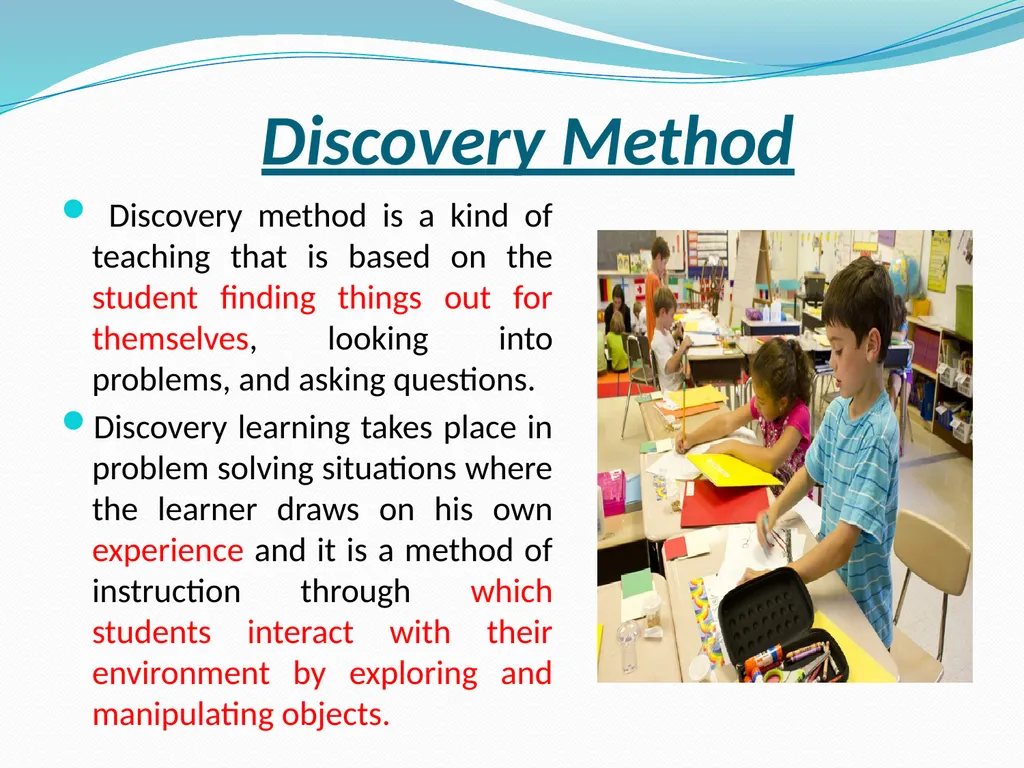
Discovery Method Discovery method is a kind of teaching that is based on the student finding things out for themselves, looking into problems, and asking questions.
Discovery learning takes place in problem solving situations where the learner draws on his own experience and it is a method of instruction through which students interact with their environment by exploring and manipulating objects.<br>
03
Main Attributes of Discovery learning. Bicknell-Holmes and Hoffman(2000) has given 3 main
attributes of discovery learning:
Exploring and problem solving to create, integrate and generalize knowledge.
Student driven, interest based activities.
Activities to encourage integration of new knowledge.<br>
04
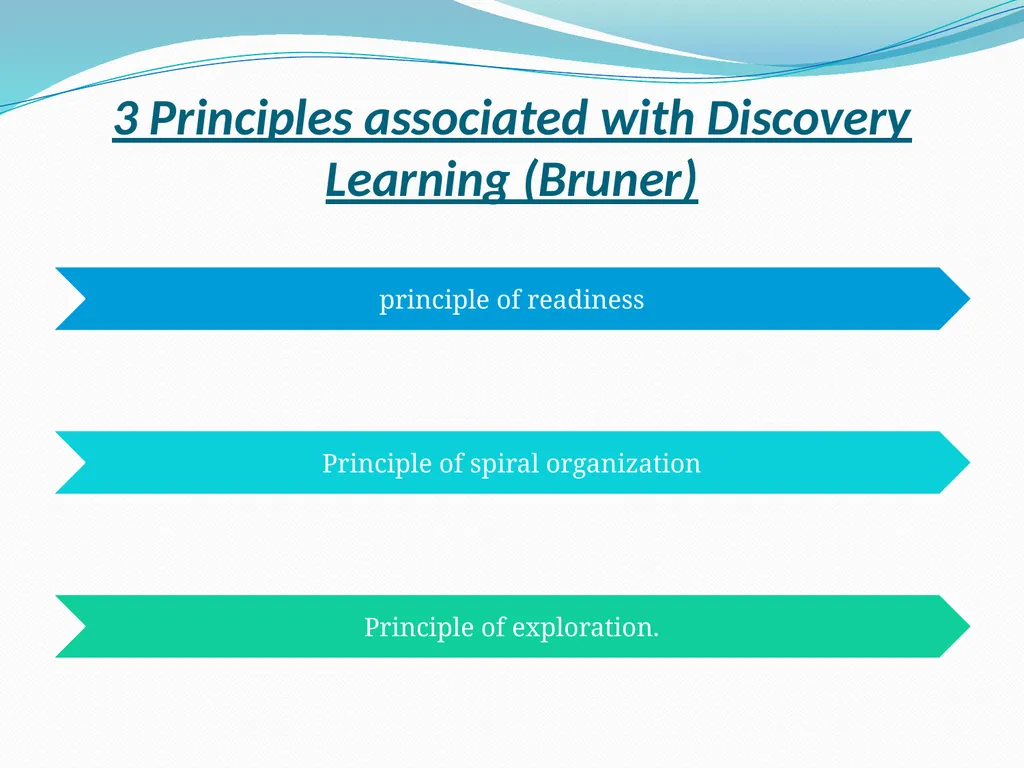
3 Principles associated with Discovery Learning (Bruner)<br>
05
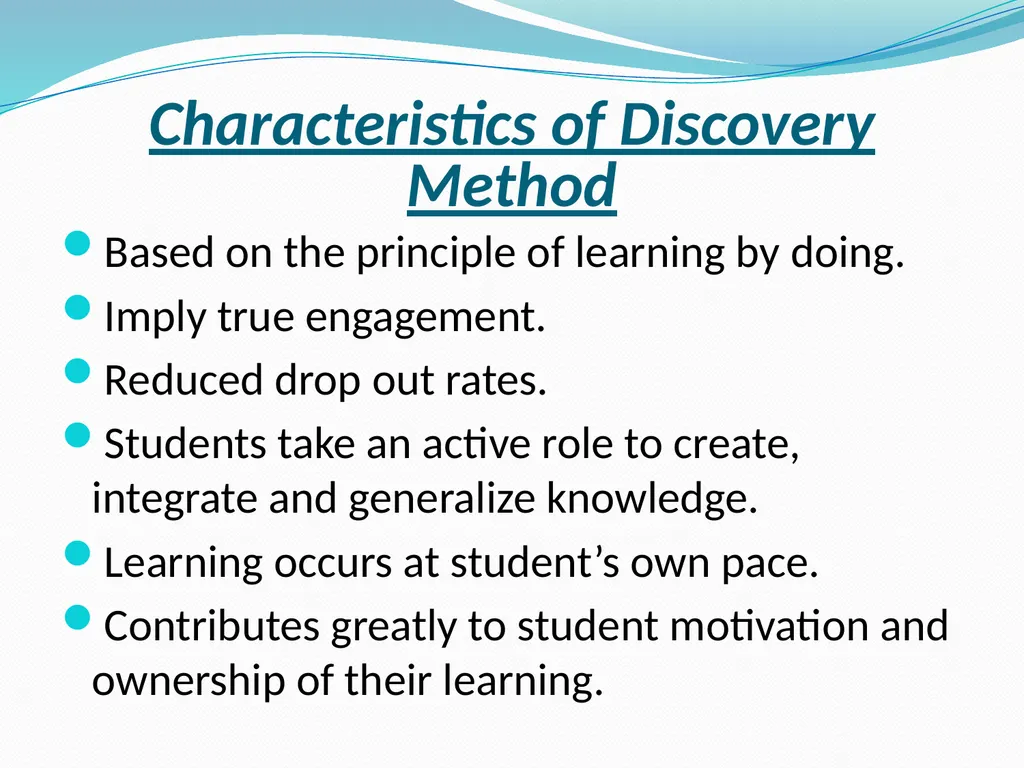
Characteristics of Discovery Method Based on the principle of learning by doing.
Imply true engagement.
Reduced drop out rates.
Students take an active role to create, integrate and generalize knowledge.
Learning occurs at student’s own pace.
Contributes greatly to student motivation and ownership of their learning.<br>
06
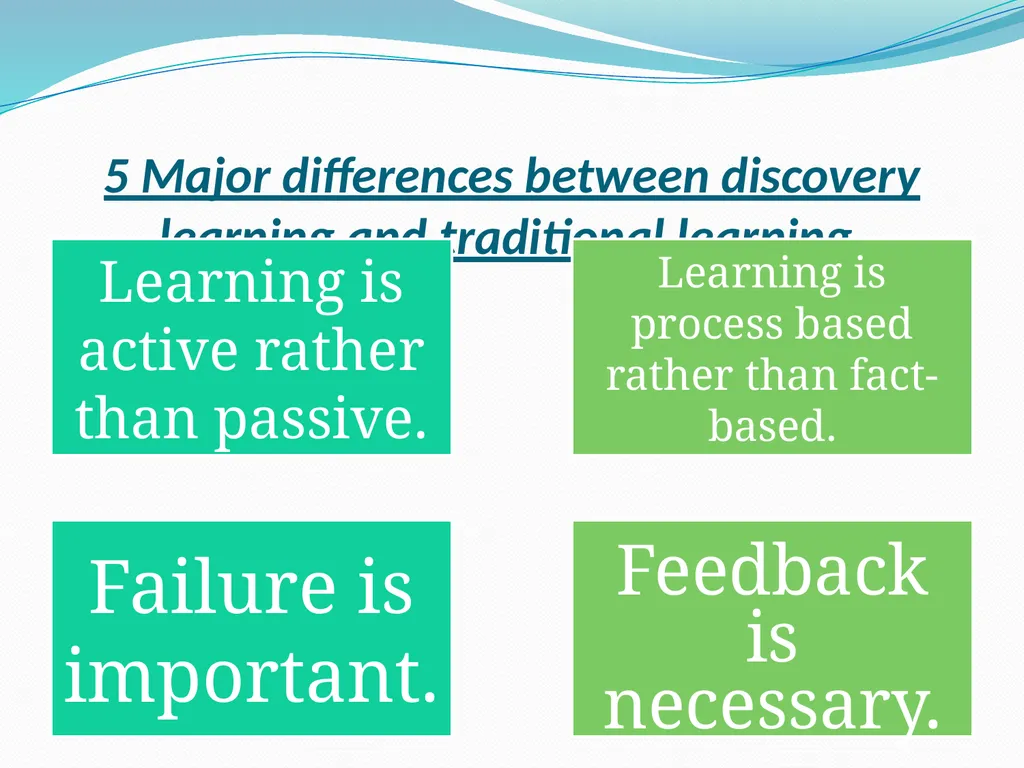
5 Major differences between discovery learning and traditional learning<br>
07
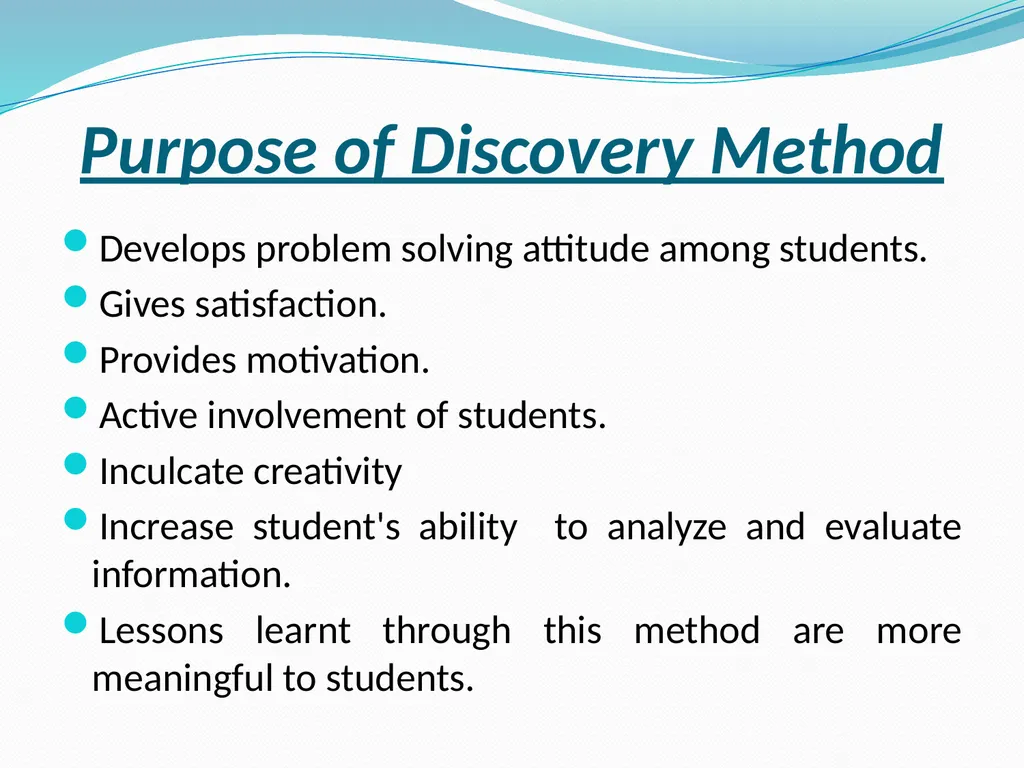
Purpose of Discovery Method Develops problem solving attitude among students.
Gives satisfaction.
Provides motivation.
Active involvement of students.
Inculcate creativity
Increase student's ability to analyze and evaluate information.
Lessons learnt through this method are more meaningful to students.<br>
08
Advantages of Discovery Method Provides high motivation
Fosters curiosity
Personalizes the learning experiences
Increases student achievement
Builds on learner's prior knowledge and understanding
Supports active involvement
Helps student learn how to learn
Easier to remember and recall
Leads to self satisfaction
Enables the development of life long learning.<br>
09
Limitations of Discovery Method Doesn’t cover the course content
Takes a long time to reach objectives
Requires too much preparation and learning time.
Leads to frustration
Not fit to use for too big or too small class size.<br>
10
Suggestions to Incorporate Discovery Method in classrooms Have specific small objectives
Encourage the students to discuss with one another
Direct discussions towards useful outcomes
Monitor activities in the classroom
Answer student’s questions
Ask leading questions
Provide some useful resources when students need help.<br>
11
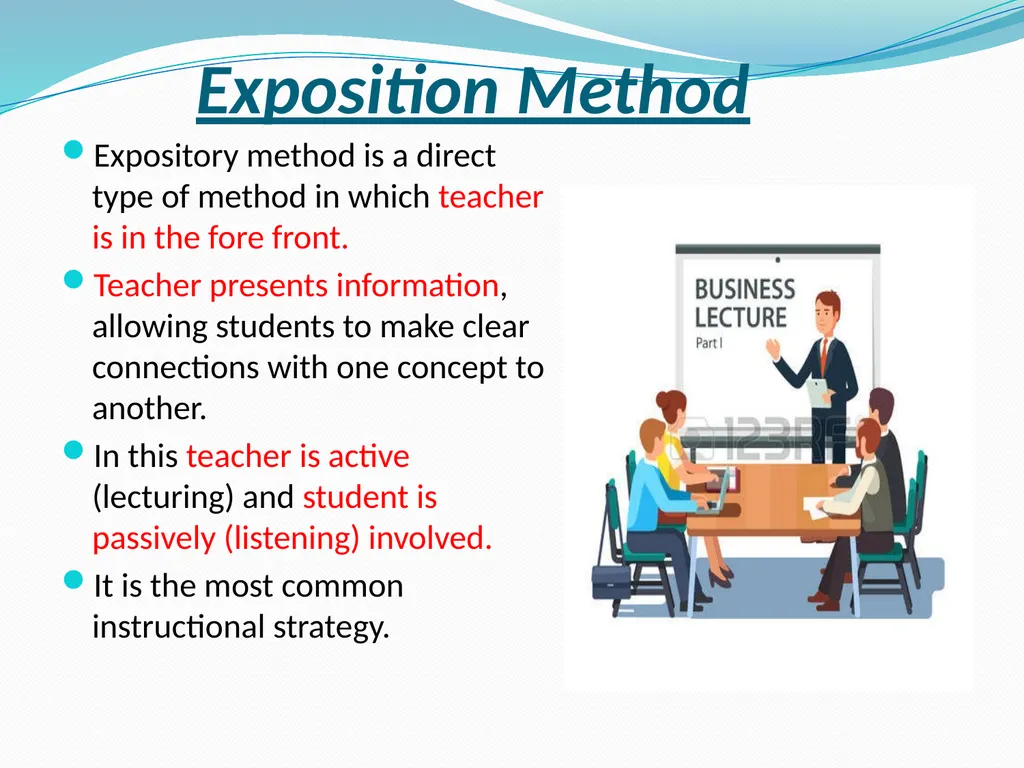
Exposition Method Expository method is a direct type of method in which teacher is in the fore front.
Teacher presents information, allowing students to make clear connections with one concept to another.
In this teacher is active (lecturing) and student is passively (listening) involved.
It is the most common instructional strategy.<br>
12
Characteristics of Exposition Method. Content oriented
Teacher - centered
One – way process
Provides factual information
Deals with the whole unit of teaching in detail from beginning to end
Clear and concise information is presented before students in a purposeful way
Helpful for students to focus on the topic in hand According to Cartell (2004)
Leader centered
Leader active
Learner passive
Content<br>
13
Advantages of Expository Method Teacher is completely in charge and guides the lesson
Teacher finds interesting and fun ways to present the instruction
Covers material in shorter duration
Develops listening skills among students
Widely used method of teaching
Being an active member, teacher can correct the errors omitted by students
Successful method in teaching concepts and principles
Popular method because it is more efficient and takes less time than discovery learning
Encourage and allow deductive reasoning<br>
14
Limitations of Expository Method Students are not actively involved
Teacher dominated
Not beneficial for slow learners
Students loose interest listening to long lectures
In this type of method, students don’t learn how to interact
Focuses on covering too much material in given time
Presumes that all students are learning at same pace<br>
15
Suggestions to incorporate Expository Method in classrooms Parting down the volume of content to reduce wasted time and minimize the risk of overload.
use of multimedia elements like images, audio, video etc while teaching a concept.
Incorporate different methods like story telling, discussions etc .
Making clear what is the most important information for them.<br>
16
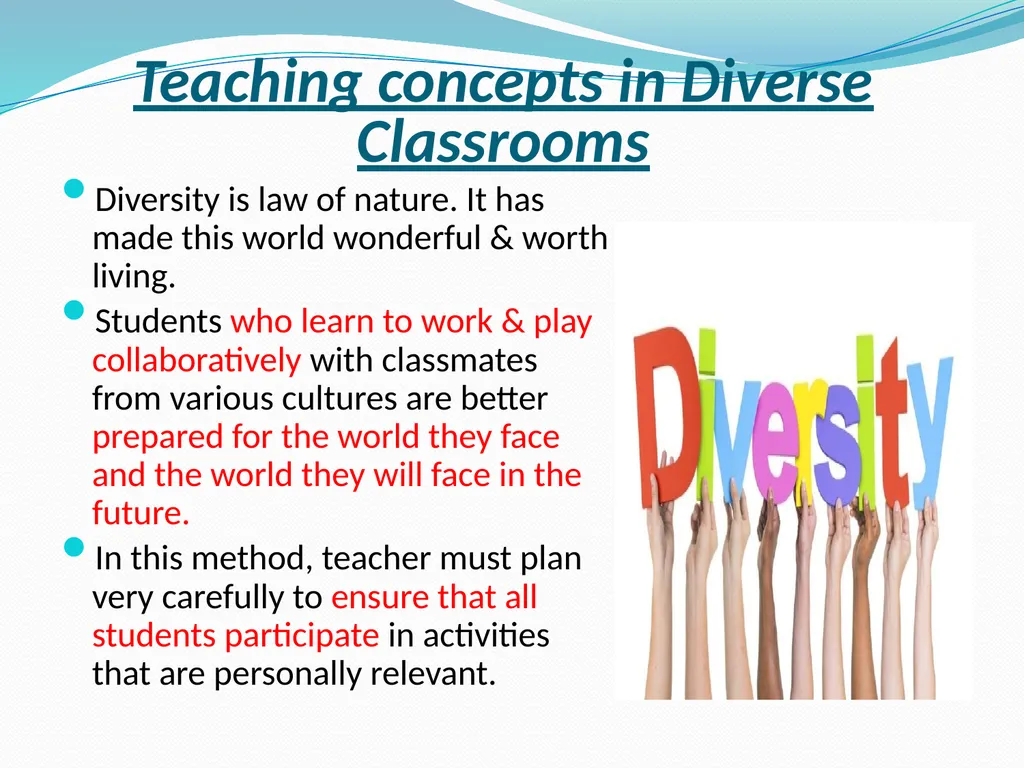
Teaching concepts in Diverse Classrooms Diversity is law of nature. It has made this world wonderful & worth living.
Students who learn to work & play collaboratively with classmates from various cultures are better prepared for the world they face and the world they will face in the future.
In this method, teacher must plan very carefully to ensure that all students participate in activities that are personally relevant.<br>
17
continued To create enthusiastic learners, effective teachers show students that what they are learning in school will equip them with the knowledge, confidence and skills necessary to have fulfilling lives.
Teachers believe in creating a caring classroom climate so that student will improve their performance in respect to their achievement.
Fostering a culturally inclusive learning environment encourages all individuals- regardless of age, gender, religious affiliation, economic status etc.
To develop personal contacts and effective intercultural skills<br>
18
Strategies in a Diverse Classroom (1) Engage in positive interactions with students
Introduce “meet and greet” process in classroom
Celebrate similarities, as well as discovering differences between students
Include understanding of individual differences
Provide opportunity for students to interact with you informally
Display positive non verbal behavior
Make an effort to learn something unique about each student<br>
19
continued (2)Eliminate classroom incivilities
Encourage students to follow disciplinary measures
Respond promptly to any behavior
Avoid ignoring or neglecting the needs of individual students
Display mutual respect towards all students
(3)Encourage open classroom discussion
Prompt students to ask question
Avoid putting anyone “on the spot” while discussing culturally or personally sensitive issues.
Ask students how they prefer to learn so that you can adapt such teaching & learning activities accordingly.<br>
20
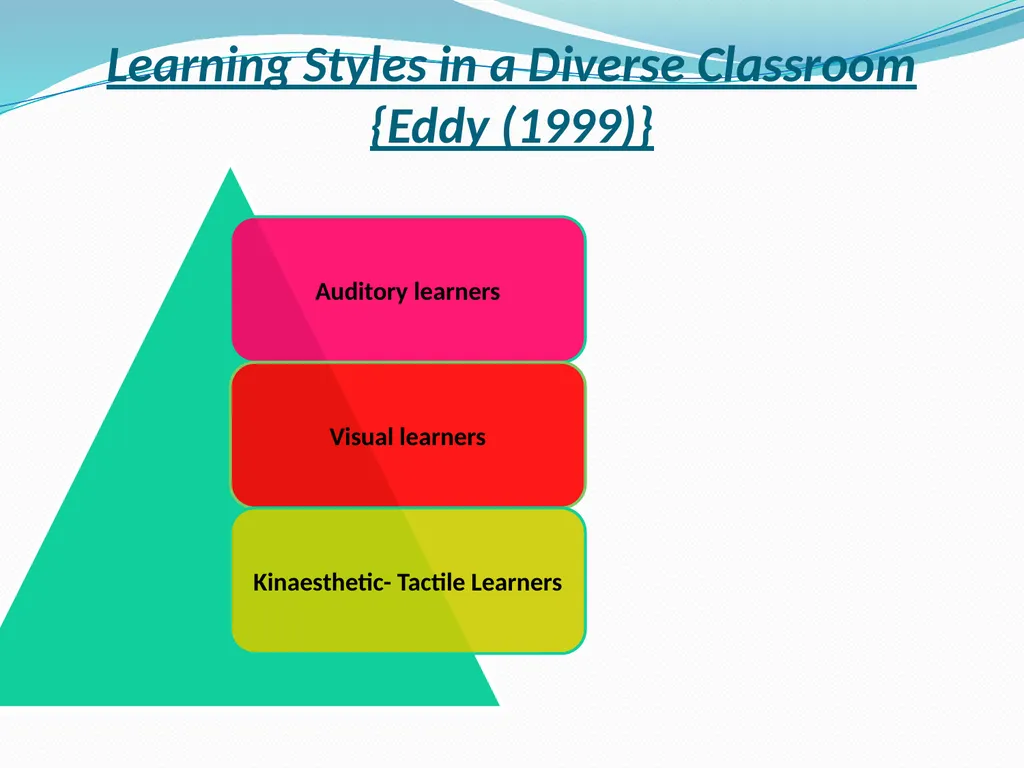
Learning Styles in a Diverse Classroom {Eddy (1999)}<br>
21
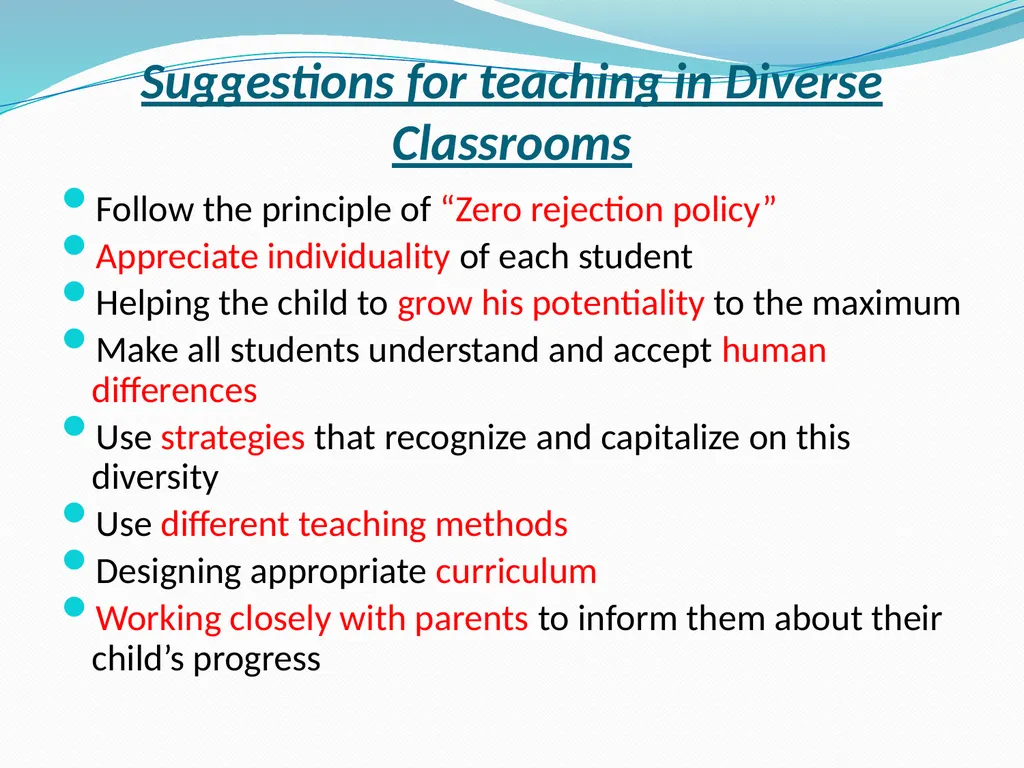
Suggestions for teaching in Diverse Classrooms Follow the principle of “Zero rejection policy”
Appreciate individuality of each student
Helping the child to grow his potentiality to the maximum
Make all students understand and accept human differences
Use strategies that recognize and capitalize on this diversity
Use different teaching methods
Designing appropriate curriculum
Working closely with parents to inform them about their child’s progress<br>
22
Conclusion Every student is different and learning concept of each student is also different from the other one. So at the end we can say that teacher have to use different teaching strategies so as to fulfill their needs and for providing satisfaction as well. Then only proper understanding will take place and at the end it will help the students to develop their cognitive abilities as well.<br>