
Teaching Structure – a one stop shop Structure and
MS
Published · 31 slides · 0 views

1 / 1

Description
Teaching Structure a one stop shop Structure and Paper 1 Language Paper 1 Question 3 Structure In this question you will be asked to look at the whole source and to consider how the writer uses structure in order to shape meaning. Start
Related Topics
Share
Embed code
Download this presentation From Below
"Teaching Structure – a one stop shop Structure and" is the property of its rightful owner. Permission is granted to download and print the materials on this website for personal, non-commercial use only, and to display it on your personal computer provided you do not modify the materials and that you retain all copyright notices contained in the materials. By downloading content from our website, you accept the terms of this agreement.
Presentation Transcript
01
Teaching Structure – a one stop shop<br>
02
Structure and Paper 1<br>
03
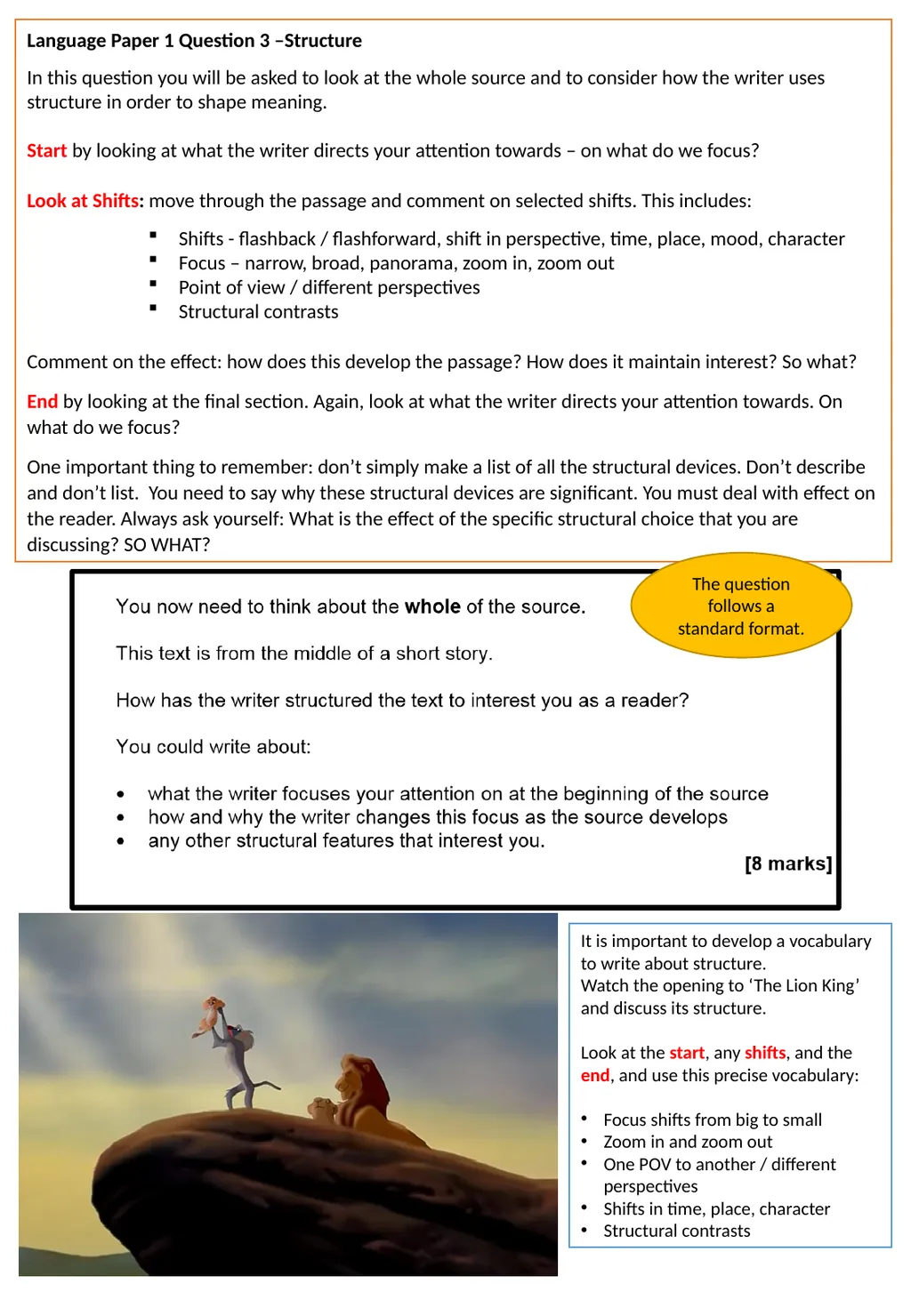
Language Paper 1 Question 3 –Structure
In this question you will be asked to look at the whole source and to consider how the writer uses structure in order to shape meaning.
Start by looking at what the writer directs your attention towards – on what do we focus?
Look at Shifts: move through the passage and comment on selected shifts. This includes:
Shifts - flashback / flashforward, shift in perspective, time, place, mood, character
Focus – narrow, broad, panorama, zoom in, zoom out
Point of view / different perspectives
Structural contrasts
Comment on the effect: how does this develop the passage? How does it maintain interest? So what?
End by looking at the final section. Again, look at what the writer directs your attention towards. On what do we focus?
One important thing to remember: don’t simply make a list of all the structural devices. Don’t describe and don’t list. You need to say why these structural devices are significant. You must deal with effect on the reader. Always ask yourself: What is the effect of the specific structural choice that you are discussing? SO WHAT? The question follows a standard format. It is important to develop a vocabulary to write about structure.
Watch the opening to ‘The Lion King’ and discuss its structure.
Look at the start, any shifts, and the end, and use this precise vocabulary:
Focus shifts from big to small
Zoom in and zoom out
One POV to another / different perspectives
Shifts in time, place, character
Structural contrasts<br>
In this question you will be asked to look at the whole source and to consider how the writer uses structure in order to shape meaning.
Start by looking at what the writer directs your attention towards – on what do we focus?
Look at Shifts: move through the passage and comment on selected shifts. This includes:
Shifts - flashback / flashforward, shift in perspective, time, place, mood, character
Focus – narrow, broad, panorama, zoom in, zoom out
Point of view / different perspectives
Structural contrasts
Comment on the effect: how does this develop the passage? How does it maintain interest? So what?
End by looking at the final section. Again, look at what the writer directs your attention towards. On what do we focus?
One important thing to remember: don’t simply make a list of all the structural devices. Don’t describe and don’t list. You need to say why these structural devices are significant. You must deal with effect on the reader. Always ask yourself: What is the effect of the specific structural choice that you are discussing? SO WHAT? The question follows a standard format. It is important to develop a vocabulary to write about structure.
Watch the opening to ‘The Lion King’ and discuss its structure.
Look at the start, any shifts, and the end, and use this precise vocabulary:
Focus shifts from big to small
Zoom in and zoom out
One POV to another / different perspectives
Shifts in time, place, character
Structural contrasts<br>
04
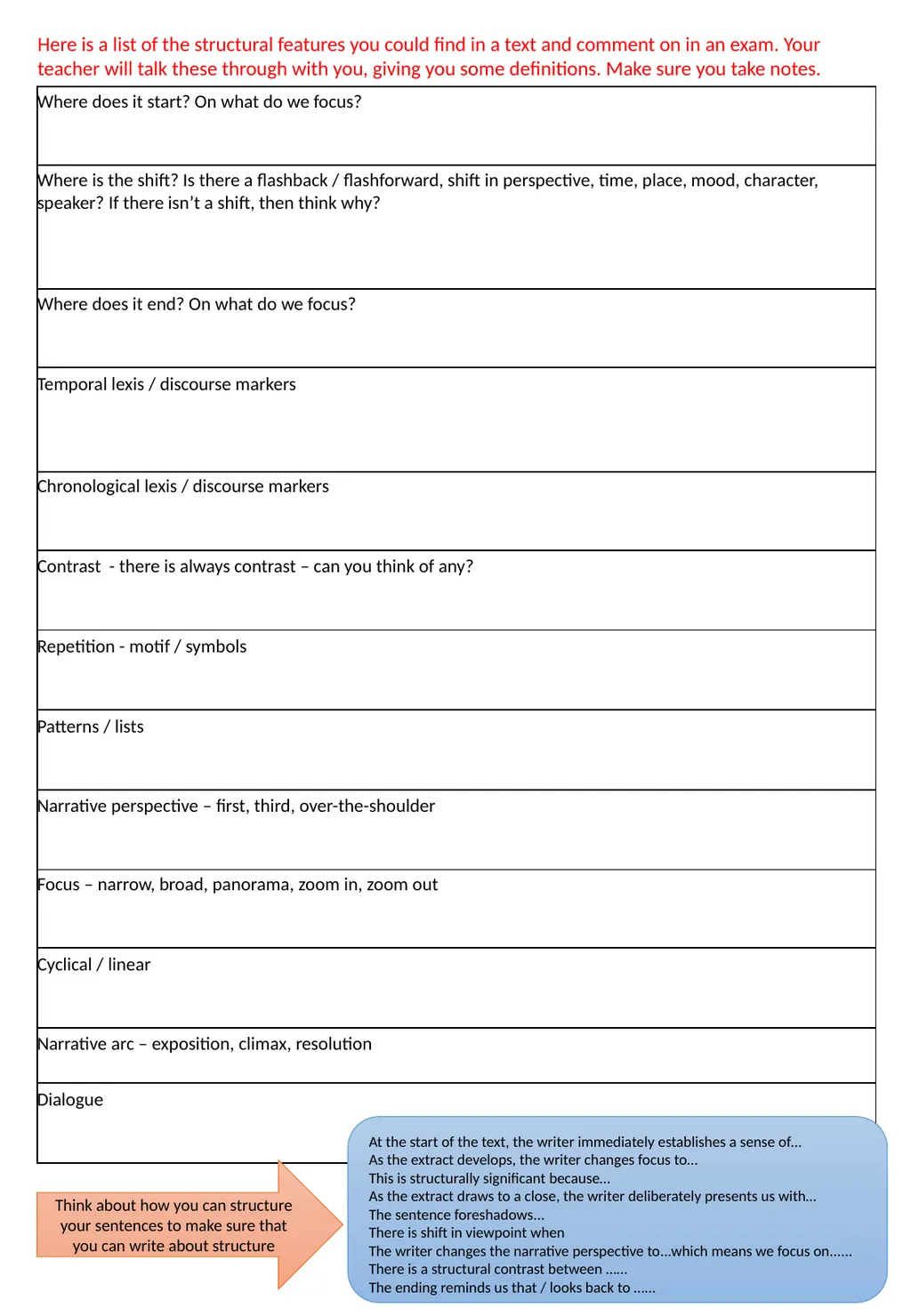
Here is a list of the structural features you could find in a text and comment on in an exam. Your teacher will talk these through with you, giving you some definitions. Make sure you take notes. At the start of the text, the writer immediately establishes a sense of…
As the extract develops, the writer changes focus to…
This is structurally significant because…
As the extract draws to a close, the writer deliberately presents us with…
The sentence foreshadows...
There is shift in viewpoint when
The writer changes the narrative perspective to...which means we focus on......
There is a structural contrast between …...
The ending reminds us that / looks back to …... Think about how you can structure your sentences to make sure that you can write about structure<br>
As the extract develops, the writer changes focus to…
This is structurally significant because…
As the extract draws to a close, the writer deliberately presents us with…
The sentence foreshadows...
There is shift in viewpoint when
The writer changes the narrative perspective to...which means we focus on......
There is a structural contrast between …...
The ending reminds us that / looks back to …... Think about how you can structure your sentences to make sure that you can write about structure<br>
05
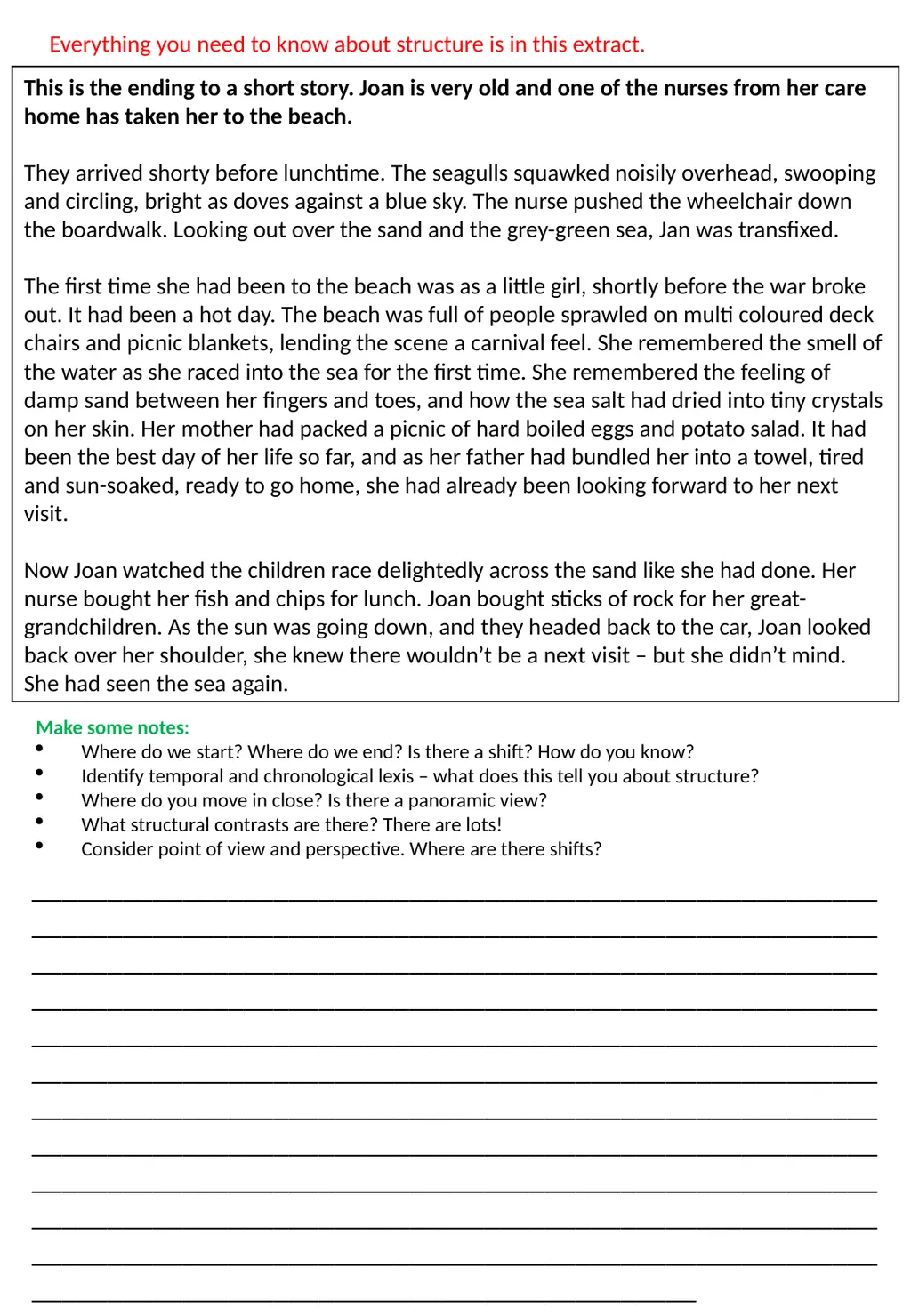
Everything you need to know about structure is in this extract. Make some notes:
Where do we start? Where do we end? Is there a shift? How do you know?
Identify temporal and chronological lexis – what does this tell you about structure?
Where do you move in close? Is there a panoramic view?
What structural contrasts are there? There are lots!
Consider point of view and perspective. Where are there shifts?
The sun is used brilliantly as a structural device – how? ____________________________________________________________________________________________________________________________________________________________________________________________________________________________________________________________________________________________________________________________________________________________________________________________________________________________________________________________________________________________________________________________________________________________________________________________________________________________________________________________________________________ This is the ending to a short story. Joan is very old and one of the nurses from her care home has taken her to the beach.
They arrived shorty before lunchtime. The seagulls squawked noisily overhead, swooping and circling, bright as doves against a blue sky. The nurse pushed the wheelchair down the boardwalk. Looking out over the sand and the grey-green sea, Jan was transfixed.
The first time she had been to the beach was as a little girl, shortly before the war broke out. It had been a hot day. The beach was full of people sprawled on multi coloured deck chairs and picnic blankets, lending the scene a carnival feel. She remembered the smell of the water as she raced into the sea for the first time. She remembered the feeling of damp sand between her fingers and toes, and how the sea salt had dried into tiny crystals on her skin. Her mother had packed a picnic of hard boiled eggs and potato salad. It had been the best day of her life so far, and as her father had bundled her into a towel, tired and sun-soaked, ready to go home, she had already been looking forward to her next visit.
Now Joan watched the children race delightedly across the sand like she had done. Her nurse bought her fish and chips for lunch. Joan bought sticks of rock for her great-grandchildren. As the sun was going down, and they headed back to the car, Joan looked back over her shoulder, she knew there wouldn’t be a next visit – but she didn’t mind. She had seen the sea again.<br>
Where do we start? Where do we end? Is there a shift? How do you know?
Identify temporal and chronological lexis – what does this tell you about structure?
Where do you move in close? Is there a panoramic view?
What structural contrasts are there? There are lots!
Consider point of view and perspective. Where are there shifts?
The sun is used brilliantly as a structural device – how? ____________________________________________________________________________________________________________________________________________________________________________________________________________________________________________________________________________________________________________________________________________________________________________________________________________________________________________________________________________________________________________________________________________________________________________________________________________________________________________________________________________________ This is the ending to a short story. Joan is very old and one of the nurses from her care home has taken her to the beach.
They arrived shorty before lunchtime. The seagulls squawked noisily overhead, swooping and circling, bright as doves against a blue sky. The nurse pushed the wheelchair down the boardwalk. Looking out over the sand and the grey-green sea, Jan was transfixed.
The first time she had been to the beach was as a little girl, shortly before the war broke out. It had been a hot day. The beach was full of people sprawled on multi coloured deck chairs and picnic blankets, lending the scene a carnival feel. She remembered the smell of the water as she raced into the sea for the first time. She remembered the feeling of damp sand between her fingers and toes, and how the sea salt had dried into tiny crystals on her skin. Her mother had packed a picnic of hard boiled eggs and potato salad. It had been the best day of her life so far, and as her father had bundled her into a towel, tired and sun-soaked, ready to go home, she had already been looking forward to her next visit.
Now Joan watched the children race delightedly across the sand like she had done. Her nurse bought her fish and chips for lunch. Joan bought sticks of rock for her great-grandchildren. As the sun was going down, and they headed back to the car, Joan looked back over her shoulder, she knew there wouldn’t be a next visit – but she didn’t mind. She had seen the sea again.<br>
06
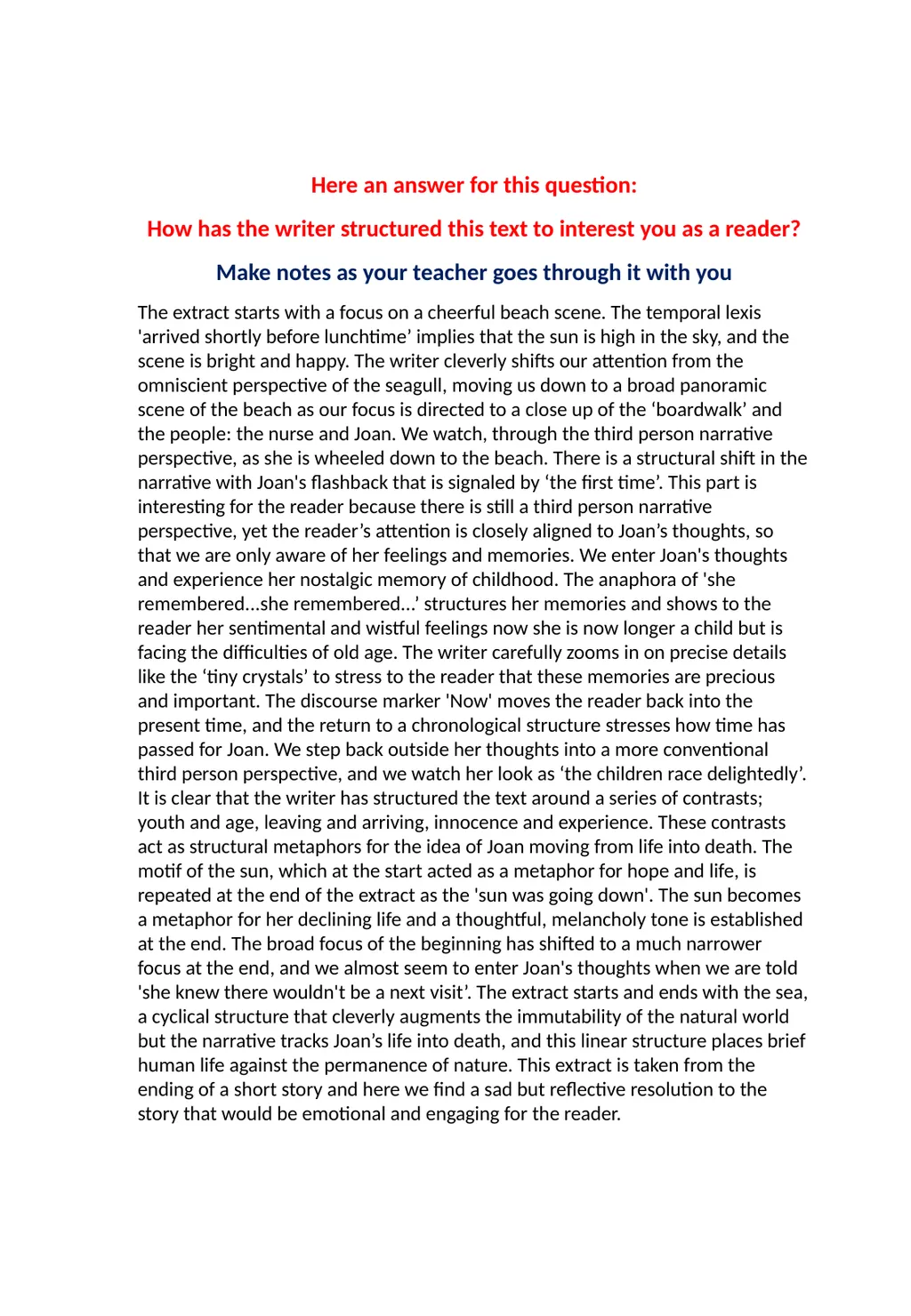
Here an answer for this question:
How has the writer structured this text to interest you as a reader?
Make notes as your teacher goes through it with you
The extract starts with a focus on a cheerful beach scene. The temporal lexis 'arrived shortly before lunchtime’ implies that the sun is high in the sky, and the scene is bright and happy. The writer cleverly shifts our attention from the omniscient perspective of the seagull, moving us down to a broad panoramic scene of the beach as our focus is directed to a close up of the ‘boardwalk’ and the people: the nurse and Joan. We watch, through the third person narrative perspective, as she is wheeled down to the beach. There is a structural shift in the narrative with Joan's flashback that is signaled by ‘the first time’. This part is interesting for the reader because there is still a third person narrative perspective, yet the reader’s attention is closely aligned to Joan’s thoughts, so that we are only aware of her feelings and memories. We enter Joan's thoughts and experience her nostalgic memory of childhood. The anaphora of 'she remembered...she remembered...’ structures her memories and shows to the reader her sentimental and wistful feelings now she is now longer a child but is facing the difficulties of old age. The writer carefully zooms in on precise details like the ‘tiny crystals’ to stress to the reader that these memories are precious and important. The discourse marker 'Now' moves the reader back into the present time, and the return to a chronological structure stresses how time has passed for Joan. We step back outside her thoughts into a more conventional third person perspective, and we watch her look as ‘the children race delightedly’. It is clear that the writer has structured the text around a series of contrasts; youth and age, leaving and arriving, innocence and experience. These contrasts act as structural metaphors for the idea of Joan moving from life into death. The motif of the sun, which at the start acted as a metaphor for hope and life, is repeated at the end of the extract as the 'sun was going down'. The sun becomes a metaphor for her declining life and a thoughtful, melancholy tone is established at the end. The broad focus of the beginning has shifted to a much narrower focus at the end, and we almost seem to enter Joan's thoughts when we are told 'she knew there wouldn't be a next visit’. The extract starts and ends with the sea, a cyclical structure that cleverly augments the immutability of the natural world but the narrative tracks Joan’s life into death, and this linear structure places brief human life against the permanence of nature. This extract is taken from the ending of a short story and here we find a sad but reflective resolution to the story that would be emotional and engaging for the reader.<br>
How has the writer structured this text to interest you as a reader?
Make notes as your teacher goes through it with you
The extract starts with a focus on a cheerful beach scene. The temporal lexis 'arrived shortly before lunchtime’ implies that the sun is high in the sky, and the scene is bright and happy. The writer cleverly shifts our attention from the omniscient perspective of the seagull, moving us down to a broad panoramic scene of the beach as our focus is directed to a close up of the ‘boardwalk’ and the people: the nurse and Joan. We watch, through the third person narrative perspective, as she is wheeled down to the beach. There is a structural shift in the narrative with Joan's flashback that is signaled by ‘the first time’. This part is interesting for the reader because there is still a third person narrative perspective, yet the reader’s attention is closely aligned to Joan’s thoughts, so that we are only aware of her feelings and memories. We enter Joan's thoughts and experience her nostalgic memory of childhood. The anaphora of 'she remembered...she remembered...’ structures her memories and shows to the reader her sentimental and wistful feelings now she is now longer a child but is facing the difficulties of old age. The writer carefully zooms in on precise details like the ‘tiny crystals’ to stress to the reader that these memories are precious and important. The discourse marker 'Now' moves the reader back into the present time, and the return to a chronological structure stresses how time has passed for Joan. We step back outside her thoughts into a more conventional third person perspective, and we watch her look as ‘the children race delightedly’. It is clear that the writer has structured the text around a series of contrasts; youth and age, leaving and arriving, innocence and experience. These contrasts act as structural metaphors for the idea of Joan moving from life into death. The motif of the sun, which at the start acted as a metaphor for hope and life, is repeated at the end of the extract as the 'sun was going down'. The sun becomes a metaphor for her declining life and a thoughtful, melancholy tone is established at the end. The broad focus of the beginning has shifted to a much narrower focus at the end, and we almost seem to enter Joan's thoughts when we are told 'she knew there wouldn't be a next visit’. The extract starts and ends with the sea, a cyclical structure that cleverly augments the immutability of the natural world but the narrative tracks Joan’s life into death, and this linear structure places brief human life against the permanence of nature. This extract is taken from the ending of a short story and here we find a sad but reflective resolution to the story that would be emotional and engaging for the reader.<br>
07
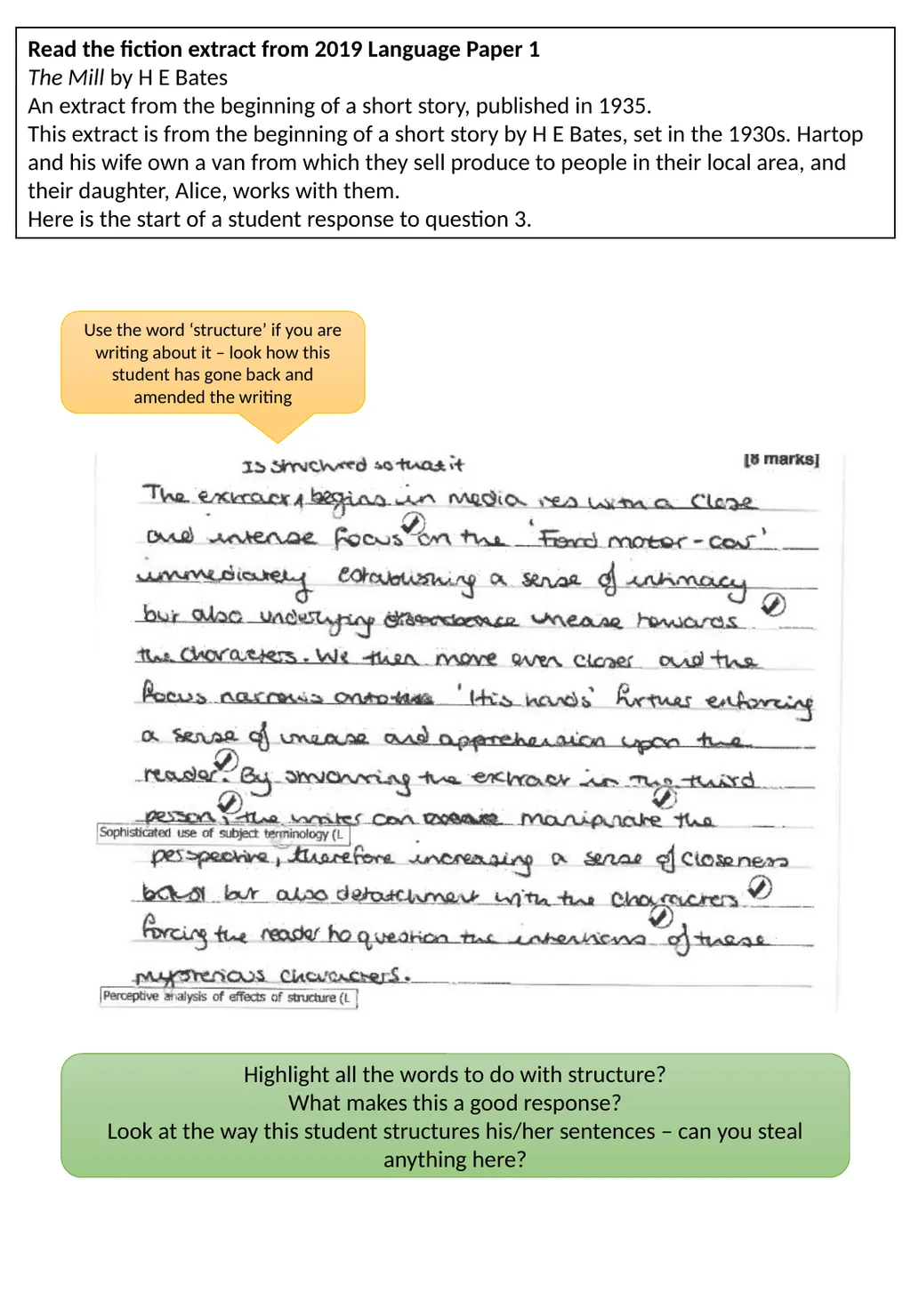
Read the fiction extract from 2019 Language Paper 1
The Mill by H E Bates
An extract from the beginning of a short story, published in 1935.
This extract is from the beginning of a short story by H E Bates, set in the 1930s. Hartop and his wife own a van from which they sell produce to people in their local area, and their daughter, Alice, works with them.
Here is the start of a student response to question 3. Use the word ‘structure’ if you are writing about it – look how this student has gone back and amended the writing Highlight all the words to do with structure?
What makes this a good response?
Look at the way this student structures his/her sentences – can you steal anything here?<br>
The Mill by H E Bates
An extract from the beginning of a short story, published in 1935.
This extract is from the beginning of a short story by H E Bates, set in the 1930s. Hartop and his wife own a van from which they sell produce to people in their local area, and their daughter, Alice, works with them.
Here is the start of a student response to question 3. Use the word ‘structure’ if you are writing about it – look how this student has gone back and amended the writing Highlight all the words to do with structure?
What makes this a good response?
Look at the way this student structures his/her sentences – can you steal anything here?<br>
08
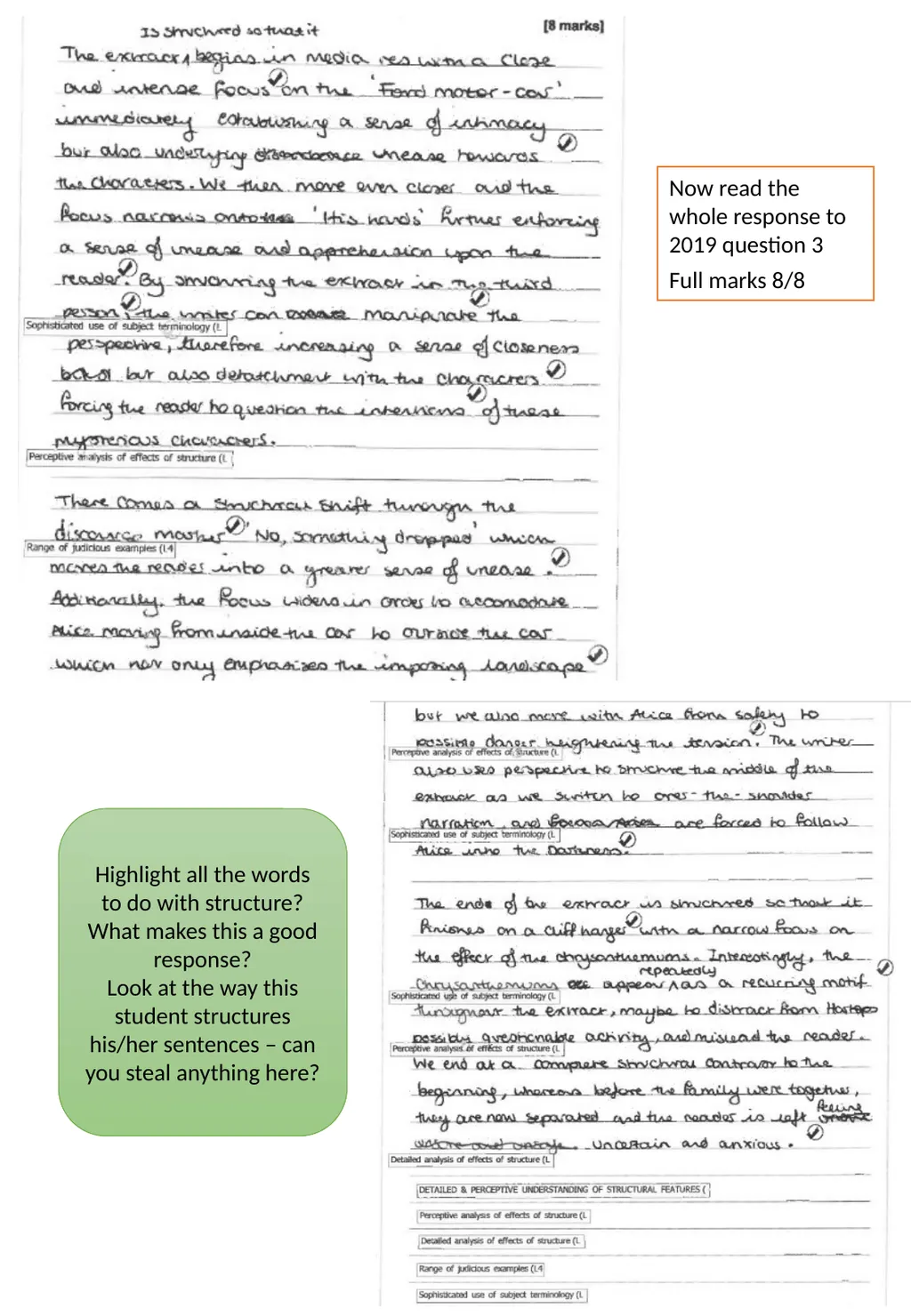
Now read the whole response to 2019 question 3
Full marks 8/8 Highlight all the words to do with structure?
What makes this a good response?
Look at the way this student structures his/her sentences – can you steal anything here?<br>
Full marks 8/8 Highlight all the words to do with structure?
What makes this a good response?
Look at the way this student structures his/her sentences – can you steal anything here?<br>
09
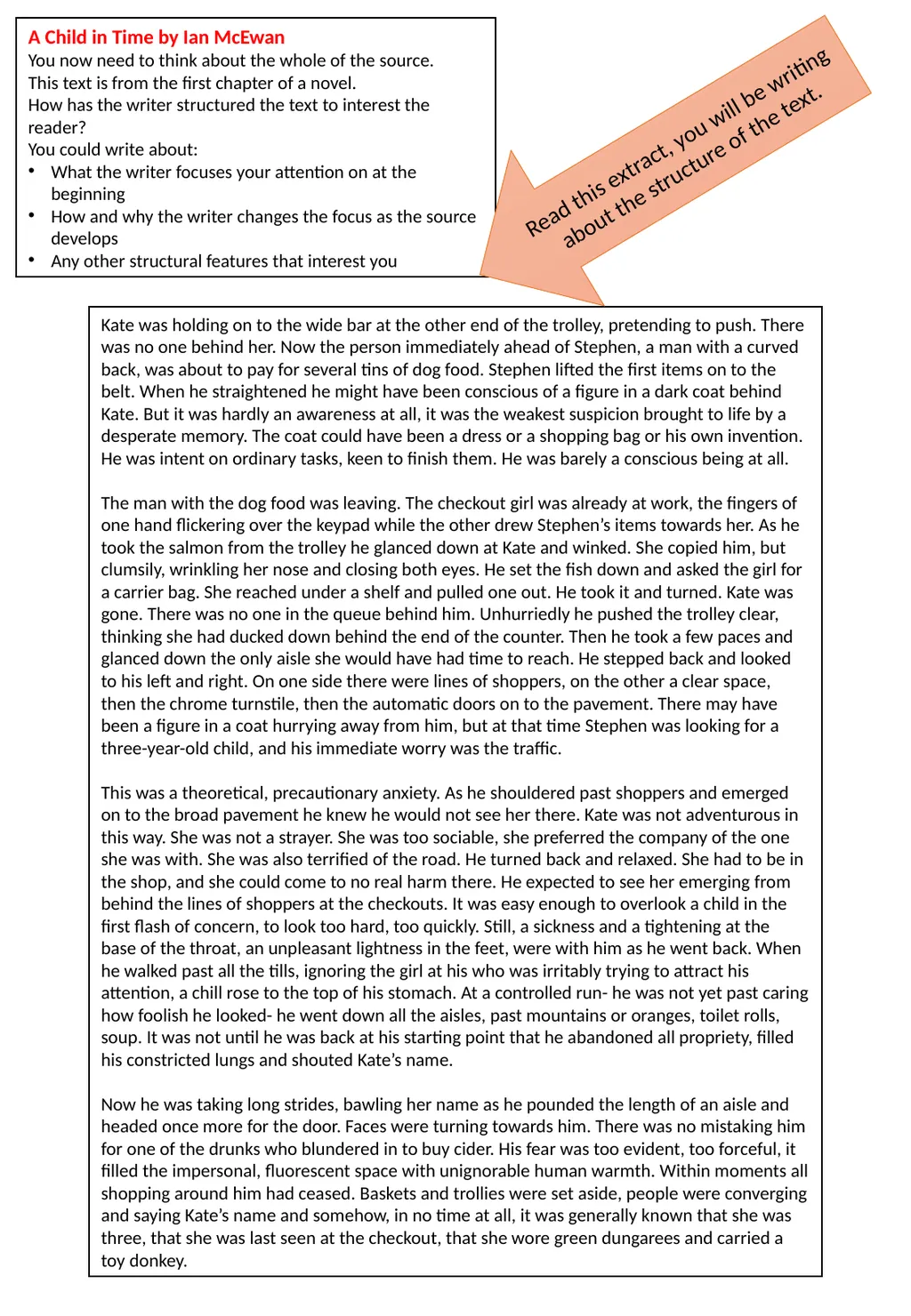
Kate was holding on to the wide bar at the other end of the trolley, pretending to push. There was no one behind her. Now the person immediately ahead of Stephen, a man with a curved back, was about to pay for several tins of dog food. Stephen lifted the first items on to the belt. When he straightened he might have been conscious of a figure in a dark coat behind Kate. But it was hardly an awareness at all, it was the weakest suspicion brought to life by a desperate memory. The coat could have been a dress or a shopping bag or his own invention. He was intent on ordinary tasks, keen to finish them. He was barely a conscious being at all.
The man with the dog food was leaving. The checkout girl was already at work, the fingers of one hand flickering over the keypad while the other drew Stephen’s items towards her. As he took the salmon from the trolley he glanced down at Kate and winked. She copied him, but clumsily, wrinkling her nose and closing both eyes. He set the fish down and asked the girl for a carrier bag. She reached under a shelf and pulled one out. He took it and turned. Kate was gone. There was no one in the queue behind him. Unhurriedly he pushed the trolley clear, thinking she had ducked down behind the end of the counter. Then he took a few paces and glanced down the only aisle she would have had time to reach. He stepped back and looked to his left and right. On one side there were lines of shoppers, on the other a clear space, then the chrome turnstile, then the automatic doors on to the pavement. There may have been a figure in a coat hurrying away from him, but at that time Stephen was looking for a three-year-old child, and his immediate worry was the traffic.
This was a theoretical, precautionary anxiety. As he shouldered past shoppers and emerged on to the broad pavement he knew he would not see her there. Kate was not adventurous in this way. She was not a strayer. She was too sociable, she preferred the company of the one she was with. She was also terrified of the road. He turned back and relaxed. She had to be in the shop, and she could come to no real harm there. He expected to see her emerging from behind the lines of shoppers at the checkouts. It was easy enough to overlook a child in the first flash of concern, to look too hard, too quickly. Still, a sickness and a tightening at the base of the throat, an unpleasant lightness in the feet, were with him as he went back. When he walked past all the tills, ignoring the girl at his who was irritably trying to attract his attention, a chill rose to the top of his stomach. At a controlled run- he was not yet past caring how foolish he looked- he went down all the aisles, past mountains or oranges, toilet rolls, soup. It was not until he was back at his starting point that he abandoned all propriety, filled his constricted lungs and shouted Kate’s name.
Now he was taking long strides, bawling her name as he pounded the length of an aisle and headed once more for the door. Faces were turning towards him. There was no mistaking him for one of the drunks who blundered in to buy cider. His fear was too evident, too forceful, it filled the impersonal, fluorescent space with unignorable human warmth. Within moments all shopping around him had ceased. Baskets and trollies were set aside, people were converging and saying Kate’s name and somehow, in no time at all, it was generally known that she was three, that she was last seen at the checkout, that she wore green dungarees and carried a toy donkey. A Child in Time by Ian McEwan
You now need to think about the whole of the source.
This text is from the first chapter of a novel.
How has the writer structured the text to interest the reader?
You could write about:
What the writer focuses your attention on at the beginning
How and why the writer changes the focus as the source develops
Any other structural features that interest you Read this extract, you will be writing about the structure of the text.<br>
The man with the dog food was leaving. The checkout girl was already at work, the fingers of one hand flickering over the keypad while the other drew Stephen’s items towards her. As he took the salmon from the trolley he glanced down at Kate and winked. She copied him, but clumsily, wrinkling her nose and closing both eyes. He set the fish down and asked the girl for a carrier bag. She reached under a shelf and pulled one out. He took it and turned. Kate was gone. There was no one in the queue behind him. Unhurriedly he pushed the trolley clear, thinking she had ducked down behind the end of the counter. Then he took a few paces and glanced down the only aisle she would have had time to reach. He stepped back and looked to his left and right. On one side there were lines of shoppers, on the other a clear space, then the chrome turnstile, then the automatic doors on to the pavement. There may have been a figure in a coat hurrying away from him, but at that time Stephen was looking for a three-year-old child, and his immediate worry was the traffic.
This was a theoretical, precautionary anxiety. As he shouldered past shoppers and emerged on to the broad pavement he knew he would not see her there. Kate was not adventurous in this way. She was not a strayer. She was too sociable, she preferred the company of the one she was with. She was also terrified of the road. He turned back and relaxed. She had to be in the shop, and she could come to no real harm there. He expected to see her emerging from behind the lines of shoppers at the checkouts. It was easy enough to overlook a child in the first flash of concern, to look too hard, too quickly. Still, a sickness and a tightening at the base of the throat, an unpleasant lightness in the feet, were with him as he went back. When he walked past all the tills, ignoring the girl at his who was irritably trying to attract his attention, a chill rose to the top of his stomach. At a controlled run- he was not yet past caring how foolish he looked- he went down all the aisles, past mountains or oranges, toilet rolls, soup. It was not until he was back at his starting point that he abandoned all propriety, filled his constricted lungs and shouted Kate’s name.
Now he was taking long strides, bawling her name as he pounded the length of an aisle and headed once more for the door. Faces were turning towards him. There was no mistaking him for one of the drunks who blundered in to buy cider. His fear was too evident, too forceful, it filled the impersonal, fluorescent space with unignorable human warmth. Within moments all shopping around him had ceased. Baskets and trollies were set aside, people were converging and saying Kate’s name and somehow, in no time at all, it was generally known that she was three, that she was last seen at the checkout, that she wore green dungarees and carried a toy donkey. A Child in Time by Ian McEwan
You now need to think about the whole of the source.
This text is from the first chapter of a novel.
How has the writer structured the text to interest the reader?
You could write about:
What the writer focuses your attention on at the beginning
How and why the writer changes the focus as the source develops
Any other structural features that interest you Read this extract, you will be writing about the structure of the text.<br>
10
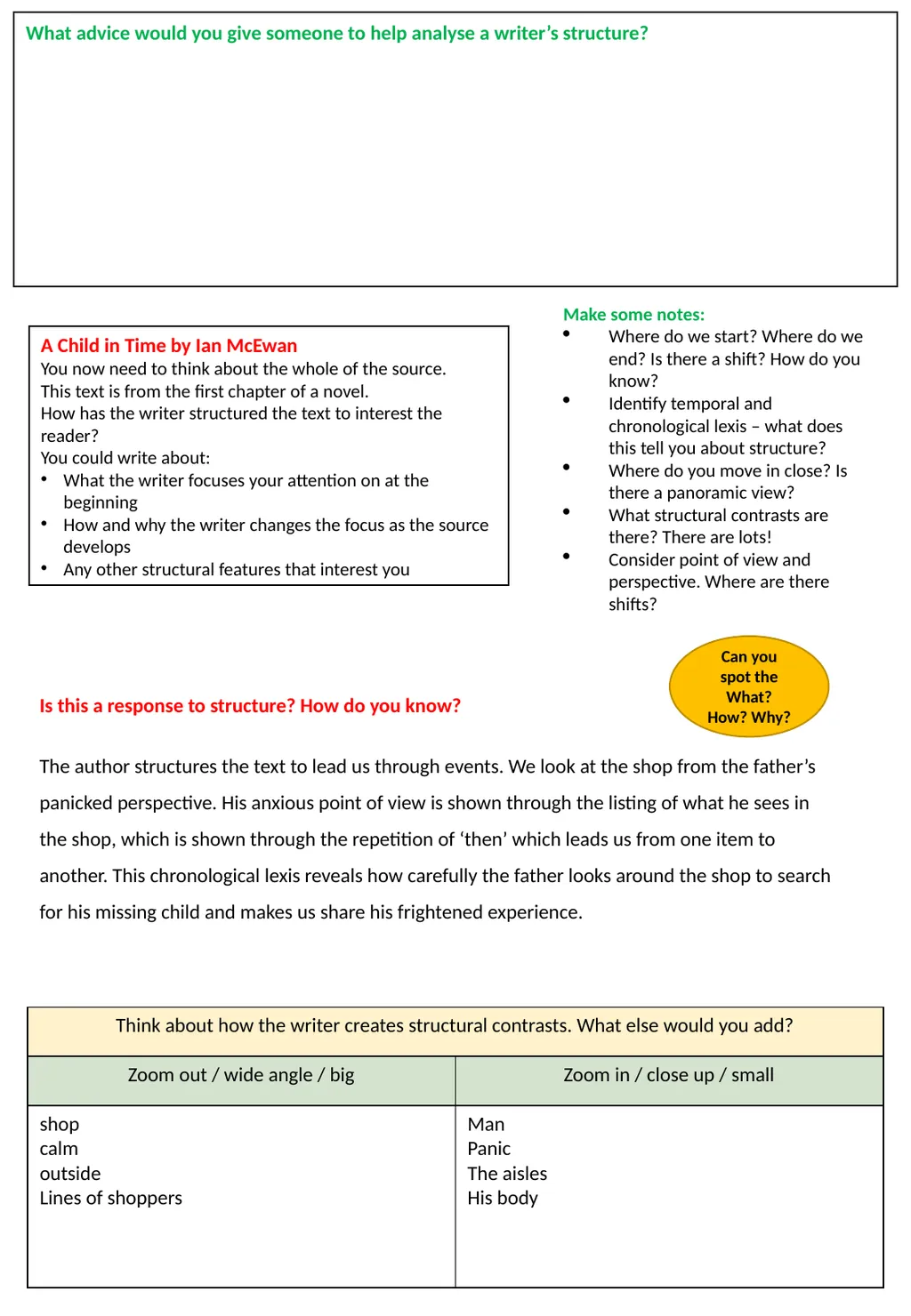
What advice would you give someone to help analyse a writer’s structure? Make some notes:
Where do we start? Where do we end? Is there a shift? How do you know?
Identify temporal and chronological lexis – what does this tell you about structure?
Where do you move in close? Is there a panoramic view?
What structural contrasts are there? There are lots!
Consider point of view and perspective. Where are there shifts? Is this a response to structure? How do you know?
The author structures the text to lead us through events. We look at the shop from the father’s panicked perspective. His anxious point of view is shown through the listing of what he sees in the shop, which is shown through the repetition of ‘then’ which leads us from one item to another. This chronological lexis reveals how carefully the father looks around the shop to search for his missing child and makes us share his frightened experience. Can you spot the What? How? Why? A Child in Time by Ian McEwan
You now need to think about the whole of the source.
This text is from the first chapter of a novel.
How has the writer structured the text to interest the reader?
You could write about:
What the writer focuses your attention on at the beginning
How and why the writer changes the focus as the source develops
Any other structural features that interest you<br>
Where do we start? Where do we end? Is there a shift? How do you know?
Identify temporal and chronological lexis – what does this tell you about structure?
Where do you move in close? Is there a panoramic view?
What structural contrasts are there? There are lots!
Consider point of view and perspective. Where are there shifts? Is this a response to structure? How do you know?
The author structures the text to lead us through events. We look at the shop from the father’s panicked perspective. His anxious point of view is shown through the listing of what he sees in the shop, which is shown through the repetition of ‘then’ which leads us from one item to another. This chronological lexis reveals how carefully the father looks around the shop to search for his missing child and makes us share his frightened experience. Can you spot the What? How? Why? A Child in Time by Ian McEwan
You now need to think about the whole of the source.
This text is from the first chapter of a novel.
How has the writer structured the text to interest the reader?
You could write about:
What the writer focuses your attention on at the beginning
How and why the writer changes the focus as the source develops
Any other structural features that interest you<br>
11
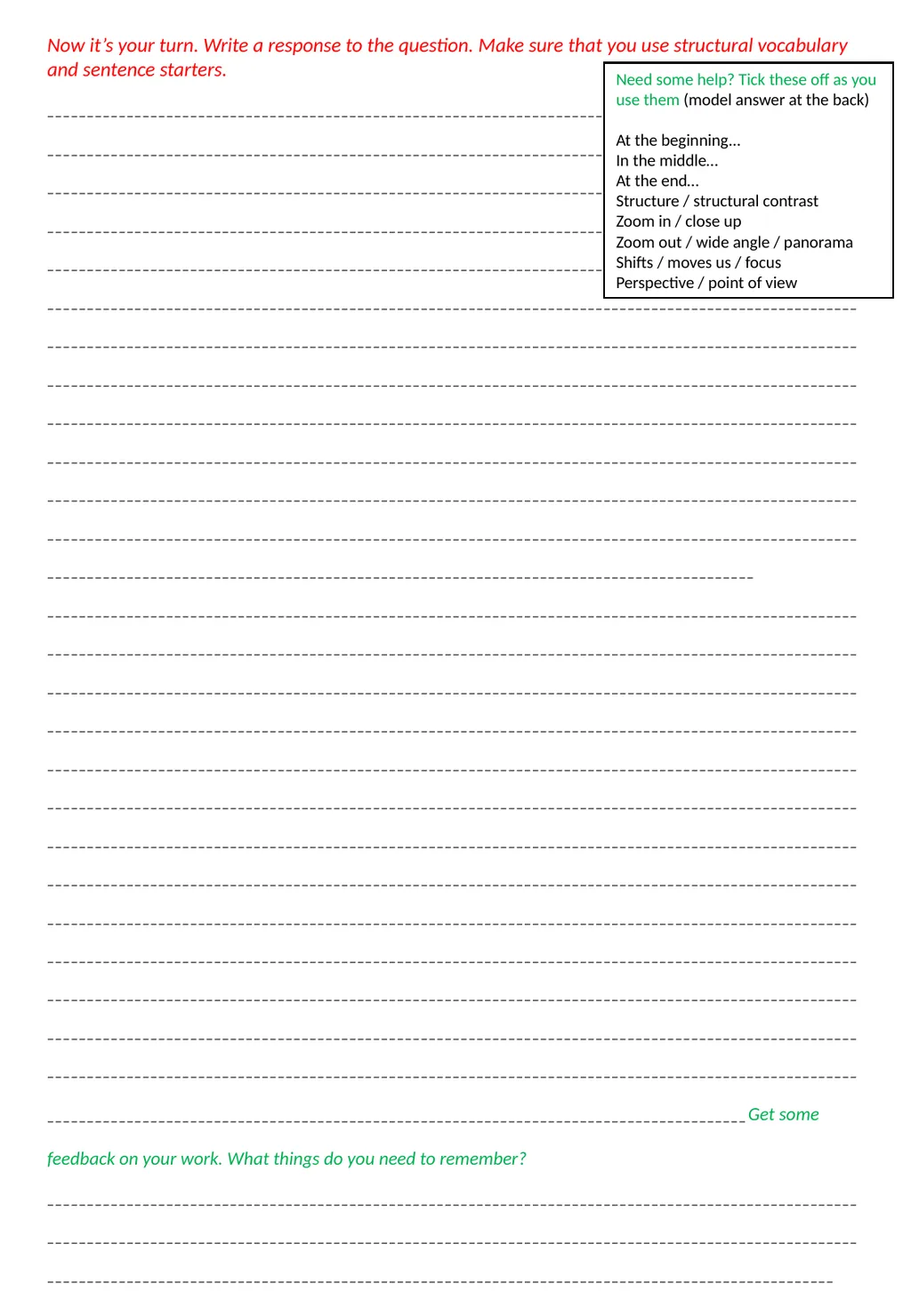
Now it’s your turn. Write a response to the question. Make sure that you use structural vocabulary and sentence starters.
_________________________________________________________________________________________________________________________________________________________________________________________________________________________________________________________________________________________________________________________________________________________________________________________________________________________________________________________________________________________________________________________________________________________________________________________________________________________________________________________________________________________________________________________________________________________________________________________________________________________________________________________________________________________________________________________________________________________________________________________________________________________________________________________________________________________________________________________________________________________________________________________________________________________________________________________________________________________________________________________________________________________________
______________________________________________________________________________________________________________________________________________________________________________________________________________________________________________________________________________________________________________________________________________________________________________________________________________________________________________________________________________________________________________________________________________________________________________________________________________________________________________________________________________________________________________________________________________________________________________________________________________________________________________________________________________________________________________________________________________________________________________________________________________________________________________________________________________________________________________________________________________________________________________________________________________________________________________________________________________________________________________________________________________________________________________________________________________________________________________________________________Get some feedback on your work. What things do you need to remember? _______________________________________________________________________________________________________________________________________________________________________________________________________________________________________________________________________________________________________________ Need some help? Tick these off as you use them (model answer at the back)
At the beginning...
In the middle…
At the end…
Structure / structural contrast
Zoom in / close up
Zoom out / wide angle / panorama
Shifts / moves us / focus
Perspective / point of view<br>
_________________________________________________________________________________________________________________________________________________________________________________________________________________________________________________________________________________________________________________________________________________________________________________________________________________________________________________________________________________________________________________________________________________________________________________________________________________________________________________________________________________________________________________________________________________________________________________________________________________________________________________________________________________________________________________________________________________________________________________________________________________________________________________________________________________________________________________________________________________________________________________________________________________________________________________________________________________________________________________________________________________________________
______________________________________________________________________________________________________________________________________________________________________________________________________________________________________________________________________________________________________________________________________________________________________________________________________________________________________________________________________________________________________________________________________________________________________________________________________________________________________________________________________________________________________________________________________________________________________________________________________________________________________________________________________________________________________________________________________________________________________________________________________________________________________________________________________________________________________________________________________________________________________________________________________________________________________________________________________________________________________________________________________________________________________________________________________________________________________________________________________Get some feedback on your work. What things do you need to remember? _______________________________________________________________________________________________________________________________________________________________________________________________________________________________________________________________________________________________________________ Need some help? Tick these off as you use them (model answer at the back)
At the beginning...
In the middle…
At the end…
Structure / structural contrast
Zoom in / close up
Zoom out / wide angle / panorama
Shifts / moves us / focus
Perspective / point of view<br>
12
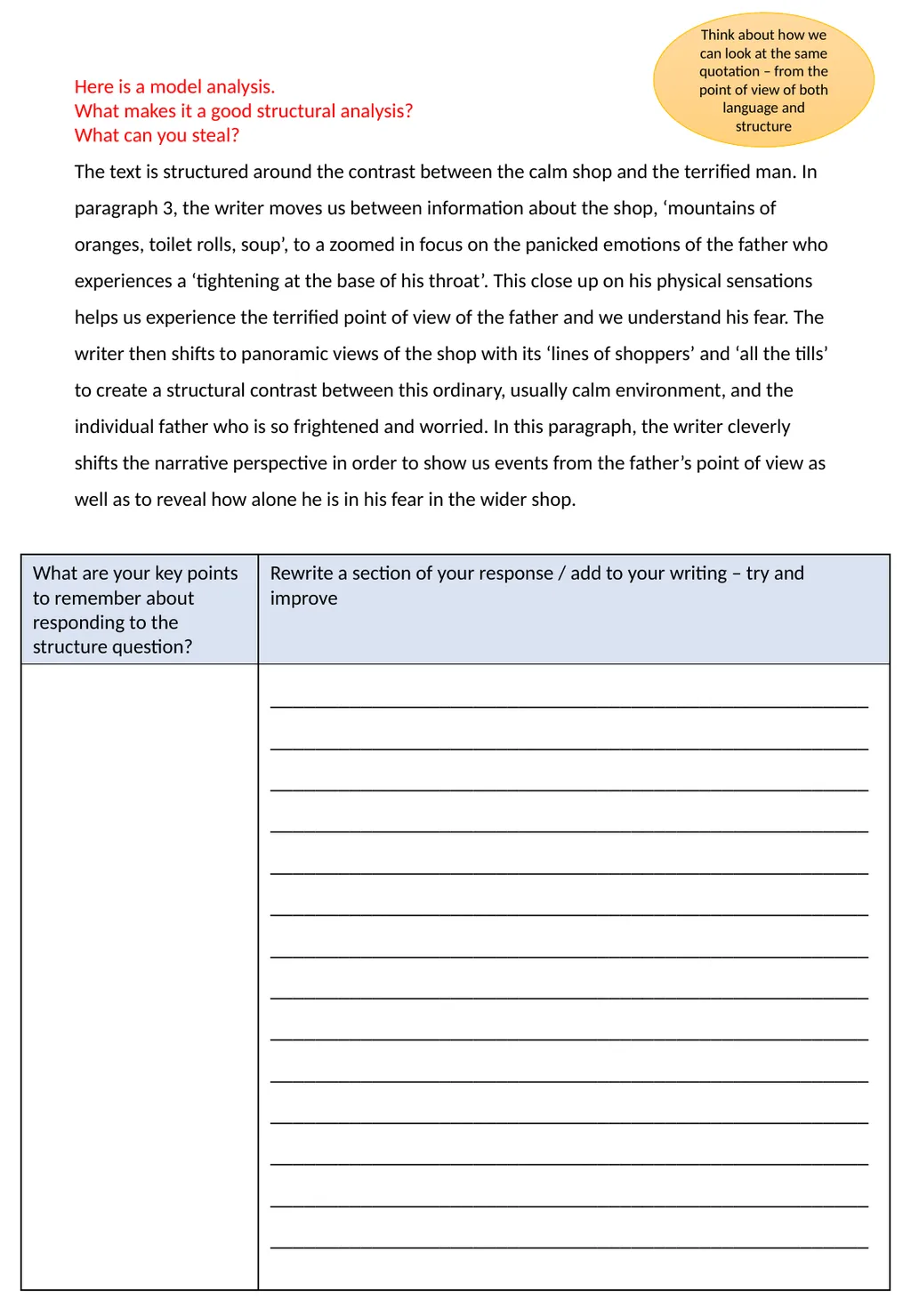
Here is a model analysis.
What makes it a good structural analysis?
What can you steal?
The text is structured around the contrast between the calm shop and the terrified man. In paragraph 3, the writer moves us between information about the shop, ‘mountains of oranges, toilet rolls, soup’, to a zoomed in focus on the panicked emotions of the father who experiences a ‘tightening at the base of his throat’. This close up on his physical sensations helps us experience the terrified point of view of the father and we understand his fear. The writer then shifts to panoramic views of the shop with its ‘lines of shoppers’ and ‘all the tills’ to create a structural contrast between this ordinary, usually calm environment, and the individual father who is so frightened and worried. In this paragraph, the writer cleverly shifts the narrative perspective in order to show us events from the father’s point of view as well as to reveal how alone he is in his fear in the wider shop. Think about how we can look at the same quotation – from the point of view of both language and structure<br>
What makes it a good structural analysis?
What can you steal?
The text is structured around the contrast between the calm shop and the terrified man. In paragraph 3, the writer moves us between information about the shop, ‘mountains of oranges, toilet rolls, soup’, to a zoomed in focus on the panicked emotions of the father who experiences a ‘tightening at the base of his throat’. This close up on his physical sensations helps us experience the terrified point of view of the father and we understand his fear. The writer then shifts to panoramic views of the shop with its ‘lines of shoppers’ and ‘all the tills’ to create a structural contrast between this ordinary, usually calm environment, and the individual father who is so frightened and worried. In this paragraph, the writer cleverly shifts the narrative perspective in order to show us events from the father’s point of view as well as to reveal how alone he is in his fear in the wider shop. Think about how we can look at the same quotation – from the point of view of both language and structure<br>
13
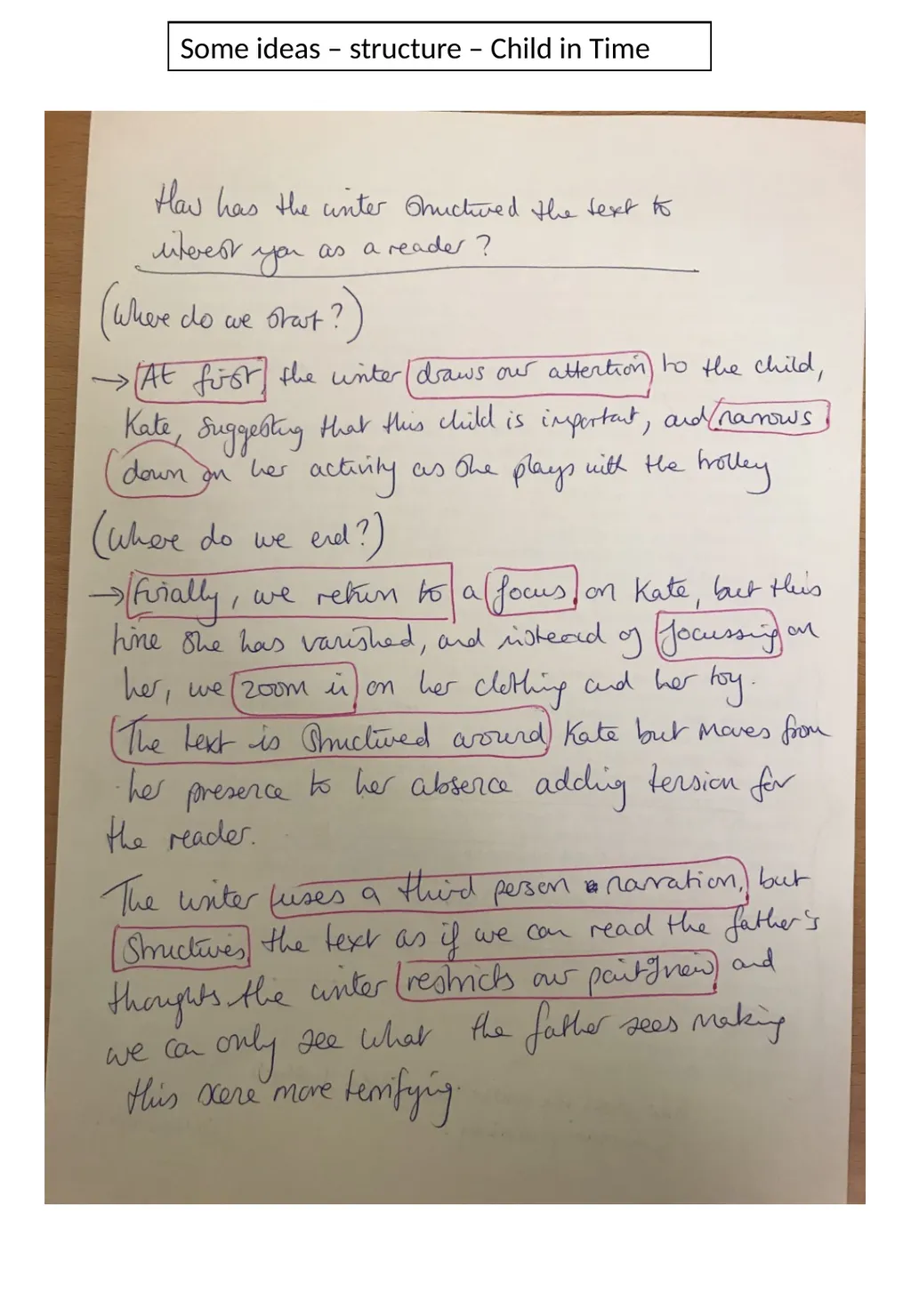
Some ideas – structure – Child in Time<br>
14
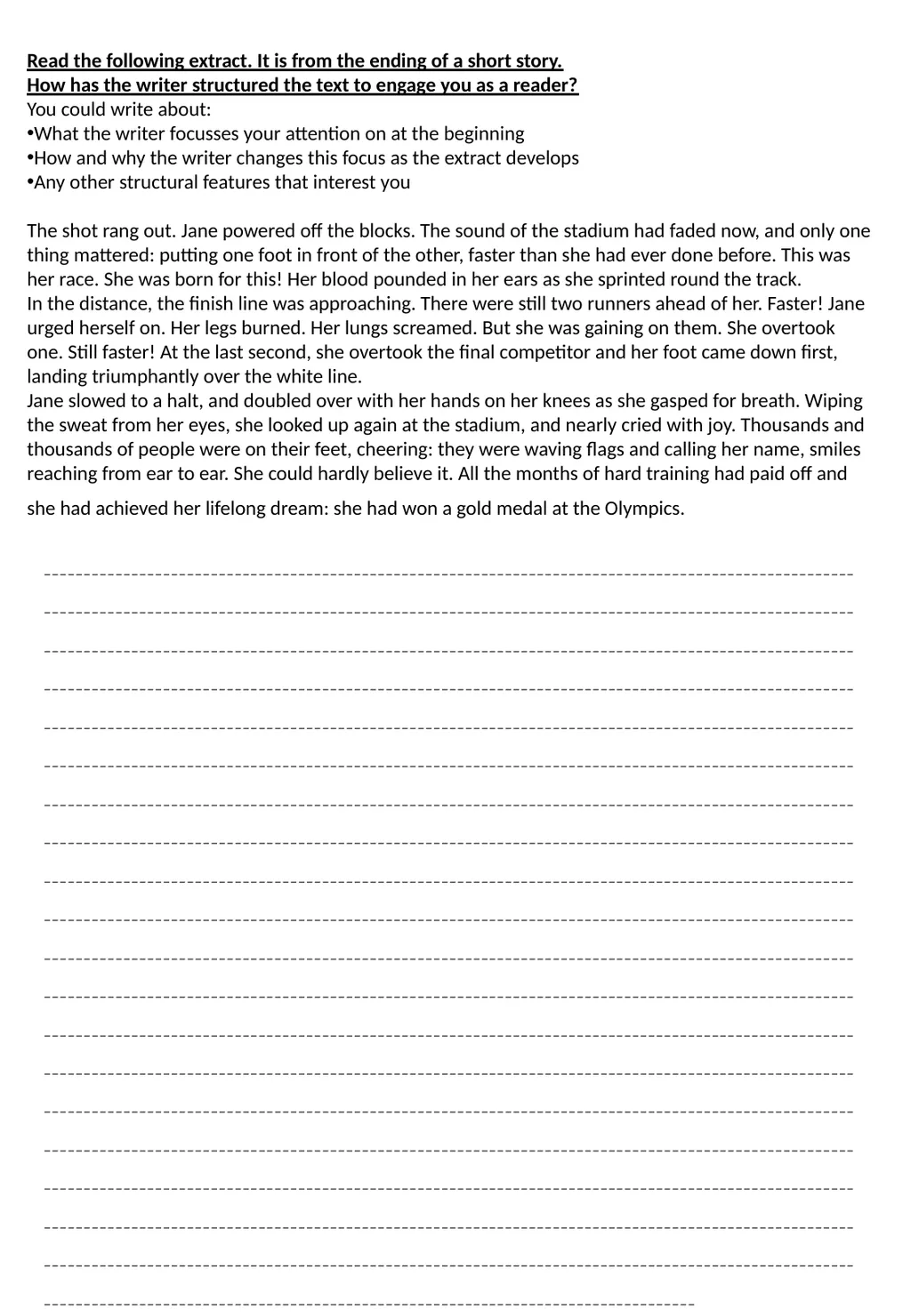
Read the following extract. It is from the ending of a short story.
How has the writer structured the text to engage you as a reader?
You could write about:
What the writer focusses your attention on at the beginning
How and why the writer changes this focus as the extract develops
Any other structural features that interest you
The shot rang out. Jane powered off the blocks. The sound of the stadium had faded now, and only one thing mattered: putting one foot in front of the other, faster than she had ever done before. This was her race. She was born for this! Her blood pounded in her ears as she sprinted round the track.
In the distance, the finish line was approaching. There were still two runners ahead of her. Faster! Jane urged herself on. Her legs burned. Her lungs screamed. But she was gaining on them. She overtook one. Still faster! At the last second, she overtook the final competitor and her foot came down first, landing triumphantly over the white line.
Jane slowed to a halt, and doubled over with her hands on her knees as she gasped for breath. Wiping the sweat from her eyes, she looked up again at the stadium, and nearly cried with joy. Thousands and thousands of people were on their feet, cheering: they were waving flags and calling her name, smiles reaching from ear to ear. She could hardly believe it. All the months of hard training had paid off and she had achieved her lifelong dream: she had won a gold medal at the Olympics. ____________________________________________________________________________________________________________________________________________________________________________________________________________________________________________________________________________________________________________________________________________________________________________________________________________________________________________________________________________________________________________________________________________________________________________________________________________________________________________________________________________________________________________________________________________________________________________________________________________________________________________________________________________________________________________________________________________________________________________________________________________________________________________________________________________________________________________________________________________________________________________________________________________________________________________________________________________________________________________________________________________________________________________________________________________________________________________________________________________________________________________________________________________________________________________________________________________________________________________________________________________________________________________________________________________________________________________________________________________________________________________________________________________________________________________________________________________________________________________________________________________________________________________________________________________________________________<br>
How has the writer structured the text to engage you as a reader?
You could write about:
What the writer focusses your attention on at the beginning
How and why the writer changes this focus as the extract develops
Any other structural features that interest you
The shot rang out. Jane powered off the blocks. The sound of the stadium had faded now, and only one thing mattered: putting one foot in front of the other, faster than she had ever done before. This was her race. She was born for this! Her blood pounded in her ears as she sprinted round the track.
In the distance, the finish line was approaching. There were still two runners ahead of her. Faster! Jane urged herself on. Her legs burned. Her lungs screamed. But she was gaining on them. She overtook one. Still faster! At the last second, she overtook the final competitor and her foot came down first, landing triumphantly over the white line.
Jane slowed to a halt, and doubled over with her hands on her knees as she gasped for breath. Wiping the sweat from her eyes, she looked up again at the stadium, and nearly cried with joy. Thousands and thousands of people were on their feet, cheering: they were waving flags and calling her name, smiles reaching from ear to ear. She could hardly believe it. All the months of hard training had paid off and she had achieved her lifelong dream: she had won a gold medal at the Olympics. ____________________________________________________________________________________________________________________________________________________________________________________________________________________________________________________________________________________________________________________________________________________________________________________________________________________________________________________________________________________________________________________________________________________________________________________________________________________________________________________________________________________________________________________________________________________________________________________________________________________________________________________________________________________________________________________________________________________________________________________________________________________________________________________________________________________________________________________________________________________________________________________________________________________________________________________________________________________________________________________________________________________________________________________________________________________________________________________________________________________________________________________________________________________________________________________________________________________________________________________________________________________________________________________________________________________________________________________________________________________________________________________________________________________________________________________________________________________________________________________________________________________________________________________________________________________________________<br>
15
_________________________________________________________________________________________________________________________________________________________________________________________________________________________________________________________________________________________________________________________________________________________________________________________________________________________________________________________________________________________________________________________________________________________________________________________________________________________________________________________________________________________________________________________________________________________________________________________________________________________________________________________________________________________________________________________________________________________________________________________________________________________________________________________________________________________________________________________________________________________________________________________________________________________________________________________________________________________________________________________________________________________________
___________________________________________________________________________________________________________________________________________________________________________________________________________________________________________________________________________________________________________________________________________________________________________________________________________________________________________________________________________________________________________________________________________________________________________________________________________________________________________________________________________________________________________________________________________________________________________________________________________________________________________________________________________________________________________________________________________________________________________________________________________________________________________________________________________________________________________________________________________________________________________________________________________________________________________________________________________________________________________________________________________________________________________________________________________________________________________________________________________________________________________________________________________________________________________Get some feedback on your work. What things do you need to remember? _______________________________________________________________________________________________________________________________________________________________________________________________________________________________________________________________________________________________________________<br>
___________________________________________________________________________________________________________________________________________________________________________________________________________________________________________________________________________________________________________________________________________________________________________________________________________________________________________________________________________________________________________________________________________________________________________________________________________________________________________________________________________________________________________________________________________________________________________________________________________________________________________________________________________________________________________________________________________________________________________________________________________________________________________________________________________________________________________________________________________________________________________________________________________________________________________________________________________________________________________________________________________________________________________________________________________________________________________________________________________________________________________________________________________________________________________Get some feedback on your work. What things do you need to remember? _______________________________________________________________________________________________________________________________________________________________________________________________________________________________________________________________________________________________________________<br>
16
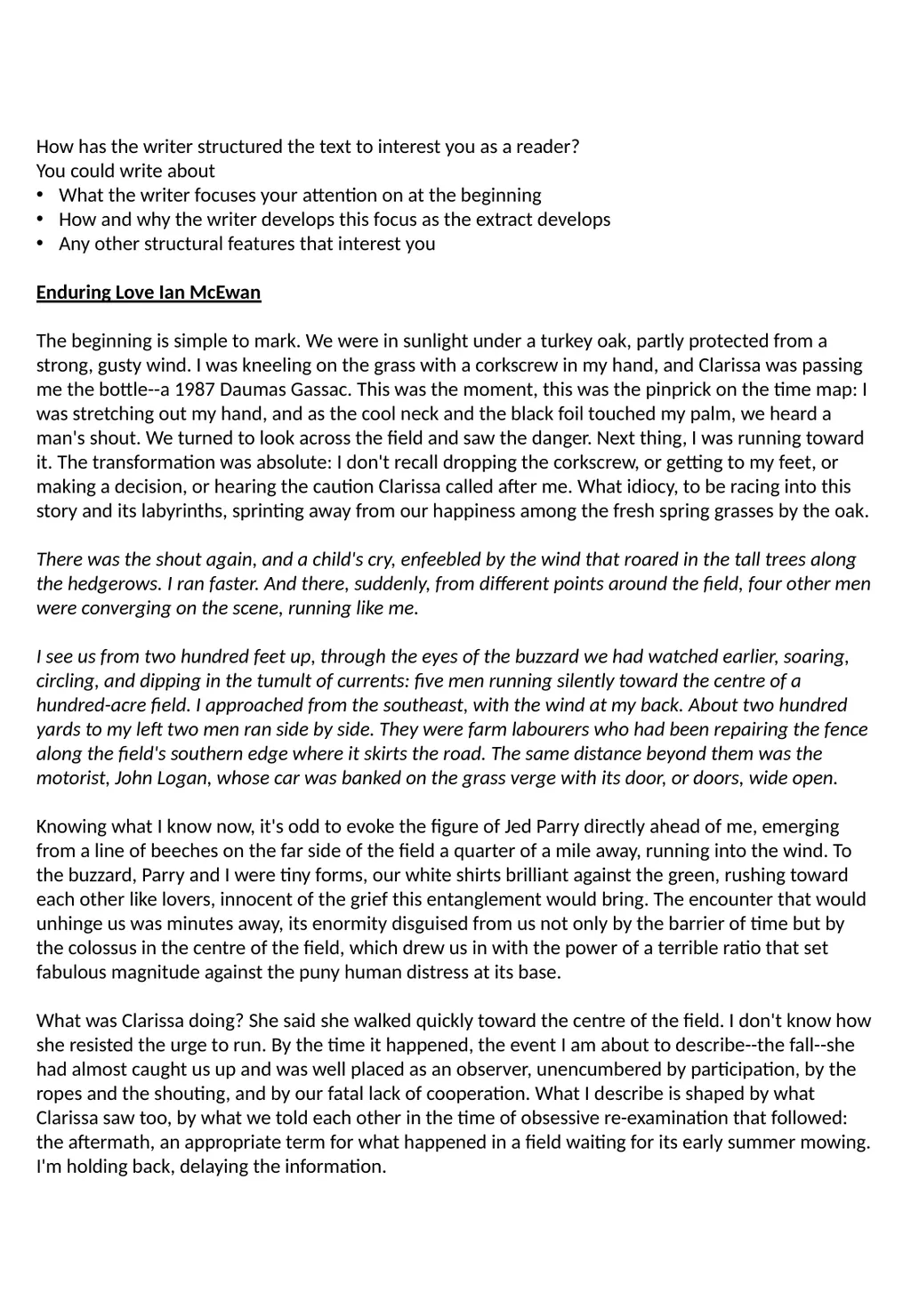
How has the writer structured the text to interest you as a reader?
You could write about
What the writer focuses your attention on at the beginning
How and why the writer develops this focus as the extract develops
Any other structural features that interest you
Enduring Love Ian McEwan
The beginning is simple to mark. We were in sunlight under a turkey oak, partly protected from a strong, gusty wind. I was kneeling on the grass with a corkscrew in my hand, and Clarissa was passing me the bottle--a 1987 Daumas Gassac. This was the moment, this was the pinprick on the time map: I was stretching out my hand, and as the cool neck and the black foil touched my palm, we heard a man's shout. We turned to look across the field and saw the danger. Next thing, I was running toward it. The transformation was absolute: I don't recall dropping the corkscrew, or getting to my feet, or making a decision, or hearing the caution Clarissa called after me. What idiocy, to be racing into this story and its labyrinths, sprinting away from our happiness among the fresh spring grasses by the oak.
There was the shout again, and a child's cry, enfeebled by the wind that roared in the tall trees along the hedgerows. I ran faster. And there, suddenly, from different points around the field, four other men were converging on the scene, running like me.
I see us from two hundred feet up, through the eyes of the buzzard we had watched earlier, soaring, circling, and dipping in the tumult of currents: five men running silently toward the centre of a hundred-acre field. I approached from the southeast, with the wind at my back. About two hundred yards to my left two men ran side by side. They were farm labourers who had been repairing the fence along the field's southern edge where it skirts the road. The same distance beyond them was the motorist, John Logan, whose car was banked on the grass verge with its door, or doors, wide open.
Knowing what I know now, it's odd to evoke the figure of Jed Parry directly ahead of me, emerging from a line of beeches on the far side of the field a quarter of a mile away, running into the wind. To the buzzard, Parry and I were tiny forms, our white shirts brilliant against the green, rushing toward each other like lovers, innocent of the grief this entanglement would bring. The encounter that would unhinge us was minutes away, its enormity disguised from us not only by the barrier of time but by the colossus in the centre of the field, which drew us in with the power of a terrible ratio that set fabulous magnitude against the puny human distress at its base.
What was Clarissa doing? She said she walked quickly toward the centre of the field. I don't know how she resisted the urge to run. By the time it happened, the event I am about to describe--the fall--she had almost caught us up and was well placed as an observer, unencumbered by participation, by the ropes and the shouting, and by our fatal lack of cooperation. What I describe is shaped by what Clarissa saw too, by what we told each other in the time of obsessive re-examination that followed: the aftermath, an appropriate term for what happened in a field waiting for its early summer mowing.
I'm holding back, delaying the information.<br>
You could write about
What the writer focuses your attention on at the beginning
How and why the writer develops this focus as the extract develops
Any other structural features that interest you
Enduring Love Ian McEwan
The beginning is simple to mark. We were in sunlight under a turkey oak, partly protected from a strong, gusty wind. I was kneeling on the grass with a corkscrew in my hand, and Clarissa was passing me the bottle--a 1987 Daumas Gassac. This was the moment, this was the pinprick on the time map: I was stretching out my hand, and as the cool neck and the black foil touched my palm, we heard a man's shout. We turned to look across the field and saw the danger. Next thing, I was running toward it. The transformation was absolute: I don't recall dropping the corkscrew, or getting to my feet, or making a decision, or hearing the caution Clarissa called after me. What idiocy, to be racing into this story and its labyrinths, sprinting away from our happiness among the fresh spring grasses by the oak.
There was the shout again, and a child's cry, enfeebled by the wind that roared in the tall trees along the hedgerows. I ran faster. And there, suddenly, from different points around the field, four other men were converging on the scene, running like me.
I see us from two hundred feet up, through the eyes of the buzzard we had watched earlier, soaring, circling, and dipping in the tumult of currents: five men running silently toward the centre of a hundred-acre field. I approached from the southeast, with the wind at my back. About two hundred yards to my left two men ran side by side. They were farm labourers who had been repairing the fence along the field's southern edge where it skirts the road. The same distance beyond them was the motorist, John Logan, whose car was banked on the grass verge with its door, or doors, wide open.
Knowing what I know now, it's odd to evoke the figure of Jed Parry directly ahead of me, emerging from a line of beeches on the far side of the field a quarter of a mile away, running into the wind. To the buzzard, Parry and I were tiny forms, our white shirts brilliant against the green, rushing toward each other like lovers, innocent of the grief this entanglement would bring. The encounter that would unhinge us was minutes away, its enormity disguised from us not only by the barrier of time but by the colossus in the centre of the field, which drew us in with the power of a terrible ratio that set fabulous magnitude against the puny human distress at its base.
What was Clarissa doing? She said she walked quickly toward the centre of the field. I don't know how she resisted the urge to run. By the time it happened, the event I am about to describe--the fall--she had almost caught us up and was well placed as an observer, unencumbered by participation, by the ropes and the shouting, and by our fatal lack of cooperation. What I describe is shaped by what Clarissa saw too, by what we told each other in the time of obsessive re-examination that followed: the aftermath, an appropriate term for what happened in a field waiting for its early summer mowing.
I'm holding back, delaying the information.<br>
17
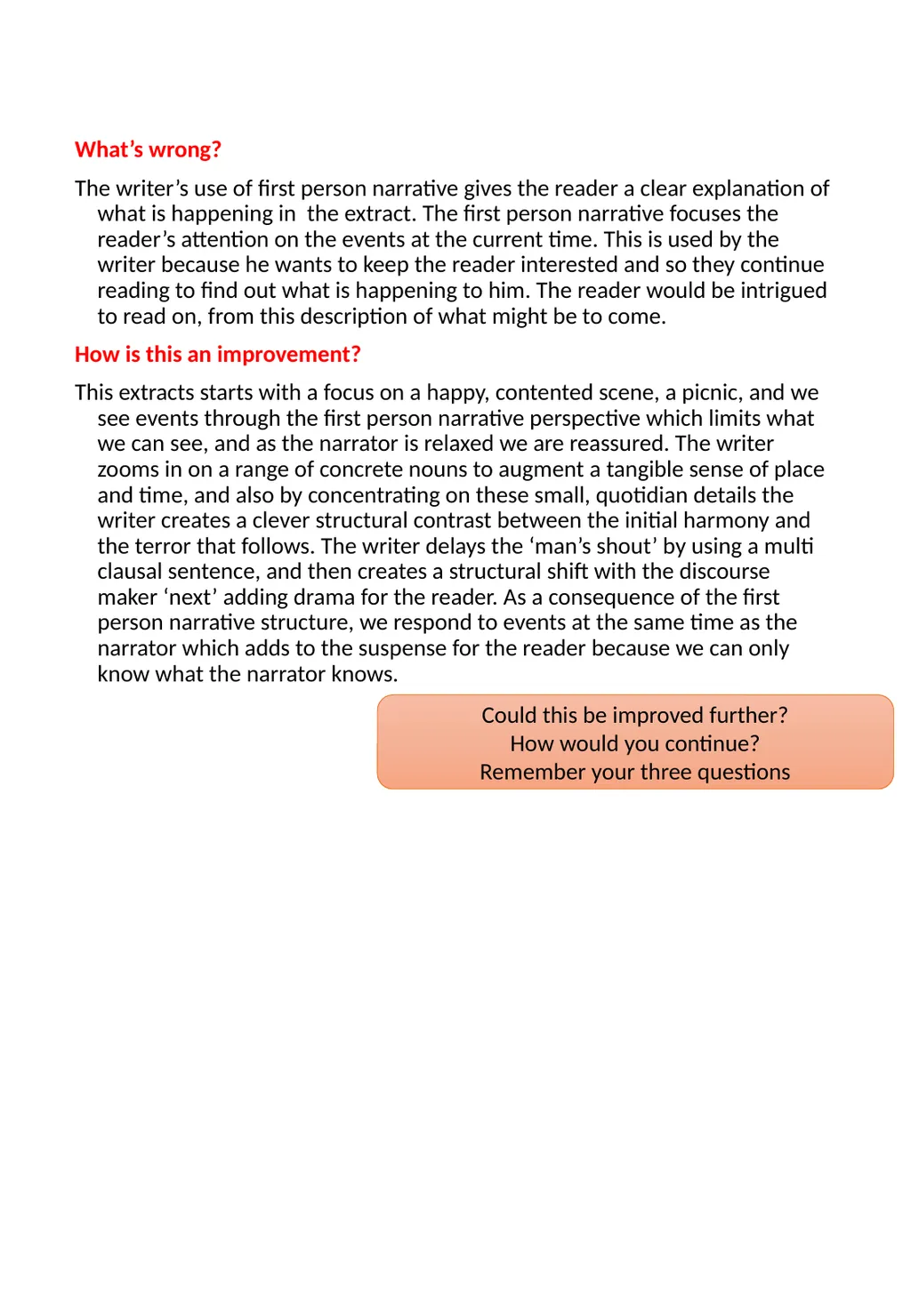
What’s wrong?
The writer’s use of first person narrative gives the reader a clear explanation of what is happening in the extract. The first person narrative focuses the reader’s attention on the events at the current time. This is used by the writer because he wants to keep the reader interested and so they continue reading to find out what is happening to him. The reader would be intrigued to read on, from this description of what might be to come.
How is this an improvement?
This extracts starts with a focus on a happy, contented scene, a picnic, and we see events through the first person narrative perspective which limits what we can see, and as the narrator is relaxed we are reassured. The writer zooms in on a range of concrete nouns to augment a tangible sense of place and time, and also by concentrating on these small, quotidian details the writer creates a clever structural contrast between the initial harmony and the terror that follows. The writer delays the ‘man’s shout’ by using a multi clausal sentence, and then creates a structural shift with the discourse maker ‘next’ adding drama for the reader. As a consequence of the first person narrative structure, we respond to events at the same time as the narrator which adds to the suspense for the reader because we can only know what the narrator knows. Could this be improved further?
How would you continue?
Remember your three questions<br>
The writer’s use of first person narrative gives the reader a clear explanation of what is happening in the extract. The first person narrative focuses the reader’s attention on the events at the current time. This is used by the writer because he wants to keep the reader interested and so they continue reading to find out what is happening to him. The reader would be intrigued to read on, from this description of what might be to come.
How is this an improvement?
This extracts starts with a focus on a happy, contented scene, a picnic, and we see events through the first person narrative perspective which limits what we can see, and as the narrator is relaxed we are reassured. The writer zooms in on a range of concrete nouns to augment a tangible sense of place and time, and also by concentrating on these small, quotidian details the writer creates a clever structural contrast between the initial harmony and the terror that follows. The writer delays the ‘man’s shout’ by using a multi clausal sentence, and then creates a structural shift with the discourse maker ‘next’ adding drama for the reader. As a consequence of the first person narrative structure, we respond to events at the same time as the narrator which adds to the suspense for the reader because we can only know what the narrator knows. Could this be improved further?
How would you continue?
Remember your three questions<br>
18
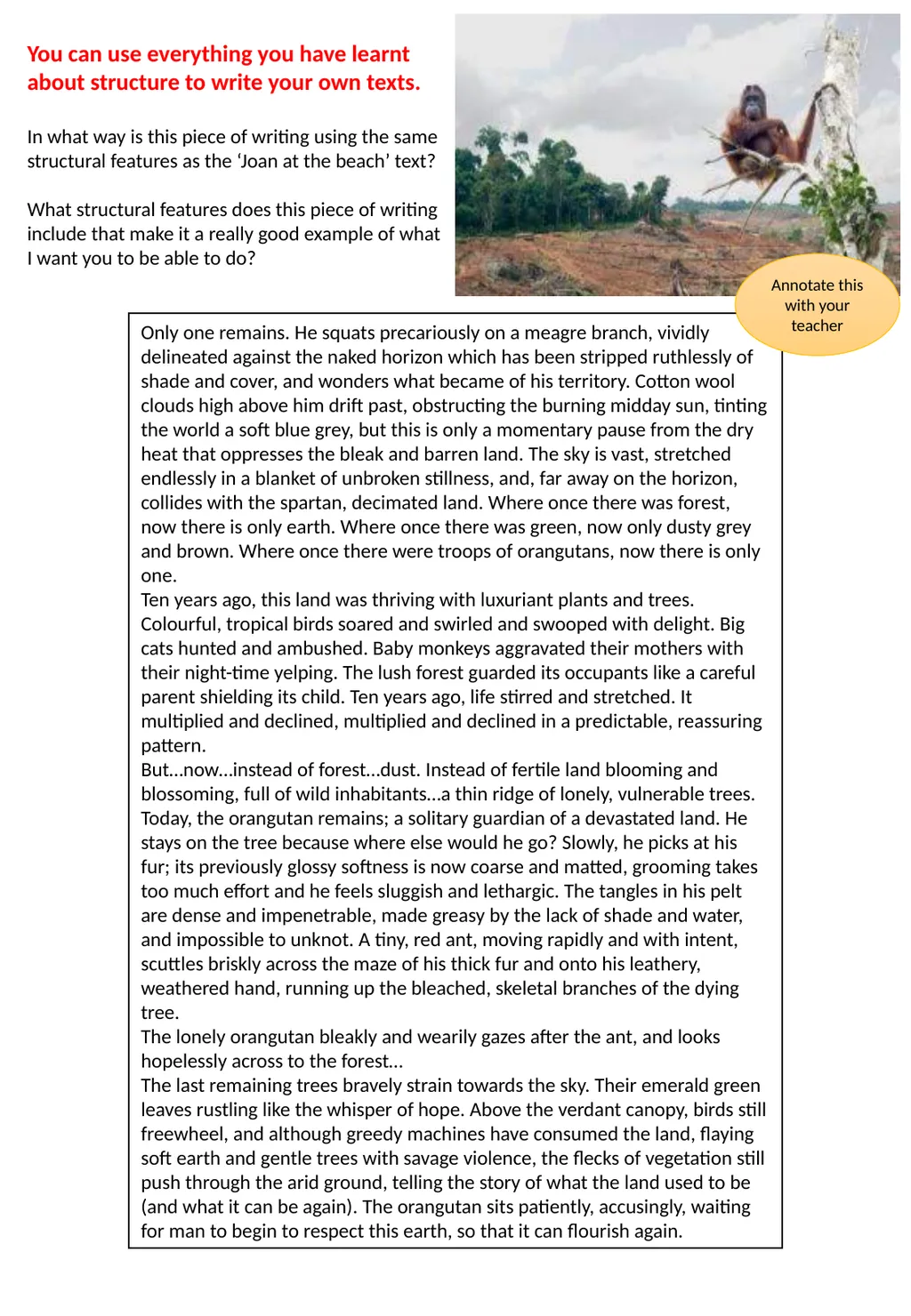
You can use everything you have learnt about structure to write your own texts.
In what way is this piece of writing using the same structural features as the ‘Joan at the beach’ text?
What structural features does this piece of writing include that make it a really good example of what I want you to be able to do? Only one remains. He squats precariously on a meagre branch, vividly delineated against the naked horizon which has been stripped ruthlessly of shade and cover, and wonders what became of his territory. Cotton wool clouds high above him drift past, obstructing the burning midday sun, tinting the world a soft blue grey, but this is only a momentary pause from the dry heat that oppresses the bleak and barren land. The sky is vast, stretched endlessly in a blanket of unbroken stillness, and, far away on the horizon, collides with the spartan, decimated land. Where once there was forest, now there is only earth. Where once there was green, now only dusty grey and brown. Where once there were troops of orangutans, now there is only one.
Ten years ago, this land was thriving with luxuriant plants and trees. Colourful, tropical birds soared and swirled and swooped with delight. Big cats hunted and ambushed. Baby monkeys aggravated their mothers with their night-time yelping. The lush forest guarded its occupants like a careful parent shielding its child. Ten years ago, life stirred and stretched. It multiplied and declined, multiplied and declined in a predictable, reassuring pattern.
But…now…instead of forest…dust. Instead of fertile land blooming and blossoming, full of wild inhabitants…a thin ridge of lonely, vulnerable trees.
Today, the orangutan remains; a solitary guardian of a devastated land. He stays on the tree because where else would he go? Slowly, he picks at his fur; its previously glossy softness is now coarse and matted, grooming takes too much effort and he feels sluggish and lethargic. The tangles in his pelt are dense and impenetrable, made greasy by the lack of shade and water, and impossible to unknot. A tiny, red ant, moving rapidly and with intent, scuttles briskly across the maze of his thick fur and onto his leathery, weathered hand, running up the bleached, skeletal branches of the dying tree.
The lonely orangutan bleakly and wearily gazes after the ant, and looks hopelessly across to the forest…
The last remaining trees bravely strain towards the sky. Their emerald green leaves rustling like the whisper of hope. Above the verdant canopy, birds still freewheel, and although greedy machines have consumed the land, flaying soft earth and gentle trees with savage violence, the flecks of vegetation still push through the arid ground, telling the story of what the land used to be (and what it can be again). The orangutan sits patiently, accusingly, waiting for man to begin to respect this earth, so that it can flourish again. Annotate this with your teacher<br>
In what way is this piece of writing using the same structural features as the ‘Joan at the beach’ text?
What structural features does this piece of writing include that make it a really good example of what I want you to be able to do? Only one remains. He squats precariously on a meagre branch, vividly delineated against the naked horizon which has been stripped ruthlessly of shade and cover, and wonders what became of his territory. Cotton wool clouds high above him drift past, obstructing the burning midday sun, tinting the world a soft blue grey, but this is only a momentary pause from the dry heat that oppresses the bleak and barren land. The sky is vast, stretched endlessly in a blanket of unbroken stillness, and, far away on the horizon, collides with the spartan, decimated land. Where once there was forest, now there is only earth. Where once there was green, now only dusty grey and brown. Where once there were troops of orangutans, now there is only one.
Ten years ago, this land was thriving with luxuriant plants and trees. Colourful, tropical birds soared and swirled and swooped with delight. Big cats hunted and ambushed. Baby monkeys aggravated their mothers with their night-time yelping. The lush forest guarded its occupants like a careful parent shielding its child. Ten years ago, life stirred and stretched. It multiplied and declined, multiplied and declined in a predictable, reassuring pattern.
But…now…instead of forest…dust. Instead of fertile land blooming and blossoming, full of wild inhabitants…a thin ridge of lonely, vulnerable trees.
Today, the orangutan remains; a solitary guardian of a devastated land. He stays on the tree because where else would he go? Slowly, he picks at his fur; its previously glossy softness is now coarse and matted, grooming takes too much effort and he feels sluggish and lethargic. The tangles in his pelt are dense and impenetrable, made greasy by the lack of shade and water, and impossible to unknot. A tiny, red ant, moving rapidly and with intent, scuttles briskly across the maze of his thick fur and onto his leathery, weathered hand, running up the bleached, skeletal branches of the dying tree.
The lonely orangutan bleakly and wearily gazes after the ant, and looks hopelessly across to the forest…
The last remaining trees bravely strain towards the sky. Their emerald green leaves rustling like the whisper of hope. Above the verdant canopy, birds still freewheel, and although greedy machines have consumed the land, flaying soft earth and gentle trees with savage violence, the flecks of vegetation still push through the arid ground, telling the story of what the land used to be (and what it can be again). The orangutan sits patiently, accusingly, waiting for man to begin to respect this earth, so that it can flourish again. Annotate this with your teacher<br>
19
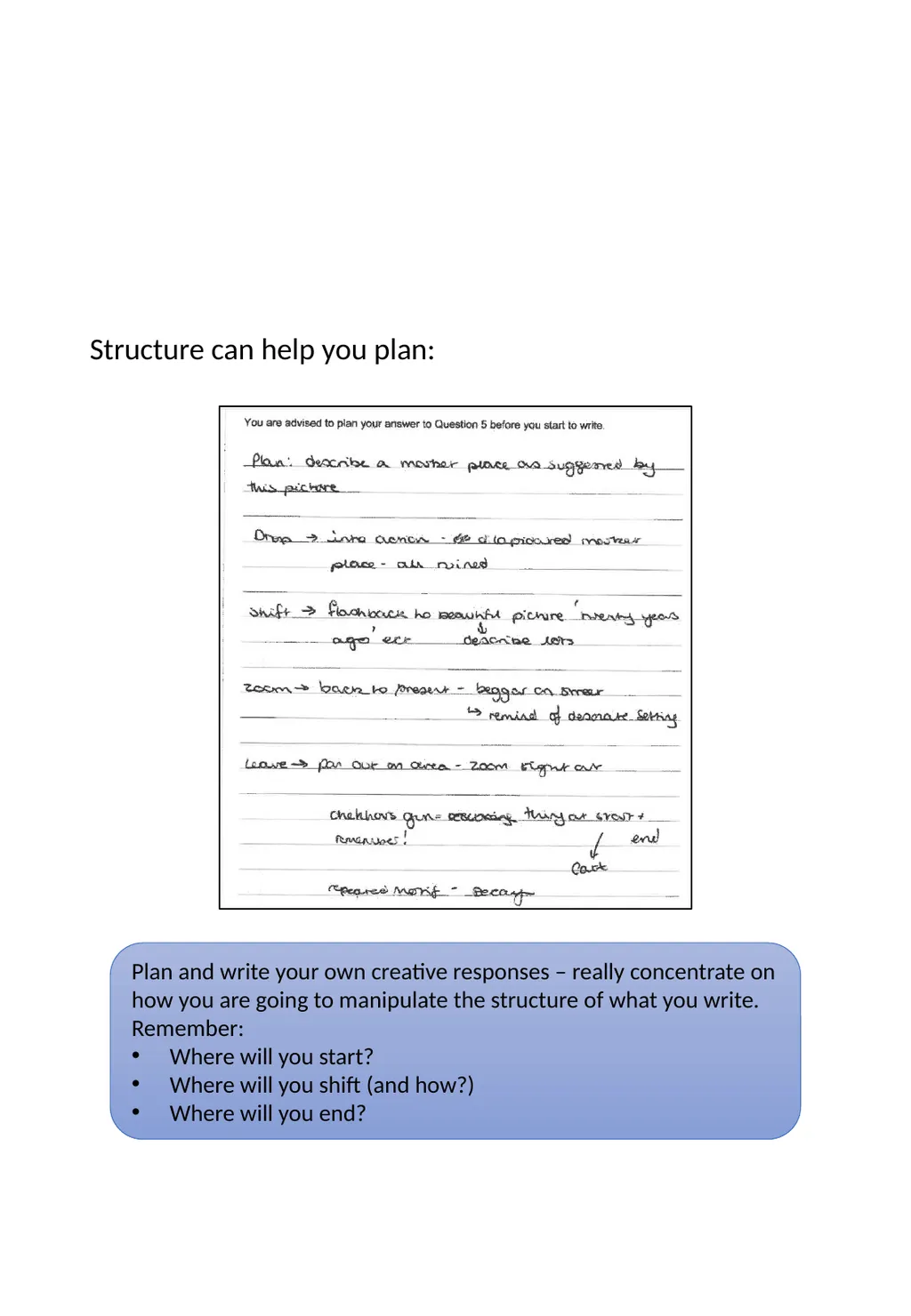
Structure can help you plan: Plan and write your own creative responses – really concentrate on how you are going to manipulate the structure of what you write. Remember:
Where will you start?
Where will you shift (and how?)
Where will you end?<br>
Where will you start?
Where will you shift (and how?)
Where will you end?<br>
20
Structure and the Literature texts<br>
21
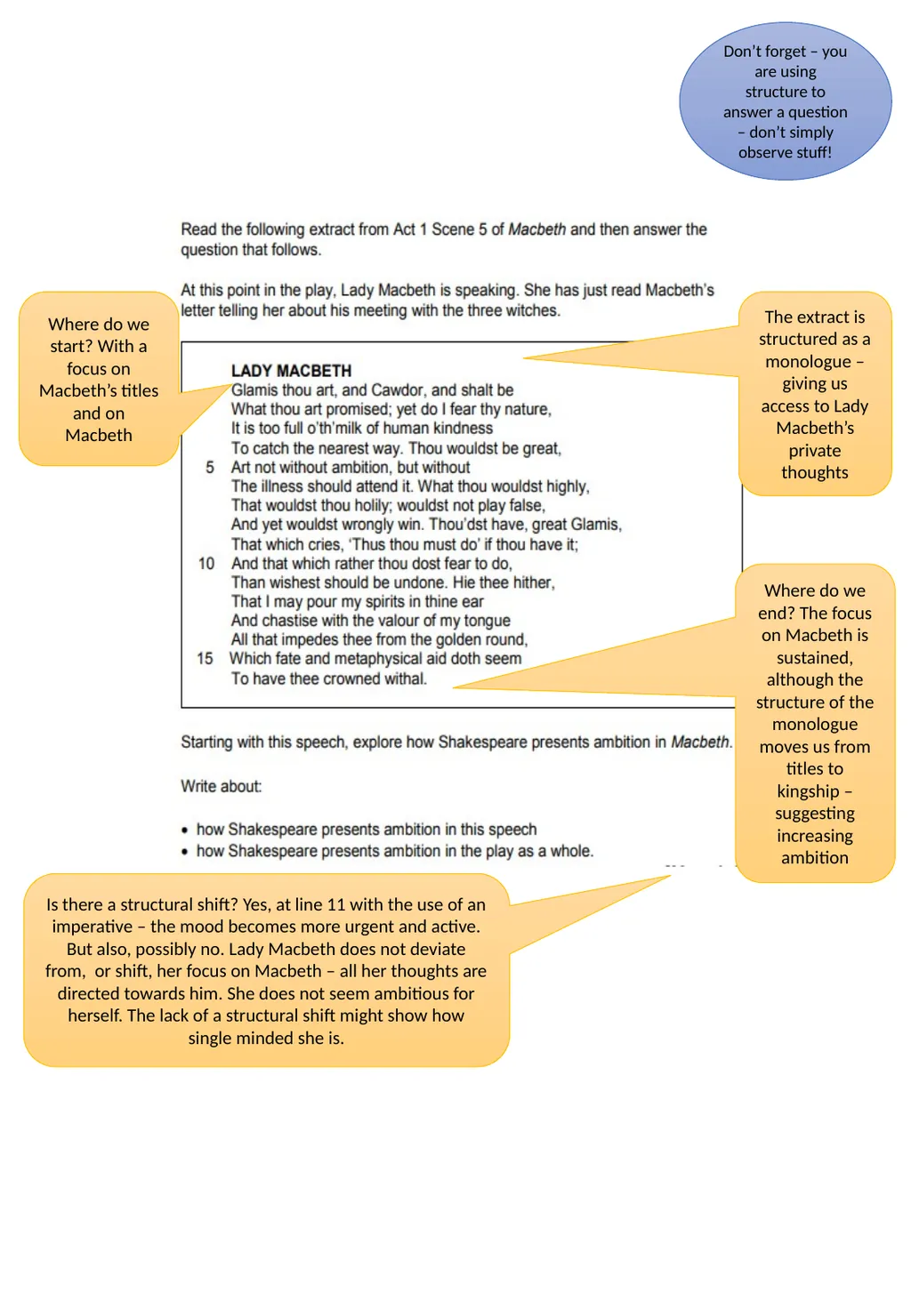
Don’t forget – you are using structure to answer a question – don’t simply observe stuff! Is there a structural shift? Yes, at line 11 with the use of an imperative – the mood becomes more urgent and active. But also, possibly no. Lady Macbeth does not deviate from, or shift, her focus on Macbeth – all her thoughts are directed towards him. She does not seem ambitious for herself. The lack of a structural shift might show how single minded she is. The extract is structured as a monologue – giving us access to Lady Macbeth’s private thoughts Where do we start? With a focus on Macbeth’s titles and on Macbeth Where do we end? The focus on Macbeth is sustained, although the structure of the monologue moves us from titles to kingship – suggesting increasing ambition<br>
22
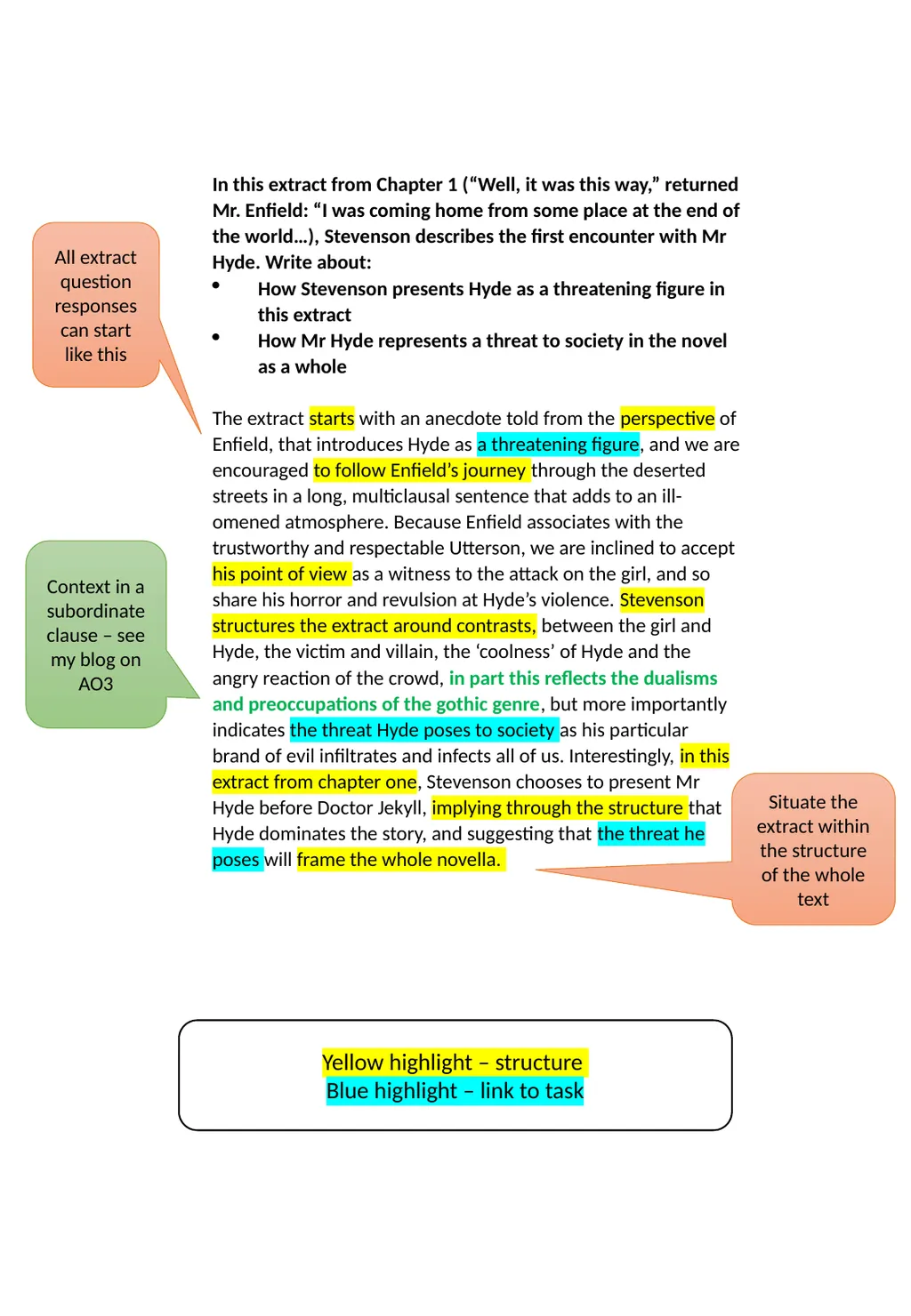
In this extract from Chapter 1 (“Well, it was this way,” returned Mr. Enfield: “I was coming home from some place at the end of the world…), Stevenson describes the first encounter with Mr Hyde. Write about:
How Stevenson presents Hyde as a threatening figure in this extract
How Mr Hyde represents a threat to society in the novel as a whole
The extract starts with an anecdote told from the perspective of Enfield, that introduces Hyde as a threatening figure, and we are encouraged to follow Enfield’s journey through the deserted streets in a long, multiclausal sentence that adds to an ill-omened atmosphere. Because Enfield associates with the trustworthy and respectable Utterson, we are inclined to accept his point of view as a witness to the attack on the girl, and so share his horror and revulsion at Hyde’s violence. Stevenson structures the extract around contrasts, between the girl and Hyde, the victim and villain, the ‘coolness’ of Hyde and the angry reaction of the crowd, in part this reflects the dualisms and preoccupations of the gothic genre, but more importantly indicates the threat Hyde poses to society as his particular brand of evil infiltrates and infects all of us. Interestingly, in this extract from chapter one, Stevenson chooses to present Mr Hyde before Doctor Jekyll, implying through the structure that Hyde dominates the story, and suggesting that the threat he poses will frame the whole novella. All extract question responses can start like this Yellow highlight – structure
Blue highlight – link to task Situate the extract within the structure of the whole text Context in a subordinate clause – see my blog on AO3<br>
How Stevenson presents Hyde as a threatening figure in this extract
How Mr Hyde represents a threat to society in the novel as a whole
The extract starts with an anecdote told from the perspective of Enfield, that introduces Hyde as a threatening figure, and we are encouraged to follow Enfield’s journey through the deserted streets in a long, multiclausal sentence that adds to an ill-omened atmosphere. Because Enfield associates with the trustworthy and respectable Utterson, we are inclined to accept his point of view as a witness to the attack on the girl, and so share his horror and revulsion at Hyde’s violence. Stevenson structures the extract around contrasts, between the girl and Hyde, the victim and villain, the ‘coolness’ of Hyde and the angry reaction of the crowd, in part this reflects the dualisms and preoccupations of the gothic genre, but more importantly indicates the threat Hyde poses to society as his particular brand of evil infiltrates and infects all of us. Interestingly, in this extract from chapter one, Stevenson chooses to present Mr Hyde before Doctor Jekyll, implying through the structure that Hyde dominates the story, and suggesting that the threat he poses will frame the whole novella. All extract question responses can start like this Yellow highlight – structure
Blue highlight – link to task Situate the extract within the structure of the whole text Context in a subordinate clause – see my blog on AO3<br>
23
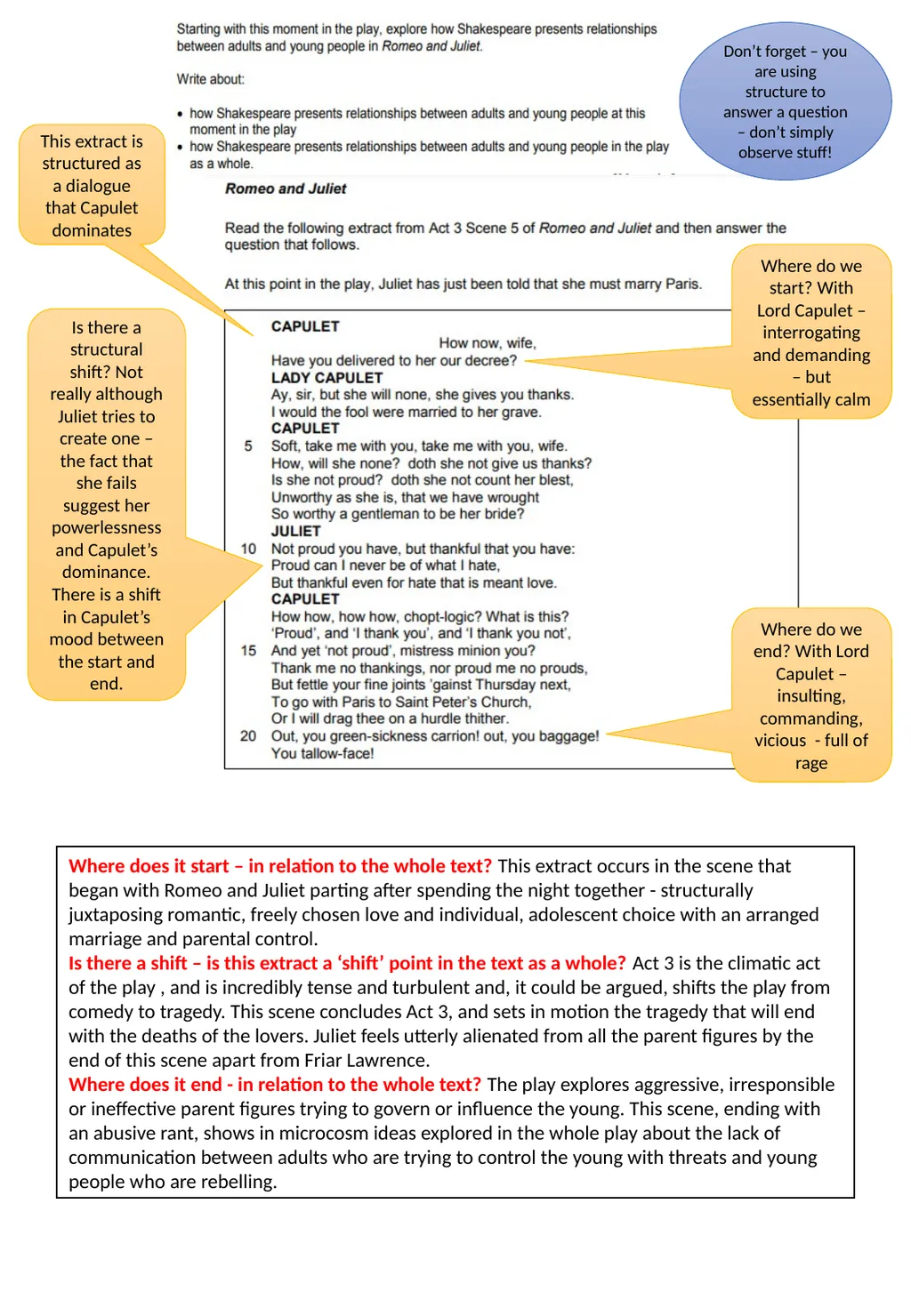
This extract is structured as a dialogue that Capulet dominates Where do we start? With Lord Capulet – interrogating and demanding – but essentially calm Where do we end? With Lord Capulet – insulting, commanding, vicious - full of rage Is there a structural shift? Not really although Juliet tries to create one – the fact that she fails suggest her powerlessness and Capulet’s dominance. There is a shift in Capulet’s mood between the start and end. Where does it start – in relation to the whole text? This extract occurs in the scene that began with Romeo and Juliet parting after spending the night together - structurally juxtaposing romantic, freely chosen love and individual, adolescent choice with an arranged marriage and parental control.
Is there a shift – is this extract a ‘shift’ point in the text as a whole? Act 3 is the climatic act of the play , and is incredibly tense and turbulent and, it could be argued, shifts the play from comedy to tragedy. This scene concludes Act 3, and sets in motion the tragedy that will end with the deaths of the lovers. Juliet feels utterly alienated from all the parent figures by the end of this scene apart from Friar Lawrence.
Where does it end - in relation to the whole text? The play explores aggressive, irresponsible or ineffective parent figures trying to govern or influence the young. This scene, ending with an abusive rant, shows in microcosm ideas explored in the whole play about the lack of communication between adults who are trying to control the young with threats and young people who are rebelling. Don’t forget – you are using structure to answer a question – don’t simply observe stuff!<br>
Is there a shift – is this extract a ‘shift’ point in the text as a whole? Act 3 is the climatic act of the play , and is incredibly tense and turbulent and, it could be argued, shifts the play from comedy to tragedy. This scene concludes Act 3, and sets in motion the tragedy that will end with the deaths of the lovers. Juliet feels utterly alienated from all the parent figures by the end of this scene apart from Friar Lawrence.
Where does it end - in relation to the whole text? The play explores aggressive, irresponsible or ineffective parent figures trying to govern or influence the young. This scene, ending with an abusive rant, shows in microcosm ideas explored in the whole play about the lack of communication between adults who are trying to control the young with threats and young people who are rebelling. Don’t forget – you are using structure to answer a question – don’t simply observe stuff!<br>
24
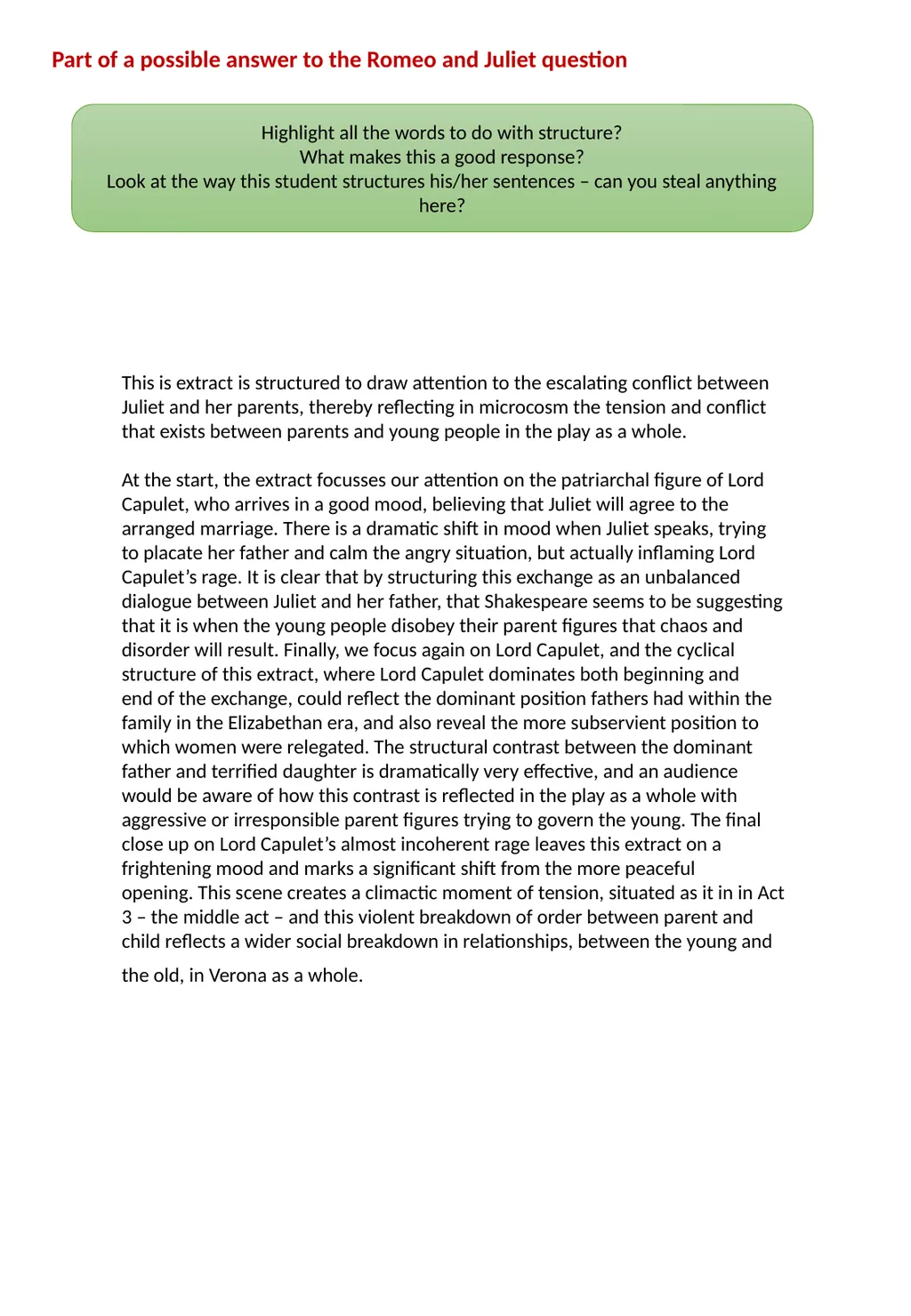
This is extract is structured to draw attention to the escalating conflict between Juliet and her parents, thereby reflecting in microcosm the tension and conflict that exists between parents and young people in the play as a whole.
At the start, the extract focusses our attention on the patriarchal figure of Lord Capulet, who arrives in a good mood, believing that Juliet will agree to the arranged marriage. There is a dramatic shift in mood when Juliet speaks, trying to placate her father and calm the angry situation, but actually inflaming Lord Capulet’s rage. It is clear that by structuring this exchange as an unbalanced dialogue between Juliet and her father, that Shakespeare seems to be suggesting that it is when the young people disobey their parent figures that chaos and disorder will result. Finally, we focus again on Lord Capulet, and the cyclical structure of this extract, where Lord Capulet dominates both beginning and end of the exchange, could reflect the dominant position fathers had within the family in the Elizabethan era, and also reveal the more subservient position to which women were relegated. The structural contrast between the dominant father and terrified daughter is dramatically very effective, and an audience would be aware of how this contrast is reflected in the play as a whole with aggressive or irresponsible parent figures trying to govern the young. The final close up on Lord Capulet’s almost incoherent rage leaves this extract on a frightening mood and marks a significant shift from the more peaceful opening. This scene creates a climactic moment of tension, situated as it in in Act 3 – the middle act – and this violent breakdown of order between parent and child reflects a wider social breakdown in relationships, between the young and the old, in Verona as a whole. Highlight all the words to do with structure?
What makes this a good response?
Look at the way this student structures his/her sentences – can you steal anything here? Part of a possible answer to the Romeo and Juliet question<br>
At the start, the extract focusses our attention on the patriarchal figure of Lord Capulet, who arrives in a good mood, believing that Juliet will agree to the arranged marriage. There is a dramatic shift in mood when Juliet speaks, trying to placate her father and calm the angry situation, but actually inflaming Lord Capulet’s rage. It is clear that by structuring this exchange as an unbalanced dialogue between Juliet and her father, that Shakespeare seems to be suggesting that it is when the young people disobey their parent figures that chaos and disorder will result. Finally, we focus again on Lord Capulet, and the cyclical structure of this extract, where Lord Capulet dominates both beginning and end of the exchange, could reflect the dominant position fathers had within the family in the Elizabethan era, and also reveal the more subservient position to which women were relegated. The structural contrast between the dominant father and terrified daughter is dramatically very effective, and an audience would be aware of how this contrast is reflected in the play as a whole with aggressive or irresponsible parent figures trying to govern the young. The final close up on Lord Capulet’s almost incoherent rage leaves this extract on a frightening mood and marks a significant shift from the more peaceful opening. This scene creates a climactic moment of tension, situated as it in in Act 3 – the middle act – and this violent breakdown of order between parent and child reflects a wider social breakdown in relationships, between the young and the old, in Verona as a whole. Highlight all the words to do with structure?
What makes this a good response?
Look at the way this student structures his/her sentences – can you steal anything here? Part of a possible answer to the Romeo and Juliet question<br>
25
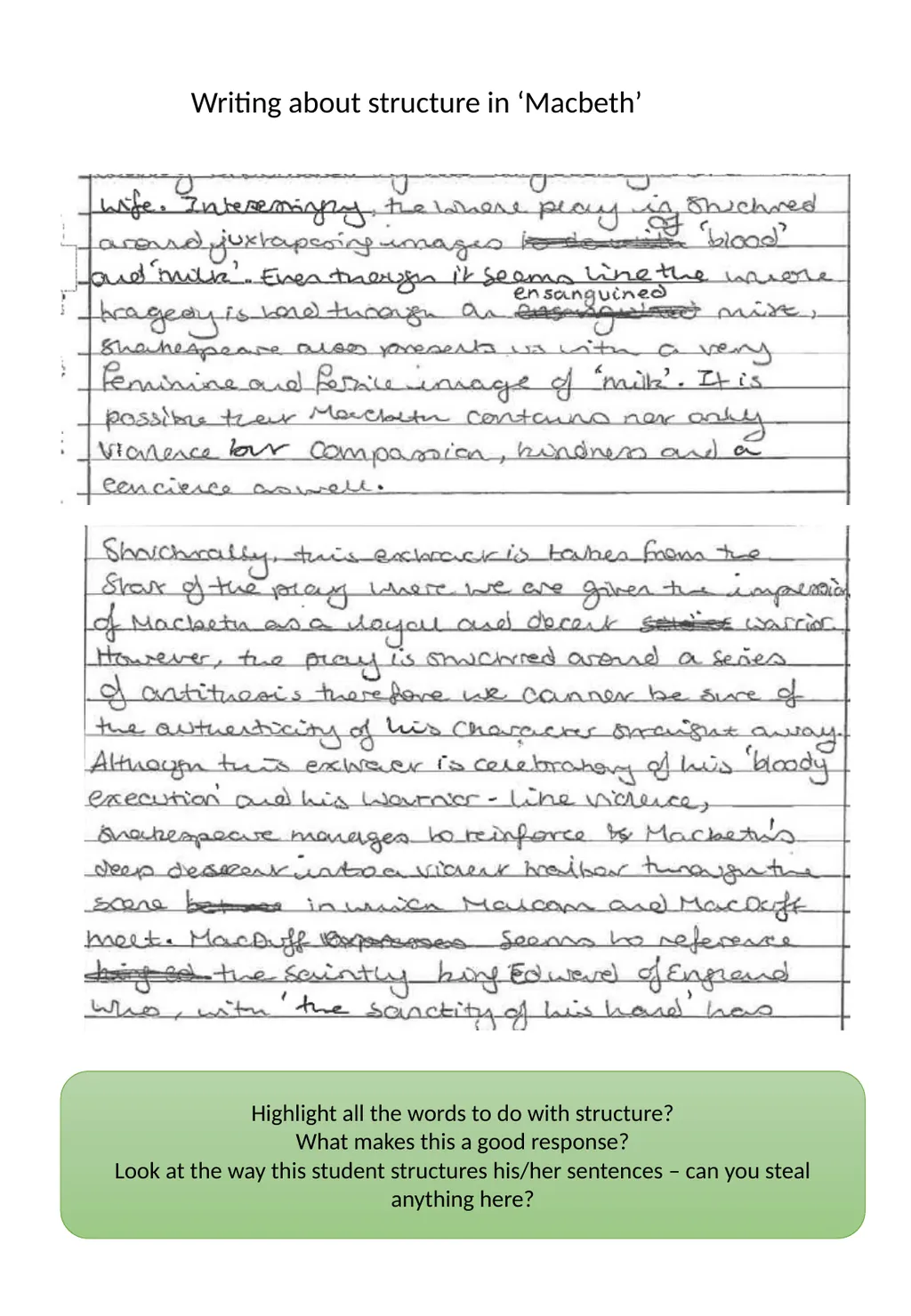
Writing about structure in ‘Macbeth’ Highlight all the words to do with structure?
What makes this a good response?
Look at the way this student structures his/her sentences – can you steal anything here?<br>
What makes this a good response?
Look at the way this student structures his/her sentences – can you steal anything here?<br>
26
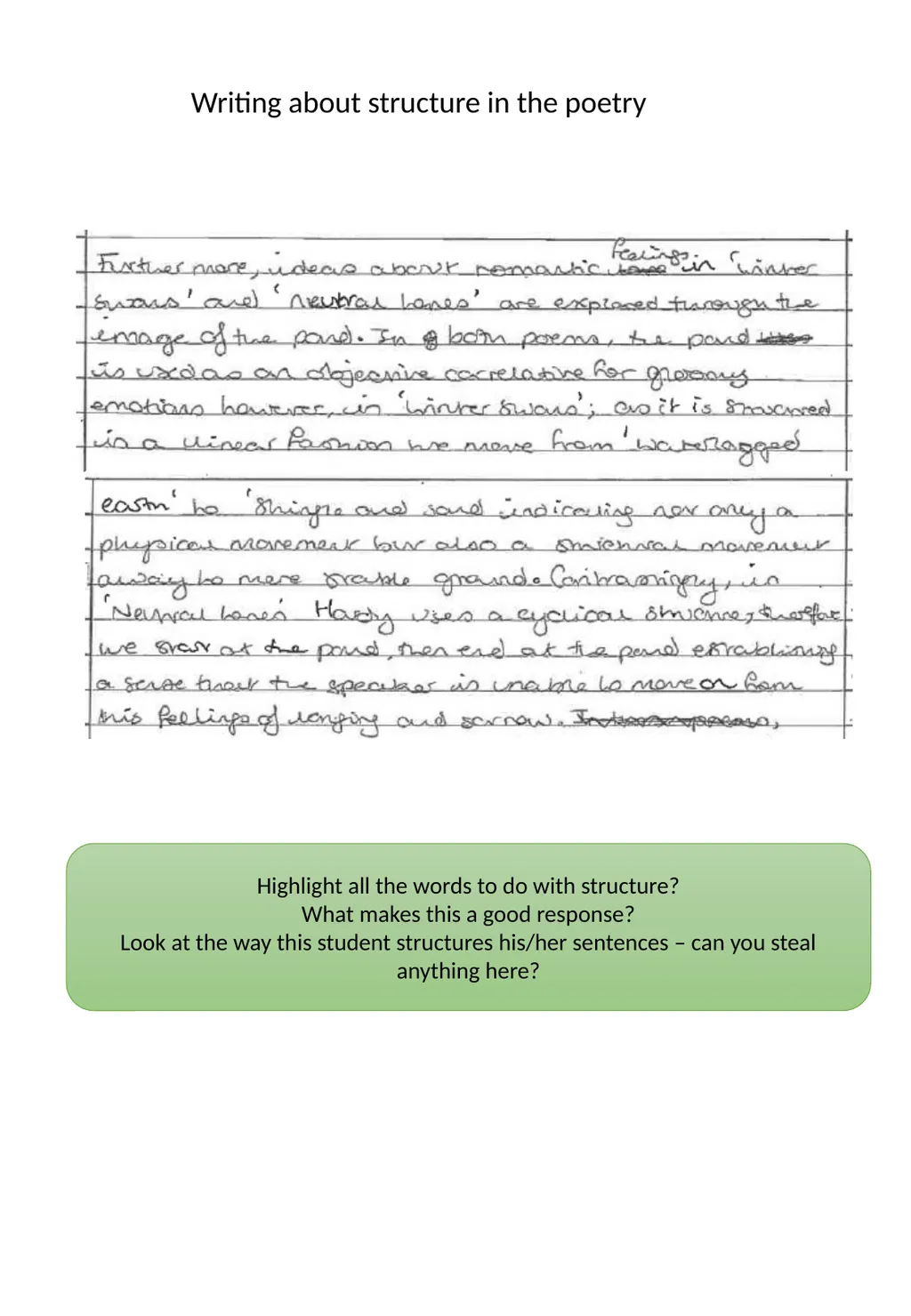
Writing about structure in the poetry Highlight all the words to do with structure?
What makes this a good response?
Look at the way this student structures his/her sentences – can you steal anything here?<br>
What makes this a good response?
Look at the way this student structures his/her sentences – can you steal anything here?<br>
27
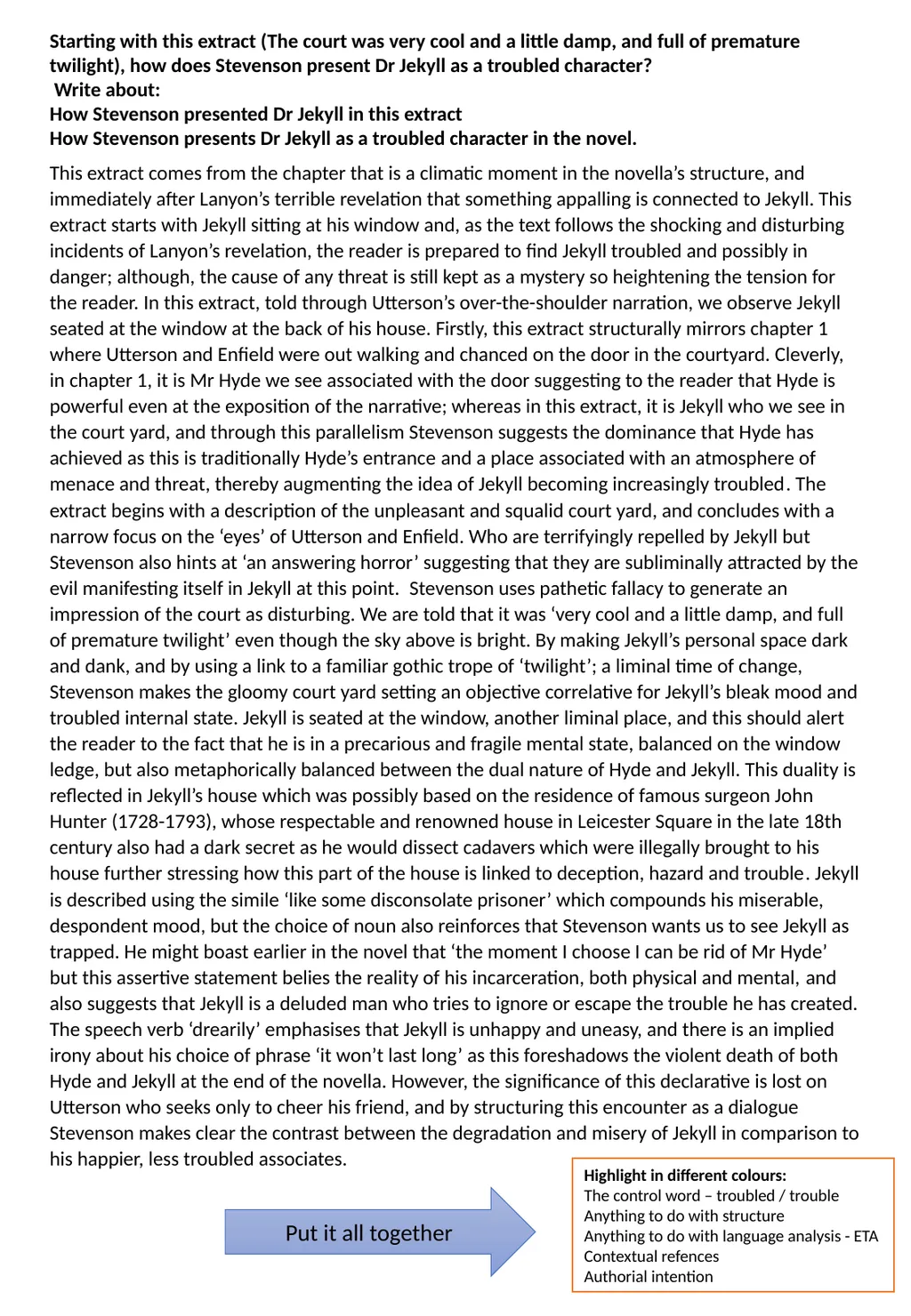
Starting with this extract (The court was very cool and a little damp, and full of premature twilight), how does Stevenson present Dr Jekyll as a troubled character?
Write about:
How Stevenson presented Dr Jekyll in this extract
How Stevenson presents Dr Jekyll as a troubled character in the novel.
This extract comes from the chapter that is a climatic moment in the novella’s structure, and immediately after Lanyon’s terrible revelation that something appalling is connected to Jekyll. This extract starts with Jekyll sitting at his window and, as the text follows the shocking and disturbing incidents of Lanyon’s revelation, the reader is prepared to find Jekyll troubled and possibly in danger; although, the cause of any threat is still kept as a mystery so heightening the tension for the reader. In this extract, told through Utterson’s over-the-shoulder narration, we observe Jekyll seated at the window at the back of his house. Firstly, this extract structurally mirrors chapter 1 where Utterson and Enfield were out walking and chanced on the door in the courtyard. Cleverly, in chapter 1, it is Mr Hyde we see associated with the door suggesting to the reader that Hyde is powerful even at the exposition of the narrative; whereas in this extract, it is Jekyll who we see in the court yard, and through this parallelism Stevenson suggests the dominance that Hyde has achieved as this is traditionally Hyde’s entrance and a place associated with an atmosphere of menace and threat, thereby augmenting the idea of Jekyll becoming increasingly troubled. The extract begins with a description of the unpleasant and squalid court yard, and concludes with a narrow focus on the ‘eyes’ of Utterson and Enfield. Who are terrifyingly repelled by Jekyll but Stevenson also hints at ‘an answering horror’ suggesting that they are subliminally attracted by the evil manifesting itself in Jekyll at this point. Stevenson uses pathetic fallacy to generate an impression of the court as disturbing. We are told that it was ‘very cool and a little damp, and full of premature twilight’ even though the sky above is bright. By making Jekyll’s personal space dark and dank, and by using a link to a familiar gothic trope of ‘twilight’; a liminal time of change, Stevenson makes the gloomy court yard setting an objective correlative for Jekyll’s bleak mood and troubled internal state. Jekyll is seated at the window, another liminal place, and this should alert the reader to the fact that he is in a precarious and fragile mental state, balanced on the window ledge, but also metaphorically balanced between the dual nature of Hyde and Jekyll. This duality is reflected in Jekyll’s house which was possibly based on the residence of famous surgeon John Hunter (1728-1793), whose respectable and renowned house in Leicester Square in the late 18th century also had a dark secret as he would dissect cadavers which were illegally brought to his house further stressing how this part of the house is linked to deception, hazard and trouble. Jekyll is described using the simile ‘like some disconsolate prisoner’ which compounds his miserable, despondent mood, but the choice of noun also reinforces that Stevenson wants us to see Jekyll as trapped. He might boast earlier in the novel that ‘the moment I choose I can be rid of Mr Hyde’ but this assertive statement belies the reality of his incarceration, both physical and mental, and also suggests that Jekyll is a deluded man who tries to ignore or escape the trouble he has created. The speech verb ‘drearily’ emphasises that Jekyll is unhappy and uneasy, and there is an implied irony about his choice of phrase ‘it won’t last long’ as this foreshadows the violent death of both Hyde and Jekyll at the end of the novella. However, the significance of this declarative is lost on Utterson who seeks only to cheer his friend, and by structuring this encounter as a dialogue Stevenson makes clear the contrast between the degradation and misery of Jekyll in comparison to his happier, less troubled associates. Highlight in different colours:
The control word – troubled / trouble
Anything to do with structure
Anything to do with language analysis - ETA
Contextual refences
Authorial intention Put it all together<br>
Write about:
How Stevenson presented Dr Jekyll in this extract
How Stevenson presents Dr Jekyll as a troubled character in the novel.
This extract comes from the chapter that is a climatic moment in the novella’s structure, and immediately after Lanyon’s terrible revelation that something appalling is connected to Jekyll. This extract starts with Jekyll sitting at his window and, as the text follows the shocking and disturbing incidents of Lanyon’s revelation, the reader is prepared to find Jekyll troubled and possibly in danger; although, the cause of any threat is still kept as a mystery so heightening the tension for the reader. In this extract, told through Utterson’s over-the-shoulder narration, we observe Jekyll seated at the window at the back of his house. Firstly, this extract structurally mirrors chapter 1 where Utterson and Enfield were out walking and chanced on the door in the courtyard. Cleverly, in chapter 1, it is Mr Hyde we see associated with the door suggesting to the reader that Hyde is powerful even at the exposition of the narrative; whereas in this extract, it is Jekyll who we see in the court yard, and through this parallelism Stevenson suggests the dominance that Hyde has achieved as this is traditionally Hyde’s entrance and a place associated with an atmosphere of menace and threat, thereby augmenting the idea of Jekyll becoming increasingly troubled. The extract begins with a description of the unpleasant and squalid court yard, and concludes with a narrow focus on the ‘eyes’ of Utterson and Enfield. Who are terrifyingly repelled by Jekyll but Stevenson also hints at ‘an answering horror’ suggesting that they are subliminally attracted by the evil manifesting itself in Jekyll at this point. Stevenson uses pathetic fallacy to generate an impression of the court as disturbing. We are told that it was ‘very cool and a little damp, and full of premature twilight’ even though the sky above is bright. By making Jekyll’s personal space dark and dank, and by using a link to a familiar gothic trope of ‘twilight’; a liminal time of change, Stevenson makes the gloomy court yard setting an objective correlative for Jekyll’s bleak mood and troubled internal state. Jekyll is seated at the window, another liminal place, and this should alert the reader to the fact that he is in a precarious and fragile mental state, balanced on the window ledge, but also metaphorically balanced between the dual nature of Hyde and Jekyll. This duality is reflected in Jekyll’s house which was possibly based on the residence of famous surgeon John Hunter (1728-1793), whose respectable and renowned house in Leicester Square in the late 18th century also had a dark secret as he would dissect cadavers which were illegally brought to his house further stressing how this part of the house is linked to deception, hazard and trouble. Jekyll is described using the simile ‘like some disconsolate prisoner’ which compounds his miserable, despondent mood, but the choice of noun also reinforces that Stevenson wants us to see Jekyll as trapped. He might boast earlier in the novel that ‘the moment I choose I can be rid of Mr Hyde’ but this assertive statement belies the reality of his incarceration, both physical and mental, and also suggests that Jekyll is a deluded man who tries to ignore or escape the trouble he has created. The speech verb ‘drearily’ emphasises that Jekyll is unhappy and uneasy, and there is an implied irony about his choice of phrase ‘it won’t last long’ as this foreshadows the violent death of both Hyde and Jekyll at the end of the novella. However, the significance of this declarative is lost on Utterson who seeks only to cheer his friend, and by structuring this encounter as a dialogue Stevenson makes clear the contrast between the degradation and misery of Jekyll in comparison to his happier, less troubled associates. Highlight in different colours:
The control word – troubled / trouble
Anything to do with structure
Anything to do with language analysis - ETA
Contextual refences
Authorial intention Put it all together<br>
28
Structure in the drama text<br>
29
Structure and Paper 2 Question 5 Transactional writing<br>
30
Janus structure – sum up the key point and move on to the next argument
Having discussed….I think it’s also important to consider….
Previously, I mentioned….now I want to focus on….
I have spoken about….yet the topic of….is also vital
Whilst it is important that….it is also essential to recognise that… Let’s write another paragraph. How can you shift to your next point?
We are going to use a Janus structure sentence to join your ideas from the last paragraph to this new one. Then carry on with reasons to develop your new topic sentence. Don’t forget everything you learned from writing paragraph 3. Did you know?
Janus was the god of beginnings and transitions in Roman mythology, and presided over passages, doors, gates and endings, as well as in transitional periods such as from war to peace. He was usually depicted as having two faces looking at opposite ways, one towards the past and the other towards the future. Think about how sentence starters can create shifts in your writing and help build your argument:
Yes, I agree that
It is clear to me that
Now, more than ever
For too long we have believed that
I am convinced that…
As a consequence of…
Firstly…
In conclusion…. Another shift. You are also going to challenge some of the opposing arguments. Now, you are going to create a ‘but’ paragraph in which you tackle some of the other side of the argument. Not forgetting your point of view though! To do this you will need to use a straw man / strong man structure.<br>
Having discussed….I think it’s also important to consider….
Previously, I mentioned….now I want to focus on….
I have spoken about….yet the topic of….is also vital
Whilst it is important that….it is also essential to recognise that… Let’s write another paragraph. How can you shift to your next point?
We are going to use a Janus structure sentence to join your ideas from the last paragraph to this new one. Then carry on with reasons to develop your new topic sentence. Don’t forget everything you learned from writing paragraph 3. Did you know?
Janus was the god of beginnings and transitions in Roman mythology, and presided over passages, doors, gates and endings, as well as in transitional periods such as from war to peace. He was usually depicted as having two faces looking at opposite ways, one towards the past and the other towards the future. Think about how sentence starters can create shifts in your writing and help build your argument:
Yes, I agree that
It is clear to me that
Now, more than ever
For too long we have believed that
I am convinced that…
As a consequence of…
Firstly…
In conclusion…. Another shift. You are also going to challenge some of the opposing arguments. Now, you are going to create a ‘but’ paragraph in which you tackle some of the other side of the argument. Not forgetting your point of view though! To do this you will need to use a straw man / strong man structure.<br>