
Techniques in Civic Engagement Presented by Bill



Description: Techniques in Civic Engagement Presented by Bill Rizzo Local Government Specialist UW-Extension Local Government Center william.rizzoces.uwex.edu http:lgc.uwex.edudgindex.html 608-265-6273 Civic engagement as weve known it Typically
Related Topics
Download Presentation
"Techniques in Civic Engagement Presented by Bill" is the property of its rightful owner. Permission is granted to download and print the materials on this website for personal, non-commercial use only, and to display it on your personal computer provided you do not modify the materials and that you retain all copyright notices contained in the materials. By downloading content from our website, you accept the terms of this agreement.
Presentation Transcript
slide1. Techniques in
Civic Engagement Presented by Bill Rizzo
Local Government Specialist
UW-Extension Local Government Center
william.rizzo@ces.uwex.edu
http://lgc.uwex.edu/dg/index.html
608-265-6273<br>
slide2. Civic engagement as we’ve known it… Typically occurs around contentious issues
Often conflict-laden
May involve uncivil behavior
A polarizing environment<br>
slide3. Three Questions What is civic engagement?
Why is it important?
How is it done?<br>
slide4. Main points The what, why, and how of civic engagement;
Civic engagement goals;
Wicked problems;
Deliberative engagement approach/steps;
Engagement roles officials can play.<br>
slide5. What do we mean by ‘civic engagement?’ A working definition - civic engagement refers to processes and methods local officials can use to communicate and collaborate with citizens and stakeholders in developing
local policy.<br>
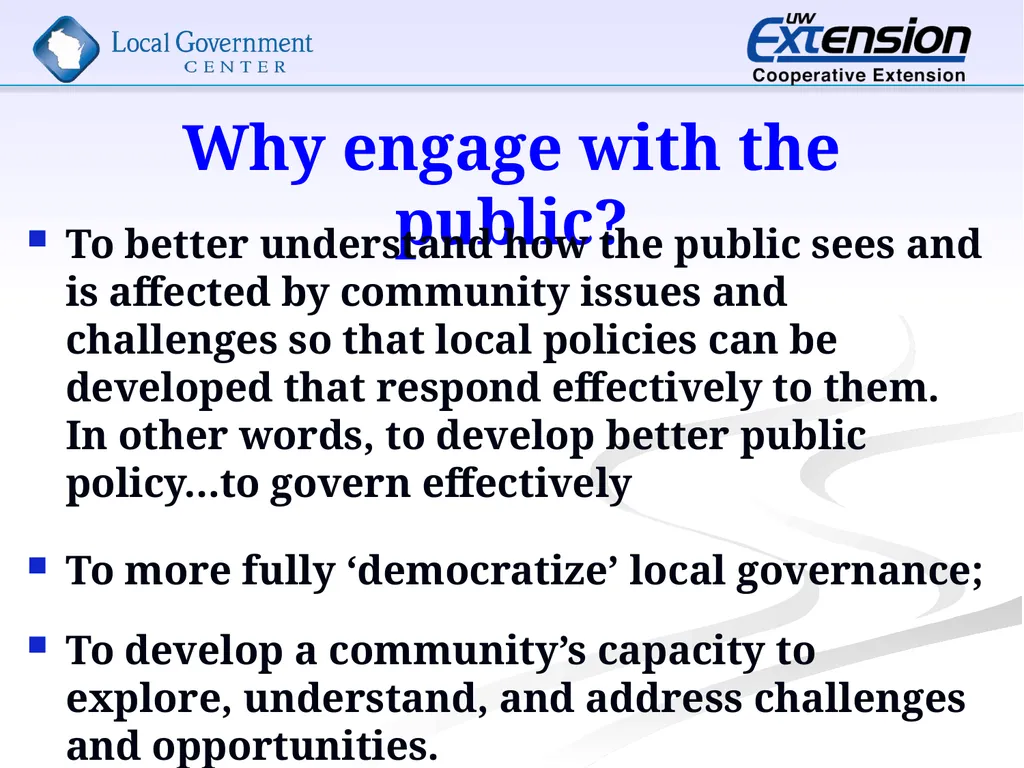
slide6. Why engage with the public? To better understand how the public sees and is affected by community issues and challenges so that local policies can be developed that respond effectively to them. In other words, to develop better public policy…to govern effectively
To more fully ‘democratize’ local governance;
To develop a community’s capacity to explore, understand, and address challenges and opportunities.<br>
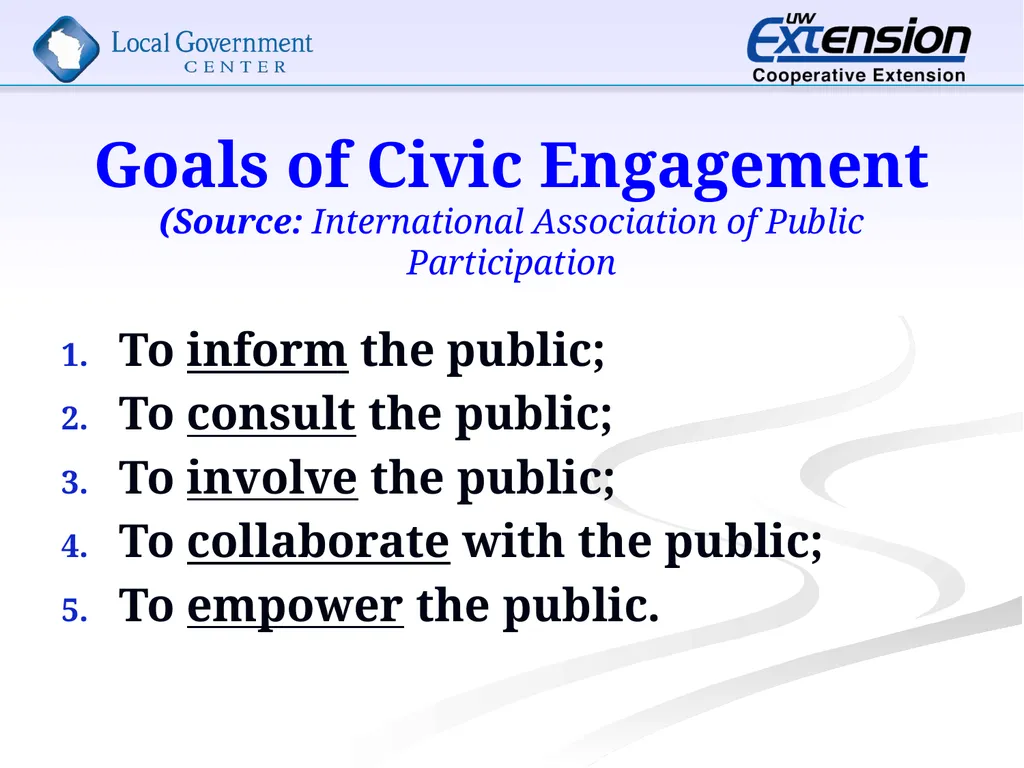
slide7. Goals of Civic Engagement (Source: International Association of Public Participation To inform the public;
To consult the public;
To involve the public;
To collaborate with the public;
To empower the public.<br>
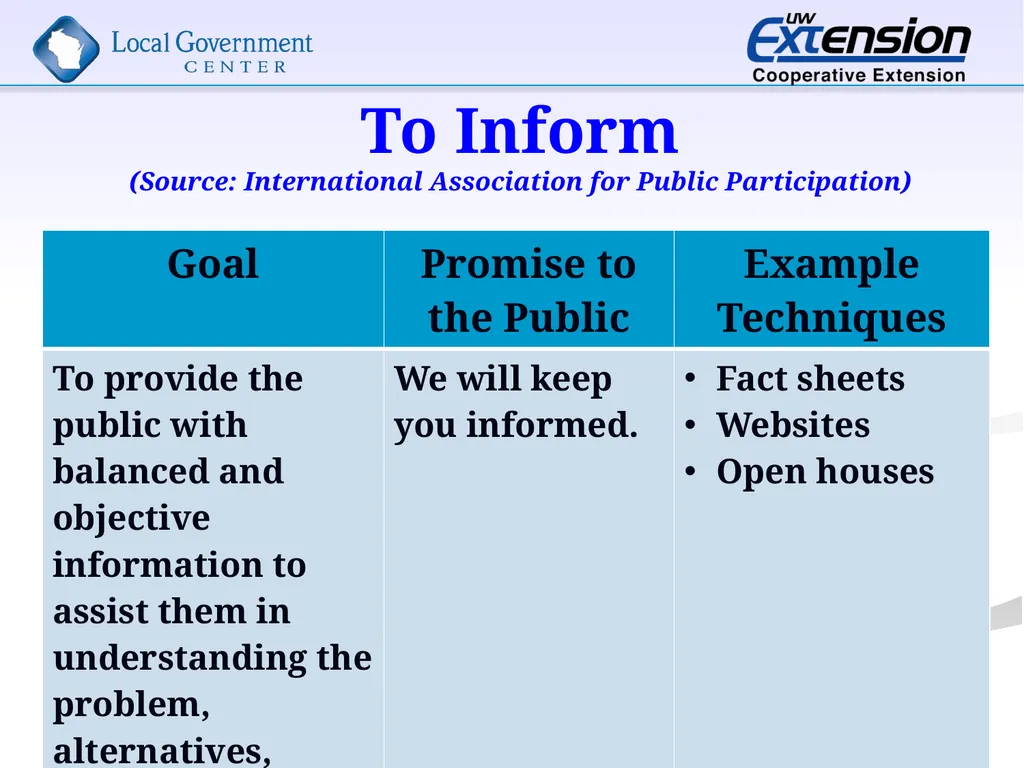
slide8. To Inform (Source: International Association for Public Participation)<br>
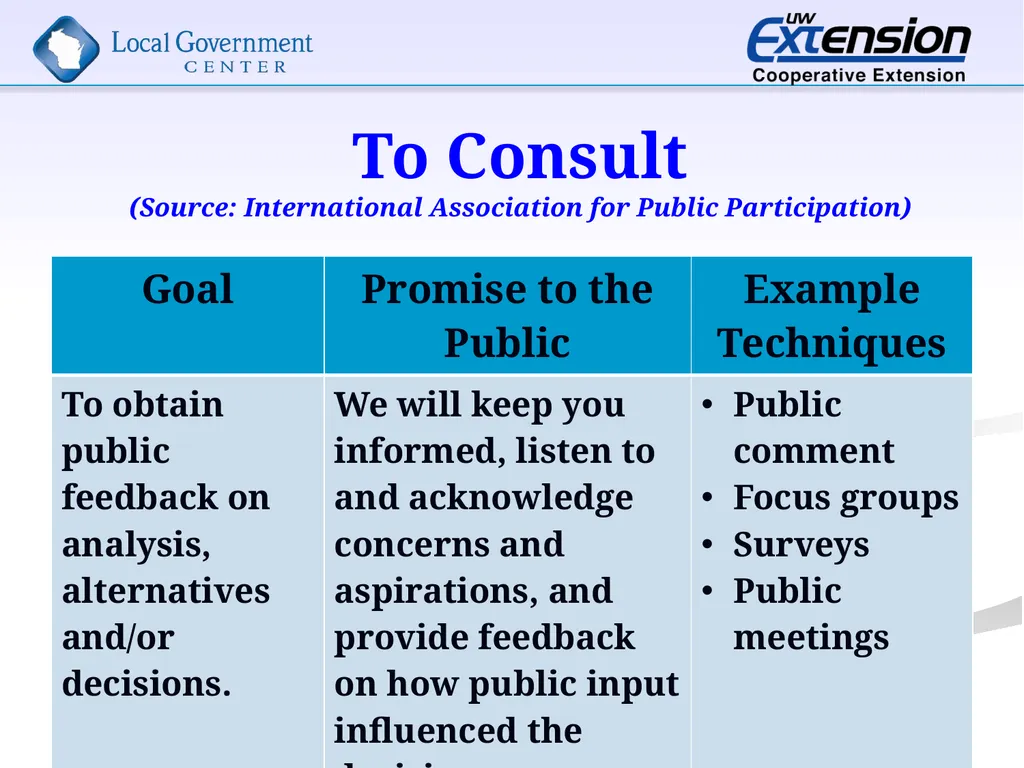
slide9. To Consult (Source: International Association for Public Participation)<br>
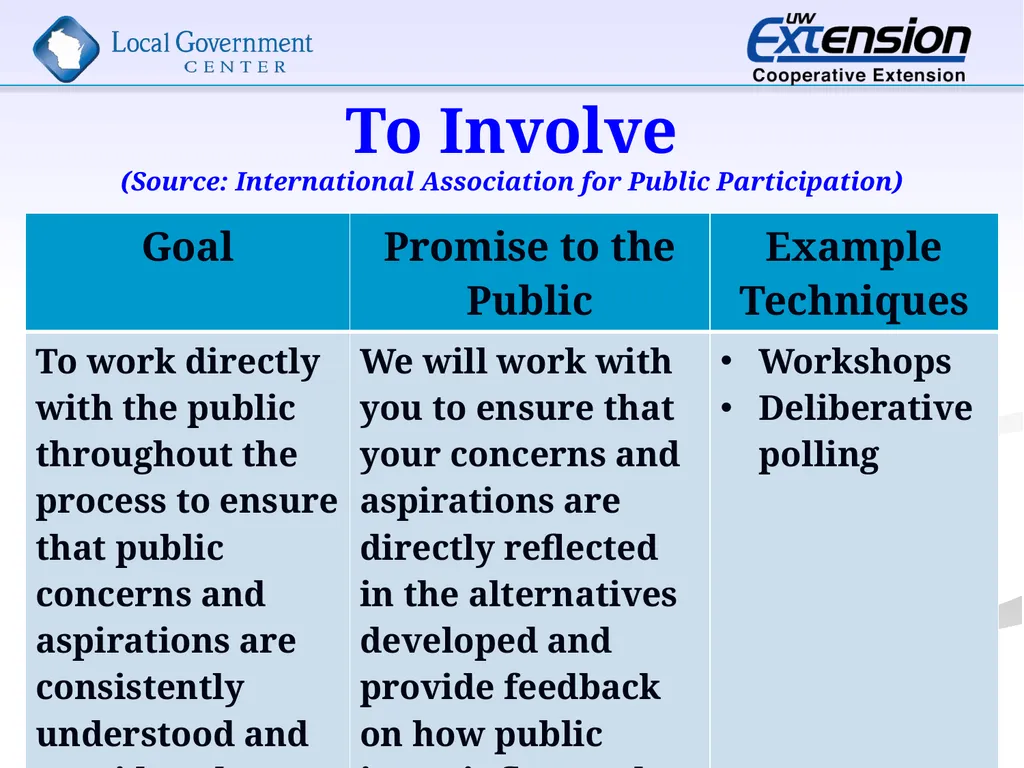
slide10. To Involve (Source: International Association for Public Participation)<br>
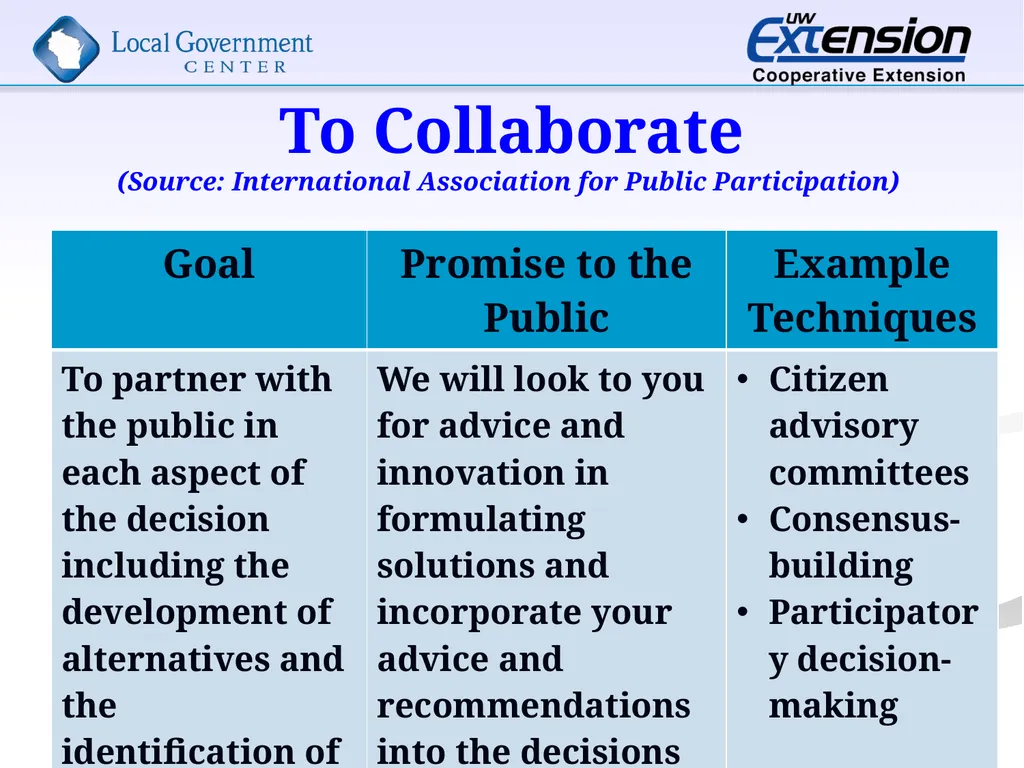
slide11. To Collaborate (Source: International Association for Public Participation)<br>
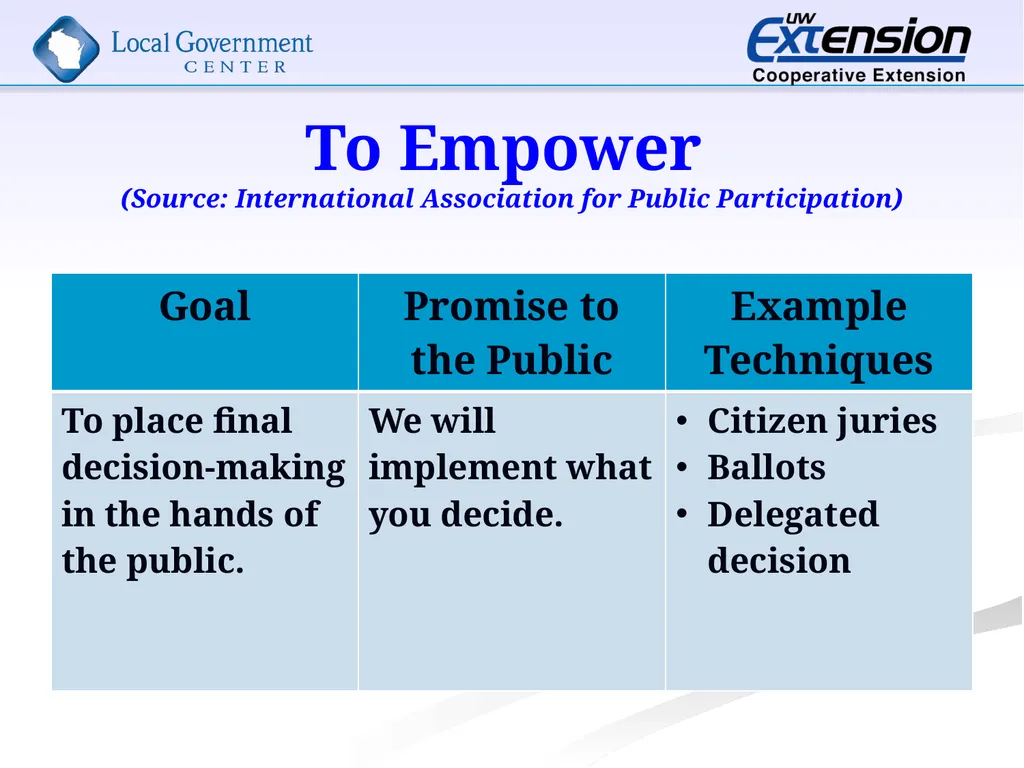
slide12. To Empower (Source: International Association for Public Participation)<br>
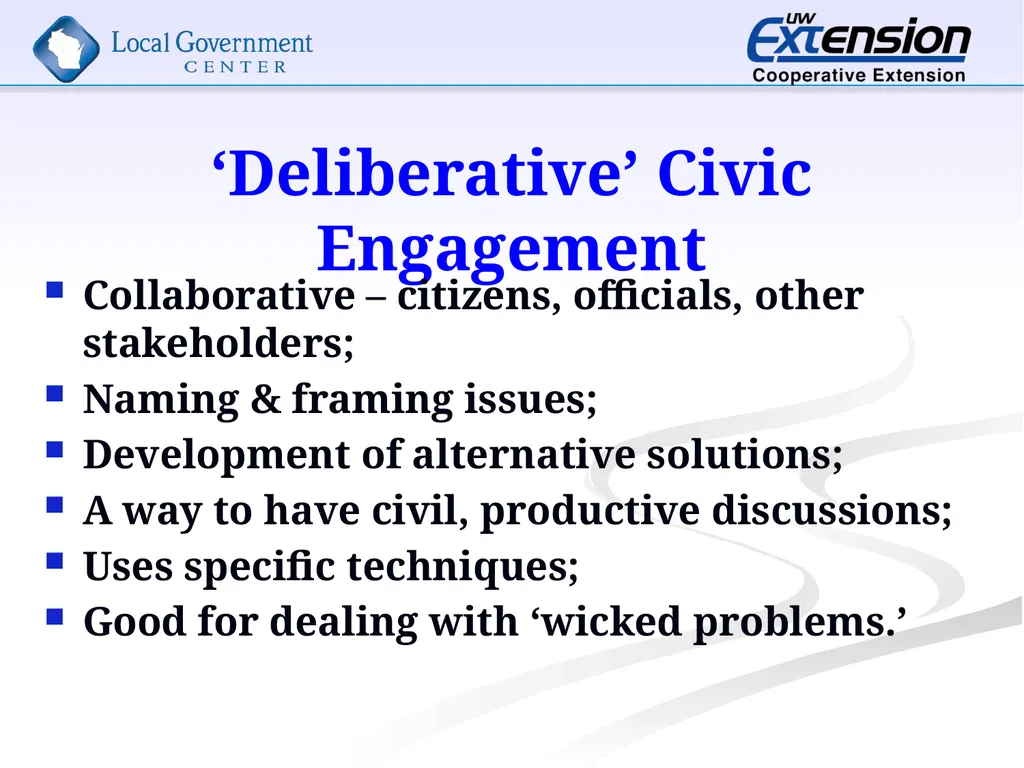
slide13. ‘Deliberative’ Civic Engagement Collaborative – citizens, officials, other stakeholders;
Naming & framing issues;
Development of alternative solutions;
A way to have civil, productive discussions;
Uses specific techniques;
Good for dealing with ‘wicked problems.’<br>
slide14. Wicked Problems Not fully understood until a solution is developed;
Since there’s no definitive ‘The Problem’, there’s also no definitive ‘The Solution;’
Solutions to wicked problems are not right or wrong;
Wicked problems are unique and novel;
Every solution is a ‘one-shot operation.’ You can’t learn about the problem without trying solutions, but every solution has costs and unintended consequences that are likely to spawn new wicked problems.
What the problem is, and its solution, are BOTH unclear<br>
slide15. Civic Engagement Techniques<br>
slide16. Issue ‘Naming & Framing’ Issue Naming
What is the problem we need to talk about?
Issue Framing
What are the critical options and drawbacks for deciding what to do about that problem?<br>
slide17. Why Name & Frame Issues? …makes it more likely that citizens will participate in making decisions because the problem is stated in terms that take into account the things they hold deeply valuable;
…results in an “issue framework” that sets the stage for public deliberation by making clear the options available for addressing an issue or problem, as well as the tensions around it;
…clarifies what is at issue, in understandable terms.<br>
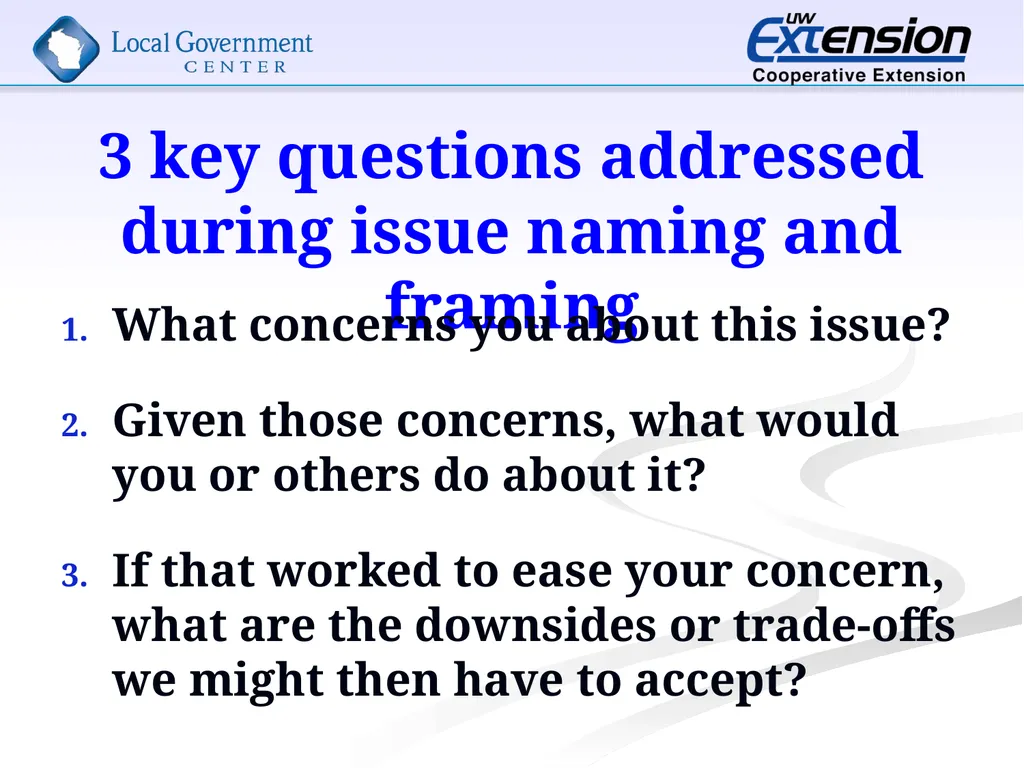
slide18. 3 key questions addressed during issue naming and framing What concerns you about this issue?
Given those concerns, what would you or others do about it?
If that worked to ease your concern, what are the downsides or trade-offs we might then have to accept?<br>
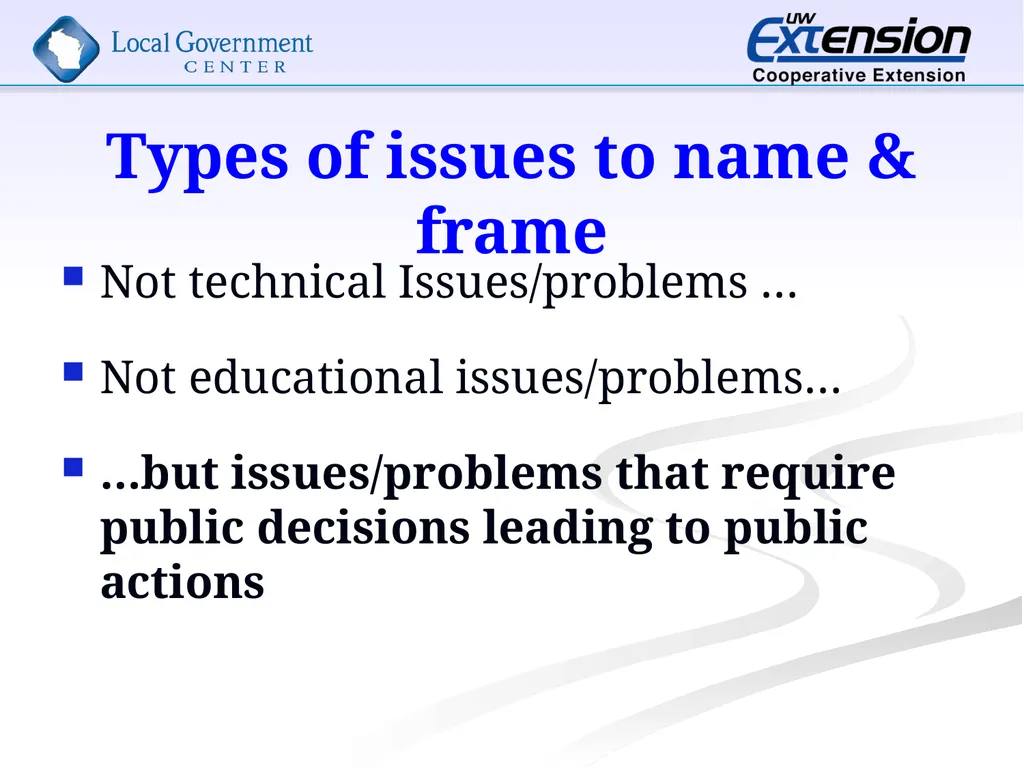
slide19. Types of issues to name & frame Not technical Issues/problems …
Not educational issues/problems…
…but issues/problems that require public decisions leading to public actions<br>
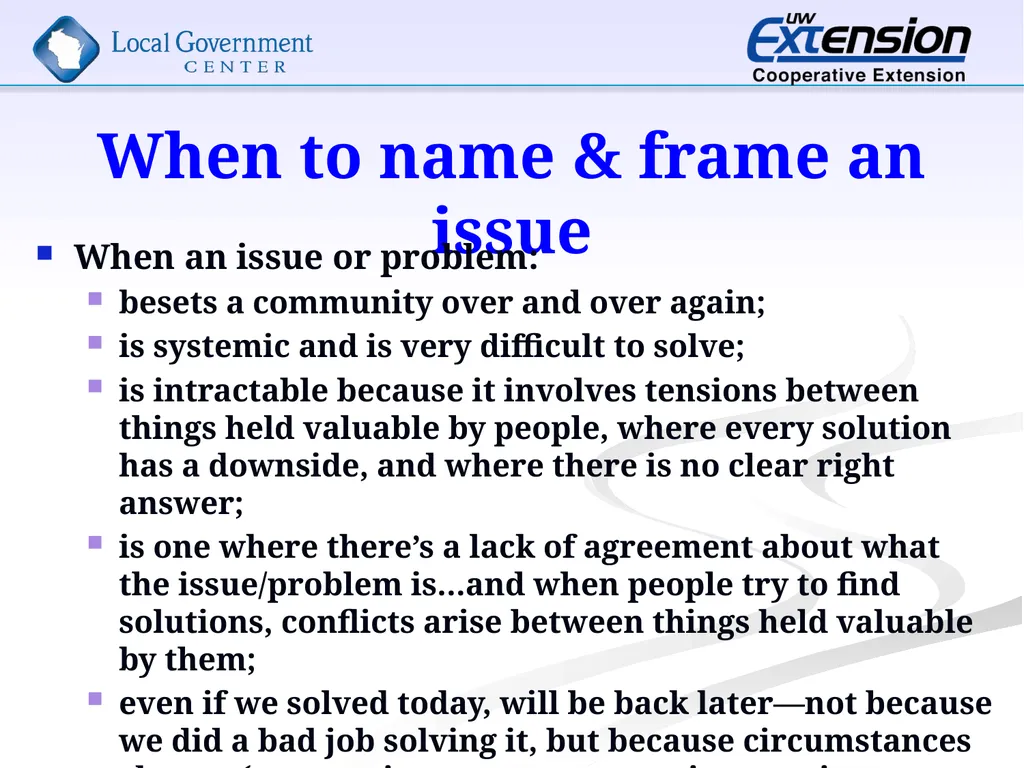
slide20. When to name & frame an issue When an issue or problem:
besets a community over and over again;
is systemic and is very difficult to solve;
is intractable because it involves tensions between things held valuable by people, where every solution has a downside, and where there is no clear right answer;
is one where there’s a lack of agreement about what the issue/problem is…and when people try to find solutions, conflicts arise between things held valuable by them;
even if we solved today, will be back later—not because we did a bad job solving it, but because circumstances change (e.g. persistent poverty, persistent crime, health care).<br>
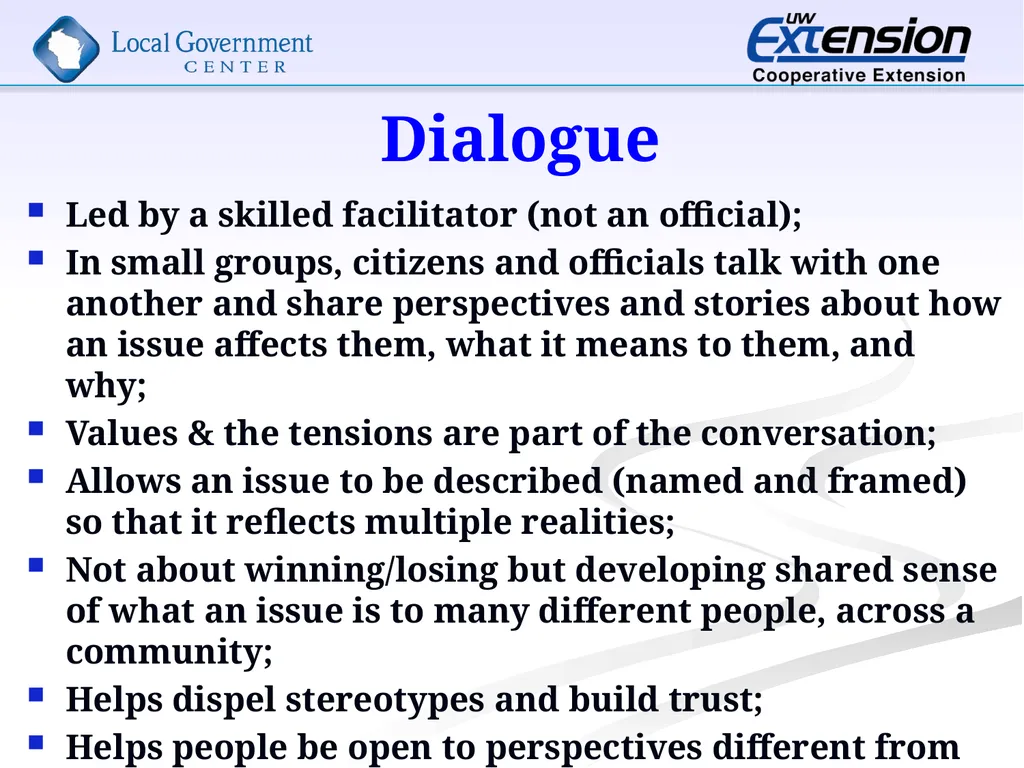
slide21. Dialogue Led by a skilled facilitator (not an official);
In small groups, citizens and officials talk with one another and share perspectives and stories about how an issue affects them, what it means to them, and why;
Values & the tensions are part of the conversation;
Allows an issue to be described (named and framed) so that it reflects multiple realities;
Not about winning/losing but developing shared sense of what an issue is to many different people, across a community;
Helps dispel stereotypes and build trust;
Helps people be open to perspectives different from their own.<br>
slide22. Public Deliberation (Source: National Issues Forums) Facilitated conversation used to generate and examine 3-4 policy options after an issue has been named and framed. Three questions for each alternative are:
What actions should be taken to implement this policy alternative?
What are the advantages of this policy alternative?
What are the tradeoffs of this policy alternative?<br>
slide23. Civic Engagement Roles for Local Officials Convener
Educator
Learner
Champion<br>
slide24. Review The what, why, and how of civic engagement;
Civic engagement goals. For each, the promise made to the public & specific techniques;
Wicked problems;
Deliberative engagement approach/steps;
Engagement roles officials can play.<br>
slide25. Techniques in Civic Engagement Presented by Bill Rizzo
Local Government Specialist
UW-Extension Local Government Center
william.rizzo@ces.uwex.edu
http://lgc.uwex.edu/dg/index.html
608-265-6273<br>
Local Government Specialist
UW-Extension Local Government Center
william.rizzo@ces.uwex.edu
http://lgc.uwex.edu/dg/index.html
608-265-6273<br>
slide2. Civic engagement as we’ve known it… Typically occurs around contentious issues
Often conflict-laden
May involve uncivil behavior
A polarizing environment<br>
slide3. Three Questions What is civic engagement?
Why is it important?
How is it done?<br>
slide4. Main points The what, why, and how of civic engagement;
Civic engagement goals;
Wicked problems;
Deliberative engagement approach/steps;
Engagement roles officials can play.<br>
slide5. What do we mean by ‘civic engagement?’ A working definition - civic engagement refers to processes and methods local officials can use to communicate and collaborate with citizens and stakeholders in developing
local policy.<br>
slide6. Why engage with the public? To better understand how the public sees and is affected by community issues and challenges so that local policies can be developed that respond effectively to them. In other words, to develop better public policy…to govern effectively
To more fully ‘democratize’ local governance;
To develop a community’s capacity to explore, understand, and address challenges and opportunities.<br>
slide7. Goals of Civic Engagement (Source: International Association of Public Participation To inform the public;
To consult the public;
To involve the public;
To collaborate with the public;
To empower the public.<br>
slide8. To Inform (Source: International Association for Public Participation)<br>
slide9. To Consult (Source: International Association for Public Participation)<br>
slide10. To Involve (Source: International Association for Public Participation)<br>
slide11. To Collaborate (Source: International Association for Public Participation)<br>
slide12. To Empower (Source: International Association for Public Participation)<br>
slide13. ‘Deliberative’ Civic Engagement Collaborative – citizens, officials, other stakeholders;
Naming & framing issues;
Development of alternative solutions;
A way to have civil, productive discussions;
Uses specific techniques;
Good for dealing with ‘wicked problems.’<br>
slide14. Wicked Problems Not fully understood until a solution is developed;
Since there’s no definitive ‘The Problem’, there’s also no definitive ‘The Solution;’
Solutions to wicked problems are not right or wrong;
Wicked problems are unique and novel;
Every solution is a ‘one-shot operation.’ You can’t learn about the problem without trying solutions, but every solution has costs and unintended consequences that are likely to spawn new wicked problems.
What the problem is, and its solution, are BOTH unclear<br>
slide15. Civic Engagement Techniques<br>
slide16. Issue ‘Naming & Framing’ Issue Naming
What is the problem we need to talk about?
Issue Framing
What are the critical options and drawbacks for deciding what to do about that problem?<br>
slide17. Why Name & Frame Issues? …makes it more likely that citizens will participate in making decisions because the problem is stated in terms that take into account the things they hold deeply valuable;
…results in an “issue framework” that sets the stage for public deliberation by making clear the options available for addressing an issue or problem, as well as the tensions around it;
…clarifies what is at issue, in understandable terms.<br>
slide18. 3 key questions addressed during issue naming and framing What concerns you about this issue?
Given those concerns, what would you or others do about it?
If that worked to ease your concern, what are the downsides or trade-offs we might then have to accept?<br>
slide19. Types of issues to name & frame Not technical Issues/problems …
Not educational issues/problems…
…but issues/problems that require public decisions leading to public actions<br>
slide20. When to name & frame an issue When an issue or problem:
besets a community over and over again;
is systemic and is very difficult to solve;
is intractable because it involves tensions between things held valuable by people, where every solution has a downside, and where there is no clear right answer;
is one where there’s a lack of agreement about what the issue/problem is…and when people try to find solutions, conflicts arise between things held valuable by them;
even if we solved today, will be back later—not because we did a bad job solving it, but because circumstances change (e.g. persistent poverty, persistent crime, health care).<br>
slide21. Dialogue Led by a skilled facilitator (not an official);
In small groups, citizens and officials talk with one another and share perspectives and stories about how an issue affects them, what it means to them, and why;
Values & the tensions are part of the conversation;
Allows an issue to be described (named and framed) so that it reflects multiple realities;
Not about winning/losing but developing shared sense of what an issue is to many different people, across a community;
Helps dispel stereotypes and build trust;
Helps people be open to perspectives different from their own.<br>
slide22. Public Deliberation (Source: National Issues Forums) Facilitated conversation used to generate and examine 3-4 policy options after an issue has been named and framed. Three questions for each alternative are:
What actions should be taken to implement this policy alternative?
What are the advantages of this policy alternative?
What are the tradeoffs of this policy alternative?<br>
slide23. Civic Engagement Roles for Local Officials Convener
Educator
Learner
Champion<br>
slide24. Review The what, why, and how of civic engagement;
Civic engagement goals. For each, the promise made to the public & specific techniques;
Wicked problems;
Deliberative engagement approach/steps;
Engagement roles officials can play.<br>
slide25. Techniques in Civic Engagement Presented by Bill Rizzo
Local Government Specialist
UW-Extension Local Government Center
william.rizzo@ces.uwex.edu
http://lgc.uwex.edu/dg/index.html
608-265-6273<br>