Technological Advances in Clinical Trial Conduct:
Description: Technological Advances in Clinical Trial Conduct: CCTG Perspective August 5, 2022 Lam Pho, Chief Information Officer Learning Objectives To review the current advancements in technologies for CCTG clinical trial conduct Review examples such
Related Topics
Download Presentation
"Technological Advances in Clinical Trial Conduct:" is the property of its rightful owner. Permission is granted to download and print the materials on this website for personal, non-commercial use only, and to display it on your personal computer provided you do not modify the materials and that you retain all copyright notices contained in the materials. By downloading content from our website, you accept the terms of this agreement.
Presentation Transcript
slide1. Technological Advances in Clinical Trial Conduct: CCTG Perspective August 5, 2022 Lam Pho, Chief Information Officer<br>
slide2. Learning Objectives To review the current advancements in technologies for CCTG clinical trial conduct
Review examples such as mobile apps (SymptomIQ and SPROUT) for real-time patient self-reporting, and eConsent
To review the future direction of technologies at CCTG
Define Data Analytics and Visualization, review examples of future development including our patient portal, and platforms for data analytics and visualizations 2<br>
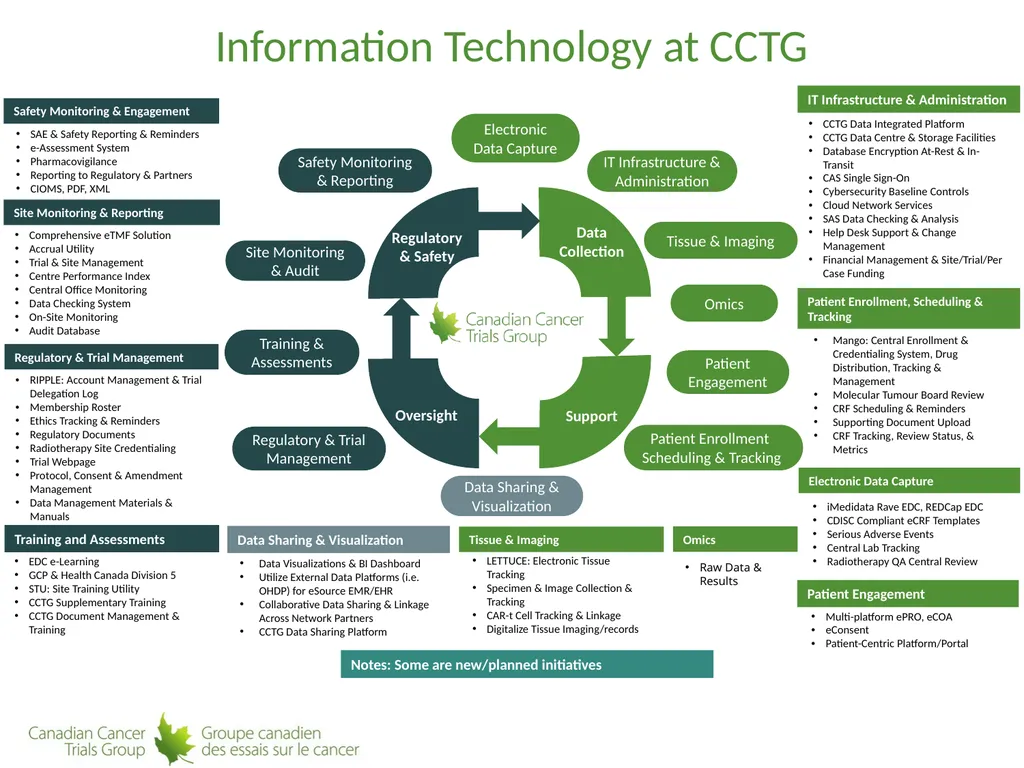
slide3. 3 Data
Collection Regulatory
& Safety Support Oversight Training & Assessments Patient Engagement Safety Monitoring & Reporting Electronic Data Capture Data Sharing & Visualization Tissue & Imaging Omics IT Infrastructure & Administration Site Monitoring & Audit Patient Enrollment
Scheduling & Tracking Regulatory & Trial Management Notes: Some are new/planned initiatives Information Technology at CCTG<br>
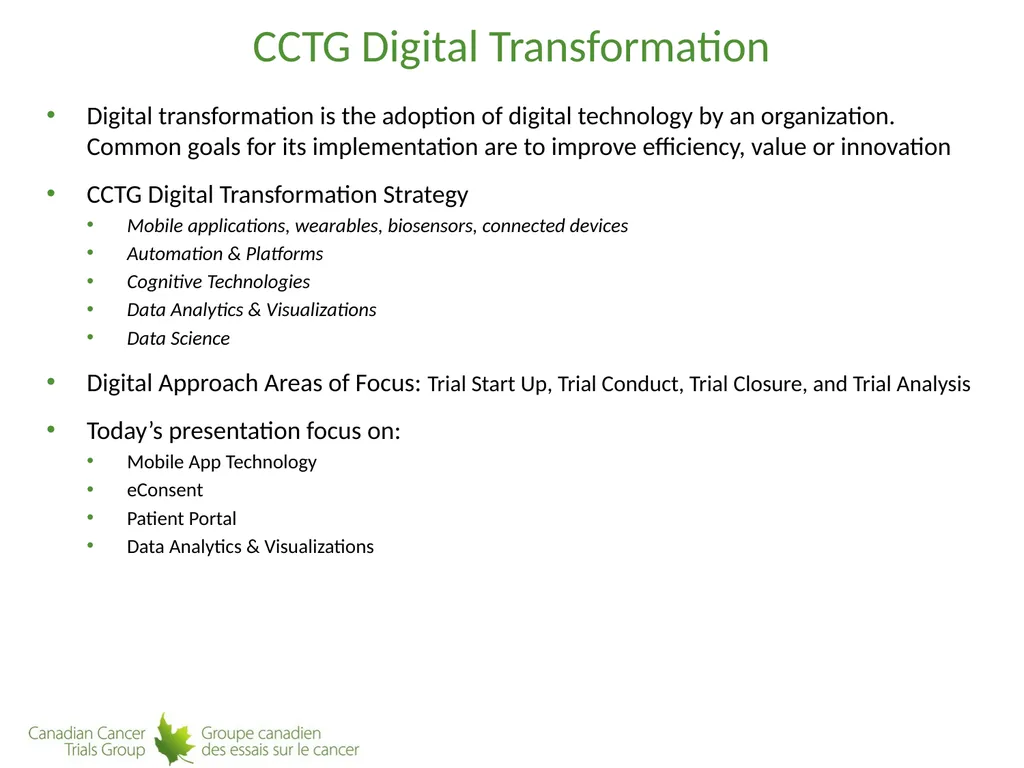
slide4. CCTG Digital Transformation Digital transformation is the adoption of digital technology by an organization. Common goals for its implementation are to improve efficiency, value or innovation
CCTG Digital Transformation Strategy
Mobile applications, wearables, biosensors, connected devices
Automation & Platforms
Cognitive Technologies
Data Analytics & Visualizations
Data Science
Digital Approach Areas of Focus: Trial Start Up, Trial Conduct, Trial Closure, and Trial Analysis
Today’s presentation focus on:
Mobile App Technology
eConsent
Patient Portal
Data Analytics & Visualizations 4<br>
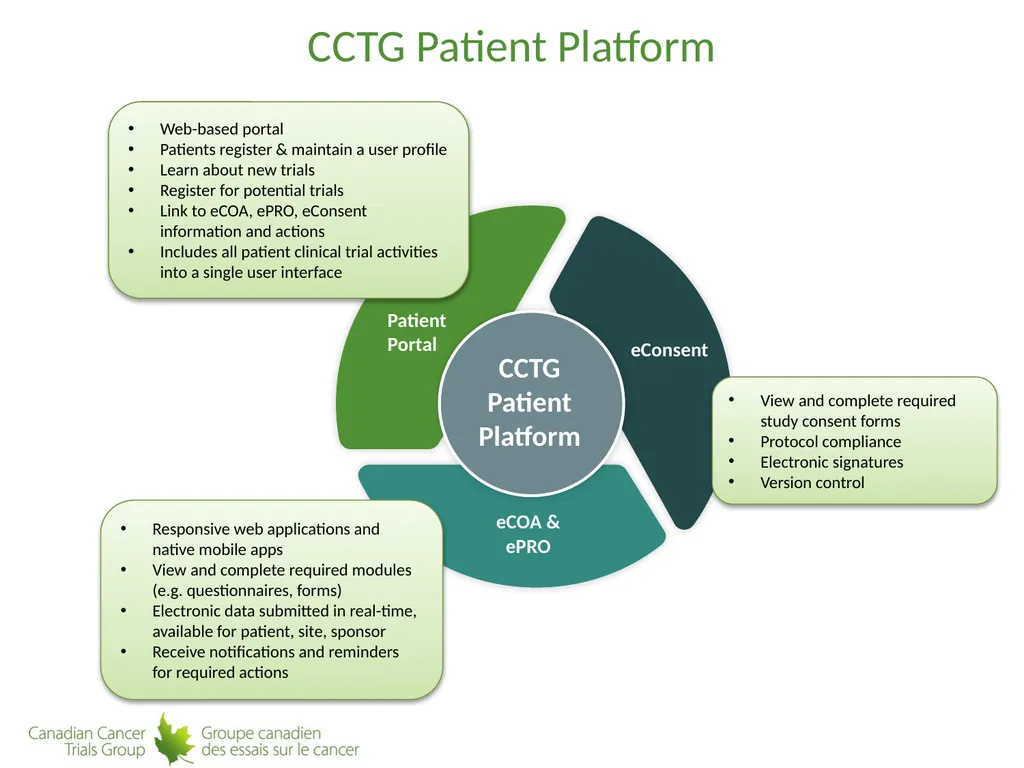
slide5. CCTG Patient Platform 5 Patient
Portal eConsent eCOA &
ePRO CCTG Patient
Platform Web-based portal
Patients register & maintain a user profile
Learn about new trials
Register for potential trials
Link to eCOA, ePRO, eConsent information and actions
Includes all patient clinical trial activities into a single user interface View and complete required study consent forms
Protocol compliance
Electronic signatures
Version control Responsive web applications and native mobile apps
View and complete required modules (e.g. questionnaires, forms)
Electronic data submitted in real-time, available for patient, site, sponsor
Receive notifications and reminders for required actions<br>
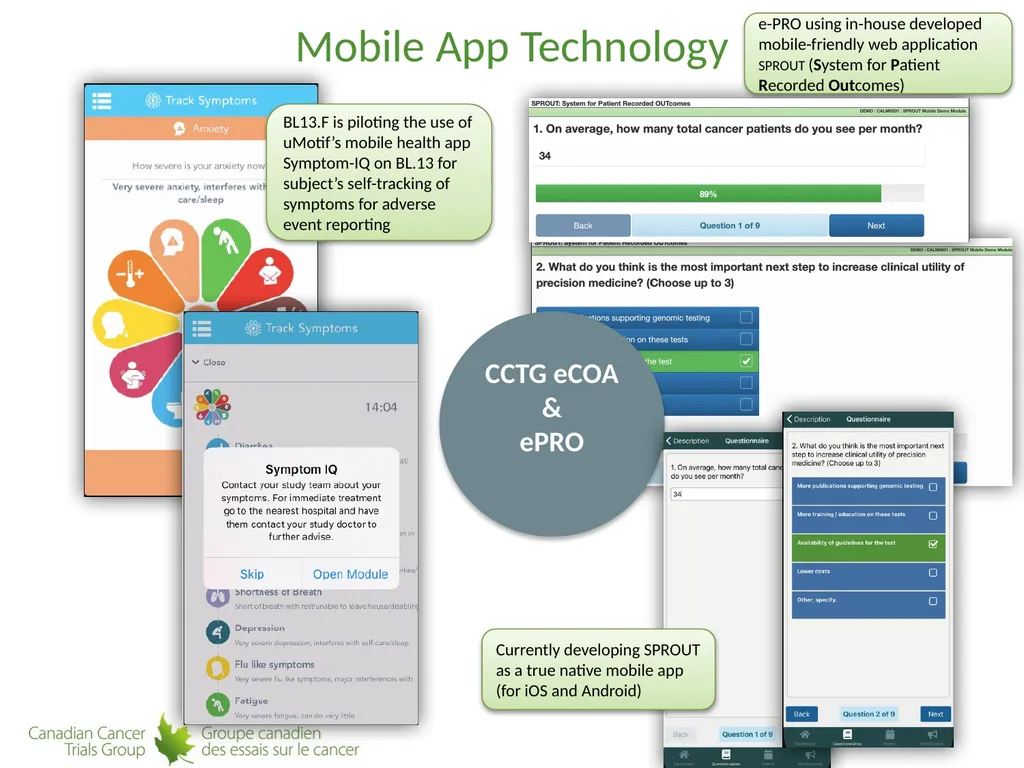
slide6. 6 CCTG eCOA
&
ePRO BL13.F is piloting the use of uMotif’s mobile health app Symptom-IQ on BL.13 for subject’s self-tracking of symptoms for adverse event reporting e-PRO using in-house developed mobile-friendly web application SPROUT (System for Patient Recorded Outcomes) Currently developing SPROUT as a true native mobile app (for iOS and Android) Mobile App Technology<br>
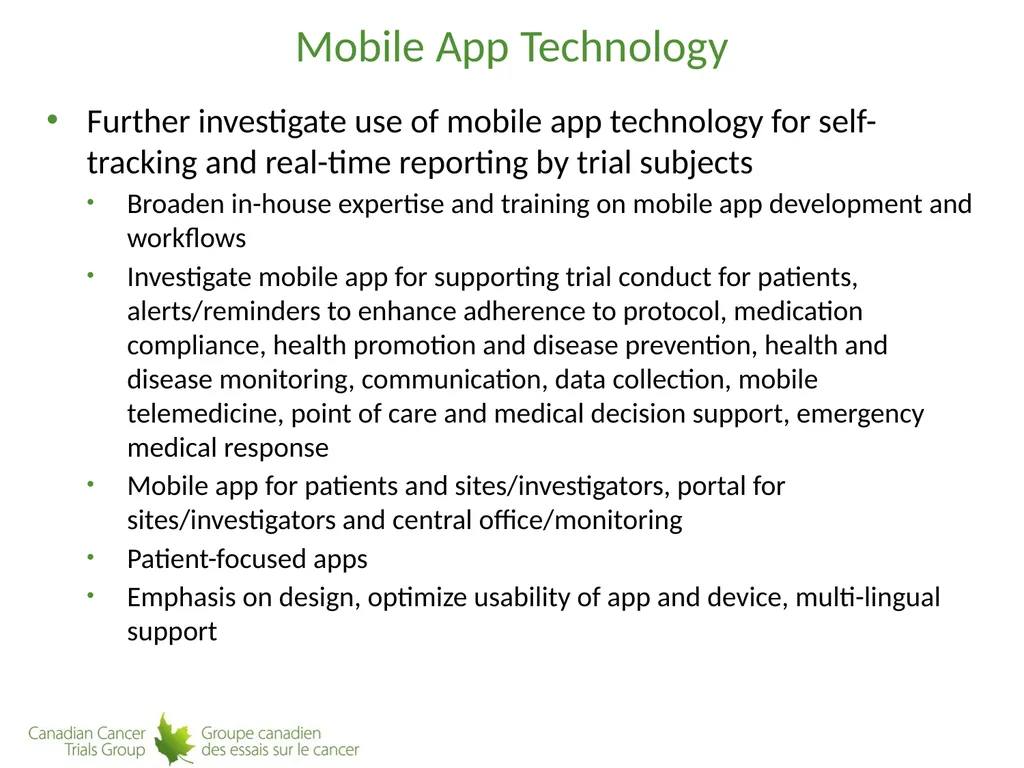
slide7. Mobile App Technology Further investigate use of mobile app technology for self-tracking and real-time reporting by trial subjects
Broaden in-house expertise and training on mobile app development and workflows
Investigate mobile app for supporting trial conduct for patients, alerts/reminders to enhance adherence to protocol, medication compliance, health promotion and disease prevention, health and disease monitoring, communication, data collection, mobile telemedicine, point of care and medical decision support, emergency medical response
Mobile app for patients and sites/investigators, portal for sites/investigators and central office/monitoring
Patient-focused apps
Emphasis on design, optimize usability of app and device, multi-lingual support 7<br>
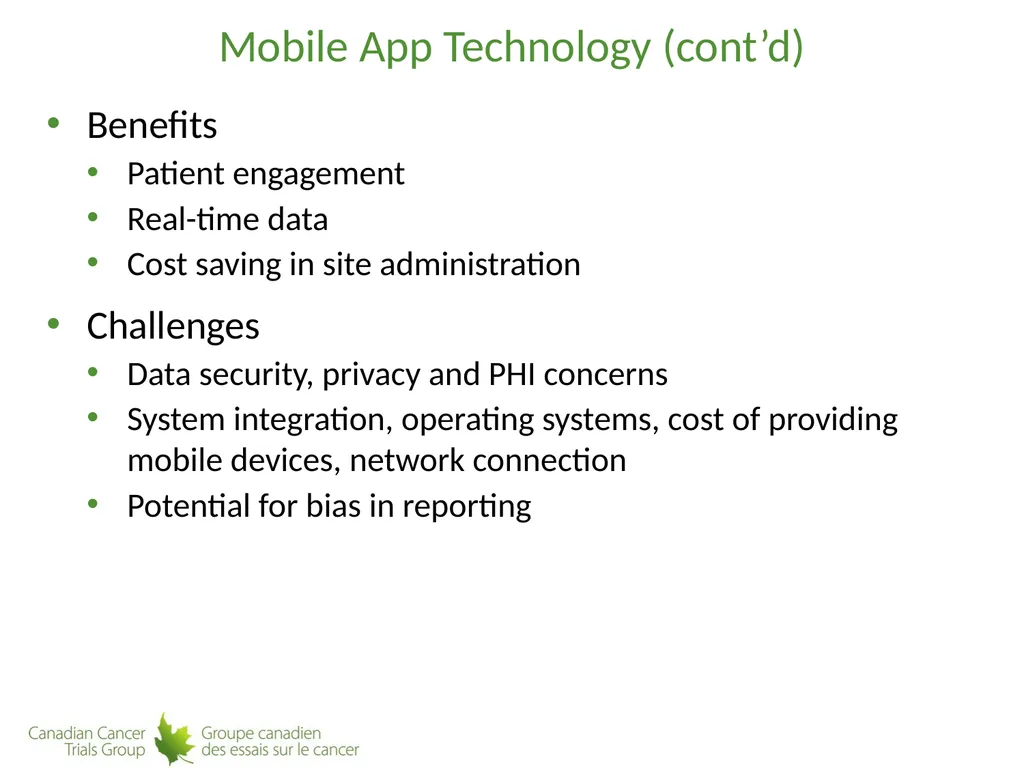
slide8. Mobile App Technology (cont’d) Benefits
Patient engagement
Real-time data
Cost saving in site administration
Challenges
Data security, privacy and PHI concerns
System integration, operating systems, cost of providing mobile devices, network connection
Potential for bias in reporting 8<br>
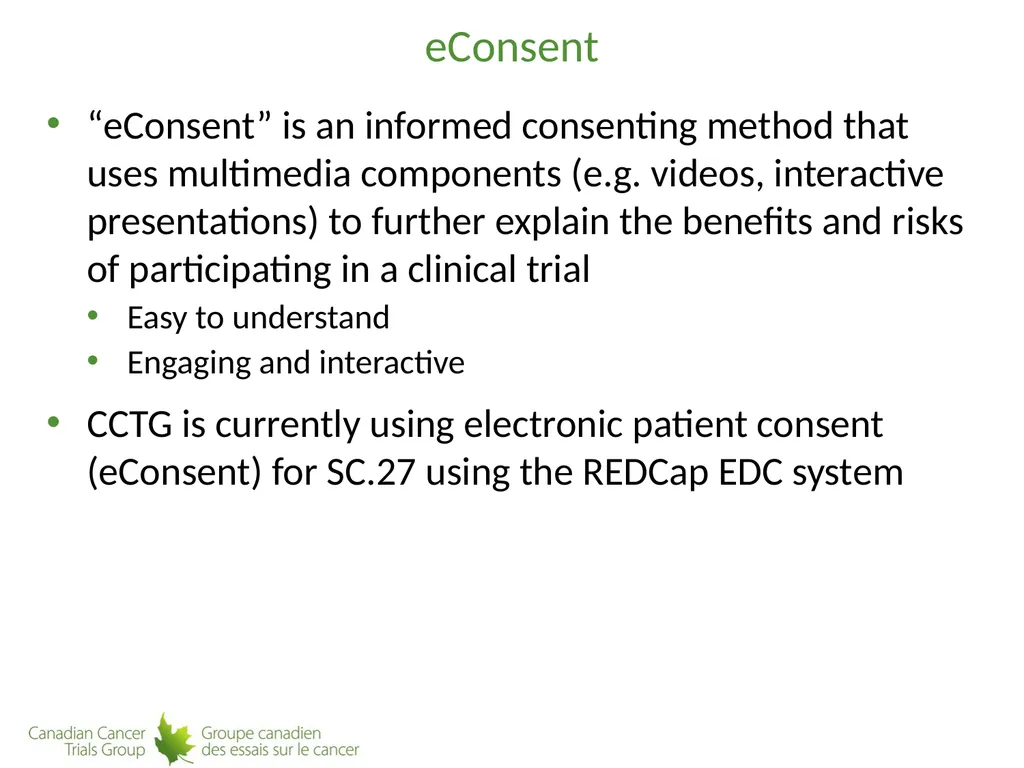
slide9. eConsent “eConsent” is an informed consenting method that uses multimedia components (e.g. videos, interactive presentations) to further explain the benefits and risks of participating in a clinical trial
Easy to understand
Engaging and interactive
CCTG is currently using electronic patient consent (eConsent) for SC.27 using the REDCap EDC system 9<br>
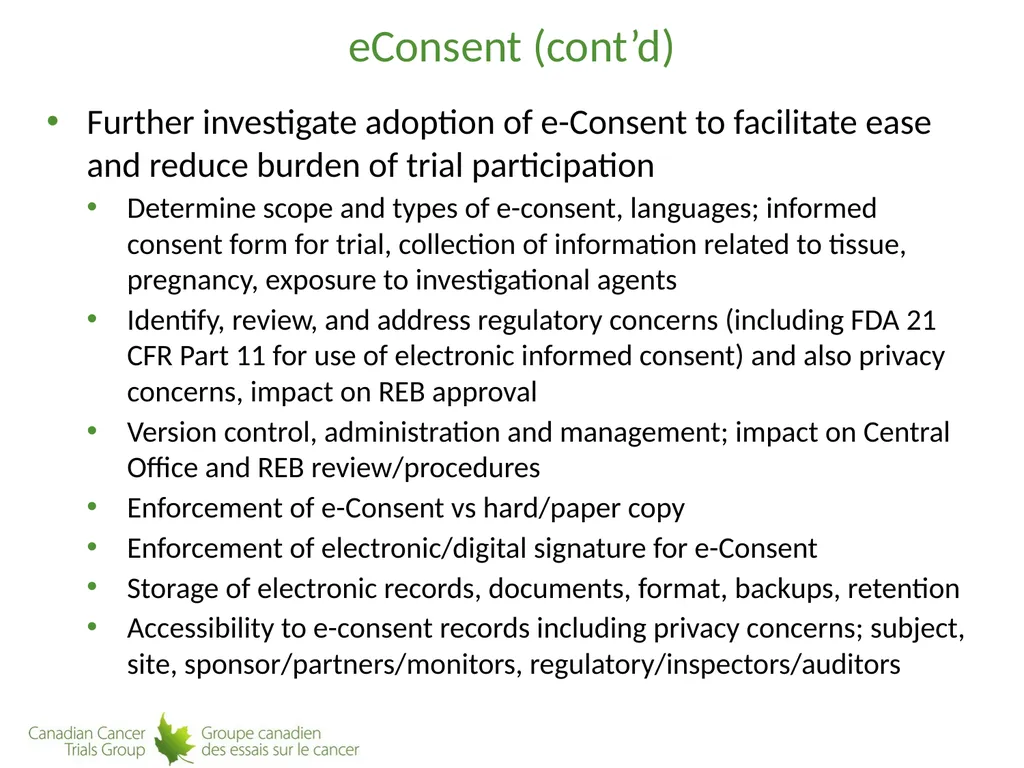
slide10. eConsent (cont’d) Further investigate adoption of e-Consent to facilitate ease and reduce burden of trial participation
Determine scope and types of e-consent, languages; informed consent form for trial, collection of information related to tissue, pregnancy, exposure to investigational agents
Identify, review, and address regulatory concerns (including FDA 21 CFR Part 11 for use of electronic informed consent) and also privacy concerns, impact on REB approval
Version control, administration and management; impact on Central Office and REB review/procedures
Enforcement of e-Consent vs hard/paper copy
Enforcement of electronic/digital signature for e-Consent
Storage of electronic records, documents, format, backups, retention
Accessibility to e-consent records including privacy concerns; subject, site, sponsor/partners/monitors, regulatory/inspectors/auditors 10<br>
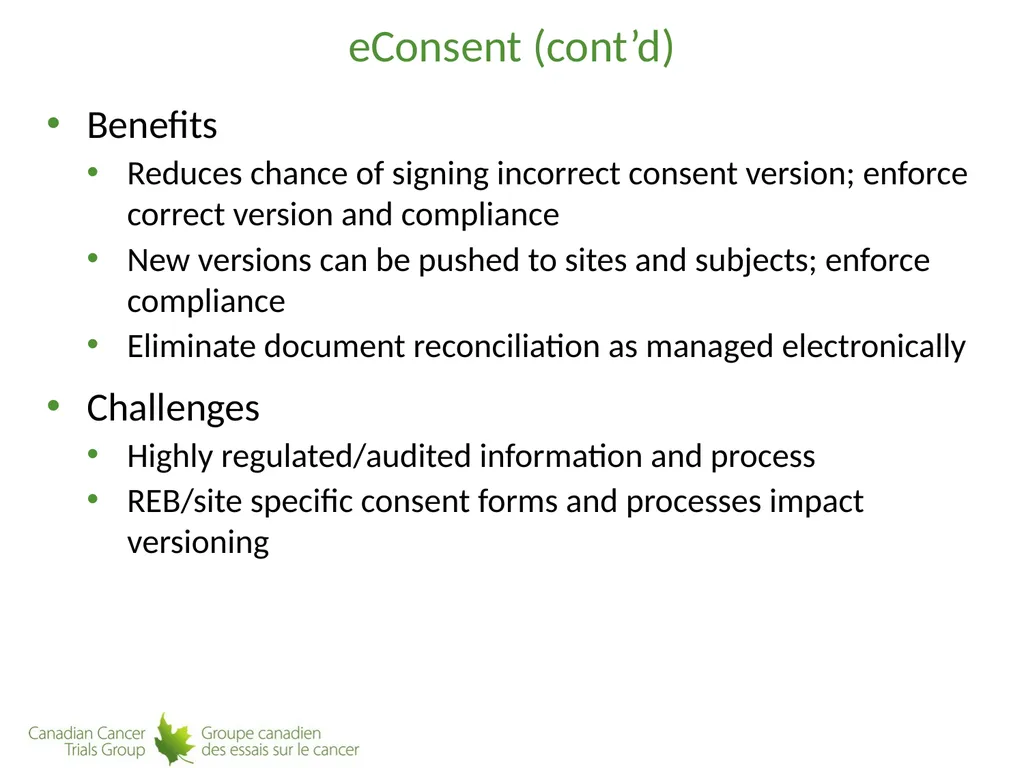
slide11. eConsent (cont’d) Benefits
Reduces chance of signing incorrect consent version; enforce correct version and compliance
New versions can be pushed to sites and subjects; enforce compliance
Eliminate document reconciliation as managed electronically
Challenges
Highly regulated/audited information and process
REB/site specific consent forms and processes impact versioning 11<br>
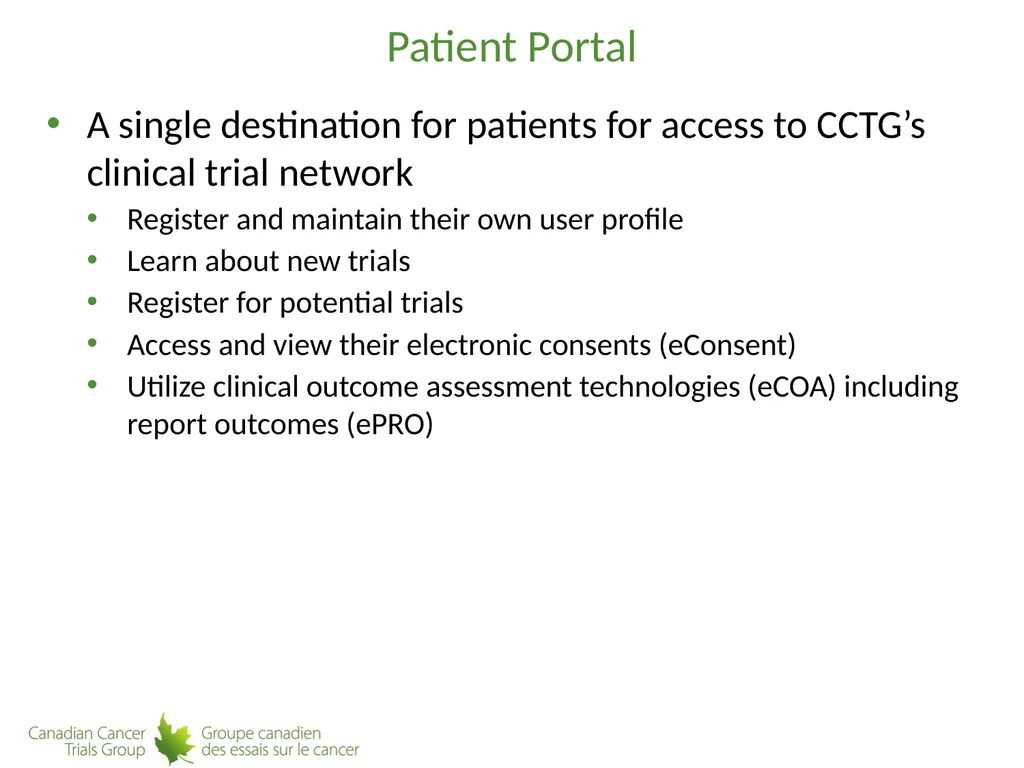
slide12. Patient Portal A single destination for patients for access to CCTG’s clinical trial network
Register and maintain their own user profile
Learn about new trials
Register for potential trials
Access and view their electronic consents (eConsent)
Utilize clinical outcome assessment technologies (eCOA) including report outcomes (ePRO) 12<br>
slide13. Data Analytics & Visualization Data analytics is a discipline focused on extracting insights from data. It comprises the processes, tools and techniques of data analysis and management, including the collection, organization, and storage of data.
https://www.cio.com/article/191313/what-is-data-analytics-analyzing-and-managing-data-for-decisions.html
Data visualization is the graphical representation of information and data. By using visual elements like charts, graphs, and maps, data visualization tools provide an accessible way to see and understand trends, outliers, and patterns in data.
https://www.tableau.com/learn/articles/data-visualization 13<br>
slide14. Data Analytics & Visualizations CCTG has a variety of applications for monitoring its trials including the Centre Performance Index (CPI) and monitoring reports (outstanding queries, CRF timeliness)
These reports are mostly tabular and static (not real-time) 14<br>
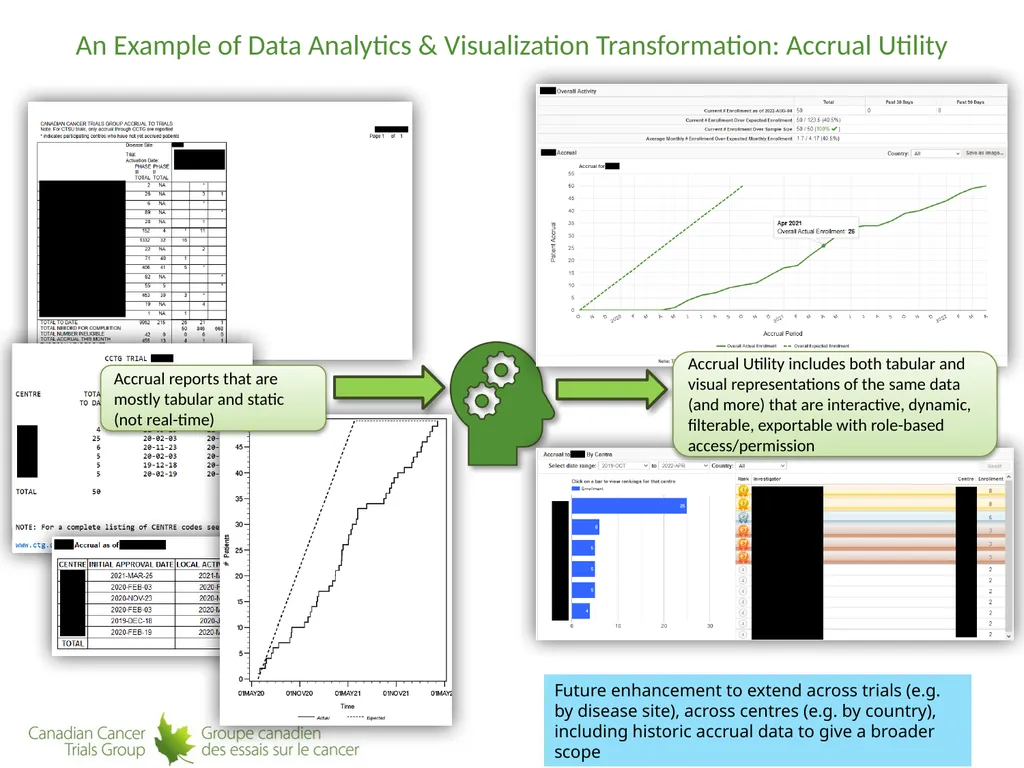
slide15. An Example of Data Analytics & Visualization Transformation: Accrual Utility 15 Accrual Utility includes both tabular and visual representations of the same data (and more) that are interactive, dynamic, filterable, exportable with role-based access/permission Accrual reports that are mostly tabular and static (not real-time) Future enhancement to extend across trials (e.g. by disease site), across centres (e.g. by country), including historic accrual data to give a broader scope<br>
slide16. Summary Increases in technological advances means more demand for IT resources, support and security
Systems and applications needs to keep up with current standards, trends, hardware/software requirements, devices and operating platforms, mobile technology
More data is being collected faster across different technologies; volume, velocity, variety
As a leader in innovation CCTG must continue to advance its technologies while maintaining commitments to quality, integrity and security 16<br>

slide17. Questions? 17<br>
slide18. Thank you 18<br>
slide2. Learning Objectives To review the current advancements in technologies for CCTG clinical trial conduct
Review examples such as mobile apps (SymptomIQ and SPROUT) for real-time patient self-reporting, and eConsent
To review the future direction of technologies at CCTG
Define Data Analytics and Visualization, review examples of future development including our patient portal, and platforms for data analytics and visualizations 2<br>
slide3. 3 Data
Collection Regulatory
& Safety Support Oversight Training & Assessments Patient Engagement Safety Monitoring & Reporting Electronic Data Capture Data Sharing & Visualization Tissue & Imaging Omics IT Infrastructure & Administration Site Monitoring & Audit Patient Enrollment
Scheduling & Tracking Regulatory & Trial Management Notes: Some are new/planned initiatives Information Technology at CCTG<br>
slide4. CCTG Digital Transformation Digital transformation is the adoption of digital technology by an organization. Common goals for its implementation are to improve efficiency, value or innovation
CCTG Digital Transformation Strategy
Mobile applications, wearables, biosensors, connected devices
Automation & Platforms
Cognitive Technologies
Data Analytics & Visualizations
Data Science
Digital Approach Areas of Focus: Trial Start Up, Trial Conduct, Trial Closure, and Trial Analysis
Today’s presentation focus on:
Mobile App Technology
eConsent
Patient Portal
Data Analytics & Visualizations 4<br>
slide5. CCTG Patient Platform 5 Patient
Portal eConsent eCOA &
ePRO CCTG Patient
Platform Web-based portal
Patients register & maintain a user profile
Learn about new trials
Register for potential trials
Link to eCOA, ePRO, eConsent information and actions
Includes all patient clinical trial activities into a single user interface View and complete required study consent forms
Protocol compliance
Electronic signatures
Version control Responsive web applications and native mobile apps
View and complete required modules (e.g. questionnaires, forms)
Electronic data submitted in real-time, available for patient, site, sponsor
Receive notifications and reminders for required actions<br>
slide6. 6 CCTG eCOA
&
ePRO BL13.F is piloting the use of uMotif’s mobile health app Symptom-IQ on BL.13 for subject’s self-tracking of symptoms for adverse event reporting e-PRO using in-house developed mobile-friendly web application SPROUT (System for Patient Recorded Outcomes) Currently developing SPROUT as a true native mobile app (for iOS and Android) Mobile App Technology<br>
slide7. Mobile App Technology Further investigate use of mobile app technology for self-tracking and real-time reporting by trial subjects
Broaden in-house expertise and training on mobile app development and workflows
Investigate mobile app for supporting trial conduct for patients, alerts/reminders to enhance adherence to protocol, medication compliance, health promotion and disease prevention, health and disease monitoring, communication, data collection, mobile telemedicine, point of care and medical decision support, emergency medical response
Mobile app for patients and sites/investigators, portal for sites/investigators and central office/monitoring
Patient-focused apps
Emphasis on design, optimize usability of app and device, multi-lingual support 7<br>
slide8. Mobile App Technology (cont’d) Benefits
Patient engagement
Real-time data
Cost saving in site administration
Challenges
Data security, privacy and PHI concerns
System integration, operating systems, cost of providing mobile devices, network connection
Potential for bias in reporting 8<br>
slide9. eConsent “eConsent” is an informed consenting method that uses multimedia components (e.g. videos, interactive presentations) to further explain the benefits and risks of participating in a clinical trial
Easy to understand
Engaging and interactive
CCTG is currently using electronic patient consent (eConsent) for SC.27 using the REDCap EDC system 9<br>
slide10. eConsent (cont’d) Further investigate adoption of e-Consent to facilitate ease and reduce burden of trial participation
Determine scope and types of e-consent, languages; informed consent form for trial, collection of information related to tissue, pregnancy, exposure to investigational agents
Identify, review, and address regulatory concerns (including FDA 21 CFR Part 11 for use of electronic informed consent) and also privacy concerns, impact on REB approval
Version control, administration and management; impact on Central Office and REB review/procedures
Enforcement of e-Consent vs hard/paper copy
Enforcement of electronic/digital signature for e-Consent
Storage of electronic records, documents, format, backups, retention
Accessibility to e-consent records including privacy concerns; subject, site, sponsor/partners/monitors, regulatory/inspectors/auditors 10<br>
slide11. eConsent (cont’d) Benefits
Reduces chance of signing incorrect consent version; enforce correct version and compliance
New versions can be pushed to sites and subjects; enforce compliance
Eliminate document reconciliation as managed electronically
Challenges
Highly regulated/audited information and process
REB/site specific consent forms and processes impact versioning 11<br>
slide12. Patient Portal A single destination for patients for access to CCTG’s clinical trial network
Register and maintain their own user profile
Learn about new trials
Register for potential trials
Access and view their electronic consents (eConsent)
Utilize clinical outcome assessment technologies (eCOA) including report outcomes (ePRO) 12<br>
slide13. Data Analytics & Visualization Data analytics is a discipline focused on extracting insights from data. It comprises the processes, tools and techniques of data analysis and management, including the collection, organization, and storage of data.
https://www.cio.com/article/191313/what-is-data-analytics-analyzing-and-managing-data-for-decisions.html
Data visualization is the graphical representation of information and data. By using visual elements like charts, graphs, and maps, data visualization tools provide an accessible way to see and understand trends, outliers, and patterns in data.
https://www.tableau.com/learn/articles/data-visualization 13<br>
slide14. Data Analytics & Visualizations CCTG has a variety of applications for monitoring its trials including the Centre Performance Index (CPI) and monitoring reports (outstanding queries, CRF timeliness)
These reports are mostly tabular and static (not real-time) 14<br>
slide15. An Example of Data Analytics & Visualization Transformation: Accrual Utility 15 Accrual Utility includes both tabular and visual representations of the same data (and more) that are interactive, dynamic, filterable, exportable with role-based access/permission Accrual reports that are mostly tabular and static (not real-time) Future enhancement to extend across trials (e.g. by disease site), across centres (e.g. by country), including historic accrual data to give a broader scope<br>
slide16. Summary Increases in technological advances means more demand for IT resources, support and security
Systems and applications needs to keep up with current standards, trends, hardware/software requirements, devices and operating platforms, mobile technology
More data is being collected faster across different technologies; volume, velocity, variety
As a leader in innovation CCTG must continue to advance its technologies while maintaining commitments to quality, integrity and security 16<br>
slide17. Questions? 17<br>
slide18. Thank you 18<br>