
TEMPERATURE INDEPENDENT PARAMAGNETISM (TIP) Name





Description: TEMPERATURE INDEPENDENT PARAMAGNETISM (TIP) Name of the instructor : U.Nithya M.Sc.,M.phil., Temperature independent paramagnetism (TIP): The nagnetic susceptibility resulting from the second order zeeman effect is independent of
Related Topics
Download Presentation
"TEMPERATURE INDEPENDENT PARAMAGNETISM (TIP) Name" is the property of its rightful owner. Permission is granted to download and print the materials on this website for personal, non-commercial use only, and to display it on your personal computer provided you do not modify the materials and that you retain all copyright notices contained in the materials. By downloading content from our website, you accept the terms of this agreement.
Presentation Transcript
slide1. TEMPERATURE INDEPENDENT PARAMAGNETISM (TIP) Name of the instructor : U.Nithya M.Sc.,M.phil.,<br>
slide2. Temperature independent paramagnetism (TIP):
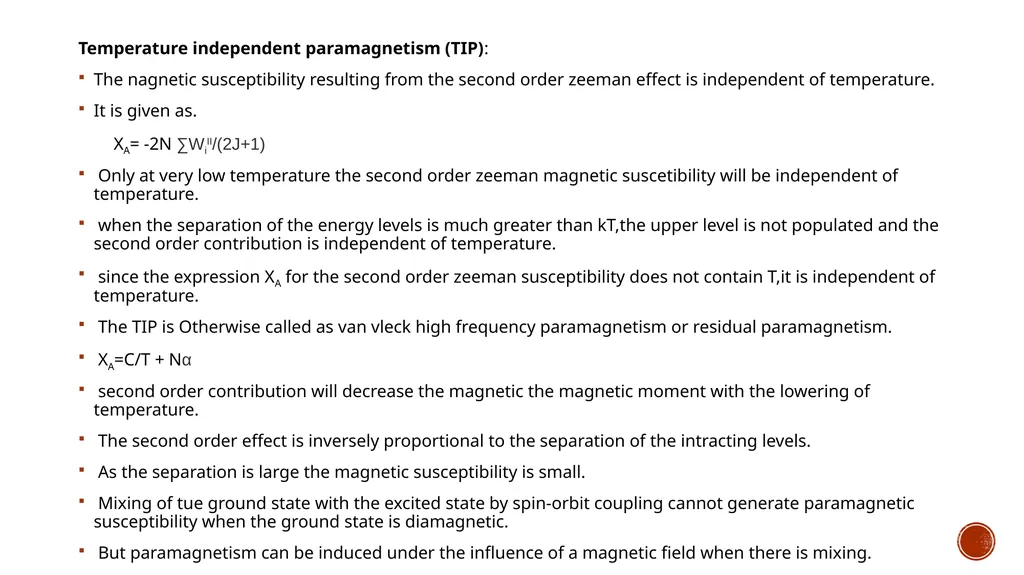
The nagnetic susceptibility resulting from the second order zeeman effect is independent of temperature.
It is given as.
XA= -2N ∑WiII/(2J+1)
Only at very low temperature the second order zeeman magnetic suscetibility will be independent of temperature.
when the separation of the energy levels is much greater than kT,the upper level is not populated and the second order contribution is independent of temperature.
since the expression XA for the second order zeeman susceptibility does not contain T,it is independent of temperature.
The TIP is Otherwise called as van vleck high frequency paramagnetism or residual paramagnetism.
XA=C/T + Nα
second order contribution will decrease the magnetic the magnetic moment with the lowering of temperature.
The second order effect is inversely proportional to the separation of the intracting levels.
As the separation is large the magnetic susceptibility is small.
Mixing of tue ground state with the excited state by spin-orbit coupling cannot generate paramagnetic susceptibility when the ground state is diamagnetic.
But paramagnetism can be induced under the influence of a magnetic field when there is mixing.<br>
slide3. Anamalous Magnetic Moments:
Anamalous magnetic moment is observed for metal ions of known symmetry with a given 10Dq values.
The value falls outside the range of magnetic moment predicted on the basis of the spin and orbital angular momenta of electrons in the metal ion.
In the octahedral symmetry the 3A2g ground state of Nickel (II) ion in the complex acquires some orbital contribution from the 2T2g excited state term due to spin – orbit coupling.
If 10Dq =8000cm-1 and λ = ~75% of the free ion value
μeff= μs (1-αλ/(10Dq)) = 3.3 B.M
For the tetrahedral Nickel (II) the ground state is 3T1 and μ =~3.5-4.0 B.M.
Diamagnetic squre planar Nickel(II) complex ,the anomalous behaviour is found to be~0-2.8 B.M.<br>
slide4. The anomalous behaviour in magnetic moment is supposed to be due to the following:
Equlibrium between two spin states
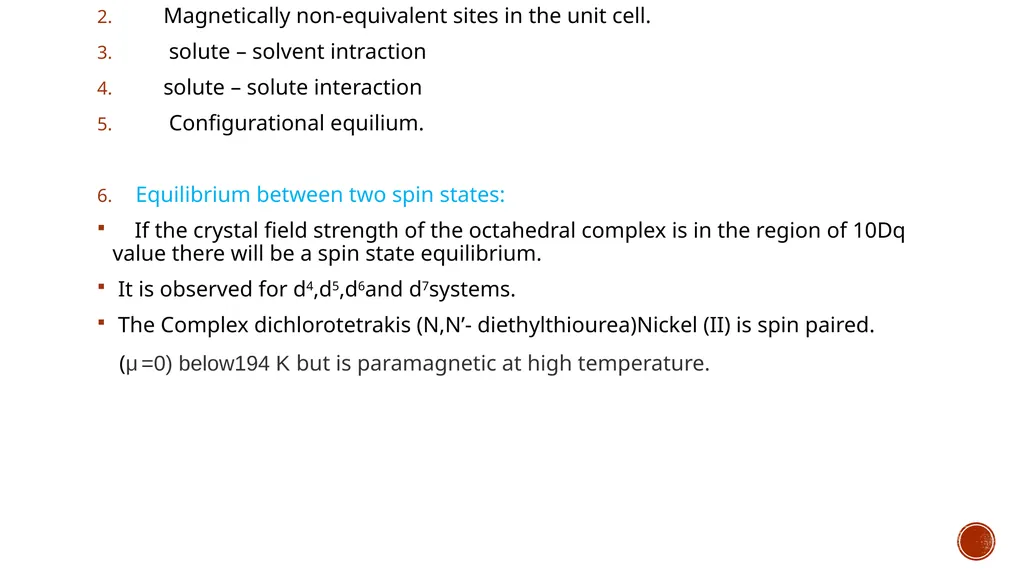
Magnetically non-equivalent sites in the unit cell.
solute – solvent intraction
solute – solute interaction
Configurational equilium.
Equilibrium between two spin states:
If the crystal field strength of the octahedral complex is in the region of 10Dq value there will be a spin state equilibrium.
It is observed for d4,d5,d6and d7systems.
The Complex dichlorotetrakis (N,N’- diethylthiourea)Nickel (II) is spin paired.
(μ =0) below194 K but is paramagnetic at high temperature.<br>
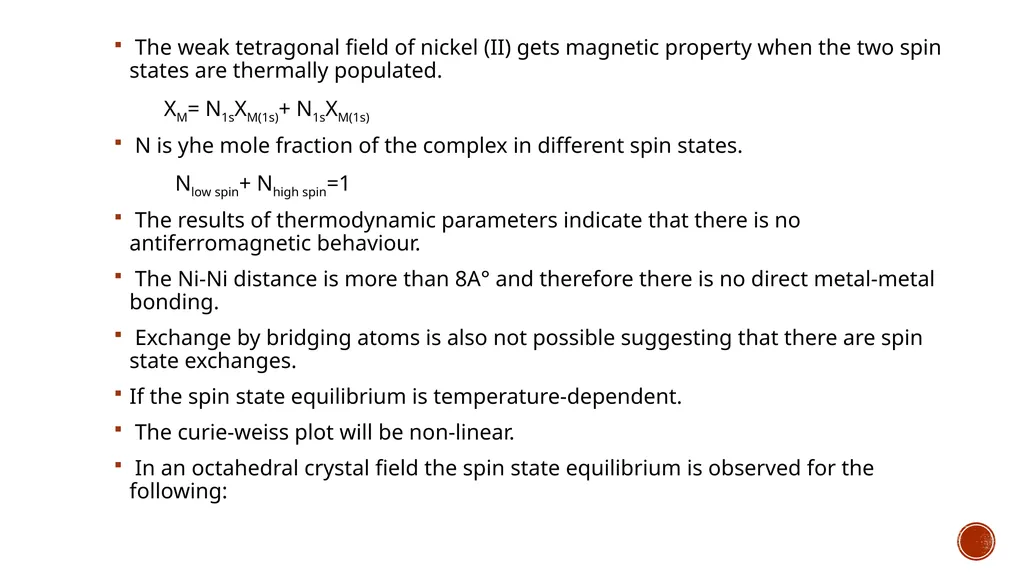
slide5. The weak tetragonal field of nickel (II) gets magnetic property when the two spin states are thermally populated.
XM= N1sXM(1s)+ N1sXM(1s)
N is yhe mole fraction of the complex in different spin states.
Nlow spin+ Nhigh spin=1
The results of thermodynamic parameters indicate that there is no antiferromagnetic behaviour.
The Ni-Ni distance is more than 8A° and therefore there is no direct metal-metal bonding.
Exchange by bridging atoms is also not possible suggesting that there are spin state exchanges.
If the spin state equilibrium is temperature-dependent.
The curie-weiss plot will be non-linear.
In an octahedral crystal field the spin state equilibrium is observed for the following:<br>
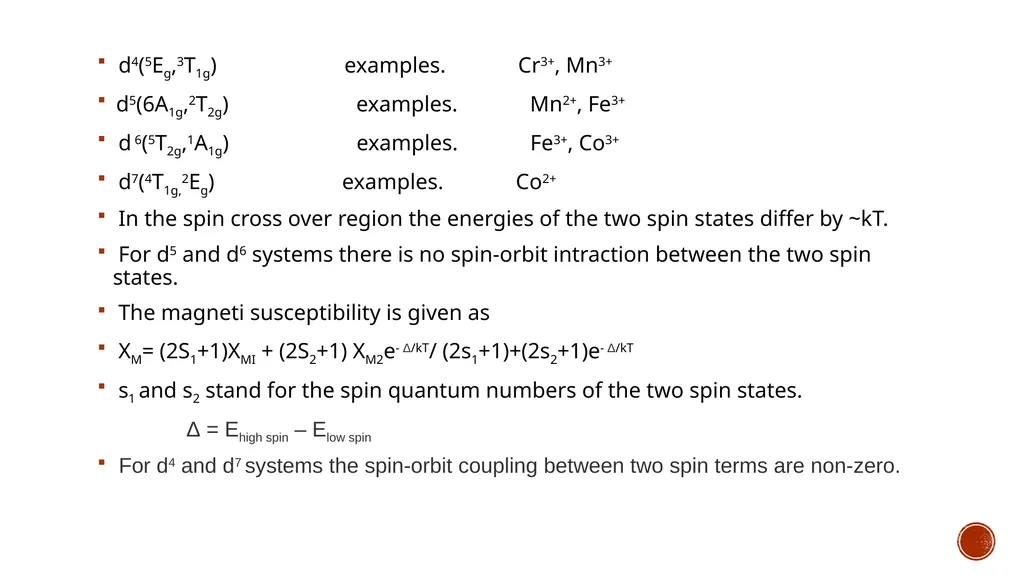
slide6. d4(5Eg,3T1g) examples. Cr3+, Mn3+
d5(6A1g,2T2g) examples. Mn2+, Fe3+
d 6(5T2g,1A1g) examples. Fe3+, Co3+
d7(4T1g,2Eg) examples. Co2+
In the spin cross over region the energies of the two spin states differ by ~kT.
For d5 and d6 systems there is no spin-orbit intraction between the two spin states.
The magneti susceptibility is given as
XM= (2S1+1)XMI + (2S2+1) XM2e- Δ/kT/ (2s1+1)+(2s2+1)e- Δ/kT
s1 and s2 stand for the spin quantum numbers of the two spin states.
Δ = Ehigh spin – Elow spin
For d4 and d7 systems the spin-orbit coupling between two spin terms are non-zero.<br>
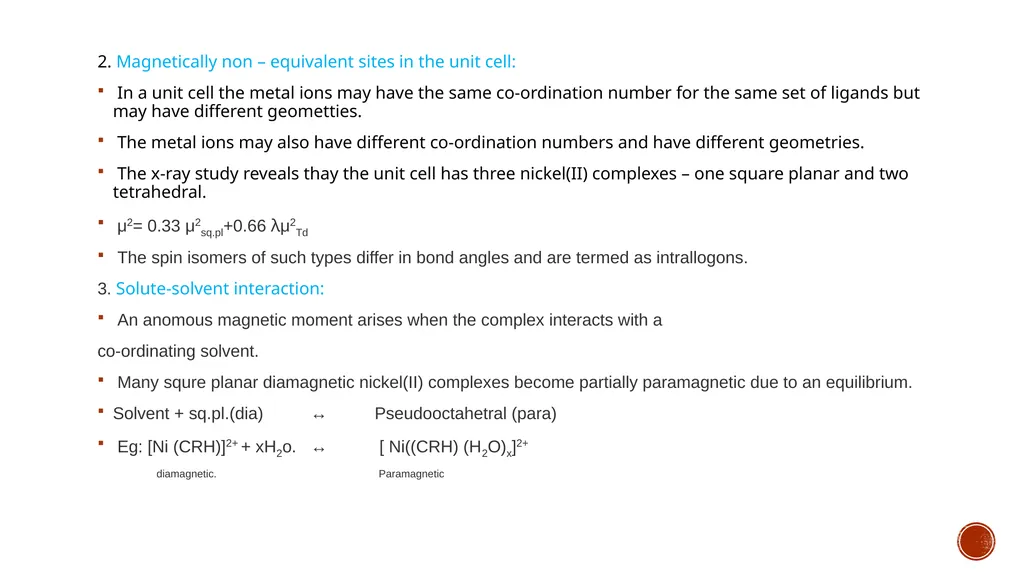
slide7. 2. Magnetically non – equivalent sites in the unit cell:
In a unit cell the metal ions may have the same co-ordination number for the same set of ligands but may have different geometties.
The metal ions may also have different co-ordination numbers and have different geometries.
The x-ray study reveals thay the unit cell has three nickel(II) complexes – one square planar and two tetrahedral.
μ2= 0.33 μ2sq.pl+0.66 λμ2Td
The spin isomers of such types differ in bond angles and are termed as intrallogons.
3. Solute-solvent interaction:
An anomous magnetic moment arises when the complex interacts with a
co-ordinating solvent.
Many squre planar diamagnetic nickel(II) complexes become partially paramagnetic due to an equilibrium.
Solvent + sq.pl.(dia) ↔ Pseudooctahetral (para)
Eg: [Ni (CRH)]2+ + xH2o. ↔ [ Ni((CRH) (H2O)x]2+
diamagnetic. Paramagnetic<br>
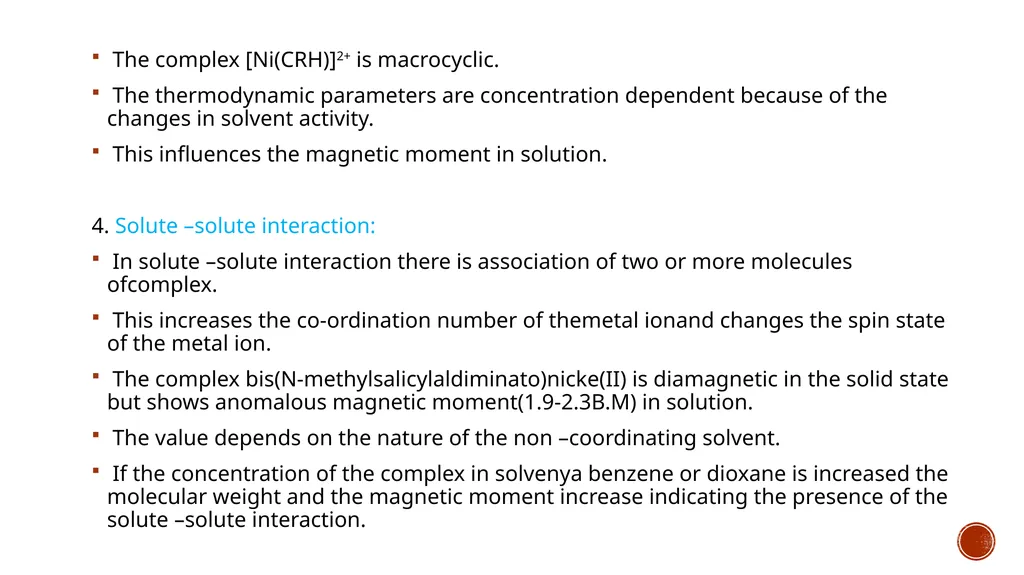
slide8. The complex [Ni(CRH)]2+ is macrocyclic.
The thermodynamic parameters are concentration dependent because of the changes in solvent activity.
This influences the magnetic moment in solution.
4. Solute –solute interaction:
In solute –solute interaction there is association of two or more molecules ofcomplex.
This increases the co-ordination number of themetal ionand changes the spin state of the metal ion.
The complex bis(N-methylsalicylaldiminato)nicke(II) is diamagnetic in the solid state but shows anomalous magnetic moment(1.9-2.3B.M) in solution.
The value depends on the nature of the non –coordinating solvent.
If the concentration of the complex in solvenya benzene or dioxane is increased the molecular weight and the magnetic moment increase indicating the presence of the solute –solute interaction.<br>
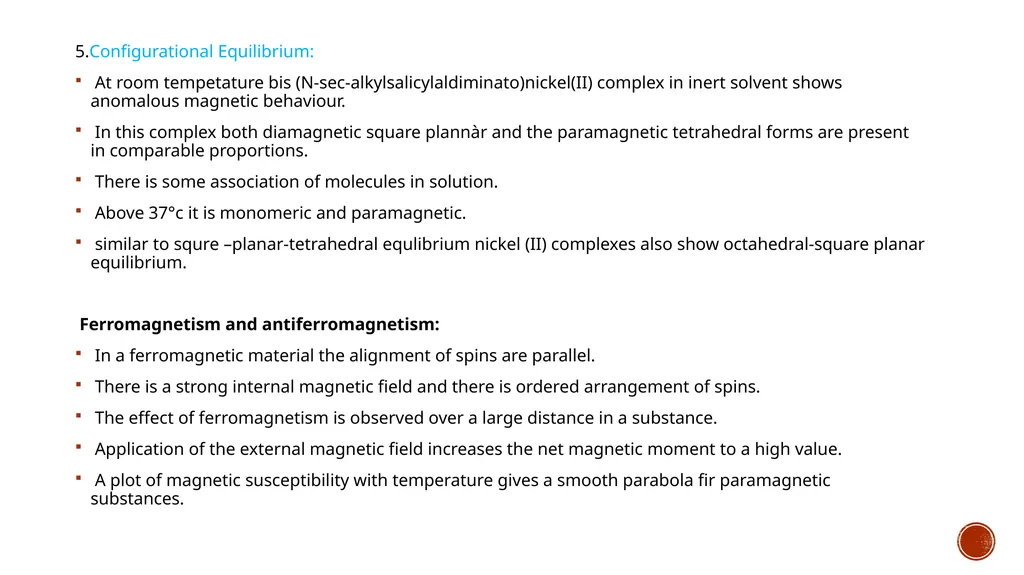
slide9. 5.Configurational Equilibrium:
At room tempetature bis (N-sec-alkylsalicylaldiminato)nickel(II) complex in inert solvent shows anomalous magnetic behaviour.
In this complex both diamagnetic square plannàr and the paramagnetic tetrahedral forms are present in comparable proportions.
There is some association of molecules in solution.
Above 37°c it is monomeric and paramagnetic.
similar to squre –planar-tetrahedral equlibrium nickel (II) complexes also show octahedral-square planar equilibrium.
Ferromagnetism and antiferromagnetism:
In a ferromagnetic material the alignment of spins are parallel.
There is a strong internal magnetic field and there is ordered arrangement of spins.
The effect of ferromagnetism is observed over a large distance in a substance.
Application of the external magnetic field increases the net magnetic moment to a high value.
A plot of magnetic susceptibility with temperature gives a smooth parabola fir paramagnetic substances.<br>
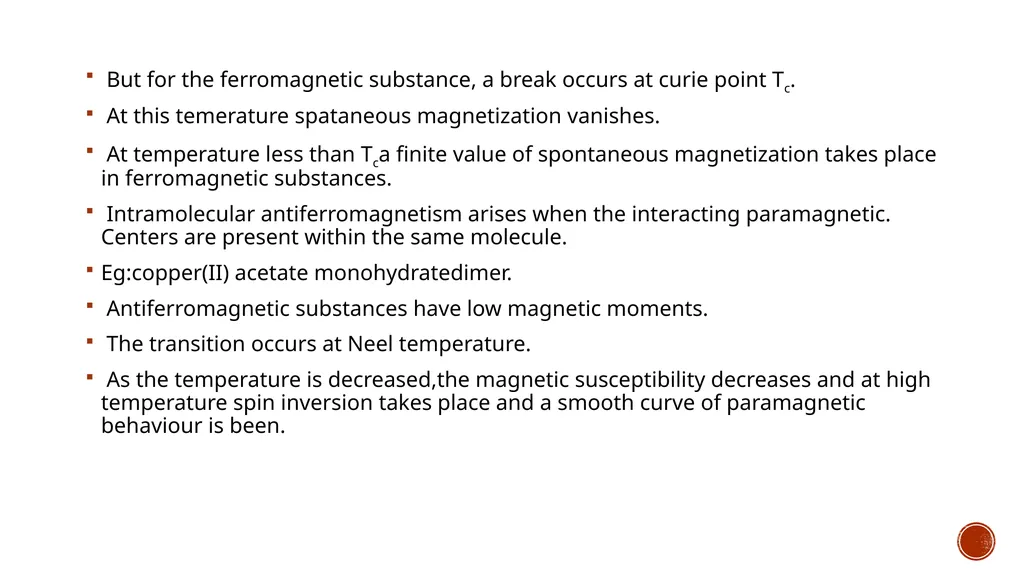
slide10. But for the ferromagnetic substance, a break occurs at curie point Tc.
At this temerature spataneous magnetization vanishes.
At temperature less than Tca finite value of spontaneous magnetization takes place in ferromagnetic substances.
Intramolecular antiferromagnetism arises when the interacting paramagnetic. Centers are present within the same molecule.
Eg:copper(II) acetate monohydratedimer.
Antiferromagnetic substances have low magnetic moments.
The transition occurs at Neel temperature.
As the temperature is decreased,the magnetic susceptibility decreases and at high temperature spin inversion takes place and a smooth curve of paramagnetic behaviour is been.<br>
slide11. Ferro and antiferromagnetic exchanges:
Magnetically dilute and concentrated transition metal complexes have anomalous magnetic moments.
Magnetic exchange intractions in such complexes occur when the neighbouring magnetic centers are close enough for direct or indirect orbital overlap.
This interaction affects the magnetic property of the complex.
This kind of interaction is dominant at a very low temperature.
when the exchange energy is greater than kT ferro and antiferromagnetisms arise.
The magnetic moment of a complex involved in an exchange interaction may be more then that of a complex not involved in an exchange interaction.
It is observed for ferromagnetic substances. If the value is less antiferromagnetism arises.<br>
slide12. Mechanism of exchange interaction:
spin –spin intraction giving a low magnetic moment takes place in any two processes
direct metal-metal interaction with the overlap of suitable metal orbitals.
super exchange phenomenon.
Direct metal-metal interaction:
When there is direct metal-metal interaction,the metal orbitals containing the unpaired electron spins overlap.
It is a dimer both in the solid state and in solution.
The cu-cu distance in the complex is 2.64A°.
Two copper atons bridged by four acetate groups with two water molecules co-ordinating along the Cu-Cu axis.
There is a laternal overlap of dX2-Y2 orbitals of each of the two copper(II)ions generating a δ bond.
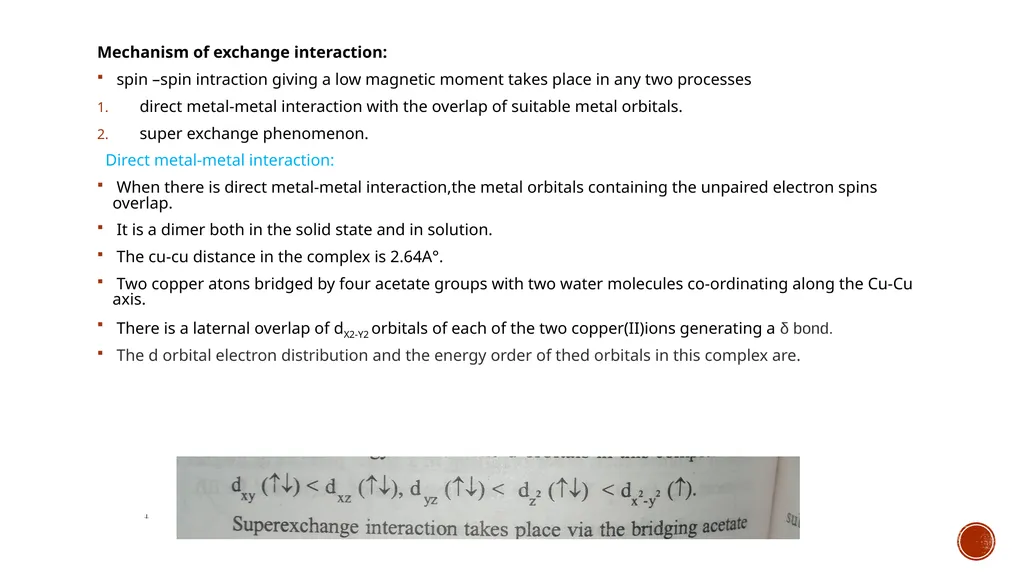
The d orbital electron distribution and the energy order of thed orbitals in this complex are.<br>
slide13. The hole in the dx2-y2 orbital (2B1state) mixes with the hole in the dxy orbital (2B2state) in the super exchange process.
The δ bond in this complex is weak.
The exchange interaction increases with the increase in the Cu-Cu distance.
Antiferromagnetic interaction takes place in copper(II) acetate dimer.
since the dx2-y2 orbitals δ overlap the dimer has the antiferromagnetic behaviour.
spin pairing takes place.
The antiferromagnetic intraction will be stronger if the metal-metal distance is shorter.
if the acetate ion supplies more electron density to coper(II).<br>
slide14. Super exchange phenomenon:
super exchange phenomenon arising from the transfer of paramagnetic spin density from one metal ion through the orbital overlap of the diamagnetic bridging atoms to an adjcent metal ions.
Thus the super exchange Phenomenon involves three atoms.
During this process of exchange the long metal-metal distance is maintained.
This makes the system magnetically concentrated system the metal – metal distance is short.<br>
slide15. THANK YOU<br>
slide2. Temperature independent paramagnetism (TIP):
The nagnetic susceptibility resulting from the second order zeeman effect is independent of temperature.
It is given as.
XA= -2N ∑WiII/(2J+1)
Only at very low temperature the second order zeeman magnetic suscetibility will be independent of temperature.
when the separation of the energy levels is much greater than kT,the upper level is not populated and the second order contribution is independent of temperature.
since the expression XA for the second order zeeman susceptibility does not contain T,it is independent of temperature.
The TIP is Otherwise called as van vleck high frequency paramagnetism or residual paramagnetism.
XA=C/T + Nα
second order contribution will decrease the magnetic the magnetic moment with the lowering of temperature.
The second order effect is inversely proportional to the separation of the intracting levels.
As the separation is large the magnetic susceptibility is small.
Mixing of tue ground state with the excited state by spin-orbit coupling cannot generate paramagnetic susceptibility when the ground state is diamagnetic.
But paramagnetism can be induced under the influence of a magnetic field when there is mixing.<br>
slide3. Anamalous Magnetic Moments:
Anamalous magnetic moment is observed for metal ions of known symmetry with a given 10Dq values.
The value falls outside the range of magnetic moment predicted on the basis of the spin and orbital angular momenta of electrons in the metal ion.
In the octahedral symmetry the 3A2g ground state of Nickel (II) ion in the complex acquires some orbital contribution from the 2T2g excited state term due to spin – orbit coupling.
If 10Dq =8000cm-1 and λ = ~75% of the free ion value
μeff= μs (1-αλ/(10Dq)) = 3.3 B.M
For the tetrahedral Nickel (II) the ground state is 3T1 and μ =~3.5-4.0 B.M.
Diamagnetic squre planar Nickel(II) complex ,the anomalous behaviour is found to be~0-2.8 B.M.<br>
slide4. The anomalous behaviour in magnetic moment is supposed to be due to the following:
Equlibrium between two spin states
Magnetically non-equivalent sites in the unit cell.
solute – solvent intraction
solute – solute interaction
Configurational equilium.
Equilibrium between two spin states:
If the crystal field strength of the octahedral complex is in the region of 10Dq value there will be a spin state equilibrium.
It is observed for d4,d5,d6and d7systems.
The Complex dichlorotetrakis (N,N’- diethylthiourea)Nickel (II) is spin paired.
(μ =0) below194 K but is paramagnetic at high temperature.<br>
slide5. The weak tetragonal field of nickel (II) gets magnetic property when the two spin states are thermally populated.
XM= N1sXM(1s)+ N1sXM(1s)
N is yhe mole fraction of the complex in different spin states.
Nlow spin+ Nhigh spin=1
The results of thermodynamic parameters indicate that there is no antiferromagnetic behaviour.
The Ni-Ni distance is more than 8A° and therefore there is no direct metal-metal bonding.
Exchange by bridging atoms is also not possible suggesting that there are spin state exchanges.
If the spin state equilibrium is temperature-dependent.
The curie-weiss plot will be non-linear.
In an octahedral crystal field the spin state equilibrium is observed for the following:<br>
slide6. d4(5Eg,3T1g) examples. Cr3+, Mn3+
d5(6A1g,2T2g) examples. Mn2+, Fe3+
d 6(5T2g,1A1g) examples. Fe3+, Co3+
d7(4T1g,2Eg) examples. Co2+
In the spin cross over region the energies of the two spin states differ by ~kT.
For d5 and d6 systems there is no spin-orbit intraction between the two spin states.
The magneti susceptibility is given as
XM= (2S1+1)XMI + (2S2+1) XM2e- Δ/kT/ (2s1+1)+(2s2+1)e- Δ/kT
s1 and s2 stand for the spin quantum numbers of the two spin states.
Δ = Ehigh spin – Elow spin
For d4 and d7 systems the spin-orbit coupling between two spin terms are non-zero.<br>
slide7. 2. Magnetically non – equivalent sites in the unit cell:
In a unit cell the metal ions may have the same co-ordination number for the same set of ligands but may have different geometties.
The metal ions may also have different co-ordination numbers and have different geometries.
The x-ray study reveals thay the unit cell has three nickel(II) complexes – one square planar and two tetrahedral.
μ2= 0.33 μ2sq.pl+0.66 λμ2Td
The spin isomers of such types differ in bond angles and are termed as intrallogons.
3. Solute-solvent interaction:
An anomous magnetic moment arises when the complex interacts with a
co-ordinating solvent.
Many squre planar diamagnetic nickel(II) complexes become partially paramagnetic due to an equilibrium.
Solvent + sq.pl.(dia) ↔ Pseudooctahetral (para)
Eg: [Ni (CRH)]2+ + xH2o. ↔ [ Ni((CRH) (H2O)x]2+
diamagnetic. Paramagnetic<br>
slide8. The complex [Ni(CRH)]2+ is macrocyclic.
The thermodynamic parameters are concentration dependent because of the changes in solvent activity.
This influences the magnetic moment in solution.
4. Solute –solute interaction:
In solute –solute interaction there is association of two or more molecules ofcomplex.
This increases the co-ordination number of themetal ionand changes the spin state of the metal ion.
The complex bis(N-methylsalicylaldiminato)nicke(II) is diamagnetic in the solid state but shows anomalous magnetic moment(1.9-2.3B.M) in solution.
The value depends on the nature of the non –coordinating solvent.
If the concentration of the complex in solvenya benzene or dioxane is increased the molecular weight and the magnetic moment increase indicating the presence of the solute –solute interaction.<br>
slide9. 5.Configurational Equilibrium:
At room tempetature bis (N-sec-alkylsalicylaldiminato)nickel(II) complex in inert solvent shows anomalous magnetic behaviour.
In this complex both diamagnetic square plannàr and the paramagnetic tetrahedral forms are present in comparable proportions.
There is some association of molecules in solution.
Above 37°c it is monomeric and paramagnetic.
similar to squre –planar-tetrahedral equlibrium nickel (II) complexes also show octahedral-square planar equilibrium.
Ferromagnetism and antiferromagnetism:
In a ferromagnetic material the alignment of spins are parallel.
There is a strong internal magnetic field and there is ordered arrangement of spins.
The effect of ferromagnetism is observed over a large distance in a substance.
Application of the external magnetic field increases the net magnetic moment to a high value.
A plot of magnetic susceptibility with temperature gives a smooth parabola fir paramagnetic substances.<br>
slide10. But for the ferromagnetic substance, a break occurs at curie point Tc.
At this temerature spataneous magnetization vanishes.
At temperature less than Tca finite value of spontaneous magnetization takes place in ferromagnetic substances.
Intramolecular antiferromagnetism arises when the interacting paramagnetic. Centers are present within the same molecule.
Eg:copper(II) acetate monohydratedimer.
Antiferromagnetic substances have low magnetic moments.
The transition occurs at Neel temperature.
As the temperature is decreased,the magnetic susceptibility decreases and at high temperature spin inversion takes place and a smooth curve of paramagnetic behaviour is been.<br>
slide11. Ferro and antiferromagnetic exchanges:
Magnetically dilute and concentrated transition metal complexes have anomalous magnetic moments.
Magnetic exchange intractions in such complexes occur when the neighbouring magnetic centers are close enough for direct or indirect orbital overlap.
This interaction affects the magnetic property of the complex.
This kind of interaction is dominant at a very low temperature.
when the exchange energy is greater than kT ferro and antiferromagnetisms arise.
The magnetic moment of a complex involved in an exchange interaction may be more then that of a complex not involved in an exchange interaction.
It is observed for ferromagnetic substances. If the value is less antiferromagnetism arises.<br>
slide12. Mechanism of exchange interaction:
spin –spin intraction giving a low magnetic moment takes place in any two processes
direct metal-metal interaction with the overlap of suitable metal orbitals.
super exchange phenomenon.
Direct metal-metal interaction:
When there is direct metal-metal interaction,the metal orbitals containing the unpaired electron spins overlap.
It is a dimer both in the solid state and in solution.
The cu-cu distance in the complex is 2.64A°.
Two copper atons bridged by four acetate groups with two water molecules co-ordinating along the Cu-Cu axis.
There is a laternal overlap of dX2-Y2 orbitals of each of the two copper(II)ions generating a δ bond.
The d orbital electron distribution and the energy order of thed orbitals in this complex are.<br>
slide13. The hole in the dx2-y2 orbital (2B1state) mixes with the hole in the dxy orbital (2B2state) in the super exchange process.
The δ bond in this complex is weak.
The exchange interaction increases with the increase in the Cu-Cu distance.
Antiferromagnetic interaction takes place in copper(II) acetate dimer.
since the dx2-y2 orbitals δ overlap the dimer has the antiferromagnetic behaviour.
spin pairing takes place.
The antiferromagnetic intraction will be stronger if the metal-metal distance is shorter.
if the acetate ion supplies more electron density to coper(II).<br>
slide14. Super exchange phenomenon:
super exchange phenomenon arising from the transfer of paramagnetic spin density from one metal ion through the orbital overlap of the diamagnetic bridging atoms to an adjcent metal ions.
Thus the super exchange Phenomenon involves three atoms.
During this process of exchange the long metal-metal distance is maintained.
This makes the system magnetically concentrated system the metal – metal distance is short.<br>
slide15. THANK YOU<br>