01
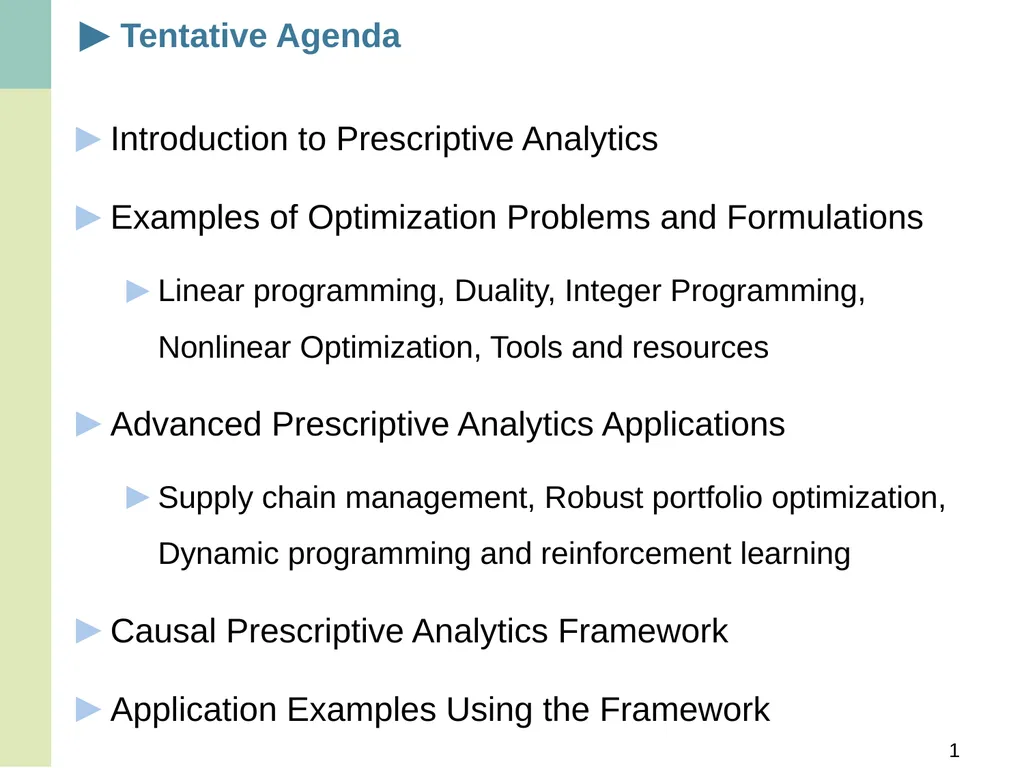
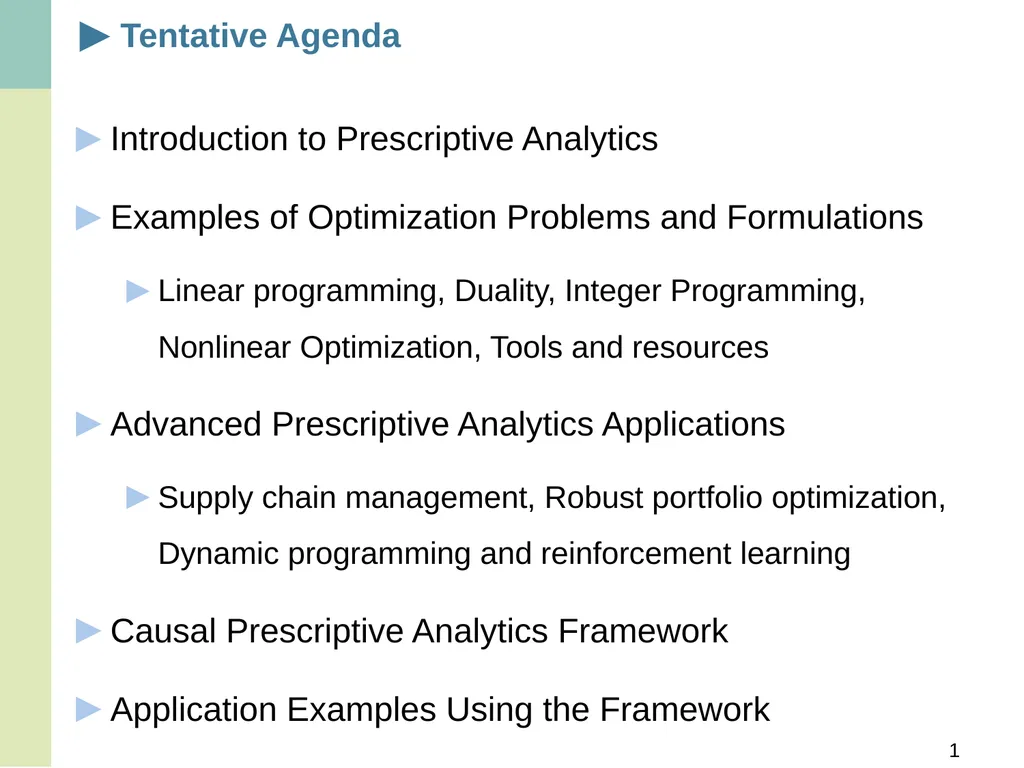
Tentative Agenda Introduction to Prescriptive Analytics
Examples of Optimization Problems and Formulations
Linear programming, Duality, Integer Programming, Nonlinear Optimization, Tools and resources
Advanced Prescriptive Analytics Applications
Supply chain management, Robust portfolio optimization, Dynamic programming and reinforcement learning
Causal Prescriptive Analytics Framework
Application Examples Using the Framework<br>
02
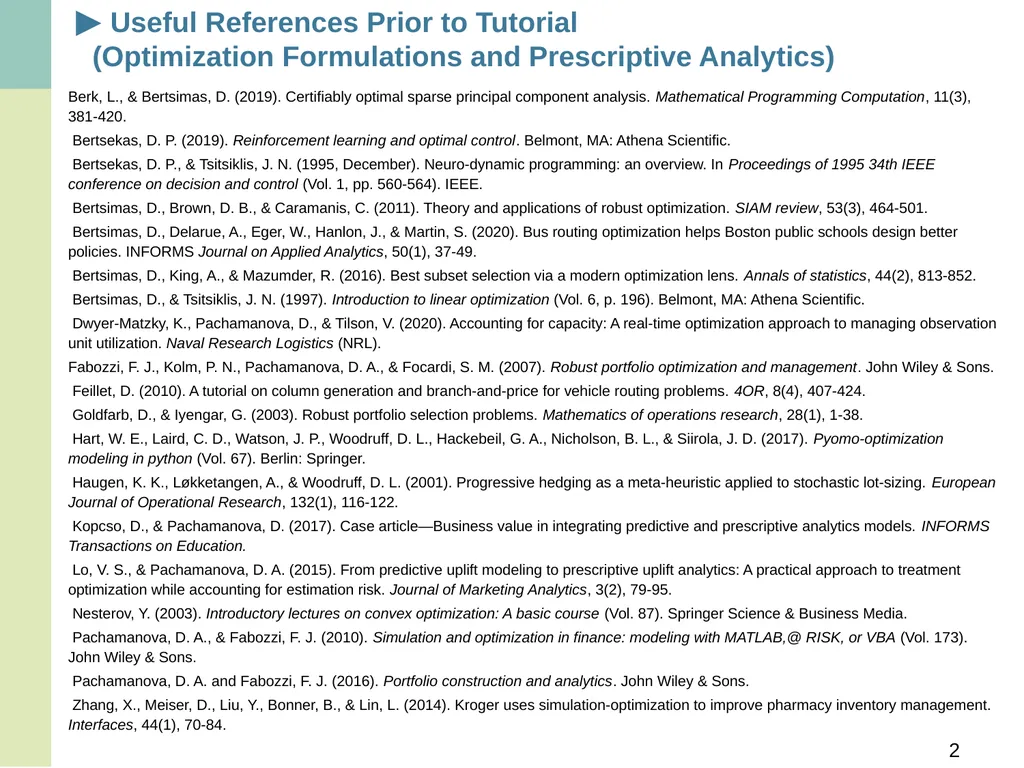
Useful References Prior to Tutorial �(Optimization Formulations and Prescriptive Analytics) Berk, L., & Bertsimas, D. (2019). Certifiably optimal sparse principal component analysis. Mathematical Programming Computation, 11(3), 381-420.
Bertsekas, D. P. (2019). Reinforcement learning and optimal control. Belmont, MA: Athena Scientific.
Bertsekas, D. P., & Tsitsiklis, J. N. (1995, December). Neuro-dynamic programming: an overview. In Proceedings of 1995 34th IEEE conference on decision and control (Vol. 1, pp. 560-564). IEEE.
Bertsimas, D., Brown, D. B., & Caramanis, C. (2011). Theory and applications of robust optimization. SIAM review, 53(3), 464-501.
Bertsimas, D., Delarue, A., Eger, W., Hanlon, J., & Martin, S. (2020). Bus routing optimization helps Boston public schools design better policies. INFORMS Journal on Applied Analytics, 50(1), 37-49.
Bertsimas, D., King, A., & Mazumder, R. (2016). Best subset selection via a modern optimization lens. Annals of statistics, 44(2), 813-852.
Bertsimas, D., & Tsitsiklis, J. N. (1997). Introduction to linear optimization (Vol. 6, p. 196). Belmont, MA: Athena Scientific.
Dwyer‐Matzky, K., Pachamanova, D., & Tilson, V. (2020). Accounting for capacity: A real‐time optimization approach to managing observation unit utilization. Naval Research Logistics (NRL).
Fabozzi, F. J., Kolm, P. N., Pachamanova, D. A., & Focardi, S. M. (2007). Robust portfolio optimization and management. John Wiley & Sons.
Feillet, D. (2010). A tutorial on column generation and branch-and-price for vehicle routing problems. 4OR, 8(4), 407-424.
Goldfarb, D., & Iyengar, G. (2003). Robust portfolio selection problems. Mathematics of operations research, 28(1), 1-38.
Hart, W. E., Laird, C. D., Watson, J. P., Woodruff, D. L., Hackebeil, G. A., Nicholson, B. L., & Siirola, J. D. (2017). Pyomo-optimization modeling in python (Vol. 67). Berlin: Springer.
Haugen, K. K., Løkketangen, A., & Woodruff, D. L. (2001). Progressive hedging as a meta-heuristic applied to stochastic lot-sizing. European Journal of Operational Research, 132(1), 116-122.
Kopcso, D., & Pachamanova, D. (2017). Case article—Business value in integrating predictive and prescriptive analytics models. INFORMS Transactions on Education.
Lo, V. S., & Pachamanova, D. A. (2015). From predictive uplift modeling to prescriptive uplift analytics: A practical approach to treatment optimization while accounting for estimation risk. Journal of Marketing Analytics, 3(2), 79-95.
Nesterov, Y. (2003). Introductory lectures on convex optimization: A basic course (Vol. 87). Springer Science & Business Media.
Pachamanova, D. A., & Fabozzi, F. J. (2010). Simulation and optimization in finance: modeling with MATLAB,@ RISK, or VBA (Vol. 173). John Wiley & Sons.
Pachamanova, D. A. and Fabozzi, F. J. (2016). Portfolio construction and analytics. John Wiley & Sons.
Zhang, X., Meiser, D., Liu, Y., Bonner, B., & Lin, L. (2014). Kroger uses simulation-optimization to improve pharmacy inventory management. Interfaces, 44(1), 70-84.<br>
03
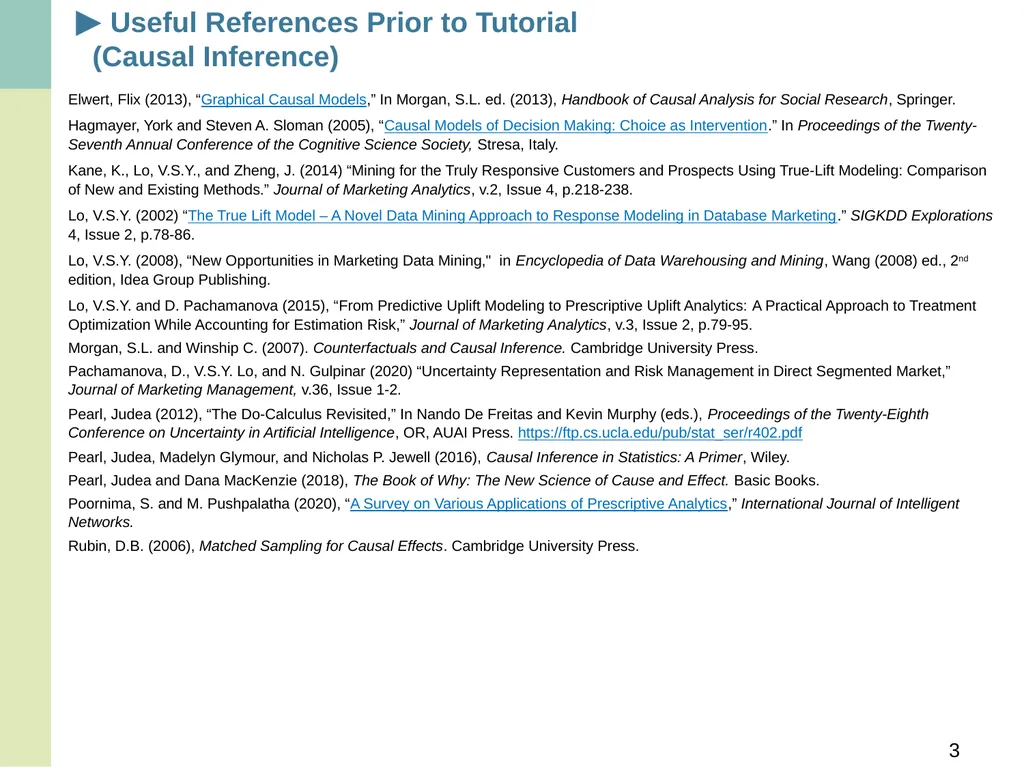
Useful References Prior to Tutorial �(Causal Inference) Elwert, Flix (2013), “Graphical Causal Models,” In Morgan, S.L. ed. (2013), Handbook of Causal Analysis for Social Research, Springer.
Hagmayer, York and Steven A. Sloman (2005), “Causal Models of Decision Making: Choice as Intervention.” In Proceedings of the Twenty-Seventh Annual Conference of the Cognitive Science Society, Stresa, Italy.
Kane, K., Lo, V.S.Y., and Zheng, J. (2014) “Mining for the Truly Responsive Customers and Prospects Using True-Lift Modeling: Comparison of New and Existing Methods.” Journal of Marketing Analytics, v.2, Issue 4, p.218-238.
Lo, V.S.Y. (2002) “The True Lift Model – A Novel Data Mining Approach to Response Modeling in Database Marketing.” SIGKDD Explorations 4, Issue 2, p.78-86.
Lo, V.S.Y. (2008), “New Opportunities in Marketing Data Mining," in Encyclopedia of Data Warehousing and Mining, Wang (2008) ed., 2nd edition, Idea Group Publishing.
Lo, V.S.Y. and D. Pachamanova (2015), “From Predictive Uplift Modeling to Prescriptive Uplift Analytics: A Practical Approach to Treatment Optimization While Accounting for Estimation Risk,” Journal of Marketing Analytics, v.3, Issue 2, p.79-95.
Morgan, S.L. and Winship C. (2007). Counterfactuals and Causal Inference. Cambridge University Press.
Pachamanova, D., V.S.Y. Lo, and N. Gulpinar (2020) “Uncertainty Representation and Risk Management in Direct Segmented Market,” Journal of Marketing Management, v.36, Issue 1-2.
Pearl, Judea (2012), “The Do-Calculus Revisited,” In Nando De Freitas and Kevin Murphy (eds.), Proceedings of the Twenty-Eighth Conference on Uncertainty in Artificial Intelligence, OR, AUAI Press. https://ftp.cs.ucla.edu/pub/stat_ser/r402.pdf
Pearl, Judea, Madelyn Glymour, and Nicholas P. Jewell (2016), Causal Inference in Statistics: A Primer, Wiley.
Pearl, Judea and Dana MacKenzie (2018), The Book of Why: The New Science of Cause and Effect. Basic Books.
Poornima, S. and M. Pushpalatha (2020), “A Survey on Various Applications of Prescriptive Analytics,” International Journal of Intelligent Networks.
Rubin, D.B. (2006), Matched Sampling for Causal Effects. Cambridge University Press.<br>