TERN: Stable Deterministic Multithreading through
Description: TERN: Stable Deterministic Multithreading through Schedule Memoization Heming Cui Jingyue Wu Chia-che Tsai Junfeng Yang Computer Science Columbia University New York, NY, USA 1 Nondeterministic Execution Same input many schedules Problem:
Related Topics
Download Presentation
"TERN: Stable Deterministic Multithreading through" is the property of its rightful owner. Permission is granted to download and print the materials on this website for personal, non-commercial use only, and to display it on your personal computer provided you do not modify the materials and that you retain all copyright notices contained in the materials. By downloading content from our website, you accept the terms of this agreement.
Presentation Transcript
slide1. TERN:Stable Deterministic Multithreading through Schedule Memoization Heming Cui
Jingyue Wu
Chia-che Tsai
Junfeng Yang
Computer Science
Columbia University
New York, NY, USA 1<br>
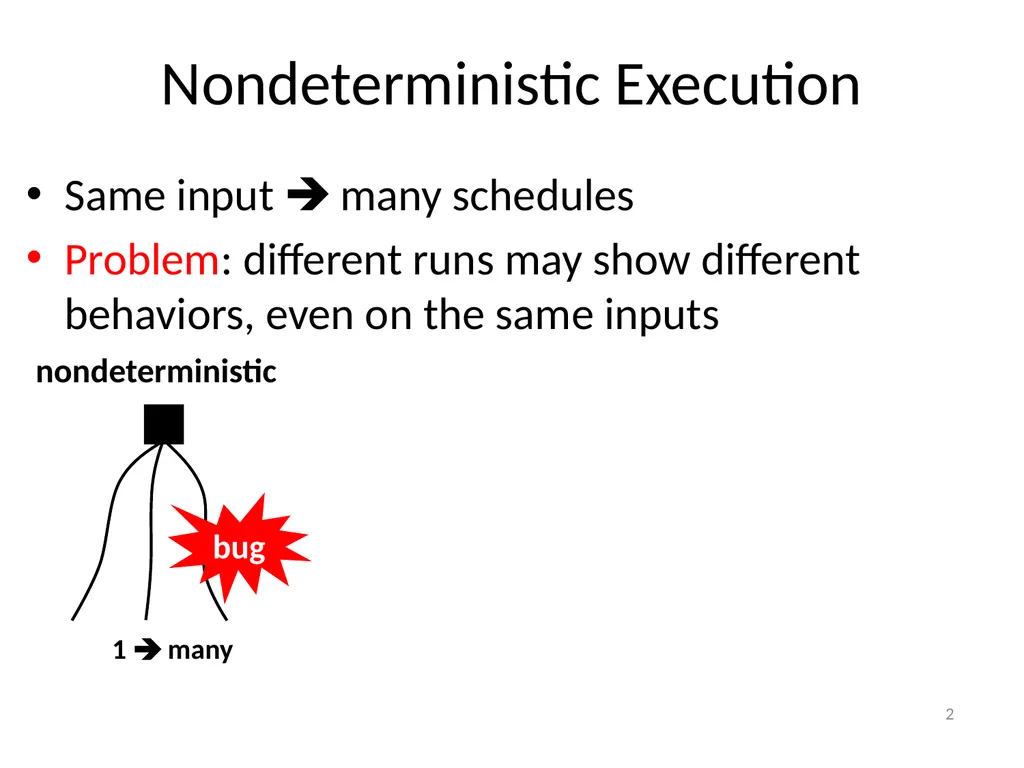
slide2. Nondeterministic Execution Same input many schedules
Problem: different runs may show different behaviors, even on the same inputs 2 nondeterministic bug 1 many<br>
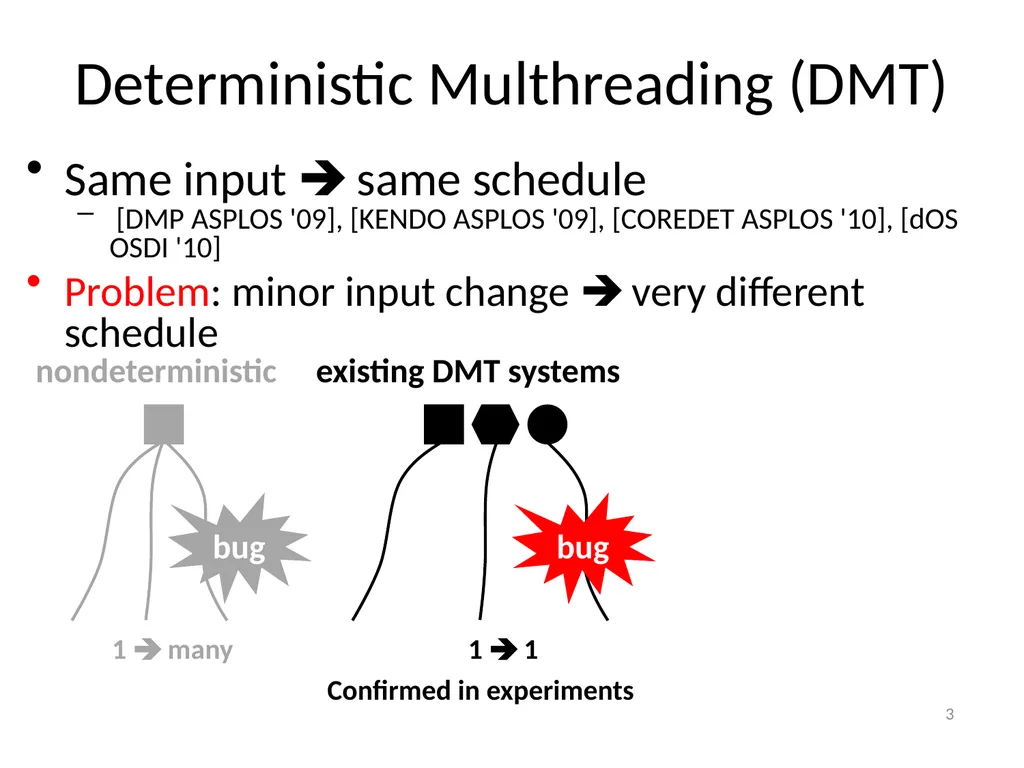
slide3. Deterministic Multhreading (DMT) Same input same schedule
[DMP ASPLOS '09], [KENDO ASPLOS '09], [COREDET ASPLOS '10], [dOS OSDI '10]
Problem: minor input change very different schedule 3 existing DMT systems bug 1 1 Confirmed in experiments<br>
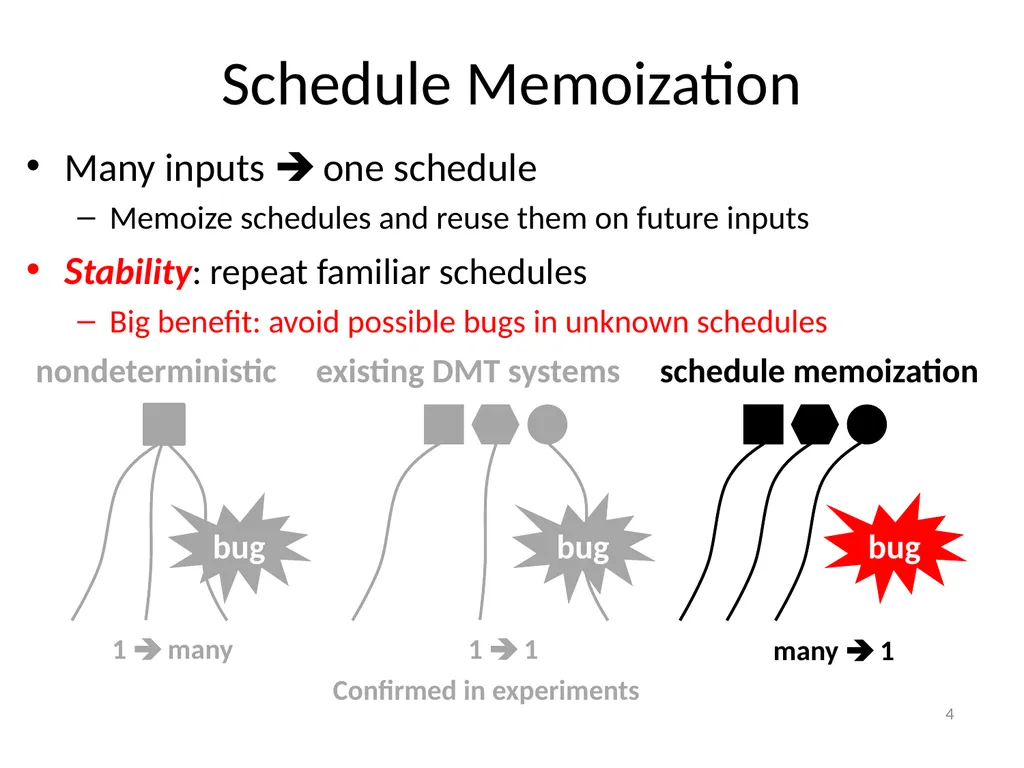
slide4. Schedule Memoization Many inputs one schedule
Memoize schedules and reuse them on future inputs
Stability: repeat familiar schedules
Big benefit: avoid possible bugs in unknown schedules 4 schedule memoization bug many 1<br>
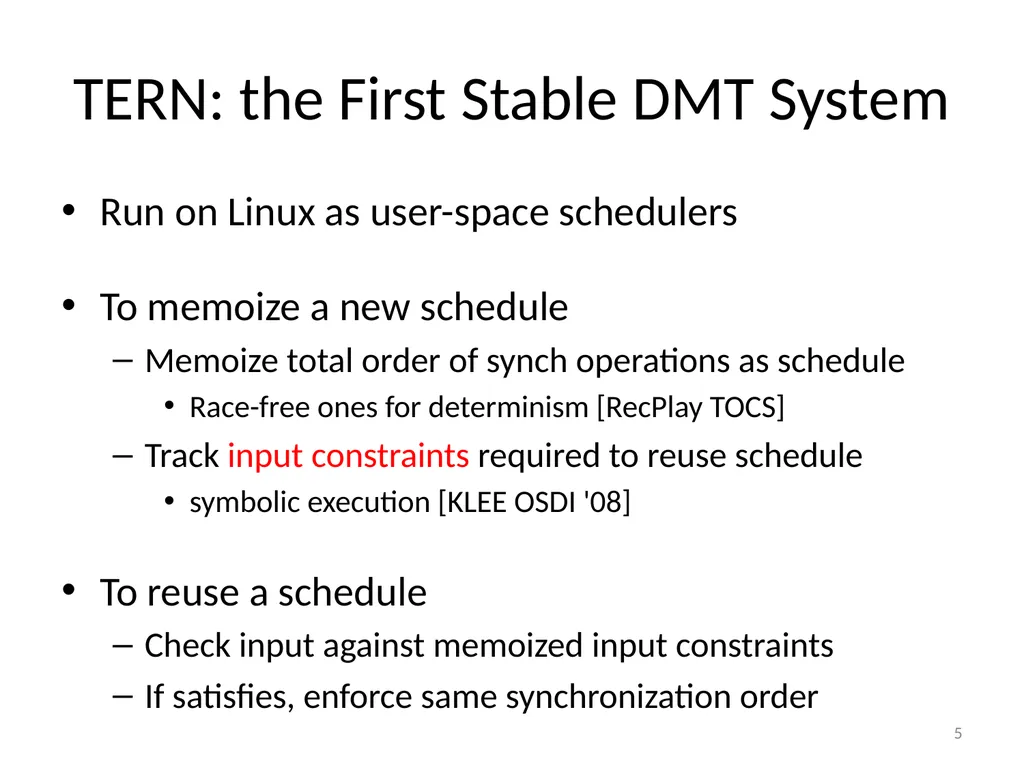
slide5. TERN: the First Stable DMT System Run on Linux as user-space schedulers
To memoize a new schedule
Memoize total order of synch operations as schedule
Race-free ones for determinism [RecPlay TOCS]
Track input constraints required to reuse schedule
symbolic execution [KLEE OSDI '08]
To reuse a schedule
Check input against memoized input constraints
If satisfies, enforce same synchronization order 5<br>
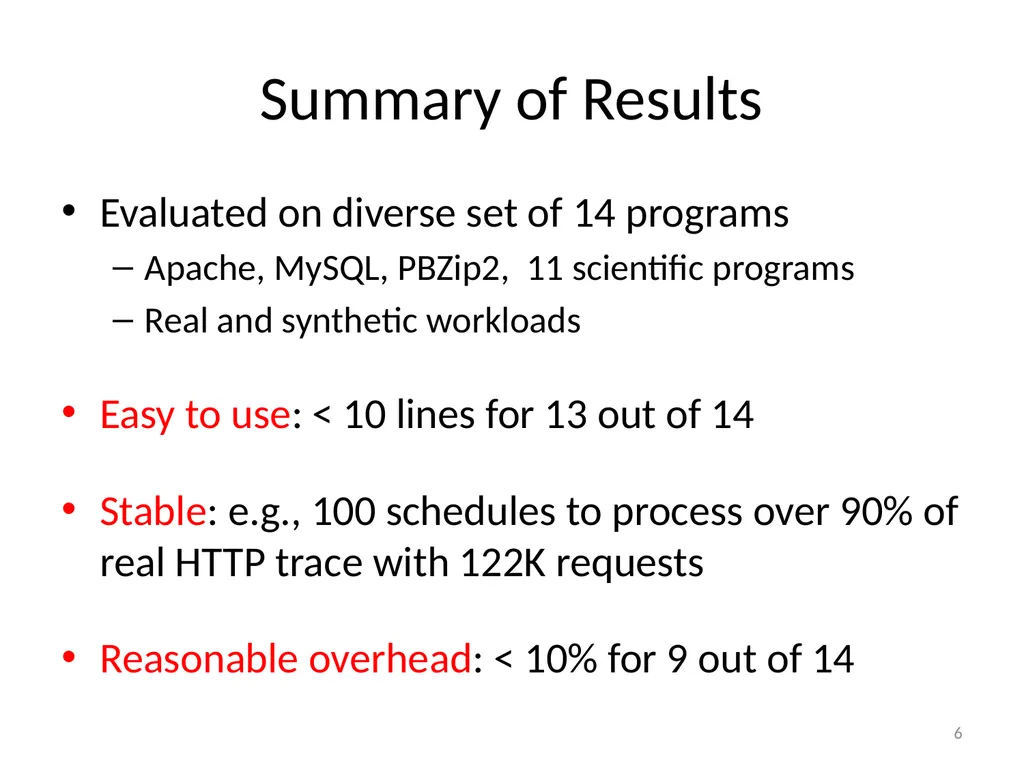
slide6. Summary of Results Evaluated on diverse set of 14 programs
Apache, MySQL, PBZip2, 11 scientific programs
Real and synthetic workloads
Easy to use: < 10 lines for 13 out of 14
Stable: e.g., 100 schedules to process over 90% of real HTTP trace with 122K requests
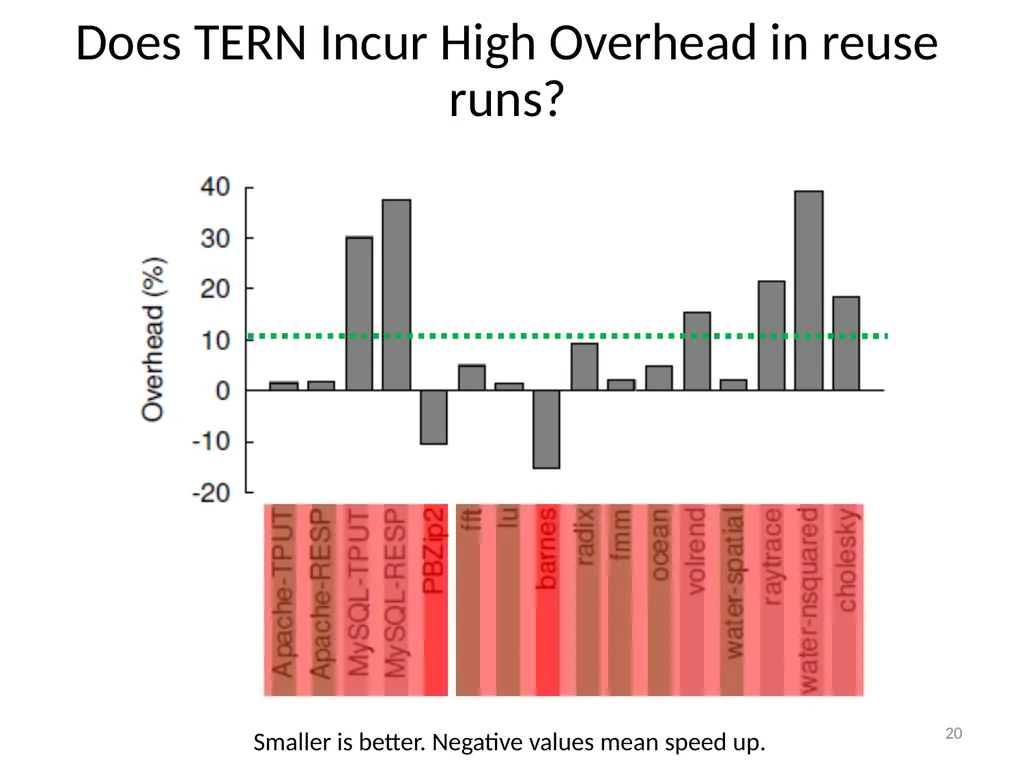
Reasonable overhead: < 10% for 9 out of 14 6<br>
slide7. Outline TERN overview
An Example
Evaluation
Conclusion 7<br>
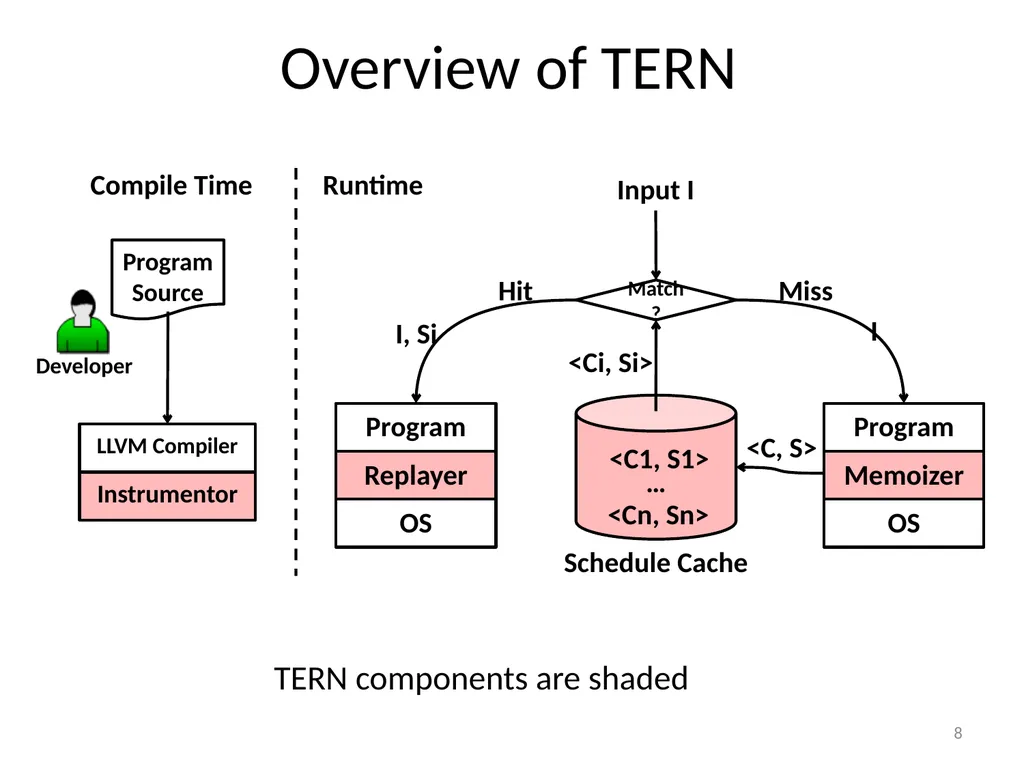
slide8. Overview of TERN TERN components are shaded 8 Input I Memoizer Runtime Compile Time <C, S> <Ci, Si> <C1, S1> <Cn, Sn> … Hit I, Si Miss I Schedule Cache Match? Program
Source Developer<br>
slide9. Outline TERN overview
An Example
Evaluation
Conclusion 9<br>
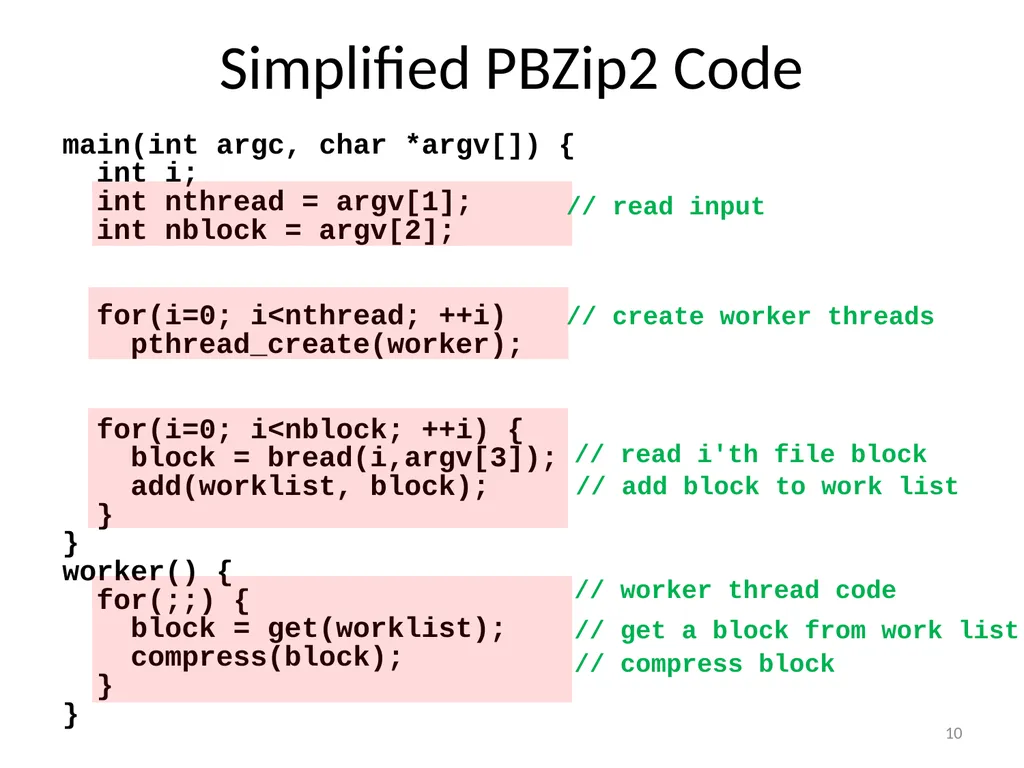
slide10. Simplified PBZip2 Code 10 main(int argc, char *argv[]) {
int i;
int nthread = argv[1];
int nblock = argv[2];
for(i=0; i<nthread; ++i)
pthread_create(worker);
for(i=0; i<nblock; ++i) {
block = bread(i,argv[3]);
add(worklist, block);
}
}
worker() {
for(;;) {
block = get(worklist);
compress(block);
}
} // create worker threads // read i'th file block // add block to work list // worker thread code // get a block from work list // read input // compress block<br>
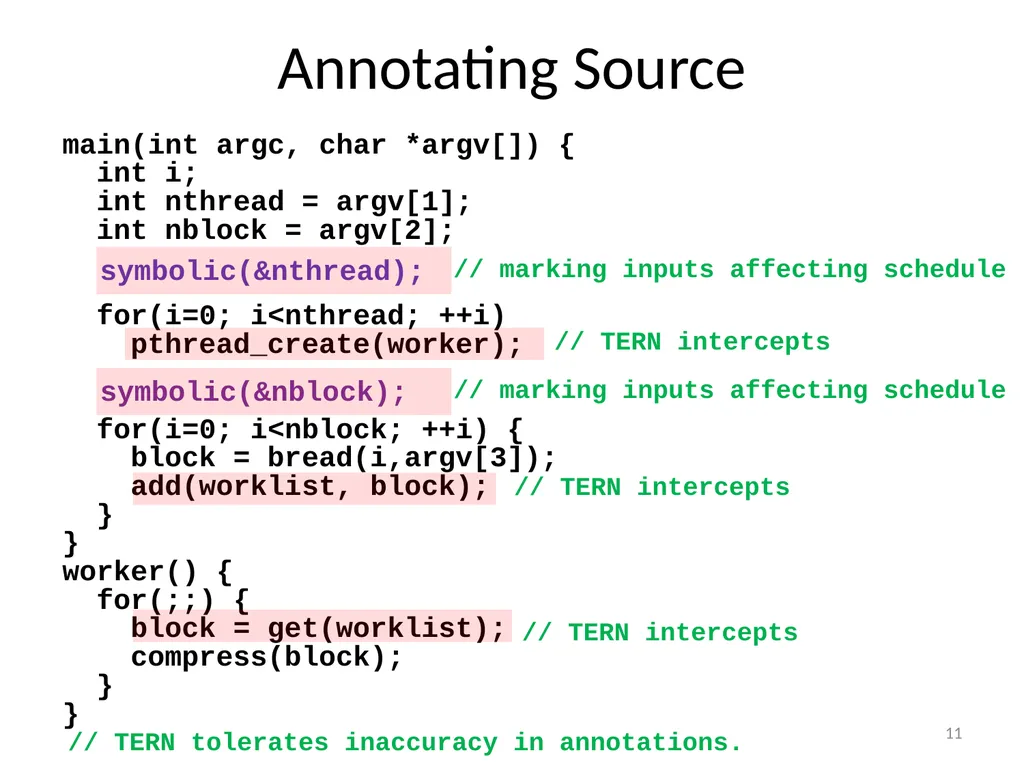
slide11. Annotating Source 11 main(int argc, char *argv[]) {
int i;
int nthread = argv[1];
int nblock = argv[2];
for(i=0; i<nthread; ++i)
pthread_create(worker);
for(i=0; i<nblock; ++i) {
block = bread(i,argv[3]);
add(worklist, block);
}
}
worker() {
for(;;) {
block = get(worklist);
compress(block);
}
} // marking inputs affecting schedule symbolic(&nthread); symbolic(&nblock); // marking inputs affecting schedule // TERN intercepts // TERN intercepts // TERN intercepts // TERN tolerates inaccuracy in annotations.<br>
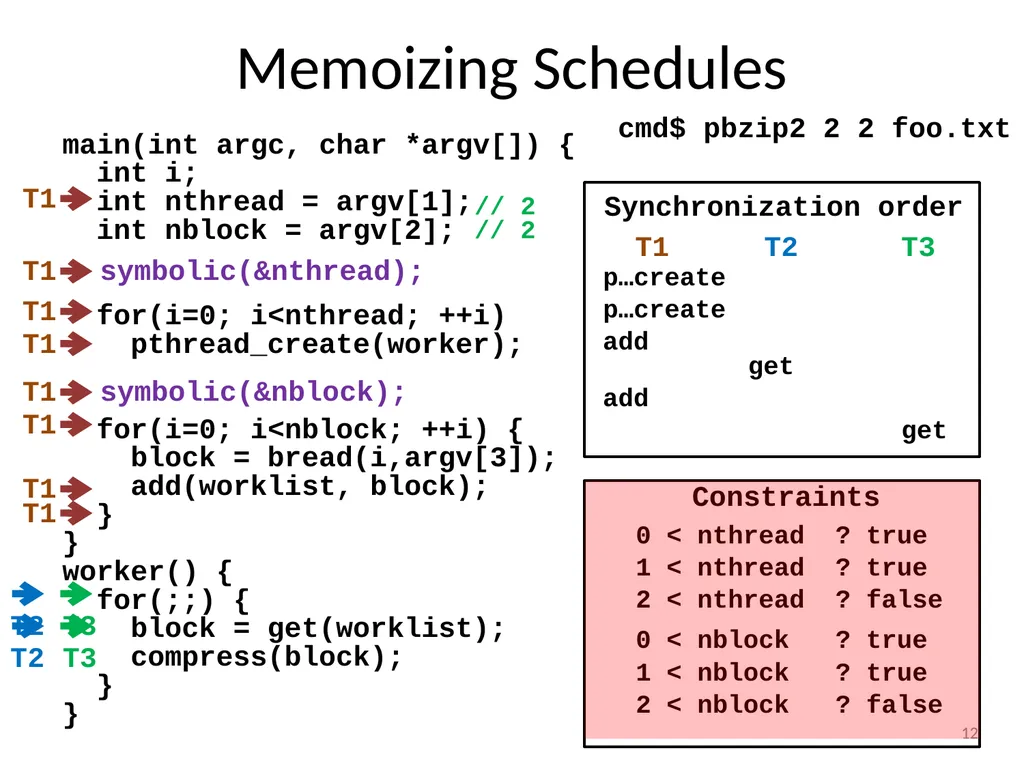
slide12. Memoizing Schedules 12 main(int argc, char *argv[]) {
int i;
int nthread = argv[1];
int nblock = argv[2];
for(i=0; i<nthread; ++i)
pthread_create(worker);
for(i=0; i<nblock; ++i) {
block = bread(i,argv[3]);
add(worklist, block);
}
}
worker() {
for(;;) {
block = get(worklist);
compress(block);
}
} symbolic(&nthread); symbolic(&nblock); cmd$ pbzip2 2 2 foo.txt T1 T2 T3 p…create add p…create get get add Synchronization order Constraints 0 < nthread ? true 1 < nthread ? true 2 < nthread ? false 0 < nblock ? true 1 < nblock ? true 2 < nblock ? false // 2 // 2<br>
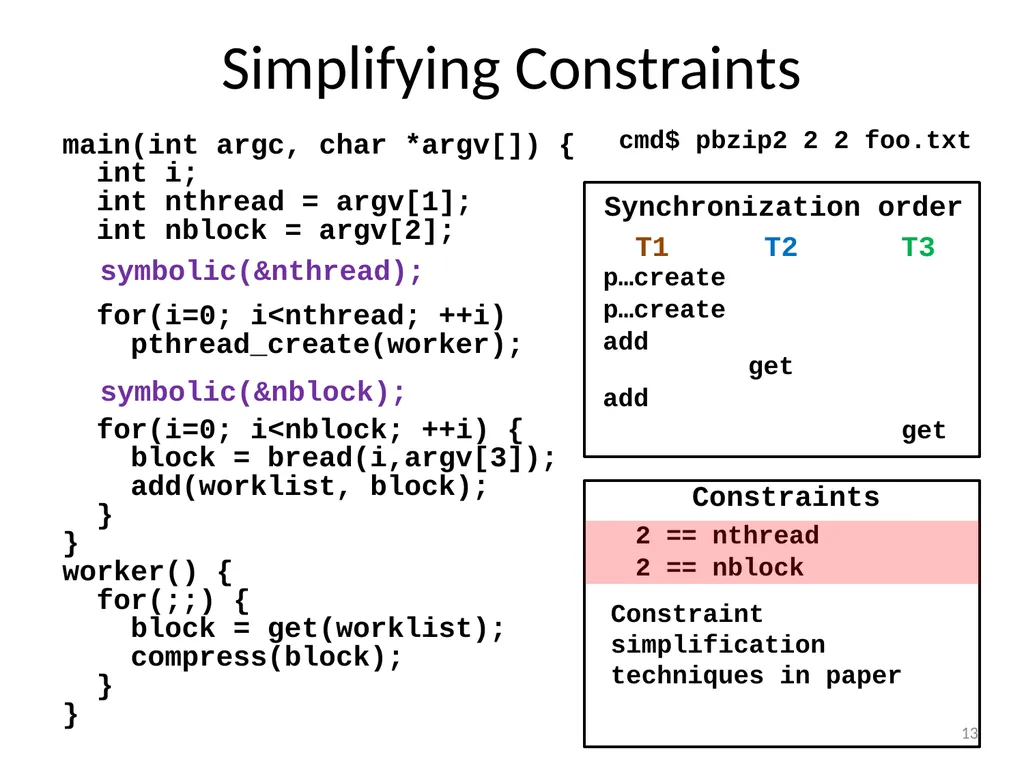
slide13. Simplifying Constraints 13 main(int argc, char *argv[]) {
int i;
int nthread = argv[1];
int nblock = argv[2];
for(i=0; i<nthread; ++i)
pthread_create(worker);
for(i=0; i<nblock; ++i) {
block = bread(i,argv[3]);
add(worklist, block);
}
}
worker() {
for(;;) {
block = get(worklist);
compress(block);
}
} symbolic(&nthread); symbolic(&nblock); cmd$ pbzip2 2 2 foo.txt T1 T2 T3 p…create add p…create get get add Synchronization order Constraints 2 == nthread 2 == nblock Constraint simplification techniques in paper<br>
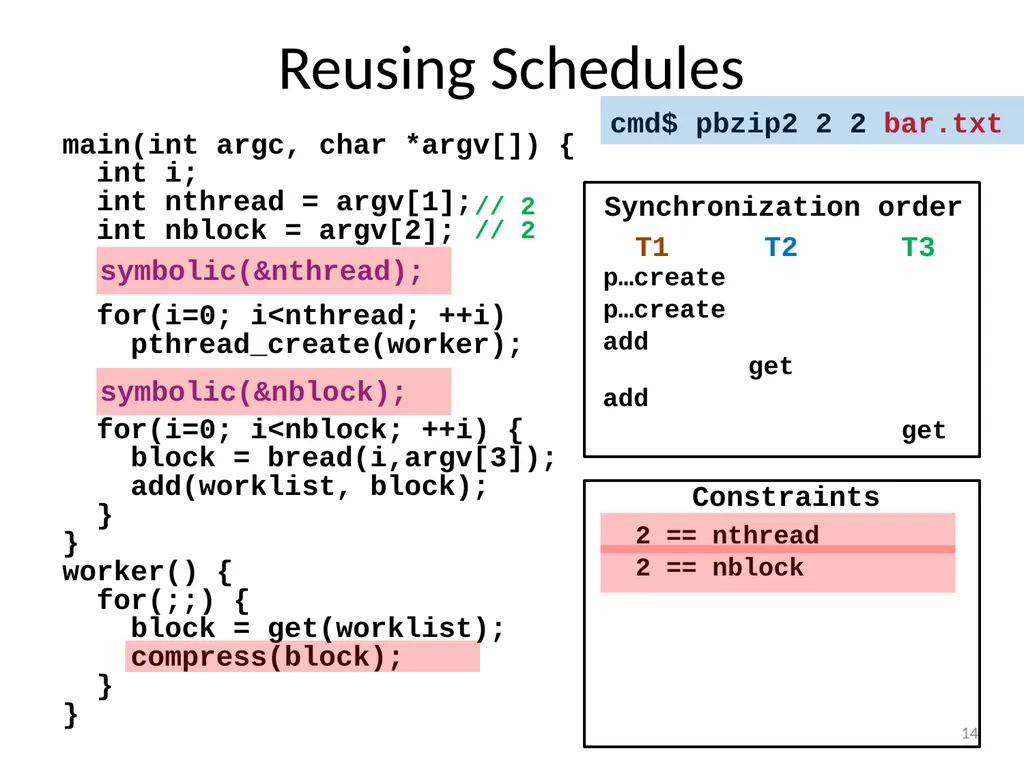
slide14. Reusing Schedules 14 main(int argc, char *argv[]) {
int i;
int nthread = argv[1];
int nblock = argv[2];
for(i=0; i<nthread; ++i)
pthread_create(worker);
for(i=0; i<nblock; ++i) {
block = bread(i,argv[3]);
add(worklist, block);
}
}
worker() {
for(;;) {
block = get(worklist);
compress(block);
}
} symbolic(&nthread); symbolic(&nblock); cmd$ pbzip2 2 2 bar.txt T1 T2 T3 p…create add p…create get get add Synchronization order Constraints 2 == nthread 2 == nblock // 2 // 2<br>
slide15. Outline TERN Overview
An Example
Evaluation
Conclusion 15<br>
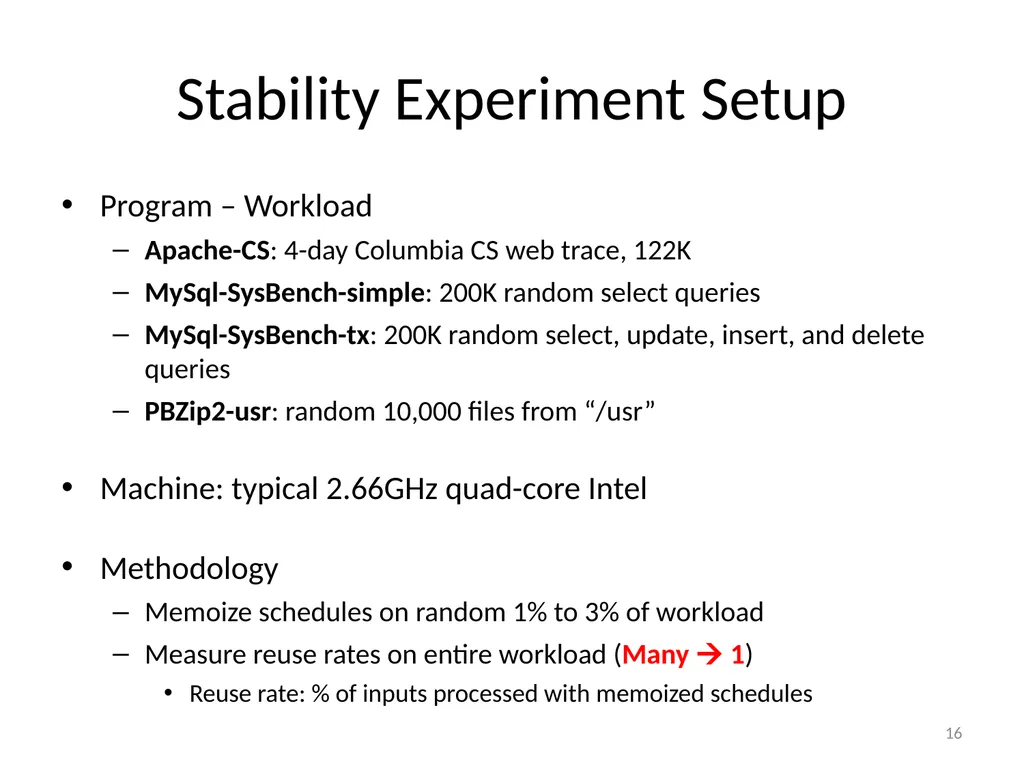
slide16. Stability Experiment Setup Program – Workload
Apache-CS: 4-day Columbia CS web trace, 122K
MySql-SysBench-simple: 200K random select queries
MySql-SysBench-tx: 200K random select, update, insert, and delete queries
PBZip2-usr: random 10,000 files from “/usr”
Machine: typical 2.66GHz quad-core Intel
Methodology
Memoize schedules on random 1% to 3% of workload
Measure reuse rates on entire workload (Many 1)
Reuse rate: % of inputs processed with memoized schedules 16<br>
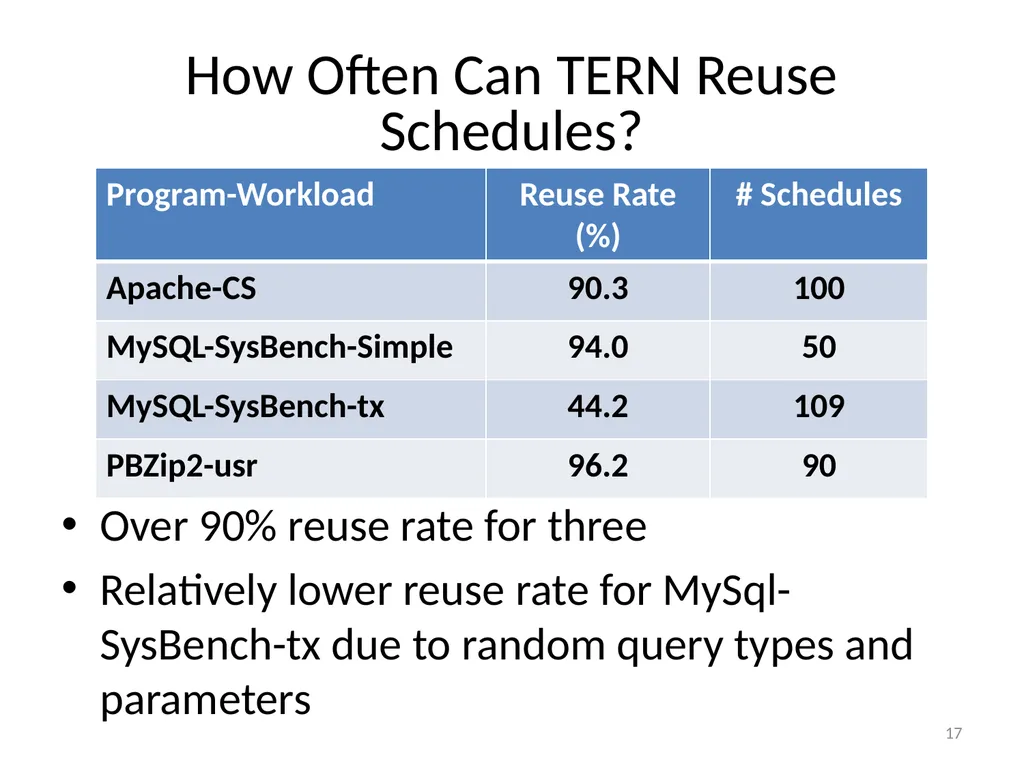
slide17. How Often Can TERN Reuse Schedules? Over 90% reuse rate for three
Relatively lower reuse rate for MySql-SysBench-tx due to random query types and parameters 17<br>
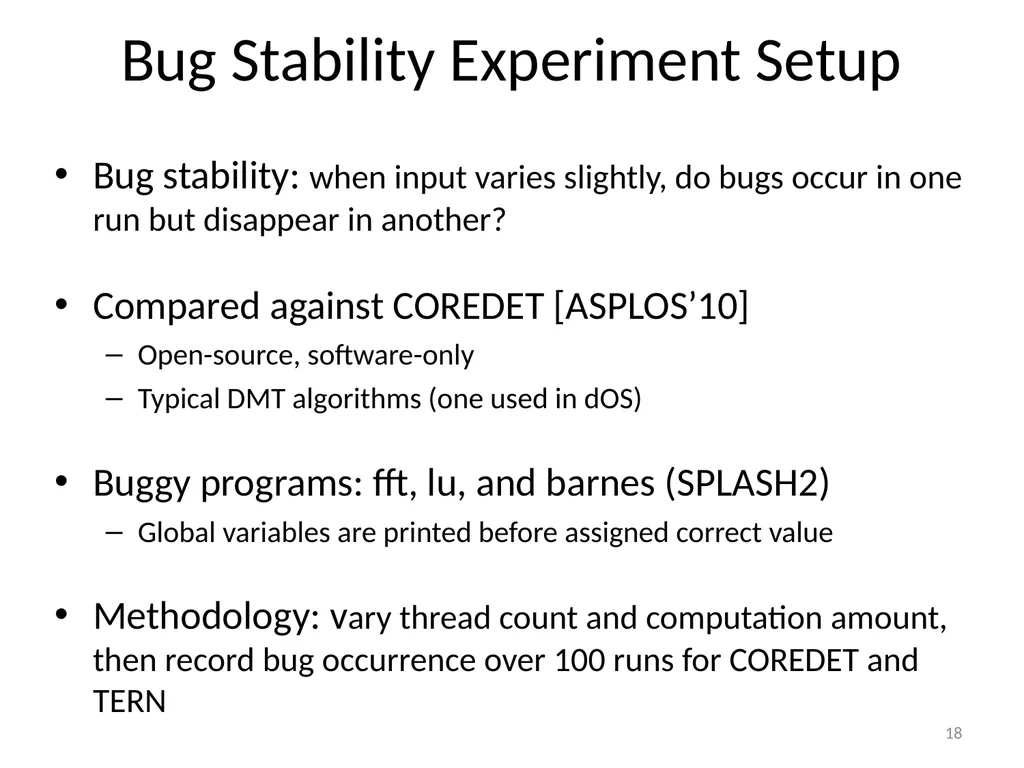
slide18. Bug Stability Experiment Setup Bug stability: when input varies slightly, do bugs occur in one run but disappear in another?
Compared against COREDET [ASPLOS’10]
Open-source, software-only
Typical DMT algorithms (one used in dOS)
Buggy programs: fft, lu, and barnes (SPLASH2)
Global variables are printed before assigned correct value
Methodology: vary thread count and computation amount, then record bug occurrence over 100 runs for COREDET and TERN 18<br>
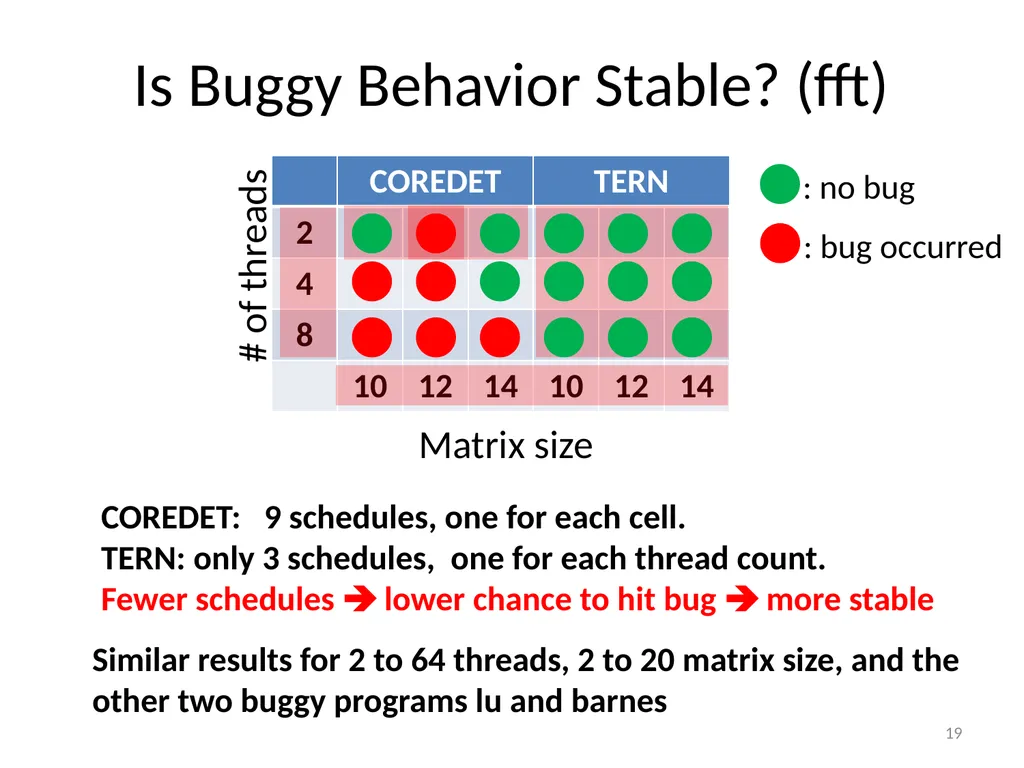
slide19. Is Buggy Behavior Stable? (fft) 19 COREDET: 9 schedules, one for each cell.
TERN: only 3 schedules, one for each thread count.
Fewer schedules lower chance to hit bug more stable Matrix size # of threads Similar results for 2 to 64 threads, 2 to 20 matrix size, and the other two buggy programs lu and barnes : no bug : bug occurred<br>
slide20. Does TERN Incur High Overhead in reuse runs? 20 Smaller is better. Negative values mean speed up.<br>
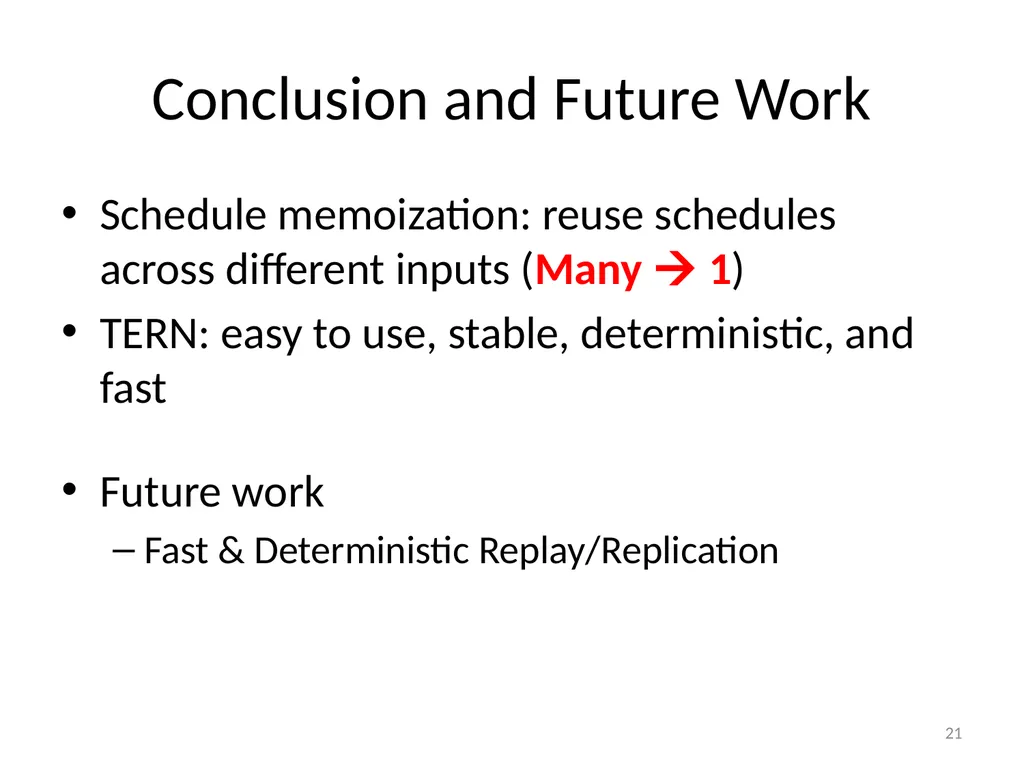
slide21. Conclusion and Future Work Schedule memoization: reuse schedules across different inputs (Many 1)
TERN: easy to use, stable, deterministic, and fast
Future work
Fast & Deterministic Replay/Replication 21<br>

Jingyue Wu
Chia-che Tsai
Junfeng Yang
Computer Science
Columbia University
New York, NY, USA 1<br>
slide2. Nondeterministic Execution Same input many schedules
Problem: different runs may show different behaviors, even on the same inputs 2 nondeterministic bug 1 many<br>
slide3. Deterministic Multhreading (DMT) Same input same schedule
[DMP ASPLOS '09], [KENDO ASPLOS '09], [COREDET ASPLOS '10], [dOS OSDI '10]
Problem: minor input change very different schedule 3 existing DMT systems bug 1 1 Confirmed in experiments<br>
slide4. Schedule Memoization Many inputs one schedule
Memoize schedules and reuse them on future inputs
Stability: repeat familiar schedules
Big benefit: avoid possible bugs in unknown schedules 4 schedule memoization bug many 1<br>
slide5. TERN: the First Stable DMT System Run on Linux as user-space schedulers
To memoize a new schedule
Memoize total order of synch operations as schedule
Race-free ones for determinism [RecPlay TOCS]
Track input constraints required to reuse schedule
symbolic execution [KLEE OSDI '08]
To reuse a schedule
Check input against memoized input constraints
If satisfies, enforce same synchronization order 5<br>
slide6. Summary of Results Evaluated on diverse set of 14 programs
Apache, MySQL, PBZip2, 11 scientific programs
Real and synthetic workloads
Easy to use: < 10 lines for 13 out of 14
Stable: e.g., 100 schedules to process over 90% of real HTTP trace with 122K requests
Reasonable overhead: < 10% for 9 out of 14 6<br>
slide7. Outline TERN overview
An Example
Evaluation
Conclusion 7<br>
slide8. Overview of TERN TERN components are shaded 8 Input I Memoizer Runtime Compile Time <C, S> <Ci, Si> <C1, S1> <Cn, Sn> … Hit I, Si Miss I Schedule Cache Match? Program
Source Developer<br>
slide9. Outline TERN overview
An Example
Evaluation
Conclusion 9<br>
slide10. Simplified PBZip2 Code 10 main(int argc, char *argv[]) {
int i;
int nthread = argv[1];
int nblock = argv[2];
for(i=0; i<nthread; ++i)
pthread_create(worker);
for(i=0; i<nblock; ++i) {
block = bread(i,argv[3]);
add(worklist, block);
}
}
worker() {
for(;;) {
block = get(worklist);
compress(block);
}
} // create worker threads // read i'th file block // add block to work list // worker thread code // get a block from work list // read input // compress block<br>
slide11. Annotating Source 11 main(int argc, char *argv[]) {
int i;
int nthread = argv[1];
int nblock = argv[2];
for(i=0; i<nthread; ++i)
pthread_create(worker);
for(i=0; i<nblock; ++i) {
block = bread(i,argv[3]);
add(worklist, block);
}
}
worker() {
for(;;) {
block = get(worklist);
compress(block);
}
} // marking inputs affecting schedule symbolic(&nthread); symbolic(&nblock); // marking inputs affecting schedule // TERN intercepts // TERN intercepts // TERN intercepts // TERN tolerates inaccuracy in annotations.<br>
slide12. Memoizing Schedules 12 main(int argc, char *argv[]) {
int i;
int nthread = argv[1];
int nblock = argv[2];
for(i=0; i<nthread; ++i)
pthread_create(worker);
for(i=0; i<nblock; ++i) {
block = bread(i,argv[3]);
add(worklist, block);
}
}
worker() {
for(;;) {
block = get(worklist);
compress(block);
}
} symbolic(&nthread); symbolic(&nblock); cmd$ pbzip2 2 2 foo.txt T1 T2 T3 p…create add p…create get get add Synchronization order Constraints 0 < nthread ? true 1 < nthread ? true 2 < nthread ? false 0 < nblock ? true 1 < nblock ? true 2 < nblock ? false // 2 // 2<br>
slide13. Simplifying Constraints 13 main(int argc, char *argv[]) {
int i;
int nthread = argv[1];
int nblock = argv[2];
for(i=0; i<nthread; ++i)
pthread_create(worker);
for(i=0; i<nblock; ++i) {
block = bread(i,argv[3]);
add(worklist, block);
}
}
worker() {
for(;;) {
block = get(worklist);
compress(block);
}
} symbolic(&nthread); symbolic(&nblock); cmd$ pbzip2 2 2 foo.txt T1 T2 T3 p…create add p…create get get add Synchronization order Constraints 2 == nthread 2 == nblock Constraint simplification techniques in paper<br>
slide14. Reusing Schedules 14 main(int argc, char *argv[]) {
int i;
int nthread = argv[1];
int nblock = argv[2];
for(i=0; i<nthread; ++i)
pthread_create(worker);
for(i=0; i<nblock; ++i) {
block = bread(i,argv[3]);
add(worklist, block);
}
}
worker() {
for(;;) {
block = get(worklist);
compress(block);
}
} symbolic(&nthread); symbolic(&nblock); cmd$ pbzip2 2 2 bar.txt T1 T2 T3 p…create add p…create get get add Synchronization order Constraints 2 == nthread 2 == nblock // 2 // 2<br>
slide15. Outline TERN Overview
An Example
Evaluation
Conclusion 15<br>
slide16. Stability Experiment Setup Program – Workload
Apache-CS: 4-day Columbia CS web trace, 122K
MySql-SysBench-simple: 200K random select queries
MySql-SysBench-tx: 200K random select, update, insert, and delete queries
PBZip2-usr: random 10,000 files from “/usr”
Machine: typical 2.66GHz quad-core Intel
Methodology
Memoize schedules on random 1% to 3% of workload
Measure reuse rates on entire workload (Many 1)
Reuse rate: % of inputs processed with memoized schedules 16<br>
slide17. How Often Can TERN Reuse Schedules? Over 90% reuse rate for three
Relatively lower reuse rate for MySql-SysBench-tx due to random query types and parameters 17<br>
slide18. Bug Stability Experiment Setup Bug stability: when input varies slightly, do bugs occur in one run but disappear in another?
Compared against COREDET [ASPLOS’10]
Open-source, software-only
Typical DMT algorithms (one used in dOS)
Buggy programs: fft, lu, and barnes (SPLASH2)
Global variables are printed before assigned correct value
Methodology: vary thread count and computation amount, then record bug occurrence over 100 runs for COREDET and TERN 18<br>
slide19. Is Buggy Behavior Stable? (fft) 19 COREDET: 9 schedules, one for each cell.
TERN: only 3 schedules, one for each thread count.
Fewer schedules lower chance to hit bug more stable Matrix size # of threads Similar results for 2 to 64 threads, 2 to 20 matrix size, and the other two buggy programs lu and barnes : no bug : bug occurred<br>
slide20. Does TERN Incur High Overhead in reuse runs? 20 Smaller is better. Negative values mean speed up.<br>
slide21. Conclusion and Future Work Schedule memoization: reuse schedules across different inputs (Many 1)
TERN: easy to use, stable, deterministic, and fast
Future work
Fast & Deterministic Replay/Replication 21<br>