Testing and linkage to care The approach of Luxembourg in prison settings Patrick Hoffmann Health Directorate Luxembourg ECDC Hepatitis B and C Network Meeting Stockholm 17th September 2019 To put you into the right context Two prisons
"Testing and linkage to care The approach of" is the property of its rightful owner. Permission is granted to
download and print the materials on this website for personal, non-commercial use only, and to display it
on your personal computer provided you do not modify the materials and that you retain all copyright
notices contained in the materials. By downloading content from our website, you accept the terms of this
agreement.
Presentation Transcript
01
Testing and linkage to care The approach of Luxembourg in prison settings Patrick Hoffmann – Health Directorate Luxembourg
ECDC Hepatitis B and C Network Meeting – Stockholm
17th September 2019<br>
02
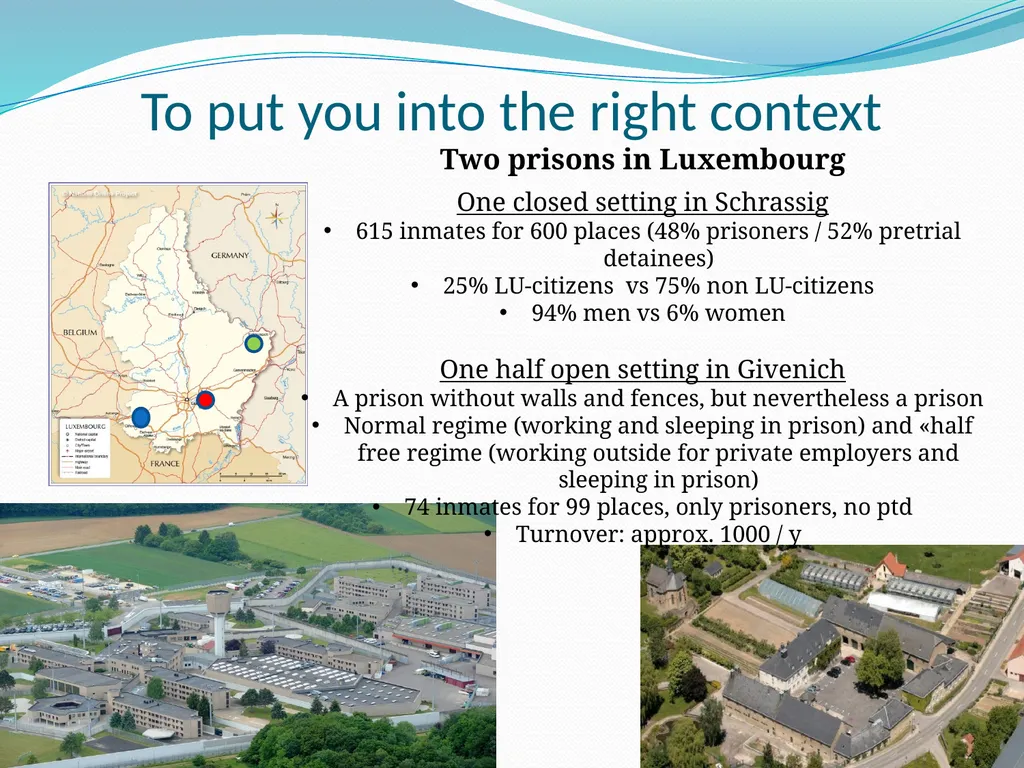
To put you into the right context Two prisons in Luxembourg
One closed setting in Schrassig
615 inmates for 600 places (48% prisoners / 52% pretrial detainees)
25% LU-citizens vs 75% non LU-citizens
94% men vs 6% women
One half open setting in Givenich
A prison without walls and fences, but nevertheless a prison
Normal regime (working and sleeping in prison) and «half free regime (working outside for private employers and sleeping in prison)
74 inmates for 99 places, only prisoners, no ptd
Turnover: approx. 1000 / y<br>
03
The medical service in Luxembourg prisons Somatic medecine
Service of Centre Hospitalier de Luxembourg
3 part time MD – 1 resident – 1 assistant
Different specialists coming into prison
20 nurses – 1 head nurse
24/7
3 surgeries
1 pharmacist – 4 preparators
different facilities (X-Ray, dentist, ophtalmologist, gynaecologist
Ultrasound, Fibroscan
Approx 13000 consultations / year Psychiatric service
Service of Neuropsychiatrical hospital in Ettelbruck
Ambulatory care and intensive care unit
Different specialists coming into prison
Detect, treat and prevent mental disorders
Pluriprofessional approach (MD, nurses, social assistant, ergotherapist)
7/7 6am to 9.30pm<br>
04
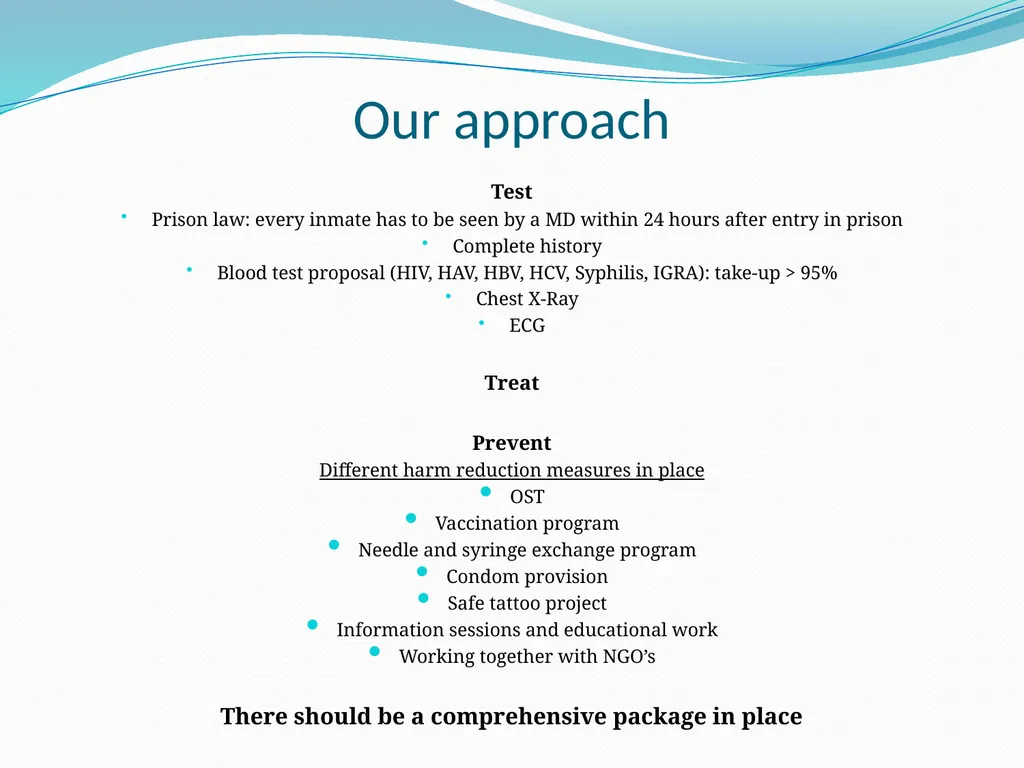
Our approach Test
Prison law: every inmate has to be seen by a MD within 24 hours after entry in prison
Complete history
Blood test proposal (HIV, HAV, HBV, HCV, Syphilis, IGRA): take-up > 95%
Chest X-Ray
ECG
Treat
Prevent
Different harm reduction measures in place
OST
Vaccination program
Needle and syringe exchange program
Condom provision
Safe tattoo project
Information sessions and educational work
Working together with NGO’s
There should be a comprehensive package in place<br>
05
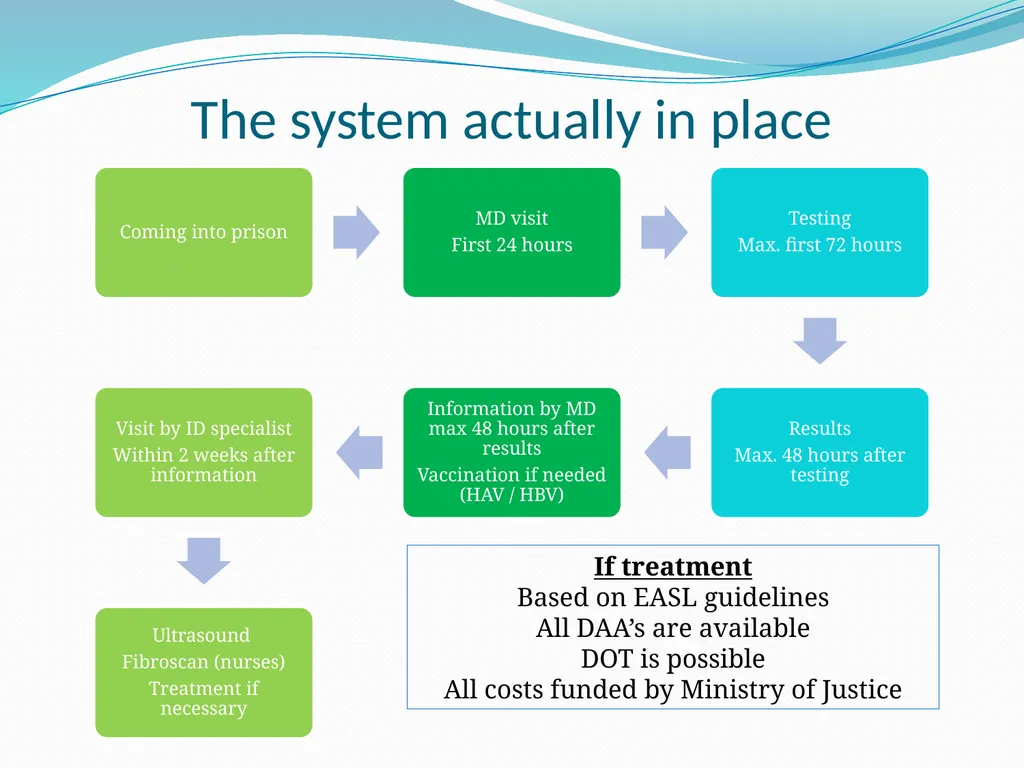
The system actually in place If treatment
Based on EASL guidelines
All DAA’s are available
DOT is possible
All costs funded by Ministry of Justice<br>
06
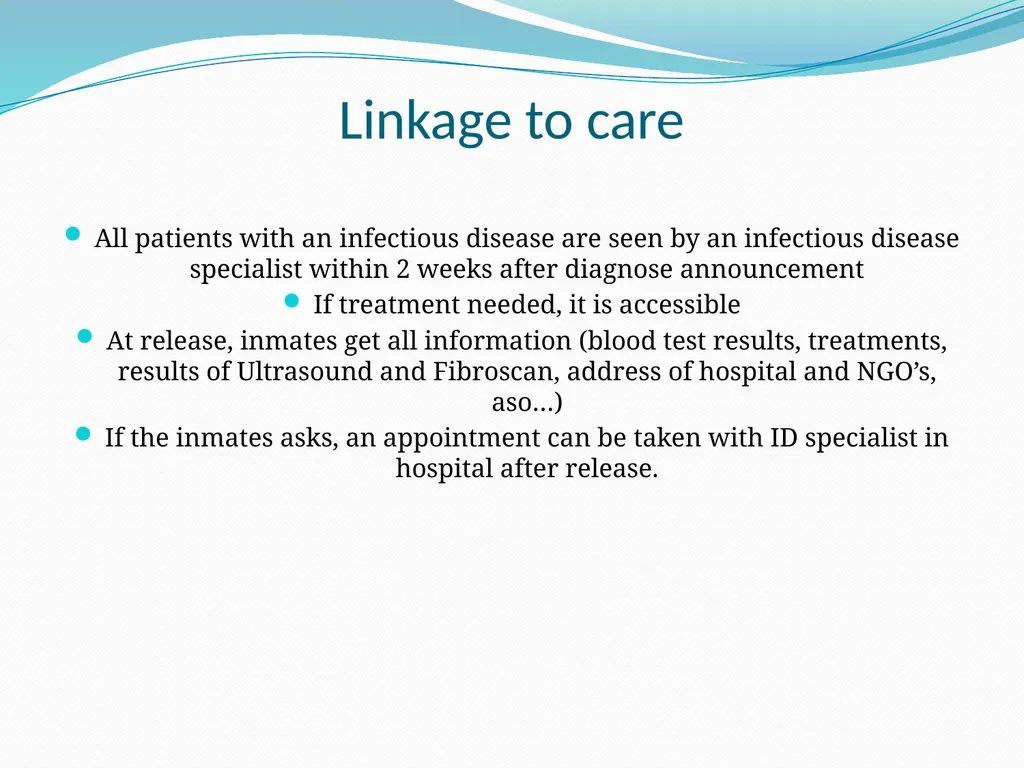
Linkage to care All patients with an infectious disease are seen by an infectious disease specialist within 2 weeks after diagnose announcement
If treatment needed, it is accessible
At release, inmates get all information (blood test results, treatments, results of Ultrasound and Fibroscan, address of hospital and NGO’s, aso…)
If the inmates asks, an appointment can be taken with ID specialist in hospital after release.<br>
07
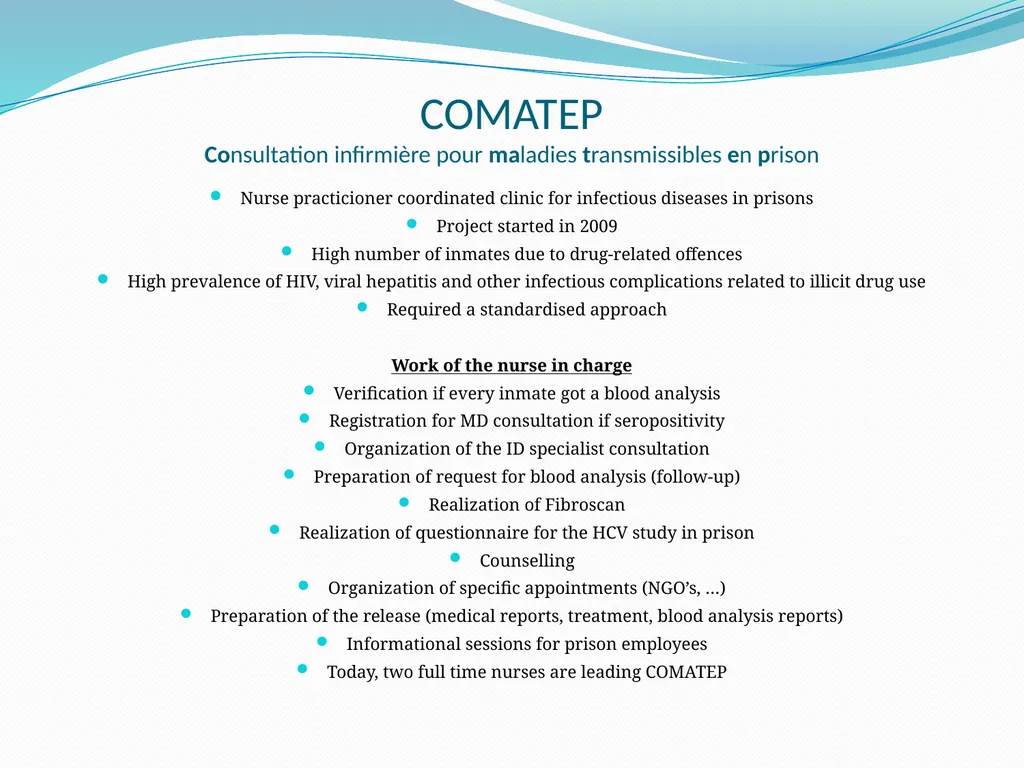
COMATEP Consultation infirmière pour maladies transmissibles en prison Nurse practicioner coordinated clinic for infectious diseases in prisons
Project started in 2009
High number of inmates due to drug-related offences
High prevalence of HIV, viral hepatitis and other infectious complications related to illicit drug use
Required a standardised approach
Work of the nurse in charge
Verification if every inmate got a blood analysis
Registration for MD consultation if seropositivity
Organization of the ID specialist consultation
Preparation of request for blood analysis (follow-up)
Realization of Fibroscan
Realization of questionnaire for the HCV study in prison
Counselling
Organization of specific appointments (NGO’s, …)
Preparation of the release (medical reports, treatment, blood analysis reports)
Informational sessions for prison employees
Today, two full time nurses are leading COMATEP<br>
08
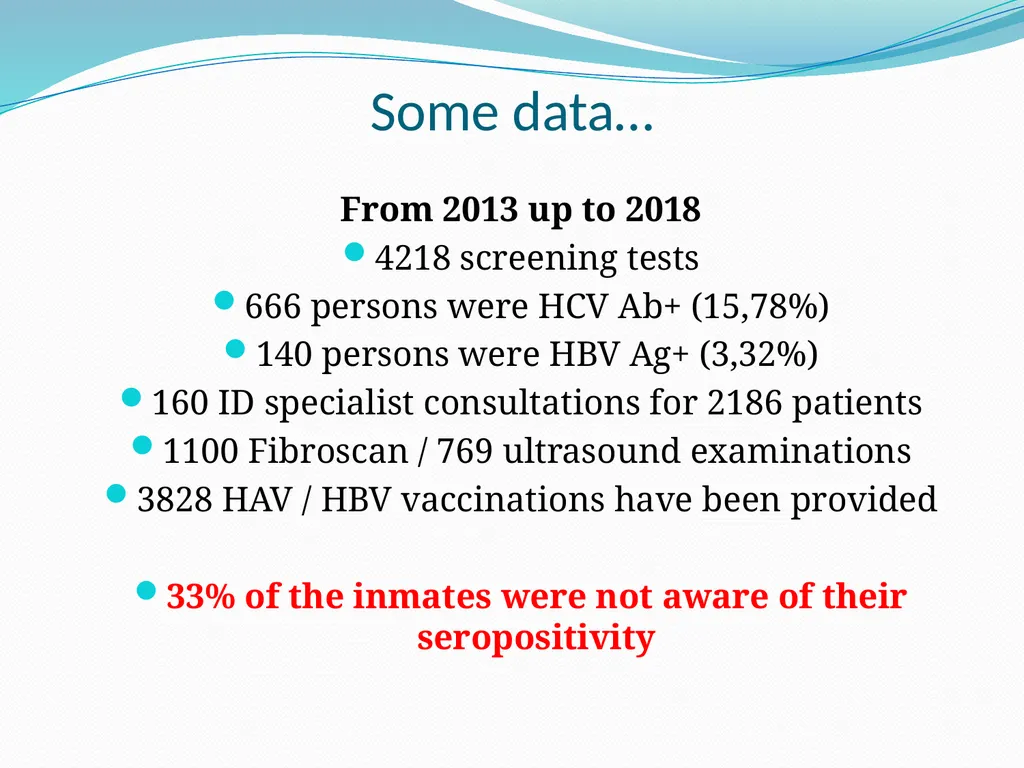
Some data… From 2013 up to 2018
4218 screening tests
666 persons were HCV Ab+ (15,78%)
140 persons were HBV Ag+ (3,32%)
160 ID specialist consultations for 2186 patients
1100 Fibroscan / 769 ultrasound examinations
3828 HAV / HBV vaccinations have been provided
33% of the inmates were not aware of their seropositivity<br>
09
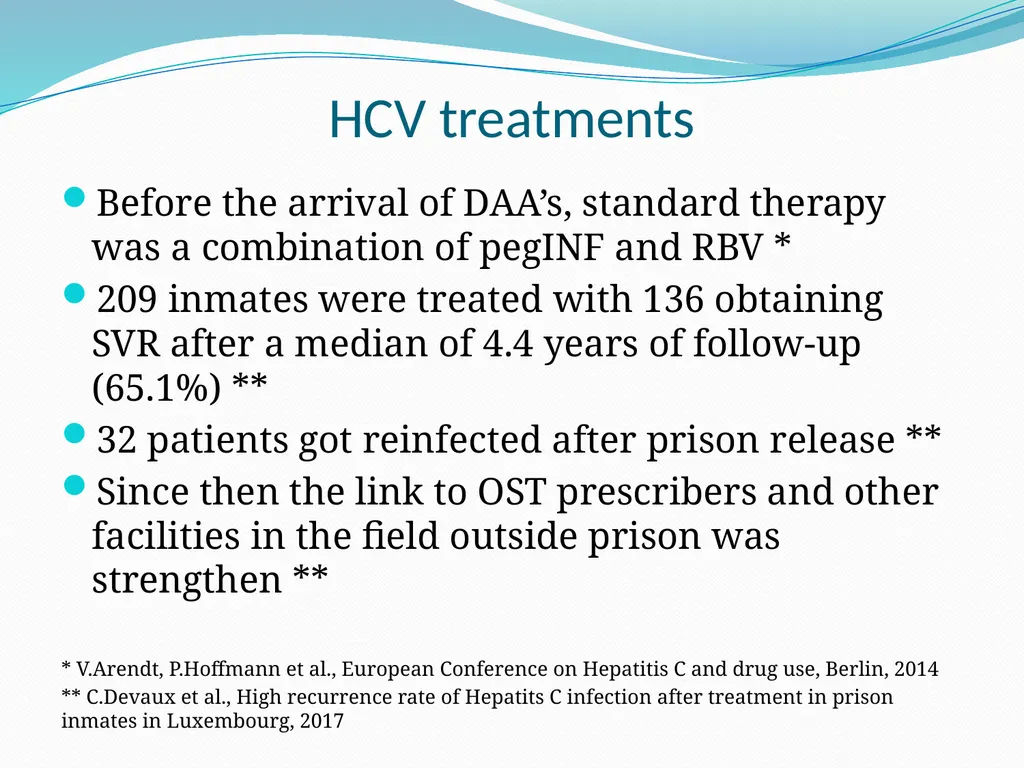
HCV treatments Before the arrival of DAA’s, standard therapy was a combination of pegINF and RBV *
209 inmates were treated with 136 obtaining SVR after a median of 4.4 years of follow-up (65.1%) **
32 patients got reinfected after prison release **
Since then the link to OST prescribers and other facilities in the field outside prison was strengthen **
* V.Arendt, P.Hoffmann et al., European Conference on Hepatitis C and drug use, Berlin, 2014
** C.Devaux et al., High recurrence rate of Hepatits C infection after treatment in prison inmates in Luxembourg, 2017<br>
10
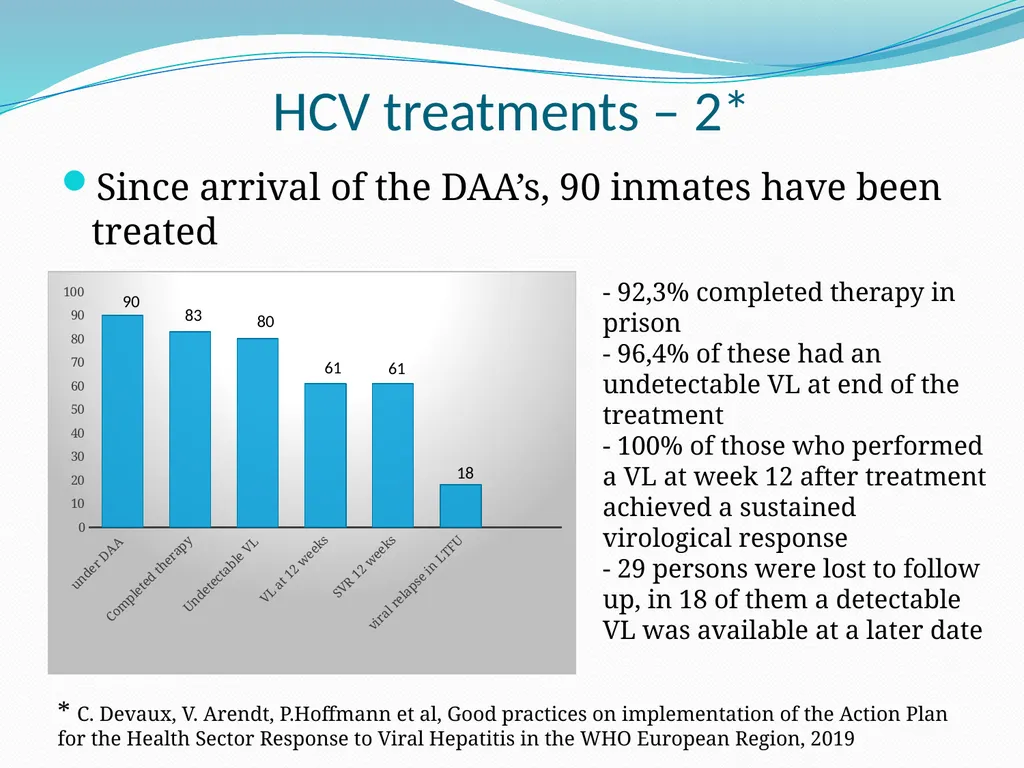
HCV treatments – 2* Since arrival of the DAA’s, 90 inmates have been treated - 92,3% completed therapy in prison
- 96,4% of these had an undetectable VL at end of the treatment
- 100% of those who performed a VL at week 12 after treatment achieved a sustained virological response
- 29 persons were lost to follow up, in 18 of them a detectable VL was available at a later date * C. Devaux, V. Arendt, P.Hoffmann et al, Good practices on implementation of the Action Plan for the Health Sector Response to Viral Hepatitis in the WHO European Region, 2019<br>
11
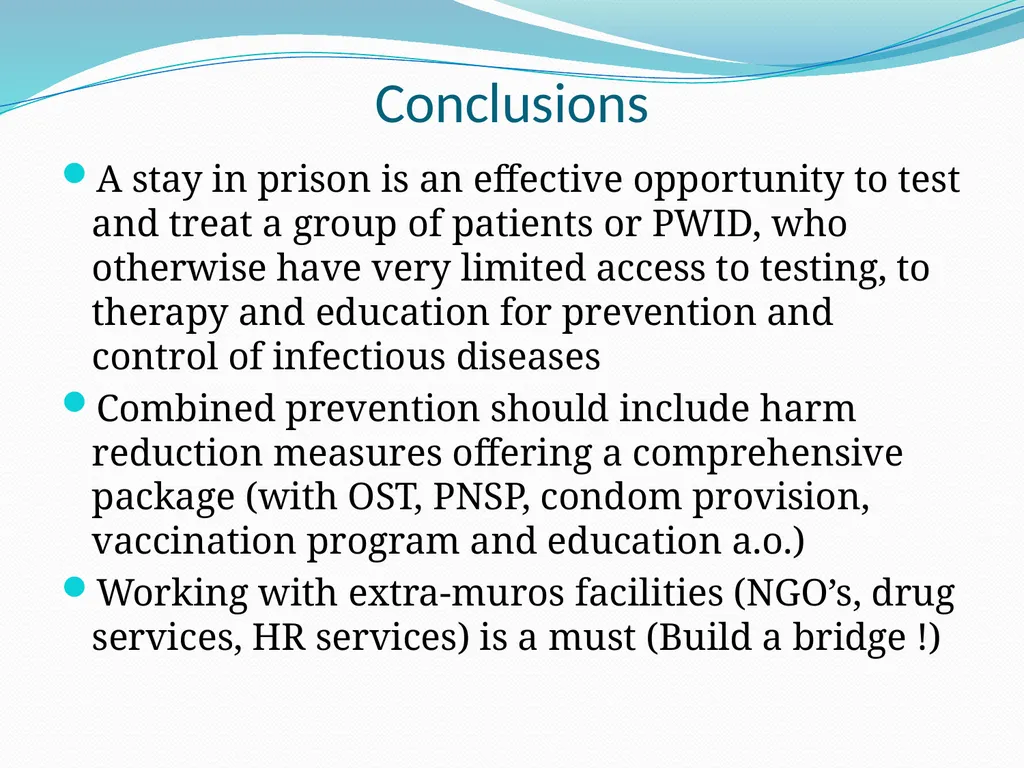
Conclusions A stay in prison is an effective opportunity to test and treat a group of patients or PWID, who otherwise have very limited access to testing, to therapy and education for prevention and control of infectious diseases
Combined prevention should include harm reduction measures offering a comprehensive package (with OST, PNSP, condom provision, vaccination program and education a.o.)
Working with extra-muros facilities (NGO’s, drug services, HR services) is a must (Build a bridge !)<br>
12
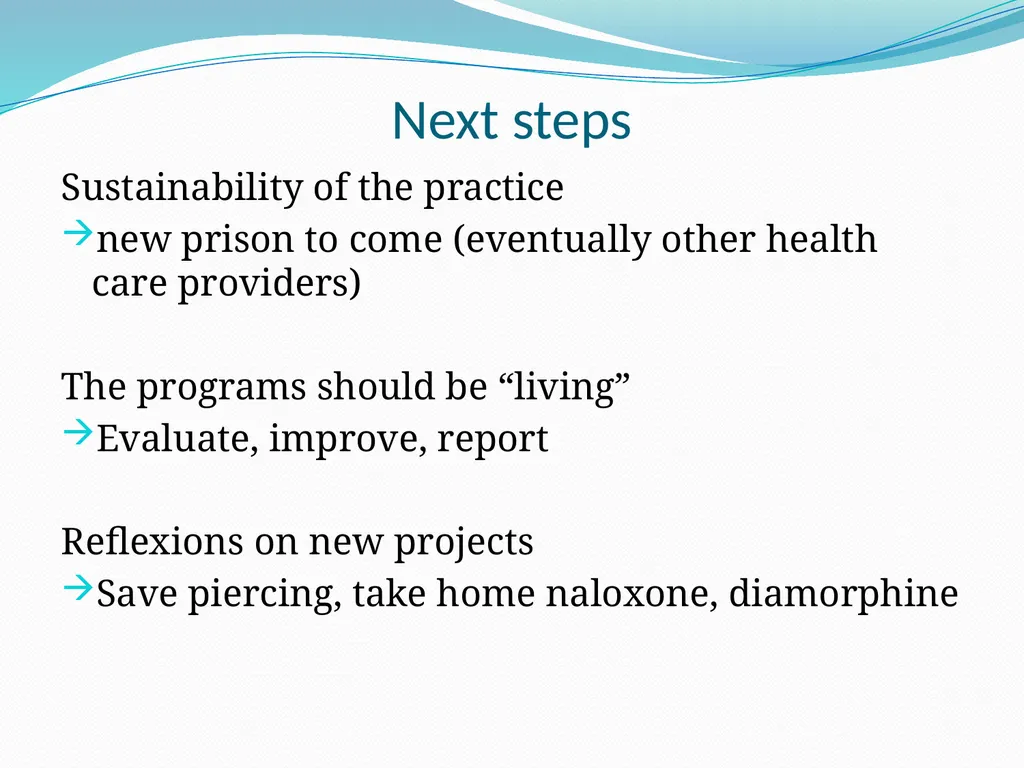
Next steps Sustainability of the practice
new prison to come (eventually other health care providers)
The programs should be “living”
Evaluate, improve, report
Reflexions on new projects
Save piercing, take home naloxone, diamorphine<br>
13
Do not forget … It’s not the place,
it’s the people !<br>
14
Acknowledgments Dr Carole Devaux, Department of Infection and Immunity, Luxembourg Institute of Health
Dr Vic Arendt, ID specialist, Centre Hospitalier de Luxembourg
Medical prison service, Centre Hospitalier de Luxembourg Thank you for your attention patrick.hoffmann@ms.etat.lu<br>