
Testing Supply Substitution Strategies This
Description: Testing Supply Substitution Strategies This resource is intended for labs performing COVID-19 tests that are authorized. This resource includes validated supply alternatives that labs can use to continue performing testing when there is a
Related Topics
Download Presentation
"Testing Supply Substitution Strategies This" is the property of its rightful owner. Permission is granted to download and print the materials on this website for personal, non-commercial use only, and to display it on your personal computer provided you do not modify the materials and that you retain all copyright notices contained in the materials. By downloading content from our website, you accept the terms of this agreement.
Presentation Transcript
slide1. Testing Supply Substitution Strategies This resource is intended for labs performing COVID-19 tests that are authorized. This resource includes validated supply alternatives that labs can use to continue performing testing when there is a supply issue with some components of a test.
The information in this resource is not intended to alter any already issued EUA for a COVID-19 diagnostic test nor is it intended to speak to any specific FDA regulatory requirement. Rather, the information is being provided to help address availability concerns regarding certain critical components of COVID-19 diagnostic tests during this pandemic. START: Go to the Main Menu<br>
slide2. Specimen Collection Intro to PCR System Types PCR Testing Process Substitution Options Select a button to learn more about a topic Learn about specimen collection, swabs, and media Learn about RT-PCR: what it is and what it’s used for Compare use of Open Mix and Match Systems vs. Closed Systems, including
instruments, supplies, and reagents Learn about the steps in the PCR testing process Learn about substitution options for the Open Mix and Match style CDC test Real-time RT Polymerase Chain Reaction (PCR) Component Substitution Strategies Additional Resources Return to FDA FAQ Return to the Main Menu<br>
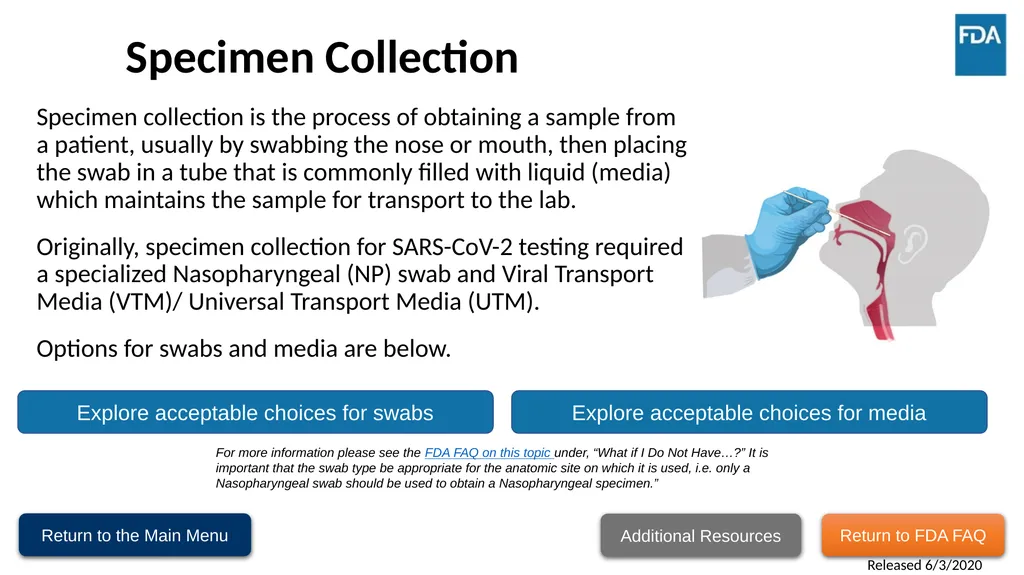
slide3. Explore acceptable choices for swabs Explore acceptable choices for media For more information please see the FDA FAQ on this topic under, “What if I Do Not Have…?” It is important that the swab type be appropriate for the anatomic site on which it is used, i.e. only a Nasopharyngeal swab should be used to obtain a Nasopharyngeal specimen.” Specimen collection is the process of obtaining a sample from a patient, usually by swabbing the nose or mouth, then placing the swab in a tube that is commonly filled with liquid (media) which maintains the sample for transport to the lab.
Originally, specimen collection for SARS-CoV-2 testing required a specialized Nasopharyngeal (NP) swab and Viral Transport Media (VTM)/ Universal Transport Media (UTM).
Options for swabs and media are below. Specimen Collection Additional Resources Return to the Main Menu Return to FDA FAQ<br>
slide4. Return to Specimen Collection Return to PCR Testing Process
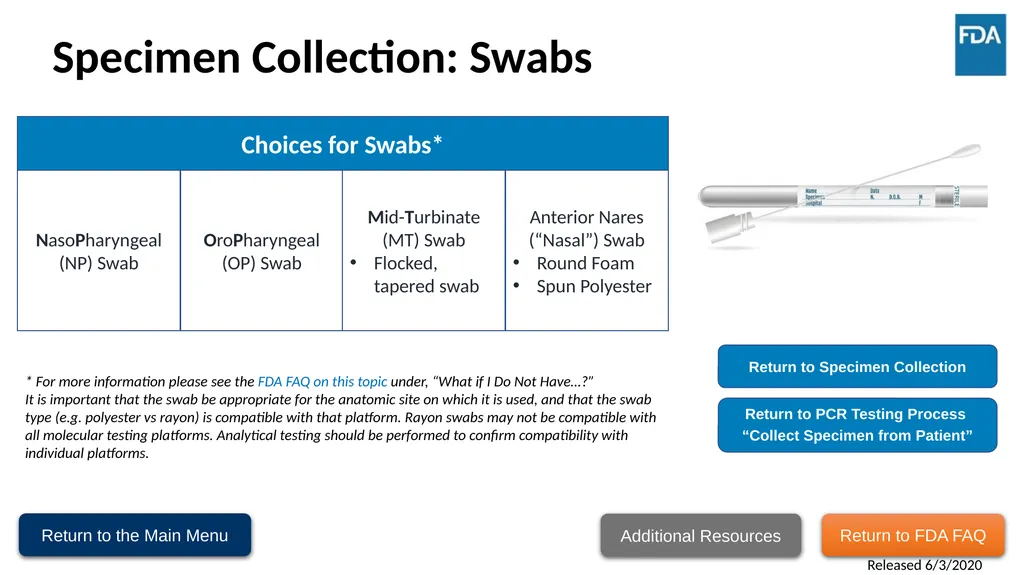
“Collect Specimen from Patient” * For more information please see the FDA FAQ on this topic under, “What if I Do Not Have…?”
It is important that the swab be appropriate for the anatomic site on which it is used, and that the swab type (e.g. polyester vs rayon) is compatible with that platform. Rayon swabs may not be compatible with all molecular testing platforms. Analytical testing should be performed to confirm compatibility with individual platforms. Specimen Collection: Swabs Additional Resources Return to the Main Menu Return to FDA FAQ<br>
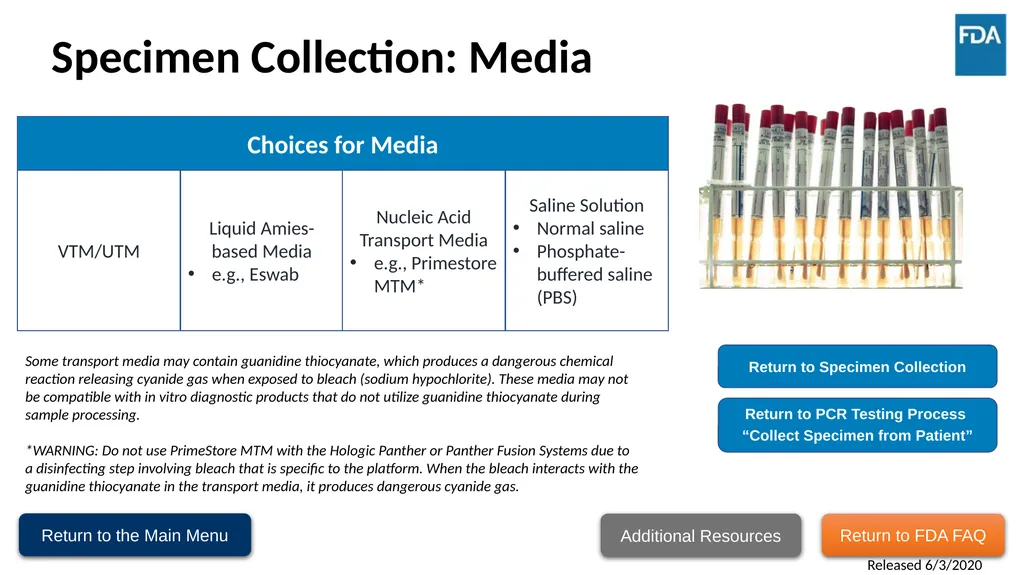
slide5. Some transport media may contain guanidine thiocyanate, which produces a dangerous chemical reaction releasing cyanide gas when exposed to bleach (sodium hypochlorite). These media may not be compatible with in vitro diagnostic products that do not utilize guanidine thiocyanate during sample processing.
*WARNING: Do not use PrimeStore MTM with the Hologic Panther or Panther Fusion Systems due to a disinfecting step involving bleach that is specific to the platform. When the bleach interacts with the guanidine thiocyanate in the transport media, it produces dangerous cyanide gas. Specimen Collection: Media Additional Resources Return to the Main Menu Return to Specimen Collection Return to PCR Testing Process
“Collect Specimen from Patient” Return to FDA FAQ<br>
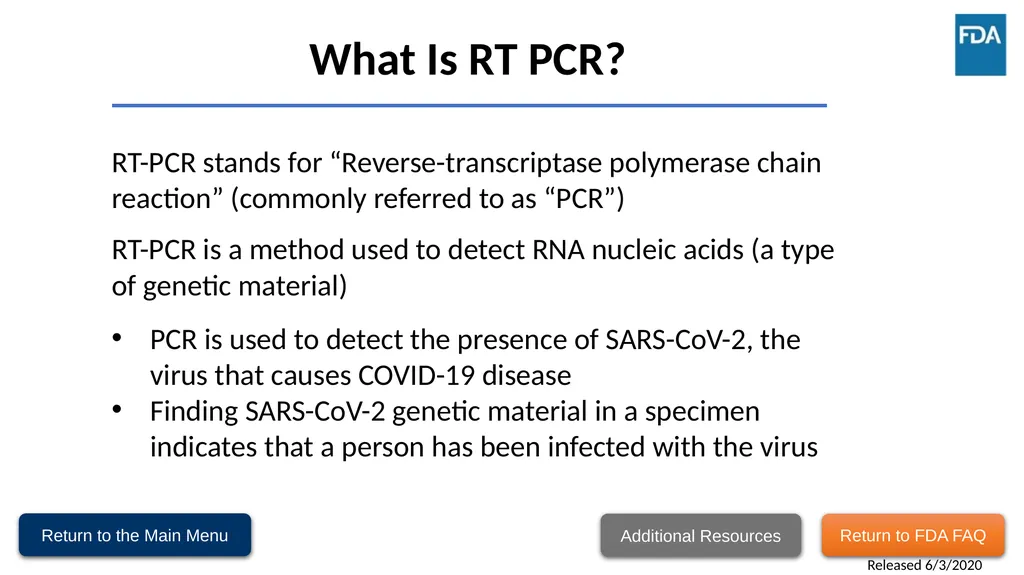
slide6. What Is RT PCR? RT-PCR stands for “Reverse-transcriptase polymerase chain reaction” (commonly referred to as “PCR”)
RT-PCR is a method used to detect RNA nucleic acids (a type of genetic material)
PCR is used to detect the presence of SARS-CoV-2, the virus that causes COVID-19 disease
Finding SARS-CoV-2 genetic material in a specimen indicates that a person has been infected with the virus Additional Resources Return to the Main Menu Return to FDA FAQ<br>
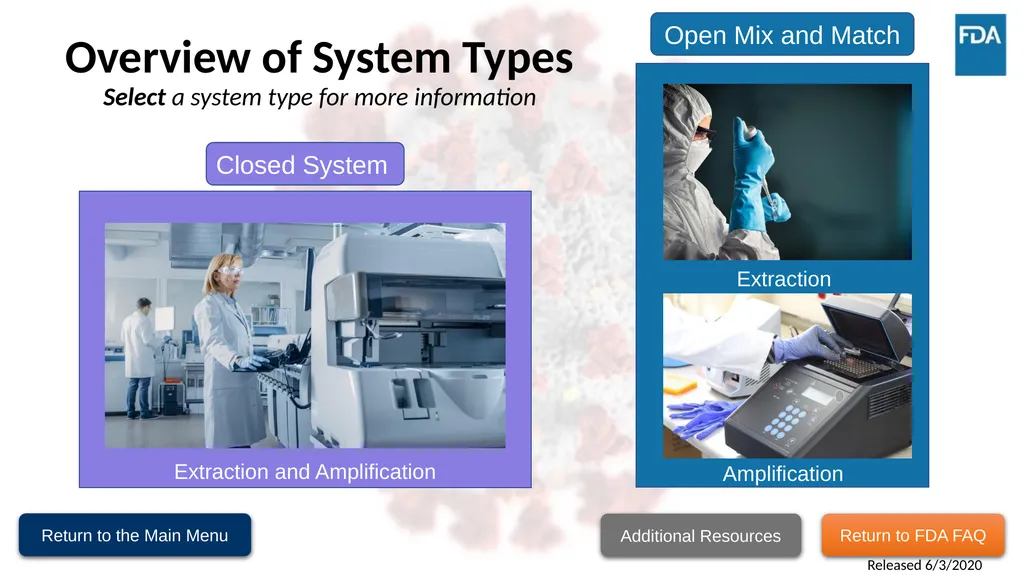
slide7. Open Mix and Match Amplification Extraction Closed System Extraction and Amplification Overview of System Types Additional Resources Return to the Main Menu Select a system type for more information Return to FDA FAQ<br>
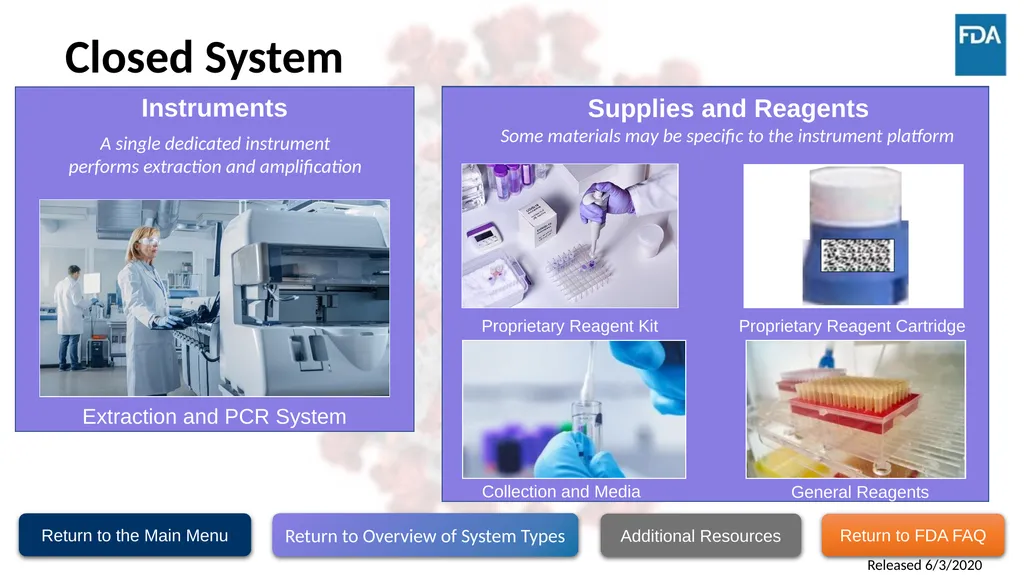
slide8. Proprietary Reagent Kit Extraction and PCR System Proprietary Reagent Cartridge Closed System A single dedicated instrument performs extraction and amplification Some materials may be specific to the instrument platform Collection and Media General Reagents Supplies and Reagents Instruments Additional Resources Return to the Main Menu Return to Overview of System Types Return to FDA FAQ<br>
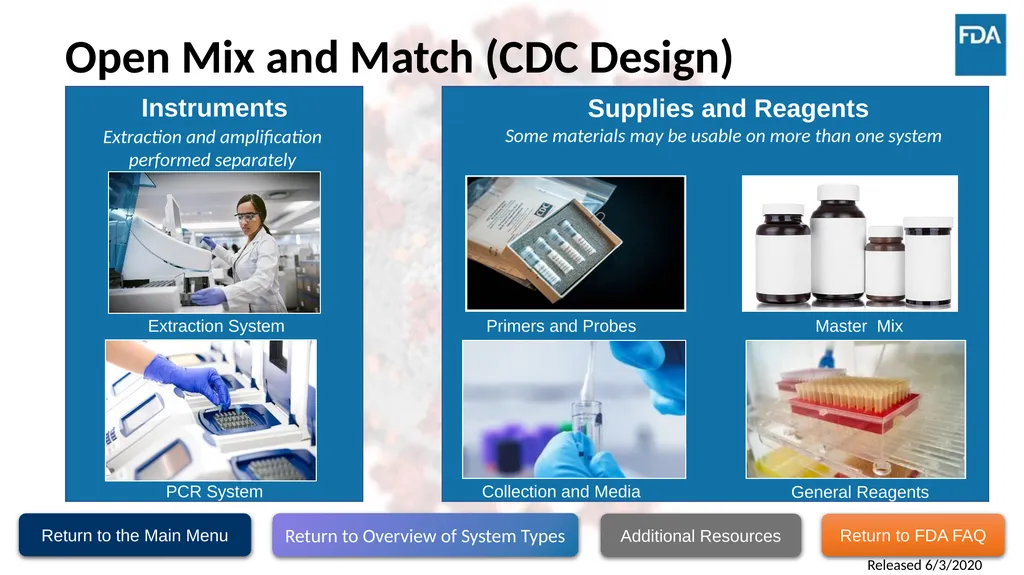
slide9. Primers and Probes Extraction System Instruments Supplies and Reagents Master Mix Collection and Media General Reagents PCR System Open Mix and Match (CDC Design) Some materials may be usable on more than one system Extraction and amplification performed separately Additional Resources Return to the Main Menu Return to Overview of System Types Return to FDA FAQ<br>
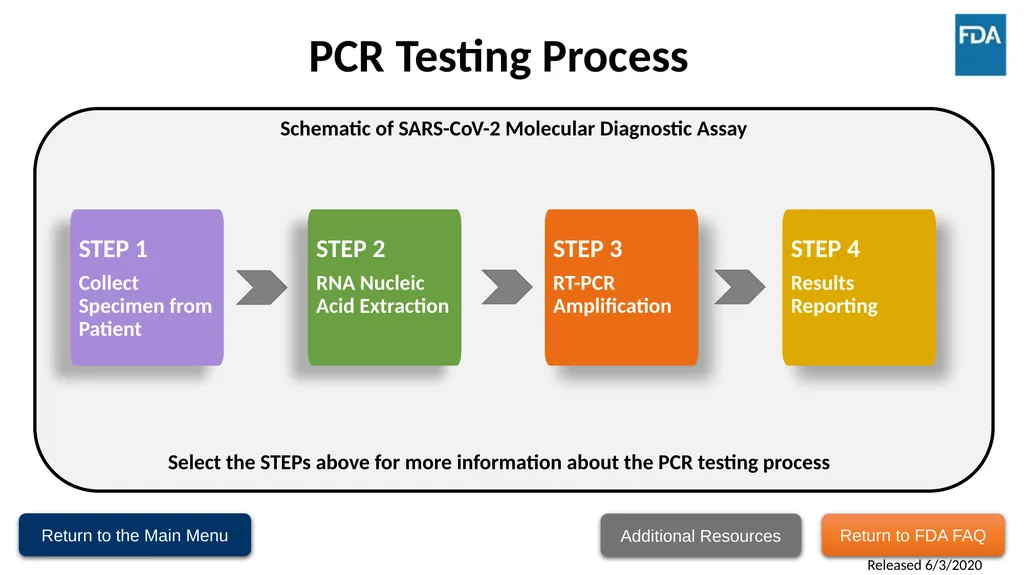
slide10. Schematic of SARS-CoV-2 Molecular Diagnostic Assay PCR Testing Process Select the STEPs above for more information about the PCR testing process STEP 1
Collect Specimen from Patient STEP 2
RNA Nucleic Acid Extraction STEP 3
RT-PCR Amplification STEP 4
Results Reporting Additional Resources Return to the Main Menu Return to FDA FAQ<br>
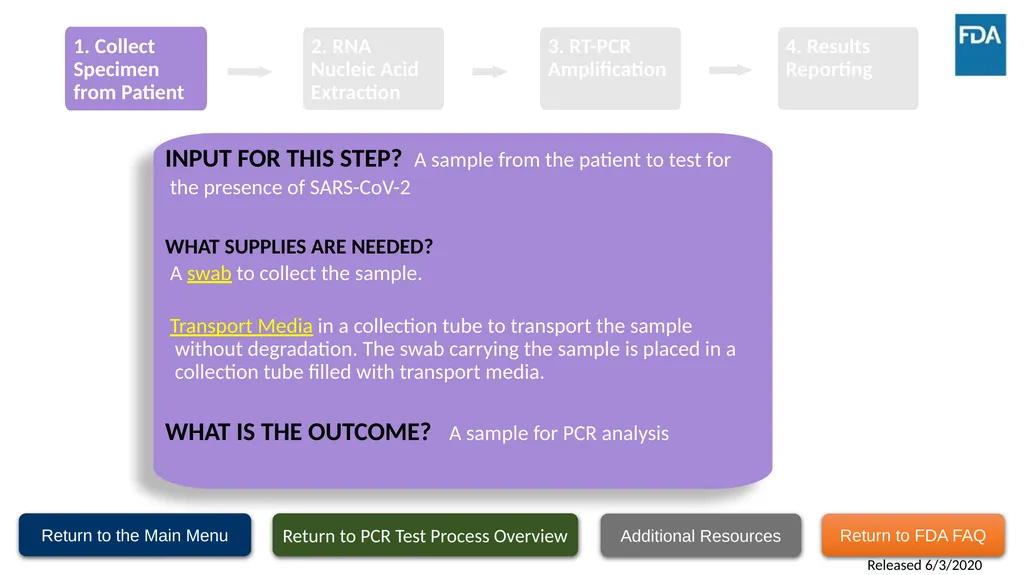
slide11. INPUT FOR THIS STEP? A sample from the patient to test for the presence of SARS-CoV-2
WHAT SUPPLIES ARE NEEDED?
A swab to collect the sample.
Transport Media in a collection tube to transport the sample without degradation. The swab carrying the sample is placed in a collection tube filled with transport media.
WHAT IS THE OUTCOME? A sample for PCR analysis Return to PCR Test Process Overview 1. Collect Specimen from Patient 2. RNA Nucleic Acid Extraction 3. RT-PCR Amplification 4. Results Reporting Additional Resources Return to the Main Menu Return to FDA FAQ<br>
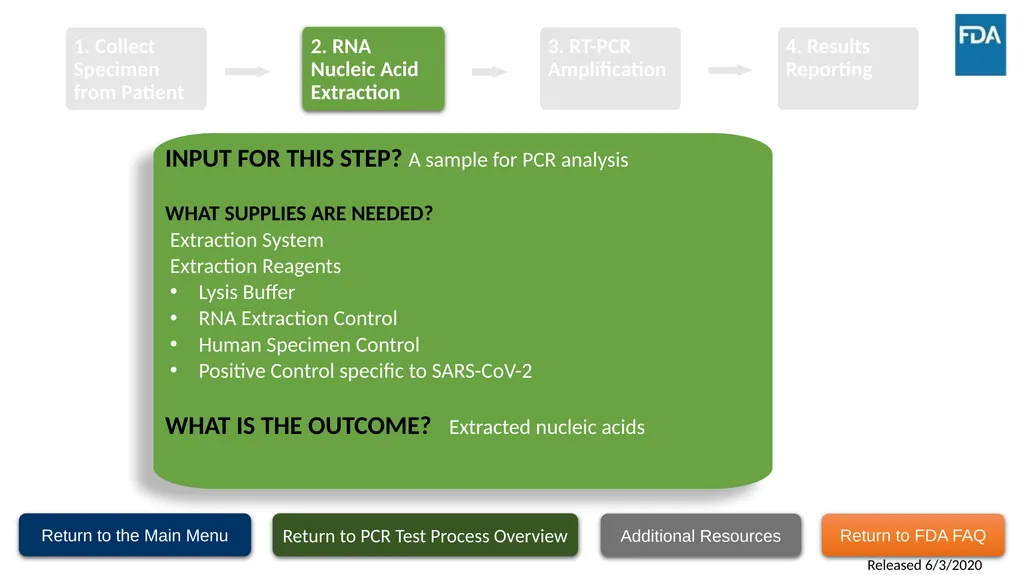
slide12. INPUT FOR THIS STEP? A sample for PCR analysis
WHAT SUPPLIES ARE NEEDED?
Extraction System
Extraction Reagents
Lysis Buffer
RNA Extraction Control
Human Specimen Control
Positive Control specific to SARS-CoV-2
WHAT IS THE OUTCOME? Extracted nucleic acids 1. Collect Specimen from Patient 2. RNA Nucleic Acid Extraction 4. Results Reporting 3. RT-PCR Amplification Return to PCR Test Process Overview Additional Resources Return to the Main Menu Return to FDA FAQ<br>
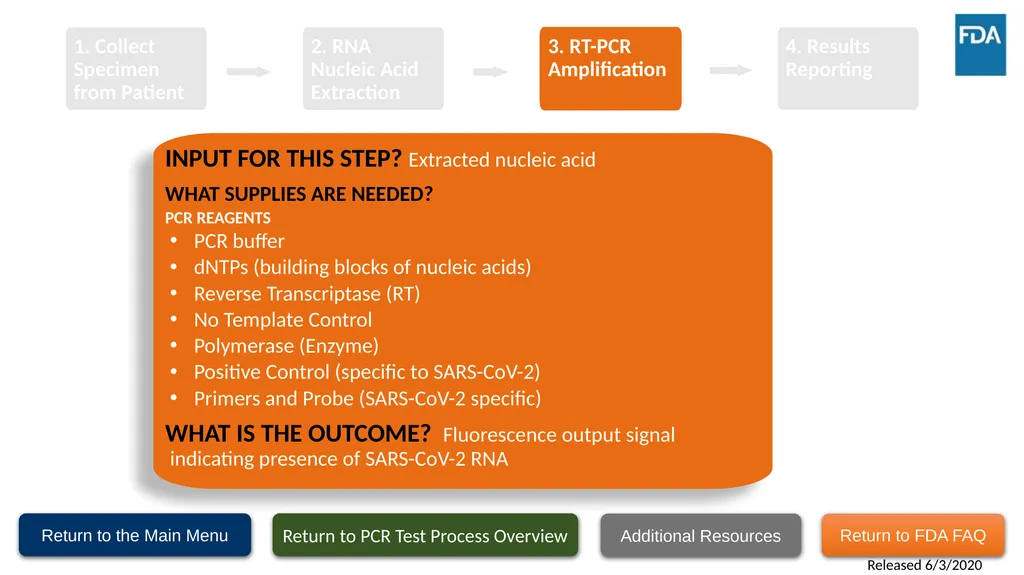
slide13. INPUT FOR THIS STEP? Extracted nucleic acid
WHAT SUPPLIES ARE NEEDED?
PCR REAGENTS
PCR buffer
dNTPs (building blocks of nucleic acids)
Reverse Transcriptase (RT)
No Template Control
Polymerase (Enzyme)
Positive Control (specific to SARS-CoV-2)
Primers and Probe (SARS-CoV-2 specific)
WHAT IS THE OUTCOME? Fluorescence output signal indicating presence of SARS-CoV-2 RNA 2. RNA Nucleic Acid Extraction 3. RT-PCR Amplification 4. Results Reporting 1. Collect Specimen from Patient Return to PCR Test Process Overview Additional Resources Return to the Main Menu Return to FDA FAQ<br>
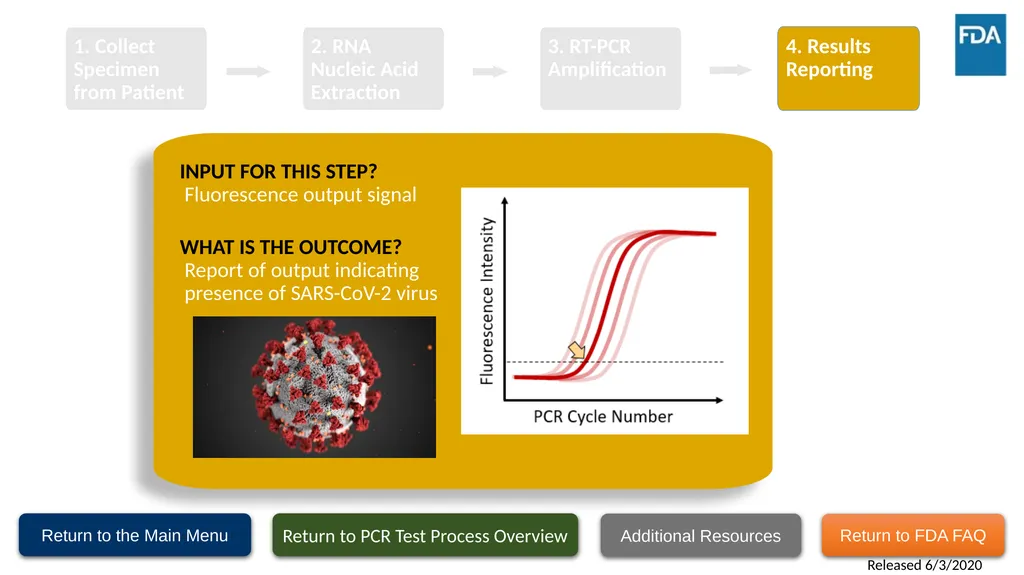
slide14. 2. RNA Nucleic Acid Extraction 3. RT-PCR Amplification 4. Results Reporting 1. Collect Specimen from Patient INPUT FOR THIS STEP? Fluorescence output signal
WHAT IS THE OUTCOME? Report of output indicating presence of SARS-CoV-2 virus Return to PCR Test Process Overview Additional Resources Return to the Main Menu Return to FDA FAQ<br>
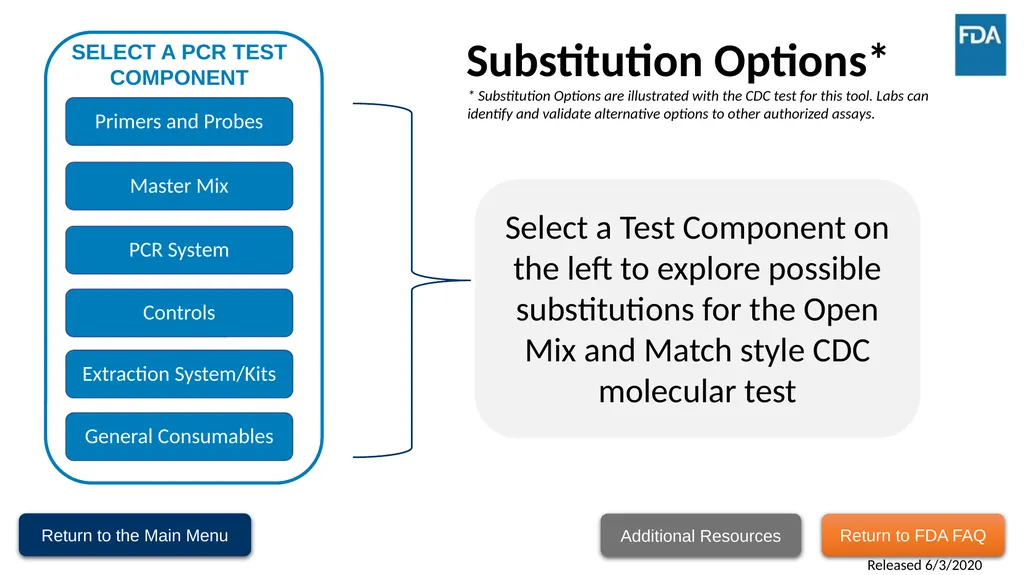
slide15. Substitution Options* Select a Test Component on the left to explore possible substitutions for the Open Mix and Match style CDC molecular test Primers and Probes SELECT A PCR TEST COMPONENT General Consumables Extraction System/Kits Controls PCR System Master Mix Additional Resources Return to the Main Menu * Substitution Options are illustrated with the CDC test for this tool. Labs can identify and validate alternative options to other authorized assays. Return to FDA FAQ<br>
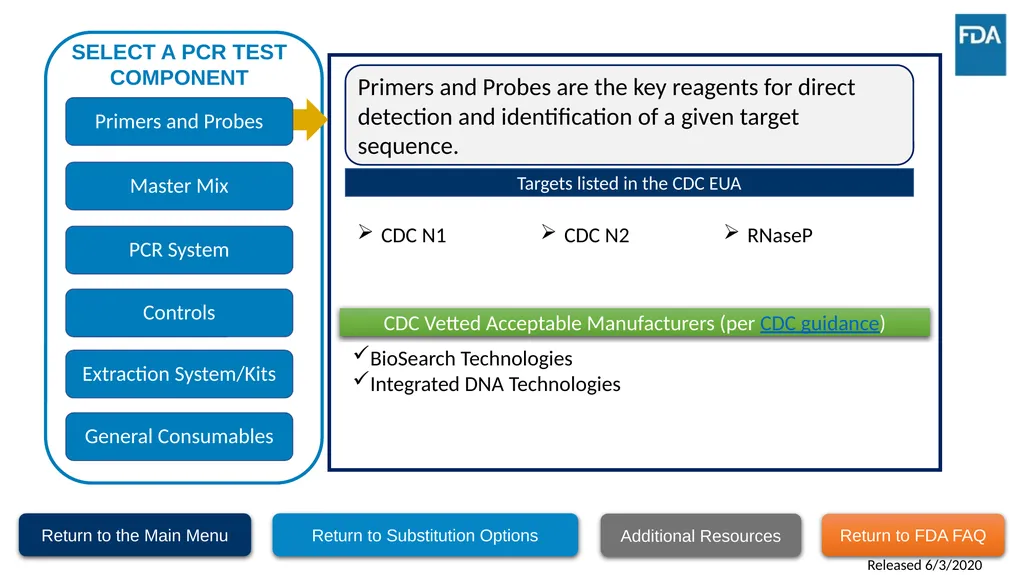
slide16. Primers and Probes are the key reagents for direct detection and identification of a given target sequence. CDC N1
CDC N2
RNaseP Targets listed in the CDC EUA BioSearch Technologies
Integrated DNA Technologies CDC Vetted Acceptable Manufacturers (per CDC guidance) SELECT A PCR TEST COMPONENT Additional Resources Return to the Main Menu Return to Substitution Options Primers and Probes General Consumables Extraction System/Kits Controls PCR System Master Mix Return to FDA FAQ<br>
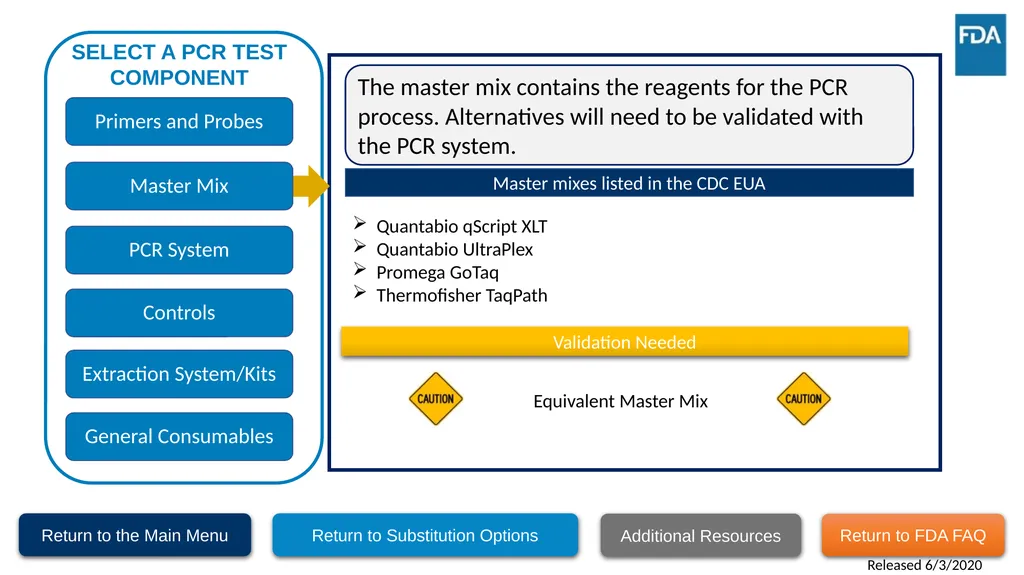
slide17. Equivalent Master Mix The master mix contains the reagents for the PCR process. Alternatives will need to be validated with the PCR system. Validation Needed Master mixes listed in the CDC EUA Quantabio qScript XLT
Quantabio UltraPlex
Promega GoTaq
Thermofisher TaqPath SELECT A PCR TEST COMPONENT Additional Resources Return to the Main Menu Return to Substitution Options Primers and Probes General Consumables Extraction System/Kits Controls PCR System Master Mix Return to FDA FAQ<br>
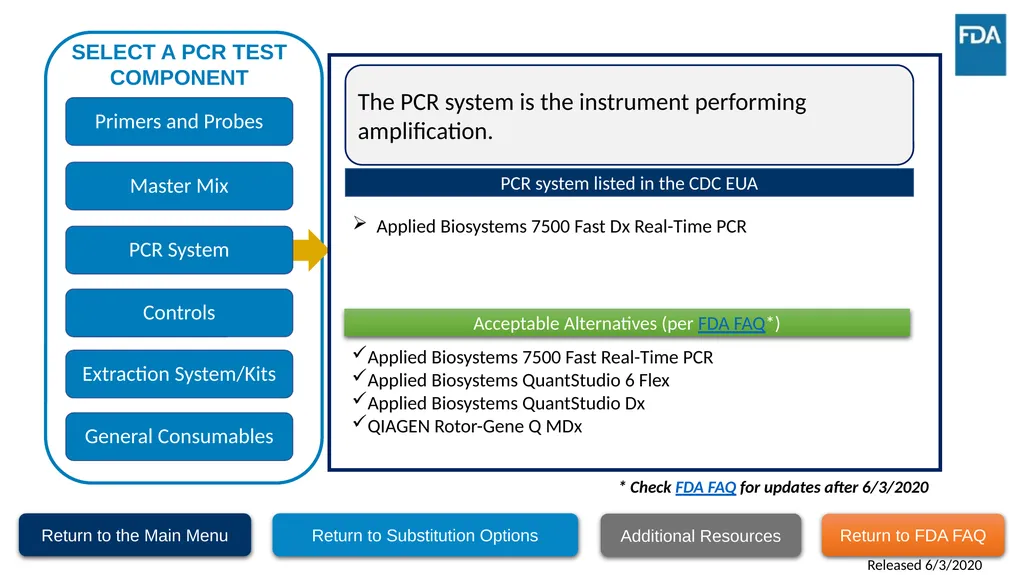
slide18. The PCR system is the instrument performing amplification. PCR system listed in the CDC EUA Applied Biosystems 7500 Fast Dx Real-Time PCR Applied Biosystems 7500 Fast Real-Time PCR
Applied Biosystems QuantStudio 6 Flex
Applied Biosystems QuantStudio Dx
QIAGEN Rotor-Gene Q MDx Acceptable Alternatives (per FDA FAQ*) SELECT A PCR TEST COMPONENT Additional Resources Return to the Main Menu Return to Substitution Options Primers and Probes General Consumables Extraction System/Kits Controls PCR System Master Mix * Check FDA FAQ for updates after 6/3/2020 Return to FDA FAQ<br>
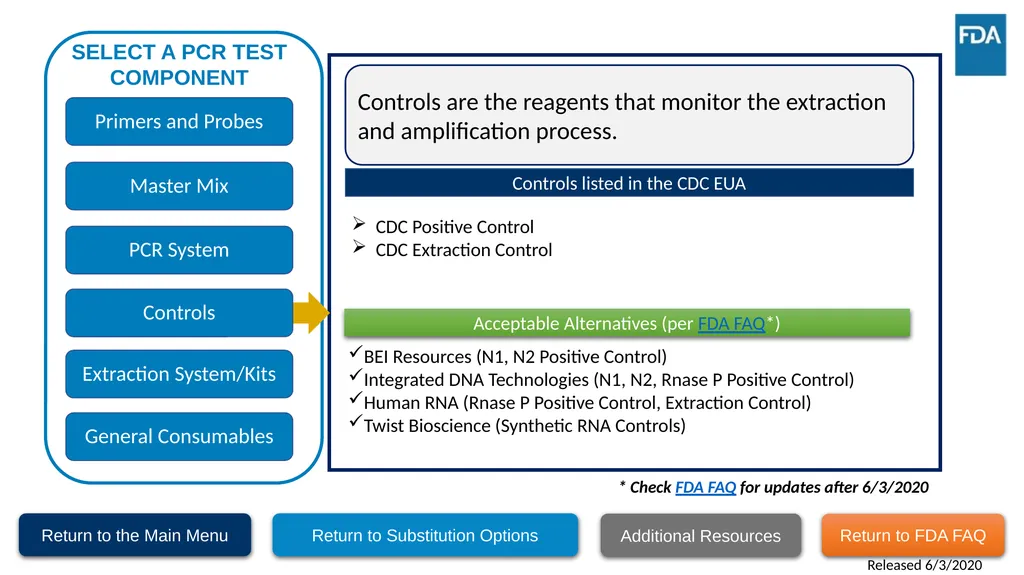
slide19. Controls are the reagents that monitor the extraction and amplification process. Controls listed in the CDC EUA CDC Positive Control
CDC Extraction Control BEI Resources (N1, N2 Positive Control)
Integrated DNA Technologies (N1, N2, Rnase P Positive Control)
Human RNA (Rnase P Positive Control, Extraction Control)
Twist Bioscience (Synthetic RNA Controls) Acceptable Alternatives (per FDA FAQ*) SELECT A PCR TEST COMPONENT Additional Resources Return to the Main Menu Return to Substitution Options Primers and Probes General Consumables Extraction System/Kits Controls PCR System Master Mix * Check FDA FAQ for updates after 6/3/2020 Return to FDA FAQ<br>
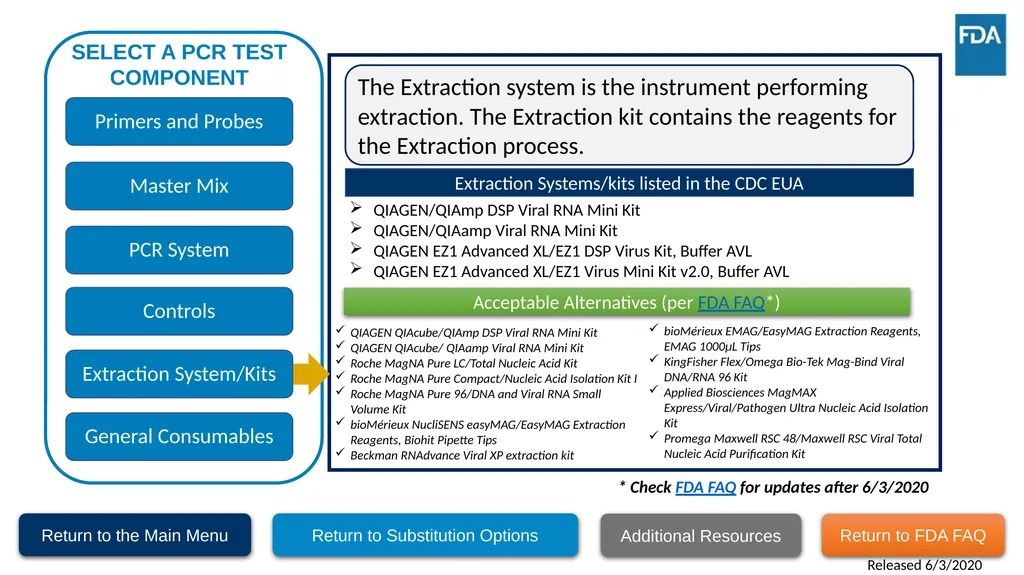
slide20. QIAGEN QIAcube/QIAmp DSP Viral RNA Mini Kit
QIAGEN QIAcube/ QIAamp Viral RNA Mini Kit
Roche MagNA Pure LC/Total Nucleic Acid Kit
Roche MagNA Pure Compact/Nucleic Acid Isolation Kit I
Roche MagNA Pure 96/DNA and Viral RNA Small Volume Kit
bioMérieux NucliSENS easyMAG/EasyMAG Extraction Reagents, Biohit Pipette Tips
Beckman RNAdvance Viral XP extraction kit The Extraction system is the instrument performing extraction. The Extraction kit contains the reagents for the Extraction process. Extraction Systems/kits listed in the CDC EUA QIAGEN/QIAmp DSP Viral RNA Mini Kit
QIAGEN/QIAamp Viral RNA Mini Kit
QIAGEN EZ1 Advanced XL/EZ1 DSP Virus Kit, Buffer AVL
QIAGEN EZ1 Advanced XL/EZ1 Virus Mini Kit v2.0, Buffer AVL Acceptable Alternatives (per FDA FAQ*) bioMérieux EMAG/EasyMAG Extraction Reagents, EMAG 1000μL Tips
KingFisher Flex/Omega Bio-Tek Mag-Bind Viral DNA/RNA 96 Kit
Applied Biosciences MagMAX Express/Viral/Pathogen Ultra Nucleic Acid Isolation Kit
Promega Maxwell RSC 48/Maxwell RSC Viral Total Nucleic Acid Purification Kit SELECT A PCR TEST COMPONENT Additional Resources Return to the Main Menu Return to Substitution Options Primers and Probes General Consumables Extraction System/Kits Controls PCR System Master Mix * Check FDA FAQ for updates after 6/3/2020 Return to FDA FAQ<br>
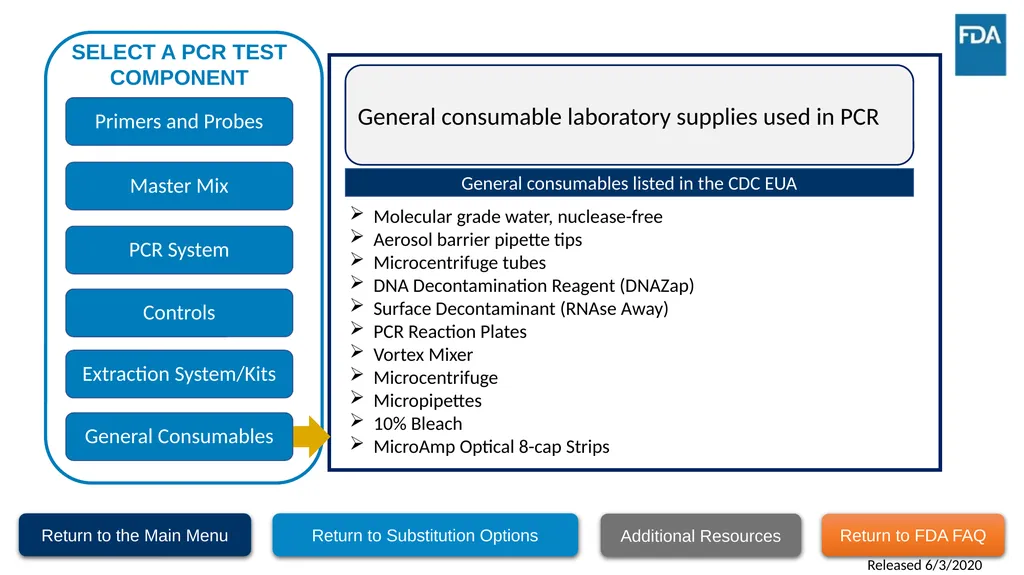
slide21. General consumable laboratory supplies used in PCR General consumables listed in the CDC EUA Molecular grade water, nuclease-free
Aerosol barrier pipette tips
Microcentrifuge tubes
DNA Decontamination Reagent (DNAZap)
Surface Decontaminant (RNAse Away)
PCR Reaction Plates
Vortex Mixer
Microcentrifuge
Micropipettes
10% Bleach
MicroAmp Optical 8-cap Strips SELECT A PCR TEST COMPONENT Additional Resources Return to the Main Menu Return to Substitution Options Primers and Probes General Consumables Extraction System/Kits Controls PCR System Master Mix Return to FDA FAQ<br>
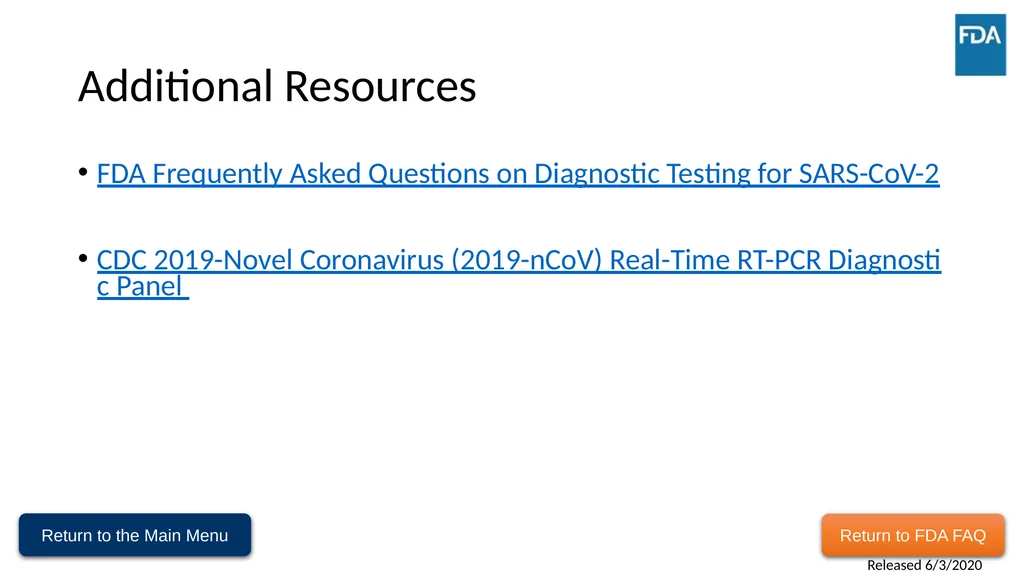
slide22. Additional Resources FDA Frequently Asked Questions on Diagnostic Testing for SARS-CoV-2
CDC 2019-Novel Coronavirus (2019-nCoV) Real-Time RT-PCR Diagnostic Panel Return to the Main Menu Return to FDA FAQ<br>
The information in this resource is not intended to alter any already issued EUA for a COVID-19 diagnostic test nor is it intended to speak to any specific FDA regulatory requirement. Rather, the information is being provided to help address availability concerns regarding certain critical components of COVID-19 diagnostic tests during this pandemic. START: Go to the Main Menu<br>
slide2. Specimen Collection Intro to PCR System Types PCR Testing Process Substitution Options Select a button to learn more about a topic Learn about specimen collection, swabs, and media Learn about RT-PCR: what it is and what it’s used for Compare use of Open Mix and Match Systems vs. Closed Systems, including
instruments, supplies, and reagents Learn about the steps in the PCR testing process Learn about substitution options for the Open Mix and Match style CDC test Real-time RT Polymerase Chain Reaction (PCR) Component Substitution Strategies Additional Resources Return to FDA FAQ Return to the Main Menu<br>
slide3. Explore acceptable choices for swabs Explore acceptable choices for media For more information please see the FDA FAQ on this topic under, “What if I Do Not Have…?” It is important that the swab type be appropriate for the anatomic site on which it is used, i.e. only a Nasopharyngeal swab should be used to obtain a Nasopharyngeal specimen.” Specimen collection is the process of obtaining a sample from a patient, usually by swabbing the nose or mouth, then placing the swab in a tube that is commonly filled with liquid (media) which maintains the sample for transport to the lab.
Originally, specimen collection for SARS-CoV-2 testing required a specialized Nasopharyngeal (NP) swab and Viral Transport Media (VTM)/ Universal Transport Media (UTM).
Options for swabs and media are below. Specimen Collection Additional Resources Return to the Main Menu Return to FDA FAQ<br>
slide4. Return to Specimen Collection Return to PCR Testing Process
“Collect Specimen from Patient” * For more information please see the FDA FAQ on this topic under, “What if I Do Not Have…?”
It is important that the swab be appropriate for the anatomic site on which it is used, and that the swab type (e.g. polyester vs rayon) is compatible with that platform. Rayon swabs may not be compatible with all molecular testing platforms. Analytical testing should be performed to confirm compatibility with individual platforms. Specimen Collection: Swabs Additional Resources Return to the Main Menu Return to FDA FAQ<br>
slide5. Some transport media may contain guanidine thiocyanate, which produces a dangerous chemical reaction releasing cyanide gas when exposed to bleach (sodium hypochlorite). These media may not be compatible with in vitro diagnostic products that do not utilize guanidine thiocyanate during sample processing.
*WARNING: Do not use PrimeStore MTM with the Hologic Panther or Panther Fusion Systems due to a disinfecting step involving bleach that is specific to the platform. When the bleach interacts with the guanidine thiocyanate in the transport media, it produces dangerous cyanide gas. Specimen Collection: Media Additional Resources Return to the Main Menu Return to Specimen Collection Return to PCR Testing Process
“Collect Specimen from Patient” Return to FDA FAQ<br>
slide6. What Is RT PCR? RT-PCR stands for “Reverse-transcriptase polymerase chain reaction” (commonly referred to as “PCR”)
RT-PCR is a method used to detect RNA nucleic acids (a type of genetic material)
PCR is used to detect the presence of SARS-CoV-2, the virus that causes COVID-19 disease
Finding SARS-CoV-2 genetic material in a specimen indicates that a person has been infected with the virus Additional Resources Return to the Main Menu Return to FDA FAQ<br>
slide7. Open Mix and Match Amplification Extraction Closed System Extraction and Amplification Overview of System Types Additional Resources Return to the Main Menu Select a system type for more information Return to FDA FAQ<br>
slide8. Proprietary Reagent Kit Extraction and PCR System Proprietary Reagent Cartridge Closed System A single dedicated instrument performs extraction and amplification Some materials may be specific to the instrument platform Collection and Media General Reagents Supplies and Reagents Instruments Additional Resources Return to the Main Menu Return to Overview of System Types Return to FDA FAQ<br>
slide9. Primers and Probes Extraction System Instruments Supplies and Reagents Master Mix Collection and Media General Reagents PCR System Open Mix and Match (CDC Design) Some materials may be usable on more than one system Extraction and amplification performed separately Additional Resources Return to the Main Menu Return to Overview of System Types Return to FDA FAQ<br>
slide10. Schematic of SARS-CoV-2 Molecular Diagnostic Assay PCR Testing Process Select the STEPs above for more information about the PCR testing process STEP 1
Collect Specimen from Patient STEP 2
RNA Nucleic Acid Extraction STEP 3
RT-PCR Amplification STEP 4
Results Reporting Additional Resources Return to the Main Menu Return to FDA FAQ<br>
slide11. INPUT FOR THIS STEP? A sample from the patient to test for the presence of SARS-CoV-2
WHAT SUPPLIES ARE NEEDED?
A swab to collect the sample.
Transport Media in a collection tube to transport the sample without degradation. The swab carrying the sample is placed in a collection tube filled with transport media.
WHAT IS THE OUTCOME? A sample for PCR analysis Return to PCR Test Process Overview 1. Collect Specimen from Patient 2. RNA Nucleic Acid Extraction 3. RT-PCR Amplification 4. Results Reporting Additional Resources Return to the Main Menu Return to FDA FAQ<br>
slide12. INPUT FOR THIS STEP? A sample for PCR analysis
WHAT SUPPLIES ARE NEEDED?
Extraction System
Extraction Reagents
Lysis Buffer
RNA Extraction Control
Human Specimen Control
Positive Control specific to SARS-CoV-2
WHAT IS THE OUTCOME? Extracted nucleic acids 1. Collect Specimen from Patient 2. RNA Nucleic Acid Extraction 4. Results Reporting 3. RT-PCR Amplification Return to PCR Test Process Overview Additional Resources Return to the Main Menu Return to FDA FAQ<br>
slide13. INPUT FOR THIS STEP? Extracted nucleic acid
WHAT SUPPLIES ARE NEEDED?
PCR REAGENTS
PCR buffer
dNTPs (building blocks of nucleic acids)
Reverse Transcriptase (RT)
No Template Control
Polymerase (Enzyme)
Positive Control (specific to SARS-CoV-2)
Primers and Probe (SARS-CoV-2 specific)
WHAT IS THE OUTCOME? Fluorescence output signal indicating presence of SARS-CoV-2 RNA 2. RNA Nucleic Acid Extraction 3. RT-PCR Amplification 4. Results Reporting 1. Collect Specimen from Patient Return to PCR Test Process Overview Additional Resources Return to the Main Menu Return to FDA FAQ<br>
slide14. 2. RNA Nucleic Acid Extraction 3. RT-PCR Amplification 4. Results Reporting 1. Collect Specimen from Patient INPUT FOR THIS STEP? Fluorescence output signal
WHAT IS THE OUTCOME? Report of output indicating presence of SARS-CoV-2 virus Return to PCR Test Process Overview Additional Resources Return to the Main Menu Return to FDA FAQ<br>
slide15. Substitution Options* Select a Test Component on the left to explore possible substitutions for the Open Mix and Match style CDC molecular test Primers and Probes SELECT A PCR TEST COMPONENT General Consumables Extraction System/Kits Controls PCR System Master Mix Additional Resources Return to the Main Menu * Substitution Options are illustrated with the CDC test for this tool. Labs can identify and validate alternative options to other authorized assays. Return to FDA FAQ<br>
slide16. Primers and Probes are the key reagents for direct detection and identification of a given target sequence. CDC N1
CDC N2
RNaseP Targets listed in the CDC EUA BioSearch Technologies
Integrated DNA Technologies CDC Vetted Acceptable Manufacturers (per CDC guidance) SELECT A PCR TEST COMPONENT Additional Resources Return to the Main Menu Return to Substitution Options Primers and Probes General Consumables Extraction System/Kits Controls PCR System Master Mix Return to FDA FAQ<br>
slide17. Equivalent Master Mix The master mix contains the reagents for the PCR process. Alternatives will need to be validated with the PCR system. Validation Needed Master mixes listed in the CDC EUA Quantabio qScript XLT
Quantabio UltraPlex
Promega GoTaq
Thermofisher TaqPath SELECT A PCR TEST COMPONENT Additional Resources Return to the Main Menu Return to Substitution Options Primers and Probes General Consumables Extraction System/Kits Controls PCR System Master Mix Return to FDA FAQ<br>
slide18. The PCR system is the instrument performing amplification. PCR system listed in the CDC EUA Applied Biosystems 7500 Fast Dx Real-Time PCR Applied Biosystems 7500 Fast Real-Time PCR
Applied Biosystems QuantStudio 6 Flex
Applied Biosystems QuantStudio Dx
QIAGEN Rotor-Gene Q MDx Acceptable Alternatives (per FDA FAQ*) SELECT A PCR TEST COMPONENT Additional Resources Return to the Main Menu Return to Substitution Options Primers and Probes General Consumables Extraction System/Kits Controls PCR System Master Mix * Check FDA FAQ for updates after 6/3/2020 Return to FDA FAQ<br>
slide19. Controls are the reagents that monitor the extraction and amplification process. Controls listed in the CDC EUA CDC Positive Control
CDC Extraction Control BEI Resources (N1, N2 Positive Control)
Integrated DNA Technologies (N1, N2, Rnase P Positive Control)
Human RNA (Rnase P Positive Control, Extraction Control)
Twist Bioscience (Synthetic RNA Controls) Acceptable Alternatives (per FDA FAQ*) SELECT A PCR TEST COMPONENT Additional Resources Return to the Main Menu Return to Substitution Options Primers and Probes General Consumables Extraction System/Kits Controls PCR System Master Mix * Check FDA FAQ for updates after 6/3/2020 Return to FDA FAQ<br>
slide20. QIAGEN QIAcube/QIAmp DSP Viral RNA Mini Kit
QIAGEN QIAcube/ QIAamp Viral RNA Mini Kit
Roche MagNA Pure LC/Total Nucleic Acid Kit
Roche MagNA Pure Compact/Nucleic Acid Isolation Kit I
Roche MagNA Pure 96/DNA and Viral RNA Small Volume Kit
bioMérieux NucliSENS easyMAG/EasyMAG Extraction Reagents, Biohit Pipette Tips
Beckman RNAdvance Viral XP extraction kit The Extraction system is the instrument performing extraction. The Extraction kit contains the reagents for the Extraction process. Extraction Systems/kits listed in the CDC EUA QIAGEN/QIAmp DSP Viral RNA Mini Kit
QIAGEN/QIAamp Viral RNA Mini Kit
QIAGEN EZ1 Advanced XL/EZ1 DSP Virus Kit, Buffer AVL
QIAGEN EZ1 Advanced XL/EZ1 Virus Mini Kit v2.0, Buffer AVL Acceptable Alternatives (per FDA FAQ*) bioMérieux EMAG/EasyMAG Extraction Reagents, EMAG 1000μL Tips
KingFisher Flex/Omega Bio-Tek Mag-Bind Viral DNA/RNA 96 Kit
Applied Biosciences MagMAX Express/Viral/Pathogen Ultra Nucleic Acid Isolation Kit
Promega Maxwell RSC 48/Maxwell RSC Viral Total Nucleic Acid Purification Kit SELECT A PCR TEST COMPONENT Additional Resources Return to the Main Menu Return to Substitution Options Primers and Probes General Consumables Extraction System/Kits Controls PCR System Master Mix * Check FDA FAQ for updates after 6/3/2020 Return to FDA FAQ<br>
slide21. General consumable laboratory supplies used in PCR General consumables listed in the CDC EUA Molecular grade water, nuclease-free
Aerosol barrier pipette tips
Microcentrifuge tubes
DNA Decontamination Reagent (DNAZap)
Surface Decontaminant (RNAse Away)
PCR Reaction Plates
Vortex Mixer
Microcentrifuge
Micropipettes
10% Bleach
MicroAmp Optical 8-cap Strips SELECT A PCR TEST COMPONENT Additional Resources Return to the Main Menu Return to Substitution Options Primers and Probes General Consumables Extraction System/Kits Controls PCR System Master Mix Return to FDA FAQ<br>
slide22. Additional Resources FDA Frequently Asked Questions on Diagnostic Testing for SARS-CoV-2
CDC 2019-Novel Coronavirus (2019-nCoV) Real-Time RT-PCR Diagnostic Panel Return to the Main Menu Return to FDA FAQ<br>