
TETANUS Unit-5 Dr Anil Kumar Asst. Professor Dept.



Description: TETANUS Unit-5 Dr Anil Kumar Asst. Professor Dept. of VCC TETANUS (Locked jawSaw Horse disease A highly fatal disease of all domestic animals caused by the neurotoxin and characterized by hyperaesthessia, tetany and convulsions Etiology:
Related Topics
Download Presentation
"TETANUS Unit-5 Dr Anil Kumar Asst. Professor Dept." is the property of its rightful owner. Permission is granted to download and print the materials on this website for personal, non-commercial use only, and to display it on your personal computer provided you do not modify the materials and that you retain all copyright notices contained in the materials. By downloading content from our website, you accept the terms of this agreement.
Presentation Transcript
slide1. TETANUS
Unit-5 Dr Anil Kumar
Asst. Professor
Dept. of VCC<br>
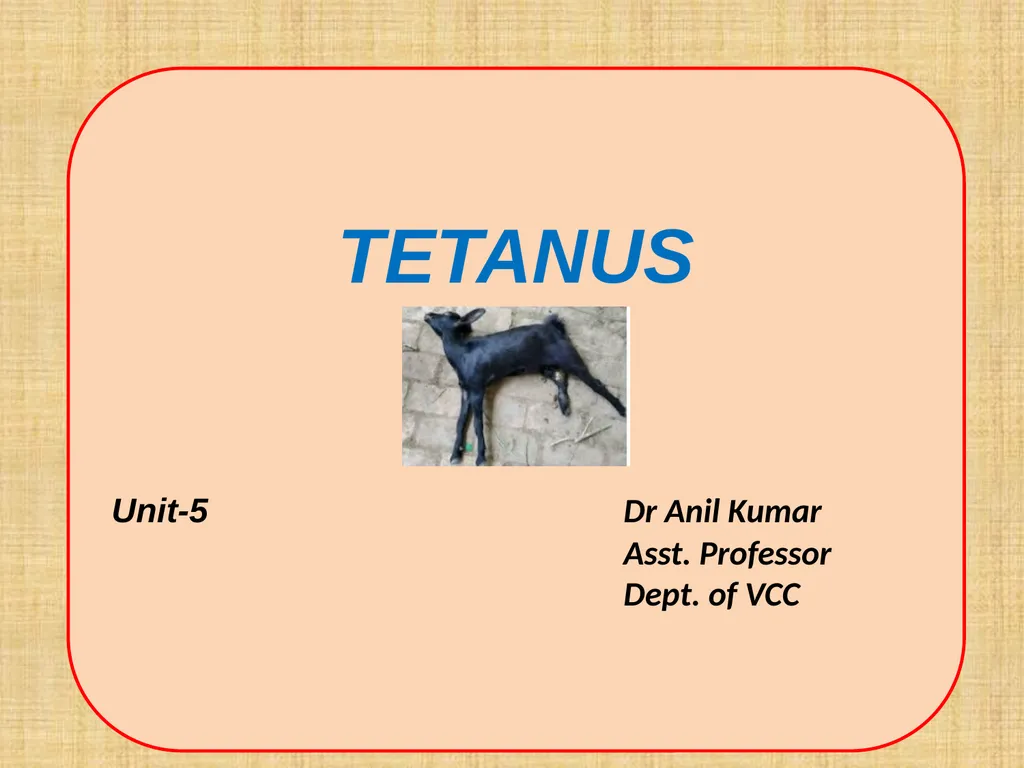
slide2. TETANUS (Locked jaw/Saw Horse disease A highly fatal disease of all domestic animals caused by the neurotoxin and characterized by hyperaesthessia, tetany and convulsions
Etiology:
Clostridium tetani , Gm positive, anerobe.
It forms a terminal spore, twice the width of micro-organism and gives a “drum stick like” appearance.
The organism produces a highly potent toxin i.e. Tetanospasmin (Neurotoxin), Tetanolysin (Hemolysin) and Fibrinolysin
Host Range:
All farm animals
Susceptibility is Horse> Sheep/Goat > Cattle >Pigs
Rare in carnivores, but birds are resistant.<br>
slide3. Transmission:
Contaminated soil , especially from faeces of horse
Deep punctured wound; spores lies in dormant stage but proliferate when tissue conditions favourable.
Horse- punctured wounds
Cattle-Genital tract
Pig- Castration
Neonates- Umbilical cord
Lambs- Castration, shearing, docking, vaccination.
Pathogenesis:
Organism→Localized at the sites of introduction without affecting surrounding tissues→Due to low O2 tension proliferation starts→Release tetanospasmin and tetanolysin→Goes to circulation through diffusion of toxins→Bound to motor end plates through retrograde transport→Blocks the motor neurons→ Causes spastic paralysis→Ultimately death due to asphyxia due to fixation of muscles of respiration<br>
slide4. Clinical Findings:
The incubation period - one to several weeks (10–14 days).
Localized stiffness, often involving the masseter muscles and muscles of the neck, the hind limbs, and the region of the infected wound, is seen first.
Generalized stiffness one day later with tonic spasm and hyperaesthesia.
Excitation increases with sudden movement or noise or other stimuli.
A spasm of head muscles causes difficulty in prehension and mastication of food, hence the common name, lockjaw.
Continuous drooling of saliva
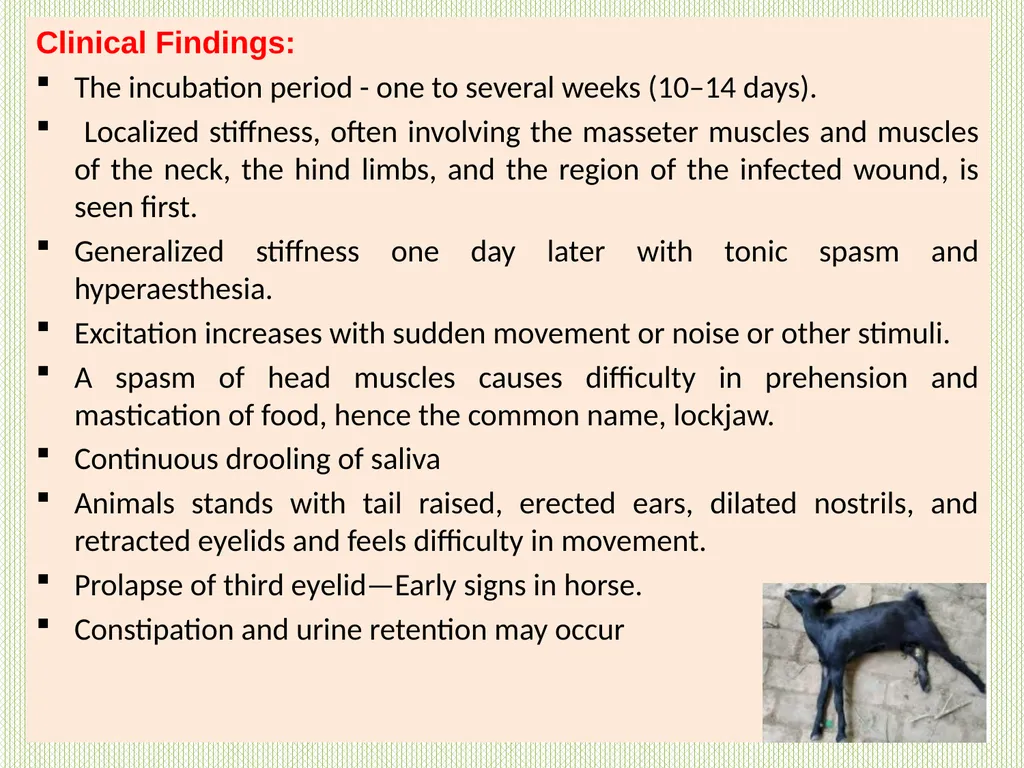
Animals stands with tail raised, erected ears, dilated nostrils, and retracted eyelids and feels difficulty in movement.
Prolapse of third eyelid—Early signs in horse.
Constipation and urine retention may occur<br>
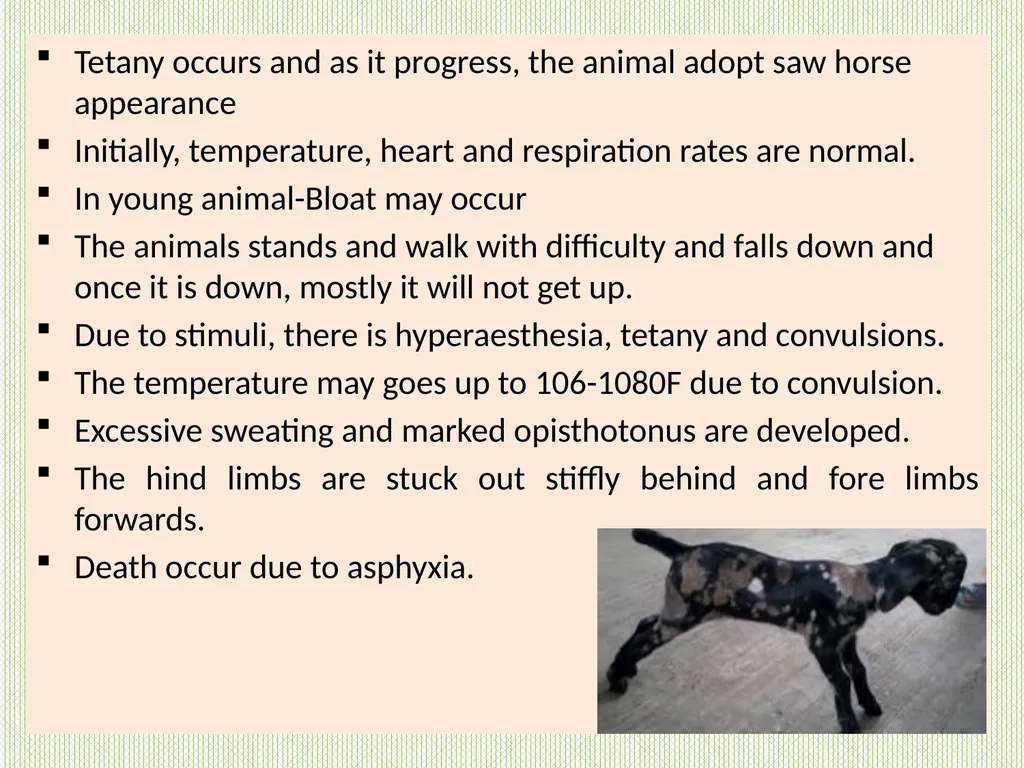
slide5. Tetany occurs and as it progress, the animal adopt saw horse appearance
Initially, temperature, heart and respiration rates are normal.
In young animal-Bloat may occur
The animals stands and walk with difficulty and falls down and once it is down, mostly it will not get up.
Due to stimuli, there is hyperaesthesia, tetany and convulsions.
The temperature may goes up to 106-1080F due to convulsion.
Excessive sweating and marked opisthotonus are developed.
The hind limbs are stuck out stiffly behind and fore limbs forwards.
Death occur due to asphyxia.<br>
slide6. Diagnosis:
History and Clinical signs
Culture of organism by anaerobic method
Differential Diagnosis:
Hypocalcaemic tetany (Mare)----Calcium therapy
Acute laminitis in horse-----No Convulsion
Cerebrospinal meningitis------ No hypersensitivity with sound and movement
Lactation tetany (Cattle)--------No third eyelid prolapse and bloat are absent
Enzootic muscular dystrophy of lambs---No tetany occur<br>
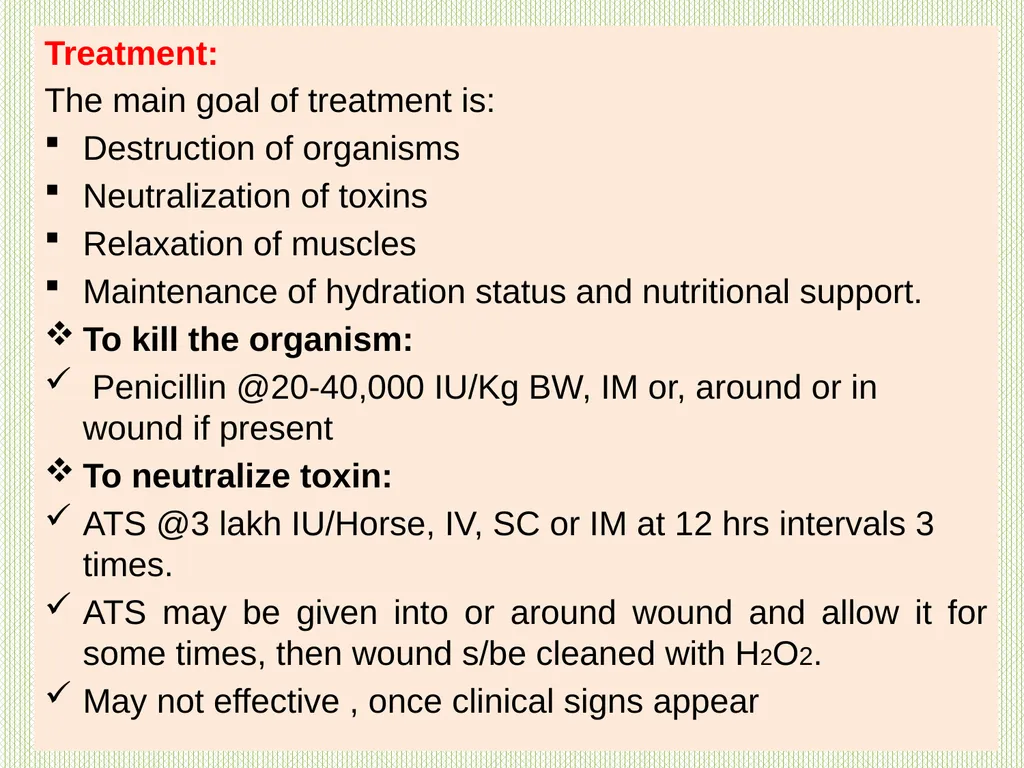
slide7. Treatment:
The main goal of treatment is:
Destruction of organisms
Neutralization of toxins
Relaxation of muscles
Maintenance of hydration status and nutritional support.
To kill the organism:
Penicillin @20-40,000 IU/Kg BW, IM or, around or in wound if present
To neutralize toxin:
ATS @3 lakh IU/Horse, IV, SC or IM at 12 hrs intervals 3 times.
ATS may be given into or around wound and allow it for some times, then wound s/be cleaned with H2O2.
May not effective , once clinical signs appear<br>
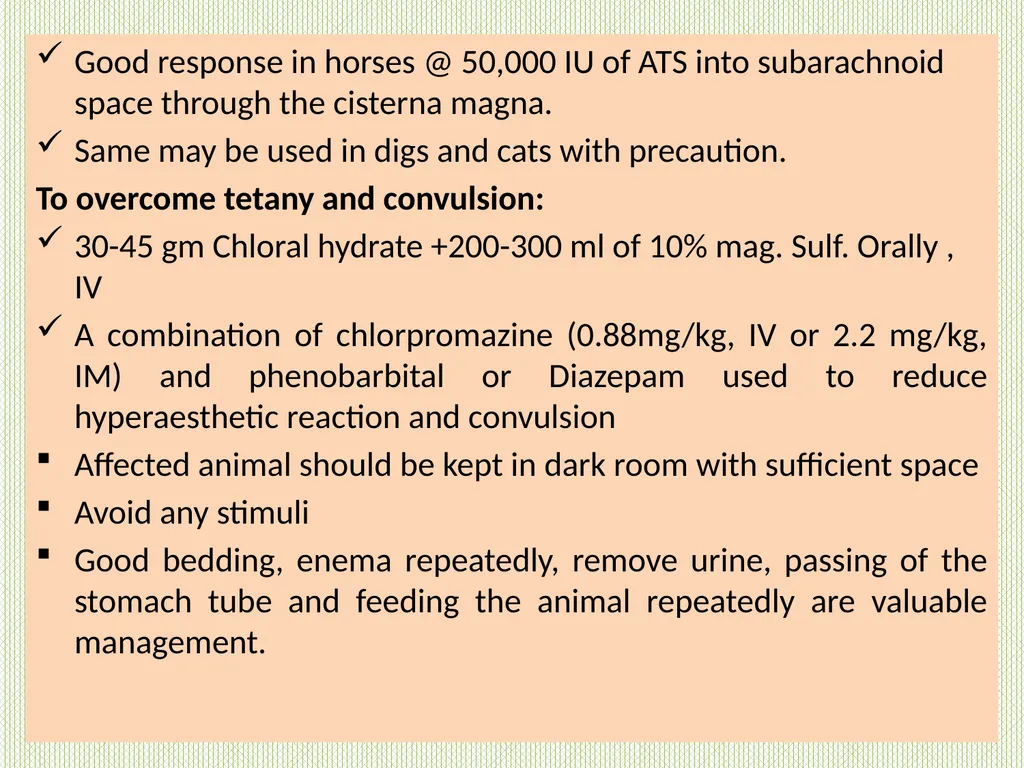
slide8. Good response in horses @ 50,000 IU of ATS into subarachnoid space through the cisterna magna.
Same may be used in digs and cats with precaution.
To overcome tetany and convulsion:
30-45 gm Chloral hydrate +200-300 ml of 10% mag. Sulf. Orally , IV
A combination of chlorpromazine (0.88mg/kg, IV or 2.2 mg/kg, IM) and phenobarbital or Diazepam used to reduce hyperaesthetic reaction and convulsion
Affected animal should be kept in dark room with sufficient space
Avoid any stimuli
Good bedding, enema repeatedly, remove urine, passing of the stomach tube and feeding the animal repeatedly are valuable management.<br>
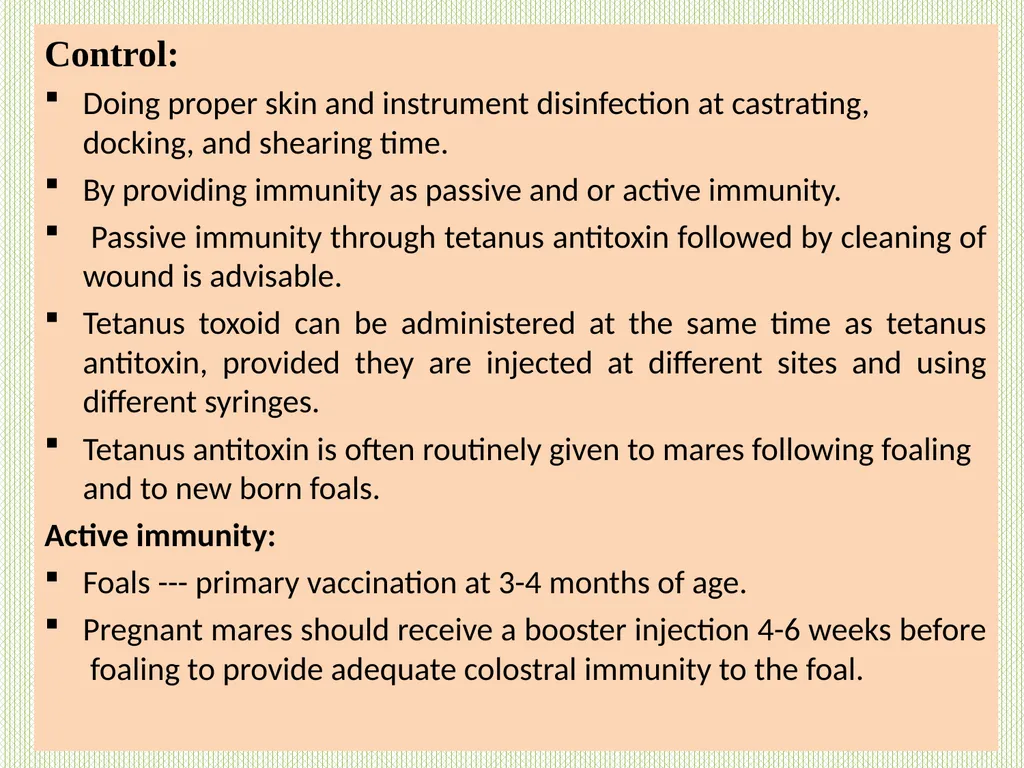
slide9. Control:
Doing proper skin and instrument disinfection at castrating, docking, and shearing time.
By providing immunity as passive and or active immunity.
Passive immunity through tetanus antitoxin followed by cleaning of wound is advisable.
Tetanus toxoid can be administered at the same time as tetanus antitoxin, provided they are injected at different sites and using different syringes.
Tetanus antitoxin is often routinely given to mares following foaling and to new born foals.
Active immunity:
Foals --- primary vaccination at 3-4 months of age.
Pregnant mares should receive a booster injection 4-6 weeks before foaling to provide adequate colostral immunity to the foal.<br>
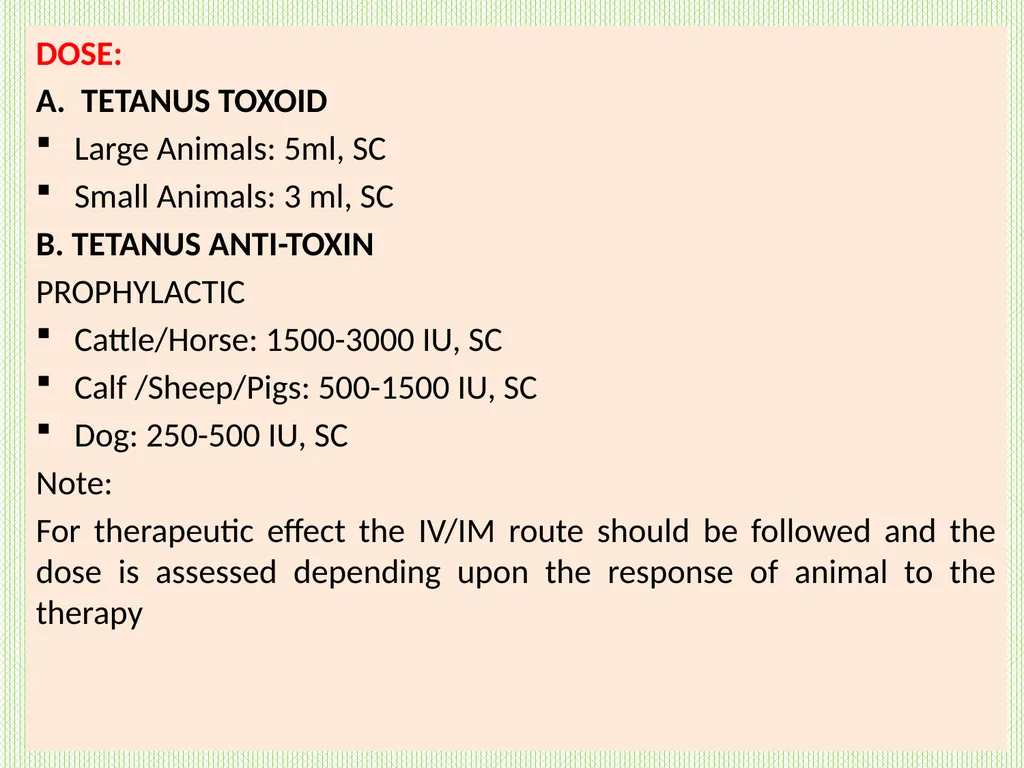
slide10. DOSE:
A. TETANUS TOXOID
Large Animals: 5ml, SC
Small Animals: 3 ml, SC
B. TETANUS ANTI-TOXIN
PROPHYLACTIC
Cattle/Horse: 1500-3000 IU, SC
Calf /Sheep/Pigs: 500-1500 IU, SC
Dog: 250-500 IU, SC
Note:
For therapeutic effect the IV/IM route should be followed and the dose is assessed depending upon the response of animal to the therapy<br>
Unit-5 Dr Anil Kumar
Asst. Professor
Dept. of VCC<br>
slide2. TETANUS (Locked jaw/Saw Horse disease A highly fatal disease of all domestic animals caused by the neurotoxin and characterized by hyperaesthessia, tetany and convulsions
Etiology:
Clostridium tetani , Gm positive, anerobe.
It forms a terminal spore, twice the width of micro-organism and gives a “drum stick like” appearance.
The organism produces a highly potent toxin i.e. Tetanospasmin (Neurotoxin), Tetanolysin (Hemolysin) and Fibrinolysin
Host Range:
All farm animals
Susceptibility is Horse> Sheep/Goat > Cattle >Pigs
Rare in carnivores, but birds are resistant.<br>
slide3. Transmission:
Contaminated soil , especially from faeces of horse
Deep punctured wound; spores lies in dormant stage but proliferate when tissue conditions favourable.
Horse- punctured wounds
Cattle-Genital tract
Pig- Castration
Neonates- Umbilical cord
Lambs- Castration, shearing, docking, vaccination.
Pathogenesis:
Organism→Localized at the sites of introduction without affecting surrounding tissues→Due to low O2 tension proliferation starts→Release tetanospasmin and tetanolysin→Goes to circulation through diffusion of toxins→Bound to motor end plates through retrograde transport→Blocks the motor neurons→ Causes spastic paralysis→Ultimately death due to asphyxia due to fixation of muscles of respiration<br>
slide4. Clinical Findings:
The incubation period - one to several weeks (10–14 days).
Localized stiffness, often involving the masseter muscles and muscles of the neck, the hind limbs, and the region of the infected wound, is seen first.
Generalized stiffness one day later with tonic spasm and hyperaesthesia.
Excitation increases with sudden movement or noise or other stimuli.
A spasm of head muscles causes difficulty in prehension and mastication of food, hence the common name, lockjaw.
Continuous drooling of saliva
Animals stands with tail raised, erected ears, dilated nostrils, and retracted eyelids and feels difficulty in movement.
Prolapse of third eyelid—Early signs in horse.
Constipation and urine retention may occur<br>
slide5. Tetany occurs and as it progress, the animal adopt saw horse appearance
Initially, temperature, heart and respiration rates are normal.
In young animal-Bloat may occur
The animals stands and walk with difficulty and falls down and once it is down, mostly it will not get up.
Due to stimuli, there is hyperaesthesia, tetany and convulsions.
The temperature may goes up to 106-1080F due to convulsion.
Excessive sweating and marked opisthotonus are developed.
The hind limbs are stuck out stiffly behind and fore limbs forwards.
Death occur due to asphyxia.<br>
slide6. Diagnosis:
History and Clinical signs
Culture of organism by anaerobic method
Differential Diagnosis:
Hypocalcaemic tetany (Mare)----Calcium therapy
Acute laminitis in horse-----No Convulsion
Cerebrospinal meningitis------ No hypersensitivity with sound and movement
Lactation tetany (Cattle)--------No third eyelid prolapse and bloat are absent
Enzootic muscular dystrophy of lambs---No tetany occur<br>
slide7. Treatment:
The main goal of treatment is:
Destruction of organisms
Neutralization of toxins
Relaxation of muscles
Maintenance of hydration status and nutritional support.
To kill the organism:
Penicillin @20-40,000 IU/Kg BW, IM or, around or in wound if present
To neutralize toxin:
ATS @3 lakh IU/Horse, IV, SC or IM at 12 hrs intervals 3 times.
ATS may be given into or around wound and allow it for some times, then wound s/be cleaned with H2O2.
May not effective , once clinical signs appear<br>
slide8. Good response in horses @ 50,000 IU of ATS into subarachnoid space through the cisterna magna.
Same may be used in digs and cats with precaution.
To overcome tetany and convulsion:
30-45 gm Chloral hydrate +200-300 ml of 10% mag. Sulf. Orally , IV
A combination of chlorpromazine (0.88mg/kg, IV or 2.2 mg/kg, IM) and phenobarbital or Diazepam used to reduce hyperaesthetic reaction and convulsion
Affected animal should be kept in dark room with sufficient space
Avoid any stimuli
Good bedding, enema repeatedly, remove urine, passing of the stomach tube and feeding the animal repeatedly are valuable management.<br>
slide9. Control:
Doing proper skin and instrument disinfection at castrating, docking, and shearing time.
By providing immunity as passive and or active immunity.
Passive immunity through tetanus antitoxin followed by cleaning of wound is advisable.
Tetanus toxoid can be administered at the same time as tetanus antitoxin, provided they are injected at different sites and using different syringes.
Tetanus antitoxin is often routinely given to mares following foaling and to new born foals.
Active immunity:
Foals --- primary vaccination at 3-4 months of age.
Pregnant mares should receive a booster injection 4-6 weeks before foaling to provide adequate colostral immunity to the foal.<br>
slide10. DOSE:
A. TETANUS TOXOID
Large Animals: 5ml, SC
Small Animals: 3 ml, SC
B. TETANUS ANTI-TOXIN
PROPHYLACTIC
Cattle/Horse: 1500-3000 IU, SC
Calf /Sheep/Pigs: 500-1500 IU, SC
Dog: 250-500 IU, SC
Note:
For therapeutic effect the IV/IM route should be followed and the dose is assessed depending upon the response of animal to the therapy<br>