
ANTHRAX UNIT-5 Dr. Anil Kumar Asst. Professor

Description: ANTHRAX UNIT-5 Dr. Anil Kumar Asst. Professor Dept. of VCC Anthrax Source: anipedia.org ANTHRAX (Spleenic feverwool sorters diseaseCarbuncles) ETIOLOGY Bacillus anthracis. Greek word for coal, because of the ulcers with dark centres that
Related Topics
Download Presentation
"ANTHRAX UNIT-5 Dr. Anil Kumar Asst. Professor" is the property of its rightful owner. Permission is granted to download and print the materials on this website for personal, non-commercial use only, and to display it on your personal computer provided you do not modify the materials and that you retain all copyright notices contained in the materials. By downloading content from our website, you accept the terms of this agreement.
Presentation Transcript
slide1. ANTHRAX UNIT-5 Dr. Anil Kumar
Asst. Professor
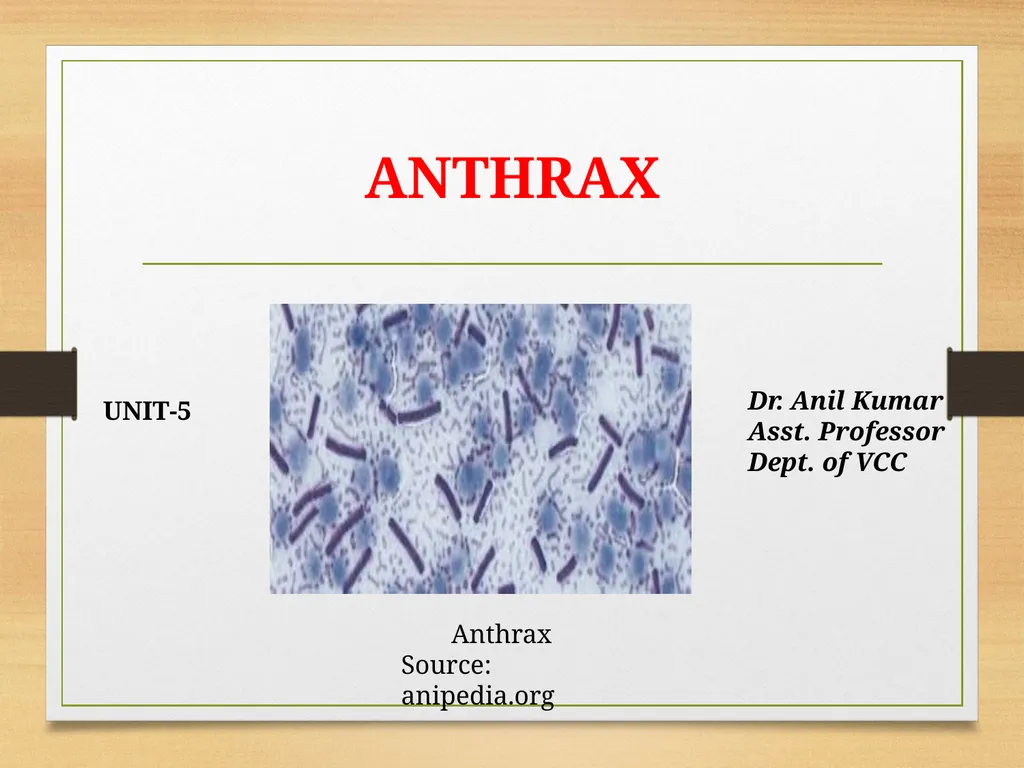
Dept. of VCC Anthrax
Source: anipedia.org<br>
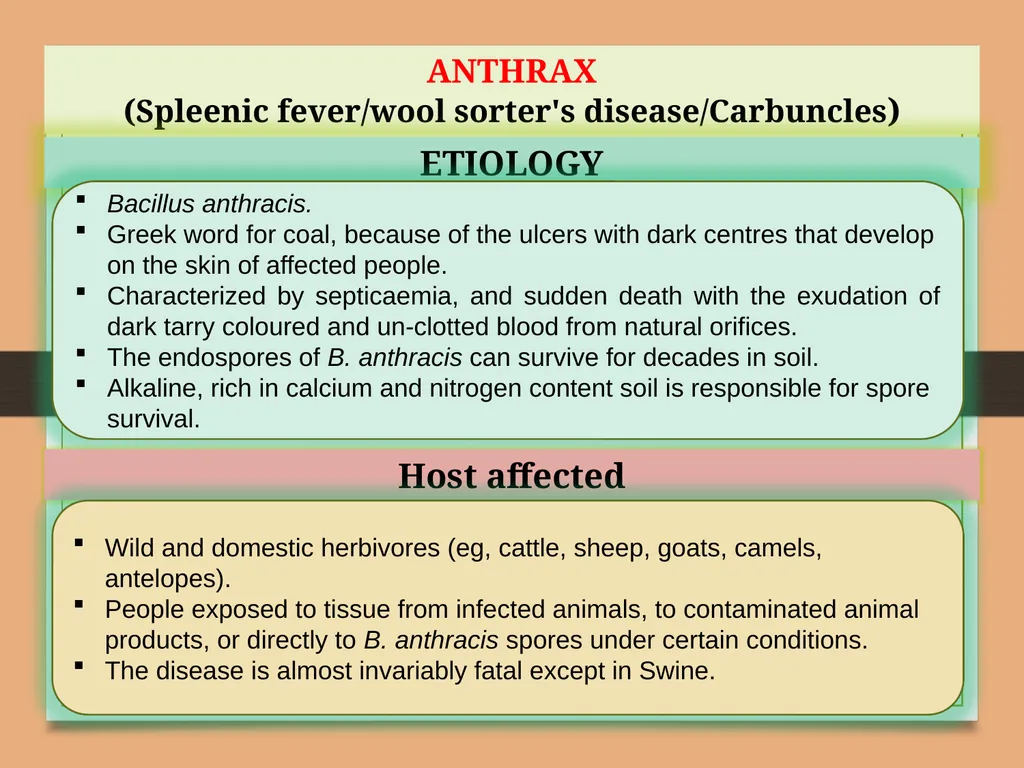
slide2. ANTHRAX (Spleenic fever/wool sorter's disease/Carbuncles) ETIOLOGY Bacillus anthracis.
Greek word for coal, because of the ulcers with dark centres that develop on the skin of affected people.
Characterized by septicaemia, and sudden death with the exudation of dark tarry coloured and un-clotted blood from natural orifices.
The endospores of B. anthracis can survive for decades in soil.
Alkaline, rich in calcium and nitrogen content soil is responsible for spore survival. Host affected Wild and domestic herbivores (eg, cattle, sheep, goats, camels, antelopes).
People exposed to tissue from infected animals, to contaminated animal products, or directly to B. anthracis spores under certain conditions.
The disease is almost invariably fatal except in Swine.<br>
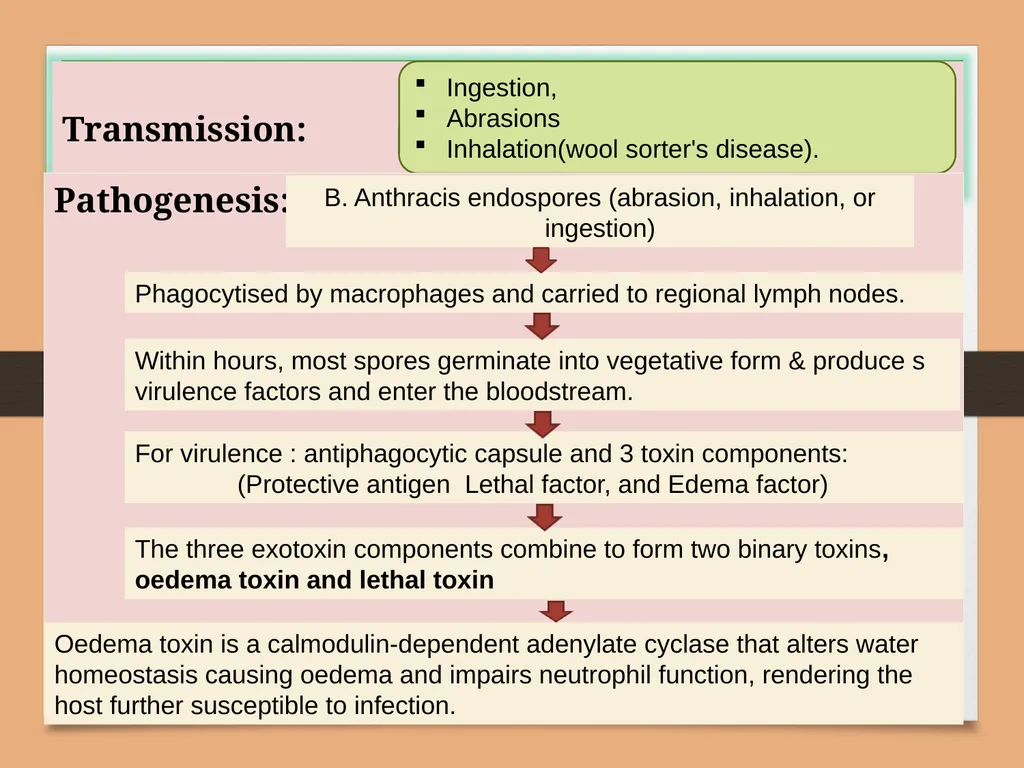
slide3. Transmission: Ingestion,
Abrasions
Inhalation(wool sorter's disease). Pathogenesis: B. Anthracis endospores (abrasion, inhalation, or ingestion) Phagocytised by macrophages and carried to regional lymph nodes. Within hours, most spores germinate into vegetative form & produce s virulence factors and enter the bloodstream. For virulence : antiphagocytic capsule and 3 toxin components: (Protective antigen Lethal factor, and Edema factor) The three exotoxin components combine to form two binary toxins, oedema toxin and lethal toxin Oedema toxin is a calmodulin-dependent adenylate cyclase that alters water homeostasis causing oedema and impairs neutrophil function, rendering the host further susceptible to infection.<br>
slide4. Lethal toxin leads to the release of reactive oxygen intermediates as well as the production of pro inflammatory cytokines, tumour necrosis factor and interleukin-1b responsible for rapid circulatory collapse. The release of these toxins results profuse haemorrhage, tissue oedema, and a paucity of acute inflammatory reaction . Depends on species affected, dose and the route.
In cattle and sheep it is septicaemic and rapidly fatal., most animals are found dead without pre-monitary signs.
Pyrexia with temperatures up to 42°C (108°F), depression, congested mucosae and petechiae may be observed ante-mortem.
Animals which survive for more than one day may abort or display subcutaneous oedema and dysentery.
In cattle, post mortem findings: rapid bloating, incomplete rigor mortis, widespread ecchymotic haemorrhages and oedema, dark un-clotted blood and blood-stained fluid in body cavities.
An extremely large soft spleen is characteristic of the disease in cattle. CLINICAL FINDINGS<br>
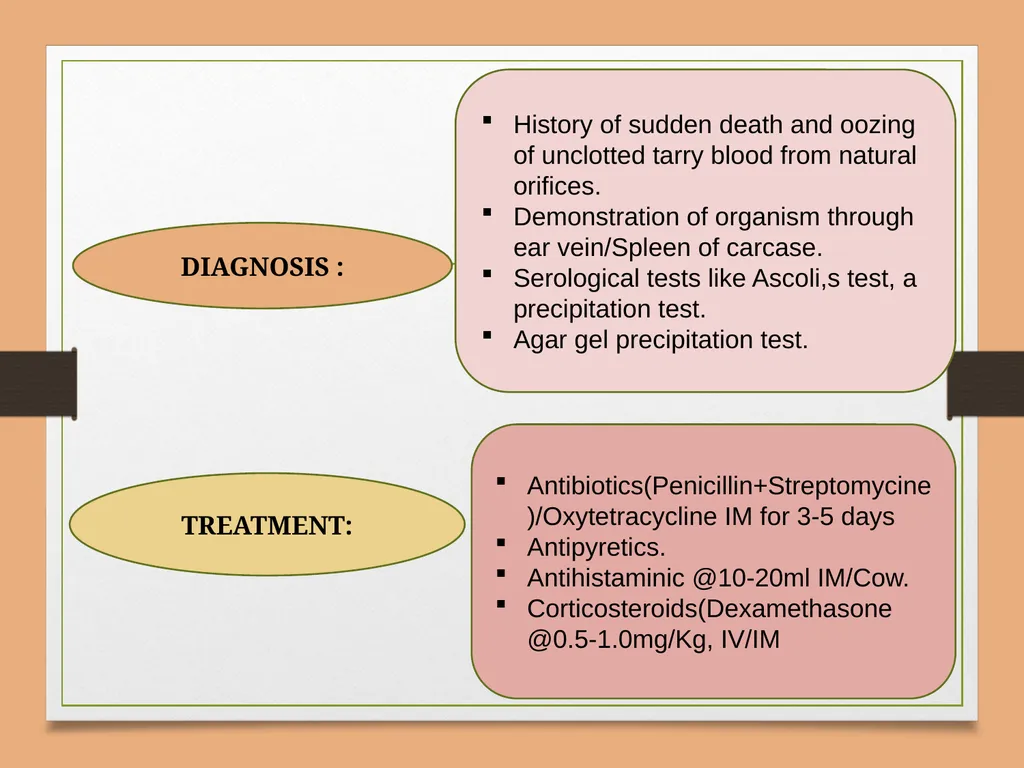
slide5. DIAGNOSIS : History of sudden death and oozing of unclotted tarry blood from natural orifices.
Demonstration of organism through ear vein/Spleen of carcase.
Serological tests like Ascoli,s test, a precipitation test.
Agar gel precipitation test. Antibiotics(Penicillin+Streptomycine)/Oxytetracycline IM for 3-5 days
Antipyretics.
Antihistaminic @10-20ml IM/Cow.
Corticosteroids(Dexamethasone @0.5-1.0mg/Kg, IV/IM TREATMENT:<br>
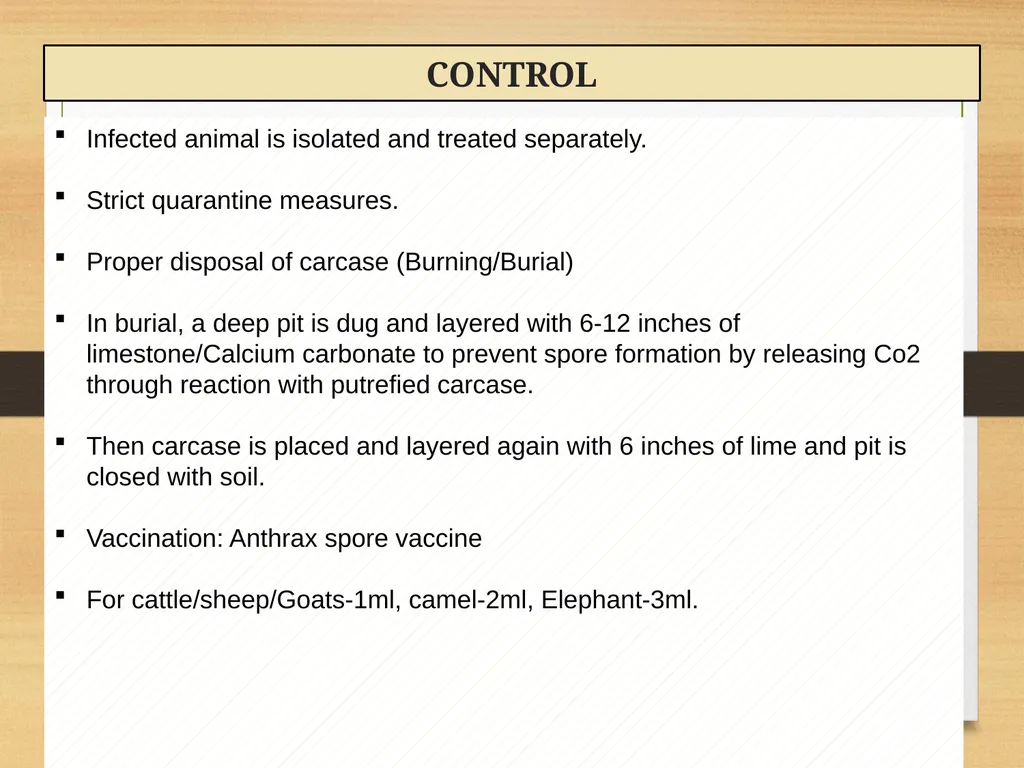
slide6. CONTROL Infected animal is isolated and treated separately.
Strict quarantine measures.
Proper disposal of carcase (Burning/Burial)
In burial, a deep pit is dug and layered with 6-12 inches of limestone/Calcium carbonate to prevent spore formation by releasing Co2 through reaction with putrefied carcase.
Then carcase is placed and layered again with 6 inches of lime and pit is closed with soil.
Vaccination: Anthrax spore vaccine
For cattle/sheep/Goats-1ml, camel-2ml, Elephant-3ml.<br>
Asst. Professor
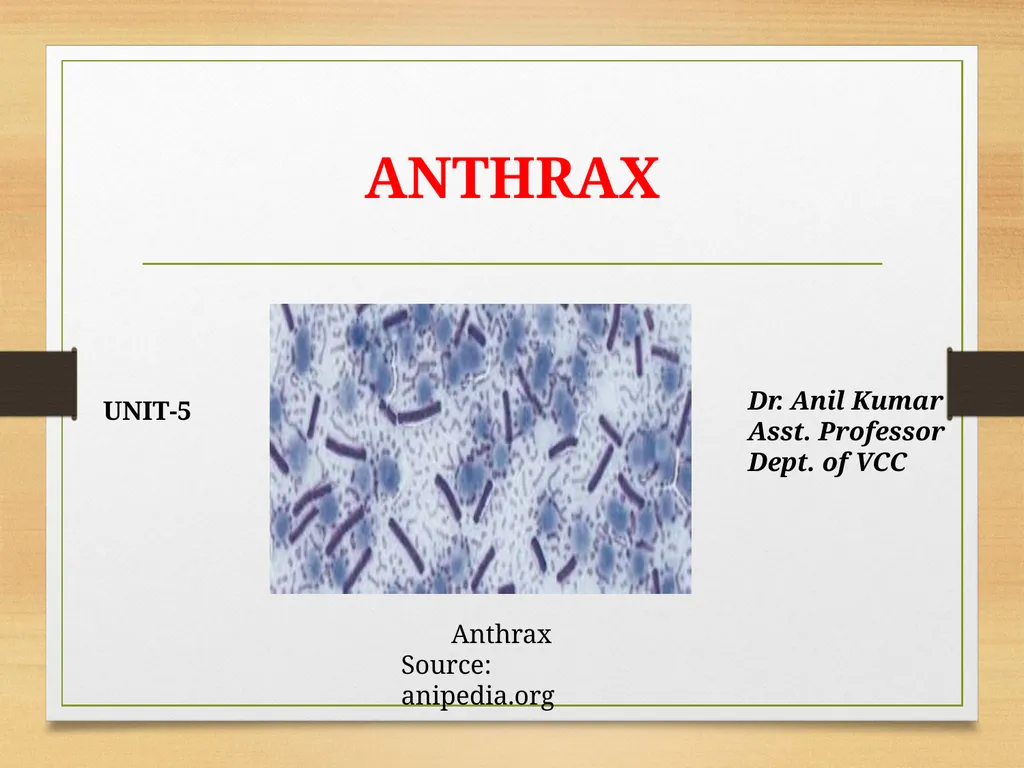
Dept. of VCC Anthrax
Source: anipedia.org<br>
slide2. ANTHRAX (Spleenic fever/wool sorter's disease/Carbuncles) ETIOLOGY Bacillus anthracis.
Greek word for coal, because of the ulcers with dark centres that develop on the skin of affected people.
Characterized by septicaemia, and sudden death with the exudation of dark tarry coloured and un-clotted blood from natural orifices.
The endospores of B. anthracis can survive for decades in soil.
Alkaline, rich in calcium and nitrogen content soil is responsible for spore survival. Host affected Wild and domestic herbivores (eg, cattle, sheep, goats, camels, antelopes).
People exposed to tissue from infected animals, to contaminated animal products, or directly to B. anthracis spores under certain conditions.
The disease is almost invariably fatal except in Swine.<br>
slide3. Transmission: Ingestion,
Abrasions
Inhalation(wool sorter's disease). Pathogenesis: B. Anthracis endospores (abrasion, inhalation, or ingestion) Phagocytised by macrophages and carried to regional lymph nodes. Within hours, most spores germinate into vegetative form & produce s virulence factors and enter the bloodstream. For virulence : antiphagocytic capsule and 3 toxin components: (Protective antigen Lethal factor, and Edema factor) The three exotoxin components combine to form two binary toxins, oedema toxin and lethal toxin Oedema toxin is a calmodulin-dependent adenylate cyclase that alters water homeostasis causing oedema and impairs neutrophil function, rendering the host further susceptible to infection.<br>
slide4. Lethal toxin leads to the release of reactive oxygen intermediates as well as the production of pro inflammatory cytokines, tumour necrosis factor and interleukin-1b responsible for rapid circulatory collapse. The release of these toxins results profuse haemorrhage, tissue oedema, and a paucity of acute inflammatory reaction . Depends on species affected, dose and the route.
In cattle and sheep it is septicaemic and rapidly fatal., most animals are found dead without pre-monitary signs.
Pyrexia with temperatures up to 42°C (108°F), depression, congested mucosae and petechiae may be observed ante-mortem.
Animals which survive for more than one day may abort or display subcutaneous oedema and dysentery.
In cattle, post mortem findings: rapid bloating, incomplete rigor mortis, widespread ecchymotic haemorrhages and oedema, dark un-clotted blood and blood-stained fluid in body cavities.
An extremely large soft spleen is characteristic of the disease in cattle. CLINICAL FINDINGS<br>
slide5. DIAGNOSIS : History of sudden death and oozing of unclotted tarry blood from natural orifices.
Demonstration of organism through ear vein/Spleen of carcase.
Serological tests like Ascoli,s test, a precipitation test.
Agar gel precipitation test. Antibiotics(Penicillin+Streptomycine)/Oxytetracycline IM for 3-5 days
Antipyretics.
Antihistaminic @10-20ml IM/Cow.
Corticosteroids(Dexamethasone @0.5-1.0mg/Kg, IV/IM TREATMENT:<br>
slide6. CONTROL Infected animal is isolated and treated separately.
Strict quarantine measures.
Proper disposal of carcase (Burning/Burial)
In burial, a deep pit is dug and layered with 6-12 inches of limestone/Calcium carbonate to prevent spore formation by releasing Co2 through reaction with putrefied carcase.
Then carcase is placed and layered again with 6 inches of lime and pit is closed with soil.
Vaccination: Anthrax spore vaccine
For cattle/sheep/Goats-1ml, camel-2ml, Elephant-3ml.<br>