
The Audiology Conundrum Audiological Pathways
SN
Published · 45 slides · 0 views
1 / 1

Description
The Audiology Conundrum Audiological Pathways Appropriate Technologies in Low Resource Settings Impacts Sustainability Joy.Rosenbergoxfordaud.co.uk Aims Convey our experiences related to deafness and development Joy Rosenberg Kelvin
Related Topics
Share
Embed code
Download this presentation From Below
"The Audiology Conundrum Audiological Pathways" is the property of its rightful owner. Permission is granted to download and print the materials on this website for personal, non-commercial use only, and to display it on your personal computer provided you do not modify the materials and that you retain all copyright notices contained in the materials. By downloading content from our website, you accept the terms of this agreement.
Presentation Transcript
01
The Audiology Conundrum
Audiological Pathways
Appropriate Technologies in Low Resource Settings
Impacts & Sustainability Joy.Rosenberg@oxfordaud.co.uk<br>
02
Aims Convey our experiences related to deafness and development
Joy Rosenberg
Kelvin Hawker
Suheir Albadarneh
Work together in small groups to investigate issues
Audiological Pathways
Appropriate Technologies in Low Resource Settings
Impacts & Sustainability
Take back key points to larger group<br>
Joy Rosenberg
Kelvin Hawker
Suheir Albadarneh
Work together in small groups to investigate issues
Audiological Pathways
Appropriate Technologies in Low Resource Settings
Impacts & Sustainability
Take back key points to larger group<br>
03
Intro Teacher of the Deaf and Audiologist
Have worked in: USA, RP, UK, Nepal
Programme Manager for UK Postgraduate courses training ToD, Audiologists and Early Years interventionists
Acknowledgement and terminology: McPherson’s Audiology in Developing Countries, 2008.
Photos: JRosenberg, Mary Hare<br>
Have worked in: USA, RP, UK, Nepal
Programme Manager for UK Postgraduate courses training ToD, Audiologists and Early Years interventionists
Acknowledgement and terminology: McPherson’s Audiology in Developing Countries, 2008.
Photos: JRosenberg, Mary Hare<br>
04
Audiology and Education of the Deaf History
Audiology – half century
Ed of Deaf – millennia (relationship to views in dev’g countries)
Present need (McPherson, 2008)
Imbalance 66% of 300 million with hrng loss live in less developed countries
1 million of needed 30 million HA are fit each year
WHO demographics – coming up (KH)<br>
Audiology – half century
Ed of Deaf – millennia (relationship to views in dev’g countries)
Present need (McPherson, 2008)
Imbalance 66% of 300 million with hrng loss live in less developed countries
1 million of needed 30 million HA are fit each year
WHO demographics – coming up (KH)<br>
05
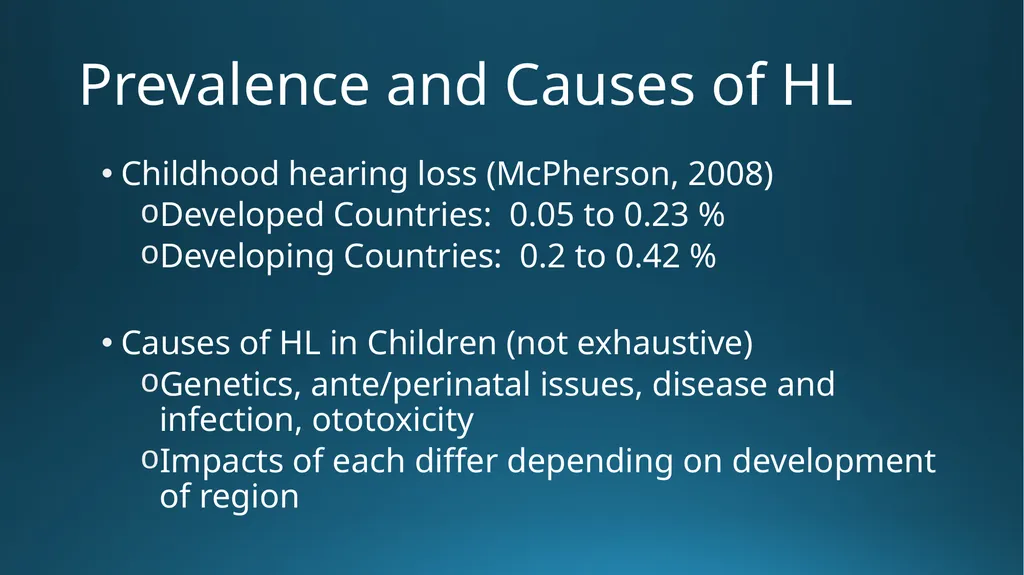
Prevalence and Causes of HL Childhood hearing loss (McPherson, 2008)
Developed Countries: 0.05 to 0.23 %
Developing Countries: 0.2 to 0.42 %
Causes of HL in Children (not exhaustive)
Genetics, ante/perinatal issues, disease and infection, ototoxicity
Impacts of each differ depending on development of region<br>
Developed Countries: 0.05 to 0.23 %
Developing Countries: 0.2 to 0.42 %
Causes of HL in Children (not exhaustive)
Genetics, ante/perinatal issues, disease and infection, ototoxicity
Impacts of each differ depending on development of region<br>
06
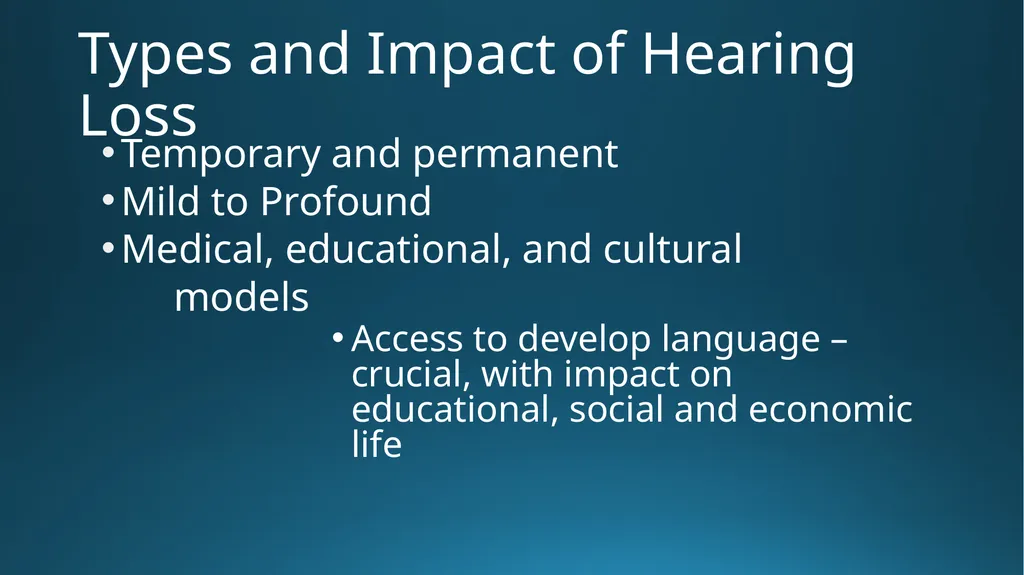
Types and Impact of Hearing Loss Temporary and permanent
Mild to Profound
Medical, educational, and cultural
models
Access to develop language – crucial, with impact on educational, social and economic life<br>
Mild to Profound
Medical, educational, and cultural
models
Access to develop language – crucial, with impact on educational, social and economic life<br>
07
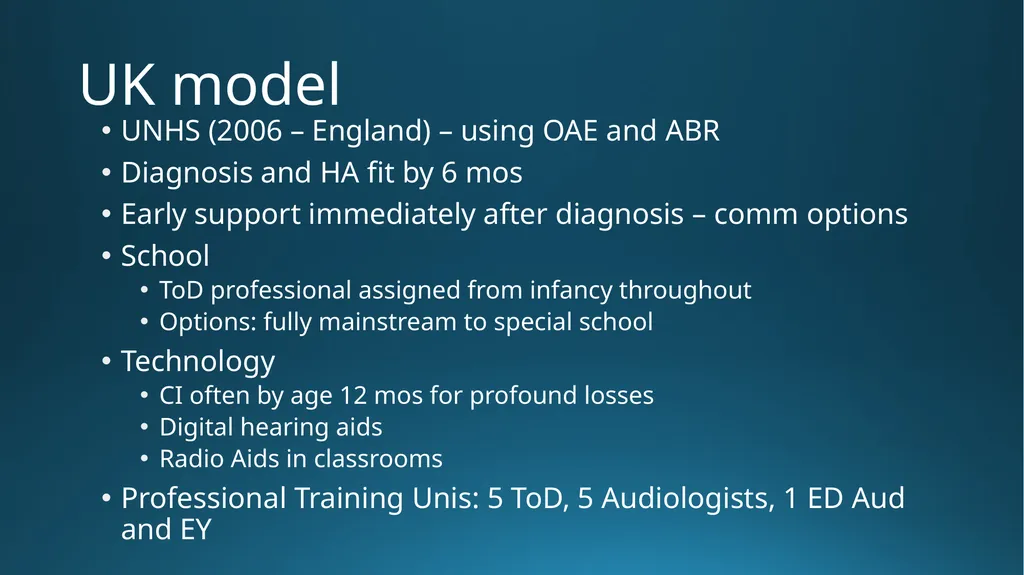
UK model UNHS (2006 – England) – using OAE and ABR
Diagnosis and HA fit by 6 mos
Early support immediately after diagnosis – comm options
School
ToD professional assigned from infancy throughout
Options: fully mainstream to special school
Technology
CI often by age 12 mos for profound losses
Digital hearing aids
Radio Aids in classrooms
Professional Training Unis: 5 ToD, 5 Audiologists, 1 ED Aud and EY<br>
Diagnosis and HA fit by 6 mos
Early support immediately after diagnosis – comm options
School
ToD professional assigned from infancy throughout
Options: fully mainstream to special school
Technology
CI often by age 12 mos for profound losses
Digital hearing aids
Radio Aids in classrooms
Professional Training Unis: 5 ToD, 5 Audiologists, 1 ED Aud and EY<br>
08
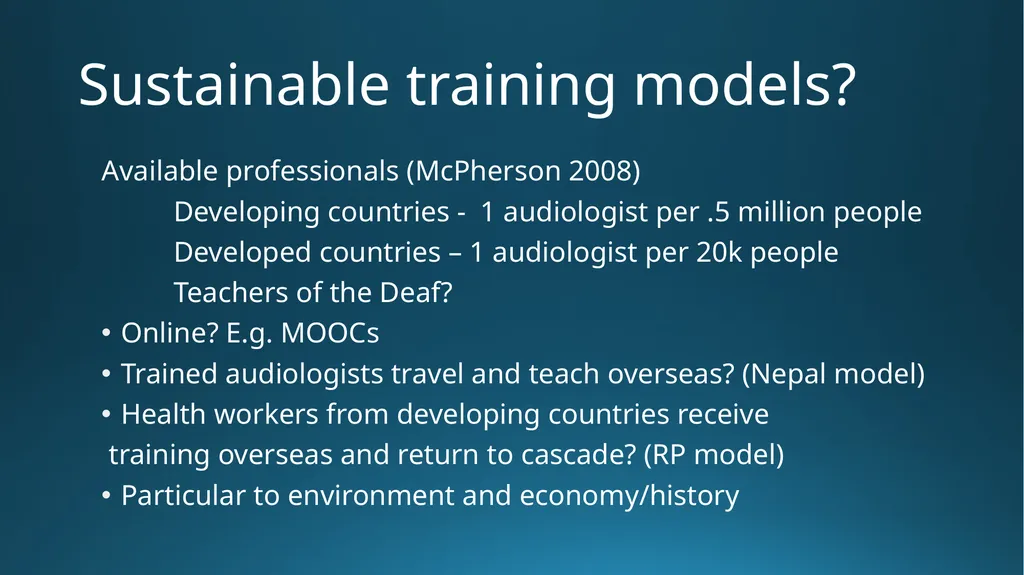
Sustainable training models? Available professionals (McPherson 2008)
Developing countries - 1 audiologist per .5 million people
Developed countries – 1 audiologist per 20k people
Teachers of the Deaf?
Online? E.g. MOOCs
Trained audiologists travel and teach overseas? (Nepal model)
Health workers from developing countries receive
training overseas and return to cascade? (RP model)
Particular to environment and economy/history<br>
Developing countries - 1 audiologist per .5 million people
Developed countries – 1 audiologist per 20k people
Teachers of the Deaf?
Online? E.g. MOOCs
Trained audiologists travel and teach overseas? (Nepal model)
Health workers from developing countries receive
training overseas and return to cascade? (RP model)
Particular to environment and economy/history<br>
09
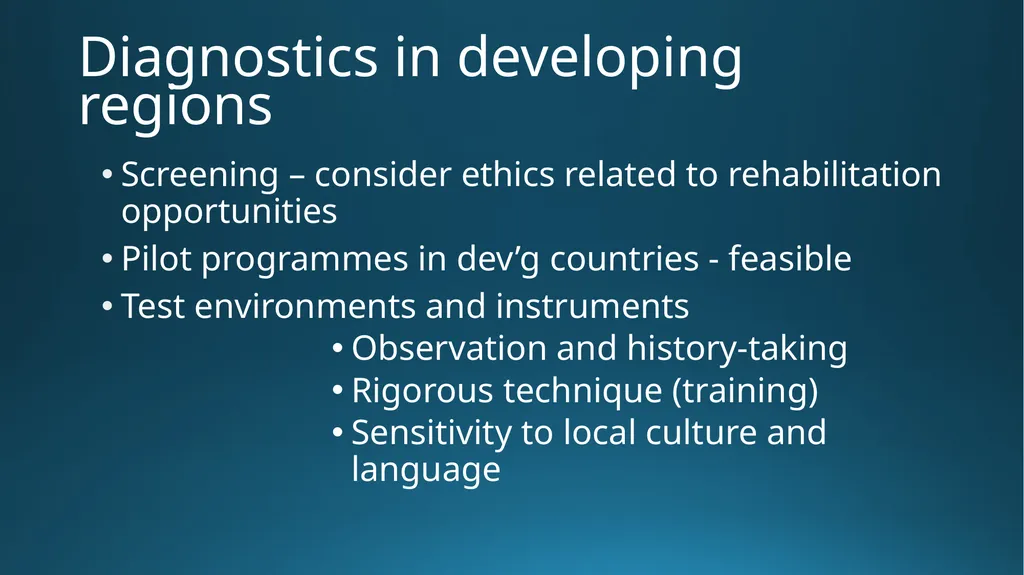
Diagnostics in developing regions Screening – consider ethics related to rehabilitation opportunities
Pilot programmes in dev’g countries - feasible
Test environments and instruments
Observation and history-taking
Rigorous technique (training)
Sensitivity to local culture and language<br>
Pilot programmes in dev’g countries - feasible
Test environments and instruments
Observation and history-taking
Rigorous technique (training)
Sensitivity to local culture and language<br>
10
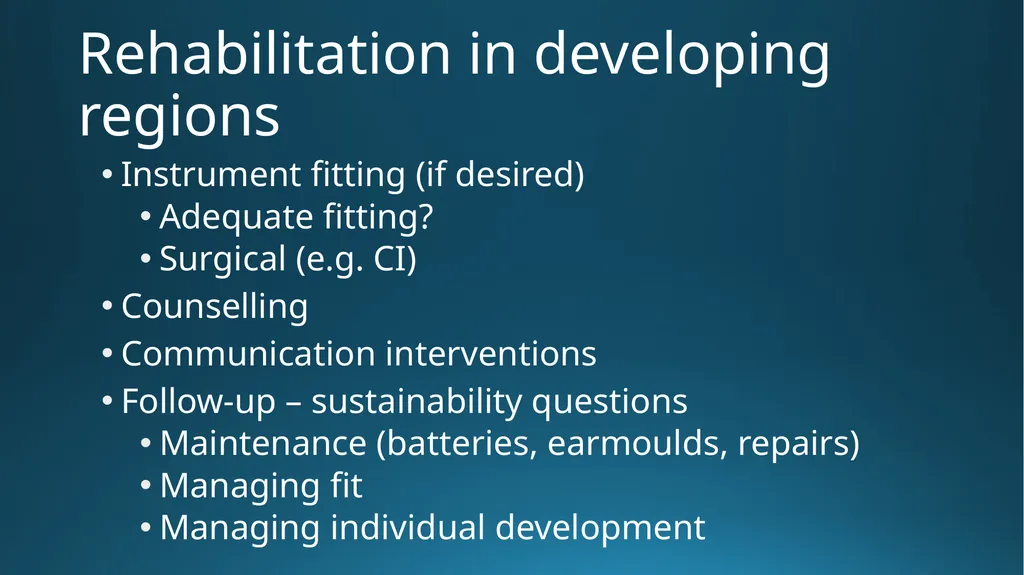
Rehabilitation in developing regions Instrument fitting (if desired)
Adequate fitting?
Surgical (e.g. CI)
Counselling
Communication interventions
Follow-up – sustainability questions
Maintenance (batteries, earmoulds, repairs)
Managing fit
Managing individual development<br>
Adequate fitting?
Surgical (e.g. CI)
Counselling
Communication interventions
Follow-up – sustainability questions
Maintenance (batteries, earmoulds, repairs)
Managing fit
Managing individual development<br>
11
Suheir Albadarneh Introduction
A teacher for deaf (1996-2000)
Head of the Total Communication Center(2001-2009)
- Head of the Rehabilitation and Ability Development dept at PRCS(2010-now)<br>
A teacher for deaf (1996-2000)
Head of the Total Communication Center(2001-2009)
- Head of the Rehabilitation and Ability Development dept at PRCS(2010-now)<br>
12
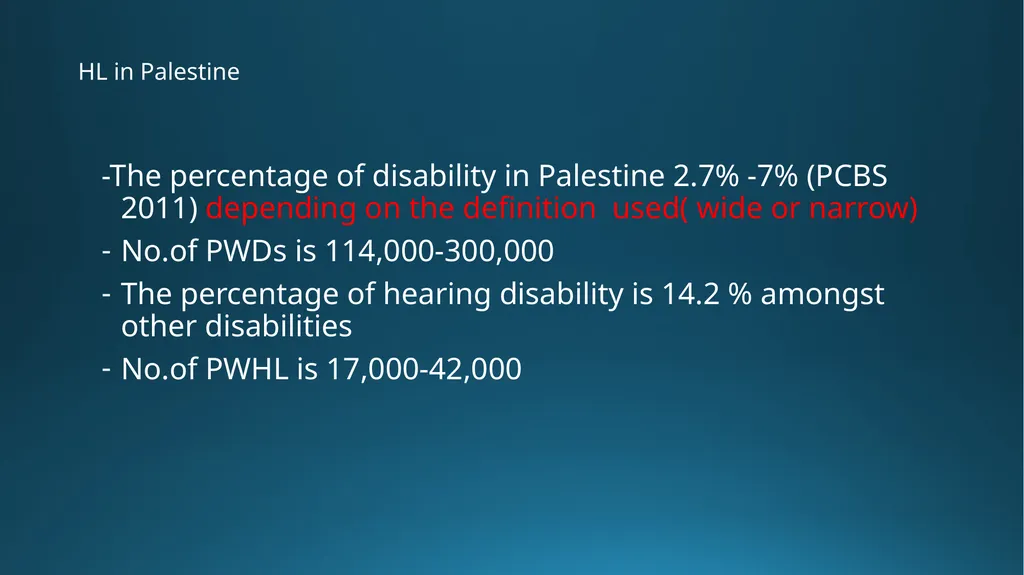
HL in Palestine -The percentage of disability in Palestine 2.7% -7% (PCBS 2011) depending on the definition used( wide or narrow)
No.of PWDs is 114,000-300,000
The percentage of hearing disability is 14.2 % amongst other disabilities
No.of PWHL is 17,000-42,000<br>
No.of PWDs is 114,000-300,000
The percentage of hearing disability is 14.2 % amongst other disabilities
No.of PWHL is 17,000-42,000<br>
13
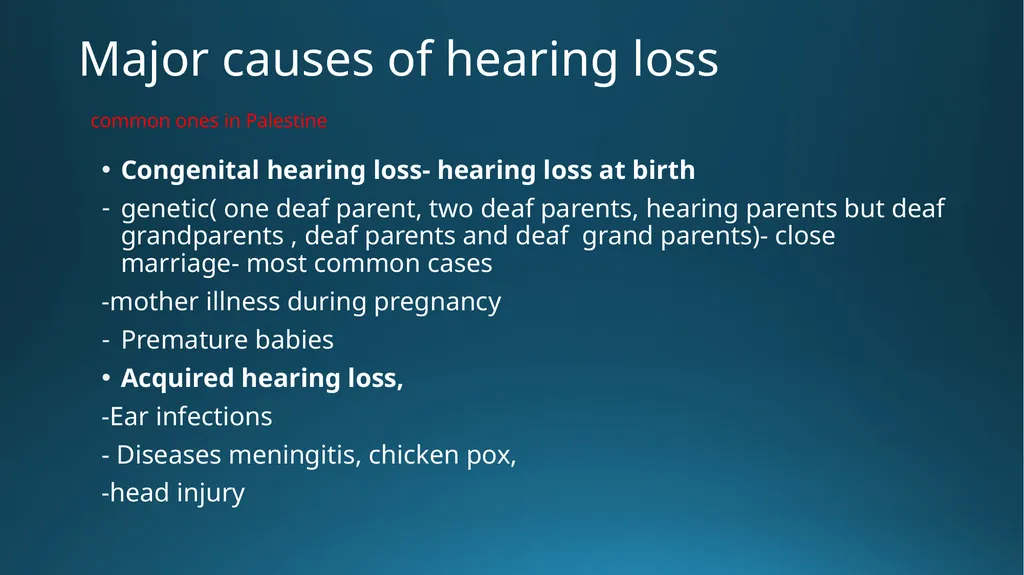
Major causes of hearing loss
common ones in Palestine Congenital hearing loss- hearing loss at birth
genetic( one deaf parent, two deaf parents, hearing parents but deaf grandparents , deaf parents and deaf grand parents)- close marriage- most common cases
-mother illness during pregnancy
Premature babies
Acquired hearing loss,
-Ear infections
- Diseases meningitis, chicken pox,
-head injury<br>
genetic( one deaf parent, two deaf parents, hearing parents but deaf grandparents , deaf parents and deaf grand parents)- close marriage- most common cases
-mother illness during pregnancy
Premature babies
Acquired hearing loss,
-Ear infections
- Diseases meningitis, chicken pox,
-head injury<br>
14
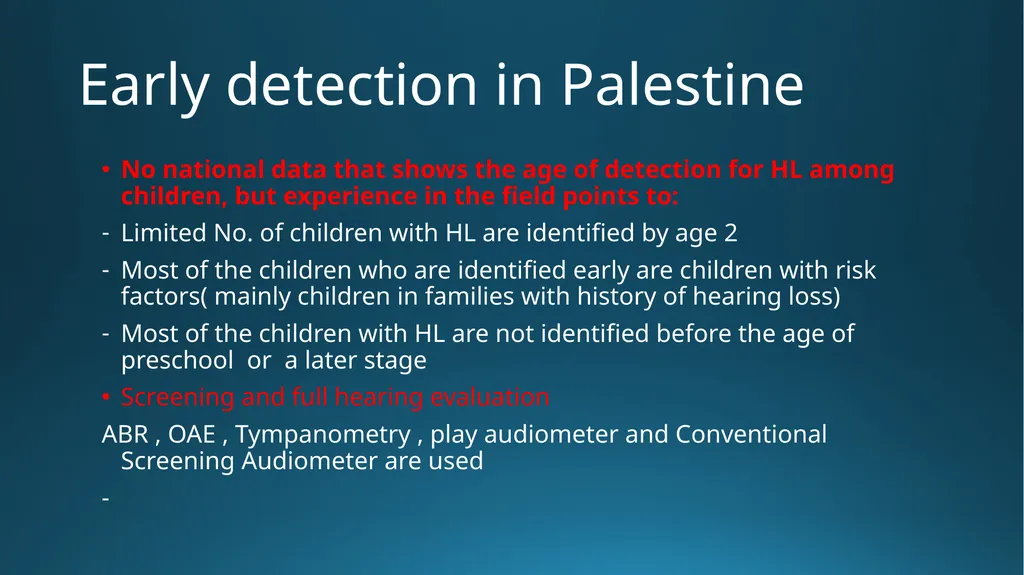
Early detection in Palestine No national data that shows the age of detection for HL among children, but experience in the field points to:
Limited No. of children with HL are identified by age 2
Most of the children who are identified early are children with risk factors( mainly children in families with history of hearing loss)
Most of the children with HL are not identified before the age of preschool or a later stage
Screening and full hearing evaluation
ABR , OAE , Tympanometry , play audiometer and Conventional Screening Audiometer are used
-<br>
Limited No. of children with HL are identified by age 2
Most of the children who are identified early are children with risk factors( mainly children in families with history of hearing loss)
Most of the children with HL are not identified before the age of preschool or a later stage
Screening and full hearing evaluation
ABR , OAE , Tympanometry , play audiometer and Conventional Screening Audiometer are used
-<br>
15
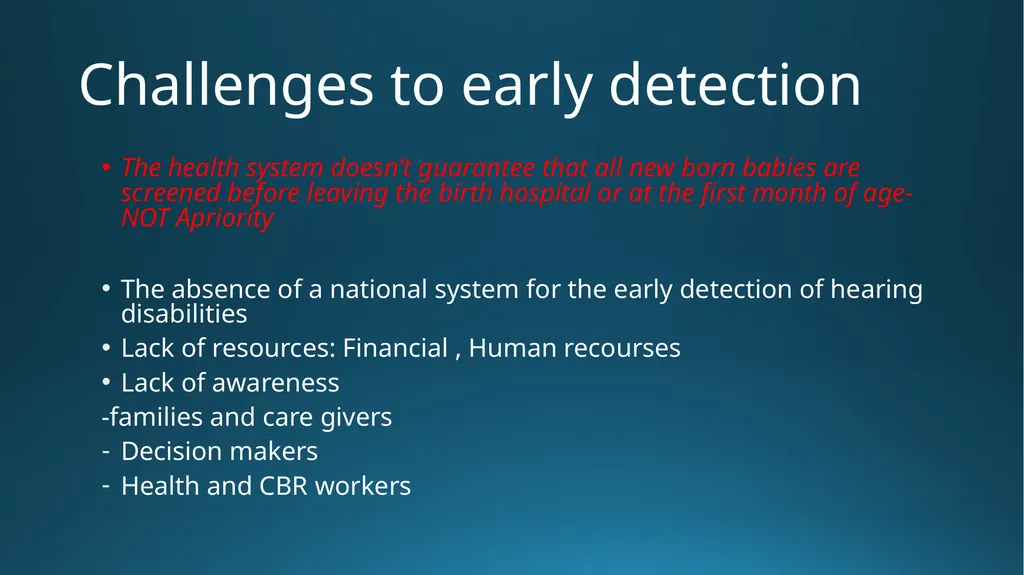
Challenges to early detection The health system doesn’t guarantee that all new born babies are screened before leaving the birth hospital or at the first month of age-NOT Apriority
The absence of a national system for the early detection of hearing disabilities
Lack of resources: Financial , Human recourses
Lack of awareness
-families and care givers
Decision makers
Health and CBR workers<br>
The absence of a national system for the early detection of hearing disabilities
Lack of resources: Financial , Human recourses
Lack of awareness
-families and care givers
Decision makers
Health and CBR workers<br>
16
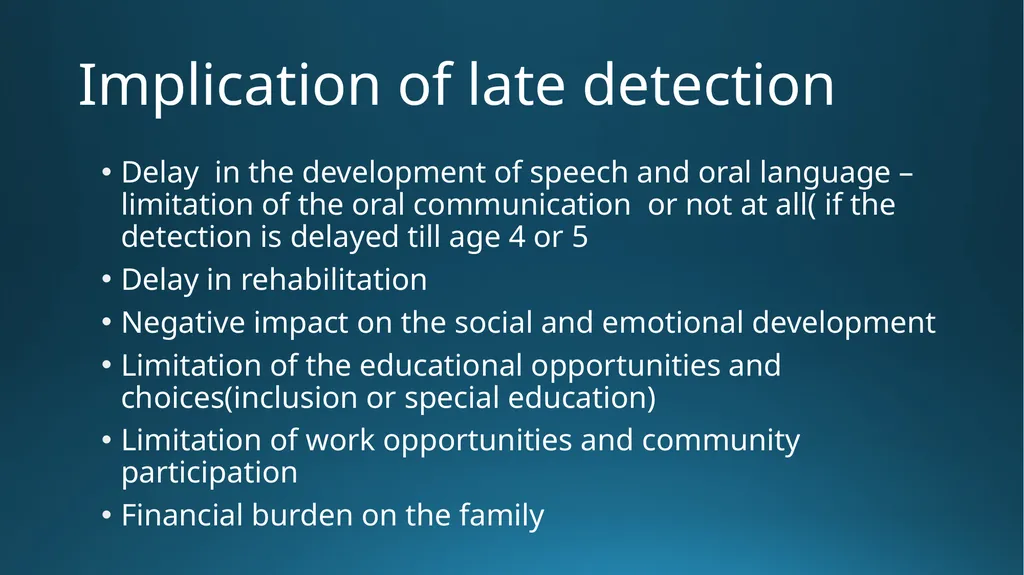
Implication of late detection Delay in the development of speech and oral language – limitation of the oral communication or not at all( if the detection is delayed till age 4 or 5
Delay in rehabilitation
Negative impact on the social and emotional development
Limitation of the educational opportunities and choices(inclusion or special education)
Limitation of work opportunities and community participation
Financial burden on the family<br>
Delay in rehabilitation
Negative impact on the social and emotional development
Limitation of the educational opportunities and choices(inclusion or special education)
Limitation of work opportunities and community participation
Financial burden on the family<br>
17
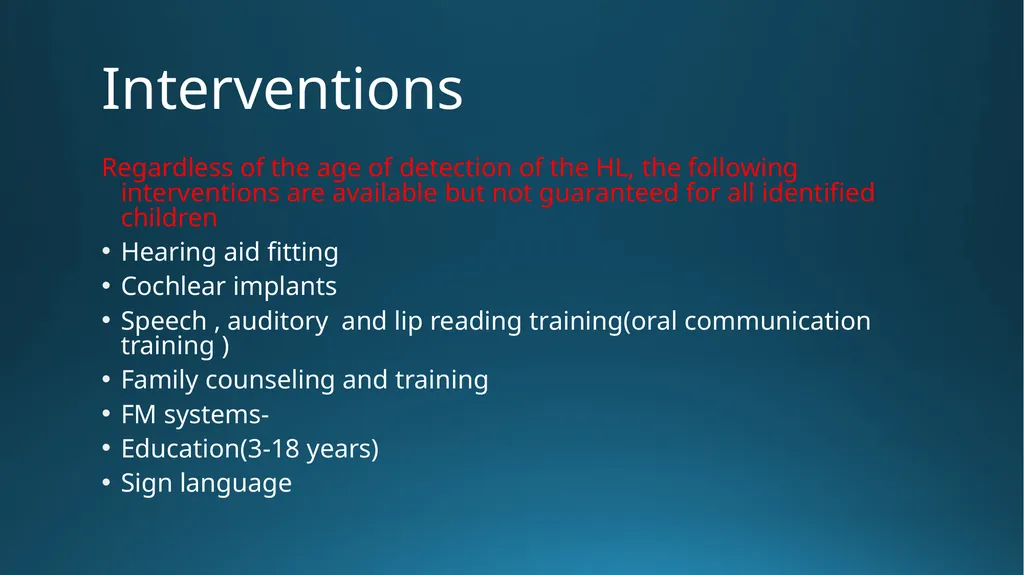
Interventions Regardless of the age of detection of the HL, the following interventions are available but not guaranteed for all identified children
Hearing aid fitting
Cochlear implants
Speech , auditory and lip reading training(oral communication training )
Family counseling and training
FM systems-
Education(3-18 years)
Sign language<br>
Hearing aid fitting
Cochlear implants
Speech , auditory and lip reading training(oral communication training )
Family counseling and training
FM systems-
Education(3-18 years)
Sign language<br>
18
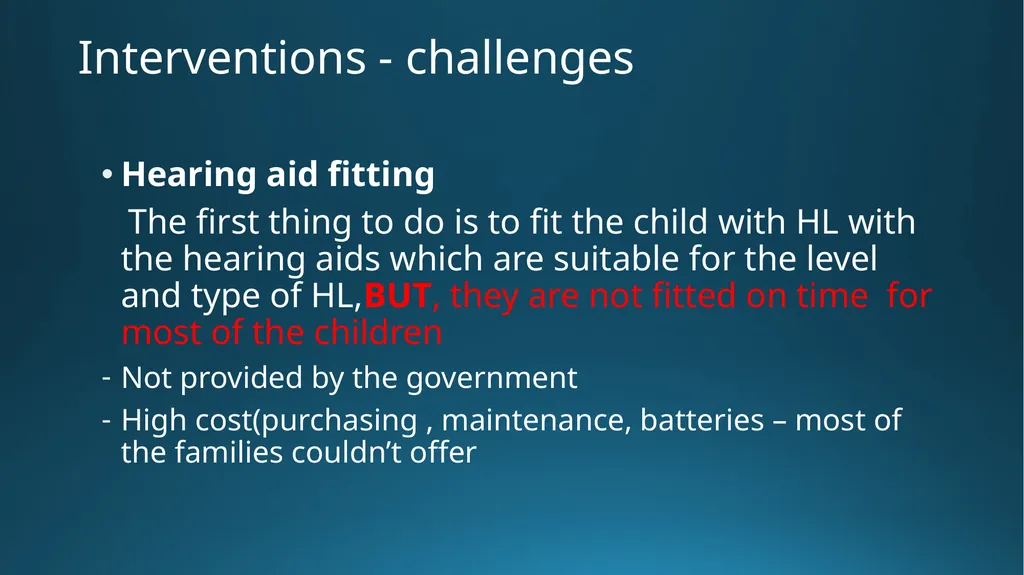
Interventions - challenges Hearing aid fitting
The first thing to do is to fit the child with HL with the hearing aids which are suitable for the level and type of HL,BUT, they are not fitted on time for most of the children
Not provided by the government
High cost(purchasing , maintenance, batteries – most of the families couldn’t offer<br>
The first thing to do is to fit the child with HL with the hearing aids which are suitable for the level and type of HL,BUT, they are not fitted on time for most of the children
Not provided by the government
High cost(purchasing , maintenance, batteries – most of the families couldn’t offer<br>
19
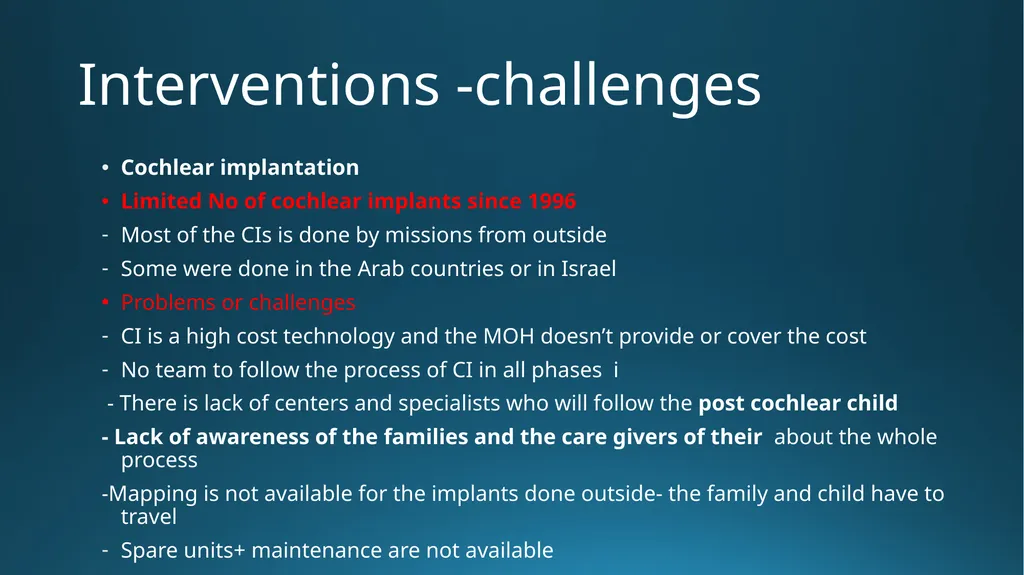
Interventions -challenges Cochlear implantation
Limited No of cochlear implants since 1996
Most of the CIs is done by missions from outside
Some were done in the Arab countries or in Israel
Problems or challenges
CI is a high cost technology and the MOH doesn’t provide or cover the cost
No team to follow the process of CI in all phases i
- There is lack of centers and specialists who will follow the post cochlear child
- Lack of awareness of the families and the care givers of their about the whole process
-Mapping is not available for the implants done outside- the family and child have to travel
Spare units+ maintenance are not available<br>
Limited No of cochlear implants since 1996
Most of the CIs is done by missions from outside
Some were done in the Arab countries or in Israel
Problems or challenges
CI is a high cost technology and the MOH doesn’t provide or cover the cost
No team to follow the process of CI in all phases i
- There is lack of centers and specialists who will follow the post cochlear child
- Lack of awareness of the families and the care givers of their about the whole process
-Mapping is not available for the implants done outside- the family and child have to travel
Spare units+ maintenance are not available<br>
20
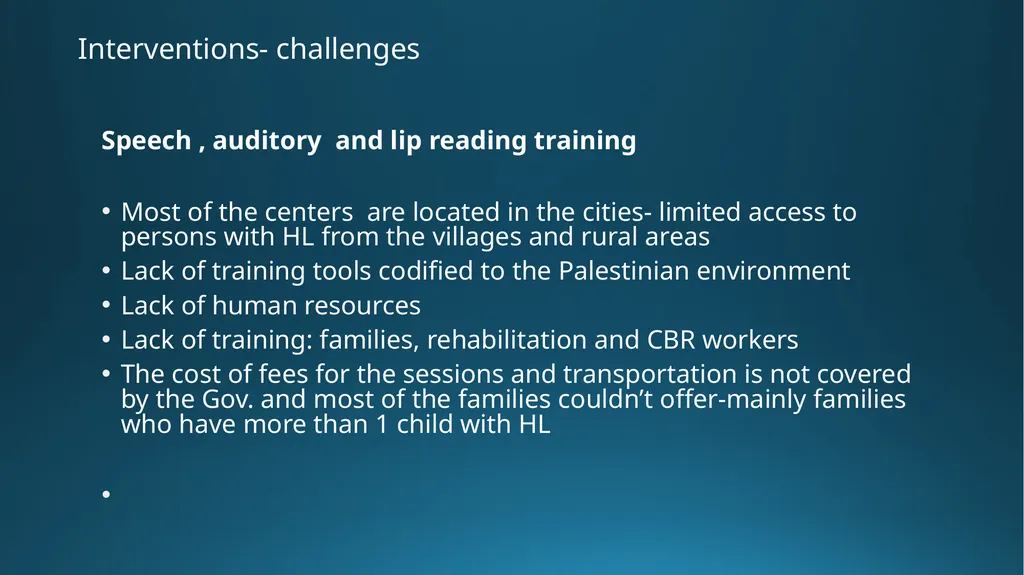
Interventions- challenges Speech , auditory and lip reading training
Most of the centers are located in the cities- limited access to persons with HL from the villages and rural areas
Lack of training tools codified to the Palestinian environment
Lack of human resources
Lack of training: families, rehabilitation and CBR workers
The cost of fees for the sessions and transportation is not covered by the Gov. and most of the families couldn’t offer-mainly families who have more than 1 child with HL<br>
Most of the centers are located in the cities- limited access to persons with HL from the villages and rural areas
Lack of training tools codified to the Palestinian environment
Lack of human resources
Lack of training: families, rehabilitation and CBR workers
The cost of fees for the sessions and transportation is not covered by the Gov. and most of the families couldn’t offer-mainly families who have more than 1 child with HL<br>
21
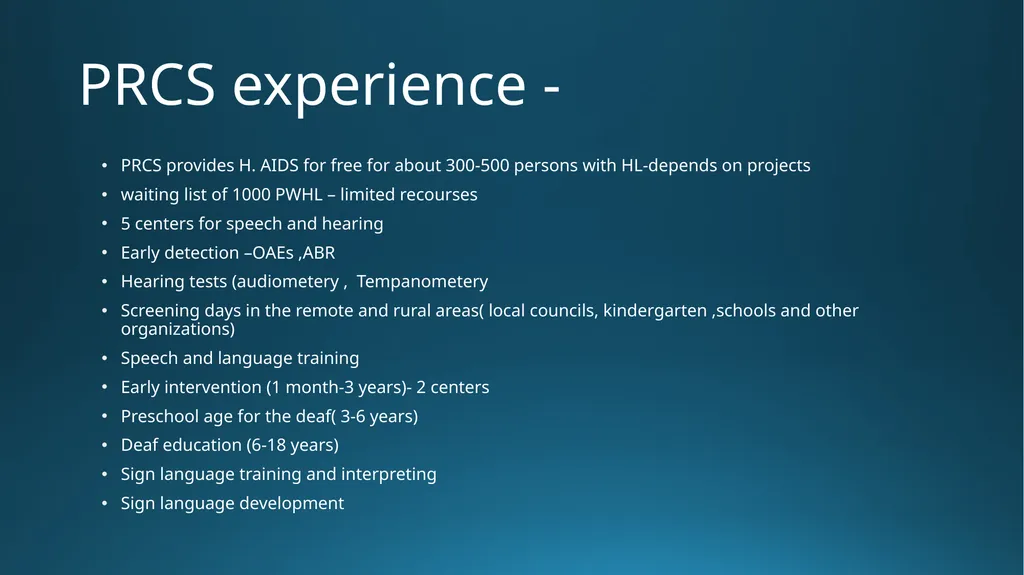
PRCS experience - PRCS provides H. AIDS for free for about 300-500 persons with HL-depends on projects
waiting list of 1000 PWHL – limited recourses
5 centers for speech and hearing
Early detection –OAEs ,ABR
Hearing tests (audiometery , Tempanometery
Screening days in the remote and rural areas( local councils, kindergarten ,schools and other organizations)
Speech and language training
Early intervention (1 month-3 years)- 2 centers
Preschool age for the deaf( 3-6 years)
Deaf education (6-18 years)
Sign language training and interpreting
Sign language development<br>
waiting list of 1000 PWHL – limited recourses
5 centers for speech and hearing
Early detection –OAEs ,ABR
Hearing tests (audiometery , Tempanometery
Screening days in the remote and rural areas( local councils, kindergarten ,schools and other organizations)
Speech and language training
Early intervention (1 month-3 years)- 2 centers
Preschool age for the deaf( 3-6 years)
Deaf education (6-18 years)
Sign language training and interpreting
Sign language development<br>
22
Kelvin Hawker<br>
23
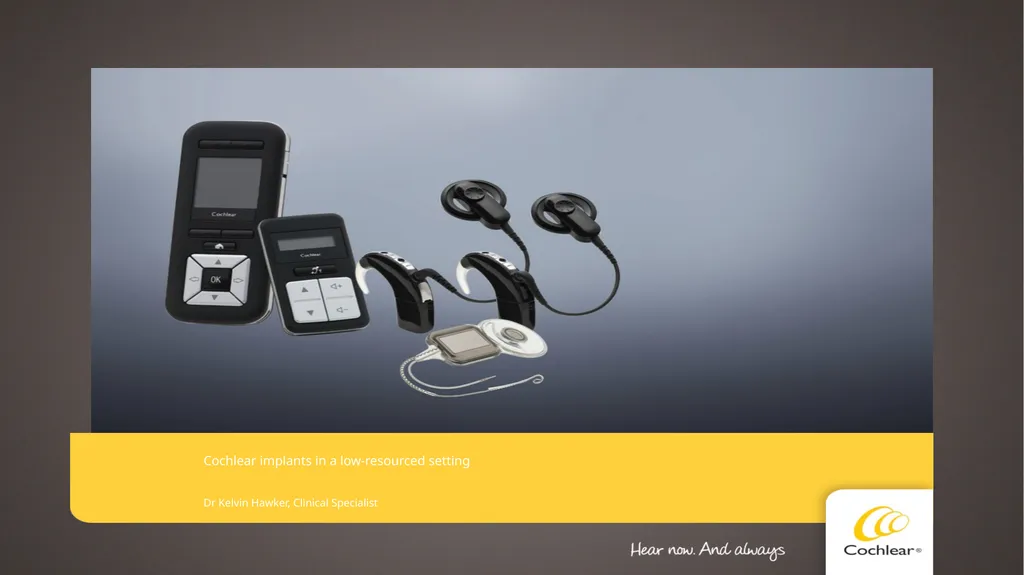
Cochlear implants in a low-resourced setting
Dr Kelvin Hawker, Clinical Specialist<br>
24
Today’s Presentation What is a cochlear Implant? Part
1 Part
2 Part
3 Who is suitable? Resources required to establish a CI Programme<br>
1 Part
2 Part
3 Who is suitable? Resources required to establish a CI Programme<br>
25
What is a cochlear implant? Part
1<br>
1<br>
26
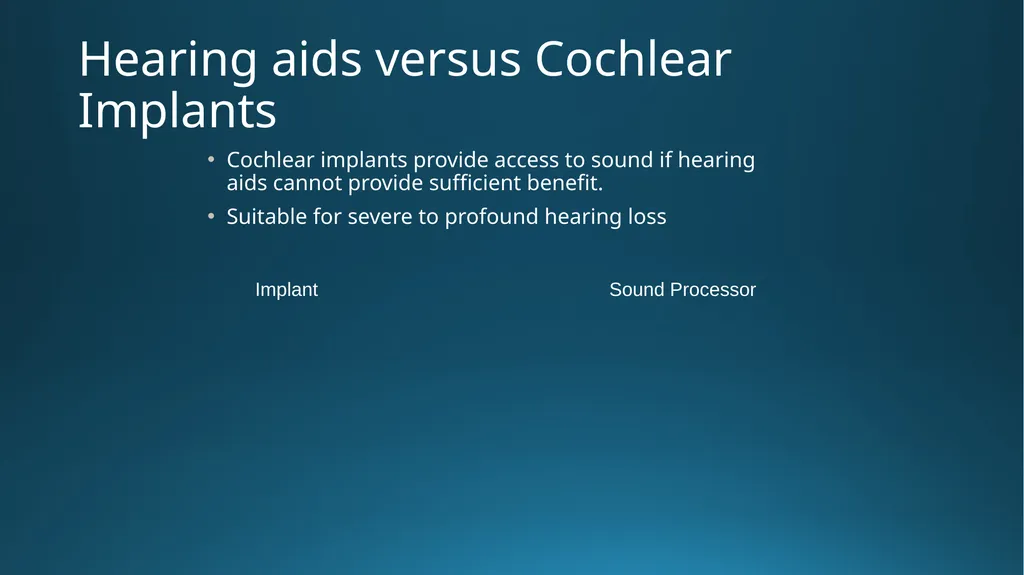
Hearing aids versus Cochlear Implants Cochlear implants provide access to sound if hearing aids cannot provide sufficient benefit.
Suitable for severe to profound hearing loss Implant Sound Processor<br>
Suitable for severe to profound hearing loss Implant Sound Processor<br>
27
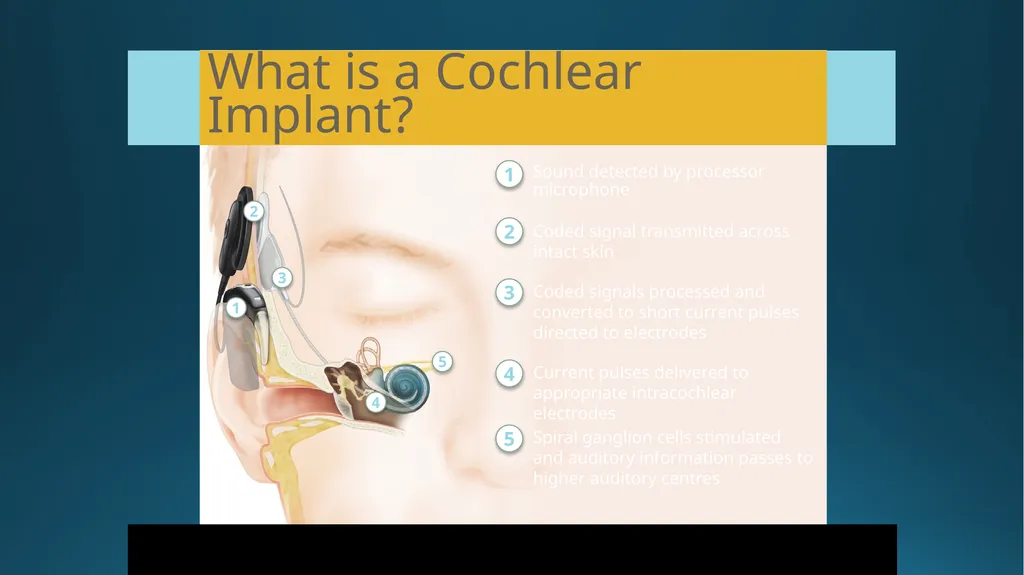
Sound detected by processor microphone 1 1 Coded signal transmitted across
intact skin Coded signals processed and converted to short current pulses directed to electrodes Current pulses delivered to
appropriate intracochlear electrodes Spiral ganglion cells stimulated
and auditory information passes to higher auditory centres 2 3 4 5 2 3 4 5 What is a Cochlear Implant?<br>
28
Who is suitable ? Part
2<br>
2<br>
29
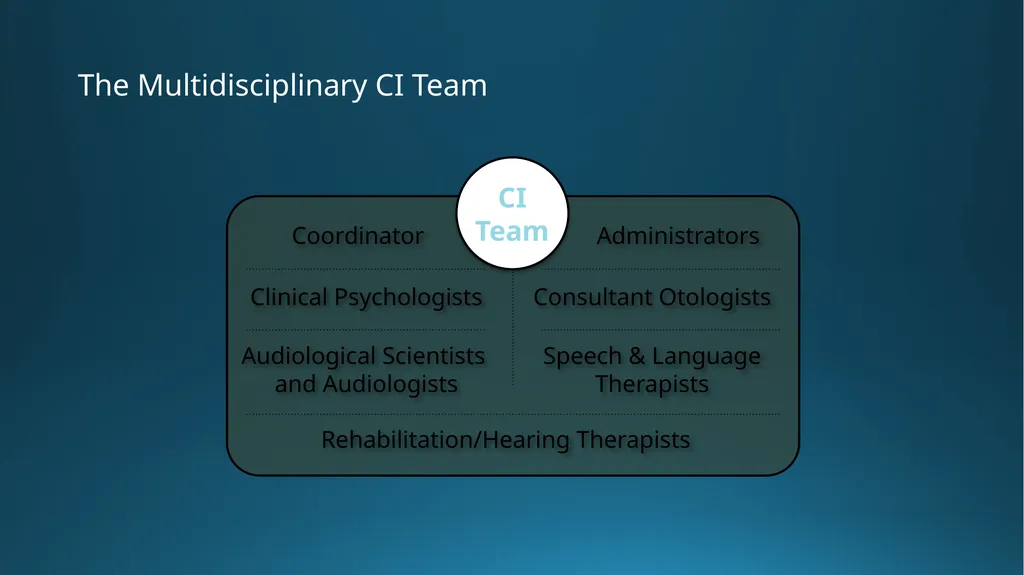
The Multidisciplinary CI Team Coordinator Audiological Scientists
and Audiologists Rehabilitation/Hearing Therapists Consultant Otologists Speech & Language Therapists Clinical Psychologists Administrators CI Team<br>
30
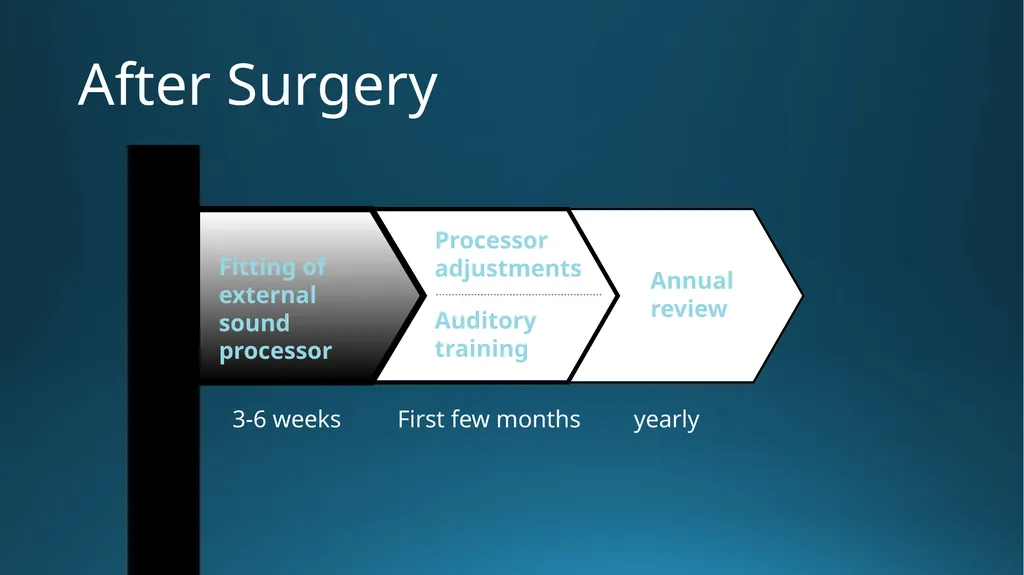
After Surgery 3-6 weeks First few months yearly<br>
31
Resources required to establish a CI Programme Part
3<br>
3<br>
32
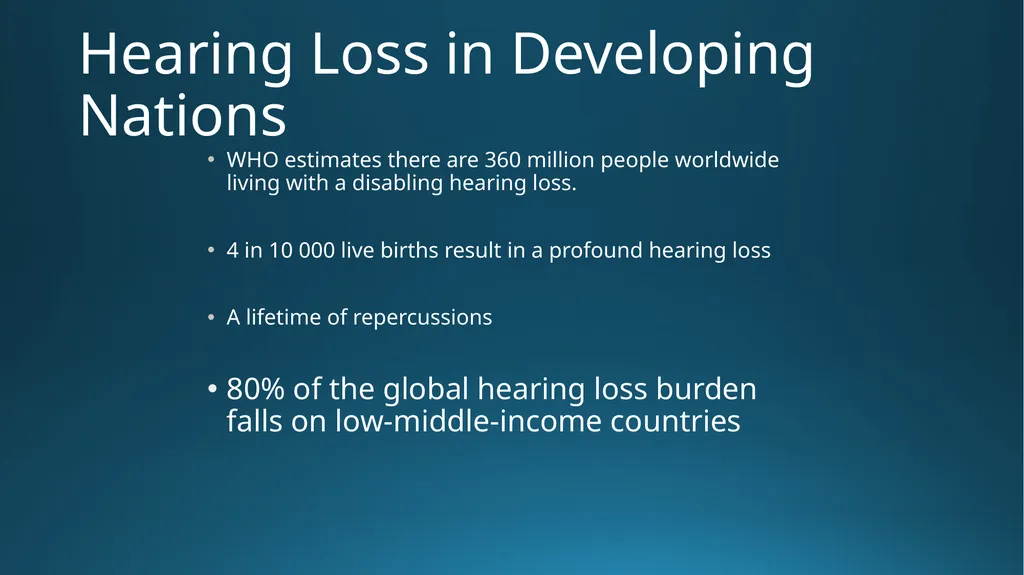
Hearing Loss in Developing Nations WHO estimates there are 360 million people worldwide living with a disabling hearing loss.
4 in 10 000 live births result in a profound hearing loss
A lifetime of repercussions
80% of the global hearing loss burden falls on low-middle-income countries<br>
4 in 10 000 live births result in a profound hearing loss
A lifetime of repercussions
80% of the global hearing loss burden falls on low-middle-income countries<br>
33
Can CI be cost-effective in low income countries? Cochlear implantation is expensive- typically £30-40k
How can this be justified?
Benefits seen over a lifetime
Language development
Opportunities for a better education
Improved employment and pay
Improved quality of life and less social isolation.<br>
How can this be justified?
Benefits seen over a lifetime
Language development
Opportunities for a better education
Improved employment and pay
Improved quality of life and less social isolation.<br>
34
Can it be done? Yes!<br>
35
Case Study from Malawi Malawi is one of the world’s most poorest nations
Population of 16 million
Life expectancy of just over 50 years
Only two ENT surgeons in the whole country<br>
Population of 16 million
Life expectancy of just over 50 years
Only two ENT surgeons in the whole country<br>
36
The Key: Collaboration Support from UK ENT surgeons
Support from a CI manufacturer
Presence of audiologists from charitable
organisations
Charitable support to develop ENT
infrastructure
Charitable donation of two drill systems<br>
Support from a CI manufacturer
Presence of audiologists from charitable
organisations
Charitable support to develop ENT
infrastructure
Charitable donation of two drill systems<br>
37
The Result 4 post-lingually deafened children have now been implanted (2 very recently)
Collaboration has led to improved resources and infrastructure
4 students from Malawi now have an MSc in Audiology from Manchester and have visited Yorkshire Auditory Implant Service
Further CI surgery planned for October 2016 and March 2017.<br>
Collaboration has led to improved resources and infrastructure
4 students from Malawi now have an MSc in Audiology from Manchester and have visited Yorkshire Auditory Implant Service
Further CI surgery planned for October 2016 and March 2017.<br>
38
Photos and case study kindly provided Mr D Strachen, YAIS<br>
39
Workshop Task Small groups
Discuss given question/s using suggested web resources if you wish
Record key points and feedback to larger group.<br>
Discuss given question/s using suggested web resources if you wish
Record key points and feedback to larger group.<br>
40
14:25 Audiological Pathways Ques 1: To what extent can we consider screening/diagnosis legitimately whilst awaiting intervention to be in place?
Ques 2: Consider cultural and local leadership views toward deafness and disability in regions with which you are familiar.
Web resources 1 UNESCO SUSTAINABLE GOALS http://www.un.org/sustainabledevelopment/education/
Web resource 2 NHSP Quality Standards
http://webarchive.nationalarchives.gov.uk/20150408175925/http:/hearing.screening.nhs.uk/standardsandprotocols<br>
Ques 2: Consider cultural and local leadership views toward deafness and disability in regions with which you are familiar.
Web resources 1 UNESCO SUSTAINABLE GOALS http://www.un.org/sustainabledevelopment/education/
Web resource 2 NHSP Quality Standards
http://webarchive.nationalarchives.gov.uk/20150408175925/http:/hearing.screening.nhs.uk/standardsandprotocols<br>
41
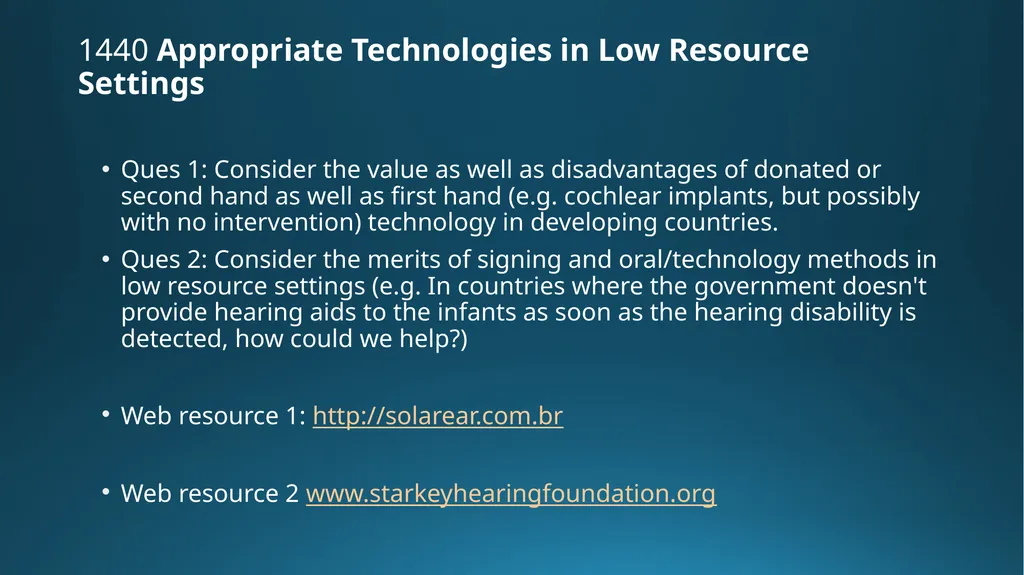
1440 Appropriate Technologies in Low Resource Settings Ques 1: Consider the value as well as disadvantages of donated or second hand as well as first hand (e.g. cochlear implants, but possibly with no intervention) technology in developing countries.
Ques 2: Consider the merits of signing and oral/technology methods in low resource settings (e.g. In countries where the government doesn't provide hearing aids to the infants as soon as the hearing disability is detected, how could we help?)
Web resource 1: http://solarear.com.br
Web resource 2 www.starkeyhearingfoundation.org<br>
Ques 2: Consider the merits of signing and oral/technology methods in low resource settings (e.g. In countries where the government doesn't provide hearing aids to the infants as soon as the hearing disability is detected, how could we help?)
Web resource 1: http://solarear.com.br
Web resource 2 www.starkeyhearingfoundation.org<br>
42
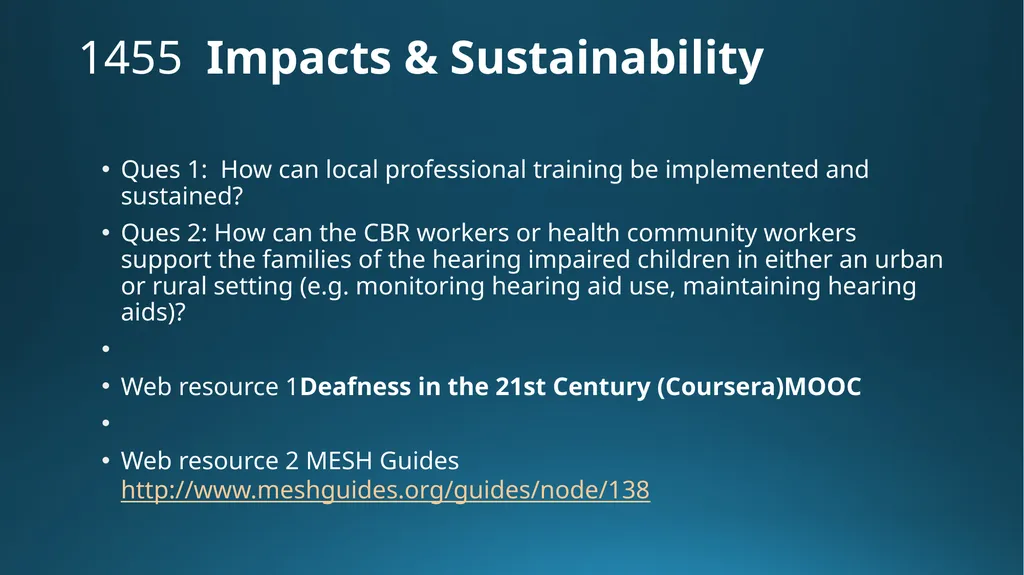
1455 Impacts & Sustainability Ques 1: How can local professional training be implemented and sustained?
Ques 2: How can the CBR workers or health community workers support the families of the hearing impaired children in either an urban or rural setting (e.g. monitoring hearing aid use, maintaining hearing aids)?
Web resource 1Deafness in the 21st Century (Coursera)MOOC
Web resource 2 MESH Guides http://www.meshguides.org/guides/node/138<br>
Ques 2: How can the CBR workers or health community workers support the families of the hearing impaired children in either an urban or rural setting (e.g. monitoring hearing aid use, maintaining hearing aids)?
Web resource 1Deafness in the 21st Century (Coursera)MOOC
Web resource 2 MESH Guides http://www.meshguides.org/guides/node/138<br>
43
Workshop Wrap Up Share key points with larger workshop group
Will be passed on to conference-wide group<br>
Will be passed on to conference-wide group<br>
44
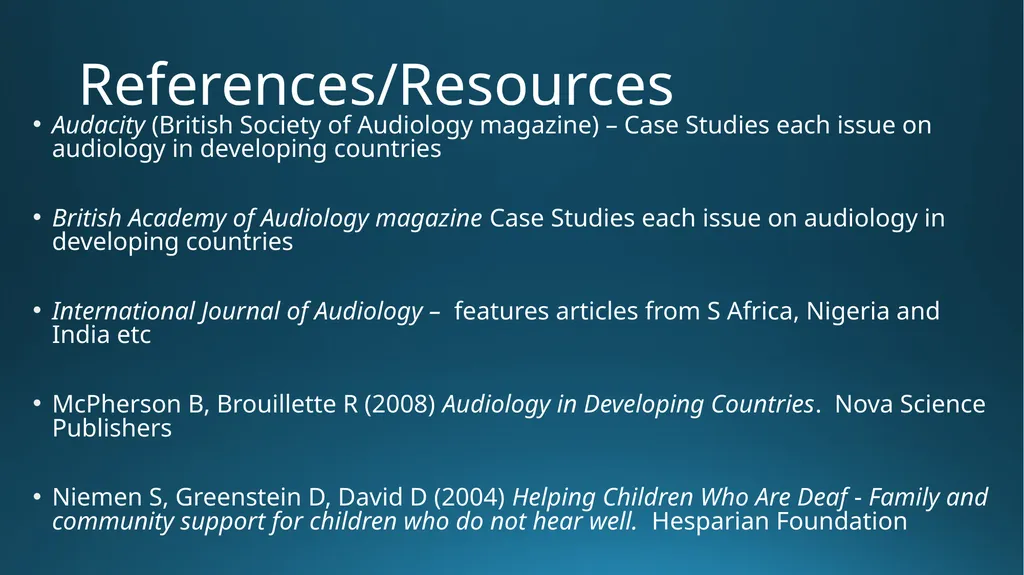
References/Resources Audacity (British Society of Audiology magazine) – Case Studies each issue on audiology in developing countries
British Academy of Audiology magazine Case Studies each issue on audiology in developing countries
International Journal of Audiology – features articles from S Africa, Nigeria and India etc
McPherson B, Brouillette R (2008) Audiology in Developing Countries. Nova Science Publishers
Niemen S, Greenstein D, David D (2004) Helping Children Who Are Deaf - Family and community support for children who do not hear well. Hesparian Foundation<br>
British Academy of Audiology magazine Case Studies each issue on audiology in developing countries
International Journal of Audiology – features articles from S Africa, Nigeria and India etc
McPherson B, Brouillette R (2008) Audiology in Developing Countries. Nova Science Publishers
Niemen S, Greenstein D, David D (2004) Helping Children Who Are Deaf - Family and community support for children who do not hear well. Hesparian Foundation<br>
45
THANK YOU Our contacts:
Joy Rosenberg: Joy.Rosenberg@oxfordaud.co.uk
Suheir Albadarneh: tcc_admin@palestinercs.org
Kelvin Hawker: khawker@cochlear.com<br>
Joy Rosenberg: Joy.Rosenberg@oxfordaud.co.uk
Suheir Albadarneh: tcc_admin@palestinercs.org
Kelvin Hawker: khawker@cochlear.com<br>